
Introduction to Kufic Motifs in Rug Design
Explore our curated range of luxury Kufic Design Rugs and bring ancient elegance into your modern home.
Defining the Kufic Design in Carpet Weaving
The Kufic design in carpet weaving refers to a decorative motif derived from the earliest formal style of Arabic script. Known for its angular, block-like, and geometric qualities, Kufic writing originated as a legible script but quickly expanded into an ornamental device that transcended language.
In rugs, a Kufic rug border often appears as a repeating series of stylized characters arranged in continuous bands, creating a rhythmic architectural frame.
Importantly, these motifs are not always true words; in many carpets they are pseudo-Kufic, meaning the forms resemble script without conveying literal text. This distinction underscores their dual purpose: functional as a border design and symbolic as a cultural marker of Islamic artistic identity.
By the 9th century, weavers across the Middle East had incorporated Kufic calligraphy-inspired ornamentation into their designs. This practice allowed rugs to embody both practical textile craftsmanship and the prestige of written culture, reflecting the central place of calligraphy in Islamic aesthetics.
Etymology and Historical Naming Origins
The term Kufic takes its name from Kufa, a prominent garrison town and intellectual hub in present-day Iraq. Kufa emerged during the early Islamic centuries as a center of religious scholarship and artistic production, giving its name to this distinct script.
While the word “Kufic” became a convenient European and academic label for a wide family of angular Arabic letterforms, in the context of rug studies it points specifically to geometric borders modeled on this script tradition.
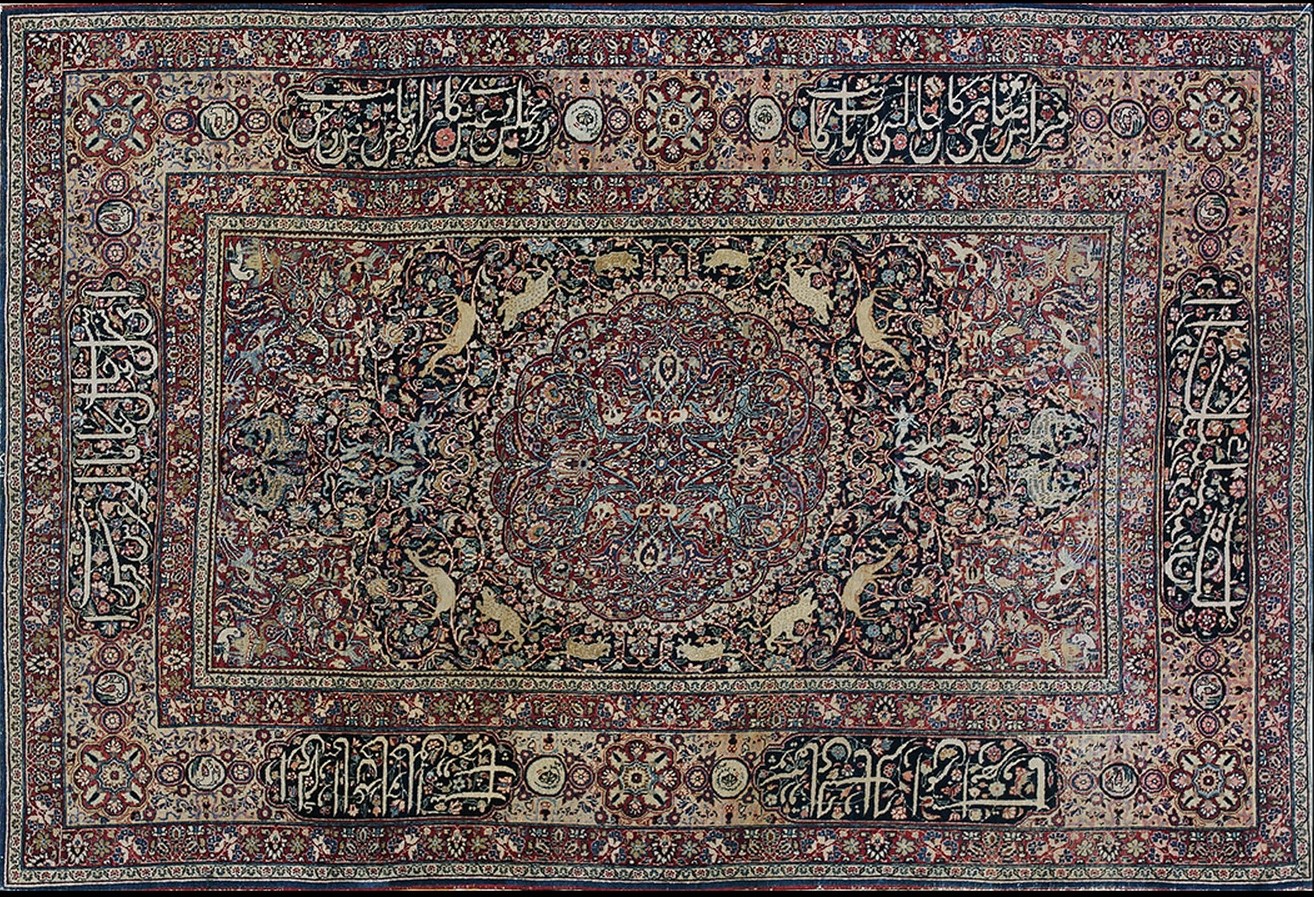
Antique Moud Small Scatter Size Wool Blue Rug – by Rugs On Net
Historical records show that Kufic design ornamentation migrated beyond manuscripts and architecture into decorative arts such as ceramics, metalwork, and textiles. Rug borders bearing this motif thus fit into a broader Islamic visual culture where the written word, or its stylized echo, was elevated as both sacred and ornamental.
The persistence of the term reflects how deeply tied the design is to its place of origin, even as its usage spread across regions.
Cultural Context: Roots in Early Islamic Calligraphy
The adoption of Kufic calligraphy into rug design reveals the cultural weight of writing in Islamic art. Early Islam placed special reverence on the written word, particularly the Qur’an, which was often transcribed in Kufic script during the Abbasid period.
By adapting these forms into textile patterns, rug weavers embedded spiritual resonance into everyday objects. Even when the script became abstracted or unreadable, its presence suggested a connection to divine revelation and Islamic identity. At the same time, Kufic design motifs in rugs also functioned as cross-cultural symbols of refinement.
They were exported to Byzantine, European, and Central Asian markets, where pseudo-Kufic ornamentation was appreciated for its exotic prestige rather than literal meaning. This dual life—as sacred emblem and international design language—demonstrates the flexibility of the motif.
The result is that a Kufic border in a carpet simultaneously evokes local piety, artistic sophistication, and global exchange. It bridges manuscript culture and weaving, sacred space and domestic use, making it one of the most enduring Islamic rug motifs in history.
Development and Historical Evolution
Early Islamic and Abbasid Textile Use
The earliest surviving evidence of Kufic design rug motifs comes from the Abbasid period. Archaeological finds at Samarra, Iraq, dating to the 9th century, reveal textile fragments decorated with Kufic borders. These pieces confirm that the motif was already integrated into woven design during the formative centuries of Islamic art.
Abbasid artisans valued the prestige of script as both sacred and ornamental, embedding pseudo-textual borders into carpets, hangings, and architectural ornament. These designs preserved the angular rhythm of the Kufa script, establishing a template that would migrate across the Islamic world.
Seljuk, Anatolian, and Timurid Adaptations
Under the Seljuks in the 13th century, the motif achieved monumental scale. Famous Konya carpets from Anatolia feature massive Kufic borders that dominate the composition, often dwarfing the central medallion.
These Seljuk Kufic rugs reflect both local taste for bold geometry and the importance of visual legibility in large mosque carpets. The Timurid period extended the practice, adapting Kufic borders into Persianate workshops where they mingled with arabesques and lattice structures, demonstrating the adaptability of the motif across dynasties.
Safavid and Ottoman Transitions
By the Safavid era (16th century Persia), artistic priorities shifted. Court carpets emphasized lush floral arabesques and complex medallion layouts, and Kufic design borders receded in favor of scrolling vine and palmette patterns. This marked a decline in Kufic’s prominence within the Persian artistic canon. In contrast, the Ottomans incorporated pseudo-Kufic into their globally exported carpets. The celebrated “Lotto” and “Holbein” carpets of the 15th and 16th centuries use Kufic-inspired bands as framing devices, though usually abstracted into rhythmic, unreadable forms. These designs, traded widely into Europe, carried Kufic’s prestige far beyond its original linguistic context.
Mamluk Egyptian Contributions
The Mamluks of Cairo (15th–16th centuries) also wove carpets with Kufic-style borders, though often reduced to subtle guard stripes framing their kaleidoscopic geometric fields.
Mamluk Kufic design elements tended to act as stabilizing frameworks rather than dominant statements, contrasting with the monumental Seljuk model. Their presence in Mamluk textiles demonstrates Kufic’s continued relevance as a unifying Islamic decorative language across regions.
19th-Century Caucasian Revival
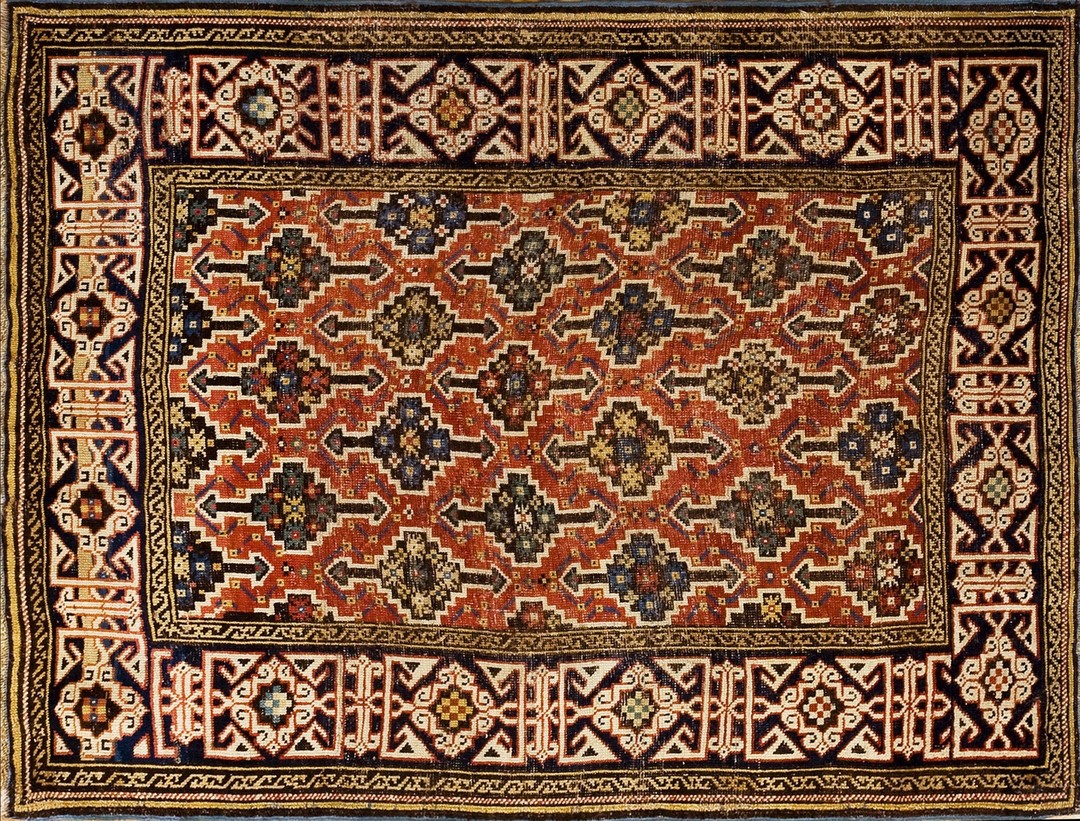
After centuries of relative decline, Kufic design returned in the Caucasus during the 19th century. Particularly in Shirvan and Kuba workshops, weavers revived the angular Kufic border as a bold framing element around geometric medallions.
This Caucasian Kufic design border revival (c. 1850–1900) was less tied to religious calligraphy and more to folk tradition, where the pattern conveyed a sense of heritage and regional identity. These rugs became widely collected, ensuring Kufic’s endurance into the modern marketplace.
Modern and Contemporary Uses
In the 20th and 21st centuries, rug designers have continued to draw on Kufic’s angular elegance. Workshops in Turkey, Iran, and the Caucasus produce modern Kufic designs, often combining the script-like borders with minimalist or abstract fields. Contemporary weavers reinterpret Kufic to appeal to global audiences—sometimes highlighting its Islamic identity, other times emphasizing its purely geometric beauty. This adaptability underscores Kufic’s lasting power as both historic Islamic rug motif and modern decorative language.
Design Characteristics and Recognition
Visual Markers of the Kufic Design Border
The most immediate feature in Kufic border recognition is its reliance on blocky, rectilinear geometry. Unlike fluid vine scrolls or curvilinear floral motifs, Kufic borders are built from bold angular bands that resemble letter-like units arranged in a continuous, almost architectural rhythm.
These forms often appear mirrored or repeated to create a meander-like structure, but instead of smooth spirals, the impression is of solid rectangular strokes. In antique rugs, the Kufic motif tends to frame the central field with thick, highly visible borders, giving the carpet a striking graphic presence.
How Kufic Differs from the Greek Key and Other Borders
A common comparison is between Kufic ornament and the Greek Key (meander) pattern. At a glance, both are continuous linear designs, but Kufic carries distinctive markers of script: thicker bars, abrupt right angles, and shapes that suggest vertical stems or horizontal baselines.
The Greek Key maintains narrower, labyrinthine turns, while Kufic designs appear heavier, broader, and more modular—closer to letters than pure geometry. Similarly, compared with other rug border types, such as floral arabesques or diamond chains, Kufic stands apart through its visual weight and calligraphic echo.
Beginner’s Guide to Recognizing Kufic on Antique Rugs
For those learning Kufic design motif identification, a simple set of cues helps:
- Look for thick, rectangular strokes arranged in alternating or mirrored bands.
- Notice the wide spacing between units, giving the design a weightier presence than most continuous borders.
- Expect repetition without meaning—the forms may look like letters, but they rarely spell words.
- Compare with floral borders: Kufic lacks vines, blossoms, or curves, instead presenting stiff, architectural balance.
Pseudo-Kufic vs. Authentic Kufic Script
A crucial distinction in rug border types is between authentic Kufic and pseudo-Kufic. Authentic Kufic reproduces actual Arabic words or Qur’anic verses, legible to those who can read the script. These appear mainly in textiles and art with overtly religious functions.
By contrast, pseudo-Kufic design is decorative: it mimics the shapes of letters without forming coherent words. In most rugs, especially those intended for wide markets, pseudo-Kufic dominates.
It offered the prestige and aura of calligraphy without requiring textual fidelity, allowing the motif to circulate freely in both Islamic and European decorative arts.
Materials, Weaving, and Technical Execution
Best Materials for Crisp Kufic Design Borders
The material foundation of a Kufic design rug plays a decisive role in how clearly the motif appears. Wool pile Kufic carpets dominate historical production, as wool provides both durability and the resilience needed for sharp, straight edges.
Wool fibers, when tightly packed, give Kufic borders their bold, architectural presence. In some luxury pieces, silk was introduced, offering a refined surface and finer detail, though wool remained the standard for clarity. The firmness of wool yarns allows the heavy verticals and horizontals of the Kufic design to stand out in contrast to softer motifs like floral scrolls.
Knot Density and Pattern Clarity
The knot density of a rug determines how faithfully the Kufic design motif can be expressed. A coarse weave with low knot count favors large-scale Kufic borders, where blocky letters dominate the design.
By contrast, a fine weave with high knot density allows weavers to articulate more intricate Kufic forms with tighter angles and subtle spacing.
Both approaches have historical precedents: Seljuk carpets emphasized monumental letters, while Persian workshops in the 16th century achieved delicate Kufic bands with refined detail.
Sixteenth-Century Persian Methods
During the Safavid Persian period, Kufic design borders were still woven, though increasingly rare as floral arabesques gained favor. Persian workshops typically employed the asymmetric (Persian) knot, which enabled more subtle shaping of letter-like strokes.
Sixteenth-century weavers combined fine knot density with color gradation to soften transitions, sometimes rendering Kufic design motifs in muted palettes rather than stark contrasts. This approach demonstrates how Persian artistry adapted Kufic’s rigidity to fit within the elegant, curvilinear aesthetics of Safavid carpets.
Dyeing: Impact of Vegetable Colors
Color plays a crucial role in Kufic design motif identification. The use of vegetable dyes—notably indigo for blues and madder for reds—created the high-contrast palettes essential for readability.
In traditional rugs, Kufic borders often alternated between strong dark outlines and lighter backgrounds, a scheme made possible by natural dyes’ richness. Vegetable colors also age gracefully, with slight fading enhancing the motif’s patina without erasing its legibility.
Machine-Made vs. Hand-Knotted Kufic Rugs
Modern production raises questions of authenticity. Hand-knotted Kufic design rugs maintain the tactile nuance, depth, and individuality valued by collectors.
In contrast, machine-made Kufic rugs can reproduce the geometry but lack the irregular charm and long-term cultural value of handcrafted work. For investment and heritage purposes, machine-made versions are generally not considered worth collecting long-term, though they serve decorative markets.
Custom Looms and Modern Replication
Today, workshops employ custom looms to reproduce Kufic borders, often using computer-aided design to plot out angular bands. While this ensures technical precision, it rarely replicates the organic irregularities of traditional handweaving, where slight variations gave Kufic design borders life and individuality.
Contemporary artisans who continue to use hand-knotting methods, paired with vegetable dyes, come closest to preserving the authentic feel of earlier Kufic borders.
Regional Styles and Variations
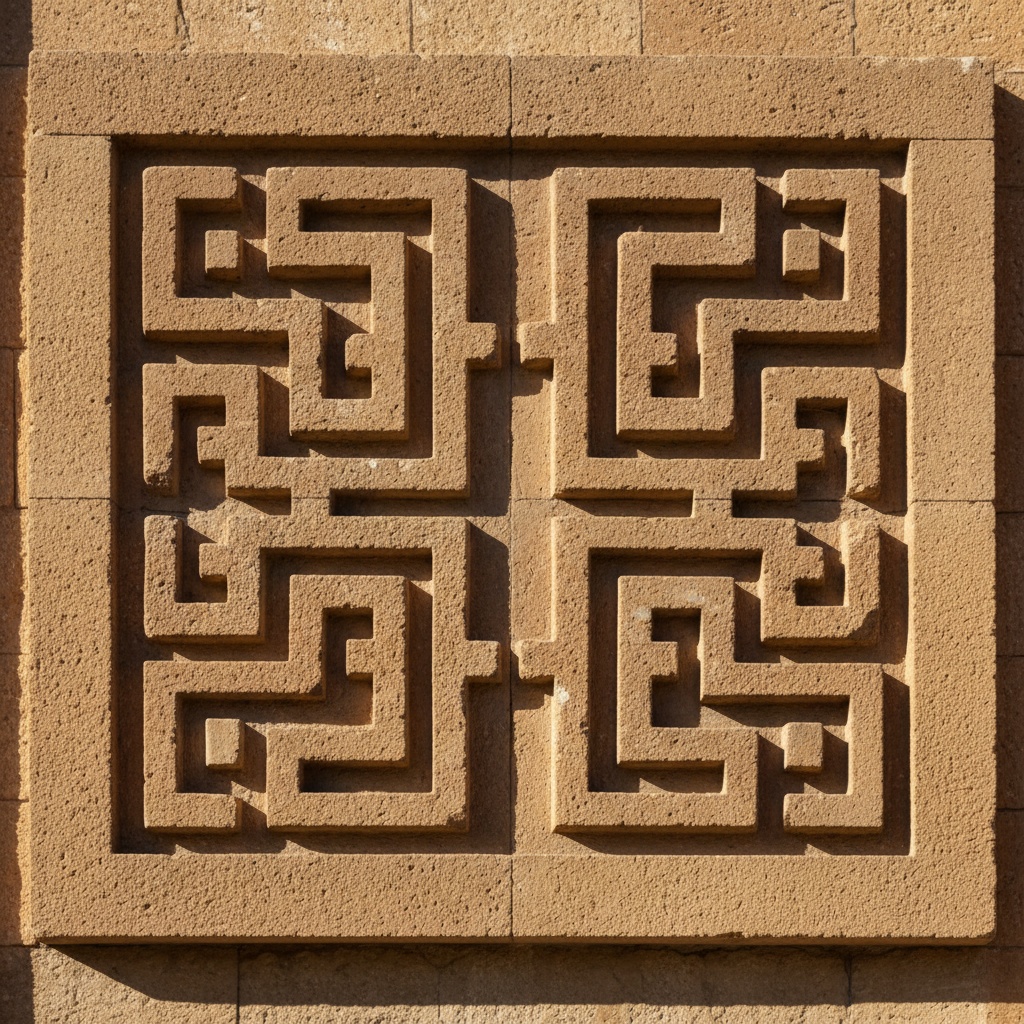
Stone carving showing geometric maze variations.
Anatolian and Turkish Kufic
In Anatolia, Kufic design rug motifs took on a monumental character. Anatolian Kufic borders, particularly in 13th-century Seljuk Konya carpets, were woven using the symmetrical Turkish knot, which naturally emphasized Kufic’s block-like geometry.
These borders often appear as heavy, oversized rectangular bands that dominate the overall composition, giving the carpets an unmistakably bold, architectural frame. The Turkish approach favored scale and visual impact, with Kufic acting as a powerful statement in mosque settings and large floor coverings.
Persian and Timurid Variants
In Persian and Timurid carpets, Kufic design borders assumed a more refined appearance. The finer weaving techniques of Timurid workshops, often employing the asymmetric knot, allowed greater detail and sometimes even true inscriptions rather than purely decorative pseudo-script.
These Persian variants frequently softened Kufic’s rigidity, blending script-like borders with curvilinear arabesques or lattice structures. This integration reflected the broader Persian artistic tendency toward elegance and complexity, positioning Kufic within a more literary and symbolic framework.
Caucasian (Shirvan) Adaptations
The Caucasus region, particularly Shirvan, developed its own distinctive Kufic design tradition during the 19th century. Shirvan Kufic borders are instantly recognizable by their continuous stepped “C” or “E” shapes, repeated rhythmically around the rug.
These angular forms, often woven in bold color contrasts, recall Kufic’s letter-like structure without direct reference to text. Instead, they functioned as strong folk motifs, anchoring the geometric fields of Caucasian carpets.
Mamluk Egyptian Examples
In Mamluk Egypt (15th–16th centuries), Kufic design motifs appeared less frequently but retained symbolic weight. Some Mamluk carpets feature Kufic inscriptions in cartouches or narrow bands, often surrounding intricate star-and-polygon fields.
These Mamluk Kufic designs were subtle compared to Anatolian boldness or Persian refinement, but their presence signaled continuity with Islamic script culture. They often served as framing devices, balancing the kaleidoscopic symmetry of Mamluk compositions.
Minor Regional and Cross-Cultural Instances
Beyond the major weaving centers, Kufic borders appeared sporadically in other traditions. Central Asian and North African textiles occasionally adapted Kufic bands, while a few rare Spanish carpets show pseudo-Kufic design ornament influenced by Islamic presence in Al-Andalus. These minor instances highlight Kufic’s wide cross-cultural reach, where the prestige of script-inspired motifs transcended language and geography.
Across Anatolia, Persia, the Caucasus, Egypt, and beyond, each region developed a unique graphic accent for Kufic borders, shaped by local weaving methods, aesthetic preferences, and cultural priorities. This adaptability ensured that Kufic remained one of the most recognizable and enduring Caucasian rug motifs and broader Islamic design elements in carpet history.
Symbolism, Status, and Cultural Meaning
Reasons for Using Kufic on Oriental Rugs
The presence of Kufic calligraphy on oriental rugs stems from its central role in Islamic culture, where the written word is revered as a vessel of divine revelation. Incorporating Kufic into carpets allowed weavers to connect their work to the sanctity of scripture, even when the motifs were pseudo-Kufic without literal meaning.
Beyond spirituality, Kufic’s strong visual rhythm gave carpets both cultural authority and aesthetic boldness, making them stand out as symbols of refinement in domestic, religious, and commercial settings.
Religious and Spiritual Symbolism
In Islamic rug symbolism, Kufic’s connection to Qur’anic transcription imbued carpets with sacred resonance. Even when unreadable, Kufic borders evoked divine words, suggesting a protective aura around the household or prayer space.
In mosques, Kufic design borders reinforced the sanctity of the textile by echoing the script of scripture. This association blurred the boundary between ornament and devotion, making Kufic one of the most spiritually charged rug motifs in Islamic art.
Protective and Talismanic Interpretations
Beyond religious resonance, Kufic borders often carried a talismanic function. Like other geometric and calligraphic motifs in Islamic art, they were thought to guard against misfortune or evil.
The act of surrounding a rug’s central field with Kufic design bands mirrored the concept of enclosing a sacred space, creating a talismanic rug that symbolically protected its users. This interpretation was especially strong in folk traditions, where pseudo-Kufic was employed as much for its protective connotations as for its visual impact.
Kufic as a Sign of Luxury and Export Prestige
In Europe, Kufic was interpreted differently: it became a marker of exoticism and high status. From the Renaissance onward, imported carpets with luxury carpet borders resembling Kufic script were prized for their foreign sophistication. Collectors and patrons did not necessarily read or recognize the script but appreciated its abstract geometry as an emblem of distant cultures.
This perception transformed Kufic into a cross-cultural symbol of refinement, bridging Islamic spirituality and European tastes for exotic luxury. Kufic’s enduring appeal lies in its ability to bridge spiritual, artistic, and commercial meanings.
Whether as a sacred script, a talismanic guard, or a prestigious export pattern, the Kufic design calligraphy meaning in rugs persists—even when the letters themselves are unreadable—because its presence conveys an aura of identity, protection, and sophistication.
The Modern Market for Kufic Design Rugs
Collector Appeal: Rarity and Heritage
Vintage Kufic design rugs command strong interest among collectors because they embody both artistic heritage and historical depth. The motif is tied to early Islamic design traditions, making these rugs rare survivals of a culturally significant form.
Kufic borders also stand out visually, giving collectors a distinct and recognizable motif that connects to centuries of Islamic art history.
Investment Potential and Resale Value
The Kufic rug value on the investment market depends on age, condition, and provenance. Antique hand-knotted examples with clear Kufic borders are considered strong long-term assets, as demand consistently outweighs supply.
Authentication and Provenance
Authentication relies on assessing materials, knotting techniques, regional origin, and comparison to museum-held examples. Genuine pieces use wool pile, vegetable dyes, and hand-knotting, whereas machine-made versions lack collector credibility.
Provenance—auction records, museum cataloguing, or previous ownership by known collectors—significantly increases resale value.
Museum-Quality Rugs: Pricing and Restoration
At the top tier, museum-quality carpets with Kufic borders can command high five-figure to six-figure prices at auction. Condition is critical, and while restoration may be necessary to stabilize a rug, excessive or insensitive repairs can diminish authenticity.
Collectors and museums alike favor pieces that retain their original weave, dyes, and proportions, even if some wear is visible.
Where and How to Buy Genuine Kufic Design Rugs
The best sources for genuine Kufic design rugs are specialist auctions, reputable dealers, and museum-recommended galleries. Organizations such as rug societies and Islamic art associations often connect buyers with vetted experts. Machine-made Kufic rugs, while visually similar, lack long-term collectible value and are better suited for decorative purposes rather than investment.
In today’s market, the value of a Kufic border carpet depends on its provenance, authenticity, and condition. Collectors continue to pursue these rugs not only for their financial potential but also for their layered meanings—spiritual, artistic, and cultural. For those investing in antique rugs, the iconic Kufic design remains one of the most rewarding motifs to acquire.
Explore Some of Our Favorite Kufic Design Rugs
FAQ
- How should I store a Kufic motif rug?
Roll pile-in, wrap in breathable fabric (no tight plastic), elevate off the floor, and check for pests every 6–12 months.
- What rug pad works best under a Kufic border rug?
Use a 1/4″ felt-rubber pad for plush pile or a thinner felt pad for low clearance. Pads protect edges and keep the Kufic border from rucking.
- How do I style colors around a Kufic border?
Let the Kufic band dictate accents—echo one border color in pillows or art. High-contrast borders (e.g., dark blue/white) visually frame seating areas.
- Any cultural cautions with Kufic inscription rugs?
Avoid placing legible sacred text where it will be stepped on; pseudo-Kufic is safer for floors. When in doubt, display legible pieces on a wall.
- Are Kufic motif rugs durable for family rooms?
Wool Kufic border rugs handle traffic well and hide soil with patterned borders. Use a felt-rubber pad and rotate every 6–12 months.
- Are kilims with Kufic motifs common?
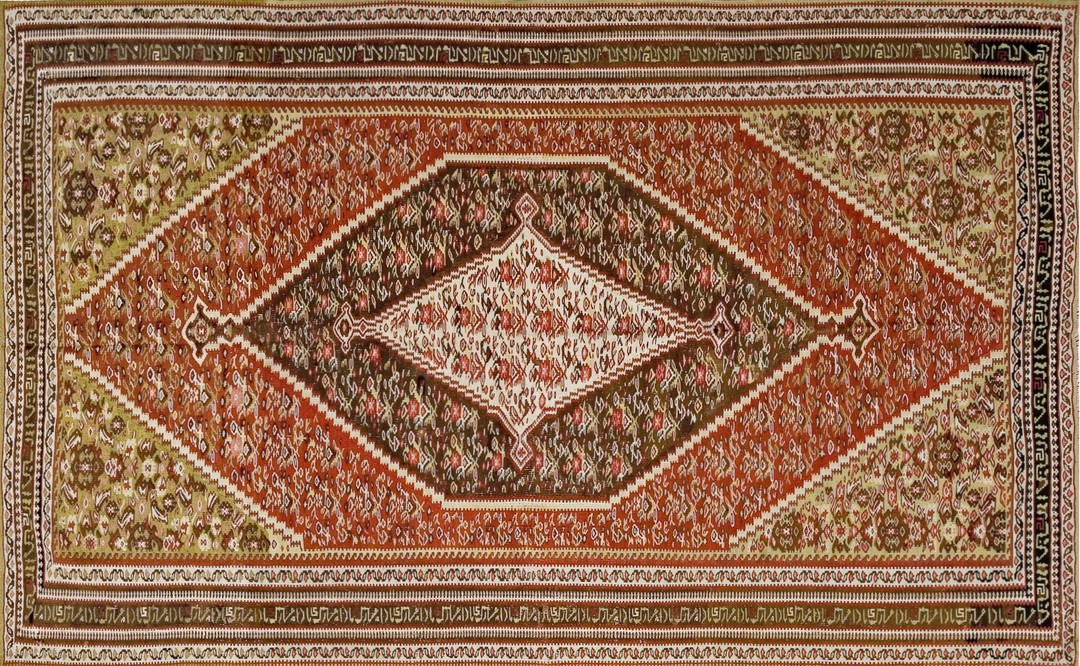
Less so—Kufic borders appear most often on pile rugs. Some flatweaves include kufesque bands, but they’re comparatively rare.
- How much do antique Kufic motif rugs cost?
Values vary widely by origin, age, and condition. Documented Uşak “Lotto” examples have sold in six figures, while later Caucasian pieces are often four- to five-figures.
- Which field patterns pair well with a Kufic border?
Arabesques, eight-pointed stars, and Harshang palmettes commonly accompany Kufic borders. These contrasts highlight the strong graphic frame.
- What’s the difference between “open-Kufic” and “closed-Kufic” borders?
Open-Kufic shows separated, letter-like strokes; closed-Kufic interlaces into a continuous, tighter band. Both are stylizations of the same script.
- Will a robot vacuum damage a Kufic motif rug?
It can catch fringe or loosen edges. Disable edge cleaning, avoid fringe, and test on low suction first.
- How do I clean a wool rug with a Kufic border?
Vacuum gently without a beater bar and blot spills with water and a white cloth. Schedule professional washing roughly every 12–18 months for traffic-exposed pieces.
- Are runners with Kufic borders available?
Yes, Kufic bands suit hall and stair runners well. Typical runner sizes range from about 2’–3′ wide and 6’–14′ long.
- How should furniture sit on a Kufic border rug?
Keep the Kufic border visible to preserve the design’s frame—aim for 2–4 inches of clear border around seating groups when possible.
- Do modern or contemporary rugs use Kufic motifs?
Yes—many new hand-knotted and machine-made designs borrow Kufic borders as graphic frames. Custom calligraphic commissions are also common.
- How do I authenticate an antique Kufic border rug?
Compare weave, dyes, and proportions to documented examples and obtain a written appraisal. Natural-dye abrash and correct border scaling are positive signs.
- Can I actually read the Kufic on a rug?
Often no—kufesque borders abstract letters into pattern. When readable, borders may carry short blessings or maker’s marks; a specialist can transcribe uncertain texts.
- What materials are typical in antique Kufic border rugs?
Mostly wool pile on wool foundation with natural dyes; some luxury pieces use silk. Many Turkish examples employ symmetrical knots on wool.
- What famous antique types use Kufic borders?
Seljuk carpets and Ottoman Uşak “Lotto”/“Holbein” rugs often display Kufic or kufesque borders. Many museum examples date to the 16th century.
- Are Kufic motif rugs appropriate for prayer spaces?
Yes—provided no sacred, readable text lies underfoot. Historically, prayer rugs sometimes used pseudo-Kufic at the foot to protect verses; ensure the rug faces the qibla.
- How should I orient a rug with a Kufic border?
If any words are legible, place them upright from the primary viewing side. Otherwise, treat the Kufic border as geometric and align it parallel to room edges.
- Is it disrespectful to step on a Kufic script rug?
If the text is legible Qur’anic verses or divine names, many consider floor use disrespectful—choose pseudo-Kufic or non-sacred text. When unsure, ask a knowledgeable religious authority.
- How do I tell a Kufic border from a Greek key on a rug?
A Kufic border looks like connected letter-shapes with vertical “teeth” and right-angle turns; a Greek key is a continuous meander or labyrinth. Kufic bands may segment into cartouches.
- Which regions are known for Kufic border rugs?
Anatolia (especially Uşak “Lotto”/“Holbein”), Seljuk-period Turkey, and the Caucasus (Shirvan/Kuba) frequently feature Kufic borders. Museum attributions often date them to the 1500s–1600s.
- What does “kufesque” or “pseudo-Kufic” mean on a rug?
It’s a decorative imitation of Kufic script, often intentionally unreadable so letters become pure pattern. Designers used it to keep sacred text from being stepped on.
- What is a Kufic motif rug?
A Kufic motif rug uses angular Kufic script as a decorative border or band, usually stylized into geometric repeats. Many classic examples come from Seljuk, Anatolian, and Caucasian weaving traditions (13th–17th centuries).