
Introduction to Foo Dog (Chinese Lion) Rugs
Infuse powerful symbolism into your space when you explore our curated selection of Foo Dogs Chinese Lions rugs now.
What Are Foo Dog Rugs?
- Foo dog rugs are woven textiles featuring the powerful image of the guardian lion, a sacred creature in Chinese and Buddhist art. — Why: These motifs are not decorative animals but spiritual protectors, traditionally placed at temple gates and palaces.
- Though often called “foo dogs,” they are never dogs; they are always stylized Chinese lions known for curly manes, wide paws, and commanding stances. — Why: The Western misnomer reflects early misunderstandings of the icon rather than the reality of Chinese symbolism.
- A guardian lion rug often presents pairs of lions, one male with a ball symbolizing worldly power and one female with a cub symbolizing nurture. — Why: This duality reinforces balance, strength, and prosperity, making the rug a talisman for protection and harmony in the home.
- In carpets, the shishi motif (stone lion) became a bridge between sacred sculpture and domestic art. — Why: This migration allowed sacred temple guardians to enter the intimate spaces of merchants, nobles, and spiritual practitioners.
Etymology & Name Origins
The term “foo dog” comes from Western attempts to transliterate Chinese sounds into English. Some scholars trace it to “Fo,” meaning Buddha, which linked the lions to Buddhist temples. Others suggest “Fu,” meaning prosperity or good fortune, as the source, reflecting the positive attributes they embodied. In Chinese, these figures are correctly called “shishi” (石狮, stone lion), a reference to the carved lions that guard temple entrances, palaces, and tombs.
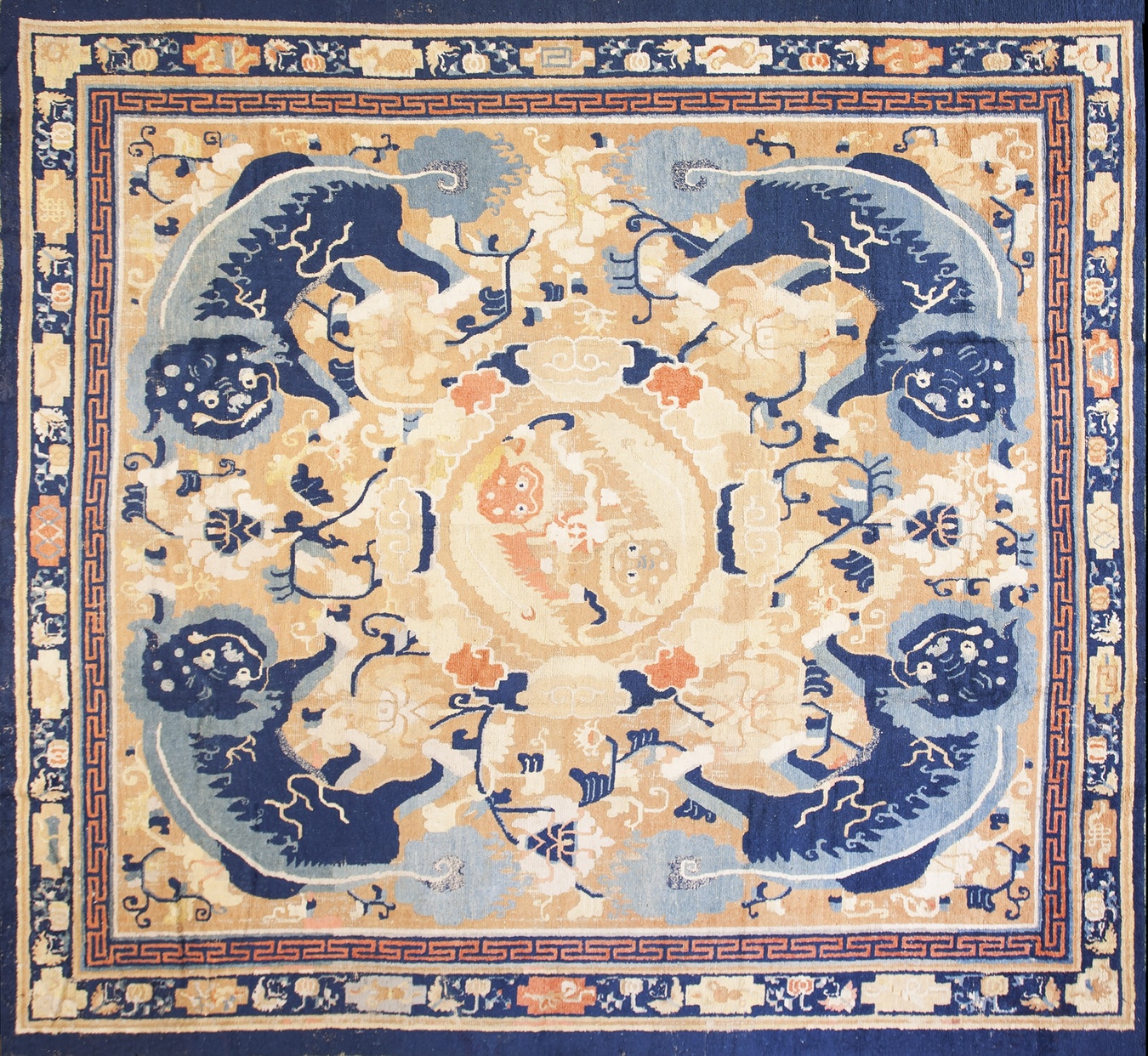
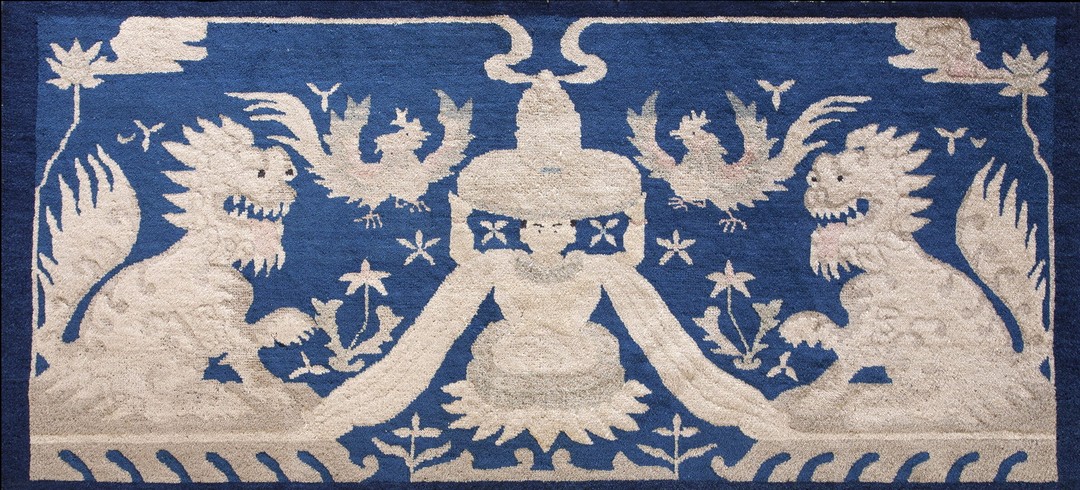
Antique Chinese – Ningxia Chinese Brown 1730s Rug – by Rugs On Net
Over centuries of trade and cultural exchange, the inaccurate “dog” label persisted, becoming a shorthand in Europe and America for rugs and artworks depicting these motifs. Yet, every genuine Chinese lion carpet represents lions, not canines—a critical distinction for understanding their cultural role.
Overview of Symbolism in Guardian Lion Motifs
- Protection: The Chinese temple lion is foremost a guardian, warding off evil spirits and misfortune when woven into a rug. — Why: In Buddhist and Daoist traditions, lions are divine protectors, ensuring safety for sacred and domestic spaces.
- Power: The lion’s muscular form, wide stance, and curled mane symbolize strength and authority. — Why: A Buddhist lion textile was a declaration of household power and alignment with celestial guardianship.
- Prosperity: Often paired with motifs of lotus flowers, pearls, or cubs, the lion embodies abundance and flourishing life. — Why: These associations made the foo dog rug not just protective but aspirational, linking domestic interiors to ideals of wealth and continuity.
- Balance: The consistent male–female pairings symbolize yin and yang, reinforcing harmony. — Why: Rugs with dual lions brought cosmic order into living spaces, a central principle in Chinese art.
The foo dog rug thus represents more than a decorative textile: it is a woven guardian, embedding ancient Chinese lion symbolism into carpets that protected households as much as they adorned them.
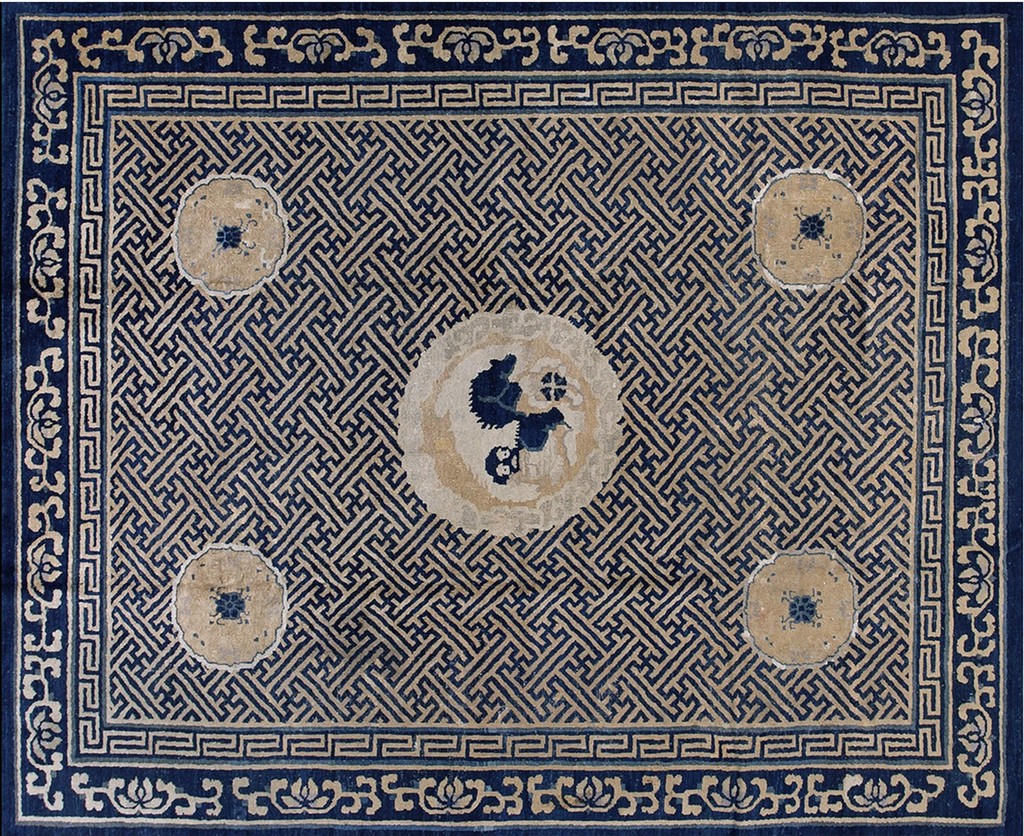
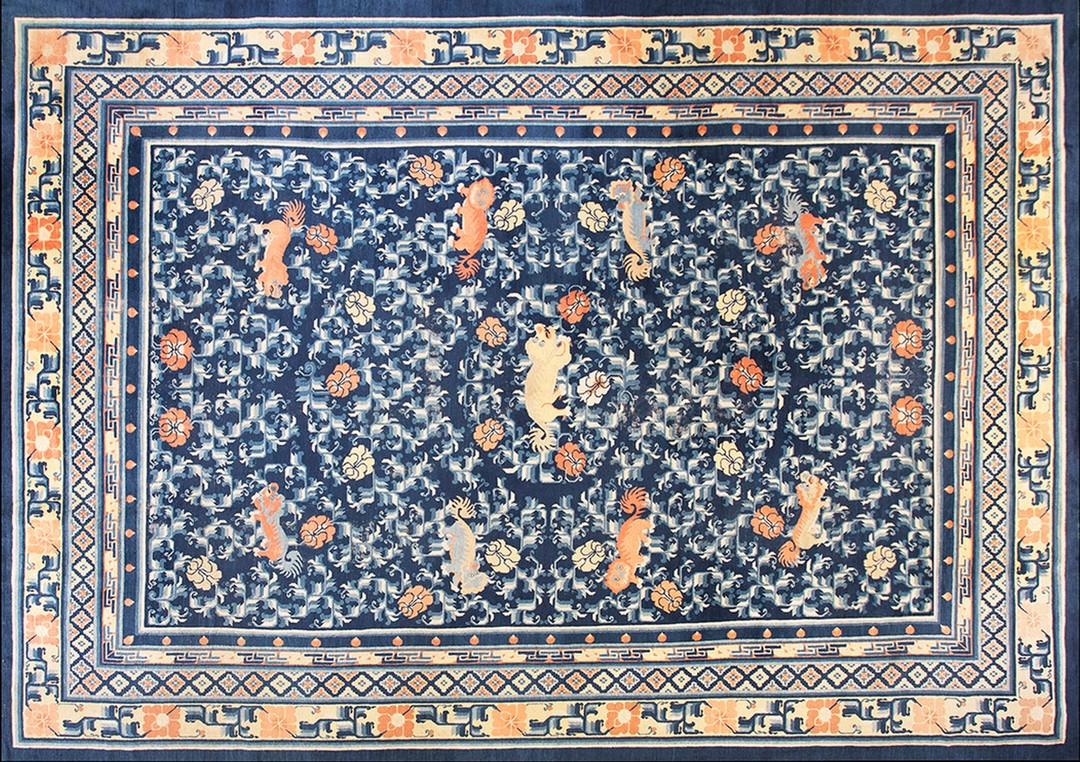
Wool Rectangle Geometric Medallion 1900s Antique Coral / Salmon Pink Hand Knotted Pile Rug by Rugs On Net
Its curly-maned lions, paired postures, and mythic strength make it one of the most iconic motifs to emerge in the transition from temple stone to woven fabric. In Chinese rugs, foo dogs symbolize protection, power, prosperity, and balance. They serve as woven guardians that carry forward the sacred role of lions from temples into domestic interiors.
Historical & Cultural Origins
Origins in Buddhist and Imperial China
The origin of the foo dog motif lies not in native Chinese fauna but in the cross-cultural exchange along the Silk Road. Lions, unknown in early China, were introduced symbolically through Indian and Central Asian Buddhist lore, where the lion was the sacred mount of the Buddha and a symbol of dharma’s power.
By the Tang Dynasty (618–907 CE), Chinese artisans had adopted the lion as a divine guardian, placing them as monumental stone lions (shishi) outside temples and palaces. Imperial patronage during the Tang and later dynasties cemented the lion as both a Buddhist protector and a marker of state authority.
Motif Migration: From Temple Sculpture to Textile
The guardian lion history reveals a natural migration of motifs from temple sculpture to textile art. Initially carved in stone at gateways, lions soon appeared in paintings, ritual banners, and embroidered cloths. By the Ming Dynasty (1368–1644 CE), these protective lions were woven into throne mats and altar covers, aligning imperial furniture with the same guardianship that protected temple thresholds.
Under the Qing Dynasty (1644–1911 CE), when rug weaving reached its artistic peak, the lion motif became a centerpiece of Buddhist lion rugs, adorning imperial halls, monasteries, and elite households. This adaptation reflects how sacred symbols were domesticated into ancient Chinese rugs, transforming monumental temple lions into portable woven guardians.
Timeline: Key Eras in Lion Motif Rugs
- Tang Dynasty (618–907 CE): Introduction of lion symbolism through Buddhism; guardian lions dominate temple architecture. — Why: Marks the earliest Chinese integration of the lion as a spiritual protector.
- Ming Dynasty (1368–1644 CE): Artistic revival of the lion motif, appearing in throne mats, tapestries, and ritual textiles. — Why: Demonstrates the shift of the lion from stone sculpture to woven and embroidered art.
- Qing Dynasty (1644–1911 CE): Peak of Chinese lion carpets, with lions woven into imperial and monastic rugs. — Why: Confirms the full integration of guardian lions into carpet weaving, solidifying their place in Chinese decorative arts.
Design Features & Visual Identification
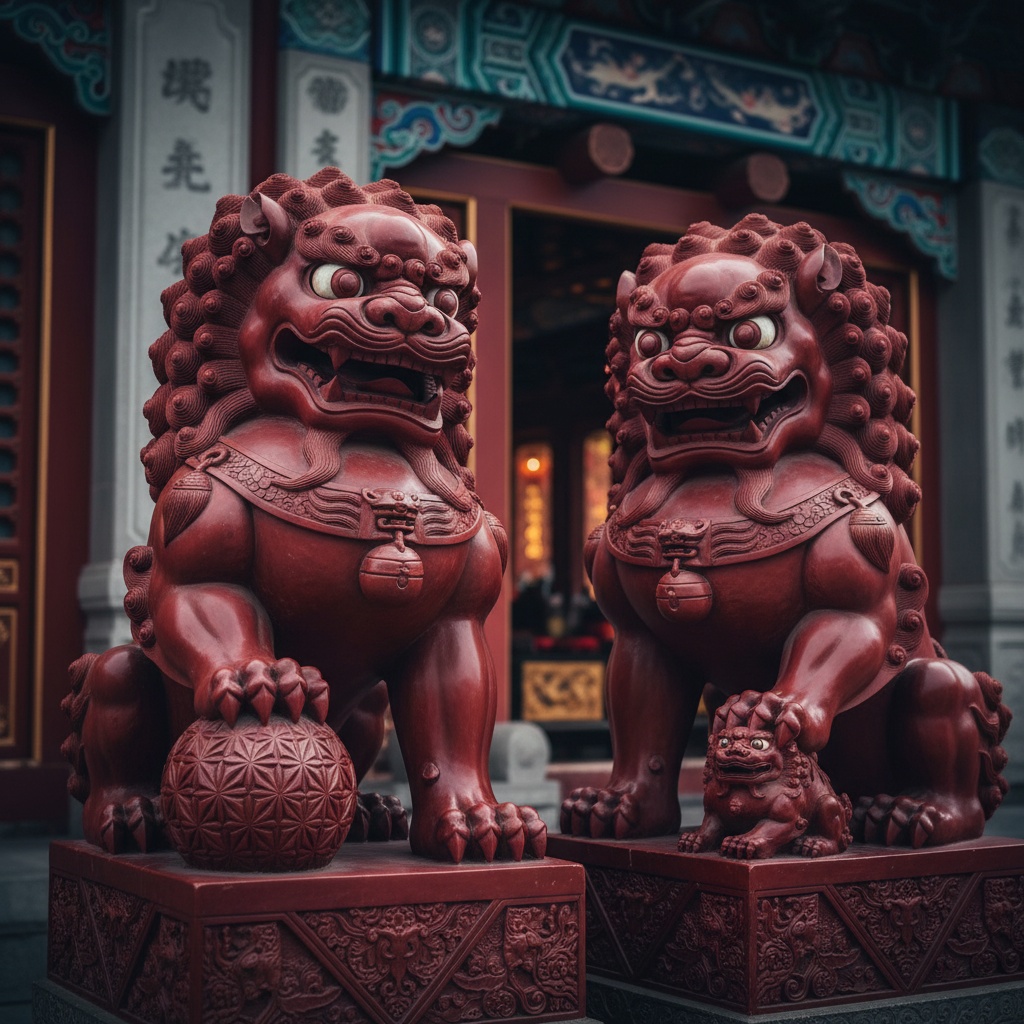
Red stone lions show traditional guardian poses
Main Visual Traits of Foo Dog Rugs
- Curly or flame-like manes: The most immediate clue to a foo dog rug pattern is the lion’s mane, often depicted as swirling curls or flame-shaped tufts. — Why: This stylized hair is a consistent artistic convention in Chinese lion depictions.
- Paired figures: Guardian lions almost always appear in pairs, the male with a paw on a ball and the female with a cub. — Why: These markers symbolize balance between protection (ball as unity and worldly power) and continuity (cub as nurturing future generations).
- Playful expressions: Foo dogs are not ferocious but animated, often with round eyes, open mouths, and exaggerated paws. — Why: These features distinguish them from tigers or dragons in Chinese rug iconography.
- Symmetrical layouts: Lions often face one another across a central axis, sometimes circling a pearl or lotus. — Why: This arrangement reflects harmony and protective balance in design.
You can identify a foo dog pattern on a rug by looking for paired lions with curly manes, a male with a ball, a female with a cub, and their distinctive round, animated faces set in symmetrical layouts.
Typical Color Palettes
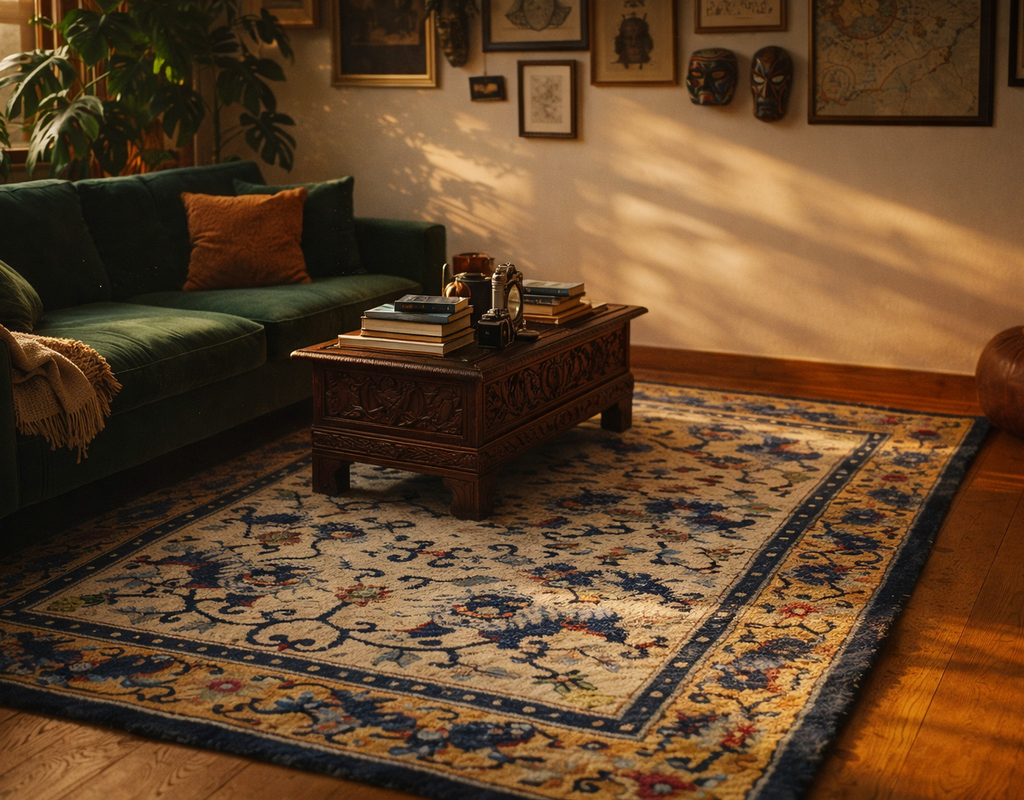
A traditional rug grounds this richly textured living room scene bathed in warm afternoon light.
- Golden yellows and ivory whites: These hues emphasize the lion’s sacred and imperial qualities. — Why: Gold and ivory signal auspiciousness and power in Chinese symbolism.
- Indigo blue and deep reds: Frequently used for backgrounds, these tones frame the lions in strong contrast. — Why: Blue represents heaven and eternity, while red conveys vitality and good fortune.
- Tibetan-influenced palettes: Crimson, green, and bright white appear in western Chinese and Tibetan Buddhist lion textiles. — Why: These regional palettes reflect monastic aesthetics and ritual use.
- Earth tones (browns, muted reds): Often used in borders or grounding elements. — Why: These stabilize the lively central motifs and connect them to natural symbolism.
The colors that typically surround Chinese lion designs include golden yellow, ivory, indigo blue, deep red, brown, and, in Tibetan contexts, vibrant crimson, green, and white. These combinations reinforce the lions’ protective and auspicious qualities. Companion Motifs: Clouds, Pearls, Lotus, etc. The lions rarely appear alone. Swirling clouds frame them with celestial energy, while flaming pearls symbolize wisdom and spiritual illumination.
The lotus flower connects the guardian lions to Buddhist purity, and Greek-key borders provide a structured architectural frame that echoes temple design. Each motif has symbolic meaning: the pearl as enlightenment, the cub as continuity, and the ball as unity and power. These surrounding images contextualize the lions, making a shishi symbolism rug more than decoration—it becomes a portable piece of sacred iconography.
What Foo Dogs Symbolize in Chinese Rugs
In the language of Chinese rug iconography, foo dogs symbolize protection, power, prosperity, and balance. They guard against evil spirits, assert authority, promise flourishing life, and embody yin–yang harmony.
A guardian lion motif woven into a rug thus continues the same spiritual guardianship that stone lions provide at temple gates, ensuring safety and auspiciousness for the space it adorns.
Materials, Weaving Techniques & Construction
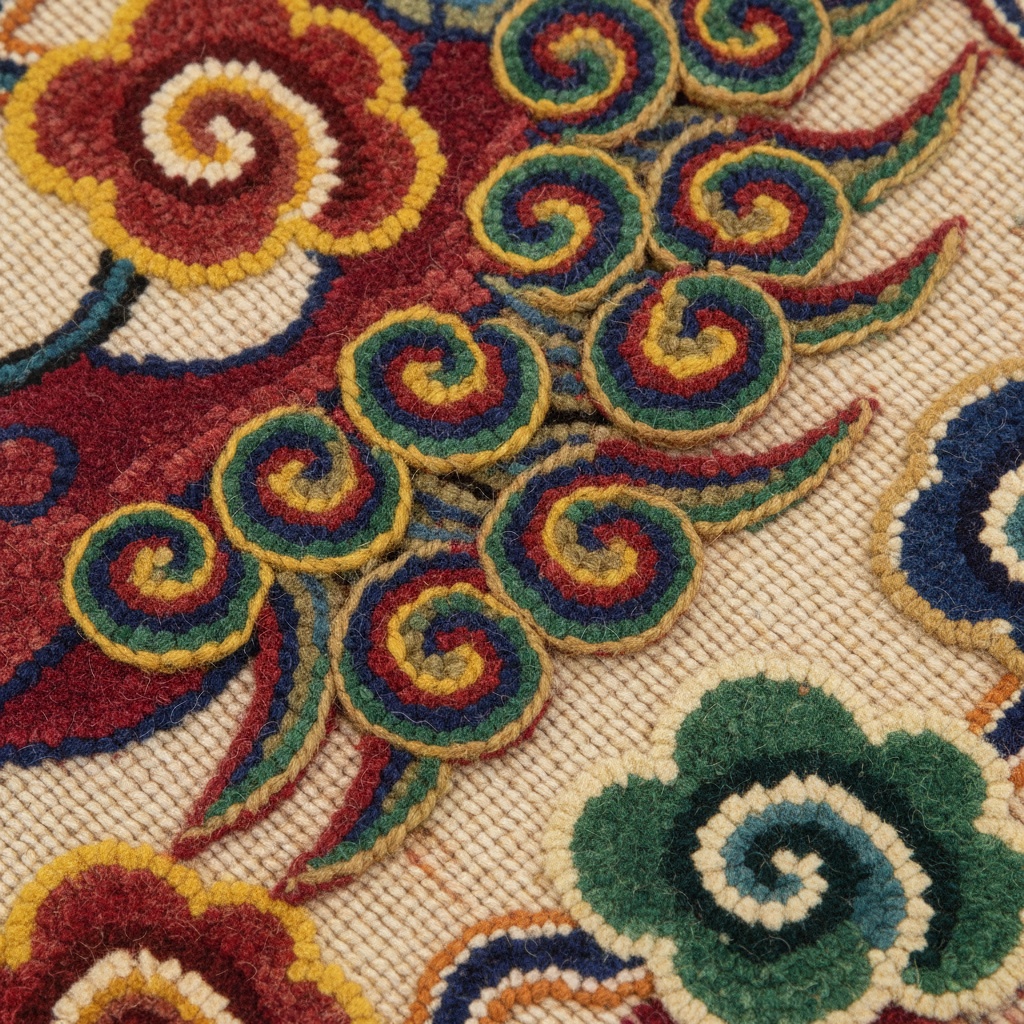
Detail of hooked wool pile construction and vibrant yarn colors.
Traditional Materials: Wool, Silk, Cotton
The majority of foo dog rug materials consist of wool pile on a cotton foundation, prized for both durability and warmth. Wool’s natural resilience and dye absorption make it the ideal medium for rendering the complex curls of lion manes and swirling cloud motifs.
Silk, by contrast, was reserved for exceptional imperial silk Chinese lion carpets, where sheen and delicacy conveyed luxury and exclusivity. Cotton understructures provided stability, keeping the rugs flat and long-lasting. Foo dog rugs are usually made of wool, with silk appearing only in rare imperial or high-status commissions.
Knots, Density & Technique Variations
The knot density of a hand-knotted guardian lion rug determines how finely details can be rendered. High knot counts allow crisp outlines of curly manes, pearl motifs, and cub details, while lower densities produce bolder, less intricate imagery.
Knot density also impacts durability: denser rugs resist wear and retain sharpness for generations. Yes, knot density directly affects the quality of Chinese lion rugs—higher densities result in superior clarity, detail, and long-term resilience.
Regional Weaving Differences: China vs. Tibet
Chinese workshops traditionally used the asymmetrical (Persian) knot, yielding flatter surfaces and refined detail. By contrast, Tibetan weavers employed the Tibetan knot, which creates a thicker pile with a subtly pebbled texture. The Tibetan version, often depicting the snow lion, emphasizes boldness and tactile depth, differing from the smoother Chinese guardian lions.
Tibetan snow lions are woven differently because the Tibetan knot structure produces thicker, more textured rugs, in contrast to the flatter, detail-oriented Chinese styles.
Synthetic vs. Natural Fibers
While modern manufacturing sometimes introduces synthetics, these fibers rarely replicate the richness of traditional wool. Synthetic foo dog rugs often lose the depth of shading and fine detailing that natural fibers achieve.
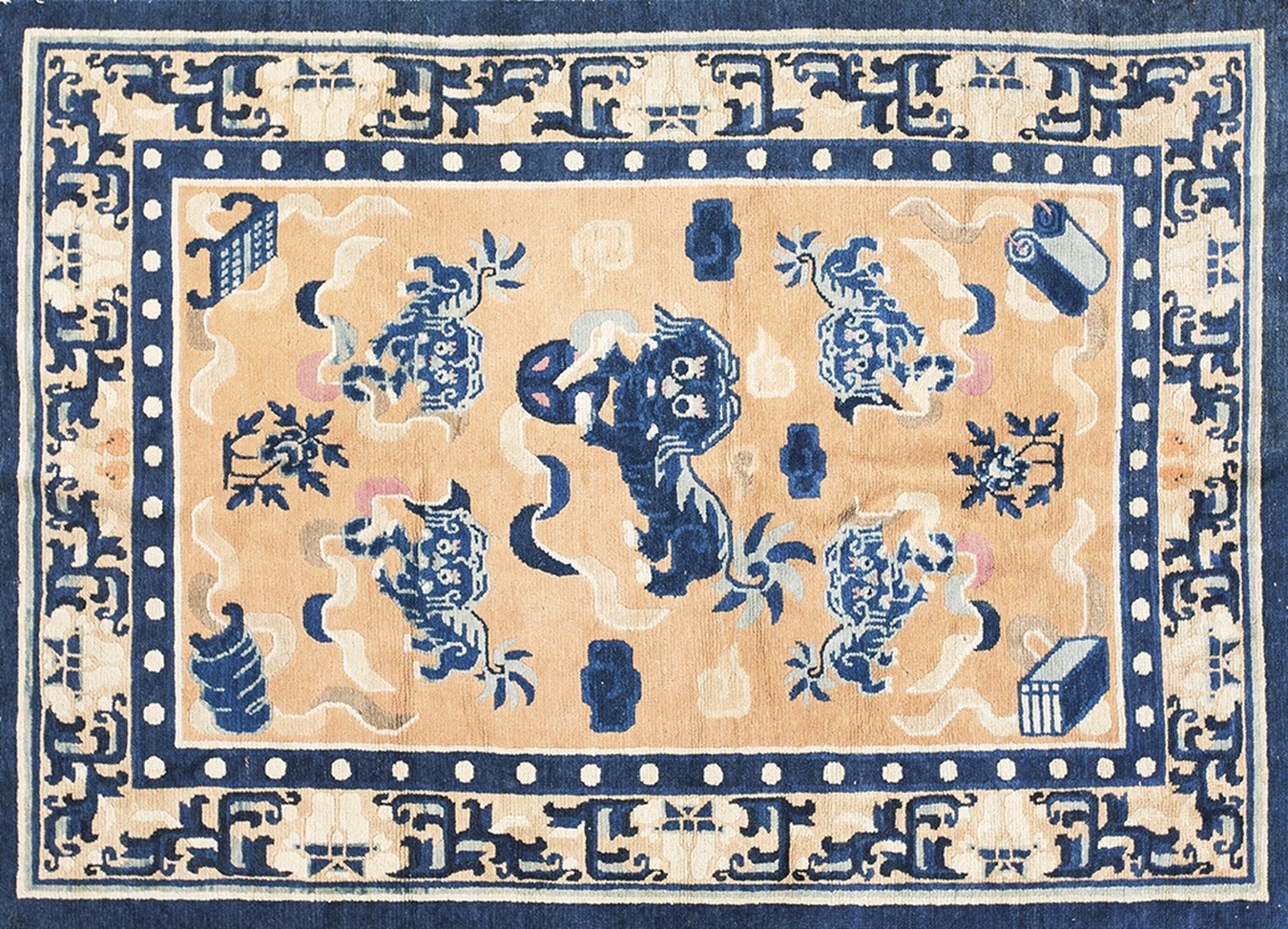
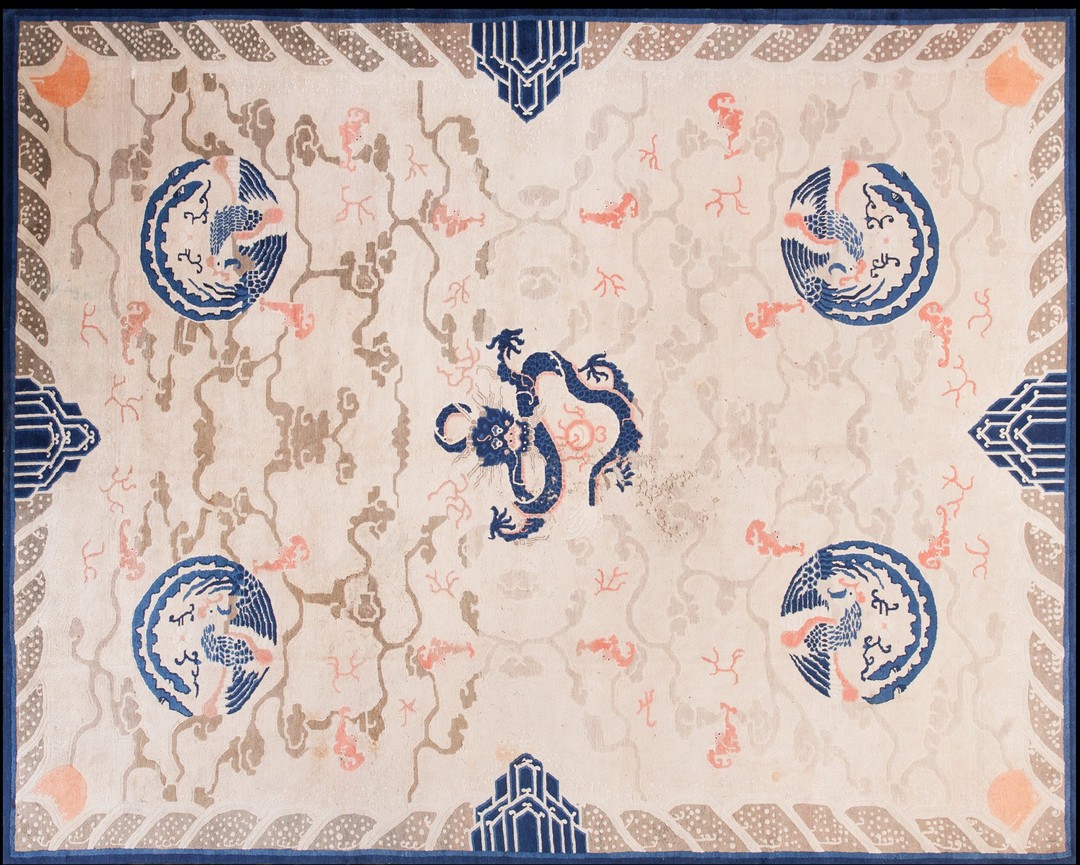
Antique Chinese – Ningxia Chinese Coral 1890s Rug – by Rugs On Net
The flame-like mane, pearl motifs, and subtle gradations of cloud patterns appear flatter and less dimensional. No, synthetic fibers cannot fully capture the traditional foo dog detailing—natural wool and silk remain essential for depth and authenticity.
Tufted vs. Hand-Knotted Snow Lion Rugs
In today’s market, construction method heavily influences value. Tufted lion rugs, made by punching yarn into a backing, are faster to produce but lack longevity. By contrast, a hand-knotted Tibetan snow lion rug can last generations, each knot tied with precision and carrying cultural continuity. Collectors and connoisseurs consistently favor the latter.
Yes, hand-knotted snow lion rugs are more valuable than tufted ones, both for their craftsmanship and their cultural integrity. In sum, the identity and value of a guardian lion rug rest on material authenticity, knotting technique, and regional weaving tradition—factors that distinguish a museum-worthy textile from a decorative reproduction.
Historical Evolution & Regional Styles
Major Periods: Tang, Ming, Qing, Export, Modern
The history of foo dog rugs begins with the Tang Dynasty (7th–10th century), when guardian lion motifs first appeared in Chinese silk textiles. These early examples were not carpets but ritual cloths and embroidered hangings influenced by Buddhist art arriving via the Silk Road. By the Ming Dynasty (1368–1644), guardian lions had become popular in decorative and religious contexts, though still relatively rare in carpets.
The true flourishing occurred in the Qing Dynasty (18th–19th century), when imperial patronage and monastic demand elevated lion designs into throne mats, altar carpets, and household rugs. During the export era (late 19th–early 20th century), foo dog motifs adapted to Western tastes, with simplified patterns and adjusted color palettes.
Today, in the modern era, both traditional workshops and commercial weaving centers continue producing rugs with guardian lion imagery, ranging from faithful reproductions to contemporary reinterpretations. The earliest foo dog carpets trace back to lion motifs in Tang Dynasty textiles, though true woven carpets with guardian lions became prominent only in the Qing Dynasty (18th–19th century).
Regional Styles: Beijing, Ningxia, Baotou, Tibet
- Beijing foo dog carpets: Known for formal compositions, open layouts, and restrained palettes of blue and beige. — Why: These rugs reflect the refined court aesthetic of the Qing capital.
- Ningxia lion rugs: Distinguished by golden yellow fields, soft fine wool, and Buddhist motifs integrated with lions. — Why: Ningxia became the spiritual weaving hub for monastic demand.
- Baotou blue rugs: Characterized by deep indigo grounds, bolder outlines, and a folk-art style that feels more rustic. — Why: These carpets served domestic and local markets rather than courtly ones.
- Tibetan snow lion carpets: Woven with thick pile and vivid colors, often rustic in execution but deeply symbolic. — Why: The snow lion is Tibet’s national emblem, and its presence in rugs asserts both religious devotion and cultural identity.
Today, the regions that still specialize in Chinese lion motifs include Beijing, Ningxia, Baotou, and Tibet, with Nepal also producing Tibetan-style snow lion rugs for the international market.
Vintage vs. Modern Replicas
Vintage foo dog rugs are hand-spun, naturally dyed, and tightly knotted, allowing fine detail in the lions’ curly manes and companion motifs such as pearls and clouds. Their wool has aged to a soft patina, and their symbolism feels integrated into both design and craftsmanship. By contrast, modern replicas often use machine-spun wool, chemical dyes, and simplified patterns.
While accessible and affordable, these newer rugs lack the depth, tactile richness, and cultural authenticity of antique examples. Vintage foo dog rugs differ from modern replicas in their natural materials, hand-knotted precision, and symbolic authenticity, whereas modern versions tend to sacrifice detail and depth for efficiency and mass production.
Together, this timeline and regional overview show that the earliest Chinese lion carpets emerged from Tang Buddhist art, blossomed in Qing workshops, and remain woven today across Beijing, Ningxia, Baotou, and Tibet—each center imparting its own stylistic fingerprint on the enduring guardian lion motif.
Symbolism, Ritual, and Cultural Significance
Protective Meaning: Power, Authority, Feng Shui, Buddhism
The symbolism of foo dog rugs derives from the guardian lion’s ancient role as a protector. In Chinese and Buddhist traditions, lions stand as cosmic defenders, warding off evil and securing auspicious energy. When woven into a feng shui lion rug, their placement in interiors reinforces the same authority once reserved for temple gates and palace entrances.
In Buddhism, the lion is the voice of the dharma—its roar spreading truth and order—making a protective Chinese lion rug more than decoration: it is a spiritual safeguard. In secular contexts, the lions also signal power and authority, echoing the prestige of the courts and monasteries that first embraced them. In Chinese rugs, foo dogs symbolize protection, power, prosperity, and continuity, carrying forward their sacred role as guardians into the domestic realm.
Usage in Palaces, Temples, Modern Homes
- Palaces: Guardian lion carpets served as throne mats, affirming imperial legitimacy and cosmic protection. — Why: The lion’s presence connected the emperor with divine authority.
- Temples: Lions appeared on altar carpets, reinforcing the sanctity of Buddhist ritual space. — Why: Their symbolism harmonized spiritual power with physical protection.
- Modern homes: Today, foo dog rugs are placed at entryways or in living rooms as focal points and feng shui enhancers. — Why: Their protective aura adapts seamlessly into household décor, blending tradition with design.
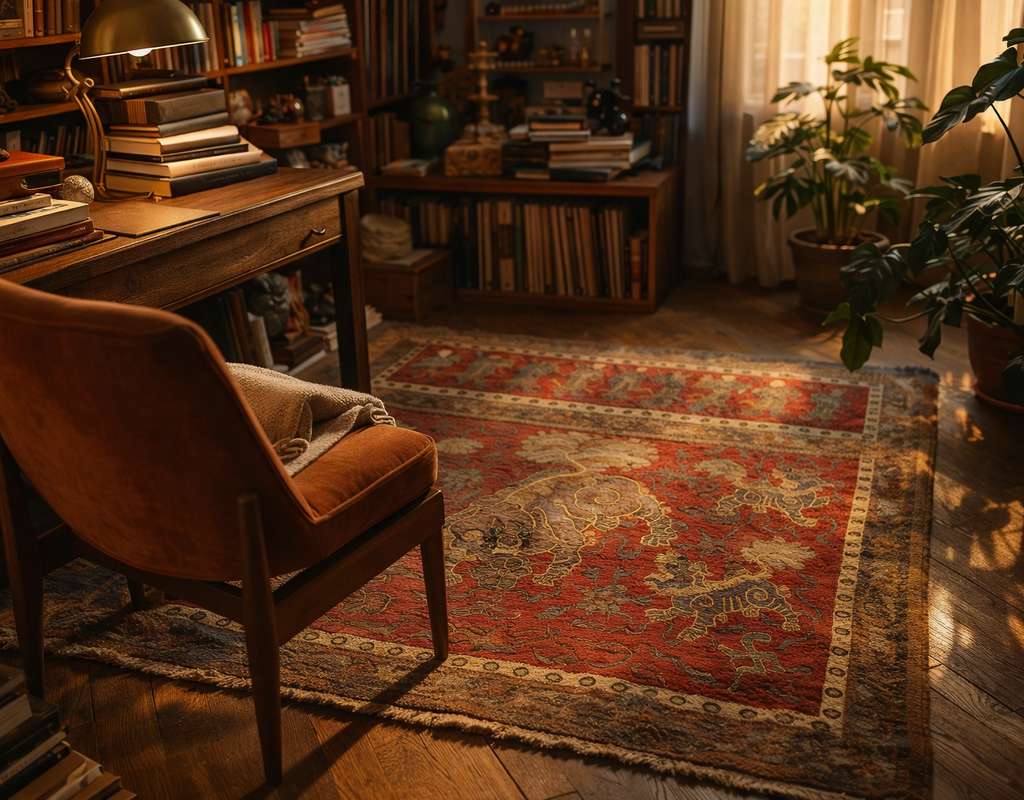
Warm afternoon light streams into a traditional library, highlighting the texture and deep color of the area rug.
Symbolic Nuances in Motif Details
Every detail in a guardian lion rug carries meaning. The male lion rests a paw on a ball, symbolizing unity, empire, and control over worldly matters. The female lion, with a cub beneath her paw, embodies nurture and continuity, ensuring the flow of prosperity across generations.
Flaming pearls represent wisdom and enlightenment, while swirling clouds and lotuses signify fortune and purity. These layers of iconography enrich the rug’s function, making it both art and amulet.
Influence on Value and Resale Prices
Symbolism strongly impacts the resale value of lion rugs. Collectors prize foo dog motifs not only for their rarity but also for their spiritual resonance. Carpets featuring crisp guardian lions, complete with symbolic pearls or cubs, command premiums at auction.
Their protective and auspicious associations enhance desirability, ensuring that rugs with intact and well-rendered lions often sell at higher values compared to non-figurative pieces of similar age. The foo dog motif often increases rug resale prices because buyers view them as culturally significant, auspicious, and rare examples of guardian lion meaning in textiles.
Foo Dogs in Minimalist Interiors
Despite their bold imagery, foo dog rugs can enhance even the most pared-down spaces. In minimalist rug décor, a guardian lion carpet becomes a deliberate statement piece, adding vibrancy and symbolic depth without overwhelming the room. Neutral surroundings allow the rug’s imagery—curly-maned lions, vivid motifs, and auspicious colors—to function as a cultural anchor and focal point.
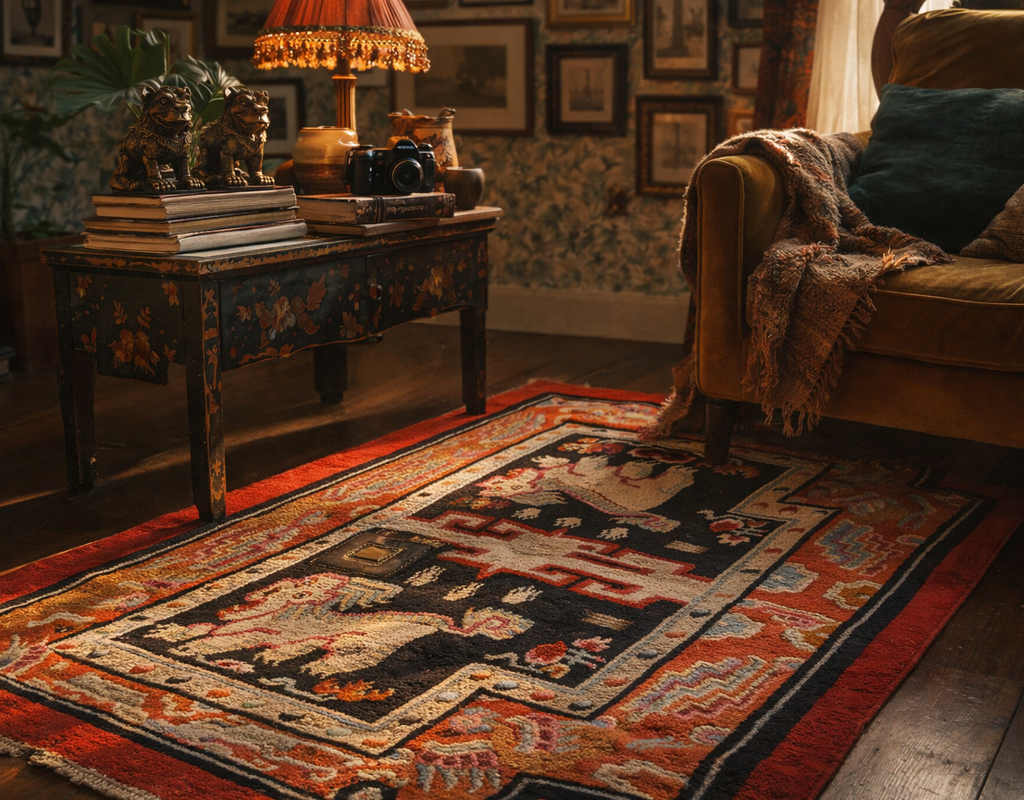
A vibrant, patterned area rug anchors this richly decorated, warmly lit corner of an eclectic living space.
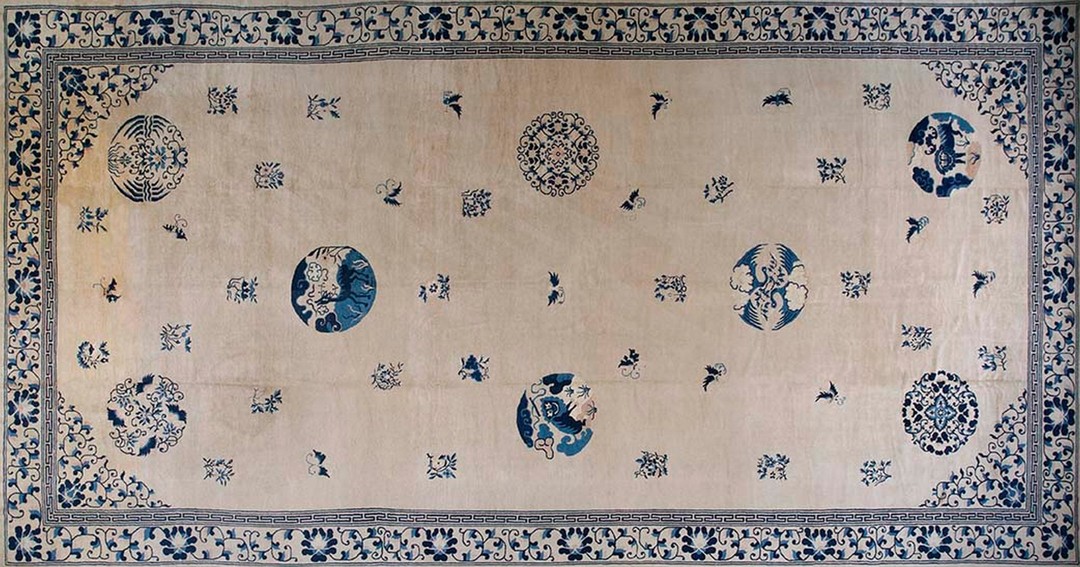
Antique Ningxia Chinese Allover Ivory 1850s Rug – by Rugs On Net
Yes, minimalist interiors can accommodate bold guardian lion rugs, where they act as intentional centerpieces that harmonize simplicity with symbolic richness. The enduring appeal of the guardian lion motif rests not only in its history but in its ability to protect, inspire, and elevate interiors—from imperial palaces to modern homes—while continuing to drive collector value.
Collectibility, Authentication & Market Value
Antique vs. Modern: Rarity, Authentication, Value Drivers
The value of an antique lion carpet lies in its rarity, authenticity, and condition. True Qing dynasty lion rugs and earlier examples from Ningxia or Beijing are exceptionally scarce, commanding high prices at auctions.
By contrast, modern reproductions, while decorative, lack the natural dyes, hand-spun wool, and patina of genuine antiques, making them less collectible. Collectors and connoisseurs prioritize provenance, knotting technique, and intact imagery when determining market value.
Authentication of Qing-Era and Antique Carpets
- Natural dye patina: Fading and oxidation patterns in natural dyes are hallmarks of age. — Why: Artificial chemical dyes age differently, helping experts distinguish genuine Qing-era pieces.
- Hand-knotted structure: An authentic foo dog rug should show hand-tied knots, not machine or tufted construction. — Why: Knot structure confirms both technique and region of origin.
- Region-specific motifs: Ningxia lions, Baotou blues, and Tibetan snow lions each carry stylistic fingerprints. — Why: Regional traits help authenticate origin and era.
- Construction details: Wool quality, cotton foundations, and pile height reflect period-specific weaving traditions. — Why: Technical traits allow scholars to differentiate antique works from later copies.
Collectors authenticate Qing-era guardian lion carpets by examining dye patina, hand-knotted structure, and regional weaving traits, often supported by provenance records and expert appraisal.
Impact of Motif, Age, and Condition on Prices
- Motif clarity: Crisp guardian lions with pearls, cubs, and symbolic details command premiums. — Why: Iconography drives cultural and collector interest.
- Age: Older rugs, especially 18th–19th century examples, carry higher prestige. — Why: Age reinforces historical authenticity and scarcity.
- Condition: Wear is tolerated, but intact motifs and borders dramatically increase value. — Why: Preserved imagery ensures symbolic and visual impact.
- Restoration: Skilled conservation can protect value, while poor repairs diminish it. — Why: Restoration quality directly influences resale price.
Yes, color fading is expected in antique lion carpets, and it does not necessarily reduce desirability—patina is often a marker of authenticity.
Insurance and Preservation
Given the high values and cultural importance, collectors are advised to treat antique foo dog rugs as fine art. Yes, you should insure your antique foo dog rug separately, as standard home policies rarely account for the full collectible value of a Qing dynasty lion rug or rare silk guardian lion carpet.
Market and Restoration Considerations
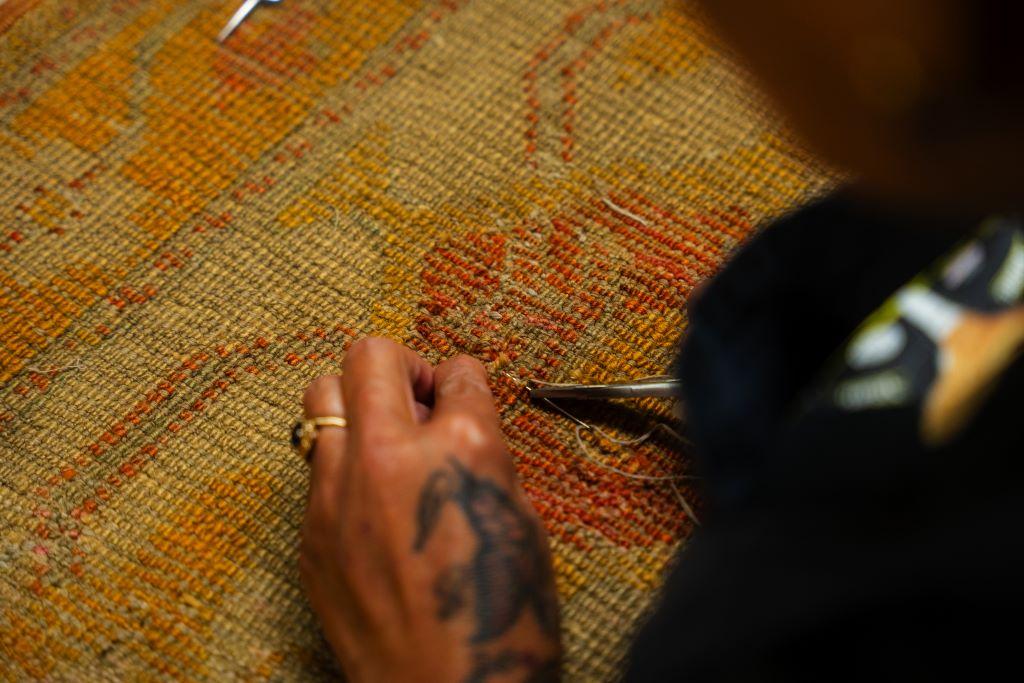
Detail of hands mending a rustic, richly colored woven rug.
Investment Outlook
The market for authenticating foo dog rugs remains strong, with prices driven by rarity, symbolism, and global appreciation of Buddhist and Chinese cultural motifs.
As fewer genuine antiques surface, demand for documented, well-preserved examples continues to grow, positioning antique guardian lion carpets as both cultural treasures and sound investments.
Modern Reproductions & Custom Foo Dog Rugs
Contemporary Designs: Faithful Replicas vs. Artistic Interpretations
- Faithful replicas: Some workshops produce modern foo dog rugs that closely mirror Qing-era or Ningxia examples, using hand-knotted wool and traditional color palettes. — Why: These pieces appeal to buyers who want historical fidelity without the high cost of antiques.
- Artistic interpretations: Other weavers reinterpret the guardian lion motif in abstract, minimalist, or pop-art styles, emphasizing bold graphics or simplified outlines. — Why: This approach integrates the contemporary lion rug into modern décor while retaining symbolic presence.
Vintage foo dog rugs differ from modern replicas in that antiques are hand-spun, naturally dyed, and carry historical patina, while modern pieces often use machine-spun wool, chemical dyes, or simplified designs. Collectors value the authenticity and aged beauty of vintage rugs over the efficiency of reproductions.
Materials, Dyes, and Quality in Modern Production
In today’s market, materials shape authenticity. Hand-knotted wool remains the gold standard, producing depth, resilience, and crisp detailing. Cotton foundations ensure structural integrity, while silk may be used for luxurious accents. Chemical dyes create brighter tones, but lack the mellow aging seen in natural dyes.
Machine-made and synthetic Chinese lion rugs offer affordability and durability, but they often flatten the intricate shading of curly manes and flaming pearls. Synthetic fibers cannot fully capture the traditional foo dog detailing, as they lack the richness, texture, and color depth of natural wool or silk.
Custom Commissions: Where & How
- Chinese workshops: Traditional centers in Beijing and Ningxia still accept commissions for custom guardian lion carpets, often blending classical motifs with client-directed details. — Why: These regions maintain historic expertise in lion iconography.
- Tibetan and Nepalese weavers: Workshops in Lhasa and Kathmandu specialize in the Tibetan snow lion rug, offering thicker textures and vivid palettes. — Why: Their knotting traditions give rugs bold, tactile qualities.
- High-end Western studios: Contemporary rug ateliers in Europe and the U.S. can translate the foo dog rug motif into bespoke designs tailored for modern interiors. — Why: These options cater to clients seeking unique, personalized reinterpretations.
You can commission a custom foo dog design rug through established weaving centers in China, Tibet, and Nepal, or through specialized Western studios that offer bespoke guardian lion motifs in luxury finishes.
Balancing Tradition and Innovation
The modern foo dog rug market stands at the crossroads of preservation and reinvention. While wool, silk, and hand-knotting preserve cultural authenticity, artistic reinterpretations open the motif to new audiences.
Collectors prize faithful reproductions for their symbolic accuracy, while designers value contemporary adaptations as statement pieces. At every level, the enduring guardian lion continues to evolve—woven not only as a protector of homes but as a bridge between ancient Chinese lion carpets and modern interior aesthetics.
Explore a Few of Our Foo Dog Rugs
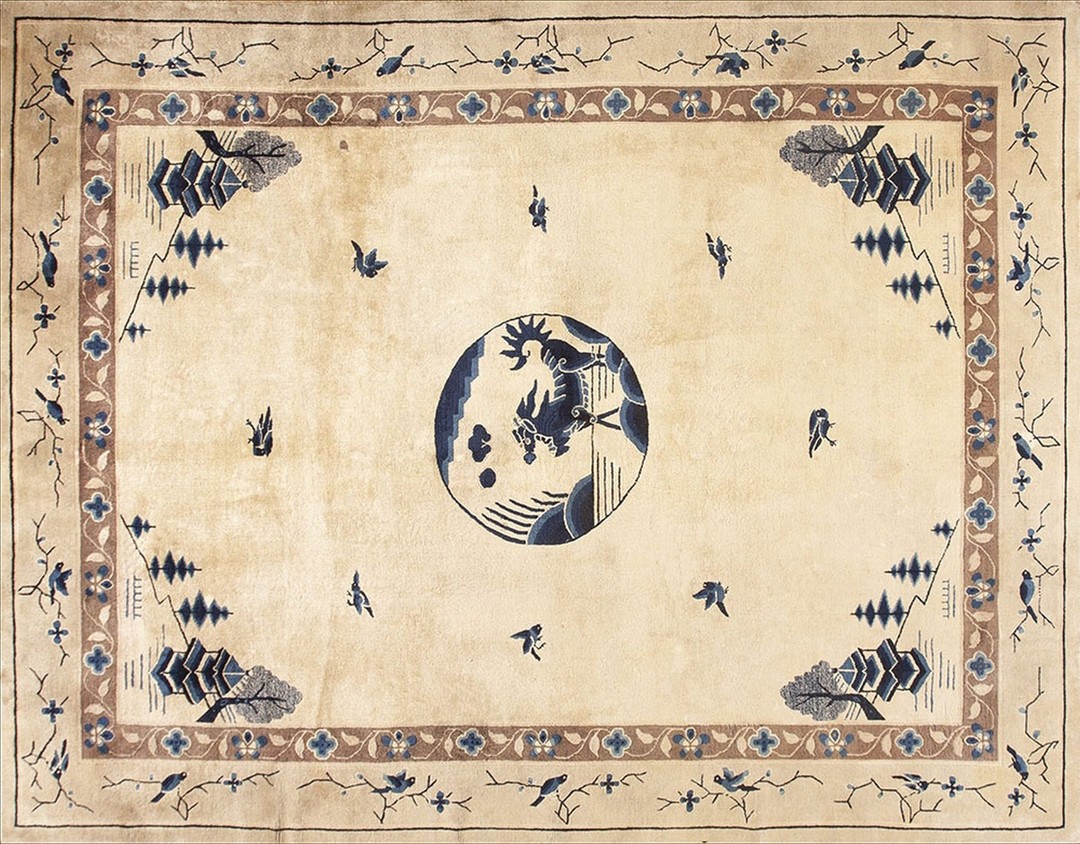
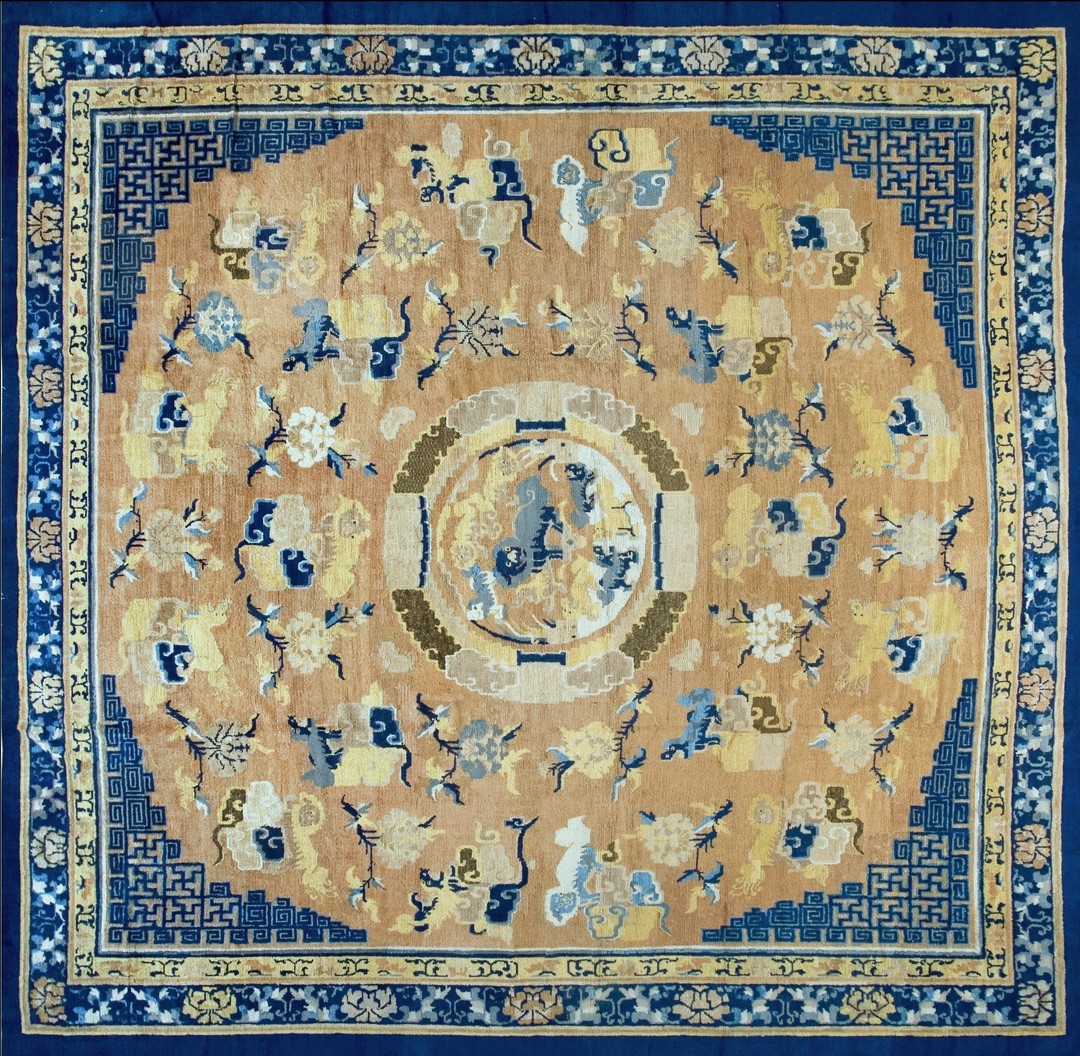
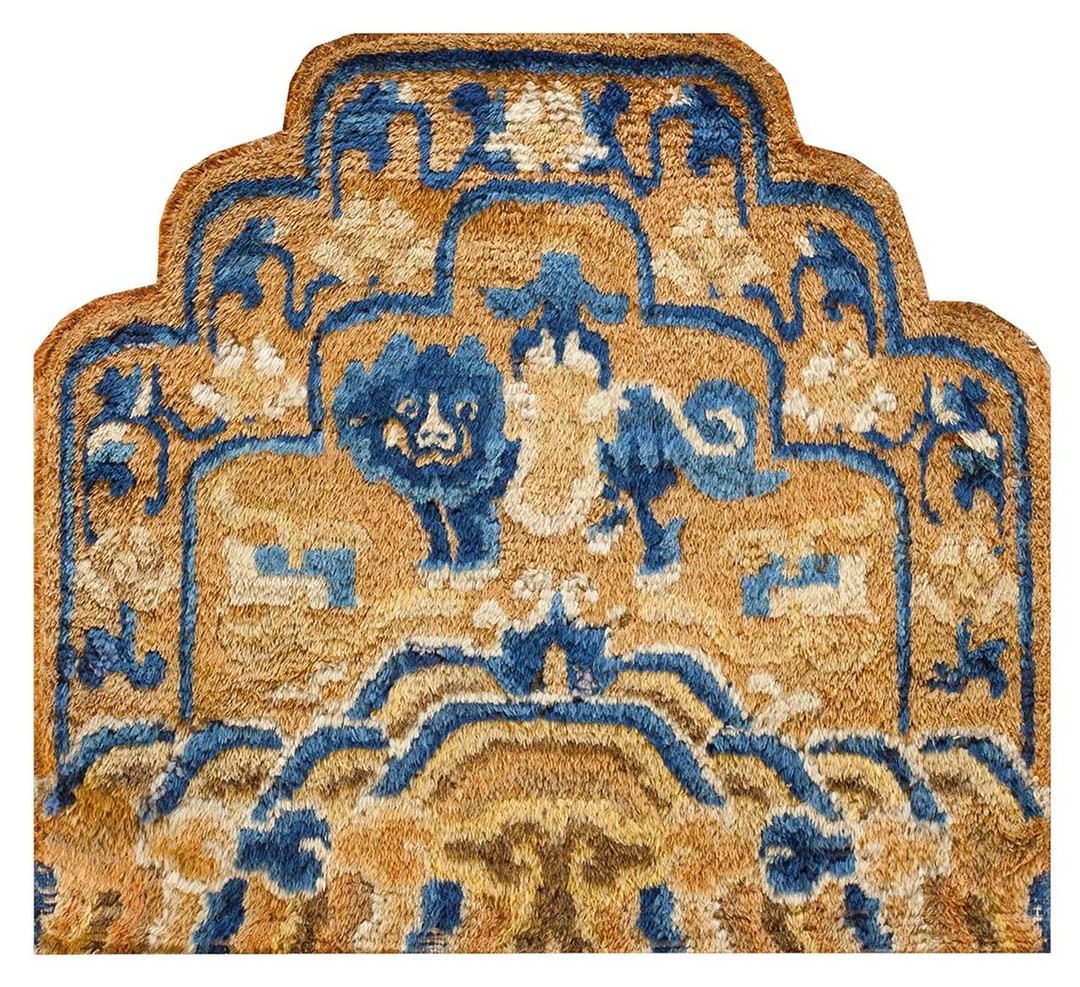
FAQ
- Where can I find authentic examples in the U.S.?
Reputable antique rug galleries and auction houses frequently offer Ningxia, Baotou, and Peking pieces. Ask for age, origin, and restoration notes in writing.
- Any cultural considerations?
Use respectful terms (“guardian lion,” “shishi,” “snow lion”) and avoid trivializing religious symbols. Display as art with context.
- Are there silk versions?
Yes—some early 20th-century Chinese pictorial rugs use silk (sometimes with metallic thread). These are decorative, not ideal for heavy traffic.
- How do I tell male vs. female on a rug?
The male typically presses a ball; the female restrains a cub. Check which paw holds the object to identify.
- What other motifs pair well with lions?
Dragons, bats, lotus, cloud bands, and fret borders are classic companions. A medallion plus corner lions is a common layout.
- Are these suitable for use above radiant floor heating?
Usually, yes at moderate settings. Avoid excessive heat with silk or very old pieces; use a breathable pad.
- Is the color likely to get lighter when exposed to sunlight?
Yes—natural dyes can fade under UV. Use window film or rotate 180° every 6–12 months.
- Are robot vacuums safe on these rugs?
Fringe can tangle; set no-go zones or flip/tuck fringes before runs. For antiques, manual vacuuming is safer.
- Should I use a rug pad?
Definitely. A felt or felt-rubber pad reduces slippage, adds cushioning, and prolongs the rug’s life.
- How should I clean one safely?
Vacuum with suction only (no beater bar). For washing, use cool water and wool-safe soap—or hire a specialist.
- Do guardian-lion rugs work in modern interiors?
Yes—open Peking layouts and bold blue-on-ivory palettes read clean and graphic. Pair with neutral sofas and black accents.
- Where does this motif sit best in a home?
Entryways, living rooms, and studies suit the protective theme. A 3’×5′ by the door or an 8’×10′ anchors a seating area.
- Are they durable for high-traffic areas?
Hand-knotted wool handles traffic well with a pad and rotation. Avoid placing rare antiques in heavy sun or wet zones.
- What do they cost?
Small early-20th-century Baotou pieces often list around \$1,500–\$3,000. Rare 18th-century Ningxia with lions can exceed \$20,000.
- How can I spot an antique versus a reproduction?
Look for hand-knot irregularities, age wear, natural-dye mellowing, and patina on fringes. Browns may show slight “corrosion” in old pieces.
- Are these rugs hand-knotted?
Antique examples are typically hand-knotted wool, sometimes silk with metallic thread. Chinese pieces often use an asymmetric knot on cotton or wool foundations.
- Are guardian-lion rugs considered auspicious?
Yes—lions signify protection and strength. Placing them near entries or living areas is a popular choice.
- What sizes did traditional pieces come in?
Tibetan khaden seat rugs are around 3’×5′ (≈91×152 cm). Chinese scatter rugs often run 2’×4′ to 3’×5′.
- How do Chinese guardian lions differ from Tibetan snow lions?
Guardian lions echo Chinese Buddhist temple guardians; snow lions symbolize Tibet’s fearless, joyful spirit. Snow lions are often white with turquoise/green manes on Tibetan pieces.
- What colors are typical for guardian-lion rugs?
Indigo blues, ivory, saffron/gold, and camel grounds are common. Early Ningxia often used soft yellows with rich blues.
- Which rug traditions feature this motif most?
Antique Chinese Ningxia, Baotou, and Peking rugs, plus Sino-Tibetan and Tibetan pieces. You’ll also see snow lions on Tibetan khaden and saddle rugs.
- Should guardian lions on a rug face a certain way?
For symbolism, many face them toward an entry, “guarding” the threshold. If a pair is depicted, male typically on the right, female on the left when viewed from outside.
- What do the male and female lions represent?
Traditionally the male rests on a ball (material world) and the female restrains a cub (nurture). Together they balance yang and yin.
- Is “Foo Dog” the right term?
It’s common but imprecise; “Chinese guardian lion” or “shishi” is preferred. In Tibetan contexts, the related motif is the “snow lion.”
- What are “Foo Dogs” on rugs?
They’re Chinese guardian lions (shishi), not dogs—protective symbols often shown as a pair. On rugs, they appear flanking medallions or “embroidered balls,” common in Ningxia, Peking, and Baotou pieces.