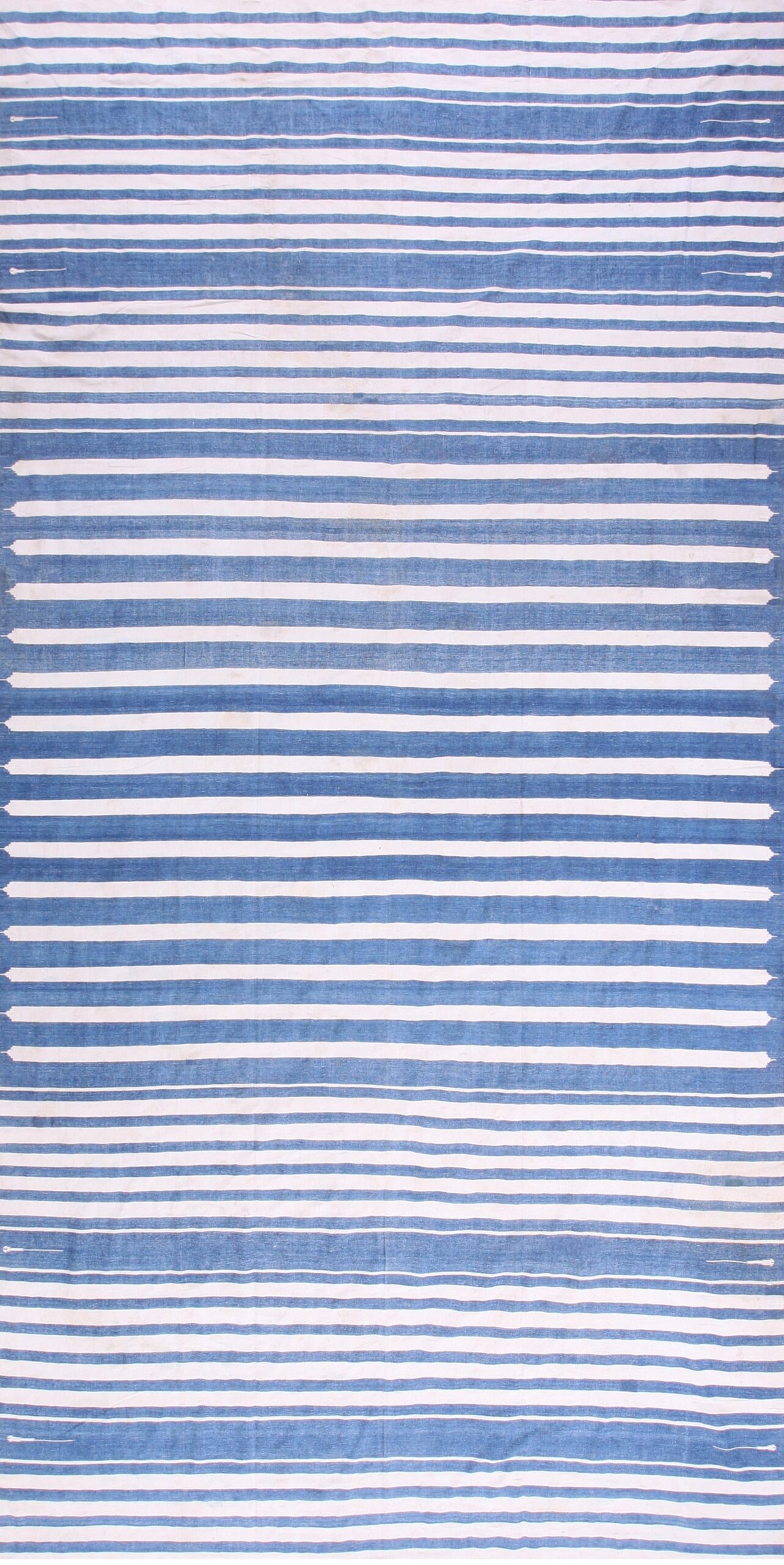
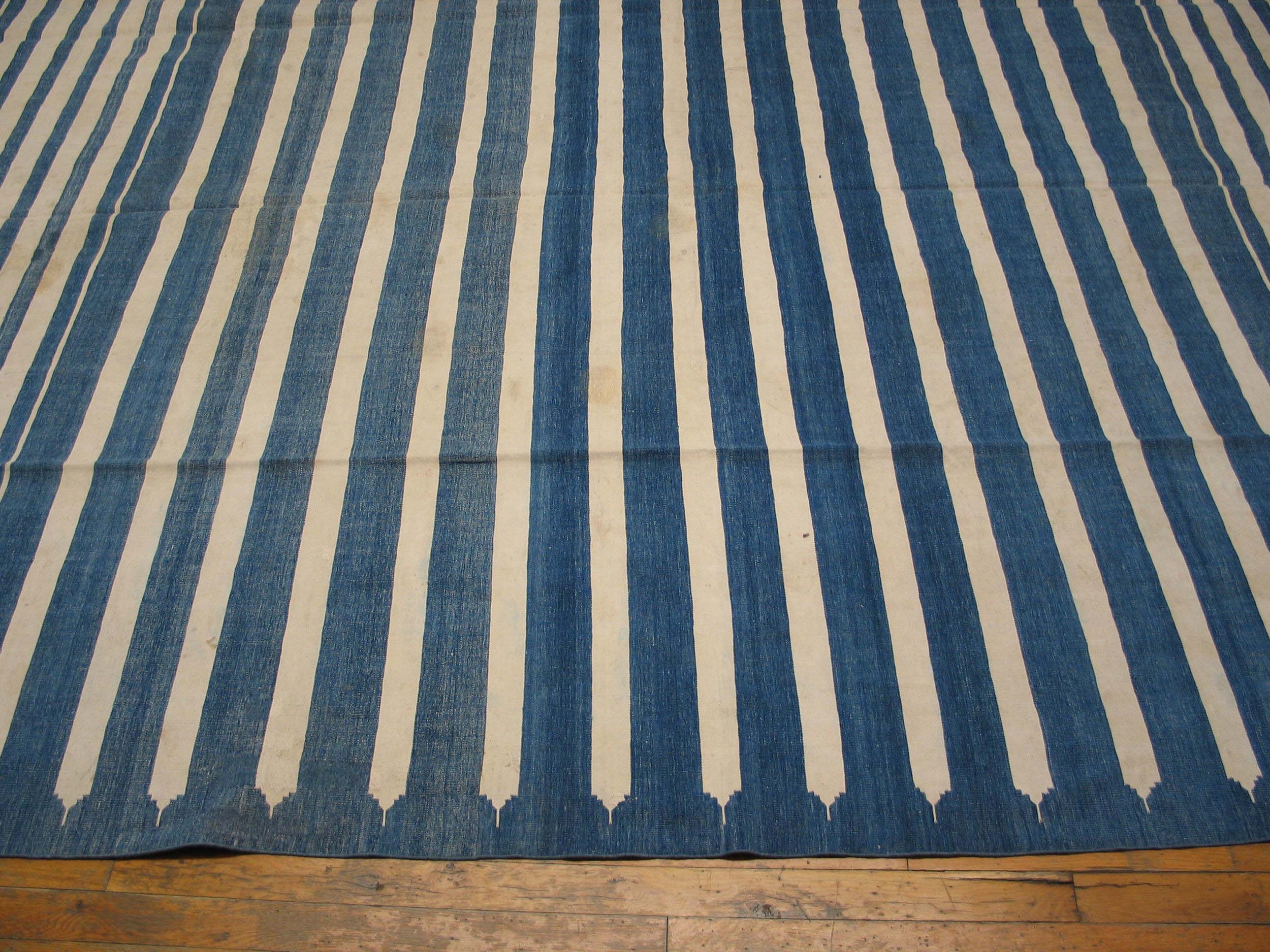
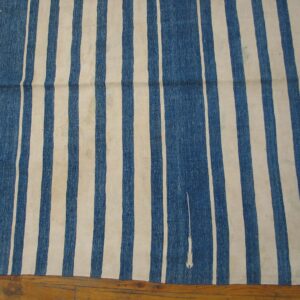
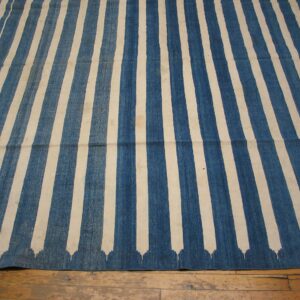
This early twentieth-century cotton Dhurrie carpet woven in India is a masterclass in “Architectural Minimalism,” representing the enduring appeal of the flat-weave tradition in South Asia. While many Indian textiles of this era were celebrated for their intricate floral or kaleidoscopic geometric patterns, this specimen leans into a crisp, rhythmic stripe design that feels remarkably modern, predating the mid-century Scandinavian and Bauhaus movements that would later embrace similar aesthetics.
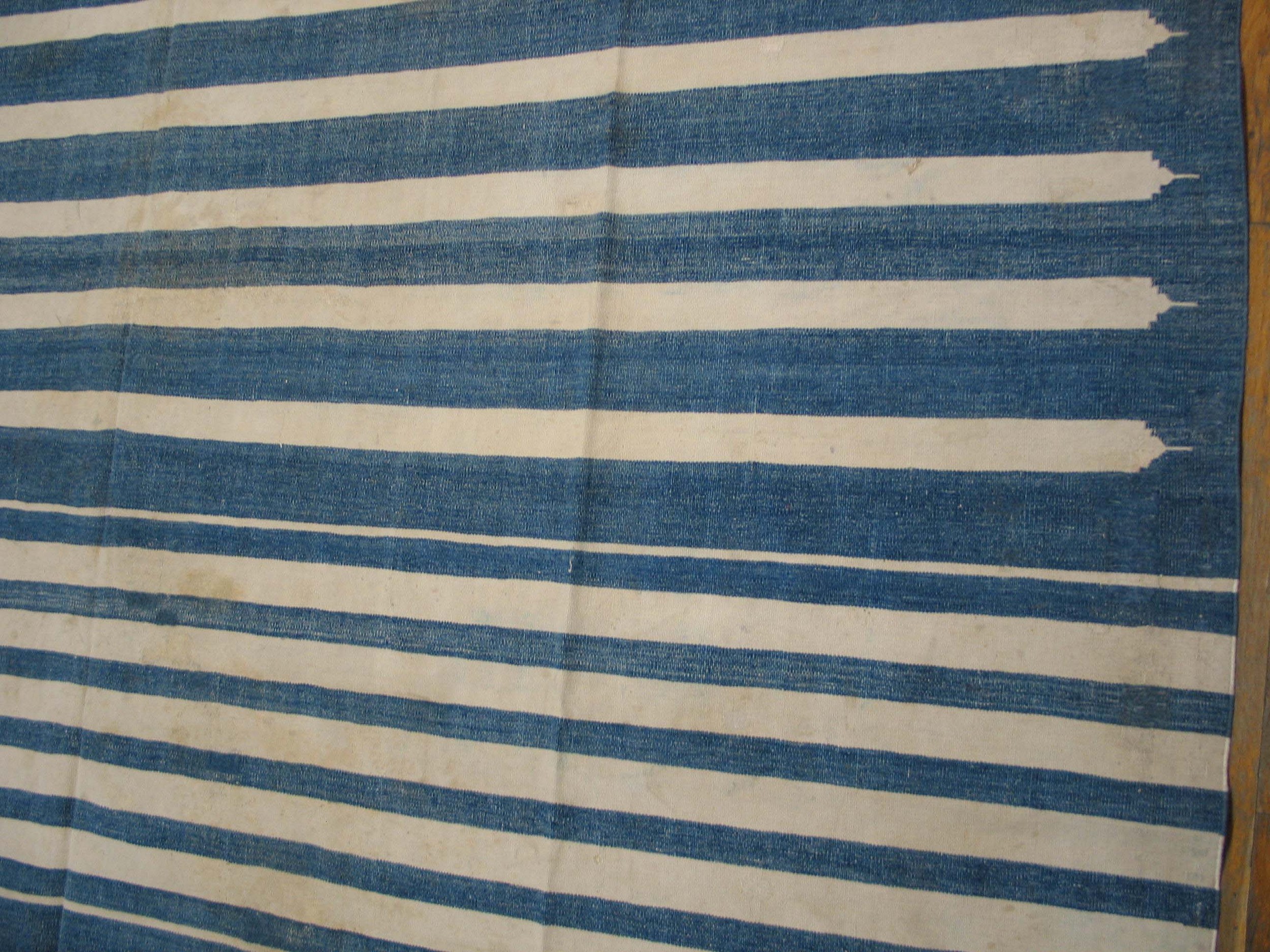
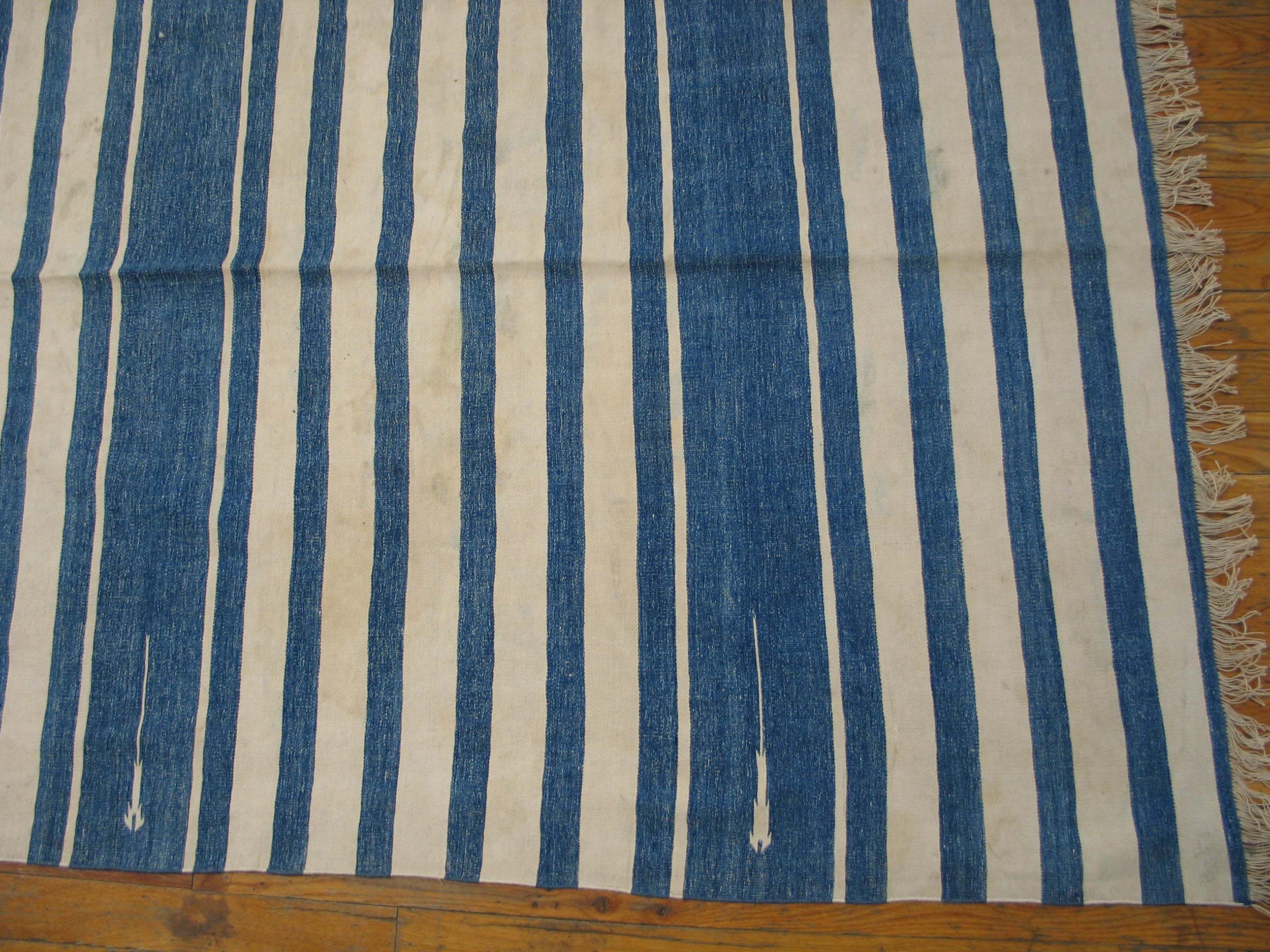
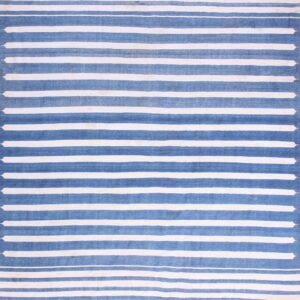
The composition is centered upon a horizontal stripe and banded motif. The design is defined by a series of repeating linear elements that vary in thickness, creating a subtle visual vibration across the field. In the dhurrie tradition, these stripes were often more than decorative; they were a reflection of the loom’s width and the weaver’s disciplined tension. The drawing is clean and unwavering, showcasing the technical precision of the hand-weaver who managed to maintain perfectly straight lines over a substantial surface area.
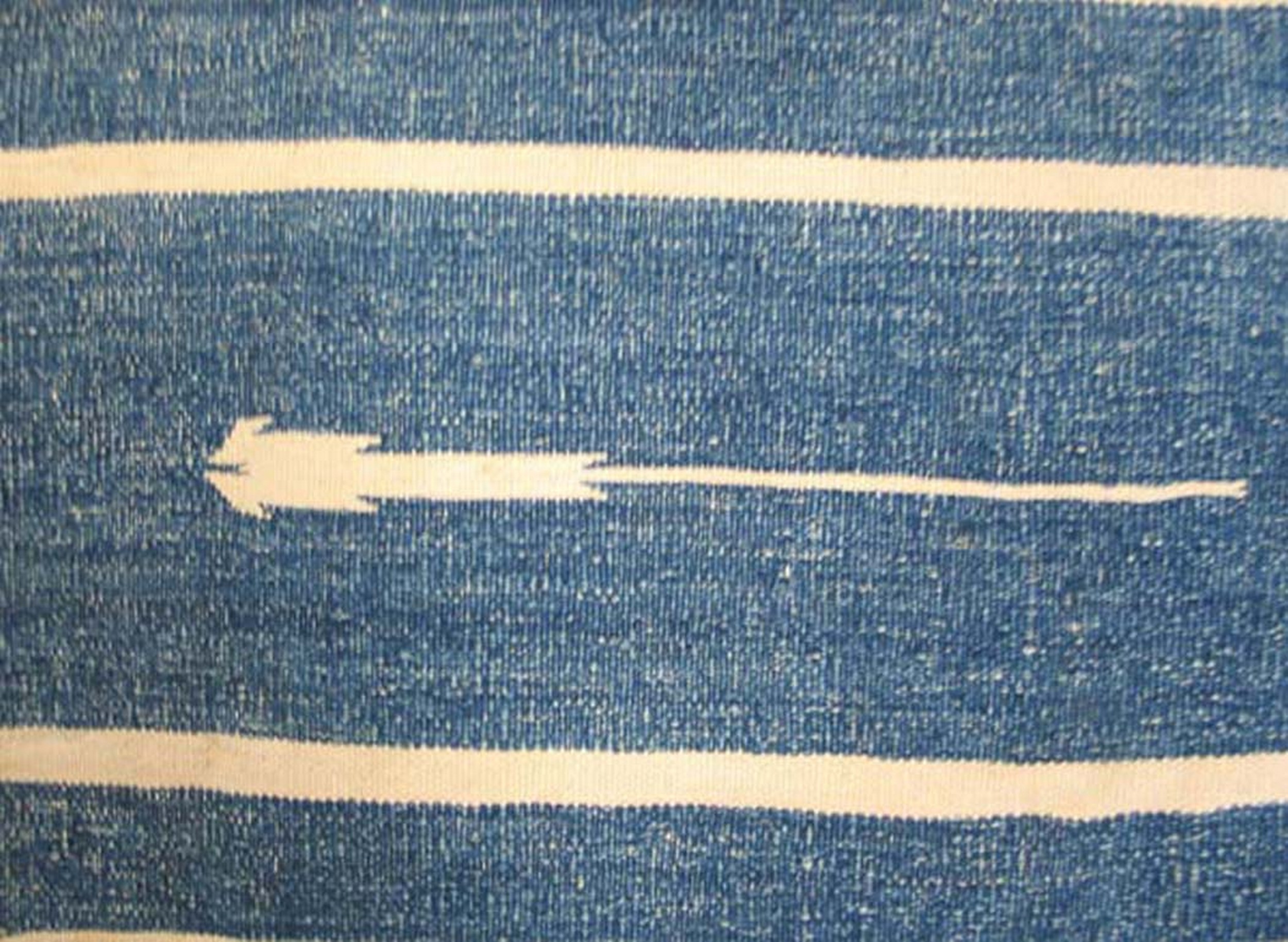
The palette is anchored by a timeless and nautical Blue and White color theory. The blue is typically derived from natural Indigo, a dye for which India has been world-renowned for millennia. Against the crisp, unbleached White or Cream cotton foundation, the indigo bands take on a luminous quality. Because this is an antique specimen, the colors exhibit a beautiful “organic” patina; the whites have mellowed to a soft parchment tone, and the indigo shows a delicate abrash (tonal variation), shifting from a deep navy to a soft sky-blue where the dye has aged gracefully over a century.
Technically, this antique dhurrie is prized for its tight, warp-faced weave and its lightweight, breathable handle. Being crafted entirely of cotton, it possesses a matte, non-reflective surface that is cool to the touch—a functional necessity for the climate of its origin. Unlike knotted pile rugs, the flat-weave rugs construction is fully reversible, offering a practical longevity that has allowed it to survive in such excellent condition. The cotton used in this period was often hand-spun, giving the rug a subtle, tactile irregularity that distinguishes it from modern machine-made reproductions.
The borders are typically minimal or nonexistent, allowing the stripes to run “edge-to-edge” to create a sense of infinite, expansive space. To possess this antique blue and white geometric striped Indian flatweave cotton Dhurrie rug is to own a piece of textile history that feels entirely relevant today. It bridges the gap between the ancient village looms of India and the sophisticated, “less-is-more” requirements of contemporary coastal or urban interiors—transforming any floor into a sanctuary of historical soul and calm, linear grace.