
Introduction to Checkerboard Rug Patterns
Discover our curated selection of luxury checkerboard checkered rugs and define your room’s aesthetic.
What is a Checkerboard Rug Pattern?
A checkerboard rug pattern is defined by a repeating sequence of alternating squares arranged in a precise grid, most often in two contrasting tones. The term “checkerboard” itself originates from the chessboard—rooted in the Persian word shāh (meaning king), which evolved into “check” in English. The association with game boards, tiling, and universal geometric order has made this pattern recognizable across cultures and centuries.
In the context of rugs, a checkerboard design translates the familiar logic of symmetry and balance into a textile form that grounds a space both visually and symbolically. A checkerboard area rug is therefore more than decoration—it embodies rhythm, clarity, and timeless simplicity.
Visual Structure & Defining Features
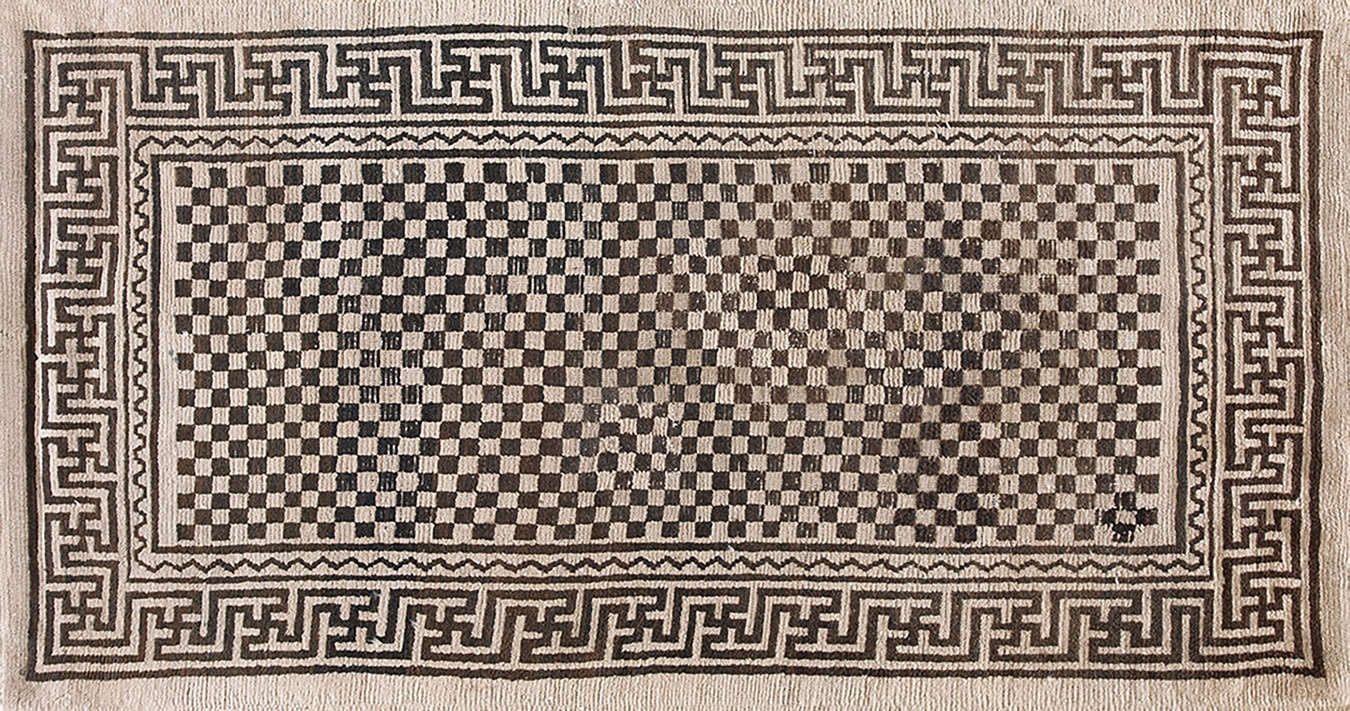
Antique Chinese – Tibetan Ivory 1930s Rug – by Rugs On Net
The visual structure of checkered rugs rests on three defining features:
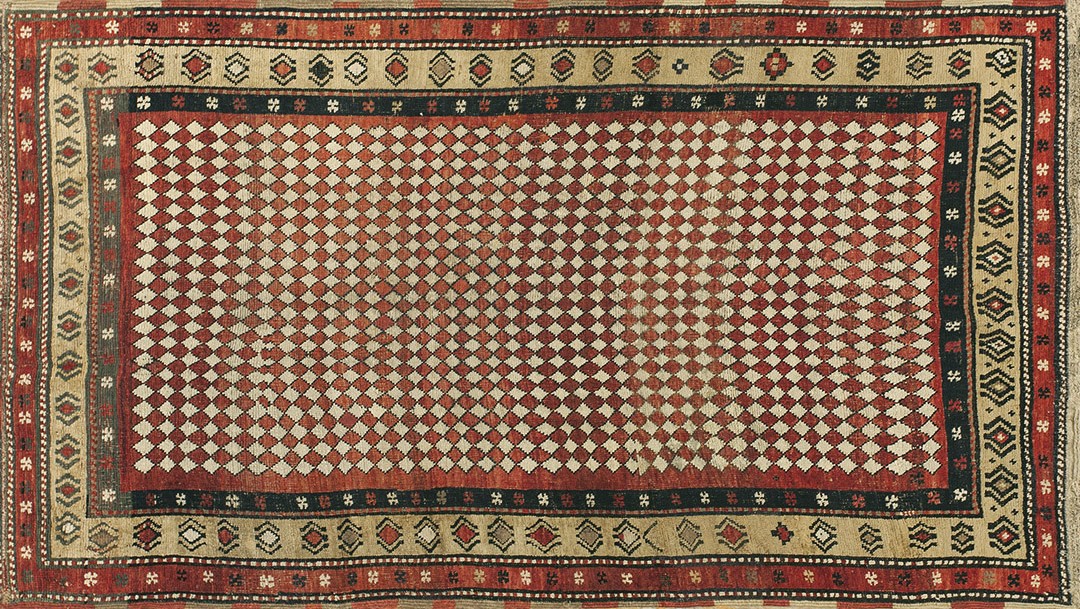
- Alternating Squares: The pattern is built from equal-sized squares that alternate in tone, often creating a binary rhythm like black and white. While monochrome examples are the most iconic, many rugs use softer contrasts—such as cream with beige, navy with ivory, or even vibrant multi-colored arrangements.
- Color Contrast: At its core, the design relies on contrast. Whether bold and dramatic or subtle and tonal, the play of dark and light establishes the strong graphic appeal of a checkerboard rug design. The visual tension between the two colors gives the pattern clarity even from a distance.
- Grid Structure: Every checkerboard rug is organized by a strict grid, ensuring balance and repetition. This grid not only provides visual order but also reinforces the universal appeal of the pattern—it is instantly recognizable, regardless of cultural background. For this reason, a grid rug pattern is considered one of the most stable and versatile in textile design.
Checkerboard motifs have been adapted globally. In some traditions, the squares are sharply delineated, mirroring tiled floors or chessboards. In others, artisans introduce irregularities—slight variations in dye, handwoven textures, or distressed finishes—that soften the rigidity while preserving the underlying rhythm. This flexibility allows the check motif to appear both modern and traditional, depending on execution.
Graphic Impact and Universality
The checkerboard rug offers instant visual order with a graphic punch. Its symmetrical layout makes it a powerful anchor in any room, from minimalist lofts to traditional interiors. While the basic formula is simple, the outcome is endlessly adaptable: a high-contrast black-and-white chessboard rug projects boldness, while a muted tonal palette creates quiet elegance. The universality of this design also explains its symbolic depth.
Checkerboard patterns have been associated with strategy and logic through chess, with timeless flooring traditions through tilework, and with cultural rituals where alternating squares signify balance or duality. As a rug, the design retains these connotations while serving a practical role as a floor covering.
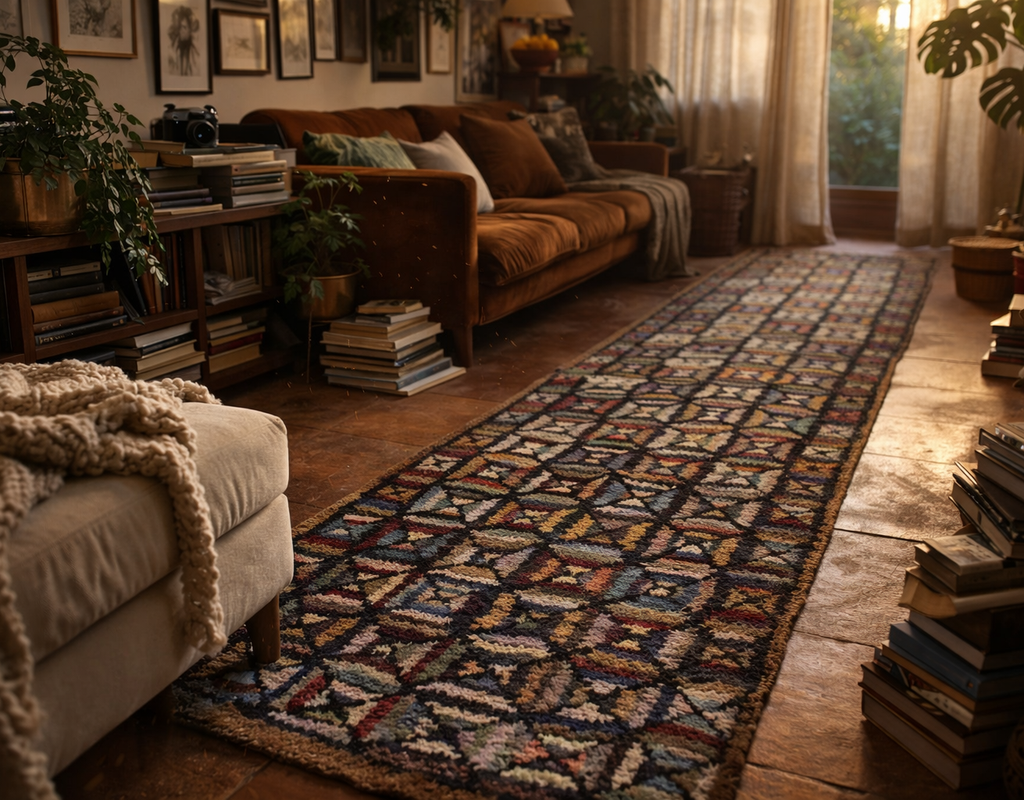
Warm, eclectic living space illuminated by natural light, featuring a vibrant, patterned runner rug.
Above all, checkerboard rugs remain one of the most recognizable and enduring geometric designs in the world of textiles. Their combination of order, contrast, and adaptability makes them an essential category in rug design, bridging historical inspiration with modern taste.
Origins and Historical Evolution
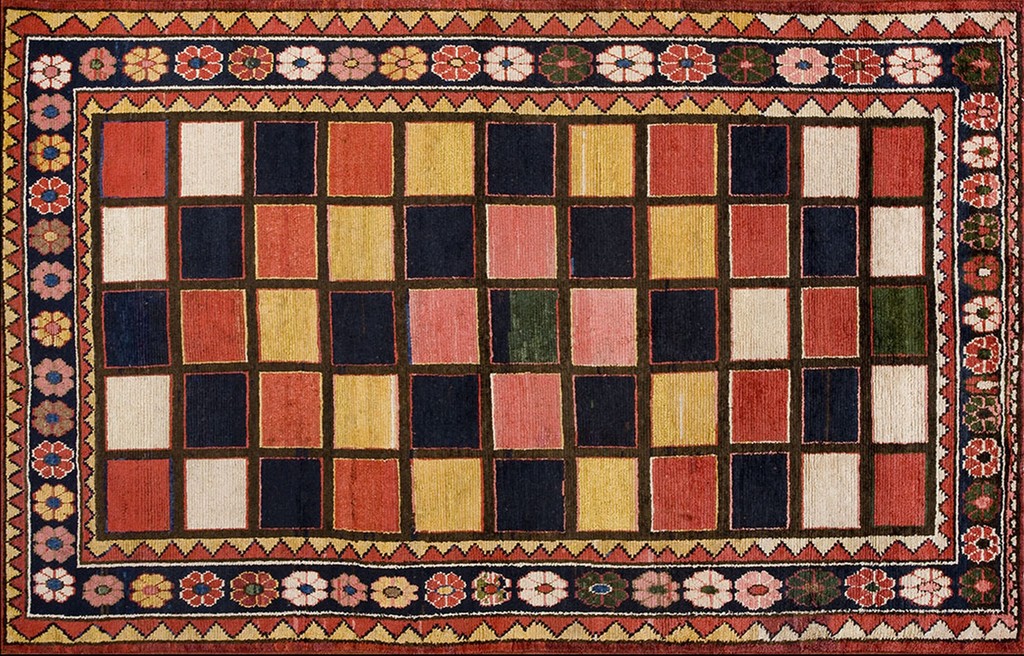
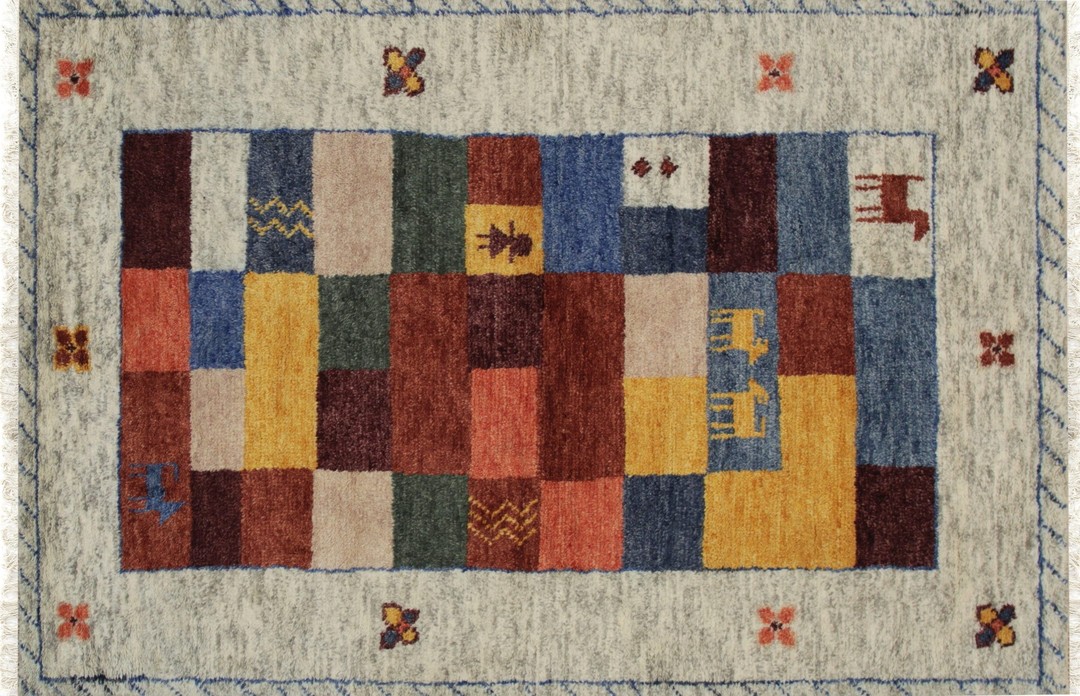
Colorful Geometric Checkerboard Design Persian Antique Tribal Gabbeh Rug by Rugs On Net
Where Did Checkerboard Rug Designs First Emerge?
The origins of checkerboard rugs cannot be traced to a single place or culture. Instead, the global checkerboard motif emerged independently across multiple regions as early weavers discovered that crossing colored warp and weft threads naturally created alternating square patterns. This simple yet powerful effect appeared in some of the world’s earliest known textiles, long before the design was formalized into chessboards or tiled floors.
From Bronze Age Xinjiang to Iron Age Europe and from the Nile Valley to the Andes, evidence shows that ancient checkered textiles were a convergent invention born out of the fundamental logic of weaving itself.
Ancient Roots Across Continents
Archaeological finds confirm that the history of checkerboard patterns is vast and multicultural. In China’s Tarim Basin, Bronze Age woven fragments reveal rudimentary grid rug patterns, while Celtic and Iron Age European textiles incorporated checks as decorative borders. Egyptian weavers used alternating squares in linen, linking the design to ceremonial and everyday fabrics.
Across the Atlantic, Andean civilizations employed check motifs in wool textiles, often in bold red-and-black contrasts that symbolized duality. In Africa, early kente cloth carried by Akan weavers featured geometric checks, blending symbolism with aesthetics. These diverse appearances highlight how the checkerboard evolved independently across continents, each culture imbuing the pattern with its own meanings.
Milestone Eras and Design Diffusion
Although rooted in multiple ancient traditions, the history of checkerboard patterns gained momentum through cultural diffusion and trade.
During the classical era, Greco-Roman mosaics and pavements popularized grid-based ornamentation, reinforcing the motif as both decorative and architectural.
In India, vibrant checked textiles became integral to Madras cloth traditions, later traded worldwide.
In Europe, the Middle Ages saw checkerboard designs emerge in heraldry, floor tiling, and woven fabrics, eventually influencing the development of Scottish tartan.
In Africa, the geometric rigor of kente patterns expanded through regional exchanges, cementing the check motif as a marker of cultural identity.
By the time chess spread from Persia to Europe, the black-and-white chessboard rug became one of the most universally recognized check designs.
From ancient handwoven squares to global textile commerce, the origins of checkerboard rugs illustrate a design that transcended borders and eras. Its spread was accelerated by trade networks, migrations, and cross-cultural borrowing, ensuring that the checkered rug became more than a decorative pattern—it carried symbolic, practical, and ceremonial significance across the world.
Today, the enduring legacy of these ancient checkered textiles is visible in every modern checkerboard area rug, a testament to the universal appeal of balance, contrast, and geometric order.
Design Characteristics of Checkerboard Rugs
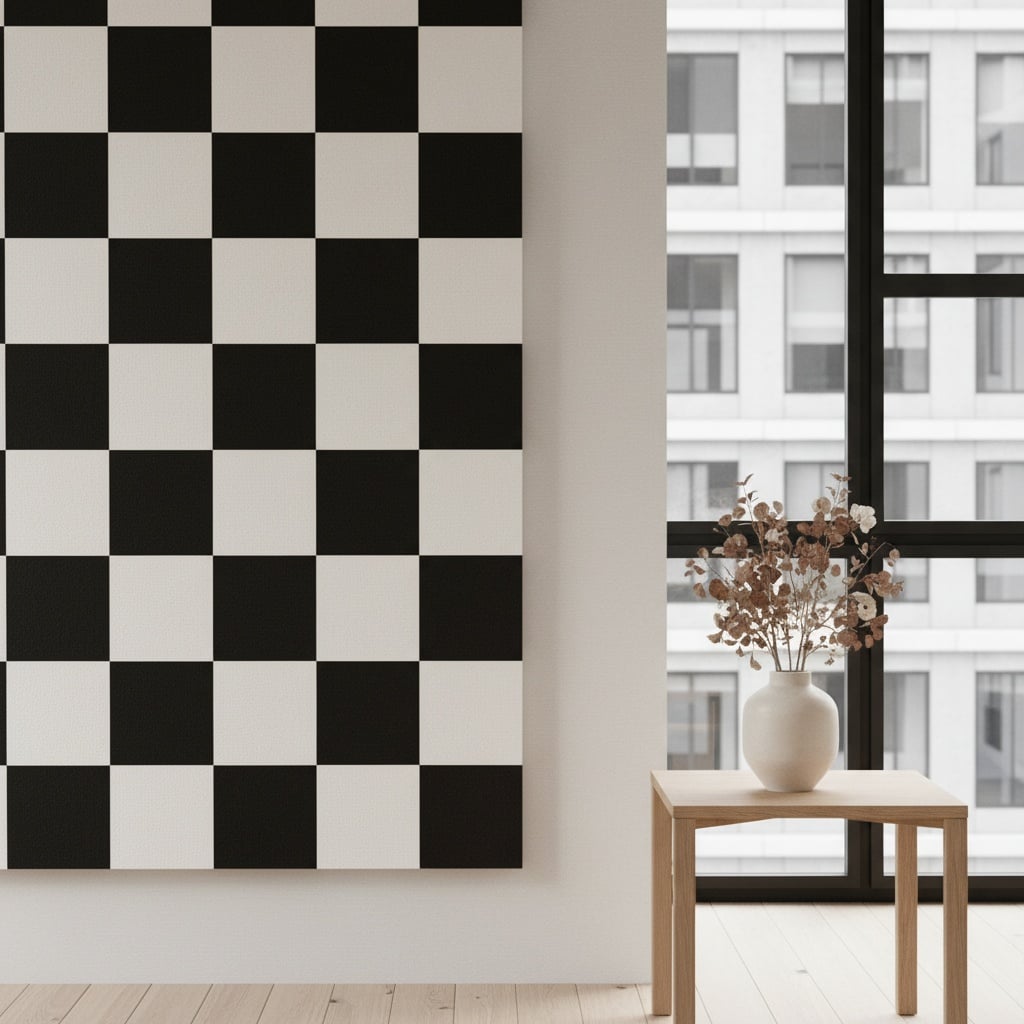
Wall art showcasing a bold checkerboard pattern motif.
Core Visual Traits
At the heart of every checkerboard rug design is the strict geometry of the grid. Equal squares arranged in alternating tones create a visual rhythm that is both orderly and dynamic.
Symmetry ensures balance, while contrast provides definition—whether in bold black-and-white pairings or softer tonal blends. The motif is highly adaptable: some patterned checker rugs stay pure to the grid, while others introduce subtle variations such as floral fills, tribal guls, or miniature stars inside each square. Together, these traits make checkerboard rugs instantly recognizable and endlessly versatile.
Why Are Checkerboard Rugs Visually Striking in Homes?
The visual impact of checkered rugs lies in their ability to ground a space with order and clarity. The repeated square structure creates a sense of stability, while the alternating tones generate movement that draws the eye across the room. This balance of stillness and rhythm explains why a striking checkerboard rug feels both calming and energizing.
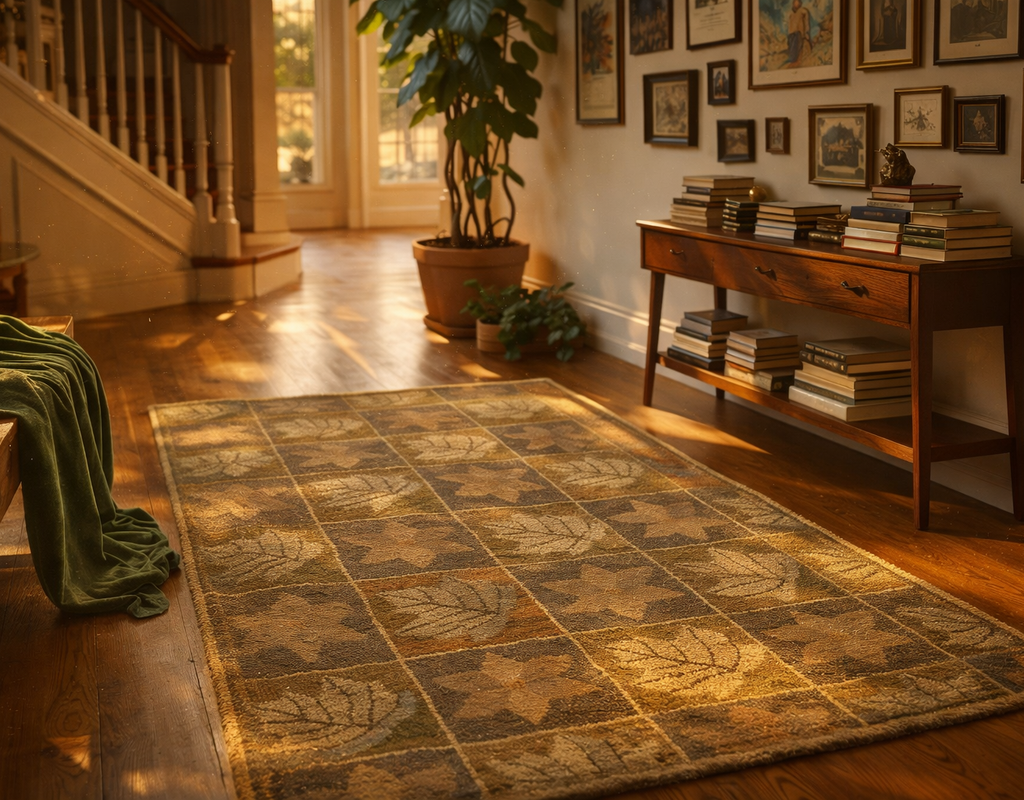
The rich textures and warm light create an inviting atmosphere in this traditionally styled space.
Whether placed in a modern loft or a traditional living room, the design harmonizes with its surroundings while providing a bold focal point. It is a universal pattern that signals clarity, structure, and timeless style.
Colorways: Classic, Bold, and Muted
The choice of color defines the personality of a checkerboard rug. The classic chessboard rug—black and white—remains the most iconic, radiating high contrast and graphic sharpness. Bold alternatives in red, green, or blue provide playful energy, often suited to eclectic or retro interiors.
More recently, muted palettes have dominated 2020s design trends. The muted checkerboard rug, rendered in beige, cream, taupe, or dusty pastels, offers a softer take on the pattern.
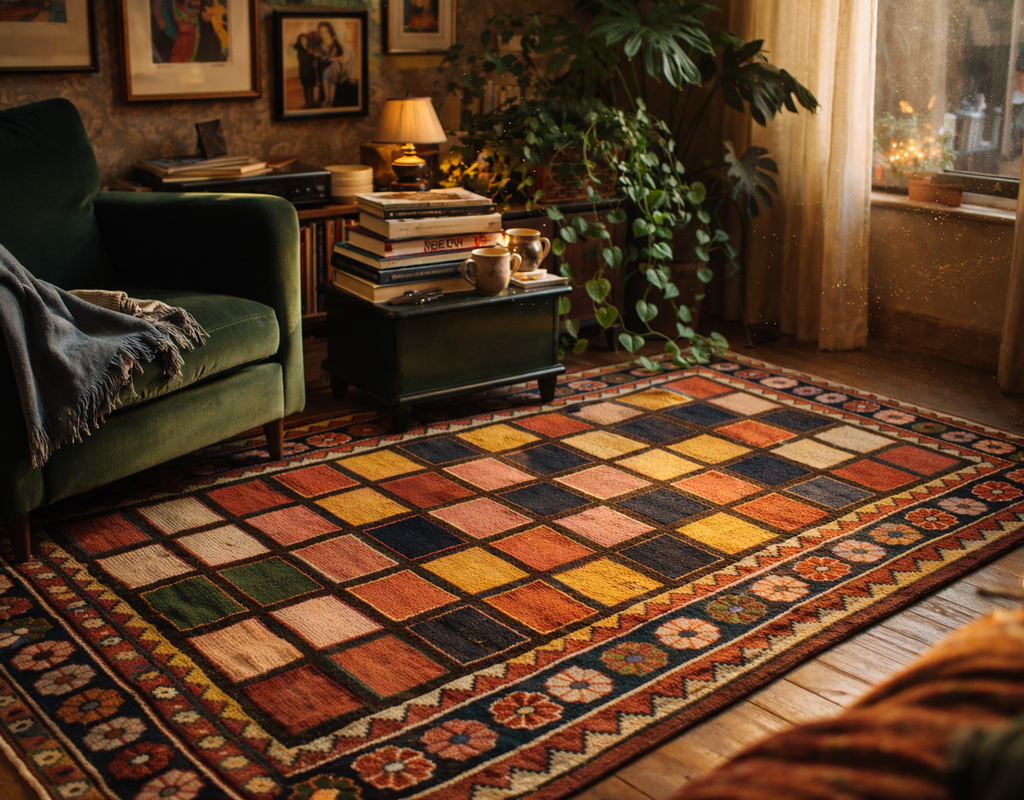
A richly patterned, colorful rug anchors this warmly lit and heavily textured bohemian living space.
These subdued tones maintain the order of the grid while blending seamlessly with minimalist or Scandinavian-inspired décor. This trend reflects a broader shift toward understated elegance, where checkerboard patterns feel fresh yet timeless.
Pile Height and Pattern Clarity
Yes, pile height directly affects checkerboard rug clarity. A low, flat pile enhances definition, making the grid appear crisp and precise—ideal for showcasing strong contrast in modern interiors. By contrast, high-pile or shag constructions soften edges, giving the pattern a diffused, almost blurred quality.
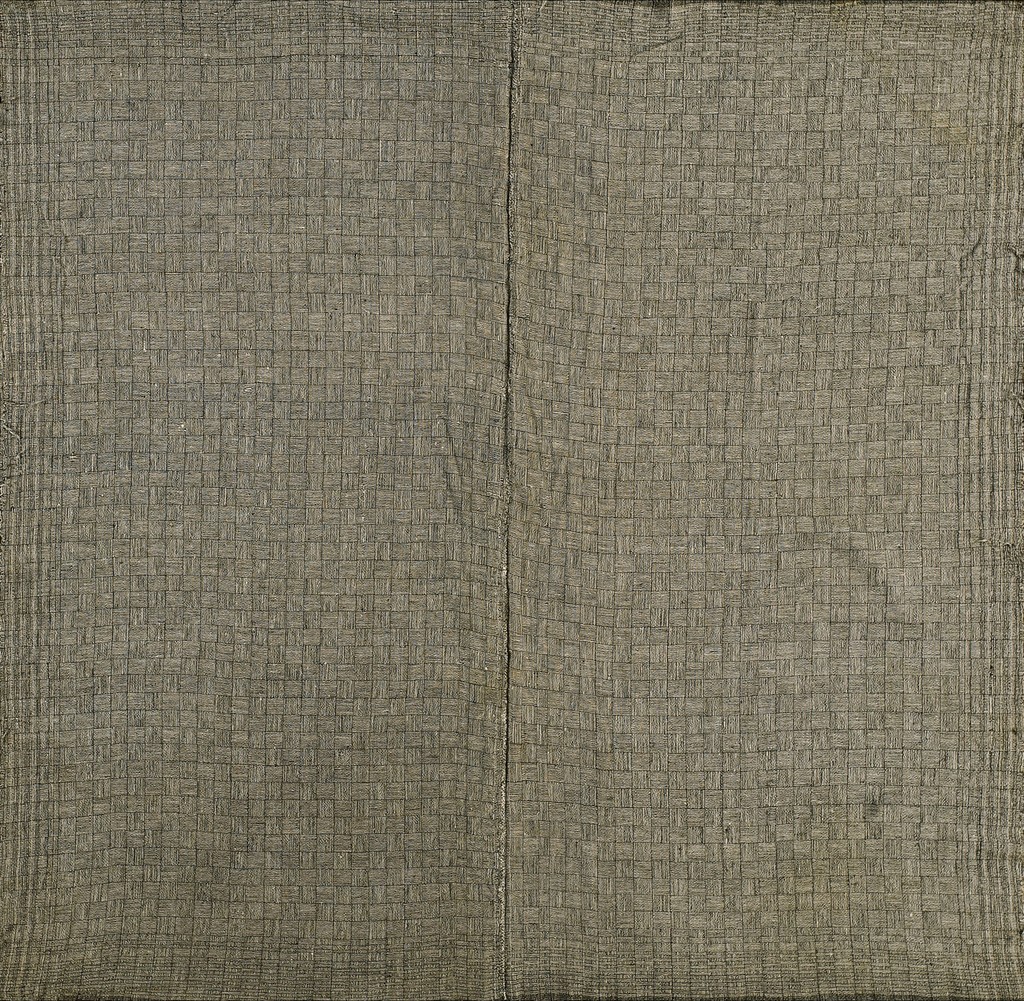
Antique Shawl Indian 1925 Rug by Rugs On Net
This flexibility allows homeowners to choose between a sharp, graphic look or a more relaxed, textural interpretation of the grid. In every case, pile height is a key factor in how clearly the design reads across a room.
Motif Variations and Patchwork Grids
Beyond the strict two-tone formula, checkerboard rugs often experiment with secondary details and structural variations:
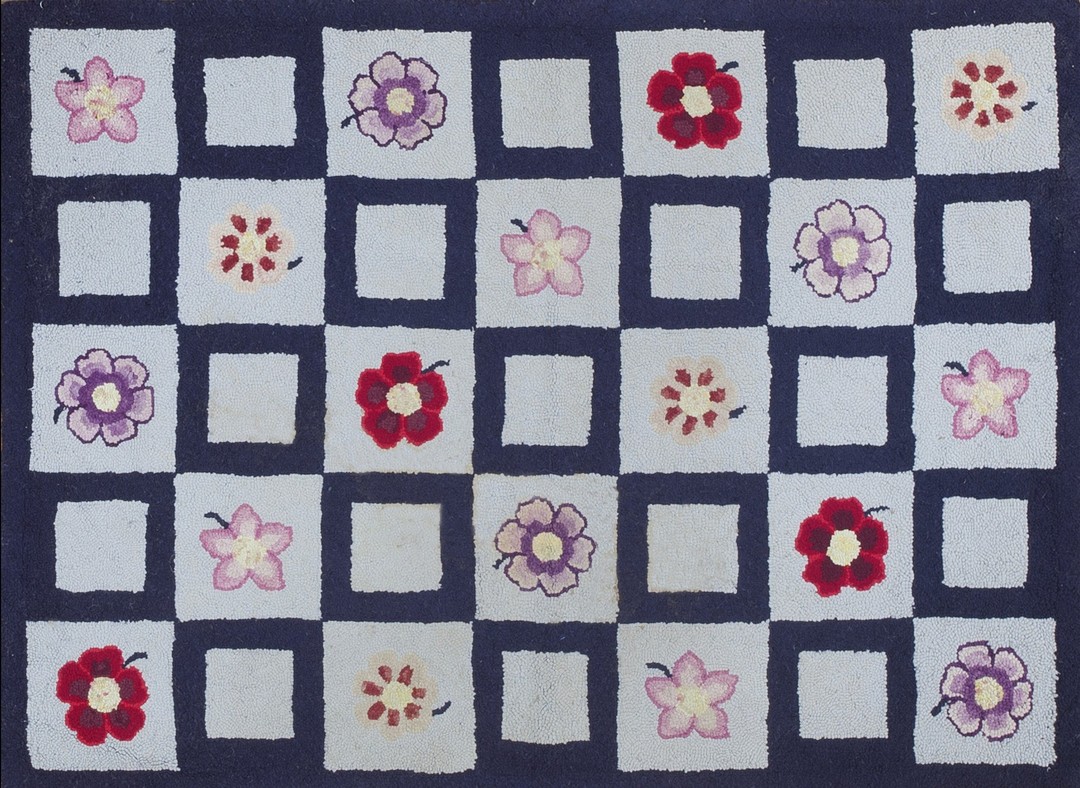
- Floral or Starred Checks — Why: Inserts delicate motifs into each square, blending geometry with ornament.
- Gul or Tribal Inserts — Why: Adds cultural resonance, referencing traditional weaving practices.
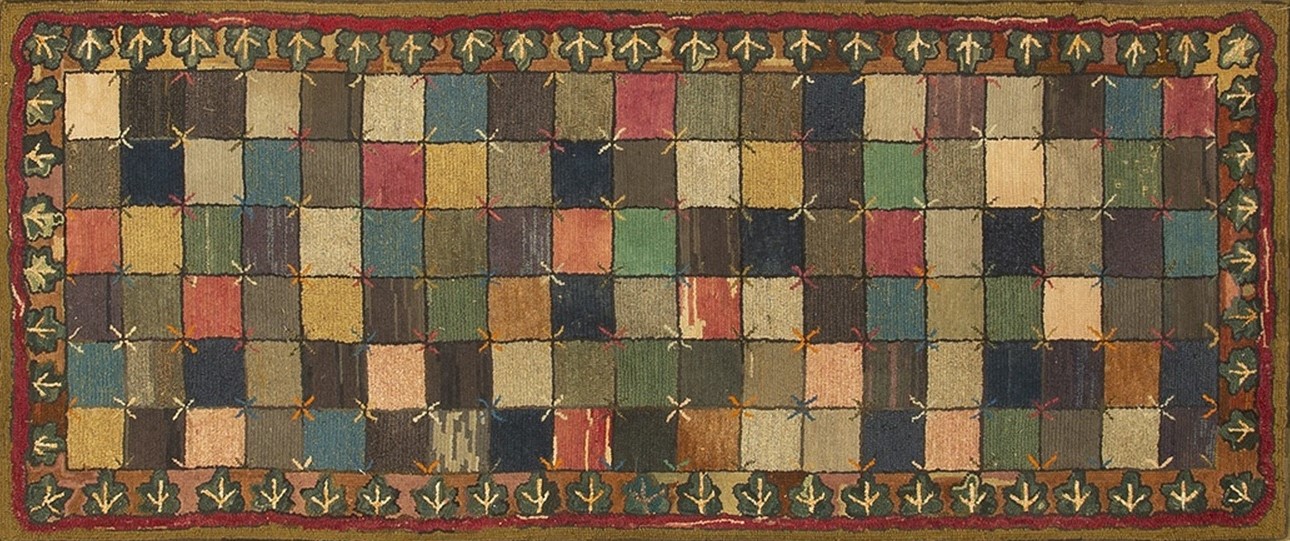
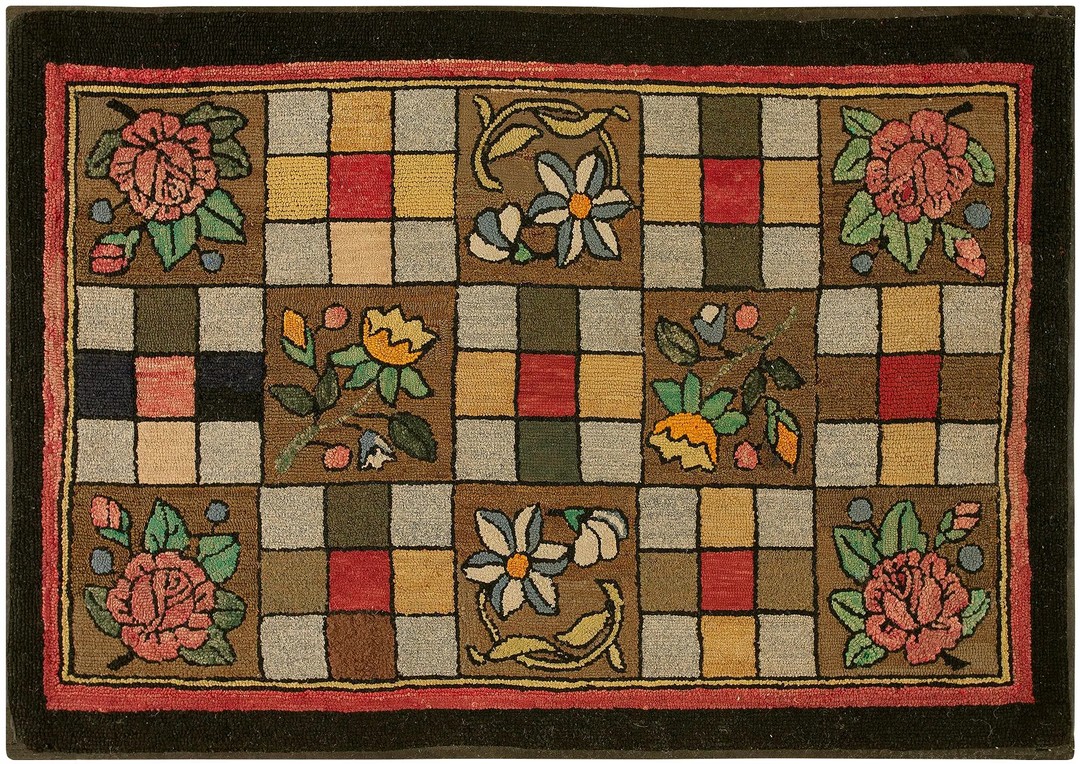
- Patchwork Grids — Why: Mimics the checkerboard layout but with irregular colors or textures, producing a more handcrafted, organic effect.
- Distorted or “Melting” Checks — Why: Creates a modern twist, where the grid seems to ripple, bend, or fade, bringing movement to a static structure.
These variations expand the expressive range of the checkerboard area rug, proving that a centuries-old grid can still inspire fresh design innovations.
Construction, Materials & Weaving Techniques
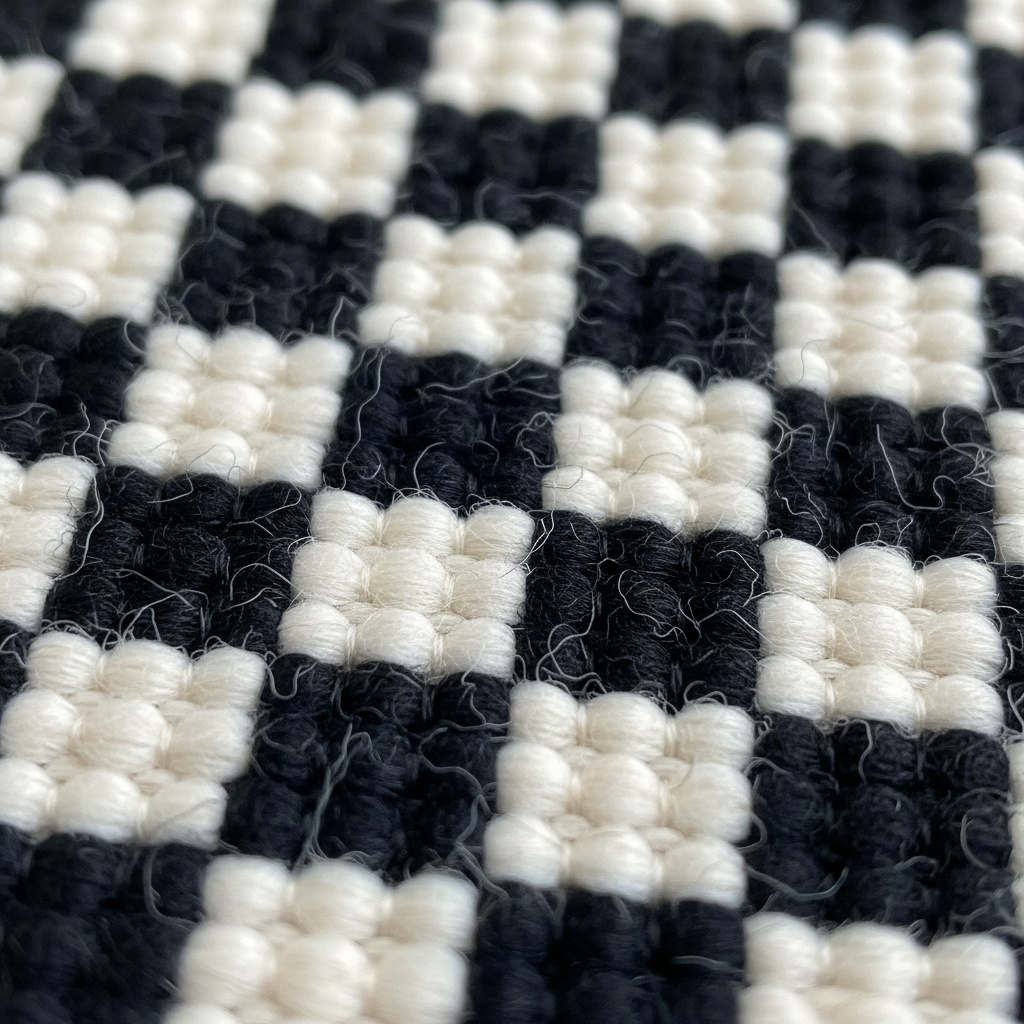
Macro view of the raised weave technique in a checkerboard pattern.
What Materials Are Common for Woven Checkerboard Rugs?
The materials used in checkerboard rug design play a decisive role in texture, durability, and cost. The most traditional and highly valued option is the wool checkerboard rug, prized for its warmth, resilience, and ability to hold deep, lasting colors.
Cotton, by contrast, produces a lighter and more affordable cotton checkered rug, often used in casual settings such as kitchens or entryways. Silk is rare but luxurious, adding sheen and refinement to checkerboard motifs.
Other fibers—including raffia, jute, and modern synthetics—appear in budget or outdoor styles, extending the grid rug pattern into different markets and use cases.
How Are Flat-Weave Checkerboard Rugs Constructed Differently?
The flatweave checkerboard rug, such as a kilim or dhurrie, is crafted using interlocking colored weft threads. Instead of raised pile, the pattern emerges directly from the crossing of yarns, resulting in sharp-edged checks with no texture interruption.
This technique produces lightweight rugs with excellent portability and crisp design definition. Flat-weave construction also makes checkerboard rugs reversible, adding functional value in spaces that see heavy wear. Compared to pile rugs, flat-weaves emphasize graphic clarity over plush comfort.
Hand-Tufted, Pile, and Pieced Methods
Hand-tufted rugs are another popular form of checkerboard area rug, produced by punching yarn into a backing fabric with a tufting gun. These rugs mimic the look of knotted pile but are less durable, making them more affordable but shorter-lived. Knotted or cut-pile rugs provide depth and comfort, yet they can soften the crispness of the grid depending on pile height.
Pieced construction—stitching together squares of different fabrics or hides into a checkerboard layout—offers a patchwork variation that emphasizes texture and artisanal craftsmanship. Each method balances cost, durability, and aesthetic value, allowing buyers to choose based on budget and intended use.
Does Pile Height Affect Checkerboard Rug Clarity?

A detailed focus on the intricate, vivid colors and geometric weave of a traditional textile rug.
Checkerboard pile clarity depends heavily on pile height. Low pile ensures sharp, defined edges ideal for bold contrast, while high pile creates a diffused, softer appearance.
This makes construction technique a key decision for homeowners seeking either a crisp modern look or a more relaxed, tactile feel.
How Do Wool Checkerboard Rugs Compare to Cotton Versions?
When comparing materials, a wool checkerboard rug stands out for longevity and vibrancy. Wool fibers bounce back under pressure, resist crushing, and hold dyes with remarkable depth, ensuring contrast remains sharp for decades.
A cotton checkered rug is lighter, cooler underfoot, and more affordable, but it wears down faster and shows stains more easily. Wool suits living rooms, bedrooms, and high-traffic areas where durability matters, while cotton is ideal for casual, budget-friendly, or seasonal use.
Are Custom-Sized Checkerboard Rugs Cost-Effective for Large Rooms?
Yes—custom checkerboard carpets are often cost-effective for large spaces, especially when compared to piecing together multiple smaller rugs. Custom sizing allows the grid to scale proportionally with the room, preserving symmetry without awkward edges or cutoffs.
While custom orders carry a higher upfront cost, they often deliver better long-term value by ensuring perfect fit and design balance.
Eco-Friendly Dyes & Sustainable Choices
Sustainability is reshaping the market for sustainable checkerboard rugs. Many artisans now use natural or recycled fibers combined with eco-friendly plant-based dyes. The question of longevity is critical: can eco-friendly dyes maintain checkerboard contrast long-term? The answer depends on quality.
High-grade vegetable and low-impact synthetic dyes can hold their vibrancy nearly as well as conventional chemical dyes, though some subtle fading (or abrash) over time is natural. Rather than detracting, this soft evolution of tone can add character to the checkerboard motif. For buyers prioritizing sustainability, these rugs balance eco-conscious living with the enduring appeal of the grid.
Regional and Cultural Variations
Notable Types: Scottish Tartan, Indian Madras, African Kente, Middle Eastern Keffiyeh
- Scottish Tartan Checks — Why: More than decorative, tartan represents clan identity and heritage. A tartan check rug translates this symbolic grid into textile art, layering color and meaning beyond the standard black-and-white checkerboard.
- Indian Madras Checks — Why: Originating in Madras (now Chennai), these lightweight cotton textiles became global exports. A Madras check rug embodies the breezy character of the fabric while adapting the grid to floor coverings, merging tradition with colonial-era trade history.
- African Kente and Kuba Checks — Why: Kente cloth of the Akan people and Kuba raffia from Central Africa both employ checker motifs as markers of social rank, storytelling, and ritual practice. A kente checkerboard rug reflects this cultural richness while visually amplifying the grid through bold colors.
- Middle Eastern Keffiyeh Checks — Why: The iconic keffiyeh scarf, with its black-and-white or red-and-white grid, carries deep cultural symbolism tied to identity and resistance. Adapted into textiles, a keffiyeh check rug channels the visual and symbolic clarity of this regional pattern.
Symbolic Meanings by Region
- Scotland — Why: Checker patterns signify kinship, loyalty, and local identity, making tartan checks more than ornamentation.
- India — Why: Madras checks historically symbolized trade and global exchange, their bright grids signaling craftsmanship and adaptability.
- Africa — Why: Checker motifs in kente are tied to proverbs, leadership, and life events, underscoring the grid’s role in cultural storytelling.
- Middle East — Why: The keffiyeh’s check motif symbolizes protection, resilience, and solidarity, transferring these layered meanings into rug form.
How Does Origin Affect Checkerboard Rug Resale Value?
The value of a regional checkerboard rug is deeply tied to its place of origin. Moroccan, Persian, and African examples command higher prices due to handwoven craftsmanship, natural materials, and cultural distinctiveness. A tartan check rug made in Scotland, for instance, carries greater collector appeal than a mass-produced imitation, while authentic African kente-inspired rugs may rise in value due to rarity and symbolic importance.
Indian Madras or gingham-style rugs, being more widely exported and produced, tend to be more accessible but still hold historic value tied to colonial trade. In the resale market, provenance, rarity, and cultural authenticity drive pricing. Buyers view a regional checkerboard rug not only as décor but also as a cultural artifact.
As a result, origin remains one of the strongest determinants of long-term investment potential and collector interest in checkerboard rug value.
Identifying and Evaluating Vintage Checkerboard Rugs
How Can You Identify Authentic Vintage Checkerboard Rugs?
An authentic checkerboard rug from past decades or centuries carries subtle hallmarks of hand craftsmanship. The squares may be slightly irregular, reflecting the rhythm of a human hand rather than a machine. Natural dyes, often plant- or mineral-based, create tones that soften and vary with age, producing the subtle abrash prized by collectors.
Local wool, spun and dyed in small batches, gives a handwoven check rug depth of texture and durability. Signs of wear—patina, faded areas, or minor fraying—are not flaws but markers of authenticity, distinguishing a true vintage checkerboard rug from mass-produced imitations.
Should You Invest in Vintage Checkerboard Moroccan Pieces?
Yes—vintage Moroccan checkerboard runners and rugs are among the most collectible and sought-after examples on today’s market. Their appeal lies in bold, unexpected color combinations and artisanal irregularity that transforms the strict grid into something organic and expressive.
Unlike factory-made rugs, these pieces embody individuality; no two are alike. Rising global demand and limited supply have made Moroccan checkerboard rugs strong candidates for investment, often increasing in value over time.
For collectors, their imperfect squares and saturated natural dyes are not only decorative but also cultural treasures.
What Drives Price Differences Among Premium Checkerboard Wool Rugs?
The market for a premium wool checkered rug is shaped by several factors:
- Fiber Quality — Fine, long-staple wool holds dye better, resists wear, and delivers a soft yet durable surface, commanding higher prices.
- Dye Quality — Rugs colored with natural, high-grade dyes age with beauty and fetch more than those using synthetic or unstable dyes.
- Region & Provenance — A rug tied to a notable weaving tradition—such as Moroccan, Persian, or Anatolian origins—will often be valued more than a generic version.
- Knot Density & Craftsmanship — Higher knot counts and precision weaving elevate both clarity of the checkerboard pattern and durability, directly affecting price.
- Rarity — Unusual color palettes, runner sizes, or preserved antique examples naturally push valuations higher.
Together, these elements explain why two checkerboard rugs that appear similar in design may differ drastically in value. For collectors and investors alike, provenance and craftsmanship remain the most decisive criteria when judging a rug’s long-term worth.
Authenticity, cultural origin, and material excellence ensure that the vintage checkerboard rug stands not only as a design icon but also as a collectible asset with enduring appeal.
Checkerboard Rugs in Contemporary Interior Design
Are Checkerboard Rugs Still Trendy in 2025 Interiors?
Yes—the trendy checkerboard rug remains a defining feature of 2025 interiors. Designers and tastemakers describe the pattern as both nostalgic and graphic, offering a timeless link to historic textiles while feeling fresh in contemporary spaces.
Its combination of structure, rhythm, and bold contrast allows it to function as either a statement piece or a subtle background element, depending on palette and placement. The checkerboard motif has proven itself more than a passing trend; it has become a design staple that adapts seamlessly to evolving interior styles.
Who Popularized Checkerboard Rug Designs in Modern Interiors?
The revival of the modern checkered rug owes much to influential figures and brands. French designer Andrée Putman reintroduced the motif as high-style minimalism in the late 20th century, while lifestyle brands such as MacKenzie-Childs and IKEA brought check motifs into mainstream décor.
More recently, social media influencers and interior stylists have amplified the pattern’s resurgence, making it a fixture in aspirational home tours and design feeds. This blend of high design and mass accessibility has ensured the checkerboard rug’s enduring relevance.
Why Do Modern Designers Favor Muted Checkerboard Palettes?
Contemporary interiors often lean toward natural, earthy tones, which explains the popularity of the muted palette checkerboard rug. Designers favor colors like sage, terracotta, taupe, and ivory for their subtlety and versatility.
These softened palettes preserve the grid’s order while avoiding the stark visual intensity of black and white. In living spaces that prioritize warmth and calm, muted checkerboards provide structure without overwhelming, aligning perfectly with the broader trend toward grounded, nature-inspired interiors in the 2020s.
Can Checkerboard Rugs Complement Minimalist Scandinavian Décor?
Absolutely—a Scandinavian checkerboard rug is one of the most effective applications of the pattern. Minimalist and Scandinavian interiors prioritize simplicity, light, and functional clarity.
The checkerboard grid adds structure without clutter, harmonizing with pale woods, neutral walls, and understated furniture. When executed in soft or tonal shades, checkerboard rugs act as architectural anchors, supporting the space’s clean lines while contributing warmth and depth.
Where Should Small Checkerboard Rugs Be Placed Effectively?
A small checkered rug is most impactful in transitional or accent areas where its graphic punch can shine without dominating.
Common placements include:
- Entryways – where the grid creates a welcoming statement
- Kitchens, where durable cotton or flatweave versions offer both style and practicality
- Beneath accent furniture like side tables or reading chairs, where the rug becomes a focal point in a smaller vignette.
Placement Strategies for Impact
- Center Stage in Living Rooms — Why: A large checkerboard rug grounds seating areas, giving order to sofas and tables.
- Layered Under Dining Tables — Why: The grid provides balance, framing the table while reinforcing symmetry.
- Accent in Entryways — Why: A small checkered rug makes an instant visual impression, setting the tone for the home.
- Kitchens and Utility Spaces — Why: Flatweave checkerboards bring durability and charm to high-use areas.
- Bedroom Anchors — Why: Placed under or beside the bed, a muted checkerboard creates warmth and soft structure.
In today’s interiors, the modern checkered rug serves as both a foundational piece and an accent detail, proving that the checkerboard motif is as relevant in contemporary design as it has ever been.
Care, Cleaning & Maintenance
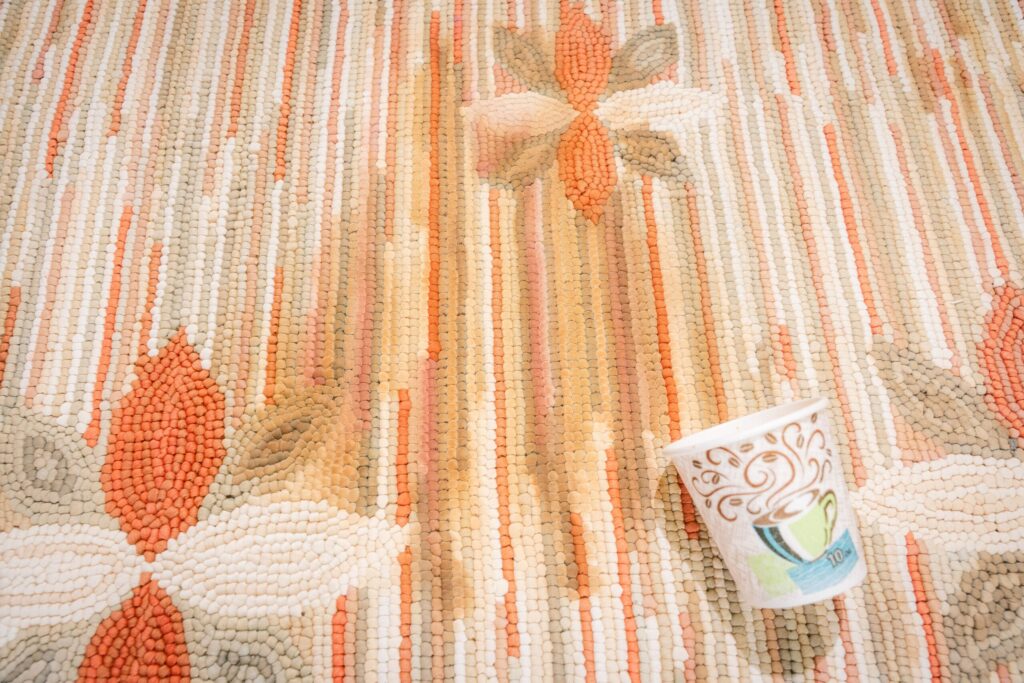
Close-up view of a tipped paper coffee cup resting on a handwoven wool rug, highlighting the rug’s dense pile, subtle color variations, and traditional geometric motifs in warm neutral and terracotta tones.
When Is Professional Cleaning Essential for Checkerboard Wool Rugs?
For a wool checkerboard rug, professional cleaning is essential at least once a year, especially for pieces in high-traffic areas or those exposed to frequent spills. Wool fibers naturally resist dirt, but embedded particles and stains can dull the crisp contrast that defines the grid.
Professional cleaning services use specialized methods to lift dirt and preserve both dye and fiber integrity, ensuring the checks remain sharp. For collectors or owners of vintage pieces, periodic expert care is not optional—it is key to safeguarding the rug’s investment value.
Maintenance Best Practices
- Vacuum Regularly — Why: Prevents dust and grit from settling deep into fibers, helping to maintain the contrast and rhythm of the pattern.
- Rotate the Rug — Why: Evenly distributes foot traffic and sunlight exposure, avoiding uneven fading or wear across the checkerboard grid.
- Address Spills Immediately — Why: Prompt blotting prevents liquids from penetrating wool fibers, keeping checks free from discoloration.
- Avoid Harsh Chemicals — Why: Strong cleaners can strip dyes and blur the sharp lines of the checker motif. Wool-safe products preserve clarity.
- Use Rug Pads — Why: Pads reduce friction and slippage, minimizing stress on the weave and extending the rug’s life.
Together, these practices form the foundation of checkerboard rug cleaning and upkeep. Preventative care preserves both the material strength and the visual crispness of the grid, while scheduled professional cleanings provide deep protection.
By combining daily diligence with expert intervention, owners can ensure that their checkered rugs retain their bold contrast and timeless appeal for decades.
Explore a few of our checkerboard rug selections

FAQ
- Are there eco- or ethically certified checkerboard rugs?
Look for GoodWeave-certified checkerboard rugs (child-labor-free) and OEKO-TEX-certified materials. Recycled-PET checkerboard options offer lower-impact performance.
- How much do checkerboard rugs cost?
Expect \$50–\$200 for small machine-made checkerboard rugs, \$150–\$400 for 8×10 synthetics, \$300–\$900 for hand-tufted wool, and \$800–\$3,000+ for hand-knotted pieces.
- Are checkerboard rugs timeless or just a trend?
Checkerboard rugs are timeless, cycling in and out of peak popularity. Today’s twists—color, texture, and plaid-leaning grids—keep them current.
- Which checkerboard rug colors are easiest to style?
Neutrals like ivory/stone or taupe/gray checkerboard rugs pair effortlessly. Softer pastels modernize the look without the stark upkeep of pure black-and-white.
- Will a checkerboard rug make a small room look bigger?
Large-scale checks or a diagonal-set checkerboard can visually open a space. Small, dense checks can feel busier in tight rooms.
- How do I keep a checkerboard rug from slipping or curling?
Add a quality pad and corner grippers; reverse-roll curled edges overnight. Rotate checkerboard rugs every 6–12 months to even wear.
- How do I spot-clean a synthetic checkerboard rug?
Mix mild dish soap with cool water, blot the stain, then rinse and blot dry. For washable checkerboard rugs, follow the machine-wash label and line-dry.
- How do I clean a wool checkerboard rug safely?
Blot, don’t scrub; use cool water and a wool-safe detergent or diluted white vinegar. Test for dye fastness first to avoid color bleeding.
- Are checkerboard rugs OK with underfloor heating?
Generally yes—wool or other breathable checkerboard rugs work well. Avoid overly thick pads and check your floor system’s R-value limits.
- Can I layer a checkerboard rug over carpet?
Yes—layer a checkerboard rug with a low-profile pad designed for carpet-over-carpet. Keep the top rug thinner than the carpet to reduce buckling.
- What rug pad is best under checkerboard rugs on hardwoods?
Use a natural-rubber + felt pad cut slightly smaller than the checkerboard rug. It prevents slipping, adds cushion, and protects finishes.
- Will checkerboard rugs confuse robot vacuums?
Some robots misread dark checks as “cliffs,” avoiding black checkerboard rugs. Mid-tone checks or newer models with improved sensors reduce this issue.
- Can I use checkerboard rugs outdoors?
Yes—choose polypropylene or recycled-PET checkerboard rugs labeled indoor/outdoor. Rinse seasonally, dry completely, and store clean and dry over winter.
- Are polypropylene or recycled-PET checkerboard rugs easy to clean?
Synthetic checkerboard rugs are low-maintenance and often washable. For outdoor-safe versions, hose, mild soap, and full air-drying usually suffice.
- Are jute checkerboard rugs a good idea with pets?
Jute checkerboard rugs can fray from claws and absorb stains. They’re best in low-moisture, lower-traffic spaces without scratch-happy pets.
- Are wool checkerboard rugs good for pets and kids?
Yes—wool checkerboard rugs resist stains naturally and spring back from traffic. Vacuum weekly with suction only and blot spills promptly with cool water.
- Do checkerboard rugs hide stains and pet hair?
Patterned checkerboard rugs mask minor stains and shedding more effectively than solids. Multitone or medium-contrast checks are most forgiving for pets and kids.
- Do black-and-white checkerboard rugs show dirt easily?
High-contrast checkerboard rugs highlight lint on dark squares and crumbs on light ones. Mid-tone checks (oat/stone/gray) hide everyday messes better.
- How wide should a checkerboard runner be in a hallway?
A checkerboard runner typically works at 2–3 feet wide. Leave 4–6 inches of exposed floor on each side and about 6–12 inches at each end for balance.
- What size checkerboard rug should go under a 6-chair dining table?
Choose a checkerboard rug that extends 24–30 inches beyond the tabletop on all sides so chairs stay on the rug when pulled out; 8×10 fits many six-seaters.
- What size checkerboard rug works for a living room?
Most living rooms suit 8×10 or 9×12 checkerboard rugs, with front sofa legs on the rug. Aim to leave about 8–12 inches of floor visible around the perimeter.
- Where do checkerboard rugs work best in a home?
Checkerboard rugs shine in living rooms, bedrooms, entryways, and kids’ spaces. Use low-pile or flatweave versions in dining rooms and hallways for easier chair movement and door clearance.
- What’s the difference between checkered rugs, plaid rugs, and gingham?
Checkered or checkerboard rugs use equal squares in two colors; gingham is a small, woven two-color check; plaid combines multiple stripe sets and line weights, creating more complex grids.
- Are checkerboard rugs in style in 2025?
Yes—checkerboard rugs remain popular, with designers also pivoting to softer plaid variations. Colorful checks and textured weaves keep the motif feeling fresh this year.
- What are checkerboard rugs?
Checkerboard rugs feature evenly sized squares in alternating colors (often black and white) arranged in a grid. They read bold but simple, suiting modern, vintage, and Scandinavian interiors alike.