
What “Arts and Crafts Rug Design” Means (and What It Isn’t)
Fall in love with our Arts & Crafts design rugs that weave artistic heritage, earthy charm, and timeless pattern into every knot
Definition of Arts and Crafts rugs
Arts and crafts rug design represents a specific category of textile art that emerged within the broader Arts and Crafts movement of the late 19th century. This style is not merely defined by the age of the piece but by a distinct philosophy of authentic craftsmanship and “useful beauty.” Originating in Britain in the 1870s and flourishing roughly between 1880 and 1910, this movement sought to restore the severed link between the artist and the craftsman.
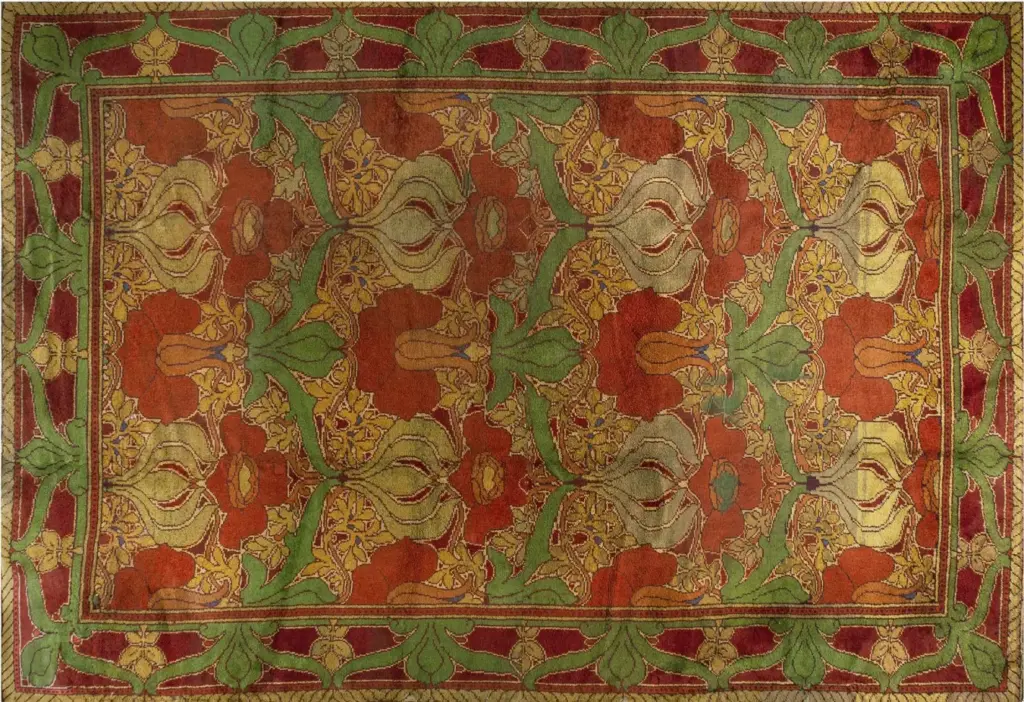
What defines an Arts and Crafts rug style is its rejection of low-quality mass production in favor of natural forms and simplicity. These rugs often bridge traditional Oriental carpet influences with a modern artisan sensibility. The design language prioritizes the integrity of the materials and the method of making as part of the style identity. It is a holistic approach where the pattern, the Wool, and the weave work together to create a harmonious interior element rather than a distracting centerpiece.
What it isn’t: generic Victorian carpet ornamentation
It is crucial to distinguish arts and crafts style rugs from the generic Victorian carpet ornamentation that preceded them. The Arts and Crafts movement was a direct reaction against the Victorian era’s overly ornate, machine-made look. Victorian carpets often featured busy, cluttered designs with three-dimensional shading intended to make flowers and fruit look realistic, as if dropped onto the floor.
In contrast, Arts and Crafts designers rejected this visual excess. They believed that a floor covering should look flat and solid, not like a window into a garden. Consequently, an authentic arts and crafts carpet style avoids the heavy, confusing elaboration typical of Victorian manufacturing. Instead, it favors clean lines and distinct motifs that respect the two-dimensional nature of the floor.
What it isn’t: “any floral” or “any vintage-looking” rug
A common error is assuming that any rug with a flower motif or a vintage appearance qualifies as an arts and crafts inspired rug pattern. However, strict design principles are required for a piece to fit this category. In this style, nature is stylized into a repeatable pattern rather than depicted with painted realism. The goal was to capture the essence of a plant—its structure and rhythm—rather than a photographic copy.
Therefore, a rug featuring chaotic, realistic bouquets or generic vintage scrolling does not meet the criteria. The “Arts and Crafts” label applies only when the botanical elements are disciplined and organized. The design must reflect the movement’s core ideals of simplicity and order. If the pattern lacks this structural logic or uses harsh, synthetic colors inconsistent with the era’s natural dye preference, it falls outside the definition.
Quick identification checklist
To accurately identify this specific style, look for these defining characteristics:
- Stylized Natural Motifs
— Why: The movement valued nature but believed it should be adapted into structured designs suitable for a flat surface, rather than mimicking 3D realism.
- Muted, Earthy Color Palettes
— Why: Designers preferred natural vegetable dyes over the harsh, bright synthetic chemicals common in mass-produced Victorian carpets.
- Hand-Knotted or Hand-Tufted Texture
— Why: Quality materials and the method of making are part of the style identity; the movement championed human craftsmanship over industrial machinery.
- Ordered Symmetry and Repeatable Patterns
— Why: This structure provides a sense of “useful beauty” and calm, contrasting with the chaotic clutter of the previous era.
Common misconceptions
| Misconception | Reality | Why it matters |
|---|---|---|
| It is defined only by age. | It is defined by philosophy and design language. | Many rugs from 1900 are Victorian or commercial styles, not Arts and Crafts. |
| Any floral rug counts. | Nature must be stylized and flat. | Realistic shading violates the movement’s principle of 2D design integrity. |
| It is purely decorative. | It focuses on “useful beauty.” | The durability and utility of the rug are just as important as its visual appeal. |
| It creates a busy look. | It aims for simplicity. | Authentic designs are meant to ground a room, not overwhelm it with ornamentation. |
Origins and Timeline: Britain → Ireland → America
British origins (1870s) and why the movement formed
The origins of arts and crafts rugs are firmly rooted in Britain during the 1870s. This distinct style developed not merely as a change in fashion, but as a direct, philosophical reaction against the Industrial Revolution. Early reformers, led by figures like William Morris, believed that rapid industrialization had degraded both the dignity of the worker and the quality of the goods produced. They argued that the separation of the designer from the maker resulted in soulless, inferior products.
Consequently, the movement sought to reunite art with labor. Unlike ancient regional rug traditions that evolved over centuries in the East, this was a deliberate, modern Western design reform. The British proponents aimed to replace the anonymity of the factory with the visible hand of the artisan. This foundational period set the stage for a revolution in textile design, prioritizing natural materials and honest construction over the artificial perfection of machine-made goods.
Rug design and weaving “golden age”
The arts and crafts rug history reached its zenith during a distinct “golden age” spanning roughly from 1880 to 1910. It was during these three decades that the theoretical ideals of the 1870s were successfully translated into physical production. Workshops across Britain began producing hand-knotted carpets that adhered to the new aesthetic principles of flatness, stylized nature, and rich, natural color.
This era marked the moment when Arts and Crafts rug design became a commercially viable yet artistically compromised alternative to mass-market flooring. The period saw the collaboration of celebrated architects and designers who turned their attention to the floor as an essential component of the “total work of art” in an interior. By 1910, the style had fully matured, establishing a legacy of design excellence before the onset of World War I shifted global aesthetic priorities.
Great Exhibition-era context and taste backlash
The stylistic choices of Arts and Crafts designers were a calculated backlash against the tastes promoted by Victorian industry, famously showcased in events like the Great Exhibition of 1851. Critics of this era derided the popular commercial carpets which featured garish colors and overly ornate, three-dimensional patterns that mimicked realistic floral arrangements or architectural relief.
Reformers viewed this machine-made ornament as deceptive and tasteless. They argued that a carpet should respect the two-dimensional nature of the floor, providing a solid foundation rather than a confusing visual depth. This critique drove the shift toward the simplified, bold, and outlined motifs that characterize the movement. The rejection of Victorian excess was central to defining the new visual language of the late 19th century.
Donegal Carpets in Ireland
While Britain provided the design philosophy, Ireland became a critical center for making these designs a physical reality, specifically through Donegal arts and crafts carpets. In the late 1890s, Scottish textile manufacturer Alexander Morton established workshops in Killybegs, County Donegal. These workshops were instrumental in turning the intricate designs of British artists like C.F.A. Voysey into scalable production without sacrificing hand-knotted quality.
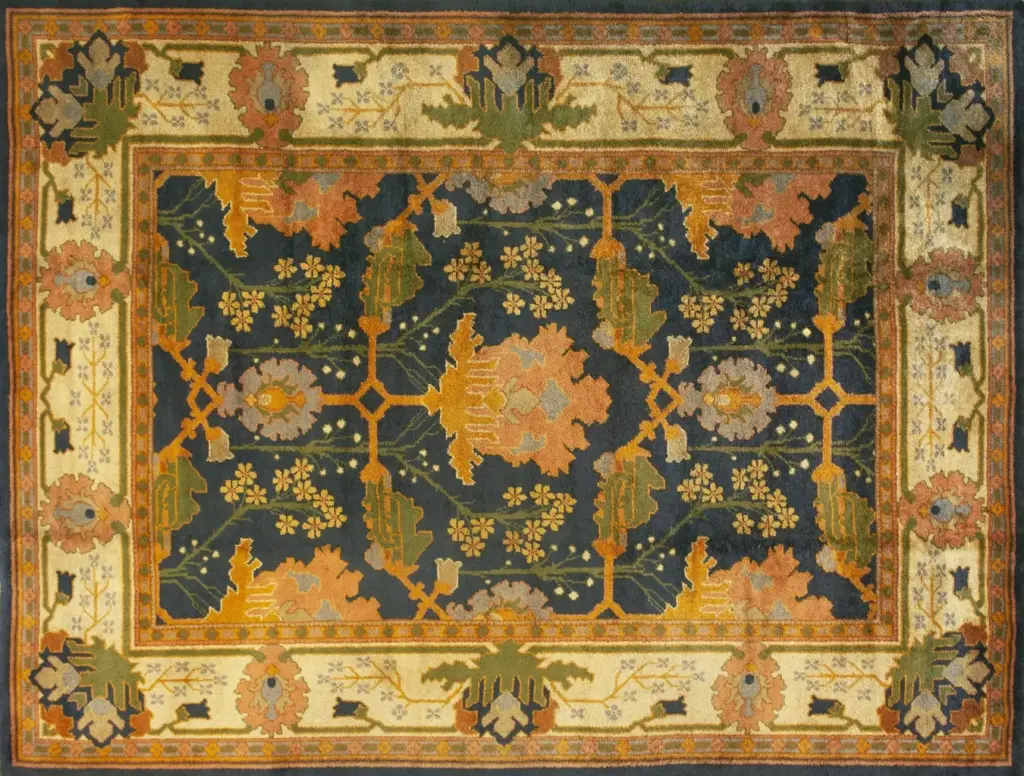
The Donegal workshops utilized the abundant local wool and a skilled local workforce to produce heavy, luxurious carpets that became synonymous with the style. These carpets often featured large-scale, open patterns with Celtic and Art Nouveau influences, distinguishing them from their British counterparts. Ireland’s contribution was vital in demonstrating that high-quality, hand-tufted rugs could be produced in volume to meet the growing demand for Arts and Crafts interiors.
U.S. spread into Craftsman/Mission interiors
By the turn of the century, the movement migrated across the Atlantic, finding a receptive audience in the United States where it integrated with craftsman era rugs 1900s. Influential American figures such as Gustav Stickley promoted the British and Irish aesthetic through publications like The Craftsman. Stickley and his contemporaries advocated for “Mission” or “Craftsman” style homes that mirrored the British ideals of simplicity and utility.
In the American context, imported Donegal and British rugs were often marketed alongside domestic Textiles to complete these interiors. The sturdy, Geometric, and nature-inspired designs of the European movement perfectly complemented the heavy oak furniture and unadorned architecture of American Craftsman homes. This trans-Atlantic adoption cemented the style’s status as an international design standard rather than a purely British phenomenon.
Timeline snapshot
- 1870s: The Philosophical Origins (Britain)
— Why: William Morris and contemporaries formulate the rejection of industrial manufacturing, establishing the theoretical basis for the movement.
- **1880–1890: The Formative Decade**
— Why: The first dedicated workshops are established, and the “flat” design language is codified to distinguish it from Victorian realism.
- 1898: Establishment of Donegal Workshops
— Why: Production scales up as Irish weavers in Killybegs begin executing designs by major British artists, creating the famous Donegal brand.
- 1900–1910: The American Adoption
— Why: The style reaches peak popularity in the U.S., becoming the standard flooring for Craftsman and Mission style architecture.
The Philosophy Underfoot: Craft, Honesty, Nature, Usefulness
The “beautiful + useful” principle for rugs
The core of the arts and crafts design philosophy rug lies in the famous maxim attributed to William Morris: “Have nothing in your house that you do not know to be useful, or believe to be beautiful.” In this context, a rug was never intended to be a purely decorative showpiece that one feared to walk upon. Instead, it was conceived as functional art underfoot—a durable foundation for daily life that simultaneously elevated the spirit.
These rugs communicate values as much as taste. By integrating beauty into a utilitarian object, the movement rejected the Victorian tendency to separate art from everyday living. A rug was expected to serve the home by providing warmth and acoustic softening, while its design provided intellectual and visual satisfaction. This duality ensured that the object possessed an inherent “useful beauty,” grounding the interior in both a physical and aesthetic sense.
Honest materials and moral design
For the Arts and Crafts reformer, design was a moral issue, and “honesty” was the supreme virtue. Constructing an honest materials wool rug meant rejecting the deception of industrial manufacturing, where low-quality fibers were often disguised with chemical treatments. Honesty in this style encompasses not just the visible pattern, but the integrity of the materials, the color, and the construction beneath.
This commitment to integrity dictated the use of high-quality, organic wool and natural dyes. Designers fiercely opposed the harsh aniline dyes introduced in the 19th century, which produced garish, fugitive colors that faded poorly. Instead, they championed vegetable and insect dyes—indigo, madder, and weld—which yielded rich, harmonious tones. This choice was not merely aesthetic; it was a statement against the “sham” of cheap, mass-produced goods that prioritized profit over quality.
Nature as a corrective to industrial ugliness
The emphasis on arts and crafts craftsmanship rugs was also a direct response to the visual chaos and grime of industrial cities. Nature served as a corrective force, offering a sense of calm, harmony, and organic order within the home. However, this did not mean bringing wild, untreated nature indoors. The movement believed in interpreting nature through a lens of order, creating stylized patterns that suggested the essence of a garden without the messiness of realism.
Owners used these rugs as philosophical statements, rejecting the cheapness of factory production in favor of harmony. The repeating patterns of vines, blooms, and leaves provided a psychological respite from the machine age. By engaging with these natural forms, the homeowner could restore a sense of connection to the natural world, fostering a peaceful environment that countered the ugliness of the rapid urbanization outside their walls.
How handcraft changes character and longevity
The physical method of creation profoundly affects the final object. Handmade arts and crafts carpets possess distinct characteristics that machine-made equivalents cannot replicate.
- Graceful Aging (Abrash)
— Why: Natural dyes and hand-spun wool create subtle tonal variations that soften and harmonize over time, rather than fading into a flat, dull gray.
- Structural Durability
— Why: Hand-knotting ties the pile directly to the foundation, creating a structure that can withstand decades of foot traffic unlike glued or machine-locked backings.
- Visual Depth and Texture
— Why: The slight irregularities of the human hand catch light differently than uniform machine weaves, giving the rug a living, breathable quality.
- Restoration Potential
— Why: Because the construction is mechanical and knot-based, these rugs can be repaired and re-knotted by conservators, extending their lifespan indefinitely.
Nuance on machines
While the movement is famous for its rejection of industrialization, the reality was nuanced. The primary enemy was the misuse of machines to produce inferior, soulless goods, not the machine itself. Some leaders of the movement acknowledged that mechanized looms could be used effectively if—and only if—the artist retained control over the design and the materials remained high quality.
Therefore, “machine-made” was not an automatic disqualification if the integrity of the design was preserved. The goal was to ensure that the tool served the craftsman, rather than the craftsman becoming a slave to the machine. A rug produced with mechanical assistance could still align with the movement’s ideals provided it eschewed the visual trickery and material shortcuts typical of commercial Victorian factories.
Key Figures and Workshops: Morris, Voysey, Donegal, and Beyond
William Morris: workshops and production
The history of William Morris carpets serves as the foundation for the entire movement’s approach to textiles. Morris, who co-founded Morris, Marshall, Faulkner & Co. in 1861 (later simply Morris & Co.), was the primary catalyst for reviving hand-knotted rug production in Britain. His initial experiments began in the late 1870s at his home in Hammersmith, where he installed looms in the coach house to personally master the craft. These early “Hammersmith” rugs are rare, identifying prototypes that established the category.
To meet growing demand, Morris eventually moved production to the larger Merton Abbey facility on the River Wandle. This expansion allowed the firm to produce larger carpets while maintaining the strict quality controls Morris demanded. The Merton Abbey workshop became the physical and philosophical center where Arts and Crafts rug design originated, proving that a modern workshop could operate on medieval guild principles of dignity and skill.
Morris & Co. patterns and technique revival
Morris & Co. did not simply produce patterns; they revived lost technical standards. Morris was obsessive about the “honest” chemistry of color, rejecting the fading, harsh aniline dyes of the Victorian commercial market in favor of permanent, rich vegetable dyes like indigo and madder. The firm’s technique revival involved high-density hand-knotting that ensured the rugs were thick, durable, and capable of aging gracefully.
The patterns produced at Merton Abbey set the aesthetic standard for the era. They featured intricate, swirling botanical motifs—acanthus leaves, vines, and stylized blooms—organized into complex but symmetrical systems. These designs required immense skill to execute, positioning the rug not as a mere floor covering, but as a woven tapestry for the floor that anchored the entire artistic scheme of a room.
C.F.A. Voysey: design system and popularity
While Morris looked backward to Persian and medieval traditions, C F A Voysey rug designs looked forward, establishing a cleaner, more modern graphic style. Voysey was less concerned with complex botanical realism and more focused on the rhythm of the repeat. His designs often featured open backgrounds with “floating” motifs of birds, hearts, or tulips, framed by wide, distinct borders.
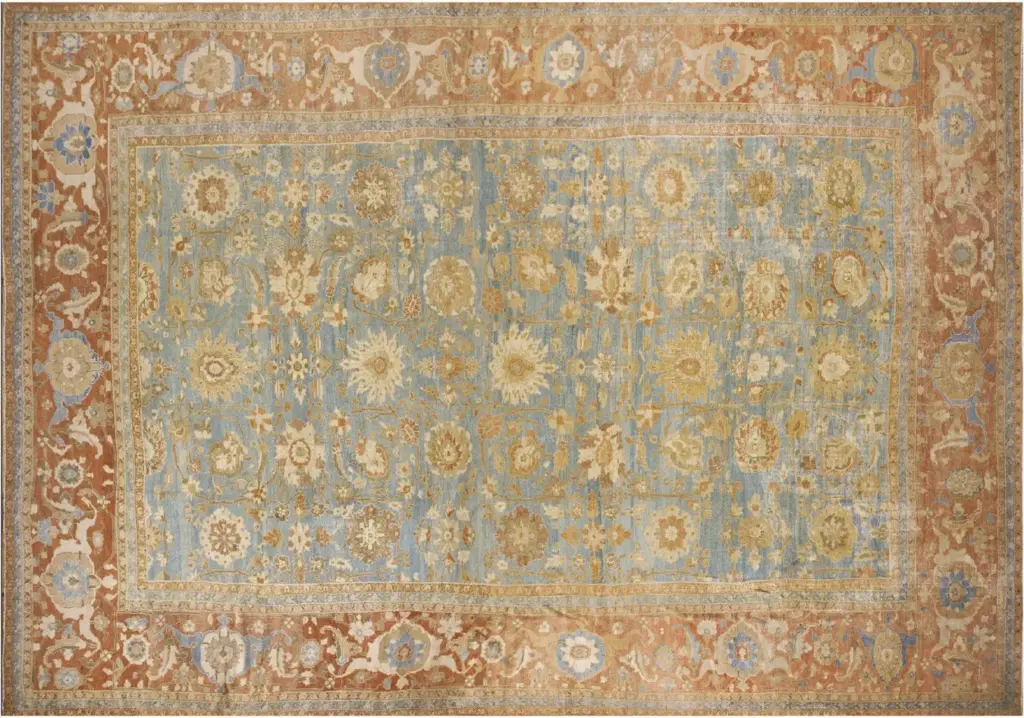
Voysey’s genius lay in creating patterns that were scalable and adaptable to different manufacturing methods without losing their artistic integrity. His ability to simplify nature into bold, flat shapes made his work immensely popular between 1890 and 1910, the period when Arts and Crafts rug design became popular globally. His lighter, fresher aesthetic provided an alternative to the dense complexity of Morris, influencing a generation of designers.
Donegal Carpets: Morton workshops and artisan training
The most significant scaling of Arts and Crafts rug production occurred in Ireland through Donegal carpets arts and crafts. Scottish textile manufacturer Alexander Morton recognized that British labor costs were high for hand-tufting, so in 1898, he established workshops in Killybegs, County Donegal. This move was not just a business decision but a social project intended to provide employment and training to the local rural population.
The Killybegs workshops successfully trained local Irish workers to execute sophisticated designs by Voysey and other British masters. These “Donegal” carpets became famous for their thick, luxurious pile and bold coloring. By combining top-tier British design with the skilled hand-craftsmanship of Irish weavers, Morton created a brand that dominated the high-end market, proving that rural artisan industries could compete with industrial factories.
Stickley and the U.S. Craftsman retail channel
The link between British design and American homes was solidified through Gustav Stickley. In the United States, Stickley craftsman rugs Voysey designs were frequently featured in The Craftsman magazine and sold through Stickley’s catalogs. Stickley understood that his American oak furniture required a specific type of foundation to look its best, and he identified the British and Irish imports as the perfect match.
Stickley acted as a curator, importing Donegal carpets and British weaves to retail alongside his own “Craftsman” line. This retail channel was crucial for the movement’s expansion, as it allowed American homeowners to purchase the exact rugs that defined the “Mission” look. Through Stickley’s endorsement, the designs of Voysey and the production of Donegal became integral parts of the American Arts and Crafts interior.
Additional contributors
- Gavin Morton
— Why: A nephew of Alexander Morton, he was a gifted colorist and designer who created many of the most iconic, geometrically stylized Donegal patterns.
- Archibald Knox
— Why: Known for his work with Liberty & Co., Knox introduced distinctive “Celtic Revival” motifs—interlaced knots and sinuous lines—into the rug lexicon.
- The Glasgow School (Charles Rennie Mackintosh)
— Why: They pushed the style toward the avant-garde, introducing linear, grid-like, and rose-motif designs that anticipated the shift toward modernism.
- Silver Studio
— Why: A prolific independent design studio that supplied patterns to major manufacturers, ensuring the “Arts and Crafts” look reached a wider commercial audience.
Design DNA: Motifs, Layouts, Borders, Rhythm
Why natural motifs dominate
The overwhelming prevalence of nature in arts and crafts rug motifs is not accidental; it is a deliberate philosophical choice. Designers of the movement believed that the natural world offered the ultimate corrective to the ugliness of the industrial age. By bringing the outdoors in, they sought to create a domestic sanctuary that echoed the tranquility of a garden or a woodland floor. Unlike the exoticism of earlier eras, this style often favored native flora—English wildflowers, hedgerow vines, and forest undergrowth—grounding the home in its local landscape.
This approach translates the garden into pattern. However, the goal was never photographic realism. Why are natural motifs common in Arts and Crafts rugs? Because they were seen as a source of honest beauty that could soothe the mind. The movement posited that looking at organic forms—leaves, branches, and blooms—calmed the eye and the spirit, offering a “restful” backdrop for daily life that machinery and urban concrete could not provide.
Common motifs
The specific vocabulary of this style is rich with recurring symbols drawn from the British countryside. Arts and crafts rug motifs frequently feature the acanthus leaf—a favorite of William Morris—alongside lilies, tulips, and roses. These botanical elements are invariably flattened and simplified, stripped of three-dimensional shading to respect the two-dimensional nature of the floor.
Animals also play a significant role, particularly in the work of C.F.A. Voysey. A **Voysey Bird motif rug** might feature stylized doves, owls, or rabbits nestled among the foliage. These creatures are not depicted as they would appear in a scientific illustration but are treated as graphic shapes that fit into the rhythmic structure of the design. Whether it is a scrolling vine or a perching bird, the motif serves the pattern first, ensuring the rug remains a cohesive textile rather than a picture canvas.
Layout logic: repeats, symmetry, and rhythmic fields
The layout of these rugs is defined by a sense of order and continuity. Many designs utilize an arts and crafts all over pattern rug structure, where a specific unit of design repeats infinitely across the field. This “infinite” layout suggests that the pattern continues beyond the physical edges of the rug, creating a sense of expansiveness.
This repetition is key to the “calm” feeling associated with the style. By establishing a predictable rhythm—A-B-A-B or mirrored symmetry—the designer creates a visual “heartbeat” that is easy for the brain to process. Unlike the chaotic, scattered compositions of the Victorian era, the Arts and Crafts field is disciplined. The symmetry provides balance, transforming a collection of leaves and flowers into a harmonious, unified surface that anchors the room without demanding constant attention.
Border systems: framing, balance, containment
The border is never an afterthought; it is a functional tool used to contain the energy of the central field and provide architectural stability to the textile.
- The Framing Function
— Why: A wide floral vine border carpet acts like a picture frame, clearly defining the edge of the functional space and separating the rug from the surrounding floorboards.
- Contrast and Balance
— Why: Borders often feature a denser or differently scaled pattern than the main field, providing necessary visual contrast that prevents the “all-over” design from feeling monotonous.
- Containment of Movement
— Why: The strong linear boundaries of the border stop the eye from wandering off the edge, recirculating the viewer’s gaze back into the restful center of the rug.
Iconic design cues
To identify the authentic “DNA” of this style, look for these specific design elements that are iconic in Arts and Crafts rugs:
- Flatness of Design
— Why: The rejection of 3D shading and perspective ensures the rug looks solid and safe to walk on, adhering to the principle of “honesty” in design.
- Stylized Abstraction
— Why: Flowers and animals are reduced to their essential lines and shapes, favoring decorative geometry over realistic chaos.
- Curvilinear Restraint
— Why: While lines are curved and organic (vines, stems), they are controlled and geometric, avoiding the “whiplash” excess of the related Art Nouveau style.
- Interlocking Repeats
— Why: Motifs are often linked by continuous stems or vines, symbolizing the interconnectedness of nature and creating a seamless visual flow.
Color Palette: Natural Dyes, Earth Tones, and Soft Contrast
Typical Arts & Crafts palette families
The palette of this movement is immediately recognizable by its grounding in the earth. **Arts and crafts Rug Colors** eschew the bright, artificial primaries of the industrial age in favor of deep, resonant tones that suggest the landscape. The core families include profound indigo blues, soft sage or olive greens that evoke forest foliage, and warm terracotta reds derived from madder root. Complementing these are rich golden mustards and warm browns, which serve as a neutral foundation.
These craftsman rug earth tones are designed to work together to create a “somber richness.” Unlike the pastel frivolity of the Rococo or the electric brightness of modern synthetic dyes, these hues are dense and saturated. An indigo sage terracotta wool rug does not shout for attention; instead, it absorbs light, adding warmth and visual weight to the floor that anchors the entire room.
Natural dyes vs aniline dyes
A central tenet of the Arts and Crafts philosophy was the rejection of the “new” aniline dyes that flooded the Victorian market in the mid-19th century. William Morris and his contemporaries viewed these synthetic chemical colors as harsh, garish, and impermanent—fading quickly to dull, lifeless grays. In contrast, they championed a natural dye palette rug approach, reviving the use of vegetable and insect dyes like indigo, madder, weld, and walnut husks.
The superiority of natural dyes lies in their ability to age gracefully. While aniline dyes clash and fade unevenly, natural dyes soften over time into a “mellow harmony.” They develop a graceful patina, where the colors seem to blend more seamlessly as the rug matures. This chemical honesty ensures that the rug retains its beauty for decades, offering a depth of color that modern synthetics struggle to replicate.
Balance and restraint: avoiding “too jewel-toned” contrast
The aesthetic goal of an Arts and Crafts rug is harmony, not high-contrast drama. Designers specifically avoided the sharp, jarring transitions often found in commercial carpets.
- Softened Transitions
— Why: Colors are chosen to bleed slightly into one another visually, creating a cohesive surface rather than a collection of isolated bright spots.
- Muted Saturation
— Why: Extremely bright or “jewel-toned” colors were considered distracting; the rug is meant to be a background element that supports the architecture, not the focal point.
- Tonal Variation (Abrash)
— Why: The use of hand-dyed wool creates slight inconsistencies in color (abrash), which adds life and texture to the rug, preventing it from looking like a flat, plastic sheet.
Palette pairing with interiors
The specific color choices of these rugs were intentional, designed to support the wood-heavy interiors of the era.
- Dark Oak and Walnut Woodwork
— Why: The warm, reddish undertones of madder and terracotta perfectly complement the heavy timber characteristic of Craftsman and Mission homes.
- Natural Stone and Brick
— Why: Sage greens and earthy browns echo the materials found in Arts and Crafts fireplaces and foundations, creating a seamless transition from floor to structure.
- Copper and Brass Hardware
— Why: Golden mustards and warm browns in the rug pick up the metallic glint of hammered hardware often found on cabinetry and doors.
Quick palette guide
| Hue family | Typical vibe | Common pairings |
|---|---|---|
| Indigo Blue | Deep, calming, infinite | Cream, mustard, rust |
| Sage / Olive Green | Organic, fresh, restful | Terracotta, chocolate brown |
| Madder Red / Terracotta | Warm, inviting, grounded | Indigo, pale gold, sage |
| Golden Mustard | Sunny, rich, illuminating | Olive green, dark oak wood |
| Warm Brown / Fawn | Neutral, stabilizing | Any accent color |
Materials and Construction: Wool, Foundations, Knots, and Weaves
Traditional materials
The durability and tactile richness of this style rely heavily on the quality of the raw materials. The standard wool arts and crafts rug is constructed with a high-grade wool pile, valued for its natural luster, resilience, and ability to hold dye deeply. While the surface is almost exclusively wool—occasionally accented with Silk or Mohair for texture and sheen—the foundation (the unseen skeleton of the rug) varies.
To answer the common question of what materials are used in traditional Arts and Crafts rugs: expect a pile of hand-spun or semi-worsted wool secured onto a foundation of Cotton, Jute, or sometimes wool. Morris & Co. frequently utilized cotton warps and jute or wool wefts. This choice was practical rather than traditional; cotton provided a rigid, consistent structure that prevented the rug from distorting, ensuring the complex, symmetrical patterns remained aligned over decades of use.
Natural dye practice
The material integrity of these rugs extends to their coloration. William Morris famously revived traditional dyeing techniques, rejecting the “fugitive” chemical dyes of the Victorian era. The “mellow” finish characteristic of a true Arts and Crafts carpet comes from the use of vegetable and insect dyes: indigo for blues, madder root for reds and terracottas, and weld for yellows and greens.
These natural substances do not sit on the surface of the fiber like some modern synthetics; they bond chemically with the wool. This results in a color that is rich but not glossy. Over time, these dyes soften and harmonize rather than fading into dull gray, creating a graceful patina that enhances the rug’s beauty as it ages.
Hand-knotting: what to look for
When evaluating a hand knotted arts and crafts carpet, specific structural details indicate the quality of the craftsmanship.
- Pile Density and Height
— Why: A dense, thick pile (often deeper than Persian counterparts) was preferred to provide a luxurious, sound-dampening feel underfoot and substantial durability.
- Knot Consistency
— Why: While hand-work implies irregularity, the best workshops maintained relatively consistent knot counts per Square inch to ensure the pattern’s resolution remained sharp.
- Fringe and Edge Finishing
— Why: In authentic pieces, the fringe is the end of the warp threads, not a sewn-on addition, indicating the rug is a single, integral structural unit.
Donegal technique: Turkish (Ghiordes) knot
The legendary durability of Irish production is largely due to the knotting technique employed. The workshops in Killybegs trained local weavers to use the Turkish, or Ghiordes, knot. A Donegal ghiordes knot rug features a symmetrical knot where the yarn loops around two warp threads and is pulled tight between them.
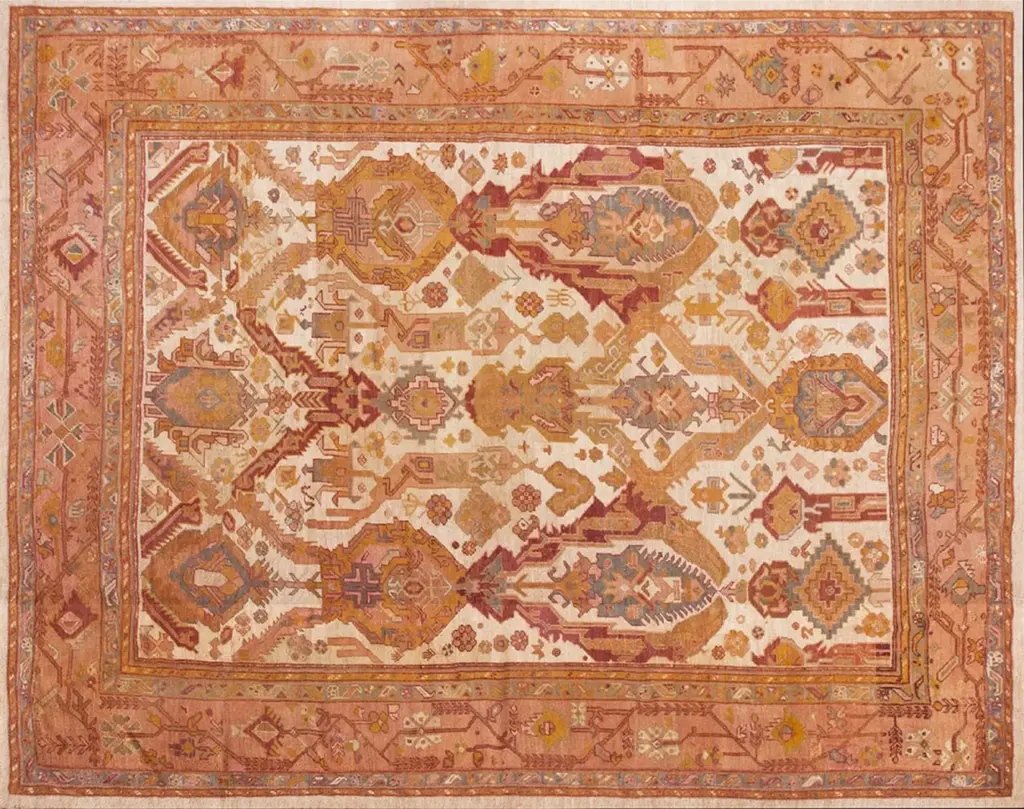
This technique is significant because it produces an exceptionally secure pile that is less likely to shed or pull out under heavy traffic. The symmetrical nature of the knot also allows for the bold, geometric, and clear-lined designs that Donegal carpets are famous for, contributing to a structure that is as robust as it is beautiful.
Hand-woven/flatwoven and jacquard production nuance
Not every high-quality example is hand-knotted. There is a distinct tradition of the arts and crafts woven carpet, which includes flatweaves (like heavy kilims) and machine-assisted Jacquard productions. The movement’s leaders, including Morris, acknowledged that mechanical looms could be used ethically if they served the artist’s vision.
Consequently, some high-end rugs were produced on Jacquard looms which allowed for intricate, repeating patterns at a more accessible price point than hand-knotting. The distinction lies in the intention and material quality; a machine-woven rug using high-grade wool and artist-controlled designs retains the “integrity” of the movement, whereas a mass-market version using cheap materials does not.
Choosing construction type
| Priority | Hand-knotted | Hand-woven/flatwoven | Why |
|---|---|---|---|
| Durability | Best | Good | Knotting creates a dense pile that withstands decades of heavy foot traffic. |
| Detail/Complexity | Best | Moderate | Individual knots allow for pixel-perfect resolution of complex vines and curves. |
| Reversibility | No | Yes | Many flatwoven structures look identical on both sides, doubling the lifespan between cleanings. |
| Price/Accessibility | High | Moderate | Weaving is faster than knotting, making these rugs more affordable without sacrificing style. |
Iconic Rugs and Patterns: The Canon and the Afterlives
Morris-era icons
The canon of Arts and Crafts flooring begins with the foundational works of William Morris. The Morris Lily carpet (1875) stands as a landmark design, representing his first attempt at a machine-made wool-Pile Carpet. Featuring stylized lilies floating against a dark, grounding background, it established the convention of using deep indigo or black fields to make natural colors pop.
Following this, the Peacock and Dragon carpet (1878) exemplified Morris’s move toward bolder, large-scale repeats. This design abandoned the delicate scatter of the Lily in favor of a powerful, interlocking structure of mythical beasts and foliage. Another significant, though rarer, example is the Swan House carpet (woven c. 1887), designed specifically for a grand interior. These pieces defined the era’s aesthetic: rich, heavy, and intellectually structured, proving that a floor covering could possess the same artistic merit as a tapestry.
Voysey icons
While Morris focused on medieval richness, C.F.A. Voysey introduced a lighter, more practical approach that defined the Voysey Donegal carpet style. Voysey’s genius lay in his structural innovation: he often designed the field pattern to be completely independent of the border.
This separation allowed his rugs to be scalable. Unlike Morris’s intricate, interlocking borders which required specific dimensions to resolve correctly, a Voysey field could be cut or extended to fit any Room Size without breaking the design logic. His iconic “botanical fields”—featuring open grids of tulips, hearts, or birds—became the standard for flexible, domestic rug design, making the Arts and Crafts look accessible to a wider variety of homes.
Famous motifs adapted into rugs
Many of the most beloved rug designs today actually began their lives as wallpapers or printed cottons. The Strawberry Thief rug is a prime example of this cross-medium translation. Originally designed as a textile in 1883, its mirror-image symmetry and dense foliage made it perfectly enticing for the floor. The thrushes stealing strawberries provide a playful yet orderly narrative that translates beautifully into a thick wool pile.
Similarly, the “Seaweed” pattern, designed by J.H. Dearle in 1901, was adapted from wallpaper into rug formats. Its sinuous, underwater tendrils and lack of rigid geometric grid offered a fluid, organic alternative to stiffer designs. These adaptations highlight a key feature of the movement: the universality of the pattern. Because the design language was based on flat, stylized nature, a motif could migrate from a wall to a chair to a floor without losing its integrity.
What makes a rug “iconic” in this category
To answer what design elements are iconic in Arts and Crafts rugs, one must look for specific interactions between nature and structure.
- Stylized, Not Realistic, Nature
— Why: Icons like the Lily carpet succeed because the flowers are flattened into design elements rather than painted like a 3D picture.
- Strong Rhythmic Repeats
— Why: The most enduring patterns, like Peacock and Dragon, rely on a powerful, visible grid or wave structure that organizes the natural motifs.
- Scalable Composition
— Why: Designs that allowed for variable sizing (like Voysey’s independent fields) became commercially successful and widely distributed.
- Narrative or Mythic Elements
— Why: Patterns that hint at a story or a specific environment (a garden, a forest, a legend) resonate more deeply than Abstract shapes.
Where originals are encountered today
Authentic examples from the 1880–1910 period are rare treasures, usually found in specific contexts.
- Major Museums (e.g., V&A Museum)
— Why: Institutions preserve pristine examples to demonstrate the technical and artistic peak of British textile history.
- National Trust Properties
— Why: Historic homes often retain their original furnishings, allowing visitors to see how these rugs functioned in their intended architectural settings.
- High-End Auctions
— Why: When original Morris or Donegal carpets appear at auction, they command high prices due to their scarcity and condition.
- Reproduction Collections
— Why: Because the patterns are timeless, high-quality modern reproductions keep the “afterlife” of these designs active in contemporary homes.
Comparisons That Clarify: Oriental, Kilim/Geometric, Modern, and Mission
Arts & Crafts vs Persian/Oriental rugs
While often grouped together in general decor discussions, the arts and crafts vs oriental rug distinction is fundamental. Persian and Oriental rugs are the products of ancient, evolving regional traditions, carrying centuries of inherited symbolism and cultural meaning specific to the East. In contrast, Arts and Crafts rugs are the result of a deliberate, intellectual design reform in the late 19th-century West.
Designers like Morris and Voysey admired Oriental carpets for their flat, stylized approach but sought to create a new, native language. They replaced the intricate, dense mathematics of the Persian knot with broader, clearer patterns that reflected the British countryside. Arts and Crafts rugs are “signed” works of individual artists reacting to industrialization, whereas traditional Oriental rugs are often the collective expression of a tribe or village lineage.
Differences in motifs and layouts
The visual difference lies chiefly in the subject matter. How do Arts and Crafts rugs differ from Oriental rugs? While Oriental rugs feature boteh, medallions, and intricate arabesques, Arts and Crafts rugs prioritize Western botanical life. You will see recognizable English flowers—lilies, tulips, roses—and animals like thrushes or rabbits, all stylized into repeatable patterns.
Structurally, while both use borders, Arts and Crafts layouts often favor an “all-over” repeat without a Central Medallion. This creates a more democratic, less hierarchical field that feels expansive. The lines in Arts and Crafts designs are curvilinear but controlled, lacking the frenetic density often found in highly detailed Persian city rugs.
Arts & Crafts vs tribal/geometric/kilim
When comparing an arts and crafts rug vs kilim, the difference is textural and geometric. Tribal rugs and kilims rely on angular, stepped geometry necessitated by their weaving techniques. They are often flatwoven, lightweight, and feature bold, contrasting blocks of color.
Arts and Crafts rugs, conversely, are typically hand-knotted with a thick, luxurious wool pile. Their design language is curvilinear—vines loop and curve rather than zigzag. While a kilim feels rustic and nomadic, an Arts and Crafts rug feels architectural and settled, designed to add weight and permanence to a furnished room.
Arts & Crafts vs modern/contemporary
The divide between an arts and crafts rug vs modern rug centers on narrative and abstraction. Modern Rugs often embrace pure abstraction, asymmetry, or minimalism, stripping away recognizable forms to focus on texture or color fields.
Arts and Crafts designs, however, never fully abandon the narrative of nature. Even the most stylized Voysey pattern retains the identity of a flower or a bird. There is always a link to the organic world. Furthermore, Arts and Crafts designs adhere to a strict logic of symmetry and repeat, whereas contemporary designs frequently break these rules to create tension or surprise.
Arts & Crafts vs Mission style rugs
The relationship between mission style rug vs arts and crafts is one of overlap rather than opposition. “Mission style” refers broadly to the American architectural and furniture movement (led by figures like Stickley) which championed simple lines and oak construction. These interiors frequently used Arts and Crafts rugs as their foundation.
However, strictly speaking, “Mission” patterns tend to be more geometric and austere, influenced by Native American and Spanish colonial motifs. Arts and Crafts patterns remain rooted in British botanical whimsy. While they are historically and aesthetically compatible—sharing the same era and wood-heavy context—their design vocabularies differ: one leans toward the geometric Southwest, the other toward the verdant English garden.
Comparison tables
| Attribute | Arts & Crafts | Persian/Oriental | Kilim/Tribal | Modern |
|---|---|---|---|---|
| Origin | Western Design Reform (1880s) | Ancient Eastern Tradition | Nomadic/Village Tradition | 20th/21st Century Art |
| Motifs | Stylized Western Flora/Fauna | Boteh, Medallions, Arabesques | Angular Geometry, Totems | Abstract, Minimalist |
| Primary Forms | Curvilinear, Repeating Vines | Intricate, Dense Patterns | Stepped, Zigzag Lines | Asymmetric, Free-form |
| Color Feel | Earthy, Muted, “Mellow” | Jewel Tones, Deep Reds/Blues | Bold, High Contrast | Monochromatic or Vivid |
| Texture | Thick Wool Pile | Varied (Fine Silk to Wool) | Flatwoven (No Pile) | Varied (Shag to Flat) |
Decorating With Arts & Crafts Rugs Today (Including Modern Interiors)
Using them in Craftsman interiors
In traditional settings, craftsman rug styling relies on a philosophy of harmonious integration. Historically, these rugs were designed to anchor rooms dominated by heavy oak architecture, exposed beams, and built-in cabinetry. The key to success in a Craftsman or Mission interior is to lean into the warm, earthy palette. The rug should act as the foundational layer that ties the rich wood tones together with the wall color. Because the architecture itself is often linear and geometric, the curvilinear, organic patterns of a William Morris rug decor scheme provide a necessary softness, breaking up the straight lines without clashing with the structural honesty of the home.
Using them in modern interiors
Integrating an arts and crafts rug in modern interior requires a strategy of contrast and restraint. Can Arts and Crafts rugs fit modern interiors? Absolutely, provided you “edit the room.” In a contemporary space with neutral walls and streamlined furniture, a bold Arts and Crafts rug becomes the sole “hero” piece.
The density of the pattern serves as a counterpoint to the minimalism of modern design. Instead of competing with other busy elements, the rug adds depth, soul, and a sense of history to a sleek environment. To make this work, keep the major furniture silhouettes simple and unadorned. Let the rug carry the visual weight of the pattern, while the rest of the room remains airy and uncluttered.
Layering patterns successfully
Mixing patterns with such distinct rugs requires a careful hand.
- Vary the Scale
— Why: If the rug has a large-scale repeat (like Morris’s Peacock and Dragon), choose smaller, tighter patterns for throw pillows or curtains to prevent visual competition.
- Echo Key Colors
— Why: Pull one or two specific shades from the rug—perhaps a sage green or indigo blue—and repeat them in solid fabrics elsewhere to create a cohesive thread.
- Balance Organic with Geometric
— Why: The swirling vines of an Arts and Crafts rug pair beautifully with simple stripes or plaids, offering a pleasing contrast between fluid and rigid forms.
Room-by-room pairing ideas
Different spaces offer unique opportunities for mission living room rug ideas and beyond.
- Living Room
— Why: Use a large central rug to ground a seating arrangement of leather or linen sofas; the natural materials echo the rug’s ethos of honest craftsmanship.
- Dining Room
— Why: A bordered rug frames the dining table perfectly; ensure the border is wide enough to remain visible even when chairs are pulled out.
- Hallway / Entry
— Why: A runner with a dense, dark-ground pattern (like the Morris Lily) hides high-traffic wear while immediately establishing a welcoming, historical tone.
- Bedroom
— Why: Smaller scatter rugs on either side of the bed introduce warmth and softness underfoot without overwhelming the serene atmosphere needed for sleep.
Common mistakes to avoid
Even with beautiful pieces, styling errors can undermine the look.
- Overcrowding with Pattern
— Why: Placing an intricate Arts and Crafts rug in a room with floral wallpaper and patterned upholstery creates visual chaos; the eye needs a place to rest.
- Ignoring the Foundation
— Why: These rugs look best on wood or stone floors; placing them over wall-to-wall carpeting often cheapens their appearance and causes bunching.
- Mismatched Lighting
— Why: Harsh, cool-toned LED lighting clashes with the warm, natural dyes of the rug; opt for warm white bulbs (2700K–3000K) to enhance the richness of the wool.
- Sizing Too Small
— Why: A “postage stamp” rug floating in the middle of a room looks disconnected; the rug should be large enough for the front legs of furniture to sit on it.
Buying and Authenticity: Antique vs Reproduction, What to Look For
Antique originals vs later copies
Authenticating an antique arts and crafts carpet requires careful examination of the materials, as the design itself is easily copied. Original pieces from the 1880–1910 period, such as those from the Morris & Co. or Donegal workshops, are distinguished by their dye quality and wool character. In true antiques, natural dyes will have softened into a mellow, harmonious palette over time—a phenomenon known as “abrash”—whereas later commercial copies often display the harsh, uniform fading typical of early synthetic chemical dyes.
Furthermore, the wool itself tells a story. Originals used high-grade, hand-spun wool that retains a natural luster and resilience even after a century. Later copies, particularly mass-market versions from the mid-20th century, often feel drier and more brittle. The weave structure in an original is typically a dense, hand-knotted pile that feels substantial and heavy, unlike the looser, flimsier construction of cheaper imitations.
Reproductions and reinterpretations
For most homeowners, a morris rug reproduction is the most accessible way to bring this style home. However, there is a significant difference between a faithful reproduction and a loosely “inspired” piece. Faithful reproductions are often licensed designs produced by specialist makers who adhere to the original patterns, color palettes, and material standards (using 100% wool and hand-knotting).
In contrast, “inspired” reinterpretations often simplify the pattern, alter the scale, or introduce modern materials like Viscose or Polyester blends. While these can be affordable and visually striking, they lack the durability and the “honest” material philosophy of the movement. A good reproduction honors the style by prioritizing strong design and natural materials, ensuring the rug ages gracefully rather than deteriorating quickly.
What to inspect before purchase
When you decide to buy arts and crafts rug pieces, inspect these critical elements to gauge quality:
- Fiber Content
— Why: Ensure the pile is 100% wool (or a wool/silk blend); avoid viscose or synthetic blends which crush easily and do not clean well.
- Dye Appearance
— Why: Look for rich, saturated colors that appear to penetrate the fiber deeply, rather than a surface print that reveals white roots when the pile is parted.
- Backing and Foundation
— Why: A hand-knotted rug will have a pattern visible on the back that mirrors the front; a canvas backing usually indicates a hand-tufted rug held together with glue (latex), which has a shorter lifespan.
- Pattern Resolution
— Why: Check the clarity of the curves and vines; jagged, pixelated lines suggest a low knot count or poor design translation.
Where they’re sold
Finding quality arts and crafts rugs involves knowing where to look based on your budget and authenticity goals.
- Specialist Dealers and Auctions
— Why: The primary source for genuine antiques and investment-grade collectibles; offers expertise and provenance but at premium prices.
- Licensed Heritage Brands
— Why: Companies that hold the archives (like Morris & Co.) license accurate reproductions that guarantee design fidelity.
- High-End Rug Showrooms
— Why: Often carry hand-knotted contemporary productions from India or Nepal that use traditional techniques to recreate Arts and Crafts designs.
- Online Marketplaces
— Why: Good for finding vintage or “inspired” pieces, but requires vigilance regarding material descriptions and return policies.
Construction choice by lifestyle
To answer the common questions—”Should I choose a hand-knotted or hand-woven Arts and Crafts rug?” and “How does hand craftsmanship affect Arts and Crafts rugs?”—refer to this lifestyle guide.
| Situation | Best construction | Why |
|---|---|---|
| High Traffic (Hallway/Family Room) | Hand-Knotted | The dense pile and individual knots provide maximum durability and resilience against crushing. |
| Casual/Budget-Friendly (Bedroom/Den) | Hand-Woven / Flatweave | More affordable and lighter weight; offers the aesthetic without the heavy investment, though less plush. |
| Short-Term / Low Use (Guest Room) | Hand-Tufted | Provides the visual look of a thick rug at a lower price point, but relies on glue that degrades over time. |
| Investment / Heirloom | Antique Hand-Knotted | Only authentic knotting and natural materials retain value and history; hand craftsmanship ensures it can be restored. |
Care and Longevity: Keeping Wool Arts & Crafts Rugs Beautiful
Routine maintenance
The primary enemy of any wool arts and crafts rug is not foot traffic, but the microscopic grit and dirt that accumulates at the base of the pile. This grit acts like sandpaper, cutting the wool fibers over time. To maintain the structural integrity of the rug, follow this routine:
- Vacuum Regularly with Suction Only
— Why: Frequent removal of surface dust prevents dirt from settling deep into the foundation where it causes permanent abrasion.
- Disengage the Beater Bar
— Why: The rotating brush found on most vacuums is too aggressive for hand-knotted wool and can shred the pile or tear the fringe.
- Sweep with a Natural Bristle Broom
— Why: Occasional sweeping helps realign the pile and brings luster to the wool without the mechanical stress of a vacuum.
Gentle cleaning principles for wool
When considering wool rug cleaning tips, the guiding principle is preservation. Wool is a protein fiber that contains natural oils (lanolin) which repel dirt and moisture. Aggressive cleaning with harsh chemicals or high heat strips these oils, leaving the fiber brittle and dull.
Furthermore, natural dye rug care requires specific pH awareness. The indigo, madder, and weld dyes used in authentic Arts and Crafts rugs can be sensitive to highly alkaline cleaners (like Standard Carpet shampoos), which may cause colors to bleed or shift. Cleaning solutions should always be pH-neutral and applied sparingly. The goal is to lift soil without stripping the rug of the character and patina that define its value.
Stain response steps
Accidents happen, but quick action can prevent permanent damage. If a spill occurs on your arts and crafts rug care list, follow these steps immediately:
- Blot, Never Rub
— Why: Rubbing forces the liquid deeper into the pile and can permanently mat or distort the wool fibers.
- Use Cold Water Only
— Why: Hot water can “set” protein-based stains (like food or blood) and may cause natural dyes to run.
- Apply a White Vinegar Solution
— Why: A mixture of white vinegar and water is a gentle, natural cleaner that helps neutralize odors without damaging the dye chemistry.
- Elevate and Dry Thoroughly
— Why: Damp wool sitting on a floor invites mold and mildew into the cotton foundation; prop the wet area up to allow air circulation from both sides.
Sunlight, rotation, and padding
To answer the question of how to maintain handmade wool rug investments for the long term, you must address environmental factors.
- Install a High-Quality Rug Pad
— Why: A dense pad acts as a shock absorber, reducing the friction between the rug and the floor that wears down the knots from the underside.
- Rotate the Rug Annually
— Why: This ensures that foot traffic wears the pile evenly and prevents specific areas from becoming threadbare while others remain pristine.
- Filter Direct Sunlight
— Why: Ultraviolet rays can fade natural dyes significantly; rotating the rug helps even out fading, but window treatments are the best defense against color loss.
Professional cleaning: when and why
While spot cleaning handles daily life, a deep professional wash is necessary every three to five years. For valuable Arts and Crafts rugs, this should never be done by a standard steam-cleaning service. You require a specialist who understands dye stability and hand-washing techniques.
Professional immersion cleaning removes the deep-seated dust that vacuuming misses. Experts will “dust” the rug (vibrate the dry soil out) before washing it. This is crucial for maintaining the hygiene of the heavy wool pile and removing odors. Moreover, professionals can test the dyes for stability before introducing water, preventing the disastrous bleeding of reds into whites that can ruin an iconic Morris or Voysey pattern.
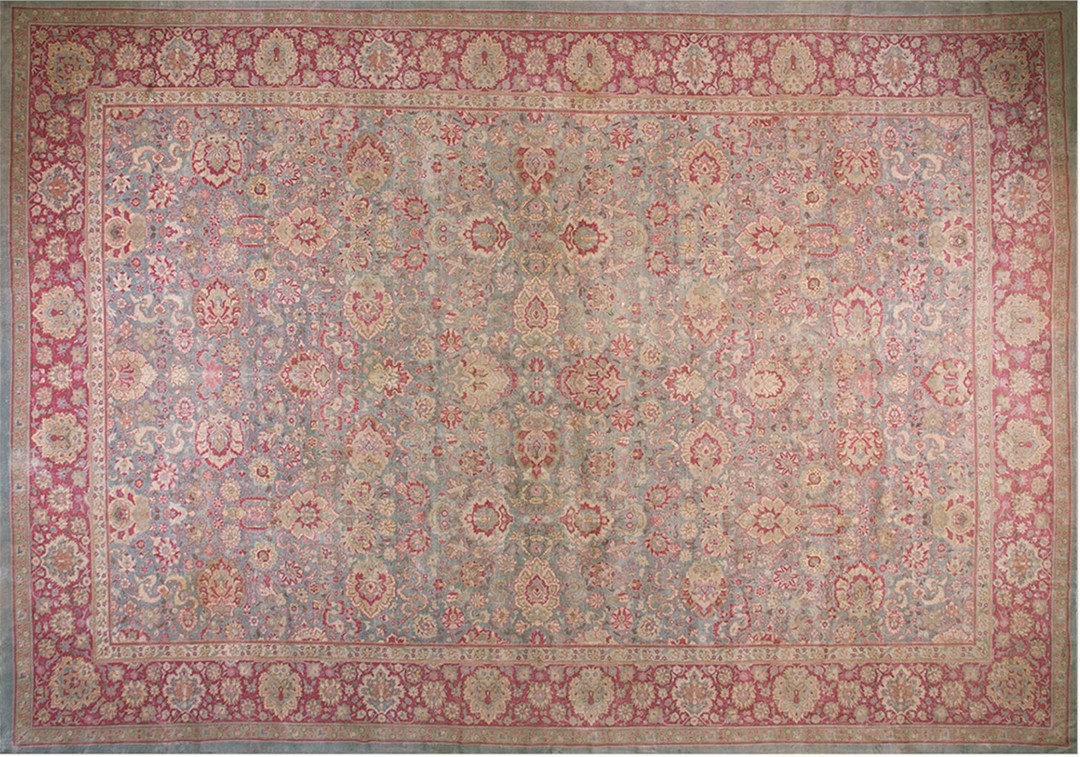
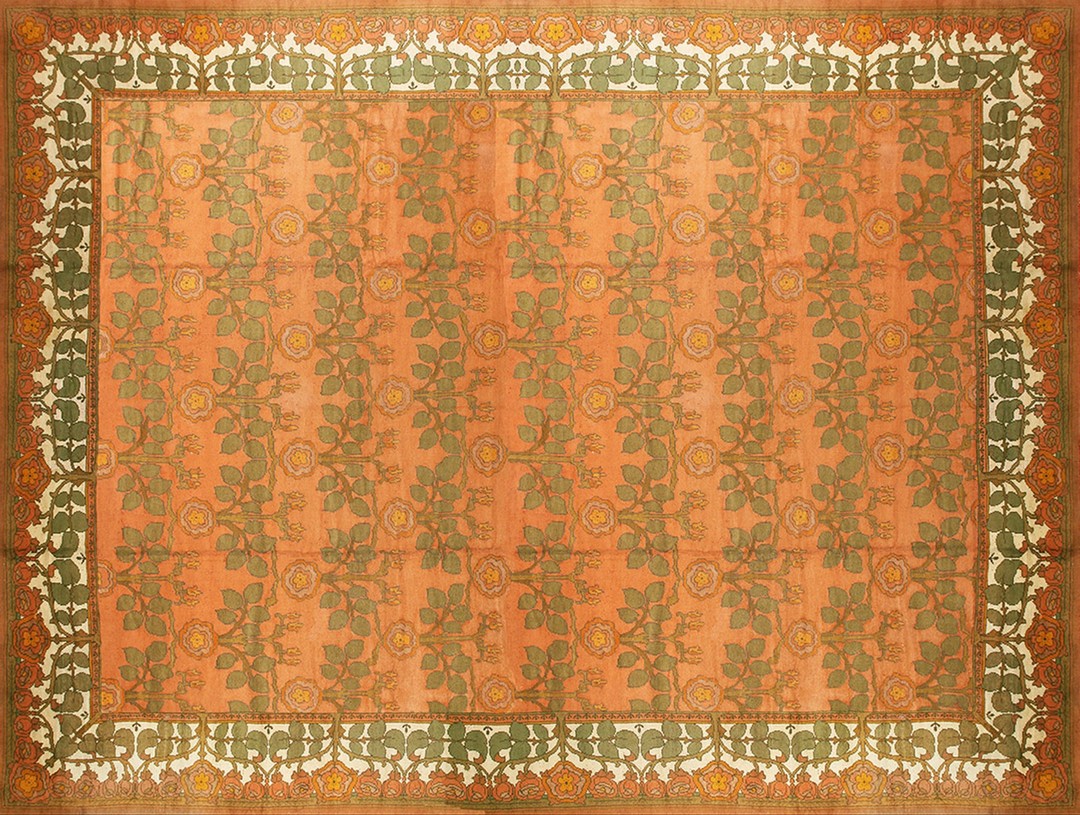
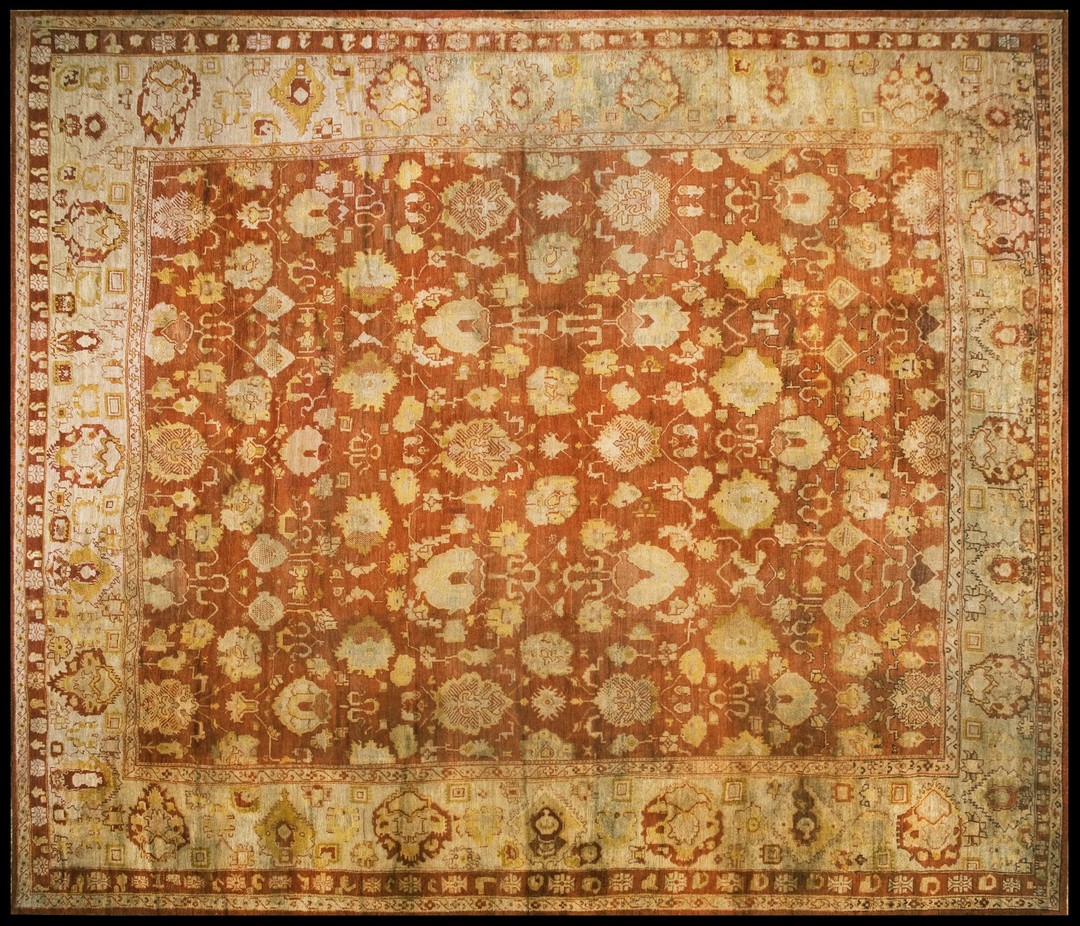
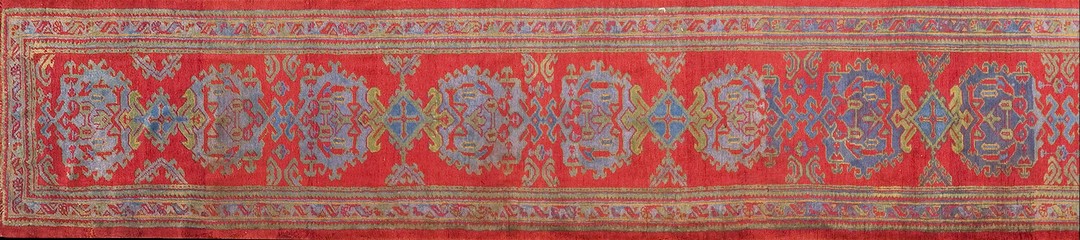
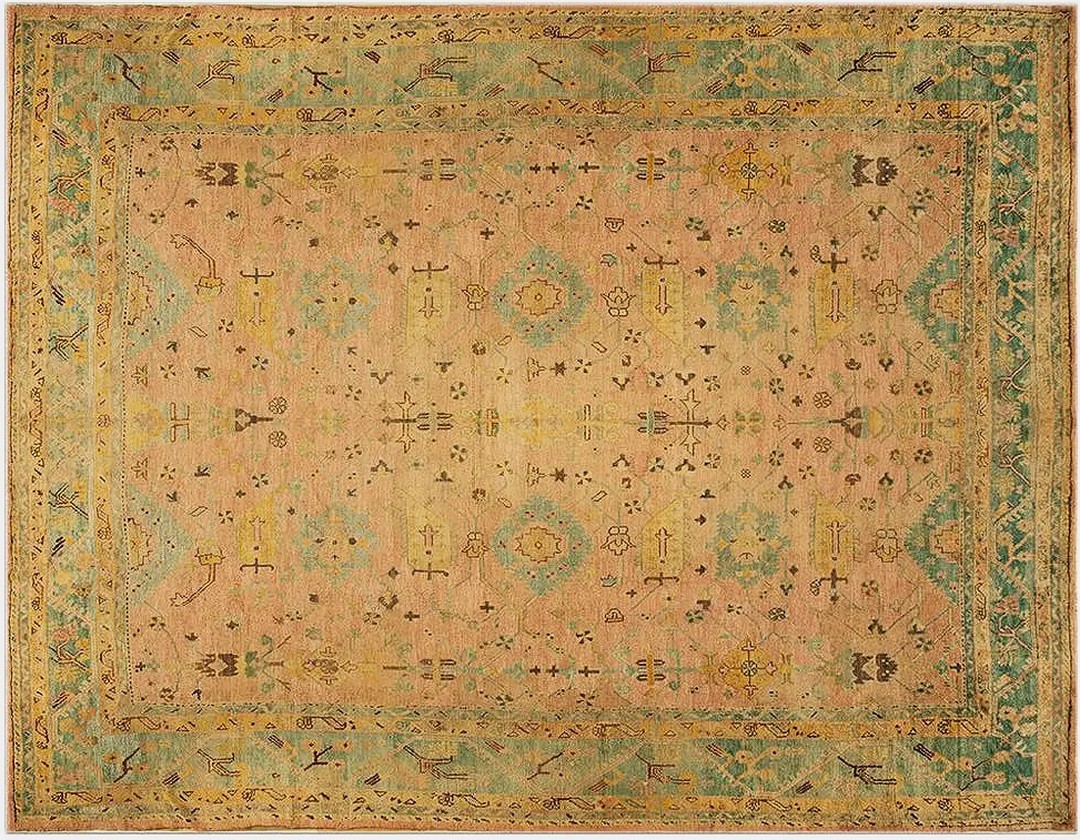
Explore a Few of Our Arts and Crafts Rugs

FAQ
- How do I prevent fading on Arts and Crafts rugs?
Rotate Arts and Crafts rugs every 6–12 months and use window UV protection when possible. Direct sun is the biggest culprit—fading often shows first along bright window lines.
- Can I use a steam cleaner on Arts and Crafts rugs?
It’s usually risky, especially for wool or older Arts and Crafts rugs, because heat and moisture can cause dye bleed or shrinkage. If you must, test a hidden corner first and keep moisture minimal.
- How do I clean Arts and Crafts rugs safely?
Vacuum weekly (no beater bar on delicate or fringe-heavy Arts and Crafts rugs) and blot spills fast with water and mild wool-safe soap. For deep cleaning, use a reputable rug wash service.
- How can I tell if Arts and Crafts rugs are handmade?
Check the back: handmade Arts and Crafts rugs often show clear pattern definition, slight irregularities, and visible knots or weft structure. Perfectly uniform backing and printed patterns suggest machine production.
- Are vintage Arts and Crafts rugs valuable?
Some vintage Arts and Crafts rugs can be collectible, especially well-documented pieces in good condition. Value usually depends on rarity, condition, size, and whether colors remain strong and even.
- How much do Arts and Crafts rugs cost?
Arts and Crafts rugs range widely: machine-made can start under $300, while hand-knotted wool often runs $1,000–$5,000+ depending on size, materials, and knot density.
- Do Arts and Crafts rugs work in modern interiors?
Yes—Arts and Crafts rugs can soften minimal spaces with pattern and warmth. Keep surrounding materials simple, and let the rug be the “crafted” focal point.
- How do I style Arts and Crafts rugs with Mission-style furniture?
Arts and Crafts rugs pair well with Mission-style furniture by echoing straight lines and warm wood tones. Match one rug color to a wood undertone (oak/walnut) and keep upholstery simple.
- Are Arts and Crafts rugs suitable for bedrooms?
Yes—Arts and Crafts rugs add warmth and structure in bedrooms. A common setup is a 8×10 under a queen bed, or 2×3 rugs on each side for smaller budgets.
- What size Arts and Crafts rug works under a dining table?
Pick an Arts and Crafts rug that extends about 24 inches beyond the table on all sides. This helps chairs stay on the rug when pulled out.
- How do I choose the right size for Arts and Crafts rugs in a living room?
For Arts and Crafts rugs, aim for front legs of main furniture on the rug or all legs on for a formal layout. Common sizes are 8×10 or 9×12 for standard rooms.
- Can I put Arts and Crafts rugs on top of carpet?
Yes—Arts and Crafts rugs can be layered over low-pile carpet to define a seating area. Use a thin, firm pad or gripper to reduce shifting and rippling.
- Do Arts and Crafts rugs need a rug pad?
Most Arts and Crafts rugs benefit from a rug pad for grip and cushioning. A pad can also reduce edge curl and extend rug life by lowering friction on the backing.
- Are Arts and Crafts rugs good for homes with kids and pets?
Generally yes, especially wool Arts and Crafts rugs with lower pile and tighter construction. Choose darker, patterned fields to hide crumbs and hair, and trim pet nails to reduce snags.
- Are Arts and Crafts rugs good for high-traffic areas?
Yes—Arts and Crafts rugs in wool, especially tighter weaves, handle traffic well. Use a quality rug pad and rotate every 6–12 months to even out wear.
- What rug pile height works best for Arts and Crafts rugs?
Low to medium pile is common for Arts and Crafts rugs because it keeps patterns crisp. A typical range is about 0.25–0.5 inches, depending on construction.
- What materials are best for Arts and Crafts rugs?
Wool is the classic choice for Arts and Crafts rugs because it’s resilient and dyes well. Wool blends can work, but 100% wool is often the safest long-term performer.
- Are Arts and Crafts rugs usually hand-knotted, hooked, or flatwoven?
Arts and Crafts rugs can be hand-knotted, hand-hooked, or flatwoven depending on maker and era. Many modern interpretations use hand-knotted wool for durability and crisp pattern edges.
- How are Arts and Crafts rugs different from Art Deco rugs?
Arts and Crafts rugs emphasize organic inspiration and handcraft, while Art Deco rugs highlight sleek geometry and modern glamour. Deco often reads sharper and more machine-age (1920s–30s).
- How are Arts and Crafts rugs different from Art Nouveau rugs?
Arts and Crafts rugs lean more rectilinear and structured, while Art Nouveau rugs favor sweeping curves and whiplash lines. If it feels “architectural,” it’s often closer to Arts and Crafts.
- What motifs show up most in Arts and Crafts rugs?
Arts and Crafts rugs commonly feature stylized florals, vines, leaves, birds, and simple trellis forms. Look for motifs that feel flattened and graphic, not highly shaded or photographic.
- What colors are common in Arts and Crafts rugs?
Arts and Crafts rugs often use earth tones like olive, rust, ochre, tan, and deep blue. Many palettes are muted-but-rich, chosen to feel natural and age gracefully.
- What design features define Arts and Crafts rugs?
Arts and Crafts rugs typically use clear outlines, balanced geometry, and stylized plants or animals. Expect orderly repeats, strong borders, and “designed-by-hand” symmetry rather than busy realism.
- When did Arts and Crafts rugs become popular?
Arts and Crafts rugs rose with the Arts and Crafts era, roughly 1880–1910, and stayed influential into the early 20th century through Mission-style and bungalow interiors.
- What are Arts and Crafts rugs?
Arts and Crafts rugs are rugs inspired by the late-1800s/early-1900s Arts and Crafts movement, emphasizing handmade craftsmanship, simple structure, and nature-based motifs over flashy ornament.