
Rug Repair & Restoration: The Invisible Mend Standard
At Rugs On Net, our Manhattan studio provides a complete spectrum of specialized care for your hand-knotted textiles. Beyond this service, we ensure your investment remains structurally sound and visually vibrant.
Bring us the damage before it spreads. We preserve structure, honor patina, and return your rug with strength that does not announce itself.
Also read about our other services we offer: Rug Blocking and Stretching, Moth Proofing, and Rug Cleaning.
Comprehensive Rug Care Services
You cannot replace something that was never mass-produced. A hand-knotted rug carries decisions made by human hands — knot by knot, row by row, often over months or years on a village loom. When that textile is damaged, the question is not “can I buy another one?” The question is “can the original be conserved?” At Rugs On Net, the answer is almost always yes, and our benchmark for the work is simple: The Invisible Mend — repair so integrated that the eye follows the design, not the intervention.
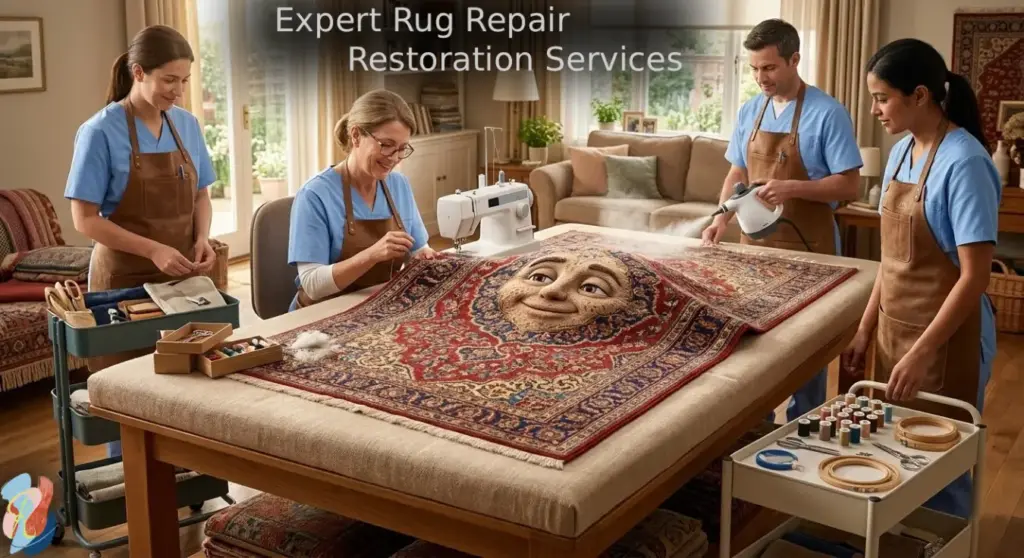
The hallmark of great repair is invisibility. We match knots, not just colors. We match tension, not just pattern. And we match age — because a newly bright repair on a century-old textile looks worse than the damage it replaced.
Why Small Damage Becomes Expensive Fast
This is the single most important thing I tell rug owners: damage does not wait. A hand-knotted rug is a tensioned system where every element — warp, weft, knot, edge binding, fringe — depends on the others for stability. When one element fails, the load transfers to the surrounding structure. We call this The Cascade Effect, and it is the reason a $200 fringe repair today can prevent a $2,000 foundation reconstruction next year.
A fringe is not decoration. It is the exposed ends of the warp threads — the vertical foundation that runs the entire length of the rug. Every knot in the textile is tied around those warps. When fringe deteriorates, the terminal knots at the edge loosen. Once those knots release, the next row loosens. Then the next. This is The Unraveling Clock, and it accelerates with every vacuum pass, every footstep, every time the rug is moved or rolled.
I have examined rugs where a client brought it in for “a small fringe issue” and the diagnostic revealed that the unraveling had already migrated three inches into the field — destroying knot rows that took the original weaver days to tie. That is the cascade in action. The visible fringe damage was the symptom. The real problem was already inside the rug.
Textile Forensics: How We Diagnose Before Any Repair
Every repair project at Rugs On Net begins with Textile Forensics — a comprehensive diagnostic evaluation that must happen before any tool touches the rug. This is not a cursory glance. It is a systematic assessment of the textile’s construction, condition, history, and repair requirements.
Why is this step so important? Because a repair that ignores the rug’s construction logic will fail. A Persian rug uses asymmetric (Senneh) knots. A Turkish rug uses symmetric (Ghiordes) knots. The repair must match the original knot type, or the repaired section will have a different pile density, different light refraction, and a visibly different texture. The same principle applies to yarn twist direction, weft spacing, and foundation thread count. Get any of these wrong, and the repair announces itself.
What We Evaluate
The KPSI Standard
KPSI — Knots Per Square Inch — is the fundamental metric of rug construction density. A coarse tribal rug might have 40-80 KPSI. A fine Persian Isfahan might have 400-800 KPSI. The repair must match the original density precisely, because KPSI determines pile height, pattern resolution, and structural flexibility. Reweaving a 300 KPSI rug at 200 KPSI creates a soft, loose patch that sinks relative to the surrounding field. Reweaving at 400 KPSI creates a stiff, raised patch. Neither is invisible.
Foundation Architecture
Before we can address the visible damage, we need to understand the condition of the Foundation Architecture underneath — the warp and weft engineering that holds everything together. If the foundation is compromised (dry rot, insect damage, structural fatigue), cosmetic pile repair on top of a weak foundation is wasted effort. It would be like patching drywall on a wall with a cracked stud. We assess warp/weft stability first and address structural issues before any cosmetic work begins.
Color Archaeology
Matching colors in a rug repair is not like matching paint at a hardware store. A century-old rug has undergone decades of light exposure, oxidation, and chemical change. The red that the weaver tied in 1920 does not look like the same red dye today. It has mellowed, shifted, and developed what collectors call patina. If we repair with freshly dyed yarn that matches the “original” red, the patch will look brand new against a field that has aged — which is exactly as visible as leaving the hole.
This is why we practice what we call Color Archaeology: matching the color as it exists today, accounting for oxidation, UV fading, and natural aging. We select and sometimes custom-blend yarns to integrate with the current state of the rug, not its theoretical original state. The goal is The Patina Principle — age-appropriate harmony, not over-restored brightness.
Our Repair & Restoration Services
Our Manhattan studio handles virtually every type of damage a hand-knotted or handmade rug can sustain. Each type of damage tells a story about the rug’s life, and each requires a specific approach grounded in understanding the textile’s construction, fiber chemistry, and dye composition.
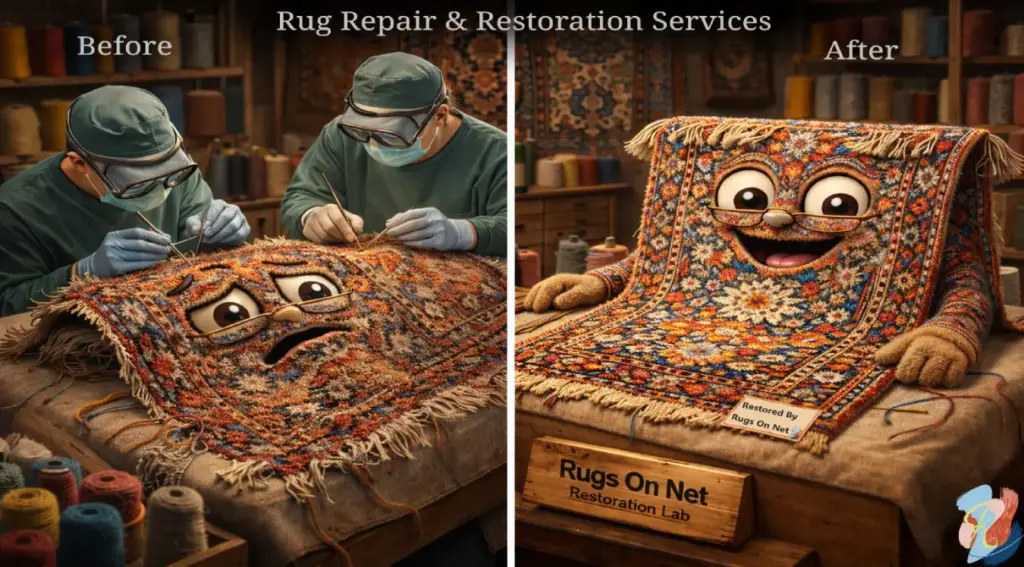
Fringe Repair & Reconstruction
Most rug owners think of fringe as a decorative border. In a hand-knotted rug, fringe is structural. It is the exposed ends of the warp threads that run the entire length of the textile. Every knot is tied around these warps. When the fringe deteriorates, the knots at the edge loosen and the rug begins to unravel — not just at the fringe, but progressively inward, row by row.
This is why fringe repair is one of the most urgent services we provide. A minor fringe issue today can become a major structural failure in months. I tell clients: if you are going to address one thing, address the fringe.
- Re-inserting original fringe: The most authentic repair. We hand-weave the original warp threads back into the rug’s structure, fully restoring integrity and value.
- Hand-stitching pre-woven fringe: A practical option that stops unraveling immediately and restores appearance, while leaving the door open for a more comprehensive repair later.
- Securing loose terminal knots: For early-stage fringe wear, we can stabilize the end knots to prevent the cascade from starting — often the most cost-effective intervention.
Overcasting & Edge Repair
The edges of a hand-knotted rug — the selvages — are the lateral binding that holds the weft threads in place. When the overcasting wears through, the weft threads at the edge begin to loosen, and knot rows can start to pull away from the sides. Unlike fringe damage (which moves inward from the ends), edge damage moves inward from the sides. The structural logic is the same: one failure point creates the next.
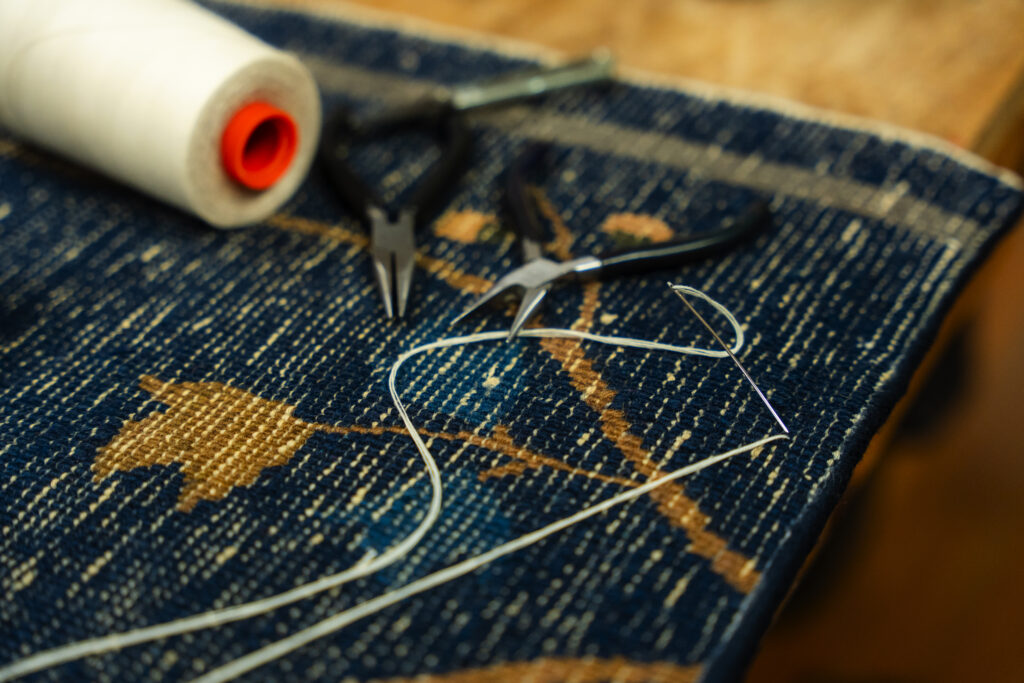
We hand-overcast damaged edges using yarn that matches the original in color, weight, and twist. This is not decorative stitching. It is structural binding that locks the existing weft threads in place and prevents further lateral loss.
Hole & Tear Reweaving
Holes and tears are the most complex repairs we perform. A hole is not just missing pile — it is missing foundation. To repair it properly, we must first rebuild the warp and weft structure in the damaged area, then tie new knots into that rebuilt foundation, matching the original knot type, density, yarn, and color.
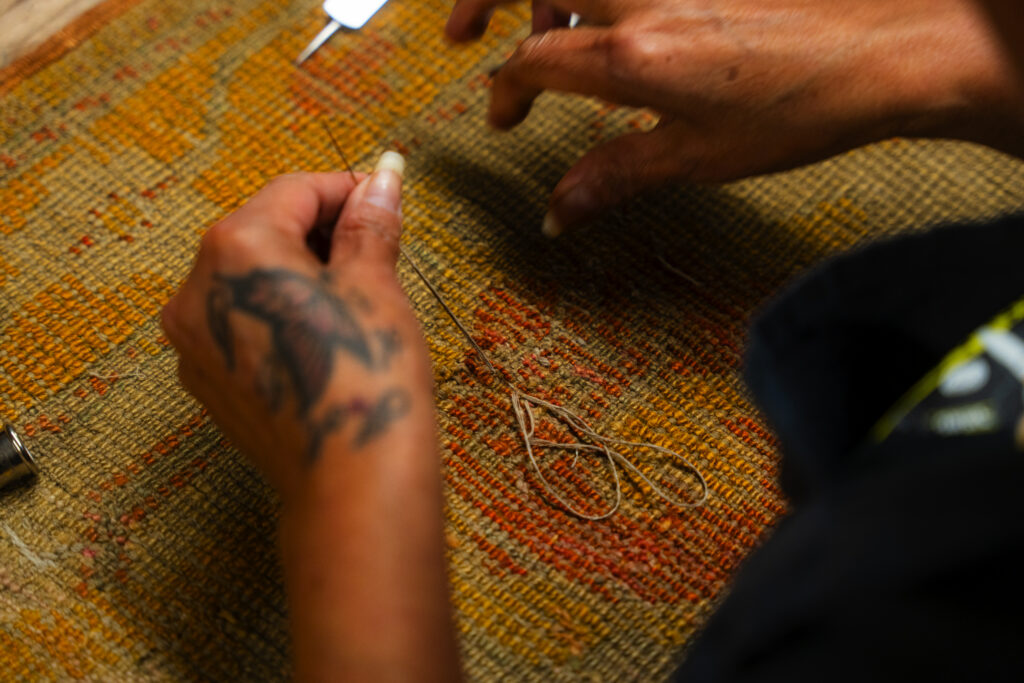
This is where KPSI matters most. A fine 300+ KPSI rug requires thousands of individual knots per square inch of repair. Each knot is tied by hand, one at a time, following the original pattern logic. The weaver doing this work must be able to read the rug’s design language and continue it seamlessly through the repaired area. This is not production work — it is artisanal conservation, and it requires patience, skill, and an eye for design continuity that cannot be automated.
For large areas of damage, we sometimes source period-appropriate wool from decommissioned textiles to ensure the fiber’s age and character match the original. New wool, even when correctly dyed, has a different sheen and texture than wool that has been in service for decades.
Color Restoration & Pattern Integration
Even when the structure is repaired perfectly, a color mismatch can make the work visible. This is the final and often most painstaking step: ensuring the repaired area blends seamlessly with the surrounding field in terms of color, pattern flow, and surface texture.
We use a combination of yarn selection, custom dyeing, and controlled aging techniques to achieve visual integration. In some cases, we “antique” new yarn using natural processes to match the patina of the original. In others, we selectively adjust the surrounding area’s color to meet the repair halfway. The goal is always the same: when you look at the finished rug, your eye should move across the surface without pausing at the repair boundary.
Dry Rot & Foundation Stabilization
Dry rot is one of the most insidious forms of rug damage because it is often invisible until the rug is handled. The cotton foundation becomes brittle from trapped moisture — a slow process caused by improper cleaning, water damage, or prolonged contact with a damp floor. The rug may look fine on the surface, but when flexed, the foundation cracks and crumbles like old paper.
We detect dry rot during our intake diagnostic using a physical flexibility test. If present, we stabilize the affected areas with conservation-grade backing support before proceeding with any other repairs. Reweaving over a rotted foundation is pointless — the new work will fail as the foundation continues to disintegrate underneath.
[Image: close-up of torn edge before repair and integrated edge after hand overcasting]
Is Rug Repair Worth It? The Investment Calculus
This is the question I hear most often, and the honest answer is: it depends on the rug, the damage, and the owner’s intentions. But for most hand-knotted rugs of reasonable quality, the math strongly favors repair over replacement.
A practical benchmark we use is the 20-40% rule: repair is generally justified when the total cost falls between 20% and 40% of realistic replacement value for a comparable rug. Below 20%, repair is almost always worth it. Above 40%, the economics become less clear and the decision involves sentimental or historical value that goes beyond pure financials.
The Appreciation Factor
What most owners do not realize is that well-maintained antique rugs can appreciate in value over time — in many cases around 7-10% annually. This is not guaranteed, and it depends on origin, rarity, condition, and market demand. But it means that a rug you paid $5,000 for twenty years ago may be worth $15,000-$25,000 today — if it has been properly maintained. Unrepaired structural damage reverses this appreciation rapidly. A rug with foundation holes, missing fringe, or visible moth damage will sell at a steep discount regardless of its provenance.
The calculus is straightforward: a $500 fringe repair on a rug that appreciates $1,000 per year is not a cost. It is an investment that protects compounding value.
When Repair Is Not Worth It
I am honest with clients when the numbers do not make sense. If a rug has low market value, extensive foundation damage, and the repair estimate exceeds replacement cost, I will say so. There is no benefit in spending $3,000 to repair a rug that could be replaced with a comparable piece for $1,500. In these cases, I recommend stabilization only — securing the edges and fringe to prevent further deterioration — and letting the rug live out its useful life gracefully rather than investing in a full restoration it does not financially justify.
The “Rug Repair Near Me” Risk
When people search “rug repair near me,” the results often include alterations shops, upholstery services, and general carpet repair companies. These businesses may be excellent at what they do, but repairing a hand-knotted rug is a specialized discipline that requires specific knowledge and skills they typically do not have.
The most common problem I see from non-specialist repairs is machine stitching. A sewing machine can close a tear quickly, but it does so with a continuous thread under mechanical tension — which is fundamentally different from the individual hand-tied knots that make up the original textile. Machine-stitched repairs create stiff lines in the rug that do not flex naturally, can pucker the surrounding fabric, and are always visible to anyone who looks closely. Worse, they can mask continuing structural damage underneath by covering holes without addressing the foundation failure that caused them.
I have also seen repairs where a previous provider used the wrong knot system (Turkish knots on a Persian rug, or vice versa), used yarn that was too thick or too thin, or matched colors to a photograph rather than to the physical rug under proper lighting. Each of these mistakes creates a repair that is technically “complete” but visually obvious — the opposite of the invisible mend standard.
Repair Timeline Expectations
Good repair takes time because precision is the product. I would rather under-promise and deliver excellent work than rush a job and produce a visible repair. Here is a general framework:
Days
Minor fringe securing, simple edge reinforcement, and small overcasting jobs. These are urgent stabilization tasks that prevent further damage and can often be completed within a few business days.
Weeks
Moderate overcasting across longer edges, partial field stabilization, and color-matched fringe reconstruction. These require careful yarn selection and patient hand work.
Multi-Week to Months
Fine reweaving, complex antique restoration, large area reconstruction, and any project involving custom dye matching or foundation rebuild. A museum-quality reweave of a high-KPSI antique can take months of daily hand work. This is not a process that can be accelerated without compromising quality. Rush work is visible work.
Common Concerns About Rug Repair
“Will I be able to see the repair?”
Our goal is always The Invisible Mend. For most repairs — fringe, overcasting, moderate reweaving — the work should be undetectable to anyone but a trained specialist examining the back of the rug. For very large reweaves on highly complex patterns, there may be subtle differences visible on close inspection, and I will be upfront about that before we begin. I never promise invisible results on a job where I know the complexity makes that unrealistic.
“Will repair affect the value of my rug?”
Professional, hand-executed repair done to conservation standards preserves and often increases value compared to the damaged state. In the antique rug market, a well-repaired piece trades at a significantly higher price than a damaged one. What reduces value is poor repair — machine stitching, mismatched colors, wrong knot types. Quality of execution is everything.
“Can you fix a repair that someone else did badly?”
Yes. We regularly undo and redo prior repairs that were executed with incorrect techniques or materials. This adds cost because we are essentially doing the work twice — removing the old repair and then performing it correctly — but it is almost always worth it for valuable textiles that deserve proper conservation.
When to Schedule Repair Immediately
If you notice any of the following, do not wait. Every week of delay allows The Cascade Effect to progress further, increasing both the scope and cost of the eventual repair.
- Fringe actively detaching from one or both ends
- Edge unraveling with exposed side cords
- Holes, splits, or thinning foundation visible through the pile
- Visible pattern breaks or stiff lines from prior poor repairs
- The rug “cracks” or feels brittle when flexed (possible dry rot)
For preventive care, see our rug care guide. For distortion correction, see our blocking and stretching service. For pest-related damage, see our moth proofing service.
How Much Does Rug Repair Cost?
Repair pricing varies significantly depending on the type of work, knot density, damage extent, and color complexity. We provide specific quotes after hands-on evaluation because photos rarely reveal the full condition of the foundation or the extent of subsurface damage.
Book Rug Repair in Manhattan
Rugs On Net
36 E 31st Street
New York, NY 10016
+1 212-683-0167
Hours: By appointment
FAQ
- Where can I book rug repair in Manhattan or NYC, and what should I bring?
For rug repair in Manhattan/NYC, book an appointment and bring the rug (or detailed photos plus measurements if it’s oversized). Expect an intake exam of fringe, edges, foundation strength, and dye stability.
- What should I ask a rug repair specialist before approving work?
Ask what knot type and density they’ll match, how they’ll handle color/patina, and whether foundation weakness (like dry rot) is present. A clear plan beats vague promises of “like new.”
- How can I prevent needing rug repair in the first place?
Vacuum gently (no aggressive beater bars on fringe), rotate every 6–12 months, and use a proper pad to reduce slip and edge wear. Address small fringe/edge issues early—delay multiplies cost.
- What’s the difference between “fringe replacement” and “fringe securing” in rug repair?
Fringe securing stabilizes end knots and prevents further unraveling without rebuilding everything. Fringe replacement reconstructs the end finish (often new fringe) and is more involved, especially on hand-knotted rugs.
- Can rug repair help after water damage?
Yes, but timing matters—water can trigger dye bleed, mildew, and foundation weakening. Rug repair often starts with controlled cleaning/drying, then stabilizes compromised areas before any reweaving.
- Does rug repair include color restoration for faded areas?
Sometimes, but it’s case-by-case. Color work can involve yarn replacement, careful dye blending, or limited correction; heavy-handed “re-dyeing” can look flat, so good shops aim for subtle integration.
- Can rug repair fix curling, rippling, or distortion?
Sometimes—distortion may need blocking/stretching rather than reweaving. If edges are also failing, rug repair often combines structural edge work with reshaping for a flat, square finish.
- How do rug repair shops quote reweaving if photos look fine?
Photos rarely show foundation weakness, knot loss under the surface, or how far unraveling has traveled. Most reputable rug repair quotes require hands-on inspection to measure true scope and density.
- Will rug repair affect my rug’s value?
High-quality rug repair typically preserves or improves value compared to leaving damage. Poor repair—visible stitching lines, wrong materials, bright mismatched yarn—can reduce value more than the original damage.
- What rug repair signs mean I should act immediately?
Act fast for detaching fringe, exposed side cords, holes/slits, or “cracking” when flexed. Waiting can turn a small stabilization into a larger foundation reconstruction within months.
- Should rug repair ever use glue or tape?
For valuable handmade rugs, glue-based “rug repair” is usually a red flag because it stiffens fibers and can age poorly. Conservation-style repairs rely on hand work that flexes with the textile.
- Is DIY rug repair with a needle and thread a good idea?
DIY rug repair is risky on hand-knotted rugs because incorrect stitching can distort tension and make later restoration harder. If you must do something, limit it to temporary stabilization and avoid adhesives.
- Can rug repair undo a bad repair done elsewhere?
Usually yes, but it can cost more because the old work must be removed first. Machine stitching, wrong knot type, or mismatched yarn often needs full re-repair to blend properly.
- Can rug repair fix moth or insect damage?
Yes—rug repair can reweave eaten pile and stabilize the foundation, but prevention matters too. If active infestation is suspected, isolate the rug and get professional inspection before repair.
- What is “dry rot,” and can rug repair fix it?
Dry rot is foundation fiber weakening often tied to past moisture/mildew exposure, making cotton brittle and prone to cracking. Rug repair may require stabilization/backing before any reweaving, because rebuilding on weak fibers fails.
- Can rug repair match old colors exactly?
Rug repair matches the color as it exists today, not as it looked when new. Aging, oxidation, and UV fading change dyes, so good repair often uses custom-blended yarns to match patina.
- What is KPSI, and why does it matter in rug repair?
KPSI (knots per square inch) is density—coarse rugs may be ~40–80 KPSI while fine rugs can be ~400–800. Rug repair must match density or the patch will sit raised, sunken, stiff, or loose.
- How long does rug repair usually take?
Simple rug repair (minor stabilization, small overcasting) can be a few business days. Moderate work often takes weeks, while fine reweaving and antique integration can take multi-weeks to months.
- Can rug repair fix holes and tears invisibly?
Often yes, but true hole rug repair must rebuild the foundation first, then re-knot the pile to match density and pattern. Small holes are easier; large pattern areas may remain faintly detectable up close.
- What is edge binding/selvage rug repair, and when do I need it?
Edge rug repair rebuilds or wraps the side cords that hold wefts in place. You need it when sides are fraying, curling, or exposing cords—side damage can creep inward like end damage.
- What is overcasting in rug repair?
Overcasting is a protective stitch at the ends or edges that prevents unraveling and stabilizes the rug’s structure. It’s often used as a fast “stop-the-bleeding” repair before bigger restoration.
- Why is fringe damage such an urgent rug repair?
In many rugs, fringe is the exposed warp ends—structural, not decorative. If it deteriorates, end knots loosen and unraveling can migrate inward within months under foot traffic and vacuuming.
- How much does fringe rug repair typically cost?
Fringe rug repair commonly runs about $10–$40 per linear foot, depending on method and rug type. Securing loose end knots is cheaper than full fringe reconstruction.
- Is rug repair worth it, or should I replace the rug?
Rug repair is usually worth it when the estimate is about 20–40% of realistic replacement value. Below ~20% is almost always a yes; above ~40% depends on history, rarity, or sentimental value.
- What does “rug repair” mean for a hand-knotted rug versus a carpet?
Rug repair on hand-knotted rugs restores the foundation (warp/weft) and re-ties knots, not just surface fibers. True repairs match knot type, density, and tension so the fix doesn’t telegraph.