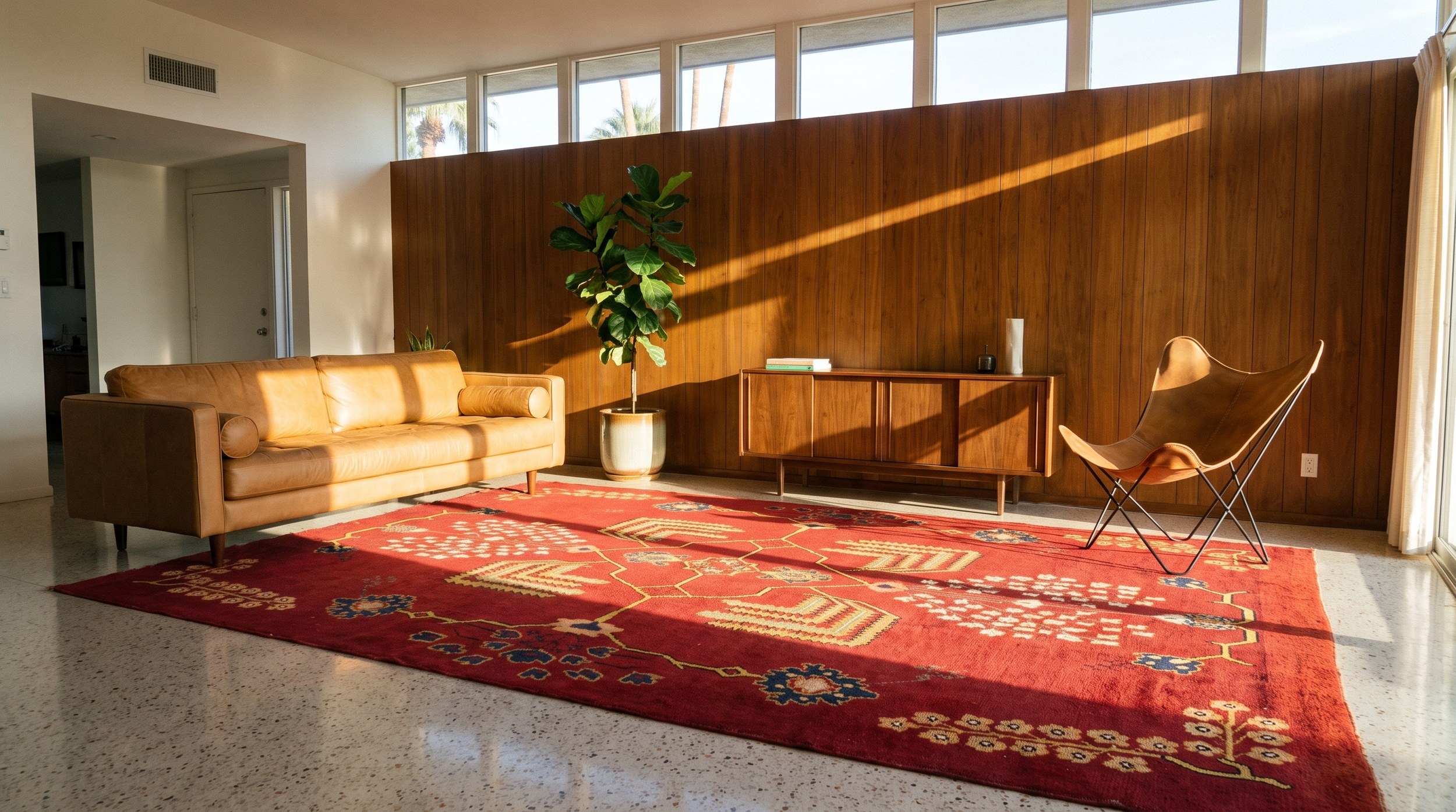
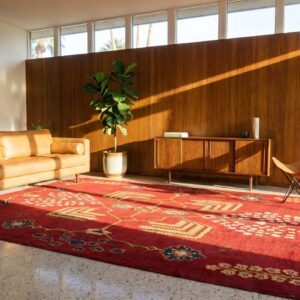
Antique Large Coral Donegal – Arts & Crafts Ireland Geometric Knotted Rug, Circa Date: 1900s. This exceptional example of Irish weaving represents the pinnacle of the Arts & Crafts movement’s influence on textile production in the British Isles. Donegal rugs are highly prized among collectors of antique rugs for their robust construction and sophisticated design pedigree.
- Type: Donegal Arts and Crafts Carpet
- From: Killybegs, Ireland
- Circa: Early 20th century
- Designer: Gavin Morton Design
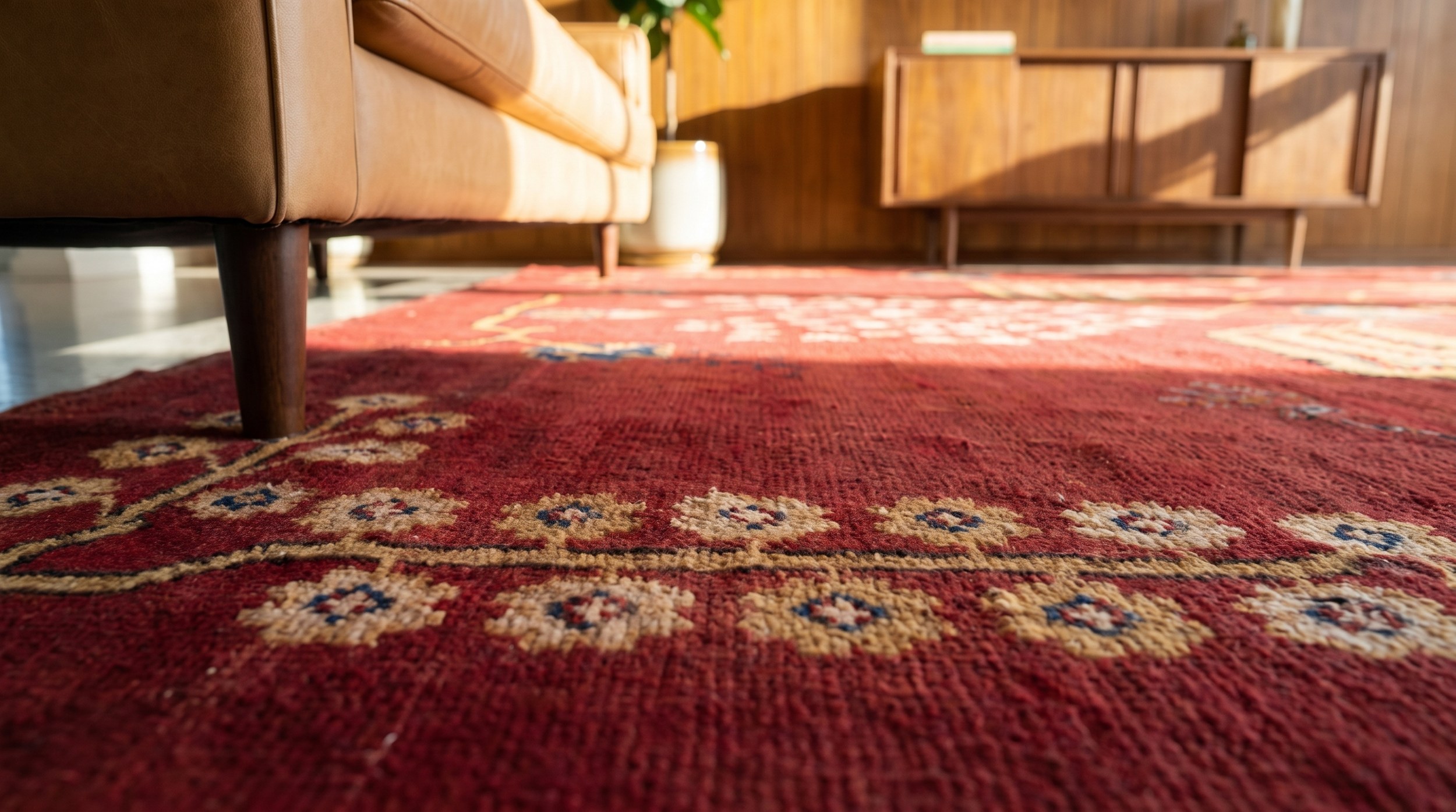
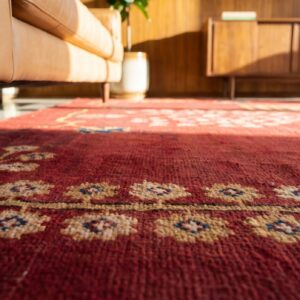
- Pile and Weave: Wool pile of symmetric knots on a wool foundation.
Morton’s of Scotland was creating mostly machine woven carpets since the middle of the nineteenth century. Gavin Morton, a second generation proprietor, saw a market in hand knotted carpets when they began to arrive in the British market in quantity from Turkish centers like Oushak. However, the Oushak trade was already controlled by merchants who would soon amalgamate into Oriental Carpet Manufacturers. But there were other sources and these were closer to home, and fell within the cost profile. Ireland, in particular, was the home of both low wages and skilled craftswomen willing to learn a new trade.
Alexander Morton was the founder of the firm of Morton’s, but his son James ran the business side of the firm, and it was he who in 1896 first set up looms at Killybegs. Carpets became readily available by 1900, in both the British Islands and America. A larger factory was opened in 1901. His brother Gavin was more attracted to the artistic, design side of the work and with Robertson and Voysey designed the large majority of Donegal carpets. Designs were eclectic, covering both traditional Irish Celtic patterns and more “Oriental”, primarily Oushak, designs. The firm operated until the 1950’s.
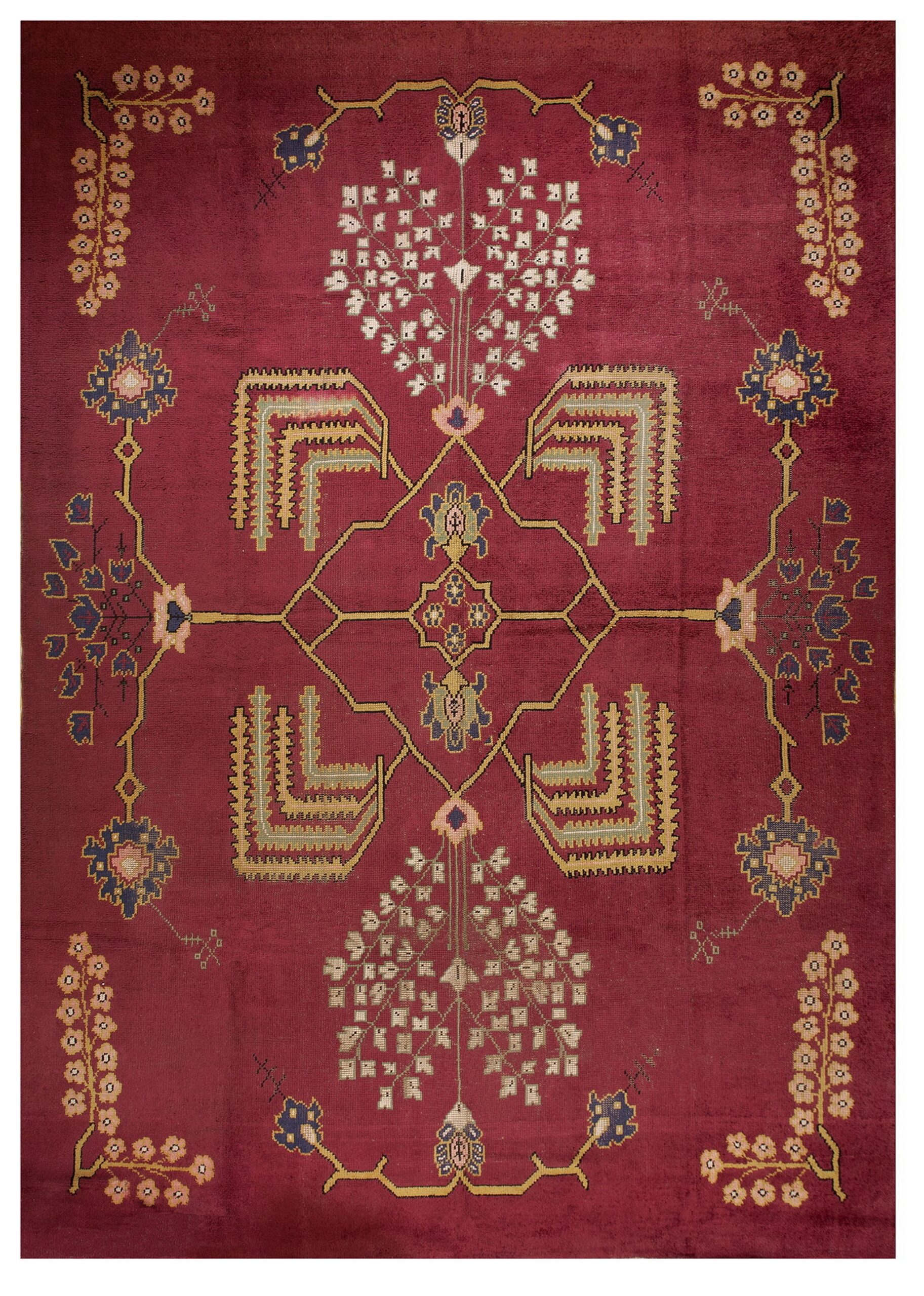
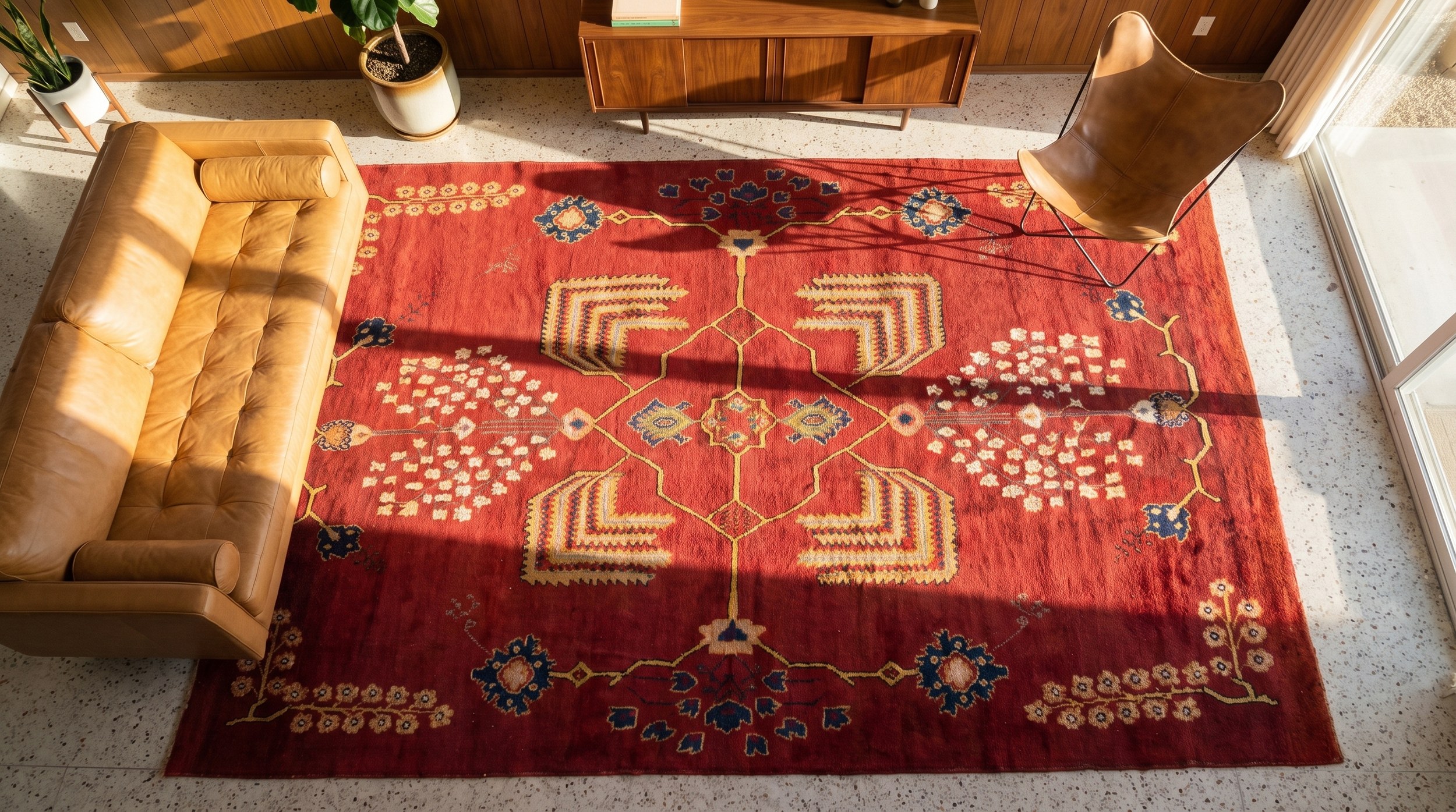
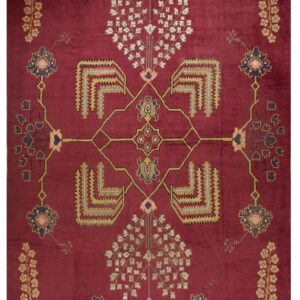
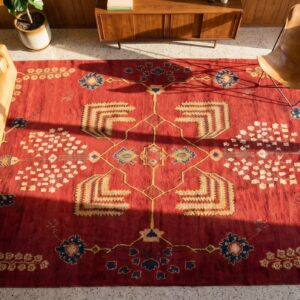
This coral carpet eschews borders. At each end of the field is a verdant vase supported on two slender stems. These bushes converge in a notched open diamond with “weeping willow” variants on the diagonals. At the corners are bent right angle floret sprays. Rosettes grow from broken stems developing from horizontal extenders of the main motif. The whole effect is that of a centered, but not overtly medallion, layout. The color palette is narrow, including coral, cream and black. One could see it as a Turkish village yastik (cushion cover) blown up to vast room-size.
The weave is quite coarse and the carpets were intended for a middle class clientele, going with wallpaper, furnishings and accessories. They were marketed primarily through Liberty of London. The carpets in this design, as most of Donegals were, came in various colorways, and there are examples with cream and dark blue grounds. Unlike Oushaks which were produced in quantity, Donegal carpets were woven in smaller numbers and have always been relatively uncommon.
The designs pare away extraneous elements and one is left with the essence. This simple, but not simplistic, boldness and strength, has made them popular in almost any but the most elaborated settings. In the early 20th century, they graced the homes of many of the newly affluent British middle classes.
The imposing field is saturated in a rich, deep coral, providing a powerful ground for the stylized central medallion and corner spandrels. The palette is carefully restrained, utilizing accents of navy, olive green, and pale gold to define the intricate geometric patterns. This specific hue places the piece within the desirable category of coral color rugs, though its depth leans toward a sophisticated claret.
Woven in the early 20th century, the scale of this piece speaks to the grand interiors it was intended to furnish, likely a manor house or institutional building. Its substantial dimensions classify it as a truly large oversized big rug, offering unparalleled coverage and anchoring power in a contemporary setting. The wool quality remains superb, reflecting the high standards of the Donegal workshops.
The design features a highly abstracted Tree of Life motif flanked by bold, serrated geometric forms that echo architectural elements. This move toward simplification and structural clarity, rejecting the dense naturalism of earlier periods, foreshadows the aesthetics found in many early modern modernist rugs. It is a testament to the enduring influence of C.F.A. Voysey and other designers who shaped the Donegal aesthetic.
Condition: Good. Repaired.