
Serapi rugs are the finest antique Heriz carpets from the Heriz district of northwest Iran (Persian Azerbaijan), woven mainly in the late 1800s. They are recognized by large angular medallions on open ivory, camel or soft red fields, natural dyes, and handspun wool. Collectors reserve the name for pieces made before about 1910. Rugs sold as “Indo Serapi” are modern Indian reproductions of the design, not antiques. Rugs On Net has close to 70 antique Heriz Serapi rugs in New York.
Introduction to Serapi Rugs
Discover our curated collection of authentic Heriz Serapi rugs waiting to transform your home.
What Makes Serapi Rugs Unique?
- Elite Subset of Heriz Carpets — Why: Serapi rugs are a distinguished branch within the Heriz weaving tradition of northwestern Persia, representing its most refined and collectible form. While all Heriz rugs share durability and bold geometry, the Serapi rug style elevates the design with more spacious layouts and striking balance.
- Bold Medallion Aesthetics — Why: Antique Serapi carpets are defined by large-scale central medallions, often surrounded by angular corner spandrels. These geometric forms dominate the field but remain carefully harmonized, creating rugs that are simultaneously commanding and elegant.
- Natural Color Palette — Why: Unlike later Heriz rugs, which often used brighter synthetic dyes, early Persian Serapi rugs employed subtle natural vegetable dyes, producing earthy reds, soft indigo blues, ivory, and muted greens. This refined palette adds depth and sophistication, making antique Serapi carpets especially prized.
- “Formal Yet Tribal” Character — Why: Serapis embody a rare duality—bridging classical Persian symmetry with tribal boldness. They are neither as curvilinear as court carpets nor as rustic as village pieces. This middle ground makes them versatile for interiors, admired by both collectors and designers.
- Pre-1910 Rarity — Why: The most collectible Serapi rugs were woven before 1910, prior to the expansion of commercial weaving in Heriz. These pieces represent a transitional era when tribal artisans still maintained traditional methods, free from industrial standardization. Their scarcity today significantly enhances their value.
- Highly Collectible Status — Why: Because of their combination of artistry, rarity, and durability, Serapi rugs hold a premier place in the Persian carpet world. Collectors consider them investment-grade textiles, and they regularly appear in auction houses and prestigious collections.
Brief Timeline of the Serapi Style
The Serapi rug style emerged in the 19th century within the Heriz weaving region of Azerbaijan, Persia (modern-day northwestern Iran). Though Heriz carpets had been woven for centuries, Serapi rugs distinguished themselves by adopting a more open and balanced design language. Scholars suggest that by the mid-1800s, weavers in the village of Serab and surrounding areas began producing these exceptional pieces, blending regional tribal motifs with the structured order of classical Persian court carpets.
By the late 19th century, Serapi rugs reached their peak, producing masterpieces that combined natural dyes, handspun wool, and innovative design layouts. These rugs were exported to Europe and America, where they quickly became favorites among collectors and wealthy patrons seeking both durability and aesthetic prestige.
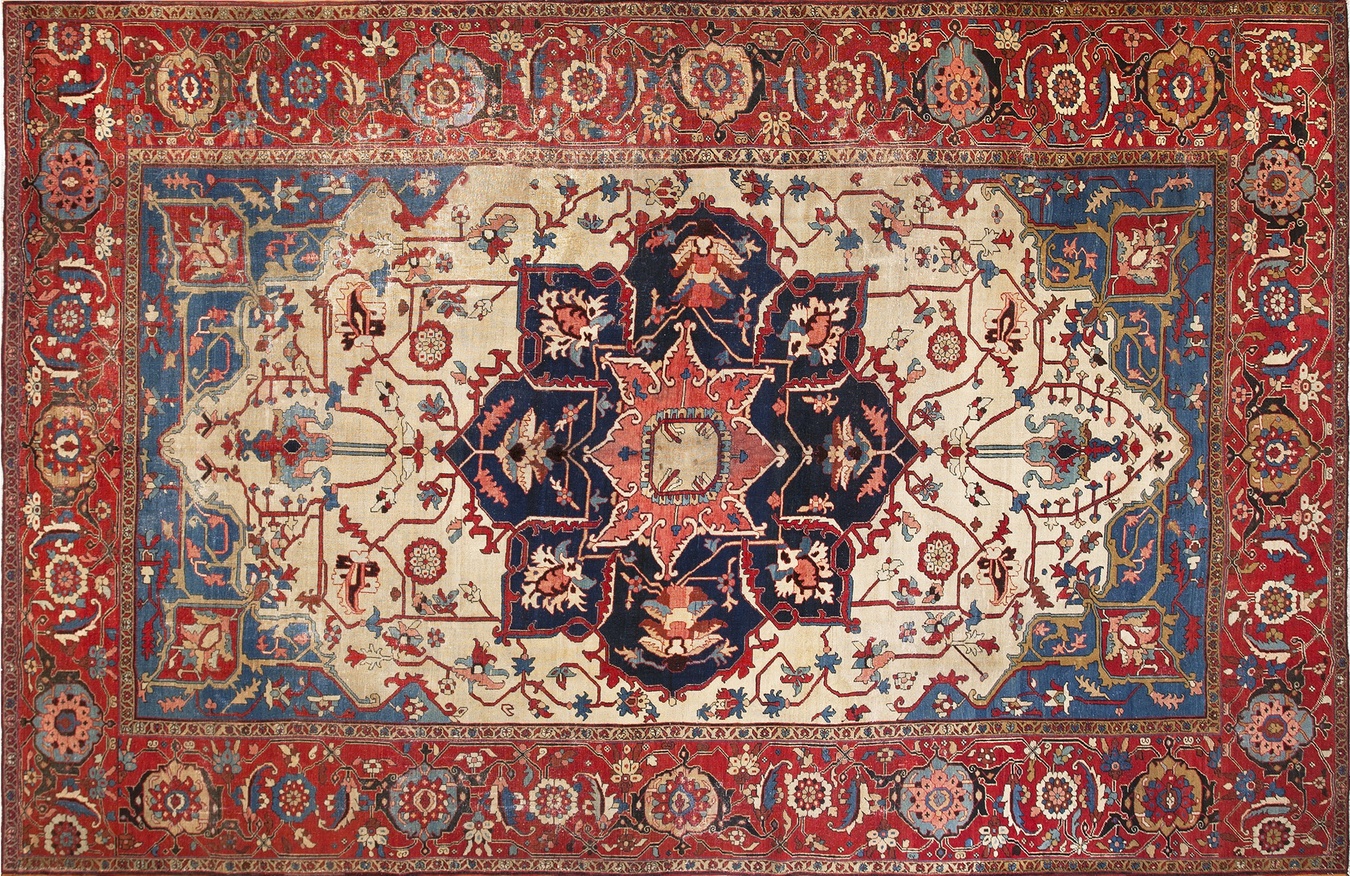
Antique Serapi Room Size Wool Ivory Rug – by Rugs On Net
After 1910, weaving in the Heriz region became increasingly commercialized, with synthetic dyes and denser production methods altering the character of the carpets. While Heriz rugs continued to be made in large numbers, the distinctive qualities of true antique Serapi carpets became rare, cementing their status as one of the most collectible Persian rug categories.
Today, when enthusiasts speak of antique Serapi carpets, they refer almost exclusively to these pre-1910 creations. Their combination of tribal vitality, formal symmetry, and rich natural palettes ensures they remain icons of Persian weaving heritage. Antique Serapi rugs stand apart in the vast Persian rug tradition because of their rarity, artistry, and enduring appeal.
As a fusion of bold geometry, refined coloring, and cultural significance, the Heriz-Serapi style continues to captivate both seasoned collectors and new admirers, embodying the essence of Persian textile mastery.
Origins & Geographic Context
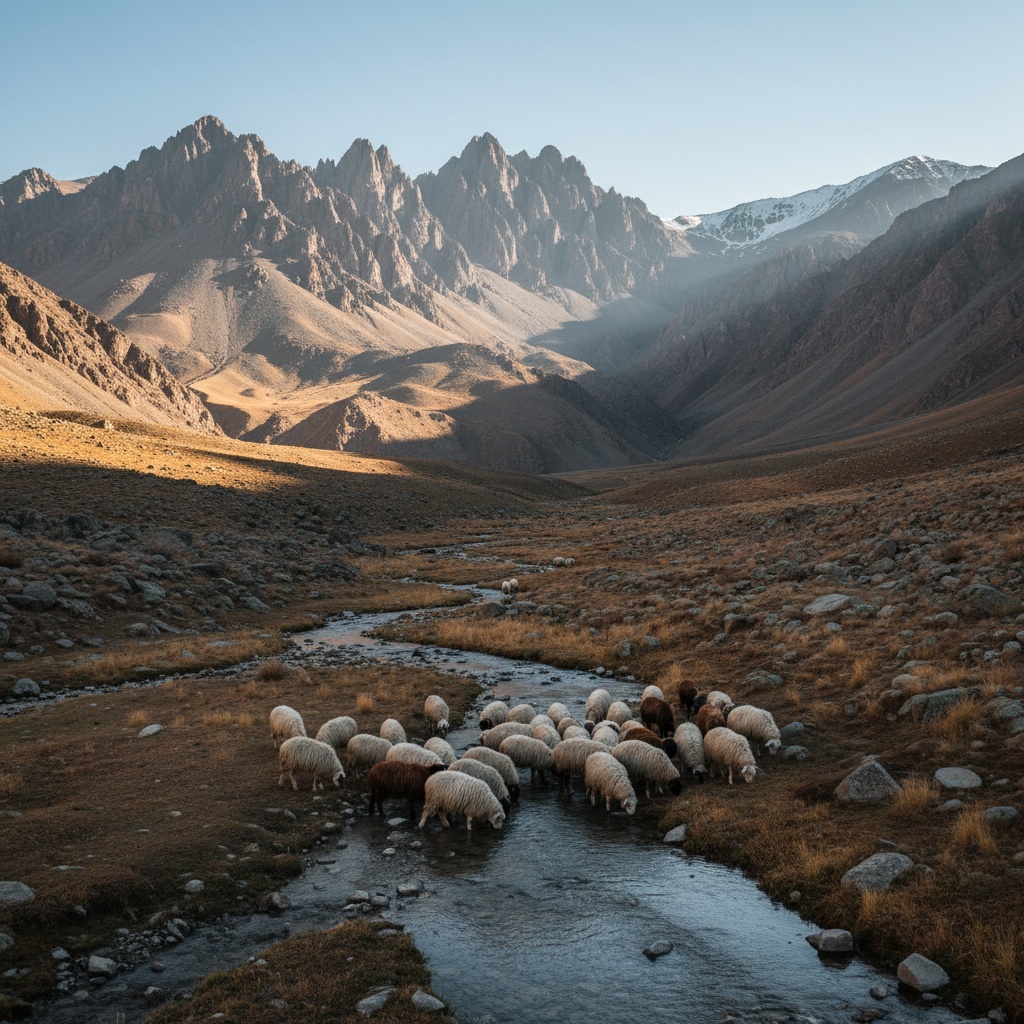
Sheep grazing near water source in high-altitude terrain.
Emergence of the Serapi Rug Style
The origin of Serapi rugs lies in the 19th century, within the mountainous Heriz district of northwest Iran. This area, known for its challenging altitude, cold winters, and mineral-rich water sources, directly influenced the durability and palette of the rugs. The hard, high-altitude climate produced resilient sheep whose wool became the foundation for Serapi carpets—strong, lustrous, and able to hold natural dyes with exceptional depth.
The Serapi rug style emerged during a time of growing global demand for Persian carpets, especially in European and North American markets. Unlike purely local village rugs woven for domestic use, Serapi carpets were consciously designed with export in mind. Their bold medallions, open fields, and carefully balanced palettes resonated with Victorian and Edwardian tastes abroad, ensuring they became staples in international trade by the late 1800s. Serapi rugs first appeared as a refinement of Heriz weaving traditions in the 19th century, developed specifically for export markets while maintaining the tribal strength and authenticity of local craftsmanship.
Link to Iran’s Heriz Region
The Heriz district remains central to the history of Serapi rugs. Situated in East Azerbaijan Province, this region has long been a hub of Persian rug history, renowned for large-scale workshop carpets as well as village weavings. Serapi rugs represent the most sophisticated branch of this tradition. The link between Serapi and Heriz is both material and cultural.
The wool of the Heriz region is celebrated for its toughness, making the rugs highly durable. The designs—anchored by monumental medallions and angular motifs—reflect the aesthetic language of Heriz carpets but with greater spaciousness and refinement. Collectors often describe Serapi as the “aristocratic” form of the Heriz family, underscoring its roots in the region while acknowledging its unique artistic elevation.
Etymology and Trade Origins
The term “Serapi” is not indigenous to local weavers. Instead, it is a trade term, most likely derived from the Persian phrase Serab-i, meaning “of Serab,” a town near the Heriz district. Western merchants and dealers adopted the name in the 19th century to distinguish these exceptional rugs from other Heriz carpets on the international market.
This naming reflects the broader pattern of how Persian rug history was shaped by trade. Just as terms like “Tabriz” or “Kerman” came to signify rug types recognizable to global buyers, “Serapi” entered the vocabulary as a marketing distinction rather than a tribal identity. The name itself embodies the meeting point of local craftsmanship and international demand—a rug rooted in the Heriz district but branded for the export marketplace.
The Serapi rug style arose from the fertile weaving culture of Heriz in the 1800s, strengthened by its geography, shaped by its climate, and propelled into the world by global trade. While the etymology reflects market-driven branding rather than a native designation, the artistry of these rugs remains inseparable from the land and people of Heriz, ensuring their place as one of the most celebrated chapters in Persian rug history.
Traditional Weavers & Cultural Roots
Village Weavers: Who Made Serapis?
The early Serapi weavers were primarily Azerbaijani Turk women living in villages scattered across the Heriz district of northwest Iran. Weaving was a domestic and communal activity, often carried out inside homes, where looms were set up in living spaces. The art was taught from one generation to the next, ensuring that patterns, color traditions, and knotting techniques remained deeply embedded within family and village identity.
While some Serapi rugs were woven directly for export markets, many were created for more intimate purposes—especially dowries and family heirlooms. A bride’s woven carpet represented her skill, devotion, and contribution to household prosperity. These textiles not only carried practical value as floor coverings but also symbolic weight, embodying pride, craftsmanship, and familial honor.
Social & Cultural Significance
The making of Persian village rugs in Heriz was more than a craft—it was a cultural language. Within households, weaving was a cornerstone of dowry traditions, where young women demonstrated their weaving mastery through rugs presented at marriage. These rugs reinforced bonds between families, marking transitions in life, and often remained treasured heirlooms for decades.
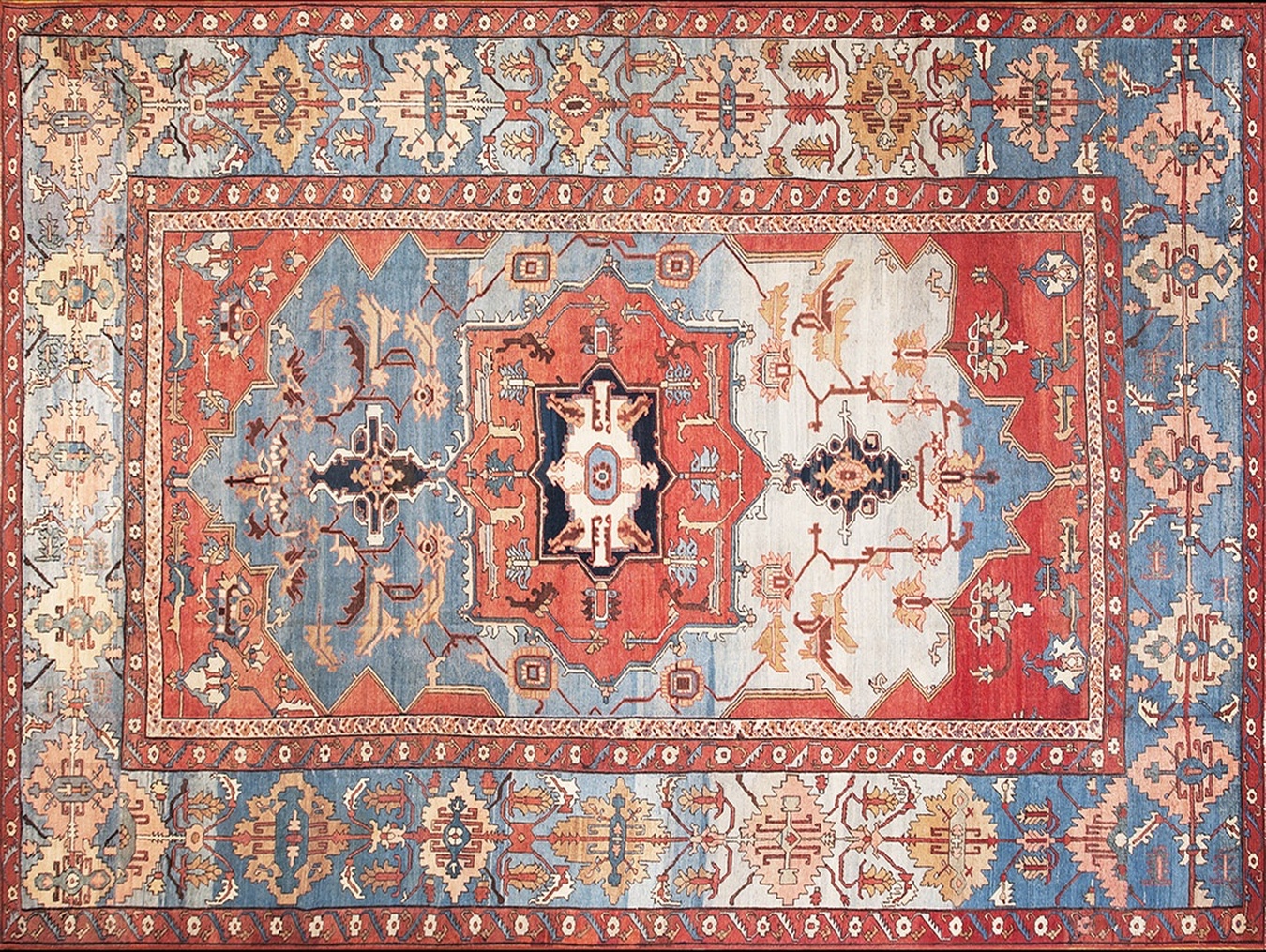
Antique Serapi Large Room Size Wool Blue Rug – by Rugs On Net
Weaving also reinforced village pride. Each rug carried the reputation of its community, signaling both artistic accomplishment and the durability of local wool. Families considered their rugs not only personal possessions but also cultural ambassadors, a testament to the Heriz weaving traditions that distinguished their region from others in Persia.
Symbolism and Tribal Influences
The iconography of Serapi rugs draws from a rich blend of influences. At their heart, these carpets embody tribal rug symbolism, with angular stars, stylized blossoms, and hooked motifs echoing Caucasian designs from nearby Azerbaijan and Armenia. These tribal elements gave Serapis their bold, geometric rhythm, setting them apart from the more curvilinear city rugs of Tabriz or Isfahan. At the same time, Serapi carpets incorporated classical Persian motifs such as palmettes, arabesques, and medallions. This marriage of tribal directness with classical refinement is what makes the Serapi style unique—formal yet powerful, ordered yet expressive. Many patterns also held symbolic meanings:
- Stars could signify protection and guidance.
- Medallions often represented cosmic order, a central point anchoring the universe.
- Geometric vines and blossoms symbolized growth, fertility, and continuity across generations.
Serapi carpets are more than decorative textiles; they are the woven stories of Heriz village women, connecting family, culture, and symbolism into works of art. Their designs—rooted in tribal strength, enriched by Persian classical beauty, and tied to local social traditions—remain enduring expressions of identity and heritage in the Persian weaving world.
Design Characteristics of Serapi Rugs
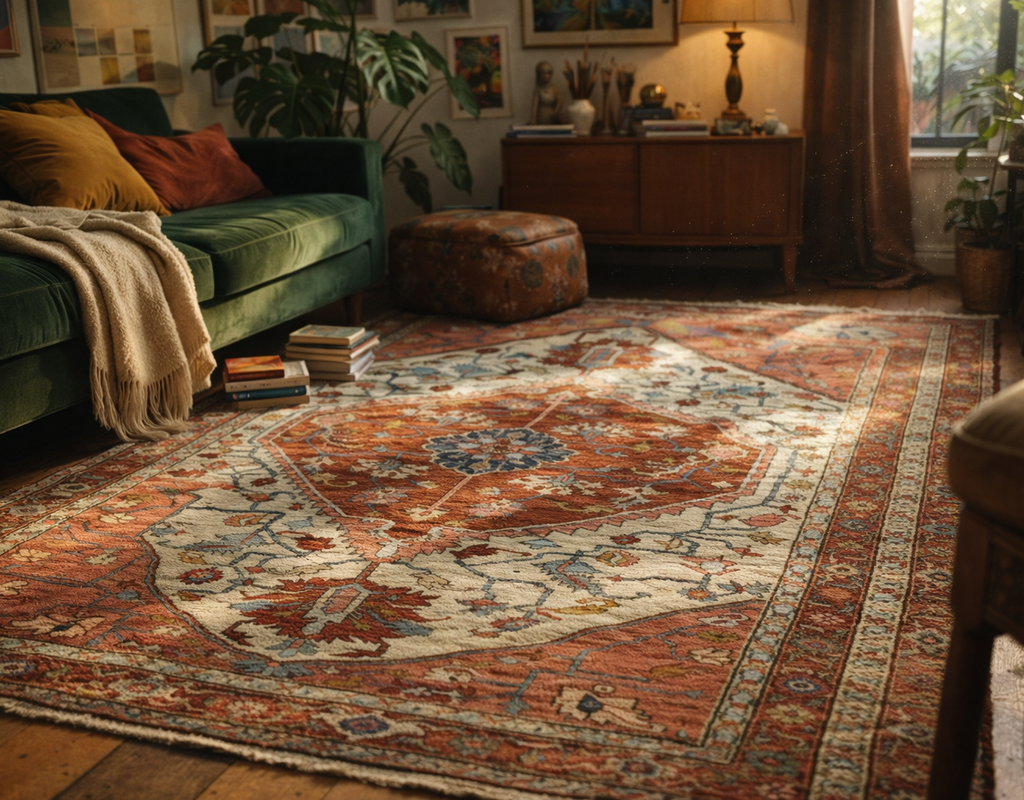
A traditional, warm-toned area rug brings texture and pattern to this inviting, richly decorated living room.
Authentic Motifs & Medallion Scale
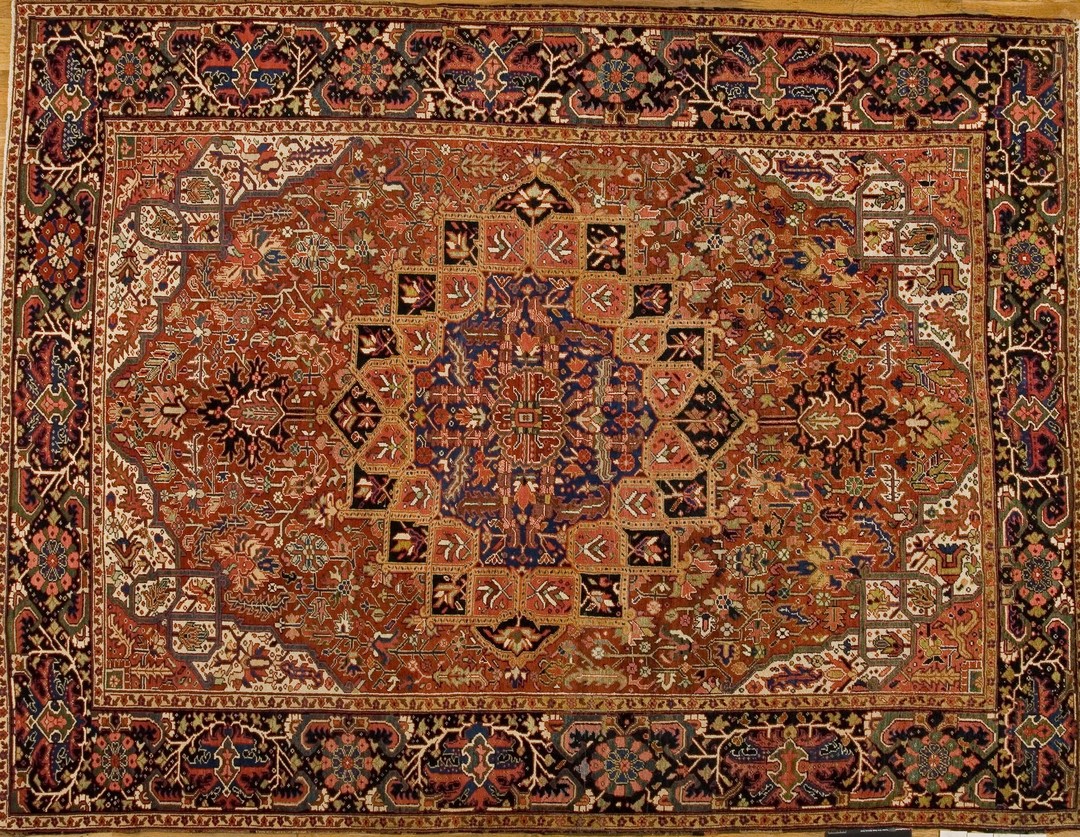
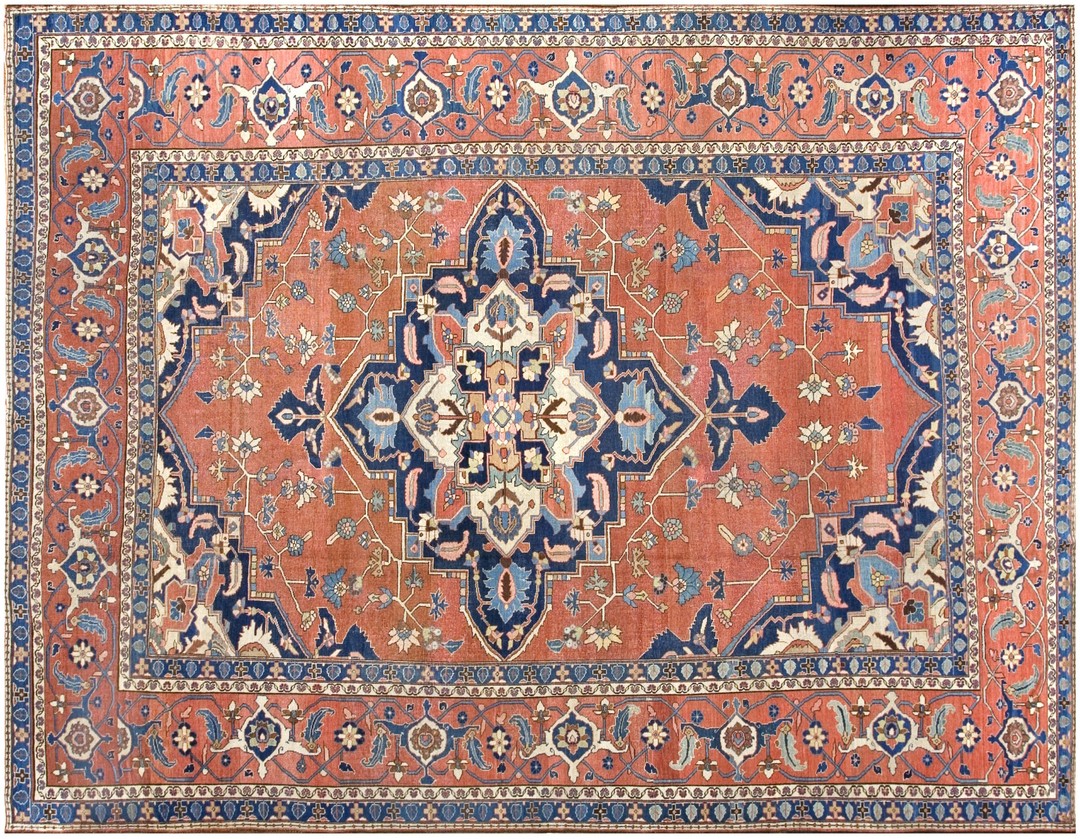
One of the clearest markers of an authentic Serapi rug is the grand medallion scale. Serapis typically feature monumental, geometric medallions that dominate the field, often paired with strong corner spandrels.
This medallion-and-corner format was rendered with remarkable spaciousness, setting Serapis apart from the denser, more compact design language of other Heriz carpets. The Serapi motifs themselves combine tribal boldness with classical elegance. Large angular palmettes, stylized vine scrolls, geometric stars, and serrated leaves are all staples of the design vocabulary.
In some examples, one may even find small animal forms subtly integrated into the field. The sheer size of the medallion and the controlled rhythm of these motifs is a top clue for identifying a true Persian Serapi rug.
Ivory Field and Open Layouts
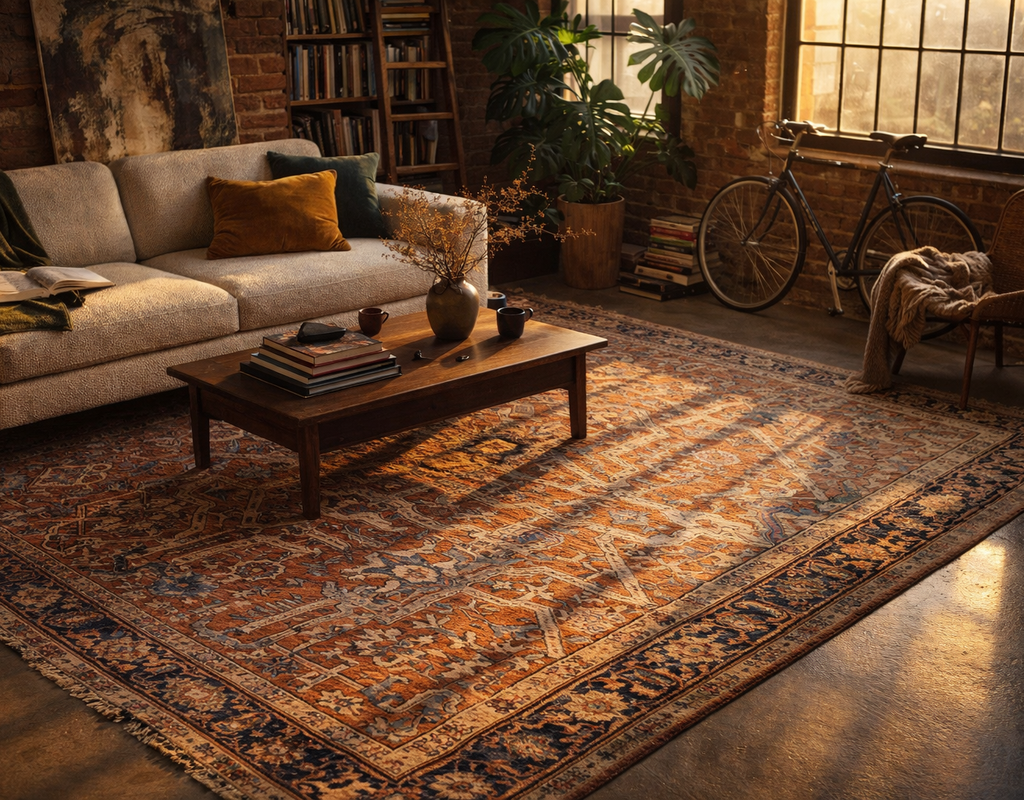
Sunlight streams across an ornate, aged area rug, illuminating the warm textures of this inviting urban living space.
The ivory field Serapi is a collector’s hallmark. Antique Serapis often use large areas of ivory or cream wool as the ground, creating a striking sense of openness and light. This negative space amplifies the grandeur of the medallion and accent motifs, lending a feeling of balance and sophistication rarely matched by other village weavings.
Differences from Heriz Patterns
- Spacious Layouts — Why: Serapis leave generous negative space around motifs, whereas standard Heriz rugs tend to be more densely filled with ornament.
- Medallion Proportions — Why: The medallion scale in Serapis is monumental, compared to the smaller, more compressed medallions of typical Heriz designs.
- Color Palette — Why: Serapis favor lighter, subtler hues such as peach, terra cotta, and pastel blue, while Heriz rugs often lean toward darker reds, navy, and rust.
- Refinement of Motifs — Why: Serapi motifs are more elongated and angular, suggesting both tribal and classical refinement, whereas Heriz motifs are chunkier and more rustic.
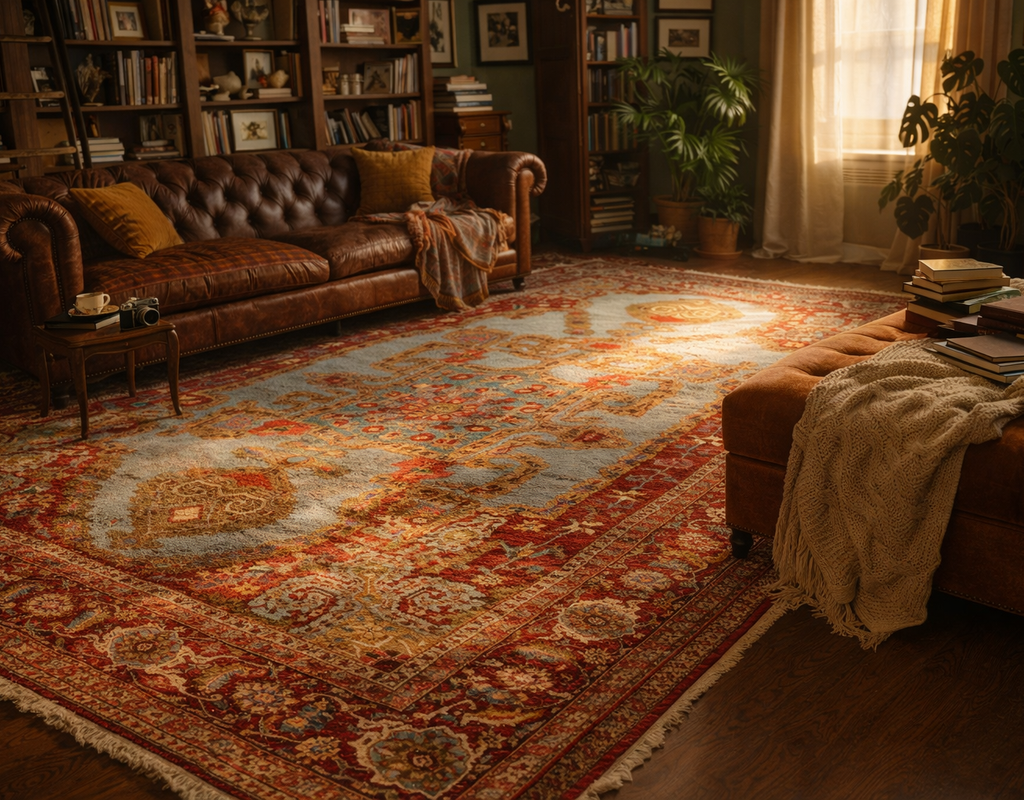
A richly patterned Persian-style rug enhances the classic, inviting atmosphere of this book-filled study.
Common & Rare Color Combinations
Collectors note that Serapis are instantly recognizable by their soft, luminous palette. Common combinations include terra cotta fields paired with ivory, or ivory grounds accented by pale blues and soft peach. These rugs often incorporate subtle greens and golden tones, which blend harmoniously rather than contrast sharply.
Rare but highly prized examples use pastel blue fields or unusual peach grounds, creating an almost watercolor-like effect due to the natural dye variations. These softer tones set Serapis apart from the more saturated Heriz palette, adding to their collectible appeal.
Signature Palette: How Serapi Colors Differ
The Serapi color palette is among its defining features. While Heriz rugs often present deep crimson reds and heavy indigo blues, Serapis lean toward terra cotta, ivory, soft peach, and powdery blue.
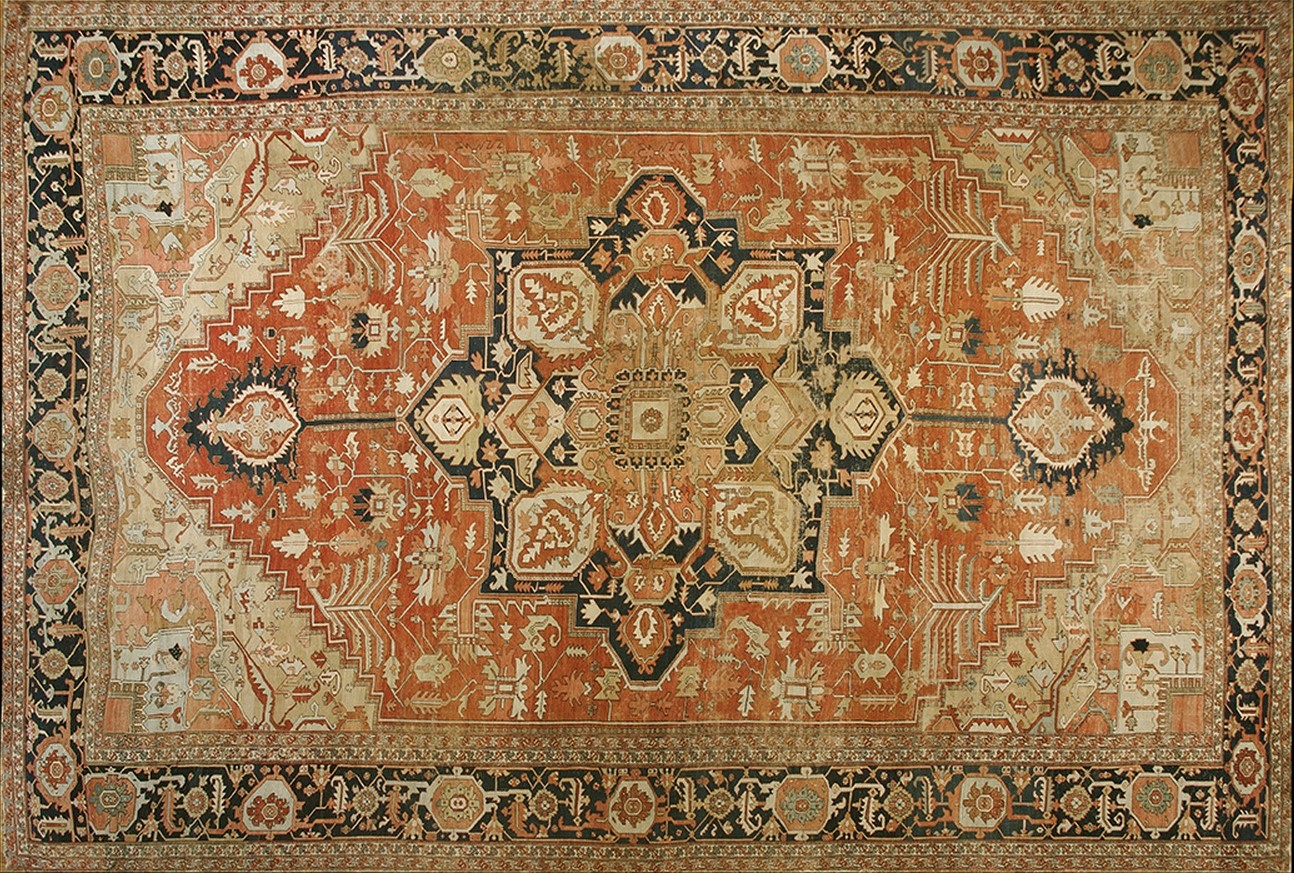
Antique Serapi Oversized Large Big Wool Coral Rug – by Rugs On Net
This softer spectrum enhances the sense of refinement and balance in their open layouts. The restrained palette also allows the bold geometry of the medallion to stand out without overwhelming the eye.
Impact of Vegetable Dyes vs. Synthetic
- Natural Abrash Variation — Why: Serapis woven before 1910 used only vegetable dyes, which aged beautifully and created abrash—the gentle shifts in shade across a field of color that add depth and movement to the rug.
- Harmony of Tones — Why: Vegetable dyes yielded a natural, balanced palette that softened over time, making antique Serapis uniquely elegant.
- Synthetic Contrast — Why: Later Heriz rugs employed synthetic dyes, often producing harsher contrasts and flatter colors, which diminished subtlety and long-term appeal.
- Collector’s Value — Why: The presence of vegetable-dyed tones is one of the key reasons antique Serapi rugs are considered investment-grade compared to later Heriz weavings.
The design characteristics of Serapi rugs—from monumental medallion scale and ivory fields to their luminous, vegetable-dyed palette—distinguish them as one of the most refined achievements in Persian village weaving.
Their open layouts, restrained colors, and symbolic motifs make them instantly recognizable within the broader Heriz vs. Serapi design debate, and ensure their continued place as icons of Persian textile artistry.
Materials & Construction
Wool, Cotton, and the Copper Connection
The foundation of Serapi construction lies in its materials. The pile is woven from handspun wool, sheared from sheep that grazed on the high-altitude pastures of the Heriz district. Local folklore—and collector consensus—credits the copper-rich soil and water of the region with producing wool of unusual strength and sheen. Whether scientifically exact or not, this belief reflects the observable reality: Serapi wool is exceptionally durable, lustrous, and able to hold natural dyes with remarkable brilliance.
The foundation of antique Serapi rugs is typically all-cotton warp and weft, which provides structural stability and allows for larger format weaving. This cotton base contrasts with fully wool foundations used in other Persian village rugs, signaling a higher level of craftsmanship intended for both local use and export.
Knotting Technique & Knot Density
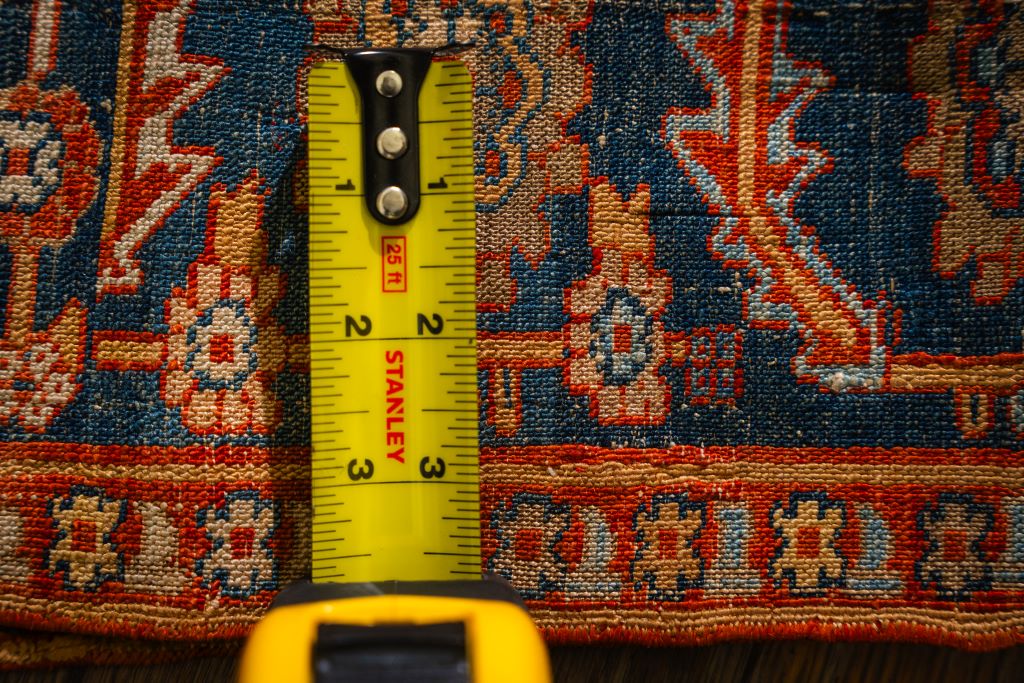
A detailed inspection of a richly colored oriental rug pattern while measuring its dimensions.
Authentic Serapi rugs are hand-knotted using the Turkish (Ghiordes) symmetrical knot, a technique that ensures strength and resilience. Knot density in Serapis ranges from 30 to 100 knots per square inch (kpsi), placing them in the medium-fine category.
While not as fine as city carpets from Tabriz or Isfahan, Serapis achieve their power through design scale rather than micro-detail. What distinguishes premium Serapi craftsmanship is density relative to the Heriz family of rugs.
Standard Heriz and Gorevan carpets often feature looser, coarser weaves, whereas older, high-quality Serapis demonstrate tighter knotting and smoother backs, giving them both structural stability and a more elegant appearance.
How Materials Affect Durability and Appearance
The copper wool rugs of the Heriz district are prized because the mineral-rich grazing environment imbues the fibers with toughness and resilience. This translates into piles that resist wear while retaining natural sheen, even after a century of use. The wool’s lanolin content further enhances softness and protects the fibers, contributing to the subtle glow collectors recognize in antique Serapi carpets.
The cotton foundation stabilizes the structure, allowing Serapis to support monumental medallions without distortion, while the balanced knot density ensures the rugs remain flexible yet firm underfoot. Together, these elements create carpets that are not only decorative but also capable of surviving generations of use—one of the reasons antique Serapis command such enduring value.
Distinguishing Features: Back, Weave, Handle
- Smooth Back — Why: Older, finer Serapis show a flatter, more polished back compared to bumpier, coarser Heriz and Gorevan rugs, signaling superior craftsmanship.
- Tighter Weave — Why: Medium-fine knot density allows for sharper execution of medallions and motifs, setting Serapis apart from their regional counterparts.
- Supple Handle — Why: Despite their durability, Serapis often feel more flexible than heavy Heriz rugs, reflecting a balance of cotton foundation and high-quality wool.
- Lanolin Glow — Why: The natural oils in Serapi wool give the surface a sheen that enhances both color vibrancy and tactile appeal, a feature collectors immediately recognize.
In every respect, the materials and construction of Serapi rugs—from their copper-enriched wool to their hand-knotted structure—explain both their longevity and their prestige.
The combination of high-quality wool, cotton foundations, and medium-fine knotting results in carpets that are unmistakably durable, visually refined, and among the most collectible hand-knotted Serapis in Persian rug history.
Historical Evolution & Collectibility
Timeline: When Were the Great Serapis Made?
The most collectible Serapi rugs were woven between the 1850s and 1910, a golden period before large-scale commercial production reshaped Heriz weaving. These early Serapis were made in village settings, where women wove for dowries, local pride, and selective export, resulting in pieces that feel both authentic and improvisational.
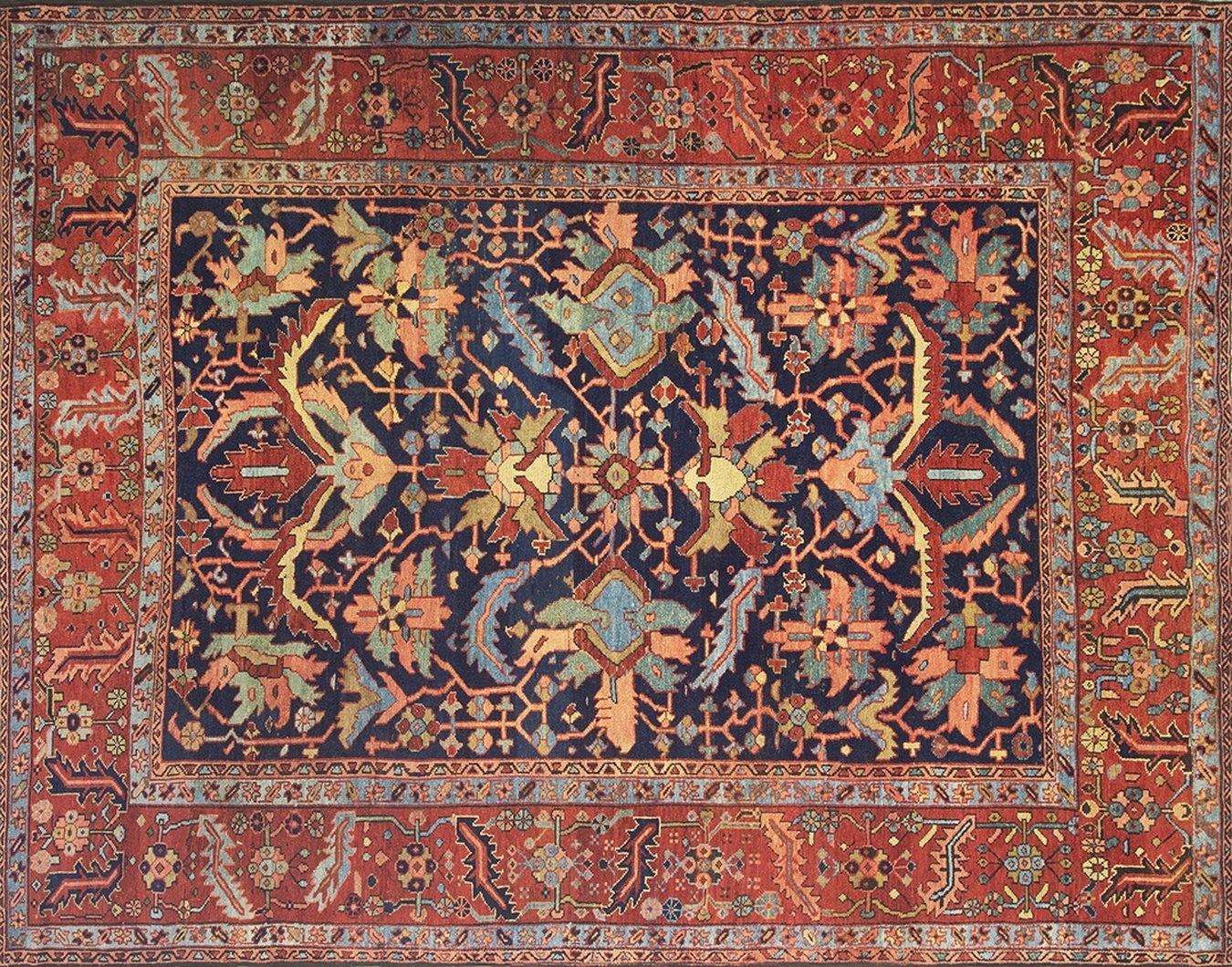
Antique Serapi Persian Blue 1890s Rug – by Rugs On Net
After 1910, production shifted toward standardized Heriz rugs, which featured denser, brighter colors and more crowded motifs. While still durable and decorative, later Heriz carpets lack the rarity and individuality that make antique Serapis so prized.
Historical Influences & Iconography
The iconography of Serapi rugs reflects a blend of Persian, Caucasian, and tribal influences. The Persian heritage is seen in the monumental medallions and palmettes, which recall classical court carpets.
The Caucasian influence comes through in angular stars, hooked devices, and geometric motifs, echoing the neighboring weaving cultures of the Caucasus. Tribal elements—such as bold improvisations, stylized animals, and free-hand geometric vines—reinforce the vitality of folk traditions within the Heriz district.
This hybrid design vocabulary gives Serapis their distinctive identity: they stand at the crossroads of Persian refinement and tribal expression, making them uniquely versatile for both collectors and interior designers.
Transition to Heriz & Gorevan Rugs
- Shift in Demand — Why: Growing European and American appetite for Persian carpets in the early 20th century pushed production toward larger, more uniform Heriz rugs.
- Commercial Standardization — Why: Unlike one-of-a-kind Serapis, Heriz weavings became increasingly export-driven, with more saturated dyes and crowded layouts.
- Emergence of Gorevan — Why: Gorevan rugs, woven in the same region, represented a coarser, thicker grade, providing a more affordable option but sacrificing the refinement of true Serapis.
- Decline of Improvisation — Why: The folk creativity of early Serapis gave way to standardized patterns that could be repeated more easily for international buyers.
Collector Status: Why Serapis Are Prized
Antique Serapis hold premier status in the Persian carpet world because of their rarity, artistry, and condition. Their open layouts, luminous natural dyes, and monumental medallions distinguish them from the more common Heriz carpets.
Collectors value Serapis as investment-grade textiles; their limited production window ensures scarcity, and their enduring aesthetic makes them adaptable to both traditional and modern interiors.
Auction Data & Value Trends
Auction houses consistently report strong sales for collectible Serapi rugs, with fine examples reaching into the six-figure range. “Museum-level” Serapis—especially large pieces in excellent condition with ivory fields or rare color palettes—attract global competition among collectors. Over the past two decades, Serapi auction prices have shown a clear upward trend, reflecting both growing recognition of their artistry and tightening supply as fewer antique examples remain in circulation.
While the market fluctuates like any asset class, the combination of limited availability, cultural significance, and enduring design appeal suggests continued appreciation. Collectors increasingly view these carpets as long-term investments as well as decorative masterpieces. The historical evolution of Serapi rugs reveals a short but brilliant era between 1850 and 1910, when village weavers created masterpieces blending tribal, Caucasian, and Persian traditions.
Their transition into Heriz and Gorevan forms reflects the pressures of commercialization, but the legacy of antique Serapis endures in the auction market, where rarity and artistry continue to drive prices higher. For collectors, these rugs remain not just textiles, but cultural investments of enduring value.
Market, Pricing & Modern Legacy
What Are Antique Serapis Worth?
In today’s market, antique Serapi rugs command some of the highest values in the Persian carpet world. Depending on size, age, rarity, and condition, prices typically range from $30,000 to over $200,000, with exceptional, museum-grade examples fetching even more at auction.
Large-scale ivory-field Serapis with rare palettes and minimal restoration are particularly coveted, often inspiring competitive bidding among top collectors.
Why Do Antique Serapis Command Higher Prices?
The reason antique Serapi prices outpace most Heriz rugs is rooted in scarcity, artistry, and historical context. Serapis were produced during a relatively short time window (1850s–1910), making authentic examples rare.
Their aesthetic balance—bold medallion scale paired with luminous natural dyes—sets them apart from denser Heriz carpets. Collectors prize them not only for their beauty but also as investment-grade heirlooms with proven auction performance.
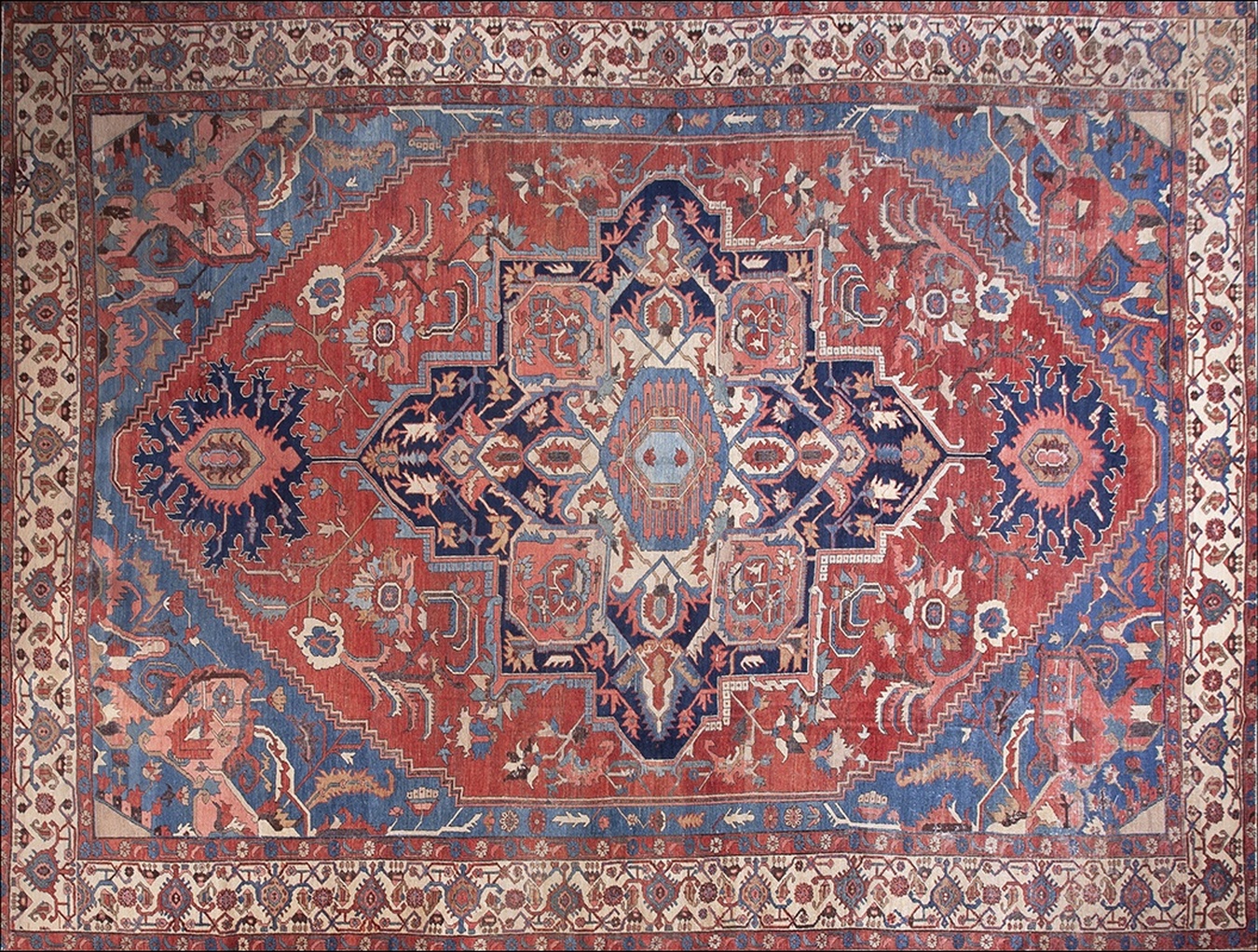
Are Serapis a Good Investment?
The steady rise in Serapi auction prices demonstrates strong collector demand. With limited supply—since no new antique Serapis can ever be made—values have trended upward for decades.
While the rug market can fluctuate, fine Serapis are considered safe-haven collectibles, much like rare art or antiques, making them appealing to investors seeking both cultural and financial returns.
Modern Production: Are New Serapis Faithful?
Today, modern Serapi reproductions are woven in India, Pakistan, Afghanistan, and occasionally Iran. While many capture the look of the Serapi rug style—grand medallions, corner spandrels, and ivory fields—faithfulness varies greatly.
The finest modern reproductions use handspun wool and natural vegetable dyes, creating rugs that echo the subtle abrash and soft palette of antiques. However, many mass-market pieces rely on synthetic dyes and machine-spun wool, producing brighter, less nuanced carpets that lack the soul of true antiques.
Online Retailers for New Serapi Rugs
For those seeking to buy Serapi rugs online, several established retailers specialize in antique and modern examples. Notable sources include:
- Claremont Rug Company — museum-level antique Serapis.
- Nazmiyal Collection — fine antiques and select reproductions.
- RugSource and Qaleen — broad selections of new Serapi-style rugs.
- Tufenkian — contemporary artisan weavings inspired by Persian traditions.
These platforms offer both authentic antiques and high-quality modern Serapi reproductions, catering to collectors, interior designers, and homeowners alike.
How Contemporary Dyes Alter Colors
The Serapi color palette was originally defined by natural vegetable dyes, which created nuanced, earthy tones—terra cotta, ivory, soft blues, and peach—with subtle abrash that evolved beautifully over time.
In contrast, many modern Serapi rugs use synthetic dyes, resulting in brighter, more uniform colors that lack the depth and natural variation of antique pieces. While this can appeal to some buyers seeking vibrant hues, it sacrifices the mellow refinement that collectors prize in true antique Serapis. The market for Serapi rugs underscores their enduring prestige.
Antique pieces remain at the pinnacle of Persian rug collecting, with values reflecting rarity and artistry. Modern reproductions make the style accessible to new audiences, though only those woven with traditional materials and dyes capture the spirit of the originals. For collectors and admirers alike, the Serapi legacy bridges past and present, offering both investment potential and timeless beauty.
Care, Cleaning & Practical Advice
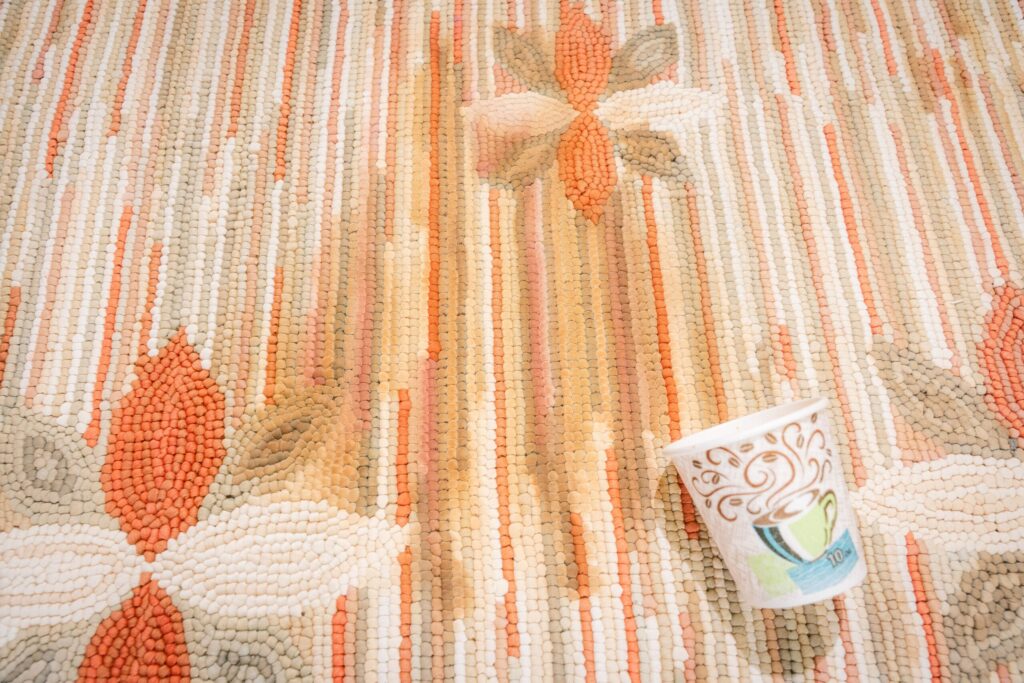
Close-up view of a tipped paper coffee cup resting on a handwoven wool rug, highlighting the rug’s dense pile, subtle color variations, and traditional geometric motifs in warm neutral and terracotta tones.
Should Serapis Be Cleaned Differently?
Yes. Cleaning antique Serapi rugs requires a gentler approach than standard wool carpets. Because these rugs are often more than a century old, their natural vegetable dyes, handspun wool, and cotton foundations are vulnerable to harsh treatment. They should never be steam-cleaned, soaked, or exposed to strong chemicals.
Instead, professional hand-cleaning by experienced rug specialists is essential to preserve both the wool’s lanolin and the nuanced Serapi color palette. Even routine maintenance must be gentle: light vacuuming without beater bars and avoiding over-wetting are critical steps in responsible care.
Tips for Preserving Antique Serapi Rugs
- Rotate Regularly — Why: Shifting the rug’s orientation ensures even exposure to light and wear, preventing uneven fading and pile compression.
- Use a Rug Pad — Why: Pads reduce friction against the floor, cushioning the foundation and extending the rug’s structural life.
- Avoid Direct Sunlight — Why: Prolonged exposure can fade the natural vegetable dyes, diminishing the value of antique Serapis.
- Address Spills Quickly — Why: Blotting (never rubbing) with a clean cloth prevents staining and reduces risk of fiber damage.
- Schedule Professional Cleaning — Why: Periodic care by experts preserves lanolin-rich wool and ensures colors remain vibrant over decades.
How to Spot a Quality Serapi
- Handspun Wool — Why: Look for subtle irregularities in thickness, which signal genuine handcraft and superior durability.
- Natural Abrash — Why: Gentle shifts in shade across fields of color reveal authentic vegetable dyes, prized by collectors.
- Smooth Back Weave — Why: Finer Serapis display flatter, polished backs compared to bumpier Heriz or Gorevan rugs, a sign of premium craftsmanship.
- Open Medallion Layout — Why: A spacious central medallion with generous negative space is a defining marker of authentic Serapi design.
- Soft, Subtle Palette — Why: Terra cotta, ivory, peach, and powdery blue distinguish Serapis from darker, heavier Heriz patterns.
Proper Serapi rug care tips highlight that these carpets are not just decorative items but cultural heirlooms. Preserving a Serapi carpet’s wool, dyes, and structure ensures that its artistry and value endure for future generations.
By combining gentle everyday practices with professional cleaning, collectors can safeguard the beauty and authenticity of these iconic Persian weavings.
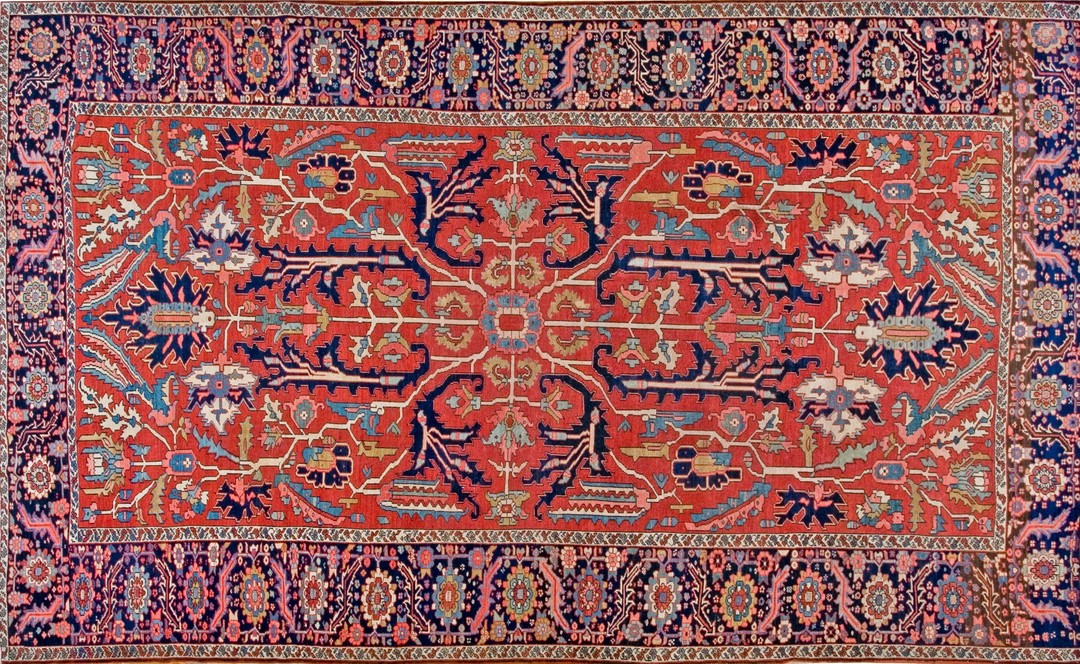
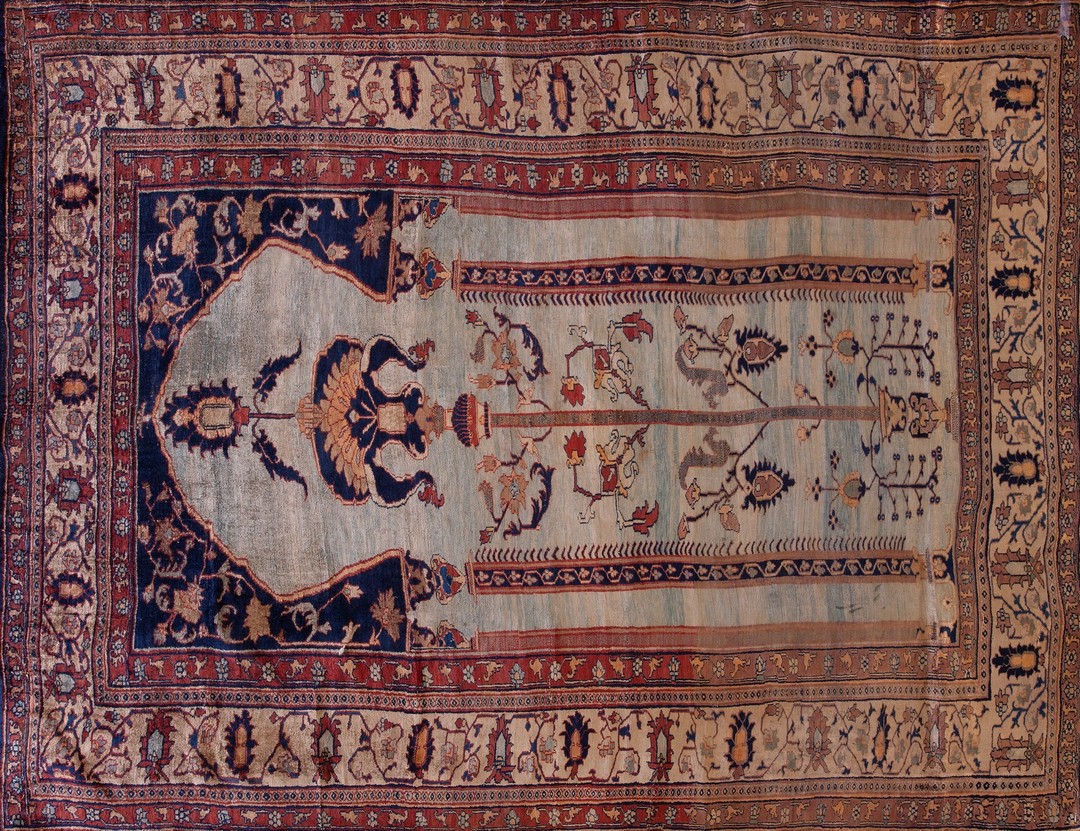
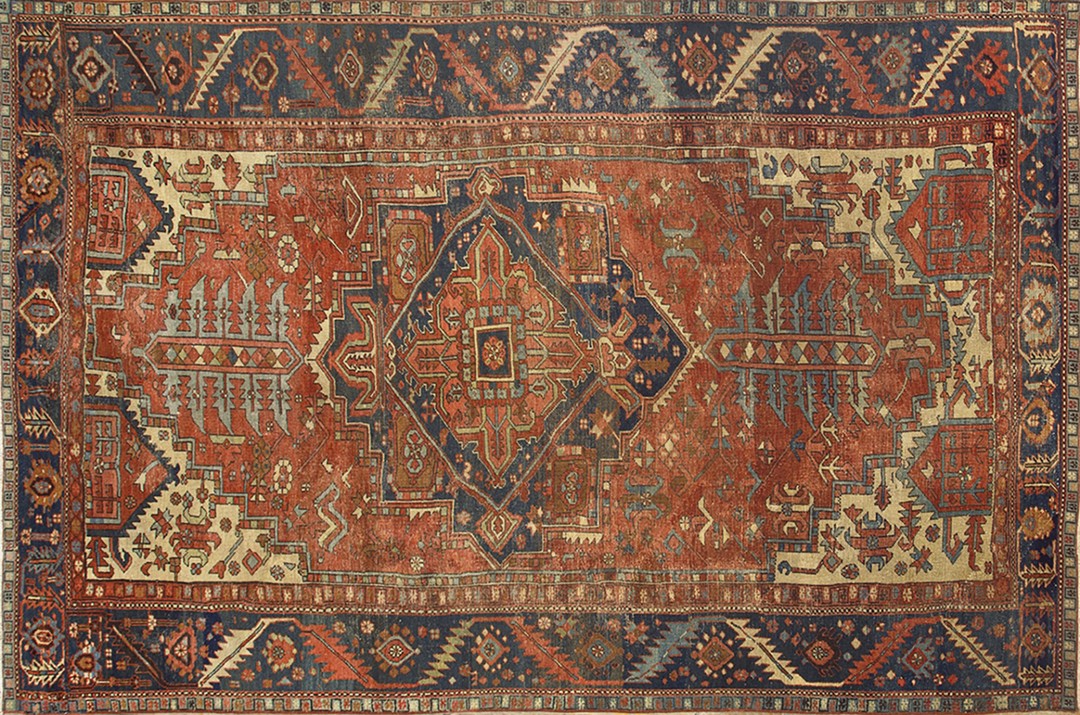
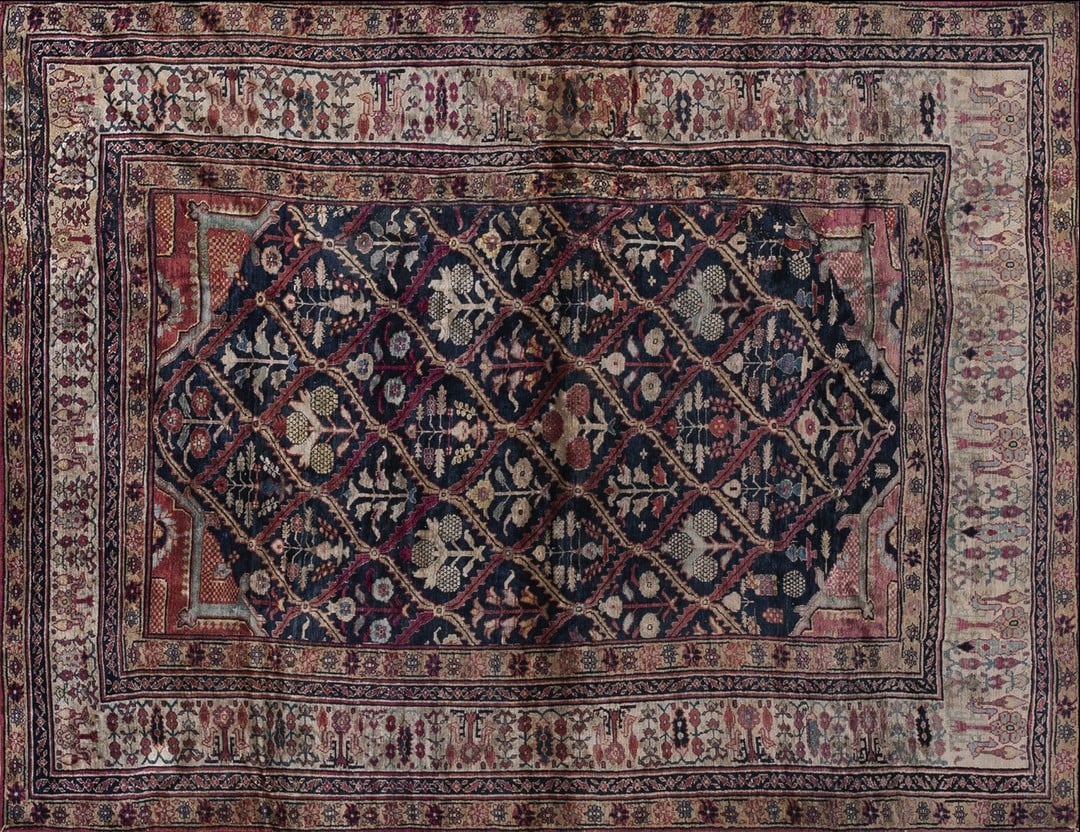
Explore a Few of Our Favorite Serapi Rugs
FAQ
- How durable are Serapi rugs in high-traffic areas?
Very durable—cotton foundations and dense wool piles handle footfall well. Use a quality pad and rotate yearly to even wear.
- Do Serapi rugs shed?
Antique Serapi rugs, having low settled pile, shed minimally. New Serapi-design rugs may shed lightly at first, then taper.
- Can Serapi rugs be used under dining tables?
Absolutely. Choose a Serapi rug extending 24–30 inches beyond the tabletop so chairs stay on the rug when pulled out.
- How can I verify the age of a Serapi rug?
Look for handspun wool, natural-dye abrash, oxidized browns, and period wear consistent with c. 1870–1910. When in doubt, get an expert appraisal.
- What does “Serapi” mean in Serapi rugs?
It’s a market term, likely linked to Serab, used to label older, finer Heriz pieces. It’s not a separate weaving town.
- Are robot vacuums safe on Serapi rugs?
Be careful with fringe. Set no-go zones or lift the robot onto the rug and hand-vacuum edges to avoid snagging.
- Are Serapi rugs good for homes with pets or kids?
Yes. Wool is naturally resilient and stains clean better than synthetics; blot spills promptly and use a pad to prevent slips.
- Can a Serapi rug go over radiant floor heating?
Yes—pair it with a heat-safe felt or felt+natural-rubber pad. Avoid PVC pads that can off-gas or degrade with heat.
- What rug pad works best under a Serapi rug?
Use felt or felt-and-natural-rubber around 1/4″ thick. It adds grip, cushions traffic, and reduces wear.
- Do Serapi rugs fade in sunlight?
They can. Rotate every 6–12 months and use shades or UV film to reduce fading.
- How should I clean a Serapi rug?
Vacuum with suction only—no beater bar—going with the pile. For deep cleaning or stains, use a qualified Oriental rug cleaner.
- Are modern “Serapi design” rugs the same as antique Serapi rugs?
No. Modern Serapi-design rugs mimic the look, but original Serapi rugs are 19th-century Heriz-region weavings.
- Are Serapi rugs a good investment?
Many hold value due to collector demand and age, but markets fluctuate. Buy a Serapi rug you love; treat appreciation as a possible bonus.
- How much do Serapi rugs cost?
Antique Serapi rugs commonly range from about \$5,000 to \$50,000+, with exceptional, large, or pristine examples reaching higher. Size, age, color, and condition drive price.
- What sizes are common for Serapi rugs?
Room sizes dominate—8×10, 9×12, and larger. True Serapi runners exist but are comparatively rare.
- What colors do Serapi rugs usually feature?
Classic Serapi rugs use rust reds, deep indigo/navy, ivory, sky blue, greens, and terracotta. Contrast between medallion and corners is typical.
- How can I identify an authentic Serapi rug?
Look for a large, multi-lobed medallion, ivory corner spandrels, angular drawing, and natural-dye abrash. Cotton foundations and clear age wear are common tells.
- What knot type and density do Serapi rugs have?
Serapi rugs usually use the symmetric Turkish (Ghiordes) knot. Densities often fall around 50–100 KPSI, varying by piece.
- What materials are used in Serapi rugs?
Serapi rugs typically have a wool pile on a cotton foundation. They’re fully hand-knotted.
- When were most Serapi rugs made?
Most antique Serapi rugs date to roughly 1870–1910. Pieces in this window are commonly labeled “Serapi” in the market.
- Serapi rugs vs. Tabriz rugs—what’s the difference?
Serapi rugs are village-woven and geometric; Tabriz rugs are city-workshop pieces with curvilinear details. Serapi uses symmetric knots; Tabriz often uses asymmetric knots and higher densities.
- How do Serapi rugs compare to Bakhshaish rugs?
Both are Heriz-area weavings. Serapi rugs lean formal with commanding medallions; Bakhshaish rugs are typically more rustic and abstract.
- How are Serapi rugs different from Heriz rugs?
“Serapi” is a trade term for earlier, finer, more open-designed Heriz rugs. Think c. 1870–1910 pieces with balanced spacing and softer palettes.
- Are Serapi rugs Persian?
Yes—Serapi rugs come from the Heriz district in East Azerbaijan, Iran. They’re hand-knotted village carpets known for strength and graphic designs.
- What is a Serapi rug?
A Serapi rug is a high-quality, antique subset of Heriz weaving from northwest Iran. Expect bold geometric medallions and spacious layouts woven mainly for export in the late 19th century.