
Introduction to Fleur-de-lis Rugs
Discover our exquisite collection of Fleur De Lis motif rugs and crown your space with timeless elegance.
What Is the Fleur-de-lis Motif?
- Stylized lily with three petals — Why: The fleur-de-lis is defined by its iconic tripartite form, where a central blade is flanked by two outward-curving petals, creating symmetry and elegance.
- Historic ties to French royalty and heraldry — Why: It became the official emblem of French kings and is still associated with nobility, making it one of the most enduring heraldic rug motifs.
- Cultural adoption beyond France — Why: While its origins are French, the motif spread across Europe and beyond, entering religious, artistic, and decorative traditions, including rug weaving.
What Does the Fleur-de-lis Symbolize in Rug Designs?
The fleur-de-lis symbol in rugs is more than a decorative accent—it carries centuries of meaning. In heraldic tradition, it represents authority, chivalry, and noble lineage. When adapted into textiles, particularly rugs, it adds a sense of purity, tradition, and heritage to interiors.
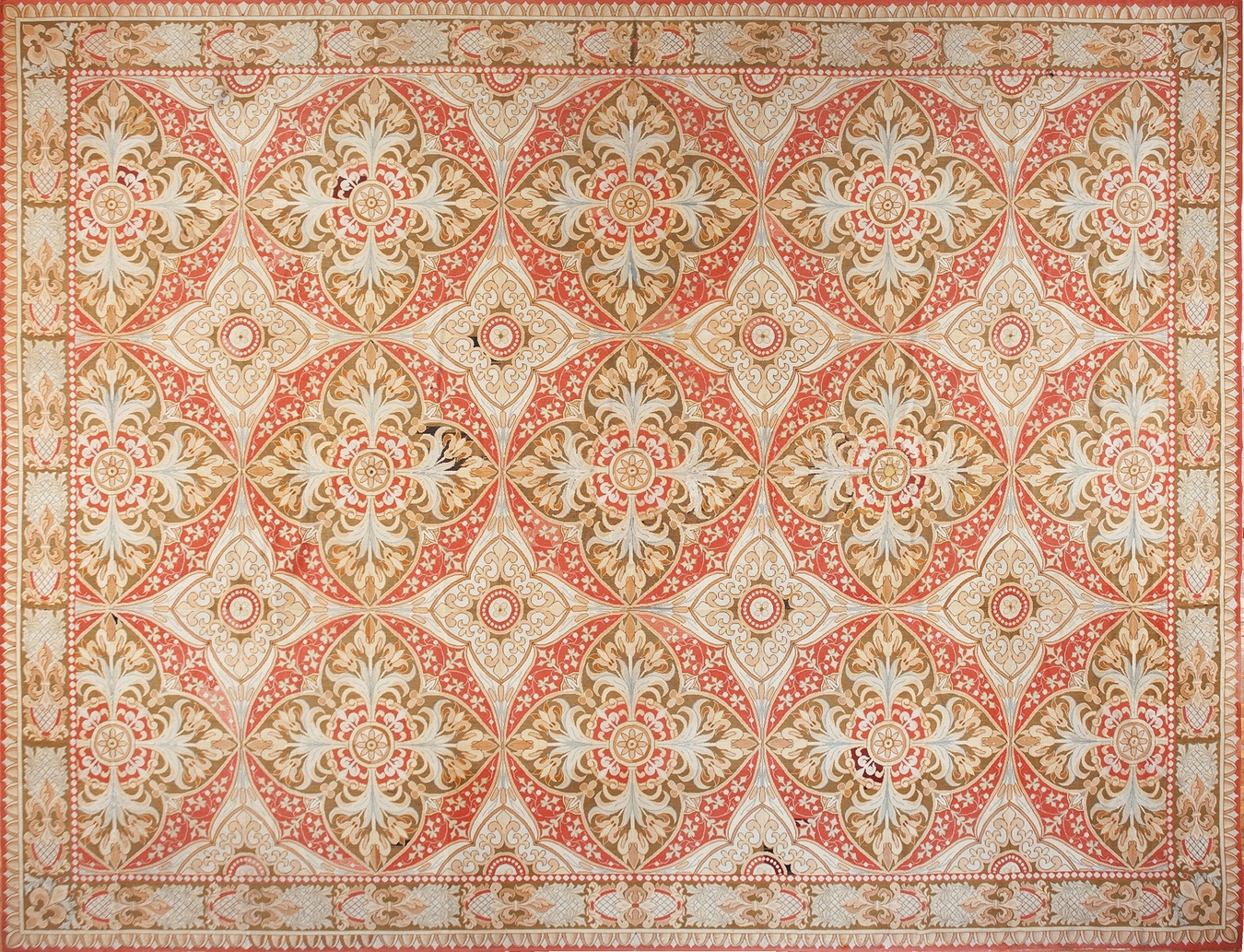
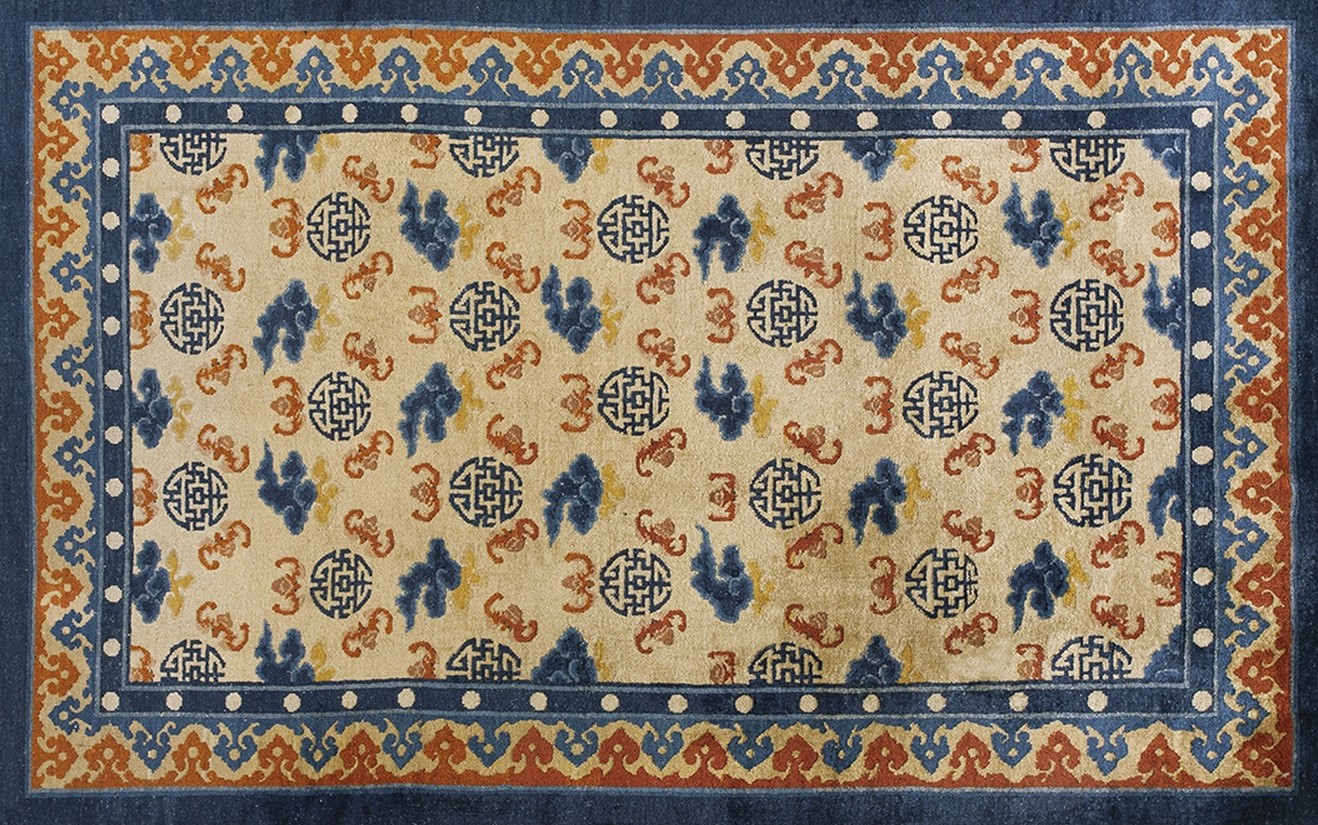
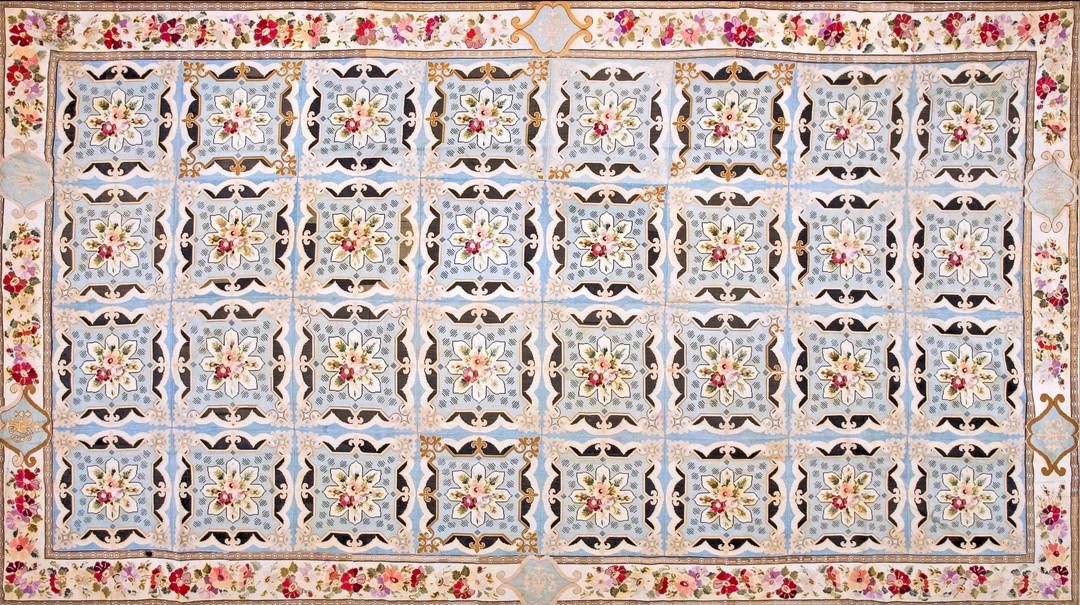
Antique Large Allover Floral Flat Weave Rug – by Rugs On Net
For formal spaces or historically inspired settings, the French lily rug design signals refinement, grounding the room in classical culture. Its symbolic weight ensures it remains popular among collectors, designers, and homeowners seeking a motif that bridges both power and beauty.
How to Identify Fleur-de-lis Patterns on Rugs
- Look for three-petal symmetry — Why: The most reliable way to identify a fleur-de-lis pattern is by spotting the balanced structure: a tall central blade with two curved side petals.
- Check the base binding — Why: Many fleur-de-lis motifs feature a band or tie near the stem, reflecting their heraldic style and distinguishing them from generic floral shapes.
- Note repeated motifs in rug design — Why: Fleur-de-lis elements are often woven in borders, medallions, or repeating fields, creating a rhythmic, noble aesthetic that aligns with classical rug traditions.
The ease of identification makes the fleur-de-lis a favorite for both rug collectors and interior designers.
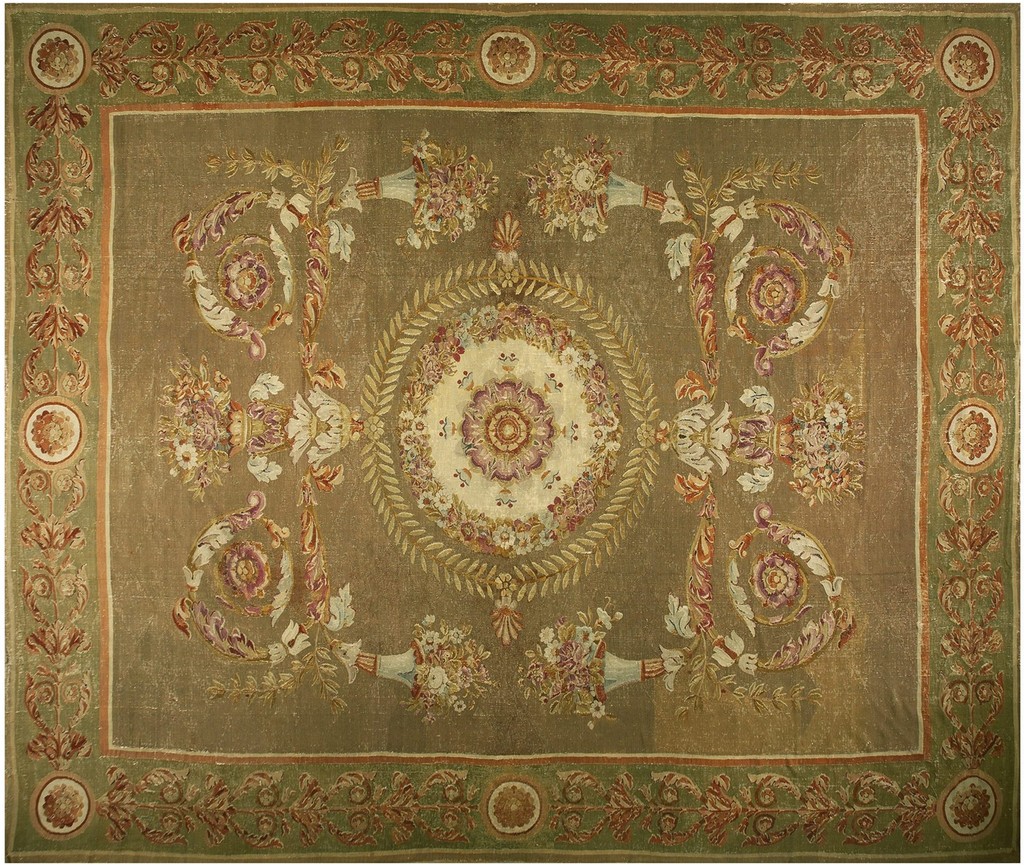
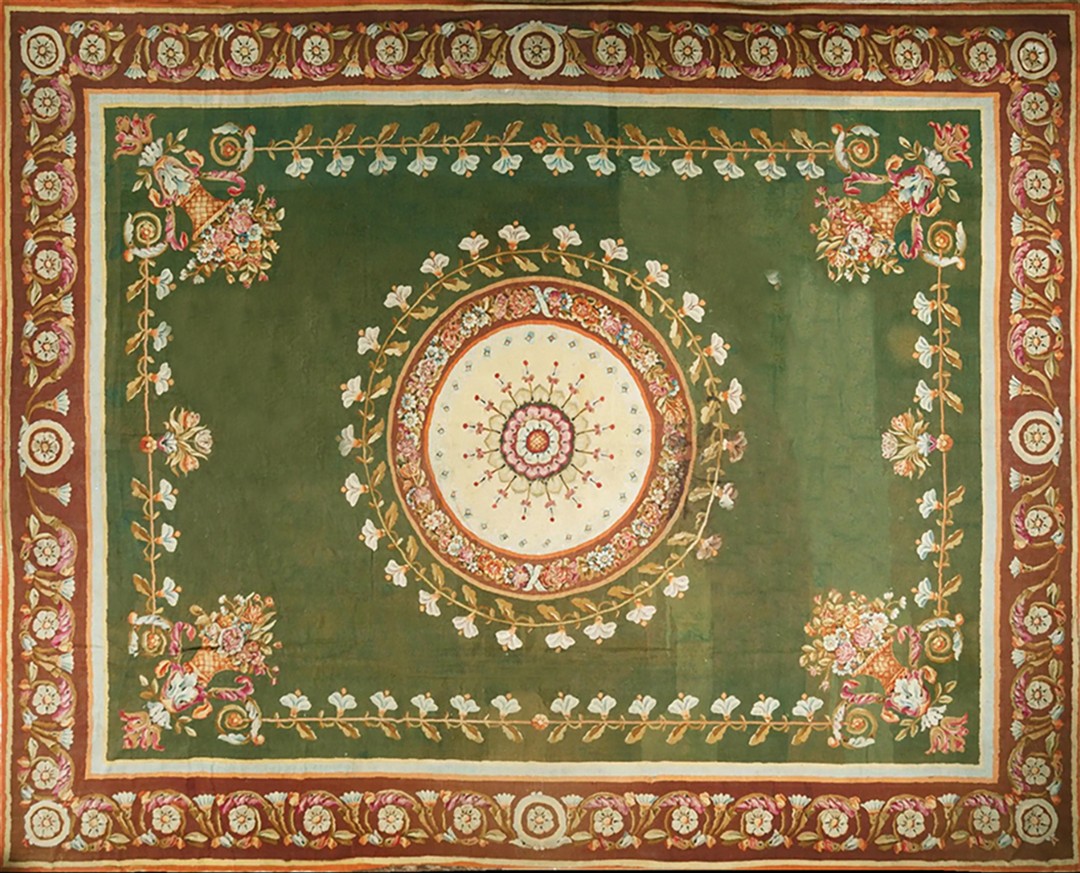
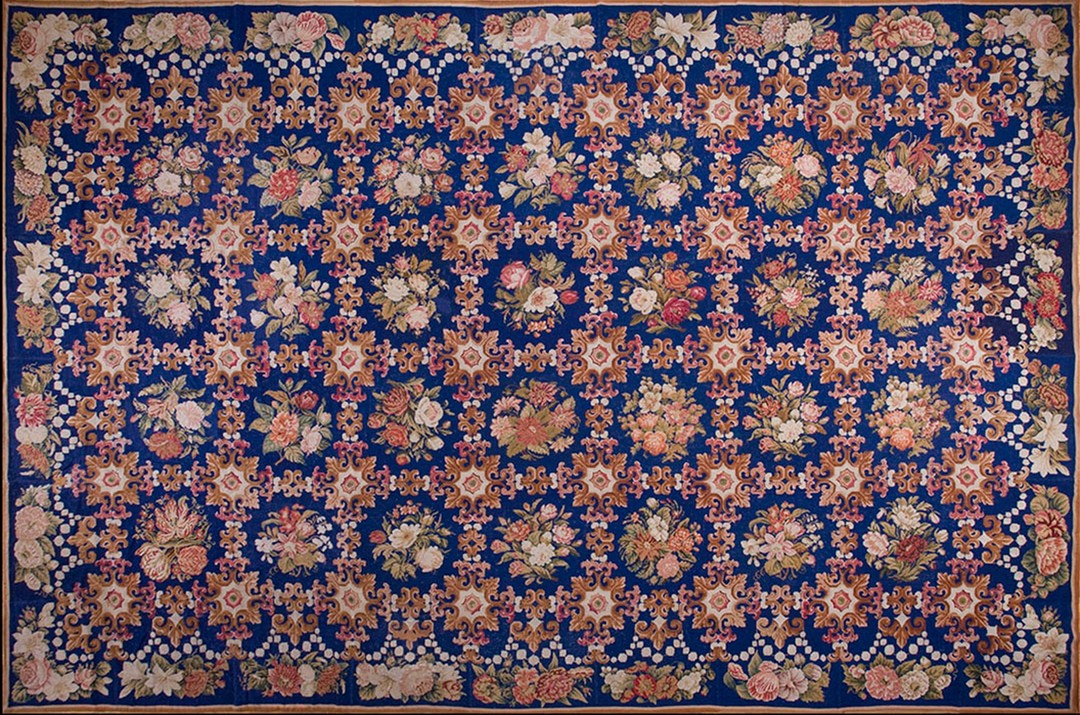
Antique Large Aubusson French Floral, Medallion Knotted Rug by Rugs On Net
Whether used as a central emblem or in repeating borders, the French lily rug design offers a timeless balance of elegance and symbolism, standing out as a distinctive heritage motif in the world of decorative carpets.
Origins & Historical Development
Where Did the Fleur-de-lis Motif in Rugs Originate?
The fleur-de-lis rug history begins in medieval France, where the motif was adopted by kings as a powerful emblem of divine authority and noble lineage. First appearing in heraldic shields and royal insignia, the origin of the French lily motif quickly extended into luxury decorative arts, including textiles.
By the 17th century, it was woven into Savonnerie carpets, which adorned the palaces of Louis XIV and other monarchs, and later into Aubusson tapestries, further cementing its place in aristocratic interiors. These royal commissions marked the fleur-de-lis not only as a visual symbol but also as a woven declaration of power and prestige.
Link to French Royalty and Heraldry
The association between fleur-de-lis rugs and French royalty is inseparable. For centuries, the motif signified divine right and the legitimacy of the crown, making its presence in French royal carpet design an unmistakable symbol of authority.
In ceremonial state carpets, the lily added grandeur to coronations, banquets, and diplomatic receptions. To display a fleur-de-lis within a rug was to affirm allegiance to monarchy and to cloak interiors with a visual language of prestige. This heraldic connection explains why the motif still carries an aura of refinement and tradition when seen in rugs today.
Spread to Other Regions
The fleur-de-lis traveled widely beyond France, adapting to local contexts while retaining its noble essence. The Bourbon dynasty brought it to Spain, where it became part of both royal heraldry and woven decoration, inspiring early examples of fleur-de-lis Spanish rugs. In the Middle East, Oriental workshops occasionally incorporated the lily into commissioned carpets for Western patrons, blending local weaving traditions with European heraldic demands.
Across the Atlantic, the motif became a civic emblem in New Orleans, a city shaped by French-Creole heritage, where it appeared not only in flags and architecture but also in locally woven and embroidered textiles. The journey of the fleur-de-lis symbol in rugs demonstrates both colonial influence and cultural adaptation.
Whether gracing French palaces, Spanish courts, Oriental commissions, or Louisiana homes, the motif retained its connotations of nobility, heritage, and identity, while simultaneously becoming a flexible design element across diverse weaving traditions.
Design Features & Motif Identification
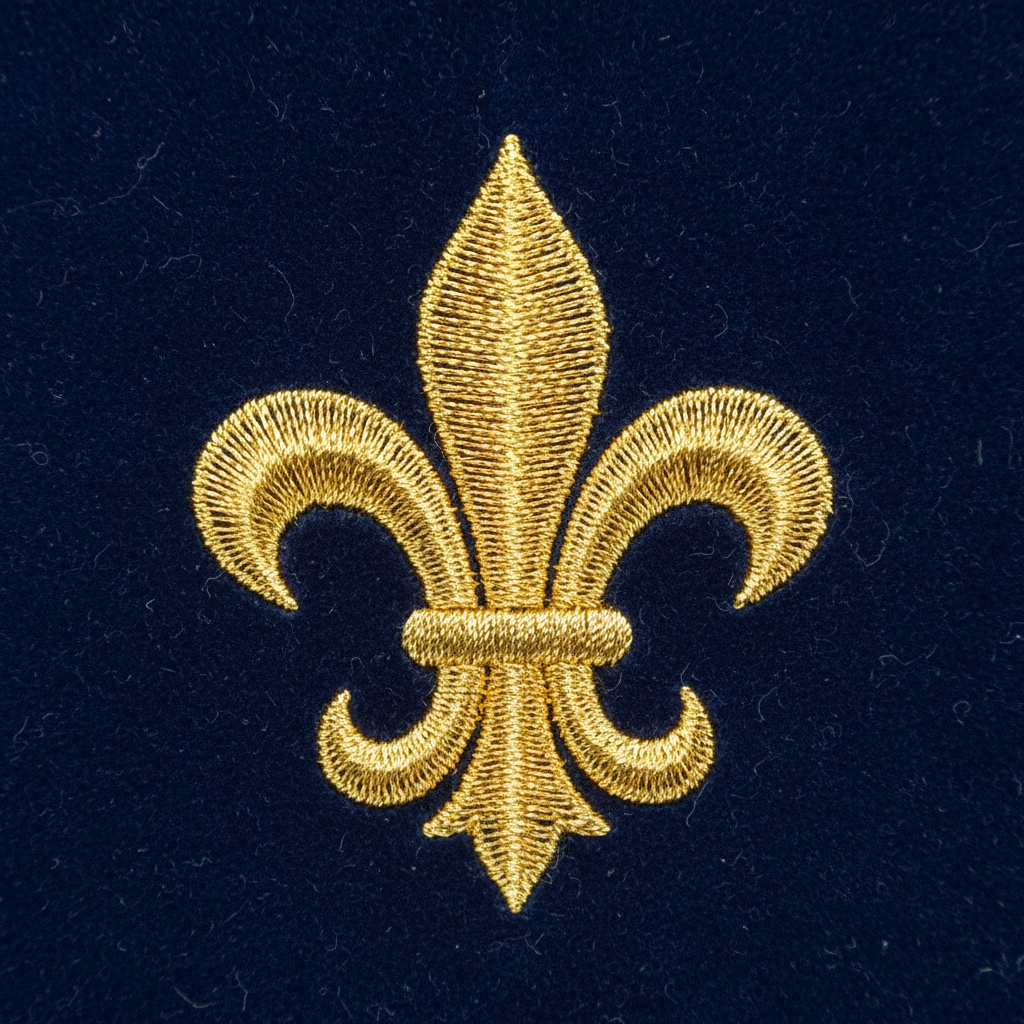
Embroidered gold motif identification
Visual Characteristics of the Fleur-de-lis
- Three distinct petals or lobes — Why: The central blade with two outwardly curving petals defines the fleur-de-lis rug pattern, making it instantly recognizable among floral motifs.
- Symmetry and balance — Why: Its precise geometry emphasizes harmony, which is why it appears so often in heraldic or ceremonial settings.
- Pointed lower tip and bound base — Why: These details help distinguish it from ordinary flowers, especially when woven into carpets with dense decoration.
- Color traditions — Why: In many historic carpets, the lily appears in gold or yellow against blue or red fields, echoing French heraldic colors.
Pattern Layouts: Central, Allover, Border
The impact of a fleur-de-lis symbol in rugs depends on how the motif is arranged. A central placement highlights the lily as a medallion, recalling ceremonial or state carpets. In allover grids, the repeated motif becomes rhythmic, conveying grandeur and formality across the rug’s surface.
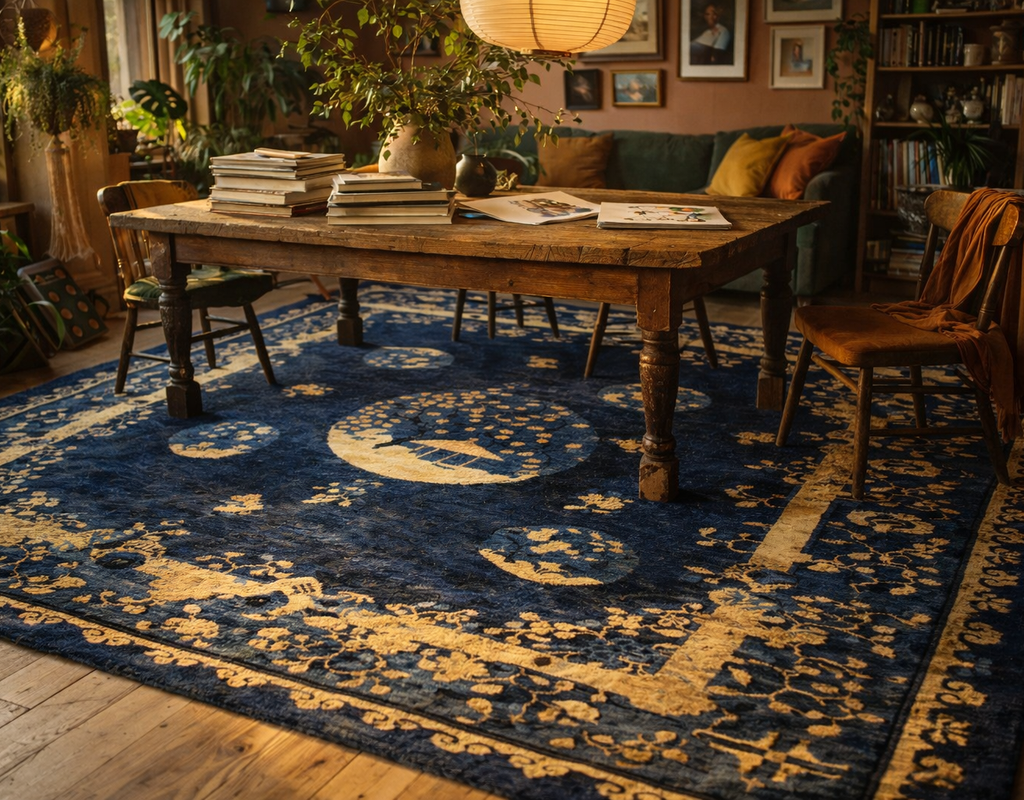
A dramatic indigo rug featuring celestial and floral patterns grounds this warm, eclectic dining and living space.
As a border element, the design serves as a decorative frame, tying heritage symbolism into the structure of the carpet without dominating the field. Each layout alters the rug’s visual weight and its role in interior design.
Differences by Region: French vs. Persian vs. American Styles
Although the form of the motif is consistent, its execution varies across cultures. In French rugs, particularly Savonnerie and Aubusson, the lily is rendered with dimensional shading and heraldic refinement, embodying royal luxury. In Persian or Oriental export carpets, the motif is often simplified and flattened, adapted for Western buyers who sought familiar heraldic designs within Eastern weaving.
In American styles, especially Louisiana-made carpets and textiles, the fleur-de-lis appears bold, graphic, and iconic, reflecting civic pride more than aristocratic lineage. These regional fleur-de-lis styles connect back to their own history, showing how one symbol was reshaped through cultural exchange and local identity.
Symbolic and Religious Interpretations
Beyond aesthetics, the lily carries layered symbolism. In Catholic tradition, its tripartite form has been interpreted as a reference to the Holy Trinity, making it a common choice for religious symbol rugs or church commissions. More broadly, it signifies purity, honor, and authority, resonating with both monarchic and spiritual contexts.
Collectors who identify French lily carpets often value not only their elegance but also the weight of this symbolic heritage woven into their design. Thus, whether appearing in a gilded French palace rug, a Persian export carpet, or a Louisiana-inspired floor piece, the fleur-de-lis rug pattern unites consistency of form with rich variations of meaning, layout, and regional style.
Materials & Weaving Techniques
Common Materials in Historic and Modern Rugs
- Wool — Why: The most traditional and durable fiber, wool has been the foundation of both pile and flatweave fleur-de-lis rugs for centuries, offering warmth, resilience, and natural dye absorption.
- Cotton or linen — Why: These fibers often served as foundations or warp threads, providing stability for elaborate patterns.
- Silk and metallic threads — Why: Used in luxury pieces, silk highlighted the shimmering elegance of the French lily motif, while gold or silver threads added regal brilliance to ceremonial carpets.
- Synthetics (nylon, polyester, polypropylene) — Why: In modern markets, these materials dominate machine-made fleur-de-lis rugs, making them affordable and easy to maintain, though less durable than wool.
Aubusson Weaving and the Fleur-de-lis
The Aubusson fleur-de-lis rug is distinct for its tapestry method rather than a knotted pile. Woven on looms, Aubusson rugs use dyed wool wefts passed through a linen or cotton warp, producing a flatweave surface. This technique allows artisans to render fleur-de-lis motifs with painterly detail, crisp outlines, and subtle shading, much like a woven painting.
In contrast, Savonnerie carpets, produced alongside Aubussons in France, employed a pile weave, giving the fleur-de-lis added depth and plushness but less fine detail. The flatweave tapestry style became especially associated with fleur-de-lis motifs due to its ability to highlight the heraldic precision of the lily.
Pile vs. Flatweave: Which Is More Common?

A detailed focus on the intricate, vivid colors and geometric weave of a traditional textile rug.
While fleur-de-lis motifs can be found in both structures, they are more common in flatweave rugs. This is because the heraldic lily requires sharp outlines and symmetry, which are easier to achieve in tapestry-style weaving.
Pile rugs, especially in Savonnerie and later modern reproductions, certainly used the motif, but often with a softer, dimensional look rather than precise definition. For collectors seeking clarity and traditional association, flatweave vs pile rugs usually favors flatwoven Aubussons.
Use of Silk, Metallic, and Synthetic Fibers
Silk was historically employed in luxury fleur-de-lis carpets, particularly for aristocratic commissions, where sheen elevated the motif’s elegance. Metallic threads—gold and silver—accentuated royal symbolism, used sparingly to emphasize borders or central medallions. In contrast, modern designs lean on synthetic materials, such as polypropylene, which replicate fleur-de-lis patterns at scale for affordable décor.
The balance today often lies in wool vs synthetic fleur-de-lis rugs, with wool prized for authenticity and longevity, while synthetics dominate for everyday practicality. In every case, material choice and weaving technique determine not just durability but also how vividly the tapestry rug weaving renders the fleur-de-lis—whether as a delicate symbol of French aristocracy or as a bold motif in contemporary interiors.
Aubusson & Savonnerie: The French Tradition
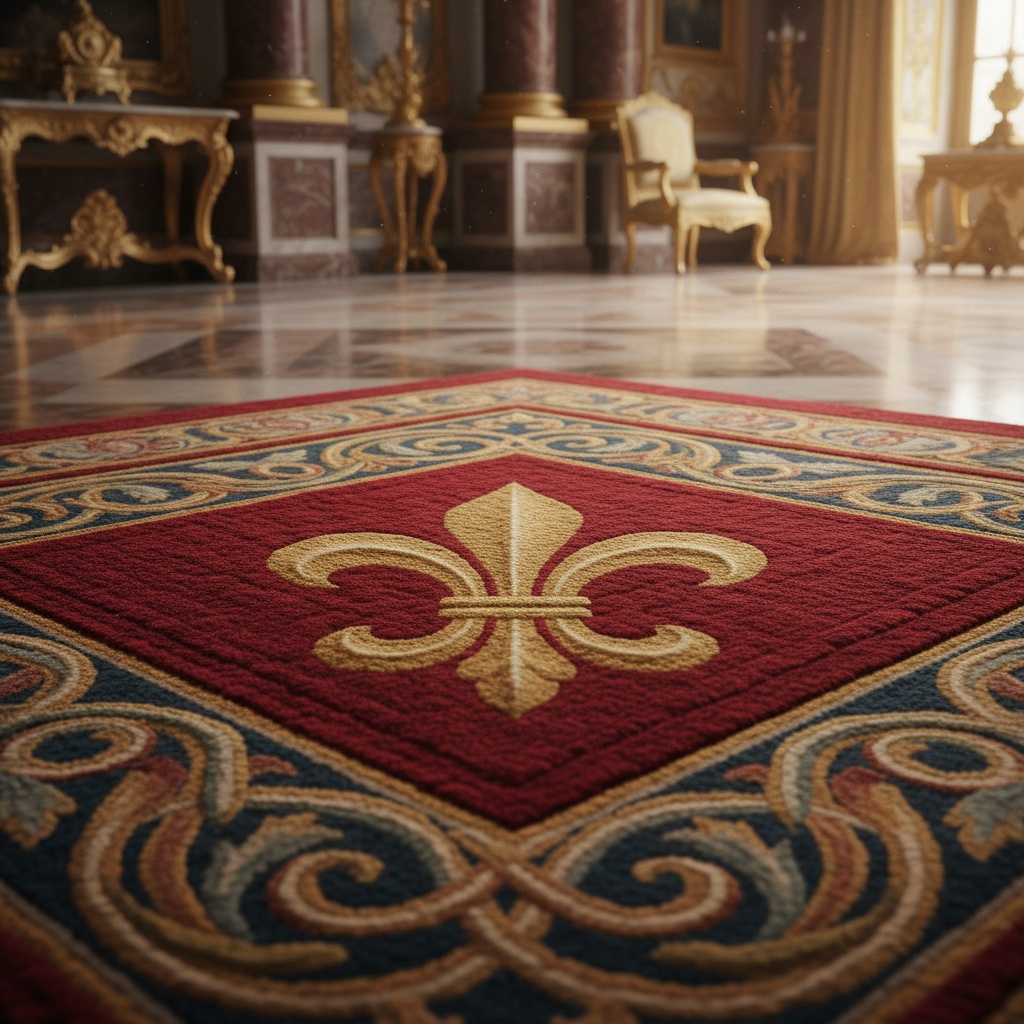
Aubusson style rug with prominent French royal symbol.
Aubusson Carpets: Construction and Motif Incorporation
The Aubusson fleur-de-lis rug represents the pinnacle of flatwoven artistry. Produced in the town of Aubusson from the 17th century onward, these carpets were woven on looms using dyed wool wefts over cotton or linen warps, creating a tapestry-like surface. The fleur-de-lis motif was incorporated with remarkable precision, its crisp outlines and balanced geometry ideally suited to the flatweave structure.
Aubusson weavers often framed the French lily within medallions or repeated it across borders, ensuring that the heraldic emblem stood out with clarity and elegance. For collectors, this weaving style demonstrates how symbolism and technique worked hand in hand to produce rugs that were as much political statements as decorative objects.
Savonnerie Carpets and Royal Patronage
If Aubusson was about refinement and clarity, the French Savonnerie carpet embodied opulence. Originating in Paris under royal workshops, Savonnerie carpets were hand-knotted pile rugs designed for palace interiors. Many featured gold fleur-de-lis set against deep blue or red fields, directly referencing royal heraldry.
These plush pile rugs, with their dimensional motifs and luxurious textures, were used in throne rooms, banquets, and ceremonial halls. The royal tapestry carpets of both Savonnerie and Aubusson became the official language of French monarchy in textile form, setting a global standard for elegance and power in rug design.
Influence on Later European and Global Designs
The influence of Aubusson and Savonnerie fleur-de-lis carpets extended far beyond France. Their success established the fleur-de-lis as a globally recognized motif, inspiring imitators and adaptations across Europe, from Spain to Italy, and even into Oriental weaving centers that catered to Western clients.
This cross-cultural diffusion underscores how French royal aesthetics reshaped rug traditions worldwide, embedding heraldic symbols into both flatweave and pile practices.
Investment Value: Vintage Aubusson Fleur-de-lis Rugs
For collectors, a vintage Aubusson fleur-de-lis rug is more than décor—it is a potential investment. Authentic pieces, especially those with verified provenance and minimal restoration, are rare and highly desirable. Their value is driven by craftsmanship, historical significance, and royal associations, making them sought-after at auctions and by private collectors.
In many cases, investing in antique rugs of this caliber has proven rewarding, as market demand for well-preserved Aubussons continues to grow.
Ultimately, Aubusson and Savonnerie rugs stand as the gold standard in fleur-de-lis textile design. They embody the height of French royal patronage while also offering long-term cultural and financial value for today’s collectors.
Modern & Contemporary Fleur-de-lis Rugs
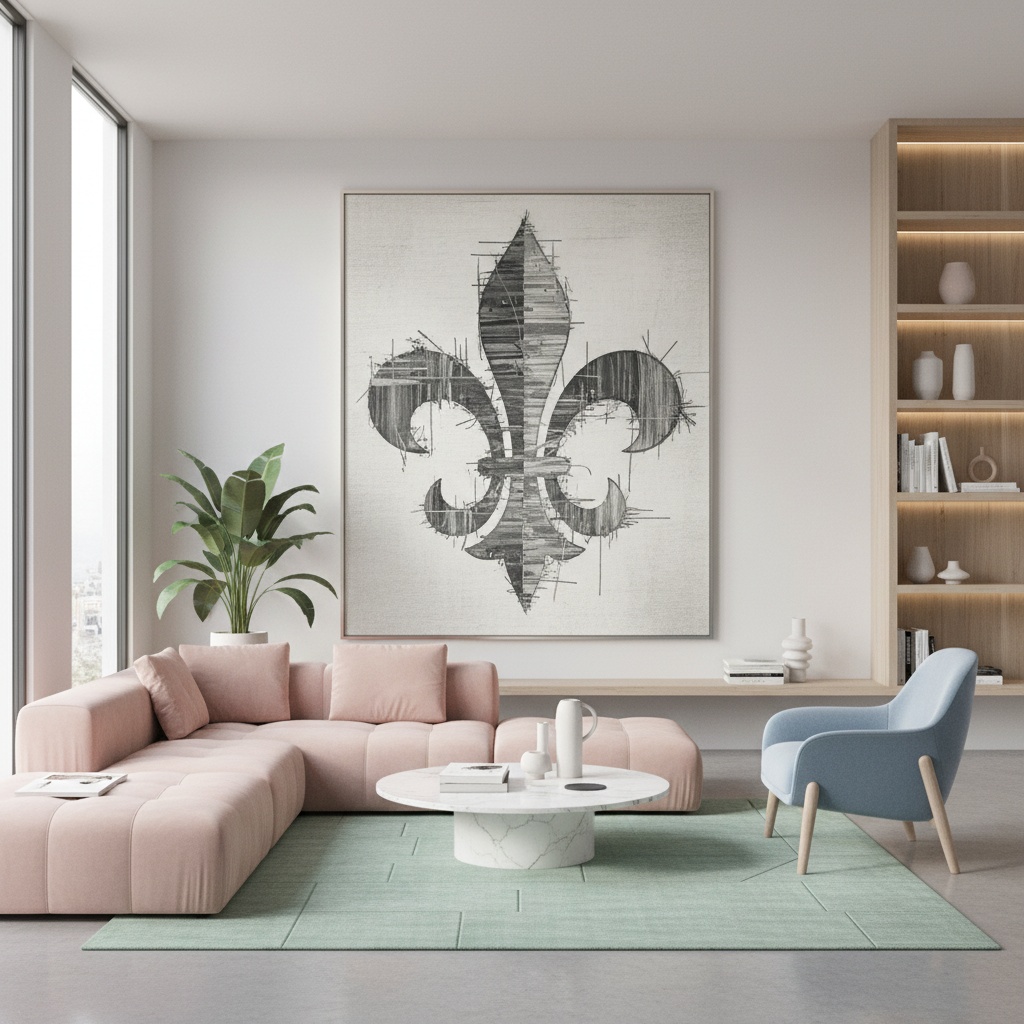
Contemporary room featuring large-scale fleur-de-lis art.
Machine-made Fleur-de-lis Rugs: Rise and Reach
The accessibility of the modern fleur-de-lis rug owes much to machine production, which took off in the mid-20th century. Once limited to aristocratic commissions and artisan workshops, the motif became widely available when mechanized looms began reproducing the French lily at scale.
This shift democratized the design, allowing households across Europe and the U.S. to enjoy what was once a royal emblem. Today, machine-made fleur-de-lis carpets exist in virtually every size, color, and price range, from entry-level décor pieces to high-end reproductions of historic styles.
Wool vs. Synthetic for Modern Rugs
A key choice for buyers is whether to opt for wool or a synthetic fleur-de-lis runner. Wool remains the benchmark for luxury: naturally resilient, richly textured, and ideal for formal interiors. By contrast, synthetic fibers like polypropylene or nylon dominate the budget and everyday market, offering stain resistance, affordability, and easy cleaning.
For outdoor areas, hallways, or busy family rooms, synthetics outperform natural fibers in durability. The decision ultimately depends on whether a rug is meant to be a long-term heritage piece or a practical solution for high-traffic living.
Modern Colorways: Rarity and Price
In contemporary production, standard colorways—navy, burgundy, beige—are widely available, keeping prices affordable. However, rare colorways in fleur-de-lis rugs—such as unexpected neutrals, pastels, or avant-garde tones—are often produced in limited runs.
Collectors and design-forward buyers may pay a premium for these unusual palettes, as scarcity enhances both decorative impact and resale potential. Compared to antique French lily rugs, modern examples are generally more affordable, but limited editions with unique colors can rival older pieces in desirability.
Outdoor and High-Traffic Options
The outdoor fleur-de-lis carpet has become a staple in recent years, especially in regions where the motif resonates culturally, such as Louisiana. Woven from weather-resistant synthetics, these rugs withstand rain, sun, and heavy foot traffic, making them ideal for patios, porches, and entryways.
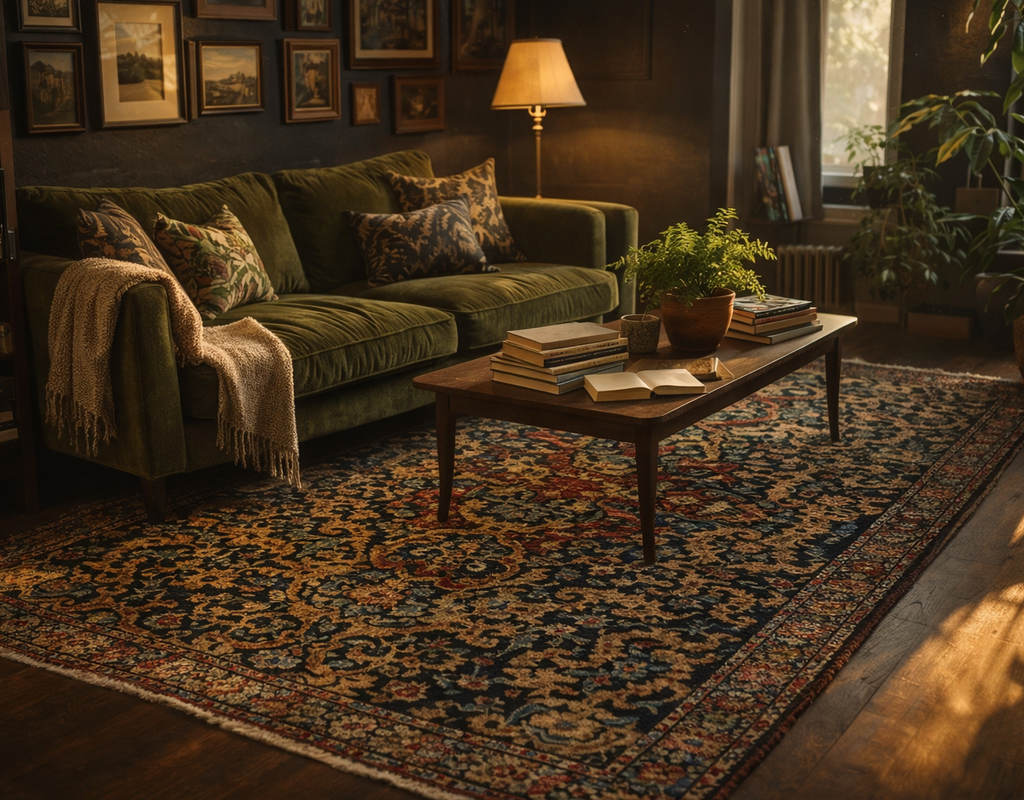
A deeply saturated living room showcasing layered textiles and warm, inviting lighting over a classic patterned rug.
Their durability ensures that even high-use spaces can carry the same sense of tradition and elegance once confined to formal salons.
Minimalist & Eclectic Interiors: Does the Motif Fit Today?
Though rooted in monarchy and heraldry, the fleur-de-lis is surprisingly versatile in 21st-century décor. A minimalist rug pattern may feature a single oversized lily in monochrome, acting as a subtle nod to history without overwhelming a pared-back interior. Conversely, eclectic homes often embrace bold fleur-de-lis grids or colorful reinterpretations, layering tradition with personal style.
The motif’s adaptability proves that even in contemporary design—whether sleek or expressive—the fleur-de-lis continues to thrive. Modern manufacturing ensures that fleur-de-lis rugs now exist for every lifestyle, from collectible luxury to durable outdoor use. The enduring motif bridges past and present, fitting equally well in classic, regional, or modern interiors.
Buying, Collecting & Authenticating
Comparing Prices: Modern vs. Antique Fleur-de-lis Rugs
- Modern machine-made rugs — Why: These are the most affordable, often produced with synthetics, and widely available in big-box and online markets. A buyer can buy a fleur-de-lis area rug for a fraction of the cost of a vintage piece.
- Handmade contemporary rugs — Why: Wool or handwoven modern examples cost more than synthetics, offering durability and better craftsmanship, but remain accessible compared to antiques.
- Antique and vintage rugs — Why: A vintage Aubusson fleur-de-lis rug or a royal Savonnerie example commands the highest prices, reflecting rarity, provenance, and historical significance. Collectors pay premiums for authenticity and preservation, making antiques true investment-grade pieces.
Authenticating Antique & Tapestry Fleur-de-lis Rugs
To authenticate an antique rug, especially an Aubusson tapestry, buyers must look for period-appropriate weaving techniques, original wool or silk fibers, and natural dyes consistent with 17th–19th century practices. Provenance documentation, such as sales records or museum references, adds credibility.
Signs of careful restoration are acceptable, but over-restoration diminishes value. A genuine antique fleur-de-lis carpet should show both historic weaving detail and verifiable lineage. Consulting a specialist or certified appraiser is strongly advised when considering high-value acquisitions.
Ready-made vs. Custom-ordered Rugs
The decision between a custom fleur-de-lis carpet and a ready-made option depends on purpose and budget. Ready-made rugs are quicker to obtain and significantly cheaper, available in standard sizes and colors.
By contrast, custom rugs allow personalization of scale, motif placement, and colorways, making them ideal for interior designers or homeowners who want a one-of-a-kind piece. Custom weaving also ensures that the fleur-de-lis pattern is adapted precisely to a room’s dimensions or aesthetic, though it comes with longer wait times and higher costs.
Sourcing Ethically Produced Wool Fleur-de-lis Rugs
Modern buyers increasingly prioritize sustainability. An ethically sourced wool rug featuring the fleur-de-lis can be identified by certifications such as GoodWeave or by purchasing from workshops with transparent supply chains. Sellers who disclose where and how their rugs are made, and who support fair wages for artisans, ensure that tradition continues without exploitation.
For those committed to conscious consumption, choosing a responsibly produced fleur-de-lis wool rug adds ethical weight to cultural heritage. In today’s market, collectors balance tradition and ethics. Whether purchasing a buy fleur-de-lis area rug as an affordable décor piece or investing in an antique tapestry with royal provenance, buyers must weigh authenticity, sustainability, and customization to find the rug that best aligns with their values and vision.
Care, Maintenance & Placement
High-pile Fleur-de-lis Rugs: Maintenance Challenges
A high-pile fleur-de-lis rug brings plush comfort and dramatic depth to interiors, but it also presents unique upkeep demands. The raised fibers easily trap dirt, dust, and debris, which can obscure the crisp lines of the lily motif over time. Regular vacuuming is essential, ideally with a suction-only setting to avoid pulling at the pile.
Occasional professional cleaning helps restore vibrancy and prevents soil buildup in the fibers. For households with pets or heavy use, these rugs require extra diligence to maintain both the clarity of the design and the rug’s overall longevity. These high-pile rug maintenance steps are the key to preserving both beauty and durability.
Outdoor Fleur-de-lis Rugs: Durability & Use
The outdoor fleur-de-lis carpet has become a practical way to bring heritage style to porches, patios, and garden seating areas. Made with weather-resistant synthetics, these rugs offer excellent outdoor rug durability, withstanding sun exposure, rain, and heavy foot traffic without fading or fraying.
Their easy-care construction—often just a rinse with water—makes them an attractive option for households seeking both function and flair. In climates where outdoor living is common, a fleur-de-lis rug can act as a stylish anchor for exterior seating areas, blending tradition with modern resilience.
Placement Tips for Different Interior Styles
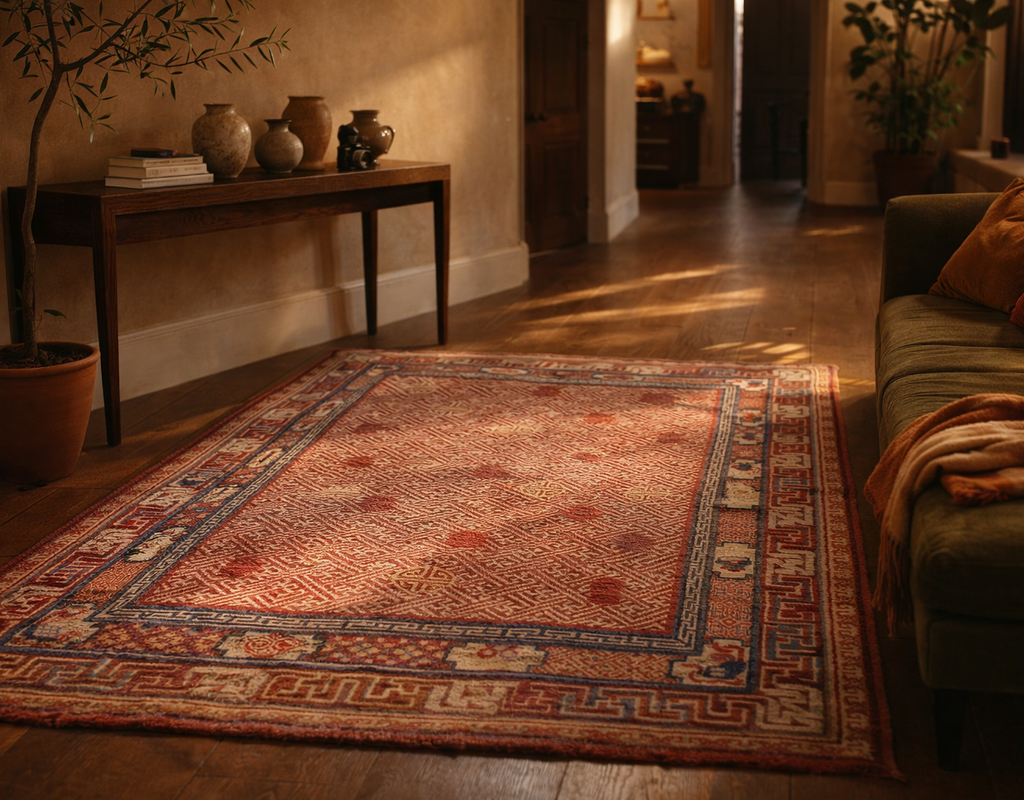
Sunlight illuminates a traditional area rug grounding a warm, organically decorated living space.
- Formal and classical rooms — Why: Place the rug as a centerpiece, letting the fleur-de-lis motif echo the refinement of traditional furniture or architectural details.
- Minimalist interiors — Why: A rug with a single oversized lily or a muted palette can serve as a subtle accent, adding heritage without overpowering clean lines.
- Eclectic or transitional spaces — Why: Use the motif in border patterns or repeating grids, allowing it to tie together varied styles while adding rhythmic structure.
- High-traffic areas — Why: Place durable, synthetic fleur-de-lis rugs in entryways or living rooms to balance practicality with symbolic design.
Knowing where to place a fleur-de-lis rug allows homeowners to enhance both style and function. Whether outdoors on a patio or indoors in a formal salon, proper placement and care ensure that the motif retains its elegance and remains a defining feature of the room.
Cultural Impact & Enduring Appeal
Symbolism in Civic, Religious, and Regional Contexts
The fleur-de-lis cultural symbol carries multiple layers of meaning that vary with context. In religious art and textiles, its three petals have long been associated with the Holy Trinity and the purity of the Virgin Mary, making it a common emblem in church carpets and liturgical weavings.
Politically, the motif historically signified royal authority and legitimacy, and in contemporary times, it continues to appear in civic emblems and regional pride. Within rug design, it often embodies purity, honor, and heritage, while adapting to different symbolic interpretations depending on where and how it is used.
Legacy in New Orleans and French Heritage Communities
In New Orleans rug decor, the fleur-de-lis has become more than an ornamental motif—it is a marker of identity. Adopted as the city’s civic emblem, it gained renewed prominence after Hurricane Katrina, symbolizing resilience, rebirth, and cultural pride.
Fleur-de-lis patterns in rugs and textiles are widely embraced in Louisiana households, reflecting the French-Creole heritage of the region. Beyond New Orleans, French heritage communities across North America and Europe incorporate the lily into decorative arts, ensuring its presence as both a French heritage rug motif and a living emblem of cultural continuity.
Design Legacy: From Royalty to Modern Decor
From its beginnings as a royal design motif in French palaces, the fleur-de-lis has undergone a remarkable evolution. Once reserved for kings and heraldry, it has become a widely accessible pattern found in both formal and casual interiors. In contemporary décor, it is equally at home in modern minimalist settings—where a single oversized lily provides subtle elegance—or in richly traditional rooms that celebrate its aristocratic roots.
This adaptability explains why the fleur-de-lis symbol in rugs remains relevant: it is a timeless emblem that speaks simultaneously to history, faith, regional identity, and modern style. The fleur-de-lis cultural symbol endures because it shifts meaning with context—royalty in one era, resilience in another, or simply decorative beauty in modern homes.
Its long journey from French royal carpets to New Orleans rug decor and today’s global interiors proves that this emblem is not just a motif, but a lasting thread of cultural expression woven into the fabric of rug design.
Explore a Few of Our Favorite Fleur-De-Lis Rugs
FAQ
- Is the fleur-de-lis symbol on rugs trademarked?
The generic fleur-de-lis is public-domain, but specific team or brand logo versions are trademarked. Avoid copying stylized logos; for commercial use, consult an IP professional.
- Are fleur-de-lis rugs good for entryways or as runners?
Yes—use 26–33″-wide fleur-de-lis runners, leaving 3–5″ of floor on each side. Low pile helps doors clear and reduces tripping.
- How much do fleur-de-lis rugs cost?
Machine-made 8×10 fleur-de-lis rugs often run \~\$100–\$300; hand-tufted wool \~\$300–\$900; hand-knotted typically \$1,000+ (antiques far higher).
- Are fleur-de-lis rugs machine-washable?
Most wool fleur-de-lis rugs aren’t. Some thin polyester/chenille versions are labeled washable; large sizes may need commercial machines. Always follow the care label.
- Do antique-style Aubusson or Savonnerie fleur-de-lis rugs exist?
Yes—historic French court carpets often included fleur-de-lis motifs. Expect higher prices; verify provenance and condition when buying antiques or faithful reproductions.
- How do I mix patterns with fleur-de-lis rugs?
Balance scale: one large-scale fleur-de-lis, plus small stripes or micro-geometrics. Keep a 3–5-color palette so the room reads cohesive.
- Will robot vacuums work on fleur-de-lis rugs?
Usually. Pick cut-pile or flatweaves, tuck fringe, and set no-go lines along tassels. Lower suction reduces snagging on decorative edges.
- Are fleur-de-lis rugs kid- or pet-friendly?
Choose low-pile or flatweave fleur-de-lis rugs in mid-tone colors; patterns hide messes. Pair with an easy-clean fiber and spot-treat quickly.
- Can I use fleur-de-lis rugs over radiant-heat floors?
Yes—keep floor temps ≤85°F and use a thin, heat-rated pad (felt/natural rubber). Avoid thick foam pads that insulate and trap heat.
- What rug pad should I use under a fleur-de-lis rug?
Use felt + natural-rubber pads for grip and cushioning; trim the pad 1–2″ smaller than the rug. Avoid cheap PVC pads on hardwoods to prevent staining.
- Are there outdoor fleur-de-lis rugs?
Yes—polypropylene flatweave fleur-de-lis rugs resist fading and moisture. Expect low pile (\~0.1–0.2″) for easy rinsing and faster drying.
- How do I clean synthetic fleur-de-lis rugs (polypropylene/nylon)?
Blot with mild detergent and water; for outdoor-safe pieces, hose and air-dry flat. Avoid hot water; rinse thoroughly to prevent residue that attracts soil.
- How do I clean wool fleur-de-lis rugs?
Vacuum regularly (suction only), blot spills with cool water and wool-safe detergent, and air-dry thoroughly. Deep clean professionally if dyes aren’t stable or the rug is thick.
- Hand-knotted vs. hand-tufted vs. machine-made fleur-de-lis rugs—what’s the difference?
Hand-knotted fleur-de-lis rugs can last decades and show crisp detail. Hand-tufted versions are plush and affordable but may shed early. Machine-made options are most budget-friendly and consistent.
- What materials are best for fleur-de-lis rugs?
Wool fleur-de-lis rugs are resilient and naturally soil-resistant. Polypropylene/nylon options offer easy care and budget value; cotton flatweaves feel casual but show stains faster.
- Are fleur-de-lis rugs good for high-traffic areas?
Yes—choose wool or low-pile synthetics. Busy fleur-de-lis repeats hide wear; aim for \~0.25–0.5″ pile in hallways and family rooms.
- Does orientation matter with a fleur-de-lis rug?
Yes. Point the lily tips “up” toward the focal wall or room entry. Center medallions under chandeliers or tables for symmetry.
- What size fleur-de-lis rug should I put under a dining table?
For six chairs, an 8×10 fleur-de-lis rug usually gives \~24″ clearance for pulled-out chairs; for eight chairs, use 9×12. Round tables pair well with round rugs.
- What colors work best with fleur-de-lis rugs?
Classic black/gold, navy/cream, or burgundy/ivory feel regal. For quieter rooms, gray/ivory or taupe/linen keep the fleur-de-lis subtle while adding texture.
- How do I keep fleur-de-lis rugs from looking dated?
Choose larger-scale or tone-on-tone fleur-de-lis rugs and simplify surrounding patterns. Neutral palettes (ivory/gray, charcoal/stone) modernize instantly.
- Which styles pair best with fleur-de-lis rugs?
Fleur-de-lis rugs excel in Traditional, French country, and Gothic revival rooms. For modern spaces, use oversized or monochrome motifs to keep the look clean.
- Do fleur-de-lis rugs carry any controversy I should know about?
Yes—under French colonial “Code Noir,” a fleur-de-lis brand marked some enslaved people. If sensitivity is a concern, discuss the symbol’s history with stakeholders and consider alternatives.
- Are fleur-de-lis rugs more French or New Orleans?
Both. Fleur-de-lis rugs reference French royalty and also New Orleans’ civic emblem, so they fit French country rooms, Southern homes, and any space wanting a classic European accent.
- What does the fleur-de-lis motif on fleur-de-lis rugs symbolize?
On fleur-de-lis rugs, the lily traditionally signals French heritage and, in Christian art, purity or the Trinity. In decor, it works mainly as an elegant, historic graphic.
- What are fleur-de-lis rugs?
Fleur-de-lis rugs feature the stylized lily (⚜︎) motif repeated or centered on an area rug. They read classic and heraldic, often suiting traditional, French country, and New Orleans–inspired interiors.