
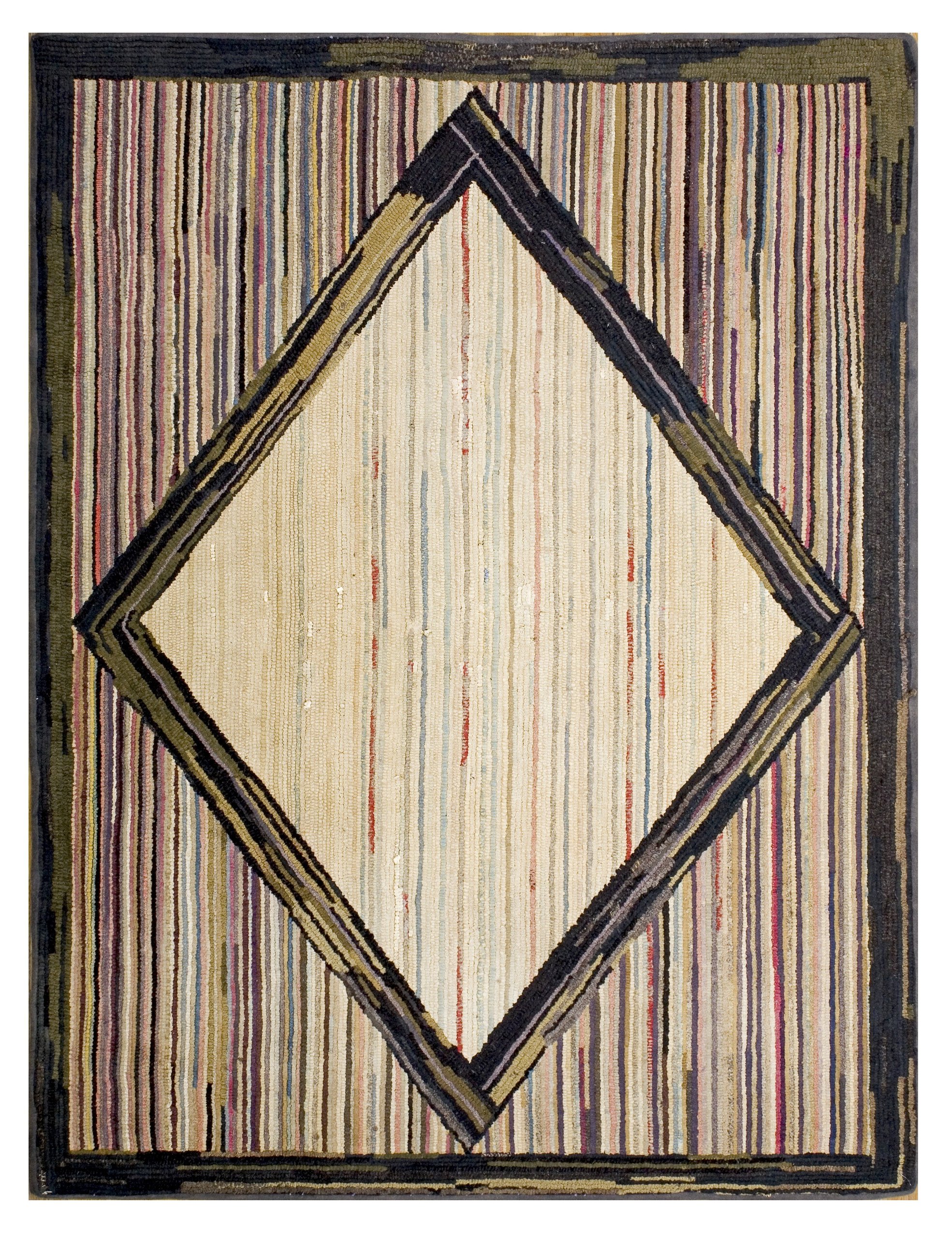
This early 20th-century antique American Hooked area rug is a vibrant and energetic masterpiece of “Primitive Geometry,” representing a high-point in the North American folk art design tradition. While many of the rugs woven in the USA of this period favored somber tones or literal floral representations, this specimen celebrates a bold, almost “Modernist” approach to design, making it a highly sought-after piece for collectors who appreciate the roots of abstract textile art.
The composition is centered upon a striking ivory diamond and colorful stripes design. The field features a large, central diamond motif—a classic symbol of the “Hearth and Home”—which is set against a background of rhythmic, multi-colored bands. The drawing is quintessentially “Naive,” characterized by the charming “hand-drawn” quality of the lines. The intentional lack of industrial symmetry gives the antique American area rug a “breathing” energy, where each stripe and geometric angle reflects the spontaneous creative decisions of the individual weaver.
The palette is a joyous celebration of historical color theory. The central ivory diamond provides a luminous, “neutral” anchor, while the surrounding stripes feature a kaleidoscopic array of madder red, indigo blue, golden ochre, and moss green. Because these remarkable area rugs were created using hand-cut strips of recycled wool flannel and hand-dyed garments, the colors exhibit a magnificent “marbled” variegation (the folk-art equivalent of abrash). This shimmering, “salt-and-pepper” texture gives the stripes a watercolor-like depth and a soft, historical glow that prevents the bold pattern from appearing too stark.
Technically, this artistic antique American folk art design hooked rug is prized for its tightly looped, nubby texture and substantial, “meaty” handle. The process of hand-hooking individual loops through a burlap or linen backing creates a dense, three-dimensional surface that catches the light with a unique, matte quality. Over more than a century of use, the wool fibers have slightly “felted” together, resulting in a velvety, suede-like patina that has softened the graphic edges of the geometric design, imbuing the piece with a sense of historical gravity and quiet luxury.
The borders act as a simple but necessary architectural frame, often using a darker “mottled” edge to “lock in” the vibrant energy of the striped field. To possess this antique American diamond and stripe rug is to own a monument to domestic ingenuity. It bridges the gap between 19th-century resourcefulness and the bold graphic sensibilities of the modern era—transforming a floor into a gallery of historical soul and colorful, geometric grace.