
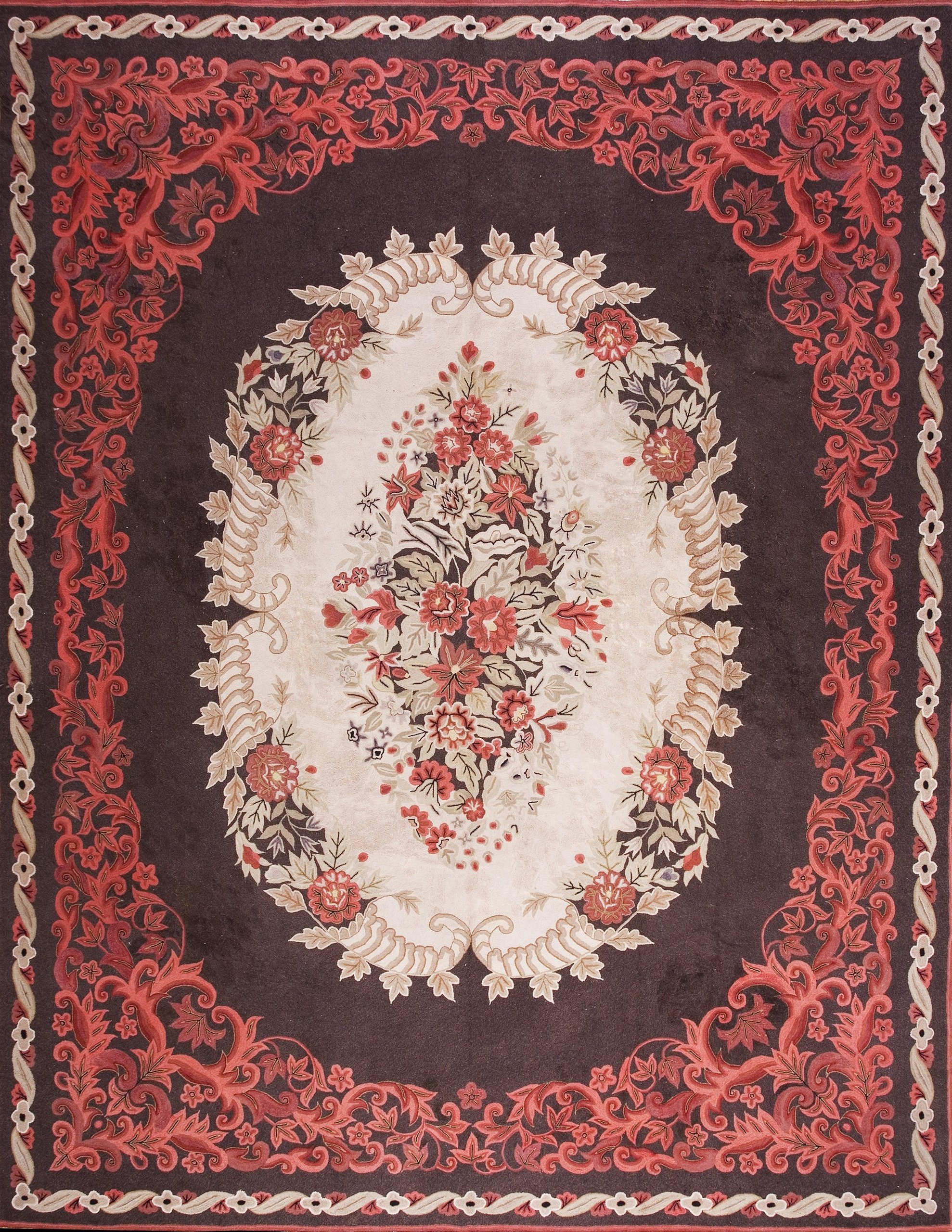
This magnificent room-size American hooked carpet from the early 20th century (circa 1920s) is a rare example of “Cottage Elegance,” representing a sophisticated bridge between rugged American folk art and the refined aesthetics of the French royal workshops. Historically, rug hooking was a provincial craft born of resourcefulness in New England, but this specific specimen is distinguished by its large-scale architectural footprint and its intentional mimicry of 18th-century European floral designs.
The composition is centered upon a luminous Ivory and Cream field, providing a high-contrast stage for a sprawling botanical narrative. Unlike the dense, dark backgrounds typical of early American folk art area rugs, this open-field aesthetic draws inspiration from French Aubusson and Savonnerie traditions. The design features a delicate central floral medallion surrounded by a rhythmic “dance” of falling petals and curling leaves. The motifs are rendered with a painterly fluidity, creating a sense of movement that leads the eye across the expansive negative space toward the grounding borders.
The palette is a masterclass in “Quiet Luxury,” utilizing a range of soft golds, dusty pinks, and earthy browns against the neutral ivory ground. Because these magnificent American area rugs were made by pulling individual loops of hand-dyed wool through a burlap or linen backing, the colors possess a natural abrash (tonal variation). This lends the flowers a three-dimensional, watercolor depth—an effect that modern synthetic dyes cannot replicate. Over the last century, these natural tones have mellowed into a sophisticated, “Shabby Chic” patina that exudes warmth and historical gravity.
Technically, a hooked rug of this room-size or oversized scale is a significant rarity. Most antique American hooked rugs were small hearth mats or “scatters”; to find one large enough to anchor a grand bedroom or a formal conversation area is a testament to the weaver’s dedication and the prestige of the original commission. The nubby, substantial texture of the hooked pile provides a heavy handle and a tactile resilience, making it as durable as it is decorative.
The borders serve as a disciplined architectural frame, often featuring dark brown leaves or scrolling vine-work that “contain” the ethereal energy of the central ivory field. To possess this large-scale American hooked carpet is to own a piece of twentieth-century folk treasure. It is a work that bridges the gap between humble colonial craft and aristocratic European design—a hand-wrought sanctuary that transforms a large interior into a space of historical charm and romantic, scholarly grace.