
Introduction to Tiger Eye Design Rugs
Discover our complete collection of captivating Tiger Eye design rugs available now.
What is a Tiger Eye Design Area Rug?
A Tiger Eye design rug refers to a pattern that draws inspiration either from the tiger’s actual eye or from the shimmering Tiger’s Eye gemstone. The term is largely a modern descriptive label, not one historically used by traditional weavers. These rugs often feature bold, eye-like focal points—sometimes round, sometimes elongated—that echo the look of a gem’s reflective surface or the piercing gaze of a tiger.
Other examples incorporate striped or circular roundels, mimicking the bands of color seen in the stone or the concentric power of a watchful animal eye. Unlike generic animal-print carpets, the Tiger Eye design motif is not strictly literal.
Some carpets present geometric abstractions that only faintly recall an eye, while others lean toward naturalistic imagery. Today, the name is applied to both traditional motifs reinterpreted through modern marketing and contemporary design innovations. This makes “Tiger Eye” more of a category-defining description than a historic weaving term.
Symbolic Meaning and Etymology
The etymology of “Tiger Eye” rugs ties back to two overlapping streams of symbolism. The first comes from the Tiger’s Eye gemstone, revered in ancient cultures across Asia and the Middle East as a talisman of courage, clarity, and protection. Its golden-brown banded surface was believed to resemble a vigilant eye, guarding the wearer from harm.
When applied to carpets, the name naturally suggested a design of watchful power and protective energy. The second stream is rooted in the tiger itself, a creature long celebrated in Chinese, Tibetan, Indian, and Central Asian iconography. The tiger’s piercing eye symbolizes vigilance, ferocity, and dominance—qualities that resonate when integrated into woven art. By fusing these traditions, the modern Tiger Eye design suggests both spiritual guardianship and bold visual presence.
Importantly, not all rugs called “Tiger Eye” bear a literal connection to tigers. Some were given the name because the central medallion, diamond form, or repeated roundels resembled a gemstone’s glowing surface, even when the weaver never intended a tiger reference. This duality is central to understanding the Tiger Eye label: it is both literal and metaphorical, protective and aesthetic.
Where Did the Tiger Eye Design Motif Originate?
The Tiger Eye design motif is not bound to a single geographic tradition. Instead, it has multiple points of origin across global weaving practices, each with distinct cultural undertones.
In Tibet and China, rugs with eye-like motifs have existed for centuries, often associated with guardian imagery and Buddhist protective symbolism. Tibetan carpets sometimes displayed circular medallions or concentric patterns meant to echo the eyes of deities or guardian animals, later reinterpreted as “Tiger Eye” designs by modern collectors.
In Morocco, Berber weavers developed abstract diamond and lozenge motifs that occasionally feature central “eyes” for protection against the evil eye—another strand folded into the Tiger Eye label when marketed abroad. American hooked rugs of the 19th and 20th centuries also employed bold circular “eye” motifs in folk art traditions, which modern dealers sometimes classify under the Tiger Eye category.
In contemporary rug design, the Tiger Eye concept has been expanded even further by Western designers, who deliberately reference the gemstone’s striated glow in abstract or geometric compositions.
This eclectic mix means that while the Tiger Eye rug is a modern naming convention, its visual roots stretch across Tibetan, Chinese, Moroccan, American, and global artisan traditions. By bridging gemstone lore, animal symbolism, and centuries of rug-making, the Tiger Eye design pattern carpet encapsulates an enduring idea: a rug that both guards and empowers, while dazzling with its distinctive eye-like design.
Origins, Etymology, and Cultural Context
The Evolution of the Tiger Eye Design Pattern Name
The phrase “Tiger Eye” pattern is a relatively recent invention. Unlike terms such as “Heriz” or “Khotan,” which stem directly from weaving centers, “Tiger Eye” is a descriptive label coined in the 20th century. The name was inspired by the Tiger’s Eye gemstone—valued for its banded surface and protective symbolism—and by the piercing look of a tiger’s eye, both of which evoked the circular or gem-like roundels seen in certain rugs.
Early dealers and collectors began applying the phrase to designs that seemed visually similar, even when the original weavers never associated their work with tigers. This explains why Tiger Eye carpet history is so complex: the term may describe a Tibetan rug with sacred tiger imagery, or a Moroccan or American folk piece whose circular motifs only look like a glowing stone. In every case, the label reflects visual analogy rather than traditional nomenclature.
Asian Origins: Tibetan, Chinese, and Central Asian Roots
The earliest tiger motif rugs are deeply tied to Tibetan and Chinese traditions. In Tibet, tiger imagery was sacred within Buddhist monastic practice. Rugs decorated with striped tiger pelts or symbolic “eyes” were believed to embody courage, protection, and spiritual power, and were sometimes used as meditation seats by lamas. These Tibetan tiger rugs date as far back as the 18th century and remain among the most iconic examples of the motif.
In China, the tiger was revered as an imperial guardian animal, often associated with military power and vigilance. Rug and textile designs occasionally incorporated tiger features—stripes, eyes, or pelt-like patterns—as emblems of strength. Central Asian examples are rarer but sometimes echo this tradition, blending local geometric design with animal symbolism.
Together, these strands show that while the modern Tiger Eye design is a new label, the tiger motif rug itself has centuries of cultural depth across Asia.
Western Folk Traditions: American Hooked Rugs and Moroccan Naming
- American hooked rugs (late 19th–early 20th century): Folk weavers in New England created rugs with roundel motifs that resembled animal paws or eyes. These were popularly called “Tiger Eye” or “Cat’s Paw” rugs, not because of tiger symbolism, but because the spotted patterns mimicked an animal’s tracks. — Why: The name was a folk marketing shorthand, making the pattern easy for buyers to identify.
- Moroccan and North African rugs: In Morocco, Berber traditions featured bold diamonds and lozenges with central “eyes,” often used for protection against the evil eye. Western dealers began calling some of these designs Tiger Eye design patterns, again purely for their visual similarity rather than cultural association with tigers. — Why: The term provided a familiar Western point of reference for abstract motifs, helping integrate Moroccan pieces into global markets.
These adaptations highlight how “Tiger Eye” became a flexible, cross-cultural label, detached from its original Asian symbolism.
How Old Are the Earliest Tiger Eye Design Rugs?
The answer depends on whether we mean the motif itself or the modern name. The oldest true tiger rugs—with stripes, eyes, or pelts—emerge from Tibet in the 18th–19th centuries, later joined by Chinese interpretations.
By contrast, the phrase “Tiger Eye” first appeared in folk rug markets of the late 19th and early 20th century, especially in America, to describe spotted hooked rugs. Thus, the Tiger Eye design motif in rugs originated in Asia, but the Tiger Eye name belongs to the modern Western trade.
This duality explains why some rugs marketed as Tiger Eye today trace to profound Buddhist symbolism, while others are simply folk or decorative pieces with eye-like patterns. By bridging Tibetan tiger rug tradition with folk innovation and dealer terminology, the Tiger Eye design illustrates how a single name can unify centuries of weaving practices under one evocative, modern label.
Visual Characteristics & Iconography
What Does a Tiger Eye Design Pattern Look Like?
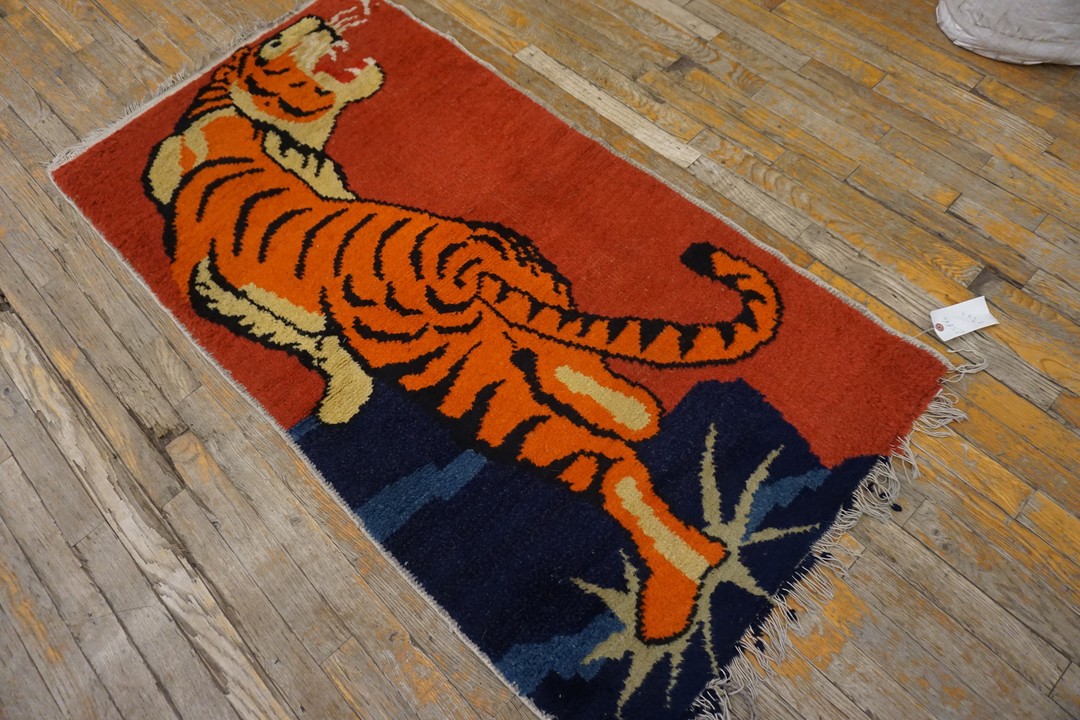
A Tiger Eye rug design is instantly recognizable for its eye-like or striped motifs, which set it apart from more conventional carpet ornament. In Tibetan examples, the pattern often mimics the appearance of a tiger skin, with a bright orange ground, black stripes, and sometimes an outlined pelt complete with head, paws, and tail. Some even include additional rosettes or “eyes” at the joints, symbolizing heightened vigilance.
In contrast, American Tiger Eye hooked rugs are not literal tigers but feature roundels, concentric circles, or gemstone-like eyes, arranged in grids or scattered across the surface. Moroccan Tiger Eye rugs frequently employ diamond-lattice arrangements with central eye shapes, blending protective symbolism with striking pattern.
Across all traditions, the visual anchor is the “eye” itself—whether through bold concentric forms, striated gemstone-like lines, or the unmistakable stripes of a tiger.
How Does Tiger Eye Design Weaving Differ from Standard Geometric Patterns?
Unlike standard geometric patterns, which rely on angular repetition—diamonds, hexagons, lozenges, or stars—the Tiger Eye design motif emphasizes organic curves and naturalistic form. Stripes flow in symmetric or mirrored waves, recalling the pelt of a tiger, while roundels echo the glow of a gemstone or a watchful gaze.
This focus on natural imagery within structured symmetry sets Tiger Eye Design weaving apart: it combines the fluidity of nature with the order of geometric composition, giving the rugs both a lifelike and a patterned quality.
Authentic Tiger Eye Design Visual Hallmarks
To identify a true Tiger Eye design motif, collectors look for several consistent features:
- Bold contrast: Strong color juxtapositions such as orange against black, or gold and ivory against darker browns.
- Symmetry and mirroring: Many designs feature a central spine or axis with stripes mirrored on either side.
- Distinctive motifs: In Tibetan rugs, this can mean tiger heads, paws, or tails integrated into the pelt outline; in Americana, grid-like roundels resembling cat’s paws or eyes; in Morocco, diamond eyes woven into earth-toned lattices.
- Organic emphasis: Patterns appear more natural and curvilinear than the purely angular lines of other traditional geometrics.
These elements together create the unmistakable visual power of the Tiger Eye design rug motif.
Colors Typical in Tiger Eye Design Moroccan Rugs
Moroccan Tiger Eye design rugs are known for their earthy, muted palettes. Common tones include gold, brown, ivory, and beige, often accented by black or dark brown stripes to highlight the eye motif.
These colors differ from the fiery oranges and blacks of Tibetan tiger rugs, giving Moroccan versions a softer, more rustic character while still emphasizing the eye-like geometry. Occasionally, touches of blue-black or ivory are used for sharper contrast, but the dominant impression is one of warm, grounded earth tones.
Typical Layouts and Motifs
- Pelt-shaped layouts (Tibet): Rugs outline a tiger skin, complete with stripes, limbs, and face. — Why: Represents protective power and a symbolic seat for spiritual practitioners.
- All-over stripe fields (Tibet/modern): Stripes arranged symmetrically across the rug. — Why: Emphasizes the animal’s energy without depicting its full form.
- Roundel or “eye” grids (Americana): Rows of concentric eyes or cat’s paw shapes. — Why: Folk adaptation meant to mimic natural spotting, often used decoratively.
- Diamond lattices with eye centers (Morocco): Geometric diamonds with central dots or eyes. — Why: Combines protective symbolism against the evil eye with marketable, modern appeal.
Symbolic Meaning in Rug Motifs
As seen in earlier traditions, the Tiger Eye design unifies animal and gemstone symbolism. It conveys strength, clarity, and protection, whether through the ferocity of the tiger, the vigilance of its eyes, or the talismanic qualities of the gemstone.
The “eye” becomes both a watchful guardian and a striking decorative element, ensuring that Tiger Eye rugs embody a sense of power and protection woven into the fabric itself.
Materials & Traditional Construction
What Materials Are Used in Traditional Tiger Eye Design Rugs?
Traditional Tiger Eye design rugs vary widely in materials depending on their cultural origin. Tibetan tiger rugs are the most iconic examples, hand-knotted from highland sheep’s wool, prized for its natural luster and resilience. Some fine pieces incorporate yak hair for texture or silk details to emphasize the stripes or eyes.
American hooked Tiger Eye rugs, by contrast, were typically made with wool strips pulled through burlap or linen backings, producing a looped surface.
Moroccan Tiger Eye rugs often used local wool or cotton, woven into flatweaves or low-pile constructions with natural, earth-toned dyes.
In modern adaptations, sisal Tiger Eye rugs have become popular: these are flatwoven from plant fibers, valued for their durability and rustic texture.
Wool vs. Sisal: Durability, Feel, and Look
The choice of wool vs. sisal has a direct impact on the performance and character of a Tiger Eye rug.
- Wool Tiger Eye design rugs: Wool offers a plush, dense pile, rich in color and highly durable when knotted by hand. Tibetan highland wool, in particular, is naturally oily, helping resist dirt and moisture. These rugs feel soft and warm underfoot, making them suitable for both decorative and functional use.
- Sisal Tiger Eye rugs: Sisal is a plant-based fiber, flatwoven into durable, coarse-textured rugs. While less plush than wool, sisal excels in high-traffic areas due to its toughness. Its natural golden-beige tone often pairs well with the eye-like or striped Tiger Eye design motif, giving a minimalist and earthy aesthetic.
— Why: Wool vs. sisal Tiger Eye rugs illustrates how material not only shapes the look and feel but also the longevity and placement of the rug in modern interiors.
Knotting, Hooking, and Weaving: Construction Methods
Tiger Eye rug construction varies by tradition:
- Hand-knotted (Tibet, China, Central Asia): Using the Tibetan or asymmetrical knot, usually around 100 knots per square inch, producing a dense, durable pile. Designs like striped pelts or tiger faces are rendered with remarkable clarity in this method.
- Hooked (America, early 20th century): Created by looping wool strips through a backing cloth, producing a raised, looped pile. The resulting Tiger Eye design hooked rug was less plush but visually bold, often used in folk interiors.
- Flatwoven or low-pile (Morocco, North Africa): Geometric “eye” or stripe motifs integrated into kilim-like weaves or minimal pile rugs, favoring practicality and climate suitability.
- Flatwoven plant fiber (modern sisal): Machine or handwoven with a textured surface, incorporating eye motifs through alternating weave patterns, usually with cotton or latex backing.
— Why: Each construction method determines the texture, use-case, and cultural identity of a Tiger Eye rug, from plush ceremonial Tibetan pieces to rustic Moroccan flatweaves.
How Tiger Eye Design Rugs Are Constructed vs. Others
Unlike standard geometric carpets that often rely on repetitive flatwoven structures, Tiger Eye design rugs are usually denser and more symbolic. Tibetan examples emphasize pile depth and fine knotting to highlight stripes and eyes, while American hooked rugs used their looped construction to create bold, circular forms.
Moroccan Tiger Eye design types lean toward flatwoven simplicity but distinguish themselves through eye-focused lattice motifs. Modern sisal Tiger Eye rugs depart even further, offering flat textures rather than plush pile, but maintain the motif through clever use of weave pattern and fiber contrast.
Typical Sizes, Finishes, and Pile Heights
- Tibetan Tiger Eye design rugs: Often medium-sized (3×6 ft meditation mats or 4×6 ft floor rugs), dense pile, natural dye finish. — Why: Suited to monastic use or symbolic seating.
- American Tiger Eye hooked rugs: Small to medium decorative pieces, looped pile, rustic backing. — Why: Accessible folk craft for homes, often reused materials.
- Moroccan Tiger Eye rugs: Wide range, from small kilims to large room-size flatweaves, low pile or none, earthy palette. — Why: Functional in hot, dry climates, with symbolic eye motifs.
- Modern sisal Tiger Eye rugs: Typically large area rugs, flatwoven, durable finish with non-slip backing. — Why: Designed for contemporary interiors and heavy foot traffic.
Key Takeaway
Tiger Eye rug materials and construction are as varied as their origins. From hand-knotted wool Tibetan tiger rugs to hooked American folk pieces and flatwoven Moroccan or sisal interpretations, each method reflects its cultural context. Material choice—wool for plushness, sisal for durability, cotton for versatility—directly shapes the look, feel, and lifespan of a Tiger Eye design.
Regional and Historical Variants
Tibetan Tiger Eye Design Rugs: Features & Symbolism
The Tibetan Tiger Eye design rug is among the most historically significant and symbolically charged versions of this design. Traditionally woven by monks, these rugs often took the form of meditation mats, with dimensions around 3×6 feet, sized perfectly for seated practice. The tiger’s stripes and watchful “eyes” were not purely decorative—they embodied Buddhist ideas of spiritual protection, courage, and power.
In Tibetan belief, the tiger represents a guardian spirit that protects against harmful forces. Rugs showing tiger pelts with bold orange grounds, black stripes, and fierce faces symbolized a practitioner seated upon a guardian animal, channeling both authority and spiritual clarity. These rugs were also status symbols, reserved for monasteries, nobility, and high-ranking lamas, emphasizing their role as sacred and exclusive textiles.
Moroccan Tiger Eye Design Patterns
The Moroccan Tiger Eye design reflects a very different weaving tradition. Instead of tiger symbolism, the emphasis lies on geometric eye motifs and earthy palettes. These rugs often feature diamond lattices with central “eye” dots, or alternating stripe-and-eye combinations, woven in soft wool with natural dyes. The color palette typically leans toward earth tones—gold, brown, ivory, beige—with black or dark accents to emphasize the “eye” forms.
Most are flatwoven kilims or low-pile rugs, lightweight and practical for Morocco’s arid climate. While the motif may have protective associations linked to the evil eye, the “Tiger Eye” label is a Western interpretation, drawing attention to the visual similarity rather than an indigenous reference to tigers.
American Hooked Tiger Eye Rugs
In the United States, the Tiger Eye hooked rug emerged in the early 20th century as part of a vibrant folk art tradition. Made from upcycled wool strips hooked into burlap or linen backings, these rugs featured bold roundels or concentric circles, which collectors and dealers began calling “Tiger Eye” or “Cat’s Paw” motifs.
Unlike Tibetan pieces, these rugs carried no Buddhist meaning—instead, their value lay in their homemade charm, practicality, and visual appeal. The roundels resembled both gemstones and animal tracks, giving them a playful, decorative quality. Today, these hooked rugs are appreciated as folk art treasures, reflecting the resourcefulness of rural American households.
Machine-Made vs. Handmade Tiger Eye Rugs
The difference between a handmade Tiger Eye rug and a machine-made one lies in both quality and meaning. Handmade rugs—whether Tibetan, Moroccan, or American folk pieces—carry a tactile richness, natural irregularity, and deep cultural or symbolic associations.
By contrast, machine-made Tiger Eye rugs offer affordability and consistency but lack the nuance of hand-knotting, hooking, or weaving. While they can mimic the eye or stripe motifs, they rarely capture the depth of expression or spiritual charge of a handmade piece. For buyers, machine-made rugs present good value and durability, but handmade Tiger Eye rugs remain the standard for authenticity, craft, and artistry.
Vintage Tiger Eye vs. New Reproductions
A vintage Tiger Eye rug—whether a Tibetan meditation mat, a Moroccan lattice-eye kilim, or an American hooked piece—tends to display superior craftsmanship and patina. The wool softens over decades, natural dyes mellow, and the pattern takes on a depth that only time can produce. These older pieces are often investment-worthy, valued by collectors for their rarity and historical significance.
New reproductions, however, make the Tiger Eye design motif accessible to modern buyers. Quality varies widely: some use traditional hand-knotting and natural dyes, while others are machine-woven in synthetic fibers. For decorators, reproductions provide variety in size and color at lower price points, while vintage rugs remain coveted for their authentic artistry and historical aura.
Key Takeaway
The Tiger Eye rug design takes on distinct forms in every region: Tibetan rugs embody Buddhist symbolism, Moroccan rugs reinterpret the motif in earthy geometrics, and American hooked rugs celebrate folk creativity.
Choosing between handmade and machine-made, or vintage and reproduction, depends on whether one values authentic craft and cultural resonance or affordability and accessibility. Either way, the Tiger Eye design pattern has proven itself a versatile and enduring design across traditions.
Symbolism, Meaning, and Modern Use
Why Is It Called the Tiger Eye Design Pattern in Carpets?
The term Tiger Eye design pattern in carpets reflects a dual symbolic heritage. On one hand, it references the Tiger’s Eye gemstone, renowned for its protective, grounding, and clarifying powers in Asian and Middle Eastern traditions. The stone’s reflective surface, resembling a vigilant eye, was believed to guard against misfortune.
On the other hand, the name evokes the tiger itself—an animal venerated in Tibetan, Chinese, and Central Asian cultures as a symbol of strength, vigilance, and authority. When rug designs incorporated eye-like medallions, bold stripes, or concentric forms, collectors and dealers began labeling them “Tiger Eye” for their visual resemblance and layered meaning.
Traditional Meanings: Courage, Protection, and Spiritual Power
In Tibet, the tiger represented more than raw strength. It symbolized the ability to subdue ego and fear, making tiger-patterned rugs a form of spiritual armor for monks during meditation. The placement of “eyes” and stripes across the rug reinforced the sense of being watched over by a protective guardian. Such rugs were also markers of rank and prestige, reserved for lamas and high officials.
In China, the tiger was an imperial emblem of military power and protective energy, often paired with the dragon as a balancing force of cosmic harmony. The eye motif in textiles reinforced vigilance, acting as a ward against evil spirits. Thus, the Tiger Eye design carried both protective and authoritative significance, rooted in centuries of symbolic association.
Contemporary Symbolism
- Statement of strength: Modern interiors use Tiger Eye rugs to project boldness and individuality. — Why: The design recalls the tiger’s ferocity and presence, making it an emblem of confidence.
- Protective energy: The “eye” motif is often marketed as a shield against negativity, echoing cross-cultural traditions of the “evil eye.” — Why: This gives the rug a metaphysical dimension beyond decoration.
- Playful or whimsical design: In fashion-forward contexts, the Tiger Eye design motif is embraced for its vivid stripes or gemstone-like glow, adding personality to eclectic spaces. — Why: Designers reinterpret the motif as both sacred and stylish, making it versatile in mood.
Can Tiger Eye Rugs Work in Minimalist Interiors?
Yes—Tiger Eye rugs can complement minimalist spaces, provided the design is carefully chosen. While bold Tibetan tiger rugs with fierce faces may serve as a dramatic focal point, Moroccan and modern abstract interpretations often feature softer earth tones and subtler motifs, which blend seamlessly into minimalist settings.
In a pared-down room, even a single eye motif or muted stripe can provide just enough texture to prevent sterility while maintaining harmony. Thus, the Tiger Eye in modern decor can function as both art object and accent, adapting easily to clean-lined spaces.
Meaning in Meditation, Status, and Modern Fashion
The Tiger Eye symbolism continues to resonate across diverse settings. In meditation practices, Tibetan Tiger Eye rugs still represent courage and inner clarity, echoing their monastic origins.
As status symbols, vintage examples highlight cultural prestige and heritage craftsmanship. In modern fashion and interiors, the design has been reimagined as everything from a statement piece in bold stripes to a whimsical motif in rugs, textiles, and even clothing prints.
Key Takeaway
From its roots in Buddhist protection and Chinese imperial symbolism to its role as a modern design accent, the Tiger Eye design pattern demonstrates remarkable adaptability.
Whether used as a guardian in meditation, a marker of prestige, or a focal point in minimalist interiors, the motif embodies a timeless balance of strength, protection, and visual allure.
Current Market & Buying Guide
Where Can I Buy Ethically Sourced Tiger Eye Rugs?
The best way to buy a Tiger Eye rug with confidence is to look for dealers and brands that work directly with artisan cooperatives and weaving workshops. In Tibet and Nepal, some organizations are linked to GoodWeave or fair-trade certifications, ensuring that rugs are made without exploitative labor and that weavers are paid fair wages.
In Morocco, seek sellers who partner with Berber craft collectives, where each rug reflects local tradition and supports rural families. For American hooked rugs, the focus is on antique dealers and folk art specialists who provide provenance. Reputable galleries and established rug houses often provide authenticity guarantees, which are essential for investment-grade purchases.
How Much Should I Budget for a Large Tiger Eye Rug?
The cost of a large Tiger Eye rug varies dramatically depending on material, construction, and origin. For a handmade wool rug, expect to pay anywhere from $2,000 to over $20,000, especially for Tibetan knotted examples or rare Moroccan weavings.
A vintage Tiger Eye rug in good condition may exceed this range if tied to a significant workshop or collection. In contrast, machine-made or sisal Tiger Eye rugs are far more affordable, ranging from $100 to $2,000, making them accessible to homeowners who want the look without the investment-level price.
Is a Vintage Tiger Eye Rug a Good Investment Piece?
Yes—vintage Tiger Eye rugs can be excellent investment pieces when chosen wisely. Tibetan rugs from the 18th–19th centuries, or early 20th-century hooked Tiger Eye rugs from America, are prized for their rarity and craftsmanship. Their patina, natural dye aging, and provenance add significant value for collectors.
Like many antique textiles, the market rewards pieces with documented origin and unique variations, making them desirable both as heritage objects and as appreciating assets. For those seeking a Tiger Eye rug investment, focusing on authentic vintage or rare regional examples is key.
Should I Choose Handmade or Machine-Made Tiger Eye Rugs?
Choosing between a handmade Tiger Eye rug and a machine-made one depends on priorities:
- Handmade rugs: Offer superior craftsmanship, durability, richness of texture, and symbolic authenticity. A Tibetan or Moroccan handmade rug often represents both artistry and cultural meaning.
- Machine-made rugs: Provide affordability, size variety, and consistency, ideal for practical use in high-traffic households. While they may lack symbolic depth, they are accessible for budget-conscious buyers.
For collectors or those seeking cultural authenticity, handmade Tiger Eye rugs are unmatched. For casual decorators, machine-made options are practical and cost-effective.
Can Tiger Eye Rugs Be Custom-Sized for Hall Runners?
Yes—custom size Tiger Eye rugs are available through artisan workshops and many contemporary rug brands. Tibetan and Moroccan workshops often accept custom commissions, adjusting both dimensions and motifs to suit hallways or specific spaces. Online retailers also offer made-to-order Tiger Eye designs, ensuring buyers can secure unique runners that retain the motif’s bold eye or stripe elements without compromising proportions.
Does the Tiger Eye Design Pattern Hide Stains Better Than Stripes?
The Tiger Eye design pattern is highly forgiving when it comes to everyday wear and spills. Its busy visual composition—eyes, stripes, and concentric motifs—naturally camouflages stains, dirt, and uneven fading far better than flat or minimal designs.
Compared to simple striped rugs, which highlight marks along their linear structure, a stain-resistant Tiger Eye rug offers practical benefits for families, pet owners, and high-traffic areas. This durability factor contributes to the design’s enduring popularity, making it as functional as it is symbolic.
Key Takeaway
When navigating today’s market, buyers should prioritize ethical sourcing, authenticity, and suitability for use. A handmade vintage Tiger Eye rug is a strong investment and cultural artifact, while machine-made or sisal options deliver affordability and practicality.
The ability to commission custom sizes and the rug’s stain-hiding advantages ensure that the Tiger Eye design remains not only historically rich but also highly functional for modern living.
Explore Some of Our Favorite Tiger Eye Design Rugs
FAQ
- How do I differentiate tiger stripe from leopard or generic “animal print”?
Tiger stripes are bold, directional bands with a central spine; leopard prints are spot-based. Tiger Eye rugs may also feature a face or staring eyes.
- Any ethical sourcing tips?
Look for GoodWeave or similar certifications, natural fiber disclosures, and transparent supply chains to reduce risks of child labor or greenwashing.
- Can I find runner formats?
Yes. Tiger stripe or pelt-inspired runners (2–3 feet wide) make dramatic hall statements without overwhelming small spaces.
- How durable are hand-knotted Tiger Eye rugs?
Very. Expect 20–50 years with routine care in living rooms; antiques require gentler use and professional maintenance.
- Where are quality modern versions made?
Nepal and India produce many hand-knotted and tufted tiger designs; machine-made options come from Turkey and the U.S., among others.
- Is there a difference between “Tiger Eye” and “Evil Eye” motifs?
Yes. Tiger Eye relates to tiger imagery and protection; Evil Eye (nazar) is a separate amulet-style eye motif common in Anatolian kilims.
- How do I protect colors from fading?
Rotate the rug every 3–6 months and use UV-filtering shades. Avoid harsh cleaners; sunlight is the main culprit for orange/black tiger palettes.
- Which type of rug pad is the right choice?
A felt-and-rubber pad adds grip and cushioning. For low doors, pick a thin option (\~1/8″). Natural rubber is best to avoid floor staining.
- Do Tiger Eye rugs work with pets and kids?
Wool hides dirt and bounces back well. Choose low- to mid-pile and a stain-resistant finish; spot-clean promptly and use a pad to prevent slips.
- How do I clean fresh spills on wool?
Blot immediately with white cloth, then dab cold water and a wool-safe detergent. Avoid scrubbing; for bleeding or antiques, call a professional cleaner.
- Safe over radiant floor heating?
Generally yes with natural fibers. Use a breathable pad and keep temperatures moderate (typically under 85°F) to prevent adhesive off-gassing or drying.
- Will a robot vacuum harm it?
Low-pile hand-knotted or machine-made pieces are usually fine, but avoid fringe and high suction on delicate wool. Use a “no-go” zone for tassels.
- Are Tiger Eye rugs appropriate for meditation spaces?
Yes—traditionally they’re protective. A modest 3×6 khaden or a 4×6 area size centers a cushion and defines a calm practice zone.
- What’s a fair price range today?
Printed or machine-made: \~\$100–\$600. Quality tufted: \~\$300–\$1,200. Hand-knotted new: \~\$1,000–\$5,000. Antique or rare examples can exceed \$20,000.
- Do Chinese Ningxia rugs use tiger imagery?
Yes. Historic Ningxia and Khotan pieces include tiger pelts or full tigers, often framed by auspicious borders and cloud motifs.
- How do I style a Tiger Eye rug without overwhelming a room?
Treat it as the focal point. Keep surrounding textiles and wall colors quieter—neutrals, charcoals, or soft blues—so the motif’s lines and eyes stand out.
- Hand-knotted, hand-tufted, or machine-made—which is best?
Hand-knotted offers the longest life and crispest detail; tufted is budget-friendly but sheds more; machine-made is durable and uniform for high-traffic areas.
- Which materials are typical?
Wool pile is standard—often Tibetan or New Zealand wool—for resilience and rich dye uptake. Older examples may have cotton warps/wefts.
- What sizes are traditional for Tibetan tiger rugs?
Seat/sleeping carpets (“khaden”) are commonly around 3×6 feet, while modern versions come in standard area sizes like 5×8, 8×10, and runners.
- How can I tell a genuine hand-knotted tiger rug from a printed one?
Flip it over. Hand-knotted backs show individual knots and slight irregularity; prints or tufted pieces reveal uniform backing or latex scrim.
- Are “Tiger’s Eye” color rugs the same thing?
Not necessarily. Many brands use “Tiger’s Eye” to label a brown-gold colorway resembling the gemstone, which may have zero tiger imagery.
- What do the eyes themselves symbolize?
Watchfulness and warding off negativity. Enlarged, staring eyes in tiger rugs are meant to protect the sitter or space during meditation or ritual.
- Where did the tiger-eye motif originate?
Primarily Tibet and neighboring regions, with related versions in Qing-era Chinese (Ningxia/Khotan) weaving. Modern interpretations are also woven in Nepal and India.
- Is “Tiger Eye” the same as a Tibetan tiger rug?
Often, yes. Tibetan tiger rugs feature full pelts, heads, or abstract stripes with prominent eyes; they’re used as protective, meditative symbols, not just animal prints.
- What does the “Tiger Eye” motif mean in rugs?
It refers to tiger-focused designs—often bold eyes or pelt/stripe layouts—symbolizing protection, courage, and mastery of the ego in Tibetan tradition.