
Introduction to Pomegranate Design Rugs
Discover our exclusive collection of Pomegranate design rugs available for your home now.
Executive Snapshot Of The Pomegranate Design
The Pomegranate design motif holds a unique place in the world of rug weaving, serving as both a decorative feature and a vessel of meaning. For centuries, artisans across Persia, the Caucasus, and Anatolia have woven pomegranates into their textiles, embedding layers of cultural symbolism into every knot. To encounter a pomegranate patterned rug is to encounter a blend of art and philosophy: fertility, prosperity, unity, and paradise woven into cloth.
This design element does not belong to one region alone—it is a cross-cultural emblem that speaks to humanity’s shared aspirations. From village looms to royal workshops, the motif has persisted through dynasties, trade routes, and modern reinterpretations, ensuring its enduring relevance. In the global rug market, pomegranate design rug meaning carries weight for both collectors and homeowners. The motif resonates with diverse audiences because it is instantly recognizable, yet adaptable to different styles.
Antique Persian pieces may present stylized fruit clusters, while Anatolian weavers often create geometric renderings. In contemporary contexts, designers embrace the pomegranate for its visual charm and universal associations with abundance and blessing. This duality—anchored in history, yet fresh in design—explains why the pomegranate remains an enduring icon in Oriental rug symbolism.
Pomegranate Design Motif: Symbolism and Universal Appeal
The Persian pomegranate design motif is one of the most powerful symbols in textile art. In Persian culture, the fruit embodies fertility and life, with seeds representing the countless blessings of family and community. In many classical rugs, the motif is integrated into garden designs, alluding to the Quranic and Biblical paradise gardens where the pomegranate grows as a tree of plenty.
Within this framework, pomegranate rugs become more than floor coverings—they are portable metaphors of paradise and prosperity. But the motif’s reach extends beyond Persia. In the Caucasus, pomegranates appear in bold, geometric form, symbolizing strength and unity among families and tribes. Anatolian rugs often depict the fruit as stylized medallions, merging local folk art with a wider heritage of Oriental rug symbolism.
These variations show how a single design, grounded in pomegranate design history, can be adapted while retaining its spiritual essence. Whether hand-knotted in silk for a royal palace or woven in wool for a village home, the motif’s message remained consistent: abundance, prosperity, and blessing.
In modern rug design, the pomegranate’s layered meaning ensures its survival. Contemporary artists adopt the motif not only for its historic roots but also for its aesthetic flexibility.
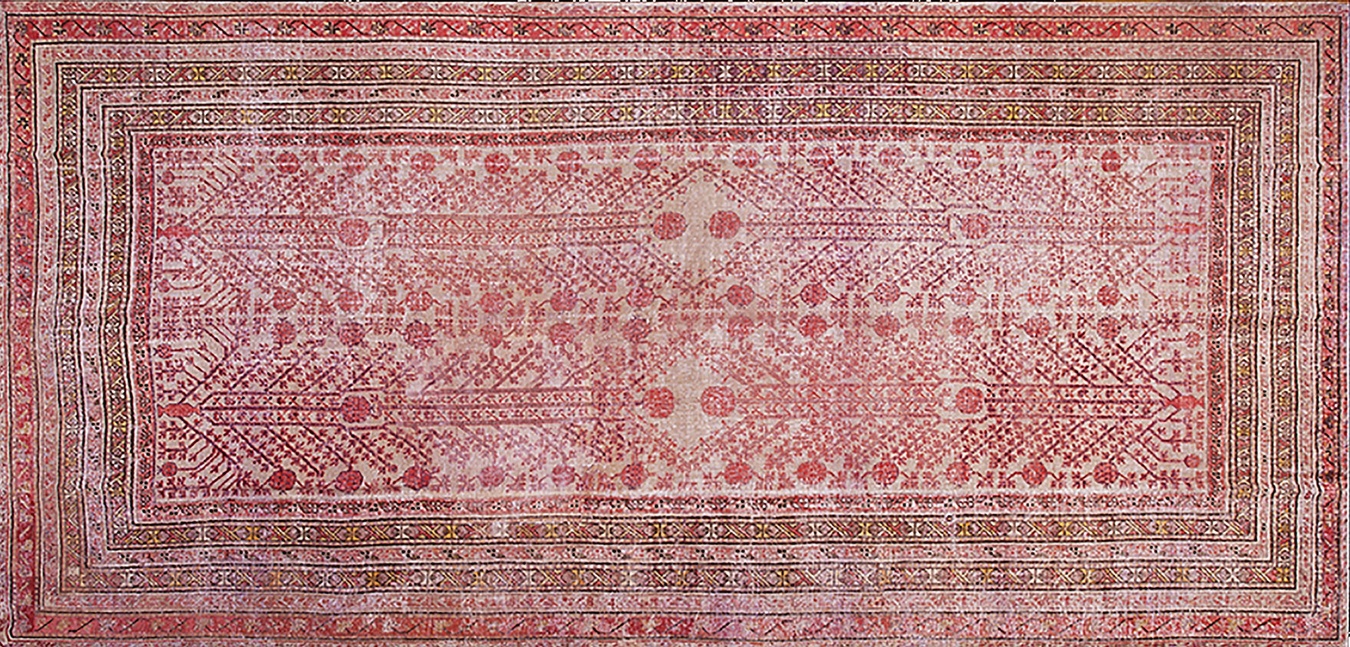
Antique Large Allover Floral Hand Knotted Pile Rug – by Rugs On Net
Designers prize the fruit’s rounded geometry, which balances symmetry and naturalism, making it adaptable to minimalist interiors or richly traditional décor. For many buyers, choosing a rug with this motif is not simply a style decision but a connection to a shared human heritage—an art form that bridges centuries and cultures.
What does the pomegranate design motif symbolize in Persian rugs?
In Persian rugs, the pomegranate design symbolizes fertility, abundance, and paradise. It represents the blessings of life, family, and spiritual richness, making it one of the most profound and enduring symbols in Oriental rug traditions.
Where did the pomegranate design in rugs originate historically?
The pomegranate design originated in ancient Persia, where the pomegranate held deep cultural and religious meaning. Through trade and migration, it spread across the Caucasus, Anatolia, and beyond, embedding itself into diverse rug-weaving traditions.
By uniting historic depth with contemporary resonance, the pomegranate design motif remains one of the most powerful and appealing symbols in rug art. Its presence continues to remind us that textiles are not only woven for use, but also for meaning—carrying forward stories of fertility, paradise, and prosperity into every generation.
Name, Etymology, and Symbolic Meaning of the Pomegranate
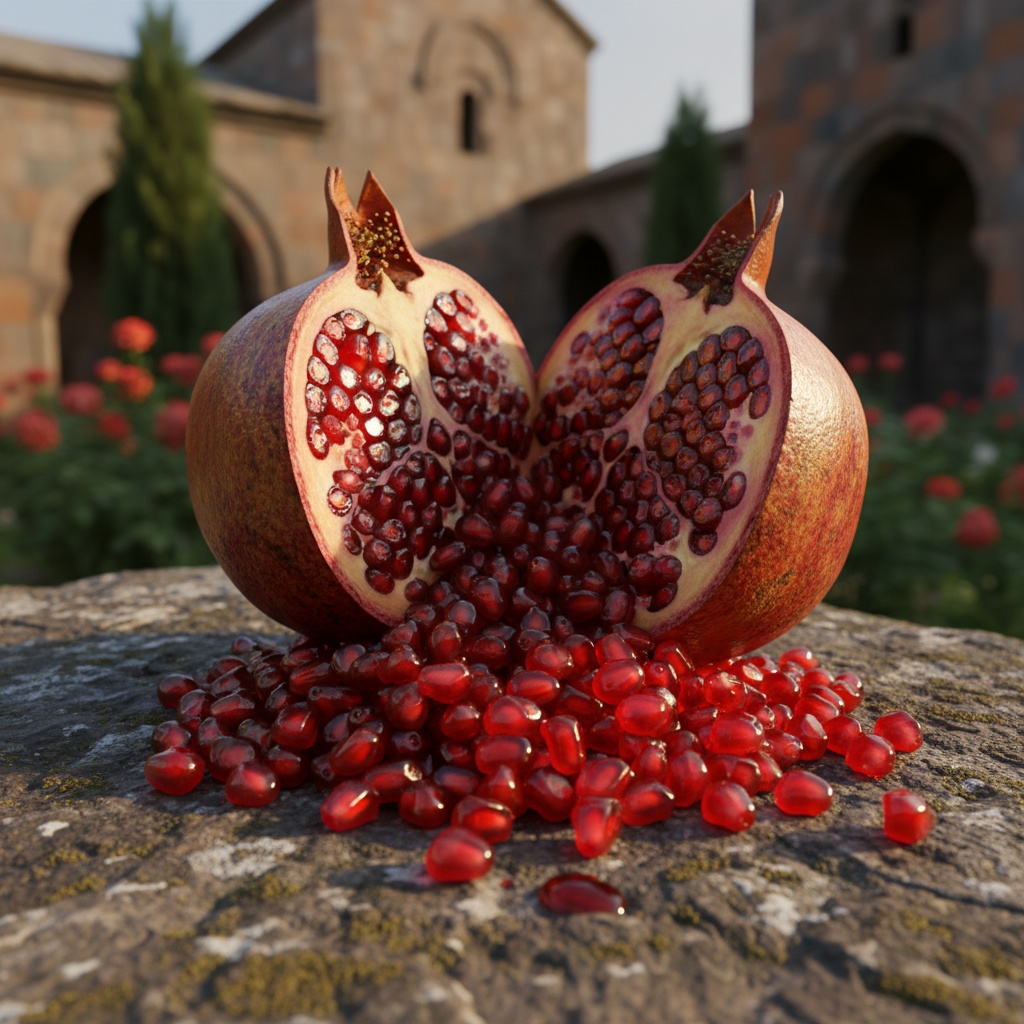
Symbolic fruit structure showing seeds and color.
Linguistic Roots Across Cultures
The pomegranate design rug etymology reveals the depth of this motif’s cultural transmission. The English word “pomegranate” derives from the medieval Latin pomum granatum, meaning “seeded apple,” a fitting description of the fruit’s clustered interior. Across rug-weaving regions, however, the fruit carries local names that reflect its integration into diverse traditions.
In Persian, it is called anâr, a term that often appears in historic carpet descriptions and poems alike. In Turkish, it is known as nar, an equally concise word used in Anatolian weaving workshops and folk songs. In Armenian, the fruit is nur, deeply rooted in the country’s iconography and ritual life.
These local variations—anâr motif, nar design, and nur symbolism—are more than linguistic curiosities. They serve as clues to provenance, pointing researchers and collectors toward a rug’s regional origin.
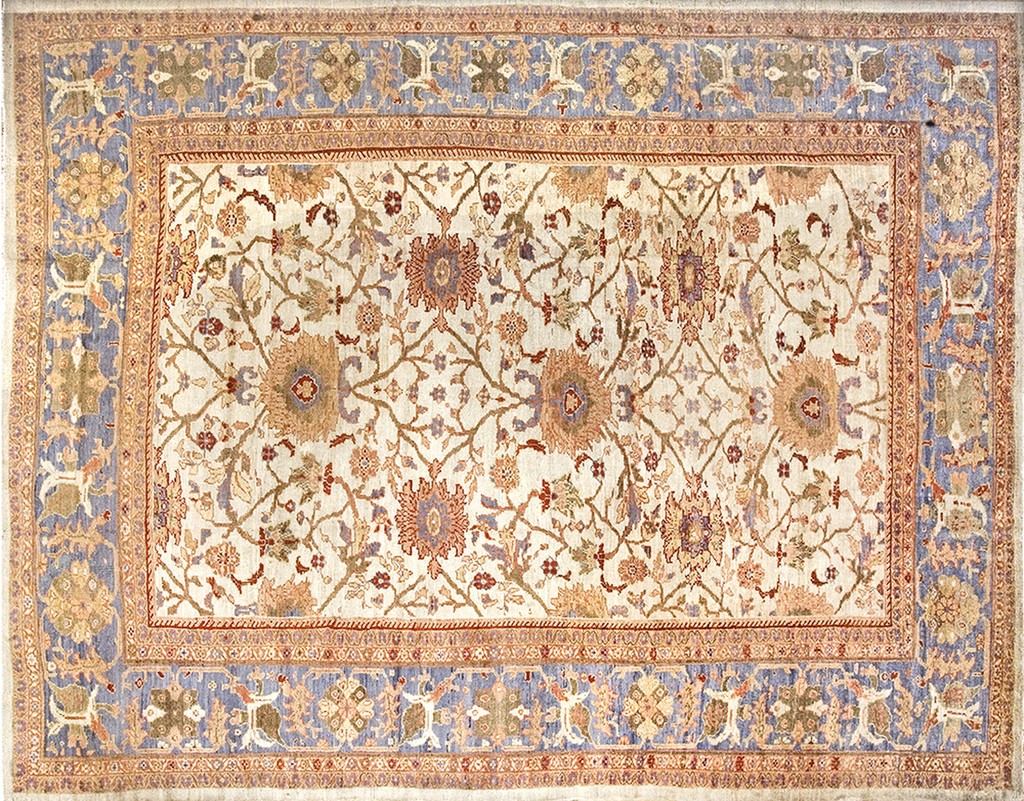
Antique Sultanabad Zeigler Large Room Size Wool Ivory Rug by Rugs On Net
A Caucasian carpet with bold, geometric pomegranates may carry an echo of the nar tradition, while a finely knotted Persian silk piece may reflect the elegance of the anâr heritage. The universality of the name across cultures underscores how widely this motif traveled and how deeply it was absorbed into regional weaving identities.
Pomegranate Design Symbolism in Persian and Oriental Rugs
At its heart, pomegranate design symbolism in rugs speaks of fertility, abundance, and the life force itself. In Persian weaving traditions, the fruit embodies paradise and renewal. The multitude of seeds represents prosperity, family, and continuity—qualities deeply valued in Persian cultural and spiritual life.
In Zoroastrian contexts, the pomegranate was tied to immortality and divine blessing, while in Islamic art it symbolized eternal paradise, linking the motif to gardens and heavenly imagery. In Armenian Christianity, the pomegranate carries an additional, poignant layer: the seeds stand for the blood of martyrs and resurrection, turning the motif into a powerful emblem of survival and spiritual rebirth.
In Turkish and Anatolian weaving, the nar design often emphasizes prosperity and household blessing, a wish woven into the textile for those who would live with it. Though the emphasis shifts by culture—immortality in Persia, resurrection in Armenia, prosperity in Anatolia—the underlying theme remains constant: fertility, prosperity, and life force.
This enduring continuity explains why the motif has remained a cornerstone of Oriental rug symbolism.
What does the pomegranate design motif symbolize in Persian rugs?
In Persian rugs, the pomegranate design symbolizes fertility, abundance, and divine blessing. It is one of the clearest examples of how rug design integrates not just artistry, but also cultural and spiritual meaning.
By tracing its etymology and symbolic layers across Persian, Turkish, and Armenian traditions, the pomegranate design motif emerges as both a linguistic bridge and a visual emblem of life, carried forward in every knot of the rug.
Historical Origins and Evolution
Early Appearances
The pomegranate design origins stretch back thousands of years, long before the fruit became a recurring element in woven carpets. In ancient Persia and Mesopotamia, the pomegranate appeared in reliefs, ceramics, and metalwork, often tied to fertility and divine blessing. Across the Caucasus, the motif was similarly present in jewelry and ritual art, where its many seeds were read as signs of unity and abundance.
Religious traditions reinforced its prominence: Zoroastrian rituals used the fruit in ceremonies to symbolize immortality and renewal, while later Islamic art incorporated the pomegranate into paradise imagery, echoing Qur’anic references to gardens filled with fruit-bearing trees. These artistic and spiritual associations prepared the ground for the motif’s eventual entrance into textile traditions.
Entry into Rug Weaving
The integration of the pomegranate into rug design drew on multiple cultural roots. Zoroastrianism imbued the motif with connotations of eternal life, which carried over into early Persian carpets. Under Islamic influence, it became a symbol of paradise, appearing within gardens, trees of life, and prayer-niche compositions.
Armenian weavers, drawing on Christian symbolism, adapted the motif to reflect resurrection and sacrifice, while in Azerbaijani traditions it came to signify prosperity and strength, often rendered in bold geometric forms. This cross-pollination of meaning illustrates the shared but regionally nuanced vocabulary of rug motifs history, where the same fruit could represent immortality, resurrection, or household blessing depending on the cultural lens.
The Motif in Safavid Persia
The Safavid pomegranate design rug represents the motif at its peak of refinement and popularity. During the 16th and 17th centuries, Safavid Iran emerged as a golden age of carpet production, when court ateliers in cities like Isfahan, Kashan, and Tabriz produced some of the most intricate and celebrated textiles in history.
In these works, the pomegranate frequently appeared within garden carpets, tree-of-life schemes, and compartment designs. One notable form was the Bakhtiari khesti carpet, structured like a walled garden with repeating squares filled with pomegranate trees and blossoms, evoking paradise on earth.
These rugs epitomized both aesthetic innovation and deep symbolic layering, demonstrating how a single motif could serve religious, cultural, and decorative functions simultaneously.
When did pomegranate design motifs peak during Safavid carpet production?
They reached their zenith in the 16th and 17th centuries, when Safavid workshops incorporated the fruit into large-scale garden and tree-of-life carpets, making it one of the most recognizable symbols of the era’s weaving art.
Later Developments: Tribal, Village, Export
After the Safavid period, the motif underwent transformations as it spread through different weaving contexts. In the 18th and 19th centuries, tribal and village weavers began to stylize the pomegranate, reducing its naturalistic form into geometric or abstract renderings.
This simplification was partly practical—smaller looms and faster production favored bold outlines over fine detail—and partly aesthetic, reflecting regional tastes. With the growth of export markets, especially in the 19th century, pomegranate design motifs appeared in rugs destined for Europe and beyond, often adapted to align with Western decorative preferences while retaining their symbolic core.
Where did the pomegranate design in rugs originate historically?
The motif’s earliest roots lie in ancient Persia and the wider Near East, particularly in religious and artistic traditions of fertility, paradise, and immortality. From there, it entered carpet design, where it became a defining element of Persian, Armenian, Anatolian, and Caucasian weaving. Through this long arc of development, the pomegranate design motif illustrates how rug design evolves in response to shifts in religion, politics, and global exchange, while still carrying forward the same timeless message of fertility, abundance, and paradise.
Regional Variations in Pomegranate Design Patterns
Persian Rugs
In Persia, the pomegranate design Pattern reached its most naturalistic and refined expression. High-knot-count carpets from Isfahan, Kashan, and Tabriz often feature deep red, richly detailed pomegranates integrated into floral scrolls, garden carpets, and tree-of-life schemes. In these compositions, the fruit is depicted as round and full, bursting with seeds that symbolize fertility and abundance.
Within garden carpets, the pomegranate tree frequently appears alongside cypress and flowering plants, evoking paradise imagery rooted in Persian poetry and Islamic cosmology. These designs emphasize continuity of life and divine blessing, ensuring that the Persian version of the motif remains one of the most iconic in the pomegranate design motif by region spectrum.
Caucasian & Armenian Carpets
In the Caucasus and Armenia, the pomegranate takes on a bolder, more geometric form. Karabagh pomegranate design carpets are especially renowned for their strong, graphic rendering of the fruit, often displayed as repeated medallions or stylized clusters. Armenian weavers imbued the motif with layers of symbolism tied to resurrection, faith, and communal strength, while Shirvan rugs often employed angular motifs that echoed local tribal aesthetics.
Here, the pomegranate’s many seeds were visual shorthand for unity, prosperity, and protection. These carpets, less concerned with naturalism, convey the symbolic essence of the fruit through vibrant colors and commanding geometry, creating designs as culturally meaningful as they are visually striking.
Anatolian (Turkish) Kilims
In Anatolia, the Turkish kilim nar motif appears in flatwoven textiles and folk-inspired designs. While pomegranates were not always the central theme, they appear frequently as part of fertility symbols and household blessings.
Anatolian weavers preferred geometric stylizations, breaking the fruit down into diamond or lozenge shapes that suited the structural demands of kilim weaving. The prominence of nar in Turkish folklore ensured the motif’s cultural relevance, even when simplified.
Why are pomegranates common in Samarkand and Turkish kilims?
In both contexts, the motif is tied to fertility, prosperity, and protection. In Anatolian kilims, the pomegranate (nar) resonates with folk traditions and symbolic blessings, while in Samarkand, it became a mark of status, wealth, and good fortune, woven into rugs to embody these values.
Samarkand & Central Asian Traditions
The Samarkand rug pattern illustrates how Central Asian weavers reinterpreted the motif. In Uzbek suzani embroideries, pomegranates symbolize prosperity, hospitality, and the continuation of family life.
Samarkand rugs, influenced by both Persian and Chinese aesthetics, depict the fruit within bold medallions and striking color palettes—purples, blues, and golden tones—that reflect the city’s crossroads position on the Silk Road. Here, the pomegranate design symbolized luck and status, reinforcing the owner’s wealth and cultural sophistication.
Indian & Mughal Influence
Under the Mughal Empire, Indian weavers adapted Persian traditions to create lush garden carpets in which pomegranate trees flourished alongside flowering shrubs and birds. These designs often mirrored Mughal palace gardens, blending Islamic paradise symbolism with South Asian artistic sensibilities.
The result was a uniquely Indian take on the motif, where the fruit’s association with fertility and abundance was amplified through vibrant naturalistic detail and dense floral ornamentation. Across all these traditions, the pomegranate’s form—whether naturalistic in Persia, geometric in the Caucasus, stylized in Turkish kilims, or richly ornamental in Mughal India—carried the same enduring message: fertility, prosperity, and the life force.
Identifying these regional variations not only sharpens appreciation of design but also helps determine the dating and valuation of vintage rugs, making the motif a critical tool for both scholars and collectors.
Design Characteristics and Visual Identification
Forms: Whole Fruit, Tree, Lattice, Borders
- Whole fruit with crown/calyx — Why: The most recognizable version, the pomegranate is often depicted as a round orb with a small crown at the top, symbolizing fertility and abundance.
- Tree laden with clustered fruits — Why: Represents paradise and prosperity, common in Persian and Mughal garden carpets.
- Lattice arrangements — Why: Pomegranates placed within compartmentalized grids symbolize order and eternity, famously seen in Bakhtiari khesti rugs.
- Borders with alternating pomegranates — Why: Used as framing devices, repeating fruits emphasize unity and continuous blessing.
Recognizing Pomegranate Design Motifs on Vintage Carpets
- Round crowned shapes — Why: Even when stylized, the small calyx crown makes the motif distinct from other fruits.
- Bold scale and freehand outlines — Why: Tribal and village weavers often created larger, less precise motifs that stand out with natural vibrancy.
- Clustered or repeating trees — Why: Older rugs integrate the motif into narrative scenes of gardens or trees of life, linking to paradise themes.
- Natural dye brilliance — Why: Authentic vintage rug motifs show uneven but rich reds, burgundies, and greens, unlike the flatter hues of synthetics.
How can I identify pomegranate design motifs on vintage carpets?
Look for rounded forms topped with a small crown, often arranged in trees, lattices, or bold borders. Vintage pieces tend to feature larger, less symmetrical renderings with deep natural dyes, making them vibrant and distinct.
A snug, dimly lit space centered around comfort, warmth, and a beautiful traditional area rug.
Common Colors & Dyes
- Reds from madder or cochineal — Why: Symbolize vitality and abundance, the most frequent color choice.
- Deep burgundy and pinks — Why: Used in Persian and Armenian variations to highlight ripeness and richness.
- Greens and blues — Why: Provide contrast, evoking leaves and garden settings.
- Neutrals and ivory grounds — Why: Help motifs stand out in lattice or medallion formats.
What colors usually accompany pomegranate design patterns in Oriental rugs?
Traditional pomegranate design pattern colors include madder red, burgundy, pink, and green, often set against ivory or blue grounds for balance.
Medallions, Repeats, and Scaling for Modern Spaces
- Pomegranate medallions — Why: Central motifs anchor the design, creating strong visual impact.
- Repeating fields — Why: Continuous repeats suggest eternal abundance and work well in long-format carpets.
- Scaled-down versions — Why: Perfect for small space rug design, reducing motif size keeps the pattern legible in apartments without overwhelming the room.
- Overscaled motifs — Why: Work in grand halls or palace-inspired settings, adding luxury and drama.
Does scaling down pomegranate design repeats suit small apartment spaces?
Yes. Scaled-down repeats allow the motif to retain its symbolic presence while fitting harmoniously into modern apartments or compact rooms.
Impact of Materials: Silk vs. Wool
- Silk rugs — Why: Offer crisper detail, finer outlines, and a luminous sheen that highlights motifs in palace or courtly carpets.
- Wool rugs — Why: Traditional, softer underfoot, and ideal for both village production and everyday use.
Should collectors favor silk or wool pomegranate design palace carpets?
It depends on purpose: silk vs wool rug choices hinge on aesthetics and practicality. Silk is prized for detail and luxury, while wool is valued for authenticity, warmth, and durability.
What distinguishes vintage versus contemporary pomegranate design kilims visually?
Vintage kilims often show larger, vibrant motifs with irregular outlines due to handspun wool and natural dyes, whereas modern kilims favor cleaner geometry, uniform scaling, and subtler synthetic shades.
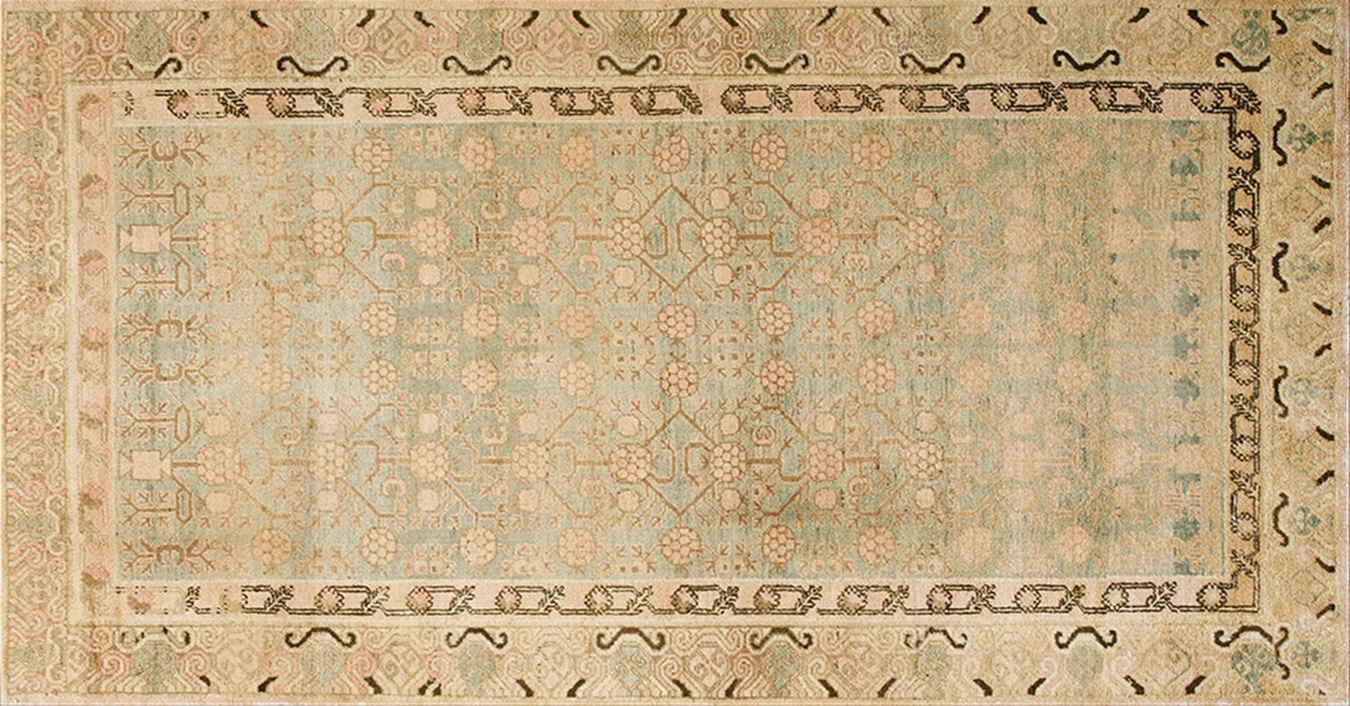
By observing form, color palettes, medallion use, and material, collectors and enthusiasts learn how to identify pomegranate design rugs with confidence. These markers distinguish authentic vintage rug motifs from contemporary interpretations, ensuring both stylistic and historical appreciation.
Construction Methods and Technical Features
Hand-Knotted Rugs: Weave, Knot Density, Pile Height
The foundation of pomegranate rug construction lies in the weaving technique. In Persian workshops, artisans typically use the asymmetrical Senneh knot, which allows for greater precision and fluidity in curves—ideal for rendering the rounded crown and clustered seeds of the pomegranate. By contrast, Turkish and Caucasian weavers favor the symmetrical Ghiordes knot, which produces bolder, geometric renderings of the fruit.
Pile height plays a direct role in clarity. A lower pile exposes the knot structure more sharply, allowing crisp outlines of pomegranate design medallions and lattice repeats. A higher pile, while luxurious underfoot, can soften or blur fine detail, particularly in smaller motifs. Collectors often look for a balance that preserves detail without sacrificing texture.
Knot density is equally crucial. Finer rugs, often exceeding 200–400 knots per square inch, can portray intricate motifs like pomegranate medallions with extraordinary precision. Tribal or village rugs, woven at lower densities, present more stylized and graphic versions of the motif, prioritizing symbolism over detail.
How is the pomegranate pattern woven in hand-knotted carpets?
It is woven knot by knot—using Senneh or Ghiordes knots—with motif clarity depending on pile height and knot density. Each knot represents a fraction of the fruit’s rounded form, collectively producing either naturalistic or stylized interpretations.
Does pile height affect clarity of pomegranate rug motifs?
Yes. Lower pile height sharpens outlines and reveals finer details, while higher pile height gives softness but may obscure small design elements.

A detailed focus on the intricate, vivid colors and geometric weave of a traditional textile rug.
What knot density best preserves intricate pomegranate design medallions?
A high knot density is essential. Above 200 knots per square inch allows weavers to capture fine outlines of seeds, crowns, and branching stems, preserving intricate medallions without distortion.
Flatweaves & Kilims: Techniques, Geometric Forms
Flatwoven kilims provide another setting for the motif. Without pile, artisans create geometric pomegranate designs using slit-weave or tapestry techniques.
The absence of knots means motifs are defined by angular forms—diamonds, hexagons, or stylized crowns—that still carry the fruit’s symbolic meaning. The Turkish kilim nar is a clear example: simplified, geometric, and integrated into fertility and blessing motifs.
Natural vs. Synthetic Dyes: Pomegranate Reds Over Time
One of the most telling markers of authenticity lies in the treatment of red. Natural dyes—especially madder root and Armenian cochineal—produce deep, layered reds that mellow gracefully with age. Over decades, these shades shift toward rich burgundy or soft rose, developing a patina that adds depth and value.
This natural dye aging is highly prized by collectors, as it signals authenticity and longevity. By contrast, synthetic dyes, introduced in the late 19th century, often appear harsher or flatter. Machine-made rugs replicate pomegranate motifs with chemical reds that may fade unevenly or lose vibrancy more quickly than natural counterparts.
How do natural dyes influence pomegranate reds over time?
They create subtle tonal variation and mellow beautifully, with colors deepening rather than degrading—a hallmark of traditional craftsmanship.
Are modern machine-made rugs replicating traditional pomegranate designs?
Yes. Many contemporary factory-produced carpets use synthetic dyes and mechanical weaving to imitate traditional pomegranate motifs, but these lack the organic depth, patina, and cultural authenticity of a hand-knotted pomegranate carpet.
In every form—knotted, flatwoven, or machine-made—the pomegranate motif’s success depends on the interplay of knot density, pile height, and dye quality, all of which determine how faithfully the fruit’s rich symbolism is preserved in textile art.
Market Value, Collectability, and Investment
Why Vintage Pomegranate Rugs Command Premiums
- Natural dyes and patina — Why: Colors from madder and cochineal mellow with age, giving vintage rugs a depth modern synthetics cannot replicate.
- Craftsmanship — Why: Hand-spun wool, natural dyes, and meticulous knotting reflect a level of artistry often absent in mass production.
- Cultural authenticity — Why: Older pieces connect directly to historic weaving centers and traditions, carrying cultural and symbolic weight.
- Scarcity — Why: As intact examples grow rarer, surviving rugs command higher premiums in the collector’s market.
Why do vintage pomegranate carpets command higher prices than new versions?
They combine superior craftsmanship, natural dyes, and authentic provenance, all of which increase desirability and long-term vintage rug value compared to contemporary reproductions.
Silk vs. Wool Palace Carpets
- Silk palace carpets — Why: Coveted for sheen, knot density, and intricate detail, they often fetch higher prices in auctions and are viewed as luxury investments.
- Wool palace carpets — Why: More traditional and robust, better suited to daily use, with enduring value due to durability and cultural authenticity.
Should collectors favor silk or wool pomegranate palace carpets?
For display or prestige, silk vs wool rug price favors silk, but for longevity and practicality, wool remains the stronger long-term choice. Many collectors balance collections with both.
Provenance & Valuation (Feraghan Focus)
Feraghan carpets, woven in west-central Persia, are especially prized when decorated with pomegranate design motifs. Known for fine knotting and balanced designs, their documented provenance significantly boosts value.
Collectors often pay a premium for Feraghan rugs with clear lineage, as origin establishes authenticity and places the rug within a recognized artistic tradition.
How does provenance impact valuation of pomegranate-pattern Feraghan rugs?
A Feraghan carpet with documented origin can be worth significantly more than an unattributed piece, since provenance confirms cultural authenticity and supports its role in collectible carpets.
Knot Density and Resale Value
Knot density directly impacts value. Rugs with higher knot counts (200+ per square inch) preserve intricate pomegranate design medallions with greater clarity, commanding higher resale prices.
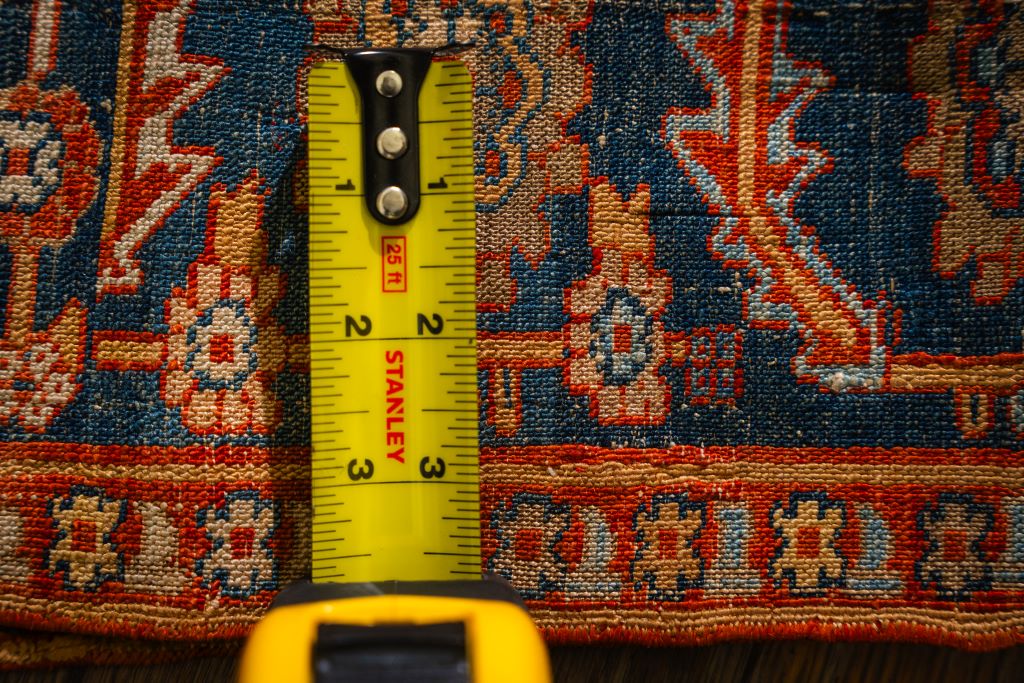
A detailed inspection of a richly colored oriental rug pattern while measuring its dimensions.
Coarser tribal versions still hold symbolic weight but generally fetch less unless paired with strong provenance or exceptional dye work.
Restoration Choices and Collector Considerations
- Sensitive repair — Why: Minor, professional repairs that respect original materials help preserve both integrity and market value.
- Heavy repainting or reweaving — Why: Reduces authenticity, often lowering collectability by erasing original character.
- Stabilization over replacement — Why: Conservators favor stabilizing worn areas to maintain historic value rather than altering design.
How do restoration choices affect vintage pomegranate design rug resale value?
Rug restoration done carefully can preserve or even enhance value, but heavy overpainting or replacement diminishes authenticity and lowers market appeal.
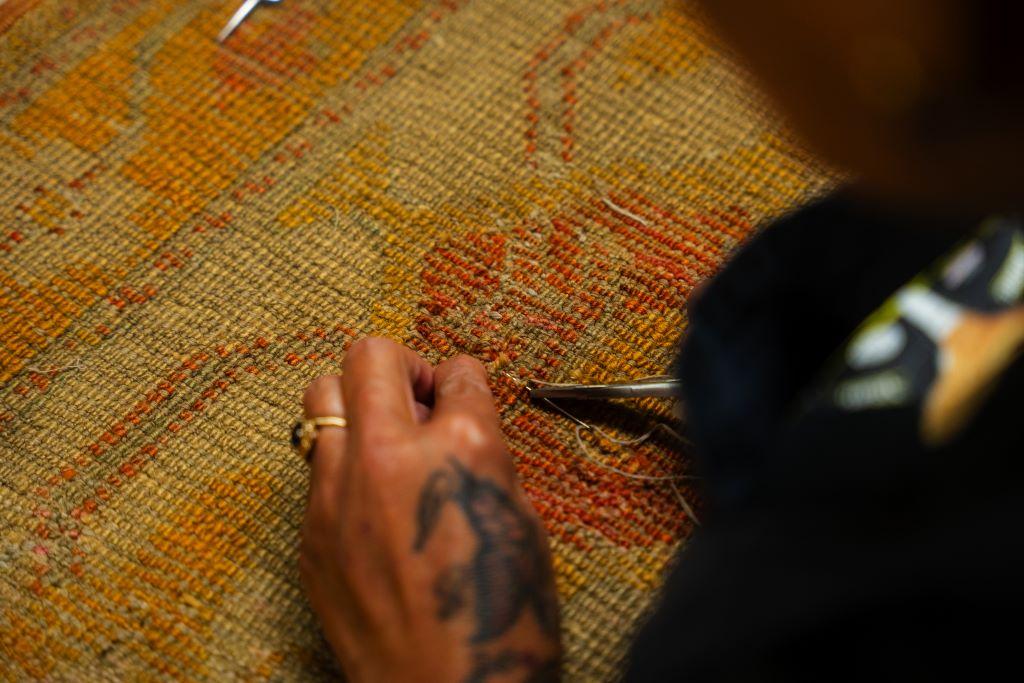
Detail of hands mending a rustic, richly colored woven rug.
Investment Potential and Market Trends
Pomegranate design rug investment is strongest in antique or vintage pieces with clear provenance, high knot density, and minimal restoration. These rugs often appreciate steadily, driven by collector demand for authentic Oriental art.
While new or export-oriented examples may not hold the same potential, museum-quality or well-preserved palace carpets remain blue-chip investments.
Can pomegranate design rugs appreciate as long-term investments?
Yes. Well-preserved antique pomegranate design area rugs, especially from recognized regions like Feraghan or Safavid-inspired workshops, can appreciate significantly, while lower-quality or heavily restored examples generally do not.
In today’s market, authenticity, provenance, and condition remain the three pillars of collectible carpets, ensuring that the enduring symbolism of the pomegranate continues to carry financial as well as cultural value.
Modern Interpretations and Design Versatility
Machine-Made & Mass-Market Replications
In today’s rug market, the modern pomegranate design rug appears in both artisanal and factory-made forms. Machine-made carpets often borrow from historic designs, replicating Persian garden scenes or Caucasian medallions with synthetic dyes and automated weaving.
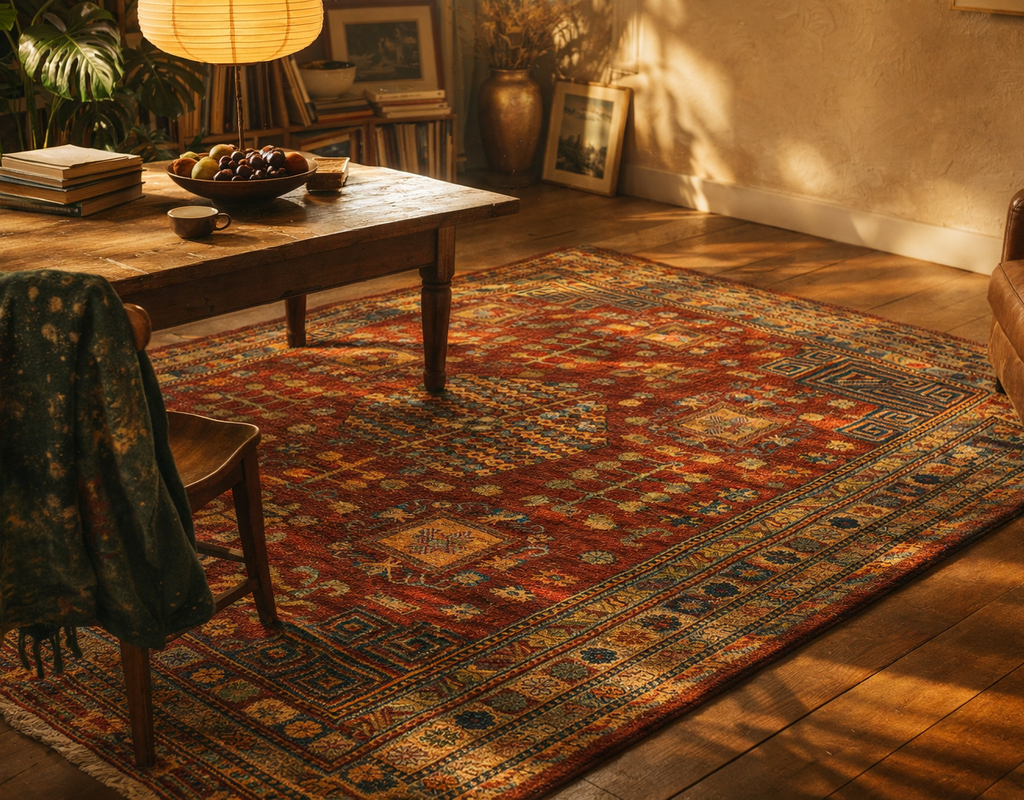
A richly patterned Oriental-style rug adds warmth and depth to this sunlit, rustic dining space.
While these rugs provide affordability and accessibility, they generally lack the depth, natural patina, and cultural authenticity of hand-knotted examples. Still, they demonstrate the enduring appeal of the motif and its ability to cross from heritage art into mass-market décor.
Minimalist & Contemporary Decor
- Abstracted forms — Why: Contemporary designers often strip the pomegranate down to circles or crowned outlines, fitting seamlessly into minimalist rug motifs.
- Neutral color palettes — Why: Using soft grays, creams, and muted reds allows the motif to integrate into modern interiors without overwhelming the space.
- Asymmetrical placement — Why: Designers may place a single oversized pomegranate medallion off-center, creating visual impact while keeping the room uncluttered.
Are reinterpreted pomegranate design motifs suitable for minimalist interiors?
Yes. Stylized or simplified pomegranate design motifs lend themselves well to minimalist and contemporary spaces, providing symbolic richness without excessive ornamentation.
Responsible Sourcing & Sustainability
- Fair-trade cooperatives — Why: Buying through certified artisan groups ensures that weavers are paid fairly and traditions are preserved.
- Hand-made and natural fibers — Why: Sustainably sourced wool, silk, or cotton reduces environmental impact while maintaining authenticity.
- Cultural preservation — Why: Supporting fair-trade pomegranate carpets helps sustain traditional techniques, ensuring motifs continue to thrive for future generations.
Where can I source responsibly-made pomegranate design rugs today?
Look for sustainable rug sourcing through fair-trade organizations, artisan workshops, and heritage cooperatives in regions like Persia, the Caucasus, and Central Asia.
Certification from recognized bodies confirms authenticity and ethical production.
Sizing and Suitability for Modern Spaces
One of the pomegranate design motif’s enduring strengths is its adaptability to space. Designers frequently scale down repeats to create patterns proportioned for modern apartments, ensuring motifs remain legible without dominating smaller rooms.
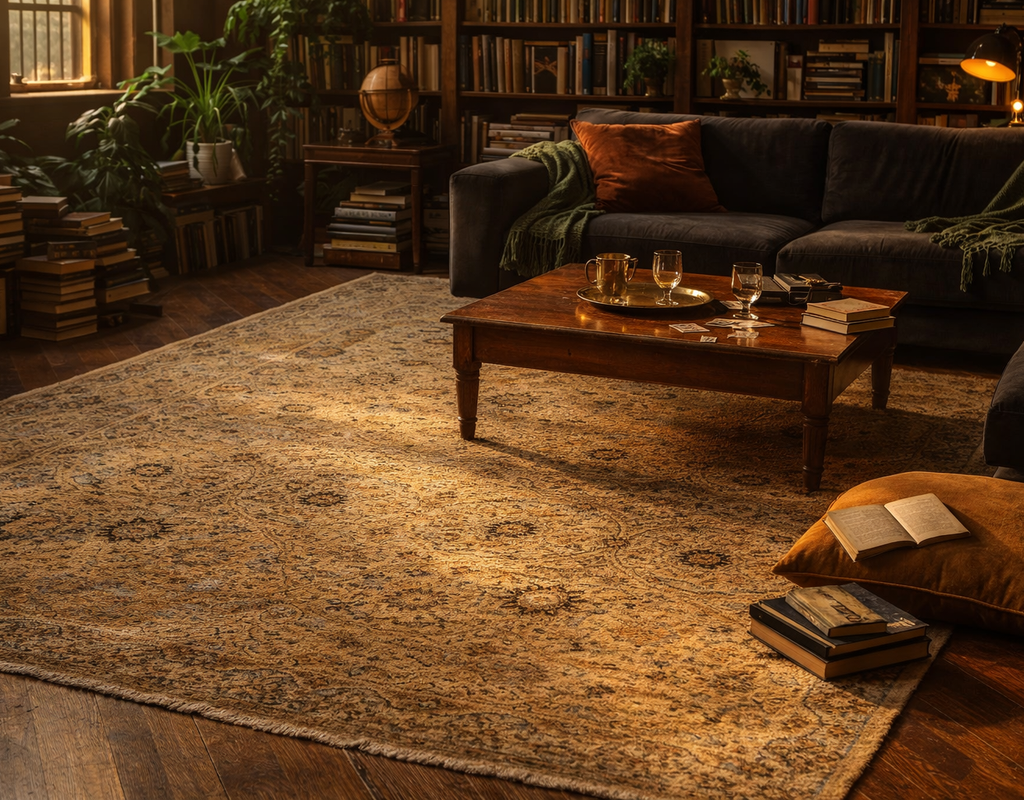
A warm, inviting reading nook defined by a traditional, aged area rug and dark, comfortable furnishings.
Conversely, in larger homes or open-plan spaces, oversized repeats and bold medallions evoke grandeur and luxury.
Does scaling down pomegranate design repeats suit small apartment spaces?
Yes. Adjusting motif size creates a small space rug solution, keeping design integrity while maintaining balance in compact interiors. The adaptability of the pomegranate—whether as a hand-knotted masterpiece or minimalist reinterpretation—ensures its relevance across eras.
By choosing ethically made pieces, homeowners not only enhance their interiors but also support artisans and preserve one of the most enduring rug symbols in textile history.
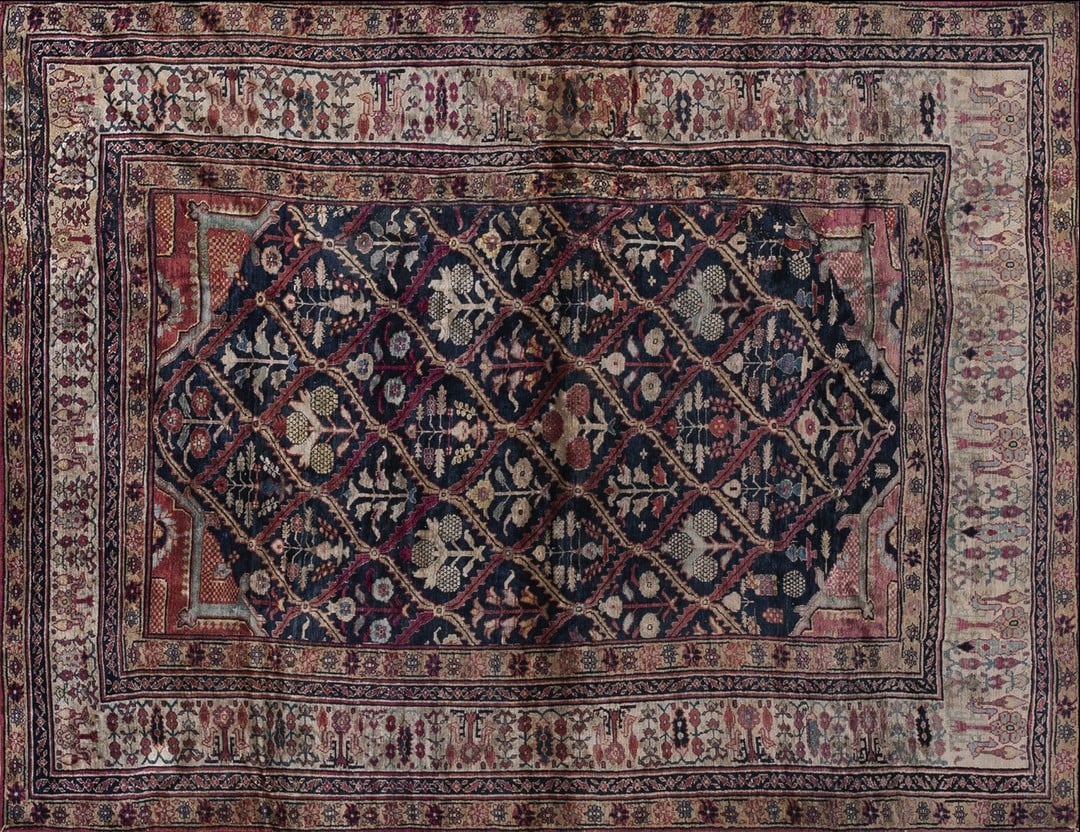
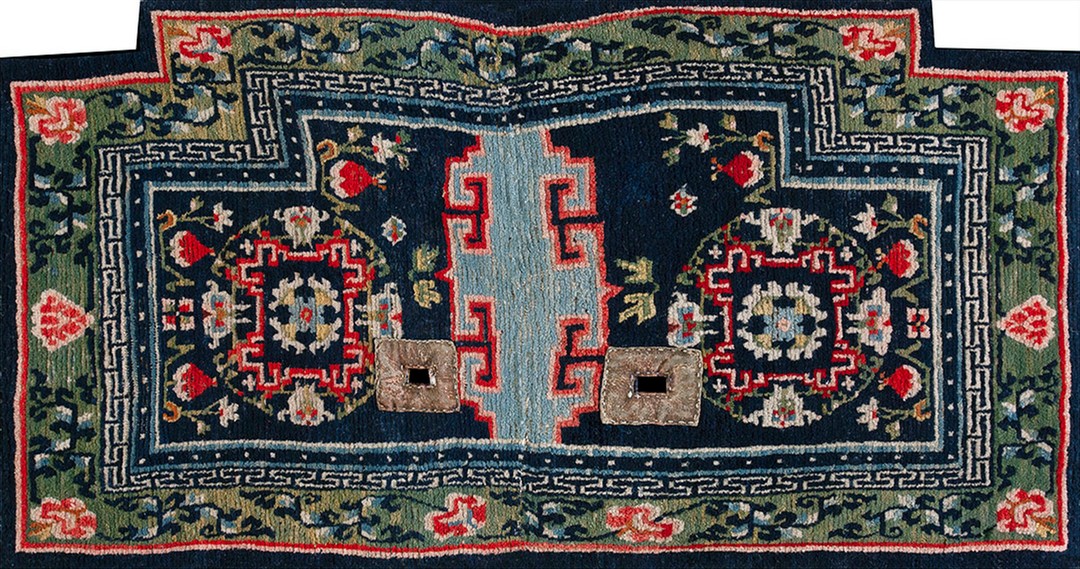
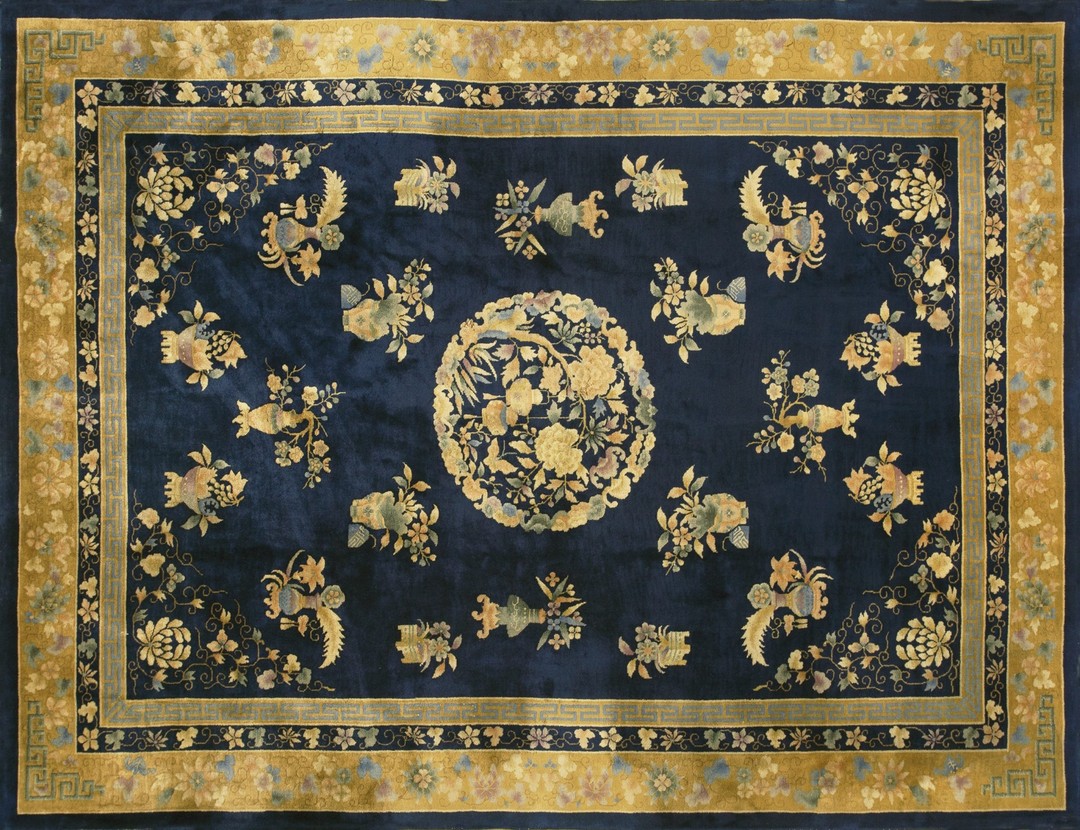
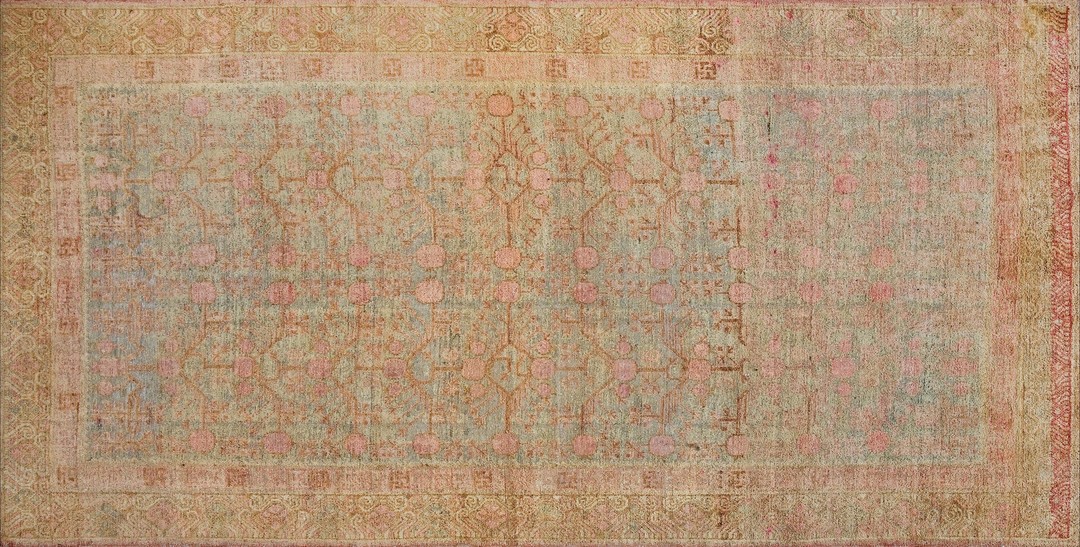
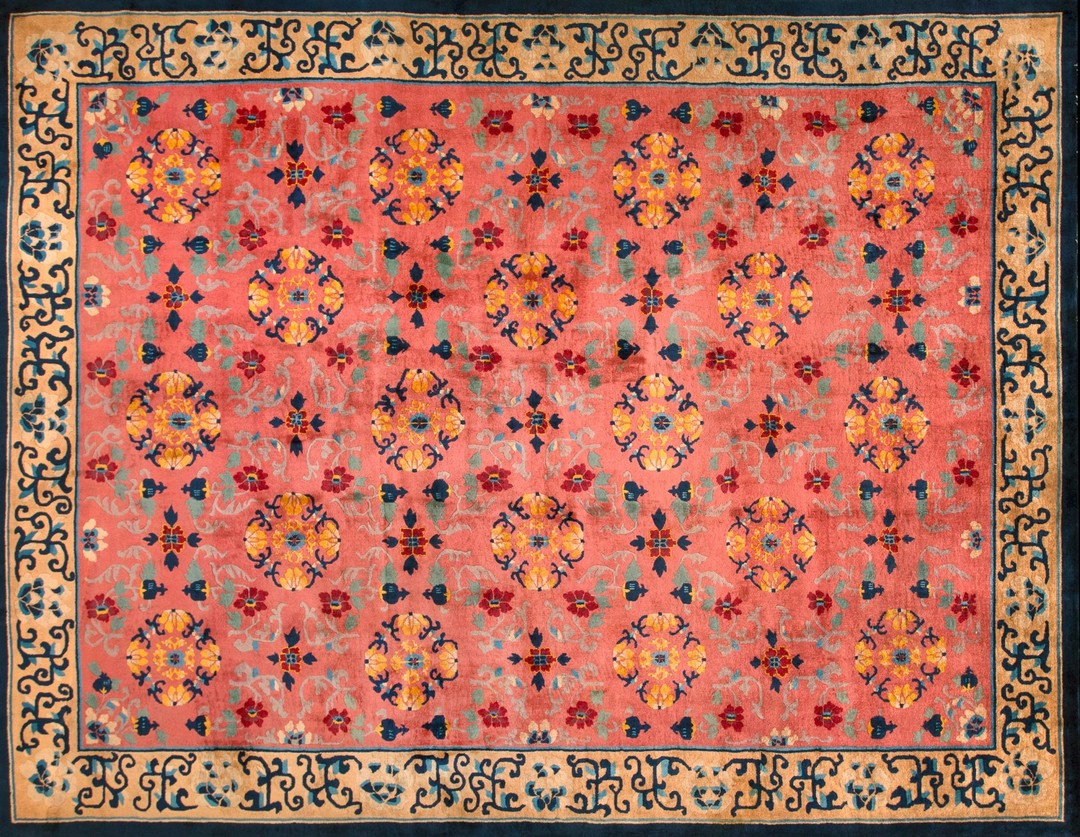
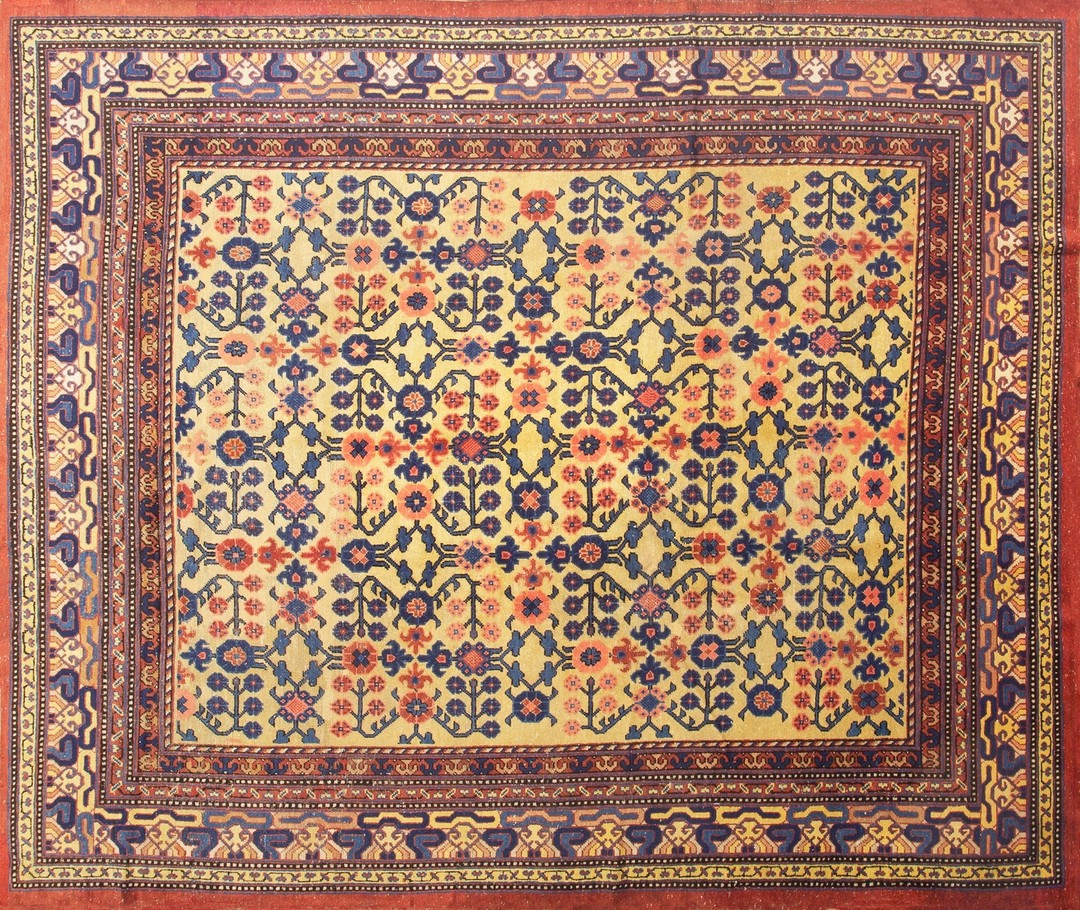
Explore a Few of Our Pomegranate Design Rugs
FAQ
- How should I store a pomegranate rug long-term?
Clean it, roll face-in with acid-free paper, and store cool, dry, and off the floor. Inspect every 3–6 months and use cedar or lavender against moths.
- Are silk pomegranate motif rugs a good idea?
Silk pomegranate rugs exist and feel luxurious but show wear easily. Reserve them for low-traffic areas or walls; wool-silk blends offer a practical middle ground.
- Can pomegranate rugs be used with radiant floor heating?
Usually yes—use natural-fiber pomegranate rugs and breathable pads, and keep floor temps moderate (under \~85°F). Check manufacturer guidance for modern pieces.
- How can I confirm a pomegranate rug is hand-knotted?
Flip it: you should see individual knots and pattern clarity on the back, with fringes forming from the warps. Avoid pieces with glued backings or printed designs.
- Are pomegranate motifs used in kilim (flatweave) rugs too?
Yes—Anatolian and Caucasian kilims use pomegranate motifs symbolizing fertility. Flatweaves are lighter and reversible, making great wall hangings or layered toppers.
- What’s the difference between pomegranate tree-field rugs and scattered pomegranate rugs?
Tree-field pomegranate rugs show vertical fruiting trees, common in Khotan pieces. Scattered pomegranate rugs repeat stylized fruits or seed pods across the field or borders.
- Do pomegranate design rugs work under dining tables?
They can—choose a rug extending at least 24″ beyond the table edges so chairs stay on the rug. Flat or medium pile helps chairs slide smoothly.
- Are pomegranate rugs practical for homes with pets or kids?
Wool pomegranate rugs handle traffic well and hide mess with pattern. Blot accidents quickly; enzyme cleaners formulated for wool help with pet issues—test first.
- Can I layer a small pomegranate rug over a bigger neutral?
Yes—layer a 5×7 pomegranate rug over a 9×12 jute or sisal for texture contrast. Keep 6–10 inches of the base rug visible on all sides.
- What rug pad is best under pomegranate rugs?
Use a dense felt-rubber pad for grip and cushioning; ¼” is ideal on hard floors. Avoid full-rubber pads under antiques on finished wood to reduce finish discoloration risk.
- Can pomegranate pattern runners work in hallways?
Absolutely—pomegranate motif runners in 2’6″–3′ widths and 8–14′ lengths guide the eye beautifully. Use a low-profile pad to prevent door drag.
- How much do antique pomegranate rugs usually cost?
Antique pomegranate rugs vary widely by condition, age, and size. Many credible examples range roughly \$4,000–\$20,000+, with rare large Khotans and pristine Caucasians higher.
- Are there contemporary pomegranate motif rugs available?
Yes—modern Khotan-inspired pomegranate rugs are newly woven in wool or silk blends. Expect hand-knotted pieces from about \$1,000–\$3,000 for a 6×9, with higher prices for larger.
- Do pomegranate rugs bleed or crock color?
Natural dyes can transfer if wet. Before cleaning, test an inconspicuous area by pressing a damp white cloth for 10 seconds; proceed only if it stays white.
- How should I clean a pomegranate wool rug at home?
Vacuum weekly with suction only and blot spills immediately. Schedule a professional wash every 3–5 years and avoid steam cleaners that can cause dye migration.
- What sizes are common for pomegranate rugs?
Khotan pomegranate rugs often come in “gallery” sizes like 6×12, 7×14, and long runners. Modern reproductions also appear in standard 8×10 and 9×12.
- Are pomegranate design rugs durable for high-traffic areas?
Hand-knotted wool pomegranate rugs are durable with proper padding. Use a felt-rubber pad (¼–⅜”) and rotate every 3–6 months to even wear.
- How do pomegranate rugs work in modern interiors?
Pomegranate rugs add organic geometry that anchors neutral rooms. Pair one 8×10 under a sofa group with solid upholstery and matte metals to balance the pattern.
- What colors are typical in pomegranate motif rugs?
Expect reds, blues, taupes, and golds; natural-dye gold/olive tones often come from pomegranate rind. Iron modifiers can shift pomegranate-dyed yellows toward olive or gray.
- What materials are pomegranate pattern rugs typically made from?
Most pomegranate pattern rugs use wool pile with wool or cotton foundations; occasional silk appears in finer workshop pieces. Wool’s natural resiliency suits living spaces.
- What do borders look like on Anatolian pomegranate rugs?
Anatolian pomegranate rugs may feature borders with repeating trios of pomegranates linked by stems. This triple-fruit motif frames the field like a garland.
- Are pomegranate design rugs found in Caucasian weaving?
Yes—Shirvan and Karabagh rugs frequently include pomegranate trees or fruit motifs, sometimes within prayer or garden layouts. Expect bold reds, indigo grounds, and geometric borders.
- How can I identify authentic Khotan pomegranate rugs?
Khotan pomegranate rugs often show vertical rows of flowering pomegranate trees across a long “gallery” field. Sizes like 6×12 or 7×14 feet are common on antiques.
- Where did pomegranate motif rugs originate?
Pomegranate motif rugs are most associated with Khotan (East Turkestan) and also appear in Caucasian Shirvan and Anatolian pieces. Many antique examples date to the 18th–19th centuries.
- What do pomegranate rugs symbolize in traditional weaving?
Pomegranate rugs traditionally symbolize fertility and abundance; the many seeds represent prosperity. They’re commonly gifted for new homes and marriages in historic weaving cultures.