
Overview & Origins of Peking Rugs
Discover our curated selection of hand-knotted Peking rugs available to elevate your home.
Name & Etymology
The name “Peking rug” is rooted in the older Western transliteration of Beijing, a form that persisted through centuries of foreign contact and trade. While today the capital of China is universally referred to as Beijing, many antique textiles and artworks are still associated with the older name, “Peking.” This is not simply a linguistic accident: it reflects the city’s identity as the “Northern Capital,” the heart of imperial China where power, prestige, and artistic production were concentrated.
By labeling these carpets “Peking,” merchants and collectors emphasized not just their geographic origin, but their deep ties to the authority and sophistication of the court. Even now, when one speaks of a Peking carpet, the name carries with it an aura of old-world prestige and a direct connection to the city’s imperial past.
Authentic Chinese Origins
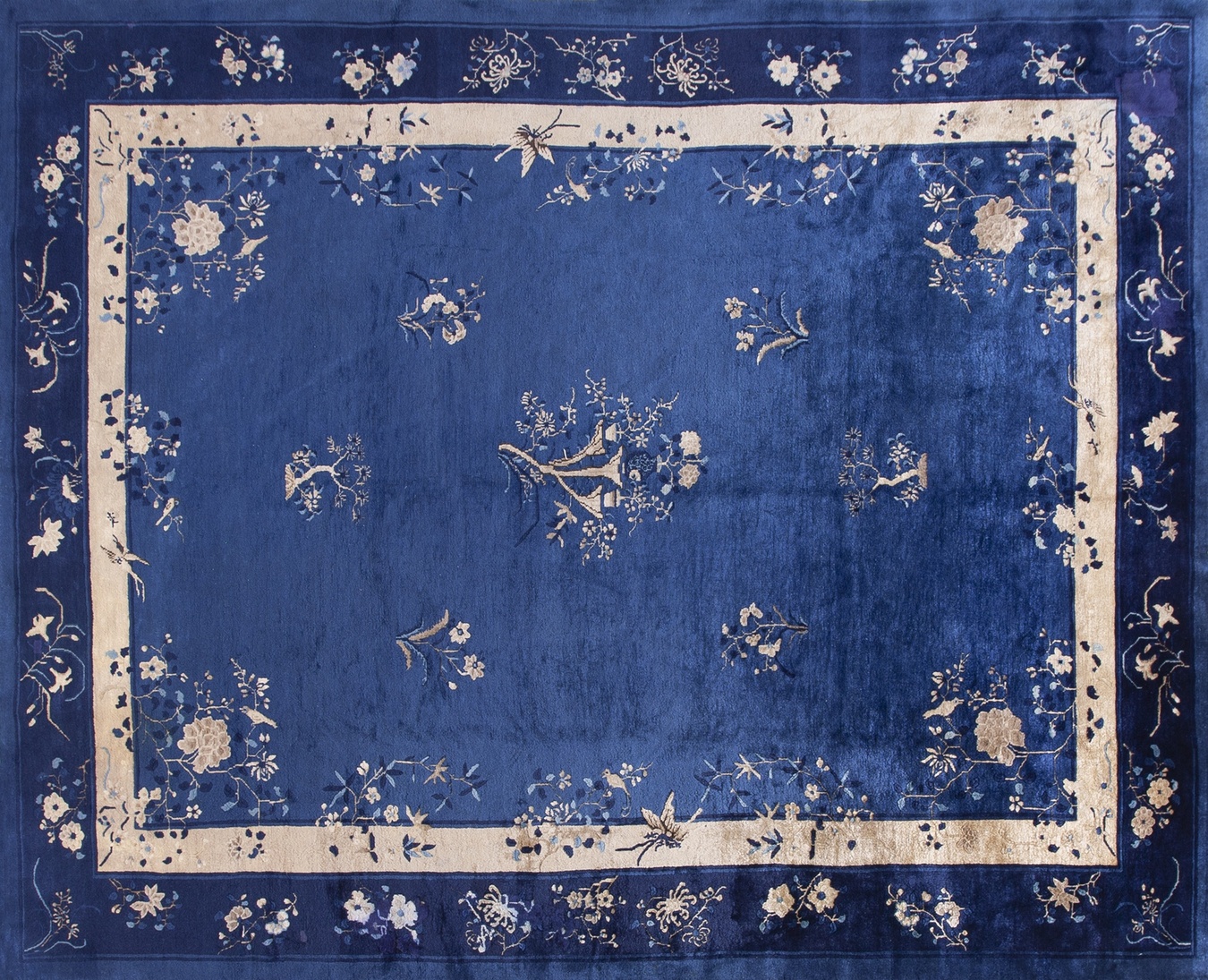
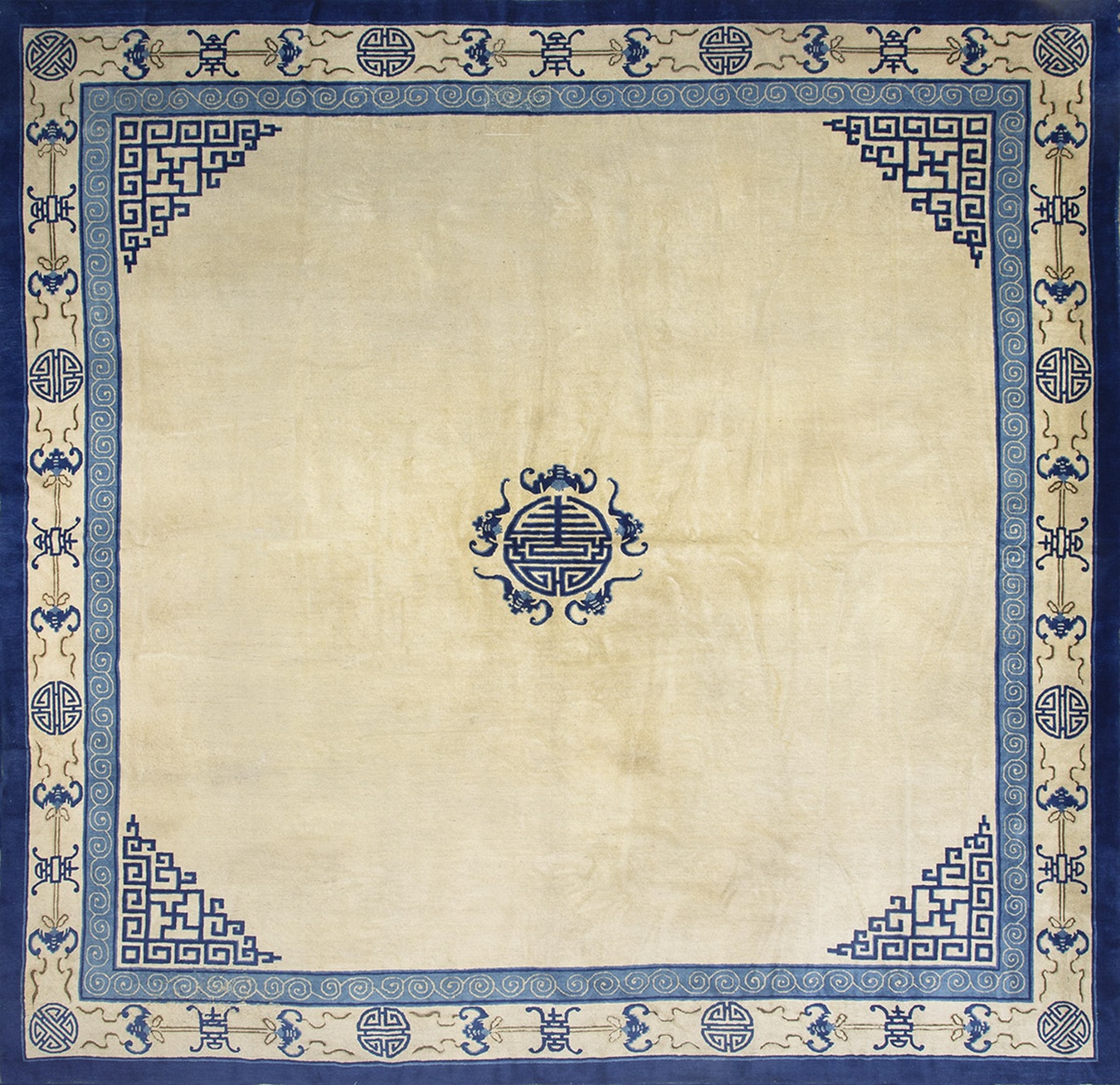
Chinese – Peking 1920s Blue Wool Knotted Antique Room Size Rectangle Rug – by Rugs On Net
Authentic Peking rugs originate in Beijing itself and the surrounding provinces of North China, areas long tied to the cultural and political life of the empire. Unlike other regional carpets—such as Ningxia in the west or the Manchu-influenced weavings of the northeast—Peking rugs were fundamentally products of the capital.
This anchoring in the center of governance and ceremonial tradition made them distinct. The weaving of these Chinese imperial rugs cannot be separated from the city’s broader history: they were made in or for Beijing, for use in palaces, temples, and later elite households. When collectors ask where genuine examples come from, the answer is clear: the birthplace of these carpets is the capital itself, and their identity remains tied to that geography.
Historical Beginnings
The history of Peking rug weaving is inseparable from the story of Beijing as a dynastic capital. The craft emerged in the imperial workshops during the late Ming dynasty and took root more firmly in the early Qing, when the city solidified its role as the empire’s administrative and cultural heart. Court patronage gave rise to weaving ateliers that supplied carpets for palatial halls, religious sanctuaries, and the private quarters of emperors and nobility.
These early productions combined durability with elegance, serving both ceremonial and decorative functions. The emergence of Peking rugs at this historical moment was no coincidence: it reflected the increasing sophistication of the Qing court’s artistic demands and the growing integration of China into global trade networks that valued luxury textiles. The style’s inception was thus tied directly to the wealth and ambition of imperial China.
From the beginning, Peking carpets were more than floor coverings; they were symbols of order, hierarchy, and prestige. As they spread beyond the palace into broader markets, they carried with them the imprint of their origins—Beijing’s role as the seat of power and cultural refinement. This foundation explains why the Peking rug history still commands respect among collectors, why the older name “Peking” retains resonance, and why these textiles remain touchstones in discussions of Chinese decorative arts.
Key Takeaway: The origin of Peking carpets lies firmly in Beijing, with their name echoing the city’s old transliteration and its imperial grandeur. Their history begins in the late Ming and early Qing court workshops, making them inseparable from the story of Chinese imperial rugs and the enduring prestige of the capital.
Geography, Trade & Regional Variations

Urban growth meeting open steppe land.
Core Weaving Regions
- Beijing — Why: The heart of the Peking rug regions, where imperial workshops defined standards of design, color, and size. All other weaving centers oriented themselves in relation to the capital’s taste.
- Tianjin — Why: As Beijing’s port city, Tianjin became a vital hub for export, later evolving into a center for Art Deco–inspired carpets in the early 20th century. Its role bridged domestic weaving traditions and global markets.
- Baotou (Inner Mongolia) — Why: Known for “Mongolian” carpets, Baotou produced more rustic, bold-patterned rugs that differed from the refinement of Beijing but still supplied northern trade routes.
- Ningxia — Why: With its legacy of Buddhist temple rugs and small-format carpets, Ningxia influenced the motifs and compact designs of northern weaving.
- Hebei Province — Why: Rich in high-quality wool, Hebei supplied the fibers that gave Peking rugs their softness, sheen, and resilience. Provincial flocks ensured durability and an unmatched tactile quality.
Together, these centers illustrate how the tradition radiated outward while remaining anchored in Beijing’s identity.
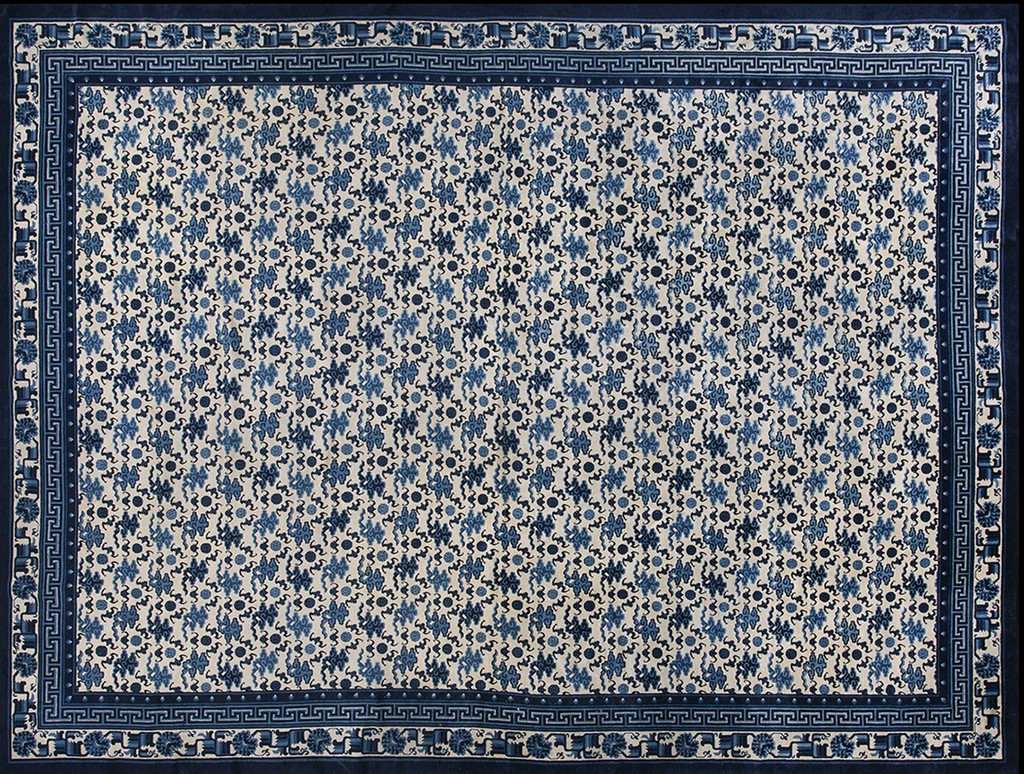
Rectangle Antique 1920s Chinese – Peking Wool Blue Knotted Room Size Rug by Rugs On Net
Provincial Support
Peking rug weaving was not an isolated craft but a coordinated network supported by surrounding provinces. Hebei’s herders provided the soft, lustrous wool that elevated Beijing’s carpets above regional competitors.
Tianjin, Baoding, and Baotou each contributed production capacity, while Ningxia maintained its specialized traditions. These collaborations ensured both supply and stylistic diversity, all under the cultural gravity of the capital.
Regional Variants: Baotou, Tianjin, Ningxia
While Peking rugs projected imperial refinement, regional variants showcased the adaptability of northern weaving traditions. Baotou rugs, often labeled “Mongolian carpets,” featured rustic motifs, coarser weaves, and bold geometric borders—expressing frontier aesthetics far from courtly formality. Ningxia carpets leaned toward dense, repeating patterns, often in smaller formats suitable for temple offerings or prayer. Their tighter knotting stood in contrast to the spacious, meditative fields of Peking designs. Tianjin carpets, by the early 20th century, shifted toward Art Deco tastes, reflecting the cosmopolitan exchange of the treaty port era. Though distinct, each regional variation reinforced Beijing’s role as arbiter: the Peking style remained the benchmark against which others were measured.
Hebei Wool: Softness, Luster & Sustainability
The softness of authentic Peking rugs is owed to Hebei wool carpets, woven with fibers that carried natural sheen and pliability. The cold, dry climate of the province produced long-staple fleece prized by weavers. Today, Hebei’s agricultural and environmental policies directly shape the sustainability of wool supply. With new “green” directives encouraging reduced pesticide use and rotational grazing, the province’s wool industry may again influence the quality of Peking-style rugs.
These policies raise an important question for the future: can the sustainability practices of Hebei ensure that Beijing carpet weaving continues with the same tactile beauty and environmental responsibility? Key Takeaway: The geography of Peking rug history reveals both a strong central hub in Beijing and an interconnected network of provinces—Tianjin, Baotou, Ningxia, and Hebei—that supplied materials, workshops, and stylistic diversity.
Provincial contributions enriched the tradition, but the prestige of the capital ensured the Peking rug retained its unique identity as China’s foremost imperial carpet.
Design Language & Iconography
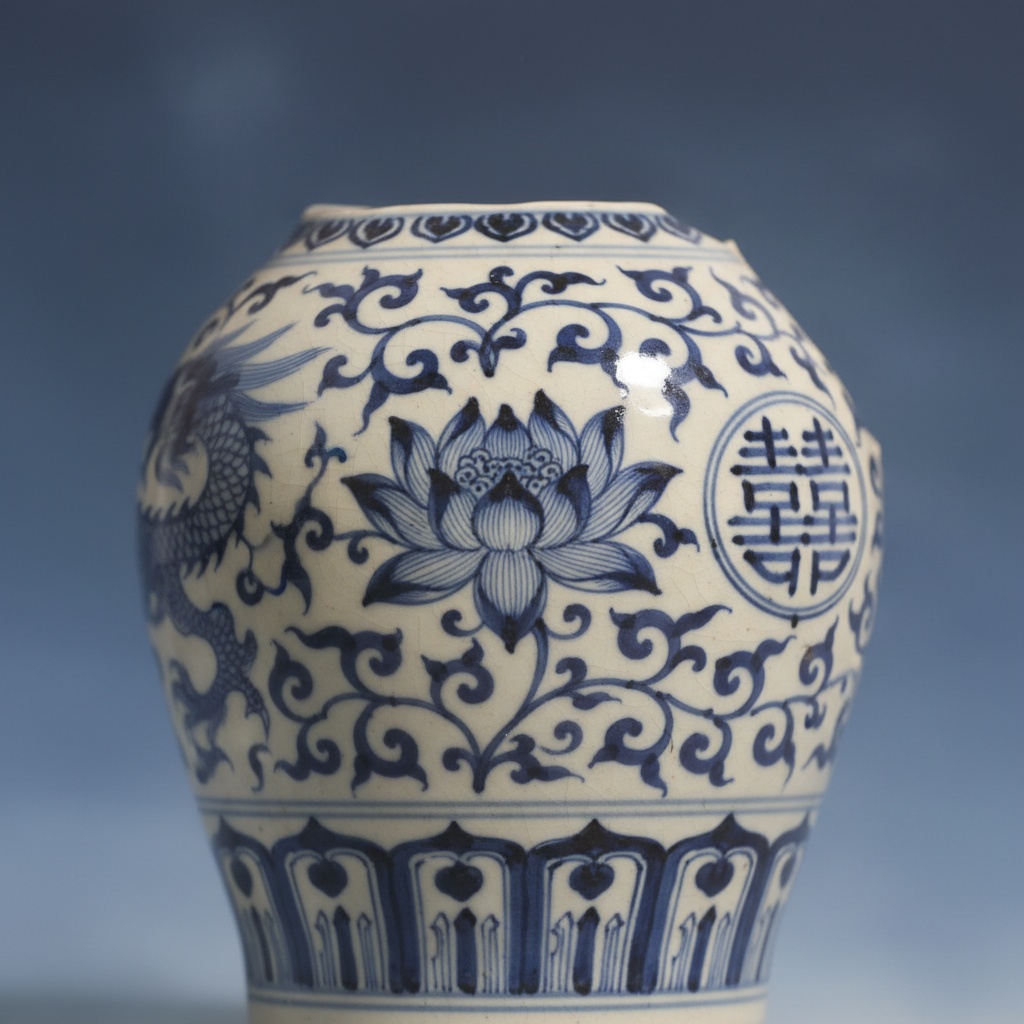
Blue and white porcelain design elements
Layout & Composition
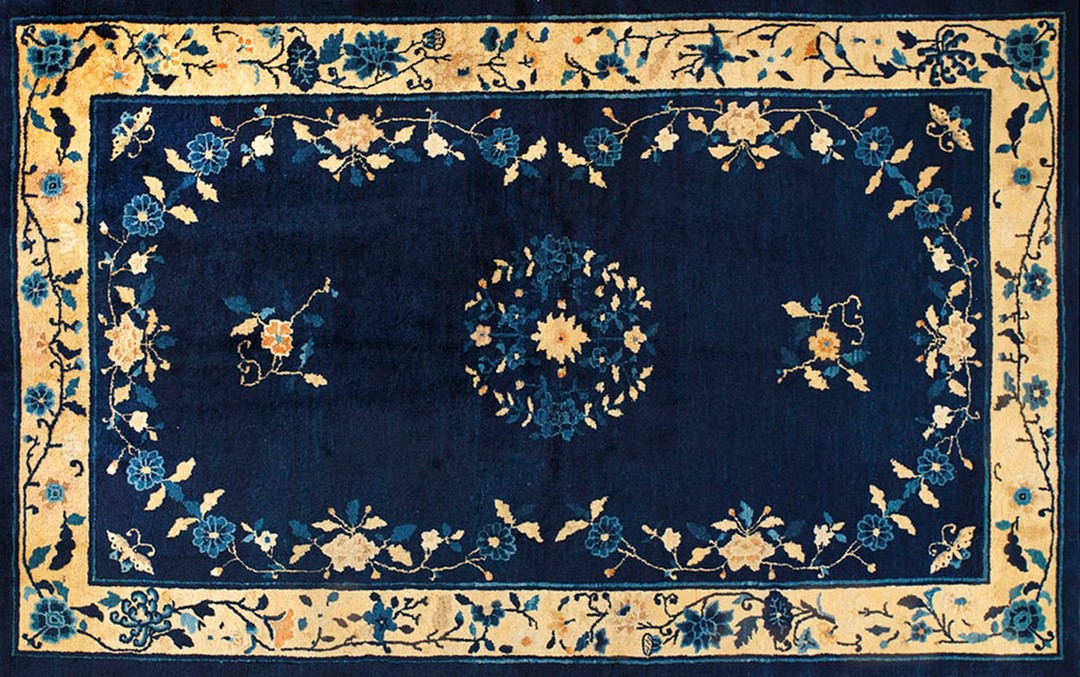
The design language of Peking rugs is instantly recognizable. Most feature a single central medallion set against an open field, a layout that emphasizes clarity and visual calm. Unlike Persian rugs with crowded, all-over designs, Peking rugs favor balanced symmetry and spacious compositions that highlight each motif.
The open fields, often in soft ivory or deep indigo, allow medallions, corner elements, or symbolic figures to stand out with striking precision. Borders remain restrained—thin frames of repeating scrolls or geometric keys rather than overly elaborate panels. This minimalist approach aligns with Chinese artistic traditions of balance, proportion, and negative space.
Motifs & Symbolism
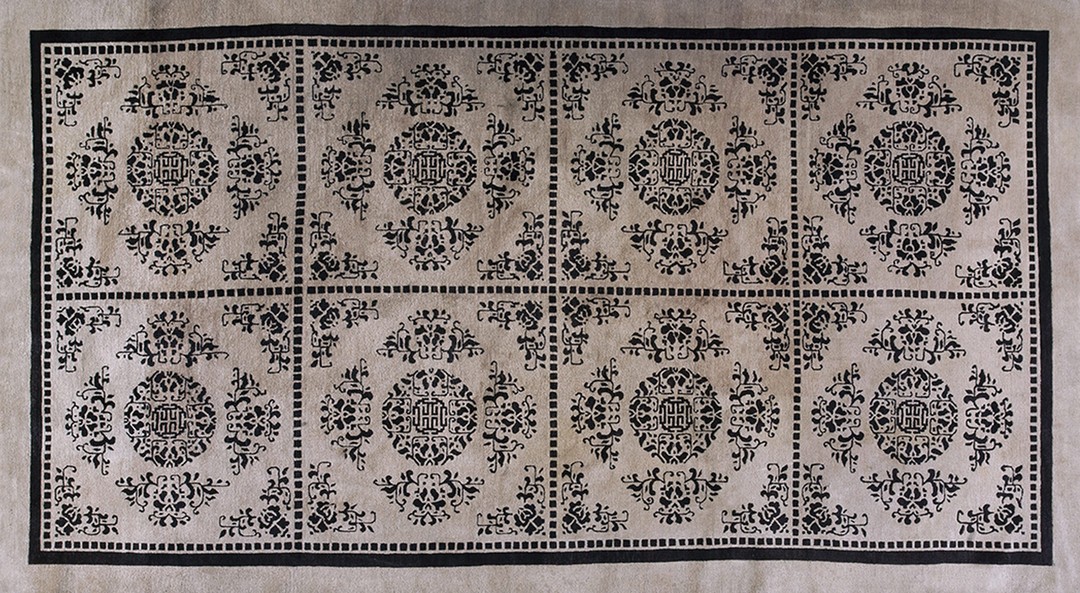
The decorative vocabulary of Peking rug motifs draws heavily from classical Chinese symbolism. Lotus flowers represent purity and spiritual enlightenment, often placed in medallions or scattered across fields. Peonies symbolize prosperity and beauty, while the “Shou” symbol conveys longevity and blessings for a full life.
Dragons embody imperial authority, strength, and cosmic power, while the phoenix expresses renewal and feminine grace. Smaller creatures such as bats (homophones for “good fortune”) and butterflies (symbols of joy and love) provide playful accents within the open field. Collectively, these motifs made Peking carpets not just decorative items but carriers of auspicious meaning, intended to harmonize interiors with blessings and virtues.
Color Palette
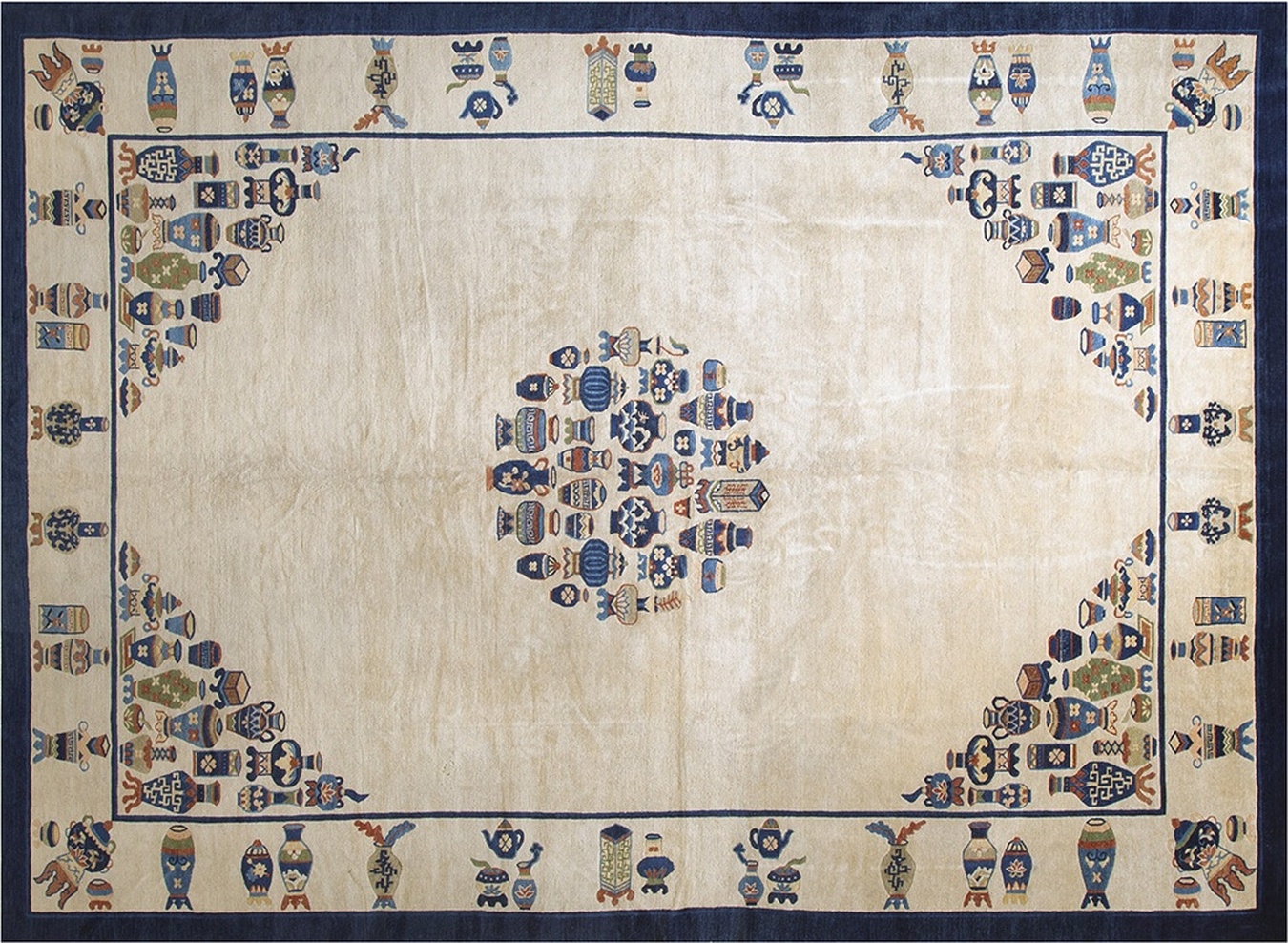
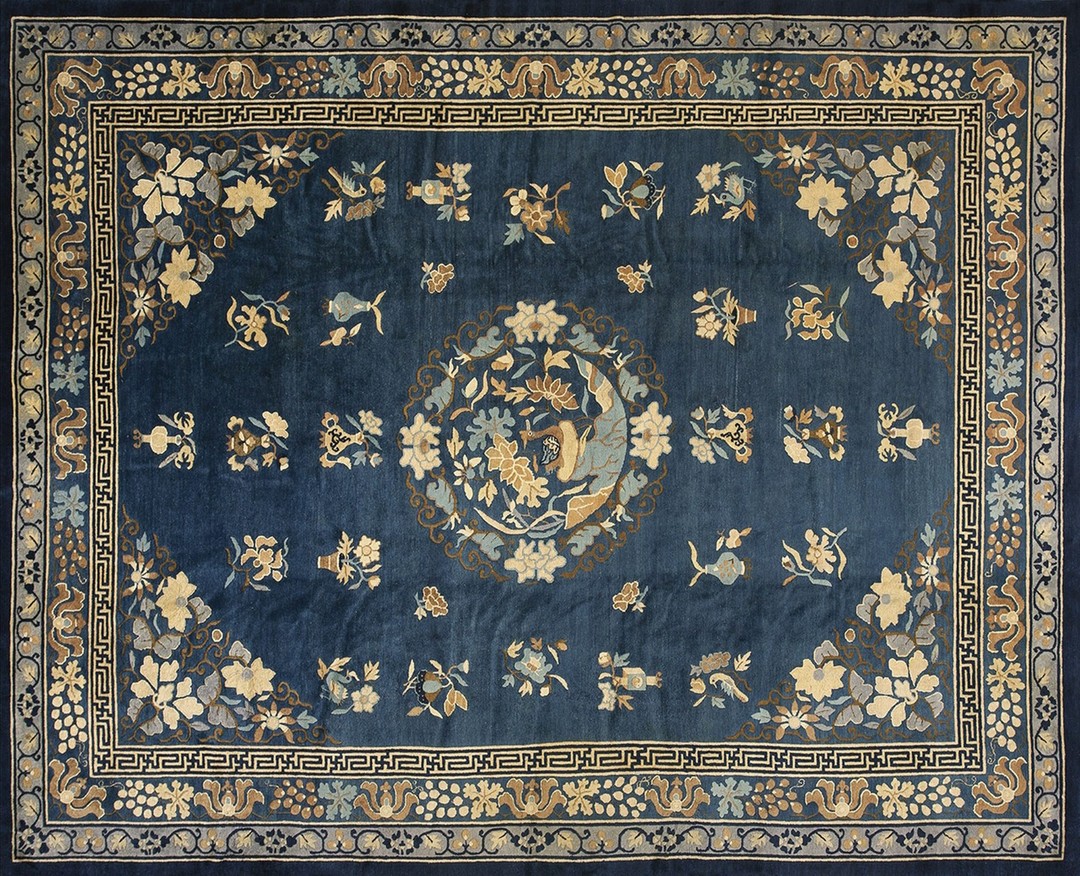
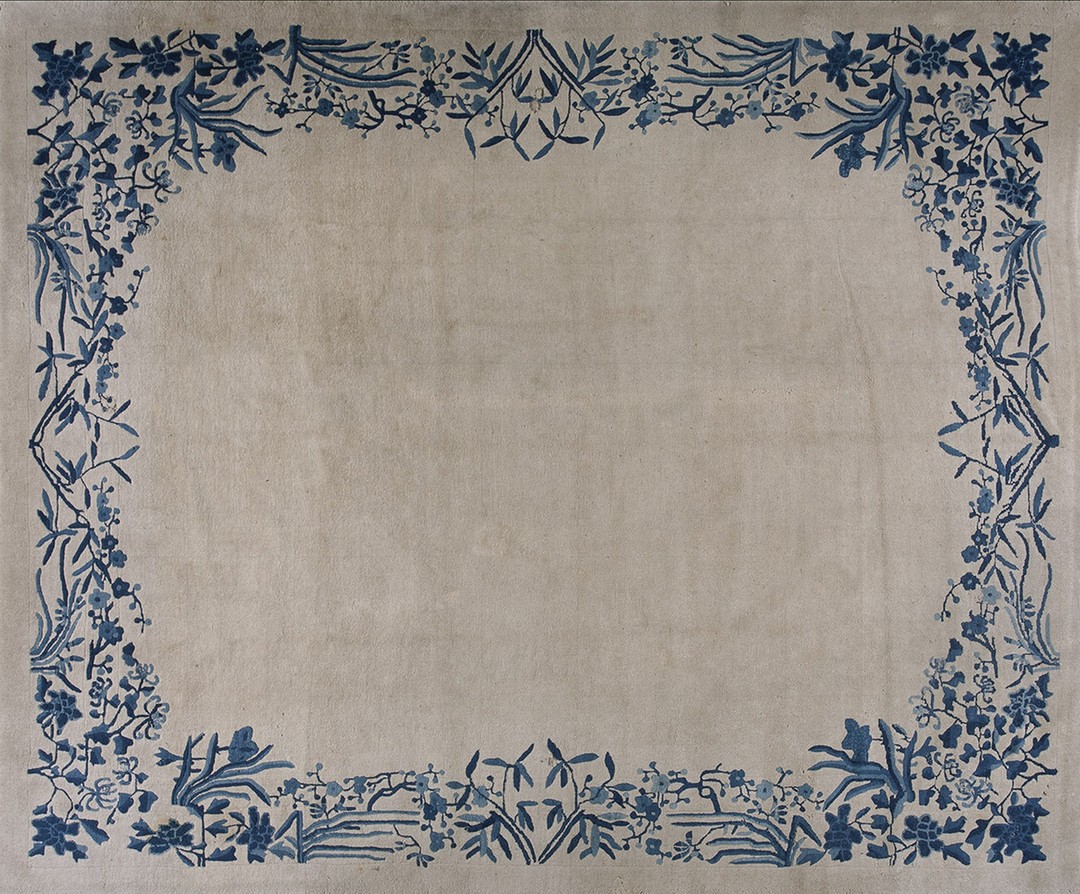
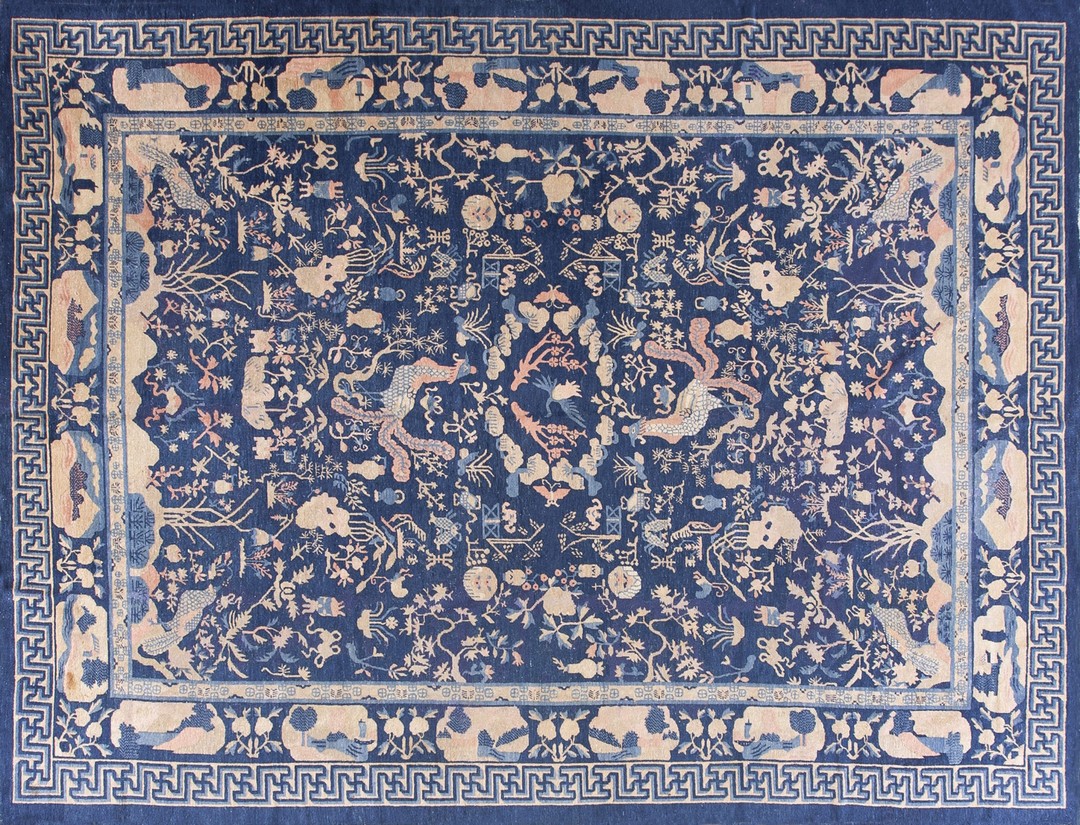
The most iconic visual hallmark of Peking rugs is the blue and ivory Chinese rug palette. Deep indigo blue paired with creamy ivory dominates, producing a crisp, serene contrast.
This restrained scheme echoes the cobalt-and-white glazes of Qing dynasty porcelain, which influenced textile design throughout northern China. Subtler accents of gold, tan, or apricot sometimes enrich the design, adding warmth without breaking the visual harmony.
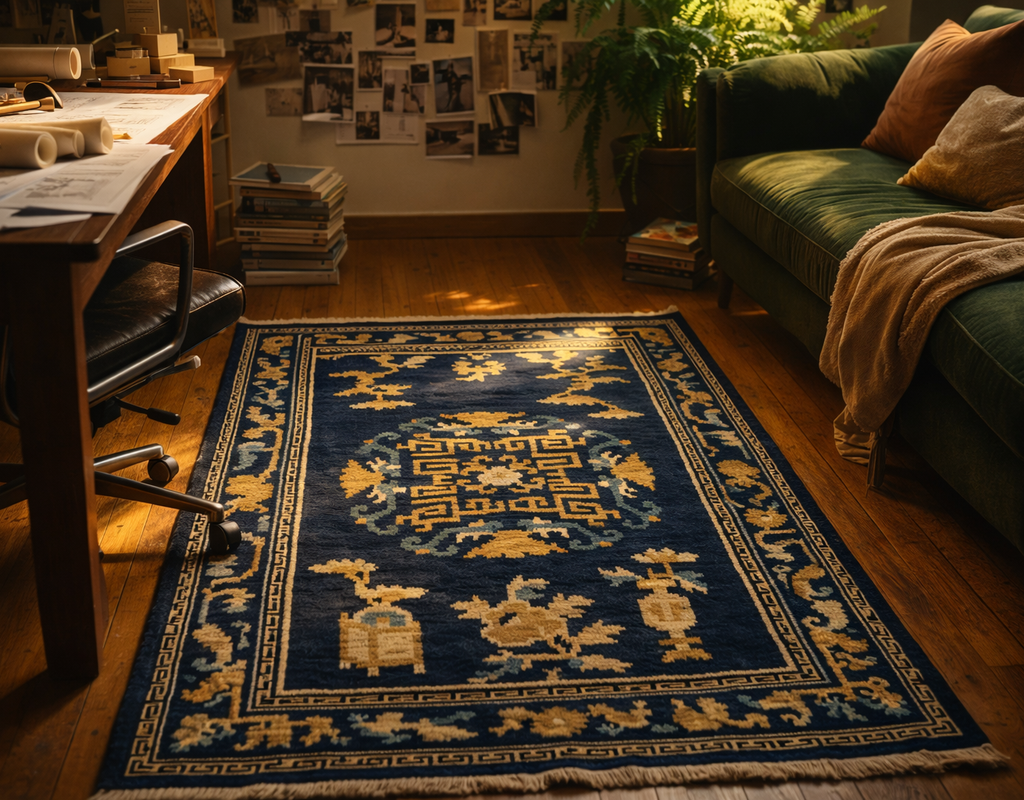
A striking blue and gold area rug grounds this atmospheric study and seating nook flooded with warm, directional light.
The limited palette was deliberate: it created a dignified, timeless look while allowing symbolic motifs to stand out clearly against uncluttered fields. For collectors today, the phrase “blue-and-ivory Peking carpet” is synonymous with elegance and imperial refinement.
Borders & Minimalist Aesthetics
Border designs reinforced the understated elegance of Peking rugs. Greek-key patterns, cloud scrolls, and floral vines appear most often, providing rhythm without overwhelming the central field. Unlike Persian or Caucasian weavings, where borders compete with the field for attention, Peking carpets used the border as a quiet frame.
This minimalist aesthetic reflects a broader Chinese artistic philosophy—leaving open space to invite contemplation, much like a landscape painting with mist-filled voids. The combination of clear medallions, symbolic motifs, blue-and-ivory hues, and restrained borders makes these carpets instantly recognizable and deeply tied to Beijing’s imperial art traditions.
Key Takeaway: Antique Peking rugs are defined by their open-field medallion layouts, auspicious Chinese carpet symbolism, and the iconic blue-and-ivory palette inspired by Qing porcelain.
Dragons, lotus blossoms, Shou symbols, and peonies embody imperial power, purity, longevity, and prosperity, while borders and negative space highlight the minimalist aesthetic that sets Peking rugs apart from other world traditions.
Materials, Weaving & Construction
Wool & Material Sources
The foundation of every authentic Peking rug lies in its wool, and the finest came from Hebei province. Known for its cold winters and dry climate, Hebei produced sheep with long, strong fibers that yielded a soft, lustrous fleece. This wool gave Peking rugs their silky sheen and supple texture, setting them apart from rougher regional weaves.
The tactile appeal of Hebei wool made these carpets desirable not only for their beauty but also for their comfort underfoot. Today, the phrase Hebei wool carpets still carries weight among collectors, a reminder of how geography shaped quality.
Knotting Technique
Peking rug materials were worked using the Persian (Senneh) knot, a technique that allowed for tighter construction than the symmetrical Turkish knot common in other weaving regions. However, Peking rug knot counts typically range between 25 and 45 knots per square inch, far lower than the densities achieved in fine Persian city rugs, which can exceed 200 knots per square inch.
This lower knot density gave Peking carpets a bolder, less intricate appearance but also made them highly durable and practical. The comparison highlights a key distinction: while Persian rugs often pursued micro-detail, Chinese rug construction prioritized clarity of design, open fields, and long-lasting structure.
Construction Details
- Cotton foundation — Why: Provided a strong, stable base that resisted warping and kept rugs flat over time.
- Double wefts — Why: Added structural integrity, making the carpets sturdy enough for heavy use in palaces, temples, and later, export markets.
- Hand-carved pile — Why: Unique to Chinese weaving, artisans clipped and sculpted the wool to create a relief effect, giving motifs like lotus flowers or dragons three-dimensional depth.
These construction choices combined softness with strength, producing rugs that could endure centuries of use without losing their visual elegance.
Key Takeaway: The excellence of Peking rugs comes from their materials and construction: Hebei wool for softness and sheen, the Senneh knot for stability, and carved pile for artistic relief. With knot counts lower than Persian city carpets, Peking rugs emphasize durability and bold symbolism rather than extreme fineness, ensuring their place as enduring Chinese imperial textiles.
Construction Secrets: The “Closed Back” and Depressed Warps
To the untrained eye, a Peking rug looks like any other thick carpet, but its “handle”—how it feels when you pick it up—is unique. These rugs utilize a “closed back” construction with heavily depressed warps.
In simpler terms, the internal vertical strings (warps) are woven on two different levels. This results in a rug that is remarkably stiff, heavy, and durable. This structural rigidity is why antique Peking rugs rarely “bubble” or lose their shape on the floor, unlike the thinner, more flexible nomadic rugs from the western provinces. If the rug feels as sturdy as a piece of heavy canvas, it is a testament to this classic Beijing construction technique.
The Art of “Carving”: Adding Three-Dimensional Depth
While the patterns of Peking rugs are visually striking, their tactile nature is equally unique. A hallmark of the Peking and later Tianjin styles is the hand-carved pile. After a rug was off the loom, master finishers would use specialized angled shears to incise the wool around the outlines of the motifs.
This “incising” or “sculpting” creates a subtle 3D relief effect, making lotus petals and dragon scales appear to lift off the background. For a collector, this depth is a key sign of a high-quality workshop production, as it required a steady hand and hours of meticulous post-weaving labor that cheaper reproductions often skip.
Imperial & Palace Carpets
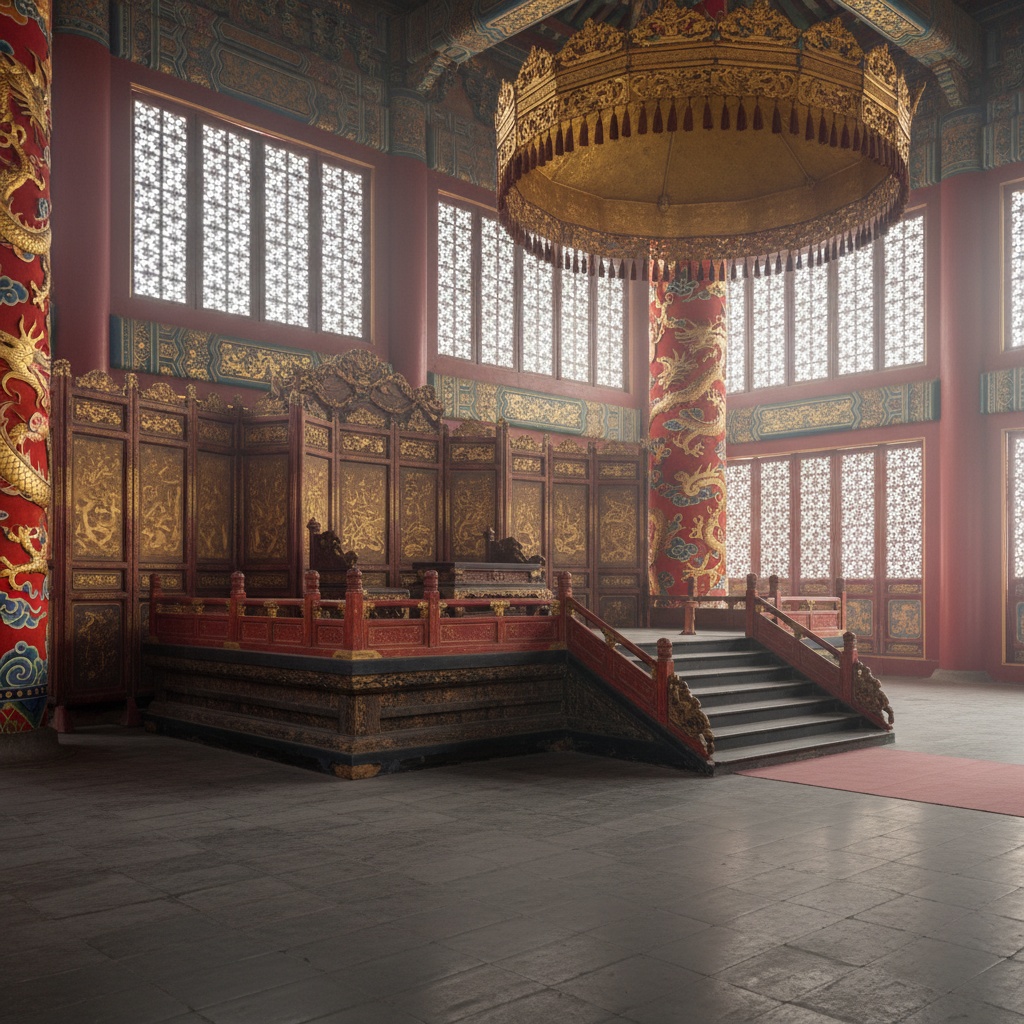
Grand hall setting for imperial carpet display.
Imperial Workshop Production
The pinnacle of Imperial Peking carpets came from workshops established under direct court patronage. These ateliers were tasked with producing rugs not for export or common households, but exclusively for palaces, temples, and the emperor’s inner chambers. Designs were overseen by court officials to ensure they aligned with imperial iconography—dragons with five claws, Shou symbols for longevity, and lotus blossoms for purity.
Production continued until the fall of the Qing dynasty in 1912, when the imperial system collapsed and with it the dedicated palace weaving tradition. After this point, no new carpets were woven under direct imperial authority, making surviving examples both rare and historically charged.
Placement in the Forbidden City
Among the most prestigious of these palace workshop rugs were Forbidden City throne carpets, placed beneath and around the daises of imperial thrones. These massive carpets served not just as decoration but as symbols of power, situating the emperor above auspicious motifs woven into the wool.
Dragons writhed through indigo fields, Shou symbols repeated in borders, and phoenixes filled corners, reinforcing the cosmic authority of the Son of Heaven. The presence of a throne carpet transformed an architectural space into a sacred seat of rule, binding textile and political power.
Viewing Imperial Carpets in Beijing
For modern visitors, the chance to see these original masterpieces remains possible. The Palace Museum in Beijing, housed in the Forbidden City, preserves and displays a remarkable collection of imperial carpets. These include throne carpets still set in context, as well as preserved weavings that demonstrate the technical brilliance of the palace workshops.
Viewing them today provides a rare glimpse into how textiles shaped the ceremonial life of the Qing court, reminding us that carpets were more than furnishings—they were woven declarations of empire.
Key Takeaway: Imperial Peking carpets are among the rarest Chinese textiles, woven until 1912 in palace workshops, displayed under thrones in the Forbidden City, and preserved today in the Beijing Palace Museum. Their symbolism and context embody the fusion of weaving, authority, and ritual at the highest level of Chinese history.
Export Boom & 20th-Century Evolution
19th-Century Export Expansion
Following the mid-19th century, the collapse of the Canton system and the opening of new treaty ports exposed Chinese decorative arts—including carpets—to global markets. Export Peking rugs began to appear in greater numbers as Western merchants recognized the appeal of Beijing’s restrained blue-and-ivory style.
These rugs were shipped abroad to Europe and later the United States, where they were valued as exotic yet adaptable to Western interiors. The simplified layouts, open fields, and auspicious motifs translated well into Victorian drawing rooms and later Edwardian salons, setting the stage for a transformation in design driven by Western demand.
1920s American Demand & Design Shift
The 1920s marked a turning point when American interior design began to favor bolder, more modern aesthetics. Peking rugs, once steeped in traditional Chinese symbolism, were redesigned for these new markets.
American buyers wanted larger formats for suburban homes and new apartment living, with colors that matched modern interiors. Rug makers adapted by introducing vivid palettes—rose, teal, gold, lavender—in place of the classic indigo and ivory.
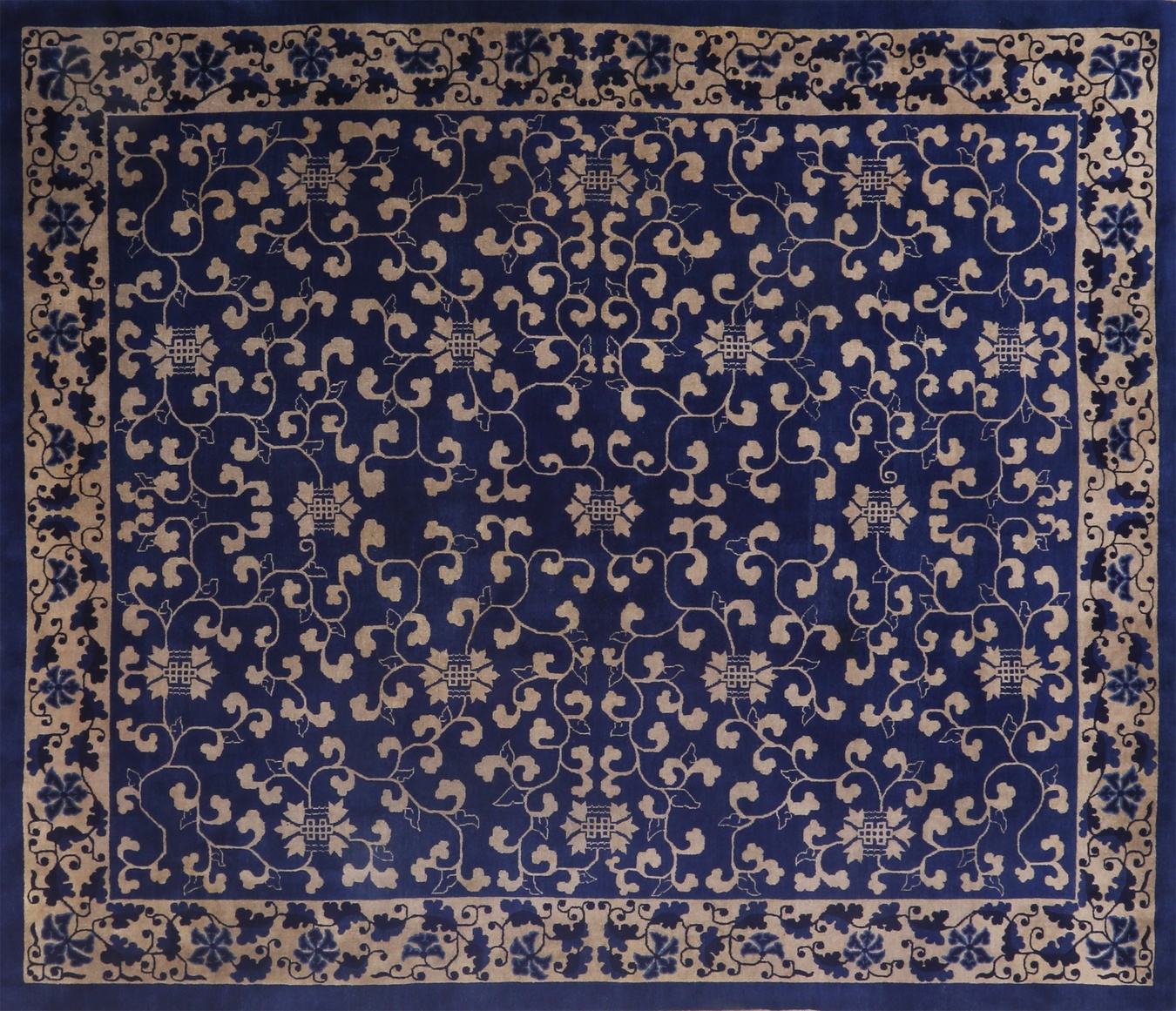
1920s Knotted Wool Chinese – Peking Rectangle Blue Antique Room Size Rug – by Rugs On Net
Motifs became less strictly Chinese, sometimes reduced to stylized florals or abstract medallions, aligning with the streamlined elegance of Jazz Age décor. This period permanently reshaped the image of the Peking rug abroad, broadening its identity beyond palace and temple traditions.
Art Deco Fusion in Tianjin Rugs
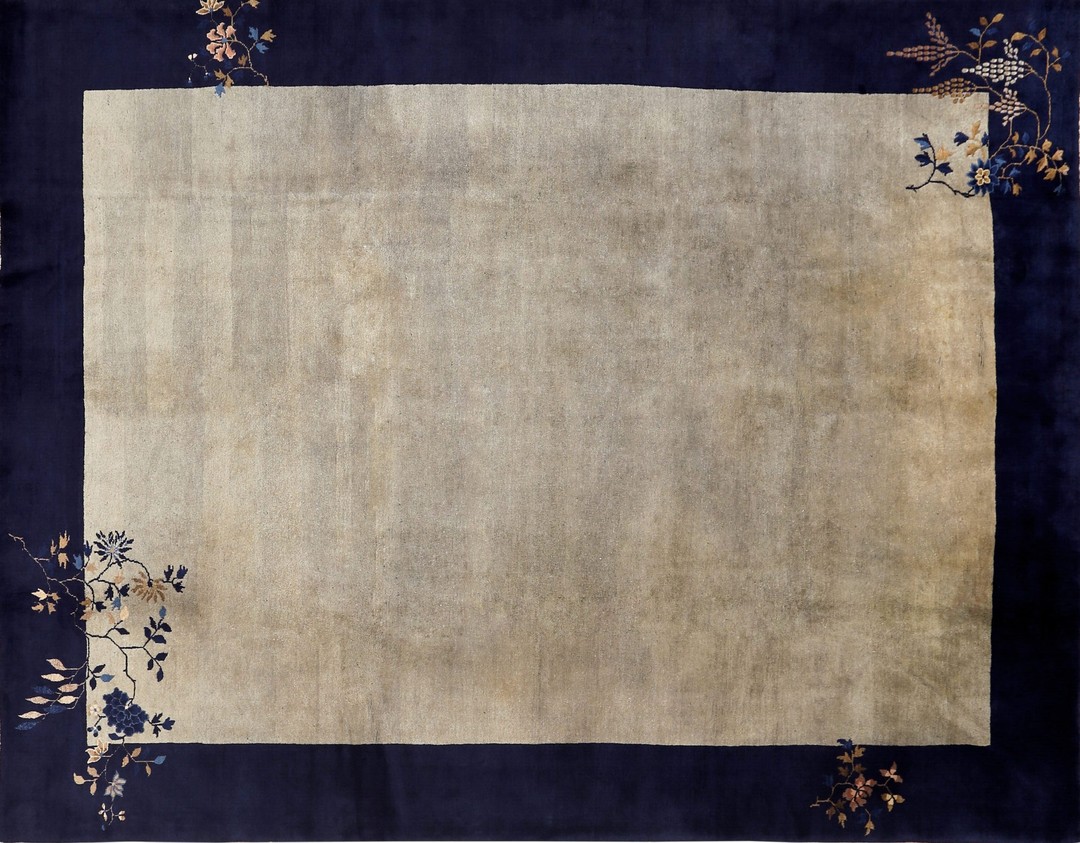
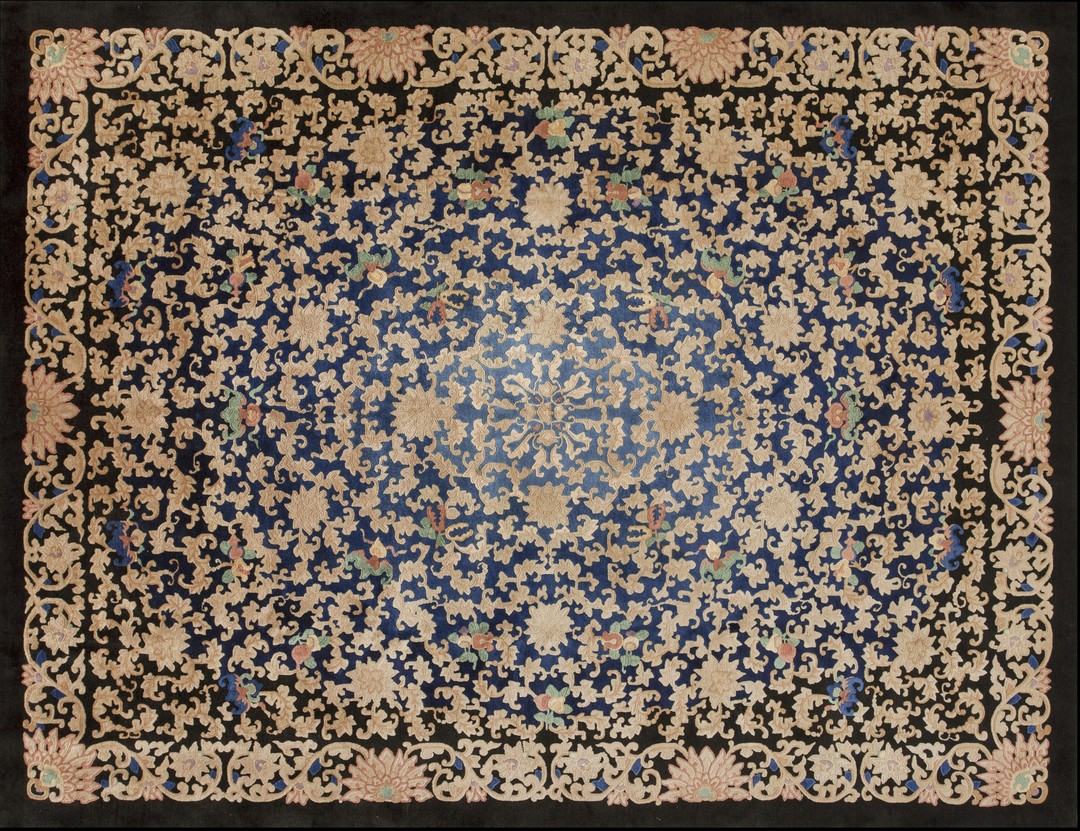
The greatest stylistic leap occurred in Tianjin, where workshops fused traditional Chinese rug construction with Western Art Deco design. The so-called Tianjin Deco rugs introduced asymmetry, oversized blossoms, angular vines, and dramatic color blocking. These bold reinterpretations transformed the Chinese carpet into a fashion statement for modernist interiors.
The movement was not accidental: Tianjin, as a treaty port, was cosmopolitan, hosting foreign residents, trading houses, and design influences that made fusion styles natural. Today, Chinese Art Deco rugs from Tianjin are highly collectible, celebrated as icons of early 20th-century cross-cultural design.
Key Makers: Nichols, Fette-Li, and Others
The export surge was spearheaded by entrepreneurs who understood Western markets. Walter Nichols, an American based in Tianjin, built a brand around richly colored, modernized Chinese rugs that matched American décor trends.
His carpets became synonymous with Deco chic, still referred to today as “Nichols carpets.” Other firms, such as Fette-Li, carried the fusion further, blending Art Deco geometry with subtle Chinese motifs. These makers helped redefine the image of the export Peking rug, ensuring that Chinese weaving not only survived the decline of imperial patronage but also thrived as a global design phenomenon.
A little known fact is that Nichols is often credited with introducing chrome dyes (synthetic) to China. While “natural dyes” are prized by collectors, most 1920s-1930s Art Deco Peking rugs used these more vibrant, light-fast synthetic dyes to achieve the deep purples, emerald greens, and “Nichols blue.”
Key Takeaway: In the 19th and 20th centuries, export demand transformed Peking rugs from palace symbols into international décor staples. The 1920s American appetite for bold design gave rise to Tianjin Deco masterpieces, with figures like Nichols and Fette-Li leading the way. Today, these Chinese Art Deco rugs stand as proof of how global markets reshaped Beijing’s weaving traditions into modern icons.
The “Fette” vs. “Nichols” Distinction
For those collecting 20th-century export rugs, two names dominate the market: Walter Nichols and Helen Fette (Fette-Li).
While both operated in the Peking/Tianjin region, their styles are distinct:
- Nichols Rugs: Known for being heavy, thick, and “bold.” They often feature a cotton foundation and a very high, dense pile with vibrant, saturated colors.
- Fette Rugs: Generally have a “softer” handle. Helen Fette utilized a different knotting technique and often opted for more traditional, delicate Chinese motifs rather than the loud, geometric Art Deco styles favored by Nichols. A Fette rug often feels more like a “textile” and less like a “floorboard” than a Nichols piece.
Cultural Significance & Symbolism
Religious & Courtly Symbolism
At the heart of Chinese carpet symbolism lies the deliberate choice of motifs tied to imperial power and spiritual belief. Dragons, especially five-clawed forms, represented the emperor himself, embodying cosmic authority, protection, and control over the elements. Their presence on Peking rugs was a direct assertion of sovereignty and divine mandate. In contrast, the lotus symbolized purity and spiritual awakening, echoing Buddhist ideals of transcendence.
Together, these motifs balanced temporal power with moral virtue, making the rug not just a floor covering but a woven declaration of legitimacy, piety, and cosmic order.
Ritual, Status, Gift Uses
- Ritual use in temples — Why: Peking rugs often adorned Buddhist altars or temple floors, their lotus or cloud motifs harmonizing with sacred spaces and prayer rituals.
- Markers of social status — Why: Owning a finely woven rug in blue-and-ivory signified wealth and refinement; in palaces, throne carpets made the emperor’s seat a visible center of authority.
- Wedding dowry rug — Why: Carpets woven with longevity motifs such as the Shou symbol or butterflies were offered in marriage dowries, symbolizing blessings for fertility, joy, and a long life together.
- Gift-giving among elites — Why: Carpets bearing auspicious designs were bestowed as diplomatic or familial gifts, embedding messages of loyalty, good fortune, or political favor.
These uses demonstrate how Peking rugs functioned beyond aesthetics—they were instruments of ritual and markers of identity within court and society.
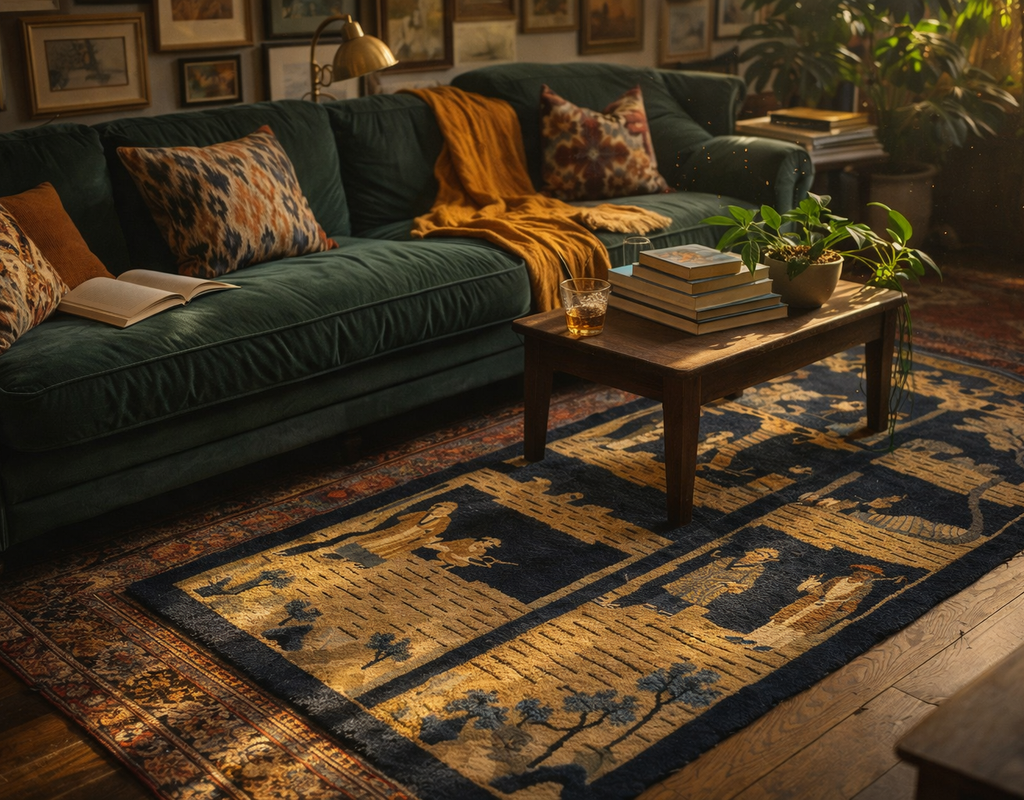
A richly layered space balancing deep jewel tones with the striking geometry and color palette of the centerpiece rug.
Symbolic Color Meanings
The palette of blue and ivory Chinese rugs carried as much meaning as the motifs. Indigo blue conveyed depth, stability, and a connection to the heavens, while ivory fields suggested purity and harmony. Accents of gold symbolized wealth and power, while apricot or tan added warmth and vitality. These color choices were far from decorative accidents—they reinforced the symbolic intentions of dragons, lotus blossoms, or Shou emblems, ensuring every aspect of the rug conveyed auspicious resonance.
Key Takeaway: Peking rugs embody a fusion of longevity motifs, Buddhist carpet art, and courtly symbolism, where dragons stand for imperial power and lotuses for purity. Used in rituals, as dowries, or as elite gifts, these rugs united art, faith, and social status, making them essential cultural objects woven with layered meaning.
The Power of Color: Imperial Yellow and the “Nichols” Blue
The color palette of a Peking rug often tells the story of its intended owner. Historically, “Imperial Yellow” was strictly reserved for the Emperor and the high court; any rug featuring a true yellow ground from the 18th or 19th century likely originated within the walls of the Forbidden City.
By the 1920s, the color story shifted with the arrival of American entrepreneur Walter Nichols. He pioneered the use of chrome dyes in Chinese workshops. Unlike earlier vegetable dyes, these synthetic pigments allowed for the “Electric Blue,” deep emeralds, and vibrant purples that define the Art Deco era.
When you see a 1920s Peking rug with a “midnight blue” field that hasn’t faded in a century, you are likely looking at the legacy of the Nichols chrome-dye revolution.
Collecting, Authentication & Value
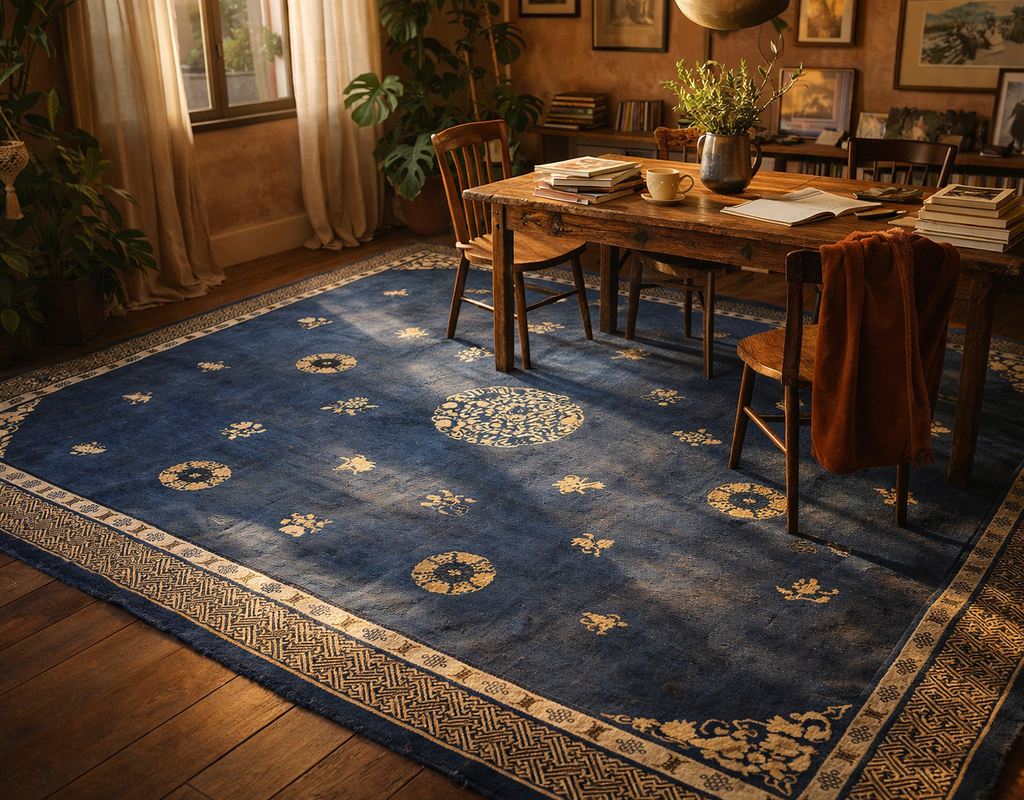
A striking blue and gold patterned rug defines the center of this rustic, sunlit dining space.
Authenticating 1920s Peking Rugs
For serious collectors, Peking rug authentication begins with identifying the hallmarks of period design. Rugs from the 1920s export era often feature vibrant Art Deco palettes—rose, teal, gold, lavender—distinct from the classic blue-and-ivory schemes of earlier palace pieces. Knotting density (25–45 knots per square inch) should be consistent with Chinese construction, and inspection of the Senneh knot confirms authenticity.
Natural dyes typically show subtle aging and uneven fading, while synthetic dyes from the late 19th century reveal sharper, more uniform tones. Wear patterns, cotton foundations, and hand-carved pile relief are additional markers that separate genuine 1920s Peking carpets from later reproductions.
Value vs. Ningxia Rugs
When weighing Ningxia vs. Peking, collectors consistently find stronger value in Peking pieces. Ningxia carpets, while historically important and prized for their dense knotting and temple use, generally command lower prices on the market due to their smaller scale and less iconic design language.
By contrast, Peking rugs—especially those with imperial or Deco-era provenance—have a broader appeal in both Western and Asian markets. Their recognizable medallions, dragon motifs, and Art Deco fusions ensure they remain collectible Chinese rugs with stable or rising value.
Palace vs. Export Rugs—Which to Buy?
For investment and prestige, palace carpet value surpasses that of export rugs. Palace rugs, woven under Qing dynasty patronage before 1912, are exceedingly rare, with provenance often tied to the Forbidden City. Their symbolism, scale, and imperial associations make them the pinnacle of collectible Chinese rugs.
By contrast, export Peking pieces—while still beautiful and valuable—lack the direct imperial link. Collectors entering the market should prioritize palace carpets whenever possible, as they combine historical significance with enduring scarcity.
Export pieces from the 1920s, particularly Nichols and Tianjin Deco rugs, remain worthwhile acquisitions for their bold design and market demand, but they do not equal palace rugs in rarity or cultural weight.
Notable Collections & Auctions
Important examples of collectible Chinese rugs are preserved in the Palace Museum in Beijing, but many of the finest palace and Deco-era Peking carpets circulate through international auctions. Houses such as Christie’s and Sotheby’s have handled notable throne carpets and early Nichols rugs, with palace pieces commanding six-figure results. Private collections in the United States and Europe also hold significant groups of Art Deco Tianjin rugs, increasingly recognized as design icons.
These auction records reinforce market confidence: authentic palace or Deco-era Peking rugs remain among the most desirable categories for collectors of Asian textiles. Key Takeaway: Collectors seeking long-term stability should prioritize palace carpets for their rarity, imperial provenance, and cultural gravitas. 1920s Deco-era rugs also command strong value when authenticated, while Peking rugs generally outperform Ningxia in market appreciation. Whether in museums or at auction, these carpets remain central to the field of Asian textile collecting.
Care, Preservation, and Environmental Factors
Beijing’s Climate & Dye Fading
The original home of Peking rugs—Beijing—has a dry, sunny climate that historically influenced the condition of these textiles. Strong sunlight can accelerate fading of natural indigo and apricot dyes, softening the crisp contrasts of the classic blue-and-ivory Chinese rugs. Even today, collectors are advised to avoid placing antique rugs in direct sunlight, as UV exposure gradually weakens both color and wool fibers.
Dry air can also lead to brittleness in the pile if rugs are not properly humidified. For long-term preservation, keeping rugs in shaded, climate-stable interiors is essential to prevent premature dye loss and fiber damage.
Environmental/Green Policy Impact on Hebei Production
Future rug quality also depends on Hebei wool policies, as this province remains central to supplying soft, lustrous wool for Chinese rug construction. New environmental initiatives in Hebei encourage rotational grazing and reduced chemical use, aiming to protect soil and water resources.
These green policies may improve sustainability but could also reduce short-term yields, influencing the availability and cost of materials for Peking-style rugs. Collectors and buyers should be aware that environmental changes in Hebei have a direct effect on the wool quality that defines authentic Peking rug care and production.
Maintenance Tips
- Rotate rugs regularly — Why: Prevents uneven fading and wear in high-traffic or sunny spots.
- Use quality rug pads — Why: Protects both the carpet and flooring, reduces slippage, and adds cushioning to preserve pile.
- Avoid direct sunlight — Why: Prevents accelerated dye fading, especially in antique rugs with natural indigo or vegetable dyes.
- Gentle cleaning only — Why: Over-washing or harsh chemicals damage fibers; dry cleaning and vacuuming without beater bars are safer.
- Store with care — Why: Rugs rolled with breathable covers in cool, dark environments remain free of mold, pests, and excess wear.
Key Takeaway: Antique rug maintenance is essential for preserving the symbolic motifs and value of Peking rugs. Beijing’s dry climate makes them vulnerable to fading, while evolving Hebei wool policies may shape future production. By rotating, padding, shading, and cleaning gently, collectors can safeguard their carpets for generations.
Preservation: The Vulnerability of the Deep Pile
While the thick Hebei wool used in Peking rugs provides luxury underfoot, it presents a specific preservation challenge. The dense, deep pile is a magnet for clothes moths, who can burrow deep into the foundation where they are difficult to spot.
Because many of these rugs have a cotton foundation (which moths won’t eat) but a wool pile (which they love), a moth infestation can “shear” the wool right off the base without the owner noticing until they move a piece of furniture. Professional cleaning and regular rotation are more than just aesthetic tips for Peking rugs; they are essential for protecting the structural integrity of the heavy wool fleece.
Modern Legacy & Market
Current Production & Revivals
Today, modern Peking rugs are no longer produced in large-scale palace or export workshops. Instead, small boutique ateliers and private commissions carry on the tradition, often weaving for collectors, designers, or ceremonial purposes.
These revivals pay homage to the open-field medallion layouts, restrained borders, and symbolic motifs that defined the style. While rare, newly commissioned pieces show how the legacy of Peking weaving continues to inspire artisans and remains relevant in luxury décor.
Contemporary Design Influences
The influence of Peking carpets is strongly felt in today’s interiors. Antique pieces—particularly Art Deco Chinese rugs from Tianjin—are celebrated for their bold asymmetry, oversized florals, and daring palettes. Designers value these rugs as graphic statements that bridge Eastern tradition and Western modernism.
Meanwhile, the iconic blue-and-ivory antique rugs complement minimalist, transitional, and even Scandinavian-inspired interiors, proving their timeless adaptability. Collectors and decorators alike turn to the Chinese antique rug market to source these pieces as focal points for sophisticated, globally minded spaces.
Interior Design Usage
In contemporary homes, antique Peking rugs serve as anchor pieces—statement rugs that ground a room with both history and artistry. Their open fields and balanced medallions work seamlessly in modern spaces, while Deco Tianjin carpets bring vibrancy to eclectic interiors.
Designers often highlight them in living rooms, entryways, and formal dining areas where their symbolism and craftsmanship can be appreciated. For readers interested in Deco styles, see our related page on [Chinese Art Deco Rugs] to explore how these 20th-century masterpieces continue to shape global design.
Tianjin Workshop Visits
For those hoping to connect with the weaving centers themselves, Tianjin carpet factories that once pioneered Art Deco styles are now mostly closed. A few boutique workshops remain and sometimes accept visitors, offering glimpses into traditional hand-weaving methods.
However, the grand industrial-scale factories of the early 20th century no longer operate, leaving museums, antique markets, and surviving Deco rugs as the best way to experience this history firsthand.
Call to Action: Explore & Shop Peking Rugs
The Peking rug style endures as both an imperial treasure and a modern design icon. Collectors, designers, and enthusiasts are encouraged to explore authentic antique pieces, whether through museum visits, trusted auctions, or curated online collections. For those seeking to bring this legacy into their homes, shopping the Chinese antique rug market offers opportunities to acquire works that blend timeless artistry with lasting value.
Key Takeaway: Though palace workshops have long ceased, Peking rugs live on—as collector’s items, interior design essentials, and cultural symbols that bridge China’s imperial past with modern global aesthetics. From the Art Deco Chinese rug boom to today’s boutique productions, their enduring legacy makes them one of the most celebrated categories in Asian textiles.
Explore a Few of Our Favorite Peking Rugs
FAQ
- How should I store Peking rugs to prevent moth damage?
Clean, dry, roll, and wrap in breathable cotton or Tyvek—never plastic. Add cedar or traps, vacuum periodically, and check every few months.
- How old are most Peking rugs on the market?
Many date to the late-Qing/Republic era (circa 1880–1930), with some later pieces and contemporary reinterpretations. Age, not just style, affects value.
- Are all Peking rugs woven in China?
Traditional antiques are Chinese, but modern “Peking-design” rugs are also produced elsewhere (e.g., India). Verify origin on labels and invoices.
- Are Peking rugs good under dining tables?
Absolutely—choose low pile and extend the rug at least 24 inches beyond the tabletop so chairs stay on the rug when pulled out.
- Can I layer a Peking rug over wall-to-wall carpet?
Yes—use a rug-to-carpet pad to lock it in place and reduce buckling. Low-pile Peking rugs layer best over dense, low-pile carpeting.
- What rug pad works best under Peking rugs?
A felt + natural-rubber pad gives cushion and grip; trim it 1–1.5 inches smaller than the rug. On carpet, use a rug-to-carpet pad to prevent rippling.
- Can I use Peking rugs with radiant floor heating?
Yes—wool performs well if heat is moderate. Pair with a felt or felt-and-natural-rubber pad rated safe for radiant heat, and avoid PVC pads.
- Where can I buy Peking rugs in the U.S.?
Look for reputable antique rug dealers, auction platforms, and established galleries. Ask for cleaning history, return policies, and written attributions.
- How much do authentic Peking rugs cost?
Prices vary widely—small or distressed pieces can be a few hundred dollars, while fine room-size examples often run \$5,000–\$20,000+ depending on age, condition, and design.
- What sizes do Peking rugs come in?
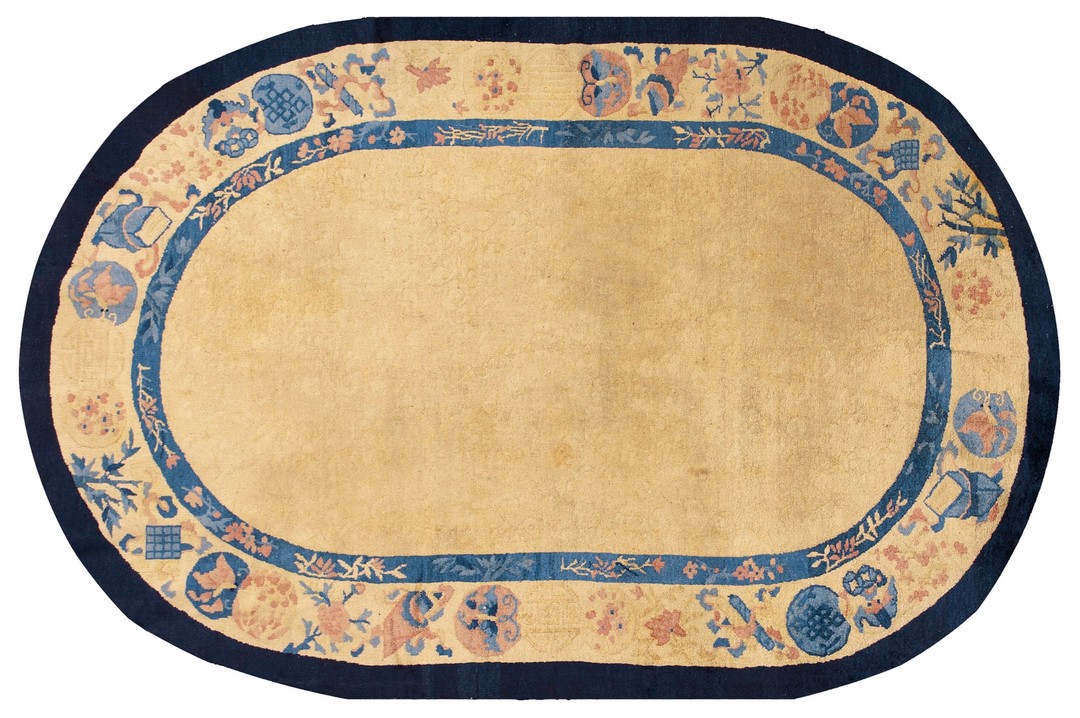
You’ll find everything from scatters and runners to room sizes like 8×10 and 9×12, plus larger mansion pieces. Round and oval shapes exist, too.
- How do I protect Peking rugs from sun fading?
Rotate every few months and use UV-blocking film, blinds, or curtains. Direct sunlight can unevenly lighten dyes and dry fibers over time.
- Will Peking rugs bleed color when cleaned?
Some can—especially older or saturated blues. Always spot-test with a damp white cloth first; if dye transfers, consult a professional cleaner.
- Do new or old Peking rugs shed?
Newer wool rugs may shed initially; vacuum lightly twice weekly until it subsides. Antique Peking rugs shed less but need gentle, regular maintenance.
- How do I care for the fringe on a Peking rug?
Don’t vacuum it; gently detangle and hand-brush with a soft brush. For deeper cleaning, isolate the fringe and use a mild solution sparingly.
- Should I vacuum Peking rugs with a beater bar?
Use suction-only or the gentlest setting and avoid the fringe. Strong beater bars can fray edges, pull knots, and damage tassels.
- How should I clean spills on a Peking rug?
Blot immediately with a white cloth, then dab a wool-safe detergent or diluted white-vinegar solution after a hidden colorfast test. Avoid scrubbing and over-wetting.
- Are Peking rugs durable for high-traffic areas?
Wool Peking rugs handle traffic well with proper pads and care. Avoid heavy use on silk-pile examples and place those in low-traffic rooms.
- What materials are Peking rugs made from?
Most Peking rugs have wool pile on cotton warps/wefts; some include silk highlights. Knot type varies (symmetrical and asymmetrical appear), with medium weaves common.
- How do Peking rugs compare to Ningxia rugs?
Peking rugs skew more formal and palace-ready; Ningxia rugs feel softer with simpler fields and gentle tones. Both share Chinese symbols but differ in handle and look.
- How do Peking rugs differ from Chinese Art Deco rugs?
Peking rugs are traditional and symmetrical with limited colors; Art Deco Chinese rugs (1920s–30s) use bold, asymmetrical motifs and saturated hues. Deco pieces are often linked to Nichols workshops.
- What colors do traditional Peking rugs use?
Peking rugs typically feature restrained palettes—soft indigos, ivory, camel, and muted gold. Blue-and-ivory combinations are especially iconic.
- What do the symbols on Peking rugs mean?
Common emblems include the shou character (longevity), bats (good fortune), cranes and deer (long life), and lotus (purity). Groupings like five bats symbolize the “five blessings.”
- How can I tell if a Peking rug is handmade?
Flip it over: you should see individual knots and fringe that’s part of the warp, not sewn on. Slight irregularities and mirrored backside patterns are good signs.
- Are Peking rugs the same as Beijing rugs?
Yes—“Peking” is the older English name for Beijing, so Peking rugs and Beijing rugs refer to the same tradition. Dealers often use both terms interchangeably.
- What are Peking rugs?
Peking rugs are hand-knotted Chinese (Beijing) carpets known for serene blue-and-ivory palettes, auspicious motifs (dragons, bats, shou), and balanced layouts. Most use wool pile on cotton foundations.