
Introduction to Moon Design Motifs in Rugs
Browse our curated collection of stunning Moon Motif Rugs available now.
Historical Origins of Moon Design Motifs
The story of moon design motif rugs begins deep in prehistory, long before settled civilizations produced palatial carpets. Some of the earliest expressions of lunar imagery appear in the woven and carved art of prehistoric Central Asia, where nomadic tribes carried with them portable textiles marked with celestial forms.
Archaeological fragments suggest that the moon, alongside stars and suns, figured prominently in early symbolic decoration, reinforcing the deep relationship between sky-watching and survival for migratory peoples. In the ancient Near East, particularly among Assyro-Babylonian and early Persian cultures, lunar symbols were formalized into religious iconography.
The moon god Sin (or Nanna) was central to Mesopotamian cosmology, and crescents carved into cylinder seals, reliefs, and temple artifacts influenced decorative systems that naturally extended into textile arts. As weaving developed into a refined cultural practice, these motifs transitioned from sacred imagery into protective and ornamental rug designs.
By the early first millennium BCE, nomadic textile cultures from Central Asia were transmitting crescent shapes, orbital patterns, and star-moon combinations into woven goods that later inspired Persian and Turkic weavers. With the spread of Islamic culture after the 7th century CE, lunar crescents became even more pronounced in artistic production, linking rugs to a universal cosmological order.
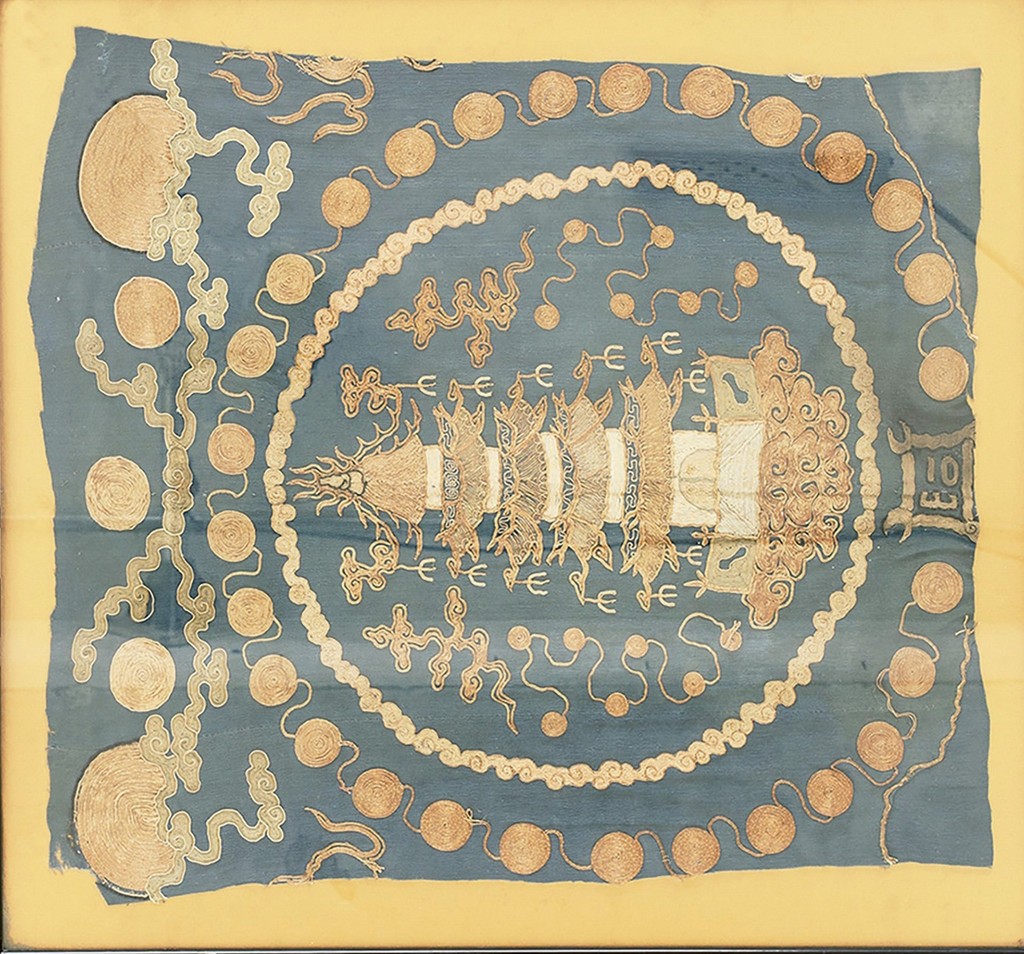
Antique Chinese Scenic Architectural Textile Art by Rugs On Net
Thus, moon design motifs in rug design originated in Central Asia, Persia, and ancient nomadic textile traditions, before dispersing widely through trade routes like the Silk Road.
Symbolic Meaning Across Cultures
The moon design symbolism in rugs has endured for millennia because of the moon’s layered cultural associations. Across civilizations, the moon was a visible marker of time, a regulator of agricultural cycles, and a constant companion in the night sky. Its waxing and waning rhythms linked it to fertility, renewal, and cosmic balance—qualities woven symbolically into rugs that often served as protective, domestic, and ritual objects.
In Assyro-Babylonian mythology, the moon design embodied divine wisdom and protection, making lunar imagery an emblem of safety for households. In ancient Persian thought, the moon was aligned with cosmic order and seasonal fertility, a logic preserved in carpet designs that celebrated abundance and stability. Among Turkic tribes, the crescent moon carried protective power against evil, a belief that migrated into the symbolic language of tribal kilims and nomadic weavings.
In Islamic traditions, the crescent moon and star came to represent divine guidance and unity, ensuring the lunar motif remained prominent in carpets produced across the Islamic world. The universality of the motif explains its endurance. Whether seen in the geometric crescents of Anatolian kilims, stylized celestial patterns in Persian village rugs, or abstracted orb designs in modern lunar carpets, the moon design continues to serve as a bridge between the cosmic and the domestic.
It is at once mytho-poetic, spiritual, and protective, a symbol that anchors the home to the heavens. The moon’s presence in rug design underscores humanity’s oldest relationship with the sky: a reminder that beneath the stars and the pale glow of the moon, people have always sought beauty, meaning, and order in their woven worlds.
From prehistoric nomads to Islamic dynasties, celestial area rugs remain a testament to the enduring power of lunar imagery in textile art.
Evolution of Moon Design Motifs in Rug Traditions
Celestial light source in an elaborate architectural setting.
Persian: From Lunar Medallion to Solar Symbol
The Persian moon design medallion, or toranj, lies at the heart of Persian carpet design. In its earliest form, the medallion was not solar but lunar, symbolizing the full moon as a radiant orb at the center of the carpet’s field.
For Persian weavers, the moon’s circular perfection carried associations with cosmic order, divine light, and prosperity.
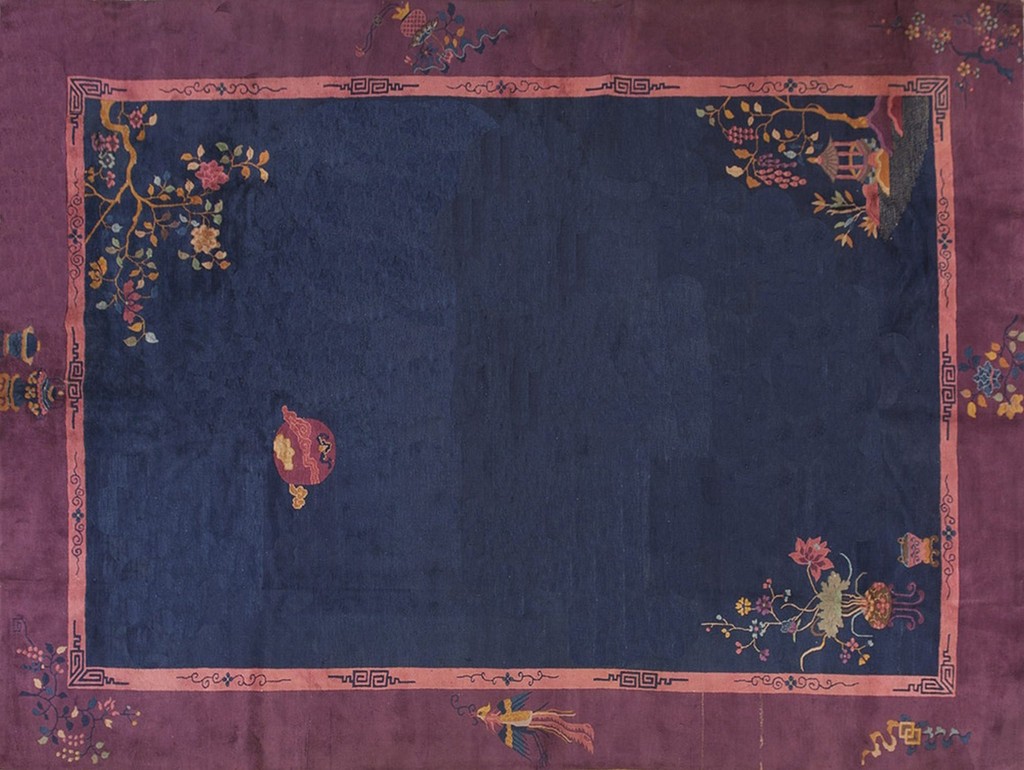
Antique Art Deco Room Size Wool Fuschia, Navy Rug by Rugs On Net
These lunar medallions mirrored the heavens, turning the woven carpet into a microcosm of the universe, where symmetry reflected divine balance. Over time, particularly during the Safavid period, the medallion’s identity shifted toward a solar interpretation, surrounded by radiating arabesques that suggested the sun’s brilliance. Yet even in this transformation, the mytho-poetic connotations of the moon remained embedded within the design.
The medallion preserved its role as a symbol of harmony and abundance, a woven reflection of the sky that tied households to both lunar rhythms and solar majesty. This duality—moon at origin, sun in later elaboration—underscores the layered cosmology within Persian rugs.
Ottoman & Anatolian: Moon Patterns in Turkish and Islamic Rugs
In Ottoman and Anatolian weaving traditions, the Ottoman crescent rug represents the fusion of earlier Turkic lunar beliefs with Islamic aesthetics. The crescent moon, long a sacred emblem among nomadic Turkic tribes, became further codified in Ottoman iconography when paired with the star, a combination that also symbolized divine guidance and sovereignty within the Islamic world.
Ottoman artisans adapted moon design patterns across centuries by embedding crescents into borders, spandrels, and even field repeats. The motif evolved in form—from sharply defined crescents in early Turkish kilims to more stylized, interlaced versions that blended seamlessly with geometric arabesques. This adaptability allowed the crescent to persist in a variety of rug types, from palace carpets to village weavings, ensuring that the Islamic moon design carpet was both a political emblem and a spiritual talisman.
The survival of the crescent motif across Ottoman centuries reflects how artisans transformed a primordial sky symbol into a timeless decorative language of empire and faith.
Central Asian & Turkic Rugs: Ay-gul and Tribal Moons
Among the nomadic cultures of Central Asia, the moon retained direct symbolic potency in everyday textiles. The Ay-gul motif, meaning “moon flower,” was a hallmark of Khotan carpets, where circular forms combined floral and lunar imagery in designs that represented fertility and cosmic blessing.
In Taimani rugs from Afghanistan, the mah motif (literally “moon”) marked tribal identity and offered protective symbolism.
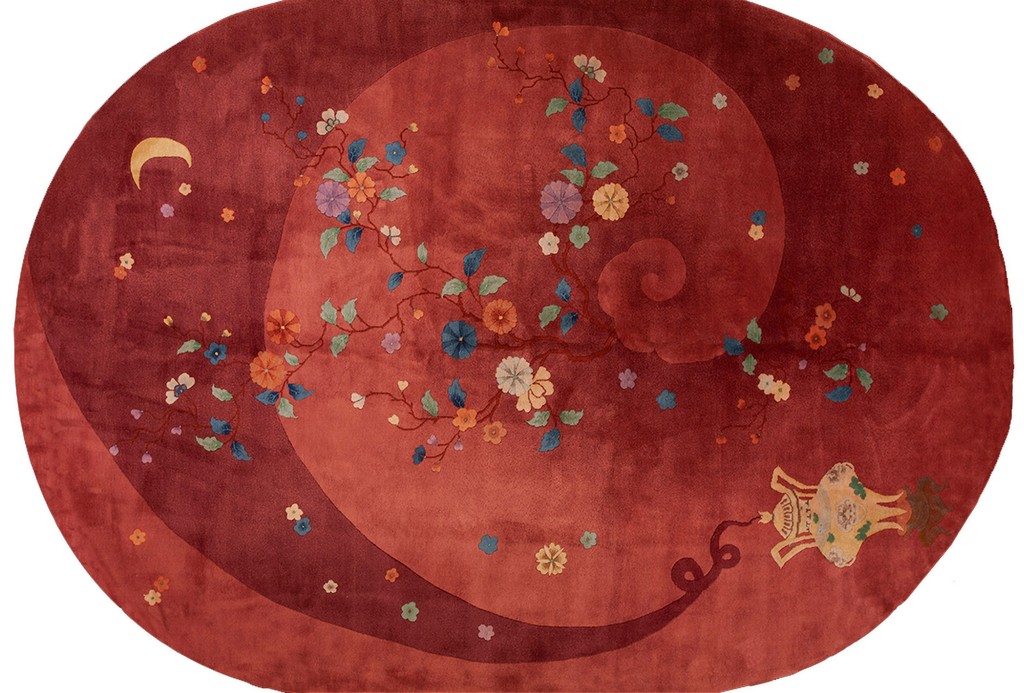
Oval Shape Antique Artistic Swirl Pattern Rustic Red Siena Color Art Deco Chinese Rug by Rugs On Net
Turkmen weavers incorporated abstract lunar elements into their famous guls, which have often been interpreted as stylized moons encased in geometric frameworks. These designs reflect the continuity of sky-worship traditions among Turkic peoples, for whom the moon was a guiding presence in nomadic life.
Unlike the more formalized medallions of Persia or crescents of the Ottomans, these tribal moons carried raw immediacy, linking weaving directly to myth, ritual, and survival under the night sky.
Caucasian and Regional Variations
- Shirvan Rugs: Lunar rosettes and crescent-flowers often paired with stars — Why: The region’s proximity to both Persia and Turkic cultures fostered hybrid celestial iconography.
- Karabagh Carpets: Crescent-and-star arrangements featured prominently in border systems — Why: Reflects Ottoman-Islamic influence while preserving local tribal aesthetics.
- Dagestan and Daghestan Kilims: Stylized half-moons woven into repeating patterns — Why: Protective and talismanic usage tied to local folk beliefs.
- Armenian Rugs: Incorporation of lunar symbols alongside Christian crosses — Why: Demonstrates cross-cultural exchange where moon imagery transcended purely Islamic or Persian contexts.
These regional expressions reveal how the moon design motif traveled and transformed, shifting form but rarely losing significance. Whether as the luminous medallion of Persia, the enduring crescent of the Ottomans, or the Ay-gul motif of Central Asia, lunar symbols have woven together disparate rug traditions into a shared celestial heritage.
Visual Forms and Motif Characteristics
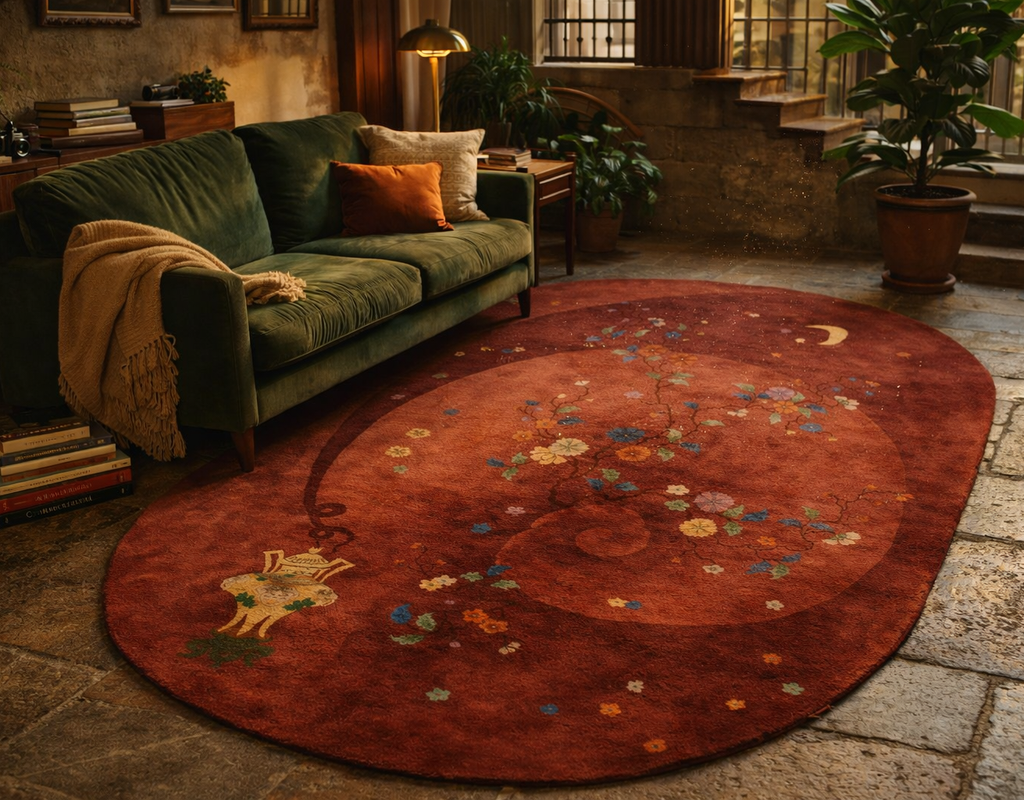
A striking, narrative rug brings warmth and fantasy to this atmospheric, stone-floored living space.
Celestial motifs featuring full and crescent moons in textile patterns.
The Full Moon and Medallion Layouts
In rug design, the full moon design finds its most enduring expression in the medallion format. Circular, rosette-like, or orb-shaped medallions dominate the central field, often interpreted as sun or moon depending on context. In classical Persian carpets, the toranj medallion frequently appears as a glowing full moon at the center of the rug, surrounded by smaller quarter-moons in the corners (lachak-toranj layout).
This arrangement transformed the carpet into a woven sky map, where the field of the rug mirrored the heavens.
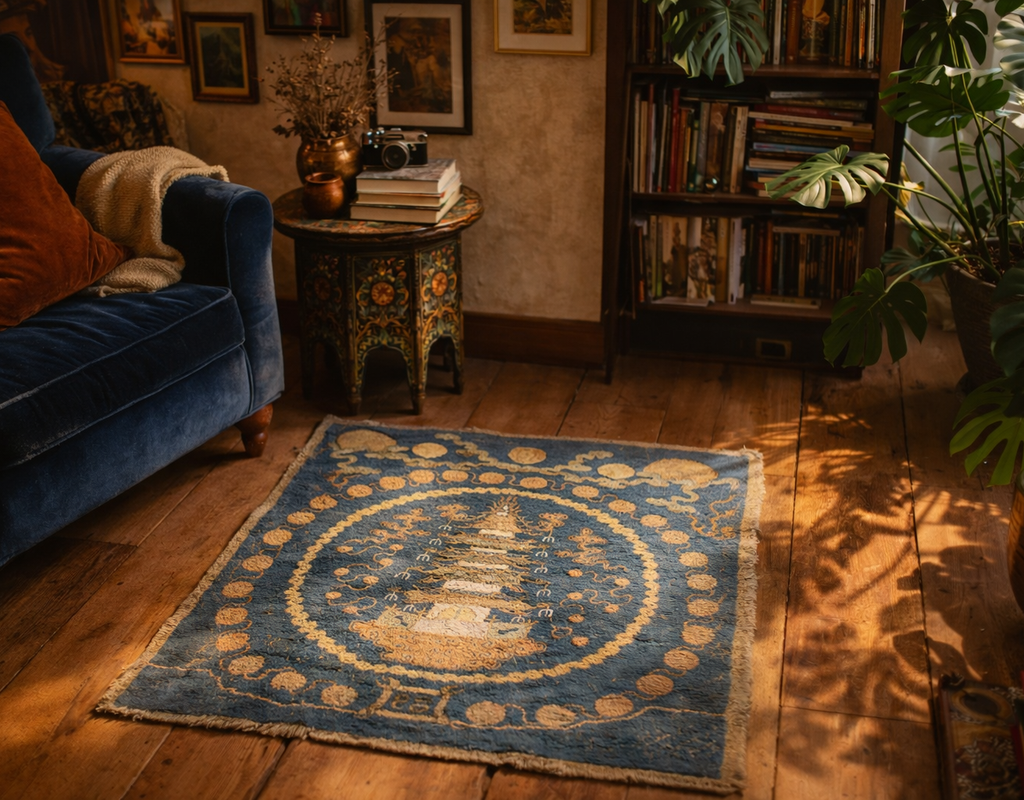
An eye-catching blue and gold Tibetan or Chinese-style rug anchors the corner of this richly decorated, sunlit room.
The medallion’s symmetry reinforced cosmological balance, allowing it to serve both aesthetic and symbolic functions—at once a design anchor and a lunar emblem.
Crescent Moons in Kilims and Flatweaves
The crescent moon design kilim is one of the most distinctive renderings of lunar symbolism in textile traditions. On Anatolian and Central Asian flatweaves, crescents appear in highly abstracted form: geometric arcs, often stepped or hooked, reduced to their most essential outline. They are typically small in scale and woven into borders, acting as protective or talismanic markers rather than dominant field motifs. Color plays a crucial role in their visibility.
Crescents are most often woven in ivory or yellow tones, set against darker reds, blues, or browns, ensuring they stand out within the pattern. Their placement—tucked discreetly into borders or paired with small stars—demonstrates the symbolic importance of subtle lunar presence.
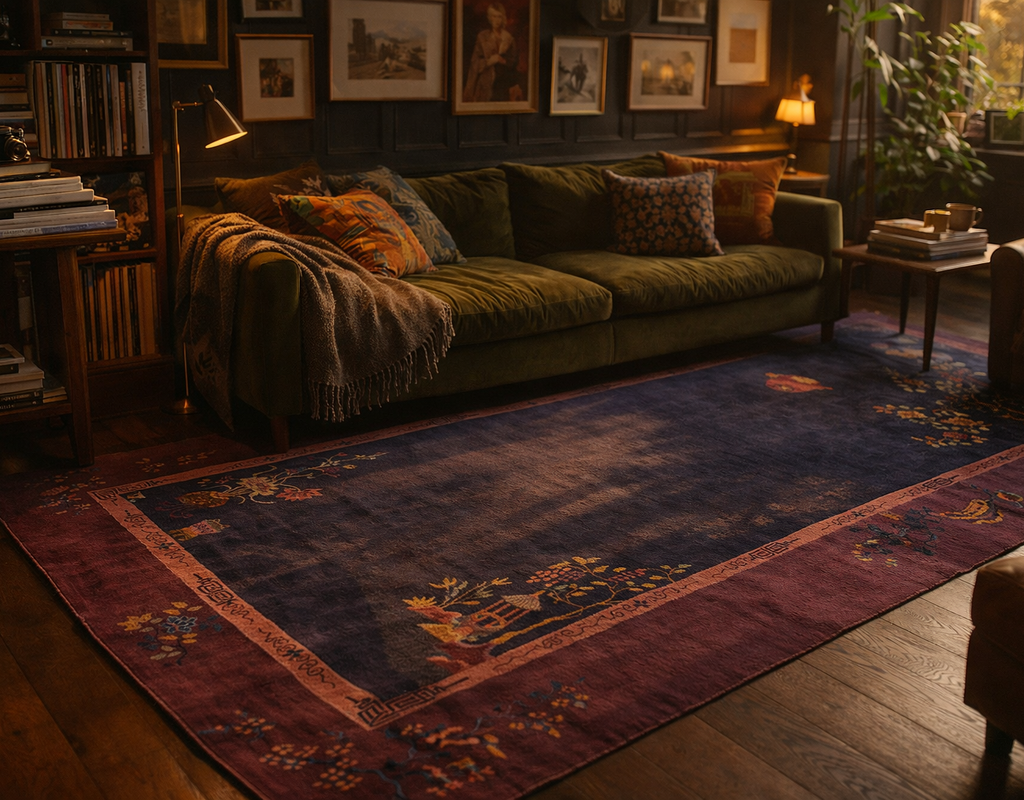
The combination of dark wood, jewel-toned velvet, and an ornate rug creates an inviting, classic ambiance.
The crescent moon on tribal kilims thus appears as a stylized geometric arc, its power lying in contrast and repetition rather than grandeur.
Lunar Phases and Celestial Patterns
- Phase Icons: Small crescents, half-moons, and full circles placed in sequence across a rug’s field — Why: Directly reference the passage of time and cycles of renewal.
- Arc Motifs: Sweeping arcs in contrasting colors that suggest waxing and waning — Why: Translate cosmic rhythms into abstract geometry.
- Gradient Designs: Color-block transitions from light to dark woven across runners — Why: Create a modern visual metaphor for lunar phases, appealing to contemporary aesthetics.
In modern rug design, these approaches bring lunar imagery into literal interpretation. The lunar phase rug has become a popular form of celestial décor, where sequences of moons are depicted as icons, arcs, or gradients that run along the length of a carpet or runner.
This makes the cosmic cycle tangible within domestic interiors, bridging traditional symbolism with modern design language.
Moon Design Motifs and Star Pairings
The moon design rarely appears alone in rugs. Throughout history, star and moon carpets amplified celestial meaning by coupling crescents or medallions with radiant star forms. In Ottoman and Anatolian traditions, the crescent-star pairing reflected Islamic symbolism and imperial identity. In Caucasian and Central Asian rugs, stars functioned as amplifiers of cosmic energy, surrounding moons with points of light to suggest the fullness of the night sky.
In contemporary celestial motif area rugs, designers often revive this pairing through minimal yet powerful compositions: moons in soft ivory balanced by sharp-pointed stars in metallic tones, or abstract celestial constellations scattered across dark fields. Whether woven traditionally or designed for modern interiors, the union of moon and star remains one of the most enduring expressions of humanity’s fascination with the cosmos in textile art.
Techniques & Materials for Lunar Motifs
Knotting and Weaving for Moon Imagery
The success of a luminous moon design motif in a rug often depends less on symbolism and more on the precision of craftsmanship. High knot density, particularly when combined with asymmetric knots, allows weavers to create circular medallions and crescents with smooth edges and subtle gradations.
This fineness makes it possible to depict glowing orbs and delicate arcs without distortion, preserving the intended celestial effect. In tribal kilims and flatweaves, where knotting is absent, moon design forms emerge through bold color contrast and geometric abstraction, emphasizing essence over detail.
Using Silk and Wool for Luminous Effects
Among rug materials, silk holds unparalleled power to render lunar brilliance. A silk moon design rug, woven with fine filaments, produces a natural luster that mimics the glow of moonlight. The reflective quality of silk enhances depth, giving medallions or crescents a sheen that shifts with changing light. High-quality wool can also achieve subtle radiance when tightly spun and densely knotted, though its effect is softer and warmer than silk’s crystalline gleam.
Thus, for moon-lit effects, silk remains the superior choice: its sheen and fine pile accentuate both detail and luminosity, while wool provides durability and warmth. Many masterworks combine the two, with silk reserved for moon design motifs and wool for the field, ensuring contrast between glowing celestial forms and a matte background.
High-Low Carving for Dimensional Moons
In modern production, artisans and manufacturers employ high-low carving to achieve dimensional effects. By sculpting the pile at different heights, moons are raised or recessed from the rug’s surface, catching light in distinctive ways. This technique transforms a flat motif into a dimensional moon design carpet, where shadow and relief add depth to circular medallions or crescents.
For example, a full moon design may be carved slightly higher than the surrounding field, giving it a luminous prominence, while crescents may be recessed and outlined, accentuating their curvature. The result is a carved celestial rug that not only depicts the moon but also evokes its three-dimensional presence, echoing the relief of the actual night sky.
Flatweave and Tapestry Approaches
Flatweaves and tapestry-style rugs interpret the moon differently, relying on abstraction rather than pile or sheen. In Anatolian kilims, crescents are rendered as hooked or stepped motifs, their presence established through ivory or yellow threads woven against darker grounds. The lack of pile means the illusion of glow comes entirely from color placement and contrast. Tapestry approaches in contemporary design push this further, using color blocks, gradient arcs, or repeated phase icons to suggest the moon’s progression.
Whether luminous in silk, dimensional through carving, or geometric in flatweaves, moon design motifs prove that technique and material are central to their effect. From the reflective shimmer of a silk moon design rug to the textured relief of a carved lunar medallion, artisans continue to reimagine the cosmos through the language of textile craft.
Moon Design Motifs in Modern and Contemporary Rugs
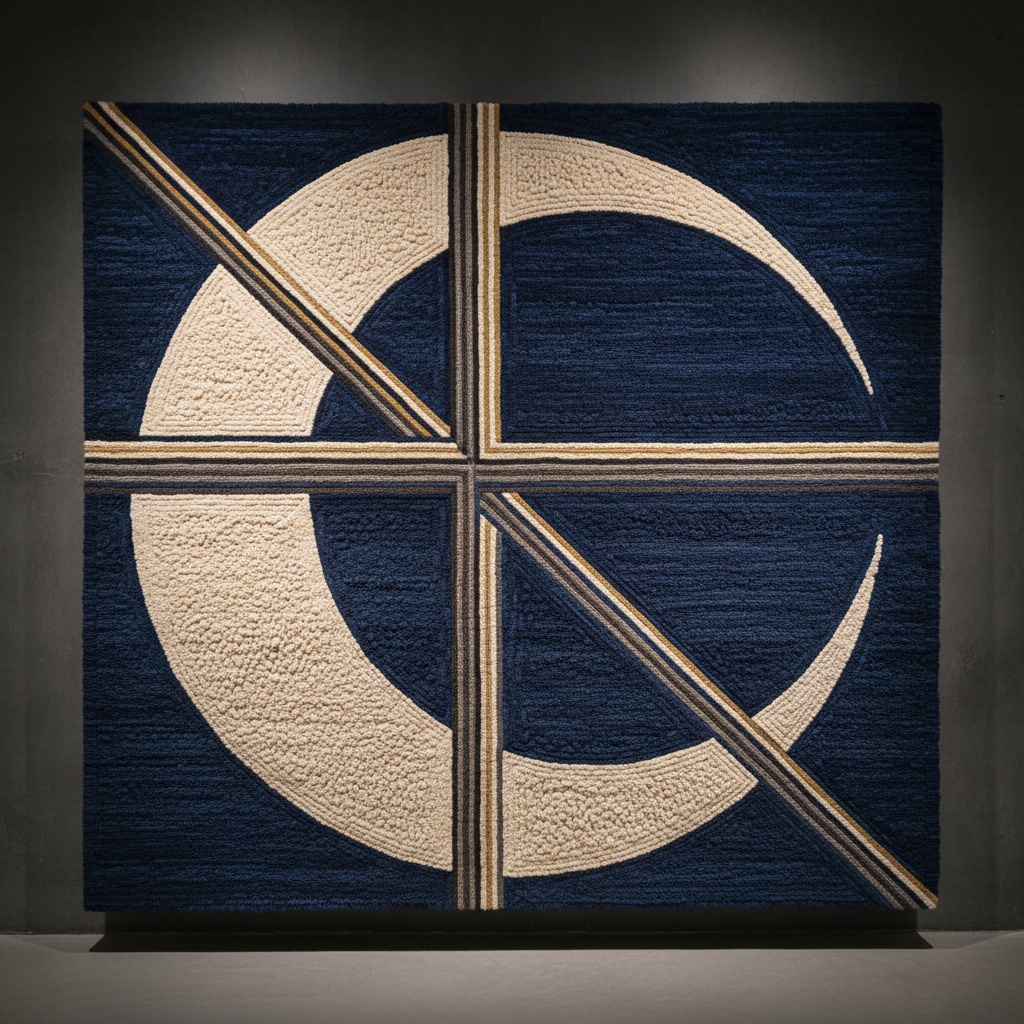
Geometric rug featuring abstract crescent moon elements.
Revival and Reproduction: Traditional Meets Modern
Today’s designers have revived lunar imagery by blending ancient symbolism with fresh aesthetics. The contemporary moon design rug often takes inspiration from Persian medallions, Ottoman crescents, or Central Asian tribal forms, reinterpreted with clean geometry, neutral palettes, or bold contrasts to suit modern interiors.
Traditional motifs are reproduced in new colorways—ivory moons set against deep navy, or abstracted crescents woven in monochrome fields—bridging heritage with minimalism. This revival demonstrates the flexibility of lunar imagery, capable of carrying both spiritual depth and modern visual clarity.
Artist Collaborations and Limited Editions
One of the most significant drivers of value in contemporary moon design rugs is the rise of artist collaboration carpets. When painters, illustrators, or textile artists reinterpret lunar motifs in rug form, the result is often issued in limited edition lunar area rugs, making each piece part functional décor and part collectible artwork. These collaborations enhance both exclusivity and cultural capital.
Because they are produced in restricted numbers and often signed or certified, such pieces hold strong appeal for collectors. Limited-edition artist collaborations increase the collectability and future value of moon design rugs by uniting craftsmanship with contemporary art prestige. Buyers see them not only as décor but also as investments that merge textile tradition with avant-garde creativity.
Digital Printing and Pictorial Moon Rugs
Advances in digital technology have introduced new possibilities for lunar imagery. Pictorial moon design rugs can now feature photographic renderings of the moon’s surface, complete with craters and shadows, directly printed or tufted onto the textile.
These pieces lean into literalism, serving as bold statement rugs for modern homes. Unlike hand-knotted or woven examples, digitally printed designs prioritize visual exactness over symbolic abstraction, appealing to a younger demographic that favors graphic clarity and thematic décor.
Fusion with Astrology, Boho, and Celestial Themes
The moon design has also found a natural home within contemporary bohemian and celestial design movements. The boho celestial rug often features lunar phases lined across a runner, paired with stars, suns, or astrological symbols. These designs tap into modern interests in spirituality, wellness, and cosmic cycles, making moon design rugs highly marketable in lifestyle-driven décor.
The fusion of astrology and textile art has resulted in rugs that double as symbolic tools—floor coverings that reference zodiac alignments or lunar cycles while maintaining decorative appeal. Their popularity underscores the enduring cultural resonance of the moon: timeless in tradition, yet constantly reinvented to reflect contemporary values.
From revivals of medallions to cutting-edge collaborations, from digital lunar prints to mystical boho designs, the moon design motif’s flexibility proves why it continues to thrive in modern rug-making. Whether as an art collectible, a fashion-forward statement, or a spiritual anchor, the moon remains one of the most versatile and evocative symbols in textile design.
Market, Collecting, and Buying Guide
Vintage vs. Modern Moon Rugs
- Vintage Moon Rugs: Scarce and therefore expensive; their rarity, historical context, and provenance drive up market value. — Why: Collectors prize uniqueness and authenticity, making vintage moon rug value consistently high.
- Modern Moon Rugs: More widely available, produced in both hand-knotted and machine-made forms. — Why: They provide affordability and stylistic range, appealing to contemporary buyers.
- Artist Collaborations: Limited runs of contemporary designs hold strong investment potential. — Why: Exclusivity and artistry elevate their long-term value.
Price Ranges: Antique, Hand-Knotted, and Machine-Made Rugs
Antique and vintage lunar carpets—particularly Persian medallion examples or Ottoman crescent rugs—can command high auction prices, sometimes reaching tens of thousands of dollars depending on provenance. For today’s buyers, hand-knotted moon design carpets woven in wool typically cost several hundred to several thousand dollars, with size, knot density, and origin influencing the price.
Machine-made celestial rugs remain the most affordable, often under a few hundred dollars, and while they can convincingly mimic the pattern and coloration of hand-knotted examples, they cannot replicate the depth of texture and sheen.
Factors Influencing Collectibility and Scarcity
Collectors must weigh rarity, authenticity, and condition above all else. Scarcity and provenance increase the value of vintage moon design carpets, especially when accompanied by documentation of origin.
Restoration history also plays a role; rugs with minimal but careful conservation retain higher value than those over-restored or heavily altered.
Natural dyes enhance desirability, as they produce softer and more authentic lunar palettes prized by purists, while synthetic fibers may appeal more to buyers prioritizing durability.
Authenticity, Restoration, and Insurance
Authentication of museum-quality pieces involves three key steps: expert appraisal, provenance research, and material analysis. A genuine Anatolian moon design medallion rug should be verified by textile specialists who can confirm weave structure, dye composition, and regional characteristics.
For rare silk examples, collectors are advised to insure them at appraised value, as rare moon crescent silk carpets are particularly vulnerable to damage from light or mishandling.
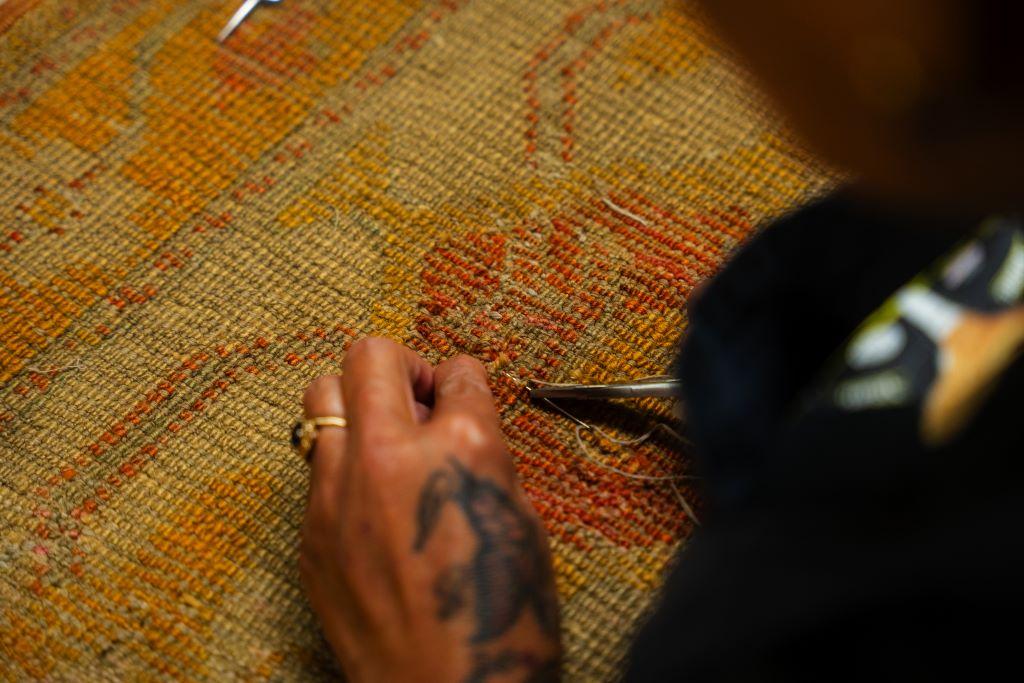
Detail of hands mending a rustic, richly colored woven rug.
Restoration should be conservative: gentle cleaning, careful color retouching, and minor reweaving where necessary. Over-restoration risks erasing historical integrity and diminishing value.
Where and When to Buy Moon Rugs
- Rug Fairs and Auctions: Provide access to authentic antiques and high-end pieces. — Why: These venues offer provenance documentation and professional appraisal.
- Reputable Galleries and Dealers: Best for sourcing museum-quality moon design carpets intended as long-term investments. — Why: They ensure authenticity and offer expert guidance.
- Online Auctions and Sales Platforms: Increasingly reliable for both vintage and contemporary rugs. — Why: Accessible and often competitively priced, with detailed listings.
- Seasonal Sales (end-of-season or clearance): The best time to buy moon design motif rugs at reduced prices. — Why: Retailers and manufacturers clear stock, providing significant discounts.
For more casual buyers, synthetic-fiber rugs are a smart option. Synthetic fiber is durable enough for kids’ moon-themed bedroom rugs, combining affordability with resilience. For collectors and enthusiasts, natural dyes remain recommended, since they offer the soft, subtle lunar tones that synthetic dyes often fail to replicate.
From affordable machine-made celestial rugs to rare vintage moon design rug treasures, today’s market offers opportunities for every budget. Whether buying as a collector, investor, or decorator, the key is to match authenticity and materials with intended use, ensuring that each lunar carpet—whether humble or museum-grade—retains its place in the cosmic tradition of textile art.
Care, Preservation, and Customization
Preserving Fading Moon Design Motifs
Restoration experts employ delicate, highly specialized techniques to conserve antique rugs where lunar designs have faded with time. The process begins with thorough assessment of the rug’s condition, identifying areas where natural dyes have lightened or fibers have weakened.
For a restoring moon design rug, conservators use gentle, pH-balanced cleaning methods to remove dirt without further stripping color. Where fading is significant, experts apply color touch-ups using natural or stable dyes that match the original tones of ivory, yellow, or indigo once used to depict moons.
In more advanced cases, reweaving with compatible wool or silk fibers reinforces weakened motifs while retaining structural integrity. Restoration experts preserve fading moons on antique rugs through gentle cleaning, precise color retouching, and careful reweaving, always prioritizing minimal intervention to protect authenticity.
Choosing Dyes and Fibers for Moon Rugs
The choice of dyes and fibers is central to both appearance and longevity. Natural dyes, derived from plants and minerals, create the soft, authentic glow of lunar imagery and age gracefully. Synthetic dyes, while more uniform and affordable, may lack the subtlety needed for celestial palettes but remain practical for everyday use.
For fibers, wool provides warmth and durability, making it ideal for functional rugs, while silk yields luminosity unmatched in textiles, turning the insured silk moon design rug into both a luxury décor item and a fragile investment. Blends of wool and silk often strike a balance, with silk reserved for moon design medallions and crescents to enhance contrast and sheen.
Custom & Commissioned Lunar Rugs
The growing market for bespoke design has made custom lunar carpets an attractive avenue for both collectors and homeowners. Commissioning a rug allows clients to personalize size, color, and motif—whether that means incorporating the phases of the moon, combining crescents with stars, or rendering photographic lunar surfaces. A
rtist-designed commissions add exclusivity and artistic pedigree, increasing not only the rug’s personal resonance but also its potential investment value. Commissioning a custom moon-phase rug can increase future resale value, particularly when the piece is tied to a recognized artist, produced in limited numbers, or represents a unique design innovation.
These bespoke rugs are often treated as functional artworks, gaining prestige over time. For valuable antiques and commissioned pieces alike, collectors should insure rugs at full replacement value, relying on professional appraisals to set accurate coverage. High-value celestial carpets—particularly silk examples—require protection against theft, fire, or accidental damage, ensuring that the investment is as well-preserved as the motif itself.
From fade repair celestial rugs to one-of-a-kind commissions, the world of moon design carpets emphasizes both preservation and creativity. With proper care, careful material selection, and thoughtful customization, the moon’s glow within textiles can endure for generations, retaining its symbolic power and financial value.
Browse a few of our favorite moon design rugs
FAQ
- How much should I budget for a quality wool moon rug?
Hand-tufted wool moon rugs in 8’x10′ often run \~\$300–\$900; hand-knotted versions cost far more. Prices vary by weave, origin, and fiber quality.
- What colors complement a moon rug without clashing?
Pair navy or charcoal moon rugs with soft ivory, muted gold, or dusty blush. Limit patterns elsewhere to keep the motif focal.
- Do round moon rugs work in reading nooks?
Yes—4’–6′ round moon rugs create a defined, cozy zone under a chair and lamp. Center the “moon” graphic inside the seating footprint.
- Are glow-in-the-dark moon rugs safe?
Many use non-toxic photoluminescent pigments (like strontium aluminate). Verify safety testing and avoid excessive heat or harsh cleaners.
- How thick should a moon rug be near doors?
Keep pile at 1/4″–1/2″ so doors clear. Test with cardboard shims before buying a thick moon rug.
- Could a star-and-crescent moon rug be misinterpreted culturally?
Possibly. If sensitivity matters, choose abstract lunar phases or single-crescent moon rugs without stars to keep meanings open-ended.
- Are antique moon motif rugs common?
True antique moon rugs are rare; crescents and stars appear more in some historic textiles than carpets. Expect modern reinterpretations rather than frequent antiques.
- Which interior styles pair best with moon rugs?
Moon rugs suit Art Deco, celestial-boho, and minimalist spaces. A simple crescent medallion reads modern; star-and-crescent borders nod to historic textiles.
- Do outdoor moon rugs exist for patios or balconies?
Yes—look for polypropylene or PET flatweave moon rugs. Hose off, then dry completely on both sides to prevent mildew.
- How should I clean a viscose moon rug safely?
Avoid water; moisture can stiffen or discolor viscose. Use dry compound cleaners or hire a rug professional for solvent-based methods.
- How do I spot-clean a wool moon rug after a spill?
Blot immediately; use cool water and a drop of mild soap after testing for colorfastness. Avoid harsh scrubbing—dab, then dry thoroughly.
- Do wool moon rugs shed, and how do I vacuum them?
New wool moon rugs may shed for 1–3 months. Vacuum with suction-only (no beater bar) and go with the pile direction.
- Are moon rugs safe over radiant floor heating?
Generally yes—use low-pile wool or flatweave moon rugs and avoid thick shags that trap heat. Confirm your system’s max floor temperature.
- Can robot vacuums handle a moon rug?
Most robots work best with low-pile or flatweave moon rugs. Hide fringe under the rug and disable “edge lift” if it snags.
- Are moon motif runner rugs practical for hallways?
Yes—choose 2’6″x8′ or 3’x10′ moon runners with low pile for door clearance. Add a non-slip pad to prevent bunching.
- Will a dark blue moon rug fade in sunlight?
UV exposure can fade dark dyes. Rotate the moon rug every 3 months and use window film or sheers to reduce direct sun.
- What rug pad should I use under a moon rug on hardwood?
A felt-plus-natural-rubber pad balances cushioning and non-slip. Aim for about 1/4″ thickness and trim the pad 1–2 inches smaller than the rug.
- Are washable moon rugs worth it for homes with pets?
Yes—machine-washable moon rugs simplify cleanup. Wash cold with mild detergent and air-dry; avoid overloading large sizes.
- Do viscose or “silk-look” moon rugs hold up in busy rooms?
Not well—viscose fibers are moisture-sensitive and can mat or discolor. Reserve viscose moon rugs for low-traffic spaces.
- Which material is better for a moon rug—wool or synthetic?
Wool moon rugs are durable, naturally stain-resistant, and age well; synthetics are budget-friendly and often washable. Match material to traffic and cleaning needs.
- What size moon area rug fits best under a queen bed?
An 8’x10′ moon rug usually leaves 18–24 inches showing on three sides. For smaller rooms, try 6’x9′ pulled forward from the nightstands.
- Are moon rugs good for nurseries and kids’ rooms?
Yes—calming shapes and nighttime colors work well. Choose low-pile, OEKO-TEX–certified moon rugs and a felt-and-rubber pad for grip.
- How do I style a moon rug in a modern living room without it feeling childish?
Pick a moon rug in muted tones—navy, charcoal, ivory—with minimal linework. Anchor it with solid upholstery and one metallic accent, like a brass lamp.
- Are moon-and-stars rugs considered religious, and is a moon rug appropriate in any home?
Moon-and-star imagery can carry cultural or religious associations, but décor use is generally neutral. If guests may perceive symbolism strongly, choose abstract lunar rugs or simpler crescents.
- What does the crescent moon motif on a moon rug typically symbolize?
It often represents guidance, renewal, and cycles of time; in many traditions, crescent-and-star motifs signal protection or new beginnings. Meanings vary by culture and context.