
Introduction to Isfahan Rugs
Explore our exquisite collection of hand-knotted Isfahan rugs available for purchase today.
Defining Isfahan Features and Reputation
Among the great schools of Persian weaving, Isfahan rugs stand apart as emblems of artistic mastery and cultural refinement. Their global reputation rests not only on technical precision but also on the city’s enduring place in Iran’s artistic imagination. Collectors and scholars alike point to their fine knot density, meticulous detailing, and balanced use of color as hallmarks of Persian rug artistry.
Designs often incorporate medallions, floral arabesques, and garden-inspired layouts, executed with extraordinary symmetry. These are not everyday floor coverings but woven artworks meant to embody refinement, prestige, and the Persian aesthetic ideal. What sets Isfahan rugs apart on the world stage is the combination of delicacy and durability. Weavers typically work with silk or high-grade wool, sometimes silk foundations, producing a texture that feels luxurious yet precise.
The knot counts can exceed those of many other Persian rug centers, giving the weaver a broader canvas for elaborate detail. As a result, scenes from poetry, intricate palmettes, and scrolling vine motifs appear with jewel-like clarity. This attention to both form and meaning elevated Isfahan’s workshops to an unrivaled position in the international market. Owning such a piece has long symbolized cultural sophistication and worldly taste, reinforcing the Isfahan rug reputation as among the finest in existence.
The prestige also comes from lineage. During the Safavid dynasty, when court patronage was at its peak, Isfahan became a hub for weaving masterworks destined for palaces and diplomatic gifts. That legacy still shapes how these rugs are viewed today: not only as textiles but as cultural ambassadors.
To many connoisseurs, an Isfahan rug embodies the pinnacle of Persian weaving, fusing centuries of tradition with living craftsmanship that continues to this day.
What Isfahan Is Famous For in Iran
Within Iran itself, the city of Isfahan holds a unique place in the national consciousness. It is known as a showcase of Persian civilization, from architecture to fine arts, and its fame goes far beyond rug weaving. The saying “Isfahan nesf-e jahan”—meaning “Isfahan is half the world”—captures the sense that the city contains, within its beauty and artistry, the essence of half the world’s splendor. Locals and visitors alike point to this phrase as evidence of the city’s central role in Iranian identity. The city’s architectural achievements reinforce this reputation.
At the heart of the city lies Naqsh-e Jahan Square, a UNESCO World Heritage site flanked by monumental mosques, a palace, and the bustling Grand Bazaar. These landmarks, with their blue-tiled domes and refined geometry, embody the same qualities of harmony and elegance that define the city’s rugs. Just as its mosques and palaces are celebrated for their design, so too are its carpets admired as extensions of this aesthetic vision.
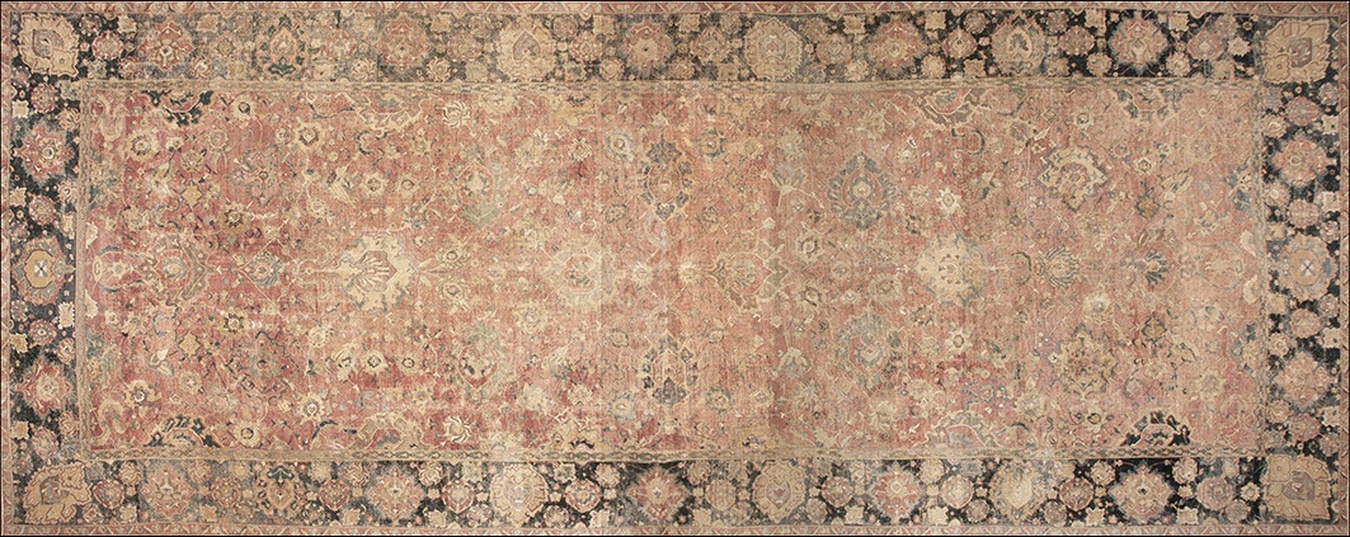
Antique Oversized Isfahan Persian Knotted Rug – by Rugs On Net
Thus, when one asks what Isfahan is famous for in Iran, the answer spans both stone and thread. The city is celebrated for its architectural marvels, its role as a cultural and artistic capital, and its production of some of the world’s most highly regarded Persian carpets.
Together, these elements explain why Isfahan continues to symbolize refinement and why its woven masterpieces remain treasures in both Iranian homes and global collections.
Geography & Cultural Foundations
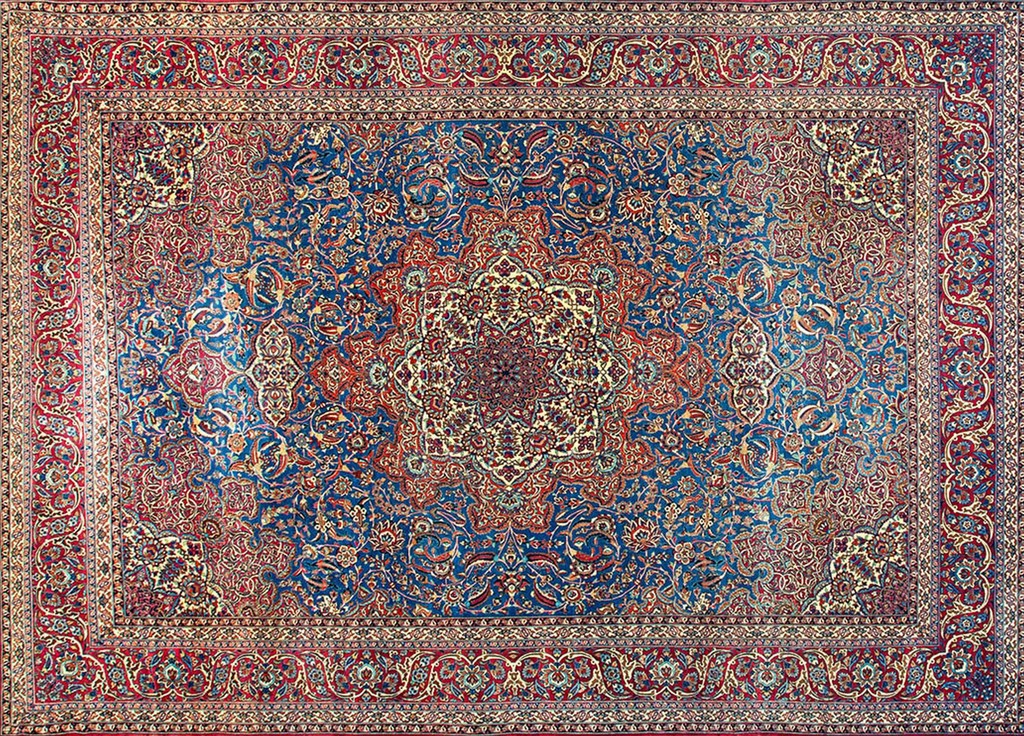
Antique Isfahan Persian Allover Geometric Knotted Rug by Rugs On Net
Isfahan’s Location and Importance
Situated in the heart of the Iranian plateau, Isfahan’s location has always shaped its destiny. The city lies in central Iran, positioned along vital east–west and north–south trade routes that historically linked the Persian Gulf, the Caspian Sea, and the Silk Road. This centrality made it a natural crossroads of commerce and culture, drawing merchants, artists, and scholars from across Asia and beyond. Its fertile plain, nourished by the Zayandeh River, further supported settlement and prosperity, allowing the city to flourish both economically and artistically.
The turning point came in the late 16th century when Shah Abbas I elevated Isfahan to the rank of Safavid capital. This decision concentrated political power, wealth, and cultural resources in the city. Royal workshops were established, artisans were invited from across the empire, and patronage transformed the city into a showcase of Persian civilization.
Its carpets, commissioned for palaces and diplomatic gifts, quickly gained prestige. Thus, the city’s geographic advantages combined with royal authority to cement its role as a global hub of artistic production.
Rise of Isfahan as a Rug Center
The Safavid dynasty’s patronage explains why Isfahan became a Safavid-era rug center. Shah Abbas envisioned the city not just as a capital but as a beacon of Persian culture. By relocating the capital from Qazvin to Isfahan, he ensured it was better protected and closer to trade arteries. This stability allowed craft industries to thrive, especially weaving, which benefited from both state sponsorship and international demand.
Royal carpet ateliers, supported by the court, produced some of the most intricate masterpieces of the era, often destined for foreign courts or grand mosques. The meticulous knotting, silk foundations, and elaborate medallion designs pioneered in this period established a standard that defined these carpets for centuries.
The Safavid model also encouraged guild organization, where artisans worked collectively under master designers, ensuring consistency and excellence. This system elevated the art form beyond mere craft, positioning Isfahan rugs as cultural icons inseparable from Persian identity.
Key Landmarks & Artistic Inspiration
The architectural wonders of Isfahan served as both backdrop and blueprint for its weaving traditions. At the center lies Naqsh-e Jahan Square, one of the largest public squares in the world, encircled by monumental buildings that directly inspired rug designs. The Sheikh Lotfollah Mosque, with its radiant dome and arabesque tilework, is echoed in the stylized floral and geometric patterns of Isfahan mosque rugs.
Similarly, the grand Shah Mosque (Imam Mosque) provided design motifs—its turquoise domes, pointed arches, and intricate mosaics became woven into medallion-and-corner layouts and arabesque borders. Even the symmetry of palace gardens, designed to represent paradise, translated into carpet fields filled with trees of life, flowers, and flowing water channels. These landmarks were not simply admired—they became templates, embodying a unity of architecture and textile art.
For weavers, transposing the grandeur of Isfahan’s mosques and palaces into silk and wool ensured that each rug reflected the city’s soul. Thus, the city’s central geography, its status as Safavid capital, and the artistic brilliance of its landmarks together explain how the city became both a historic center of Persian rug artistry and a living archive of Iran’s cultural heritage.
History of Isfahan Rug Weaving
Safavid Golden Age & Shah Abbas’ Influence
The rug history of these iconic pieces is inseparable from the reign of Shah Abbas I, the Safavid monarch who transformed the city into the artistic capital of Persia. Recognizing the power of textiles as both symbols of prestige and instruments of diplomacy, Shah Abbas relocated master weavers from across the empire to Isfahan. He established royal workshops, where artisans worked under court supervision to produce some of the most refined Safavid rugs ever woven.
These carpets were not utilitarian goods but woven masterpieces designed for palaces, mosques, and diplomatic exchange. Many featured silk foundations, extraordinarily high knot counts, and elaborate medallion or garden designs that mirrored the architecture of the city itself.
Known today as Shah Abbas carpets, these creations defined a new standard of Persian rug artistry, one that combined meticulous craftsmanship with symbolic depth. It was in this period that Isfahan rugs gained their first wave of international acclaim, prized in Europe, India, and the Ottoman world as diplomatic treasures and luxury imports.
Decline, Revival, and Modern Era
The brilliance of the Safavid Golden Age was abruptly halted in 1722 when Afghan forces invaded Isfahan, bringing both political collapse and the disbandment of the royal workshops. For nearly two centuries, rug weaving in Isfahan entered a period of decline, surviving only in limited local production without the grandeur of Safavid patronage.
The loss of stability and court sponsorship meant that designs and weaving excellence largely dispersed to other regions. A revival emerged in the early 20th century, spearheaded by dedicated workshops that sought to reclaim the city’s reputation. Foremost among them was the Seirafian workshop, founded in the 1930s, which became synonymous with precision, innovation, and fidelity to classical Safavid aesthetics.
The Seirafian family, alongside other ateliers, reintroduced silk foundations, fine knotting, and designs inspired by Isfahan’s mosques and gardens. This revival restored the city’s status as a leading rug center, bridging the gap between historical grandeur and modern artistry.
In the contemporary era, Isfahan carpets remain among the most sought-after Persian rugs, balancing tradition with evolving market tastes. Workshops continue to produce pieces of extraordinary detail, though the scale and viability of production often fluctuate with broader economic and political conditions.
International Acclaim & Economic Shifts
From the Safavid courts onward, Isfahan rugs have carried a reputation for excellence abroad. Their role as diplomatic gifts under Shah Abbas ensured early recognition in Europe, where collectors marveled at their jewel-like intricacy. By the 19th and 20th centuries, Western demand further elevated their prestige, with museums and collectors classifying them among the finest examples of textile art in the world.
However, the city’s rug industry has always been tied to broader economic shifts. Periods of international sanctions, changing consumer tastes, and fluctuations in export demand have directly influenced workshop viability. While global appreciation remains strong, production often contracts or expands depending on access to foreign markets and the purchasing power of international buyers.
Despite these challenges, the enduring reputation of Isfahan rugs ensures that their artistry continues to command high value in both domestic and global contexts. The story of Isfahan weaving, therefore, is one of brilliance, disruption, and rebirth: from Shah Abbas’s royal ateliers to the Seirafian workshop revival, the tradition stands as a testament to resilience and the timeless appeal of Persian craftsmanship.
Design & Artistic Characteristics
Classic Medallion-and-Vine Layout
The hallmark of an Isfahan medallion rug is the lachak-toranj or “medallion-and-corner” composition. At its center rests a large, often circular or oval medallion, carefully balanced by quarter medallions (lachaks) in each corner of the field. Flowing out from these anchors is a system of scrolling vines, floral sprays, and arabesques that cover the field in precise symmetry.
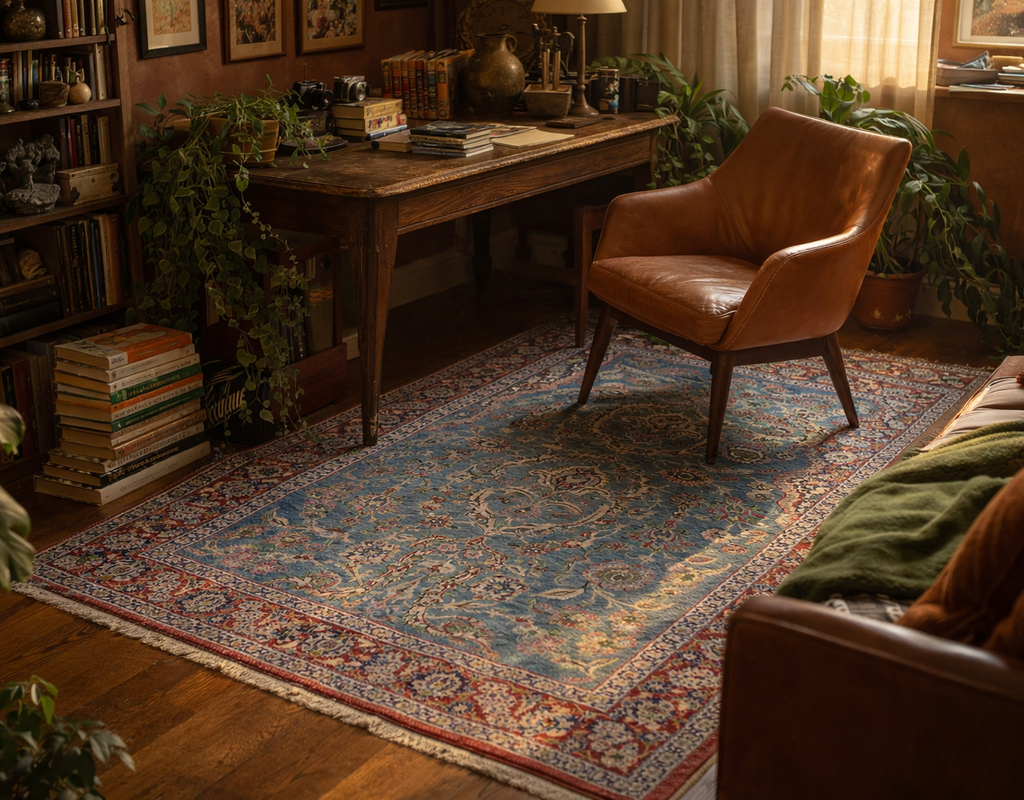
A richly patterned oriental rug grounds the inviting, literature-filled study space.
This “medallion-and-vine” layout is considered the signature of Isfahan weaving, an arrangement that conveys balance, harmony, and continuity. Its origins lie in Safavid court carpets, but the structure has been refined over centuries into a format instantly recognizable to collectors today.
Motifs: Arabesques, Floral, and Naqsh-e Jahan Elements
Isfahan rugs are distinguished by their curvilinear detail and delicate ornamentation. The arabesque motif—an infinite, scrolling vine that interlaces with itself—is central to their design vocabulary.
This is complemented by palmettes, intricate floral scrolls, and especially the Shah Abbasi flower, a stylized palmette form named after Shah Abbas I. These motifs reflect both Persian garden symbolism and the ornamental programs of Safavid architecture. A defining feature is the incorporation of Naqsh-e Jahan motifs.
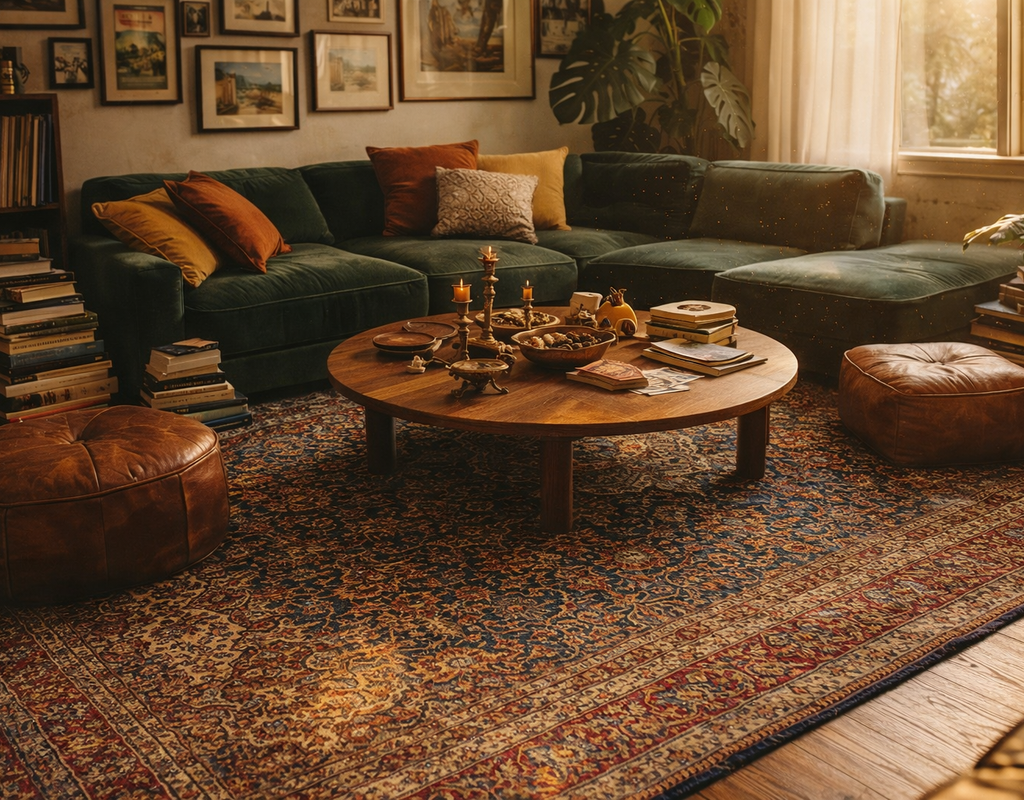
An atmospheric reading nook combining jewel tones, rich textiles, and vintage decor for a supremely cozy aesthetic.
Antique Isfahan Small Scatter Size Wool Ivory Rug – by Rugs On Net
Just as the grand square in Isfahan is framed by monumental arches, domes, and tiled panels, rug designers mirrored these elements in carpet fields. Medallions echo the geometry of the square itself, while border cartouches resemble the architectural niches that frame its monumental mosques and palaces.
Thus, the visual language of Isfahan’s urban landscape became encoded in its rugs, giving them a direct link to the city’s cultural identity.
Landmark Inspirations: Sheikh Lotfollah Dome
Among all the landmarks of Isfahan, none has influenced rug design more than the Sheikh Lotfollah Mosque. Its luminous dome, covered in arabesques and radiating star-like symmetry, provided direct inspiration for rug medallions.
Weavers translated the dome’s pattern of nested arabesques and lotus motifs into woven form, creating carpets where the central medallion mirrors the architectural ceiling. This explains why Sheikh Lotfollah’s dome is mirrored in carpet layouts: it embodies both divine symbolism and artistic mastery, making rugs portable reflections of mosque grandeur.
Color Palettes: Historical & Modern
Historically, Isfahan rugs employed rich, saturated palettes. Ivory served as a luminous backdrop, complemented by deep blue, crimson red, rose pink, and occasional emerald green. This contrast highlighted the precision of motifs and mirrored the vibrancy of Safavid tilework. In the modern market, however, color use has evolved.
Many contemporary pieces now employ softer, pastel tones—powder blue, beige, and pale rose—to suit interior design preferences abroad. The transition reflects both market demand and the adaptability of Isfahan workshops, while still maintaining ties to the traditional schemes of classic Persian rug artistry.
Differences: Isfahan vs. Kashan, Tabriz, and Nain Rugs
Despite sharing a Persian heritage, Isfahan rugs display distinct characteristics when compared to other weaving centers:
- Isfahan vs. Kashan: Isfahan rugs are finer, more formal, and often employ silk warps for sheen. Kashan pieces, while elegant, tend toward bolder layouts and heavier use of red and blue fields. — Why: Isfahan weaving was rooted in Safavid royal ateliers, giving it a courtly precision absent in many Kashan village looms.
- Isfahan vs. Tabriz: Tabriz carpets are renowned for variety and innovation, but their knot counts are generally lower. Persian knot density in Isfahan often exceeds 400 kpsi, whereas Tabriz pieces average closer to 200–300. — Why: Silk warps and the atelier system allowed Isfahan to push technical fineness further.
- Isfahan vs. Nain: Both are central Iranian schools, and outsiders sometimes confuse them. Yet Nain rugs usually feature fewer colors and a cooler palette of ivory and blue. Isfahan pieces, by contrast, employ greater color variety and curvilinear refinement. — Why: Nain developed later, partially inspired by Isfahan’s traditions but with a different aesthetic identity.
Silk Foundations and Knot Density
A technical hallmark of Isfahan weaving is the frequent use of silk warps, creating a foundation that allows tighter knotting and a luminous sheen across the surface. This refinement enabled weavers to achieve Persian knot densities exceeding 400 knots per square inch, far surpassing many rival centers.
Such density gives artists the precision to depict scrolling arabesques, tiny blossoms, and mosque-inspired geometries with jewel-like clarity.
To answer directly: yes, silk warps can be found in these fine Persian carpets, and they remain one of the features that distinguish these rugs from those of neighboring cities. Combined with intricate curvilinear designs and high knot counts, they place Isfahan rugs among the most technically accomplished textiles in the Persian tradition.
Materials, Construction & Weaving Techniques
Wool, Silk, and Cotton in Isfahan Rugs
- Kork wool: Isfahan weavers often select fine lamb’s wool, known as kork, prized for its softness and sheen. — Why: This material allows for smooth, tightly packed knots that highlight intricate details.
- Silk highlights: While wool forms the pile, silk is frequently used to accent motifs and add luminosity. — Why: Silk reflects light, giving arabesques, medallions, and Shah Abbasi flowers a jewel-like brilliance.
- Cotton or silk warps: Foundations are typically cotton, but many high-grade pieces employ silk warps. — Why: A silk warp carpet signals luxury, enabling tighter knotting, greater sheen, and overall refinement.
Persian Knotting & High Knot Density
The technical mastery of Isfahan weaving rests on the Persian knot (asymmetric knot). Unlike the symmetrical Turkish knot, the Persian knot allows for greater flexibility and precision in curvilinear patterns. Knot density is typically very high, often exceeding 400 knots per square inch.
This density provides the structural basis for Isfahan’s hallmark detail—slender vines, arabesques, and mosque-inspired domes can all be rendered with clarity that would be impossible on coarser carpets. After knotting, the pile is hand-sheared to a low, even height.
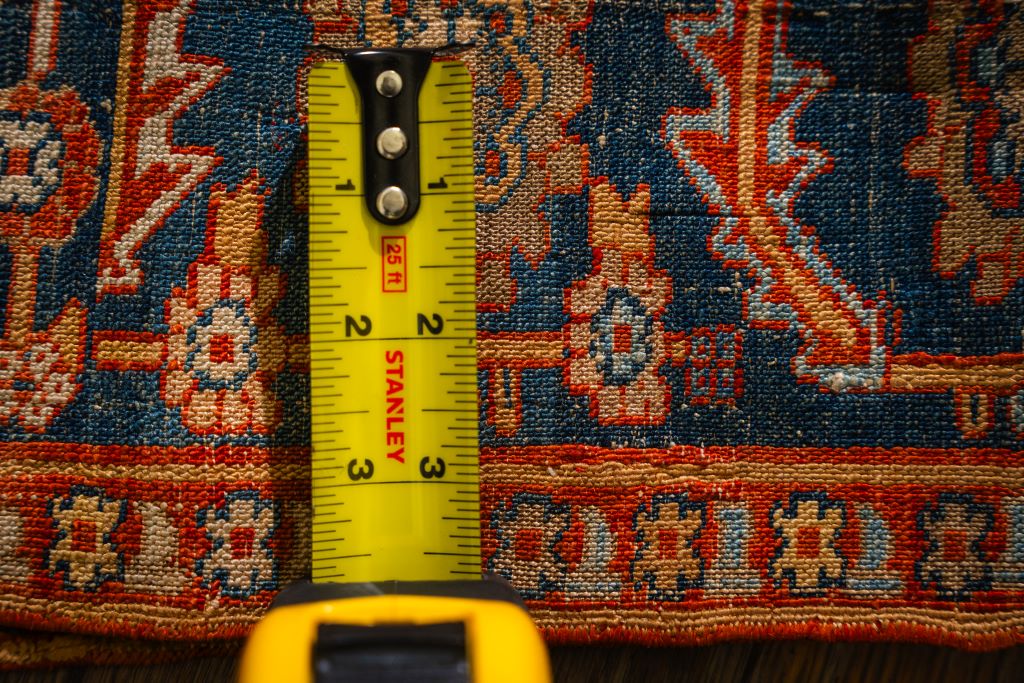
A detailed inspection of a richly colored oriental rug pattern while measuring its dimensions.
This shearing process sharpens the motifs, preventing the designs from blurring into one another and ensuring that every arabesque scroll or lotus blossom is crisp and legible. Together, the combination of fine materials, Persian knotting, and careful finishing explains why Isfahan rug materials and construction are regarded among the finest in the world.
Workshop vs. Village Production
Isfahan rug making is predominantly associated with urban workshops, where production is carefully planned and executed by trained master weavers. These city workshop rugs are characterized by their symmetry, precise drawing, and uniformity of knotting. Many are designed by skilled artists who draft cartoons (design templates) before weaving begins.
By contrast, rural or village production around Isfahan typically lacks the same technical finesse. These pieces may have looser knotting, less intricate designs, and greater variation in quality. While village rugs can still be beautiful, they do not carry the same prestige as workshop carpets. The distinction reflects the cultural role of Isfahan itself: a city long associated with refinement, planning, and excellence in design.
Signature Practices & Quality Indicators
- Signed rugs: Many Isfahan carpets bear the rug signature of the master weaver or workshop, often woven discreetly into the border. — Why: A signature authenticates the piece, connecting it to a known atelier and increasing its value.
- Silk warp and fine knot count: These remain the clearest indicators of a luxury-level Isfahan carpet. — Why: They distinguish top-tier pieces from ordinary production.
- Balanced design and even shearing: A rug where every arabesque, medallion, and motif appears sharp and proportional is a hallmark of skilled weaving. — Why: Consistency demonstrates both planning and execution at the highest level.
To address the common questions directly: silk warps can indeed be found in the carpets, and they are a key marker of their prestige. While Nain and Isfahan rugs are woven similarly—both employ Persian knots and sometimes silk foundations—Isfahan pieces generally achieve higher knot densities and greater color variety, setting them apart as more technically ambitious.
Regional Variations within Isfahan Province
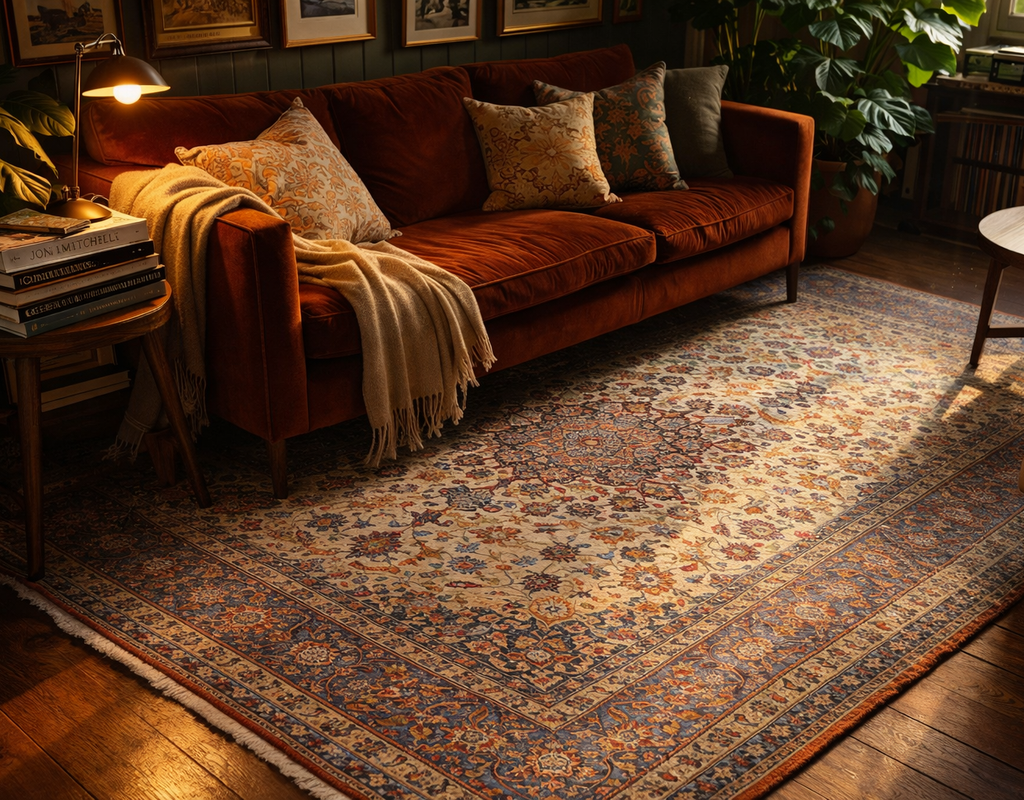
The warm, intricate design of the area rug complements the deep tones of the velvet sofa for a rich, inviting atmosphere.
Nain, Najafabad, Josheghan, and Rural Styles
Though Isfahan rugs are most closely associated with the city itself, the wider Isfahan province rug towns each developed distinctive weaving traditions.
- Nain rugs are perhaps the best known outside the city of Isfahan. They are woven with a trademark ivory-and-blue palette, often with greater use of silk pile accents than Isfahan city rugs. Fine Nain carpets can rival Isfahan in knot density and elegance, though their cooler tones create a different aesthetic mood.
- Josheghan rugs stand apart for their geometric, all-over lattice pattern. Unlike the curvilinear medallion-and-vine of Isfahan city carpets, Josheghan designs are more angular, rustic, and rooted in village tradition.
- Najafabad carpets emulate Isfahan designs but with lower knot counts and a more rustic feel. While they can display central medallions and floral scrolls, the execution is less formal and intricate compared to signed city workshop pieces.
- Rural Isfahan province weavings vary widely in quality but tend toward coarser knotting, bolder colors, and less symmetry. These pieces remain important cultural products but are valued differently in the collector’s market.
This spectrum shows a clear distinction between city workshop rugs, with their refined silk warps and signatures, and village styles, which emphasize durability and tradition over courtly finesse.
Price Differences Among Workshop Towns
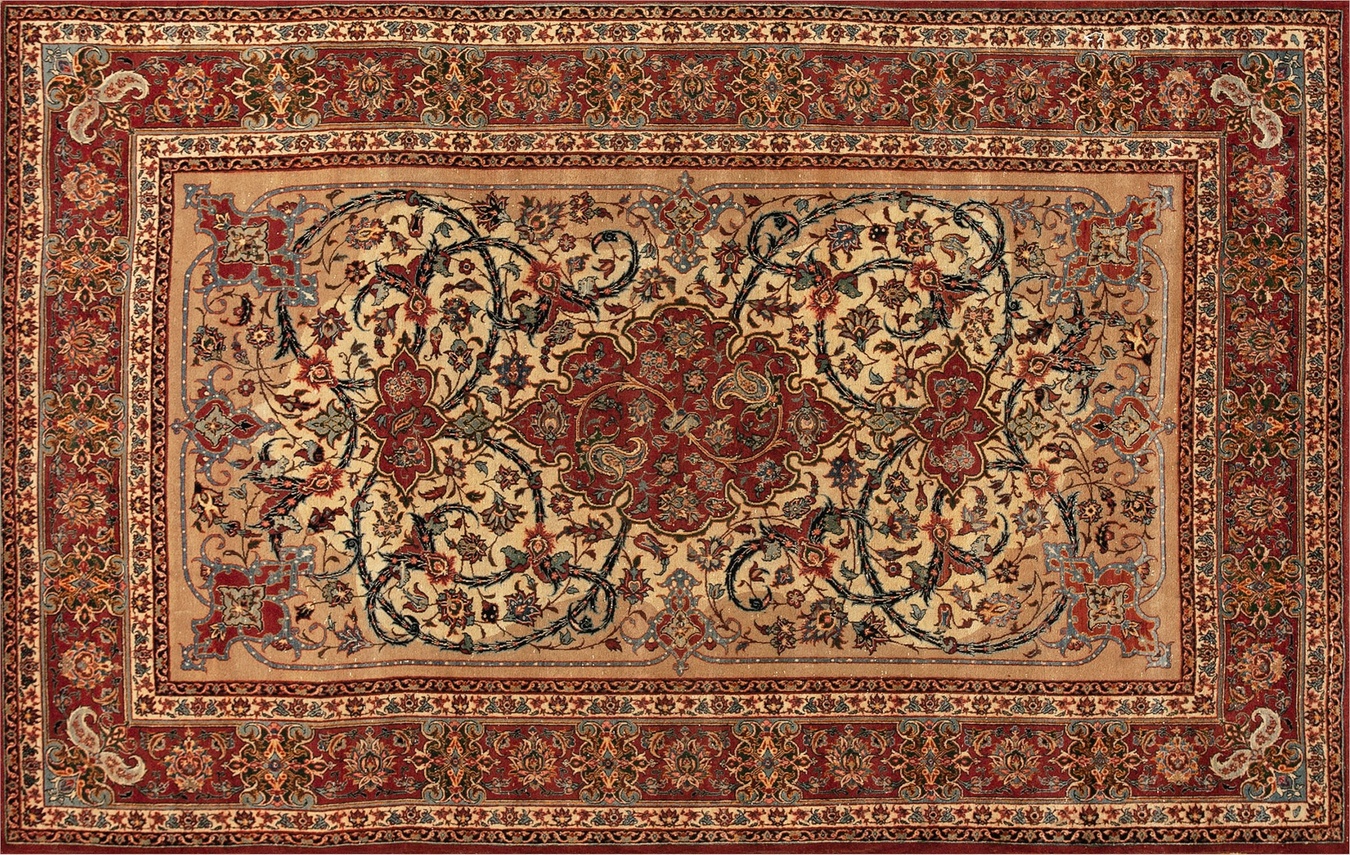
Antique Isfahan Persian Floral, Medallion Knotted Rug – by Rugs On Net
The differences in style and technique are reflected in the Persian rug price comparison:
- Isfahan city rugs—especially those bearing master signatures—command the highest values. Their high knot density, silk foundations, and link to Safavid court traditions make them the benchmark of quality.
- Top-quality Nain rugs rank just below Isfahan. While highly refined, their market value is slightly lower due to their narrower palette and somewhat less formal design vocabulary.
- Najafabad and Josheghan rugs are more affordable. They are valued for authenticity and durability but lack the technical ambition of city pieces. Their rustic character appeals to certain buyers, though they are not positioned at the same prestige level as Isfahan or Nain.
Thus, price variations are directly tied to origin: city versus village, silk versus wool foundation, and the presence or absence of a workshop signature.
Should Collectors Prefer Nain, Isfahan, or Najafabad?
The answer depends on a collector’s priorities. Those seeking the finest refinement, curvilinear elegance, and luxury materials will naturally gravitate toward Isfahan city rugs, particularly signed workshop pieces. Collectors who prefer cooler, subtler tones may opt for Nain rugs, which provide comparable fineness with a different aesthetic mood. By contrast, those looking for more rustic, affordable, and geometric designs might choose Najafabad or Josheghan rugs.
In short, which Isfahan province towns excel in fine rug weaving? Isfahan and Nain remain the leaders in technical sophistication, while Najafabad and Josheghan offer accessible alternatives with distinctive regional identities. The best choice ultimately lies in a collector’s taste for color, fineness, and provenance—whether one values the prestige of a silk-warp carpet, the cool elegance of a Nain rug, or the bold tradition of a Josheghan rug.
Modern Industry & Global Market
Scale of Today’s Isfahan Rug Industry
The Isfahan rug industry today operates on a boutique scale. Unlike the vast output of some other Persian weaving centers, modern workshops in the city prioritize artistry and refinement over sheer volume. Production is limited, with many pieces woven on commission or in small batches, ensuring each rug maintains the precision and elegance for which the city is renowned.
This artisanal focus keeps these carpets in the luxury category of the global market, where collectors value exclusivity as much as craftsmanship. In direct answer: How large is the traditional Isfahan rug industry today? It is smaller than in its Safavid or mid-20th-century peak, but remains deeply respected, thriving through quality-driven production rather than mass weaving.
Famous Weaving Families & Notable Master Weavers
The reputation of Isfahan carpets continues thanks to celebrated weaving dynasties and ateliers. Foremost among them is the Seirafian family, whose name has become synonymous with high knot density, silk warps, and designs inspired by Safavid models. Other distinguished workshops include those of Davari, Enteshari, and Hagigi, each of which upholds the city’s legacy while maintaining individual stylistic signatures.
Many rugs are signed, not only as marks of pride but also as guarantees of authenticity and artistic lineage. In answer to the question: Who are notable Isfahan master weavers? Families such as the Seirafians, along with masters like Davari and Hagigi, represent the pinnacle of Isfahan craftsmanship.
Tourist Experience: Live Weaving in the Bazaar
For visitors, the tradition of weaving is not confined to museums or private collections—it is a living heritage visible in the city’s commercial heart. In the Isfahan bazaar, particularly around Naqsh-e Jahan Square, tourists can watch artisans at their looms, knotting intricate designs in real time.
These demonstrations reveal the patience and skill required to produce an Isfahan rug, transforming the bazaar into both a marketplace and an educational space. Directly answering: Where can tourists see live weaving in Isfahan bazaar? Many central workshops surrounding Naqsh-e Jahan Square offer weaving demonstrations, blending commerce with cultural preservation.
Export, Value, and Designer Appeal
- Export market: Isfahan carpets remain highly sought after abroad, especially in Europe, North America, and East Asia. — Why: Their reputation for precision, silk warp luxury, and artistry assures them a place in the high-end global market.
- Value retention: Signed workshop rugs from master families often appreciate in value. — Why: Limited production and enduring reputation make them reliable collector investments.
- Designer demand: Interior designers and collectors commission Isfahan carpets for their blend of function and art. — Why: The medallion-and-vine elegance and luminous silk details integrate easily into both traditional and contemporary interiors.
Contemporary Innovation & Artistic Collaborations
While rooted in tradition, Isfahan weaving also adapts to the modern era. Some workshops experiment with softer palettes and minimalist interpretations of medallion layouts to align with global interior design trends. Collaborations between Isfahan master weavers and contemporary artists have also emerged, producing rugs that reinterpret classical motifs for modern spaces.
This spirit of innovation keeps the tradition dynamic, ensuring that Isfahan rugs remain not relics of the past but living works of art celebrated worldwide. In short, the Isfahan rug industry today is boutique, artisanal, and globally prestigious, carried forward by famous families like the Seirafians and sustained as both cultural heritage and modern luxury.
Symbolism, Culture & Legacy
Symbolic Motifs and Persian Paradises
- Garden of Paradise: Many Isfahan rugs embody the Persian ideal of paradise as a walled garden with flowing water and blooming flora. — Why: The rug becomes a microcosm of eternal harmony, a “Persian paradise carpet” underfoot.
- Unity and Infinity: Arabesque scrolls and repeating floral forms symbolize cosmic order and divine unity. — Why: The endless vine reflects immortality, reminding the viewer of life’s continuity beyond the material.
- Medallions as Cosmos: Central medallions echo domes, representing the heavens. — Why: They place the household at the center of a symbolic universe, reinforcing spiritual protection.
This layering of these beautiful area rugs symbolism shows how weaving transcends ornament, carrying messages of spirituality, balance, and cultural identity.
Rugs in Social Life, Dowry, and Heirlooms
In Iranian tradition, rugs are woven not just as art objects but as vessels of social meaning. An Isfahan rug in Iranian culture has long served as a measure of refinement, wealth, and family pride. High-quality carpets are essential elements of a bride’s dowry, signaling both the family’s taste and their commitment to household prosperity.
Passed from generation to generation, these pieces become heirlooms, linking families to their past while marking milestones in domestic life. Rugs also play a role in hospitality: offering guests a place on a fine carpet reflects generosity and cultural esteem. In this way, an Isfahan rug is both an artwork and a living participant in the rhythms of Iranian home life.
Carpets as Cultural Ambassadors
Beyond private spaces, Isfahan carpets act as emissaries of Persian culture. Since the Safavid era, they have been gifted to foreign courts as symbols of sophistication. Today, they appear in museums such as the Victoria & Albert Museum in London, the Metropolitan Museum of Art in New York, and the Carpet Museum of Iran, where they are celebrated as woven masterworks.
UNESCO has recognized the Persian carpet as Intangible Cultural Heritage, underscoring its role as a shared cultural achievement. Thus, each rug serves as more than an object of trade: it is a UNESCO Persian carpet legacy, bridging Iran’s heritage with global appreciation and ensuring that the art form retains its ambassadorial status in the modern world.
Storytelling, Folklore, and Modern Influence
Isfahan rugs are also vehicles of narrative and poetry. Some carry poetic inscriptions, lines from Hafez or Rumi, woven discreetly into borders as blessings or reflections of love and spirituality. Narrative motifs—hunters, gardens, or mythic animals—turn carpets into woven stories, blurring the line between text and textile. Folklore and local legend are embedded in these designs, giving each piece a voice that transcends time.
In modern culture, the influence of Isfahan carpets extends to literature, film, and even contemporary art installations. Designers and poets alike continue to use the carpet as a metaphor for storytelling, weaving, and interconnectedness. This integration demonstrates the Isfahan art legacy: a living dialogue between past and present, tradition and innovation.
Together, these elements show that Isfahan rugs fuse symbolism, art, and living tradition. They are at once spiritual metaphors, social heirlooms, cultural ambassadors, and storytellers—woven embodiments of Iranian identity whose resonance continues across centuries and continents.
Explore a Few of Our Favorite Isfahan Rugs
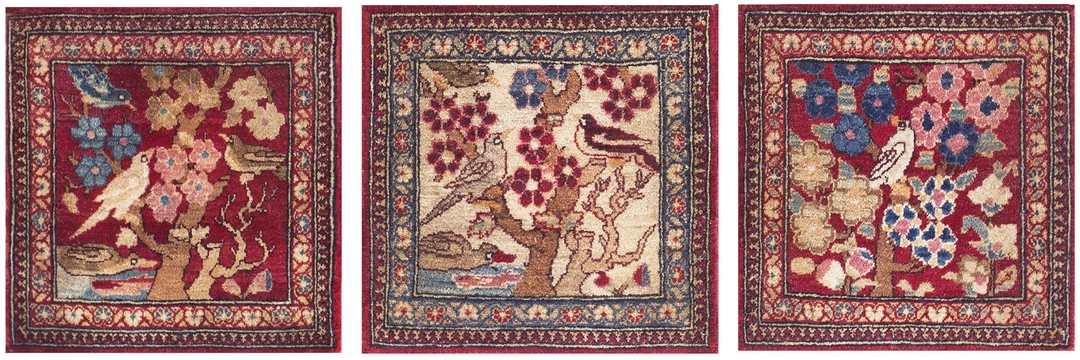
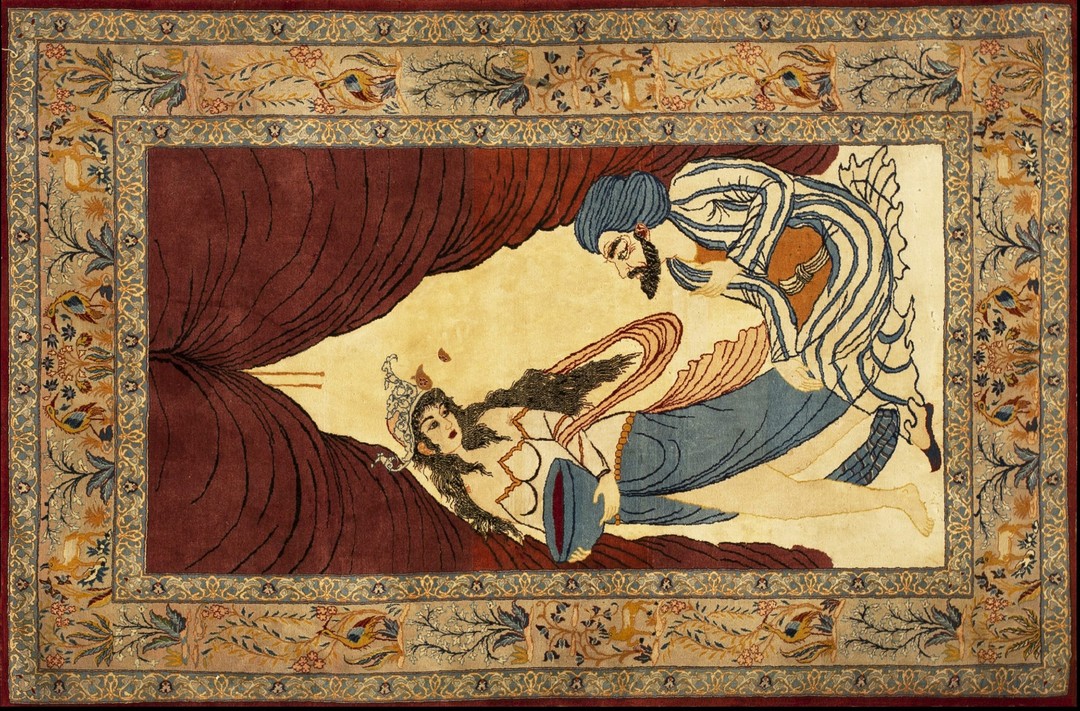
FAQ
- What’s the difference between antique and modern Isfahan rugs?
Antique Isfahan rugs often show richer natural dyes and cotton foundations; modern pieces may use paler palettes, refined kork wool, and silk foundations. Both retain the hallmark precision and medallion-floral style.
- How should I store an Isfahan rug long-term?
Roll (don’t fold) pile-in with acid-free paper, wrap in breathable cotton or Tyvek, and elevate off floors. Inspect every 6–12 months for pests or moisture.
- Are Isfahan rugs a good investment?
Quality Isfahan rugs—especially signed, early, or silk pieces—tend to hold value. Keep receipts, appraisals, and clear provenance to support future resale.
- What’s the history of Isfahan rugs?
Isfahan rugs flourished under Safavid Shah Abbas (16th–17th century), declined after 1722, then revived in the early 20th century with renowned workshops like Seirafian.
- How do I authenticate an Isfahan rug versus copies?
Check for high KPSI, asymmetrical knots, fine kork wool, and balanced curvilinear drawing. Workshop signatures and silk foundations are strong indicators; verify country-of-origin labels.
- Can Isfahan rugs be used with radiant floor heating?
Wool Isfahan rugs tolerate moderate radiant heat; keep surface temperatures below about 85°F. Use a breathable pad and monitor humidity.
- Should I use a rug pad under an Isfahan rug?
Yes—use a thin felt or felt-rubber pad (\~1/8–1/4 inch) to prevent slipping, cushion footfall, and extend the rug’s life. Avoid overly spongy pads.
- Do Isfahan rugs bleed color when wet?
Some reds and indigos in Isfahan rugs may bleed. Always test colorfastness with a damp white cloth before any cleaning and consult a specialist for silk.
- How should I vacuum and clean Isfahan rugs?
Use suction-only vacuuming (no beater bar) and blot spills promptly with white cloth. Schedule professional hand washing every 2–5 years, depending on use.
- Are Isfahan rugs practical with pets or kids?
Choose wool-pile Isfahan rugs on cotton foundations and busy patterns to disguise wear. Avoid full-silk Isfahan rugs in active homes.
- Are Isfahan rugs good under dining tables?
Yes—short, dense piles handle chairs well. Size so chairs stay on the rug when pulled out (typically add 24 inches beyond the table on all sides).
- Are Isfahan rugs durable for high-traffic areas?
Wool-pile Isfahan rugs are durable but have low, fine piles; silk foundations can be delicate. Best for medium or formal traffic; use a quality pad to reduce wear.
- How much do Isfahan rugs cost today?
Small wool Isfahan rugs can start in the low hundreds to low thousands, while room-size vintage pieces often run \$4,000–\$20,000+. Signed or full-silk examples can reach six figures.
- Are runner-size Isfahan rugs available?
Runner Isfahan rugs exist but are comparatively rare versus room sizes. Expect limited selection and higher prices for fine signed runners.
- What sizes do Isfahan rugs usually come in?
Isfahan rugs range from small mats (\~2×3 ft) to large room sizes (8×10, 9×12, 10×14+). Oversize pieces exist but are less common.
- What motifs are common on Isfahan rugs?
Isfahan rugs feature Shah Abbas palmettes, arabesques, vine scrolls, vase and tree-of-life patterns. Central medallions frequently echo the Sheikh Lotfollah Mosque dome.
- Isfahan rugs vs Nain rugs—what’s the difference?
Nain rugs favor lighter ivory-blue palettes and use “La” grades (e.g., 6La, 4La) for fineness. Isfahan rugs often show deeper reds/navy and emphasize named workshop traditions.
- How do Isfahan rugs differ from Kashan rugs?
Isfahan rugs are typically finer with silk foundations appearing more often; Kashan rugs more commonly use cotton foundations. Isfahan drawing is ultra-precise; Kashan florals are lush but usually slightly heavier.
- Are Isfahan rugs usually signed?
Many city-workshop Isfahan rugs are signed in a small border cartouche, often with names like Seirafian. Look along the end guard borders for Persian script or occasional Latin letters.
- Why are some Isfahan rugs called “Polonaise” rugs?
“Polonaise” refers to 16th–17th-century Persian silk Isfahan rugs exported via Poland and misattributed there. Many used metal-wrapped threads and pastel palettes.
- Are Isfahan rugs handmade and what knot type do they use?
Yes—Isfahan rugs are hand-knotted using the asymmetrical Persian (Senneh) knot. The pile is typically clipped low to sharpen detail.
- Do Isfahan rugs use silk or wool?
Most Isfahan rugs have a fine kork-wool pile with silk highlights on cotton or silk foundations. Full-silk Isfahan rugs exist and command premium prices.
- What knot density is typical for Isfahan rugs?
Isfahan rugs commonly range around 300–600 knots per square inch (KPSI), with master workshop pieces reaching 700+ KPSI. Antique or top-tier silk examples can be even finer.
- How can I identify an authentic Isfahan rug quickly?
Authentic Isfahan rugs show very high knot density, asymmetrical (Persian) knots, crisp curvilinear drawing, and quality natural materials. Many bear a woven workshop signature in a border cartouche.
- What defines Isfahan rugs?
Isfahan rugs are finely knotted Persian carpets, usually kork wool with silk highlights on silk or cotton foundations, featuring precise curvilinear florals and a central medallion. Many echo Shah Abbas motifs and mosque tilework.