
Introduction to the Crab Motif in Caucasian Rugs
Discover our exquisite collection of authentic crab design rugs to capture this historic Caucasian motif in your space.
Definition and Visual Characteristics
The crab motif is one of the most recognizable geometric rug motifs in Caucasian weaving, particularly in Kuba and Shirvan rugs. Despite its name, the design is not a literal depiction of a crab but rather a highly stylized, abstract medallion that reminded early Western collectors of a crab’s body and outstretched claws. Its structure consists of a central polygonal form surrounded by angular, step-edged lobes that radiate outward, giving the impression of symmetry and tension within the field of the carpet.
Unlike rugs dominated by a single large medallion, crab rugs typically feature an allover field of repeating crab medallions, arranged in staggered rows across the surface. This repetition creates a rhythmic pattern that is both decorative and emblematic of Caucasian design traditions. The motif’s sharp outlines, rectilinear contours, and crisp execution exemplify the broader aesthetic of these regional weavings, where geometry and abstraction take precedence over naturalism.
Collectors and scholars often note the crab motif’s strong architectural quality: it feels almost like a tessellation of interlocking forms, balancing boldness with controlled symmetry. In some rugs, the crab elements are framed by companion motifs such as rosettes or diamond-shaped medallions, further enhancing the sense of order within the composition. Borders may also repeat crab borders, smaller scaled versions of the motif that echo the central field.
Crab vs. Harshang Motif
The crab motif is frequently compared to the harshang rug design, in part because “harshang” translates to “crab” in Persian. However, the two are not identical and must be distinguished carefully. The harshang motif originated in Persian weaving as a type of floral palmette. It is curvilinear, organic, and often elaborate, with leaf-like appendages that curl gracefully outward.
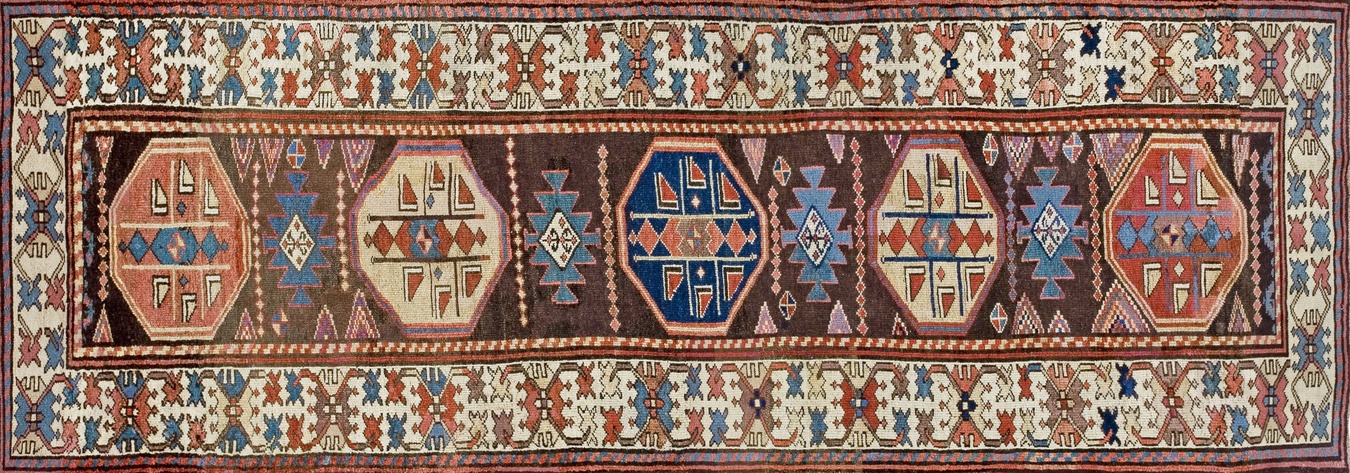
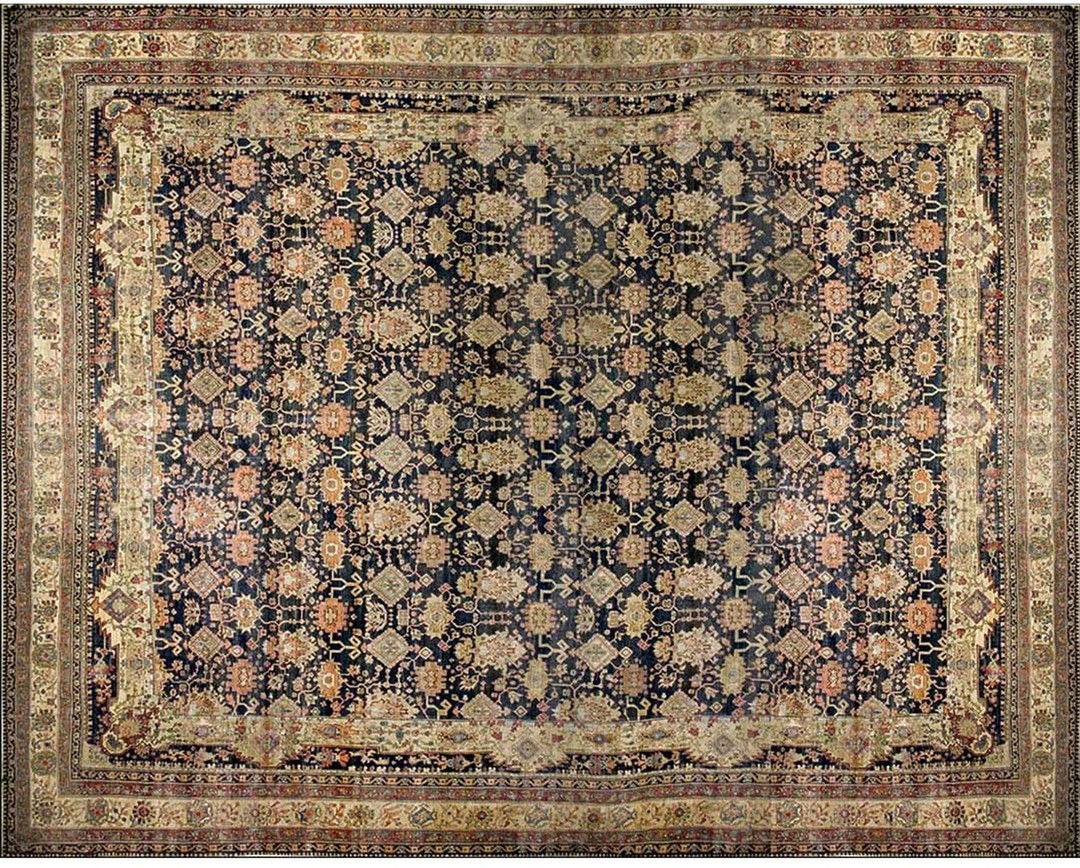
Antique Kurdish Persian Allover Geometric Hand Knotted Pile Rug – by Rugs On Net
Harshang patterns tend to emphasize botanical rhythm and complexity, appearing in Persian carpets from Heriz to the Caucasus. By contrast, the Caucasian crab medallion strips this concept down to its essentials, replacing curves with rigid angles, and blossoms with abstracted claws. Whereas Harshang designs may dominate a central medallion layout or flow into vine-scroll arrangements, crab motifs are typically set into allover repeating fields.
This structural distinction is crucial: the crab is not a floral palmette but a geometric emblem, flattened and abstracted to suit the angular weaving traditions of the Caucasus. In other words, the crab motif represents the Caucasian interpretation of what Persian weavers conceived as a botanical form. It translates naturalism into geometry, a hallmark of the region’s aesthetic. This adaptation is part of a broader pattern in Caucasian design, where borrowed motifs from Persia, Anatolia, and Central Asia are reimagined in sharply linear, angular forms.
Name, Origin, and Historical Development
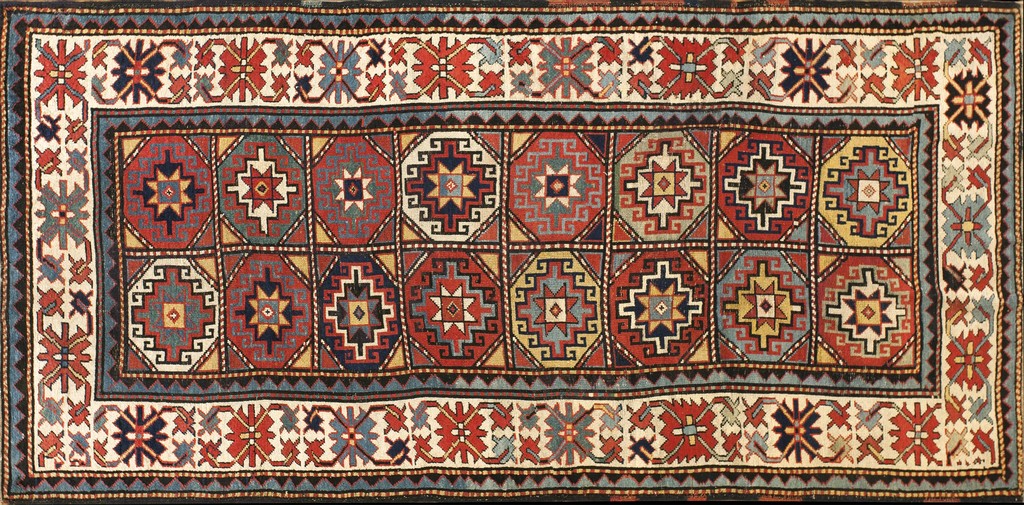
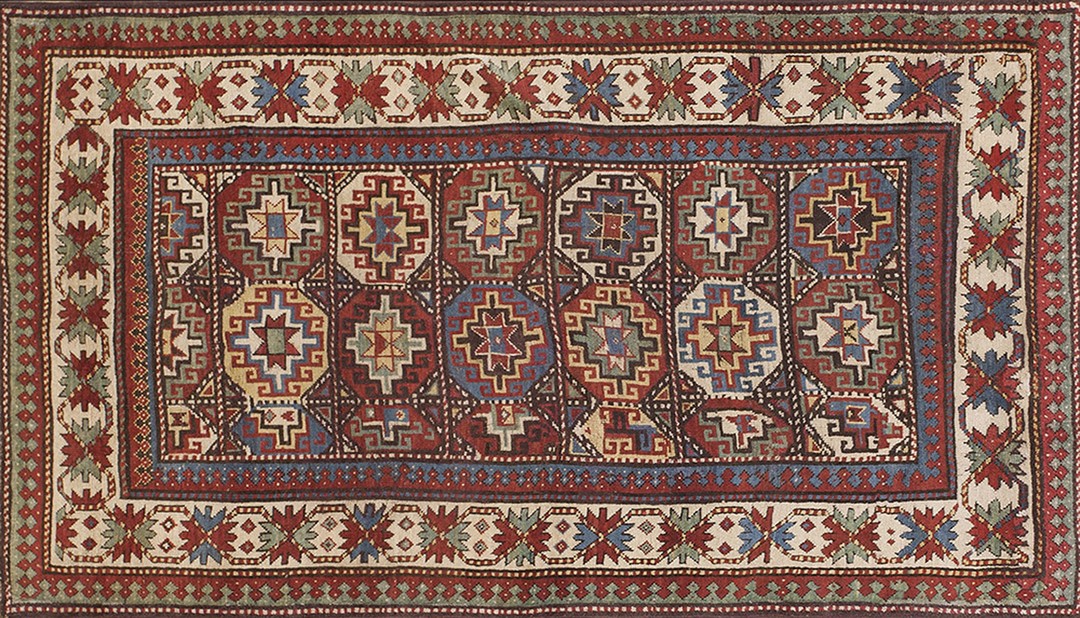
Exciting Bold Tribal Geometric Grid Pattern Antique Caucasian Moghan Rug by Rugs On Net
Etymology: Why “Crab”?
The term “crab” design in rugs is a Western coinage, not a native Caucasian or Persian label. Early collectors and scholars saw the angular, radiating extensions of the motif and likened them to a crab’s claws. In Persian and Azeri, the word kharchang (xərçəng) does indeed mean “crab,” but in rug terminology, harshang refers to a floral palmette motif, not an animal figure.
Thus, the connection between rugs and the crab as an animal is purely linguistic and visual. It is important to emphasize that the crab motif is abstract and geometric, not a zoological or folkloric emblem. The name reflects Western observers’ imagination rather than the weavers’ intent.
Historical Origins and Timeline
The crab rug history is deeply rooted in the crosscurrents of Safavid and Caucasian design traditions. The motif ultimately derives from Safavid Persian designs of the 16th and 17th centuries, where curvilinear palmettes dominated courtly carpets. From there, the form was transmitted into the Caucasus, particularly visible in 17th-century Karabagh dragon carpets, which adapted Persian floral forms into bold, angular interpretations.
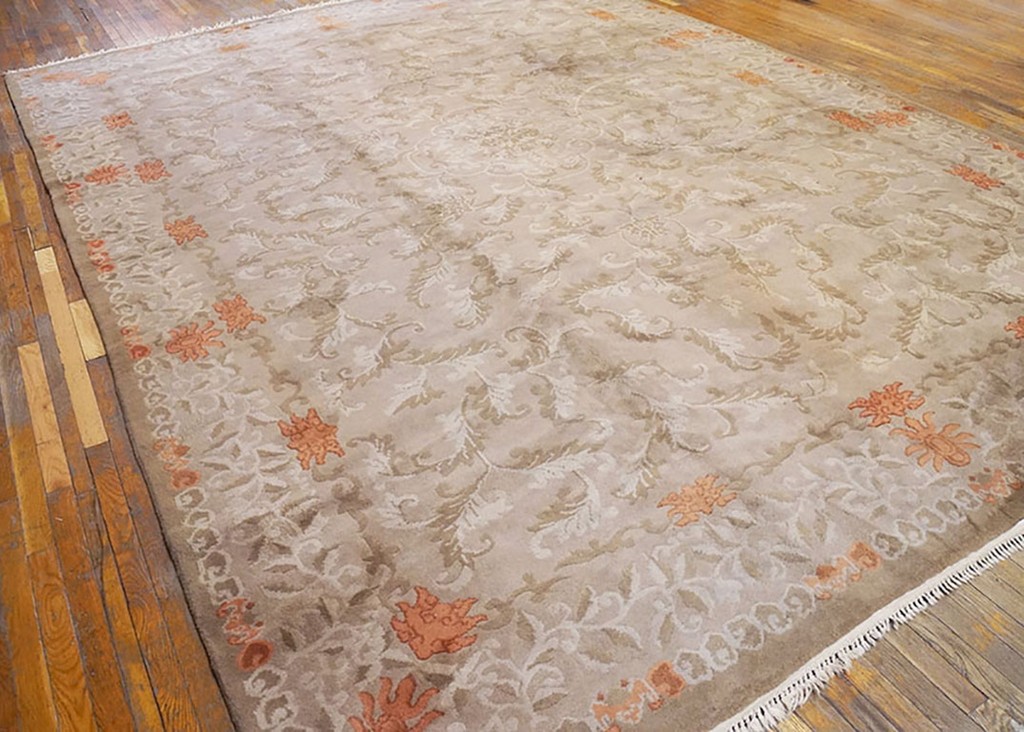
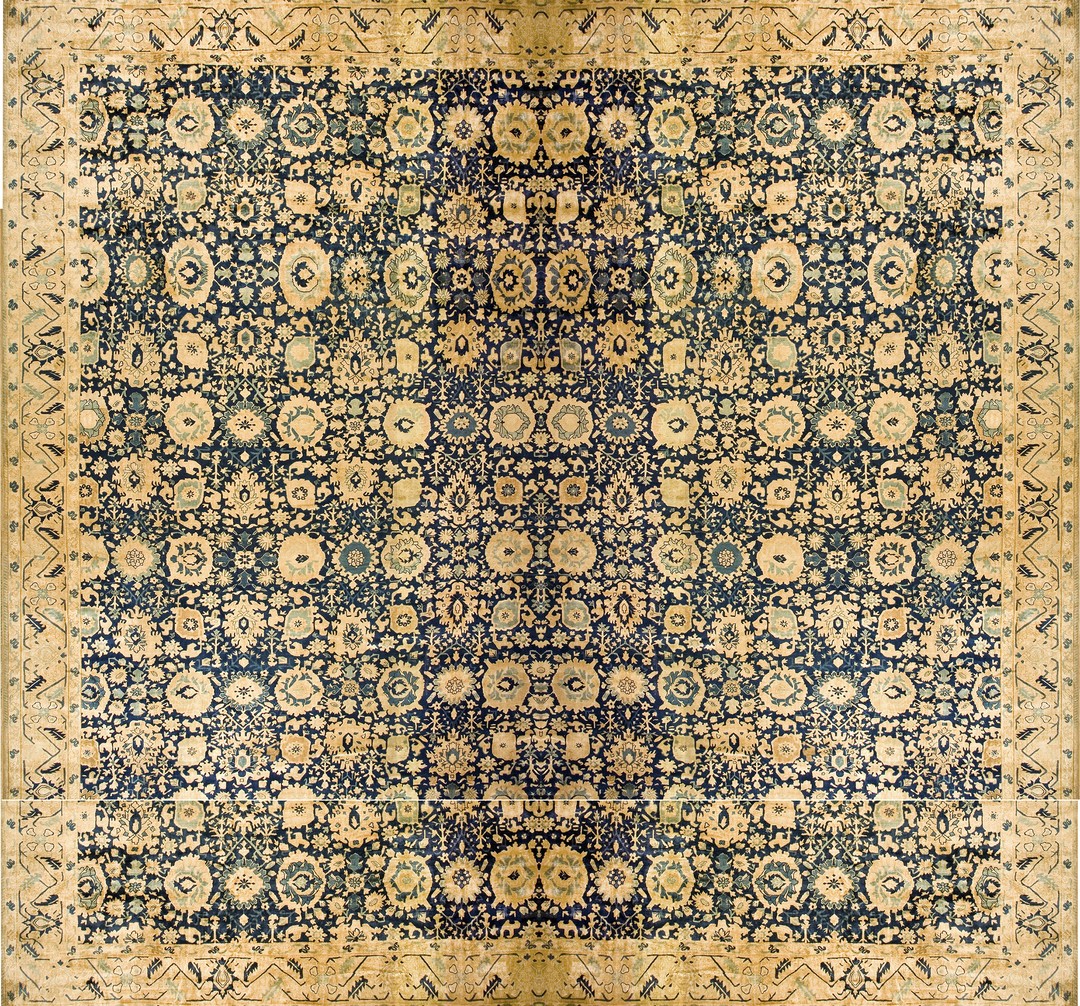
Antique Chinese Room Size Wool Ivory Rug by Rugs On Net
Over time, village and town weavers across the Caucasus abstracted these palmettes further, reducing curvilinear flourishes into sharp, stepped edges. By the 18th century, the crab motif had crystallized as a distinct Caucasian design element, particularly in Kuba and Shirvan regions. The 19th century marked its peak, as local weaving centers standardized the motif into the familiar allover fields of crab medallions that now define the type.
Early Use and Evolution
The evolution of the kharchang motif illustrates the transformation of Persian palmette ornament into the geometric idiom of the Caucasus. In its earliest phases, the design still echoed Persian botanical inspiration, with softer lobes and more floral rhythm. As it entered the Caucasian tradition, however, the lines became straighter, the claws more pronounced, and the symmetry more rigid.
By the 19th century, crab rugs had become a hallmark of regional production, especially within Kuba workshops, often woven alongside related Afshan designs. These rugs emphasized repeat patterns rather than central medallions, aligning with broader Caucasian aesthetics of tessellation and balance.
Geographic & Cultural Context
Main Weaving Regions: Kuba, Shirvan, Karabagh
The crab motif became a defining feature of several major Caucasian rug weaving regions, particularly Kuba, Shirvan, and Karabagh. These areas, now spanning Azerbaijan, Armenia, and Daghestan, formed the cultural and geographic heartland of crab rug production. Kuba crab rugs are especially renowned for their crisp execution, dense knotting, and sharply articulated geometric lobes. They often present the crab motif in carefully arranged rows, creating a highly rhythmic field.
Shirvan crab rugs, by contrast, tend to be slightly finer and may integrate the motif into more delicate, interlocking layouts, emphasizing refinement and detail. Karabagh Afshan rugs—descendants of Safavid floral traditions—adapted the crab medallion into larger-scale, bolder compositions, frequently combining it with dragon or vine-scroll elements. Crucially, the motif was never confined to a single village, ethnicity, or workshop.
Instead, it represents a pan-regional Caucasian rug tradition, practiced by Azeri, Lezgin, Armenian, and other local weavers across diverse communities. Each group contributed stylistic nuances, but all shared in transforming Persian palmette ancestry into a uniquely Caucasian geometric emblem.
Cross-Cultural Influences
- Persian heritage — Why: The crab motif’s ancestry in Safavid palmettes and Karabagh dragon carpets reveals its Persian roots, later adapted into sharper Caucasian forms.
- Turkic traditions — Why: Turkic nomads introduced geometric abstraction and step-edged symmetry, which reinforced the crab medallion’s angularity.
- Local Caucasian design — Why: Indigenous weavers emphasized tessellation, allover fields, and architectural balance, which shaped the crab’s repeating structure.
- Russian imperial markets — Why: By the 19th century, under Russian rule, Caucasian rugs—including those with crab designs—entered export networks, fueling demand in Europe and beyond, and formalizing the motif’s fame worldwide.
The Caucasian rug tradition thrives precisely because of this cultural interplay. The crab motif stands as a visual record of centuries of exchange—Persian floral heritage distilled into Turkic and Caucasian geometry, carried forward by multi-ethnic weavers, and propelled into global markets under Russian oversight.
Unified Historical Origin
The crab motif historically originated in Safavid Persian palmettes, reaching the Caucasus by the 17th century and crystallizing into geometric form in the 18th and 19th centuries. In geographic context, its spread across Kuba, Shirvan, and Karabagh ensured it became a shared cultural design, not bound to one people but reflecting the rich mosaic of the Caucasus.
The result is a motif that is both local and transnational: a Caucasian rug emblem rooted in Persian origins, shaped by Turkic abstraction, and woven by diverse Caucasian communities into one of the region’s most enduring patterns.
Motif Structure, Borders, and Identification
Geometry and Layout
The crab medallion is built from a central rosette or lotus-like core, framed by four serrated lobes that project outward like claws. Each lobe is angular, with “stepped” edges that reflect the weavers’ use of straight weft and warp threads. Unlike curvilinear Persian palmettes, which emphasize flowing lines, the crab motif embodies the geometric discipline of Caucasian rugs.
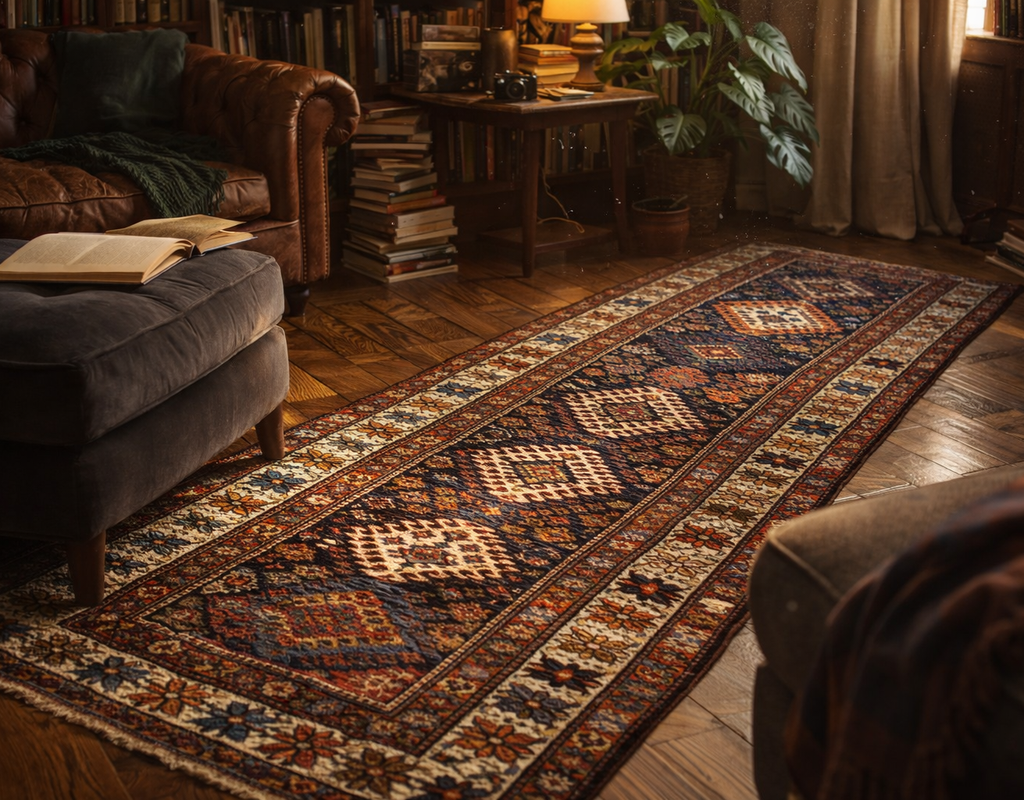
A beautifully preserved runner rug anchors the reading nook of this richly appointed, dimly lit library.
These motifs are rarely presented singly. Instead, they repeat in offset rows across the field, creating a lattice-like effect where each crab medallion interlocks with the next. This uniformity distinguishes crab rugs from those with large, dominating central medallions.
The repetition creates a rhythmic, architectural surface—an allover Afshan pattern that emphasizes balance and order.
Identifying Crab Borders
- Miniaturized crab motifs — Why: Borders often feature scaled-down crab designs, easily recognized by their serrated “claws.”
- Alternating directions — Why: Crab motifs in borders frequently alternate orientation, producing visual movement along the rug’s edge.
- Even spacing — Why: The hallmark of crab borders is regularity; spacing between motifs is consistent, reinforcing the geometric character.
- Independent use — Why: Crab borders are not exclusive to crab field rugs; they can appear in other Caucasian weavings, making border identification a valuable diagnostic tool.
Recognizing these features helps collectors and scholars authenticate pieces and distinguish them from related patterns like the Lesghi star motif, which often shares the same geometric boldness but a different structural vocabulary.
Afshan Pattern and Allover Layout
The Afshan pattern, closely associated with Shirvan and Karabagh weaving, frequently incorporates crab medallions into its expansive, repeating fields. Afshan designs favor uniformity and tessellation, where motifs are systematically aligned rather than dominated by a single central figure.
Within this layout, the crab motif thrives as a repeating emblem, its claws locking into the visual grid. This association with Afshan weaving underscores the crab’s role as a regional hallmark of Caucasian rug design.
Symbolic Meaning and Local Interpretation
Though named after an animal, the crab motif is not zoological. Its form is rooted in the Persian palmette motif, symbolizing fertility, abundance, and continuity of life. Caucasian weavers abstracted this floral heritage into angular, geometric forms, aligning with their aesthetic sensibilities. To local artisans, the crab motif was not a “crab” at all but part of a larger visual language of growth and renewal.
The Western nickname, while descriptive, obscures this deeper symbolic continuity from Persia to the Caucasus. The crab border and medallion together form one of the most diagnostic features of Caucasian rugs—geometric, repeating, and deeply tied to the region’s artistic identity, yet flexible enough to migrate into multiple rug traditions.
Materials, Construction, and Dyeing
Common Materials: Wool, Cotton, Silk
- Wool pile rugs — Why: Wool was the dominant material for crab rugs, valued for its warmth, resilience, and pliability under the weaver’s hand. It provided the ideal balance between durability and softness, making it suitable for both village and workshop production.
- Wool foundations — Why: Most antique crab rugs were woven on wool warps and wefts, giving structural cohesion. Wool-on-wool construction is considered the hallmark of Kuba and Shirvan pieces.
- Cotton foundations — Why: Introduced in later Karabagh and workshop rugs, cotton provided extra stability and helped rugs lie flatter, making them more desirable for export.
- Silk pile — Why: Rarely used, silk introduced a luminous silk rug sheen that transformed the crab motif into a more decorative, luxury-oriented feature. These rugs were not for everyday use but for prestige display.
Knot Type & Knot Density
The Ghiordes knot (Turkish knot)—a symmetrical knot—is standard in Caucasian crab rugs. This knotting style naturally favors angular, rectilinear motifs because each knot locks evenly around the warp. As a result, the crab motif’s serrated “claws” appear with crisp, geometric precision.
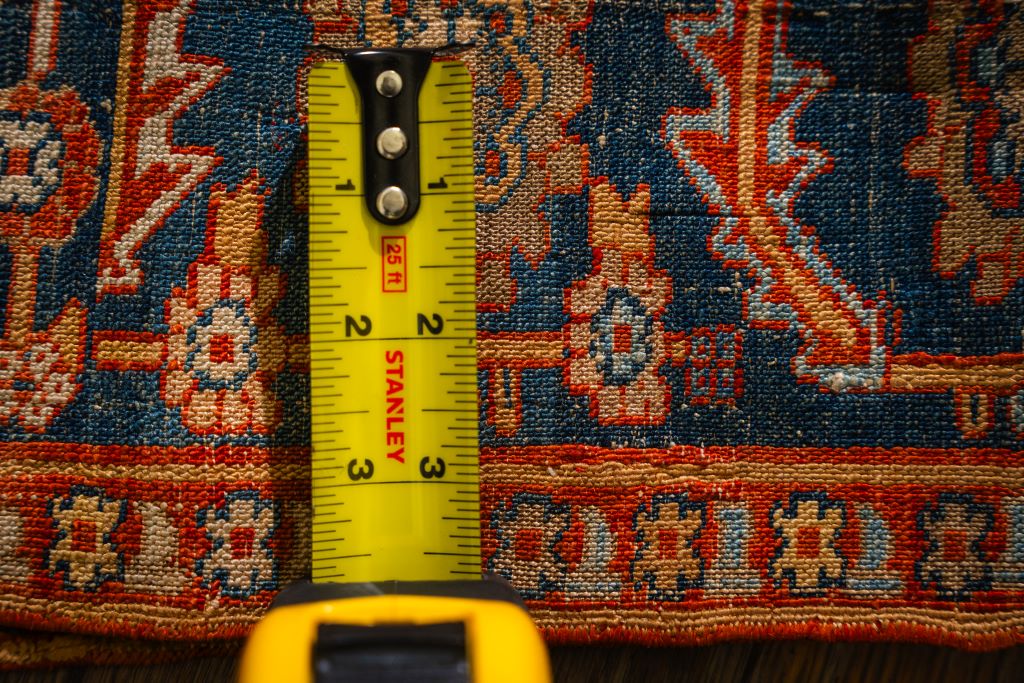
A detailed inspection of a richly colored oriental rug pattern while measuring its dimensions.
Knot density plays a decisive role. Most crab rugs fall within the 80–160 knots per square inch range. At the lower end, motifs may appear more rustic or bold, with thicker outlines.
At the higher end, the design achieves exceptional clarity—step-edged lobes are sharply articulated, and the crab medallion stands out in precise detail. Thus, knot density directly impacts motif legibility and refinement.
Dye Types and Color Palettes
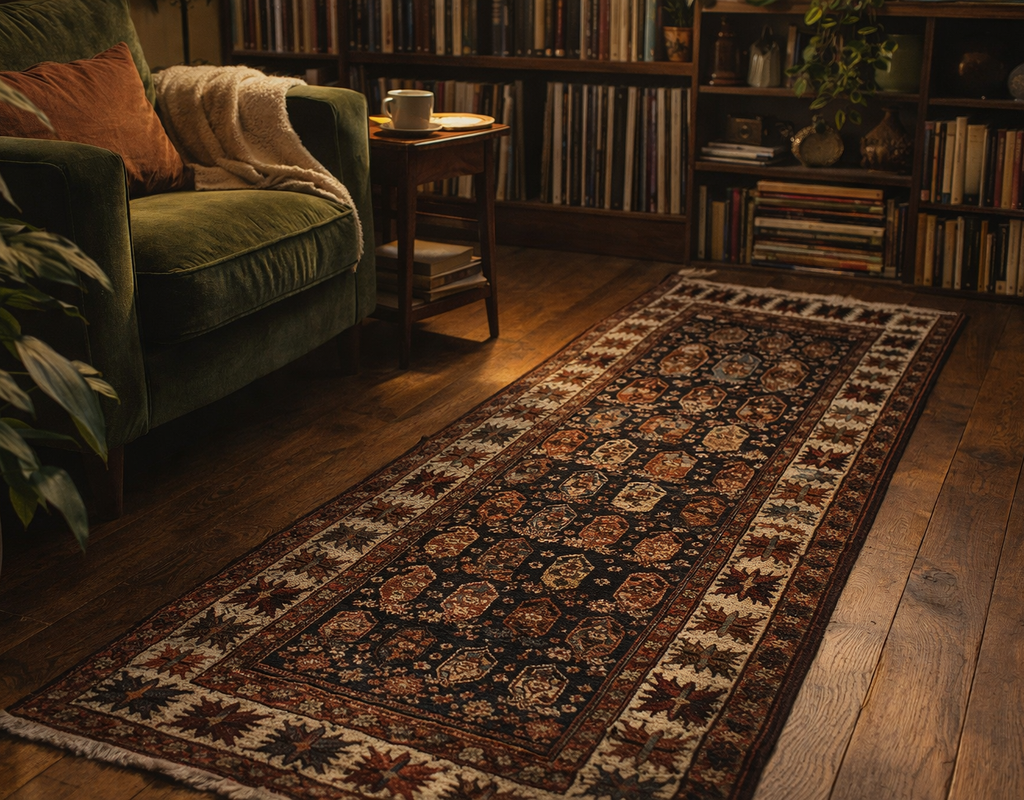
The warm lighting highlights the texture of the velvet chair and the deep colors of the antique-style runner rug in this intimate study space.
- Indigo (blue) — Why: Provided deep navy or lighter sky tones for fields and borders, setting a strong backdrop for crab motifs.
- Madder (red) — Why: Offered a spectrum from rich crimson to rust, forming the most common ground color for crab rugs.
- Weld, saffron, or other yellows — Why: Produced golden highlights that emphasized claws, rosettes, or border details.
- Walnut husk (brown/black) — Why: Added darker outlines for depth and contrast.
- Later aniline dyes — Why: Introduced in the late 19th century, these synthetics produced brighter shades but lacked the stability of natural dye rugs, often fading unevenly.
The rug color palette of indigo, madder red, saffron yellow, ivory, and green remains the most effective for highlighting crab designs. High contrast between dark fields and light motifs ensures the crab medallion’s serrated claws remain legible, even at a distance.
Looms and Weaving Techniques
Village weavers in the Caucasus typically worked on horizontal ground looms, portable and practical for small household rugs. In contrast, larger town and workshop rugs, particularly in Karabagh, were woven on vertical looms, allowing greater precision and scale.
The choice of loom influenced not only rug size but also consistency of knotting and motif alignment. Through its materials, knotting methods, and natural dyes, the crab motif exemplifies the technical artistry of Caucasian weaving—where wool, color, and structure converge to make geometric forms come alive.
Regional Variations and Notable Subtypes
Kuba Crab Rugs
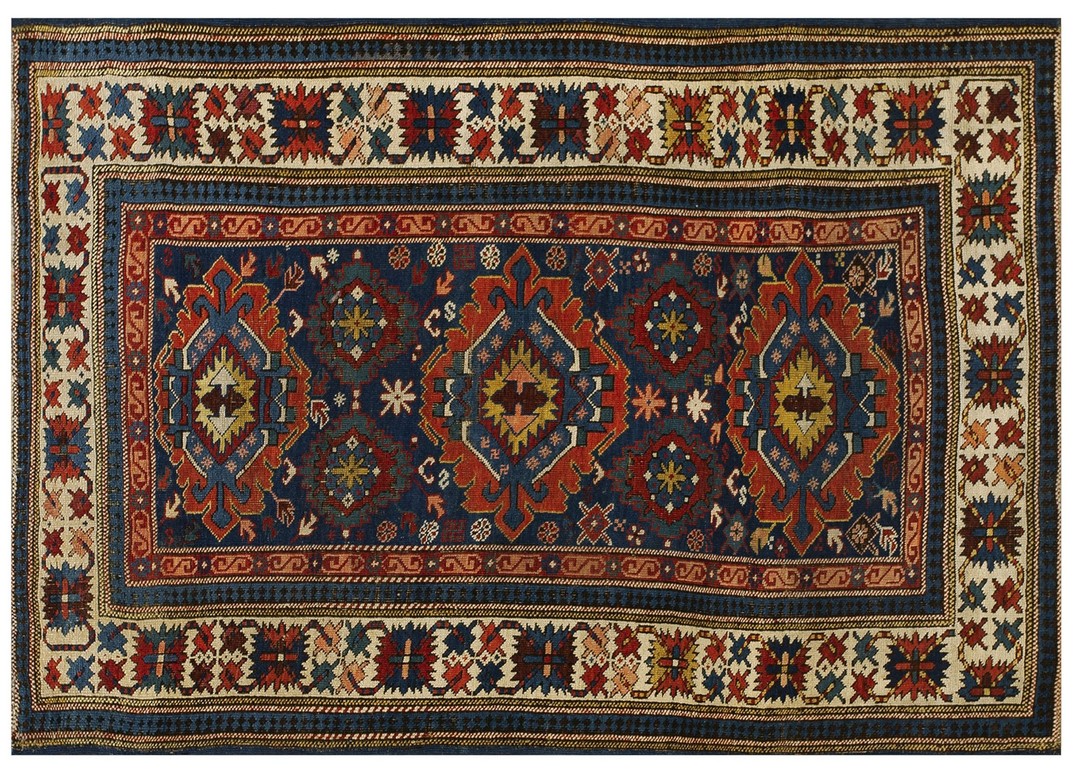
The Kuba crab rug is often considered the archetype of the motif, renowned for its fine weave and crisp execution. Typically woven on a wool foundation, these rugs feature a lattice-style layout with tightly packed, offset rows of crab medallions. Kuba pieces tend to be smaller in size, reflecting the limitations of village looms, but what they lack in scale they make up for in precision.
Their color palettes often emphasize deep indigo fields, ivory highlights, and balanced red accents, producing sharp contrast that enhances the stepped geometry of the motif. Collectors prize these rugs for their clarity and compact proportions, which preserve the integrity of the crab design.
Shirvan Crab Rugs
The Shirvan crab rug shares much with Kuba weaving but tends toward a slightly coarser weave and a more open visual rhythm. Motifs are spaced farther apart, giving the field a looser, more breathable aesthetic. Color ranges are broader than in Kuba examples, often incorporating greens, golden yellows, and softer browns in addition to the standard indigo and madder red.
These rugs frequently adopt the Afshan allover layout, but with greater negative space, allowing the crab medallion to stand out individually. For connoisseurs, Shirvan rugs are notable for balancing boldness with refinement while retaining the geometric discipline of the Caucasus.
Karabagh Afshan Rugs
The Karabagh Afshan subtype demonstrates how Persian influences shaped local Caucasian production. Unlike Kuba and Shirvan rugs, which stress angularity and tight repetition, Karabagh crab rugs often feature larger-scale medallions with softer, more curvilinear outlines. The Persian floral legacy is more visible here, with palmette-derived lobes appearing alongside crab medallions in hybrid compositions. Karabagh workshops also experimented with cotton or silk foundations and, in rare cases, silk pile, producing rugs with greater sheen and prestige appeal. These pieces often reached export markets, reflecting the commercial networks of the 19th century.
Comparison Table
- Kuba Crab Rugs — Why: Fine weave, small size, crisp geometry, indigo/ivory palettes.
- Shirvan Crab Rugs — Why: Slightly coarser, more open layout, broader color spectrum.
- Karabagh Afshan Rugs — Why: Larger motifs, Persian curvilinear influence, occasional silk/cotton use.
- Zeikhur Rugs — Why: A related type, sometimes incorporating crab motifs, prized for variation within the Kuba tradition and recognizable lattice layouts.
Investment and Collecting Insight
Should I invest in a 19th-century crab Kazak rug? Yes, 19th-century crab rugs, including Kazak examples, are highly collectible. Their regional specificity, handwoven craftsmanship, and rarity compared to modern reproductions give them lasting value. However, condition, color preservation, and provenance remain critical to their long-term investment potential.
The regional rug variations of the crab motif—Kuba, Shirvan, Karabagh, and even Zeikhur—illustrate how geography and local culture shaped design. For scholars and collectors, these subtle differences act as signatures of origin, allowing one to trace not just a rug’s place of weaving but also the lineage of artistic exchange across the Caucasus.
Crab Motif in the Marketplace: Value & Collectibility
Why Collectors Prize Antique Crab Rugs
Among antique Caucasian rugs, the crab motif holds a unique position. Collectors value these pieces not only for their striking geometric clarity but also for their deep historical resonance. The crab border and medallion embody the Caucasus’ fusion of Persian, Turkic, and local design elements, making them highly representative of regional artistry.
Their reliance on natural dyes, wool pile, and traditional looms ensures authenticity, while their bold symmetry gives them versatility in both traditional and modern interiors. This combination of artistry, cultural history, and visual impact has helped drive their desirability.
Crab Motif Appreciation vs. Other Styles
Compared to many other Caucasian types, crab rugs have seen faster appreciation in value. Their angular, architectural look appeals to contemporary collectors and interior designers, setting them apart from more floral or subdued motifs.
While patterns such as the Lesghi star or Karagashli also command respect, the crab motif’s iconic look and adaptability in both small Kuba formats and large Karabagh Afshan pieces have ensured it remains at the forefront of demand.
19th-Century Crab Kazaks: Investment Considerations
Should I invest in a 19th-century crab Kazak rug? Yes—these pieces represent one of the most sought-after categories of crab rug investment. Woven in the highlands, 19th-century crab Kazaks are known for their bold scale, rich color palettes, and powerful crab medallions.
Condition and provenance are decisive: intact pile, well-preserved natural dyes, and documentation from reputable sources can elevate values dramatically. For collectors, they offer both historic authenticity and strong market resilience, making them excellent long-term investments.
Repairs, Provenance, and Value Impact
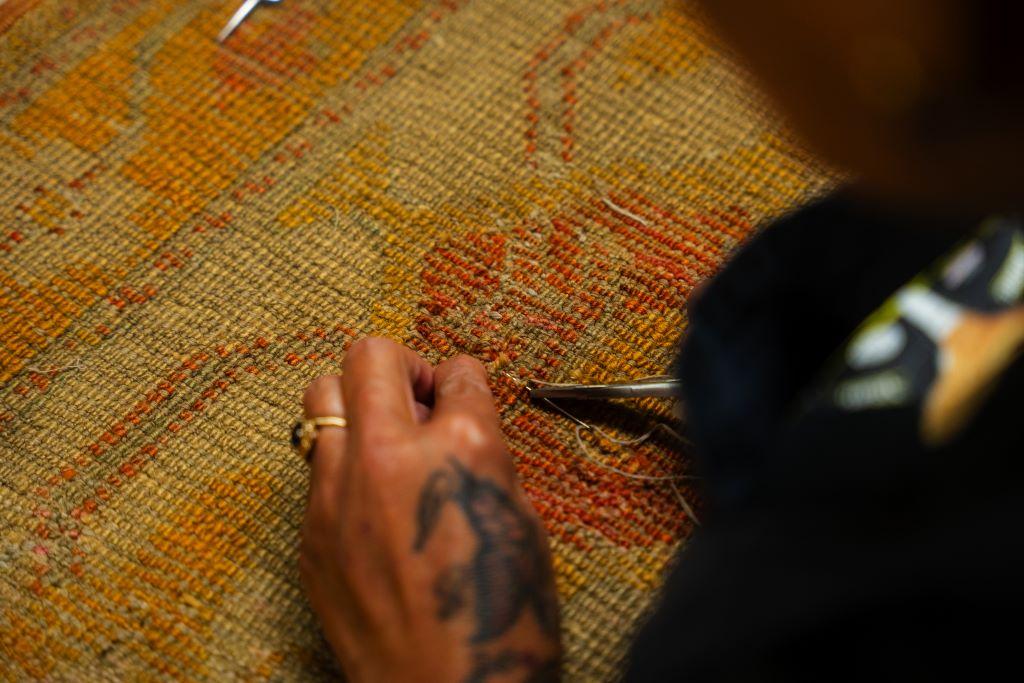
Detail of hands mending a rustic, richly colored woven rug.
- Repairs and reweaving — Why: Professional restorations must be disclosed; minor conservation is acceptable, but extensive reweaving lowers value unless executed at museum-level standards.
- Provenance — Why: A rug with documented sales history (auction catalogs, dealer certification, museum records) carries greater credibility and typically commands higher prices.
- Condition reports — Why: Buyers rely on third-party inspection for assurance; rugs with strong reports outperform similar but undocumented examples.
Buying Guide: Where & What to Buy
For serious buyers, the safest sources remain reputable auction houses such as Christie’s, Sotheby’s, or Bonhams, which frequently feature antique Caucasian rugs in dedicated textile sales.
Specialized dealers in New York, London, and Istanbul also maintain curated inventories of crab rugs, often with provenance records. For broader access, major online marketplaces provide opportunities, but due diligence—verifying knot density, natural dyes, and documented origin—is essential.
Price Ranges for Museum-Grade Crab Rugs
At the top tier, museum-grade crab rugs—19th-century examples in exceptional condition, with strong color retention and documented provenance—can achieve prices well into six figures at auction. More typical but still collectible pieces may range from $10,000 to $40,000, while smaller or partially restored Kuba or Shirvan examples may be available in the $5,000 to $15,000 range.
Condition and rarity are the decisive factors within these bands. The marketplace for crab motif rugs reflects their dual nature: they are both historical artifacts and contemporary design treasures. For collectors and investors alike, their combination of artistry, rarity, and strong market demand makes them one of the most resilient and rewarding categories of antique Caucasian rugs.
Modern and Contemporary Crab Motif Rugs
Are Modern Weavers Still Producing Crab Designs?
Yes. The modern crab rug remains part of the weaving landscape, both in Azerbaijan—its historical homeland—and in weaving centers abroad. Contemporary artisans continue to reinterpret the motif in hand-knotted formats, while commercial workshops produce more accessible versions for international markets.
These new productions often cater to demand for the graphic, geometric appeal of the crab design, which fits seamlessly into both traditional and modern interiors. However, the range of quality is wide: from high-end revivals using traditional methods to lower-cost machine-made carpets that borrow the motif without preserving its original depth.
New Reproductions vs. Vintage Originals
The difference between new vs. vintage rugs is critical for collectors. Vintage 19th-century crab rugs display superior craftsmanship: hand-spun wool, natural vegetable dyes, and medium-to-fine knot densities that give the motifs precision and vitality. The colors in these rugs age beautifully, developing a mellow patina that deepens the crab medallion’s visual energy.
By contrast, many hand-knotted reproductions use synthetic dyes, commercial wool, or lower knot density, producing flatter tones and less tactile richness. Machine-woven versions may replicate the motif superficially but lack the texture, irregularity, and artistry that give antique crab rugs their life. While modern examples can be durable and affordable, they do not hold the same collectible value as vintage originals.
For connoisseurs, distinguishing between the two comes down to close examination of wool quality, dye vibrancy, knot density, and the subtle “energy” of the pattern.
Legacy, Revivals, and Design Trends
A growing revival movement has sought to honor the legacy of crab rugs by reproducing them with traditional methods. These revival pieces use hand-spun wool and vegetable dyes, often modeled after 19th-century Kuba and Shirvan crab rugs, preserving the stepped, angular precision of the original motifs. Such rugs bridge past and present, providing authenticity for buyers who cannot access antique originals. At the same time, contemporary crab design has entered broader decorative trends.
Interior designers appreciate the bold, tessellated geometry of crab motifs, adapting them to non-traditional palettes—such as soft neutrals, grays, or even bright contemporary colors—to suit modern homes. This trend underscores the crab motif’s versatility: it is both a historic Caucasian symbol and a timeless graphic element. In today’s marketplace, the modern crab rug thrives as both a decorative choice and a revived heritage craft. Yet for collectors, vintage originals remain unmatched in artistry, authenticity, and long-term value.
Care, Display, and Interior Use
How Dye & Material Choice Affect Longevity and Appearance
The long-term durability of a crab motif rug is closely tied to its materials and dyes. Wool rugs dyed with natural vegetable colors age gracefully, developing a soft patina while retaining depth and vibrancy. Indigo, madder, and saffron-based hues are especially resistant to fading, making antique examples both visually appealing and structurally resilient. By contrast, later synthetic dyes may fade unevenly, affecting both appearance and value. Silk rugs, while prized for their sheen, are fragile and best reserved for display or low-traffic settings. Collectors and homeowners alike should consider material choice when deciding whether to use a crab rug as a functional floor covering or as a decorative textile.
How to Verify Authenticity & Provenance
- Dealer certification — Why: Established dealers often provide written guarantees that confirm origin and age, adding trust to a purchase.
- Auction records — Why: Catalog listings from Sotheby’s, Christie’s, and other houses document sale history, which strengthens provenance.
- Expert appraisal — Why: Independent textile experts can authenticate materials, knotting, and dyes, offering unbiased verification.
- Museum catalog references — Why: Comparison with published collections provides authoritative benchmarks for identifying rare crab rugs.
Rug provenance and authenticity verification are critical, not only for peace of mind but also for resale and collector value. A crab motif rug with proper documentation will always command stronger market confidence than one without.
Styling with Crab Motif Rugs in Modern Interiors
The repeating, tessellated structure of the crab rug in interiors makes it exceptionally versatile. Its rhythmic medallions integrate well in both traditional and contemporary spaces, functioning as either a bold focal point or a subtle graphic layer. In modern settings, crab rugs balance minimal architecture with historical texture, their indigo and ivory palettes working especially well against neutral walls and furnishings.
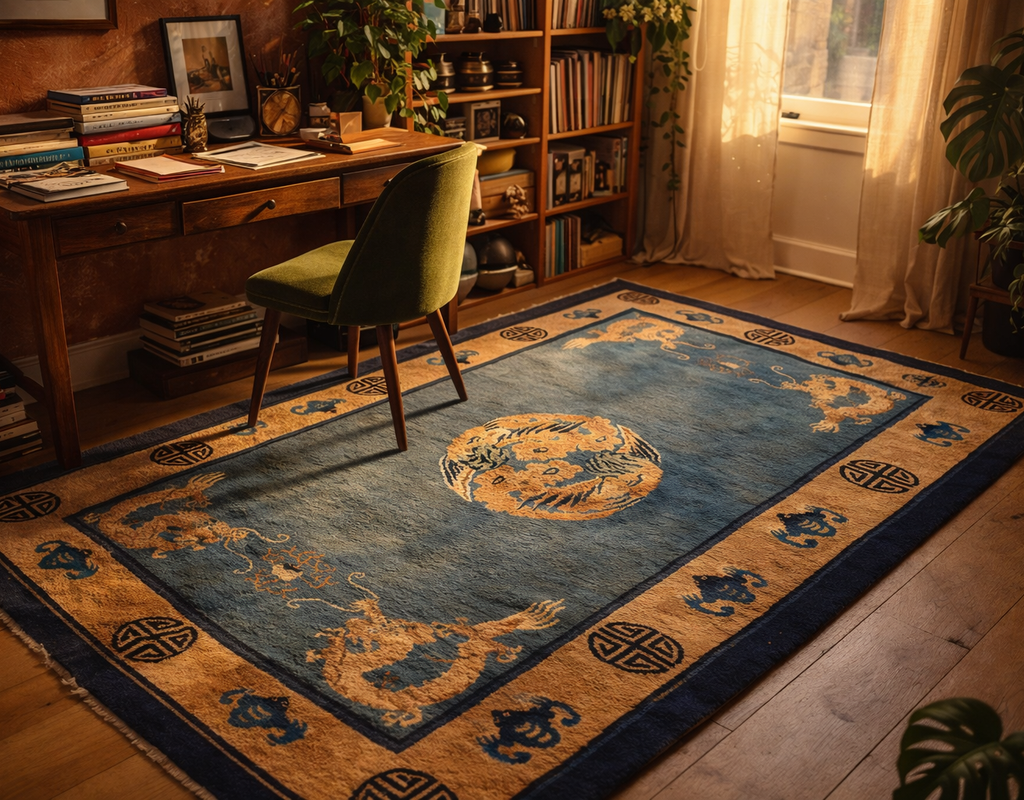
A vintage-style study area grounded by a dramatic blue and gold Chinese rug.
In classic interiors, their geometric order complements antique furniture and decorative schemes. For fragile examples—particularly silk or older wool rugs—low-traffic placement and occasional rotation prevent uneven wear while preserving vibrancy. With careful rug care, documented provenance, and thoughtful styling, crab motif rugs continue to thrive not only as treasured antiques but also as powerful design statements in today’s interiors.
Explore some of our crab design rugs
FAQ
- What are common condition red flags?
Cut-down borders, over-repaired corners, extensive reweaves, stiff latex-like backs on “antique” pieces, or heavy color bleed. Factor these into price and longevity.
- Where can I authenticate or appraise one?
Work with reputable dealers or ISA-, ASA-, or AAA-accredited appraisers. Ask for age estimates, origin, dye/fiber notes, and disclosure of repairs or reductions.
- How do I check dyes without damaging the rug?
Dab a damp white cloth on hidden areas; minimal transfer is normal in antiques, but bleeding is a warning. Avoid home chemicals; consult a professional for concerns.
- Will a crab-motif suit modern interiors?
Absolutely. The bold geometry anchors contemporary rooms. Pair with neutral upholstery and echo a palette color—like indigo or rust—in pillows or art.
- Are crab-motif rugs safe with pets and kids?
Choose sturdy, thicker-pile or newer hand-knotted pieces for durability. Reserve fragile antiques for lower-traffic rooms; use pads and door mats to limit grit.
- How should I care for a crab-motif rug?
Use a quality pad, vacuum gently without a beater bar, rotate seasonally, blot spills quickly, and schedule a professional wash every 3–5 years.
- What foundations and knots should I expect?
Caucasian: wool warps/wefts with symmetrical (Turkish) knots. Heriz/Serapi: typically cotton foundations with symmetrical knots. Oushak: wool on wool or cotton, symmetrical knots.
- How old are most crab-design antiques?
Many surviving examples date to the late 19th–early 20th centuries. Earlier Northwest Persian Harshang carpets exist but are scarcer and command premiums.
- What’s the Seychour “Alpan” crab design?
A Kuba-region Caucasian subtype with distinctive hooked palmettes and crisp drawing. Fields may show repeating crab palmettes framed by classic Caucasian borders.
- Do Karaja rugs feature crab-like elements?
Often, yes. Karaja drawing includes angular medallions and small insect/crab-like motifs, usually in saturated reds and indigo with crisp geometry.
- How does Harshang compare to Herati or Mina Khani?
Harshang has big hooked palmettes (“claws”); Herati is a rosette-diamond with fish leaves; Mina Khani is rosettes linked by curved trellis. Scale and rhythm feel different.
- Are there modern washable rugs with crab motifs?
Yes. Contemporary machine-made and printed Persian-style designs often include crab/Harshang patterns and some are marketed as washable; quality and feel vary widely.
- How can I tell hand-knotted from tufted or machine-made?
Hand-knotted backs mirror the front with visible knots and no fabric/latex mesh. Tufted rugs have a cloth backing; machine-made backs look uniform and perfectly regular.
- How much do crab-design rugs cost?
Wide range. Small vintage examples can start around low four figures; exceptional antiques often run into mid-five figures. Age, condition, dyes, and provenance drive price.
- What sizes are most common?
Caucasian crab designs appear in small formats and runners; Persian Heriz/Serapi are often 8×10, 9×12, or larger. Oversized antiques exist but are rarer and pricier.
- Are crab-motif rugs durable for high-traffic rooms?
Heriz/Serapi and many Kurdish examples are famously tough due to robust wool and construction. Antique Caucasian pieces can be sturdy but deserve pads and sensible care.
- What colors are typical in crab-motif rugs?
Madder reds, deep indigo, and ivory are common in Caucasian/Persian examples; Oushak versions skew softer (wheat, blush, light blue). Modern pieces may broaden the palette.
- Do Turkish Oushak rugs use crab designs?
Yes. Some early 20th-century Oushaks interpret Harshang palmettes at large scale, often in softer, pastel palettes with looser drawing.
- How do Persian Heriz/Serapi crab rugs differ?
They’re usually room-sized with cotton foundations, bold medallions, and heavy borders—often featuring a crab border. Knotting is typically symmetrical and the handle is sturdy.
- How do I recognize a Caucasian crab-design rug?
Expect geometric drawing, wool pile on wool foundation, symmetric knots, lively abrash, and smaller sizes (often 3×5 to 4×7 or runners). Seychour/Kuba “Alpan” layouts are classics.
- What does the crab motif symbolize?
Meanings vary by culture, from protection and good fortune to water or fertility. Treat symbolic claims cautiously; they’re interpretive, not universal.
- Are crab motifs literal crabs?
No—they’re abstract floral palmettes that only suggest claws. Dealers and historians adopted “crab” as shorthand; the weavers conceived them as stylized flowers and leaves.
- What is a “crab border”?
A main border of alternating palmettes whose hooked leaves read like crab claws. You’ll see it on Heriz/Serapi, some Kurdish pieces, and Caucasian runners.
- Which regions are best known for crab-design rugs?
Northwest Persia (Heriz/Serapi, Bidjar), the Caucasus (Kuba/Seychour “Alpan” designs), and parts of Turkey (Oushak). Modern Pakistani Heriz-style pieces also use Harshang layouts.
- What is the “crab” motif in rugs?
It’s a stylized palmette with serrated, hooked extensions that resemble crab claws. In Persian texts it’s called Harshang (Kharchang) and appears as repeating medallions or an all-over field pattern.