
Introduction to Coat of Arms Rug Designs
Discover our exquisite collection of Coat of Arms Tapestries Rugs and weave a narrative of history into your home.
What is a Coat of Arms Rug?
A coat of arms rug is a decorative textile in which a heraldic emblem—such as a family crest, institutional seal, or national arms—forms the centerpiece of the design. These rugs, often called armorial carpets or heraldic carpets, were not ordinary household weavings but highly specific commissions. Patrons of nobility, military leaders, and influential families ordered them to display their identity, status, and authority.
Unlike generic floral or geometric motifs, the heraldic motif in rugs carried direct symbolic meaning, making the rug as much a declaration of lineage as it was an object of luxury. In simple terms, a coat of arms rug design is both an artwork and an emblem, woven to be recognized as belonging to a particular family, ruler, or institution.
Etymology and Name Origins
The expression “coat of arms” reaches back to medieval Europe, when knights painted their shields and wore embroidered surcoats marked with distinctive symbols during battle and tournaments. These arms distinguished friend from foe and, over time, became hereditary, passed from generation to generation.
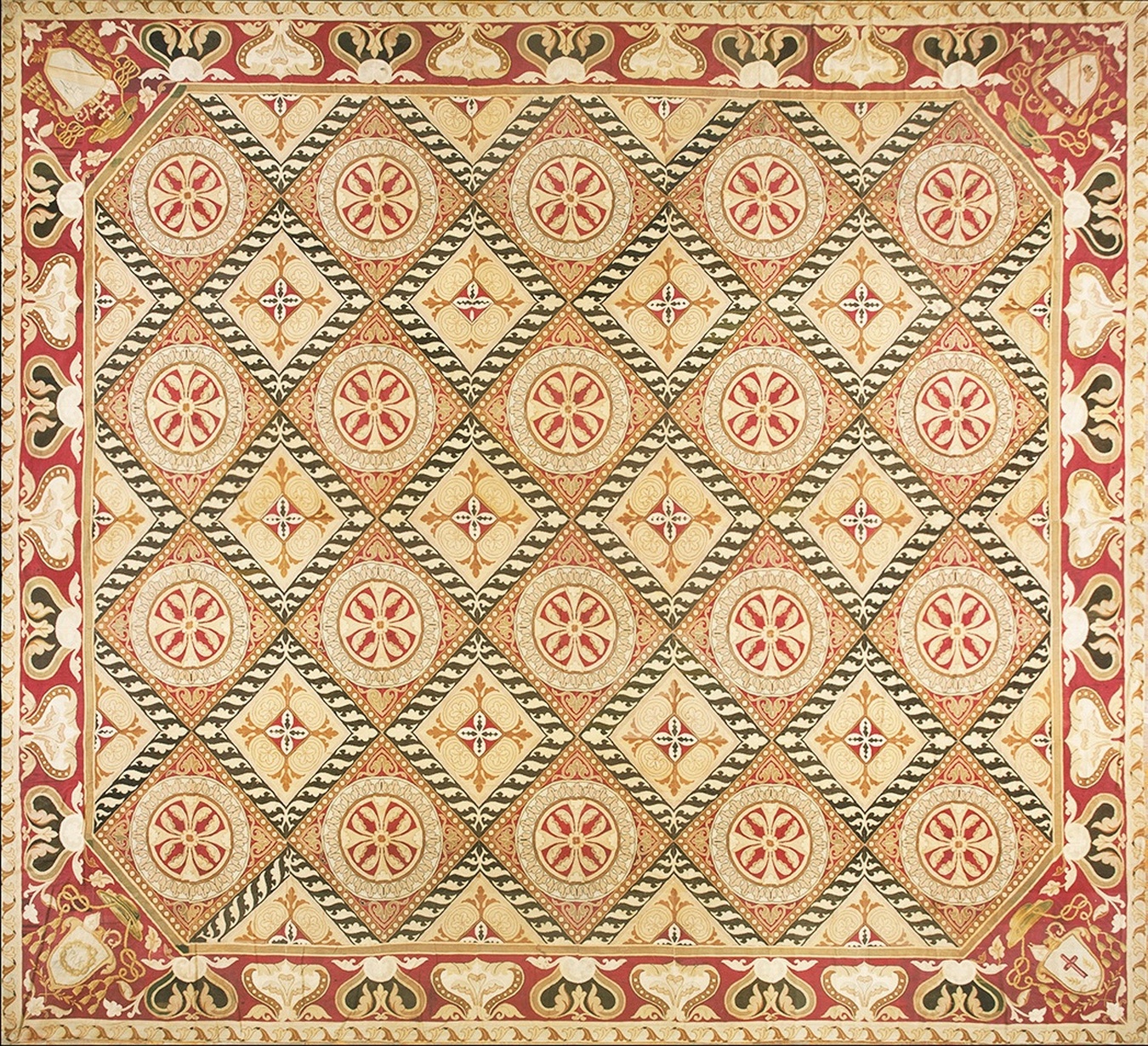
When transferred into textiles, the term retained its association with heraldry. An armorial carpet design thus became the woven equivalent of a shield—an extension of heraldic language into the medium of rugs. The choice of wording in rug scholarship—“coat of arms rug,” “family crest rug,” or “emblem carpet”—reflects this historical lineage.
Each term reinforces the idea that the textile serves a dual function: it is not merely a floor covering or wall hanging, but a heraldic surface where ancestral authority is proclaimed. The adoption of heraldic vocabulary into rug discourse shows how deeply entwined these carpets are with European and Ottoman traditions of aristocracy, diplomacy, and prestige.
Symbolism and Purpose
The symbolism of a heraldic carpet design lies in its ability to merge art with identity. While coats of arms appeared more commonly in banners, tapestries, and architecture, their presence in rugs carried a unique prestige.
A rug was mobile, intimate, and tactile—it could be rolled, gifted, or displayed in halls, throne rooms, and palaces. By weaving heraldic emblems into carpets, patrons projected their authority into spaces where daily life unfolded, not just ceremonial walls. The use of rugs also underscored luxury.
Producing a family crest rug required custom design, skilled dyework, and precise weaving, often by workshops serving royal courts or wealthy merchants. Beyond their decorative role, emblem carpets embodied loyalty, kinship, and dynastic pride. They marked alliances through marriage, celebrated lineage, and reinforced political ties.
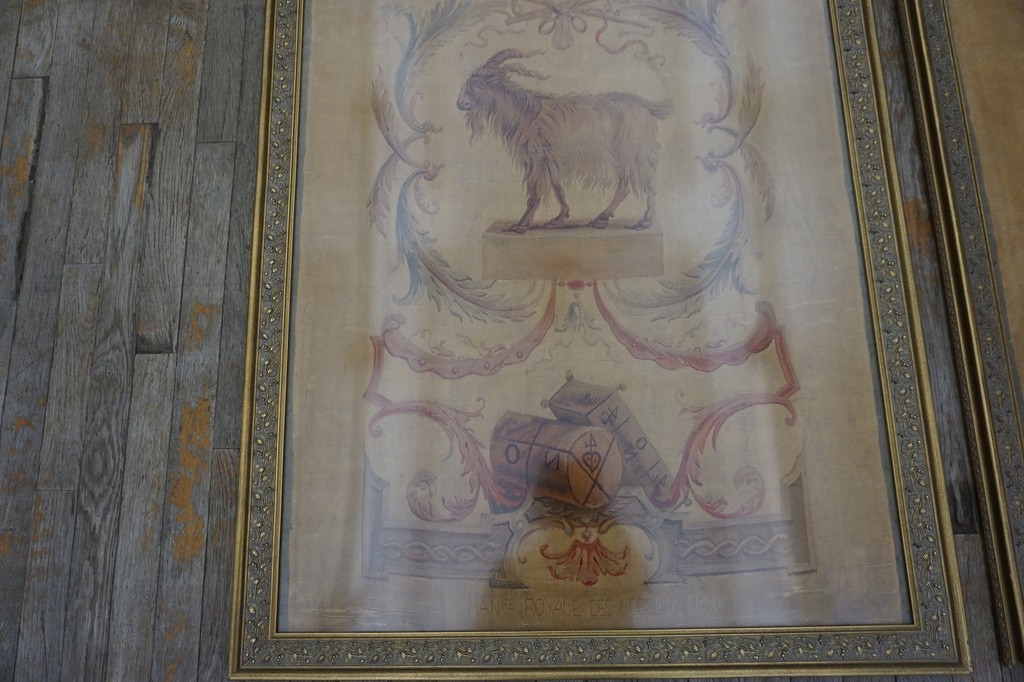
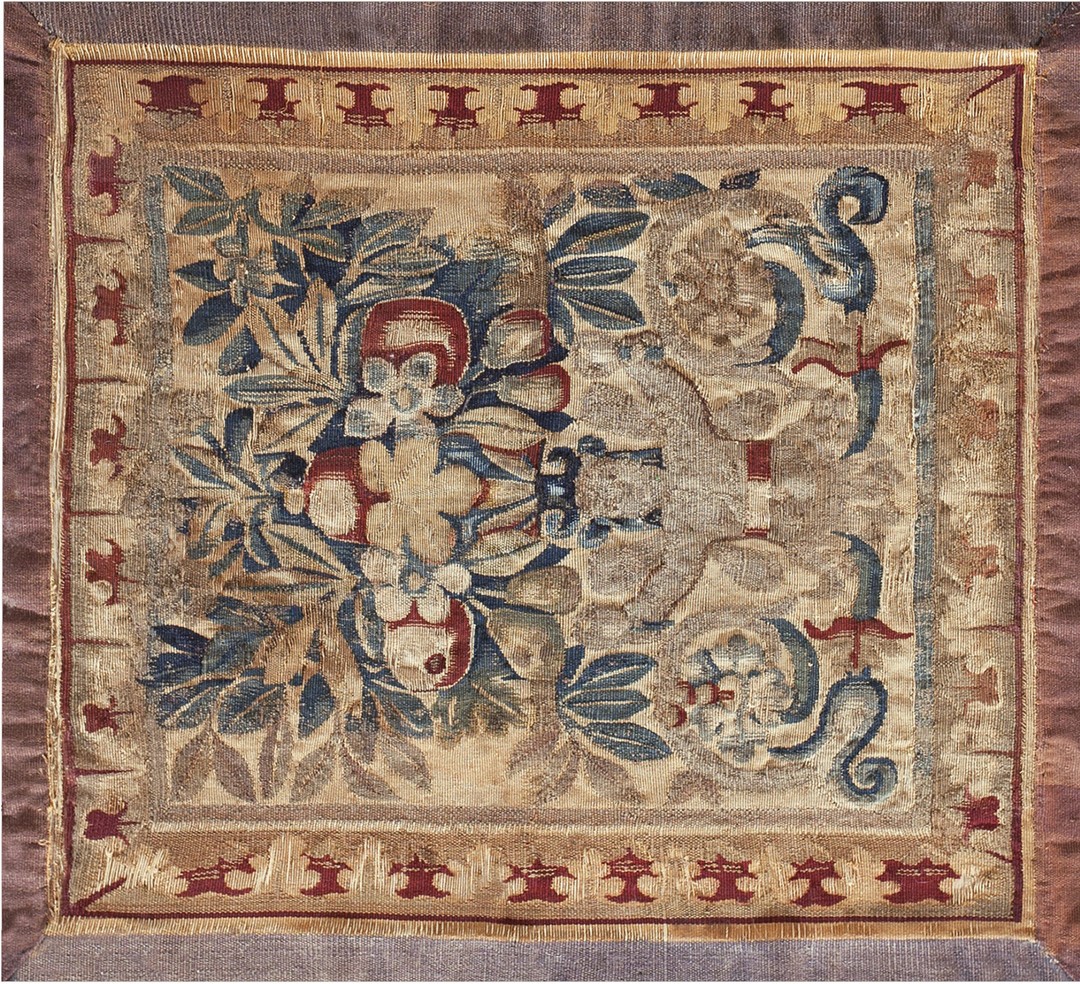
Pair of Scenic Antique 18th Century Beauvais French Tapestries by Rugs On Net
When a ruler presented such a rug to an ally, it was not simply a textile gift but a woven statement of recognition and shared prestige. In short, coat of arms rugs were never anonymous.
They carried a heraldic motif in rugs that proclaimed identity in a medium associated with wealth and refinement. As symbols of heritage, they served both personal and political functions, fusing the art of weaving with the enduring power of heraldry.
Origins and Early History
Where Were the Earliest Armorial Carpets Woven?
The earliest armorial carpets appeared in 14th–15th century Spain, particularly in the weaving centers of Murcia. These workshops were staffed largely by Mudéjar artisans—Muslim weavers working under Christian rule—who applied Islamic weaving expertise to produce textiles that carried Christian heraldic imagery.
One of the most celebrated examples is the so-called Spanish Admiral carpet, named for the prominent family arms woven into its field. These rugs marked the beginning of a tradition in which carpets, like tapestries, became vehicles for heraldic display.
Cross-Cultural Exchange
The emergence of armorial carpets in Spain was a direct product of cultural synthesis. The Mudéjar weavers brought with them centuries of Islamic technical knowledge: complex knotting structures, advanced dye chemistry, and geometric border ornamentation. Their Christian patrons, however, demanded motifs that expressed dynastic identity, civic pride, or institutional allegiance.
The result was a hybrid art form—rugs with heraldic shields framed by Islamic arabesques and geometric medallions. This Islamic–Christian synthesis gave the armorial carpet its distinctive look: European coats of arms rendered with Near Eastern weaving finesse.
Such cross-cultural aesthetics symbolized not only artistic exchange but also the political realities of Iberia, where Christian monarchs relied on the skills of Muslim artisans to create luxury objects for courts, cathedrals, and guild halls.
Who Traditionally Owned Armorial Rugs?
From their earliest history, noble family rugs and royal crest rugs were not commodities for ordinary households. They were bespoke commissions reserved for the elite. Owners included monarchs, aristocrats, high clergy, and municipal institutions. A cathedral chapter might order a carpet with its arms to decorate its choir, while a powerful family displayed its lineage across banquet halls and reception chambers.
By the 16th and 17th centuries, European nobles extended this practice beyond Spain, commissioning armorial carpets from Persian and Mughal workshops. These pieces often blended local textile traditions with European heraldry, reflecting diplomatic ties and the global exchange of luxury goods. Whether woven in Murcia, Isfahan, or Lahore, the defining feature was exclusivity: the heraldic rug was a status emblem, a woven declaration of lineage and power, designed for those at the pinnacle of society.
Evolution and Historical Spread
Medieval Spain: The Admiral Carpets
Among the earliest and most iconic examples of armorial carpet design are the 15th-century Admiral carpets woven in Murcia, Spain. Their defining features include repeated shield devices emblazoned with family or institutional arms, set against bold geometric backgrounds that reflect Islamic patterning traditions.
Many pieces are further framed with Kufic-style borders, a direct nod to the Mudéjar artisans who wove them. The visual hallmarks of the Admiral carpet design therefore combine heraldic shields with Islamic ornament, creating a hybrid style. These carpets served both as prestigious furnishings in noble residences and as visual markers of identity, reinforcing the power of their patrons in civic or courtly spaces.
Safavid Persia, Mughal India, and Diplomatic Gifts
By the 16th and 17th centuries, the practice of weaving coats of arms spread far beyond Iberia. In Safavid Persia, workshops at Kerman and Isfahan produced Persian armorial carpets for foreign patrons, often commissioned as diplomatic gifts.
These rugs retained the lush floral fields and medallion structures of Persian design, but their central medallions carried European coats of arms, making them stylistically distinct from their Spanish counterparts.
Unlike the repeating shields of Admiral carpets, a Persian Kerman armorial rug often highlighted a single, dominant crest framed by scrolling arabesques and rich vegetal ornament. In Mughal India, armorial commissions were likewise tied to diplomacy and commerce. The celebrated Girdlers’ Carpet, presented in 1630 to the Worshipful Company of Girdlers in London, is a prime example.
Its design fuses Mughal floral artistry with the arms of an English guild, demonstrating how heraldic motif in rugs could be adapted to foreign cultural frameworks. Such pieces circulated as luxury gifts, functioning as woven ambassadors between courts and trade networks.
Baroque and Rococo: France and Beyond
The 17th and 18th centuries saw the rise of French Savonnerie armorial carpets, produced under royal patronage for Versailles and other palaces. These rugs epitomized the grandeur of Baroque and Rococo aesthetics, with gilded scrollwork, lush acanthus leaves, and elaborate cartouches framing the royal arms of Bourbon monarchs.
Unlike the austere geometry of Spanish or Persian examples, Savonnerie carpets reveled in theatrical ornamentation. At the same time, the Aubusson workshops specialized in heraldic tapestries and rugs, catering to aristocratic households across Europe.
Here, coats of arms were integrated into broader allegorical and floral schemes, serving as decorative centerpieces that balanced personal identity with courtly taste. These French models influenced aristocratic commissions across Italy, England, and the Habsburg lands, embedding heraldic rugs firmly within the European decorative arts tradition.
Later Adaptations: Qajar Iran, Caucasus, Other Regions
- Qajar Iran (19th century): Rugs prominently featured the lion and sun motif, a national emblem, woven into medallion formats. — Why: to assert dynastic legitimacy and national identity within Persian court culture.
- Caucasus: Bold eagle motif rugs emerged, often abstracted into angular forms. — Why: to align local weaving traditions with imperial Russian and Ottoman heraldic influences.
- England: Axminster carpets for the landed gentry incorporated family crests within neoclassical layouts. — Why: to provide domestic counterparts to the grand Savonnerie style, aligning with Georgian tastes.
These regional variations demonstrate how the heraldic carpet design was never static. Each culture adapted the motif to local aesthetics while preserving the central function: the projection of lineage, authority, or national symbolism.
From the repeated shields of the Admiral carpets to the single crests of Persian Kerman, from the Baroque flourish of French Savonnerie to the emblematic lions, suns, and eagles of later traditions, the armorial carpet became a universal medium for expressing identity across political and cultural boundaries.
Visual Characteristics and Motif Recognition
How Can Beginners Spot Heraldic Motifs in Rugs?
For those new to armorial rug recognition, the easiest clue is the presence of a shield or crest woven prominently into the design. In most cases, a rug with crest will display a bold central medallion or repeated shields that stand apart from typical floral or geometric ornament.
Look for symmetrical arrangements, motto scrolls, and supporters (lions, eagles, or mythological figures) that often flank the arms. Colors, too, provide hints: heraldic tinctures such as gold, red, blue, and black were consistently chosen to align with established coats of arms. These elements, when combined, make spotting heraldic rug motifs much easier, even for beginners.
Spanish Admiral Carpet Visual Hallmarks
The Admiral carpet design of medieval Spain can be recognized by repeated rows of shields distributed across a geometric lattice field. Borders often incorporate Kufic script or pseudo-Kufic patterns, reflecting their Mudéjar craftsmanship.
The shields themselves are simplified but distinct, standing in clear contrast to the repeating ground pattern. This systematic repetition, combined with bold heraldic color blocks, defines the Spanish armorial carpet tradition and differentiates it from later styles.
Persian Kerman Armorial Rug Features
A Persian armorial carpet from Kerman presents a different aesthetic. Rather than repeated shields, it typically features a single, dominant coat of arms or crest set within a lush floral or arabesque medallion.
The surrounding field is densely filled with curvilinear motifs, scrolling vines, and palmettes, hallmarks of Safavid weaving. Where the Admiral carpets emphasized geometric repetition, the medallion carpet motif of Kerman blended heraldic emblems seamlessly into Persian decorative idioms, resulting in a more fluid and painterly rendering of arms.
Borders, Layouts, Color Use
- Borders: Often frame the arms with secondary motifs such as floral scrolls, calligraphy, or geometric repetition. — Why: they reinforce the central emblem while anchoring it within broader design traditions.
- Layouts: Symmetry dominates, with arms placed either in repeated rows (Spain) or within a central medallion (Persia, France). — Why: symmetry underscores the authority and order associated with heraldic imagery.
- Color Use: Rugs follow heraldic tinctures—gold for nobility, red for valor, blue for loyalty, black for constancy. — Why: these colors preserved the symbolic language of coats of arms while ensuring instant recognition.
Knot Types, Weaving Techniques, and Impact on Motif Clarity
- Knot Density: Higher knot counts allow finer detail in shields, mottoes, and heraldic animals. — Why: precision is essential for accurately representing complex coats of arms.
- Knot Type: Spanish weavers often employed symmetrical (Turkish) knots, producing bold outlines, while Persian Kerman workshops used asymmetrical (Persian) knots, enabling curvilinear finesse. — Why: knot type directly shapes whether a crest appears angular or fluid.
- Technique: Use of color gradation and careful outlining ensured clarity of small heraldic devices. — Why: without technical precision, the heraldic symbolism would be lost in abstraction.
Together, these characteristics reveal how to identify an armorial carpet: the shield or crest is always the defining motif, supported by layout, color, and weaving technique that ensure its clarity and authority remain unmistakable.
Materials, Construction, and Durability
What Materials Increase Durability?
The primary heraldic rug materials were chosen according to both function and prestige. Wool was the most common fiber for pile, valued for its resilience, elasticity, and ability to withstand daily use.
Wool retained dyes well, ensuring that heraldic tinctures like red, blue, and gold remained vivid over centuries. For elite commissions, silk was introduced, lending a luminous sheen but sacrificing some durability compared to wool.
In the most luxurious wool vs. silk armorial carpets, silk served decorative rather than functional purposes, often reserved for wall display rather than floor covering.
To heighten opulence, some emblem carpets incorporated metallic threads in rugs, with gold or silver-wrapped silk highlighting crowns, mottoes, or decorative flourishes. While visually striking, these metallic inclusions made rugs less suited to wear, positioning them as ceremonial display objects rather than utilitarian furnishings.
Does Knot Type Influence Heraldic Clarity?
As discussed in relation to visual recognition, knot technique in heraldic carpets directly shaped motif precision. A higher knot density meant sharper outlines for coats of arms, legible motto scrolls, and more lifelike heraldic animals. Spanish workshops employed symmetrical knots, producing bold and angular clarity, while Persian Kerman weavers used asymmetrical knots that allowed fluid curves and delicate shading.
For heraldic rugs in particular, knot choice determined whether a crest appeared schematic or painterly, underscoring the importance of construction in transmitting identity.
How Did Tapestry Heraldry Transition to Pile Carpets?
Before the rise of pile weaving, heraldic emblems were commonly displayed in flatweave tapestries. These textiles provided large surfaces for coats of arms, but the images were woven in weft-faced techniques, limiting depth and textural contrast.
The tapestry to pile rug evolution occurred as courts sought heraldic textiles that combined durability with artistic detail. Pile weaving, especially with fine knot counts, enabled heraldic motifs to achieve greater three-dimensionality, nuanced color blending, and sharper outlines.
This transition reflected not only a technical development but also a shift in prestige: pile armorial carpets were both luxury furnishings and political emblems, rivaling tapestries in grandeur while offering greater intimacy and tactility.
Metallic Threads and Conservation
- Use of Gold and Silver: Metallic-wrapped silk threads highlighted crowns, helmets, and ornamental borders. — Why: these additions emphasized wealth, status, and divine sanction associated with heraldry.
- Fragility Over Time: Metals corrode, tarnish, and weaken surrounding fibers. — Why: this makes preservation particularly challenging compared to plain wool or silk.
- Conservation Practices: Controlled humidity, low light exposure, and minimal handling are essential. — Why: they slow oxidation and prevent fibers from breaking down.
- Museum Methods: Rugs with metallic embellishments are often stored flat and encased in protective mounts. — Why: avoiding folds and stress preserves both structural integrity and visual brilliance.
In every case, the interplay of materials and construction reflects the intended role of the armorial carpet. Wool provided endurance, silk and metallic threads conveyed magnificence, and the knotting technique determined how faithfully heraldic identity could be rendered in woven form.
Symbolism, Cultural Relevance, and Social Status
Why Did Nobility Commission Coat of Arms Carpets?
The practice of the noble carpet commission stemmed from the desire to weave identity into a medium that was both luxurious and visible. For aristocrats and rulers, a coat of arms rug was more than decoration: it was a public assertion of lineage, authority, and permanence. Displaying a crest in a woven carpet transformed a domestic or ceremonial space into a stage of dynastic prestige.
Unlike paintings or tapestries fixed to walls, rugs were portable, allowing heraldic display to travel between palaces, banquets, and diplomatic meetings. As such, status symbol rugs offered a tactile, versatile way to reinforce noble power and communicate rank to all who entered the space.
Diplomacy, Marriage, and Institutional Use
Armorial rug symbolism extended beyond personal vanity into the political and ceremonial realms. Heraldic carpets often accompanied royal marriages, their woven emblems celebrating the union of two families and broadcasting the merging of dynastic power.
In diplomacy, a gift of a heraldic rug from one ruler to another acted as a woven ambassador, embodying recognition, respect, and political alliance.
Institutions also embraced heraldic carpets. Churches displayed armorial designs linked to patrons or ecclesiastical offices; guilds commissioned rugs to commemorate their craft and authority, often embedding their emblems alongside decorative patterns.
In royal courts, heraldic carpets anchored ceremonial spaces—throne rooms, reception halls, or council chambers—where political theater and identity projection were paramount.
Family, Guild, and State Identity
- Family Identity: Heraldic rugs immortalized dynasties by preserving family crests in durable, prestigious form. — Why: they served as legacy objects, tying future generations to ancestral glory.
- Guild Identity: Trade organizations wove their insignia into commemorative carpets. — Why: to assert legitimacy, authority, and pride in shared craftsmanship.
- State Identity: National or civic arms were integrated into carpets for palaces, parliaments, and council chambers. — Why: to materialize abstract political authority in a tangible, everyday form.
Through these functions, identity in carpet design became a hallmark of heraldic weaving. Whether tied to noble families, trade guilds, or entire states, the emblematic rug transformed lineage and allegiance into visible, touchable artistry. The armorial carpet thus operated not only as a work of beauty but as a medium of storytelling, embedding narratives of power, loyalty, and tradition within its knotted threads.
Market, Collecting, and Authentication
How Can Collectors Authenticate Antique Coat of Arms Rugs?
The process of armorial rug authentication combines technical textile analysis with heraldic scholarship. Collectors and specialists examine the foundation materials—wool, silk, or metallic threads—against the expected time period and region.
Knot type and density provide further evidence: Spanish Admiral carpets display symmetrical knots with bold geometric outlines, while Persian Kerman pieces use asymmetrical knots for curvilinear finesse. Equally crucial is heraldic accuracy. A crest or shield must align with historical heraldry, confirming that the rug depicts a legitimate coat of arms rather than a decorative invention.
Finally, supporting documentation, such as period inventories, portraits, or guild records, strengthens the case for authenticity.
What Drives Auction Prices for Heraldic Carpets?
The heraldic carpet auction price is determined by rarity, historical importance, condition, and provenance. Rugs directly tied to prominent patrons or specific commissions command the highest values, as they embody a traceable story. Condition is equally important: intact borders, legible coats of arms, and well-preserved dyes dramatically increase bidding interest.
Beyond physical qualities, market demand often follows the prestige of the associated family, institution, or court—making armorial carpets more than just decorative objects, but artifacts of history.
Documented Provenance and Its Effect on Value
Among collectors, provenance in rugs is critical. A documented lineage tracing an armorial carpet back to its original commission—such as a Savonnerie rug woven for Louis XIV or a Mughal carpet gifted to an English guild—multiplies its value.
Provenance not only reassures authenticity but also ties the carpet to narratives of diplomacy, nobility, or cultural exchange. Without this documentation, even a well-preserved rug may struggle to reach its full market potential.
Comparison: Armorial vs. Floral Savonnerie Rug Prices
In the French tradition, floral vs. armorial carpet price comparisons show a consistent pattern: armorial Savonnerie rugs typically outprice their floral counterparts. While floral carpets demonstrate the aesthetic brilliance of the Savonnerie workshops, heraldic examples are rarer and uniquely tied to individuals or dynasties.
Their singularity makes them irreplaceable, whereas floral designs were often repeated in series. As a result, collectors prize armorial Savonnerie rugs as both masterpieces of design and documents of political history.
Modern Reproductions: Are They a Good Investment?
Today’s reproduction armorial rugs are valued primarily as personalized luxury objects rather than investment-grade antiques. While high-quality reproductions—woven with wool, silk, and fine knotting—can achieve strong decorative and sentimental value, their resale potential is limited. They lack the historical aura and rarity that drive auction demand.
However, for families, institutions, or corporations wishing to preserve identity in textile form, commissioning a reproduction serves as a meaningful expression of heritage, even if it does not promise significant financial return.
Are Reputable Workshops Offering Bespoke Armorial Rugs?
Yes, several bespoke armorial rug workshops operate today, particularly in Europe, India, and China. These workshops combine traditional weaving techniques with heraldic design consultation, allowing patrons to commission rugs bearing their own family crest or institutional emblem.
While not collectible antiques, such pieces extend the tradition of heraldic carpets into the present, continuing the practice of weaving identity and status into the very fabric of a rug.
In every tier of the market—whether antique, auction-grade masterpieces or modern bespoke commissions—the enduring value of armorial carpets lies in their dual role as art objects and identity markers, bridging personal heritage and global history.
Restoration, Legal, and Conservation Issues
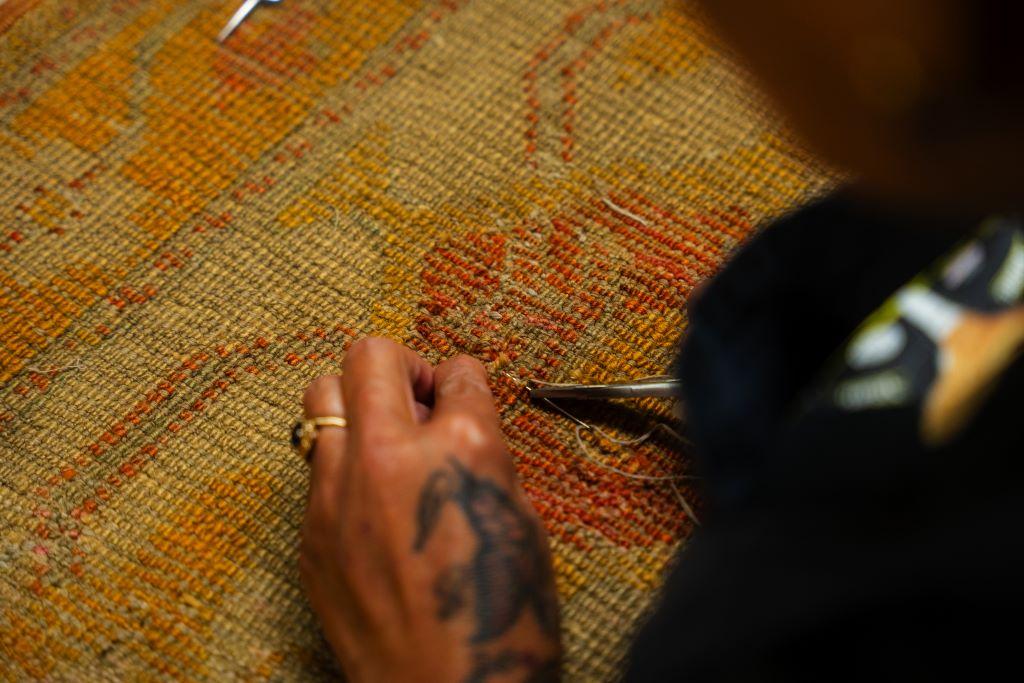
Detail of hands mending a rustic, richly colored woven rug.
Should Restorers Re-weave Missing Shield Details?
The question of restoring armorial rugs—specifically whether missing shield details should be re-woven—remains debated among conservators. On one hand, re-weaving can restore visual integrity, ensuring that the coat of arms remains legible as a symbol of lineage and authority. On the other, heavy intervention risks erasing the authenticity of the original weaving, substituting modern interpretations for historical truth.
Current restoration best practices lean toward minimal intervention: stabilizing existing threads, conserving surrounding structure, and only re-weaving when necessary to prevent structural collapse or catastrophic visual loss. Where re-weaving occurs, it is usually distinguishable upon close inspection, preserving transparency about what is original and what is restored.
Can Artisans Legally Reproduce Another Family’s Arms?
The reproduction of heraldic emblems in textiles raises legal and ethical questions. In many jurisdictions, coats of arms remain protected under heraldic law or intellectual property statutes. Unauthorized use of another family’s crest in a rug may be treated as heraldic carpet copyright infringement or as a breach of heraldic regulation.
For example, in the United Kingdom, arms are registered and regulated by the College of Arms, while similar institutions exist in parts of Europe. Artisans weaving a rug with another family’s arms without consent risk legal repercussions as well as accusations of cultural appropriation. The accepted practice is to produce bespoke armorial rugs only for verified clients with legitimate rights to the heraldic emblem.
Conservation Methods for Metallic Threads
As discussed in material analysis, rugs with gold- or silver-wrapped silk fibers demand special care. Metallic thread conservation rugs require environments with stable humidity and low light, as fluctuations accelerate tarnish and fiber degradation. Handling should be minimized, with storage flat and stress-free to avoid breaking delicate filaments.
Museums often employ protective mounts, layered archival materials, and climate-controlled cases to ensure longevity. These measures protect not only the metallic highlights but also the heraldic clarity of crests, crowns, and motto scrolls that rely on these threads for emphasis.
In sum, conserving and reproducing heraldic carpets involves more than technical skill—it requires ethical consideration, legal awareness, and adherence to conservation science. The shield and crest motifs that make these rugs unique must be preserved with both reverence for authenticity and respect for heraldic law.
Modern Legacy and Design Adaptation
Decline in European Demand
The widespread popularity of armorial carpets in Europe waned after the late 18th century. The upheavals of the French Revolution marked a turning point, as aristocratic commissions and royal patronage—once the lifeblood of armorial production—collapsed alongside the old order.
With industrialization in the 19th century, rug manufacture shifted toward broader markets, favoring repeatable floral and geometric designs rather than singular heraldic commissions. By this period, the collector armorial carpet became a rarity, valued as a relic of pre-Revolutionary prestige rather than a contemporary furnishing.
How Armorial Motifs Persist in Modern Rugs
- State and Institutional Carpets: Government halls, parliaments, and universities still commission modern armorial rugs bearing national or institutional arms. — Why: these carpets reinforce continuity of authority and embody institutional heritage.
- Bespoke Family Rugs: Wealthy patrons today commission bespoke family rugs with crests or monograms. — Why: the practice revives a sense of lineage and offers heirloom-quality furnishings tied to personal identity.
- Heritage Rug Design in Decor: Contemporary designers adapt heraldic motif revival patterns—stylized shields, crests, or emblematic borders—into broader rug collections. — Why: this introduces a touch of aristocratic ambiance into modern interiors, even for clients without personal coats of arms.
Interior Design Uses and Collector Appeal
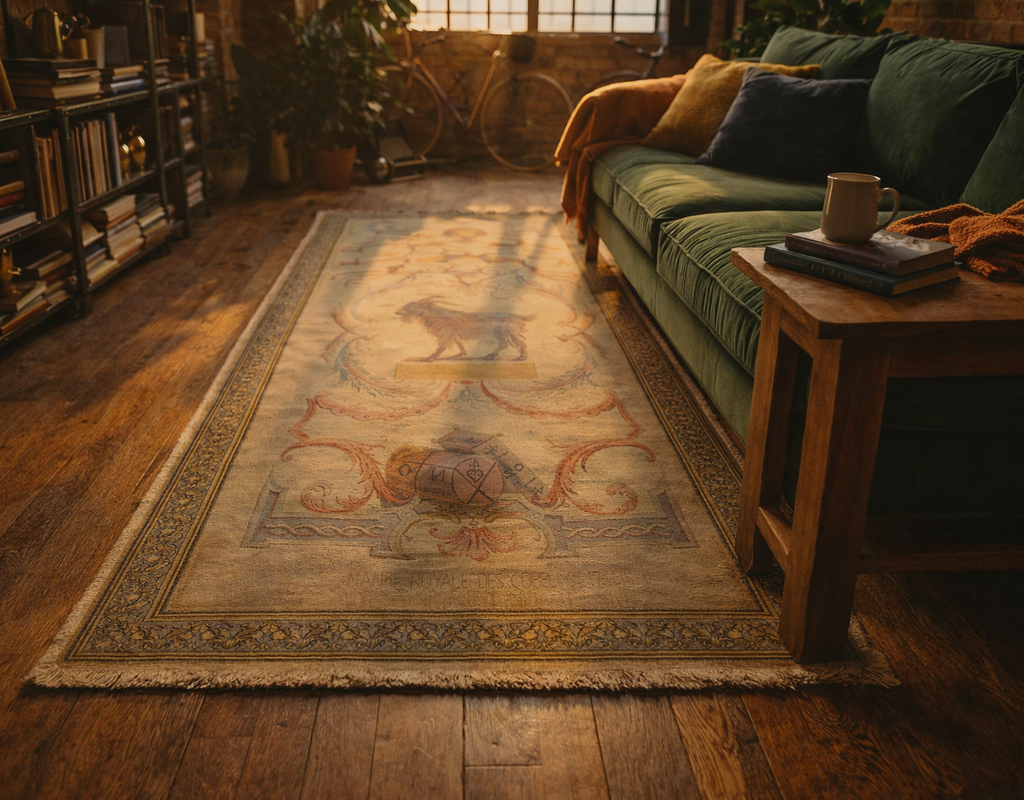
Golden hour lighting highlights the texture of the velvet couch and the detailed tapestry-style rug.
- Interior Design Applications: Heritage rug design functions as a focal point in spaces intended to convey tradition or prestige, such as libraries, studies, and ceremonial halls. — Why: the heraldic crest offers immediate visual gravitas and storytelling value.
- Collector Interest: Collectors prize armorial carpets for their historical narratives and uniqueness. — Why: each piece, tied to a family, guild, or ruler, carries a traceable story that elevates it beyond purely decorative textiles.
- Decorative Impact: A collector armorial carpet can dominate a room’s visual scheme, combining heraldic symbolism with artistic beauty. — Why: unlike generic floral designs, these rugs assert identity and history, making them conversation pieces as well as art objects.
Although no longer woven in the vast numbers seen in Baroque or Rococo France, the modern armorial rug retains a powerful niche.
Whether as bespoke heirlooms, institutional commissions, or heritage-inspired design statements, heraldic carpets continue to embody identity, prestige, and tradition—ensuring that the emblematic crest remains alive in textile form, centuries after its aristocratic origins.
Explore a few of our favorite Coat of Arms rugs
FAQ
- How should I store coat of arms rugs?
Roll (never fold) with acid-free interleaving, wrap in breathable materials, and keep in a cool, dark, dry space. Avoid basements and plastic that traps moisture.
- Where can I buy coat of arms rugs in the US?
Check reputable dealers and major auctions; review condition reports, restoration notes, and return policies. Ask for dye tests and UV photos when possible.
- Where can I see coat of arms rugs in the US?
The Met (New York) displays Savonnerie and Polonaise; Cleveland Museum of Art shows royal Savonnerie; Philadelphia Museum of Art exhibits a Spanish “Admiral” carpet.
- How do I authenticate and insure coat of arms rugs?
Get a written appraisal from a qualified specialist, with photos of the arms and condition notes. Schedule valuables on your homeowner’s policy.
- What’s the difference between heraldic tapestries and coat of arms rugs?
Tapestries are woven wall textiles; coat of arms rugs are floor coverings (knotted, tufted, or needlepoint). Rugs require pads and traffic-aware care.
- Are robot vacuums safe for heraldic rugs with fringe?
Use no-go zones and tuck fringe under; robots can tangle tassels or scuff edges. Manual vacuuming with suction-only is safest for fringed coat of arms rugs.
- Can coat of arms rugs work in contemporary interiors?
Definitely—pair a simplified, monochrome heraldic motif with neutral palettes. One bold armorial centerpiece anchors minimalist rooms.
- Where do coat of arms rugs look best at home?
Formal dining rooms, libraries, and entries showcase heraldic centers well. Common sizes like 8×10 or 9×12 frame the arms without crowding furniture.
- Do modern machine-made coat of arms rugs exist?
Yes—digitally printed or power-loomed options offer fast turnaround and lower cost. They’re practical for events, offices, or kids’ rooms.
- How can I estimate the age of coat of arms rugs?
Check materials, construction, and dyes; synthetic aniline dyes appear after the 1850s. Earlier pieces typically use natural dyes and period-correct heraldry.
- Are antique coat of arms rugs valuable?
Yes—armorial antiques can realize five- to six-figure prices. Value depends on age, condition, workshop, and documented provenance.
- Who verifies the accuracy of heraldry for coat of arms rugs?
In the UK, the College of Arms (England/Wales) or Lyon Court (Scotland) can confirm or grant arms. Provide your lineage or blazon before weaving.
- Is it legal to put someone else’s arms on coat of arms rugs?
It depends on jurisdiction. In Scotland, unauthorized arms use is a criminal offense; elsewhere, trademark and misrepresentation risks remain—get permission or a grant first.
- How much do custom coat of arms rugs cost?
Expect roughly \$30–\$70 per sq. ft. for hand-tufted and \~\$90–\$160+ per sq. ft. for hand-knotted. An 8×10 hand-knotted may run \$7,000–\$16,000+.
- Can I commission a custom coat of arms rug?
Absolutely. Provide vector artwork or a clear blazon; typical lead times are \~8–16 weeks for hand-tufted and \~3–5 months (or more) for hand-knotted.
- Do I need a pad under coat of arms rugs?
Yes—use a felt-and-natural-rubber pad to prevent slip and reduce wear. Avoid cheap PVC pads that can off-gas and discolor hardwood finishes.
- How do I protect heraldic rugs from fading if I hang them?
Limit light to roughly 50–100 lux, use UV-filtering glazing, and keep relative humidity near 45–55%. Rotate displays periodically to reduce cumulative light exposure.
- How should I clean coat of arms rugs at home?
Vacuum with suction only (no beater bar) and blot spills with cool water and a wool-safe detergent. Schedule professional cleaning as needed and rotate the rug every 6–12 months.
- Are coat of arms rugs durable enough for high-traffic areas?
Antique heraldic rugs are best for low-traffic, formal spaces. For busy rooms, choose new wool coat of arms rugs; wool resists soiling and recovers pile better than viscose.
- How can I identify authentic coat of arms rugs?
Examine weave (hand-knotted or needlepoint), dye quality, heraldry accuracy, and age signs. Provenance documents and museum or auction references significantly boost confidence.
- What materials do coat of arms rugs typically use?
Most armorial rugs are wool; some elite pieces use silk and even metal-wrapped silk (e.g., Polonaise). Silk highlights and gilt brocading appear on 17th-century masterpieces.
- Which weaving centers are best known for heraldic rugs?
Coat of arms rugs are associated with Savonnerie (France), Axminster (England), Spanish “Admiral” carpets, and Persian Kerman/Polonaise pieces incorporating arms.
- Are coat of arms rugs always antique?
No—armorial rugs exist from the 15th century to today. You’ll find antiques in museums and modern custom pieces from hand-tufted to hand-knotted constructions.
- Where did coat of arms rugs originate?
Coat of arms rugs emerged across Europe and Persia, notably Spanish medieval “Admiral” carpets, French Savonnerie, English Axminster, and Persian Kerman commissions for European patrons.
- What are coat of arms rugs (a.k.a. armorial rugs)?
They’re rugs featuring heraldic shields, crests, and supporters integrated into the pattern. Historic examples include Spanish “Admiral” carpets and French Savonnerie pieces with royal arms.