
Introduction to Khotan Rugs
Elevate your home décor when you explore our curated selection of luxury hand-knotted pile rugs available now.
Defining Khotan Rugs & Etymology
Khotan rugs, more widely known as Khotan rugs, are a distinctive category of oriental carpets that emerged from the Silk Road city of Khotan in present-day Xinjiang, Western China. The name “Khotan” is itself a layered term, combining the word “knot”—a reference to the hand-knotted construction technique central to all traditional carpets—with the historic place-name “Khotan.”
This duality captures both the material essence of the rugs and their geographic origin, underscoring their identity as works of craftsmanship deeply rooted in place. Unlike names tied purely to design or region, “Khotan” expresses both the act of weaving and the cultural geography of the carpets.
The terminology reminds us that these are not factory pieces but carefully knotted textiles embodying the labor and artistry of generations of Khotan weavers. Over time, the word has become a shorthand for the hybrid, richly cosmopolitan style that Khotan rugs represent.
Where is Khotan on the Silk Road?
Khotan was one of the great oasis cities of the southern Silk Road, situated on the southern edge of the Taklamakan Desert in Xinjiang. Its strategic location placed it at the junction between Chinese dynasties, Central Asian khanates, and Persian empires.
Caravans carrying silk, jade, spices, and wool stopped in Khotan, making it both a thriving trade hub and a cultural melting pot. This crossroads geography explains the eclectic artistry of Silk Road oasis rugs produced in Khotan.
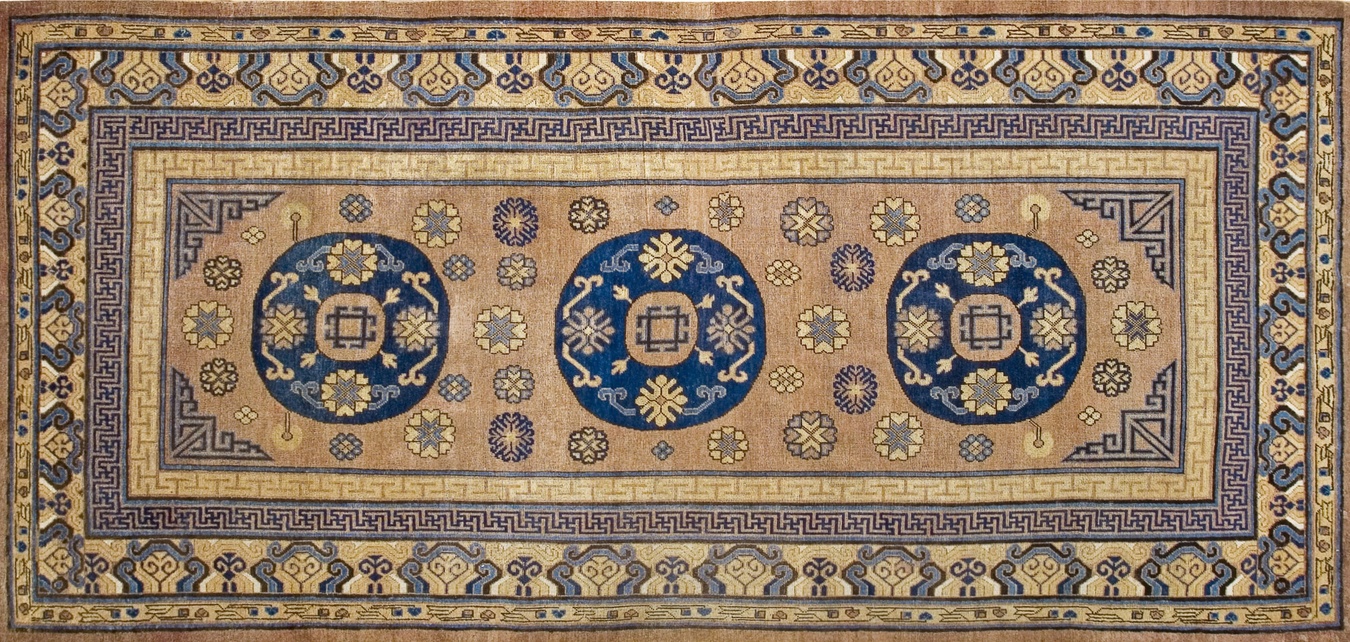
While some rugs traveled further west through Samarkand before reaching Persian markets, their identity was tied to the Khotan workshops. The city’s reputation as a carpet center rested on its ability to fuse influences brought by merchants, pilgrims, and artisans who passed through its bazaars.
What Distinguishes Khotan Rugs from Other Oriental Rugs?
The singularity of Khotan rugs lies in their hybrid oriental rug styles, combining motifs and structures from multiple traditions while remaining instantly recognizable as a Central Asian product.
Unlike Persian carpets, which often emphasize curvilinear arabesques and floral all-over designs, or Chinese carpets, which lean toward symbolic medallions and restrained borders, Khotan carpets merge both approaches.
Key distinguishing features include:
- Medallion layouts reminiscent of Persian and Central Asian rugs.
- Chinese-influenced borders featuring fretwork, cloud bands, and lotus motifs.
- Geometric and symbolic patterns such as pomegranate trees, Buddhist symbols, or Central Asian lattice forms.
- A balanced aesthetic that avoids the density of Persian designs and the austerity of Chinese models, creating a middle ground unique to Khotan.
Because of this fusion, Khotan rugs stand apart from single-tradition carpets. They represent the cosmopolitan identity of the Silk Road, where artistic vocabularies were constantly exchanged.
Their weavers did not simply borrow motifs but transformed them into a cohesive visual language that reflected Khotan’s position at the cultural crossroads of East and West.
A Crossroads of Design and Trade
To understand Khotan carpets, one must see them as products of both geography and history. The city’s oasis location ensured access to wool from nomadic herders, dyes from local plants and imported sources, and a steady demand from merchants who wanted rugs suitable for export.
While many Khotan rugs passed through Samarkand on their way to Persia or Europe—leading some to mistakenly call them “Samarkand rugs”—the true creative heart was in Khotan itself.
Thus, Khotan rugs are best defined as Central Asian carpets of hybrid oriental style, born of the Silk Road’s constant exchange. They are not merely decorative objects but living testaments to how trade routes shaped material culture. Each rug embodies the knots of its maker and the knots of connection that tied Khotan to China, Persia, and the wider world.
Geographic and Cultural Origins
The Oasis of Khotan
At the southern edge of the Taklamakan Desert, Khotan flourished as one of the most important oasis cities of the Silk Road. Fed by rivers descending from the Kunlun Mountains, the fertile strip allowed agriculture, trade, and craftsmanship to thrive despite the desert’s harsh surroundings.
This unique geography made Khotan not only a survival hub but also a cultural and trade center, linking merchants and pilgrims from China, Central Asia, Persia, and India.
The city’s economy revolved around silk weaving, jade carving, and wool production, but it was the weaving of carpets that showcased Khotan’s ability to absorb and reinterpret external influences.
Merchants traveling along the Silk Road carried not just goods but ideas—new dyes, patterns, and weaving techniques—that were integrated into the distinctive artistry of Khotan rugs.
Silk Road Cultural Fusion
The Silk Road rug trade played a defining role in shaping the design vocabulary of Khotan carpets. Trade routes ensured the constant flow of materials and inspiration:
- Imported dyes such as indigo and cochineal enriched local palettes.
- Persian motifs like palmettes and medallions found their way into carpet fields.
- Chinese symbols including lotus blossoms, fretwork borders, and cloud patterns reflected eastern influence.
- Turkic and Mongol geometric structures contributed bold angularity.
- Tibetan and Indo-Iranian ideas infused spiritual and floral elements.
The result was not a patchwork but a cohesive hybrid style, where external ideas were adapted into forms that became identifiably “Khotan.” This cultural layering explains why Khotan rugs are so distinct: they embody centuries of exchange, with each knot recording the cosmopolitan essence of the Silk Road.
Xinjiang’s Regional Context
Khotan was not an isolated weaving center but part of a larger network across Xinjiang, historically known as East Turkestan. Alongside Khotan, the cities of Kashgar and Yarkand were major carpet-weaving hubs. Each developed its own recognizable style while sharing motifs through trade and migration.
- Khotan rugs tended toward medallion or “pomegranate tree” designs, with softer palettes and a balanced blend of Persian and Chinese motifs.
- Kashgar rugs often emphasized geometric precision, bold contrasts, and tribal patterns.
- Yarkand rugs favored more spacious fields and refined detail, often appearing lighter in tone.
Together, these Central Asian weaving centers created a regional family of rugs, unified by Silk Road cultural exchange but differentiated by local taste and tradition.
Khotan, Kashgar, Yarkand, Samarkand
The term “Samarkand rug” has often been used as a catchall trade label for carpets from Khotan, Kashgar, and Yarkand, even though Samarkand itself—located further west in present-day Uzbekistan—was primarily a commercial hub rather than a weaving center. Rugs woven in Xinjiang frequently passed through Samarkand’s markets on their way to Persia, Russia, or Europe, acquiring the label “Samarkand carpets” in the process.
This explains why Khotan rugs are sometimes called Samarkand carpets: they were marketed through that city, even though the actual weaving traditions belonged to the Xinjiang oases. Distinctions remain clear to specialists, however. Khotan rugs are recognized for their hybrid Persian-Chinese designs and muted colors, while Samarkand rugs—as a broader category—include pieces from Kashgar and Yarkand that may differ in technical weave, knot density, and color palette.
In this way, the Silk Road rug trade did not just move textiles; it shaped their very identity. Regional variants evolved by borrowing shared motifs but maintained individuality through local adaptations. The result is a spectrum of carpets—Khotan, Kashgar, Yarkand—all historically linked to Samarkand’s markets yet each carrying its own unique weaving heritage.
Design Characteristics of Khotan Rugs
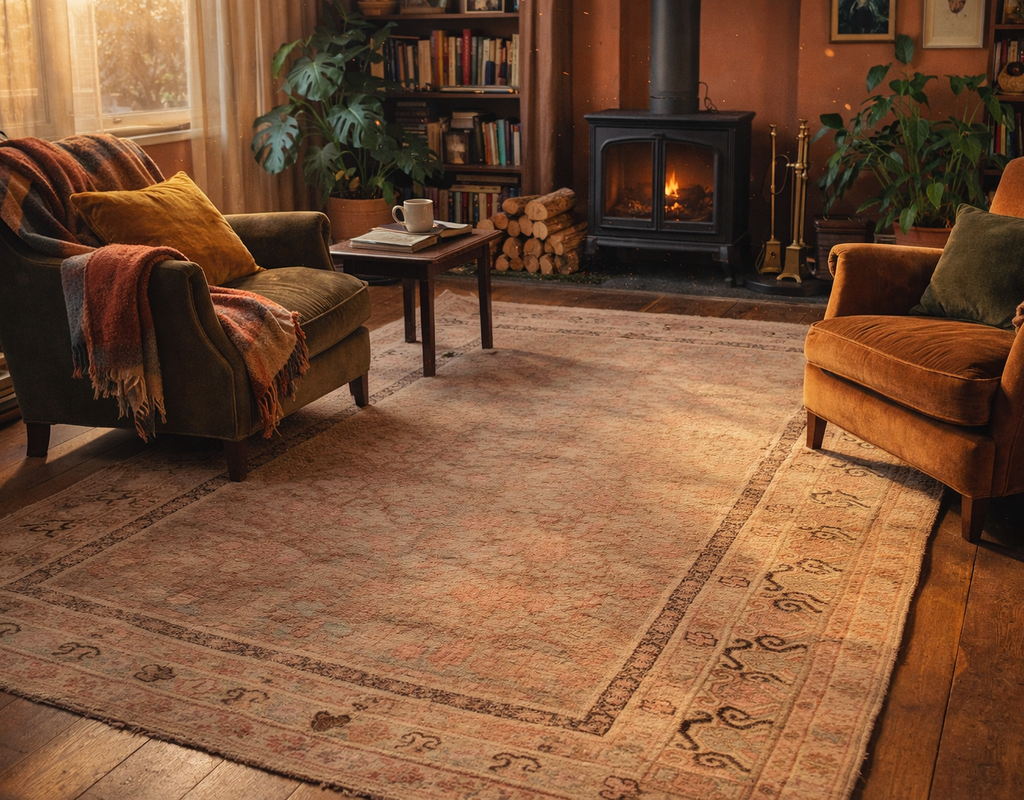
A sunlit corner boasting comfort with plush seating atop a faded, traditional area rug.
Signature Motifs
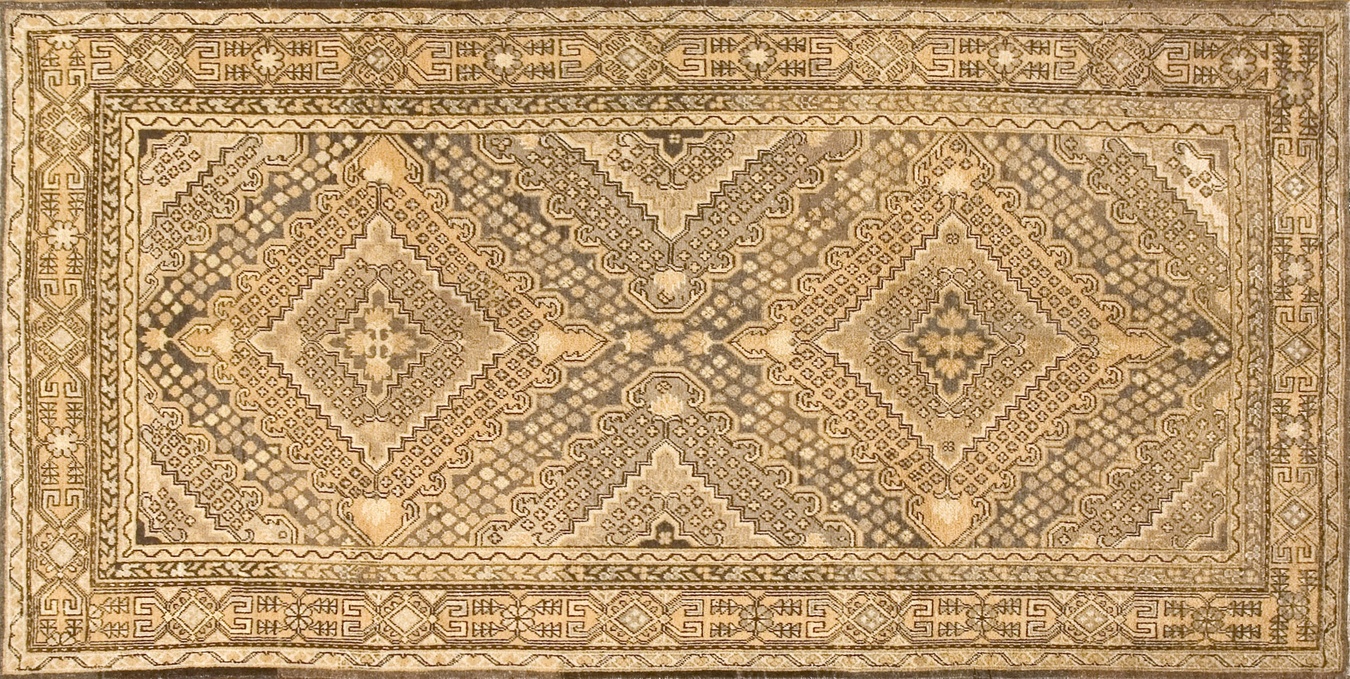
Antique Khotan Allover Geometric Hand Knotted Pile Rug – by Rugs On Net
- Circular medallions — These dominate the fields of many antique Khotan rug motifs, often arranged in rows of three across the central axis. Medallions reflect Persian influence, but their bold geometry also ties them to Central Asian tribal traditions. — Why: They serve as focal anchors, symbolizing harmony and balance across the carpet’s surface.
- Pomegranate tree designs — Stylized vases sprouting pomegranate branches are one of the most recognizable Khotan signatures. — Why: The pomegranate design represents fertility, abundance, and prosperity, connecting Chinese symbolism with Persian garden imagery.
- Guls and Herati patterns — Borrowed from Turkmen and Persian weaving, guls provide geometric strength, while Herati motifs add flowing symmetry. — Why: They link Khotan weaving to broader Central Asian carpet traditions while softening the field with repeating rhythm.
- Cloud bands and lotus blossoms — Motifs adopted from Chinese art, often floating across the carpet’s surface or worked into the border. — Why: They bring celestial and spiritual associations, underscoring Khotan’s connection to Chinese symbolism.
- Greek key and swastika fretwork — The borders frequently feature Khotan border patterns of interlocking lines, continuous scrolls, or swastika-like arrangements. — Why: The Greek key conveys infinity and continuity, while the swastika fret, an ancient Asian symbol, represents eternity, good fortune, and cosmic order.
Layouts: Medallion, Pomegranate, Lattice
Khotan weavers developed a set of field structures that distinguish their work from other oriental rugs. The medallion layout, usually three round medallions running lengthwise, reflects Persian precedent but rendered with Central Asian boldness.
The pomegranate vase layout is unique to Khotan, symbolizing prosperity and renewal through stylized tree-of-life imagery.
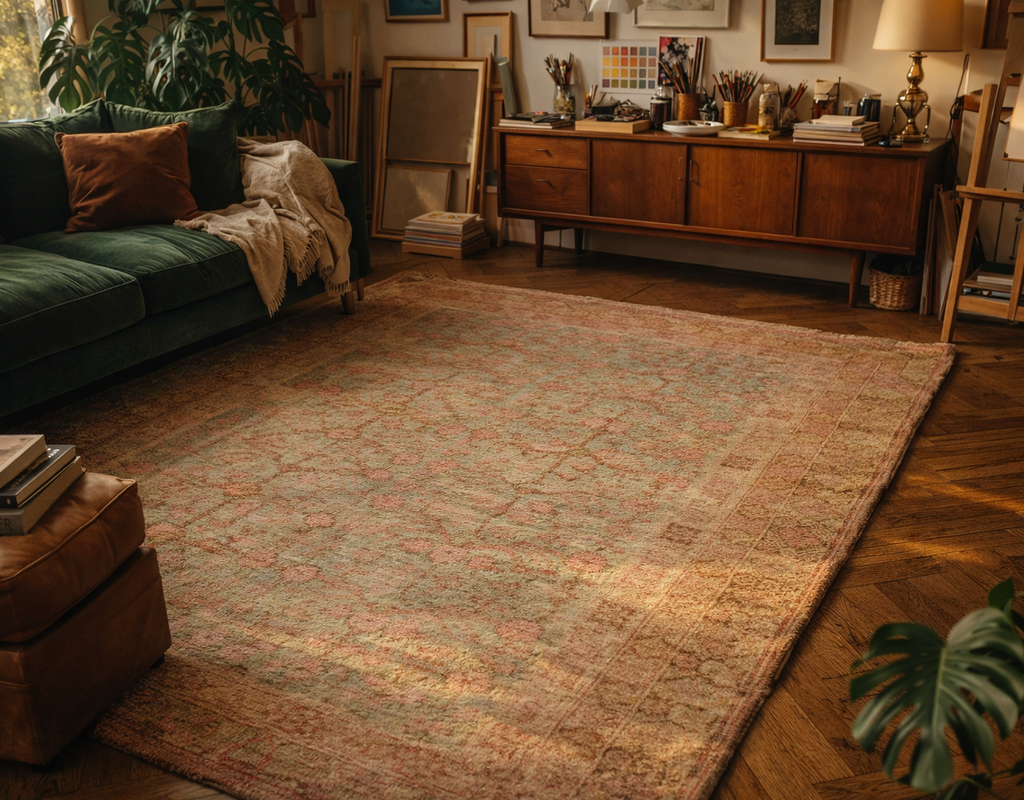
A cozy, art-filled room blending deep jewel tones with faded vintage textiles.
The lattice layout—fields divided into interlocking diamonds or lozenges—reveals both nomadic Turkic geometry and Chinese garden influences, resulting in a hybrid visual framework rarely found outside the region.
Borders: Greek Key, Swastika Fret, Lotus, Vine Scrolls
The borders of Khotan rugs frame the interior field with rich symbolism. The Greek key meander suggests infinite continuity, a motif tied to both Mediterranean and Central Asian artistic vocabularies.
The swastika fretwork, used long before its modern misappropriation, was a sacred symbol of eternity and auspicious fortune in Buddhist and Central Asian contexts. Lotus and peony blossoms in the borders show Khotan’s deep Chinese artistic heritage, representing purity, longevity, and renewal.
Vine scrolls and arabesques echo Persian design, filling borders with rhythmic flow and balance. The synthesis of these motifs turns every border into a cultural archive of Silk Road exchanges.
Traditional and Modern Colors
The Silk Road color palette of antique Khotan rugs was rich yet controlled. Natural dyes created tones such as lacquer red, Tibetan crimson, deep indigo, warm gold, earthy brown, saffron yellow, and creamy ivory.
Cochineal and indigo were imported through trade, while safflower and other vegetal dyes were locally sourced. In the late 19th century, synthetic dyes introduced bright oranges, magentas, and purples, which transformed the look of many Samarkand-exported carpets.
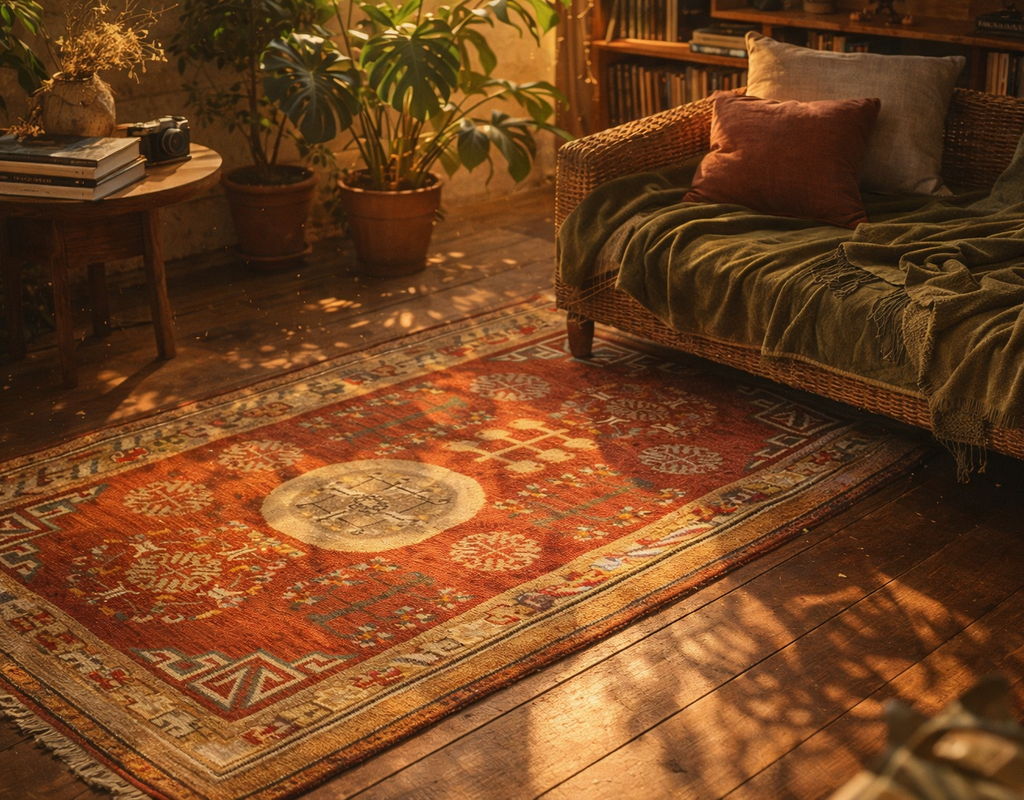
Golden hour light streams across a richly patterned, warm-toned rug and natural fiber furnishings.
Contemporary Khotan reproductions often return to the traditional palette, emphasizing reds, blues, and creams, while occasionally using softer, modern neutrals to meet global interior tastes.
Khotan vs. Samarkand Design
While the terms “Khotan rug” and “Samarkand rug” are often used interchangeably, specialists distinguish them by design emphasis. Khotan rugs favor medallion and pomegranate tree layouts, softer palettes, and a deliberate blending of Persian and Chinese influences.
Samarkand rugs, used as a broader trade category, may incorporate Kashgar or Yarkand styles, often with bolder tribal motifs, geometric all-over layouts, and more experimental use of color. In essence, Khotan designs are centered on medallions and prosperity symbols, while Samarkand encompasses the wider Central Asian rug spectrum, marked by diversity and regional adaptation.
Materials and Construction
Wool, Silk, Cotton: Sources and Use
The hallmark of Hotan wool rugs is the lustrous, durable wool sourced from local Kirghiz and other regional sheep herded in the steppes and foothills of Xinjiang. This glossy wool provides a resilient pile with a sheen prized by collectors.
While wool is the primary material, silk pile carpets were also produced in Khotan, especially for elite or export markets, showcasing the city’s renown as a Silk Road weaving hub.
The foundation of most pieces used cotton warps for structural stability, with wool or mixed cotton wefts to secure rows of knots. This careful combination of materials gave Khotan rugs their balance of strength, pliability, and luminous finish.
Weaving Technique: Knots, Density, Looms
Khotan carpets employed the asymmetrical Persian knot (also known as the Senneh knot), distinguishing them from the symmetrical Turkish knot used in many other Central Asian traditions. Knot density typically ranged between 30–80 knots per square inch (kpsi), depending on the workshop and intended market.
This density allowed for a level of detail that accommodated both bold medallions and intricate border motifs. The looms were generally horizontal, set up in village or workshop contexts, and adapted to produce long, narrow rugs with classic 2:1 proportions, suited for Central Asian interiors.
Rug Sizes, Ratios, and Structural Features
One of the unique features of Khotan weaving was its preference for elongated formats, often two times longer than wide, making them well-suited to the layout of oasis homes and caravanserai halls.
The construction was sturdy, often reinforced with multiple wefts between knot rows, which increased durability and allowed the rugs to endure heavy use in both domestic and commercial spaces. These structural traits, along with the glossy wool, gave Khotan rugs a dense yet flexible handle that differentiated them from neighboring Kashgar or Yarkand products.
Knot Density’s Effect on Value
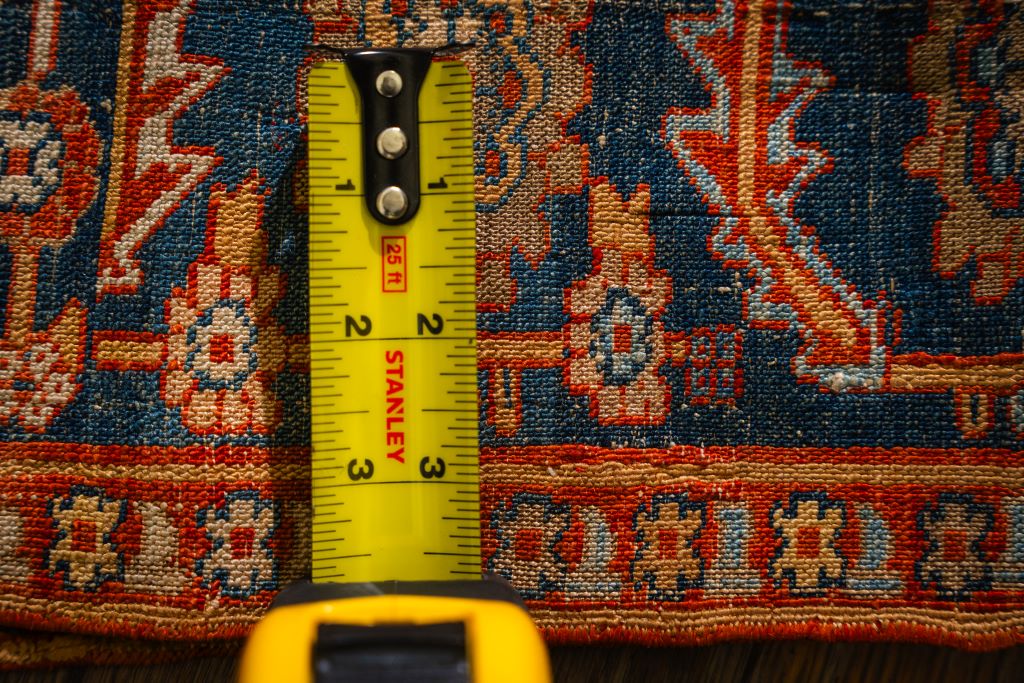
A detailed inspection of a richly colored oriental rug pattern while measuring its dimensions.
The role of Khotan rug density in determining value is nuanced. Higher knot counts generally allow for finer detail and greater precision in motifs, which can raise a rug’s desirability and resale price. However, knot density is not the sole determinant of value.
Other rug value factors include age, condition, rarity of design, use of natural dyes, and provenance. A coarser antique Khotan carpet with rare pomegranate tree motifs might command more on the market than a finely knotted but more generic design. Collectors prize not just technical refinement but also cultural and artistic distinctiveness.
Regional Weaving Variations
Though unified under the identity of Khotan rugs, weaving practices varied across Uyghur counties of southern Xinjiang. Workshops in Khotan city emphasized hybrid Persian-Chinese designs with balanced knotting. Rural counties surrounding Hotan Prefecture sometimes favored thicker piles and sturdier weaves suited to local use, while Kashgar and Yarkand wove with slightly different proportions and palette choices.
The Hotan Carpet Workshop, established in the 20th century to preserve weaving traditions, helped consolidate and revive regional techniques, ensuring the survival of patterns, dye recipes, and knotting methods that might otherwise have been lost to mechanized production.
In sum, Khotan carpets are defined by their material quality, Persian knot construction, and strong yet supple structure, making them enduring examples of Silk Road craftsmanship and cultural synthesis.
Historical Evolution of Khotan Rug Weaving
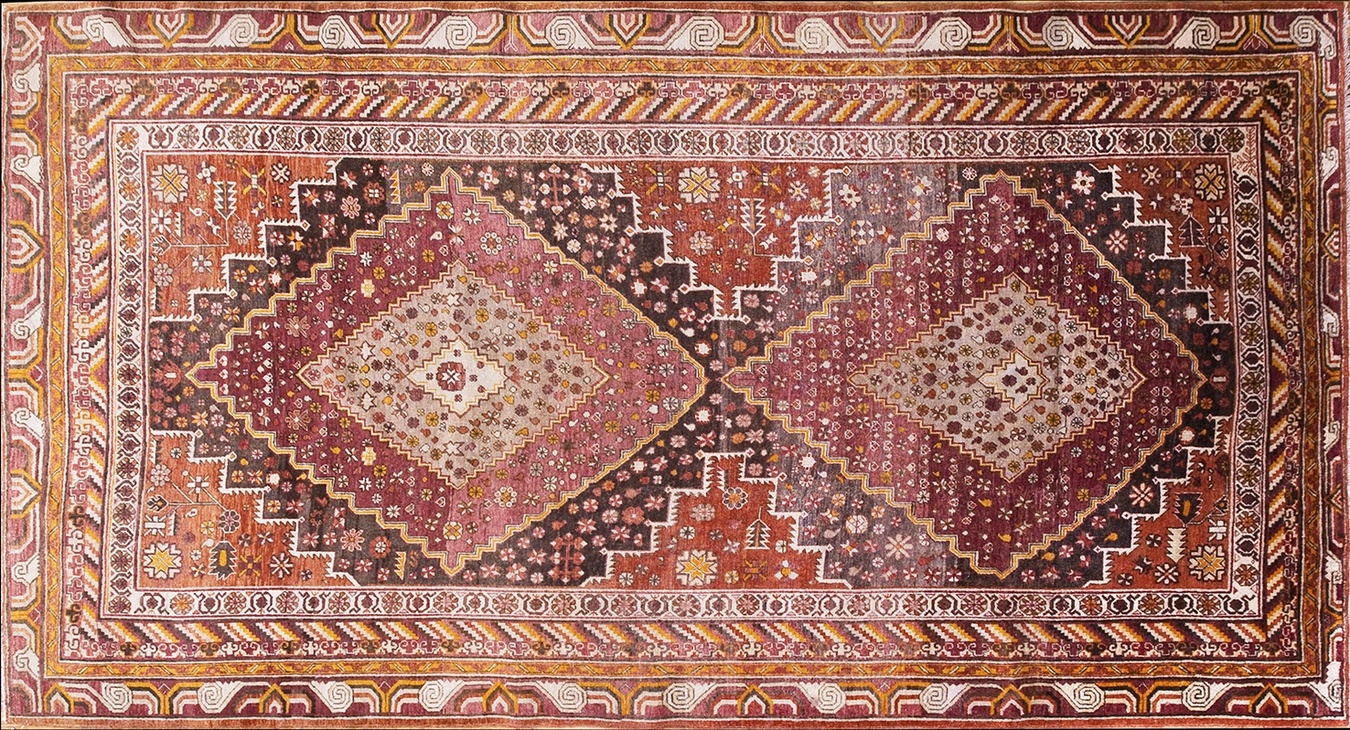
Antique Khotan Room Size Wool Brown Rug – by Rugs On Net
Ancient Origins and Archaeological Finds
The roots of Hotan carpet history reach back nearly two millennia. Archaeological excavations in the Tarim Basin have uncovered carpet fragments dating from the 3rd–6th centuries CE, providing evidence of early pile weaving in the region. These remnants, preserved in desert sands, demonstrate that Khotan was producing knotted textiles long before many other Central Asian centers.
Chinese historical records from the Tang Dynasty (7th–10th centuries) also mention the quality of carpets from Khotan, confirming that weaving was already an established and recognized tradition. This deep antiquity makes Khotan’s weaving legacy among the oldest rug traditions in Asia, linking it to the Silk Road’s earliest artistic exchanges.
Medieval and Qing Dynasty Weaving
While Khotan’s weaving continued through the medieval Islamic period, its true golden age began under Qing Dynasty rugs production in the late 18th century. After the Qing conquest of Xinjiang in the 1750s, the region enjoyed relative stability and increased imperial attention. The Qing court valued the artistry of Khotan carpets, and political patronage encouraged expanded production both for local use and for export.
The influx of merchants and the strengthening of Silk Road trade under Qing administration helped spread Khotan’s reputation, turning it into a leading producer of hybrid Persian-Chinese carpets.
Rise and Significance of the Hotan Carpet Workshop
The Hotan Carpet Workshop occupies a central place in both the historic and modern story of Khotan weaving. Originally organized to preserve traditional designs and production methods, it served as a training ground for new generations of weavers. By consolidating local techniques—whether medallion layouts, pomegranate trees, or distinctive border patterns—it ensured continuity in artistry.
In modern times, the workshop became a state-supported enterprise, exporting carpets abroad and keeping ancient Khotan weaving alive in an era of industrialization. Its enduring significance lies in its dual role as a cultural preserver and a commercial exporter, bridging heritage and global markets.
Introduction of Synthetic Dyes
The synthetic dye use in rugs began in Khotan around the 1870s, following broader chemical innovations in Europe. These new aniline-based colors brought bright oranges, magentas, and purples into the Khotan palette, expanding the range beyond traditional vegetal dyes such as indigo, safflower, and madder. While the vivid hues appealed to some export markets, they also introduced issues of fading and color instability. Collectors today often favor naturally dyed Khotan carpets, considering them superior in depth and longevity. Nonetheless, synthetic dyes represent a pivotal shift in the region’s weaving history, reflecting changing tastes and the pressures of global trade.
20th-Century Changes and Modern Revival
The 20th century brought upheavals that disrupted traditional carpet production. Political instability, economic decline, and shifting global demand caused weaving to wane in the early decades. Yet, beginning in the mid-century, efforts to revive the industry gained momentum.
The Hotan Carpet Workshop, along with independent weavers in surrounding counties, reestablished Khotan as a key producer. Today, both antique and newly woven Khotan rugs continue to circulate on international markets, their Silk Road legacy intact. In summary, rug weaving began in Khotan as early as the 3rd century CE, flourished under Qing Dynasty patronage, and was safeguarded through the Hotan Carpet Workshop.
The introduction of synthetic dyes after 1870 altered its palette, while the 20th century witnessed decline and revival. The story of Khotan carpets is thus one of resilience, adaptation, and continuity across centuries.
Regional & Workshop Variations
Uyghur County Weaving: Local Differences
Within Xinjiang’s Uyghur rug weaving tradition, each county developed subtle yet meaningful variations that specialists and collectors recognize. Hotan city workshops favored refined medallion and pomegranate-tree designs, often with silk pile and precise knotting. Surrounding Hotan county carpets leaned toward wool foundations, denser pile, and sturdier textures suited to domestic use.
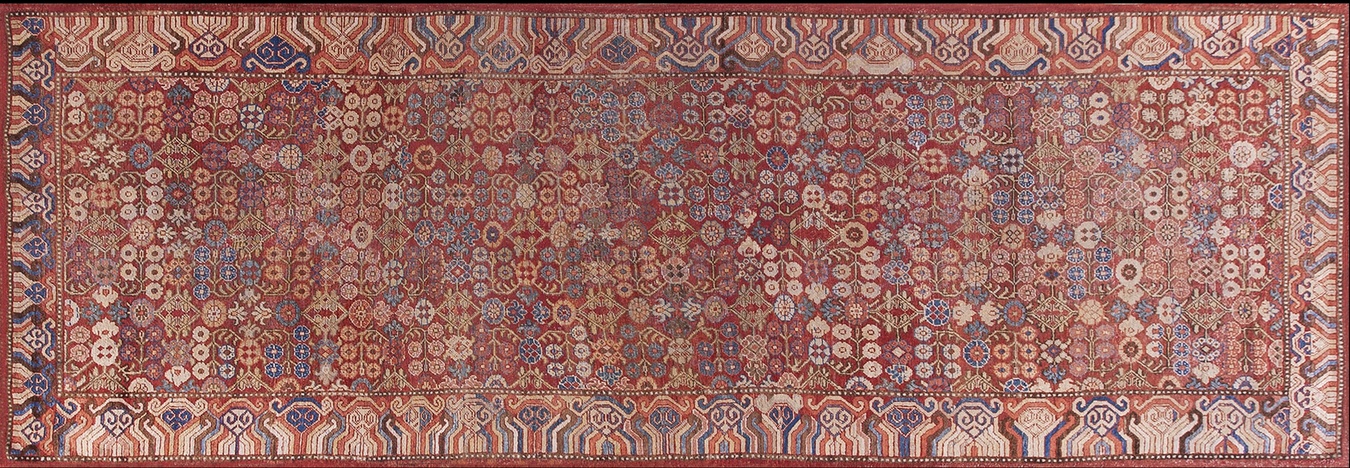
Antique Khotan Hallway Runner Wool Persimmon Rug – by Rugs On Net
Kashgar rugs often carried bolder geometric patterns with more pronounced outlines, while Yarkand rugs leaned toward open fields and lighter motifs with distinct weft structures. These differences reflect both local taste and workshop traditions, creating a mosaic of styles under the broader label of Khotan or Samarkand rugs.
Silk vs. Wool Rug Specialties
Production across the Silk Road oases often reflected material availability. Hotan city became known for silk pile carpets, a natural outgrowth of its ancient role as a silk-producing center. These luxurious rugs were treasured for export and courtly patronage. In contrast, the surrounding counties specialized in wool carpets, using glossy fleece from regional flocks. Wool rugs were practical for domestic interiors and long-distance caravan trade, offering both resilience and beauty. Together, silk and wool production illustrate the diversity of Hotan county carpets, with silk prized for prestige and wool valued for durability.
Sourcing of Hotan Wool
The wool used in Hotan wool rugs came primarily from sheep grazed in the Kunlun foothills, especially the Kirghiz flocks. The climate and pasturage of the southern Xinjiang highlands produced fleece with natural sheen and softness, ideal for carpet pile.
Local sourcing meant that Hotan weavers could rely on abundant high-quality wool without dependence on imports, contributing to the distinct tactile and visual quality of their rugs.
Melikawat Archaeological Site
The Melikawat archaeological finds underscore the antiquity of Khotan’s weaving tradition. Located just outside Hotan, Melikawat was an ancient Buddhist city that flourished as part of the Silk Road network.
Excavations at the site have revealed textile fragments, weaving tools, and evidence of early pile construction, proving that the region’s rug-making heritage extends back over 1,500 years. Melikawat thus serves as a critical link in understanding the evolution of Khotan carpets from antiquity to their later flowering under Qing patronage.
Hotan Museum Preservation
The Hotan Museum rugs collection preserves both the tangible and intangible legacy of Khotan weaving. The museum houses historic carpets, antique looms, and dyeing equipment, allowing visitors to see the full process of traditional production.
By safeguarding rare textiles and contextual artifacts, the museum ensures that the artistry of Khotan carpets is documented for both scholars and the public. Visitors can view ancient looms in Khotan today within the museum’s exhibits, gaining insight into techniques that have otherwise vanished from daily use.
Where to See and Source Historic Carpets
For collectors, sourcing Khotan rugs directly in Xinjiang is possible but increasingly rare, as antique pieces are now mostly in private or museum collections. While visiting Xinjiang offers unparalleled access to cultural context and occasional opportunities to see village production, the most reliable avenue for acquiring authentic antique Khotan carpets remains reputable international dealers and auction houses.
These institutions provide provenance documentation and expert verification—essential for ensuring authenticity in a market where imitations exist. For those seeking the richest historical experience, however, standing before the looms at the Hotan Museum or walking the ruins of Melikawat connects the modern viewer with a legacy woven into the fabric of the Silk Road itself.
Cultural, Symbolic, and Spiritual Relevance
Motif Symbolism
- Pomegranate trees — The most iconic of Silk Road rug icons, the pomegranate appears in vase-and-branch motifs throughout antique Khotan carpets. — Why: It symbolizes fertility, prosperity, and renewal, functioning as both a “tree of life” and a marker of abundance across Persian, Chinese, and Central Asian cultures.
- Lotus and peony blossoms — These floral motifs are hallmarks of lotus rug symbolism, inherited from Chinese Buddhist art. — Why: The lotus conveys purity, enlightenment, and immortality, while the peony represents beauty and longevity. Their presence on Khotan rugs reflects spiritual aspirations alongside aesthetic elegance.
- Swastika fretwork — Used in borders and field lattices, this ancient motif predates its modern misappropriation. — Why: Within Khotan rug symbolism, the swastika represented luck, eternity, and cosmic balance, aligning with Buddhist and Central Asian cosmologies.
- Medallions and guls — Circular medallions and tribal guls anchor many Khotan designs. — Why: Medallions evoke unity and harmony, while guls, borrowed from Turkic traditions, highlight tribal identity and protection.
Rugs as Trade Goods, Status, and Religious Objects
Beyond their visual impact, Khotan rugs were trade goods and cultural currency. Woven in an oasis along the Silk Road, they traveled widely, serving as signs of wealth for merchants and as status symbols in both Central Asian and Persian households.
They also functioned as dowry items, embedding their symbolism into family life and inheritance. In religious contexts, Khotan carpets served as prayer rugs or mosque furnishings, their geometric layouts aligning with Islamic practice while still echoing Buddhist-inspired motifs from earlier centuries.
Buddhist and Islamic Influences
The layering of influences in Khotan carpets reveals the region’s religious crossroads. Before the 11th century, Khotan was a Buddhist kingdom, and many enduring motifs—lotus blossoms, cloud bands, fretwork—reflect Buddhist visual culture.
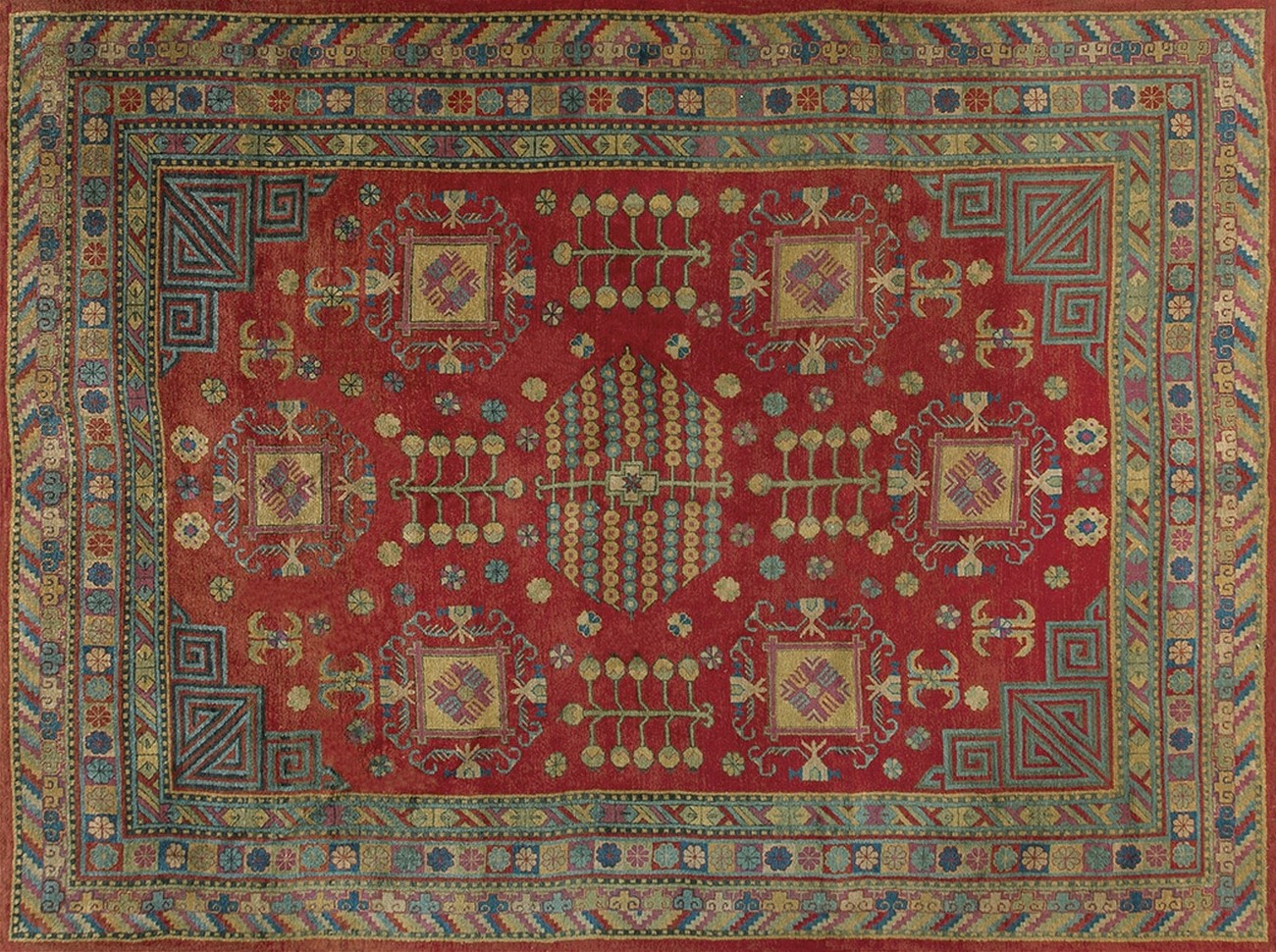
After Islam became dominant, figurative imagery diminished, but many symbolic elements persisted, reshaped into abstract or floral patterns compatible with Islamic aesthetics. Thus, Khotan rug symbolism bridges two traditions: Buddhist spirituality and Islamic restraint, creating a hybrid iconography unique to the region.
Inscriptions and Narrative Meaning
Some antique Khotan rugs bear inscriptions, prayers, or short dedications, weaving narrative meaning into their structure. These inscriptions reinforced rugs’ spiritual role while also marking patronage or ownership.
Combined with symbolic motifs, inscriptions transformed carpets into texts of identity, belief, and memory. Each Khotan carpet thus carried not only decorative value but also encoded cultural narratives, linking domestic, spiritual, and communal life into a single woven surface.
In sum, antique Khotan carpet patterns are dominated by motifs—pomegranate, lotus, swastika fret, medallions—each charged with layers of cultural symbolism. Whether serving as trade goods, religious objects, or heirlooms, these rugs remain enduring expressions of the Silk Road’s multi-cultural iconography.
Modern Market, Legacy & Collecting
Antique vs. Modern Khotan Rugs
For collectors, antique Khotan rugs are highly sought after due to their provenance, subtle natural palettes, and the way they blend seamlessly into both modern and traditional interiors. Their value is determined not just by knot density but also by rarity of design, age, and overall condition.
By contrast, modern Khotan design rugs are produced in India, Pakistan, and China, often with the explicit intention of replicating the antique look. These newer pieces, while lacking the historical depth of antiques, are hand-knotted and designed to appeal to contemporary buyers seeking timeless Central Asian aesthetics.
Designer Use and Global Trends
Interior designers prize Khotan rug collecting for the same reason merchants did centuries ago: adaptability. The hybrid style of medallions, pomegranate trees, and Chinese-inspired borders allows Khotan rugs to function equally well in classic, minimalist, or eclectic interiors.
Their restrained Silk Road palettes of reds, indigos, creams, and golds make them versatile statement pieces. This timelessness has kept Khotan rugs relevant across centuries, bridging the gap between heritage textiles and modern design.
Replicating Antique Khotan Border Motifs
The answer to whether modern designers can replicate antique Khotan border motifs is yes—and they frequently do. Workshops today reproduce iconic Greek key, swastika fret, lotus, and vine-scroll borders to capture the authenticity of antique pieces.
While some reproductions closely follow museum examples, others adapt motifs to suit contemporary interiors. This practice ensures the continuity of traditional design language, while also making it accessible to a new generation of rug buyers.
Collecting, Sourcing, and Authenticity
Collectors must prioritize rug authenticity and preservation when acquiring Khotan carpets. Provenance, natural dye usage, and recognizable motifs are essential for establishing value. Antique pieces are best acquired through reputable dealers and auction houses, which can provide documentation and expert evaluation.
While reproductions satisfy decorative needs, serious collectors seek genuine antiques, often focusing on rare motifs like pomegranate trees or unusual colorways. Preservation is equally important: careful cleaning, avoiding direct sunlight, and using pads to reduce wear ensure that these textiles endure for future generations.
Sourcing in Xinjiang
Although Khotan rugs originate in Xinjiang, antique rug sourcing directly from the region is now complex. Political restrictions, export regulations, and limited availability of genuine antiques make it difficult for collectors to rely on Xinjiang as a primary source.
While visiting Xinjiang offers cultural immersion and the chance to see weaving workshops, the most secure and practical route for collectors remains international dealers and established galleries.
Museum Preservation
Institutions such as the Hotan Museum and international collections like the Metropolitan Museum of Art safeguard the finest examples of Khotan weaving. The Hotan Museum preserves historic carpets alongside traditional looms and dyeing equipment, ensuring both the objects and the processes survive.
By contextualizing rugs within broader Silk Road history, museums allow visitors to appreciate Khotan weaving as a living cultural legacy rather than as isolated artifacts.
In today’s market, Khotan rug collecting is defined by a balance of heritage and adaptability. Antique pieces remain coveted investments, while modern reproductions keep the style alive in contemporary homes. Above all, authenticity, careful sourcing, and institutional preservation ensure that the legacy of Khotan rugs continues to thrive.
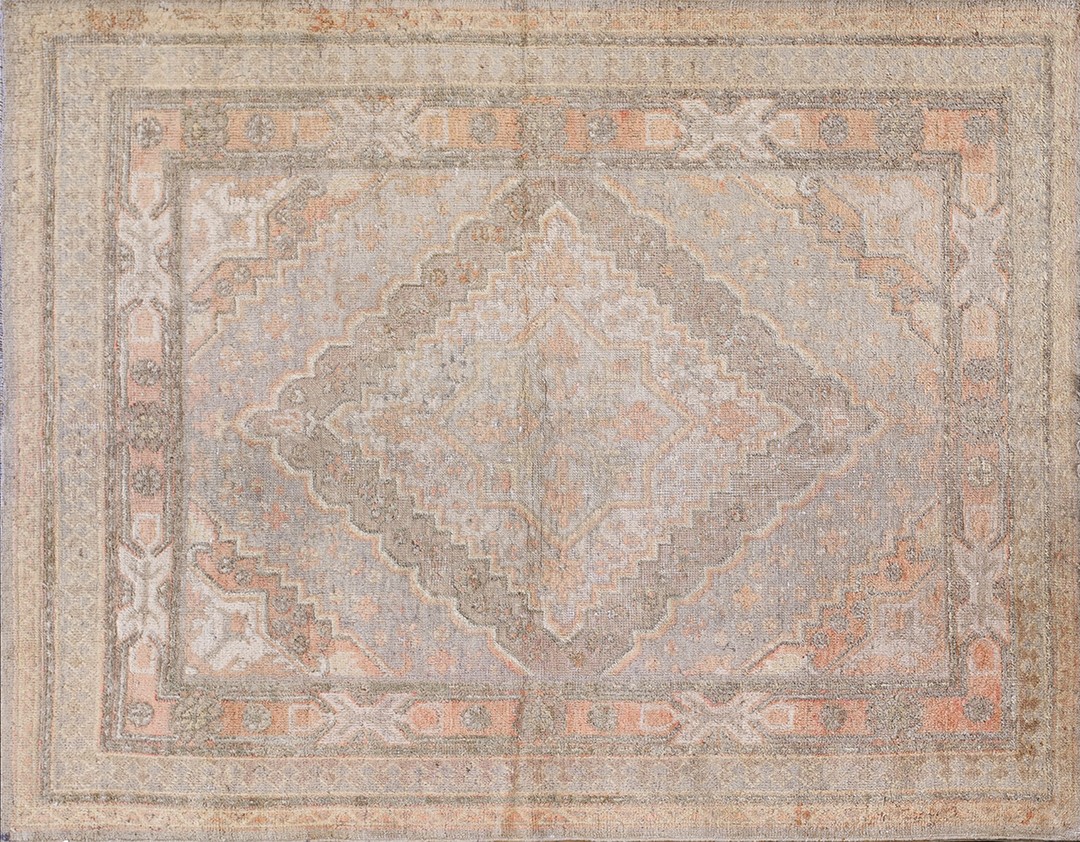
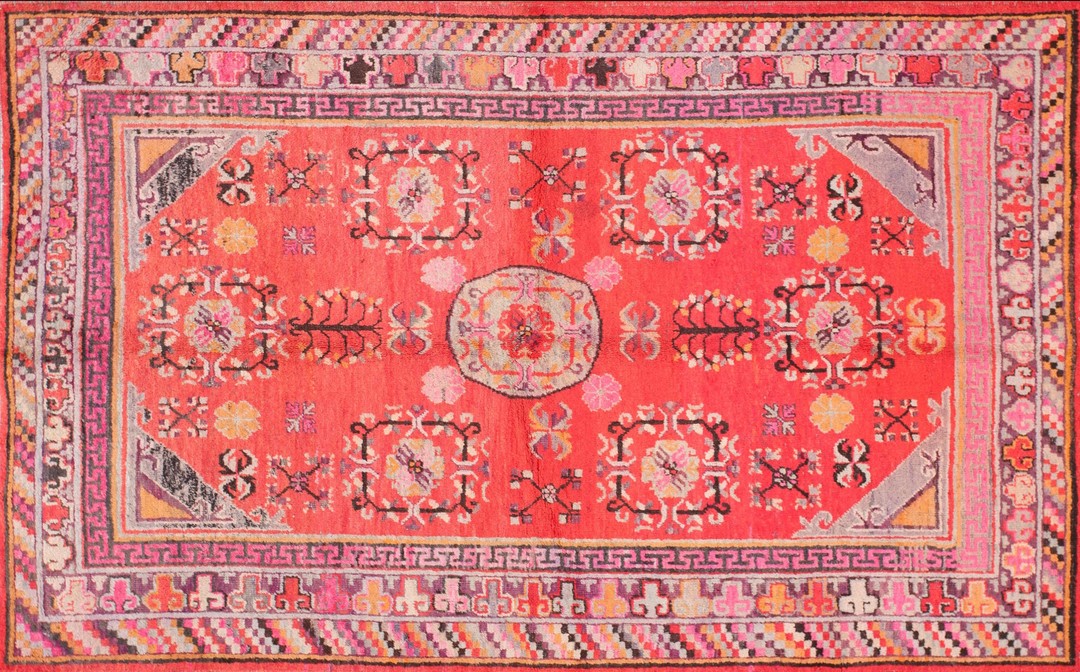
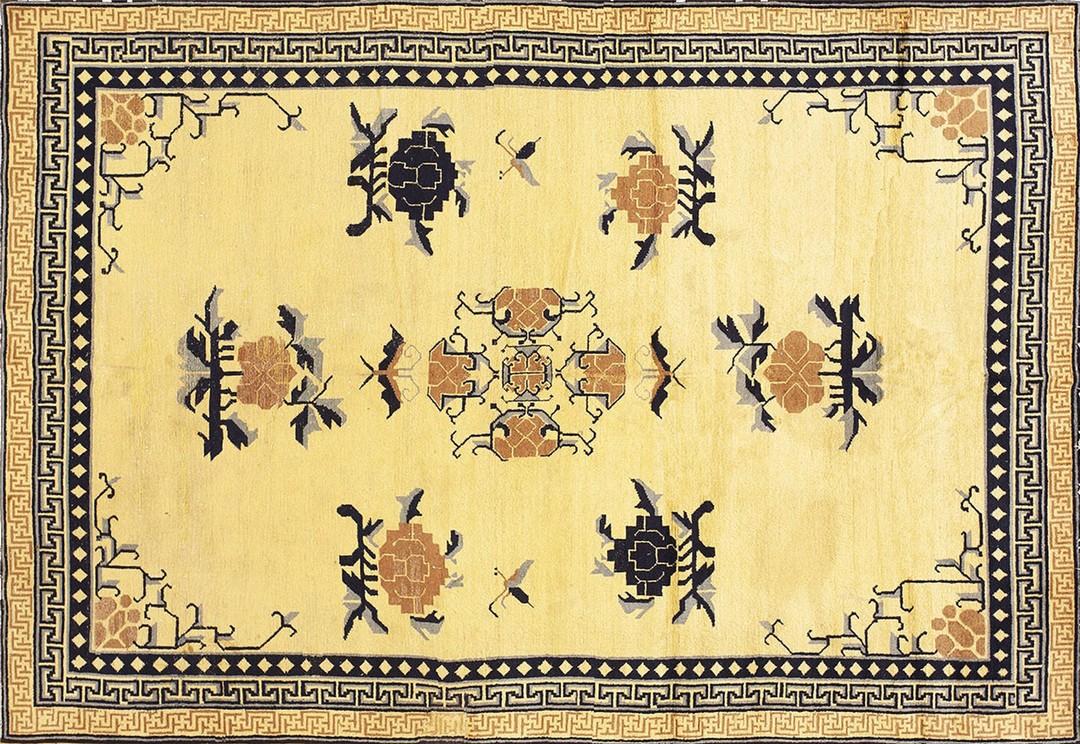
Explore a Few of Our Favorite Khotan Rugs
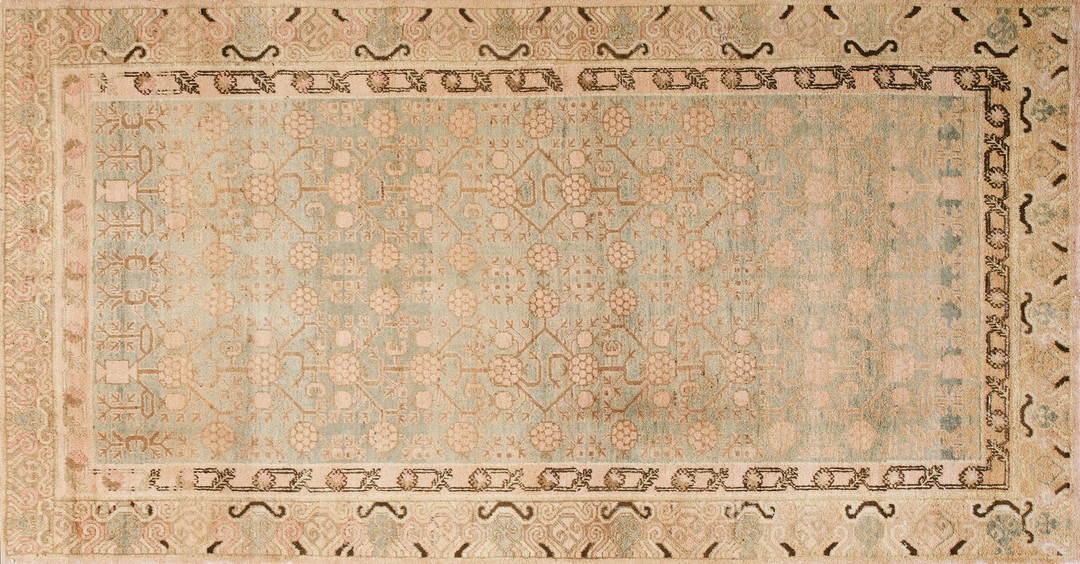
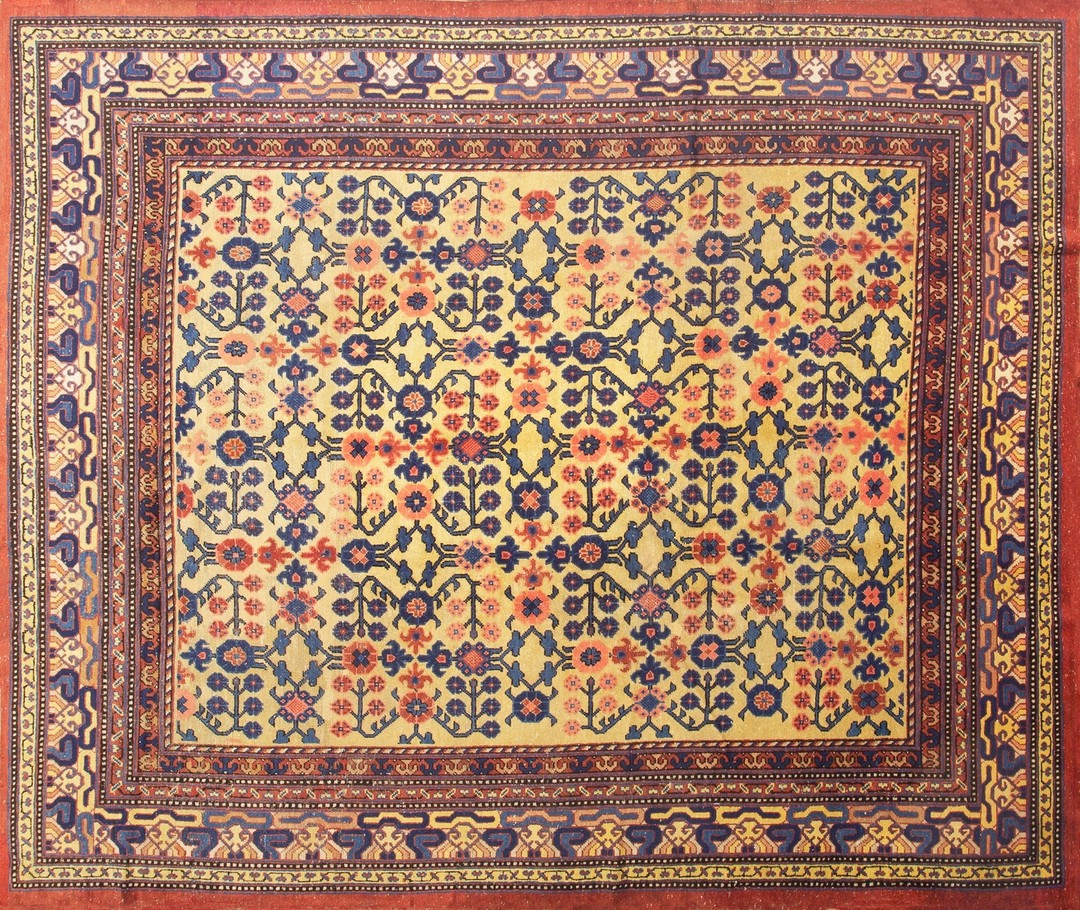
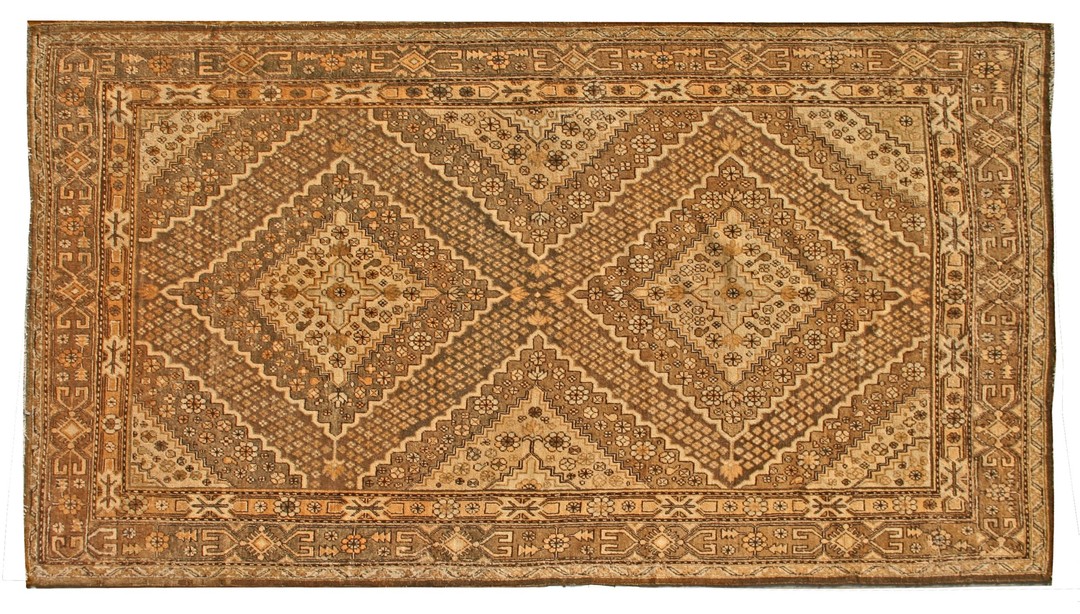
FAQ
- How should I place furniture on Khotan rugs?
For living rooms, place front sofa/chair legs on a Khotan rug (8×10 or 9×12) to unify seating. In dining rooms, allow 24–30 inches of rug beyond table edges.
- Where can I see Khotan rugs in the U.S.?
Major museums and galleries frequently exhibit Khotan rugs—look to the Metropolitan Museum of Art (NYC), textile museums, and specialty dealers in New York and Los Angeles.
- How do Khotan rugs compare to Oushak rugs?
Oushak rugs (Turkey) favor large star medallions and airy drawing; Khotan rugs emphasize pomegranates, vases, and Chinese-influenced borders. Both often use soft, room-friendly palettes.
- Are there silk Khotan rugs?
Yes—silk Khotan rugs and silk-highlights exist, though they’re rarer and more delicate. Reserve silk pieces for low-traffic areas.
- What knot density do Khotan rugs have?
Typically medium to fine; the back shows crisp knots and clear pattern outlines. Density varies by workshop and era rather than a single standard.
- Are Khotan runners common?
Khotan rugs often come in “gallery” proportions—great for halls and long rooms. A \~3–4×12 ft gallery Khotan rug is a classic find.
- What rug pad works best under Khotan rugs?
Use a felt-plus-natural-rubber pad cut 1 inch smaller on all sides. It cushions, prevents slipping, and reduces wear.
- Do Khotan rugs bleed or fade?
Some late-19th-century dyes can be fugitive, leading to fading or bleeding if improperly cleaned. Test colorfastness before washing and avoid harsh chemicals.
- Can Khotan rugs go over radiant heat floors?
Yes, with caution: keep temperatures moderate, use a breathable felt-and-rubber pad, and monitor humidity (around 40–55%). Avoid latex-glued pads that trap heat.
- Do Khotan rugs work in modern or minimalist interiors?
Absolutely—their soft palettes and graphic pomegranate/trellis layouts pair well with clean lines. A muted 9×12 Khotan rug can anchor neutral sofas beautifully.
- Are new Khotan-style rugs being made today?
Yes—many hand-knotted Khotan-style rugs are produced in India, Afghanistan, Pakistan, and China. Product pages may say “Khotan design” to indicate a reproduction.
- What condition issues matter most on vintage Khotan rugs?
Watch for end losses, reweaves, reductions, dye run, and moth damage. Honest restoration is fine; undisclosed resizing can affect value significantly.
- How much do Khotan rugs cost?
Antique Khotan rugs commonly range from about \$5,000 to \$40,000, with exceptional or large examples higher. Modern Khotan-style pieces often run \$1,000–\$6,000 depending on size and materials.
- How can I tell if a Khotan rug is authentic and antique?
Look for hand-knotted backs, age-consistent wear, natural dye variegation, and classic Khotan motifs. Verify dimensions, provenance, and any restorations with a trusted dealer or appraiser.
- How should I clean and maintain Khotan rugs?
Vacuum gently with suction only (no beater bar), blot spills with a white cloth, and schedule professional hand-washing every 3–5 years. Protect fringes by vacuuming from the edges inward.
- Are Khotan rugs good for homes with pets and kids?
Choose sturdy, lower-pile Khotan rugs or modern Khotan-style reproductions. Busy pomegranate or lattice patterns hide minor spills; avoid delicate silk pieces in play areas.
- Are Khotan rugs durable for everyday use?
Wool Khotan rugs wear well, but antiques deserve mindful care. Use a quality rug pad and rotate yearly to distribute foot traffic.
- How do Khotan rugs differ from Persian or Turkish rugs stylistically?
Khotan rugs mix Chinese motifs with Persian layouts, while Turkish/Oushak rugs lean toward large star medallions and looser drawing. Khotan borders often show fretwork or rainbow-band effects.
- What sizes do Khotan rugs usually come in?
Antique Khotan rugs often appear in long “gallery” formats (e.g., \~6×12 ft), plus room sizes like 8×10 and 9×12. Runners and square pieces exist but are less common.
- How are Khotan rugs constructed?
Most Khotan rugs are hand-knotted with wool pile on cotton foundations, sometimes with silk. Many use the asymmetrical (Persian) knot and medium-to-fine weave.
- What colors do Khotan rugs typically use?
Expect soft, muted palettes—ivory, camel, celadon, rust, teal, and faded reds/blues. Antique dyes often mellow to pastels over time.
- What motifs define Khotan rugs?
Classic Khotan rugs feature pomegranates (fertility/abundance), vases, lattice trellises, triple medallions, cloud bands, and fretwork borders. Pomegranate or vase-and-vine layouts are especially iconic.
- Are “Knotan rugs” the same as Khotan rugs?
Yes—“Knotan rugs” is a common misspelling of Khotan rugs (also spelled Hotan). Search using “Khotan rug” to find accurate results.
- Why are Khotan rugs sometimes called Samarkand rugs?
Many Khotan rugs moved through Samarkand’s markets, so dealers used “Samarkand” as a trade name. You’ll see both terms for the same East Turkestan weaving tradition.
- What are Khotan rugs and where do Khotan rugs come from?
Khotan rugs are hand-knotted carpets from the Silk Road oasis of Khotan (Hotan) in East Turkestan/Xinjiang. They blend Chinese and Persian design elements and were widely traded via Samarkand.