
Introduction to Bakshaish Rugs
Explore our stunning selection of antique Bakshaish rugs perfect for discerning collectors.
What Defines a Bakshaish Rug?
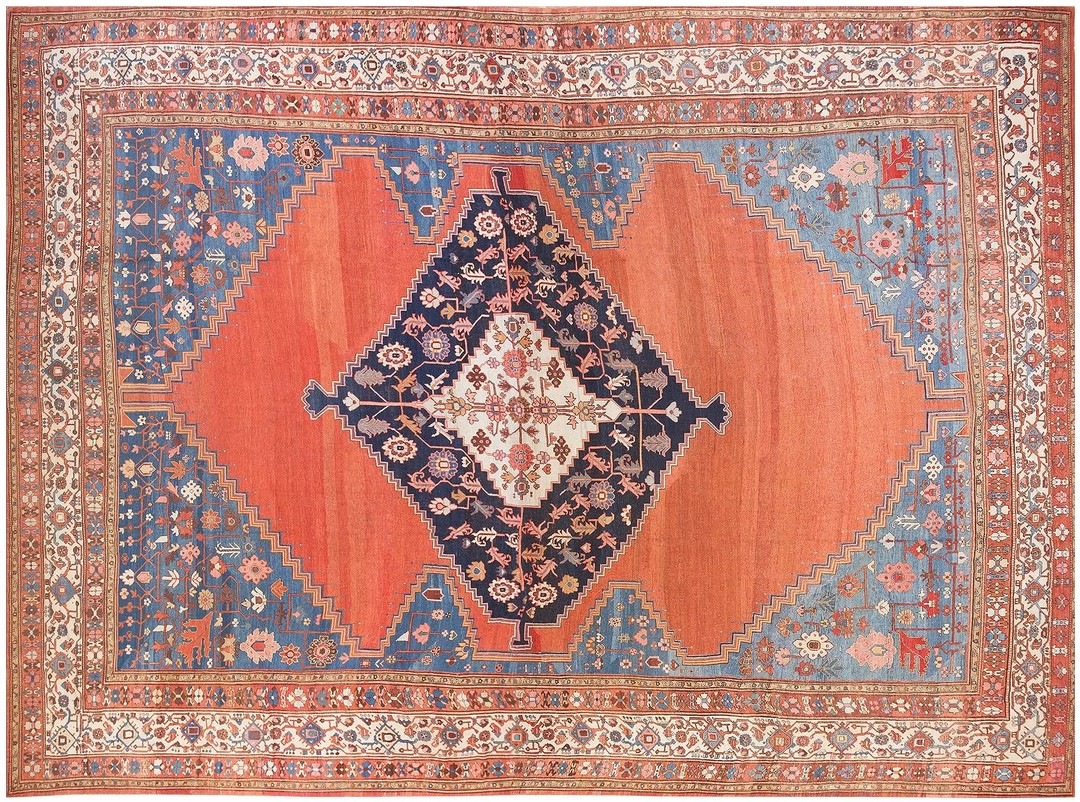
Bakshaish rugs stand among the most celebrated examples of Northwest Persian rugs, admired for their bold, geometric artistry and folk-driven aesthetic. Unlike the refined, symmetrical elegance of Tabriz or Isfahan weaving, Bakshaish rugs origin is rooted in village traditions that favor individuality and improvisation. Their patterns often showcase large-scale medallions, abstracted botanical motifs, and angular geometric figures that appear almost primitive in their raw power.
This blend of abstraction and geometry gives them a presence that is at once rustic and sophisticated, bridging tribal spontaneity with urban influences. Construction also sets Persian Bakshaish carpets apart. They are typically hand-knotted on a wool foundation, using high-quality mountain sheep wool known for its luster and durability.
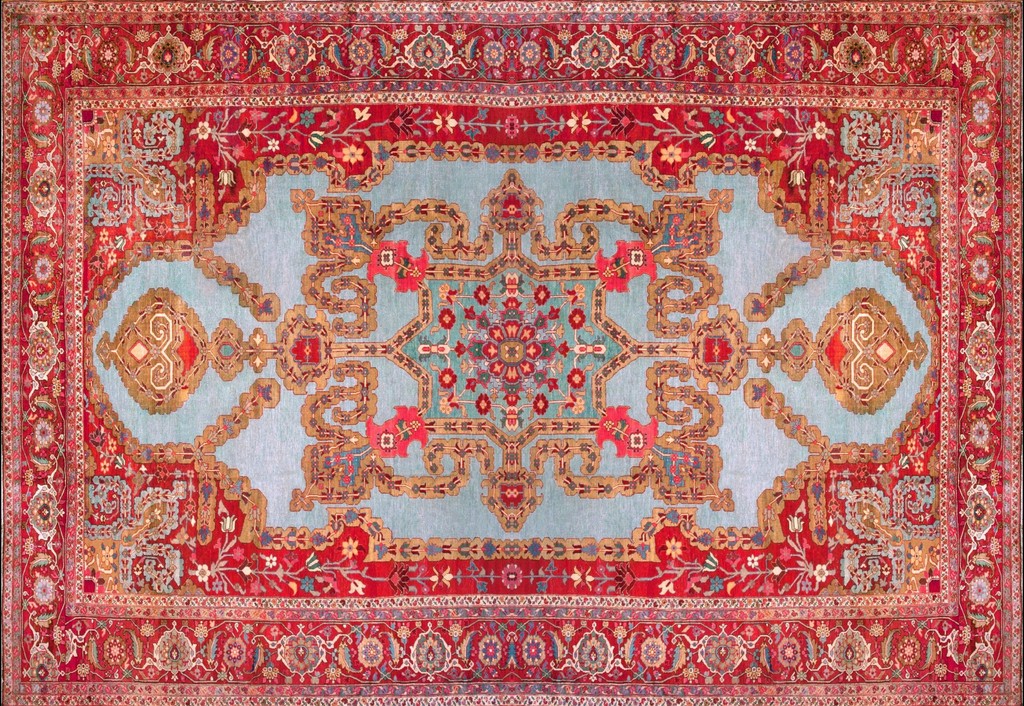
Antique Oversized Serapi Persian Knotted Rug by Rugs On Net
Knot density is moderate, reflecting their village origin—looser than urban Persian carpets but tighter than nomadic weaves. The pile is often plush, adding a tactile richness underfoot. Colors tend toward earthy reds, soft blues, ivory, and golden tones, derived from natural dyes, which mellow into a warm patina over decades. These characteristics make each Bakshaish unique, highly valued in antique rug markets, and celebrated as a hallmark of Persian folk artistry.
Name, Etymology & Pronunciation
The name “Bakshaish” carries both geographic and linguistic significance. In Persian, the word relates to “forgiveness” or “clemency,” a fitting echo of the rugs’ gentle, human touch in design. In English, usage of the name reflects its association with the village’s rug production rather than the word’s literal meaning. Pronounced roughly as Bakh-sha-eesh (بخشش in Persian), the term is inseparable from its weaving legacy.
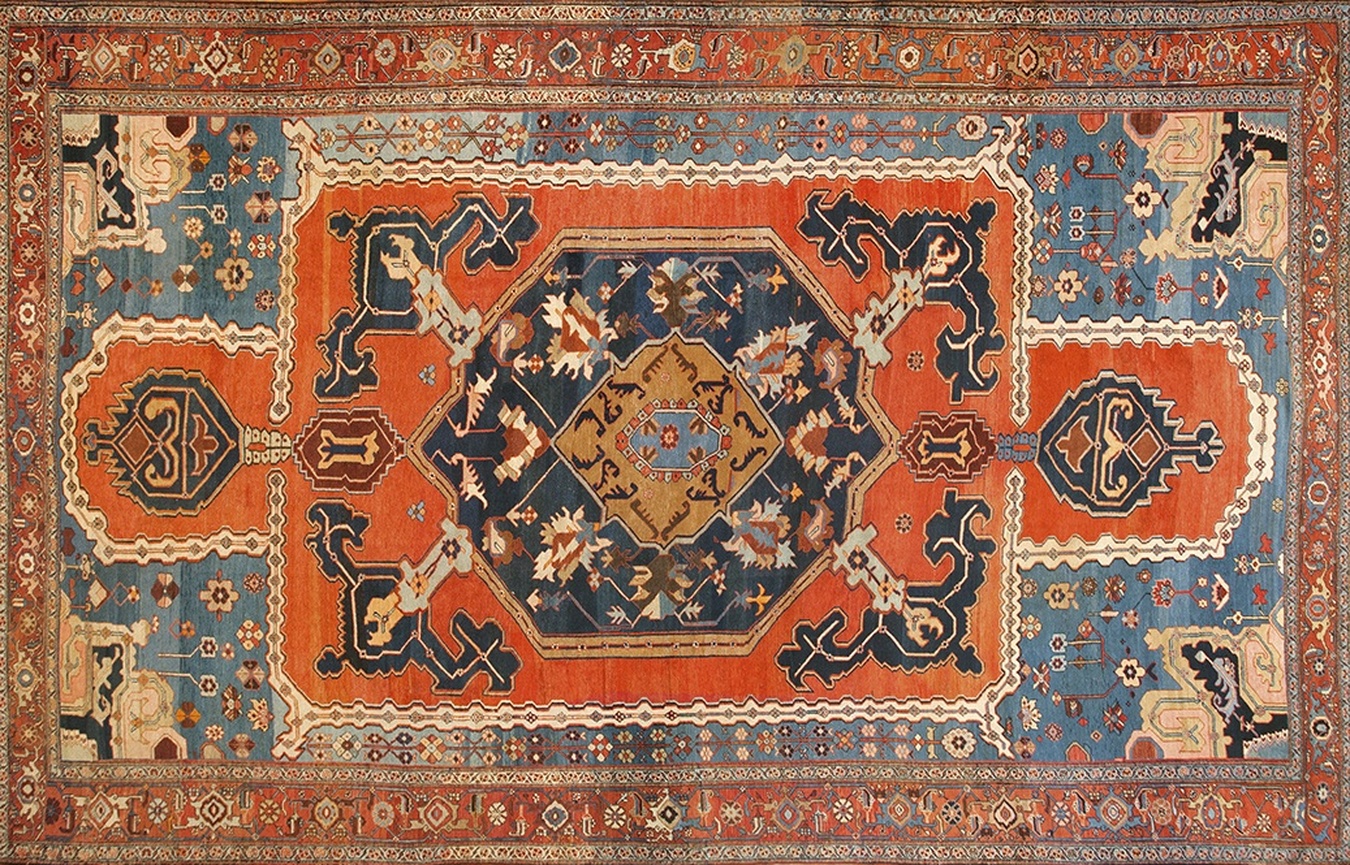
Historically, in rug literature, Bakshaish pieces were sometimes grouped under broader labels like “Heriz rugs” or “Northwest Persian rugs.” This reflects the interconnected weaving traditions of the region. Yet over time, collectors and scholars have recognized Bakshaish as a distinct category—an identity that elevates its rugs to a coveted status in the antique carpet world. The name itself, tied directly to the village, serves as a mark of authenticity and greatly influences market value.
Country & Geographic Location
Where is Bakshaish? What country is it in? The answer is central to understanding the rugs themselves. Bakshaish is a small weaving village in East Azerbaijan province, Iran, located in the country’s northwestern corner. This province lies near the borders of Armenia and the Republic of Azerbaijan, in a mountainous landscape long celebrated for its pastoral life and weaving traditions.
As part of Iran’s greater rug-producing belt, Bakshaish village Iran belongs to the same cultural geography that produced Heriz, Karaja, and other renowned weaving centers. Its remote yet connected location allowed Bakshaish weavers to absorb influences from neighboring towns while preserving the rustic individuality of their designs. The village’s geographic identity is not a minor detail—it is the foundation of authenticity.
To a collector or connoisseur, knowing that a rug originates from Bakshaish in East Azerbaijan confirms both its cultural heritage and its rightful place within the history of Persian Bakshaish carpets. This location is not only a point on a map but a living connection to the mountains, flocks, and artisans who gave these rugs their enduring power.
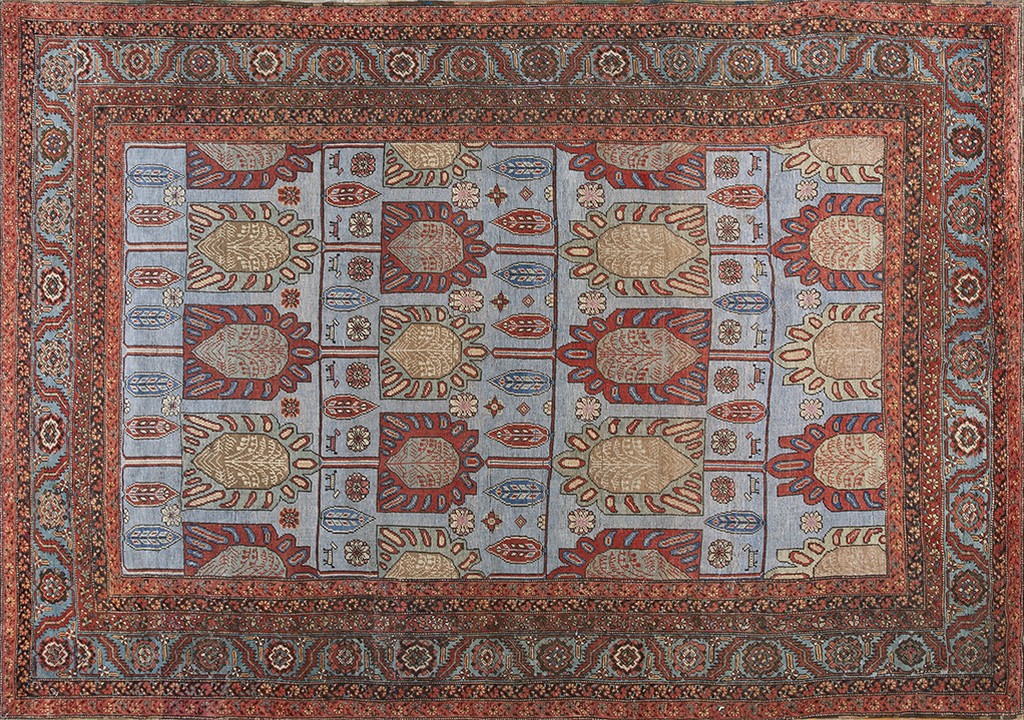
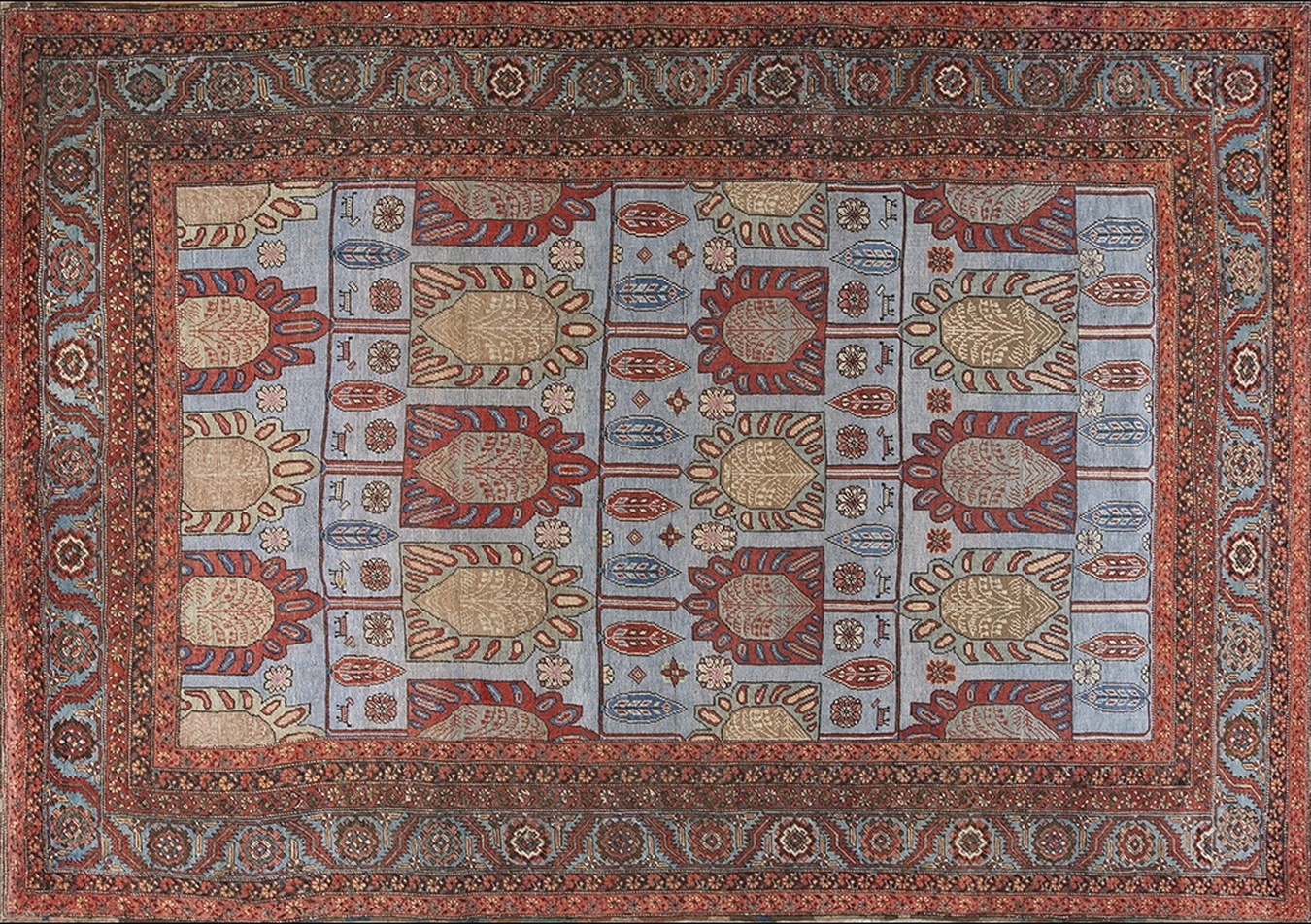
Large Scale Allover Tribal Geometric Design Antique Light Blue 19th Century Persian Bakshaish Rug by Rugs On Net
Geographic & Cultural Origins
The Village of Bakshaish: Location & Landmarks
Nestled in the uplands of Azerbaijan, Bakshaish sits at an elevation of roughly 5,000 feet, where crisp mountain air, fertile valleys, and wide pastures define the landscape. The village lies only 30–50 miles east of Tabriz, yet its geography gives it a sense of isolation that historically nurtured creativity in weaving. Surrounding Bakshaish landmarks include forested slopes, snow-fed rivers, and expansive grazing lands that sustained the sheep whose wool became the foundation of rug-making.
These natural surroundings provided not just material resources but also visual inspiration: jagged mountain ridges echo in the angular motifs of Bakshaish designs, while valley meadows and flora find expression in stylized botanical forms. The landscape’s rugged beauty and relative remoteness gave Bakshaish rugs their distinctive rustic strength. Unlike the polished elegance of metropolitan centers, Bakshaish weaving reflects the highland environment—powerful, enduring, and deeply tied to the rhythms of nature.
The Role of East Azerbaijan
Does East Azerbaijan oversee Bakshaish rug production today? Yes—administratively, the village of Bakshaish falls under the authority of East Azerbaijan province, which is part of northwestern Iran. While traditional weaving remains largely a local, family-driven craft rather than a government-regulated industry, provincial oversight defines the region’s cultural and economic identity.
East Azerbaijan is known as one of Iran’s foremost rug-weaving provinces, encompassing not only Bakshaish but also the celebrated centers of Tabriz and Heriz. This connection anchors Bakshaish rugs firmly within the framework of Iranian textile heritage. It highlights their authenticity while distinguishing them from other rug-making regions in Persia. The provincial association also links Bakshaish rugs to broader narratives of Azerbaijani art and culture, where weaving is a point of pride and tradition.
Influence of Tabriz and the Heriz Region
Closeness to Tabriz has always mattered. Does proximity to Tabriz raise Bakshaish rug value? Absolutely. Tabriz, long a capital of Persian weaving, exerted both economic and artistic influence over Bakshaish. Merchants from Tabriz introduced village weavers to larger markets, ensuring that Bakshaish rugs circulated far beyond their local boundaries.
This exposure elevated their status among collectors and buyers who recognized both the rustic charm and the sophisticated market connections of these carpets. Stylistically, Tabriz rug influence is evident in the incorporation of large medallion layouts, balanced compositions, and a sense of order layered onto Bakshaish’s natural improvisation. At the same time, the Heriz region weaving tradition provided neighboring inspiration.
Heriz rugs are known for durability and strong geometric motifs, qualities echoed in Bakshaish weaving but expressed with greater spontaneity and abstraction. Together, these regional forces shaped Bakshaish rugs into hybrids—bridging urban refinement with tribal vitality.
Local Life, People & Tribal Influences
- Azeri Turkish population — Why: The local people of Bakshaish are primarily Azeri Turks, whose language, culture, and aesthetics shaped weaving traditions with distinctive motifs and color sensibilities.
- Tribal and nomadic exchanges — Why: Interactions with nomadic groups passing through the uplands enriched the design vocabulary, introducing symbolic patterns rooted in pastoral and spiritual life.
- Sheep and grazing economy — Why: Flocks grazing in mountain pastures provided the lustrous wool that defined the rugs’ durability and texture. Local sheep were prized for their long, resilient fibers, unmatched by imported alternatives.
- Natural dye sources — Why: Plants, roots, and minerals from the valleys and forests around Bakshaish supplied the dyestuffs for reds, blues, and yellows, giving the rugs their earthy yet radiant palettes.
In this way, the village embodied a cultural fusion—the folk artistry of its people, the shared motifs of tribal neighbors, and the polished influence of Tabriz. Geographic isolation preserved its individuality, while its proximity to major weaving centers secured its reputation in the larger world of Persian rugs.
Historical Evolution of Bakshaish Weaving
Origins & Early Development
When did Bakshaish rug weaving first emerge? Scholars trace the history of Bakshaish rugs to the late 18th and early 19th centuries, when villagers in East Azerbaijan began producing carpets that reflected both local tribal traditions and the influence of nearby weaving centers such as Heriz and Tabriz. Unlike courtly Persian carpets that had centuries of refinement, antique Bakshaish weaving started as a humble folk craft, grounded in community practices.
These earliest rugs were often irregular, with spontaneous patterns and variable sizes, embodying a raw creativity that would later become a defining hallmark. The geographic isolation of Bakshaish played a crucial role. Without strict urban oversight, early weavers enjoyed a freedom of expression that allowed abstract forms, oversized medallions, and geometric experimentation to flourish. This improvisational spirit gave rise to designs that felt both ancient and innovative, making Bakshaish one of the most distinctive rug traditions in Iran.
Nineteenth-Century Artistic Flourishing
The 19th century marked what many collectors regard as a village “renaissance” for Bakshaish rugs. Weavers embraced bold, large-scale designs that departed from rigid symmetry. Instead, they worked in what can be described as a “jam session” method of weaving—a process where each artisan contributed personal touches, resulting in carpets that were alive with variation and movement.
During this period, Bakshaish carpets became synonymous with Persian folk artistry. Their geometric medallions floated against spacious backgrounds, framed by rustic borders filled with abstracted floral or animal motifs. No two rugs were alike, and this individuality set them apart from the more uniform productions of urban workshops.
The Impact of 19th-Century Trade
How did 19th-century trade reshape Bakshaish rug patterns? By the late 1800s, the expansion of global trade, fueled by European demand, profoundly altered the trajectory of Bakshaish weaving. Merchants from Tabriz recognized the commercial potential of Bakshaish rugs and began standardizing their patterns for export.
This shift meant a greater emphasis on symmetrical medallion-centered layouts, which appealed to Western buyers. Aniline dyes, introduced in the latter half of the 19th century, briefly entered the Bakshaish palette. While these synthetic colors allowed for brighter tones, they lacked the depth and harmony of natural dyes and sometimes destabilized the visual balance.
The commercialization of design, combined with synthetic dye use, reduced the organic spontaneity of traditional Bakshaish artistry. In effect, trade transformed the rugs from local expressions of creativity into products crafted for predictable market tastes.
The “Revival Period” and Twentieth-Century Changes
By the early 20th century, Bakshaish weaving entered what is often called the “Revival Period.” Production became increasingly standardized, with patterns tailored to export markets. While this era preserved the construction techniques and general aesthetic of antique Bakshaish weaving, it often lost the free-spirited inventiveness of the 19th-century village masterpieces.
Rugs produced during this time were still admired for durability and design, but connoisseurs noted a decline in the raw individuality that had defined the earlier works.
Modern Reproductions & Revival Efforts
Can contemporary artisans replicate traditional Bakshaish aesthetics? Modern efforts to revive Bakshaish weaving have yielded mixed results. On one hand, skilled artisans today can reproduce the construction techniques—hand-knotted wool on wool or cotton foundations, with natural dyes that closely mirror the earthy reds, soft blues, and golden tones of the originals. These modern Bakshaish carpets often present a polished homage to their ancestors. Yet, what they cannot fully replicate is the spirit of spontaneity.
The village weavers of the 19th century were not bound by export markets or formalized design templates; their rugs embodied lived experience, improvisation, and a communal rhythm that modern workshops rarely achieve. Contemporary weavers can echo the look, but the Bakshaish rug revival cannot fully capture the unrepeatable essence of those brief but extraordinary decades when the village’s artistry reached its peak.
In sum, the historical arc of Bakshaish weaving highlights a time-warped period of creativity, followed by the pressures of trade and the attempts of later generations to reclaim its magic. Collectors continue to prize authentic 19th-century pieces as cultural treasures, recognizing that their originality arose from a fleeting moment in Persian rug history that can never be exactly reproduced.
Design Characteristics & Symbolism
Medallion, Garden & Allover Patterns
Bakshaish rugs are best known for their unrestrained approach to composition. Unlike the precise symmetry of city carpets, village carpet designs from Bakshaish favor large-scale medallions that can appear oversized or even off-center, floating within wide fields of negative space. This looseness creates a sense of freedom and spontaneity, where patterns feel alive rather than rigid.
Garden layouts are also common, often symbolizing paradise with stylized trees, shrubs, and water channels. In many cases, allover designs replace medallions entirely, filling the surface with repeating motifs that echo the natural rhythms of the highland environment. These variations highlight the individual artistry of each weaver, ensuring no two pieces are identical.
Tribal Motifs vs. Classical Persian Motifs
How do weavers combine both? The artistry of Bakshaish rugs lies in their ability to reinterpret grand classical Persian motifs through a village lens. Safavid designs—palmettes, scrolling vines, and garden imagery—were not copied in detail but abstracted into geometric, angular forms. At the same time, local weavers incorporated tribal symbols such as hooked polygons, stylized animals, and guardian figures.
The result was a hybrid style: sophisticated in origin yet folk in execution. This blend of classical refinement with tribal spontaneity is one of the defining features of Bakshaish rug motifs, creating carpets that feel timeless yet unmistakably tied to their rural context.
Use of Geometric & Folkloric Elements
- Hooked polygons and angular medallions — Why: These geometric forms symbolized strength and protection, reflecting both tribal aesthetics and the rugged mountain environment.
- Animals and guardian figures — Why: Stylized deer, birds, or mythical beasts served as protective emblems, rooting the rugs in folkloric belief.
- Tree of Life and garden symbols — Why: These motifs represented continuity, fertility, and paradise, tying the design to Persian cosmology and village spirituality.
- Floating motifs and asymmetry — Why: The off-balance placement of designs reflected creative improvisation, showcasing the human hand rather than mechanical repetition.
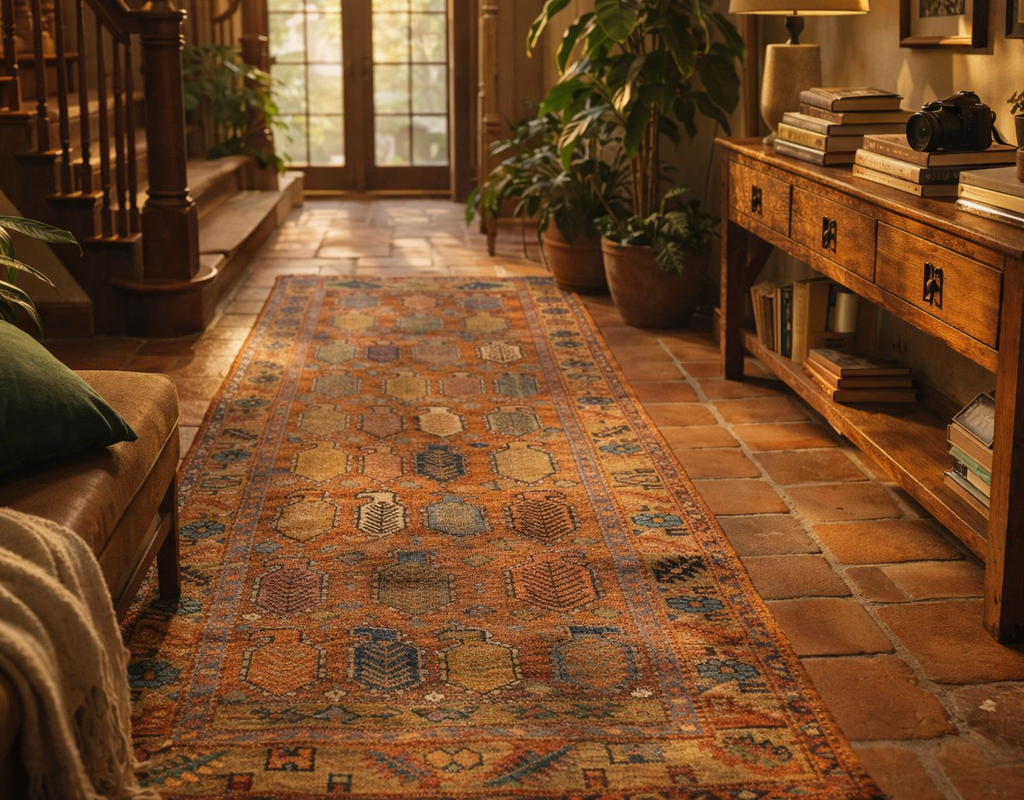
A richly patterned runner rug anchors the warm, earth-toned entryway.
Color Palette & Traditional Dyes
Which traditional dyes color authentic Bakshaish carpets? Bakshaish weavers relied on natural dyes that produced earthy, enduring tones. The most iconic was indigo, yielding the deep Bakshaish blue dye that became a signature of the region. Madder root created rich rust reds, while natural yellow dyes derived from plants or minerals introduced warm highlights.
Undyed camel hair and ivory wool were often left in their natural state, softening the palette with neutral tones. This reliance on organic dyes not only ensured longevity but also gave each carpet a harmonious connection to its environment.
Iconic Motifs: Landmarks, Nature & Local Life
What nearby landmarks inspire Bakshaish rug motifs? The highland setting of East Azerbaijan directly influenced the designs. Snow-capped mountains inspired jagged, angular motifs; village flora such as oak leaves or rosettes appeared as stylized ornaments; grazing animals from the upland pastures became recurring symbols of livelihood and protection.
These motifs grounded the rugs in the daily experiences of Bakshaish weavers, translating their environment into lasting works of art.
Cultural Symbolism & Narrative in Bakshaish Rugs
- Trees of Life — Why: A universal emblem of immortality, linking the weaver’s work to spiritual beliefs about eternity and growth.
- Birds in pairs — Why: A symbol of fidelity and companionship, reflecting both family bonds and village values.
- Rosettes and oak leaves — Why: Representing cultivated versus wild nature, these motifs acknowledged both the agricultural and untamed aspects of life in Bakshaish.
- Geometric improvisations — Why: Beyond decorative appeal, they conveyed the individuality of each artisan, embedding personal and cultural stories into the fabric.
Through their colors, symbols, and asymmetry, Persian rug symbolism in Bakshaish carpets reveals a dialogue between geography, tradition, and imagination. Each rug becomes not just a functional floor covering but a narrative canvas—an artistic testament to the people and landscape of Bakshaish village Iran.
Materials, Construction & Weaving Methods
Wool, Cotton, Camel Hair – Local Materials
The foundation of authentic Bakshaish rug materials lies in the natural resources of East Azerbaijan. Warps and wefts were often cotton, providing a stable base for large carpets, while the pile was woven from thick, handspun wool sheared from sheep grazing on highland pastures. This wool, rich in lanolin, gave Bakshaish rugs a luminous sheen and remarkable durability—qualities still praised today.
Camel hair was sometimes incorporated to introduce warm golden-brown tones, blending naturally with the earthy reds and blues. These fibers, drawn directly from the village’s environment, created a tactile warmth and flexibility that made Bakshaish rugs both functional and beautiful.
Turkish Knotting & Knot Density
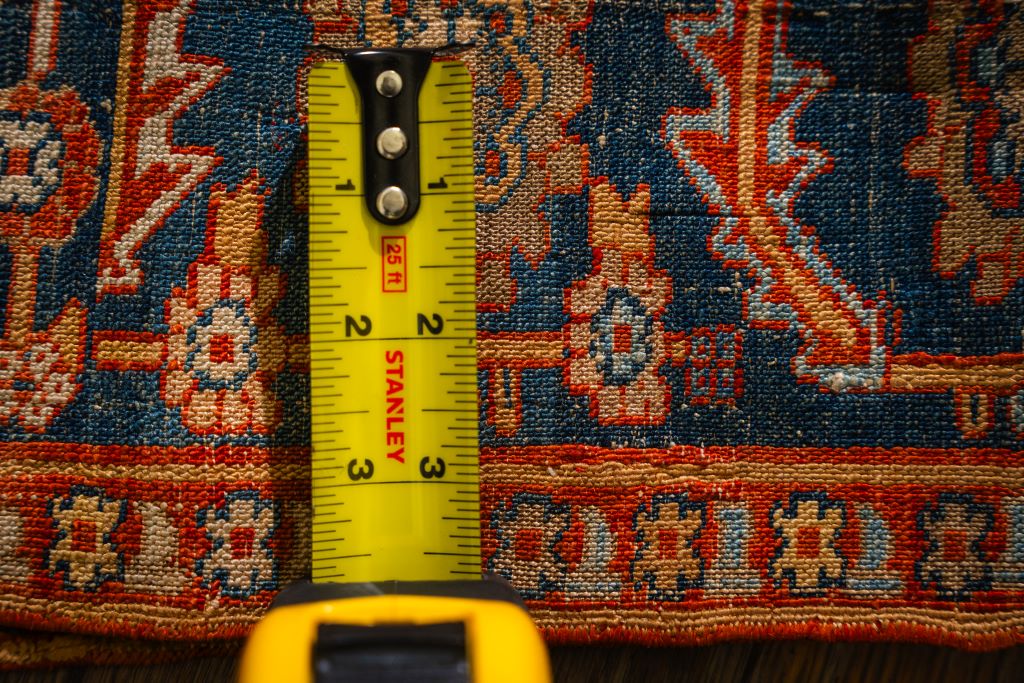
A detailed inspection of a richly colored oriental rug pattern while measuring its dimensions.
Bakshaish weavers used the symmetrical Turkish knot (also called the Ghiordes knot), a method shared with many Northwest Persian traditions. Knot density in Bakshaish rugs typically ranged from 6–10 knots per square inch, lower than the fine counts of urban carpets but perfectly suited to their bold, large-scale motifs.
How does knot density affect antique Bakshaish pricing? Denser rugs allow for sharper detail and command higher prices on the market, especially when combined with strong condition and natural dyes.
However, even looser, more rustic examples are prized for their artistic power and authenticity. Collectors value them as much for their aesthetic as for their technical execution, meaning knot density is only one of several factors shaping value.
Large Looms & Collaborative Weaving
The construction of these village carpets was often a communal effort. Large horizontal looms accommodated oversized rugs, sometimes spanning entire village homes. Women played a central role, weaving together in groups where designs were not dictated by written charts but carried through oral tradition.
Weavers would chant patterns aloud—passing motifs and rhythm from one hand to another—creating a collaborative improvisation much like music. This group method infused the rugs with variation and spontaneity, hallmarks of Bakshaish artistry. The very process of weaving was an act of storytelling, memory, and shared creativity.
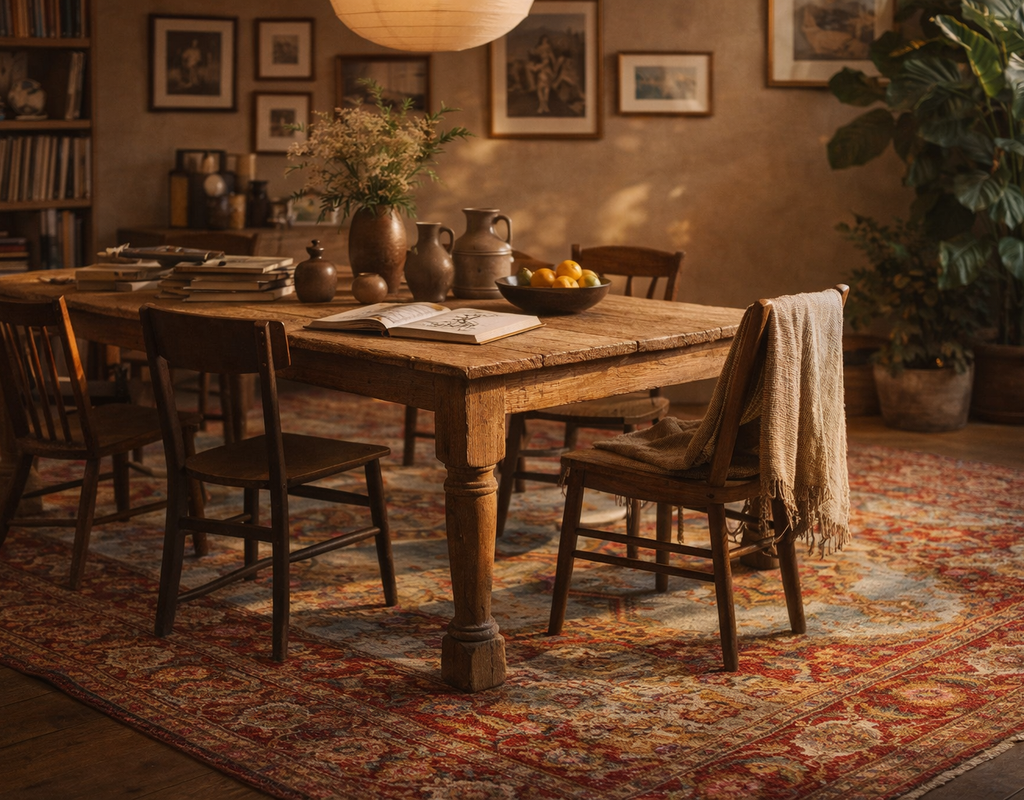
A warm, dimly lit dining space grounded by a detailed, vintage-style Oriental rug.
Condition vs. Age: What Matters for Buyers?
Should buyers prioritize age or condition for Bakshaish rugs? Both factors matter, but condition often weighs more heavily in determining price. A rug from the 19th century may lose much of its value if riddled with holes, dye bleed, or extensive repairs. Conversely, a slightly younger rug in excellent state can be more collectible.
Age adds historical importance, but collectors and decorators alike seek carpets that can still function and display well. In this sense, Persian rug knot density, material quality, and preservation converge: the better the wool, the tighter the weave, and the cleaner the condition, the more desirable the rug.
Conclusion
The essence of Bakshaish wool quality and carpet construction lies not in perfection but in authenticity. With robust foundations, lustrous wool, and camel hair accents, these rugs were built for endurance.
Their moderate knot density balances bold design with structural strength, while collaborative weaving anchored them in cultural tradition. For today’s buyers and collectors, appreciating these materials and methods is key to understanding why Bakshaish rugs remain some of the most tactile, enduring, and soulful carpets in Persian weaving history.
Regional Relationships: Bakshaish vs. Heriz, Serapi, Karaja & Gorevan
Bakshaish and Heriz: Key Design Differences
How do Bakshaish designs differ from Heriz rugs? While both belong to the broader Heriz region carpets family, their artistic spirits diverge. Bakshaish vs Heriz rugs can be summarized as freedom versus formality. Bakshaish rugs embrace improvisation—large, asymmetrical medallions, floating motifs, and open fields that reflect a village-based, tribal sensibility.
Heriz rugs, by contrast, are more standardized and symmetrical, particularly in later 19th- and early 20th-century pieces, where patterns were calibrated for commercial export. Heriz weaving tends to be coarser, with a heavier, more rigid aesthetic, while Bakshaish maintains a looser, more painterly energy. Collectors often describe Bakshaish as the most “tribal” of the region, prized for its individuality, while Heriz rugs represent the codified, commercial side of the same tradition.
The Serapi-Bakshaish Connection
The Serapi Bakshaish comparison is one of the most debated in the rug world. Serapi carpets are generally distinguished by finer weaving, lighter and more spacious palettes, and an elegance that appealed to European buyers of the 19th century. Yet, the highest-quality Bakshaish rugs—especially large-scale medallion pieces from the same period—sometimes rival Serapi masterpieces in beauty and refinement. In fact, on the market, the finest Bakshaish examples are often indistinguishable from Serapi, and many rugs historically shifted between labels depending on dealer preference. The overlap underscores the shared geography and materials of the region, even as subtle differences in palette and finesse provide collectors with distinctions to weigh.
Karaja & Gorevan: Neighboring Styles
- Karaja rugs — Why: Woven just north of Heriz, these smaller carpets feature repeating medallion chains across the field. Their distinct geometry and unique color combinations (often including bright greens and oranges) set them apart.
- Gorevan rugs — Why: Produced closer to the commercial export markets, Gorevan rugs are thicker and more utilitarian, with less artistic subtlety. They often used similar materials but were designed for durability and trade volume rather than aesthetic innovation.
These neighboring styles show the spectrum of weaving within East Azerbaijan—from the collectible artistry of Bakshaish and Serapi to the functional, accessible production of Gorevan.
The Regional “Family” of Northwest Persian Carpets
Together, Bakshaish, Heriz, Serapi, Karaja, and Gorevan form a tight-knit family of Persian tribal rugs tied by geography, shared use of Turkish knots, and mountain-wool construction. Yet within this kinship, Bakshaish stands out as the most expressive. It took the shared materials and techniques of the region and elevated them into designs that balance spontaneity with grandeur.
Serapi shared this pinnacle in its finest moments, Heriz defined the region’s commercial backbone, Karaja introduced small-scale charm, and Gorevan delivered accessible exports. Within this constellation, Bakshaish retains its reputation as the most authentic and unrestrained voice of the Heriz region carpets, embodying the raw creative spirit of village weaving in Northwest Persia.
The Market & Legacy of Bakshaish Rugs
Collector Appeal: Why Bakshaish Stands Out
Why are Bakshaish rugs famous among collectors? Among the broad family of Northwest Persian weavings, Bakshaish rugs command particular reverence because they embody a rare blend of artistry, scale, and individuality. Their improvisational medallions and abstracted tribal motifs make them feel closer to “art on the floor” than mere furnishings.
Collectors value authentic Bakshaish rugs for their spontaneity, their village-rooted folk charm, and their ability to hold their own against more formal Persian carpets in museum settings. This unique artistic identity has elevated Bakshaish carpets into the category of cultural treasures, ensuring their place as some of the most collectible Persian rugs in the world.
Auction Records, Investment Value & Appreciation
Why might Bakshaish rugs appreciate faster than others? Age, rarity, and artistic distinction drive their investment potential. While Serapi and Heriz carpets remain sought after, Bakshaish examples are fewer in number, and their individuality makes them harder to replicate. This scarcity fuels demand, particularly at auction, where record-breaking sales in the 2000s signaled a steep rise in Bakshaish rug value.
Collectors view them as blue-chip assets within the antique carpet market, appreciating faster than more common Serapi rugs.
Are Bakshaish rugs safer investments than Serapi carpets? Many experts say yes. While both categories can achieve high values, Bakshaish rugs carry an “art-level” status that insulates them somewhat from fluctuations in decorative trends. Their reputation as village masterpieces gives them a longevity in the market that positions them as safer long-term holdings.
Authenticity: How to Authenticate Antique Bakshaish
Where can collectors authenticate 1880s Bakshaish carpets? Authentication should begin with reputable dealers and auction houses that specialize in Persian rugs, where expertise and provenance records are available.
Certificates of authenticity, dye analysis, and comparisons with museum-quality examples can verify originality. Major institutions, rug societies, and established galleries provide the benchmarks collectors need to separate true 1880s Bakshaish carpets from later imitations. Provenance tied to exhibitions or private collections often enhances trust and value.
Preservation: Protecting Vegetable Dye Colors
What preservation methods protect Bakshaish vegetable dye colors? Since Bakshaish rugs relied on natural vegetable dyes—indigo for blue, madder for red, plant-based yellows—protection of these hues is paramount. Owners should avoid direct sunlight, which can cause fading, and refrain from harsh chemical cleaners, which strip natural pigments.
Gentle vacuuming, rotation to balance wear, and professional washing with natural pH solutions help safeguard the integrity of vegetable dye rug preservation. Maintaining these colors is not only about beauty but also about protecting market value.
Condition, Restoration & Materials: Best Practices
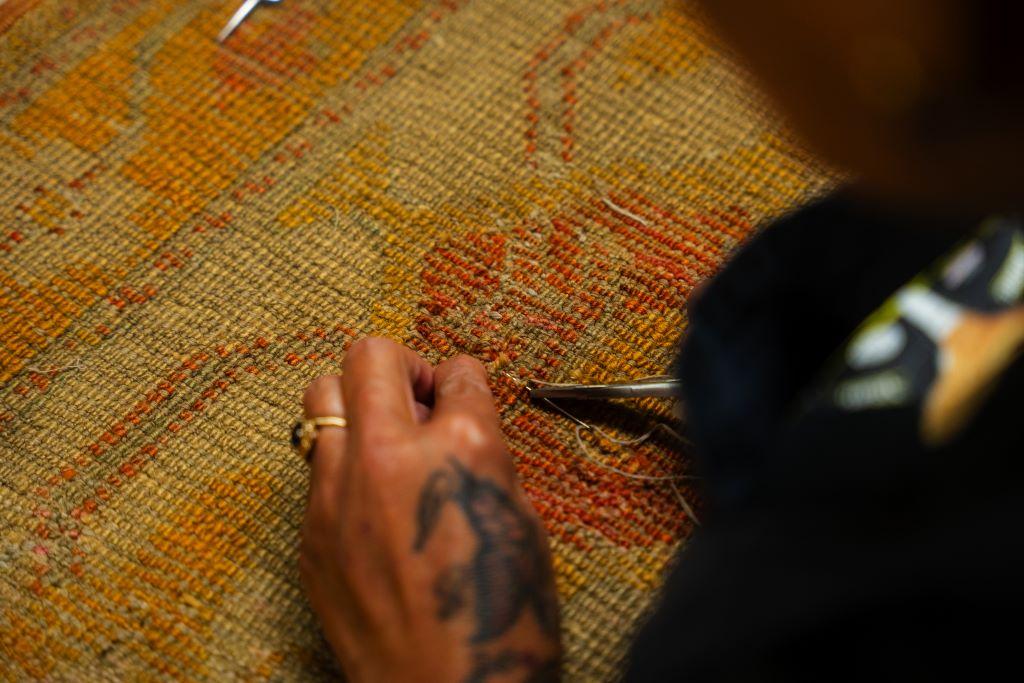
Detail of hands mending a rustic, richly colored woven rug.
Should restorers use traditional materials on Bakshaish rugs? Yes—authentic restoration requires handspun wool and natural dyes that match the original palette. Substituting synthetic fibers or chemical dyes diminishes both artistic integrity and monetary value.
Proper restoration can stabilize a rug and even preserve its investment worth, but authenticity in materials is critical. Condition versus restoration plays a delicate role: careful repairs done in traditional style preserve value, while poorly executed interventions may reduce it.
Political & Export Factors
How do regional politics influence Bakshaish rug exports? Political shifts in Iran have always influenced the global supply of investing in Bakshaish carpets. Sanctions, trade restrictions, and cultural heritage laws sometimes limit the export of antique rugs, tightening availability in Western markets.
At the same time, global demand ensures that existing collections outside Iran continue to appreciate in value, with fewer fresh examples reaching auction. These geopolitical dynamics add another layer of rarity, making authentic Bakshaish rugs both culturally precious and financially resilient.
Legacy
The legacy of Bakshaish weaving rests not only in its artistry but in its enduring market strength. For collectors, these carpets are more than antiques—they are cultural investments, objects whose rarity and individuality continue to push their value upward.
Preserving their dyes, authenticating their origins, and respecting their materials ensures that investing in Bakshaish carpets remains both a safe and rewarding endeavor.
Bakshaish Rugs in Contemporary Interiors
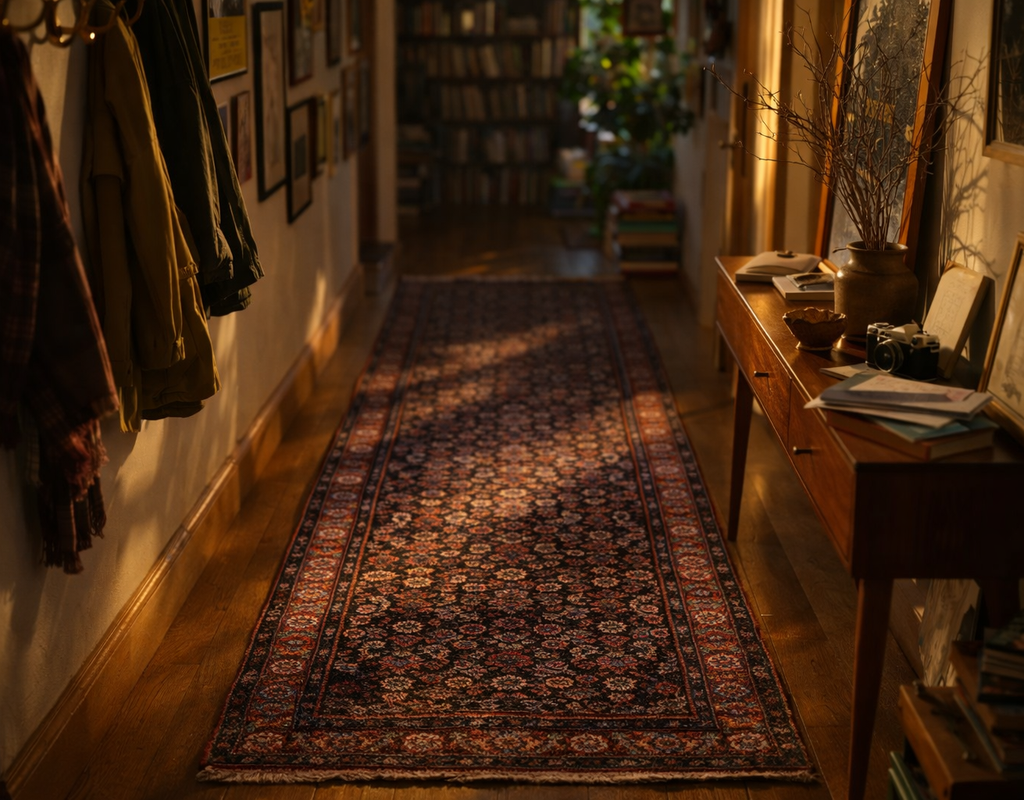
Golden hour sunlight streams across the floor, highlighting the deep colors of the runner rug in this inviting hallway.
Modern Design Pairings & Trends
- Minimalist interiors — Why: Antique Bakshaish rugs in interiors add warmth and depth to pared-down spaces, their bold medallions and rustic colors grounding sleek architecture with character.
- Eclectic and bohemian rooms — Why: The spontaneous geometry of Bakshaish weaving complements layered, textural design schemes where cultural artifacts and modern art co-exist.
- Classic traditional settings — Why: With their roots in Persian artistry, Bakshaish rugs harmonize with antique furniture, paneling, and formal décor while still adding a touch of folk vitality.
- Modern rustic and organic interiors — Why: Neutral-ground Bakshaish carpets, often woven with camelhair, fit seamlessly with wood, stone, and natural materials central to contemporary rustic design.
- Luxury contemporary spaces — Why: Designers increasingly use large-scale Bakshaish pieces as statement anchors, treating them less as floor coverings and more as collectible artworks.
The Rise of “New Bakshaish” Rugs
What defines “New Bakshaish” rugs, and how do they compare to antiques? In recent decades, contemporary workshops have produced new vs antique Bakshaish revivals that follow traditional construction—hand-knotted on cotton foundations with high-quality wool, often dyed with natural pigments. These reproductions echo the medallion layouts, earthy palettes, and tribal motifs of the originals.
However, their character is inevitably more formalized. Where 19th-century weavers improvised freely, modern producers work from patterns designed to appeal to global markets. As a result, while “New Bakshaish” rugs are durable, beautiful, and suitable for modern homes, collector value remains firmly with antique pieces whose spontaneity cannot be duplicated.
Can Contemporary Artisans Capture the Original Aesthetic?
Can contemporary artisans replicate traditional Bakshaish aesthetics? Technically, yes—they can achieve the contemporary Bakshaish style through wool quality, knotting technique, and vegetable dyes. Artisans today can reproduce the deep indigo “Bakshaish blue,” the warm madder reds, and even the rustic camelhair tones.
They can also mirror the scale of medallions and the layout of motifs. But what they cannot fully capture is the improvisational spirit that made antique rugs feel like one-of-a-kind canvases. Modern rugs tend toward order; antique Bakshaish celebrated unpredictability. For interior design, this distinction is less limiting.
A modern Persian rug trend sees designers happily using both antiques and new reproductions: antiques as rare, investment-grade artworks and new pieces as accessible ways to bring the Bakshaish aesthetic into contemporary homes. The enduring appeal lies in the style’s ability to bridge rustic village artistry with sophisticated interior sensibilities—an aesthetic as relevant today as it was in 19th-century East Azerbaijan.
Explore a Few of Our Bakshaish Rugs
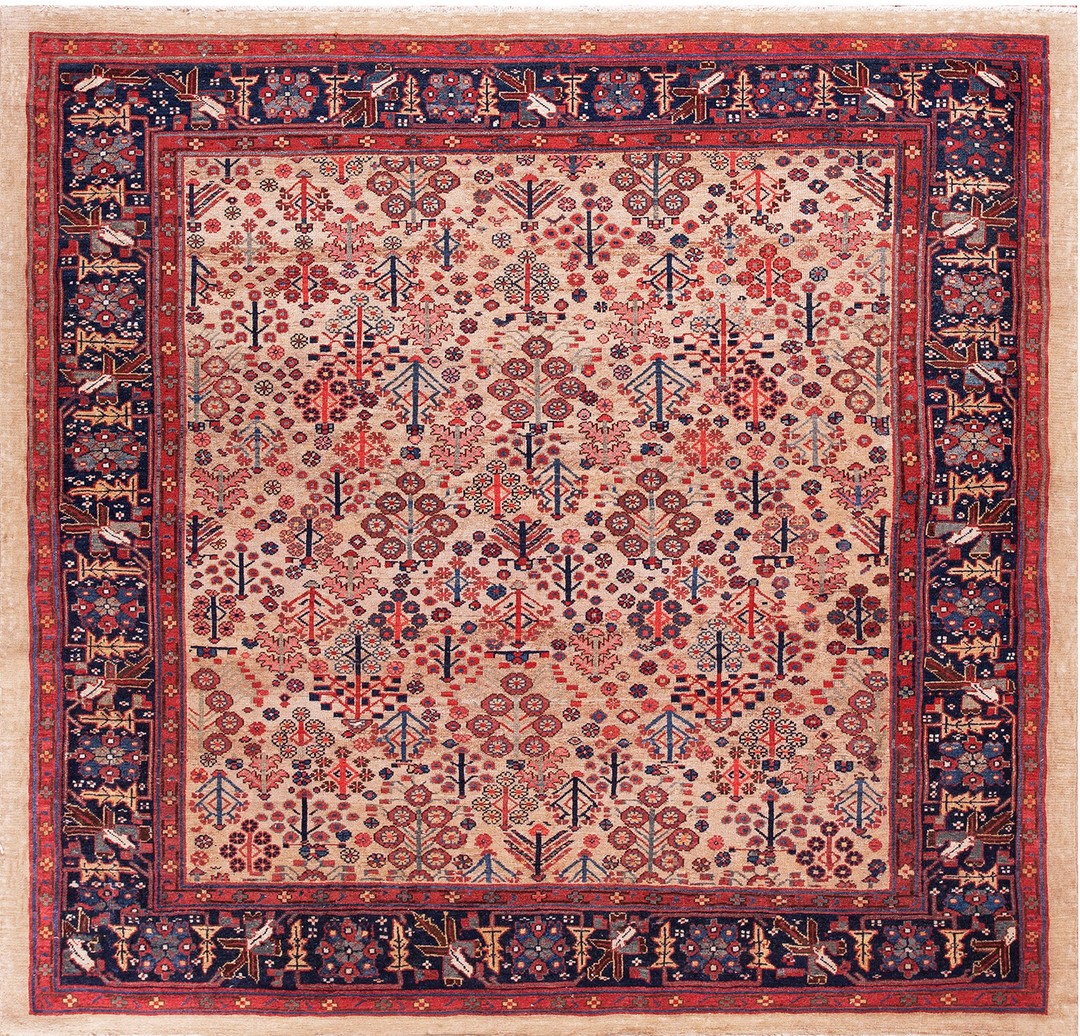
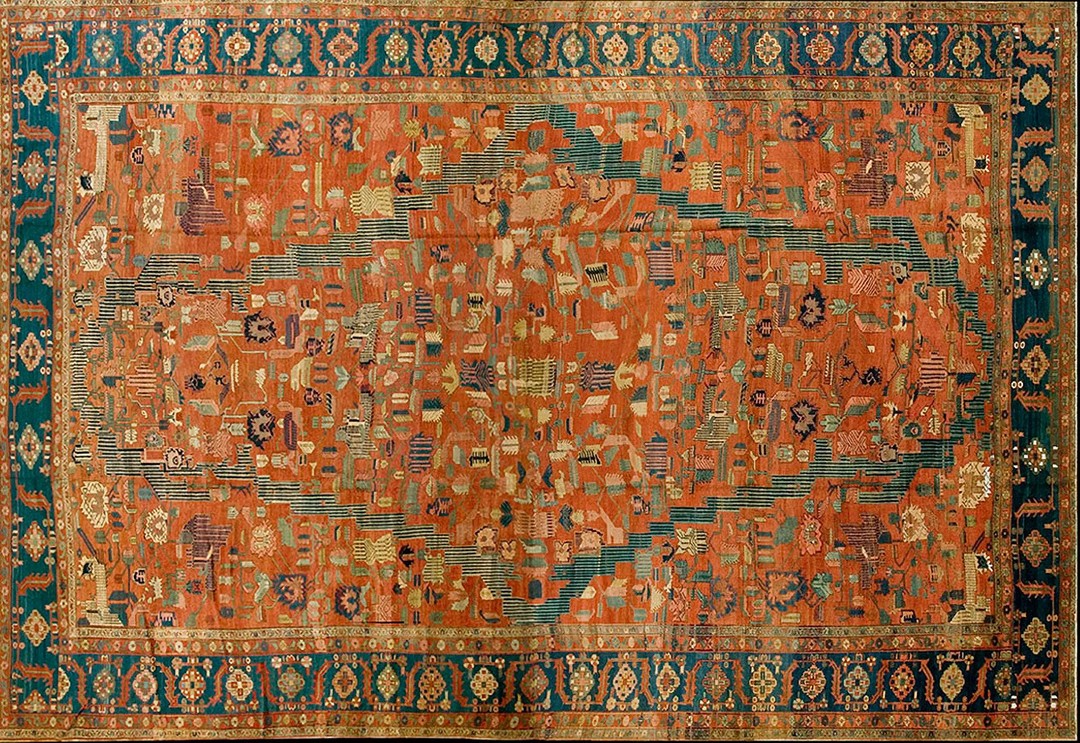
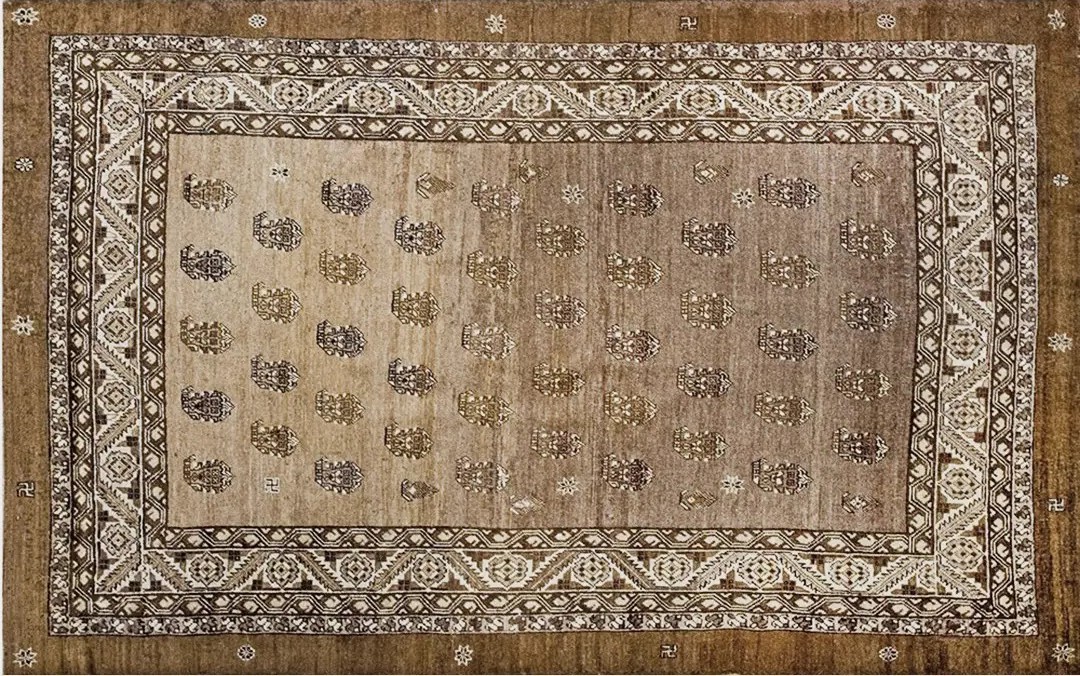
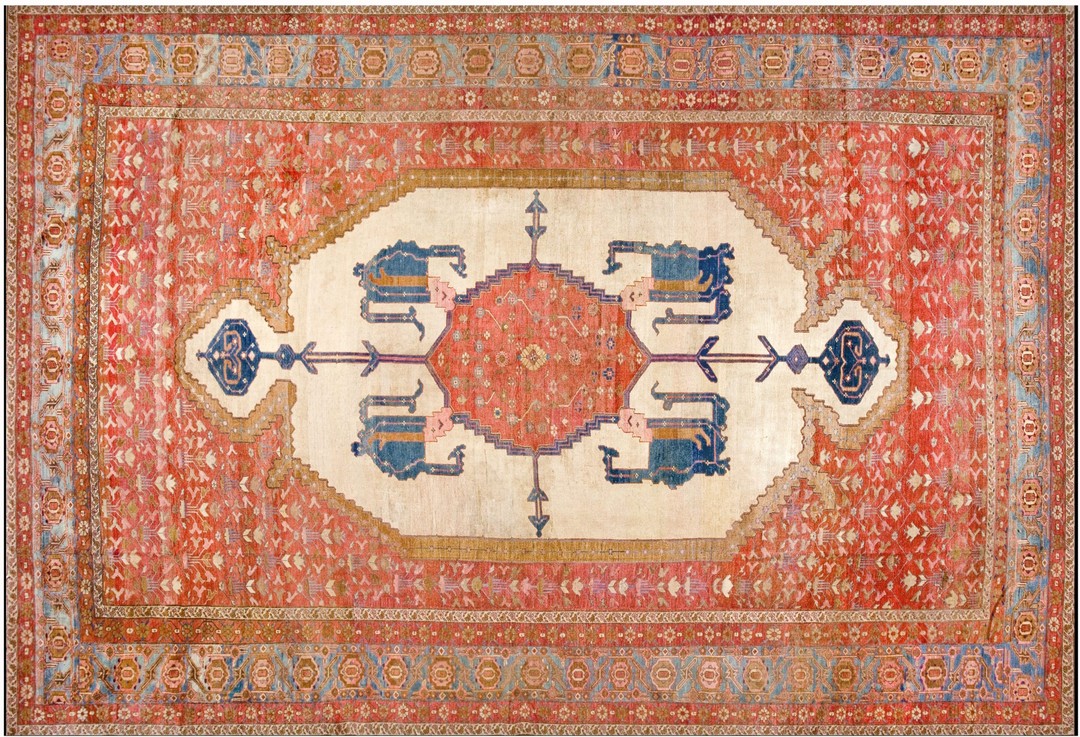
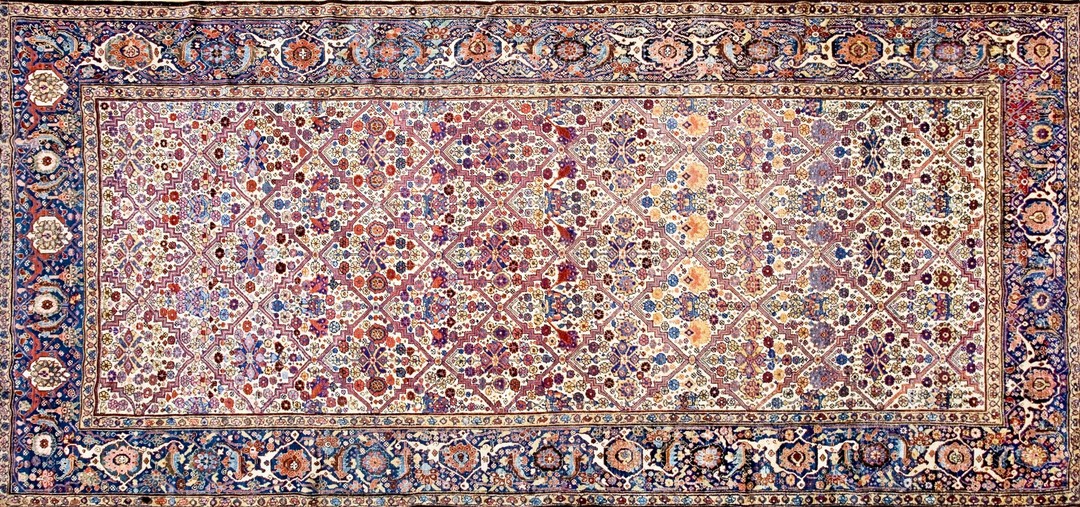
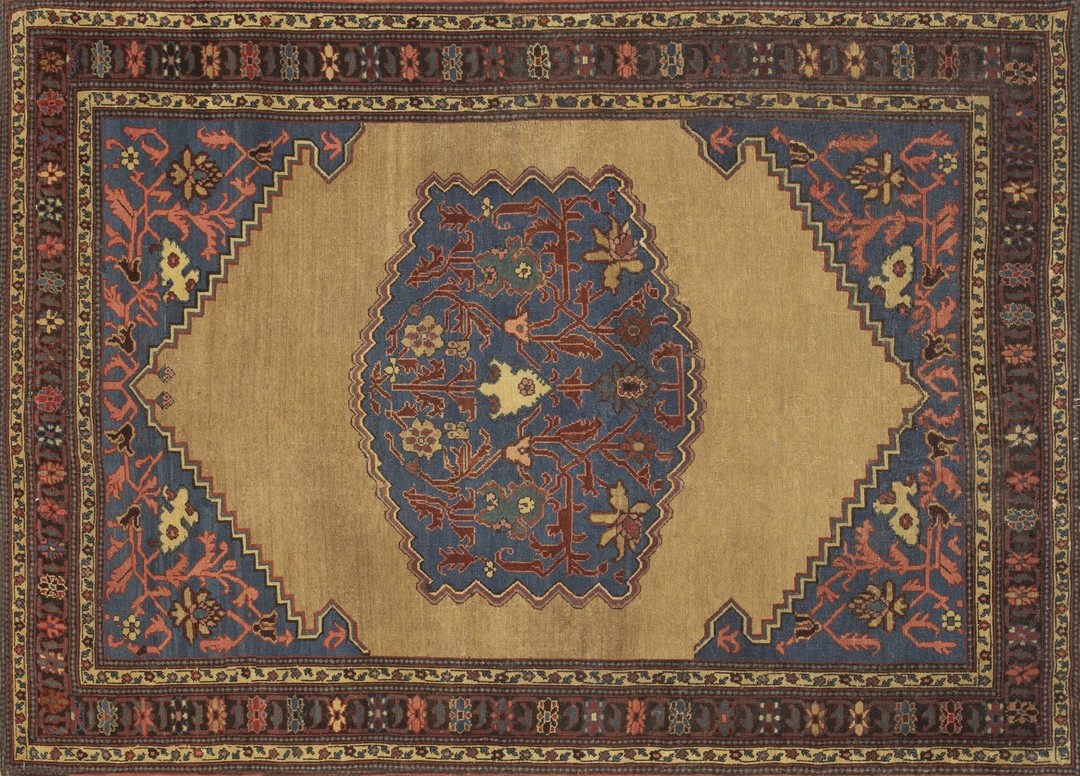
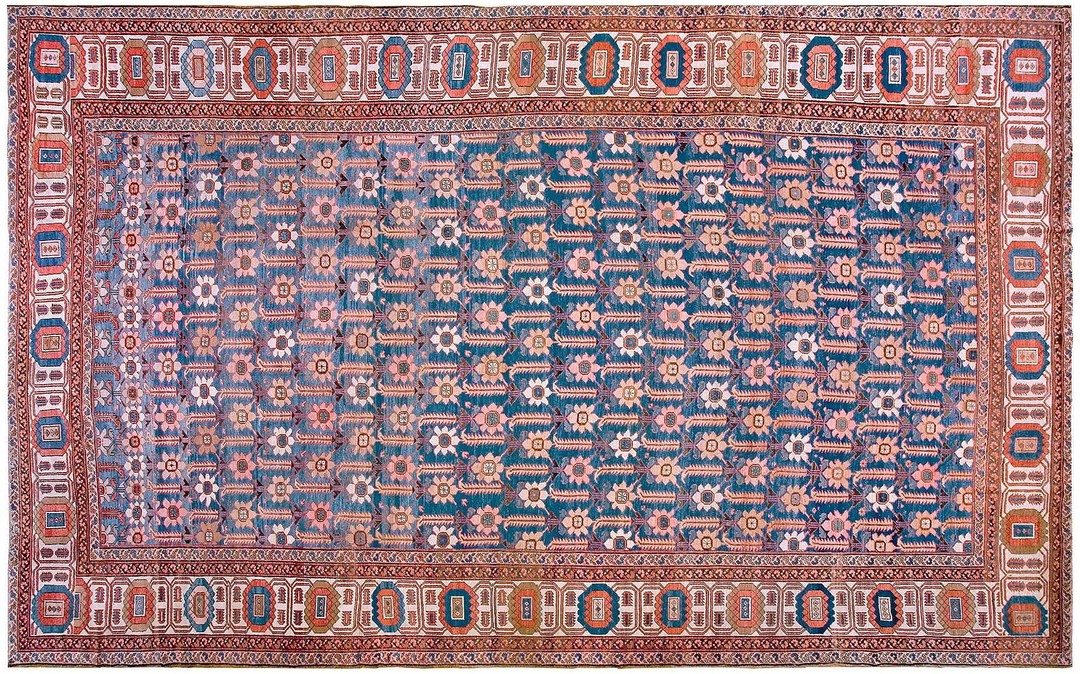
FAQ
- Is “Bakhshayesh” the same as Bakshaish rugs?
Yes—“Bakhshayesh” is an alternate transliteration of Bakshaish; both refer to rugs from the same northwest Iranian weaving center and its broader Heriz-area tradition.
- Where can I buy authentic Bakshaish rugs in the U.S.?
Look to reputable specialist galleries and major auction houses with condition reports and guarantees; compare examples in person when possible and ask about returns.
- How should I store Bakshaish rugs?
Clean first, roll pile-in, wrap in breathable material, and store in a climate-controlled, dry space (around 60–75°F); check periodically for moths and moisture.
- Can Bakshaish rugs go over radiant-heated floors?
Gentle radiant heat is usually fine for wool Bakshaish rugs; use a breathable pad and avoid high temperatures or trapped moisture to prevent drying or shrinkage.
- Are Bakshaish runner rugs available?
Yes—Bakshaish runners and gallery sizes are found, often with open, tribal drawing; lengths can exceed 15 feet, making them great for halls and long spaces.
- Do Bakshaish rugs bleed or fade?
Older Bakshaish rugs typically use stable vegetable dyes, but color can fade in strong sun and some late-19th-century pieces may include early synthetics—spot-test and limit UV exposure.
- What motifs appear in Bakshaish rugs?
Bakshaish rugs commonly show large medallions, abstract flora, and inventive borders like the oak-leaf-and-rosette meander, often drawn with playful asymmetry.
- How do I verify a Bakshaish rug’s age and authenticity?
Inspect the back for hand knots, look for natural wear and oxidation, and request provenance; when in doubt, get a written evaluation from a qualified rug appraiser or conservator.
- Do new Bakshaish-design rugs exist?
Yes—workshops in Turkey, Pakistan, India, and elsewhere weave Bakshaish-design rugs today; they echo the look at lower prices but aren’t antique Bakshaish rugs.
- Are Bakshaish rugs a good investment?
Top-tier antique Bakshaish rugs have a strong auction record and collector demand, but returns aren’t guaranteed—buy the best condition and design you can, and seek expert appraisal.
- How much do Bakshaish rugs cost?
Prices vary widely: smaller or later pieces can start in the low thousands, while fine 19th-century Bakshaish rugs often reach five to six figures depending on size, condition, and artistry.
- Are Bakshaish rugs good for homes with pets?
Wool in Bakshaish rugs naturally resists soiling, but antique piles are delicate; wipe accidents immediately, avoid harsh enzyme cleaners, and consider a protective pad.
- Can robot vacuums be used on Bakshaish rugs?
Use caution—robot vacuums can catch fringes and tug fibers. Disable brush rolls near the rug, or vacuum manually with a suction-only tool to protect Bakshaish rugs.
- How should I clean Bakshaish rugs at home?
Vacuum gently with suction only (no beater bar), protect fringes, blot spills with cool water, and schedule professional hand washing when soiled; rotate annually to even wear.
- What is a camel-hair Bakshaish rug?
Camel-hair Bakshaish rugs use undyed camel hair for the field, creating golden-khaki tones; they’re relatively rare and highly prized by collectors.
- Do Bakshaish rugs use the Turkish (symmetric) knot?
Most Bakshaish rugs from the Heriz area employ the symmetric (Turkish/Ghiordes) knot on a cotton foundation, contributing to their toughness and crisp geometry.
- Are Bakshaish rugs durable for everyday use?
Yes—Bakshaish rugs are robust, but antiques deserve care: use a quality rug pad, rotate yearly, avoid constant direct sun, and keep heavy wear and moisture in check.
- What materials are Bakshaish rugs made from?
Bakshaish rugs typically use wool pile on a cotton foundation, sometimes incorporating undyed camel hair for luminous tan fields; dyes are predominantly natural in older pieces.
- What’s the difference between Serapi and Bakshaish rugs?
Serapi usually denotes finer, more formal late-19th-century Heriz-area weaving, while Bakshaish rugs skew village-made and improvisational; terms overlap and are dealer conventions, not strict labels.
- How do Bakshaish rugs differ from Heriz rugs?
Bakshaish rugs are generally freer and more tribal in drawing, while Heriz rugs tend to be busier and more rigid; both use sturdy wool and come from the same northwest Persian region.
- What colors are typical in Bakshaish rugs?
Bakshaish rugs often feature rusts, brick reds, deep/navy blues, camel or ivory grounds, and exceptional blues (azure to teal), with salmons, corals, buffs, and greens adding warmth.
- What sizes do Bakshaish rugs usually come in?
Many Bakshaish rugs are room-size or oversize—commonly 8×11 to 13×17 feet—with examples up to roughly 12×19, plus runners and smaller mats.
- How can I identify authentic Bakshaish rugs?
Authentic Bakshaish rugs show big, improvisational medallions, inventive borders, earthy palettes, and a medium-coarse weave (about 30–80 KPSI), with hand-knotted wool pile and visible irregularities.
- Where do Bakshaish rugs come from?
Bakshaish rugs originate in the village of Bakhshayesh (Heris County) near Tabriz in northwest Iran, a historic weaving hub famed for expressive, large-scale designs.
- What are Bakshaish rugs?
Bakshaish rugs are hand-knotted Persian village carpets from northwest Iran, known for bold, freely drawn geometry and rich natural colors, mostly woven in the 1800s–early 1900s.