
Introduction to Aubusson and Their Rugs
Discover our curated selection of genuine authentic antique French Aubusson rugs available to buy and bring elegance into your home today.
What are Aubusson rugs?
Aubusson rugs are flat-woven carpets from Aubusson France. They feature elegant tapestry-like designs, often featuring flowing floral arrangements, soft medallions, and pastel palettes that emphasize harmony.
Unlike knotted pile carpets, these rugs are woven in a way that produces a smooth surface, giving them the refined appearance of wall tapestries laid beneath one’s feet. Their origins are intertwined with the prestigious tapestry-making traditions of the region, which began centuries ago and matured into a craft that merged artistry with functional floor coverings.
Today, the very phrase Aubusson rugs France immediately conjures images of aristocratic salons, French châteaux, and refined European interiors. The style is defined not just by technical excellence, but by its cultural symbolism of luxury, artistry, and French refinement.
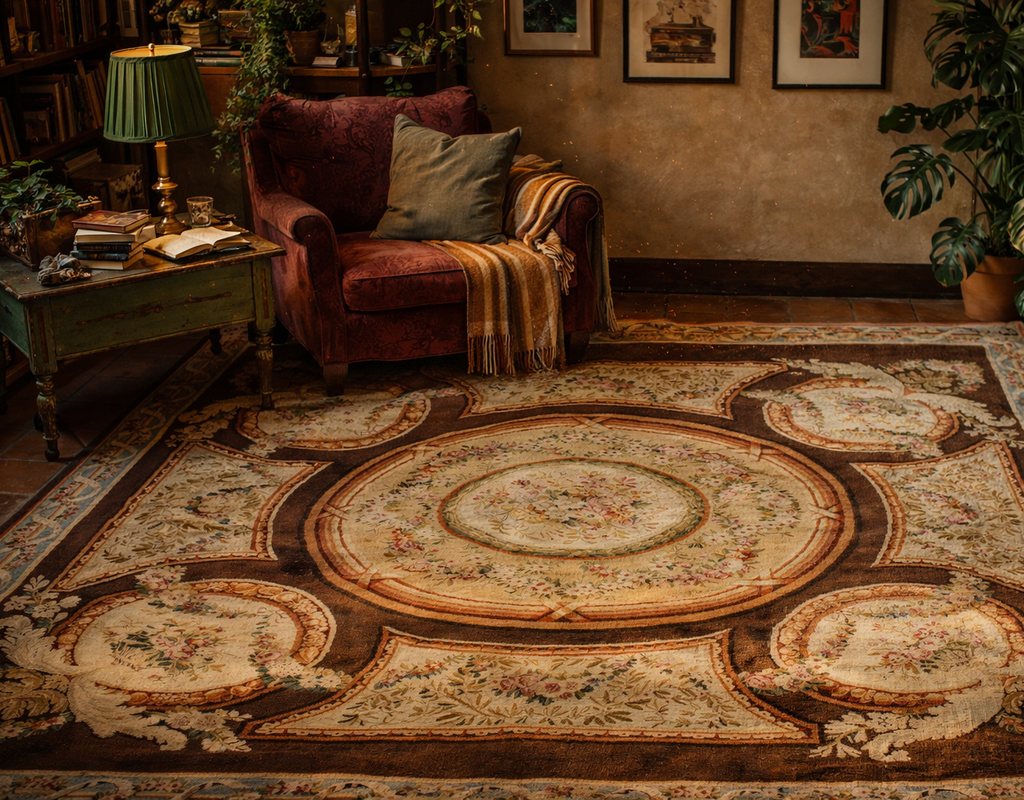
The dramatic floral rug complements the rich textures and vintage pieces of this inviting reading space.
Slit-Tapestry: The Fingerprint of an Aubusson
The traditional Aubusson is woven using the “slit-tapestry” technique. Because the weft threads do not travel across the entire width of the rug, but instead turn back when a new color begins, a tiny vertical gap or “slit” is created between different color blocks.
In the finest antique pieces, these gaps are meticulously hand-sewn together after weaving. If you hold an authentic Aubusson up to a window, these microscopic “pinholes” of light acting as seams are the definitive proof of its handmade, tapestry-woven origin.
The Expert’s Triage: 3 Ways to Spot a Real Antique Aubusson
If you are buying rugs online, ask the rug store / dealer for three specific photos to help try and separate an 18th / 19th-century masterpiece from a newly woven reproduction.
Here are the questions:
- The “Mirror” Back: Ask for a photo of the reverse side. A true Aubusson is a hand-woven tapestry; the design on the back should be a crisp, near-identical mirror of the front. If you see a canvas or cloth backing glued on, it is a modern tufted imitation.
- The “Galon” Signature: Look at the outermost dark blue or green border (the galon). On many authentic pieces, you will find woven initials or workshop marks. These are the “artist signatures” of the Creuse Valley weavers.
- The “Iron-Eat” Test: In antique Aubussons, the dark brown and black outlines were often dyed with iron-rich minerals. Over 150+ years, this iron slightly corrodes the wool. If those dark outlines look “etched” or sit slightly lower than the surrounding pastel wool, you are looking at genuine age.
Where is Aubusson?
Aubusson is a small town in central France, located in the Creuse department of the historic Limousin region, now part of Nouvelle-Aquitaine. The town lies on the banks of the Creuse River, where medieval bridges such as the Pont de la Terrade and Pont Neuf still connect its picturesque quarters.
Its geography—remote, pastoral, and nestled amid rolling hills—helped cultivate a tradition of self-sufficiency and craftsmanship, eventually giving rise to a weaving culture that placed Aubusson on the map of global artistry. For anyone searching for Aubusson location, the coordinates point to a modest town in rural France, yet its cultural importance far surpasses its physical size.
Population & Local Character
Despite its enormous reputation in the arts, Aubusson itself remains a small community with a population of about 3,300 residents. This Aubusson population figure reflects the town’s intimate scale, where local life is still marked by quiet streets, traditional cafés, and artisan workshops that echo centuries-old rhythms.
Today’s Aubusson blends heritage with modern life: its residents honor their tapestry legacy while engaging with global visitors, collectors, and institutions that seek to learn from its traditions. The character of Aubusson is shaped by this duality—both a humble French town and a custodian of world-famous craftsmanship.
Aubusson’s Global Reputation
What makes Aubusson extraordinary is not its size, but its global reputation. For centuries, the name “Aubusson” has been synonymous with luxury rugs that are flatwoven and tapestries, prized by European nobility, collectors, and museums. In recognition of this legacy, UNESCO inscribed Aubusson tapestry weaving as part of the Intangible Cultural Heritage of Humanity, ensuring the preservation of skills passed down through generations.
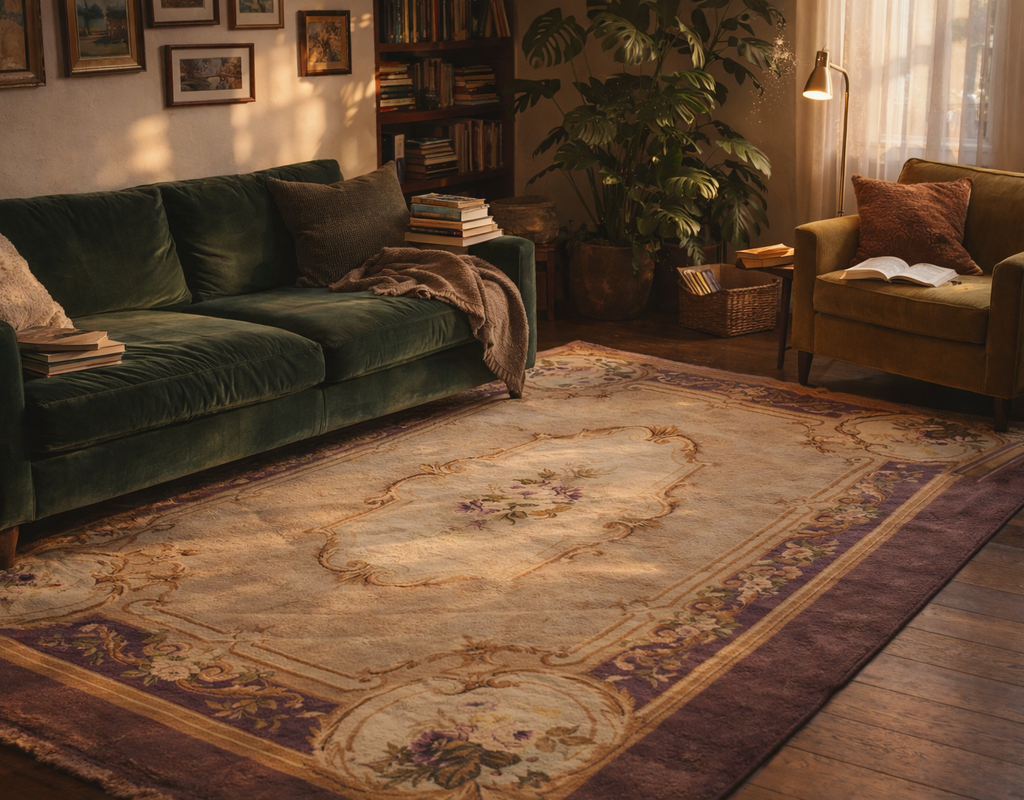
Warm, layered lighting illuminates the blend of vintage furniture and classic textiles in this richly decorated reading nook.
Today, Aubusson rugs are collected and commissioned worldwide, from Parisian salons to international art fairs, with their prestige rooted in their ability to blend fine artistry and practical use. This French tapestry town continues to inspire designers, artisans, and cultural historians, making its weaving tradition not just a relic of the past but a living, globally relevant art form.
In short, Aubusson is both a geographic place and a cultural icon. It is a small town in central France with a modest population, yet it wields enormous influence on the global stage through its unique flatweave rugs and tapestries, celebrated as benchmarks of elegance and craftsmanship.
Geographic and Historical Origins
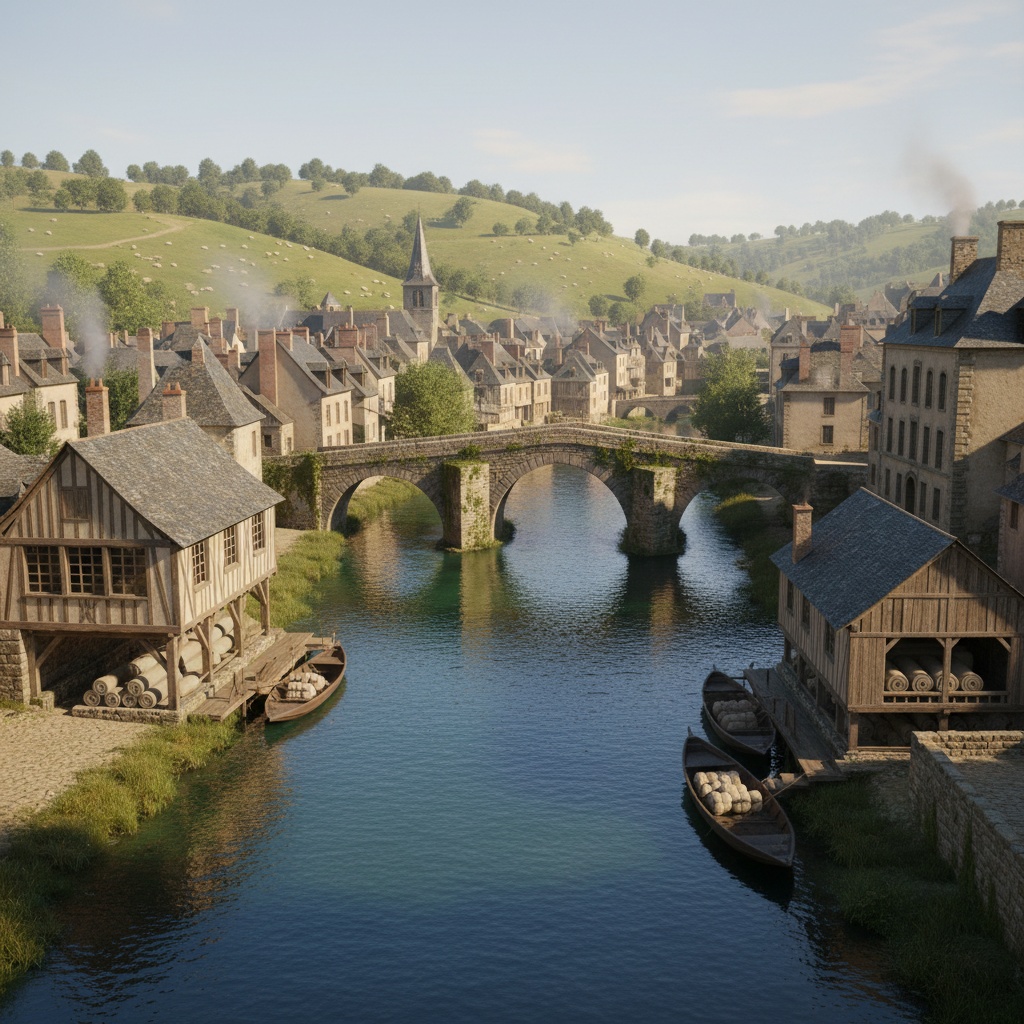
Historic European town setting by a river.
Why Aubusson Became a Weaving Center
The rise of Aubusson as a weaving hub was no accident of fate, but the product of geography, resources, and cultural exchange. The cool climate of the Creuse region provided ideal conditions for wool production, while the surrounding hills supported extensive sheep farming. This steady supply of high-quality wool became the lifeblood of tapestry workshops.
Moreover, Aubusson’s location along the Creuse River gave artisans access to clean water for dyeing and washing fibers, as well as trade routes that connected the rural town to broader markets. In the 14th and 15th centuries, Flemish weavers in Belgium—renowned across Europe for their technical expertise—settled in the town, bringing advanced weaving methods with them. Together, these factors explain why Aubusson developed as a weaving center, uniting natural resources with imported skill.
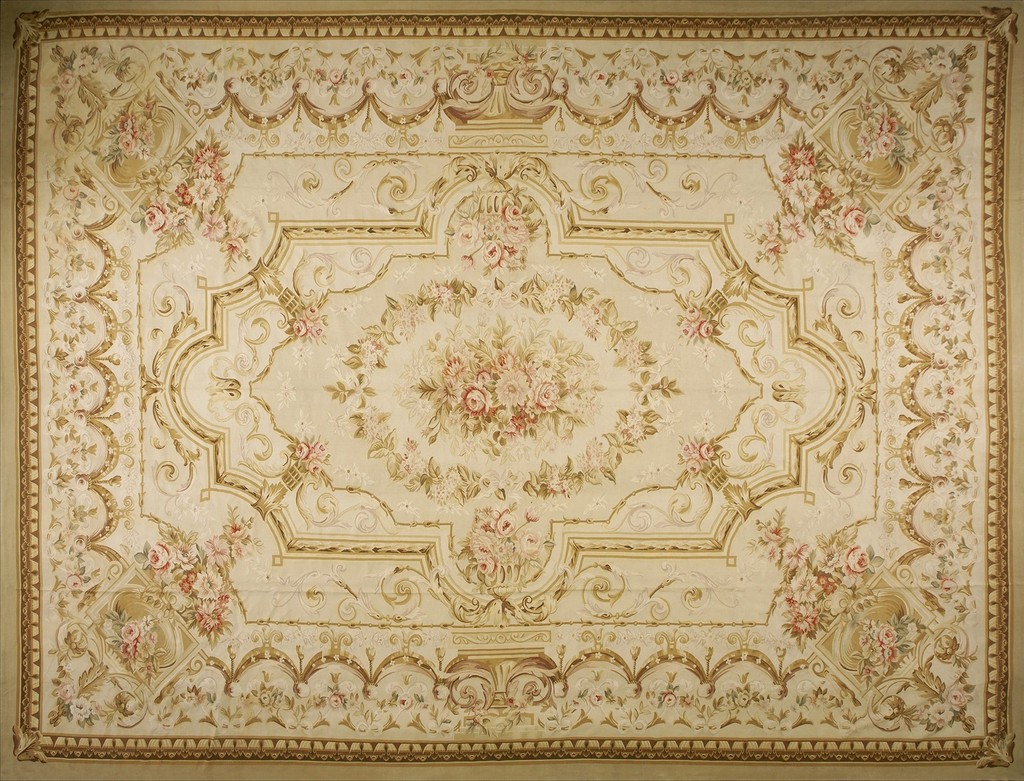
Vintage Large Aubusson Chinese Medallion Knotted Rug by Rugs On Net
Historical Timeline of the Aubusson Weaving Tradition
The story of Aubusson weaving history stretches back to the late Middle Ages. By the 1300s and 1400s, Flemish migration had planted the seeds of a tapestry-making industry in the Creuse.
Over the following centuries, Aubusson grew from a regional craft town to a center of national prestige. In 1665, under the influence of Louis XIV’s administration, Aubusson’s workshops received royal privileges as a Manufacture Royale. This official recognition elevated the town’s artisans, enabling them to compete with the Gobelins and Beauvais manufactories in Paris.
By the 18th century, Aubusson tapestries and rugs were in demand across Europe, their flat-woven elegance gracing the homes of nobility and the halls of power.
Royal Privileges and Louis XIV’s Impact
The reign of Louis XIV proved decisive for Aubusson. His powerful minister, Jean-Baptiste Colbert, sought to centralize and elevate French craftsmanship, granting Aubusson Colbert Louis XIV protections and privileges that legitimized its workshops as part of the royal economy. These privileges not only secured Aubusson’s artisans against foreign competition but also tied their reputation to the grandeur of the French crown.
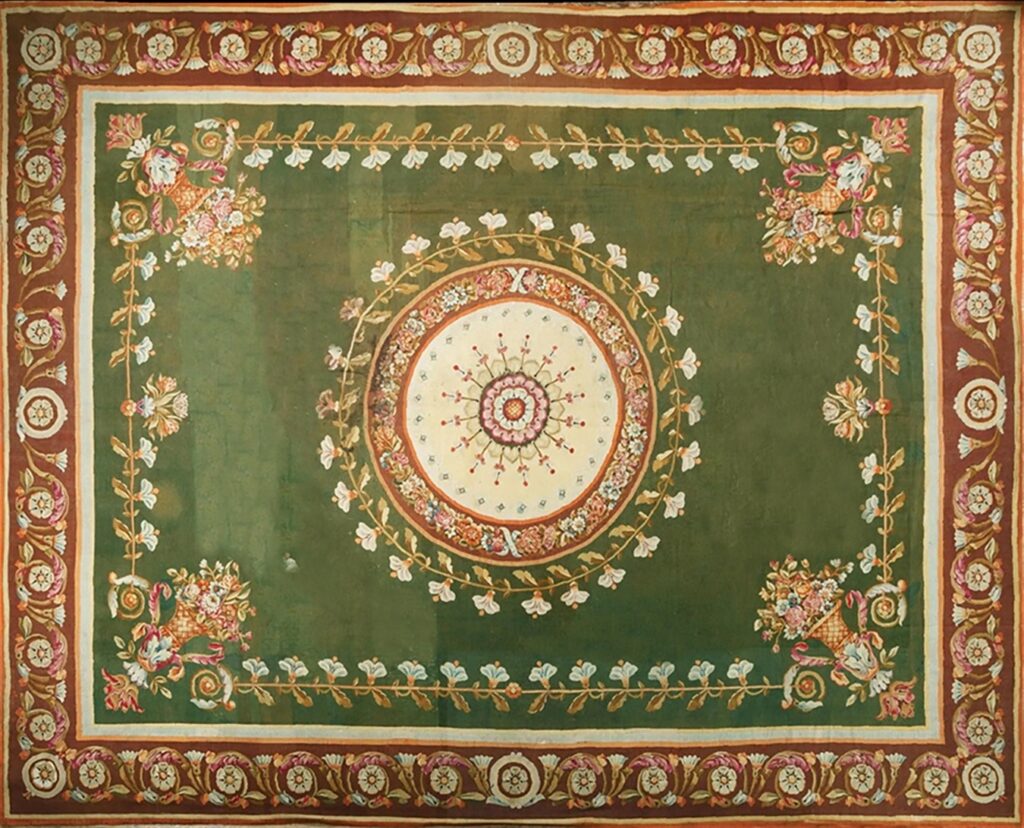
Louis XIV’s court favored grand designs, and Aubusson’s ability to translate Baroque and classical themes into refined tapestries gave it enduring prestige. The granting of royal status was the critical moment when Aubusson shifted from a regional weaving tradition to an internationally recognized manufactory.
Creuse River and Local Landmarks
- Pont de la Terrade — Why: This medieval bridge once connected the weaving workshops along the Creuse River, symbolizing the link between artisans and trade routes.
- Pont Neuf — Why: A later stone bridge, it became an emblem of Aubusson’s expansion and modernization, reflecting the town’s resilience and growth.
- Creuse River Aubusson — Why: The river itself was essential not only for practical textile production (washing, dyeing, transport) but also for shaping the very identity of Aubusson as a tapestry town.
The geography of Creuse and the cultural forces of migration, patronage, and industry together forged Aubusson’s unique place in history—a French rugs and weaving center sustained by sheep, rivers, and royal favor.
Materials, Construction, and Techniques
Flat-Weaving Methods: The Tapestry Technique
The hallmark of Aubusson construction is the tapestry technique, which produces a pileless surface. Instead of being knotted like Persian or Oriental carpets, Aubusson rugs are woven using colored weft threads that pass over and under strong cotton or linen warps. These wefts are carefully interlaced to form the design, meaning the pattern is not applied on top but created as part of the structure itself.
The result is a flat, smooth textile that resembles wall tapestry in finish. For detail and richness, artisans sometimes introduce silk highlights, but the dominant medium has always been wool. This distinct Aubusson tapestry technique sets it apart from knotted rug traditions and aligns it with the French lineage of wall hangings adapted for floors.
Aubusson Knotting Methods: Symmetrical or Asymmetrical?
Unlike many weaving traditions, Aubusson does not use knotted construction. There are no symmetrical knots (Turkish/Ghiordes) or asymmetrical knots (Persian/Senneh) in these textiles. Instead, the designs emerge entirely from the interwoven wefts of the tapestry process.
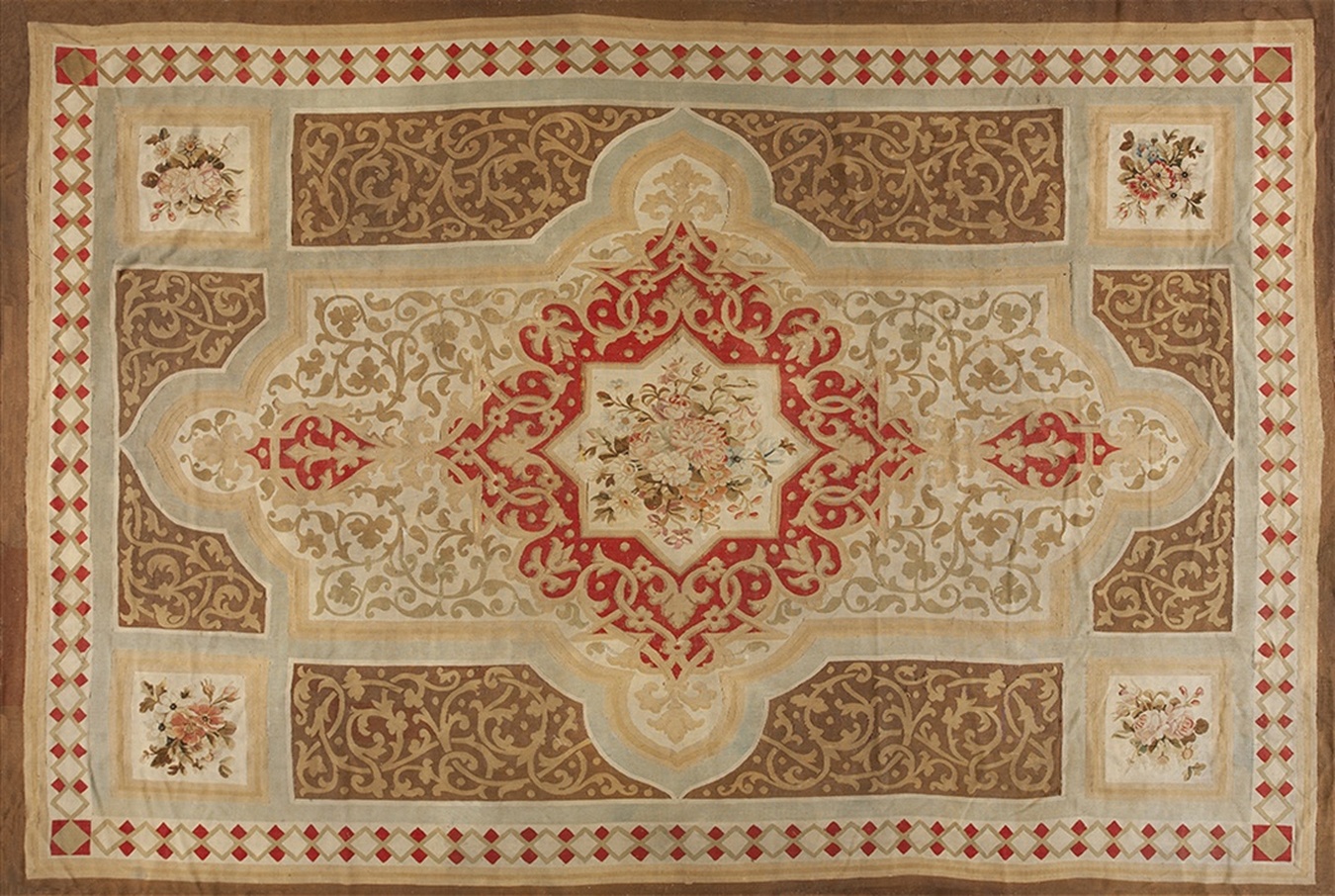
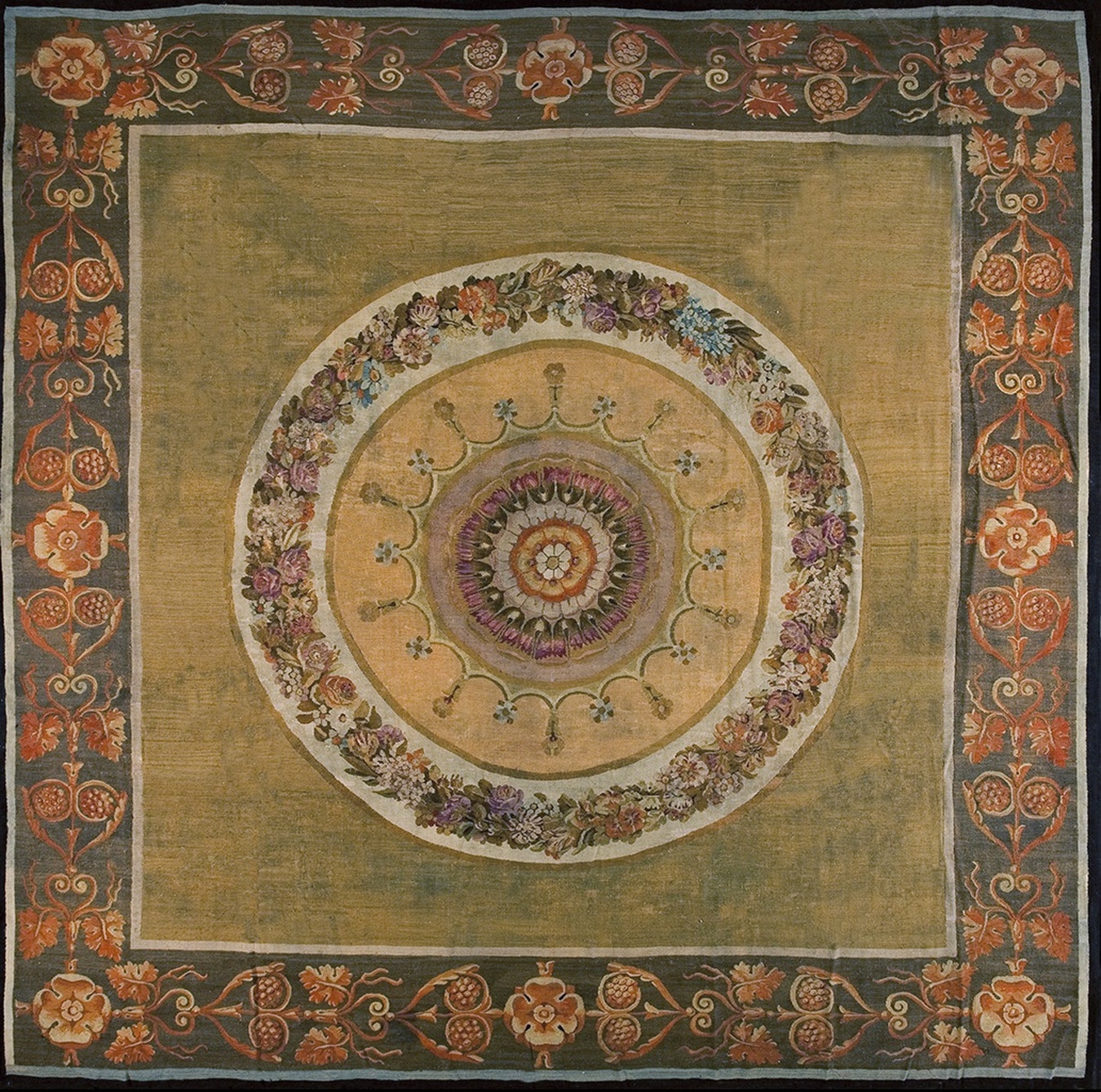
Antique Aubusson French Allover Medallion Flat Weave Rug – by Rugs On Net
This distinction is crucial in understanding why Aubusson belongs in the family of flatweaves rather than pile area rugs. Thus, when asked whether Aubusson weaving uses symmetrical or asymmetrical knots, the answer is clear: neither—it is not a knotted rug.
Limousin Wool: Regional Support for Craft
The Limousin region’s sheep farming provided Aubusson with an abundant supply of high-quality wool. This resource was essential in establishing the area as a weaving center and remains central to the tradition today. Limousin wool rugs are prized for their durability and softness, qualities that make the threads both strong enough for warp and supple enough for richly dyed wefts.
The region’s natural pastures gave the wool its resilience, while clean local waters enhanced the dyeing process, resulting in fibers that could carry the delicate pastel tones and soft shading that define Aubusson design. Without this local supply, Aubusson weaving would not have flourished into the world-renowned tradition it became.
The Aubusson Cartoon and Looms
A distinctive feature of Aubusson weaving is the reliance on the cartoon, a full-scale drawing of the design placed beneath the warp threads. Weavers work from the back of the textile, following the cartoon with precision to reproduce the pattern.
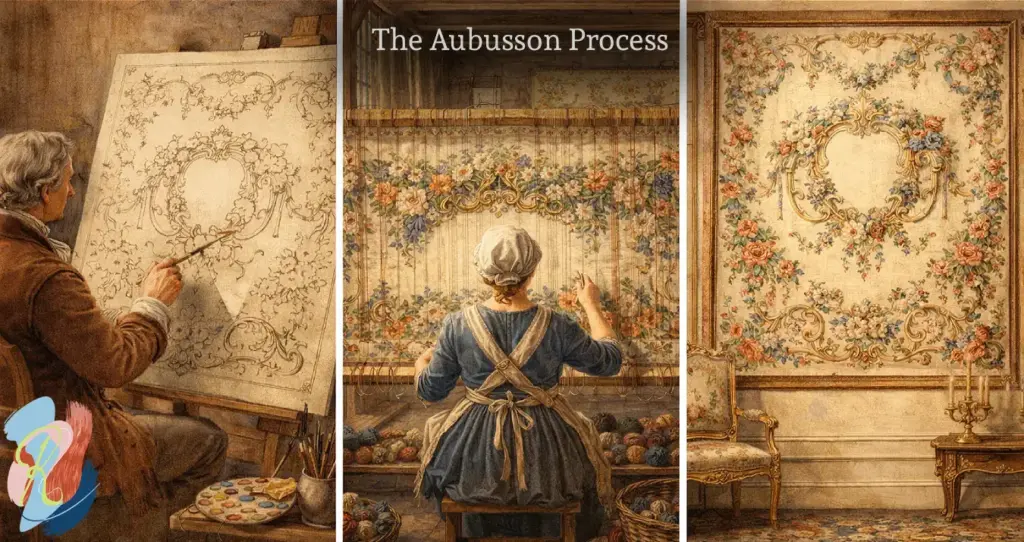
The loom of choice is the horizontal basse-lisse loom, a flat structure where the warp lies horizontally, allowing the artisan to sit above the work. This Aubusson horizontal loom setup encourages accuracy and long working sessions, ideal for the large, detailed rugs and tapestries the town is famous for.
Workshop Practices in Aubusson and Felletin
- Aubusson workshops — Why: As the historic center, Aubusson remains home to artisans who preserve the authentic methods recognized by UNESCO. Visitors can witness the legacy firsthand in living workshops.
- Felletin workshops — Why: Just a few kilometers from Aubusson, Felletin also developed a strong weaving industry, and today it continues to host active looms, keeping the regional craft alive.
- Tours and demonstrations — Why: Many workshops open their doors to visitors, offering guided tours that showcase looms, cartoons, and artisans at work, making it possible for enthusiasts to experience the craft’s living tradition.
In sum, the Aubusson tapestry technique, the reliance on Limousin wool, and the use of horizontal looms guided by cartoons together form the technical DNA of these rugs.
Combined with the enduring activity in both Aubusson and Felletin workshops, this construction heritage remains visible and accessible today.
Signature Design & Motifs
Classic Floral Carpets
At the heart of Aubusson floral design lies an emphasis on refined natural motifs rendered with painterly softness. The most recognizable patterns feature roses, lilies, and garlands woven into scrolling acanthus leaves and encircling central medallions. These medallions, often oval or round, anchor the composition, while foliate wreaths and scrolling borders create balance and symmetry. The palette favors light pastels—soft blues, creams, and rose tones—designed to harmonize with French interiors. These motifs gave rise to the archetypal Aubusson medallion carpet, instantly recognizable for its elegance and restraint.
Pastoral and Mythological Scenes
Beyond florals, Aubusson weaving also excelled in narrative design. Tapestries and rugs frequently depicted pastoral landscapes, often with shepherds, flocks, and idyllic countryside scenes, reflecting Enlightenment ideals of harmony with nature.
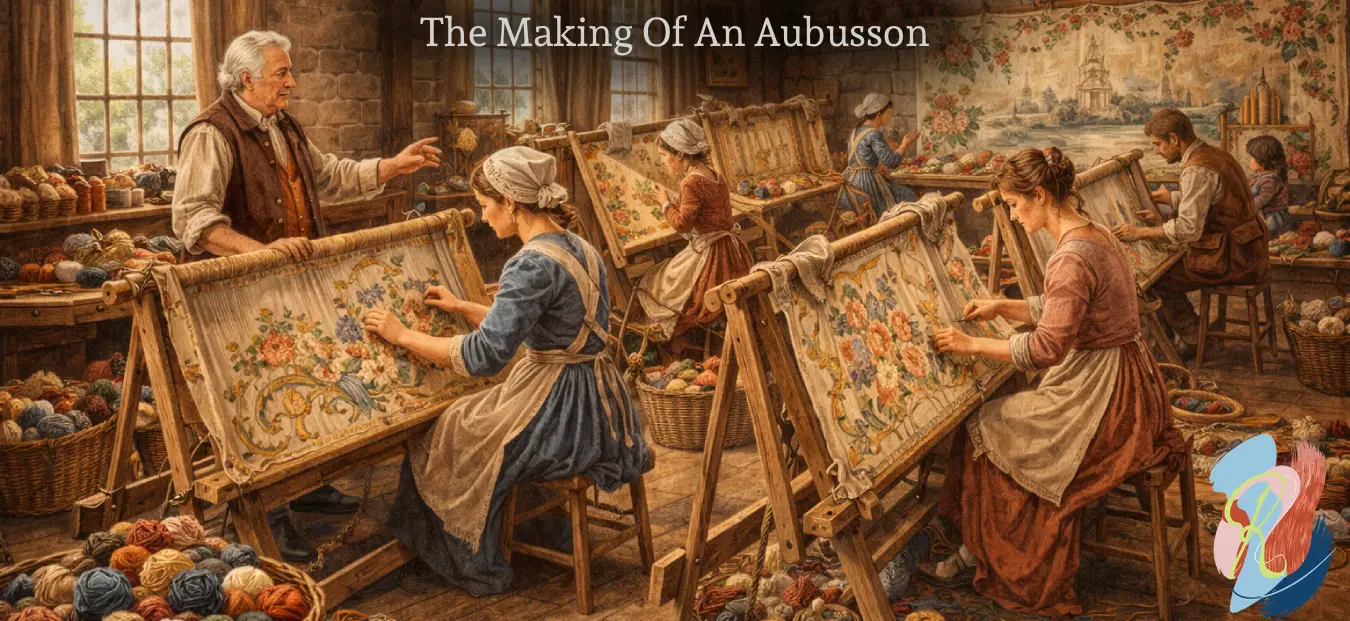
At the same time, mythological figures and allegories—drawn from Greco-Roman tradition—appeared as central subjects, embodying themes of love, virtue, or triumph. These scenes underscored Aubusson’s role as more than a producer of decorative textiles; it was also a medium of storytelling and symbolism, weaving cultural ideals into functional art.
Rococo, Neoclassical, and Other Period Influences
- Rococo motifs (18th century) — Why: Lighthearted curves, playful cherubs, and asymmetrical scrolls suited the era’s decorative exuberance and remain a signature of Aubusson rococo neoclassical transitions.
- Neoclassical patterns — Why: Inspired by classical antiquity, these designs incorporated laurel wreaths, urns, and architectural symmetry, aligning Aubusson with the aesthetics of Louis XVI and the Empire period.
- Empire style — Why: Bold eagles, columns, and Napoleonic symbols reinforced France’s imperial ambitions, woven into carpets for grand state interiors.
- Art Deco elements — Why: By the early 20th century, Aubusson adapted to modern tastes, weaving geometric abstractions and stylized florals that carried its tradition into contemporary design.
Aubusson vs. Savonnerie Style
Although often confused due to overlapping patrons and motifs, Aubusson vs Savonnerie distinctions are clear. Aubusson rugs are flatwoven tapestries created with interlaced wefts and a smooth, pileless surface. In contrast, Savonnerie carpets are knotted pile rugs, producing a plush texture more akin to Persian and Oriental carpets.
Stylistically, both traditions shared similar palettes—pastels, florals, medallions, and neoclassical motifs—but their construction techniques defined their function. Aubusson rugs suited lighter, decorative applications where elegance and portability were prized, while Savonnerie carpets were heavier, more luxurious, and better suited to monumental interiors.
Together, these motifs and stylistic traditions make Aubusson an enduring symbol of French artistry, weaving floral bouquets, pastoral stories, and classical grandeur into textiles that remain iconic worldwide.
| Feature | Aubusson | Savonnerie |
|---|---|---|
| Construction | Flatweave (Tapestry): Woven like a thick cloth with no pile. | Hand-Knotted (Pile): Thousands of knots creating a plush surface. |
| Texture | Smooth, firm, and ultra-low profile. | Thick, soft, and velvety to the touch. |
| Technical Marker | Visible vertical “slits” or pinholes between color changes. | Solid, continuous surface; no slits between colors. |
| Best For | Dining rooms (chairs slide easily) and wall tapestries. | Bedrooms and living salons where comfort is prioritized. |
| Durability | Requires a dense felt pad to protect the foundation threads. | The vertical pile provides a natural buffer against wear. |
The “Savonnerie” Cousin
A common point of confusion is the difference between an Aubusson and a Savonnerie. While both are French and feature similar floral motifs, an Aubusson is traditionally (not always) a flatweave (like a heavy fabric), whereas a Savonnerie is a thick, hand-knotted pile rug.
In the 19th century, the Aubusson workshops began producing pile rugs to compete with Savonnerie, leading to the rare and highly prized “Knotted Aubusson.”
Understanding the Styles: From Rococo to Empire
Not all Aubussons are created equal in design.
To date an antique piece, look at the geometry:
-
- Louis XV (Rococo): Asymmetrical, flowing “C” and “S” curves, and abundant, naturalistic roses in shades of pink and cream.
-
- Empire (Napoleonic): More rigid and masculine. Look for Roman “laurel” wreaths, central eagles or medallions, and a palette of deeper forest greens, golds, and burgundies.
Knowing these shifts allows a collector to match the rug not just to a room’s colors, but to its architectural era.
Designing & Decorating with Elegance: How to Style an Aubusson Rug
Placing and positioning rugs in a decorative room setting is easy with an Aubusson. An Aubusson is essentially “art for the floor.” Because they lack the heavy, thick pile of traditional knotted rugs, they offer a sophisticated, low-profile look that doesn’t overwhelm a room.
The Anchor of a “Grandmillennial” Space
The rise of the “Grandmillennial” aesthetic—which celebrates traditional patterns like chintz, ruffles, and florals—has brought the Aubusson back into the spotlight.
-
- Design Tip: Pair a pastel floral Aubusson with bamboo “Chippendale” chairs or pleated lampshades. The rug acts as a soft, romantic base that ties traditional elements together without the visual “heaviness” of a dark Persian carpet.
Adding Warmth to Minimalist Interiors
If you have a modern, “all-white” room with clean-lined furniture, an antique Aubusson provides the perfect “organic contrast.”
-
- Design Tip: Use an Aubusson with a muted, sun-faded palette. It adds a sense of history and “soul” to a sterile room, making the space feel lived-in and curated rather than just “decorated.”
The Ultimate Dining Room Choice
Aubussons are arguably the best rugs for a dining room.
-
- The Practical Benefit: Because they are flat-woven (pileless), dining chairs slide effortlessly across the surface. You won’t struggle with chair legs getting “caught” in a thick pile.
-
- The Visual Benefit: The central medallions common in Aubusson designs are perfectly framed by a dining table, creating a symmetrical, formal focal point.
Layering for a Bohemian Touch
If an Aubusson feels “too formal” for your vibe, try layering.
-
- Design Tip: Place a large, chunky Jute or Sisal rug down first, then “float” a smaller Aubusson on top. This “dresses down” the French elegance, giving it a relaxed, global, and layered look that works in a library or bedroom.
Wall Hanging: Treating the Rug as a Tapestry
Remember that the Aubusson technique is identical to tapestry making. If you have a beautiful fragment or a piece that is too delicate for high foot traffic, mount it on the wall.
-
- Design Tip: Hanging an Aubusson behind a bed or in a grand hallway creates a stunning acoustic and visual centerpiece that highlights the “painterly” shading of the weave.
Regional Variations, Imitations, and Authentication
Production in Felletin and Other Creuse Villages
-
- Felletin — Why: Just a few kilometers from Aubusson, Felletin Aubusson rugs carry equal weight in the tradition. Felletin was historically a center of weaving excellence, and its workshops remain active, sustaining the UNESCO-recognized craft.
-
- Other Creuse villages — Why: Smaller towns across the Creuse valley also contributed to the supply chain, producing both weavers and materials. These communities ensured that the tapestry-making industry was not limited to Aubusson alone but was a broader regional heritage.
-
- Shared identity — Why: By considering Felletin alongside Aubusson, collectors and scholars recognize that the prestige of the style rests not just on one town but on a network of rural workshops that collectively upheld its standards.
International “Aubusson Style” Rugs
The prestige of Aubusson weaving led to widespread imitation. Today, Aubusson style reproductions are manufactured in countries like China, India, and Pakistan, often at lower price points. These imitations mimic the floral medallions, pastel palettes, and neoclassical motifs of authentic French pieces but differ in construction details, wool quality, and finishing.
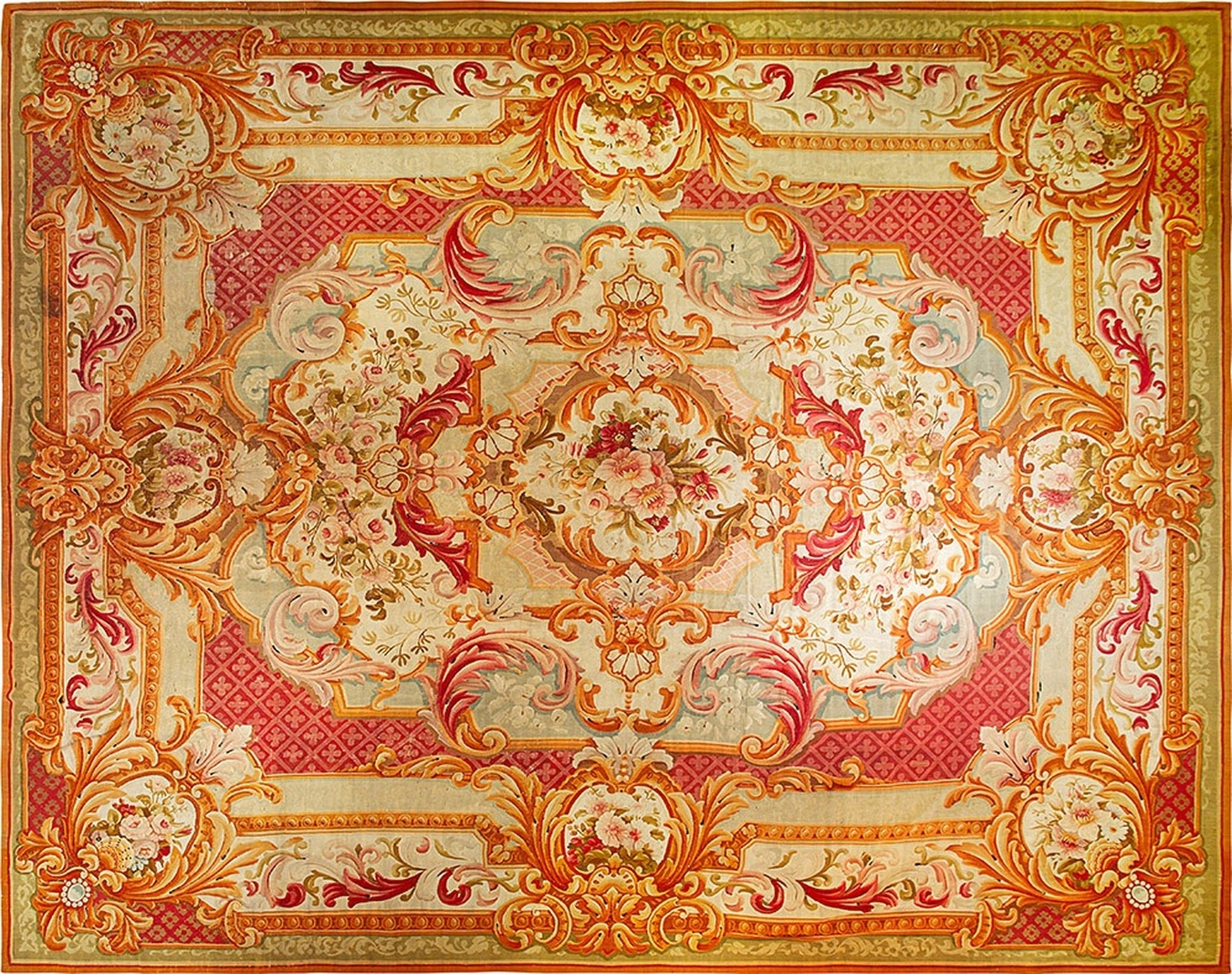
While reproductions can offer decorative appeal at accessible prices, they do not carry the same cultural or collectible value as rugs made in the Creuse region. Understanding this distinction is critical for buyers who seek the cachet of authentic Aubusson craftsmanship.
Verifying Authentic Aubusson: Labels, Origin, Collecting Tips
-
- Check for labels and origin stamps — Why: Only rugs produced in Aubusson or Felletin bear marks identifying them as genuine. An authentic Aubusson label is the most reliable indicator of provenance.
-
- Consult auction records and dealers — Why: Because Aubusson style reproductions are widespread, working with trusted auction houses or recognized dealers helps ensure authenticity.
-
- Inspect condition and restoration — Why: Many antique pieces require conservation. Aubusson rug restoration can be expensive, sometimes rivaling the cost of purchase, so factoring this into a budget is essential. Restoration quality also impacts long-term value.
-
- Evaluate weaving technique — Why: Genuine Aubusson rugs use the flatwoven tapestry method, not knots or pile. This structural feature helps distinguish originals from imitations.
In short, Aubusson and Felletin together uphold the authentic tradition, but the market is full of reproductions. Collectors must verify labels, origins, and weaving methods, while also weighing the potential cost of restoration when purchasing antique examples.
Aubusson in Modern Times
Market and Collectability
Antique Aubusson rugs and tapestries are among the most sought-after French textiles in today’s art market. Their delicate floral medallions, neoclassical motifs, and historical narrative scenes place them alongside other elite European decorative arts. Collectors prize both 18th- and 19th-century examples, which appear at major auction houses worldwide.
As a result, market values can be significant, often depending on size, condition, and rarity. For serious buyers, an Aubusson is not simply a decorative purchase but an investment in cultural heritage.
Restoration and Conservation Considerations
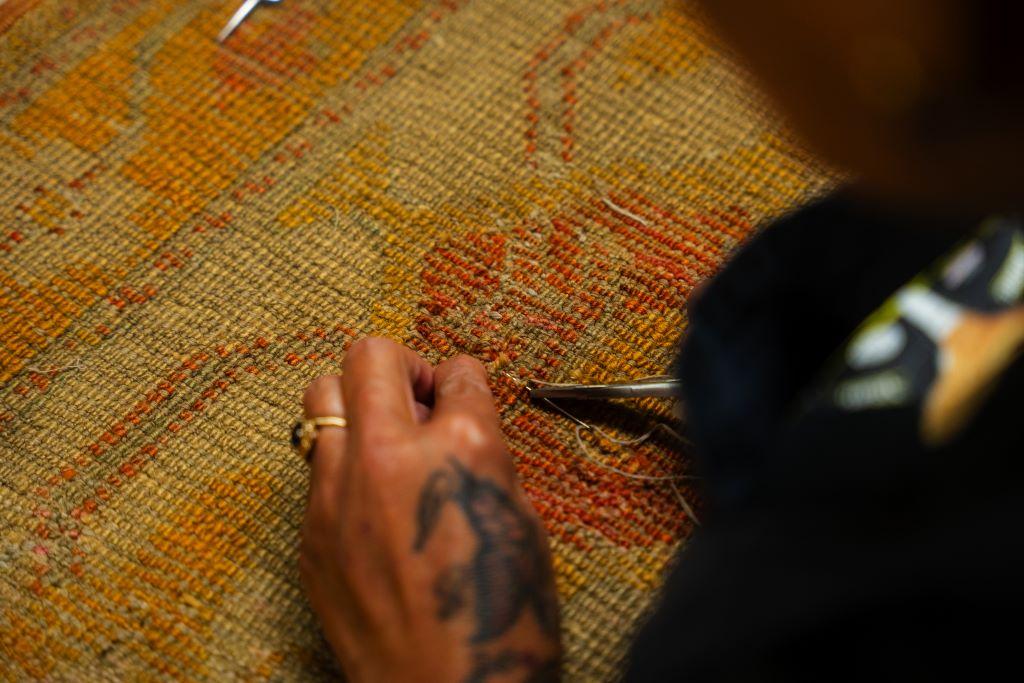
Detail of hands mending a rustic, richly colored woven rug.
Because Aubusson rugs are flatwoven and pileless, they are particularly susceptible to wear, thread loss, and fading. Aubusson rug restoration is a delicate and specialized process, often requiring hand-reweaving, dye-matching, or structural stabilization.
Costs can be substantial, and in some cases restoration expenses rival or exceed the acquisition price. For collectors, budgeting for conservation is as critical as the purchase itself. Proper restoration not only preserves the textile’s beauty but also safeguards its market value for future generations.
Conservation: The Fragility of the Flatweave
Because they lack the “buffer” of a vertical pile, Aubusson rugs are more delicate than Persian or Oriental carpets. The wool wefts take the direct friction of footsteps. To prolong the life of an antique Aubusson, it is essential to use a high-quality felt-and-rubber pad. This adds a much-needed layer of “cushion” that prevents the foundation threads from being crushed against the hard floor.
The Cité Internationale de la Tapisserie: Museum & Visitor Guide
At the center of Aubusson’s cultural life stands the Cité Internationale de la Tapisserie, located in the town itself. This world-renowned Aubusson tapestry museum houses the largest public collection of Aubusson works, spanning centuries of weaving and rug history.
Beyond its exhibitions, the museum also serves as a living institution: it hosts ongoing workshops, educational activities, and contemporary commissions, ensuring the art of wall hanging tapestries remains relevant. For visitors, the Cité offers immersive displays, interactive exhibits, and access to archives that contextualize Aubusson’s role in global textile history.
Touring Aubusson Workshops
-
- Aubusson workshops — Why: Visitors can book guided tours to see artisans working on horizontal looms, following traditional cartoons much as their predecessors did centuries ago.
-
- Felletin workshops — Why: Just nearby, Felletin offers another vantage point to witness the craft, reinforcing the idea that the tradition is regional rather than confined to one town.
-
- Advance booking — Why: Because many weaving studios are still active workplaces, reservations are essential to secure access for an Aubusson workshop tour.
Incorporating Aubusson Tours into a Limousin Trip
The Limousin region is one of rural France’s cultural treasures, and Limousin travel Aubusson itineraries often combine tapestry heritage with the pastoral landscape. A practical trip might include: visiting the Cité Internationale de la Tapisserie, joining a guided workshop tour in Aubusson or Felletin, and exploring the bridges and historic quarters along the Creuse River.
Travelers can balance cultural immersion with leisure, combining tapestry visits with hikes, local cuisine, and the broader heritage of central France. For today’s visitor, Aubusson is not just a name on a label but a living destination where weaving, history, and tourism converge—anchored by its world-class museum and vibrant workshop culture.
Cultural & Symbolic Significance
Prestige, Patronage, and Artistic Legacy
From their beginnings in the 15th century, Aubusson tapestries and rugs became symbols of French luxury and refinement, treasured by both aristocracy and the rising bourgeoisie.
These textiles were not only decorative but functional, insulating stone walls in châteaux while showcasing the wealth and taste of their owners. Royal patronage under Louis XIV, and later commissions by European courts, established an enduring Aubusson art legacy. Today, their prestige is enshrined by UNESCO recognition, affirming that the weaving tradition is part of the intangible cultural heritage of humanity.
Symbolic Motifs and Storytelling in Aubusson Weaving
Aubusson designs were never just decorative—they were narratives woven into fabric. Aubusson tapestry symbolism drew on allegories, virtues, and fables, as well as classical mythology.
Pastoral scenes conveyed harmony with nature, while mythological figures represented ideals of love, triumph, or wisdom. Florals such as roses symbolized beauty, acanthus leaves echoed classical strength, and garlands celebrated abundance. These symbolic layers gave Aubusson works meaning beyond their surface beauty, embedding cultural values into domestic and courtly life.
Aubusson Influence on Furniture, Interiors, and Fashion
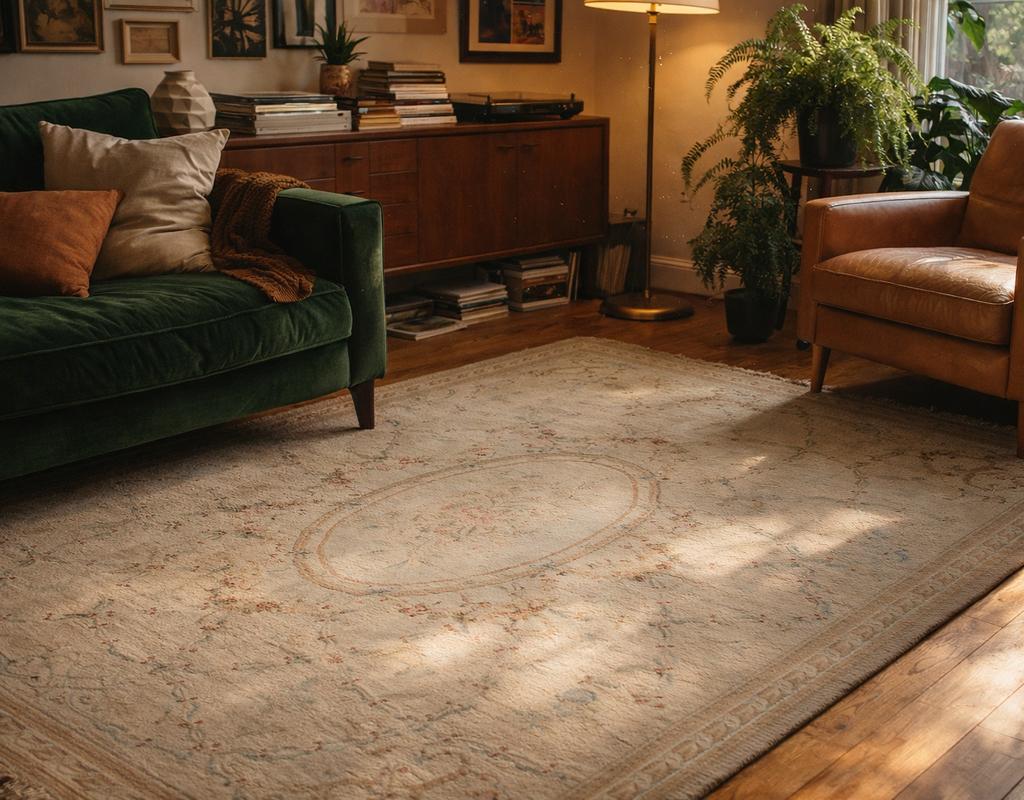
Sunlight illuminates the soft textures and warm tones of this eclectic, plant-filled reading nook.
-
- Furniture upholstery — Why: Aubusson’s floral and neoclassical motifs became staples of Aubusson furniture upholstery, gracing chairs, sofas, and screens in French and European interiors.
-
- Interior decoration — Why: Aubusson rugs and tapestries served as the centerpiece of salons, influencing color schemes and layouts of elite homes, a tradition that continues in modern interior design.
-
- Fashion and textiles — Why: Designers have long borrowed Aubusson motifs for haute couture fabrics and accessories, adapting their delicate florals and classical imagery for luxury fashion.
In this way, Aubusson cultural significance extends far beyond the floor or wall.
Its symbolism speaks to ideals of refinement and storytelling, while its artistic influence has left a lasting imprint on the decorative arts, furniture, and fashion industries worldwide.
Where should I look to buy authentic Aubusson rugs online and what should I check before purchasing?
What to Check Before Purchasing an Aubusson Online
Buying an Aubusson online requires a higher level of scrutiny than a standard knotted rug. Because they are flatwoven, certain “invisible” issues can affect their value.
Here is what you should demand from any online seller:
-
- The “Light Test” for Slits: Ask for a high-resolution photo of the rug held up to a window or light source. You should see the characteristic “pinholes” of light at the color boundaries. If the gaps look like they are tearing or pulling apart, the rug needs structural repair.
-
- Foundation Integrity: Ask if the rug has been “backed.” Many antique Aubussons are backed with canvas to protect the fragile tapestry. While this adds durability, you want to know if that backing is hiding significant holes or dry rot in the original weave.
-
- Dye Consistency: Flatweaves show “abrash” (natural color variation) differently than pile rugs. Check for “hot spots”—areas where a modern chemical dye might have been used to “touch up” a stain. At Rugs On Net, we vet every piece to ensure any restoration is professional and matches the original vegetable-dye palette.
-
- The “Smell” Factor: Because Aubussons are pure wool and often stored in old European homes, they can retain a “musty” odor if not cleaned properly. Ensure the seller provides a professional cleaning guarantee before shipping.
Authenticity & Quality: A Buyer’s Checklist
The Collector’s Field Guide: How to Spot an Authentic, High-Quality Aubusson
Distinguishing a genuine antique or high-quality hand-woven Aubusson from a modern machine-made “Aubusson-style” rug requires looking at the “bones” of the textile.
Look for the “Slits” (The Slit-Tapestry Test)
Authentic Aubussons are woven using the slit-tapestry technique. When two colors meet vertically, a tiny physical gap or “slit” is left between them.
-
- The Test: Hold the rug up to a window or a strong light. If you see needle-thin pinholes of light following the outlines of the flowers or medallions, it is a genuine hand-woven tapestry.
-
- The Red Flag: If the colors are “interlocked” or look like a continuous piece of fabric with no gaps, it is likely machine-made or a lower-quality needlepoint.
Inspect the Reverse Side
A high-quality Aubusson is essentially reversible (though usually one side is designated as the “face”).
-
- The Quality Marker: The back should show the same crisp design as the front, with neatly finished “lazy lines” where the weaver changed bobbins.
-
- The Red Flag: If the back has a heavy canvas glued to it, or if there are thousands of messy “thread tails” hanging off, it is a tufted reproduction, not a woven work of art.
The “Painterly” Shading (Hatching)
Because Aubussons are pileless, they cannot rely on the height of the wool to create depth. Instead, they use a technique called hatching (interlocking triangles of two colors).
-
- The Quality Marker: In a high-quality piece, the transition from a dark leaf to a light leaf looks like a fine painting with a smooth gradient.
-
- The Red Flag: Lower-quality rugs will have “blocky” or “pixelated” color changes that look jarring to the eye.
Fiber “Luster” and Dye Quality
-
- The Quality Marker: Authentic Aubussons use high-mountain wool that has a natural sheen. The dyes should be “soft”—think of the colors of a dried bouquet rather than a neon sign.
-
- The Red Flag: If the rug has a “shiny” or “slick” feel like plastic, it is likely synthetic (polypropylene), which lacks the heat-retention and durability of genuine wool.
Why Buying Aubusson Rugs From Rugs On Net Is A Wise Choice
Acquiring an Aubusson rug—whether a centuries-old antique or a high-fidelity reproduction—is an investment in artistry. At Rugs On Net, we specialize in bridging the gap between the royal history of France and the practical needs of the modern collector.
A Curated, Expert Selection
Unlike generalist retailers, our collection of Aubusson rugs is hand-picked for its “painterly” quality and structural integrity. We look for pieces that maintain the soft, “sun-kissed” patina that characterizes the best French weaving, ensuring every rug in our inventory meets the aesthetic standards of a true Manufacture Royale piece.
Competitive Pricing Through Direct Expertise
The market for French flatweaves can be opaque, with prices varying wildly. Because of our deep roots in the rug industry and our specialized knowledge of the Aubusson market, we are able to source exceptional pieces without the “middleman” markups found in high-end design showrooms. This allows us to offer investment-grade textiles at a value that is accessible to both seasoned collectors and first-time buyers.
Personalized Concierge Service
An Aubusson is more than a floor covering; it is a room-defining element.
Our rugs on net team provides personalized guidance to help you navigate:
-
- Size & Scale: Finding the right 9×12 or oversized palace rug for your specific architectural layout.
-
- Style Matching: Determining whether a floral Rococo or a structured Napoleonic Empire design best suits your interior.
-
- Conservation Advice: We provide expert tips on placement, padding, and lighting to ensure your rug remains a family heirloom for generations.
Transparent Authenticity
Every rug we sell comes with the Rugs On Net commitment to transparency. We provide detailed imagery of the weave (including the traditional “slit” markers of tapestry construction) and honest assessments of condition, so you can buy with the confidence that your new Aubusson is exactly what it claims to be.
Explore a few of our selected Aubusson rugs
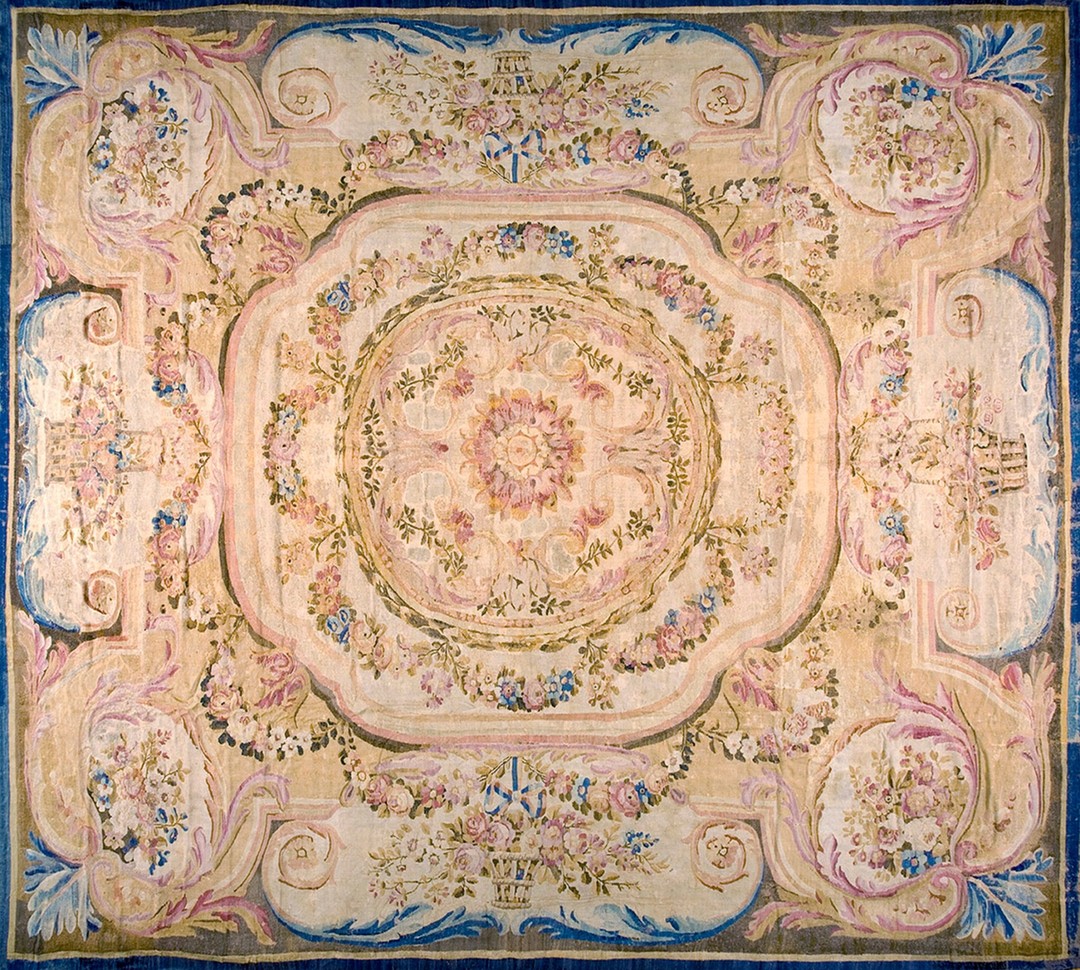
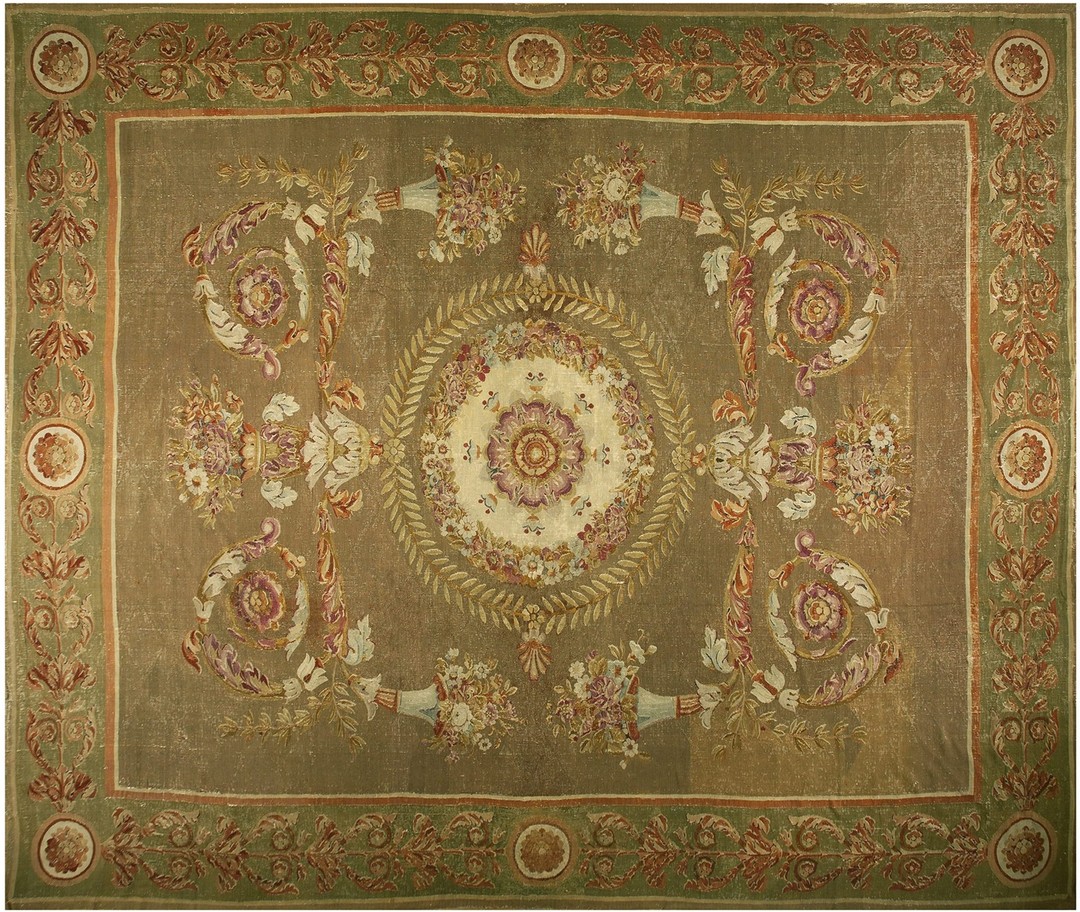
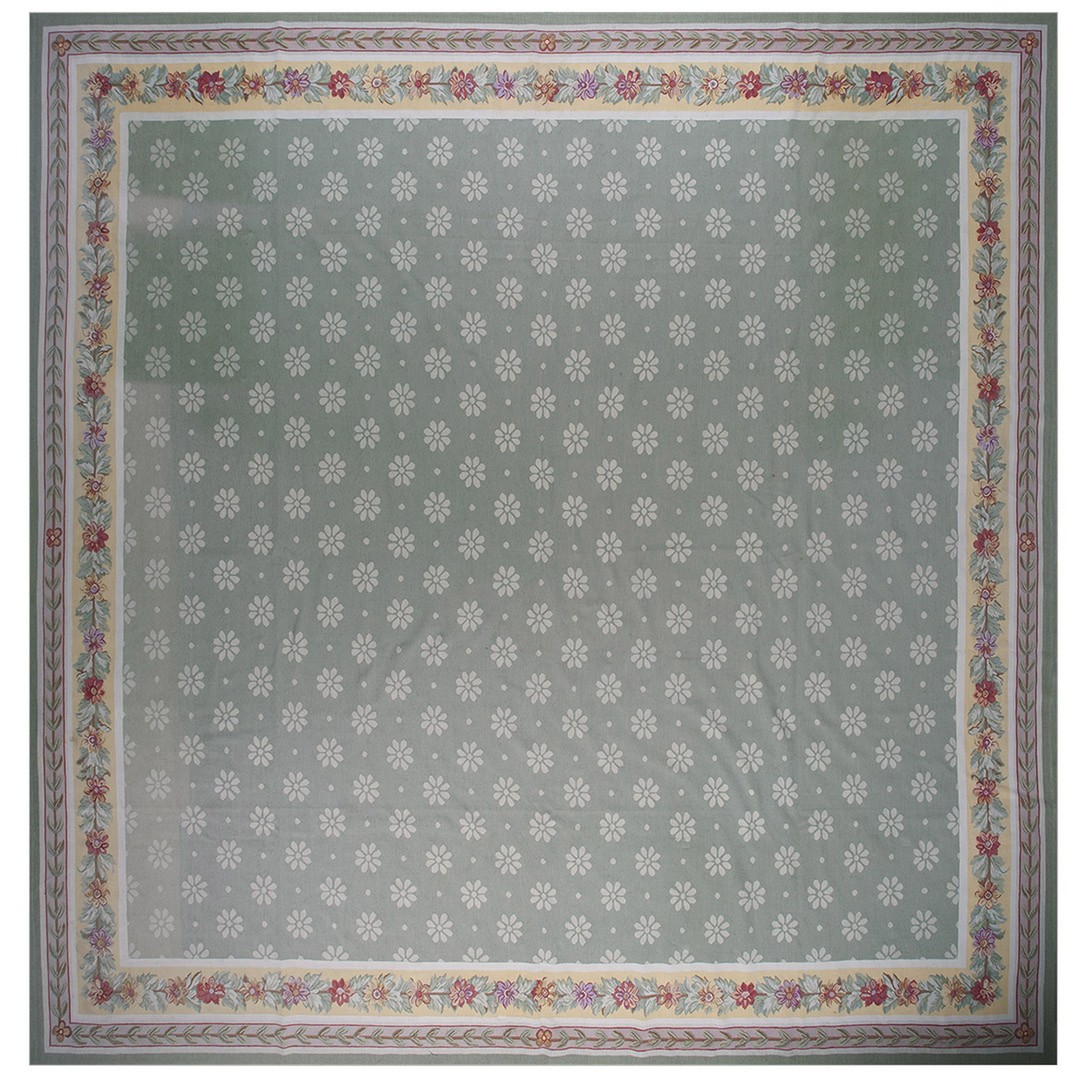
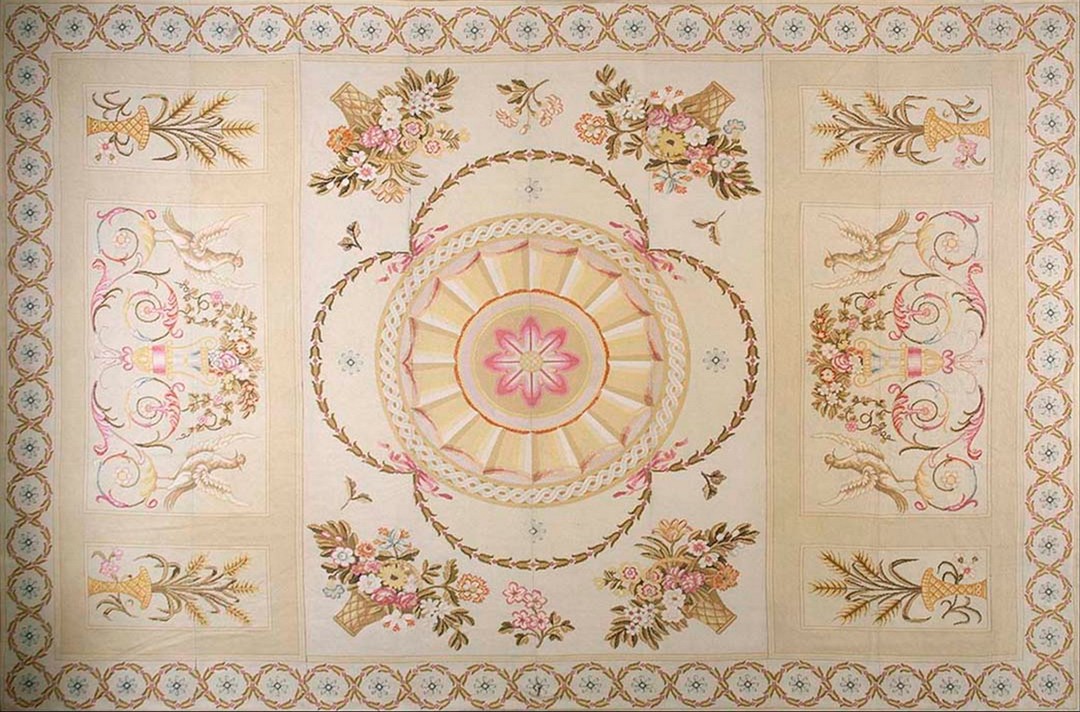
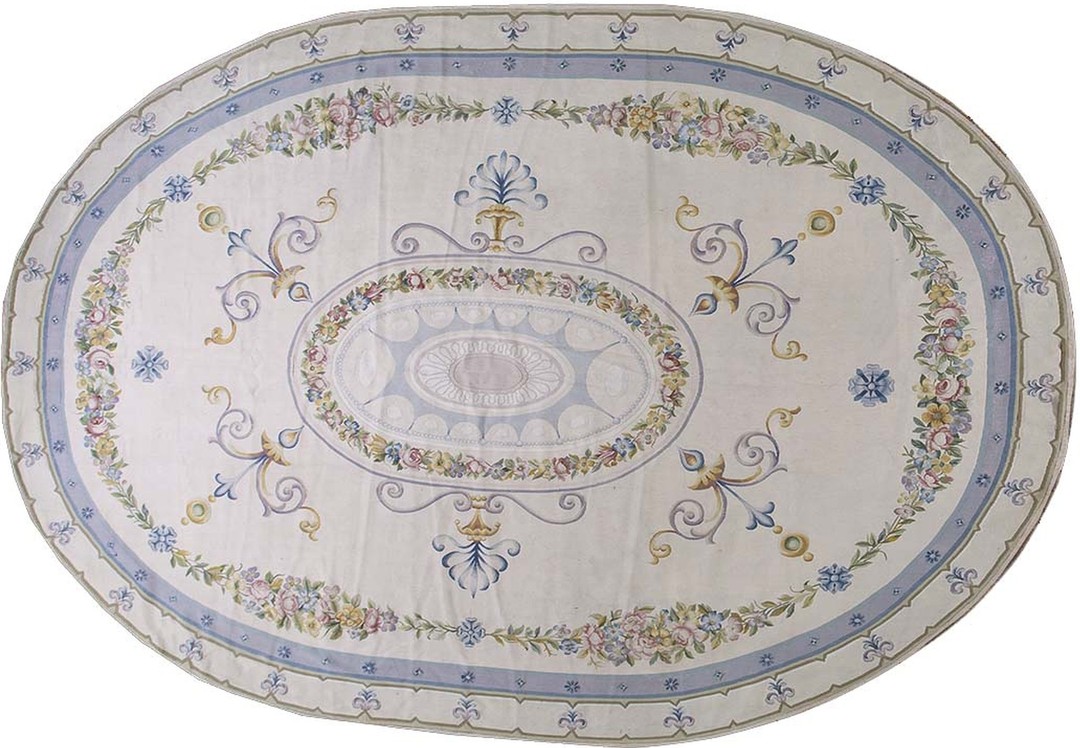
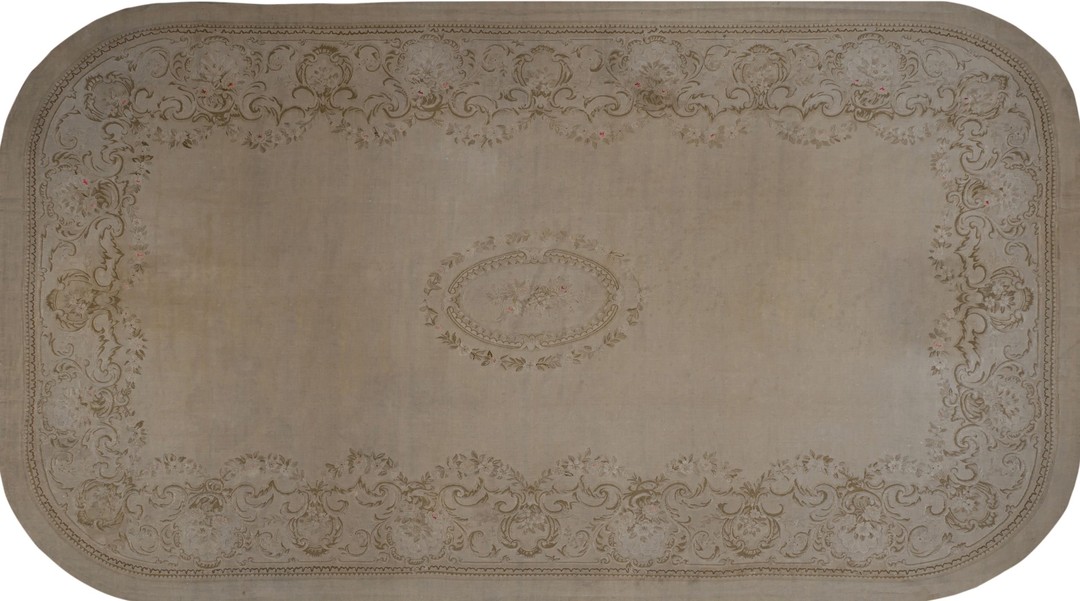
Their soft palettes and classical frames play nicely with minimalist furniture and neutral walls. Try a 9×12 Aubusson rug under a clean-lined sofa to add warmth without visual clutter. Wool can, so keep Aubusson rugs clean and vacuum both sides periodically, especially edges and under furniture. Pheromone traps and prompt professional help curb infestations. Roll (never fold), wrap in Tyvek or acid-free paper—not plastic—and keep in a cool, dry space. Add cedar/lavender and inspect every 2–3 months for moths. Condition, size, age, and design drive price; many good antique Aubusson rugs trade in the \~\$10,000–\$50,000+ range, with exceptional examples higher. Small or worn pieces can be far less. Yes—Aubusson-style rugs are produced worldwide (France, China, India, Pakistan), in flatweave, hand-tufted, or hand-knotted forms. Reproductions can cost a few hundred to a few thousand dollars. Needlepoint rugs are stitched onto canvas; Aubusson rugs are woven. On the back, needlepoint shows a clear stitch grid; Aubusson shows tapestry wefts with no glued backing. Blot (don’t rub) with cool water and a wool-safe detergent, then dry quickly. For dyes or pet accidents, book a professional wash instead of DIY steam. All rugs fade with UV exposure; rotate Aubusson rugs every 3 months and use UV shades or films. Keep bright areas to a few hours of direct sun daily, max. Flatweave Aubusson rugs allow chairs to slide more easily than plush piles. Choose a size that extends \~24″ past the table so chairs stay on the rug when pulled out. A 1/8″ felt-and-natural-rubber or all-rubber pad adds grip without bulk. Avoid PVC pads on hardwoods; size the pad \~1″ smaller than the rug. Yes—use thin, breathable Aubusson rugs with low-profile pads and avoid thick foam or rubber-backed barriers. Keep total thickness near ⅜″ or less for efficient heat transfer. Wool resists soiling, but claws and accidents can harm Aubusson rugs—especially antiques. Blot spills immediately and consider placing them in lower-traffic rooms. U.S. professional rates often run about \$2–\$8 per sq ft; an 8×10 Aubusson rug could be \$160–\$640. Delicate or silk details can increase pricing. Plan a wash every 1–3 years, sooner with pets/kids or heavy traffic. Antique or fragile Aubusson rugs may warrant conservator guidance. Use suction only—disable the beater bar to protect fibers and edges. Weekly vacuuming (front and occasional back) keeps dust from grinding in. Today’s Aubusson rugs commonly come in 5×8, 8×10, and 9×12; antiques were often salon-scale like 12×15+. Measure to allow at least 18–24″ of floor border in living rooms. Aubusson rugs favor French neoclassical florals and cartouches; Persian rugs are knot-pile with regional motifs (medallions, Heriz, Kashan, etc.). Aubusson flatweaves feel thinner underfoot. Flip it: you should see a tapestry weave (not a tufted canvas) and often hemmed edges with little or no fringe. Seek documented provenance and an appraisal for pieces claimed 18th–19th century. Many flatwoven Aubusson rugs show the pattern on both sides, but antiques are typically displayed one way for finish and preservation. Some modern Aubusson-style flatweaves are marketed “reversible.” Wool is standard for Aubusson rugs, sometimes with silk details on wool or cotton foundations. Expect a thin profile (often under ¼″ for flatweaves). Aubusson rugs often feature central ovals/cartouches, floral garlands, acanthus scrolls, and neoclassical frames. Colors skew pastel—ivory, blush, pale blue, soft gold. Antique Aubusson rugs are decorative and best for low-to-moderate traffic; modern pile-woven “Aubusson style” options handle more wear. A rug pad and quarterly rotation help longevity. Savonnerie rugs are knotted-pile carpets made in Paris, while Aubusson rugs are primarily flatwoven tapestries. Think plush vs thin; both share neoclassical motifs. Most Aubusson rugs use a low-warp tapestry flatweave with wool (sometimes silk highlights), yielding a thin, smooth surface. Some later examples were pile-woven, but the classic look is pileless. Aubusson rugs are French tapestry-woven (usually flatweave, no pile) carpets from the Aubusson/Felletin region, famous since the 17th–18th centuries for floral medallions and soft palettes. Many originals are room-size, like 9×12 or larger.FAQ
This page covers the history of the Aubusson workshops and how the tapestry technique works. For what antique Aubussons actually cost, which shapes and sizes come up, and what to check before you buy one, see our antique Aubusson buying and identification guide.