
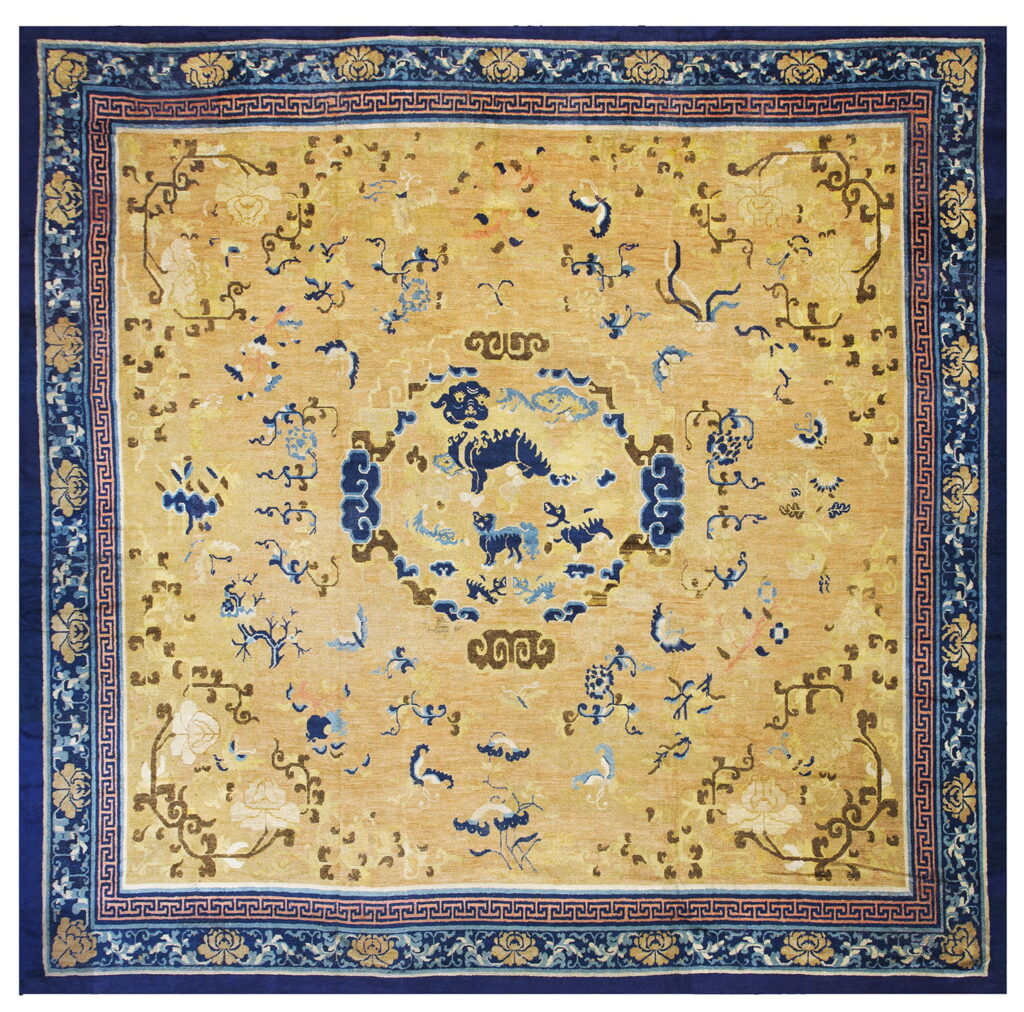
An antique Ningxia carpet is a hand-knotted wool carpet from the Ningxia region of north-central China, woven between the 17th and the 19th century, with a mellow yellow, apricot or ivory ground, indigo blue drawing and a few bold symbols such as fu lions, dragons, lotus and cloud bands. Ningxia carpets are the earliest Chinese carpets that survive in any number. Rugs On Net has ten in its collection highlights in New York, and this guide uses them to show what to look for.
Key takeaways
- Ningxia is the oldest Chinese carpet tradition collectors can still buy: the pieces here date from about the 1650s to the 1880s.
- The palette is small and warm: yellow, apricot, ivory and several blues, all from natural dyes.
- The designs are open and symbolic. A few large motifs sit on a quiet ground, inside a key fret, pearl or peony border.
- Many were woven for a purpose: seat and throne mats, platform rugs, long temple and hall carpets.
- Size ranges widely, from seat mats of about 2 feet square to a carpet nearly 18 feet square.
What makes a carpet a Ningxia?
Three things: where it was made, how it feels and how it is drawn. Ningxia lies on the upper Yellow River, on the old routes between China, Mongolia and Tibet, and its workshops wove for monasteries, the court and wealthy households. The wool is soft and glossy and the knotting is fairly loose, so an old Ningxia is supple in the hand, quite unlike a stiff, densely knotted Persian city carpet.
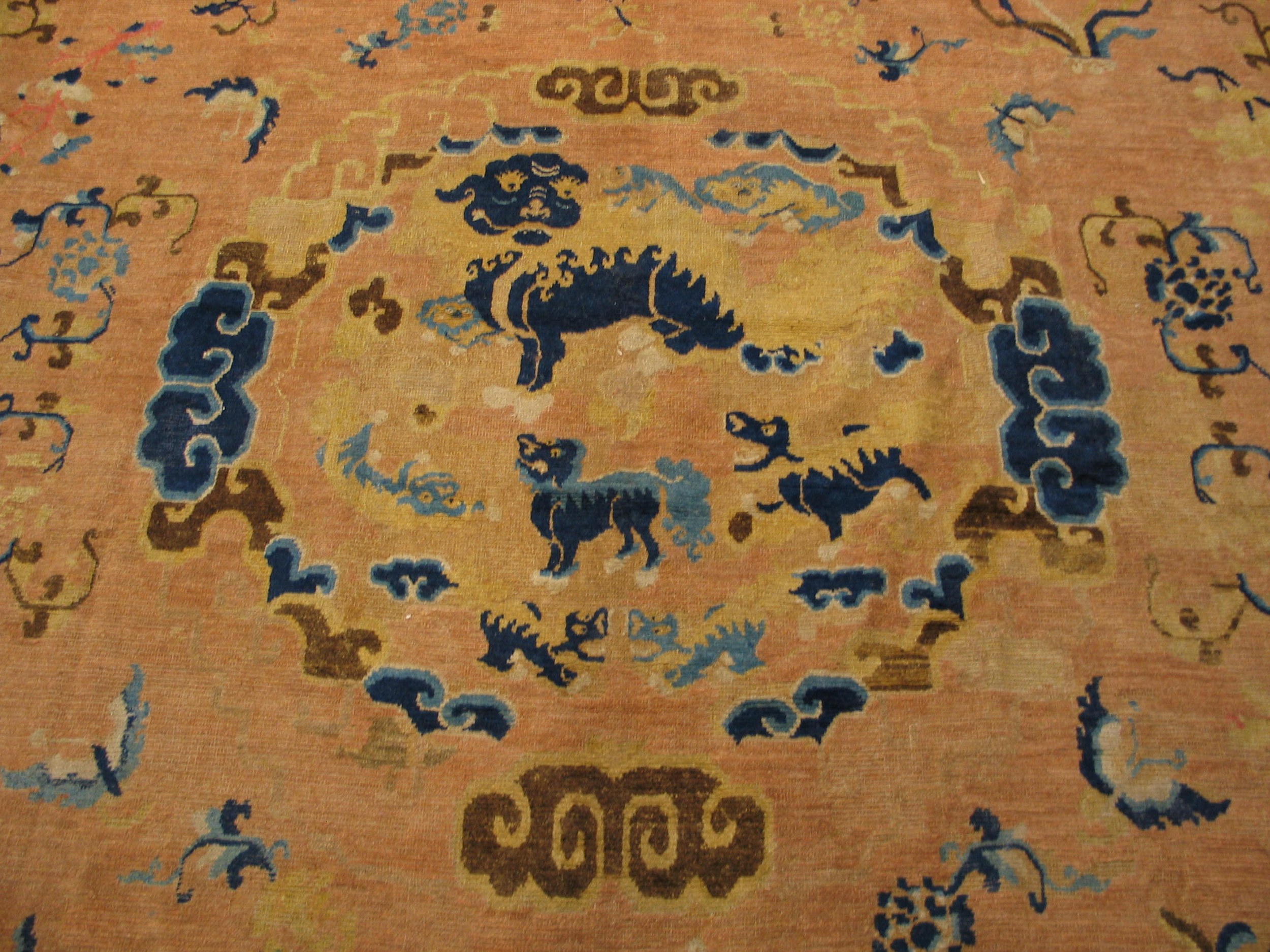
The drawing is spare. Where a Persian carpet fills the field, a Ningxia leaves it open and places a few motifs with care: a roundel at the center, sprays of flowers, a pair of cranes, cloud bands in the corners. The meaning matters as much as the pattern. Fu lions guard, dragons stand for power, the lotus for purity, bats for good fortune, and the running key fret in the border is an old sign of continuity.
How can you tell an 18th century Ningxia from a later one?
Look at the borders, the color and the spacing. Early pieces tend to have fewer and simpler borders, often a key fret and a plain outer band, and more open ground between the motifs. The yellows and apricots are soft and varied, because the dyes were natural and the wool has had centuries to mellow. By the later 19th century the drawing is usually tighter and more regular, with more borders and a cooler, more even color.
These are tendencies, not rules. Dating an early Chinese carpet is a matter of judgment built on handling many of them, and we are glad to go through the evidence with you in front of the carpet.
Which Ningxia carpets are in the Rugs On Net collection highlights?
Ten pieces, selected by Kevin Rahmanan, who founded the gallery in 1979. They show nearly every side of the tradition.
| Piece | Size | What to look at |
|---|---|---|
| Mid-18th century carpet, stock 20853 | 11 ft 9 in x 12 ft | Square format, a roundel of mythical beasts, scattered flowers and a key fret border |
| Early 18th century carpet, stock 21641 | 3 ft 11 in x 7 ft 6 in | Large blue cloud bands on a golden yellow ground |
| 18th century carpet, stock 24257 | 5 ft 9 in x 12 ft 10 in | An interlocking lattice in indigo and camel with a bold key fret border |
| 18th century carpet, ivory ground, stock 22965 | 9 ft 2 in x 13 ft | Room size, with flowering vines across an ivory field and no medallion |
| Mid-18th century dragon rug, stock 23371 | 3 ft 2 in x 3 ft 6 in | A single dragon on an open field: a seat or throne mat format |
| 18th century rug, stock 21617 | 2 ft x 3 ft 4 in | Peonies on a coral ground above a wave and mountain border |
| Early lattice rug, stock 24056 | 4 ft 2 in x 5 ft 6 in | A quatrefoil lattice in deep indigo on faded camel, dated circa 1650s |
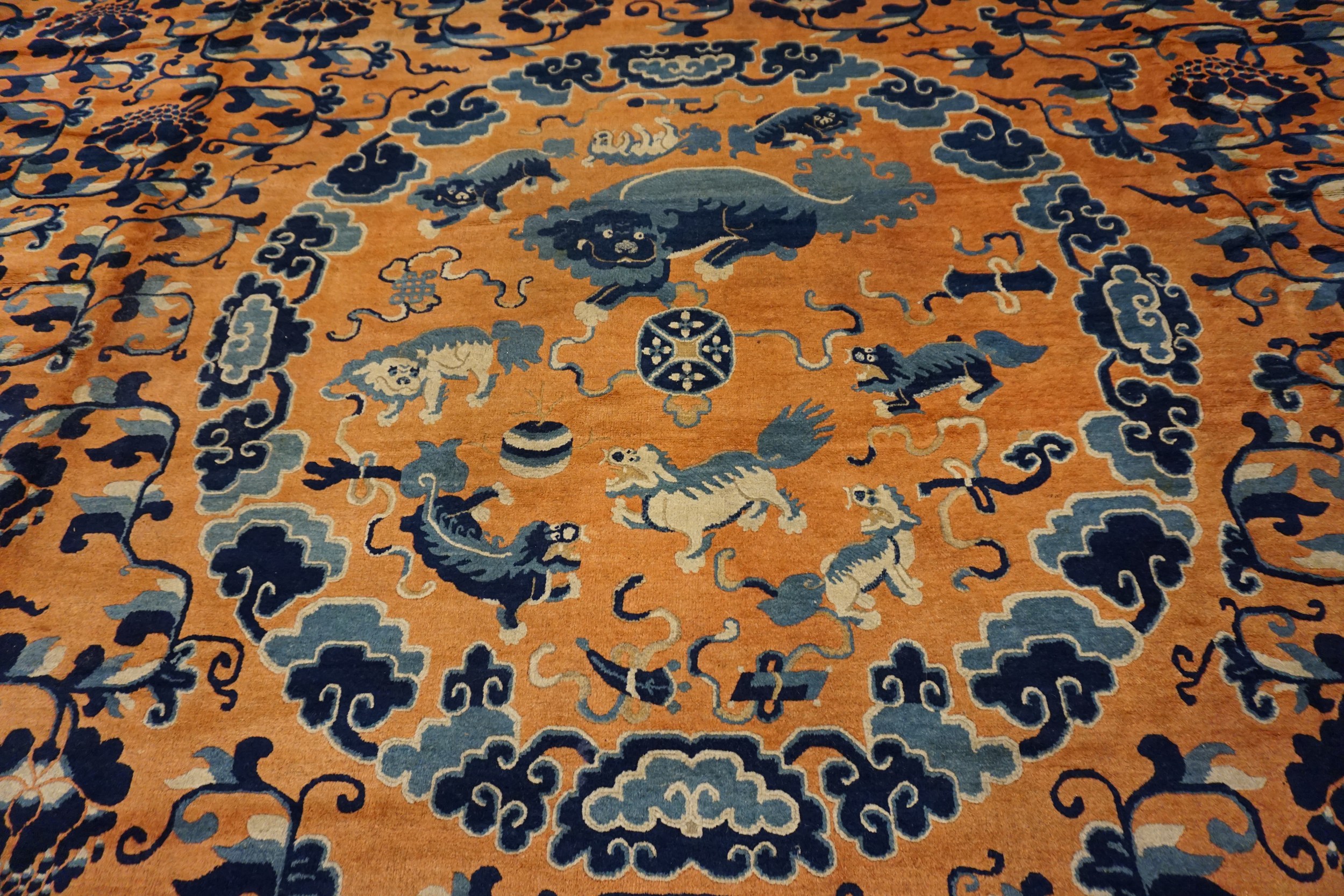
| Mid-19th century carpet, stock 24013 | 17 ft 10 in x 17 ft 10 in | A monumental square carpet: apricot field, blue lotus scrolls, central roundel |
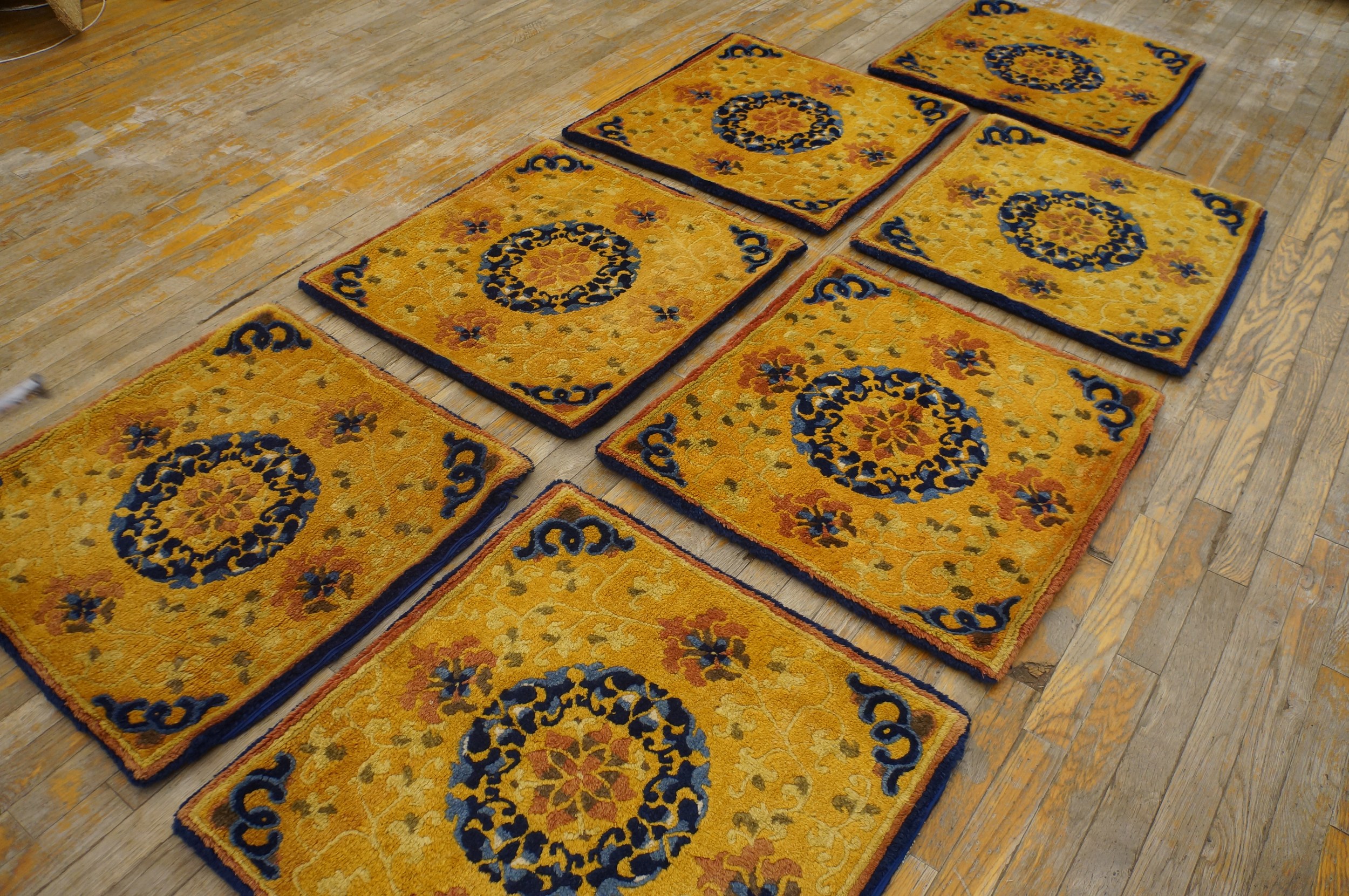
| Set of seven mats, stock 25198 | each 2 ft 2 in square | A matched set of yellow seat mats with floral medallions, rare to find together |
| Late 19th century rug, stock 6877 | 2 ft 2 in x 4 ft 3 in | Ivory field and red border in a small seat rug format, 1880s |
Why are so many Ningxia rugs square or small?
Because they were furniture before they were floor coverings. Square mats covered seats and thrones, pairs and sets furnished a row of chairs or a meditation hall, and longer pieces lay on the raised heated platform, the kang, where a household sat and slept. That is why a matched set like our seven yellow mats is unusual: sets were split up over the years, and most surviving mats are singles.
How do you live with an early Chinese carpet?
More easily than you might expect. The open designs and warm, quiet colors sit well with modern furniture and with plain walls, which is one reason designers look for them. Small mats work on a wall, a bench or a table as well as on the floor. The wool is soft, so a very early piece is best kept out of the heaviest traffic, with a good pad underneath. Our rug cleaning and restoration pages explain the care we recommend.
Where can you see and buy antique Ningxia carpets?
All ten pieces are in New York and can be seen by appointment at 36 East 31st Street, 9th floor: book a visit, call (212) 683-0167 or email [email protected]. See them together in our collection highlights, browse all antique Ningxia rugs, or read how Ningxia compares with later Chinese weaving in Peking vs Ningxia vs Art Deco Chinese rugs and what the motifs mean in antique Chinese rug symbols. If you own one, start with a free appraisal from photographs.
Antique Ningxia carpet FAQ
How old are Ningxia carpets?
The Ningxia carpets collectors look for were woven from the 17th to the 19th century. The pieces in the Rugs On Net collection highlights date from about the 1650s to the 1880s.
What colors are typical of a Ningxia carpet?
Yellow, apricot and ivory grounds with indigo and pale blue drawing, sometimes with coral or brown. The colors come from natural dyes and soften with age.
What is the difference between a Ningxia and a Peking rug?
Ningxia is the earlier tradition, with softer wool, looser knotting and warm yellow and apricot grounds. Peking rugs come later, mostly from the late 19th and early 20th century, and are usually blue and ivory with a firmer weave.
Are antique Ningxia carpets rare?
Early ones are. Eighteenth century and earlier examples in good, complete condition are scarce, and large carpets and matched sets of mats are scarcer still.
Where can I buy an 18th century Chinese carpet?
Rugs On Net in New York has several 18th century Ningxia carpets and rugs in its collection highlights, viewable by appointment at 36 East 31st Street, 9th floor.