
Introduction: Defining Islamic Rugs in Context
What is an Islamic Rug?
An Islamic rug is not defined strictly by geography but by its cultural and artistic framework. These textiles are produced across Muslim-majority regions such as the Middle East, North Africa, Central Asia, and South Asia. Yet ,what makes them “Islamic” is the influence of Muslim culture, faith, and aesthetics on their design.
An Islamic carpet definition emphasizes the way patterns, motifs, and symbolism reflect Islamic art traditions, aligning with the broader visual language found in architecture, manuscripts, and ceramics.
This framework distinguishes Islamic rugs from the broader category of oriental carpets, which may be woven in similar regions but do not always follow the same cultural or religious design principles.
Distinction from Oriental Rugs
While every Islamic rug can be considered part of the oriental rug family, not all oriental rugs are Islamic rugs. The distinction lies in design history and the principles guiding decoration. A hallmark of Muslim rug art is the practice of aniconism, the avoidance of human or animal figures in sacred contexts.
Instead, artisans developed intricate Islamic art motifs such as arabesques, geometric tessellations, and calligraphic inscriptions. These patterns echo the interior of mosques, Qur’anic illumination, and tilework, creating a cohesive artistic identity across media.
By contrast, oriental rugs outside the Islamic sphere—such as those woven in Christian Armenia or Buddhist Tibet—may feature figural imagery or mythological elements absent in Islamic weaving traditions. This key difference highlights why the term “oriental vs Islamic rugs” remains central in design history discussions.
Role of Faith and Patronage
Faith and political power profoundly shaped rug weaving traditions in the Islamic world. Religious principles guided the development of non-figural ornament, but it was dynastic patronage that transformed rugs from utilitarian floor coverings into fine art.
Ottoman sultans, Safavid shahs, and Mughal emperors established royal workshops, sponsoring master weavers who created carpets of extraordinary scale and refinement for palaces, mosques, and diplomatic gifts. These commissions elevated rugs to symbols of prestige and spiritual devotion, embedding them into the visual culture of empire.
Court sponsorship ensured that rug weaving stood alongside calligraphy, architecture, and ceramics as one of the great artistic achievements of Islamic civilization.
In design history, what defines an Islamic rug is therefore not only its place of origin but the way Muslim culture infused its aesthetic, symbolism, and function.
The blending of faith, aniconic artistic principles, and dynastic support forged a legacy of Muslim rug art that remains central to the story of Islamic art. For deeper context, see our related guide on [oriental rugs].
Historical Timeline and Muslim Influence
Early Fragments and Medieval Weaving Traditions
The earliest traces of Islamic rug history date from before the 15th century, though few complete examples survive. These fragments, preserved in archaeological sites and rare collections, show that pile-weaving and flatweave traditions were well established across Muslim lands.
And this establishment came long before the flowering of court-sponsored production.
In medieval contexts, rugs served both practical and symbolic roles—lining homes, mosques, and caravanserais while reflecting cultural identity through pattern and technique.
Even in these early centuries, the influence of Islamic faith is evident: geometric forms and stylized vegetal motifs replaced figural depictions, aligning weaving with the broader principles of Islamic art.
Safavid Persia, Ottoman Turkey, Mughal India
- Safavid Persia (16th–17th c.) — Why: Safavid shahs institutionalized weaving through royal workshops in cities like Isfahan and Kashan. Their Safavid carpets introduced monumental garden and vase designs, richly dyed in natural reds and blues, setting a standard of refinement and innovation for Islamic rug traditions.
- Ottoman Empire (14th–19th c.) — Why: The Ottomans developed a recognizable style featuring bold central medallions, saz foliage, and a palette of strong reds and indigos. Production centers like Uşak exported thousands of rugs to Europe, making Ottoman weaving the face of Islamic carpets in Renaissance paintings and European collections.
- Mughal India (16th–18th c.) — Why: Under Akbar and his successors, workshops blended Persian influences with Indian artistry. Mughal rug traditions introduced naturalistic floral motifs inspired by miniature painting, producing masterpieces that combined Islamic elegance with Indian decorative richness.
Silk Road and Global Trade Routes
As portable textiles, rugs traveled effortlessly along the Silk Road, making them ambassadors of Islamic culture far beyond their regions of origin. From Persia to Anatolia to India, carpets were traded into Europe, China, and North Africa.
There they were prized as luxury goods, diplomatic gifts, and markers of wealth. Their durability and visual splendor made them perfect for long-distance exchange.
The spread of Islamic rugs along global trade routes echoed the themes from the Introduction: cultural context and dynastic patronage transformed these textiles into universal symbols of prestige.
Through trade, Islamic art motifs—geometric tessellations, arabesques, and medallions—entered foreign markets, influencing both Western decorative arts and Chinese silk traditions.
Islamic rugs were valued on the Silk Road because they embodied the refinement of Muslim craftsmanship and carried with them the authority of empire. Ottoman weavers in particular shaped international perceptions of Islamic rug styles by exporting vast quantities to Europe.
This ensured that the medallion-and-vine format became synonymous with Islamic carpet design. In every era, rugs served not merely as floor coverings but as vehicles of faith, art, and cultural diplomacy.
Prayer Rugs: Sacred Function and Symbolism
The Mihrab Motif and Mecca Orientation
At the heart of Islamic prayer rug symbolism lies the mihrab motif, a stylized niche design that recalls the architectural recess in a mosque wall indicating the direction of Mecca. On a rug, the pointed arch serves as both a visual and spiritual compass, orienting the worshipper correctly during daily prayers.
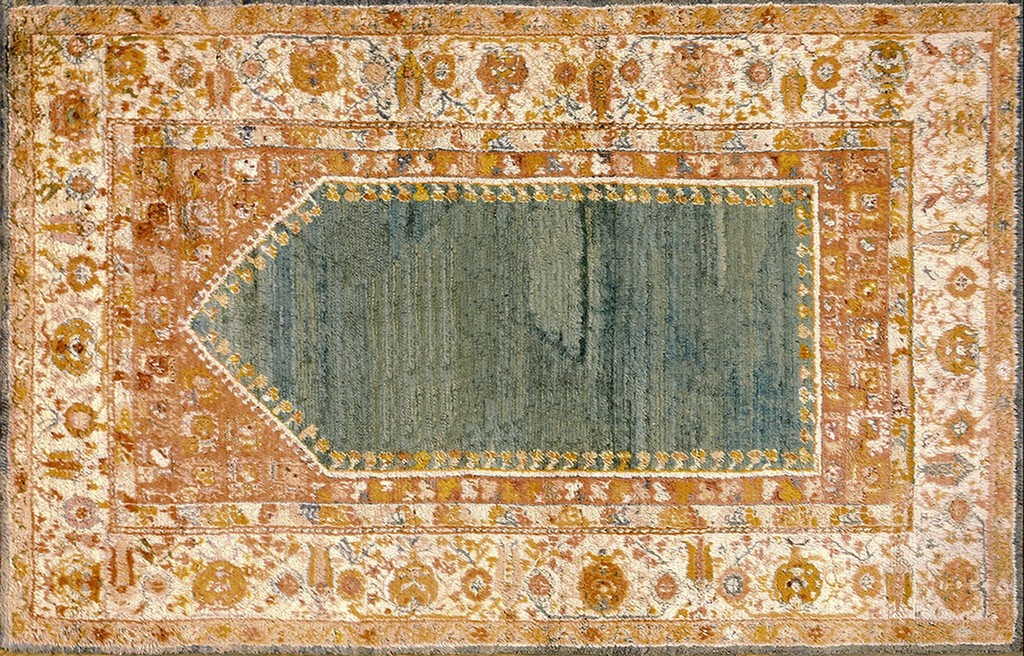
https://rugsonnet.com/small-scatter-size-antique-turkish-angora-oushak-islamic-prayer-rug/
By kneeling on a mihrab motif carpet, the faithful symbolically step into a miniature sanctuary, transforming any space into a site of devotion. This portability explains why prayer rugs, or sajjadah, are usually small in size (about 2 × 4 feet), designed for individual use while embodying profound communal meaning.
Regional Variations
Prayer rug design varied across Islamic lands, with each region translating the mihrab concept into distinctive artistic languages:
These variations show that while the guiding principle of the mihrab remained central, artisans adapted its form to local traditions, weaving regional identity into the fabric of devotion.
Mosque-Scale Carpets: Saff Rugs
Beyond individual prayer rugs, mosques required large-scale woven solutions. Mosque-inspired rugs, often called saff carpets, featured repeated rows of niches to accommodate lines of worshippers. Just as mosque architecture structured collective devotion, these saff rugs mirrored that rhythm on the floor, ensuring order and unity during prayer.
This direct translation of mosque space into textile reinforces how architecture shaped rug design, a theme that connects with the broader influence of mosques across Islamic art.
Mosques thus played a defining role in Islamic rug design. They established the visual language of arches, niches, and orientation, which migrated from stone and tile into wool and silk.
Construction techniques reinforced sacred function—dense knotting for durability, fine wool and silk for reverence, and carefully balanced symmetry to embody divine order.
Every prayer rug became a woven reflection of the mosque, serving as a portable sanctuary that allowed believers to carry the essence of sacred architecture into daily life.
Artistic Motifs and Symbolism
Geometric Patterns
One of the most recognizable features of Islamic rug motifs is the use of intricate geometric forms. Stars, polygons, and interlocking grids reflect not only a mathematical heritage but also a symbolic vision of divine unity and infinity. These patterns embody the principle of tawhid—the oneness of God—by suggesting a cosmos without beginning or end.
In geometric Islamic art, repetition and symmetry are not mere decoration; they serve as meditative designs that connect worshippers to eternal truths. Their precision demonstrates the scientific and mathematical advances of the Islamic world, woven directly into daily life through textiles.
Arabesques and Vegetal Motifs
Scrolling vines, blossoming flowers, and interlaced foliage dominate many arabesque carpets. These vegetal designs symbolize paradise, echoing Qur’anic descriptions of lush gardens as rewards for the faithful. The endless curling of leaves and tendrils represents growth, renewal, and spiritual flourishing.
In a cultural world where earthly gardens were scarce luxuries, woven gardens offered constant reminders of divine abundance and eternal life. Arabesque ornament unified Islamic art across media, appearing in mosques, ceramics, manuscripts, and carpets alike, reinforcing its central role as a visual metaphor for paradise.
Calligraphy as Ornament
Few traditions integrated sacred text into decoration as seamlessly as Islamic art. In rugs, calligraphy often appears in cartouches, borders, or central medallions, transforming language into visual form. Verses from the Qur’an, the name of Allah, or pious phrases are executed in elegant scripts—especially Kufic, with its angular, monumental style.
Kufic lettering in rugs bridges text and ornament, sanctifying the carpet while also affirming its place as a bearer of divine words. The presence of scripture within a rug elevated it beyond utility, turning it into a devotional object, a woven remembrance of God.
Prohibited Patterns
Islamic aniconism, particularly in sacred contexts, restricted the depiction of human and animal forms in rugs intended for religious or domestic devotion. This prohibition shaped a unique design language: abstraction, geometry, vegetal motifs, and calligraphy became the dominant modes of expression.
While secular or courtly carpets sometimes included animal or hunting scenes, these were exceptions outside the prayer context. In the sacred sphere, the absence of figural imagery emphasized spiritual purity, allowing abstraction to convey the divine more effectively than direct representation.
Common motifs in Islamic rugs therefore include geometric tessellations, arabesques, and calligraphic panels, all serving symbolic and devotional roles. Geometric patterns are central because they embody infinity and divine unity, while calligraphy motifs appear as visualized scripture that blesses the object.
Patterns forbidden in sacred contexts—figures of humans or animals—ensured that Islamic carpets developed an abstract beauty unlike any other, weaving spirituality directly into their form.
Stylistic Influences by Region
Persian: Curvilinear Elegance
Persian Islamic carpets are renowned for their refinement, often woven with asymmetrical (Persian or Senneh) knots that allow weavers to create delicate curves and intricate floral arabesques. Signature elements include centralized medallions radiating across a field of scrolling vines, lotus blossoms, or the Tree of Life.
This curvilinear approach emphasized elegance and complexity, setting Persian workshops apart as leaders in Islamic carpet design. Their rugs were prized both within the Islamic world and by European collectors, establishing Persia as a central pillar of Islamic rug history.
Ottoman: Medallions and Bold Borders
Ottoman rug traditions relied on symmetrical (Turkish or Ghiordes) knots, producing sturdy, graphic designs with bold outlines and saturated reds, blues, and golds. Ottoman artisans favored large central medallions, surrounded by saz leaves—long, stylized foliage—and strong borders that gave structure to the field.
Workshops in Uşak, Hereke, and Bursa became hubs of production, exporting carpets across Europe. Ottoman weavers shaped Islamic rug styles by popularizing this medallion-and-vine format, which became instantly recognizable in Western art, appearing in Renaissance paintings as markers of wealth and prestige.
Caucasian & Turkmen: Tribal Geometry
In contrast to courtly refinement, Caucasian tribal rugs and Turkmen weavings display strong geometric character. Using symmetrical knots, artisans wove motifs such as hooked diamonds, stars, and gul medallions—the repeating tribal emblems that identified clan identity.
Bright color contrasts, often with deep indigo and vivid red, gave these rugs a bold, unmistakable look. These pieces emphasized durability and symbolic expression, reflecting the mobile lifestyles of nomadic groups in the Caucasus and Central Asia.
North Africa: Berber Identity
Berber Islamic rugs from Morocco and North Africa showcase distinct regional identity. Woven from thick, local wool, they often employ looser weaves and abstract geometric motifs with symbolic meaning tied to protection, fertility, or tribal lineage.
Unlike Persian or Ottoman rugs, Berber carpets lean into texture as much as design, offering a tactile quality that reflects the environment and traditions of mountain and desert communities.
India: Mughal Reinterpretations
When the Mughal Empire adopted Persian models, it developed a hybrid aesthetic that combined Islamic design principles with local Indian artistry. Mughal rug traditions incorporated medallions and floral motifs but infused them with naturalism drawn from Indian miniature painting.
The result was a softer palette, abundant floral sprays, and imagery that bridged two worlds—retaining Islamic geometry and arabesques while celebrating India’s love of botanical detail.
Regional Rug Traits
Regional identity was deeply tied to rug style, with knot type influencing the look and durability of each tradition. The contrast between tribal weavings and court-sponsored carpets illustrates the diversity of Islamic rug art.
While Persian rugs represent elegance and Mughal rugs innovation, Ottoman exports defined global recognition of Islamic carpets. This is why Islamic rugs, though related to Persian examples, form a broader cultural category—distinguished by faith, geography, and stylistic diversity across regions.
Time Periods and Dynastic Patronage
Safavid Court Carpets (16th–17th Century)
The Safavid dynasty rugs of Persia represent one of the pinnacles of Islamic carpet history. Court workshops in cities like Isfahan, Kashan, and Tabriz institutionalized weaving as a royal art form, producing medallion and garden carpets with exceptionally high knot counts. These designs fused architecture, geometry, and botanical imagery into textiles of unprecedented refinement.
Safavid rulers understood carpets as symbols of imperial grandeur—objects that could grace mosques, palaces, or serve as diplomatic gifts. By centralizing production, they ensured that Persian weaving defined elegance across the Islamic world.
Ottoman Imperial Workshops
In Anatolia, the Ottomans elevated carpet weaving into an imperial enterprise. Ottoman imperial carpets were produced in centers such as Uşak and Hereke, where symmetrical knots and bold medallion-centered designs became hallmarks.
Exported widely to Europe, these rugs entered Renaissance art, where they were painted under the feet of kings and saints, cementing their role as emblems of wealth and global prestige. Through their wide circulation, Ottoman carpets spread Islamic motifs into the Western imagination, reinforcing the cultural authority of the empire.
Mughal Adaptations
The Mughal emperors of India built upon Persian models while infusing them with Indian sensibilities. Mughal Islamic weaving carried forward floral arabesques but rendered them with the naturalism seen in Indian miniature painting.
Palettes softened, details grew more intricate, and designs reflected both Islamic order and Indian botanical delight. As noted in Stylistic Influences, this hybridization gave Mughal rugs a distinct identity within the Islamic canon, serving as both devotional objects and luxurious statements of imperial refinement.
Qajar, Later Ottoman, and Colonial Encounters
In the 18th and 19th centuries, dynastic patronage shifted. The Qajars in Persia oversaw a revivalist movement, reinterpreting Safavid patterns while adapting to Western markets that increasingly dictated taste.
Similarly, the later Ottoman workshops, especially in Hereke, produced luxury silk and wool carpets designed with both Islamic motifs and European decorative preferences.
Colonial encounters reshaped global trade, and Islamic rugs became symbols not only of empire but also of cross-cultural exchange—commodities that carried the legacy of Islamic art into industrial modernity.
Across these periods, dynasties institutionalized weaving, turning it into a marker of imperial power. Political patronage defined trends in design, from Safavid medallions to Ottoman boldness and Mughal floral intricacy.
What defines an Islamic rug in design history is not just the weave or knot, but its cultural role as a textile of empire, shaped by faith, aesthetics, and political authority. Carpets thus served as woven symbols of empire, prestige, and the enduring power of Islamic artistic traditions.
Materials and Dyes
Wool, Cotton, Silk, Camel and Goat Hair
The foundation of Islamic weaving lay in the materials available to artisans.
- Wool in Islamic rugs — Why: Sheep’s wool was the most widely used fiber. Its durability, warmth, and ability to absorb dye made it ideal for both pile and flatweave construction.
- Cotton — Why: Cotton was often used as warp and weft threads. Its strength provided structural stability and allowed for finer knotting.
- Silk — Why: Silk signified luxury. Used in court carpets, it produced luminous, delicate weaves with exceptional clarity of detail, marking rugs as high-status objects.
- Camel and Goat Hair — Why: Coarser fibers from camels or goats were employed for edges, bindings, or decorative accents, adding strength and textural variety.
These material choices reflected both regional availability and social prestige. A wool rug served daily needs, while silk carpets were reserved for rulers, mosques, and diplomacy.
Natural Dyes
Color was central to natural dye carpets, and Islamic artisans developed mastery over plant- and mineral-based sources:
These dyes imbued rugs with both visual impact and symbolic meaning, weaving cultural values into the very fabric.
Abrash and Patina
Collectors often prize abrash rug patina—the natural variations in color caused by uneven dye batches or fading over centuries. Once considered imperfections, abrash now signifies authenticity and the handmade process.
Likewise, patina from age and use enhances the aura of antique rugs, confirming their history and giving them unique character. In Islamic rugs, this uneven beauty reflects the imperfection of human hands and the passage of time, making each piece distinct.
Synthetic Dyes in the Modern Era
From the mid-19th century onward, the introduction of synthetic dyes transformed rug aesthetics. While these chemical colors offered consistency and affordability, they often lacked the depth and subtle tonal shifts of natural dyes.
As a result, many modern carpets appear brighter but less nuanced compared to their predecessors. Today, collectors and scholars value natural dyes for their richness, cultural authenticity, and connection to traditional practices.
In early Islamic rugs, natural materials such as wool, cotton, and silk provided both structure and prestige, while natural dyes like madder, indigo, and saffron gave carpets their enduring beauty.
Because natural dyes are organic, they remain more sensitive to cleaning methods than synthetic ones, linking the art of weaving directly to the traditions of careful rug care and preservation.
Production Techniques and Craft
Looms and Weaving Setups
The foundation of Islamic rug weaving methods begins with the loom. In settled urban workshops, vertical looms allowed artisans to create large, finely detailed carpets with stable tension across thousands of knots.
By contrast, nomadic and tribal weavers often used horizontal looms, which could be dismantled and carried easily during migrations. This portability reflected lifestyle realities: weaving was both an artistic pursuit and a practical necessity for communities on the move.
Knotting Types: Persian vs. Turkish
The choice of knot determined a rug’s durability and design clarity.
This distinction explains why Persian rugs often appear flowing and intricate, while Ottoman and Caucasian carpets display stronger outlines and greater durability. Knot type was not merely technical—it directly shaped the artistic identity of each region.
Tribal Portability Features
Nomadic weaving required additional adaptations. Tribal rugs were often reinforced with extra weft wraps or stiffer structures to withstand travel, frequent rolling, and exposure to varied climates.
These adjustments made them more practical for daily use in tents or on the ground, while also embedding tribal identity through durable geometric motifs. The portability of these textiles mirrored the mobility of their makers, underscoring how lifestyle shaped design choices.
Prayer Rug Weaving Techniques
Mihrab weaving techniques presented unique challenges. To form the arched niche, weavers manipulated tension, used stepped outlines, or employed double-weave structures to create the pointed arch motif.
Borders were carefully aligned so that the arch maintained symmetry, reinforcing its sacred orientation toward Mecca. This technical mastery ensured that prayer rugs were not only functional but also spiritually resonant, transforming thread and tension into a woven sanctuary.
The construction techniques defining Islamic prayer rugs combined artistry with devotion: tight knots for durability, careful loom setup for precision, and specialized methods for sacred motifs.
In village settings, weaving was typically the work of women, who passed techniques across generations, embedding cultural memory into each carpet. Thus, craft in Islamic rugs was as symbolic as it was technical—each knot and motif an act of skill, faith, and identity.
Vintage vs. Modern Rugs
Antique Rugs: Irregular Beauty
Antique Islamic rugs—typically those woven before 1920—are prized for their artistry and handcrafted irregularities. Weavers used hand-spun wool, natural dyes, and traditional looms, resulting in subtle variations in color (abrash), knotting, and pattern.
These irregularities are not flaws but hallmarks of authenticity, reflecting both the human hand and the spiritual symbolism embedded in Islamic rug traditions.
Collectors value antique pieces for the way they embody centuries of cultural heritage, carrying forward the techniques and motifs of dynasties such as the Safavids, Ottomans, and Mughals.
Modern Rugs: Accessibility and Uniformity
By contrast, modern rugs are often produced with machine-spun fibers and synthetic dyes. While this industrial approach allows for mass accessibility, consistency, and affordability, it also eliminates much of the charm and individuality of older carpets.
Modern rugs tend to appear uniform, lacking the organic character of vintage prayer rugs or tribal weavings. For buyers seeking artistry and cultural connection, pre-industrial carpets remain the benchmark.
Collectible Types
Certain categories of rugs are considered especially collectible in today’s markets:
- Safavid court carpets: Renowned for curvilinear medallions, garden designs, and extraordinary knot counts.
- Ottoman Uşak rugs: Bold medallions, saz leaves, and symmetrical knotting that shaped European tastes.
- Turkoman gul rugs: Tribal weavings marked by repeating gul emblems, strong geometry, and symbolic clan identity.
- Caucasian tribal rugs: Hooked motifs, stars, and bright contrasts reflecting nomadic heritage.
- Qajar revival pieces: Persian rugs from the 19th century that reinterpreted earlier Safavid traditions for both local and Western buyers.
These categories represent not just craftsmanship but also historical resonance, making them central to the category of collectible Persian carpets and related Islamic weavings.
Global Art Market
On the global stage, authentic Islamic rugs are prized as both cultural artifacts and works of fine art. Museum-quality examples from the Safavid dynasty or rare Ottoman workshops can command six- and even seven-figure sums at auction. Provenance, rarity, and preservation drive value, with some carpets considered as important as illuminated manuscripts or court paintings.
This reflects the enduring prestige of weaving in Islamic culture—textiles that once adorned mosques and palaces now rank among the most coveted treasures in the art market.
Vintage Islamic rugs differ from modern ones in their materials, methods, and artistry, with antiques representing cultural heritage and modern rugs emphasizing accessibility. Collectible types include Safavid masterpieces, Uşak medallion carpets, tribal gul rugs, and Caucasian weavings.
Authentic Islamic rugs are prized in global art markets because they embody history, faith, and artistry, with rare examples fetching six- or seven-figure prices. Ultimately, rarity and provenance define their place as both functional textiles and celebrated works of art.
Preservation, Museums, and Authentication
Museum Conservation Practices
Because Islamic rugs are fragile textiles, Islamic carpet conservation requires strict environmental control. Museums typically display early carpets under low light to prevent fading and maintain humidity levels to keep fibers stable. Conservators use delicate techniques such as reweaving missing knots, stabilizing weakened edges, or mounting textiles on supportive backings to preserve their structure.
These methods ensure that masterpieces from Safavid Persia or Ottoman Turkey can survive for centuries as cultural treasures. Museum preservation of rugs thus protects them as both functional textiles and irreplaceable works of Islamic art.
Wall Hangings and Decorative Uses
To extend longevity, many collectors and institutions hang antique carpets on walls rather than placing them on floors. Wall display eliminates wear from foot traffic while highlighting the rug as a visual centerpiece, a practice especially important for antique Islamic rugs that have already endured centuries of use.
As noted in the discussion of Vintage vs. Modern rugs, antiques are valued less for utility and more for artistry. Displaying them as wall hangings allows their symbolic patterns, colors, and inscriptions to be appreciated without risk of damage.
Authentication and Provenance Checks
High-value carpets demand careful rug authentication. Experts analyze knot type (Persian/Senneh vs. Turkish/Ghiordes), fiber materials, and dye composition to confirm authenticity. Natural dye testing can distinguish pre-industrial pieces from those made with synthetic colors after the 19th century.
Inscriptions, woven signatures, or workshop attributions add another layer of verification, especially in Safavid or Mughal rugs. Provenance documents—auction records, previous ownership, and historical references—further establish legitimacy, ensuring that collectors invest in genuine heritage rather than reproductions.
Collectors’ Guidance
For buyers, expert authentication is essential. Because rugs can command six- or seven-figure sums, as highlighted in global art market discussions, verification safeguards against costly mistakes.
Independent appraisals, museum-trained specialists, and scientific dye testing help confirm both age and origin. Authenticating Islamic rugs before buying not only protects financial investment but also preserves cultural integrity, ensuring that historic textiles are properly identified and valued.
Museums preserve early Islamic carpets through conservation practices that minimize light and humidity damage, while collectors often protect their pieces by hanging them as decorative art.
Expert verification is crucial in the high-value market, where authenticity defines both cultural significance and financial worth. In this way, preservation and authentication together safeguard the legacy of Islamic weaving across centuries.
Global Legacy and Modern Continuity
UNESCO-Listed Traditions in Iran and Turkey
The global recognition of UNESCO carpet traditions underscores the enduring importance of Islamic weaving. Persian carpet weaving, particularly in regions like Kashan, Tabriz, and Qom, is officially listed by UNESCO as an Intangible Cultural Heritage of Humanity.
Similarly, Turkey’s Anatolian weaving traditions are celebrated for their role in sustaining centuries-old skills. These listings ensure that weaving is not only remembered but actively protected, affirming rugs as cultural legacies rather than relics of the past.
Contemporary Weavers Reviving Traditional Methods
Modern Islamic rug weaving continues in workshops and homes across Iran, Turkey, India, and Central Asia. Many artisans still employ hand-spun wool, natural dyes, and traditional looms, preserving the exact methods used by their ancestors.
In Kashan and Tabriz, weavers reproduce classic medallion carpets; in Anatolia, village workshops continue geometric kilim production. Contemporary weavers adapt to modern markets while safeguarding the symbolic and technical integrity of their traditions.
Rugs as Cultural Ambassadors in Modern Interiors
Today, Islamic rugs act as cultural ambassadors in global design. In modern interiors, a Persian or Anatolian carpet serves not only as decoration but as a statement of cultural identity, artistry, and heritage.
Their presence in homes, offices, and public spaces symbolizes a continuity of tradition, while their motifs—medallions, arabesques, and borders—convey an aesthetic language instantly recognizable across cultures. As with antique pieces prized in museums and collections, new handwoven rugs extend Islamic art into everyday life.
Lasting Symbolism in Art and Identity
The motifs of Islamic rugs—geometry representing unity, arabesques symbolizing paradise, and calligraphy affirming divine presence—remain timeless. Even in contemporary forms, these symbols continue to resonate with spiritual and cultural meaning.
This Islamic art continuity links past and present, showing how a woven carpet embodies both daily utility and eternal truths.
Islamic rugs are still handwoven today, demonstrating that they are living traditions rather than historical artifacts alone. They remain symbols of identity and artistry worldwide, ensuring that the cultural survival of Islamic weaving continues across generations.
Through UNESCO recognition, artisan revival, and global appreciation, the legacy of Islamic carpets endures as one of humanity’s most celebrated artistic achievements.
FAQ
-
What’s the difference between Islamic rugs and “Oriental rugs”?
“Oriental rugs” is a broad geographic term; Islamic rugs are those from Muslim-influenced regions within that umbrella. All Persian rugs are Oriental, but not all Oriental rugs are Islamic.
-
What should mosques consider when selecting Islamic rugs?
Mosques often choose Islamic rugs with partitioned row lines, low-distraction patterns, and durable fibers. Common row spacing is roughly 4 feet between guide lines.
-
How much do antique Islamic rugs cost?
Prices for antique Islamic rugs vary widely by origin, size, condition, and rarity—often from low four figures to six or seven. Seek appraisal for high-value pieces.
-
Are Islamic rugs compatible with underfloor heating and robot vacuums?
Generally yes. Keep floor temperature moderate, add a pad to insulate Islamic rugs, and secure or remove fringes before using robot vacuums.
-
Can non-Muslims use Islamic prayer rugs as decor?
Yes, Islamic prayer rugs can be used decoratively. Avoid placing pieces with sacred calligraphy on floors or near bathrooms to maintain respect.
-
How can I tell if an Islamic rug is hand-knotted?
Flip Islamic rugs over: hand-knotted backs show individual knots and slight irregularities; fringes are warp ends, not sewn on. Machine-made backs look uniform.
-
How should Islamic rugs be cleaned and cared for?
Vacuum Islamic rugs regularly without a beater bar, rotate every 3–6 months, and avoid direct sun. For deep cleaning, use a specialist every 1–3 years.
-
Are Islamic rugs practical for homes with kids or pets?
Yes—wool Islamic rugs are resilient and soil-hiding. Use a quality rug pad and spot-clean spills promptly to protect fibers and backing.
-
What is the boteh (paisley) motif in Islamic rugs?
The boteh on Islamic rugs is a teardrop-shaped motif linked to Persian design, symbolically associated with a cypress or floral spray. It appears in all-over and border patterns.
-
How do Islamic rugs use color and dyes?
Historic Islamic rugs used natural dyes like madder (reds), indigo (blues), and cochineal (crimsons). Synthetic aniline dyes became common in the late 19th century.
-
What makes the Ardabil Carpet iconic in Islamic rugs?
The Ardabil Carpet (Iran, 1539–40) is a masterwork of Islamic rugs with wool pile on silk foundation and extraordinary density—over 5,000 knots per 10 cm square.
-
How did Islamic rugs influence European interiors and art?
Islamic rugs appeared prominently in Renaissance paintings and European homes as status symbols. “Holbein,” “Lotto,” and “Ghirlandaio” labels trace their depiction in artworks.
-
What distinguishes Mamluk Islamic rugs?
Mamluk Islamic rugs from Cairo feature kaleidoscopic stars, polygons, and a limited color palette. They often use S-spun wool and symmetric knots.
-
Which regions are famous for Islamic rugs?
Notable centers include Persia/Iran, Anatolia/Turkey, Mamluk-era Cairo, Mughal India, the Caucasus, and Morocco. Each region’s Islamic rugs carry distinct motifs and structures.
-
What knot types are found in Islamic rugs?
Islamic rugs commonly use the asymmetric Persian (Senneh) knot and the symmetric Turkish (Ghiordes) knot. Region and design—curvilinear vs. geometric—often influence the choice.
-
What materials are most common in Islamic rugs?
Wool piles with cotton or silk foundations are typical in Islamic rugs; silk piles appear in luxury pieces. Wool’s dye uptake and durability suit daily use.
-
Are all Islamic rugs hand-knotted?
No. Islamic rugs include hand-knotted pile and flatweaves (e.g., kilims), plus modern machine-made versions. Hand-knotted examples show individual knots on the back.
-
Are Qur’anic verses appropriate on Islamic rugs used on floors?
Many Muslims avoid placing Islamic rugs with Qur’anic verses where they’ll be stepped on, out of respect. Choose calligraphy without sacred text for floor use.
-
How should Islamic prayer rugs be oriented during use?
Place Islamic prayer rugs with the mihrab pointing toward the qibla. A compass app or mosque qibla indicator can help ensure correct alignment.
-
What are typical sizes for Islamic prayer rugs?
Many Islamic prayer rugs measure around 70×110 cm (27.5″×43″), with variants like 64×120 cm or 80×125 cm. Children’s and travel sizes are smaller.
-
What does the mihrab on Islamic prayer rugs symbolize?
The mihrab on Islamic prayer rugs echoes a mosque’s prayer niche indicating qibla (direction of Mecca). It may include a hanging lamp referencing the “Verse of Light.”
-
Why do Islamic rugs often avoid human or animal figures?
Many Islamic rugs reflect aniconism in religious art, so abstract and vegetal designs dominate. Exceptions exist in court carpets, including Safavid examples with animals.
-
What motifs are common on Islamic rugs?
Islamic rugs favor geometric patterns, arabesques, and calligraphy instead of figures. Stars, polygons, scrolling vines, and palmettes are frequent across Persian, Turkish, and Mughal pieces.
-
How do Islamic prayer rugs differ from other Islamic rugs?
Islamic prayer rugs feature a mihrab (prayer-niche) motif and portable size for individual worship. Typical adult sizes are about 27″×43″ (70×110 cm).
-
What are Islamic rugs and how are they defined?
Islamic rugs are carpets made across Muslim-majority regions, blending local techniques with Islamic art principles. They span from Morocco to Iran and India, with traditions dating at least to the 14th century.