
Introduction to Vase Design in Area Rugs
Explore our curated selection of timeless Vase Design Rugs and find the perfect centerpiece for your home.
What is the Vase Design Motif in Persian Rugs?
At its core, the vase design motif in Persian rug design depicts a vessel—sometimes simple, often highly stylized—overflowing with flowers, vines, or branching foliage. This image appears either as a single commanding centerpiece or repeated in rhythm across the field of the carpet.
In purely visual terms, it transforms the rug into a blossoming garden, with stems and tendrils curling outward in carefully balanced symmetry.
Technically, Safavid weavers achieved this effect through fine knot density, nuanced dye work, and inventive arrangements that gave movement and vitality to what is essentially a static object. Symbolically, the vase serves as both container and fountain: the literal source from which life, beauty, and renewal emerge.
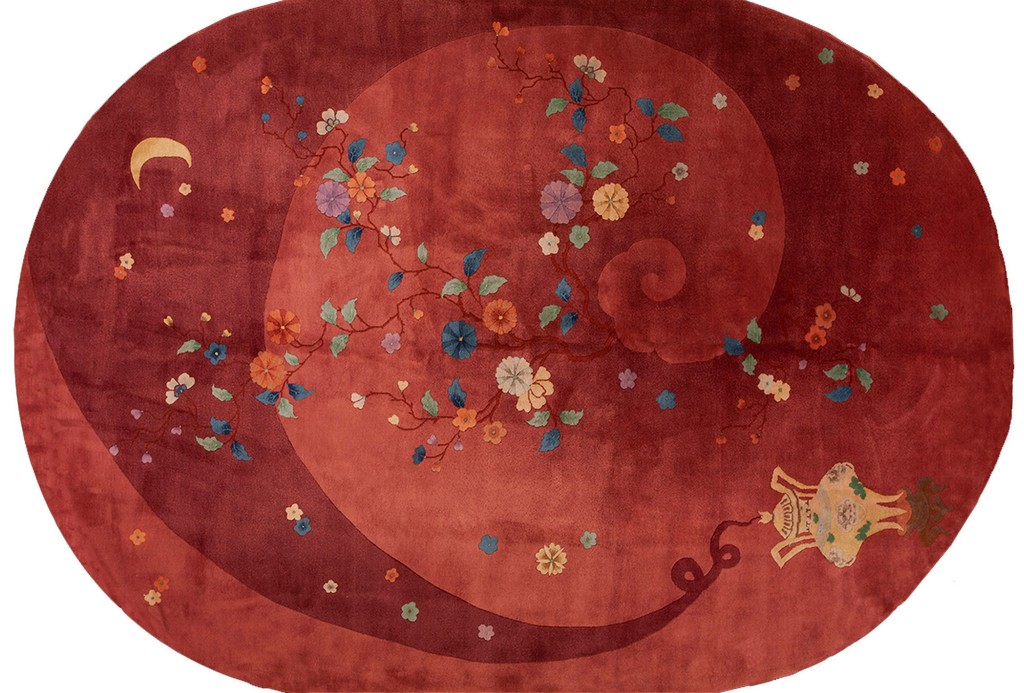
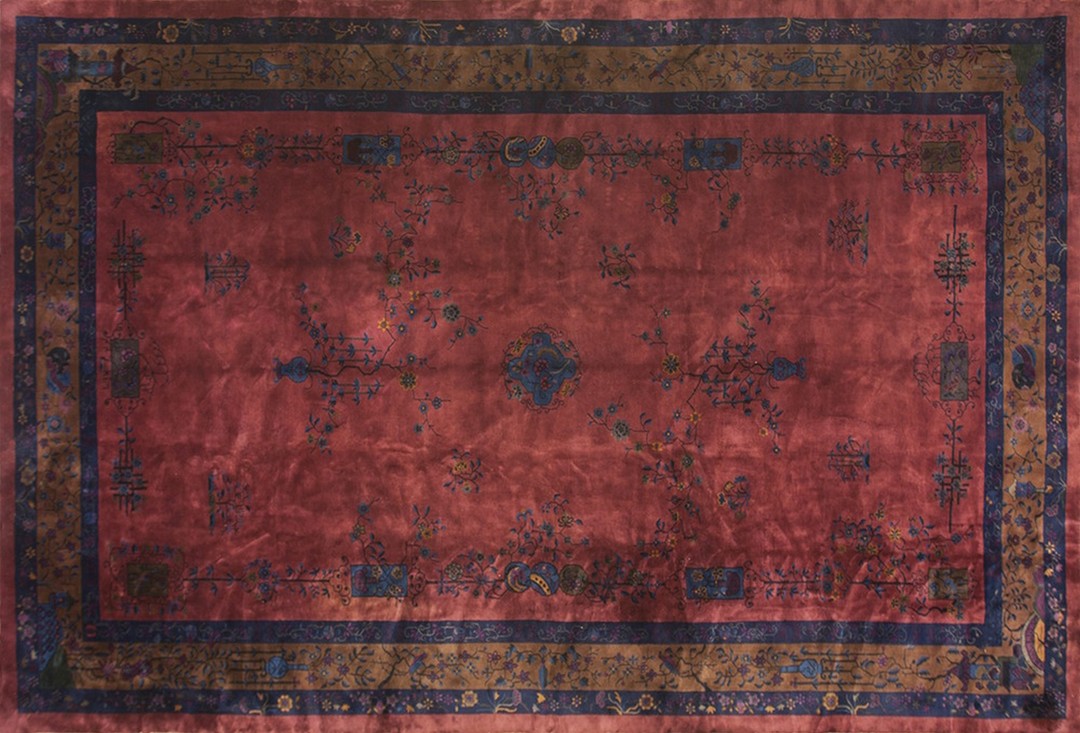
Oval Shape Antique Artistic Swirl Pattern Rustic Red Siena Color Art Deco Chinese Rug by Rugs On Net
Within the Islamic and Persian artistic tradition, such imagery resonates deeply, evoking themes of fertility, abundance, and the paradise garden promised in spiritual texts.
Vase design motif rugs therefore operate on multiple levels—as decorative masterpieces, technical triumphs, and vessels of meaning woven into daily life.
Name, Etymology, and Basic Meaning
The label “vase carpet” is primarily a scholarly term introduced in the modern era to group a distinct family of Safavid weavings. In their native context, these textiles are called “Goldani” (گلدار or گلدانی), meaning “flowered” or “floral vase.”
The Persian term emphasizes the motif not as a detached object but as an arrangement—a vase alive with blooms, ordered yet organic. For Persian audiences, the Goldani rug expressed cultural continuity, echoing floral imagery long present in manuscript painting, tilework, and architecture. Flowers had established symbolic roles: roses alluding to divine love, lotuses to purity, vines to eternal life.
Set within a vase design, these elements take on new unity, presenting the viewer with a woven metaphor for order, harmony, and beauty contained yet infinitely renewing. This etymological distinction underscores the difference between modern academic categories and the lived symbolism understood by Safavid patrons and artisans.
Why Did Safavid Weavers Introduce Vase Design Patterns?
The Safavid vase carpet emerged in the royal workshops of the 16th and 17th centuries, particularly in Kerman, where weavers enjoyed imperial patronage and access to the finest materials. Their introduction of the vase design pattern was both deliberate and profound.
Culturally, it reflected Persia’s long-standing fascination with the garden as a symbol of order and abundance; spiritually, it embodied the Islamic vision of the “Garden of Paradise”—an eternal sanctuary of flowing water and perpetual bloom. The vase itself functioned as the earthly vessel through which this ideal paradise could be visualized in the woven medium.
Artistically, the motif offered new possibilities for design: weavers could experiment with scale, rhythm, and intricacy, using the vase as a structural anchor from which vines, blossoms, and arabesques radiated. By weaving symbolic vase design motifs into carpets, Safavid artisans created textiles that transcended mere decoration. They became woven paradises, combining technical virtuosity with spiritual aspiration.
The appeal of these Persian vase carpets has endured precisely because of this dual nature: they are at once embodiments of luxury and expressions of timeless, universal symbolism. It is this fusion of artistry and meaning that secured the vase design’s place as one of the most iconic contributions of Safavid weaving to world textile history.
Historical Origins and Evolution
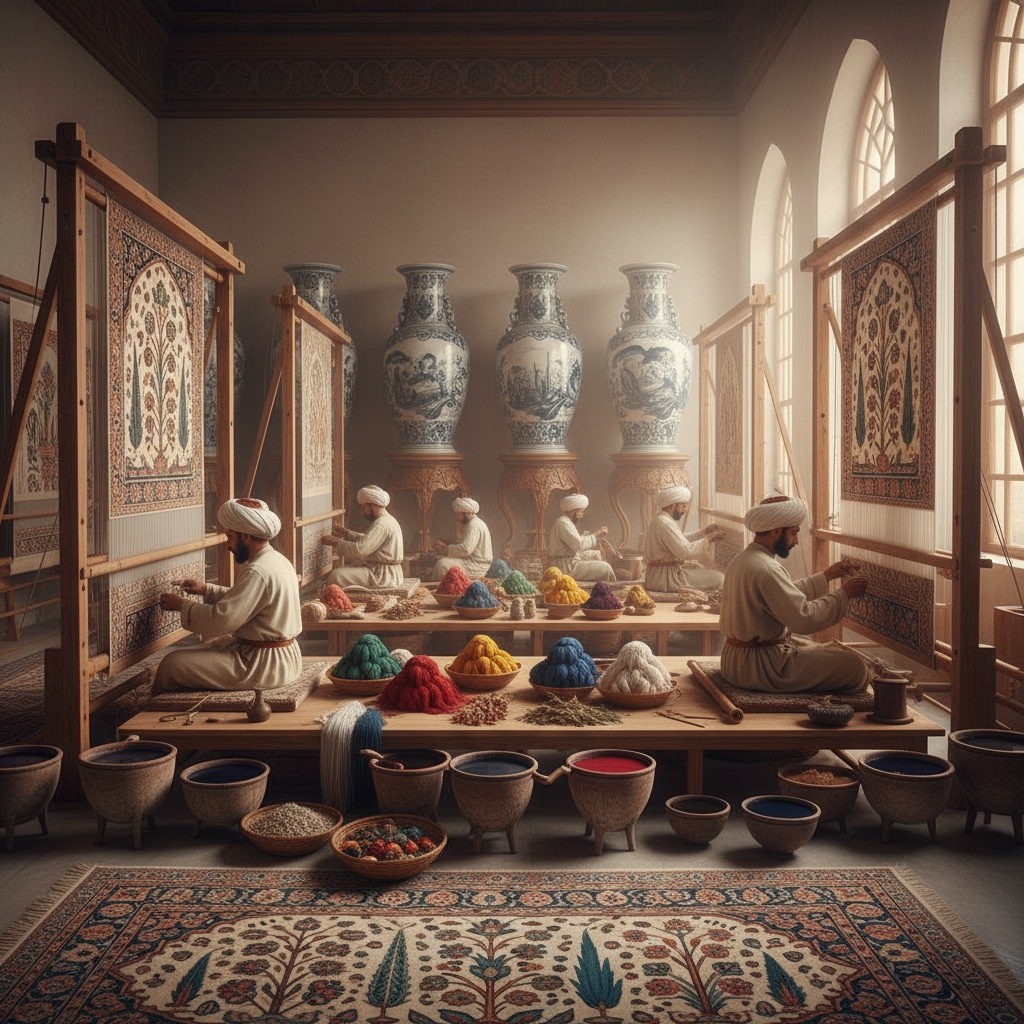
Early workshop setting showing textile production alongside decorative ceramics.
When Did Vase Design Motifs First Appear in Kirman Weaving?
The origins of the vase carpet can be traced to Kerman, Persia, during the reign of Shah Abbas I in the late 16th to early 17th century. It was in the Safavid royal workshops of this region that the first great Kerman vase rugs were produced.
These masterpieces combined technical refinement with profound symbolism, establishing the vase design motif as one of the most enduring designs in Persian textile history.
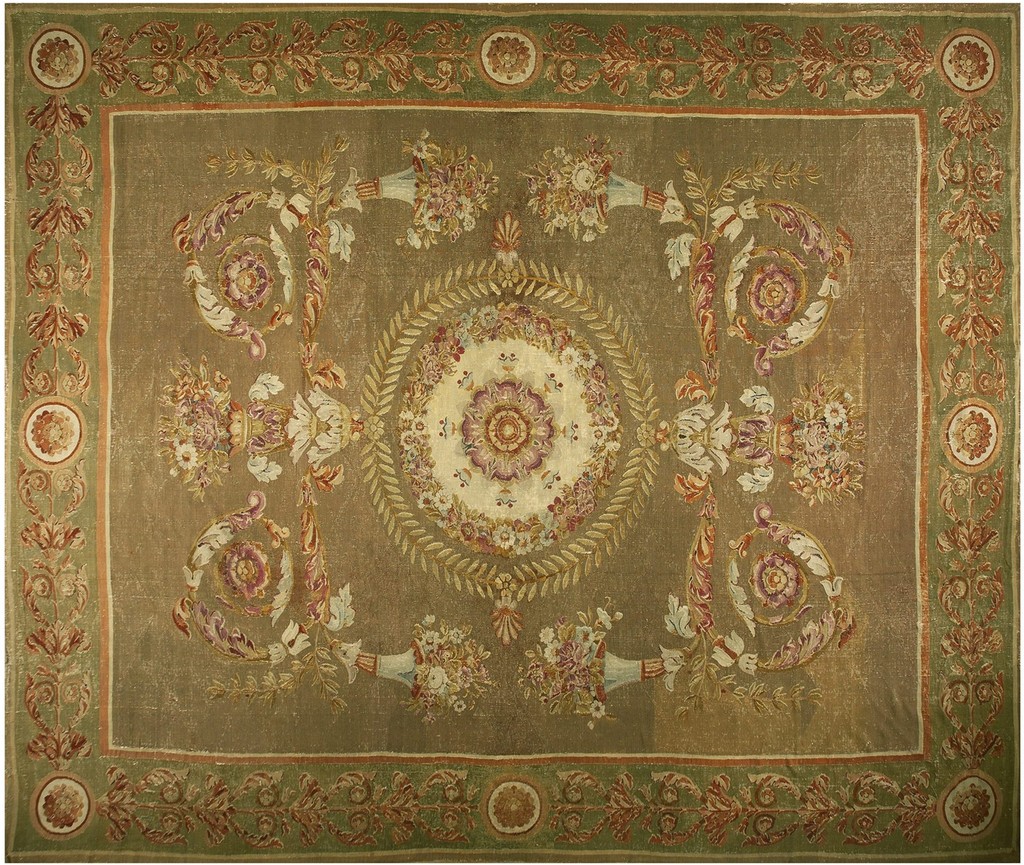
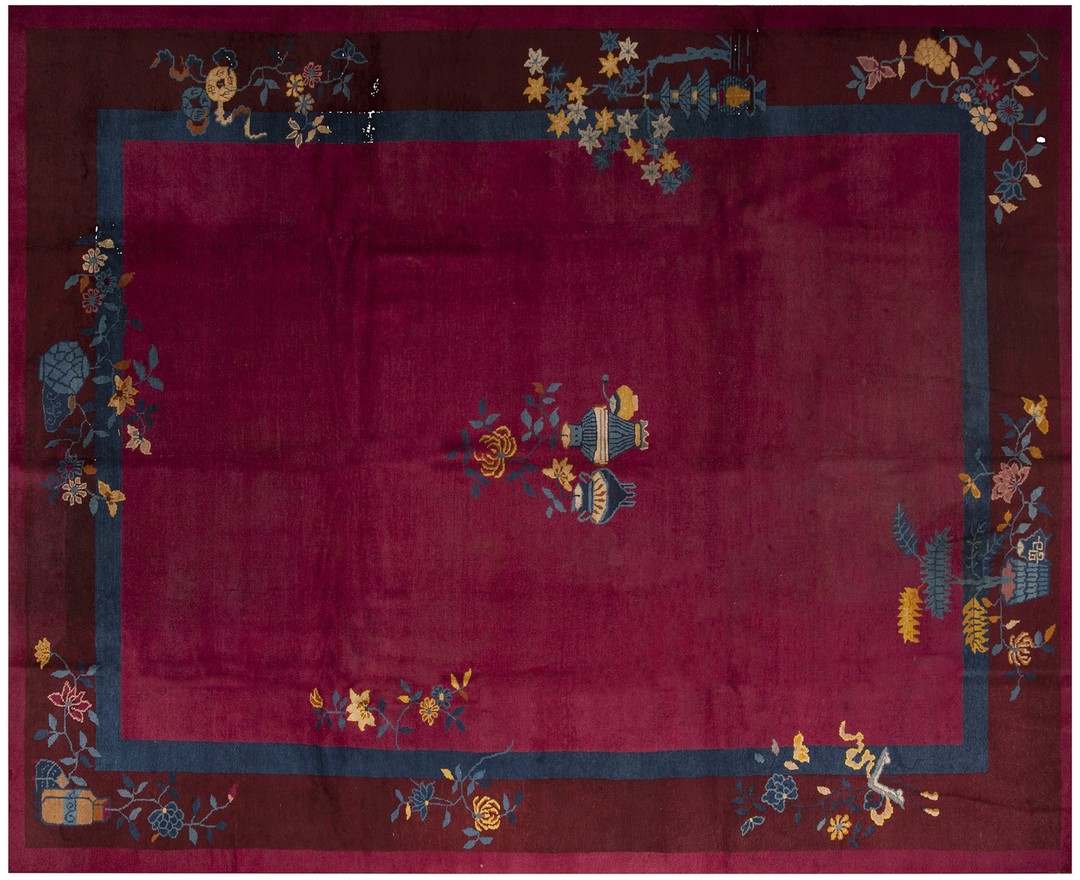
Antique Large Aubusson French Floral, Medallion Knotted Rug by Rugs On Net
Drawing inspiration from both Persian garden iconography—with its emphasis on order, symmetry, and paradise imagery—and the elegant forms of Chinese porcelain vases, Safavid weavers in Kerman crafted carpets that embodied both local tradition and global artistic exchange.
These early examples set the foundation for all subsequent interpretations of the vase design motif across Asia and beyond.
Key Design Milestones: Safavid, Mughal India, and the Caucasus
The Safavid period rug tradition of Kerman provided the blueprint for later developments. By the 17th century, the motif had traveled east into Mughal India, where it was embraced by imperial patrons who shared the Persian fascination with gardens as symbols of paradise and power.
In Mughal carpets, the vase often became integrated into formal garden layouts, echoing the architectural symmetry of places like the Shalimar Gardens of Lahore. From India, the motif continued its migration, reaching Caucasian weaving centers by the 18th and 19th centuries.
There, the vase design was reinterpreted in bold geometric forms, often stripped of Safavid delicacy but retaining the central imagery of vessels and floral abundance. These regional adaptations demonstrate how the motif could be reshaped to reflect different aesthetic languages while preserving its core symbolism.
How Vase Design Motifs Evolved and Spread
The spread of the vase design illustrates the cultural transmission of ideas along trade and artistic networks. Beginning with the Safavid vase carpet in Kerman, the motif radiated outward: first into the Mughal courts of India, where it merged with local garden symbolism, and then through the Silk Road into the Caucasus, Anatolia, and beyond.
By the 18th and 19th centuries, symbolic vase design motifs had been fully absorbed into regional weaving traditions, each adding its own character—geometric boldness in the Caucasus, ornamental richness in Anatolia, and stylized repetition in Central Asian textiles. This timeline of evolution—Safavid → Mughal/Indian → Caucasian/Anatolian → Modern— underscores the versatility of the design.
The vase motif was not bound to one geography or aesthetic but could be continually adapted, proving its timeless resonance as a unifying symbol of abundance, fertility, and spiritual paradise across diverse weaving cultures. The Kerman vase rug history remains the anchor of this journey, but its legacy is global.
Defining Features and Visual Identification
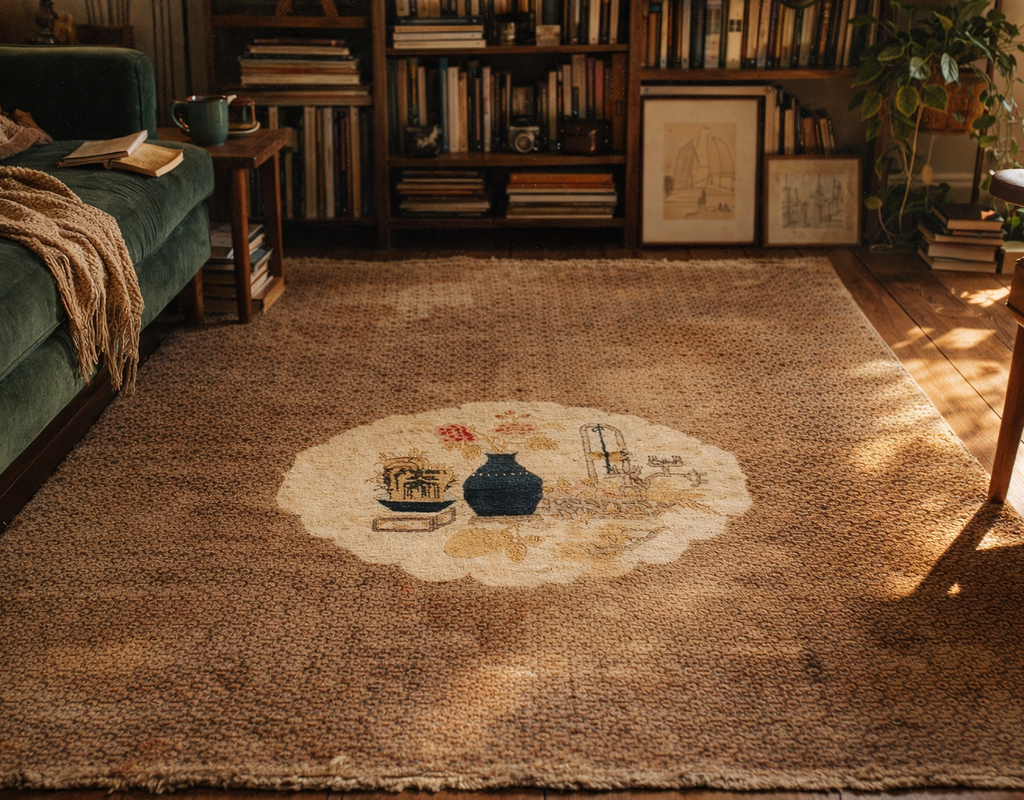
A richly textured rug anchors this snug reading area filled with books and bathed in warm afternoon light.
Vase as a central motif in traditional textile patterns.
How to Visually Identify a Vase Design Carpet
The most reliable method of vase design motif identification is to look for the central hallmark: a vessel—often stylized—overflowing with flowers. This vase may appear as a commanding centerpiece, repeated in vertical alignment, or integrated into a latticework field.
A classic vase design carpet is distinguished by its dense floral layouts, with stems and blossoms radiating gracefully from the vase in balanced symmetry. Many feature lattice or compartment structures, a signature trait of Safavid weaving, in which vines and blossoms form an interlocking framework around the central vase.
Additional hallmarks include ogival panels, sickle-shaped leaves, and intricate bouquets that seem to animate the rug’s surface with rhythm and flow. Collectively, these elements make iconic vase rug features recognizable even to the untrained eye: a central or repeated vase, an abundance of floral sprays, and an overall impression of elegant fullness.
What Symbols Typically Surround Vases in Traditional Rugs?
In traditional rug symbols, the vase rarely appears in isolation. Surrounding motifs enrich its meaning and visual impact. Common companions include scrolling vines, which signify continuity and life; palmettes and lotuses, both tied to rebirth and purity; and peonies, associated with prosperity and beauty. The tree of life motif often springs from the vase, connecting earthly growth with spiritual ascent.
Other frequent symbols include cloud bands—borrowed from Chinese decorative language—and small birds perched among the flowers, embodying joy and the soul’s freedom. These layered symbols reinforce the vase as the fountain of fertility, abundance, and paradise, while ensuring the design resonates with both spiritual and aesthetic depth.
Layouts: Allover, Lattice, Prayer, Central Medallion
Vase carpets employ a variety of layouts, each serving a distinct artistic purpose. In allover designs, small vases repeat rhythmically across the field, creating a continuous garden effect.
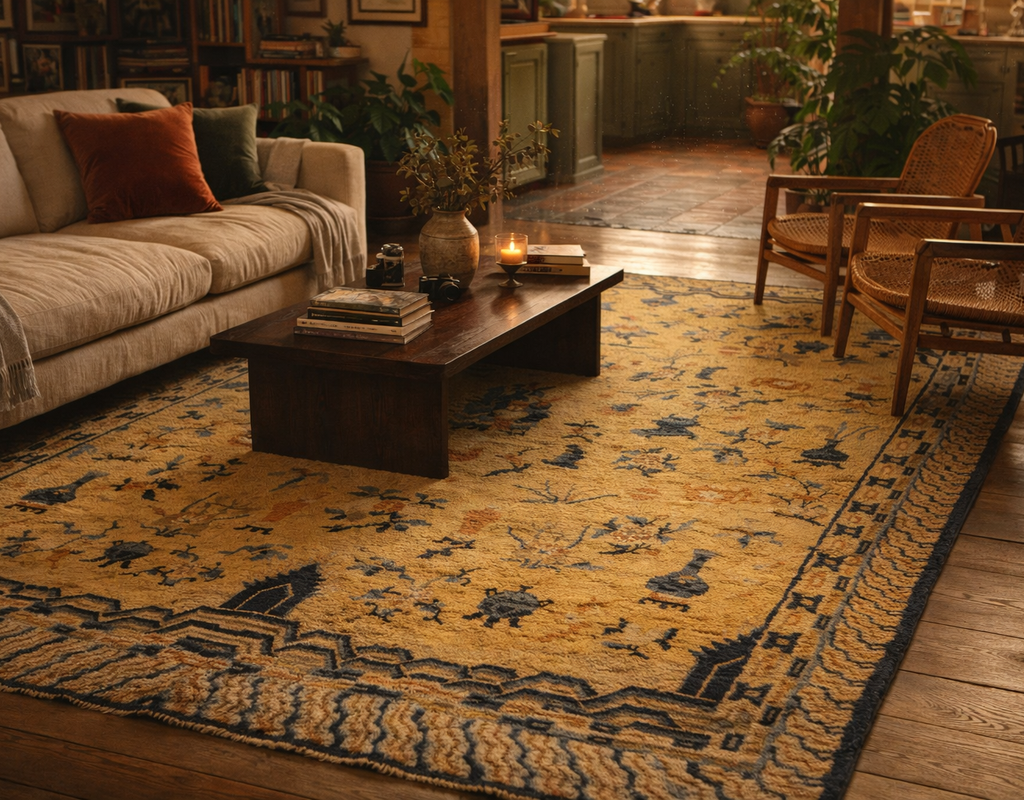
A vibrant, traditional-style rug adds warmth and character to this richly textured, dimly lit interior.
Lattice and compartment fields, among the most celebrated floral lattice rug styles, divide the surface into structured cells where vases and blossoms alternate with vines and palmettes. Prayer rugs often feature a single vase at the base of a niche, from which rises the tree of life—an image of eternal paradise tailored for devotional use.
Some central medallion vase rugs combine the Persian taste for symmetry with the vase design motif, placing the vessel below or around a radiating medallion. This adaptability of layout further underscores the motif’s versatility and lasting appeal.
Iconic Color Palettes and Border Designs
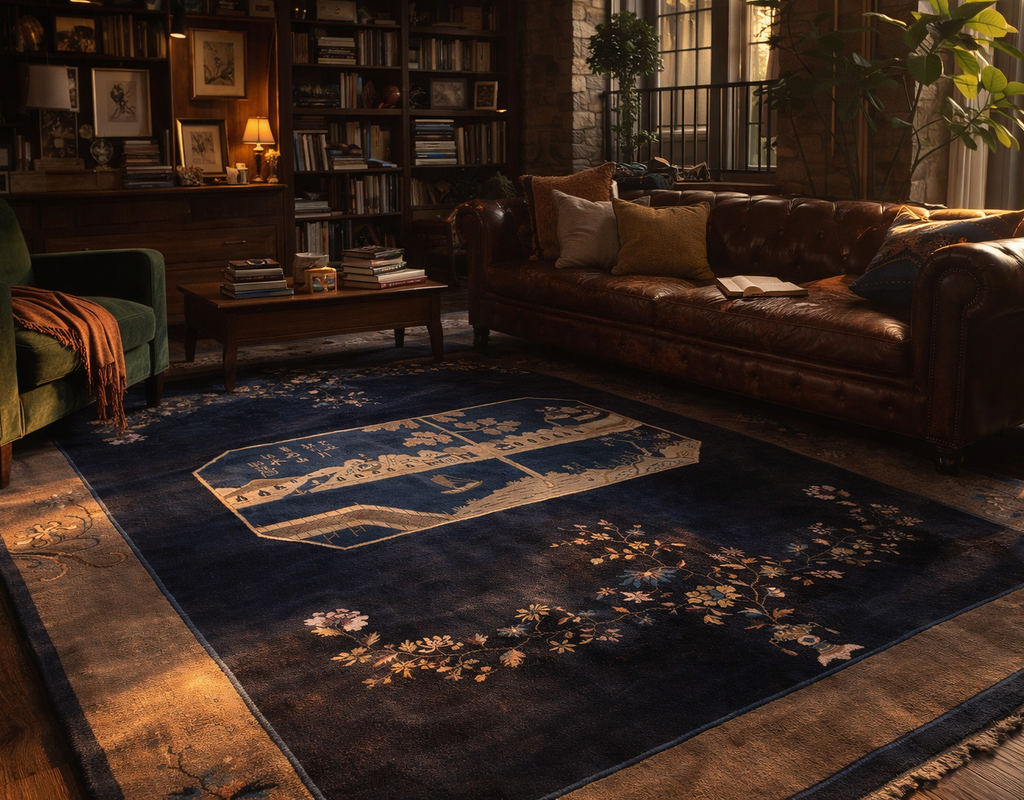
A luxurious library space grounded by a striking blue and beige oriental rug featuring detailed landscape artistry.
- Deep Indigo Grounds — Why: Creates a dramatic backdrop that enhances floral motifs and symbolizes depth and eternity.
- Rich Madder Reds — Why: A signature of Safavid weaving, representing vitality and artistic luxury.
- Soft Ivory Accents — Why: Offers contrast, highlighting blossoms and lattice frameworks with clarity.
- Emerald and Turquoise Greens — Why: Evoke nature and reinforce the garden imagery of paradise.
- Golden Yellows — Why: Suggest prosperity and divine light.
Borders frame these vibrant palettes with intricate designs: flowing vine scrolls (strapwork), cloud bands linking Persian and Chinese aesthetics, and geometric guard stripes that anchor the otherwise fluid composition.
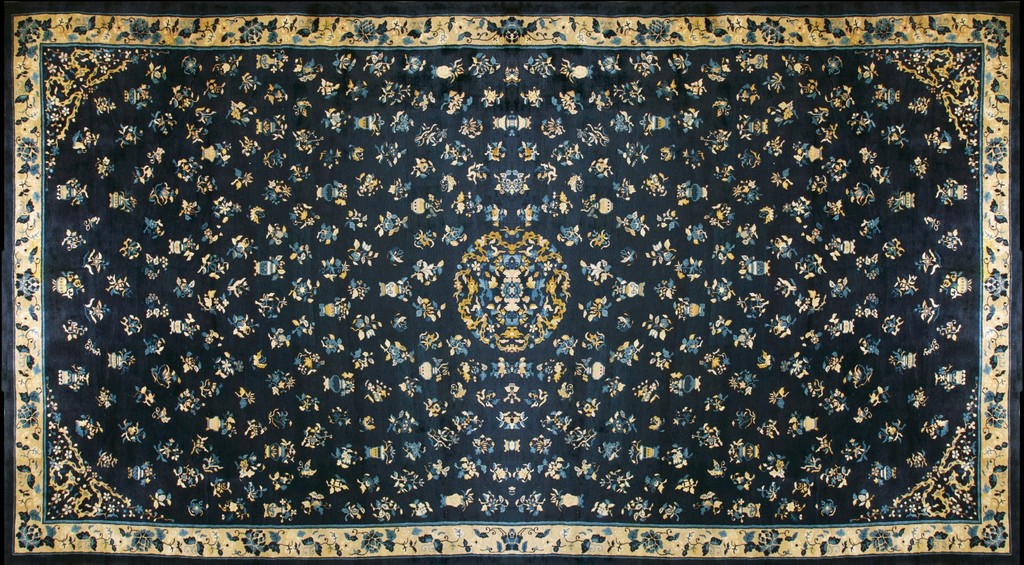
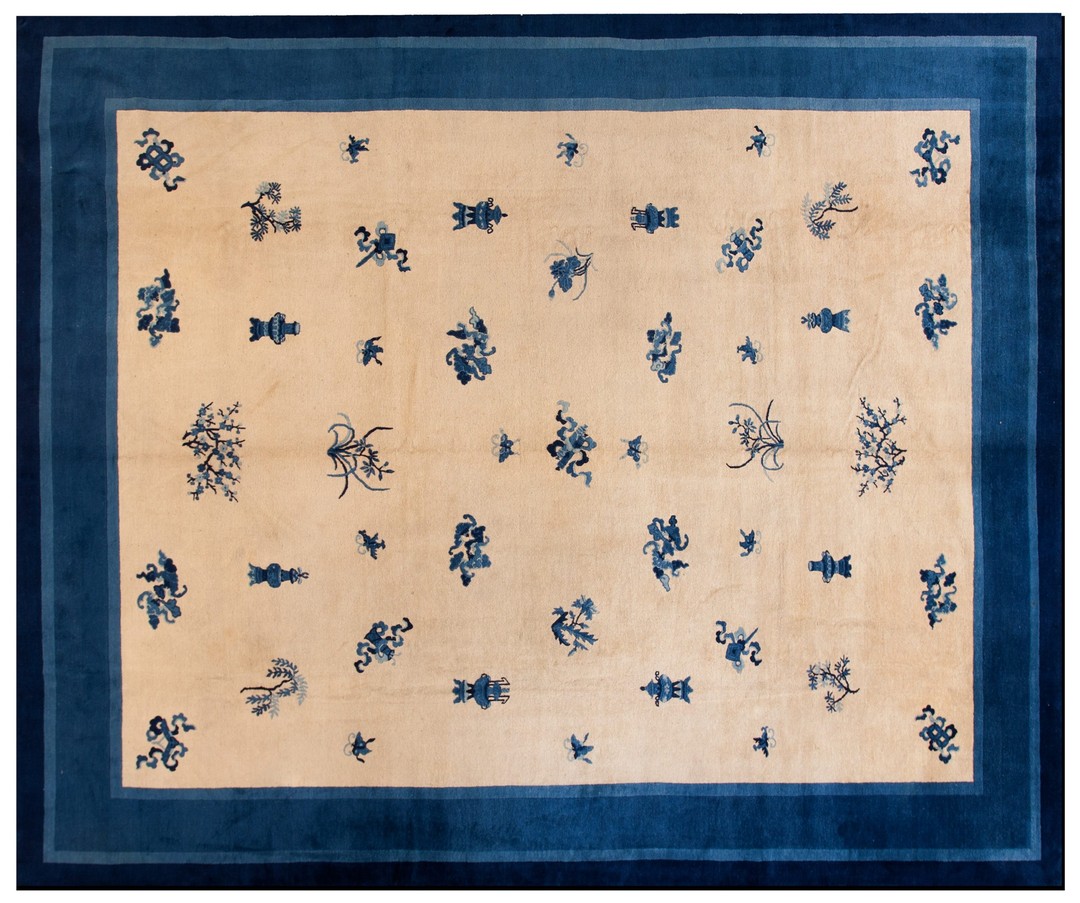
Chinese Wool – Peking 1890s Knotted Large Oversized Big Rectangle Blue Antique Rug by Rugs On Net
Together, these choices ensure that vase design carpet is not only instantly recognizable but also harmoniously balanced, making the Persian vase carpet one of the most admired traditions in textile art.
Materials, Construction, and Techniques
Wool, Silk, and Blending Methods in Vase Carpets
The foundation of vase carpet construction was its careful choice of materials. Classic Safavid vase carpets employed high-quality wool piles prized for their softness, resilience, and ability to take dye beautifully.
In luxury commissions, weavers added silk highlights to introduce luster, texture, and shimmering contrasts. Foundations were typically cotton or silk, chosen for their strength and flexibility on large looms.
The wool–silk blend rug was especially celebrated in Persian and Mughal courts, where silk threads highlighted blossoms, vines, or lattice outlines against a wool ground. This blending technique elevated the design, allowing vase design motifs to stand out with brilliance while ensuring durability suitable for both use and display.
Asymmetrical Knotting for Detail
One of the “secret weapons” of Persian weaving was the asymmetrical knot, also called the Persian or Senneh knot. Unlike the symmetrical Turkish knot, the asymmetrical form loops around a single warp thread and passes loosely under the other, creating a more flexible and finer structure. This method allowed Safavid artisans to render floral motifs with remarkable sharpness and subtlety.
The result was a carpet where every petal, vine, and palmette of the vase design motif rugs appeared crisp and lifelike. Does asymmetrical knotting enhance detail in vase designs?—the answer is unequivocally yes. It was this knotting technique that gave Safavid vase carpets their unrivaled clarity and expressive detail, making them stand apart from coarser regional traditions.
Dyeing for Vivid Colors
The vivid hues that define Persian vase carpets were achieved through mastery of natural dye techniques. Artisans relied on madder root for rich reds, indigo for deep blues, cochineal for crimson, and a range of vegetal sources to produce yellows, greens, and soft browns. The skill lay not only in sourcing but also in layering and mordanting, which allowed colors to bond securely with the wool or silk fibers.
These processes produced saturated tones that remain vibrant for centuries, giving antique vase design carpets their enduring brilliance. The harmony of indigo grounds with madder reds and ivory accents remains one of the iconic vase rug features, inseparable from their timeless appeal.
Knot Density’s Impact on Clarity
Another defining factor in vase carpet design was knot density clarity. Safavid weavers often exceeded 30 knots per cm², a technical feat that allowed for finely drawn motifs and complex compositions.
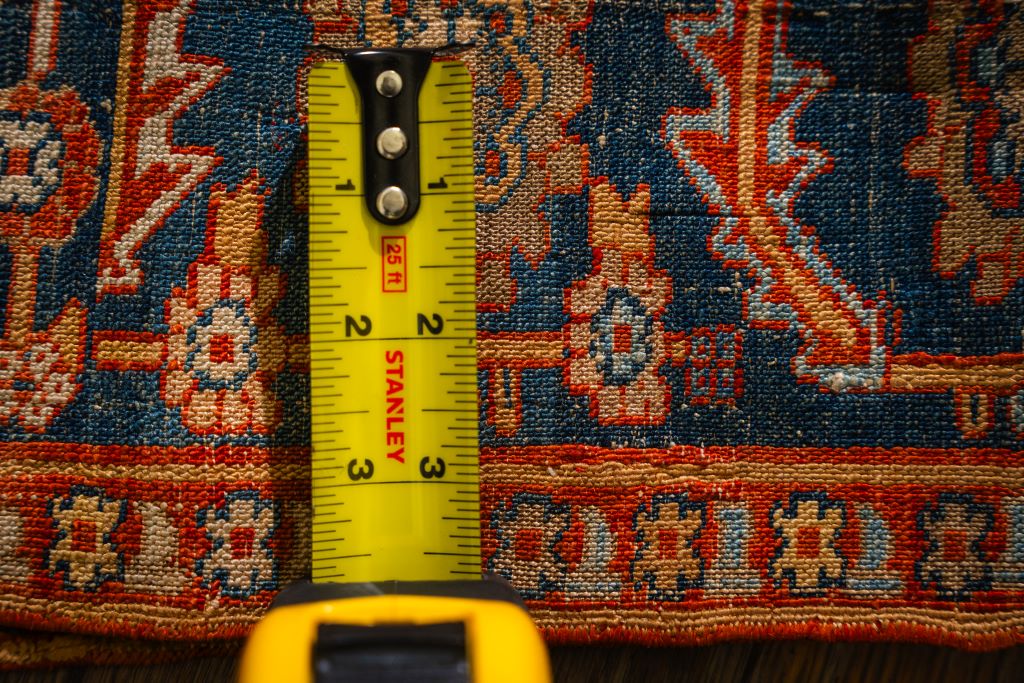
A detailed inspection of a richly colored oriental rug pattern while measuring its dimensions.
Higher knot counts translated into sharper outlines, smoother curves, and greater fidelity to naturalistic floral forms. In contrast, coarser weaves blurred detail, reducing the precision of motifs.
For vase carpets, where the motif’s beauty depended on crisp floral sprays and lattice precision, density was essential. The result was a textile that combined grandeur of scale with astonishing intricacy—woven gardens that retained clarity even under close inspection.
The Triple-Weft “Vase Technique”
Perhaps the most distinctive hallmark of Kerman vase rug history was the use of the triple-weft technique. In this structure, two taut wool wefts were inserted after each row of knots, followed by a third, looser weft of silk or cotton.
This innovation produced carpets of remarkable strength and flexibility while also enabling larger scales without distortion. The “vase technique” reinforced the reputation of Kerman workshops as centers of innovation and excellence, ensuring their works could endure the passage of centuries.
By combining fine wool and silk blends, asymmetrical knotting, natural dye mastery, dense knotting, and the triple-weft vase carpet technique, Safavid weavers created textiles that were at once durable, luminous, and deeply expressive. These technical foundations are the reason why many symbolic vase design motifs from the 17th century remain as vibrant and legible today as when they first emerged from the loom.
Regional Variations of Vase Rugs
Kerman Vase Carpets: Features, Reputation, and Value
The Kerman vase carpet stands as the definitive model for the entire tradition. Woven in the Safavid period, these pieces are instantly recognizable by their triple-weft construction, which creates a distinctive ribbed surface and remarkable durability. Their high knot density allowed weavers to render lush floral sprays, scrolling vines, and sickle leaves with extraordinary clarity.
Kerman’s mastery of dyeing, especially the balance of deep indigo, madder red, and ivory, gave these carpets enduring vibrancy. Beyond their technical features, they hold unmatched historical and cultural significance, being the earliest and most refined examples of the type.
For this reason, they dominate at major auctions, often setting records, and remain the “gold standard” for collectors. Why are Kirman vase carpets prized among collectors?—because they embody the peak of Safavid artistry, combining innovation, craftsmanship, and symbolic depth that later regional traditions could only emulate.
Mughal, Caucasian, Silk Road, and Ottoman Interpretations
The spread of the vase motif across regions demonstrates its adaptability and cross-cultural resonance. In Mughal vase rugs, woven in India during the 17th century, pastel palettes and botanically accurate flowers became the hallmark. These designs often employed grid layouts, echoing the formal geometry of Mughal gardens, where each vase anchored a compartment filled with naturalistic blossoms.
By contrast, Caucasian vase designs reinterpreted the motif in bold, geometric forms, often pairing the vase design with the tree of life or filling fields with stylized blossoms in bright, saturated dyes. Further east, Silk Road vase carpets from Khotan and Samarkand reflect Chinese and Buddhist influences. Here, the vase often carried the “treasure vase” symbolism—a sacred object representing inexhaustible abundance.
Cloud bands and lotus blossoms reinforced the blend of Persian and Chinese visual language. In the Ottoman world, the motif often appeared in prayer rugs, where a simple vase at the base of the niche was paired with tulips and carnations, flowers central to Ottoman decorative art.
Isfahan, Kashan, and Tabriz Distinctive Styles
Within Persia itself, the vase design motif was adapted to the aesthetics of different weaving centers. Isfahan vase rugs emphasized symmetry and elegance, often integrating the motif into elaborate central medallion schemes. Kashan workshops, known for their silk weaving, used the vase design to highlight luxurious materials, incorporating gold-thread details in court commissions.
Tabriz adopted the motif into more monumental designs, where vases often framed or supported large medallions, merging architectural precision with floral abundance. These variations show how even within Persia, each center shaped the motif to its artistic strengths and patronage demands.
Regional Vase Rug Features That Stand Out
- Kerman (Persia): Triple-weft ribbing, lush florals, technical mastery — Why: Established the standard for all later vase rugs, highly prized at auction.
- Mughal India: Pastel palettes, botanical naturalism, grid layouts — Why: Reflects Mughal fascination with gardens and lifelike floral studies.
- Caucasus: Bold geometric vases, tree of life motifs, vivid dyes — Why: Recast the design into local visual language of abstraction and color.
- Silk Road (Khotan): Chinese treasure vase, Buddhist symbolism, lotus blossoms — Why: Illustrates cultural blending along major trade routes.
- Ottoman Anatolia: Simple vase in prayer rugs with tulips/carnations — Why: Adapted the motif to Islamic devotional contexts and Ottoman floral taste.
- Isfahan, Kashan, Tabriz: Courtly Persian adaptations with silk, symmetry, and medallion structures — Why: Showcases the diversity of interpretation even within Persia’s weaving centers.
Each of these regional vase rugs highlights the motif’s versatility. From the technical brilliance of Kerman to the symbolic depth of Silk Road carpets, the vase design motif became a canvas upon which diverse cultures projected their own values, aesthetics, and beliefs.
This adaptability is precisely why the Mughal vase rug, the Caucasian vase design, and the Silk Road vase carpet remain enduring testaments to the motif’s universal appeal.
Symbolic and Cultural Significance
Paradise Garden and Abundance in Islamic and Persian Art
At the heart of vase rug symbolism lies the Persian and Islamic conception of the garden of paradise rug. In Islamic art, the vase is not simply a decorative object but a vessel of water—the essence of life—from which flowers, vines, and branches emerge in perpetual bloom. This imagery transforms the carpet into a portable garden, a woven paradise that could be carried indoors, symbolizing both divine bounty and harmony.
For Safavid patrons and weavers, the vase was a visual metaphor for heaven itself, its overflowing abundance promising renewal, fertility, and eternal well-being. In this sense, the symbolic vase design motifs found in carpets were not ornamental flourishes but profound cultural statements that reflected both personal devotion and societal ideals of beauty, balance, and spirituality.
Buddhist and East Asian Treasure Vase Symbolism
The spread of the motif along the Silk Road infused it with new layers of meaning. In Buddhist tradition, the Treasure Vase is one of the Eight Auspicious Symbols, representing inexhaustible wealth, spiritual blessings, and longevity. When integrated into carpets produced in regions such as Khotan or Samarkand, the vase became not only a container of life but also a symbol of infinite abundance.
In Chinese culture, the motif resonated further through language itself: the word for vase, ping, is a homophone for peace, making the vessel an emblem of harmony and stability. This merging of Persian and East Asian interpretations enriched the vase design, ensuring its relevance across faiths and empires.
Contemporary Reinterpretations: Tradition, Environment, Identity
In modern textile art and carpet design, the symbolic vase design motifs continue to evolve. Contemporary weavers and designers reinterpret the motif as a bridge between past and present—an emblem of tradition reimagined for new contexts. Many emphasize environmental harmony, portraying the vase as a container of balance between humanity and nature.
Others employ it as a marker of cultural identity, affirming links to Persian, Mughal, or Silk Road heritage while speaking to global audiences.
In this way, the motif remains as vital today as it was in the Safavid era: a timeless expression of hope, abundance, and spiritual well-being, capable of adapting to the needs and aesthetics of each generation. Through centuries of reinterpretation, vase rug symbolism has retained its essence: the promise of paradise, the blessing of abundance, and the enduring unity of craft, culture, and nature.
Antique vs. Modern Vase Rugs
Differences in Design, Materials, and Weaving
The contrast between antique vs modern vase rugs lies in the interplay of craftsmanship, materials, and subtle irregularities. Vintage vase carpets were entirely handmade, often with high-quality wool piles, silk highlights, and cotton or silk foundations. They used natural dyes—madder, indigo, cochineal—producing saturated colors that aged with graceful abrash, the tonal variations prized by collectors.
Knot density was consistently high, enabling sharp floral details and rich textures that gave depth to the design. In contrast, many modern vase rugs are produced on machine looms, particularly in budget markets, with synthetic fibers or blends. Synthetic dyes can create bright but overly uniform tones, lacking the nuanced variation of natural colorwork.
Even when handmade, modern reproductions may use lower knot counts, simplifying motifs and softening clarity. How do vintage vase carpets differ from modern reproductions?—the former are unique, naturally dyed, and subtly imperfect in ways that signal authenticity, while the latter tend toward uniformity, synthetic shine, and industrial precision.
Digital Looms and Motif Replication
The advent of digital loom reproduction has advanced the ability to mimic complex motifs, including vase designs. Modern technology can replicate the crispness of traditional vase design motifs with extraordinary precision, often producing rugs that visually resemble antiques at a glance. However, while digital looms excel at surface accuracy, they cannot replicate the tactile depth and irregular charm of handmade weaving.
The interplay of hand-tied knots, the sheen of natural silk, and the abrash of vegetable dyes give antique pieces a vibrancy and dimensionality that remain unmatched. Can digital looms replicate traditional vase design motif crispness?—yes, to a technical extent, but true depth and authenticity are best preserved in handmade rugs.
How to Identify High-Quality Reproductions
- Check for Abrash (Color Variation) — Why: Genuine vintage carpets show natural dye shifts; uniform colors may suggest modern production.
- Inspect Knot Density — Why: Higher knot counts indicate finer handmade work; lower counts blur motifs.
- Look for Material Authenticity — Why: Natural wool and silk have warmth and depth, unlike synthetic fibers’ sheen.
- Examine Back and Weave — Why: Hand-knotted rugs show slight irregularities; machine-made backs are uniform and grid-like.
- Assess Pattern Precision — Why: Perfect uniformity may signal digital loom production; subtle irregularity reflects human craftsmanship.
- Consider Provenance and Documentation — Why: Reliable sourcing and certificates provide assurance for collectors.
Ultimately, while modern reproductions can be beautiful and affordable, serious collectors value vintage vase carpets for their authenticity, rarity, and artistry.
Even in an age of digital precision, the vase motif authenticity remains most powerful when expressed through the hand and vision of the weaver.
Vase Rugs in the Modern Market
Auction Prices, Investment Value, and Market Trends
The vase carpet auction price record underscores the extraordinary value these textiles command. In 2013, the so-called Clark “Sickle-Leaf” Vase Carpet, a Safavid Kerman masterpiece, sold at Sotheby’s for $33.7 million, setting a world record for any carpet.
While not all vase carpets approach such astronomical figures, high-quality Kerman pieces with clear provenance regularly fetch tens of thousands to several million dollars, depending on rarity, size, and condition. Market trends show steady appreciation, with renewed global interest in Persian art fueling demand.
For collectors considering a vase carpet investment, antiques of proven authenticity remain one of the most stable long-term segments of the textile market.
Where to Buy Authentic Vase Carpets
Collectors seeking an authentic Safavid vase rug should look to established sources:
- Major auction houses (Sotheby’s, Christie’s, Bonhams) regularly handle rare examples.
- Reputable galleries and dealers specializing in Persian and Islamic art provide vetted, documented pieces.
- Museum deaccessions occasionally release authentic carpets into the market, though availability is rare.
These venues not only ensure access to genuine pieces but also provide critical provenance and authentication—two factors inseparable from long-term value.
Authenticity and Provenance: Verification
How should I verify authenticity of a vase carpet purchase? the answer lies in layered due diligence. Buyers should:
- Request provenance documentation tracing ownership history.
- Seek expert appraisals from recognized specialists in Persian textiles.
- Examine the weave for hand-knotting, asymmetrical knots, and natural dye signatures.
- Confirm region-appropriate features such as triple-weft construction in Kerman rugs.
Does provenance significantly affect vase carpet valuation? Absolutely—provenance can double or even triple value, transforming a fine carpet into a museum-worthy treasure.
Are Vase Motif Rugs Good Investments?
Can vase design motif rugs appreciate as long-term investments? The evidence is clear: yes. Top-tier antiques, particularly Safavid Kerman examples, have consistently risen in value.
While fluctuations occur in the broader art market, demand for carpets with secure provenance and historical importance has remained resilient. Their rarity, artistic significance, and cross-cultural appeal ensure they remain coveted by museums and private collectors alike.
Contemporary Designers and Revivals
Beyond the auction world, the vase design motif continues to inspire. Contemporary vase design rugs are being woven in Iran, India, and Afghanistan, where artisans reinterpret the classic Goldani style with both faithful reproductions and innovative adaptations.
Designers in Europe and the United States also incorporate vase design imagery into modern collections, using it as a symbol of balance, heritage, and environmental harmony. This revival reflects not only the motif’s timeless beauty but also its adaptability to current design aesthetics.
Tips for Collectors and Buyers
- Prioritize Provenance — Why: Ownership history greatly enhances both authenticity and investment value.
- Seek Natural Dyes and Handwork — Why: Genuine antiques rely on vegetable dyes and hand-knotting, unlike modern synthetics.
- Study Regional Traits — Why: Features like Kerman’s triple-weft technique or Mughal pastel palettes confirm authenticity.
- Buy from Reputable Sources — Why: Established dealers and auction houses safeguard against forgeries.
- Invest in Condition — Why: Well-preserved rugs retain value; extensive restoration lowers long-term appreciation.
- Balance Passion with Research — Why: Knowledge ensures both aesthetic enjoyment and financial security.
In today’s art market, authentic Safavid vase rugs remain among the most prestigious textile investments.
For those unable to acquire an antique, contemporary vase design motif rugs offer a meaningful way to connect with centuries of tradition while participating in the ongoing revival of one of Persia’s most enduring designs.
Explore Some of Our Vase Design Rugs
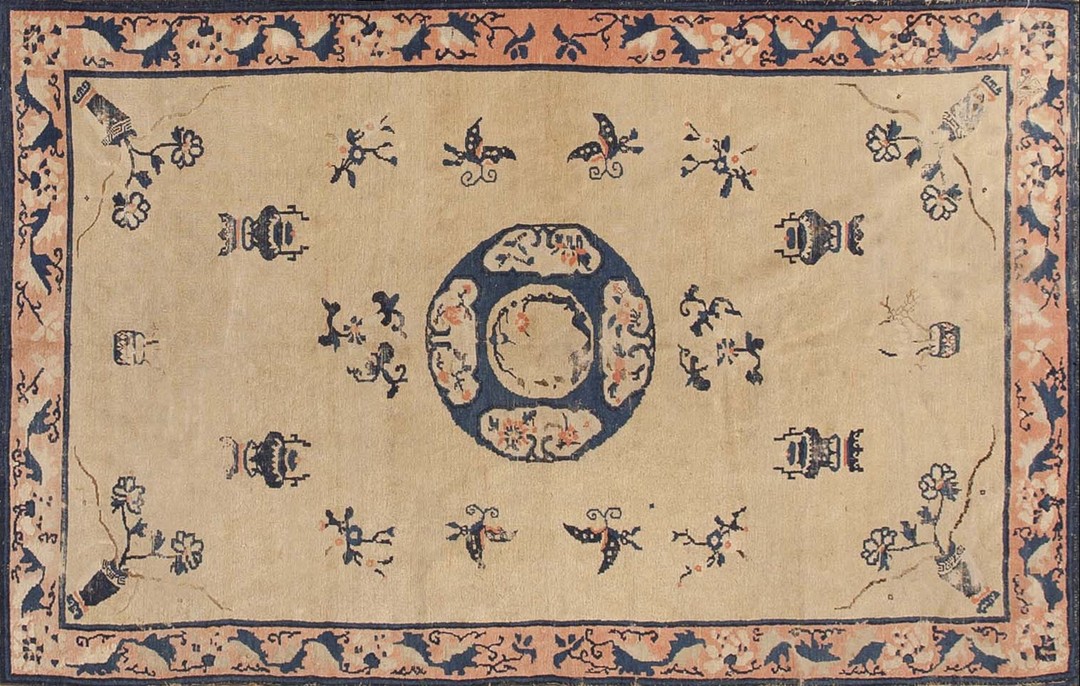
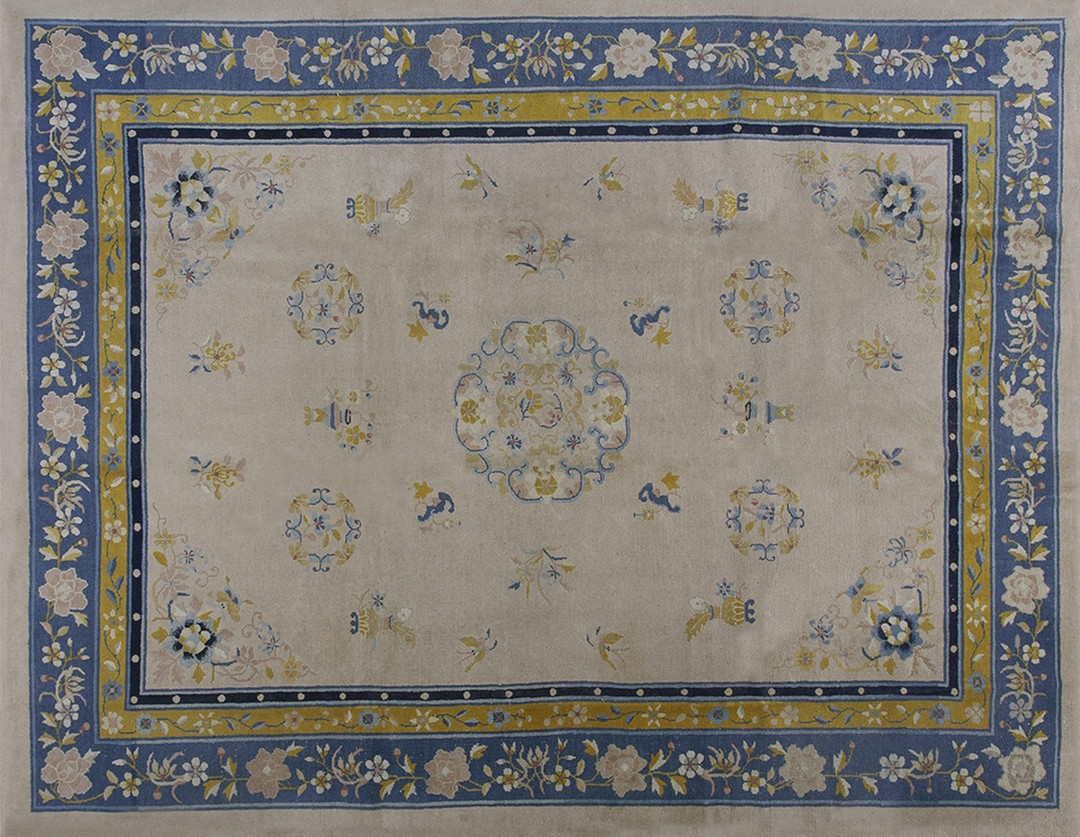
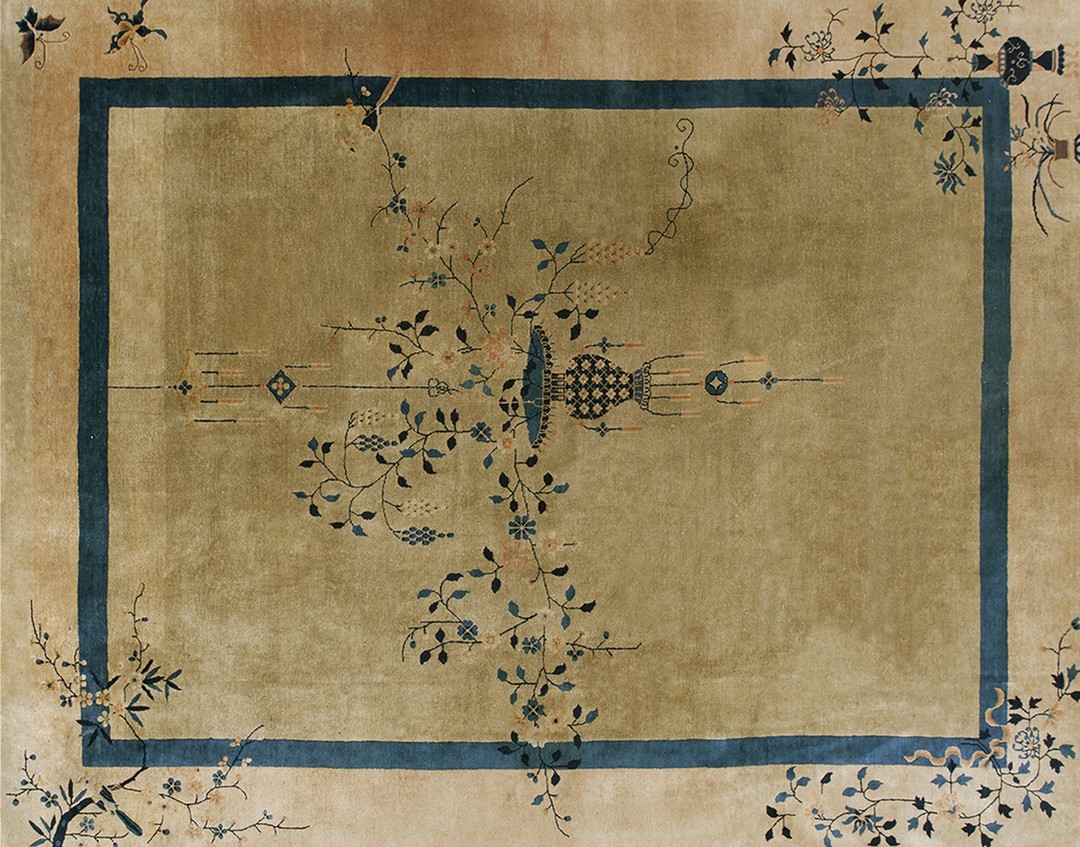
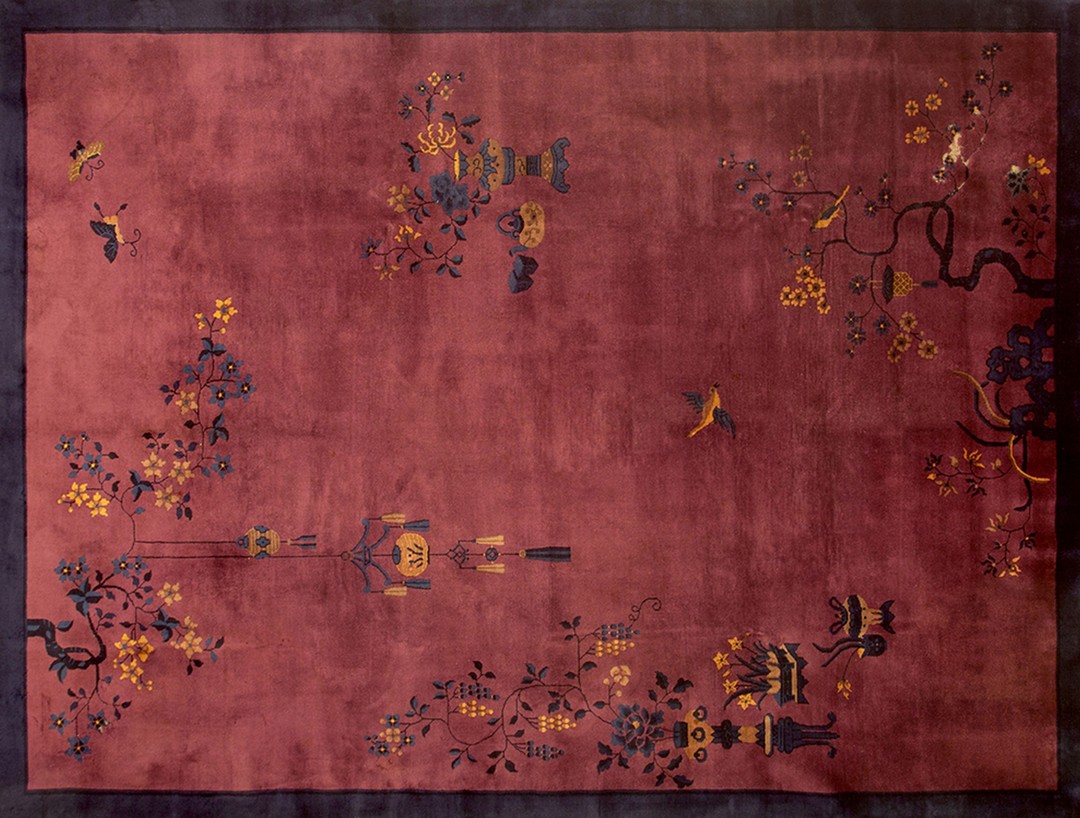
FAQ
- What’s the price range for vase motif rugs?
Machine-made vase rugs start under a few hundred dollars; good hand-knotted new pieces often run \$1,000–\$5,000+. Rare antique Kerman “vase-technique” examples can reach seven figures.
- How do vase motif rugs relate to Tree-of-Life designs?
Many Tree-of-Life rugs sprout from a base vase, symbolizing life and renewal. A vase rug may feature a tree axis or simply overflowing bouquets.
- What colors are common in vase design rugs?
Classic vase rugs use indigo, madder red, ivory, and soft Kerman pastels (pale blue, sand). Contemporary vase rugs also appear in taupe, sage, and faded teal.
- Are vase motif rugs kid- and pet-friendly?
Choose low-pile wool vase rugs and a grippy pad; avoid fringe and delicate viscose. For mess-prone areas, pick washable vase-pattern synthetics.
- Can a vase rug work in small spaces?
Absolutely—try a vase runner in a hallway or a 4×6 in an entry. Directional vase layouts can visually “lead” you through narrow zones.
- Do vase motif rugs hide stains well?
Mid-tone, busy floral vase rugs disguise wear better than very light solids. Dark navy Kashmar-style grounds or distressed Kerman palettes are especially forgiving.
- How can I spot a quality hand-knotted vase rug?
Look for crisp drawing on the back, varied color from natural dyes (abrash), even selvages, and supple wool. Antique Kerman vase rugs may show three wefts between knot rows.
- Are antique vase motif rugs a good investment?
Quality antiques can appreciate, but condition and provenance matter. Exceptional Kerman “vase-technique” examples have fetched millions at auction; consult a qualified appraiser.
- How do vase motif rugs pair with other patterns?
Balance a vase rug’s florals with solids or small-scale geometrics. It layers well with minimalist upholstery and works alongside medallion art or simple stripes.
- Are vase rugs safe over radiant-heat floors?
Yes—use wool vase rugs with a heat-rated felt or felt-rubber pad. Avoid cheap PVC pads and very thick, insulating piles that reduce heat efficiency.
- What rug pad is best under a vase rug?
Use a felt-and-natural-rubber pad cut 1–2 inches smaller than the rug. Aim for 1/8–1/4 inch in busy areas; up to 3/8 inch for cushioned rooms like bedrooms.
- How should I vacuum a wool vase motif rug?
Use suction-only or raise the beater bar to its highest setting; avoid fringes. Slow passes, rotate every 6 months, and consider professional cleaning as needed.
- Can I get washable vase pattern rugs?
Yes—machine-washable vase design rugs exist in synthetic or cotton chenille. Hand-knotted wool or silk vase motif rugs should never be machine-washed.
- Are wool vase rugs better than viscose for everyday use?
For traffic and spills, wool vase rugs win—durable, naturally soil-resistant, and easier to clean. Viscose vase rugs feel silky but dislike moisture and pet messes.
- What size vase rug fits a dining room best?
Choose a vase rug that extends 24–30 inches beyond the table on all sides so chairs stay fully on the rug when pulled out; for six seats, 8×10 is common.
- Do vase motif rugs work in modern interiors?
Yes—pair a vintage-look vase rug with streamlined furniture and solid textiles. Muted Kerman or Oushak palettes (ivory, sand, faded teal) keep it elevated, not busy.
- Are vase motif rugs directional, and how should I orient them?
Many vase rugs are directional; point the vases upright toward the room’s focal view (e.g., away from the entry or toward the bed’s headboard) so florals “grow” into the space.
- What is a vase border rug and when is it used?
A vase border rug repeats small vases around the perimeter, framing a medallion or floral field. It’s great when you want the motif present without dominating the center.
- What makes Kashmar vase rugs distinct?
Kashmar vase rugs frequently weave storylike scenes and “bowl-and-vase” (Zir Khaki/Goldani) layouts, often in deep blues and beiges. Borders may repeat large vases flanked by scrolling vines.
- What defines Kerman vase rugs versus other vase motif rugs?
Kerman vase rugs often show lush allover florals with refined drawing and, in antique examples, the famed three-weft “vase” structure. Later Kerman vase rugs favor pastel palettes and fine wool.
- Which regional styles most commonly use the vase rug design?
Kerman vase rugs and Kashmar vase rugs are classics; you’ll also find Turkish Oushak vase rugs, Caucasian vase rugs, and Khotan vase rugs with vase-and-bouquet layouts.
- What do vase motif rugs symbolize?
In Persian art, vases overflowing with flowers suggest abundance, harmony, and paradise gardens. On rugs, the motif evokes prosperity and a life-giving household.
- Where did vase motif rugs originate?
Vase motif rugs are rooted in Safavid-era Persian weaving, especially Kerman, then spread to regions like Kashmar, Oushak (Turkey), Caucasia, and Khotan. Modern makers still reinterpret the pattern.
- How is a vase motif rug different from a “vase-technique” carpet?
“Vase motif rugs” are about the vase image; “vase-technique” carpets are 17th-century Kerman weavings with three wefts per knot row. Many vase-technique pieces include vases but the term names the structure.
- What is a vase motif rug?
A vase motif rug features one or more vases spilling floral vines across the field or border. It echoes Persian “garden” imagery and often reads as directional because vases sit at one end.