
Introduction to 7 Pointed Star Rugs
Explore our curated collection of luxury seven-pointed star motif rugs and find the perfect statement piece today.
The 7-pointed star motif feels a little unusual and intriguing. It’s less common, which can make it stand out in rug patterns. If you’re seeing how complexity shifts with each point, these other motifs offer quick comparisons.
Explore other star motifs: 4-pointed, 5-pointed, 6-pointed, 8-pointed.
Executive Overview: What Is a 7 Pointed Star Rug?
A 7 pointed star rug, often referred to as a heptagram rug, is a rare textile distinguished by the incorporation of the heptagram into its woven or knotted design. Unlike the more common four-, five-, six-, or eight-pointed motifs seen in Middle Eastern and Central Asian carpets, the 7 pointed star motif stands out for both its scarcity and its depth of symbolic weight.
In rug weaving traditions, where geometric forms often carry layers of cultural and spiritual meaning, the heptagram is considered exceptional. The 7 pointed star motif in rugs appears most often in tribal, nomadic, and workshop textiles across Turkic, Persian, and Central Asian weaving cultures. It may be repeated across a field, placed within medallions, or subtly integrated into borderwork.
As a design element, it is striking: the elongated points of the star create a rhythmic asymmetry that feels both harmonious and dynamic. Collectors and scholars categorize ancient star rugs bearing the seven-pointed figure as highly significant due to their combination of artistry and symbolism.
Motif at a Glance: Why It Stands Out in Textile Art
The rarity of the heptagram in woven textiles is one of the reasons it commands attention. While many rug motifs rely on symmetry and even-numbered geometry, the seven-pointed star resists conventional balance, giving it a mysterious and otherworldly presence. Its form is more complex than common geometric designs, requiring advanced planning in weaving, which may be why it is seldom used.
Visually, the motif stands apart for its elongated, interlacing structure that produces a sense of motion and expansion. In rug design, this effect can transform a static field into something that feels alive and cosmically charged. Among ancient star rugs, the seven-pointed figure serves as a focal point, often contrasted against repeating borders or complementary motifs like diamonds, rosettes, or floral elements.
This rarity enhances its appeal to historians, artisans, and collectors alike. A rug featuring a 7 pointed star motif is not just a decorative textile but also a statement of cultural uniqueness.
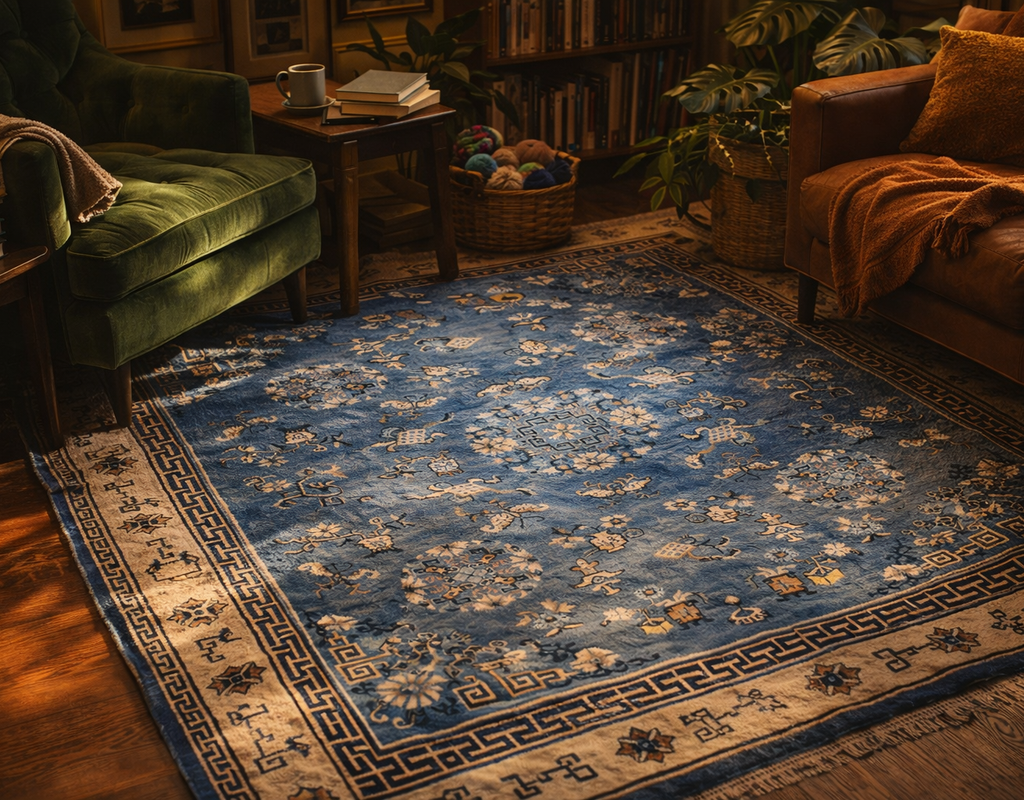
A vibrant blue antique-style rug grounds a comfortable seating area next to a well-stocked bookshelf.
For weavers, incorporating the heptagram demonstrates mastery over geometry and symbolic storytelling, setting their work apart from more conventional patterns.
Summary of Meanings and Significance of the 7 pointed star
The question, what does a 7 pointed star mean in rugs?, touches on centuries of layered interpretation. In weaving traditions, symbols rarely hold a single, fixed meaning; instead, they carry overlapping associations shaped by religion, cosmology, and tribal heritage.
The seven-pointed star motif in rugs is most commonly linked to:
- Spiritual completeness and cosmic order, drawing on the sacredness of the number seven in many cultures, from the seven heavens in Islamic thought to the seven classical planets of ancient cosmology.
- Protection and guidance, with the star acting as a talisman woven into the fabric to safeguard families, tribes, and travelers.
- Happiness and prosperity, particularly in Central Asian contexts where the star was considered a sign of good fortune woven into everyday textiles.
In Islamic art, the heptagram sometimes signifies the harmony between divine law and the universe, while in Turkic and nomadic traditions, it could serve as a spiritual compass embedded in the fabric of daily life. Across regions, this motif functions as both ornament and amulet, a balance of visual appeal and metaphysical resonance.
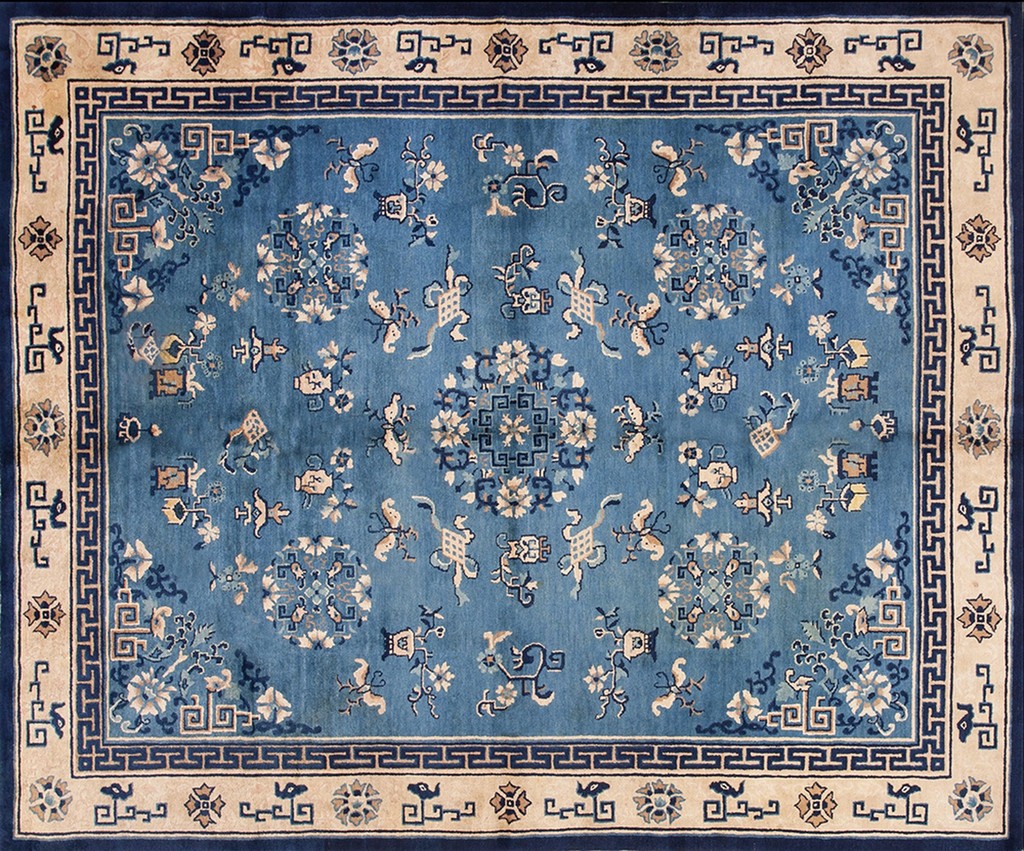
Blue Floral Medallion Hand Knotted Pile Rectangle Wool Antique 1920s Rug by Rugs On Net
The 7 pointed star rug is thus not only a rare artifact of design but also a woven expression of the human quest to understand order, meaning, and protection through art. Its presence in textile history connects deeply to the oldest traditions of rug-making, where beauty, function, and spirituality are inseparably bound.
Origins & History of the 7 Pointed Star Motif in Rugs
Ancient Beginnings and Cultural Spread
The history of 7 pointed star rugs stretches back far beyond the decorative traditions of Islamic and medieval art. Archaeological evidence suggests that the ancient star motif was present as early as the 5th century BCE, most notably in the celebrated Pazyryk rug, excavated from a Scythian burial mound in Siberia. This textile, often hailed as the world’s oldest known knotted carpet, already displays the complexity of symbolic geometry that would later shape rug-making traditions across Asia.
While not every detail of its patterning is perfectly preserved, the presence of geometric stars, including the seven-pointed variation, testifies to a deep antiquity for the motif. From these beginnings, the origins of the heptagram rug can be traced through a tapestry of cultural exchanges. Nomadic tribes such as the Oghuz carried the design westward into Anatolia, where Phrygian and later Seljuk artisans adapted it into their woven vocabulary.
The motif thrived in regions where weaving was not only practical but spiritual—its geometric balance aligning with ancient ideas of cosmic harmony. By the time the Ottomans rose to prominence, the star had become part of an expansive textile tradition that fused pre-Islamic heritage with Islamic aesthetics, ensuring the motif’s survival across centuries and borders.
Why Seven?
The number seven has carried symbolic weight in nearly every civilization that influenced rug-making. To answer the question why is the number seven sacred in star designs, one must consider both numerology and cosmology.
In Mesopotamian and Central Asian traditions, 7 represented the planets and celestial bodies visible to the naked eye, anchoring the motif in the structure of the heavens.
In Anatolia, echoes of the Pleiades—known as the Seven Sisters— reinforced its role as a cosmic guide.
With the rise of Islamic art, seven took on layered religious meanings: the seven heavens, seven gates of paradise, and the 7 verses of the opening surah of the Qur’an.
In Christian mysticism, it symbolized creation and completion; in Jewish thought, the seven-branched menorah tied the number to divine presence.
For tribal weavers, who often merged spiritual cosmology with daily craft, the heptagram became a woven prayer for protection, completeness, and balance.
The sacredness of seven amplified the visual power of the motif, making each seven-pointed star in textile history more than decoration—it was a living emblem of faith and fortune.
Timeline of Motif’s Use in Rugs
- Prehistoric & Protohistoric: Early geometric incisions and textile fragments suggest the symbolic use of star motifs, setting the foundation for later weaving traditions. — Why: Establishes the antiquity of star geometry before formal religions codified its meaning.
- Iron Age Anatolia (Phrygian & Lydian influences): Integration of cosmic symbols, including seven-pointed stars, into ritual textiles and decorative arts. — Why: Demonstrates how Anatolia served as a crossroads where celestial symbolism entered weaving.
- Seljuk Period (11th–13th centuries): Seljuk carpets introduced elaborate geometric medallions, where the heptagram occasionally appeared as a central or border motif. — Why: Shows how Islamic geometry absorbed older tribal symbols, reinforcing their sacred resonance.
- Ottoman Era (14th–19th centuries): Continuity of the motif in workshop rugs, often refined in courtly designs with cosmological undertones. — Why: Reflects the enduring place of the motif within a broader imperial art tradition.
- Modern Revivals (20th–21st centuries): Contemporary artisans and collectors reintroduced the seven-pointed star rug, celebrating its rarity and symbolic depth. — Why: Confirms the motif’s timelessness, proving it could span millennia and still feel relevant today.
The 7 pointed star pattern in weaving is thus among the oldest and most enduring symbols in textile art. Its history not only predates major religions but also bridges them, ensuring the motif remains a living thread in the story of rug-making across cultures and centuries.
Symbolic Meanings of the 7 Pointed Star in Rug Design
Islamic & Sufi Interpretations
In Islamic art, the meaning of the 7 pointed star rug is deeply tied to sacred cosmology. The heptagram reflects the seven heavens, a concept central to Qur’anic cosmology, symbolizing the layers of divine creation and spiritual ascent.
Within Sufi traditions, the star also embodies spiritual order and completeness, guiding the soul toward union with the divine. Its seven rays can be seen as a visual representation of the seeker’s journey through seven stages of enlightenment, a path widely recognized in mystical poetry and art. When woven into carpets, the symbolism of the heptagram in carpets is not merely ornamental.
For devout households, these motifs were a constant reminder of divine presence and the ordered structure of the universe. Just as prayer rugs often use geometric medallions to symbolize portals to the sacred, the 7 pointed star served as both cosmic diagram and spiritual compass, grounding the weaver and the user in a divine order that extended from earth to heaven.
Turkic and Anatolian Symbolism
Among Turkic and Anatolian weavers, the 7 pointed star protection meaning was one of its most powerful associations. Tribal women often wove the star into rugs and kilims as a shield against evil spirits, ensuring safety for the family or travelers who used the textile. Beyond protection, the motif symbolized happiness, fertility, and cosmic order, connecting daily life to the eternal rhythms of the universe.
In Anatolian folklore, the star was sometimes described as a celestial flower, a symbol of renewal and abundance. Its irregular, asymmetrical form—unlike the balance of an eight-pointed star—added to its mystique, marking it as a charm of special potency.
Within nomadic traditions, the star’s presence on a rug was both decorative and functional: it beautified the textile while serving as a woven talisman of well-being and joy.
Other Regional and Tribal Meanings
- Central Asian Tribes: Used seven-pointed stars to mark tribal identity and to embed protective charms within their textiles. — Why: Weaving served as a communal language, and the heptagram reinforced belonging and safety.
- Persian Contexts: Associated the star with imperial order, status, and mysticism, often referencing the concept of the “Seven Climes” in Persian cosmology. — Why: It connected rug design to both earthly power and cosmic hierarchy, elevating the textile’s symbolic rank.
- Caucasian and Steppe Traditions: Interpreted the motif as a cosmic guide linked to the stars, especially the Pleiades (Seven Sisters). — Why: For nomadic weavers, the star served as a navigational and spiritual emblem, linking the rug to both the land and the sky.
The symbolism of the heptagram in carpets thus spans a vast range of interpretations. For some, it signified divine completeness and the order of creation. For others, it was a woven prayer for protection, happiness, and prosperity. Always, it bridged sacred and secular worlds: literal in its reference to heavens or talismans, metaphorical in its promises of unity, joy, and cosmic harmony. In every context, the seven-pointed star rug stands out as a design loaded with meaning, where geometry transforms into a vessel of belief and beauty.
Visual Characteristics and Rug-Making Techniques
How to Identify a 7 Pointed Star Motif
The visual features that define a 7 pointed star motif are rooted in its geometric complexity. Unlike four-, six-, or eight-point stars, the heptagram cannot be evenly balanced on a simple weaving grid, which means it is often stylized. Weavers achieve the effect by elongating or shortening points, embedding the star within rosettes, or constructing it from nested polygons.
This gives the motif a distinctive, irregular symmetry that immediately sets it apart. When identifying a heptagram in rugs, look for sharp, angular arms radiating outward, sometimes finished with hooks or ram’s horn extensions to reinforce its protective symbolism. The star nearly always appears in bold, contrasting colors—deep indigos, bright reds, ivory, or natural browns—that allow the design to stand apart from the background.
Borders may carry chains of 7 pointed stars that repeat as a protective frame, while central medallions may feature a single, commanding heptagram.
Regional and Type Variations
- Anatolian Pile Carpets: Feature large, commanding 7 pointed stars, often surrounded by floral or geometric secondary motifs. — Why: These workshop rugs emphasized bold central designs for spiritual and decorative impact.
- Turkic and Central Asian Kilims: Use more angular, offset-arm stars achieved through slit tapestry techniques. — Why: The flatweave structure favors sharpness and geometric clarity.
- Persian Workshop Carpets: Sometimes place heptagrams in medallions or within borders, often linked to mystical symbolism like the “Seven Climes.” — Why: Persian design favored symbolic layering and courtly sophistication.
- Caucasian Tribal Rugs: Integrate smaller, repeating heptagrams into fields, creating a rhythmic, talismanic pattern. — Why: Repetition emphasized protection and tribal identity.
These variations demonstrate how the motif adapted to both regional aesthetics and weaving traditions, making the 7 pointed star kilim or carpet instantly recognizable to trained eyes.
Pile Rugs vs. Flatweaves: Weaving the Heptagram
A common question is how is a 7 pointed star woven into pile rugs? The answer lies in knotting precision. In pile weaving, the pile rug heptagram technique relies on symmetrical knots, particularly the Ghiordes knot, to achieve balance.
The higher the knot density, the sharper the motif appears. Thus, knot density directly changes 7 pointed star sharpness, making fine workshop rugs capable of displaying clear, crisp stars, while lower-density tribal rugs often stylize or elongate the arms. In flatweaves, such as kilims, artisans rely on slit tapestry techniques and offset wefts to render the heptagram.

A detailed focus on the intricate, vivid colors and geometric weave of a traditional textile rug.
This method allows for angular accuracy and sharp definition, though the motif may appear more abstract than in pile carpets. A genuine seven-pointed star kilim can be spotted by examining the precise angular joins and bold color contrasts, which allow the star to emerge clearly despite the limitations of the flatweave grid.
Materials, Colors & Detailing
- Wool with Natural Dyes: Best for contrast and vibrancy. — Why: The natural sheen and durability of wool highlight the star’s geometry and keep colors brilliant over time.
- Cotton Foundations: Sometimes used in workshop carpets. — Why: Provides structural stability, allowing more intricate rendering of the heptagram.
- Bold Color Palettes (reds, indigos, ivory, browns): Common in both pile and flatweave. — Why: Strong contrasts make the seven points easily distinguishable.
- Border Detailing: Chains or repeating rows of stars. — Why: Enhances the seven-pointed star protection meaning, reinforcing its talismanic function.
Is the 7 point star found in flatweave and pile rugs? Yes—both traditions incorporate it, though the technical execution differs. Flatweaves use tapestry methods for clarity, while pile rugs depend on knot density for sharpness.
In both cases, the best materials for a seven-pointed star rug are naturally dyed wool and carefully planned color contrasts, ensuring the rare motif is both visually striking and symbolically resonant.
Collecting & Buying 7 Pointed Star Rugs
Spotting Genuine & Vintage Examples
- Check Motif Clarity: A genuine vintage heptagram rug will show careful rendering of the seven points, even if stylized. — Why: Precision in geometry reflects handwoven authenticity and distinguishes it from machine-made imitations.
- Examine Materials: Look for wool with natural dyes and traditional cotton or wool foundations. — Why: Authenticity is tied to period materials, while synthetic fibers indicate later or machine-made reproductions.
- Assess Wear & Restoration: Natural patina and careful restoration maintain value; heavy chemical washes or overpainting reduce it. — Why: Original texture and motif clarity are crucial in 7 point star restoration.
- Provenance Labels or Documentation: Museum pieces and higher-value rugs usually come with documented origin and weaving tradition. — Why: Provenance adds legitimacy and boosts 7 pointed star rug value.
- Regional Traits: Anatolian, Caucasian, and Persian variants differ in design and execution. — Why: Regional origin informs symbolic meaning and collector appeal.
Modern & Custom 7 Pointed Star Rugs
Not all buyers seek museum-quality antiques. Today, artisans and workshops offer custom 7 point star rugs, enabling enthusiasts to enjoy the rare motif at an accessible price. Contemporary handwoven examples capture the spirit of the ancient design while being durable for everyday use. Online sellers and artisan cooperatives make commissioning possible, with wool-based kilims and pile rugs being the most affordable entry points.
Machine-made carpets can replicate the geometry with surprising accuracy, answering the question can machine-made rugs replicate 7 point star accuracy?—yes, they can in form, but they lack the cultural and collector value of handwoven pieces. For those who want the look without the investment, machine-made options are a decorative solution, while serious collectors prioritize handwoven authenticity.
Provenance, Value & Pricing
Provenance is one of the strongest determinants of price. To answer how does provenance impact 7 pointed star rug pricing?—an Anatolian or Caucasian origin with documented age commands far higher values than anonymous workshop reproductions.
Rare 19th-century pieces or earlier examples are increasingly difficult to find, confirming that vintage 7 pointed star rugs are harder to find today.
Market pricing spans wide ranges:
- Museum-quality antiques: Five to six figures, depending on age, condition, and provenance.
- Well-preserved 19th-century pieces: Mid-to-high five figures.
- Revival or early 20th-century examples: Lower five figures or less.
- Modern handwoven customs: Low thousands or hundreds.
- Machine-made rugs: Affordable, often under a few hundred dollars.
Thus, what price range covers museum-quality seven-point star carpets? Typically $50,000 to $100,000+, depending on rarity.
Seven-Pointed vs. Eight-Pointed Star: Collectors’ Perspectives
Collectors often ask, why choose a 7 point star over an eight-point in décor? The answer lies in uniqueness. Eight-pointed stars are far more common, found in countless Anatolian, Persian, and Islamic patterns. The 7 point star, by contrast, is visually unexpected and symbolically loaded with sacred associations.
Its rarity gives it both spiritual resonance and higher collecting heptagram carpets appeal. For collectors, owning a 7 pointed star rug is not just a decorative choice but also a way of holding a rarer piece of textile history.
Investment & Rarity Considerations
- Rarity Boosts Value: Fewer authentic examples exist, particularly from the 19th century and earlier. — Why: Scarcity drives both collectability and appreciation rates.
- Restoration Quality Matters: Proper restoration that preserves motif clarity can maintain or increase value. — Why: Poor repairs diminish both appearance and market worth.
- Modern Collecting: Should collectors invest in contemporary heptagram rugs? Yes, as long as expectations are set—while they may not appreciate like antiques, they offer aesthetic and cultural continuity. — Why: Contemporary pieces keep the tradition alive and provide accessible entry points for new collectors.
- Faster Appreciation: Does rarity make 7 point star rugs appreciate faster? Generally yes, particularly for well-documented, antique pieces. — Why: Demand exceeds supply, and collectors compete for surviving examples.
In short, the seven-pointed star rug value lies in its rarity, provenance, and condition. While antique pieces remain scarce and highly prized, custom seven-point star rugs and modern interpretations make the motif available to wider audiences, ensuring this ancient design continues to inspire collectors, decorators, and cultural enthusiasts alike.
7 Pointed Star Rugs in Modern Decor
Design Advice & Styling Tips
- Pair with Minimalist Interiors: A modern 7 pointed star rug works beautifully in clean, minimalist spaces where its bold geometry becomes the focal point. — Why: The unusual heptagram stands out most against uncluttered backgrounds, emphasizing its symmetry and intrigue.
- Use in Geometric-Themed Rooms: Complementing the star with angular furniture, abstract wall art, or linear lighting enhances the rug’s visual rhythm. — Why: Reinforces the sense of order and balance the motif conveys.
- Contrast with Organic Elements: Placing the rug alongside wood, plants, or curved furniture creates harmony between cosmic geometry and natural flow. — Why: Softens the sharpness of the design while highlighting its heritage quality.
- Highlight with Light & Space: Positioning under natural light or in an open room magnifies the star’s intricate pattern. — Why: Proper lighting ensures the motif’s rare form remains sharp and visible.
In all contexts, the 7 pointed star rug decor serves as both a statement piece and a cultural accent, offering heritage artistry with contemporary adaptability.
Where to Buy & Commission Heptagram Rugs
Collectors and decorators often ask, where can I commission a custom 7 pointed star rug affordably? Artisan workshops in Turkey, Iran, and Central Asia remain key sources, with options available through cooperatives and online platforms that connect buyers directly with weavers. Many contemporary artisans offer custom 7 pointed star carpets, allowing choices in size, material, and color palette.
For accessible options, reputable online rug marketplaces also feature handwoven and machine-made versions. Those seeking investment-grade pieces should prioritize documented provenance, while buyers interested primarily in style can buy a heptagram rug from modern workshops or commission personalized designs at reasonable prices.
Restoration, Replication & Machine-Made Options
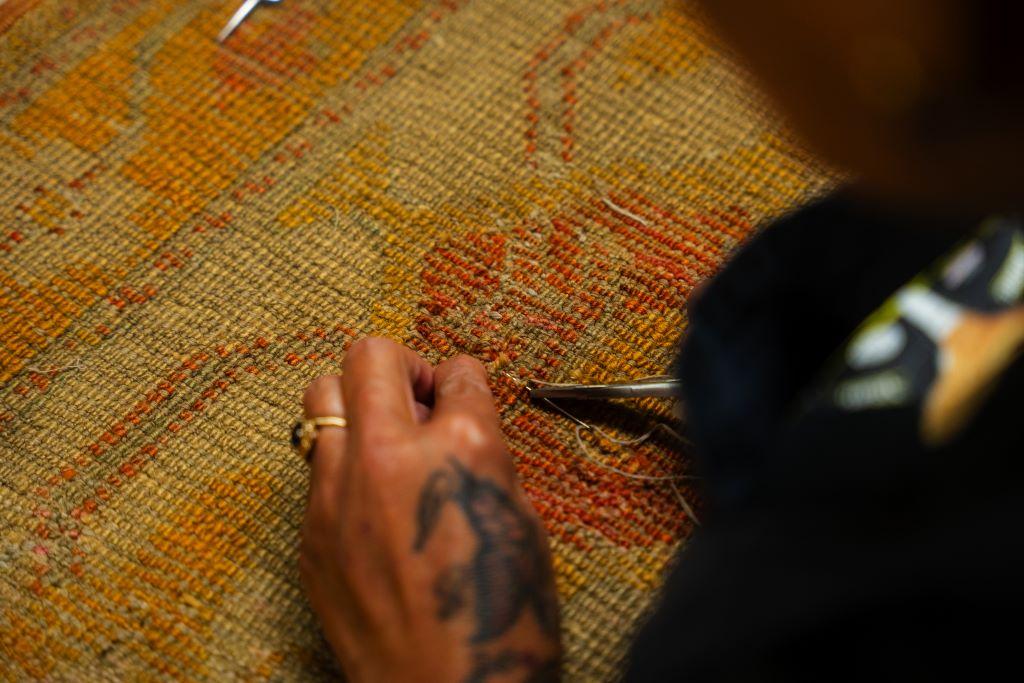
Detail of hands mending a rustic, richly colored woven rug.
- Restoration Techniques: Skilled restoration preserves motif clarity, ensuring that each point of the star remains sharp. Poor or rushed restoration can blur geometry or distort symmetry. — Why: In rare motifs, clarity directly impacts value and visual appeal.
- Machine-Made Replications: Can machine-made rugs replicate 7 point star accuracy? Yes, the mechanical precision of weaving machines can render the geometry with perfect symmetry. — Why: They offer an affordable decorative option, though without the cultural and collector value of handwoven pieces.
- Handwoven Replications: Workshops and artisans can create accurate reproductions with wool and natural dyes. — Why: These preserve both authenticity and aesthetic, appealing to those who value tradition alongside design.
- Restoration Impact: How do restoration techniques affect 7 point star clarity? When performed correctly, restoration enhances longevity while keeping the heptagram’s structure intact. — Why: Restoration ensures antique examples remain visually powerful and structurally stable, safeguarding them for collectors and designers alike.
In modern interiors, the modern seven-pointed star rug bridges past and present. Whether sourced as an antique, a custom 7 pointed star carpet, or a machine-made decorative piece, its geometry adds timeless elegance.
Buyers today have choices across budget and intent—from heritage investments to accessible statement décor—ensuring the 7 pointed star continues to radiate symbolic and visual power in contemporary living spaces.
FAQ
- What search terms help me find seven-pointed star rugs?
Try “seven-pointed star rug,” “heptagram rug,” or “7-point star kilim.” Add a size (e.g., “8×10”) or construction (“flatweave,” “hand-knotted”) to narrow results.
- Are seven-pointed star rugs ever confused with pentagram rugs?
Often online, yes. Count points—five is a pentagram, seven is a heptagram. Seven-point motifs aren’t inherently occult and appear in historical geometric ornament.
- How can I authenticate hand-knotted seven-pointed star rugs?
Flip it: the pattern should mirror on the back with individually tied knots and slight irregularities. Tufted rugs have a fabric backing with latex; printed rugs show a uniform white base.
- Will seven-pointed star rugs work over radiant floor heating?
Use low-pile rugs and breathable pads; avoid very thick or insulating underlays. Follow your floor manufacturer’s guidelines to protect sensors and prevent hot spots.
- Are seven-pointed star rugs kid- and pet-friendly?
Wool heptagram rugs are naturally stain-resistant and springy; choose low pile and darker grounds. Avoid viscose/rayon in play areas—it water-stains easily.
- Are seven-pointed star outdoor rugs a thing?
Yes—polypropylene outdoor heptagram rugs exist and are easy to hose off. Bring them in during harsh winters and dry thoroughly to prevent mildew.
- What rug pad works best under seven-pointed star rugs?
Use a thin felt-rubber or waffle pad to prevent slip and preserve geometry. Aim for \~1/8″–1/4″ thickness to keep edges flat and doors clearing.
- Do seven-pointed star rugs fade in sunlight?
All textiles fade with UV. Rotate quarterly and use window films; solution-dyed synthetics resist fading best, while naturally dyed wool benefits from indirect light.
- Are seven-pointed star runners available for hallways?
Yes—look for flatweave or printed runners in common sizes like 2’6″x8′ or 2’6″x10′. Custom lengths are feasible if you need exact coverage.
- How do seven-pointed star rugs compare to 8-point star rugs?
Seven-point is rarer and reads more unexpected; 8-point stars are canonical and widely available. Choose 7-point for a conversation piece, 8-point for traditional symmetry.
- Can I commission custom seven-pointed star rugs?
Absolutely. Hand-tufted customs often take 6–12 weeks; hand-knotted versions can require 3–6 months. Ask for a scale drawing, yarn poms, and a strike-off.
- Are antique seven-pointed star rugs collectible?
Yes—authentic examples are rare and can command premiums. Verify point counts, weave, dyes, and provenance; request dealer documentation or third-party appraisal.
- What’s the typical price range for seven-pointed star rugs?
Printed or machine-made pieces often run \$100–\$400; hand-tufted \$300–\$900; hand-knotted wool commonly \$800–\$4,000+, depending on size, density, and workmanship.
- Will colors bleed on seven-pointed star rugs with natural dyes?
Some may. Press a damp white cloth for \~10–15 seconds; if color transfers, use water only and call a professional cleaner for deep work.
- How do I clean spills on seven-pointed star rugs?
Blot immediately with a white cloth and cool water; avoid scrubbing. Test cleaners in a hidden spot first and keep moisture minimal to prevent dye migration.
- Do seven-pointed star rugs work with robot vacuums?
Flatweaves and low-pile heptagram rugs usually do; tuck or remove fringe and use a low-profile pad. Most bots handle thresholds around 0.5″ but check your model.
- How durable are seven-pointed star rugs in high-traffic areas?
Choose low to medium pile wool or a tight flatweave with a pad. Expect routine vacuuming and a professional clean every 12–18 months for wool in busy rooms.
- What materials are best for seven-pointed star rugs?
Wool balances durability, stain resistance, and line clarity. Cotton warps add stability; synthetics (polypropylene/polyester) are budget-friendly for prints but can look flatter.
- Which constructions best show clean geometry for seven-pointed star rugs?
Flatweave kilims give crisp edges; fine hand-knotted rugs work if knot density is high. Hand-tufted rugs replicate the shape affordably but usually have less detail.
- Are seven-pointed star rugs appropriate in traditional interiors?
Yes—use muted, plant-dyed wool versions for classic rooms. In modern spaces, high-contrast, graphic heptagrams read bold and sculptural, especially in 8×10 or 9×12 sizes under seating groups.
- Where are seven-pointed star rugs most likely to originate?
You’ll see them in Islamic geometry–inspired textiles and some Anatolian or Caucasian-style flatweaves, but far less often than 8-point star pieces. Many examples are modern, small-batch, or custom.
- How can I confirm a true 7-point star on seven-pointed star rugs?
Count seven tips around each star; look for continuous-line heptagrams (7/2 or 7/3) or stepped, woven variants. Beware nested rosettes or partial stars that can read as six or eight points.
- What do seven-pointed star rugs symbolize?
Meanings vary by culture; in Anatolian weaving, star motifs often signify happiness, while “seven” can carry sacred or cosmic associations. Treat any single meaning cautiously and verify by region or tribe.
- Are 7-pointed star rugs traditional or mostly modern?
Seven-fold stars appear historically but are rare; most seven-pointed star rugs today are contemporary or custom pieces. Antique examples are scarce and often misidentified as 6- or 8-point stars.
- What are seven-pointed star rugs (heptagram rugs)?
Seven-pointed star rugs feature a heptagram motif drawn from Islamic geometric patterns; they’re uncommon compared with 6- or 8-point stars. Expect stylized lines or stepped points to adapt the design to weaving.