
Master Rug Weavers: The Hidden Architects of the World’s Greatest Carpets
When most people encounter a great antique rug, they see color, pattern, and age. They notice the medallion, the vines, the borders, the softness of the wool, or the glow of silk highlights catching the light.
What they rarely perceive — yet what defines the rug more than any visible feature — is the invisible intelligence behind it. That intelligence belongs to the master weaver, known in the Persian tradition as the Ostad.
A master weaver is not simply a skilled artisan. The title represents the highest culmination of technical knowledge, artistic intuition, mathematical precision, and cultural stewardship within the traditional rug-making world. Mastery was not granted casually, nor was it self-declared. It was earned through decades of disciplined practice, apprenticeship, leadership, and consistent excellence.
To understand a true master weaver is to understand that a great rug is not merely a decorative textile. It is architecture rendered in fiber, geometry expressed through tension, and cultural memory tied knot by knot under the guidance of a singular artistic mind.
Part I: The Philosophy of the Invisible Mind
In the elite ateliers of the 19th century, a clear distinction existed between the “weaver” and the “Master.” If the weavers are the stonemasons, the Master is the architect. He is the one who perceives the finished 20-foot carpet while the loom still holds nothing but bare warp strings.
The Architect vs. The Builder: Spatial Foresight
The Master occupies the highest tier of authority within a traditional weaving hierarchy. Historically, rug weaving societies — particularly in Persia, Turkey, the Caucasus, Central Asia, and the Indian subcontinent — operated through structured systems of apprenticeship, workshop hierarchy, and guild organization.
Advancement was neither quick nor guaranteed. It required years of repetition, observation, and increasingly complex responsibility.
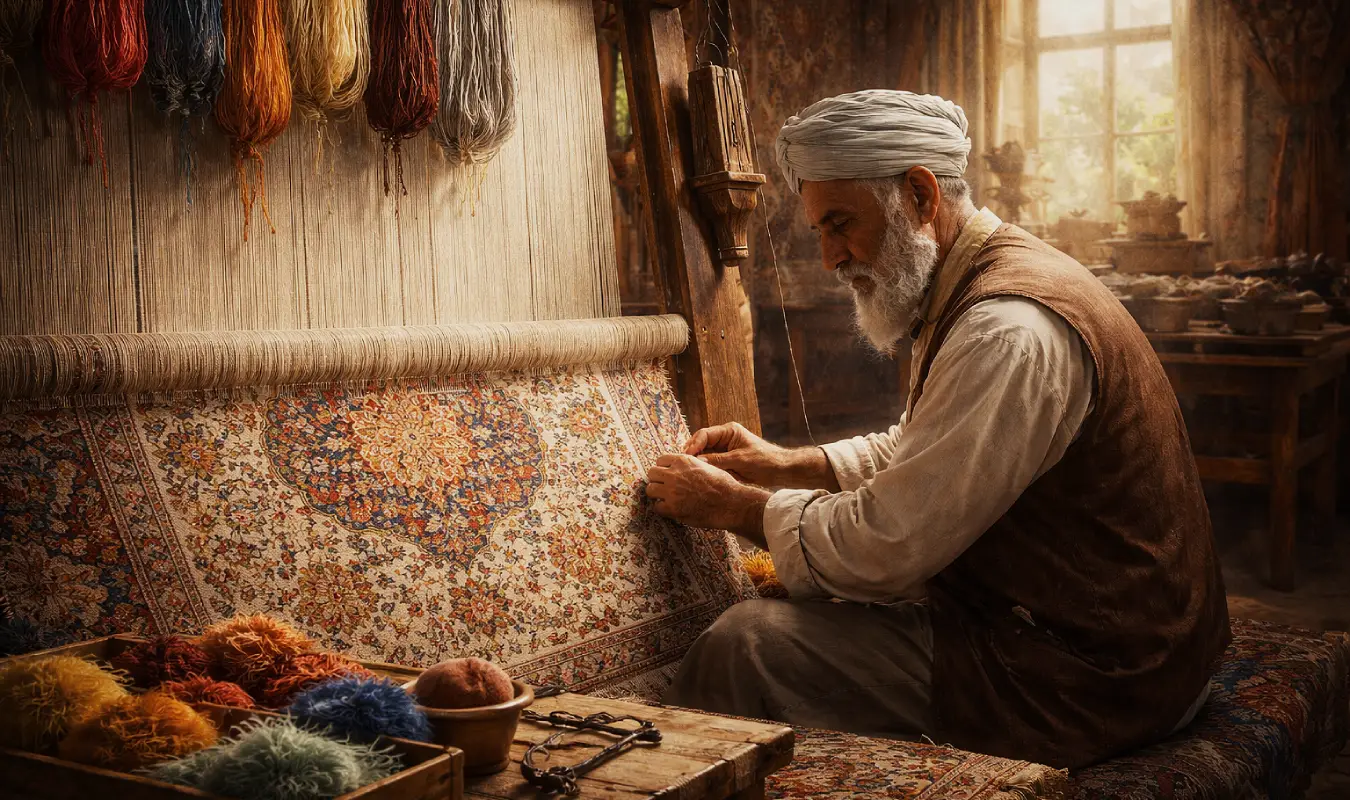
The Ostad understands the Interconnectivity of Motifs: how a tiny floral bud in the bottom-left corner must mathematically align with a leaf in the upper-right to ensure the “harmony of the whole.” This is not merely artistic flair; it is the management of Symmetry and Proportion across a medium that is constantly under tension and moving.
A Master must predict how a design will appear after it is washed and the pile has settled, a cognitive feat of “pre-visualization” that few other art forms require.
The Master as Cultural Archivist
Beyond the technical, the Master weaver serves as a living library. In traditional weaving cultures, there were no “instruction manuals.” The specific curves of a Shah Abbasi palmette or the precise geometry of a Mina Khani design were stored in the Master’s memory.
Mastery involved the ability to innovate within the tradition — knowing exactly how far a classic motif could be stretched or stylized without losing its “soul” or regional identity. They were the custodians of a visual language that reached back to the Safavid and Mughal courts.
Part II: The Socio-Economic Structures of Mastery
Mastery did not happen in a vacuum; it was the product of a rigid, almost medieval guild system that prioritized the “Sanctity of the Loom.” Advancement depended on accuracy, endurance, and aesthetic sensitivity.
A technically perfect weaver without design intuition might never reach master level, while a creative thinker without structural discipline would also fall short.
The Apprenticeship Path: A Lifelong Journey
- The Shagerd (Apprentice): Typically starting between the ages of 7 and 10, the apprentice begins with the fundamental preparation. They learned to spin wool, sort fibers, and identify colors long before they understood design theory. Their education is primarily through the senses: learning the smell of high-quality wool vs. “dead” wool (removed from hides with acid), which lacks the structural integrity for fine rug knotting.
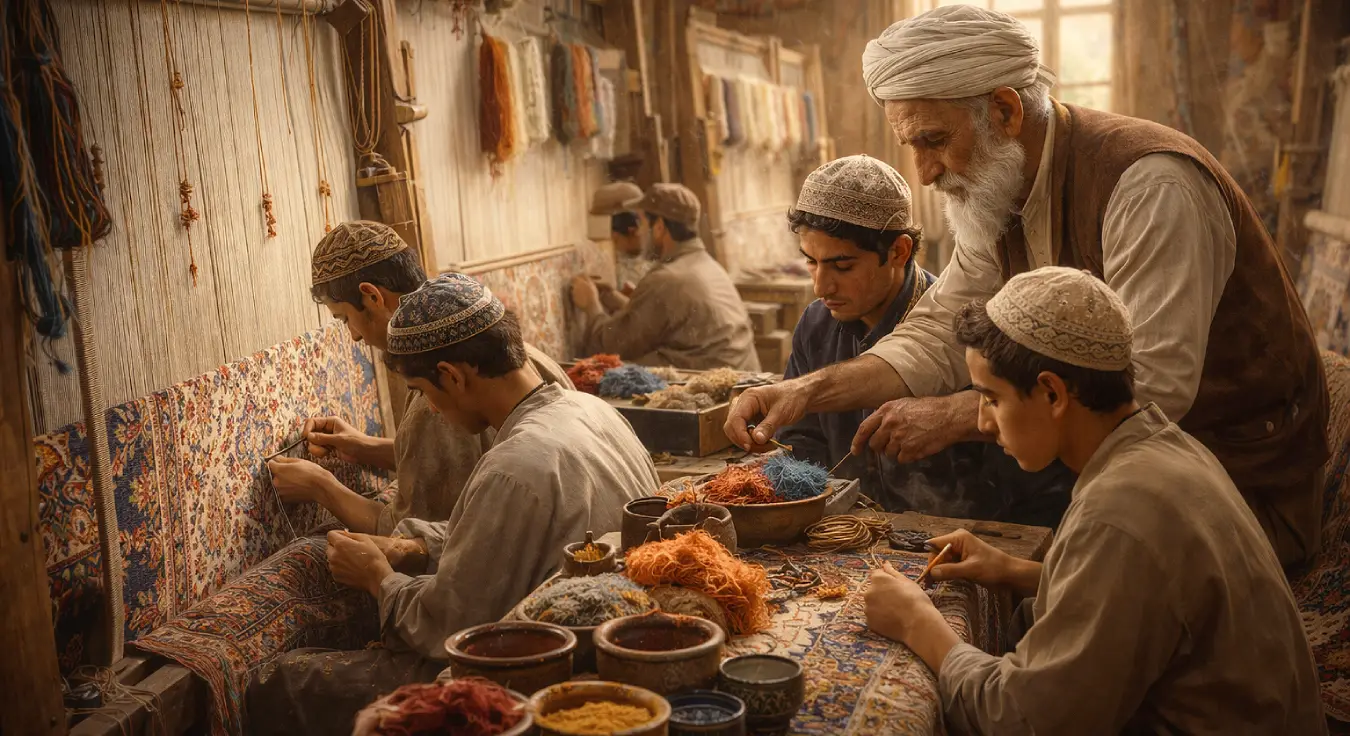
- The Journeyman: Once a weaver has mastered the basic knots, they move to the “field.” This stage builds Muscle Memory. A journeyman must tie 10,000 knots a day with “blind accuracy,” allowing them to enter a flow state where the physical act becomes subconscious. During this phase, future masters spend countless hours at the loom, building tactile intuition and an almost subconscious awareness of knot tension and rhythm.
- The Ostad (Master): Only when a weaver demonstrated “Design Foresight” — the ability to correct a pattern’s geometry without looking at a drawing — were they elevated. In larger urban workshops, the master becomes a conductor rather than a solo performer. They monitor progress, inspect alignment, adjust color transitions, and intervene when design integrity begins to drift.
The Power of the Signature (Raqam)
In the socio-economic hierarchy of the 19th century, a Master Weaver was a person of immense political and financial leverage. The Signature Cartouche found in the border of a rug was a Certificate of Value.
A rug signed by Mohtashem or Haji Jalili acted as a global reserve currency. Their reputation emerged slowly, built on sustained excellence and identifiable artistic voice.
Workshops that maintained excellence across generations became synonymous with reliability and beauty. Their works entered private collections, court inventories, and eventually museums, cementing a legacy that transcends mere craftsmanship.
Part III: The Physics and Engineering of Mastery
Mastery is as much about Physics as it is about Art. The Master Weaver is a structural engineer working with organic, elastic materials that are under constant vertical pressure.
A novice and a master may hold identical shears, hooks, and combs, yet produce radically different outcomes because the master understands how tension, spacing, and height influence the final textile.
The Mathematics of Warp Tension and Contraction
One of the most difficult elements to master is the Coefficient of Contraction. While on the loom, a rug is under thousands of pounds of vertical tension. The wool fibers are stretched to their limit. When the rug is finished and the warp strings are cut, the rug “relaxes.”
A Master Weaver must calculate this relaxation months in advance. He will weave the medallion slightly “elongated” (oval) while on the loom, calculating exactly how much the wool will “shrink” so that when it hits the floor, the oval relaxes into a perfect circle.
A mistake in this calculation creates a “snaking” edge or an asymmetrical medallion, permanently devaluing the work. This is architecture rendered in fiber, where geometry is expressed through the perfect management of tension.
The “Talim”: The Binary Language of the Loom
In the great workshops of Kerman and India, the Master weaver used an extraordinary system called the Talim. This was a coded, rhythmic song used to transmit the pattern.
The Master weaver would stand behind a row of weavers and “sing” the pattern. This oral tradition is essentially a Human Binary Code, translating a visual image into a rhythmic language.
This allowed weavers to keep their eyes on the knots and their hands moving at maximum velocity without needing to look up at a pattern chart. The loom was their instrument, but the true art lay in orchestration rather than motion.
“Four of the indigo, cross the weft, two of the madder rose, hook the gold…”
Part IV: The Role of Dye Knowledge — Where Art Meets Chemistry
Color mastery distinguished legendary weavers from competent ones. Natural dyes shift under light, age differently based on wool quality, and respond unpredictably to mineral content and temperature.
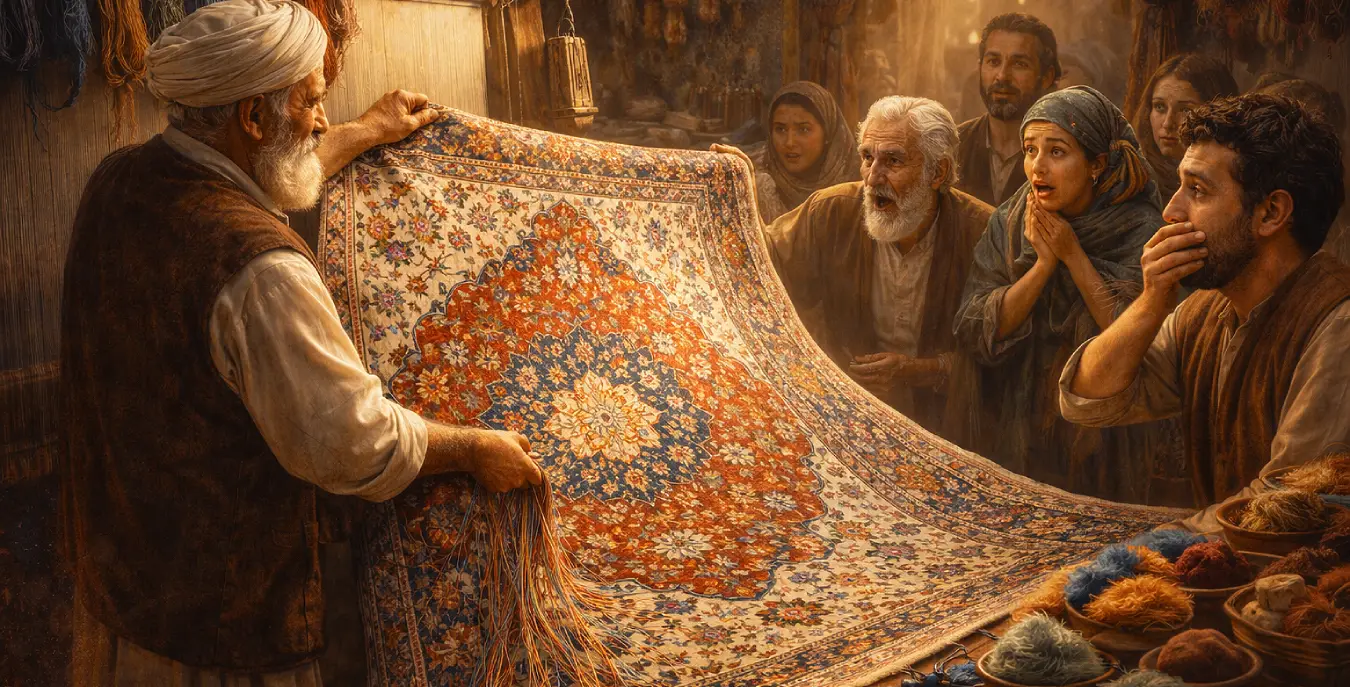
The master weaver understood not only how to produce a color, but how that color would behave decades later.
The “Abrash” (Intentional Variegation)
A novice tries to make color perfectly solid. A Master weaver knows that solid color is flat and artificial. Instead, the Master utilizes Abrah — subtle, intentional shifts in dye lots. By using wool that was dyed for different durations, the Master creates a shimmering effect in the rug’s “open fields.”
This knowledge blended botanical familiarity, mineral awareness, and experiential intuition. When light hits these tonal shifts, the rug appears to have the depth of moving water or a cloudy sky.
The Secrets of the Dye Vat
- Madder Root: A Master weaver knows that a 7-year-old root produces a deep “oxblood” red, while a younger root produces a “brick” orange. He manages his saturation with harmony, ensuring that large fields did not appear patchy or inconsistent.
- Indigo: Indigo is a fermented dye. The Master must “read” the bubbles on the top of the vat (the “flower”) to know if the oxygen levels are correct. Mastering the fermentation process is a critical skill in preventing the color from bleeding or fading prematurely.
- Saffron and Pomegranate: Used to create the “Gold of the Sultans,” a color that remains vibrant for centuries while synthetic yellows fade into a dull grey in a decade.
Part V: Profiles of the Legendary Masters
Mohtashem (Kashan): The Poet of Silk and Wool
Mohtashem Kashan rugs embody serenity and painterly restraint. Medallions appear to float within delicate floral fields, supported by soft ivories, blues, and rose tones. He utilized “Cork” wool — the fine, lanolin-rich hair from the neck of a lamb — giving his wool rugs a luminosity that mimics silk.
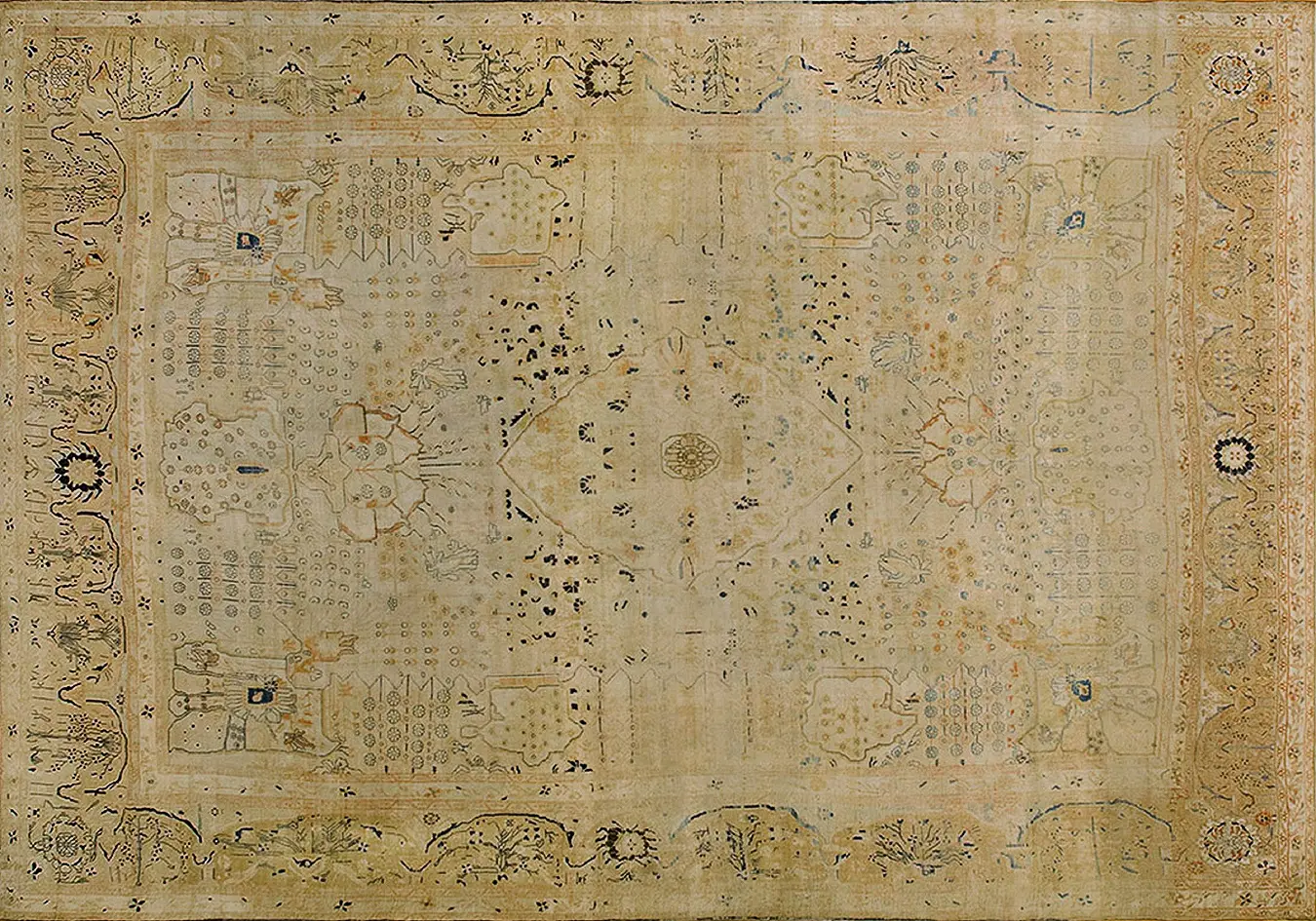
Exceptional wool quality and disciplined tension control contribute to their calm sophistication and enduring emotional resonance. Collectors often describe these rugs as luminous because their colors glow rather than sit flatly.
Haji Jalili (Tabriz): The Architectural Visionary
Haji Jalili rugs are celebrated for restraint and quiet authority. He turned away from the heavy reds and blues of the era in favor of a palette of soft terra cottas, muted blues, gentle creams, and understated greens. Fine, consistent knotting allows floral tendrils to flow with calligraphic grace.
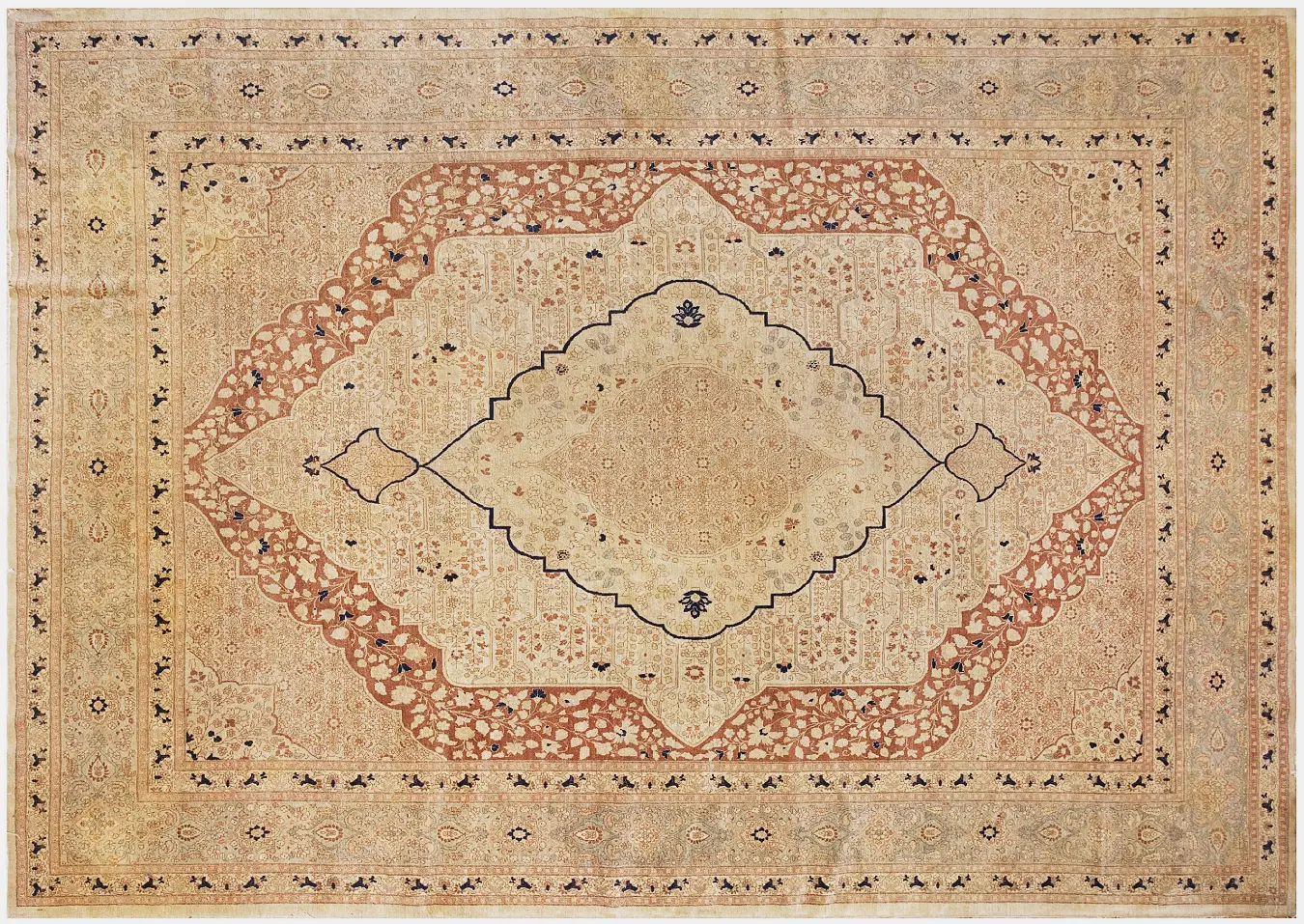
No element overwhelms another, resulting in harmony that elevates these works from craftsmanship to enduring art. His rugs reward prolonged viewing rather than immediate impact.
Persian Ziegler Sultanabad: Collaborative Mastery
The Ziegler Sultanabad tradition reveals mastery through adaptation. Workshops adjusted scale and palette to suit Western interiors while preserving Persian design identity.
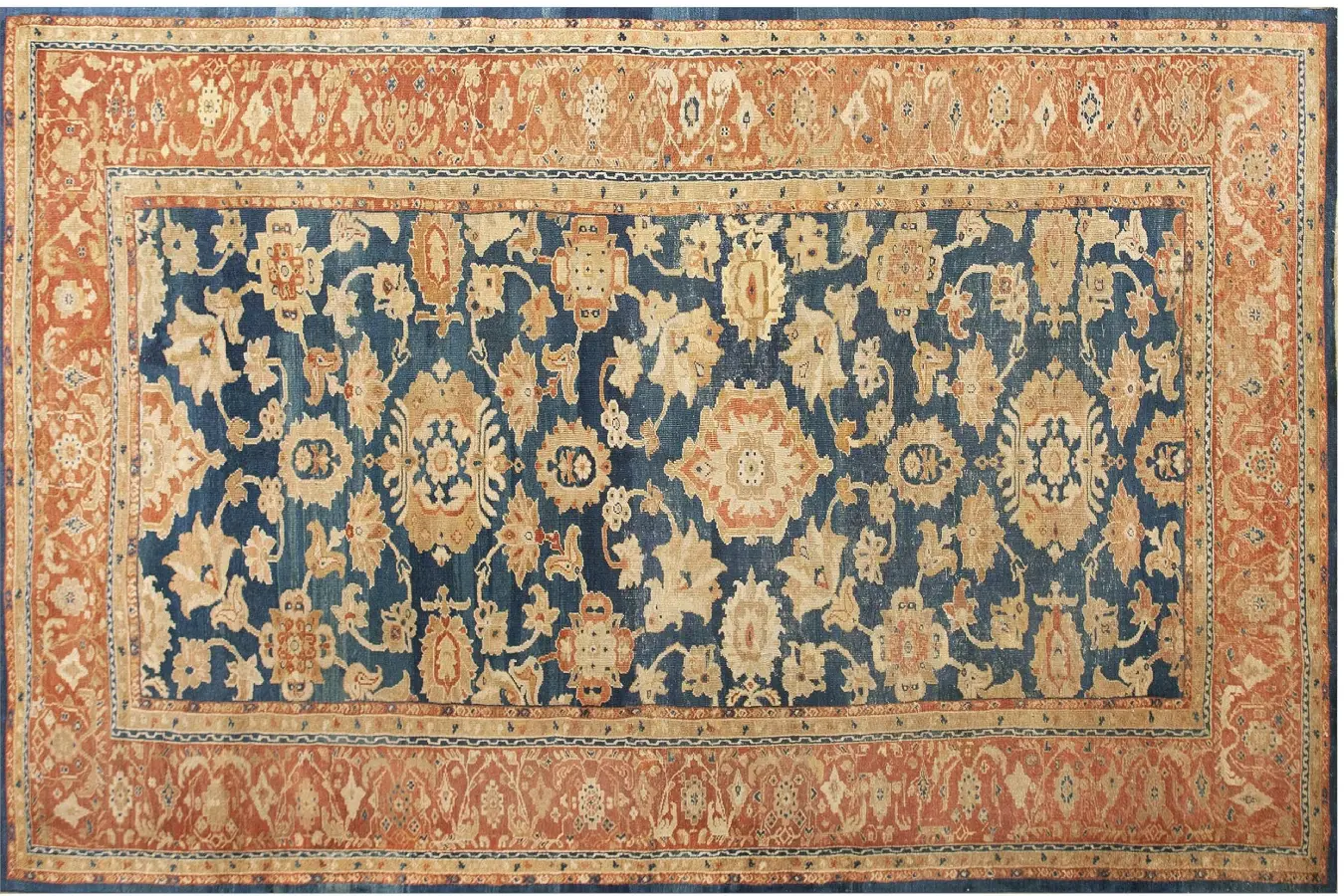
These Persian rugs feature expansive fields, large floral motifs, and muted tones that integrate seamlessly into diverse architectural spaces. Rather than singular attribution, this tradition reflects collaborative mastery — teams guided by experienced overseers who balanced authenticity with evolving global taste.
Serafian (Isfahan): Mathematical Perfection
In the 20th century, the Serafian name became the gold standard for Isfahan weaving. Their rugs often utilize silk foundations to achieve incredible knot density.
Every curve of a vine is calculated with microscopic precision. The symmetry is so absolute that it creates a sense of “inevitability” — the feeling that the rug could not have been composed in any other way.
Part VI: Regional Differences in Mastery — A Global Survey
Mastery was not a monolithic concept; it was a dialogue between the weaver and their specific environment. The definition of a “Masterpiece” in the high-altitude villages of the Caucasus is fundamentally different from one created in the royal workshops of Isfahan.
To understand the Master weaver, one must understand the regional “Design DNA” they were sworn to protect.
The Persian Urban Tradition: The Pursuit of the Infinite
In the great cities of Tabriz, Kashan, and Isfahan, mastery was defined by Refinement and Fluidity. The urban Master weaver was often a scholar of Islamic geometry.
Their goal was to minimize the “pixelation” of the knot, creating curves so smooth they mirrored the calligraphy of the Quran.
- Isfahan: Masters here focused on the Eslimi (arabesque) vine. A Masterwork is judged by the “inner life” of the floral motifs—how they spiral toward infinity without ever clashing.
- Kerman: The Kerman Master was a master of the Millefleur (thousand flowers) aesthetic. They utilized a unique “triple-weft” construction, allowing for a supple, handkerchief-like handle that belies the rug’s incredible durability.
The Anatolian Tradition: Bold Symbolism and The Court of the Sultans
Anatolian (Turkish) mastery historically split into two paths: the Hereke Imperial and the Village Geometric.
- Hereke: Established by Sultan Abdülmecid I, these workshops were the most exclusive in the world. Masters here wove exclusively for the Ottoman palaces. Their mastery was defined by the use of Ghiordes (Symmetric) knots in pure silk, often with gold and silver metallic threads.
- Village Mastery: Unlike the Persian urban curves, Anatolian masters embraced Bold Contrast. They utilized the “Double-Knot” to create rugged, monumental designs that emphasized tribal strength over floral delicacy.
The Caucasian “Design Mother”: Mental Architecture
In the rugged mountains of the Caucasus (Shirvan, Kuba, Dagestan), the master weaver was rarely a man in a workshop. She was the Matriarch of the family.
This is perhaps the most impressive form of mastery in the world: Weaving from the Mental Archive. These women did not use paper cartoons. They internalized 500 years of tribal iconography—the Dragon, the Eagle, the Star of Wisdom—and wove them from memory.
Each rug was a “freehand” masterpiece where the Master weaver had to calculate the symmetry of complex geometric polygons knot-by-knot without a visual guide. This represents a level of cognitive “pre-calculation” that rivals the most complex mathematics.
The Indian Mughal Tradition: The Pashmina Revolution
Under Emperors Akbar and Shah Jahan, Indian rug workshops merged Persian structure with Mughal Naturalism.
The Indian Master’s secret weapon was Pashmina wool (the downy undercoat of the Himalayan goat). This fiber is so fine it allows for knot densities exceeding 1,500 KPSI.
Masters here created “The Living Garden”— area rugs with such botanical accuracy that modern botanists can identify the specific species of lilies and carnations woven 300 years ago. Their mastery lay in the Tonal Gradient, using dozens of shades of a single color to create a 3D effect.
Part VII: Master Weavers in the Modern Era — The Great Revival
The 20th century was nearly the death of the Master Weaver. The introduction of “Aniline” (chemical) dyes in the late 19th century and the rise of machine-tufted “rugs” in the 1950s threatened to turn a sacred art into a mass-produced commodity.
However, a global movement has rescued the “Ostad” from extinction.
The DOBAG Initiative and the Natural Dye Renaissance
In 1981, Dr. Harald Bohmer launched the DOBAG Project in Turkey. He realized that the “chemistry of the ancestors” was being lost. He worked with village elders to rediscover how to ferment indigo and how to use pomegranate rinds to achieve stable, light-fast golds.
This birthed a new generation of Revival Masters. These modern masters act as “Textile Archeologists.” They have successfully reversed the damage of the 20th century by returning to Hand-Spun Wool (which retains its natural oils) and Long-Fermentation Dyeing.
A modern Master-level revival rug is now considered a better investment than a mediocre “commercial” antique.
The Preservation of the “Seirafian” and “Haghighi” Legacies
In Isfahan, dynasties like the Seirafian family have maintained unbroken standards for nearly a century. A modern Seirafian is not “produced”—it is Architected.
These modern ateliers serve as finishing schools for the world’s elite weavers. To be a weaver for a modern Isfahan Master is the highest honor in the trade, requiring a test of “Knot Consistency” that lasts for several weeks before one is allowed to touch a commissioned loom.
Part VIII: Conclusion — How to Recognize the Influence of a Master
For the collector, recognizing a Master’s influence is a journey from the eye to the hand. It is the difference between a “pretty floor covering” and a “work of art.”
The Connoisseur’s Checklist: Three Pillars of Evaluation
- 1. The “Turn” of the Border: This is the ultimate test of the Master’s mathematical planning. In a masterwork, the border design flows seamlessly around the corner. The motifs do not “clash” or “compress.” If the corner looks “hacked,” it was not overseen by an Ostad.
- 2. The Handle and the “Drape”: Fold a corner of the rug. A Master-level rug, despite its density, will feel supple—like a heavy fabric. This indicates that the Warp and Weft Tension was perfectly balanced throughout the years of weaving. A “stiff” or “board-like” rug indicates a failure in the Master’s engineering of the loom.
- 3. The “Luminous Path”: Walk around the rug and observe it from the “Light Side” (the direction the pile points) and the “Dark Side.” A Master-level rug will change its emotional character entirely. The colors should remain clear and vibrant from both sides, a result of the Shearing Mastery and the quality of the hand-spun wool.
Beneath every extraordinary carpet lies an invisible architecture of knowledge, patience, and vision. Institutional preservation in the Metropolitan Museum of Art and the Victoria and Albert Museum underscores that these are not merely “decorations.”
They are the survivors of history. The Master weaver remains the silent architect of our most beautiful spaces, weaving the past into the present, one knot at a time.
The Definitive Master Weaver Glossary
To navigate the world of fine rugs, one must speak the language of the Karkhaneh (workshop):
- Ostad: The Master. The “Conductor” of the loom who manages design, dye, and tension.
- Talim: The rhythmic, chanted “Binary Code” used to transmit patterns to weavers orally.
- Vagireh: A design sampler. Masters wove these “mini-rugs” to show patrons the intended color and knot density.
- Abrash: The “soul” of natural color. Intentional tonal shifts in a single color field.
- Raqam: The signature. Often found in a cartouche at the top edge of the rug.
- Cork Wool: High-lanolin wool from the lamb’s neck, used only in Master-level commissions.
- Foundation: The “bones” of the rug (the warp and weft), usually silk or high-grade cotton.
When we peel back the layers of a masterwork—the KPSI, the botanical dyes, the mathematical symmetry, and the regional iconography—we find more than just a textile. We find a document of human endurance.
A Master Weaver’s work is perhaps the only art form that is designed to be walked upon for centuries, yet it retains the delicate precision of a miniature painting.
To invest in a rug overseen by an Ostad is to become a custodian of an ancient, “invisible” architecture. These masters did not just build carpets; they built portals.
Through their hands, the nomadic geometry of the Caucasus, the floral opulence of the Safavid courts, and the restrained palettes of the Tabriz elite have survived the fires of industrialization and the transience of modern fashion.
In our current age of rapid production and disposable aesthetics, the Master Weaver stands as a quiet but firm counter-argument. They remind us that true luxury is a measure of time.
It is the three years of silent labor at the loom; it is the seven years the madder root spent in the earth; and it is the forty years the Master spent learning to “hear” the tension of the warp strings.
The legacy of a great master
Whether it is a 19th-century Mohtashem glowing with the patina of age, or a 21st-century Serafian standing as a marvel of modern engineering, the influence of the Master weaver is unmistakable.
It is felt in the weight of the wool, seen in the “Turn” of the border, and heard in the story the rug tells underfoot. Ultimately, a great rug is the manifestation of a disciplined imagination—a legacy of permanent beauty woven into the very fabric of human history.
FAQ
- Can I commission custom master weavers rugs?
Yes—many workshops can weave custom sizes and colors from an approved design. Expect longer lead times (often 4–12+ months) and confirm materials, dye method, and a strike-off sample if possible.
- What should I ask a dealer about master weavers rugs before buying?
Ask: hand-knotted or not, knot density or fineness, fiber/foundation, age (if claimed), and return policy. Request close-ups of corners, ends, and the back to confirm craftsmanship.
- Does repairing a master weaver rug reduce its value?
It can, especially if repairs are obvious or change original materials. Skilled restoration that matches wool, dye, and knotting can preserve usability—keep before/after photos and receipts.
- Can I use master weavers rugs over radiant or heated floors?
Usually yes, but keep heat moderate and avoid rubber pads that can trap heat or discolor. A breathable felt pad is often safer; always follow your floor system’s temperature guidance.
- Can master weavers rugs be used with pets and kids?
Yes—choose durable wool, lower pile, and a solid pad for stability. Spot-clean quickly, and consider patterns that hide wear; very fine silk rugs are usually less forgiving.
- How often should master weavers rugs be professionally cleaned?
A common guideline is every 1–3 years depending on traffic, pets, and spills. Avoid harsh store-bought shampoos; improper cleaning can set stains or damage dyes.
- How do I care for master weavers rugs day to day?
Vacuum gently (no aggressive beater bar) and rotate every 6–12 months for even wear. Use a rug pad to reduce abrasion and keep edges from curling.
- Are master weavers rugs a good investment?
Some can be, especially signed workshop pieces with strong provenance, but most rugs are better viewed as long-term use items. Condition and documented origin matter more than the “master weavers” label.
- Should I get a certificate for master weaver rugs?
A certificate can help, but it’s only as trustworthy as the issuer. For expensive rugs, consider an independent appraisal and detailed documentation (size, materials, knots, photos, and any inscriptions).
- How can I avoid fake “master weavers” claims when buying rugs?
Ask for clear back photos, construction type, fiber content, and return terms. If a seller won’t describe knots, foundation, and finishing, treat “master weavers” as pure marketing.
- Can a master weaver rug be machine-made?
In strict craft terms, “master weaver rug” implies handwork, but marketing can blur it. If it’s machine-made, you’ll often see very uniform backing and no individual knot structure.
- Is the fringe on master weavers rugs decorative or structural?
On hand-knotted rugs, fringe is typically the warp threads—the rug’s foundation extending out. Sewn-on fringe can indicate a non-knotted rug or a repaired/altered finish.
- How do master weavers rugs compare to hand-tufted rugs?
Hand-tufted rugs are faster to make and usually cheaper, but they don’t have individually tied knots. A quick tell: tufted rugs often have a fabric backing, while master weaver hand-knotted rugs don’t.
- Do master weavers rugs use natural dyes?
Sometimes, but not always—both natural and synthetic dyes can be used well. Natural dyes often show subtle variation (“abrash”), while modern dyes can look very even and saturated.
- What materials are typical in master weavers rugs?
Common choices are fine wool, silk highlights, or full silk in very detailed work. Cotton foundations are also common; material quality shows in sheen, softness, and how clearly the design reads.
- Are “master weavers” and “master knotters” the same in rugs?
Often they’re used similarly, but “master knotter” emphasizes knotting skill specifically. “Master weaver” can also include design supervision, loom management, and finishing standards.
- Why do master weavers rugs cost more?
You’re paying for labor, skill, and materials—plus lower error rates and stronger finishing. Even a modest size can contain hundreds of thousands of knots, which drives time and price.
- Does higher knot density always mean a master weaver rug?
No—knot density helps detail, but it’s only one factor. A well-designed 160–250 KPSI rug can look outstanding, while a dense rug can still have sloppy drawing or finishing.
- How long do master weavers rugs take to make?
Many take several months, and very fine or large pieces can take 1–3 years. Time rises fast with size and knot density because each knot is tied by hand.
- What’s the difference between a master weaver rug and a regular handmade rug?
Master weaver rugs usually show tighter control: cleaner curves, more consistent tension, and better alignment. The difference becomes obvious in detailed patterns, corners, and borders.
- Where are master weavers rugs most commonly associated with?
You’ll see “master weavers” used for Persian/Iranian, Turkish, Indian, Pakistani, and some tribal traditions, plus notable Indigenous weaving communities. The term is broad and can apply to many regions.
- Do master weavers rugs have signatures?
Sometimes—especially workshop or collectible pieces. A signature may appear in a small cartouche near an end border, but signatures can be copied, so treat it as one clue, not proof.
- How can I tell if a rug was made by master weavers?
Look for sharp motifs, consistent knot spacing, even edges, and tidy finishing. Higher knot density helps (often 200–400+ knots per square inch for very fine work), but materials and design matter too.
- Are master weaver rugs always hand-knotted?
Most “master weaver rugs” are hand-knotted, but sellers sometimes use the phrase loosely. Flip the rug: true hand-knotting shows individual knots and a clear mirrored pattern on the back.
- What does “master weavers” mean on rugs?
It usually means the rug was made under (or by) an expert weaver known for precision, design control, and clean finishing. It’s not a regulated label, so quality still needs verification.