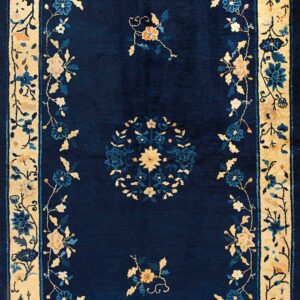
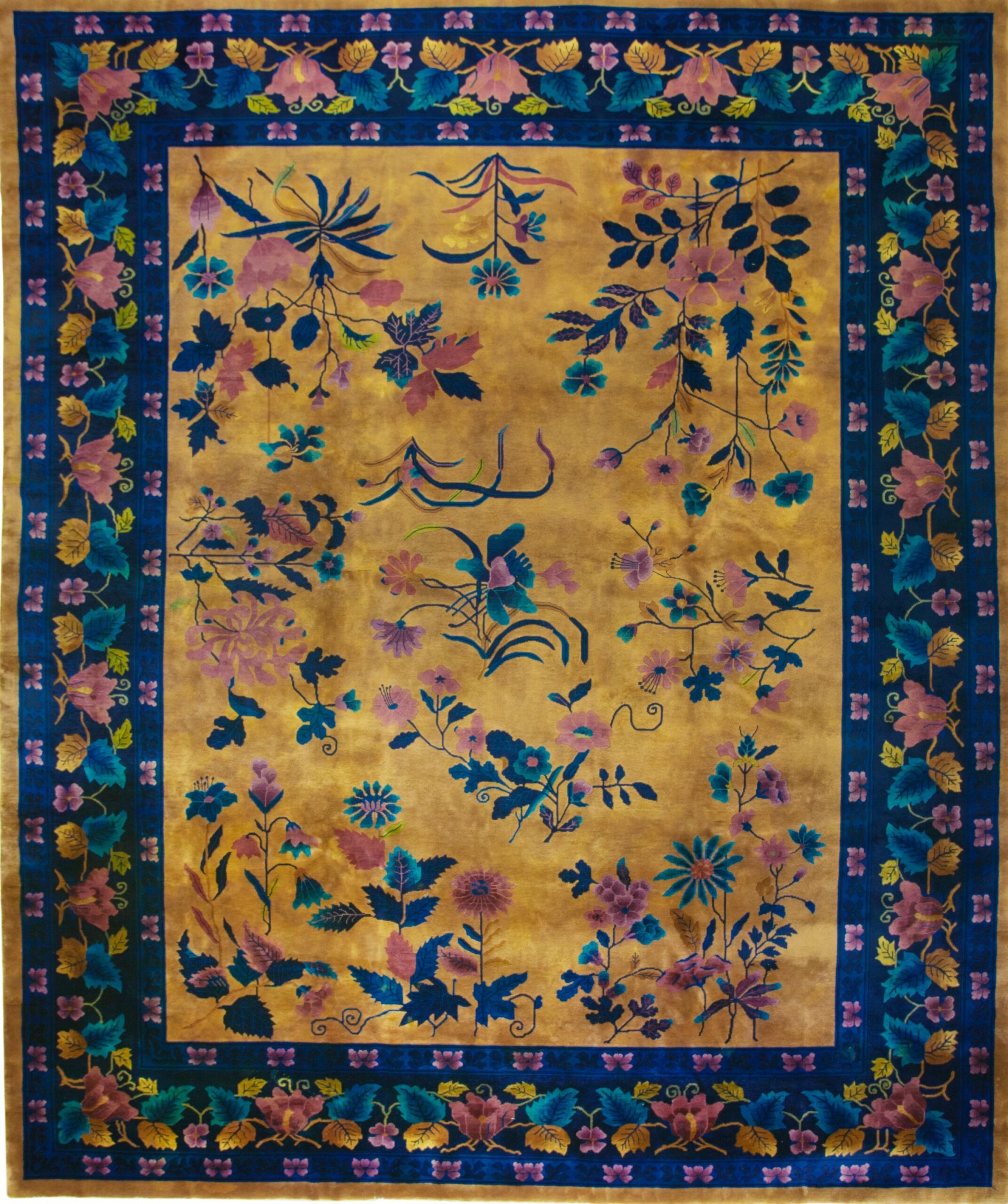
This circa 1920s Chinese Art Deco carpet is a luminous masterpiece of the “Interwar” era, representing a bold fusion of Eastern craftsmanship and Western modernist sensibilities. While traditional Chinese rugs often utilized austere color palettes and formal symmetries, the Art Deco movement in Tientsin and Peking—led by pioneers like Walter Nichols—introduced a vibrant, “Technicolor” aesthetic that redefined Asian textiles for the global stage.
The composition is defined by its exuberant floral and pictorial vignettes, often set against a vast, uncluttered field. In the Art Deco style, traditional Chinese motifs—such as flowering peonies, weepy willows, and songbirds—are rendered with a stylized, almost graphic elegance. Rather than a dense, repeating pattern, the design “floats” across the carpet, utilizing negative space to create a sense of airy sophistication. This architectural approach allows the rug to act as a serene anchor for a grand living room or dining area.
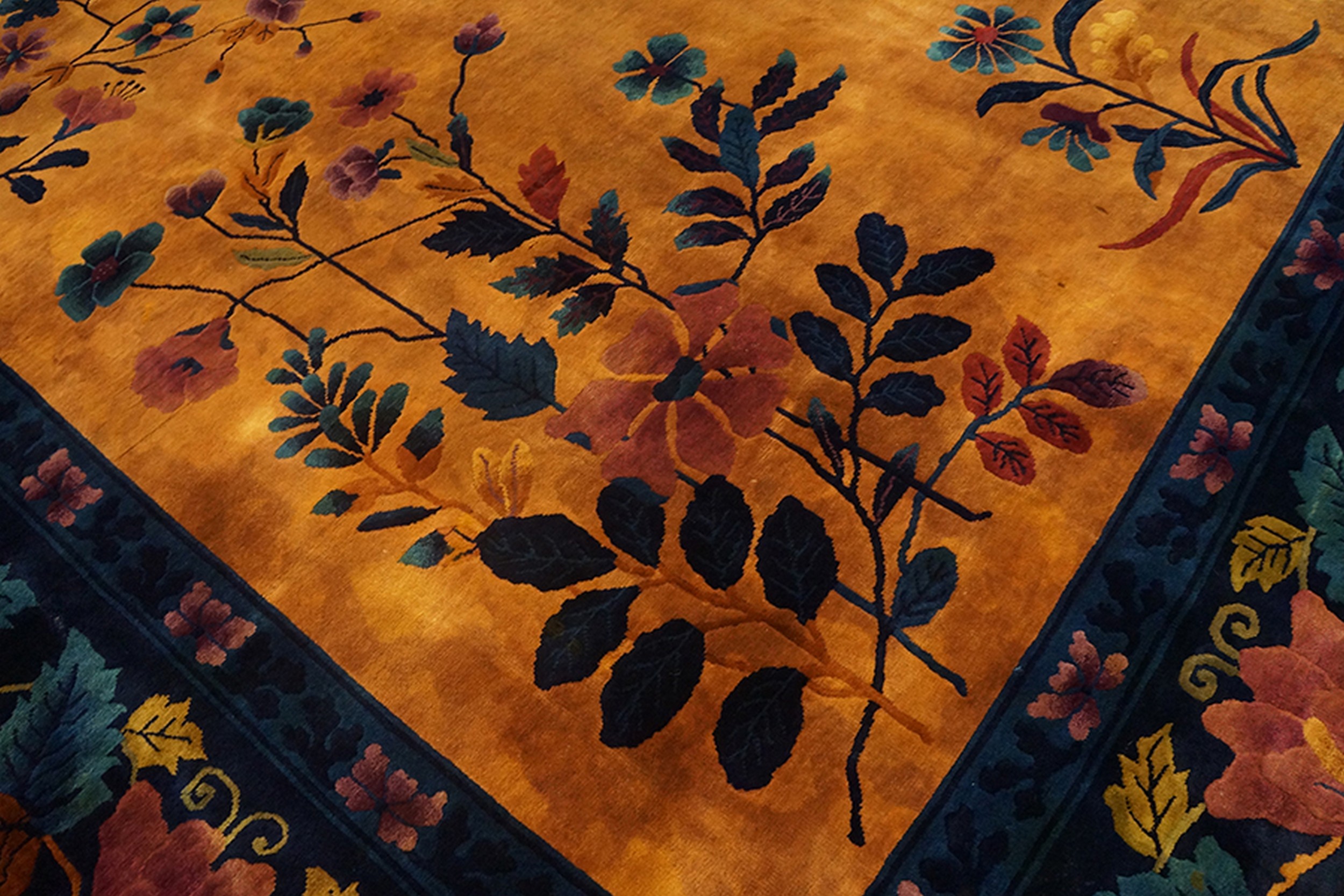
The palette is anchored by a magnificent Yellow foundation. In Chinese culture, yellow was historically the color of the Imperial court, symbolizing power, earth, and prosperity. Here, the yellow field is saturated and lustrous, providing a “solar” energy that brightens any interior. This radiant ground is often balanced by high-contrast accents in jewel tones—emerald greens, plum purples, and deep sapphire blues. Because these antique Chinese art deco area rugs utilized the finest chrome and natural dyes of the early 20th century, the colors remain startlingly vivid, possessing a “lacquered” depth that mimics the fine decorative arts of the period.
Technically, a room-size Chinese Deco carpet of this caliber is prized for its plush, heavy pile. Woven with thick, high-quality wool on a sturdy cotton foundation, these art deco rugs were built for longevity and tactile luxury. The wool is often so lustrous it mimics the sheen of silk, a result of the specialized washing processes developed in the 1920s to enhance the fiber’s natural brilliance. The “sculpting” or hand-carving often found around the floral motifs adds a three-dimensional, textural quality that is a hallmark of the Nichols style.
The borders in the Art Deco period often departed from traditional frames, sometimes appearing only on two sides or disappearing entirely into an “open field” design. This minimalist framing underscores the carpet’s modernity. To possess an antique yellow Chinese Art Deco rug is to own a piece of illustrious history—a work that bridges the gap between ancient dynasties and the high-glamour jazz age, transforming a large space into a sanctuary of historical gravity and sun-drenched, opulent grace.