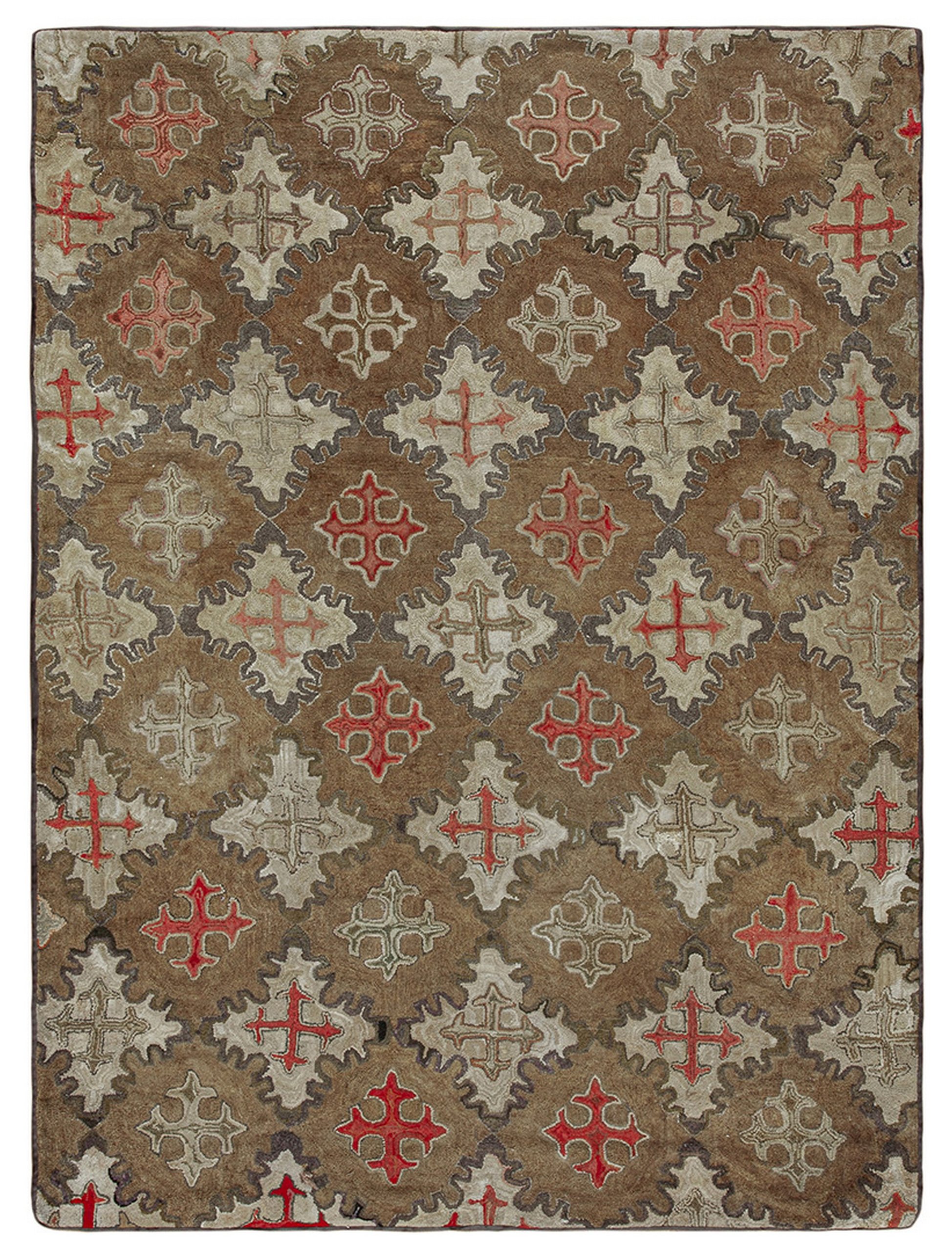
This nineteenth-century American hooked rug is a soulful and evocative exemplar of “High Folk Art,” capturing the ruggedly poetic spirit of the American Northeast. Historically, antique American hooked rugs were the quintessential “memory textiles” of the 1800s, crafted by hand using a simple hook to pull strips of discarded wool and fabric through a foundation of recycled burlap. This specific specimen is defined by its deep, saturated “earthy” palette—a sophisticated range of burnt umbers, forest greens, and tawny ochres—which reflects the organic colors of the rural American landscape and the natural dyes available to the domestic artisan.
The composition is a virtuoso display of the “all-over” botanical design, featuring a rhythmic dance of oversized autumnal leaves and scrolling vines. In the lexicon of 19th-century American folk art, these motifs were deeply symbolic, representing the bounty of the land and the cyclical nature of the seasons. The artist has achieved a remarkable “painterly” depth through the use of shading—the meticulous placement of varied tonal strips of wool within a single leaf to create a three-dimensional, sculptural effect. Unlike the rigid symmetry of European carpets, this hooked rug possesses a “charming irregularity,” where the organic flow of the pattern feels as spontaneous and alive as a forest floor.
Technically, the “earthy” ground of this rug serves as a powerful anchor for the vibrant botanical sprays, providing a sense of warmth and permanence. A rug of this size and stylistic complexity was a significant undertaking, often representing months of evening labor by the hearthside. By the late 1800s, pieces of this caliber were the heart of the American home, used to insulate cold floors while providing a singular canvas for creative expression. The borders act as a structural frame, often utilizing darker, “grounding” tones to contain the exuberant energy of the central design. To possess this hooked antique 19th-century America rug is to hold a relic of the “pioneer spirit”—a work that bridges the gap between humble utility and the timeless, graphic power of modern textile art.
Condition: Good. Repaired. Wear consistent with age and use. Overall Good Condition.