
Introduction: The Enduring Appeal of Five-Pointed Star Rugs
Discover our curated collection of striking five-pointed star rugs available now.
The 5-pointed star motif strikes a classic, almost symbolic chord. You see it across traditions and eras, bringing rhythm and energy into rug layouts. If you’re comparing points, these variations help you see the differences up close.
Explore other star motifs: 4-pointed, 6-pointed, 7-pointed, 8-pointed.
Five-Pointed Star as a Cross-Cultural Motif
The 5 Pointed Star rug design has deep roots that span civilizations and centuries. In ancient Mesopotamia and Egypt, the star was associated with celestial order and divine protection, often appearing in textiles, pottery, and architectural carvings. Across the Mediterranean, it took on mathematical and philosophical meaning, with the Greeks and Pythagoreans revering the pentagram as a symbol of proportion and harmony.
Islamic art incorporated star forms extensively, weaving them into carpets, mosaics, and manuscripts as reflections of cosmic geometry and divine balance. In medieval Europe, the 5 Pointed Star symbolized guidance and spiritual protection, carried into heraldry and later into decorative textiles.
From East to West, the motif has moved seamlessly from ancient cosmology to modern interiors, its geometry continuing to inspire both tribal artisans and contemporary rug designers.
Enduring Symbolism: Protection, Harmony, and Hope
The star motif carpet carries meanings that are as universal as they are timeless. For nomadic and village weavers, the star served as a talismanic symbol, believed to guard households against misfortune. Its balanced geometry spoke to harmony—both in the home and in the wider cosmos—while its upward-pointing arms conveyed hope, aspiration, and guidance.
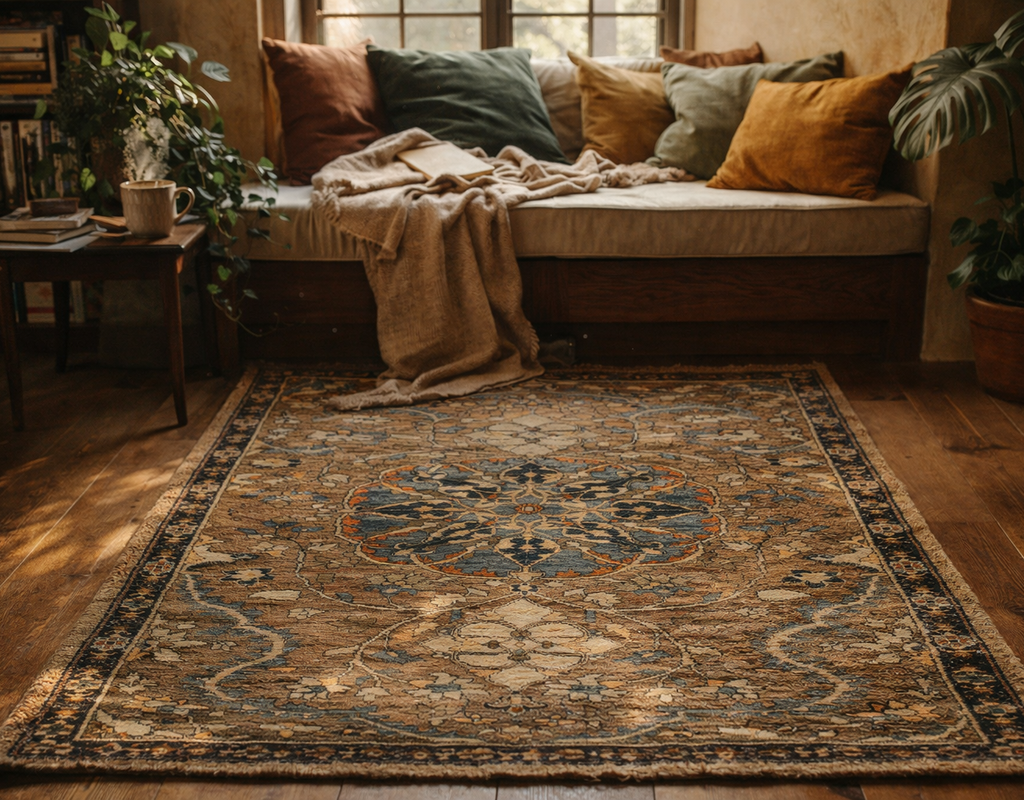
A beautifully detailed area rug brings warmth and antique charm to this sun-drenched reading corner.
Whether appearing in tribal kilims or palace carpets, the 5 Pointed Star has consistently functioned as more than a decorative choice; it has been a sign of reassurance and strength, woven directly into the fabric of daily life.
Even when adapted for contemporary interiors, the motif retains this deeper resonance, reminding owners that their cosmic rug motif connects them with a lineage of cultural meaning stretching back thousands of years.
Why the Star Motif Remains Relevant Today
The continued popularity of the pentagram design rug lies in its blend of timeless aesthetics and versatile application. In modern homes, star design area rugs function as focal points that evoke both elegance and symbolism. Their geometry pairs easily with minimalist spaces, while their cultural depth appeals to collectors of traditional handwoven carpets.
Designers and homeowners alike are drawn to the motif for its ability to bridge heritage and modernity: a star on a kilim rug can honor nomadic traditions, while a stylized version on a contemporary carpet adds a touch of celestial wonder. Rug weavers continue to use five-pointed stars because the motif is universally recognized, endlessly adaptable, and infused with meanings that resonate across generations.
In a market that increasingly values both story and style, the 5 Pointed Star remains a powerful emblem of continuity, protection, and hope.
A dimly lit workspace evokes a sense of academic pursuit, warmed by a vintage-style area rug.
Why do rug weavers use five-pointed stars? Rug weavers incorporate five-pointed stars because the symbol embodies universal themes of protection, harmony, and cosmic order. It allows them to embed layers of meaning into their work while also producing designs that are aesthetically striking and adaptable to different weaving traditions.
This combination of beauty and symbolism ensures the motif’s survival in both heritage and contemporary rug-making.
Symbolism and Cultural Meaning
The Number Five in Rug Folklore
The number five carries profound cultural resonance across weaving traditions, shaping the star symbolism in rugs. In Turkish folklore, the five-point motif often references the human hand, an ancient amuletic symbol believed to ward off evil and misfortune. This protective association is echoed in Anatolian weaving, where stars with five arms embody happiness, fertility, and the safeguarding of family life.
In Persian contexts, the number five links to spiritual frameworks such as the Panjtan, the five holy figures in Shi’a Islam, representing purity and divine protection. Central Asian tribes connected the number to the human microcosm—five senses, five extremities—aligning earthly life with cosmic order.
In each tradition, weaving a star with five points was more than an artistic flourish; it was an invocation of balance, blessing, and guidance woven directly into the textile.
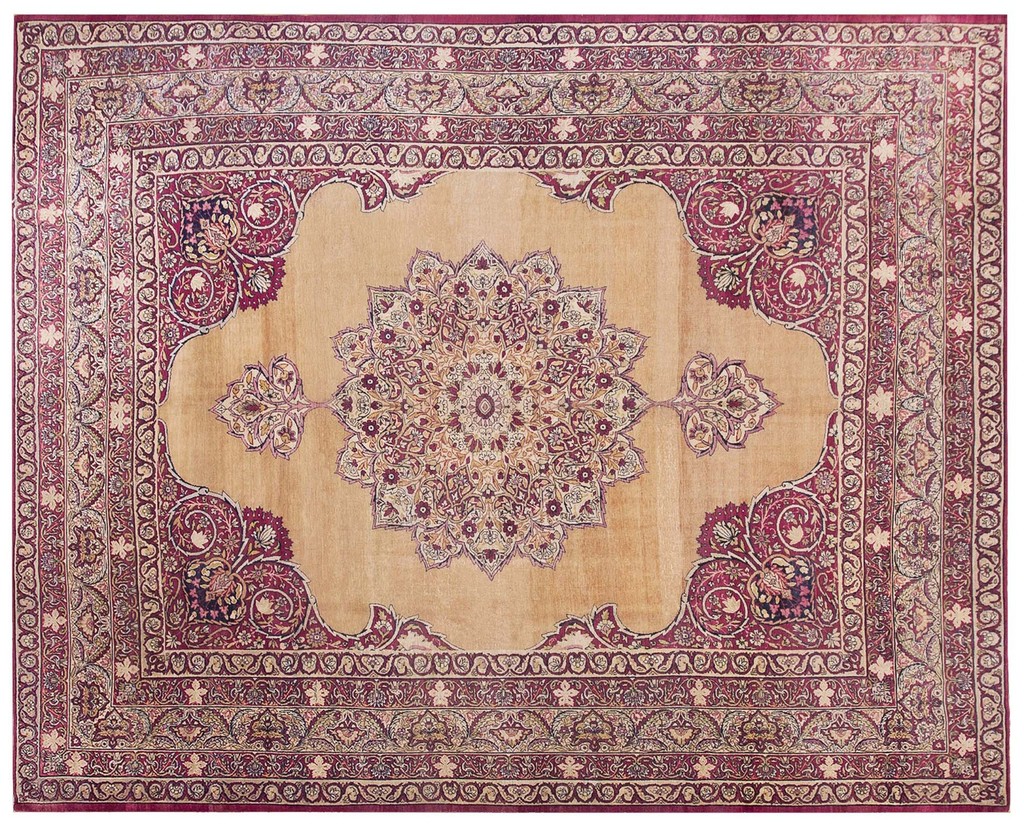
Antique Kerman – Lavar Room Size Wool Brown Rug by Rugs On Net
Does the number five hold cultural meaning in rug designs? Yes. The number five frequently embodies protection, happiness, and cosmic order, making it a central thread of meaning in protective rug design.
Whether through religious, folkloric, or symbolic frameworks, five-pointed stars are imbued with layers of cultural depth that transcend simple decoration.
The 5 Pointed Star as a Protective, Talismanic, or Spiritual Emblem
The 5 pointed star has long been considered a protective rug design across Anatolian, Persian, and Central Asian weaving traditions. For Turkish villagers, the Turkish star carpet carried talismanic qualities, believed to shelter the household from envy and evil forces. Persian weavers infused the motif with spiritual resonance, tying it to divine guardianship and cosmic order.
Among nomadic groups, the star was not only protective but also spiritual—a visual compass under the vast steppe sky, a reminder that the weaver’s family and livestock were under celestial watch. Its repetition in borders, medallions, and fields served to create a protective aura around the rug, turning a functional textile into a woven shield of blessing.
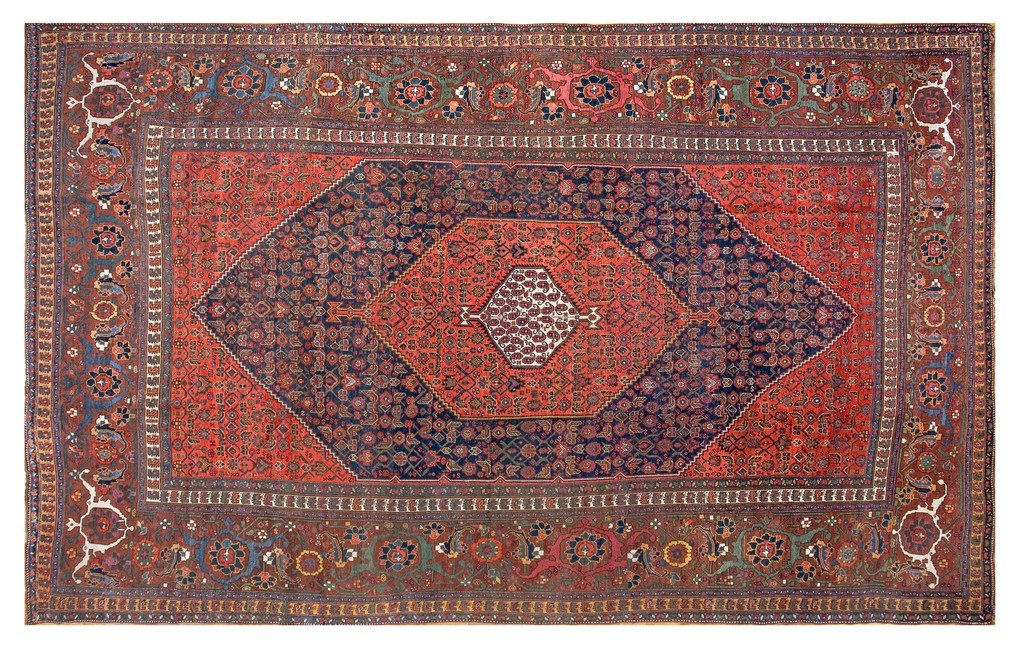
Big Size Blue Color Antique Tribal Persian Bidjar 1920s Rug by Rugs On Net
What does a 5 pointed star symbolize in Turkish carpets? In Turkish carpets, the 5 pointed star symbolizes happiness, fertility, and protection. It often references the five fingers of the hand, serving as an amulet-like emblem against evil while also blessing the home with prosperity and joy.
Associations with Happiness, Fertility, and Guidance
Across weaving regions, the star has consistently been tied to life’s most essential hopes. In Anatolia, stars represented fertility and the wish for healthy children. In Persian villages, they symbolized prosperity, harmony, and spiritual blessing. Among Central Asian nomads, stars in carpets mirrored the guiding lights of the night sky, offering reassurance and direction during long journeys across the steppes.
This constellation of meanings makes the five-point motif one of the most enduring in rug design: a symbol of happiness, fertility, and guidance, woven not only for beauty but for the promise of a protected and prosperous life.
Historical Origins and Geographic Spread
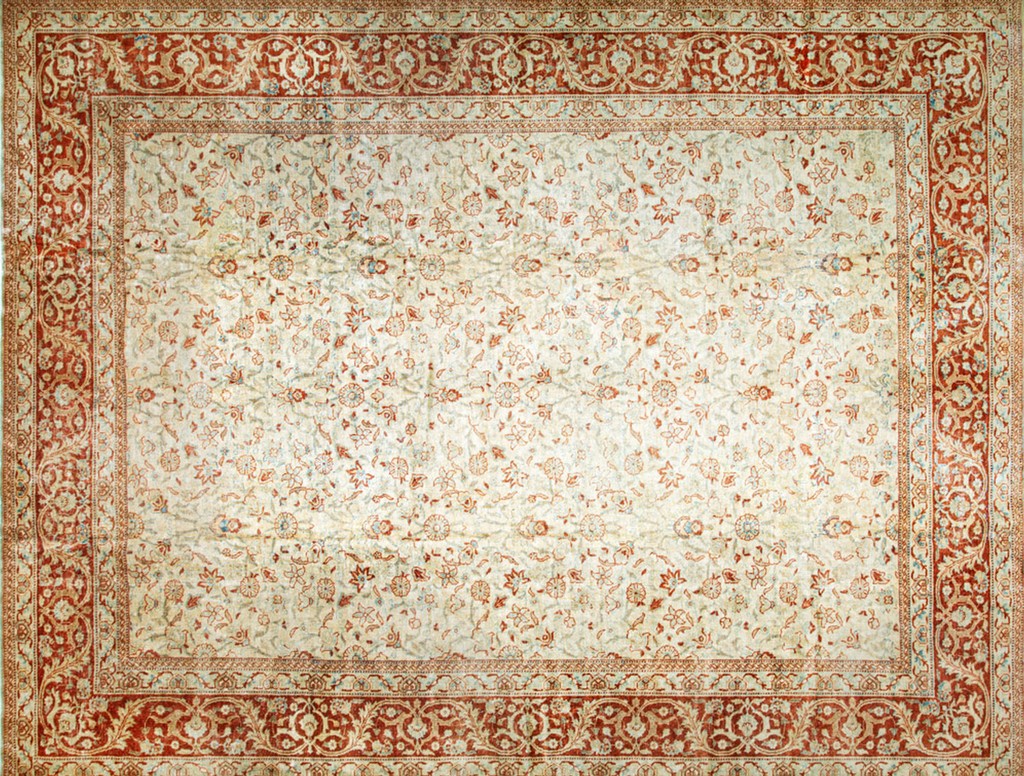
Light Ivory Field Rustic Floral Pattern Antique 19th Century Persian Tabriz Rug by Rugs On Net
Earliest Known Examples
The origin of star rug motif design reaches back to antiquity, with evidence as early as the 5th century BCE. The Pazyryk Carpet, excavated from a Scythian burial mound in Siberia, features complex geometric ornamentation that scholars link to star symbolism and cosmic order. In Anatolia, Phrygian artwork displayed star-like forms that bridged textile and architectural design, reflecting early Anatolian fascination with celestial geometry.
Meanwhile, in Mesopotamia, stars were carved into reliefs and woven into textiles as emblems of divinity and protection. These examples demonstrate that the Pazyryk star pattern and related motifs were never confined to a single culture; instead, they reflect a widespread, ancient interest in weaving cosmic order into daily life.
What is the origin of five pointed star motifs in rugs? The 5 pointed star in rugs does not stem from a single birthplace but emerged across multiple regions—Scythian, Phrygian, and Mesopotamian—each adapting it to their own spiritual and artistic frameworks.
Parallel Developments in Persia, Anatolia, Caucasus, and Central Asia
- Persia — Stars often symbolized fertility, divine blessing, and harmony, woven into medallions or all-over layouts in village and court carpets. — Why: Persian cosmology tied geometry to divine order, making stars natural symbols in textiles.
- Anatolia (Turkey) — The ancient star carpets of Anatolia carried talismanic meaning, particularly tied to happiness, fertility, and protection. — Why: Turkish weavers emphasized the star as an amulet-like figure linked to family life.
- Caucasus — Tribal weavers developed bold Caucasian star medallion rugs, marked by striking geometric layouts that turned the star into a central focal point. — Why: The mountainous region fostered highly distinct tribal styles, and stars allowed weavers to showcase identity while invoking cosmic guardianship.
- Central Asia — Nomadic groups wove star patterns into felts and flatweaves, drawing directly from the night sky under which they traveled. — Why: For nomads, the star was both a guiding light and a symbol of celestial protection, making it a natural motif for portable textiles.
Together, these parallel developments show that the 5 pointed star was not borrowed from one source but adapted uniquely across weaving cultures to embody shared values of protection, fertility, and cosmic order.
Key Innovators: Pioneers of 5 Pointed Star Medallions in Caucasian Rugs
The Caucasus became a crucible for innovation, where tribal weavers elevated the star motif into elaborate medallion-centered compositions. Villages in regions such as Shirvan and Karabagh pioneered rugs where the 5 pointed star was no longer a secondary detail but the dominant design element, repeated in bold, large-scale medallions. These Caucasian star medallion rugs represent some of the most iconic and enduring interpretations of the motif, blending tribal identity with universal cosmology.
Who pioneered 5 pointed star medallions in Caucasian rugs? Tribal weavers of the Caucasus—particularly from Shirvan and Karabagh—were among the first to pioneer complex 5 pointed star medallions, transforming a cosmic motif into a defining regional hallmark.
Visual Characteristics and Recognition
How to Identify a 5 Pointed Star in Rug Design
For collectors and enthusiasts, rug pattern recognition begins with careful attention to geometry. A true 5 pointed star is defined by its five radiating arms, arranged symmetrically around a central point. On a woven surface, this form can appear crisp and angular or slightly stylized, depending on the limitations of the loom and the weaver’s design approach.
In many cases, the motif is worked into a star medallion identification layout, standing prominently at the center of the field. In others, stars are repeated across the rug in an all-over pattern or integrated into borders. Because weaving straight lines on a grid naturally favors even-numbered points, 5 pointed stars are relatively rare compared to their six- or eight-pointed counterparts, making their identification especially rewarding.
How can I recognize a 5 pointed star pattern on a rug? Look for five evenly spaced points radiating from a central hub. Even when stylized, the star will preserve its fivefold symmetry, often appearing within medallions, scattered across fields, or incorporated into border designs. Counting the points carefully is essential, since stylization can blur distinctions between five- and six-pointed forms.
Comparison: Five, Six, and Eight Pointed Stars
- 5 Pointed Star — Rare and challenging to weave, often stylized or angular. — Why: Loom geometry favors even numbers, so the 5 point star requires creative adjustments.
- Six-Pointed Star — More common, often rendered as interlocking triangles or hexagonal patterns. — Why: Easier to balance within the weaving grid, frequently used in Islamic and Jewish symbolism.
- Eight-Pointed Star — The most common in Oriental carpets, often formed by overlaying two squares. — Why: Its symmetry is simple to map on warp and weft, making it a favorite for borders and medallions.
This comparison underscores why 5 pointed stars stand out: they are less common and often appear as artistic challenges conquered by skilled weavers.
Common Arrangements: Medallions, All-Over Patterns, Borders
The 5 point star kilim or knotted rug may showcase the motif in several arrangements. In medallions, a large central star anchors the composition, sometimes surrounded by subsidiary motifs that echo its geometry. All-over fields scatter stars across the rug like constellations, a design favored by nomadic weavers drawing inspiration from the night sky.
In borders, “running star” patterns create rhythmic sequences, while “stars-and-crosses” borders alternate motifs to enhance visual balance. These placements not only decorate but also frame the rug’s narrative, making the five-point star a versatile design element.
Are 5 pointed stars common in Anatolian kilims? No. While Anatolian kilims frequently display star motifs, most are six- or eight-pointed due to weaving geometry. Genuine five-pointed stars are less common, and when present, they tend to be stylized adaptations rather than perfect geometric pentagrams. This rarity adds to their intrigue and collectible value.
Construction, Materials, and Weaving Techniques
Knotting Methods for 5 Pointed Stars in Pile Carpets
In pile carpets, the 5 pointed star requires careful knotting to achieve its distinctive angled lines. Each point is built up through incremental knots that form diagonal steps across the warp and weft, creating the illusion of slanted geometry.
Because weaving looms naturally favor straight lines, weavers must calculate knot placement precisely, often alternating tighter and looser knots to round the motif’s edges. This technical skill distinguishes accomplished artisans, making star motif construction in pile carpets both challenging and rewarding.
How are 5 pointed star patterns knotted in pile carpets? Weavers map the star on graph-like patterns, then knot each section diagonally, building points through staggered knot rows. The result is a stylized but recognizable five point geometry that depends on the weaver’s precision.
Best Materials for Clarity: Wool, Silk, Synthetics
- Wool — Traditional and durable, wool is the most common material for star rugs. — Why: Its natural elasticity makes it versatile, though clarity can vary with fiber quality and knot density.
- Silk — The best material for star rug sharpness. Silk allows for extremely fine knots, producing crisp edges and luminous color contrasts. — Why: Ideal for luxury carpets where clarity of the star motif is paramount.
- Synthetics (e.g., polypropylene, nylon) — Affordable alternatives, widely used in mass-produced rugs. — Why: While durable and cost-effective, they often lack the crispness and depth of natural fibers, reducing the sharpness of intricate motifs.
What materials best highlight 5 pointed star motifs? Silk and fine wool highlight five-pointed stars most effectively, with silk offering the greatest clarity and wool providing durability and warmth. Synthetics may be practical but generally sacrifice precision and authenticity.
Flatweave Kilims and Geometry: Limitations and Creative Solutions
Flatwoven kilims, unlike pile carpets, lack the vertical depth needed for rounded or angled forms, which is why kilim vs pile star design often results in geometric adaptations. The weaving grid favors even-numbered points, making eight-pointed stars more common.
However, skilled Anatolian and Central Asian weavers occasionally adapted the structure by elongating or compressing segments to approximate a 5 pointed star. While not as crisp as pile knots, these creative solutions testify to the ingenuity of kilim artisans.
Can kilim weaving sharpen 5 pointed star geometry? Not easily. Kilim weaving imposes geometric limits that often blur five-point designs, though skilled weavers can stylize approximations. True sharpness is better achieved in pile carpets.
Effect of Pile Height on Motif Clarity
The pile height effect on rug clarity is especially important for 5 pointed stars. A high pile creates softness underfoot but blurs sharp lines, causing the star to lose definition. Medium to low piles preserve geometry more effectively, especially when paired with fine knotting. Collectors and designers seeking crisp star motifs prioritize rugs with tighter construction and shorter pile.
How does pile height affect 5 pointed star clarity? Higher piles soften and obscure the star’s geometry, while shorter piles or finely knotted rugs maintain sharper, more legible points.

A detailed focus on the intricate, vivid colors and geometric weave of a traditional textile rug.
Should I choose wool or synthetic for star design rugs? Wool is preferable for authenticity, durability, and traditional craft, while synthetics suit budget-conscious buyers but typically compromise on clarity and detail. For those seeking both sharpness and luxury, silk remains unmatched.
Regional Styles and Variations
Turkish Carpets: Star Symbolism and Unique Regional Styles
In Anatolia, the Turkish star rug stands out for its blend of protective and fertility symbolism with bold local aesthetics. In Konya, one of the oldest weaving centers, 5 pointed stars often appear as “barbed” or serrated forms, representing both strength and vitality.
In Kars, located in eastern Anatolia, the stars take on a more geometric character, rendered in stark lines and strong contrasts that reflect the region’s Caucasian influences. Turkish weavers frequently paired these stars with talismanic borders, reinforcing their protective power while grounding the designs in local traditions of home and family blessing.
Persian, Caucasian, and Central Asian Variants
- Persian Star Pattern Rugs — Among Persian tribal groups like the Qashqai and Bakhtiari, five-pointed stars symbolize fortune and divine protection. These motifs often appear in medallions or scattered throughout the field, accompanied by bright, layered borders. — Why: Stars aligned with Persian beliefs in cosmic order and prosperity, making them ideal for both tribal and commercial carpets.
- Caucasian Star Carpets — The Caucasus produced some of the most striking star medallion designs. Armenian, Kazak, and Azeri weavers developed bold Caucasian star carpet styles, with large central medallions or repeating stars in borders that project strength and cultural identity. — Why: Mountain tribes embraced bold, geometric layouts as visual markers of heritage, using the star to unify artistic and symbolic traditions.
- Central Asian Styles — Nomadic groups across Central Asia carried the star motif into felts, embroideries, and flatweaves. Here, stars often evoked sky worship, cosmic guidance, or even national symbolism, reflecting the wide-open landscapes of the steppes. — Why: The star naturally represented celestial order and navigation, making it essential to nomadic life.
Color Palettes and Pattern Layouts
Across all regions, contrast plays a crucial role in emphasizing the star motif. Persian weavers often relied on deep reds and midnight blues to highlight stars in ivory or gold, while Anatolian examples favored bold reds, greens, and blacks for maximum visual punch. Caucasian rugs amplified the geometry with sharp outlines, ensuring the stars stood out even from a distance.
Layouts varied—some placing a single star medallion at the center, others scattering stars across the field, and still others integrating them into dynamic border sequences. This versatility allowed each weaving culture to express its beliefs and artistry while preserving the universal resonance of the star.
Where are 5 pointed star rugs woven today? Five-pointed star motifs continue to appear in weaving centers across Turkey, Iran, the Caucasus, and Central Asia. In modern production, they are also reproduced globally, from handmade village rugs to factory-made carpets, sustaining the motif’s enduring presence in contemporary interiors.
5 Pointed Star Rugs in the Modern Era
Vintage Originals vs. Modern Reproductions
- Vintage Star Rugs — Antique and tribal rugs with five-pointed stars carry authenticity, symbolic depth, and a handmade character that cannot be replicated. Their irregularities—variations in dye, knotting, and star geometry—add charm and cultural value. — Why: Collectors and connoisseurs view these rugs as cultural artifacts, each telling a story of the weaver’s heritage.
- Modern Reproductions — Today’s market offers everything from finely hand-knotted reproductions faithful to tradition to machine-woven or printed rugs that prioritize design over symbolism. — Why: While more affordable and accessible, many lack the talismanic or spiritual meaning that defines older examples, focusing instead on decorative appeal.
How do vintage star rugs differ from modern reproductions? Vintage rugs embody heritage, cultural symbolism, and handmade artistry, while modern versions are often mass-produced, emphasizing style over spiritual meaning.
Market Trends: Collector Value, Pricing, Resale Potential
Collectible star carpets are highly prized for their rarity and authenticity. Antique five-pointed star rugs, particularly those from Turkish, Persian, or Caucasian origins, can command premium prices at auctions and in private collections.
Their symbolic richness and relative scarcity increase demand, making them reliable assets for long-term collectors. In contrast, modern reproductions generally hold little star pattern resale value, since they are produced in larger numbers and lack unique provenance.
Are 5 pointed star rugs appreciated by collectors? Yes. Collectors deeply appreciate them for their symbolism, craftsmanship, and historical context. High-quality antique examples are especially desirable and often serve as centerpiece items in curated collections.
Does a 5 pointed star motif add resale value? When tied to authentic craftsmanship and heritage, yes. The motif elevates both symbolic and financial worth, especially in rare or antique rugs. Modern reproductions, however, usually do not offer significant resale potential.
The Star Motif in Contemporary and Minimalist Interiors
- Geometric Simplicity — The clean lines of the 5 pointed star resonate with modern minimalist aesthetics. — Why: The motif provides a focal point without overwhelming simplicity-driven spaces.
- Universal Symbolism — Stars carry meanings of guidance and harmony that enrich contemporary décor with layers of cultural depth. — Why: Even in stripped-down interiors, the motif adds emotional and symbolic value.
- Versatility Across Styles — From Scandinavian minimalism to bold eclecticism, the 5 pointed star adapts easily to different design schemes. — Why: Its balance of geometry and symbolism makes it timeless and cross-cultural.
Is a 5 pointed star rug suitable for minimalist décor? Absolutely. A star rug for minimalist decor introduces subtle visual interest and symbolic resonance without breaking the clean, uncluttered aesthetic. Its geometry complements modern interiors while its timeless symbolism adds depth.
Buying Guide
Where to Find Authentic Vintage Five Pointed Star Rugs
- Specialty Dealers — Established rug galleries and dealers often provide authentication, detailed provenance, and expert appraisal. — Why: These sources give buyers confidence in the rug’s origin, age, and cultural authenticity.
- Auctions — Major auction houses and regional sales frequently feature antique 5 pointed star rugs. — Why: Auctions can provide access to rare, high-value pieces with documented the histories of the rugs.
- Online Marketplaces — Curated platforms and specialist websites occasionally list vintage examples. — Why: Online options increase accessibility, but when buying area rugs, people must verify authenticity and provenance carefully.
Where can I buy authentic vintage five-pointed star rugs? You can buy vintage star rugs from reputable dealers, trusted auctions, or vetted online platforms. Always confirm provenance and request expert documentation before purchase.
What to Expect: Price Range, Resale Value, Investment
The antique star carpet price depends on rarity, condition, knot density, and origin. A village-made vintage rug may range from hundreds to a few thousand dollars, while rare Caucasian or Persian star carpets in excellent condition can command five or six figure sums. Provenance and motif clarity are crucial: rugs with crisp, well-defined stars and documented heritage hold the highest resale value.
Collectors often view these pieces as long-term investments, both financially and culturally. How much do antique 5 pointed star rugs cost? Prices range from a few hundred dollars for common tribal examples to tens of thousands—or more—for rare, museum-quality star carpets.
Cleaning and Maintaining Star Motif Clarity
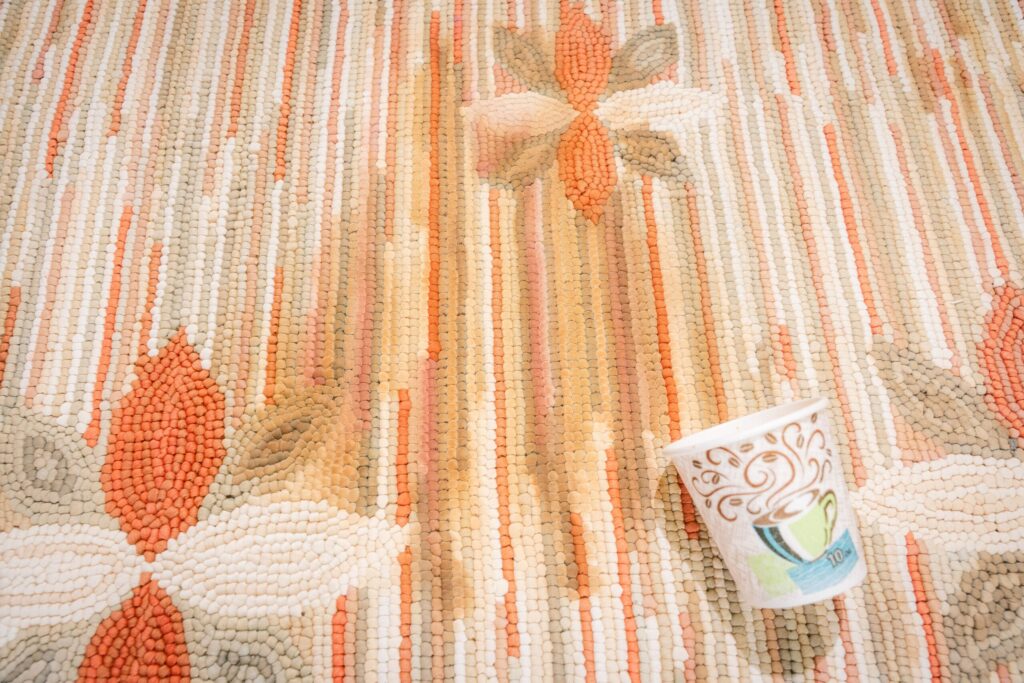
Close-up view of a tipped paper coffee cup resting on a handwoven wool rug, highlighting the rug’s dense pile, subtle color variations, and traditional geometric motifs in warm neutral and terracotta tones.
- Gentle Washing — Use mild, wool-safe solutions and avoid harsh detergents. — Why: Strong chemicals can strip natural dyes and blur the motif.
- Avoid Direct Sunlight — Prolonged exposure fades colors and diminishes the crispness of the star design. — Why: Light-sensitive dyes are common in antique and tribal carpets.
- Regular Vacuuming — Gentle vacuuming prevents dust buildup without pulling fibers. — Why: Dirt accumulation can dull star colors and textures over time.
Star rug cleaning is essential to maintain both color vibrancy and design clarity.
Professional Cleaning and Color Care for Star Rugs
When natural dyes or delicate fibers are involved, only expert oriental rug cleaners should handle the process. Immersion washing, if performed incorrectly, risks bleeding colors and dulling the motif’s geometry. Professionals use pH-balanced solutions and controlled drying methods to preserve rug color and protect the star’s definition.
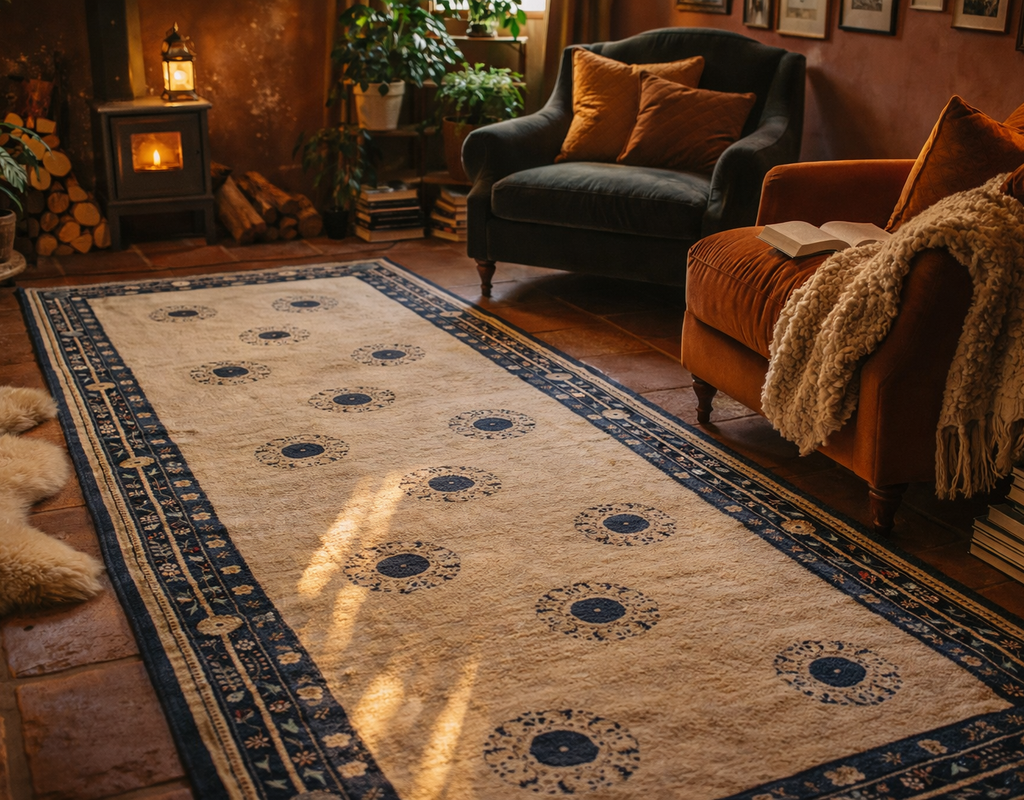
A richly textured room scene highlighted by the geometric pattern of a long, cream and navy traditional runner rug.
Can professional cleaning fade 5 pointed star colors? Yes—if performed by inexperienced cleaners using harsh chemicals or improper techniques.
To avoid this risk, choose specialists who understand antique textiles and star motif preservation.
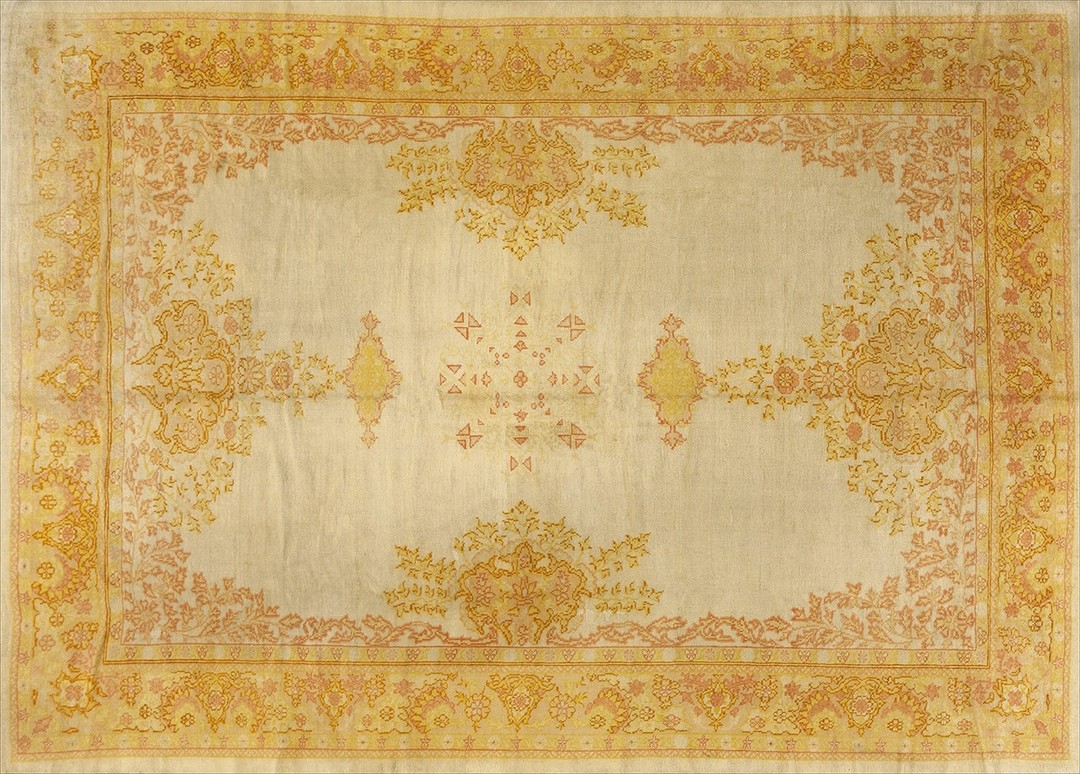
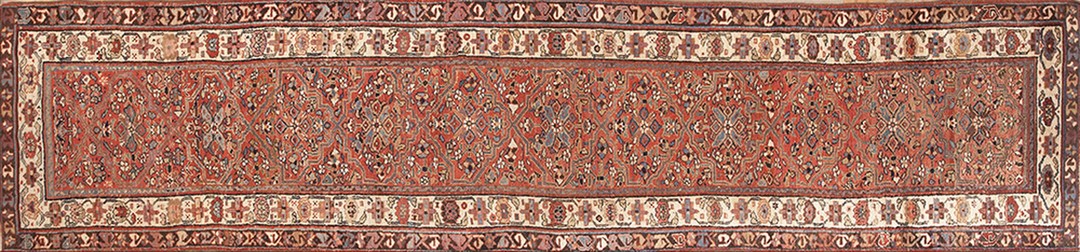
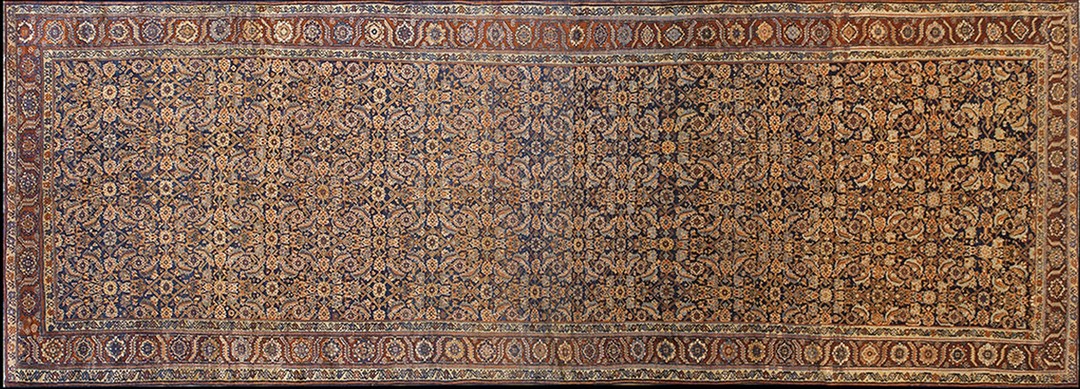
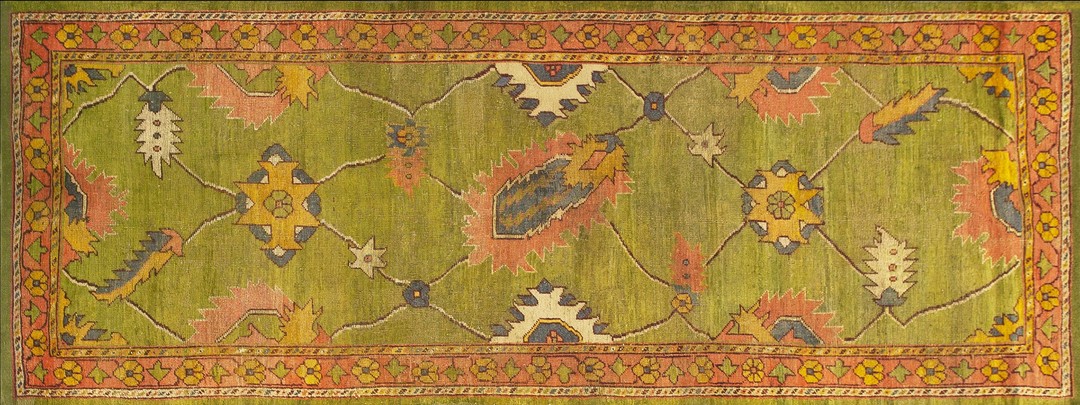
Explore a Few of Our Favorite 5 Pointed Star Rugs
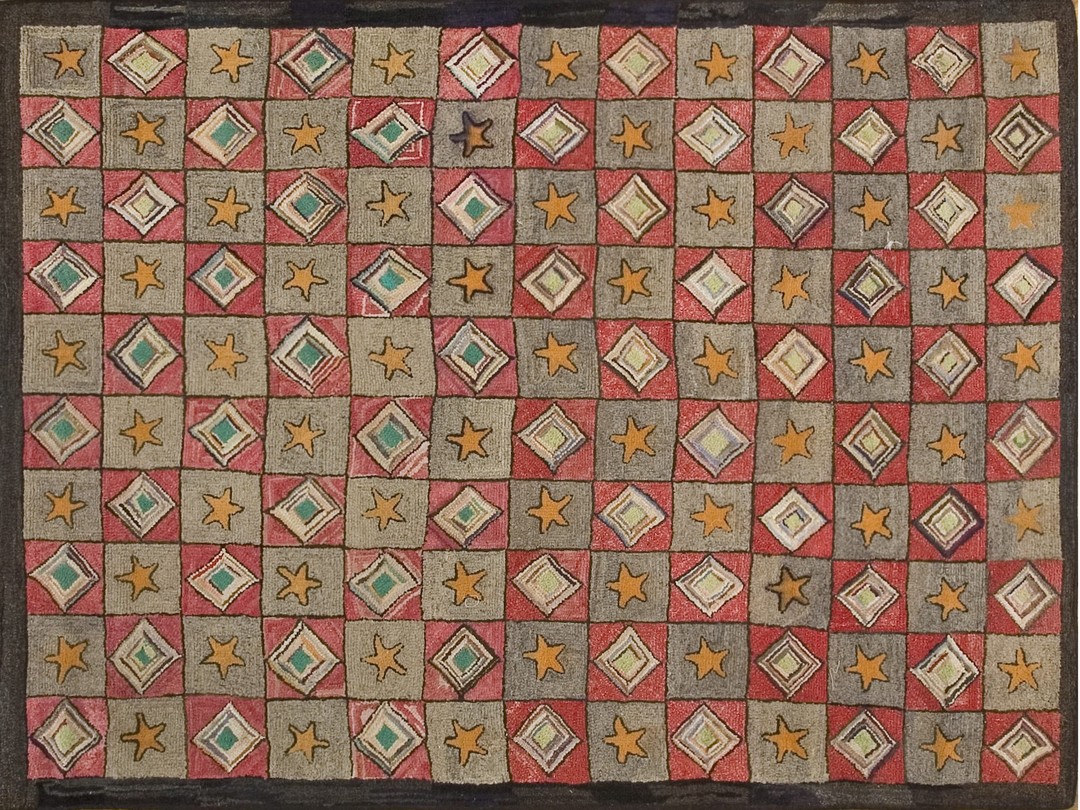
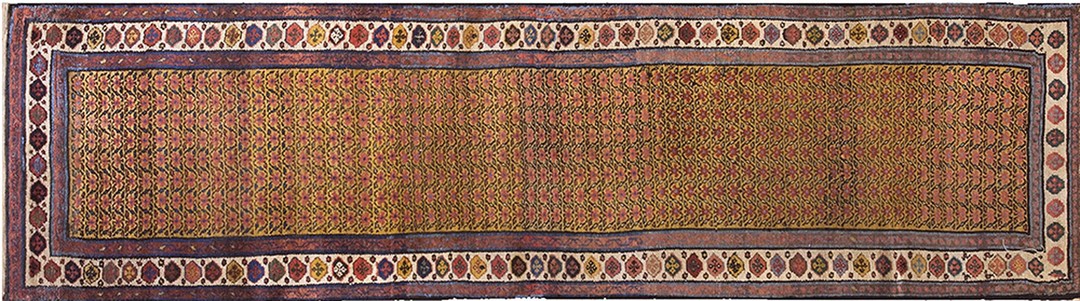
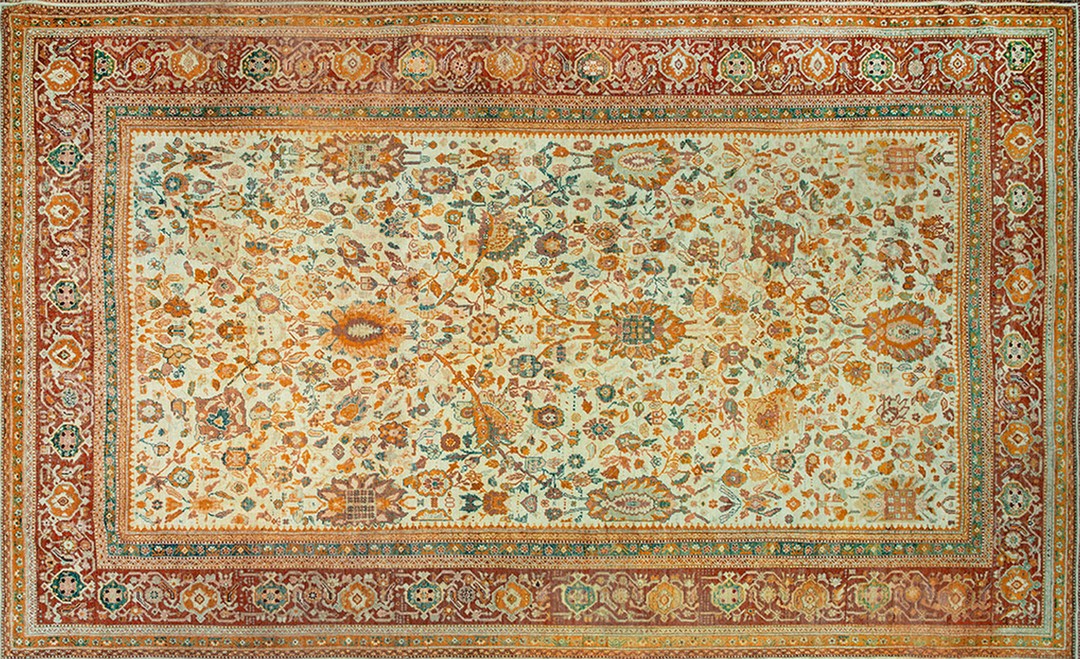
FAQ
- How should I style color with five-pointed star rugs?
Try navy-and-white or black-and-cream five-pointed star rugs for crisp contrast. Repeat the rug’s star color in two accents (e.g., pillows, art) for cohesion.
- Where do five-pointed star runners make sense?
Use five-pointed star runners in hallways, entries, and kitchens. Leave a 2–3 inch floor reveal on each side for a tailored look.
- What pile height suits doorways for five-pointed star rugs?
Keep five-pointed star rugs at 0.25–0.5 inches to clear most doors. Use low-profile pads in tight thresholds.
- How do five-pointed star rugs differ from eight-point star rugs?
Five-pointed star rugs skew nautical/contemporary; eight-point stars feel more traditional/Anatolian. Both can be geometric; pick based on style and room.
- Are five-pointed star rugs durable for high-traffic areas?
Choose dense, low-pile wool or performance fibers for five-pointed star rugs in busy zones. Darker, heathered colors hide dirt better.
- Do five-pointed star rugs pair with other patterns?
Yes—mix five-pointed star rugs with stripes or solids to avoid visual clutter. Keep one large-scale pattern and one small-scale pattern for balance.
- What’s the lead time for custom five-pointed star rugs?
Hand-tufted custom five-pointed star rugs often take 5–16 weeks. Hand-knotted versions typically need 3–6 months, depending on size and detail.
- Are non-toxic options available for five-pointed star rugs?
Look for five-pointed star rugs with OEKO-TEX or GOTS labels and natural fibers. Always ventilate new rugs to reduce initial odors.
- Will five-pointed star rugs fade in sunlit rooms?
Sunlight fades dyes; rotate five-pointed star rugs every 3–6 months. Use window shades or UV film to slow fading.
- Do five-pointed star rugs work in dining rooms?
Yes—choose low-pile five-pointed star rugs and size so chairs stay on the rug when pulled out. An 8×10 often fits a 6-chair table.
- How can I tell if a five-pointed star rug is handmade?
Flip it—hand-knotted five-pointed star rugs show irregular knots and integral fringe. Look for slight abrash (tone shifts) that signal hand-dyed yarns.
- How much do five-pointed star rugs cost?
Machine-made five-pointed star rugs often run \$50–\$300; hand-tufted \$200–\$1,000. Hand-knotted pieces typically start around \$1,000 and rise with size and craftsmanship.
- Are outdoor five-pointed star rugs practical?
Yes—choose polypropylene or other outdoor-rated five-pointed star rugs. Rinse with a hose and air-dry; store for winter to extend life.
- Which sizes are most common for five-pointed star area rugs?
Five-pointed star rugs commonly come in 5×8, 8×10, and 9×12. Round options (e.g., 6′ or 8′) center the star nicely.
- What rug pad works best under 5-pointed star rugs?
A felt-and-natural-rubber pad is a good default under five-pointed star rugs. Trim it 1–2 inches smaller than the rug on all sides.
- Are five-pointed star rugs safe over radiant floor heating?
Yes—use breathable natural fibers and a compatible rug pad. Keep overall thickness moderate; thick pads can reduce heat transfer.
- Can robot vacuums handle five-pointed star rugs with fringe?
Fringe can snag; tuck or tape fringes under five-pointed star rugs and set no-go zones. Lower suction on high-pile areas to reduce tangles.
- How do I clean a wool 5-pointed star rug after a spill?
Blot immediately with a white cloth and mild dish-soap solution; avoid scrubbing. Test cleaners first and dry thoroughly—use fans to speed evaporation.
- Do wool five-pointed star rugs shed and for how long?
New wool five-pointed star rugs can shed for several months, then taper. Vacuum weekly without a beater bar on delicate piles.
- What materials show crisp edges on 5-pointed star rugs?
Hand-tufted wool and flatweaves show the sharpest five-pointed star lines. For outdoors, polypropylene five-pointed star rugs resist moisture and UV.
- Are five-pointed star rugs good for kids’ rooms?
Yes—pick washable or low-pile five-pointed star rugs for easier cleanup. Typical nursery sizes include 4×6 and 5×7, with non-slip pads for safety.
- Which regions most influenced five-pointed star rugs?
Five-pointed stars appear in Moroccan and coastal/Americana designs, while 8-point stars dominate many Anatolian/Caucasian rugs. Expect five-pointed stars on contemporary pieces more than antiques.
- Are nautical star rugs the same as five-pointed star rugs?
Nautical star rugs are a subtype of five-pointed star rugs, usually shaded to look three-dimensional. They pair well with navy, white, and natural jute accents.
- What does the five-pointed star mean on 5-pointed star rugs?
Meanings vary by culture—guidance, protection, or faith—so treat symbolism as context-dependent. Choose what resonates; for example, the “nautical star” often signals navigation and wayfinding.
- What are 5-pointed star rugs and where are they used?
5-pointed star rugs feature a five-tip star motif found in nautical, Moroccan, and Americana styles. They work in living rooms, kids’ rooms, entryways, and even outdoors, commonly in 5×8, 8×10, or runners.