
Introduction to Yin Yang Motif Rugs
Discover our exclusive range of Yin Yang design rugs and bring perfect balance to your home décor today.
What is the Yin Yang Motif?
The yin yang motif, known in Chinese as the Taijitu, is one of the most recognizable icons in the world. It is composed of a circle divided into two swirling halves—one dark and one light—each containing a small dot of its opposite. This form represents the interdependence of opposing forces, a reminder that no element exists in isolation.
In rug design, the yin yang motif is not merely decorative but deeply symbolic: it embodies the principle of harmony between contrasts such as light and dark, masculine and feminine, or active and passive.
A yin yang motif symbol in area rugs translates ancient philosophy into tangible textile art, offering both visual rhythm and a meditative center for interior spaces.
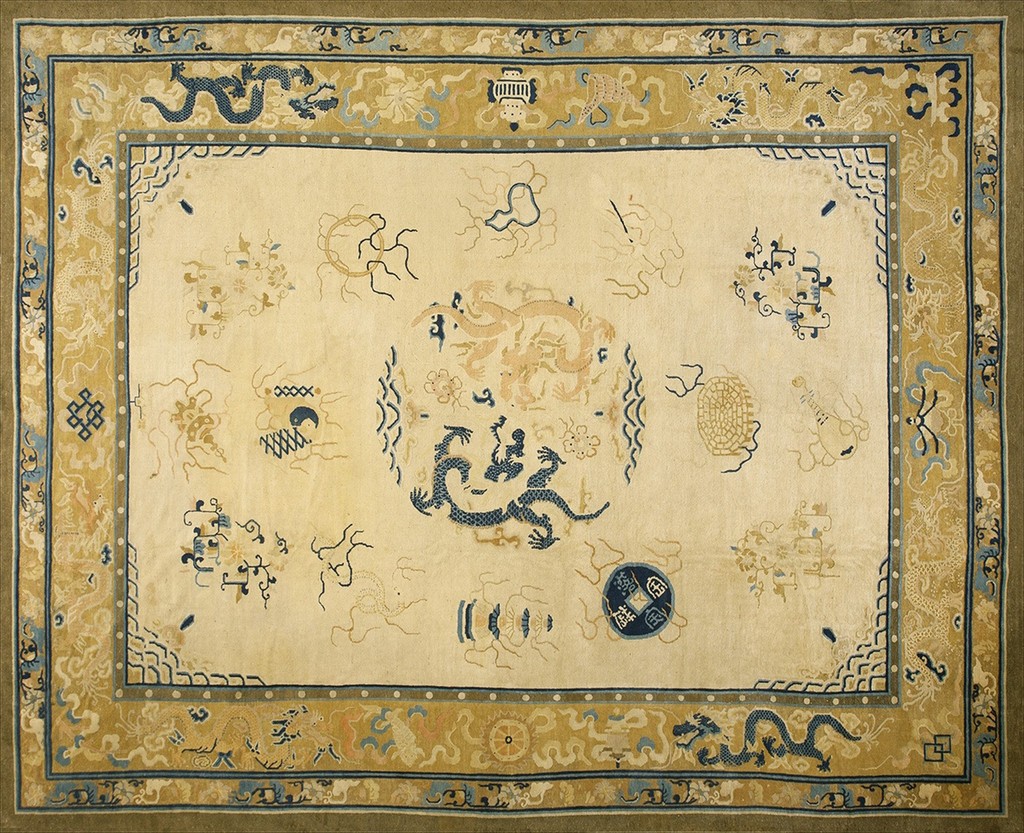
Antique Peking Chinese Medallion Ivory 1870s Rug by Rugs On Net
For those who ask, What does the yin yang symbol mean in rug design?—the answer is balance, harmony, and the intentional invitation of unity into the home. By weaving the taijitu motif into a carpet, artisans create a visual statement that transforms flooring into a philosophical canvas.
Symbolism & Meaning Across Cultures
The yin yang’s origins lie in Taoist cosmology, where it expresses the dual yet complementary nature of existence. In this worldview, yin (dark, receptive, cool, feminine) and yang (bright, active, warm, masculine) are not opposites to be divided but forces that rely on one another to maintain cosmic order. When this concept is transferred into textiles, the balance and harmony carpet becomes a medium through which the Taoist idea of unity within diversity can be lived daily.
Buddhist traditions also absorbed and adapted the motif, emphasizing impermanence and interconnection. In this context, rugs featuring the dualities of the yin yang design remind practitioners of life’s cycles and the flow between suffering and enlightenment, shadow and illumination. The curved lines of the motif echo Buddhist teachings on the interconnectedness of all beings, serving as a symbolic ground for meditation or ritual practice. In the modern era, the yin yang symbol has entered global culture, often associated with New Age spirituality and contemporary design.
Here it is valued as an emblem of mindfulness, energy balance, and personal well-being. In home décor, a yin yang motif meaning decor piece works as both a stylistic statement and an intentional tool: a way to create rooms that feel centered and harmonious. Designers and homeowners alike embrace the motif in rugs because it offers timeless aesthetics while anchoring spaces with cross-cultural meaning.
From its ancient beginnings in China to its adoption in Buddhist monasteries and its current presence in global interior trends, the yin yang symbol in rugs carries an enduring appeal. It functions as more than ornament—it is a universal language of unity, duality, and balance, woven into the very fabric of home life.
Historical Origins & Evolution
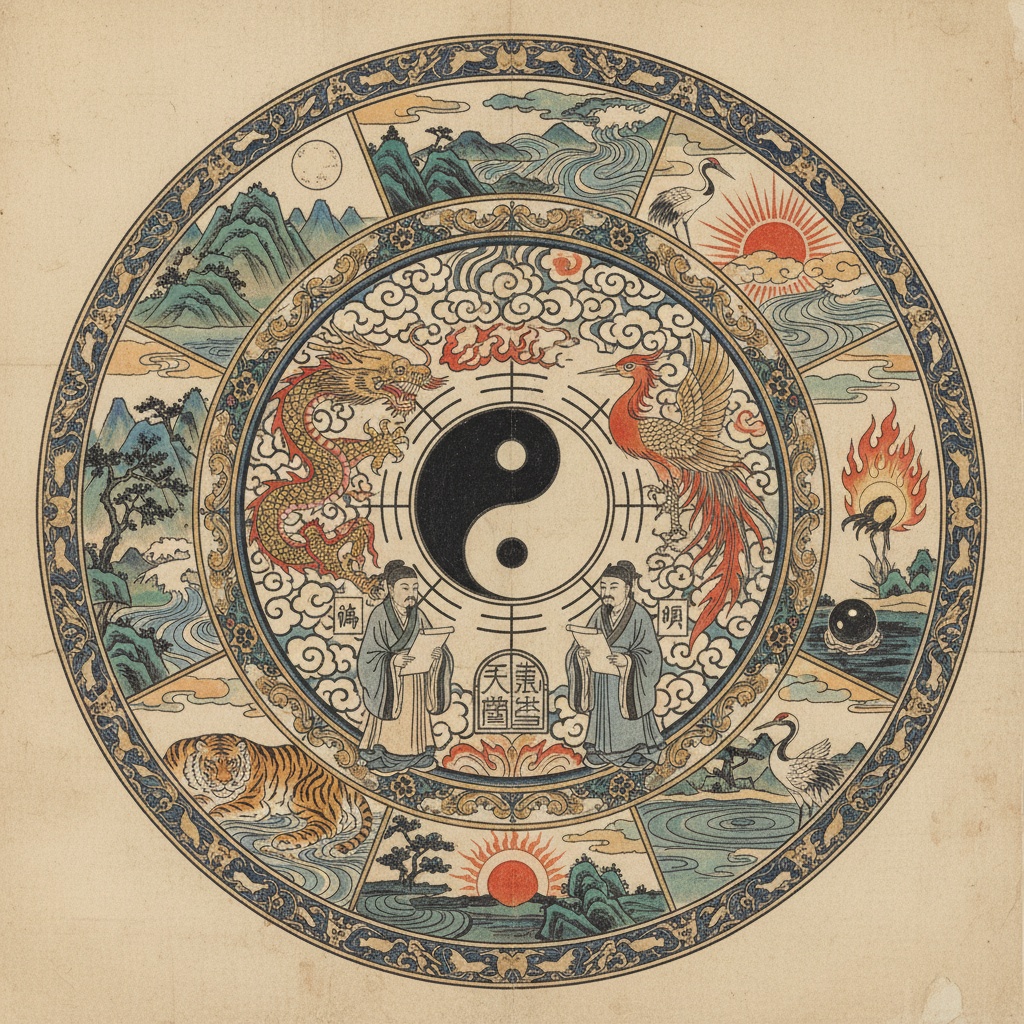
Traditional diagram illustrating cosmic balance and duality.
Chinese Roots: Taoism, Cosmology, Rug Art
The origin of yin yang motif rugs lies in ancient Chinese cosmology, where the Taijitu served as a visual emblem of Taoist philosophy. Early uses of the motif appeared in manuscripts, paintings, and imperial iconography long before it entered textile art. The introduction of the yin yang motif symbol in rugs took shape during the Qing Dynasty, when Chinese artisans began weaving carpets that carried both imperial insignia and cosmological symbols.
These rugs often adorned temples, palaces, and official residences, functioning not only as floor coverings but also as visual affirmations of harmony and order. In this context, Chinese yin yang motif weaving was a form of cultural storytelling—embedding philosophical dualities into tactile, ornamental art.
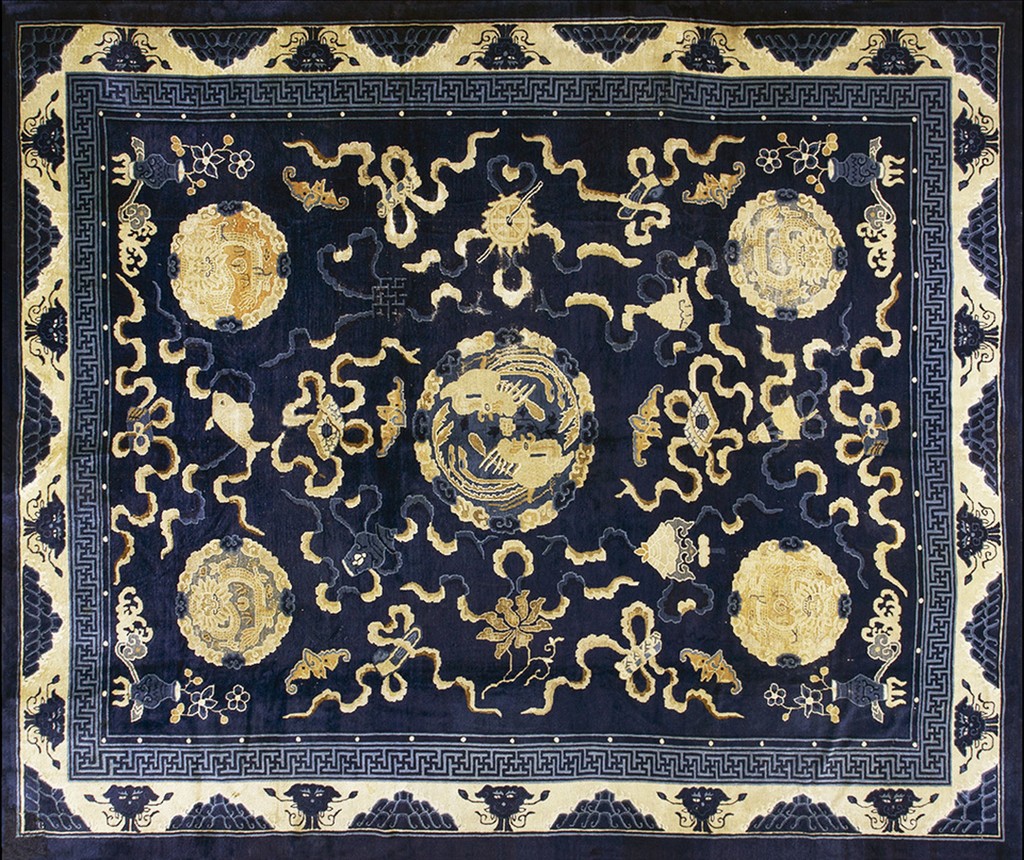
Antique Chinese – Peking Chinese Floral, Medallion Blue 1880s Rug by Rugs On Net
To answer directly: Who introduced yin yang motifs into oriental carpets? It was Chinese weavers, who first integrated the symbol into the broader tradition of carpet-making.
Spread to Tibet, East Asia, and West
From China, the motif traveled along cultural and trade networks, eventually influencing Tibetan weaving. The Tibetan yin yang motif rug became a unique hybrid, often pairing the Taijitu with Buddhist symbols such as lotus flowers or endless knots. These rugs reinforced spiritual teachings of impermanence and balance, serving as meditative anchors in monasteries and households.
The symbol also spread into other East Asian decorative traditions, where it merged with local aesthetics but maintained its universal essence of balance and duality. As global exchange intensified, the motif began appearing in Western textiles, signaling the start of its transformation from a regional cosmological emblem into a global design language.
Scandinavian Rya Rugs
By the mid-20th century, the yin yang motif symbol found a surprising new canvas: the Scandinavian rya. These shaggy wool rugs, traditionally woven for warmth, were reinvented by modern designers who sought bold, graphic motifs inspired by international art movements. The Scandinavian rya rug yin yang design emerged in the 1950s and 1960s.
It was part of a broader dialogue between East and West, reflecting both global spiritual curiosity and the clean, geometric sensibilities of Nordic modernism. For clarity: When did Scandinavian rya rugs adopt the yin yang motif?—they did so in the mid-20th century, aligning with postwar design experimentation and the rise of modern abstract forms in home décor.
Modern & Contemporary Adaptations
In contemporary rug design, the history of rugs featuring the yin yang motif has expanded from cultural heritage to fashion statement. No longer limited to imperial Chinese contexts or Tibetan monasteries, the motif now circulates in global décor markets, appearing in minimalist interiors, bohemian spaces, and even pop-culture-inspired pieces.
The journey from Qing Dynasty silk carpets to Scandinavian shag rugs highlights the symbol’s adaptability: it can be austere and meditative, or playful and bold. Today, designers continue to reinterpret the motif, proving that the yin yang symbol remains an enduring canvas for weaving balance and harmony carpets across centuries and cultures.
Design Characteristics & Identification
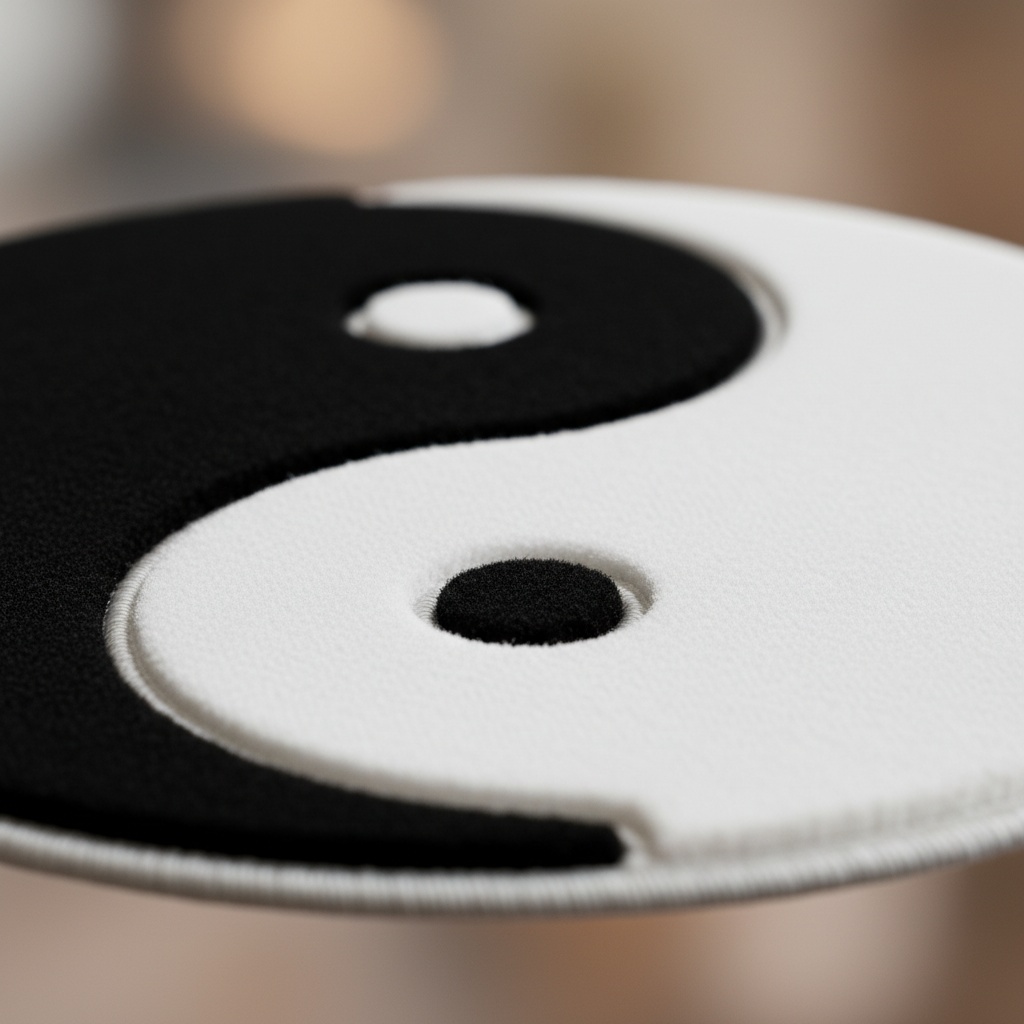
Texture and raised edges of the motif
Visual Features: Taijitu Motif
The hallmark of an authentic yin yang motif rug is the presence of the true Taijitu design. This is not merely a pattern of interlocking curves but a precise composition: a circle divided into two swirling halves, one dark and one light, each containing a small dot of its opposite. A taijitu carpet should capture this perfect duality—continuous curves without distortion, and the embedded dots as integral parts of the design.

Antique Chinese – Ningxia Large Hallway Runner Wool Yellow Rug by Rugs On Net
Rugs that mimic the shape loosely, or that omit the central dots, are often “yin yang–inspired” rather than faithful representations of the ancient symbol. To answer directly: How to identify a true Taijitu rug design? Look for the continuous circle, the swirling halves, and the opposing dots, all executed with clarity and balance.
Black & White Color Tradition
The most recognized form of the black and white yin yang motif rug reflects the original symbolic contrast of yin (black, receptive, feminine) and yang (white, active, masculine). Black and white maximize visual clarity and symbolic potency, creating an unmistakable impression of duality. The color pairing is not a stylistic coincidence but an intentional representation of balance.
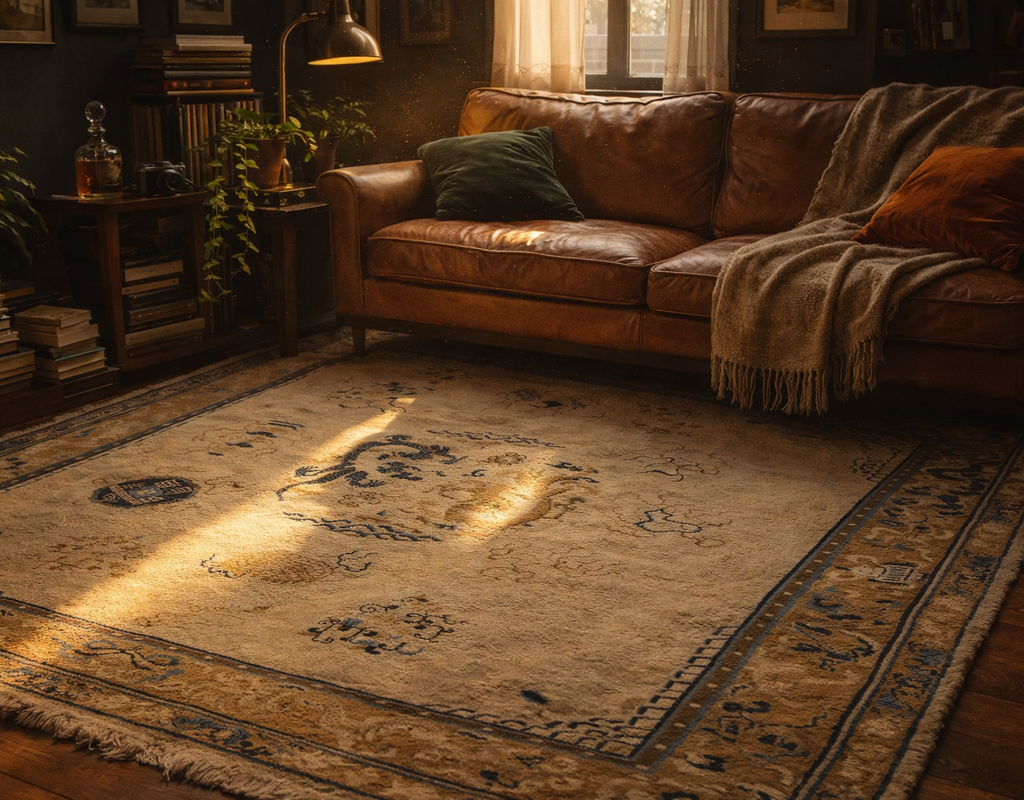
A vintage-style rug anchors this dimly lit, inviting reading nook featuring a classic leather sofa.
To address the common question: Why are yin yang rugs commonly black and white? Because the pairing most directly embodies the Taoist principle of opposites existing in harmony, with no ambiguity in their roles.
Color Variations & Feng Shui
While black and white remains the classic form, modern designs often incorporate color variations. Some rugs invert the traditional scheme—such as white-on-black dominance—which can shift symbolic meaning in feng shui practice. For example, a reversed rug may “activate” different qualities of a room, amplifying yang energy or emphasizing openness and clarity.
Other designers experiment with bold palettes like gold, red, or blue, each adding cultural or decorative nuance. In the context of feng shui yin yang decor, such choices are believed to affect the flow of energy: bright colors may invigorate, while muted tones may calm. Thus, How might color-inverted yin yang design rugs affect feng shui? They alter the balance of energy, potentially emphasizing one polarity more than the other, depending on placement and intent.
Sculpted Pile / Contrast
Many high-quality yin yang carpets employ sculpted or carved pile, where the pile height is carefully cut along the motif’s dividing curves. This technique produces sharper edges, tactile depth, and an almost three-dimensional quality. It ensures the swirling halves remain visually crisp, even from a distance.
To clarify: Does sculpted pile enhance yin yang motif rug contrast? Absolutely—it not only sharpens the motif’s definition but also allows the rug to engage both sight and touch, reinforcing the harmony of opposites through texture. A sculpted pile rug thus elevates the Taijitu from a flat symbol into a dynamic centerpiece, where balance is experienced both visually and physically.
Materials, Construction & Techniques
Wool, Silk, Cotton, Other Fibers
The most traditional wool yin yang pattern rug comes from Chinese and Tibetan weaving practices, where durable, lanolin-rich wool provided both resilience and warmth. Silk versions, often rarer and more luxurious, were prized for their sheen and ability to highlight the crisp curves of the Taijitu.
Cotton was typically reserved for the warp and weft foundation, giving structure rather than surface presence.
To answer directly: What materials are usually used for handmade yin yang motif rugs? Wool is the most common, silk the most luxurious, and cotton often the unseen support. These natural fibers ensure both symbolic authenticity and lasting quality.
Hand-Knotted Rugs & Knot Density
An authentic hand-knotted yin yang design carpet requires meticulous craftsmanship to capture the smooth curves of the design. Knot density—measured in knots per square inch—is critical. A higher density of 80–100+ knots per square inch allows for sharper, flowing lines without distortion. Lower densities may blur the circle or lose detail in the swirling halves.
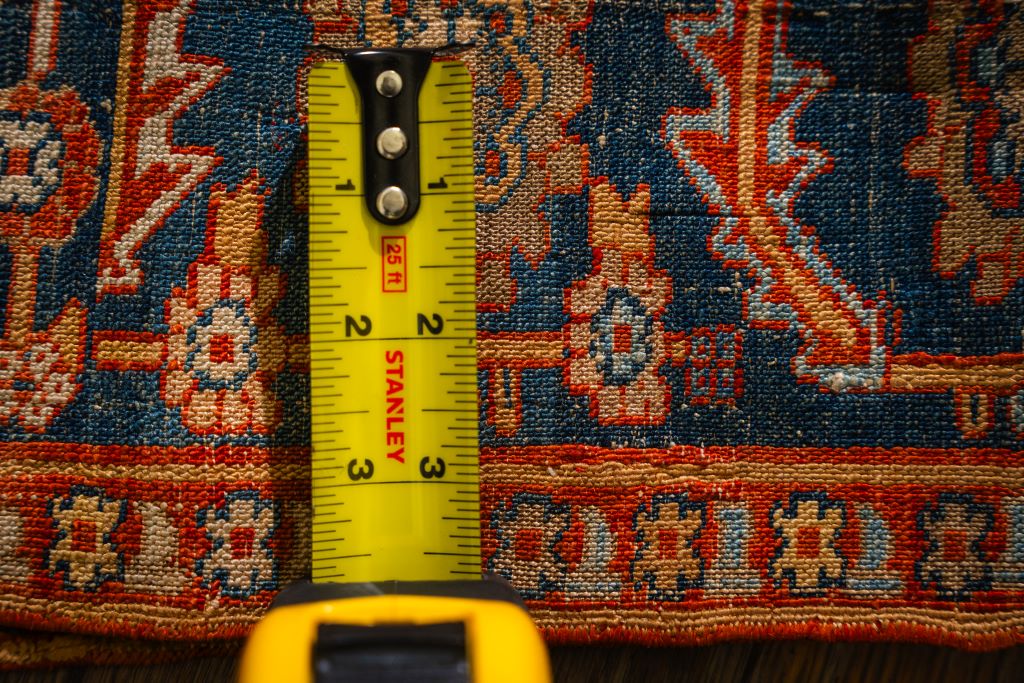
A detailed inspection of a richly colored oriental rug pattern while measuring its dimensions.
However, the intensive labor and skill required mean that Why are hand-knotted yin yang rugs rarer today? Because they are costly and time-consuming, with most contemporary production shifting to quicker tufting or machine methods. Collectors and connoisseurs still regard hand-knotting as the gold standard, especially when clarity and cultural authenticity matter.
Tibetan & Chinese Knotting Styles
Chinese and Tibetan weavers historically used distinct knotting traditions to interpret the yin yang motif. Chinese rug-making often relied on the symmetrical (Turkish) knot, prized for precision, while Tibetan weaving employed the Tibetan knot, which uses a rod and produces a thicker, denser pile. Both techniques allowed artisans to render the motif with symbolic fidelity, though Tibetan rugs often emphasized a bolder, more tactile surface compared to the refined smoothness of silk or fine Chinese wool versions.
Hand-Tufted Rugs
For buyers seeking affordability, the hand-tufted yin yang rug is a practical alternative. Instead of tying knots, artisans use a tufting gun to punch yarn into a stretched canvas, later securing it with a glued backing.
The process is faster and less costly than hand-knotting, but the tradeoff is durability—tufted rugs generally last fewer decades. To clarify: How is a yin yang motif rug hand-tufted? Yarn is mechanically punched into fabric using a tufting tool, then secured with backing, producing a design-rich surface that mimics knotted rugs at a fraction of the price.
Shag & Rya Construction
The vintage shag yin yang motif rug, particularly Scandinavian rya examples from the mid-20th century, is distinct for its long, plush pile. These rugs emphasize tactile depth, with the yin yang curves appearing soft and abstracted in texture.
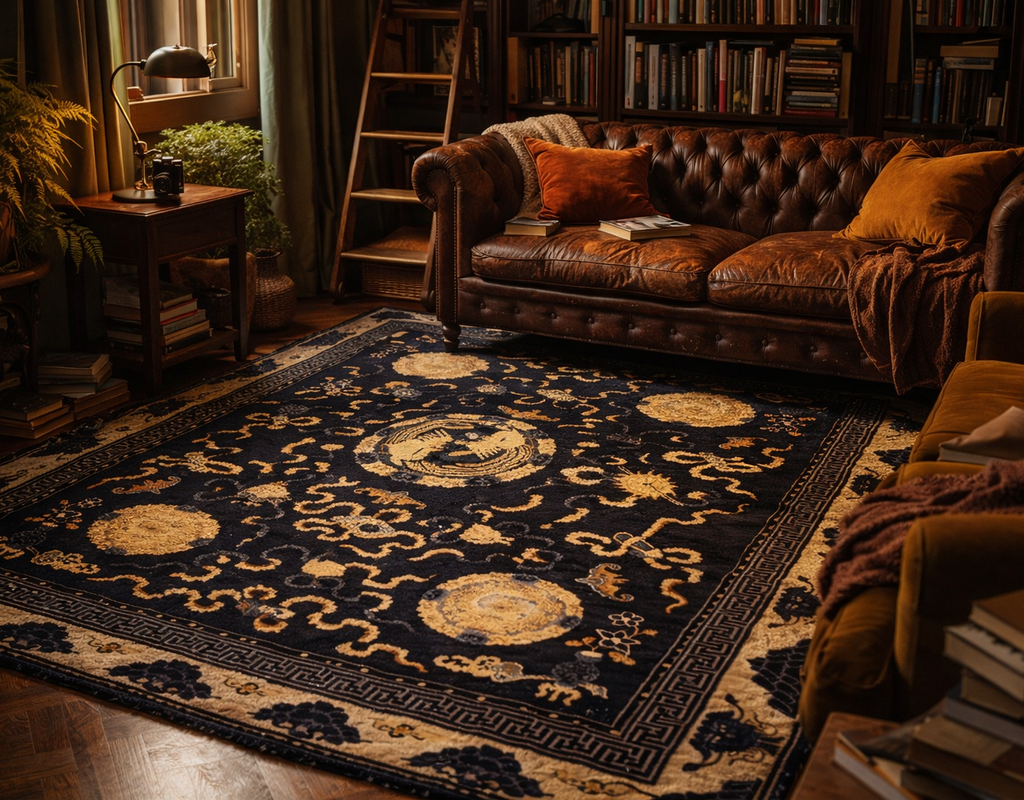
A moody and sophisticated library space warmed by the contrast of a dramatic dark blue and gold rug against distressed leather furniture.
By contrast, modern shag or machine-made versions tend to have shorter pile, less lanolin-rich wool (or synthetic fibers), and flatter execution of the motif. To answer: How do vintage shag yin yang rugs differ from modern ones? Vintage rya rugs were handwoven, denser, and made of natural wool, while modern versions are typically lighter, less textured, and often synthetic.
Machine-Made & Eco Concerns
Today’s machine-made yin yang motif rug is widely available and usually crafted from synthetics such as polypropylene, nylon, or polyester blends. They offer affordability and uniformity but sacrifice the depth and authenticity of handmade artistry.
Their environmental footprint is mixed: Are machine-made yin yang rugs environmentally friendly? Not always. Eco-friendliness depends on the fibers, dyes, and especially the backing used. Synthetic backings and chemical-heavy dyes raise sustainability concerns, while rugs made from recycled or responsibly sourced fibers represent more eco-friendly rug options.
Outdoor / Performance Rugs
The yin yang motif has even extended to outdoor living spaces. Made primarily from weather-resistant polypropylene, outdoor yin yang performance rugs resist moisture, mildew, and sun fading. These are especially suited for patios, porches, or high-traffic entryways.
To clarify: When should I choose an outdoor yin yang performance rug? When you want durability in exposed or heavy-use environments where natural wool or silk would degrade. They balance practicality with the symbolic design, ensuring harmony is carried beyond indoor décor.
Style, Decor & Buying Guide
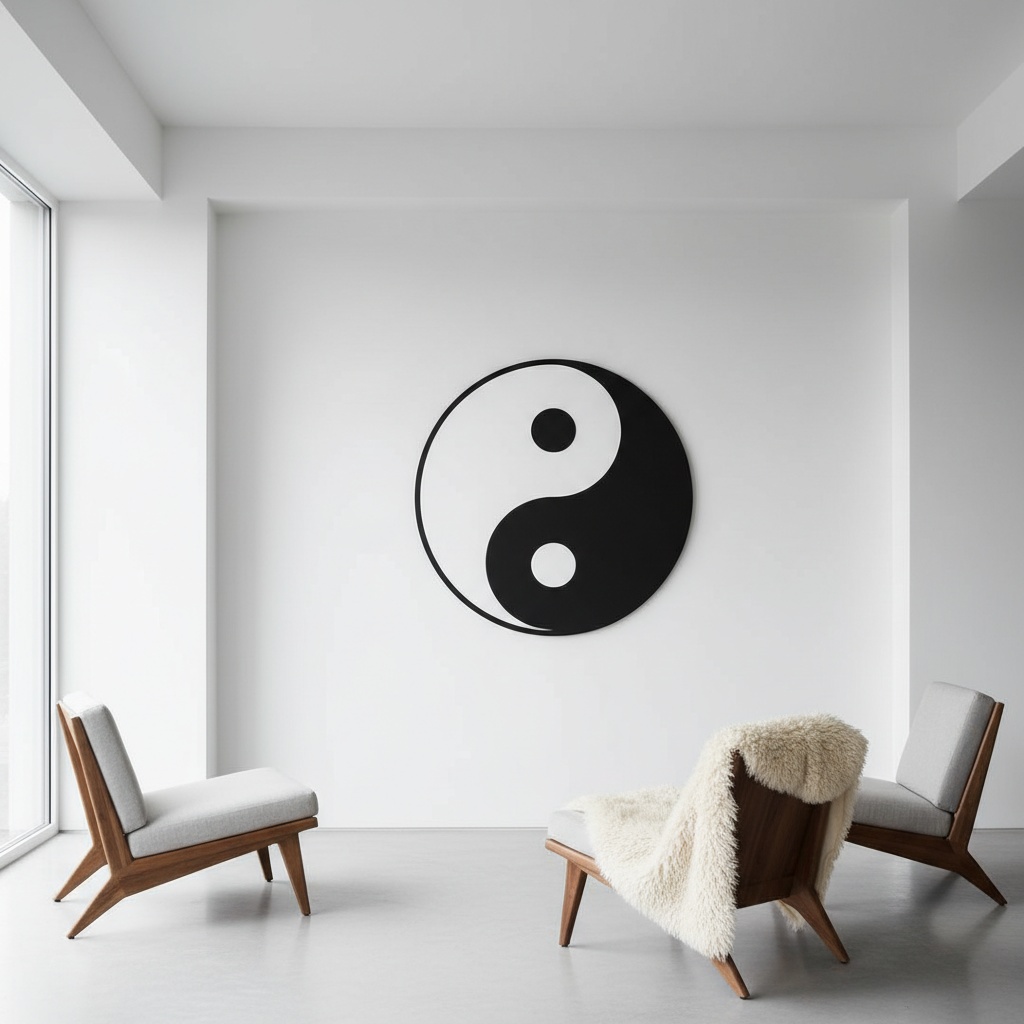
Modern decor featuring a prominent yin yang motif.
Yin Yang Rugs in Minimalist and Modern Interiors
A yin yang rug for a minimalist home offers clean geometry and balanced symbolism, making it a natural fit for contemporary spaces. The motif’s simplicity aligns with the uncluttered aesthetic of minimalism, while its circular form softens angular furniture and stark architectural lines.
To answer directly: Does a yin yang motif rug suit minimalist décor styles? Yes—the balanced, graphic design of a modern yin yang carpet grounds interiors without overwhelming them, acting as both a focal point and a harmonizing element.
Vintage, Mid-Century & Artist-Signed Rugs
Collectors and design enthusiasts often look to mid-century Scandinavian rya rugs, where the yin yang motif was reinterpreted in shaggy, textural form. A vintage yin yang rya rug from the 1950s or 1960s combines bold modernist design with artisanal craftsmanship.
Can a mid-century yin yang rya rug appreciate in value? Absolutely—rarity, condition, and demand for Scandinavian modernism continue to drive interest. Additionally, Are artist-signed yin yang rugs good investment pieces? Yes. Rugs designed or signed by recognized textile artists often command higher resale value, blending fine art with functional design. Such pieces cross into the realm of collectible art, making them both decorative and financially promising.
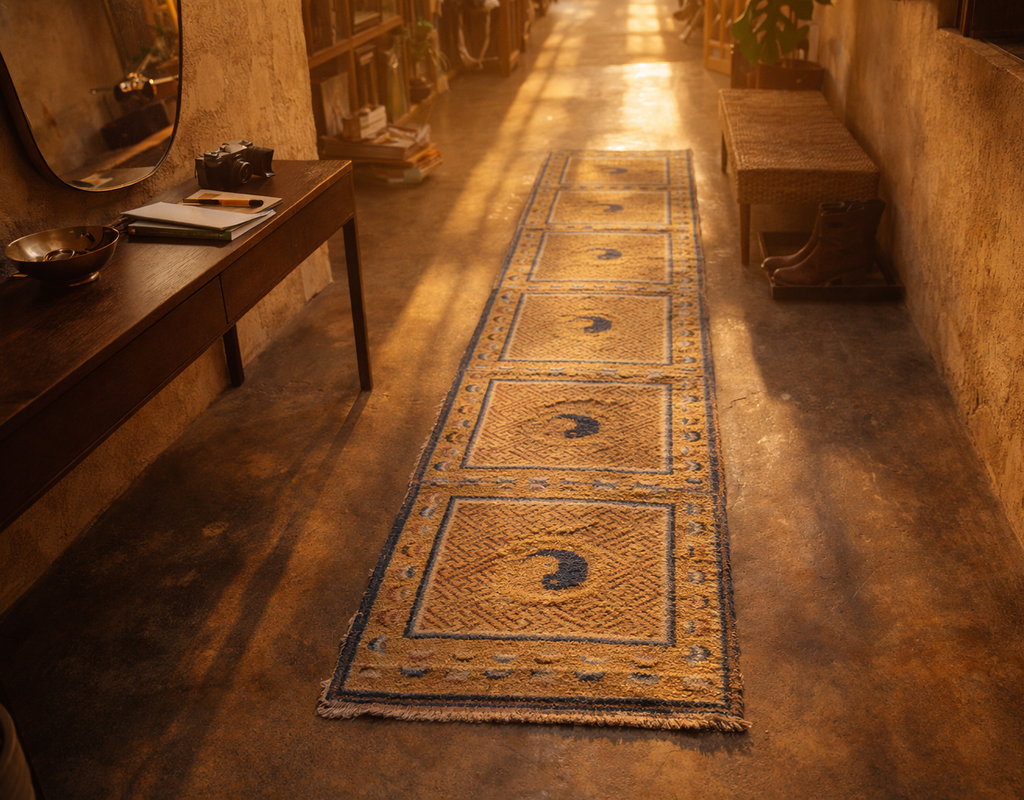
An inviting runner rug adds color and texture to this sun-drenched, rustic entryway.
Custom Sizes / Orders
The adaptability of the yin yang motif means that buyers with unique room dimensions or design visions can benefit from ordering a custom size yin yang rug. Artisan workshops often accept commissions, adjusting scale, color, and material to suit specific needs. Is a custom-size yin yang rug worth ordering? For hard-to-fit rooms, gallery-like spaces, or those seeking a truly personal statement piece, the answer is yes. Bespoke orders ensure that the motif maintains its proportions while enhancing the flow and harmony of a given environment.
Where to Buy: Budget-Friendly to Luxury
Where can I buy a budget-friendly yin yang design area rug? Mass-market retailers and online platforms offer affordable, machine-made yin yang motif rugs, making the motif accessible to a wide audience. These are ideal for casual décor or temporary use. At the higher end, antique dealers, specialized online galleries, and artisan workshops provide hand-knotted, silk, or artist-signed rug investment pieces.
People buying area rugs and seeking something between the two can explore contemporary handmade options, balancing cost with authenticity. The spectrum—from entry-level machine-woven to luxury collector carpets—ensures that there is a yin yang rug available for every budget and purpose.
Whether chosen as a modern yin yang carpet for minimalist balance, a collectible vintage yin yang motif rya for design investment, or a custom size yin yang rug for tailored interiors, the motif remains versatile, adaptable, and timeless.
Care, Cleaning & Maintenance
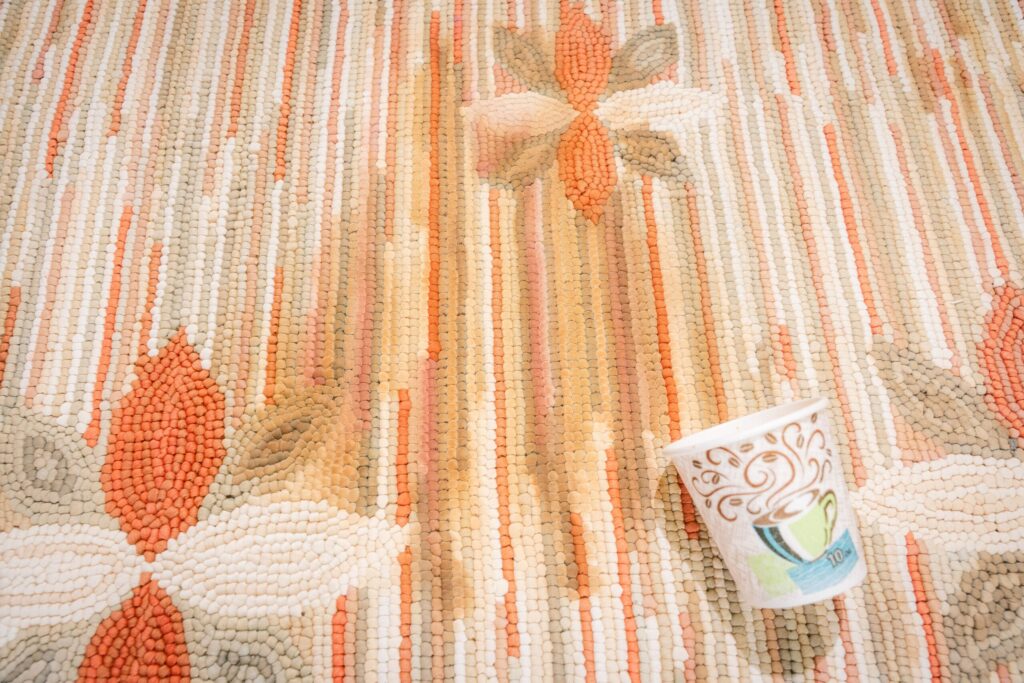
Close-up view of a tipped paper coffee cup resting on a handwoven wool rug, highlighting the rug’s dense pile, subtle color variations, and traditional geometric motifs in warm neutral and terracotta tones.
Wool Rug Cleaning & Maintenance
Proper wool rug care is essential for preserving both the durability of the fibers and the clarity of the yin yang motif. Wool’s natural lanolin provides resilience, but it can also absorb dirt and oils if neglected. To address the common question: Should I professionally clean my wool yin yang rug? Yes—professional rug cleaning is strongly recommended.
Experts use specialized methods that protect natural fibers, stabilize dyes, and maintain the crisp contrast between black and white sections. For routine upkeep, owners should vacuum lightly (without a beater bar) and rotate the rug periodically to ensure even wear. Harsh chemicals, steam, or hot water should always be avoided, as they can dull colors and weaken the foundation. Knowing how to clean a yin yang rug responsibly helps maintain its symbolic and decorative impact for decades.
Special Considerations for Sculpted/High-Pile Rugs
Sculpted or high-pile designs such as rya shags require extra attention. A cleaning sculpted pile rug involves gentle vacuuming along the motif lines to prevent fibers from matting or flattening.
Shag and rya versions may trap more dust and debris within their longer pile, demanding more frequent but careful maintenance. Occasional professional deep cleaning is advised to restore loft and preserve the visual clarity of the yin yang’s swirling halves. With mindful care, even the most tactile versions—whether sculpted or shag—retain both their texture and their powerful expression of balance.
Cultural, Symbolic & Spiritual Impact
Feng Shui, Meditation, and Wellness
- Balance in Feng Shui — A yin yang rug feng shui placement is believed to harmonize the flow of qi by balancing yin and yang energies in a room. — Why: It grounds the space with visual equilibrium, creating a supportive environment for relationships, health, and productivity.
- Meditation and Yoga Practice — As a meditation space rug, the Taijitu provides a symbolic focal point for mindfulness, reminding practitioners to embrace both light and shadow in their inner lives. — Why: The circular form anchors concentration and helps establish a calm, centered state during spiritual practice.
- Wellness and Modern Mindfulness — In wellness-focused interiors, the rug functions as a spiritual decor rug, supporting daily rituals like breathwork, journaling, or yoga. — Why: Its symbolism of harmony reinforces the pursuit of balance in mind, body, and spirit.
Yin Yang Motif Rugs as Conversation Pieces
- Cultural Storytelling — A yin yang story rug carries narratives of ancient Chinese cosmology, Taoist philosophy, and global design evolution. — Why: It sparks meaningful dialogue about heritage and the transmission of symbols across cultures.
- Artistic and Philosophical Symbol — The bold geometry of the yin yang motif is instantly recognizable, drawing attention and curiosity from guests. — Why: It transforms the rug from a mere furnishing into a conversation piece about the unity of opposites.
- Educational Value in Homes and Studios — Whether in a living room, meditation center, or yoga studio, the motif offers teaching moments about balance and harmony. — Why: It allows hosts, teachers, or homeowners to share the deeper spiritual meaning behind the design while enhancing décor.
Through feng shui alignment, mindful practice, and cultural storytelling, the yin yang motif rug transcends its role as decoration, serving as a source of peace, conversation, and spiritual resonance.
Explore a Few of Our Favorite Yin Yang Rugs
FAQ
- How do I keep a Yin Yang rug looking new long-term?
Rotate 180° every 3–6 months, use a pad, and deep-clean annually (or every 12–24 months) based on traffic. Limit strong UV to reduce fade.
- What mistakes should I avoid with a Yin Yang area rug?
Buying too small, skipping a pad, or cropping the circle. Leave 16–24″ from walls and check door clearance over the Yin Yang rug.
- Do Yin Yang rugs work in modern or minimalist spaces?
Absolutely—the high-contrast motif anchors neutral rooms. Pair a Yin Yang rug with wood, linen, and 1–2 accent colors for cohesion.
- Can I DIY a tufted Yin Yang rug?
Yes—with a tufting gun, frame, backing, yarn, and latex glue. Expect starter costs around \$300–\$600; begin with a 2’×2′ Yin Yang rug practice piece.
- Are Yin Yang bath rugs a good idea?
Yes—microfiber or chenille Yin Yang bath rugs dry fast, and TPR/rubber backings reduce slips. Typical bath sizes are \~20″×34″; hang to dry.
- Can robot vacuums handle a Yin Yang rug?
Most handle low-pile Yin Yang rugs well. Aim for ≥2,000 Pa suction and avoid thick shags or tassels that snag older models.
- Is buying a Yin Yang rug cultural appropriation?
The symbol is rooted in Chinese philosophy; respectful, informed use is generally acceptable. Learn its meaning and avoid trivializing Yin Yang rugs.
- Do Yin Yang rugs need the small dots in the design?
For symbolic accuracy, yes—the dots show each side contains the other. Minimalist Yin Yang rugs may omit them, but purists prefer both dots.
- What rug pad should I use under a Yin Yang rug?
A felt-and-natural-rubber pad prevents slips and protects floors. Avoid PVC pads on vinyl/LVP and cut the pad about 1″ smaller than the Yin Yang rug.
- Are Yin Yang rugs safe over radiant floor heating?
Yes—use low-pile wool, cotton, or flatweave synthetics and avoid thick shags. Pair the Yin Yang rug with a heat-rated pad per floor guidelines.
- Which material is best for a high-traffic Yin Yang rug?
Polypropylene resists stains and moisture; wool is durable and naturally stain-resistant from lanolin. For busy areas, choose low-pile (≤0.5″) Yin Yang rugs.
- How do I clean a black-and-white Yin Yang rug without color bleed?
Cold-wash only if the label allows, using a color-catcher sheet. Otherwise, spot-clean with wool-safe detergent and blot—never rub.
- Are Yin Yang rugs pet-friendly and easy to maintain?
Polypropylene or washable polyester Yin Yang rugs handle spills and hair well. Vacuum weekly and spot-clean immediately.
- Can Yin Yang rugs be used outdoors?
Choose polypropylene Yin Yang rugs for UV and moisture resistance. Flatweaves dry faster—shake off rain and allow airflow underneath.
- Can I use a Yin Yang rug in the dining room?
Yes—match a round table with a round Yin Yang rug and add 24–30″ clearance so chairs stay on the rug when pulled out.
- Will a Yin Yang area rug work under a coffee table?
Absolutely—use a 6′ or 8′ round for round tables and keep \~18″ past table edges. Ensure front furniture legs sit on the Yin Yang rug.
- Are Yin Yang rugs okay for kids’ rooms or dorms?
Yes—pick washable, low-pile Yin Yang rugs with non-slip backing. OEKO-TEX–certified textiles help limit harmful substances.
- Are Yin Yang rugs good for meditation or yoga rooms?
Yes—choose natural fibers and low pile for stability. A 4’–6′ Yin Yang rug neatly anchors a cushion or mat.
- How much does a Yin Yang rug cost?
Small mats run about \$20–\$100; 6’–8′ machine-made rounds \$100–\$250. Artisan wool or hand-knotted Yin Yang rugs can be \$400–\$2,000+.
- What sizes do Yin Yang rugs come in, and which should I pick?
Typical rounds are 4′, 6′, 8′, and 10′. Under a coffee table, let a Yin Yang rug extend roughly 18″ beyond the tabletop edges.
- Should a Yin Yang rug be round or rectangular?
Round best honors the symbol’s circle and avoids cropping. Common diameters are 4′, 6′, and 8′ for Yin Yang rugs.
- Do Yin Yang rugs have to be black and white?
No—any high-contrast pair works. In the classic scheme black represents yin and white yang; cream/charcoal or navy/ivory Yin Yang rugs feel softer.
- Where should I place a Yin Yang rug for good feng shui?
Use a Yin Yang rug to balance energy in calm zones—bedrooms, meditation corners, reading nooks. A 4’–6′ round works well to anchor small restorative spaces.
- Is there a correct way to orient a Yin Yang rug?
There’s no single canonical orientation; traditions vary. Many modern depictions place yang upper-left when upright—rotate a Yin Yang rug to suit room flow and intent.
- What does a Yin Yang rug symbolize in home decor?
Balance between complementary opposites (the taijitu). The two dots signify each side contains the other, suggesting harmony in a dynamic cycle.