
Introduction: The Role of Cotton in Rug-Making
Discover our premium range of soft cotton rugs designed for comfort and lasting durability.
Cotton as a Foundational and Surface Fiber in Rugs
Cotton is the most widely used natural fiber in the world, and its place in rug-making is both technical and cultural. As a foundation fiber, cotton has been pivotal for centuries because of its strength, flexibility, and widespread availability. The warp and weft threads of many handmade rugs are cotton, providing the stable base that allows intricate patterns and tight knotting to be achieved.
This technical role distinguishes it from wool, which is often chosen for pile, and silk, which is prized for sheen. Without cotton’s tensile strength, many of the world’s most iconic hand-knotted rugs—from Persian masterpieces to Anatolian village weaves—would not have been possible.
Cotton also appears as a surface fiber in the creation of flatwoven and decorative rugs. In handmade cotton rugs, the fiber offers a smooth, soft touch that absorbs dyes well, producing clear, crisp colors and patterns.
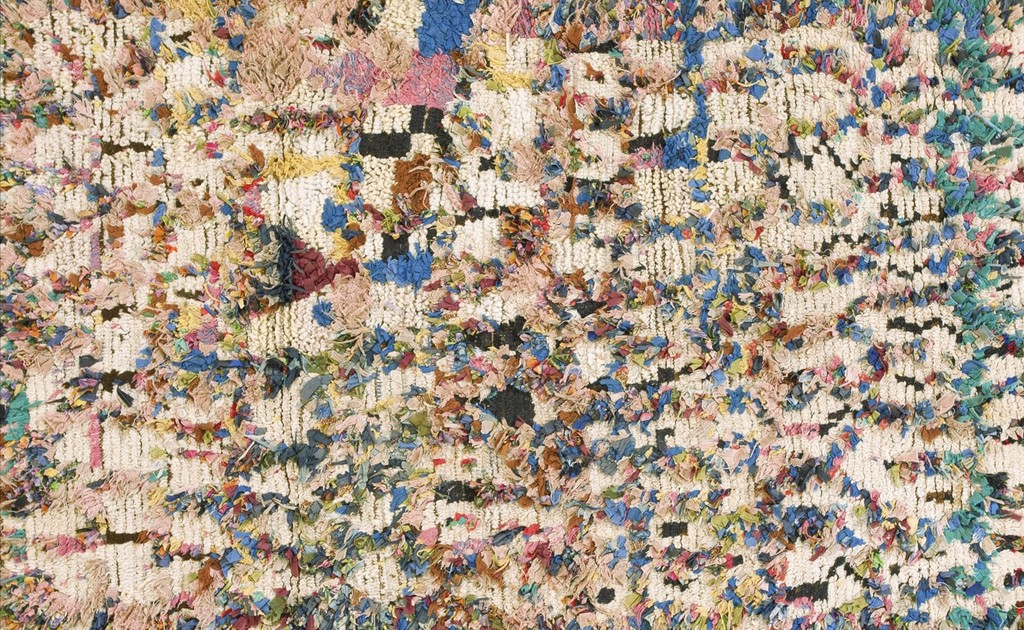
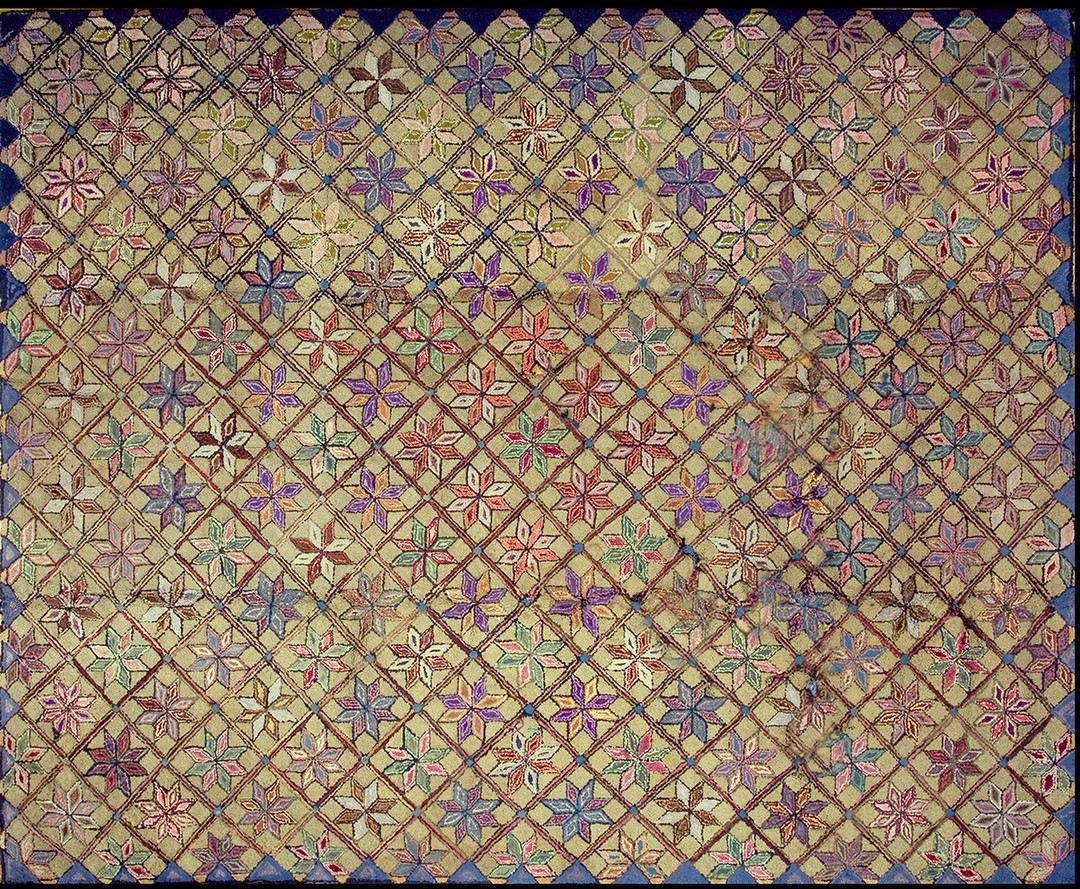
Vintage Berber Moroccan Boucherouitte Small Scatter Size Wool & Cotton Rug by Rugs On Net
In machine-made cotton rugs, the material plays a role in both structural reinforcement and visible texture, balancing affordability with comfort. Across cultures, from ancient weaving traditions to today’s industrial looms, cotton has been essential for both utility and artistry.
Why Cotton Matters Today
Cotton’s dual role—as both the unseen backbone and the visible surface—makes it unique among rug fibers. Its importance extends beyond heritage into the modern marketplace, where cotton area rugs remain popular for their affordability, versatility, and natural origin.
In an era that prizes both sustainable materials and practical durability, cotton continues to meet consumer needs across a wide range of styles. Handmade cotton rugs appeal to those seeking artisanal authenticity, while machine-made cotton rugs provide accessible options for everyday living.
Why Is Cotton So Commonly Used in Rug Making?
Cotton is so commonly used in rug making because it combines strength, workability, and abundance. It has historically been more affordable than silk and more flexible than wool, making it the perfect foundation for knotting and weaving.
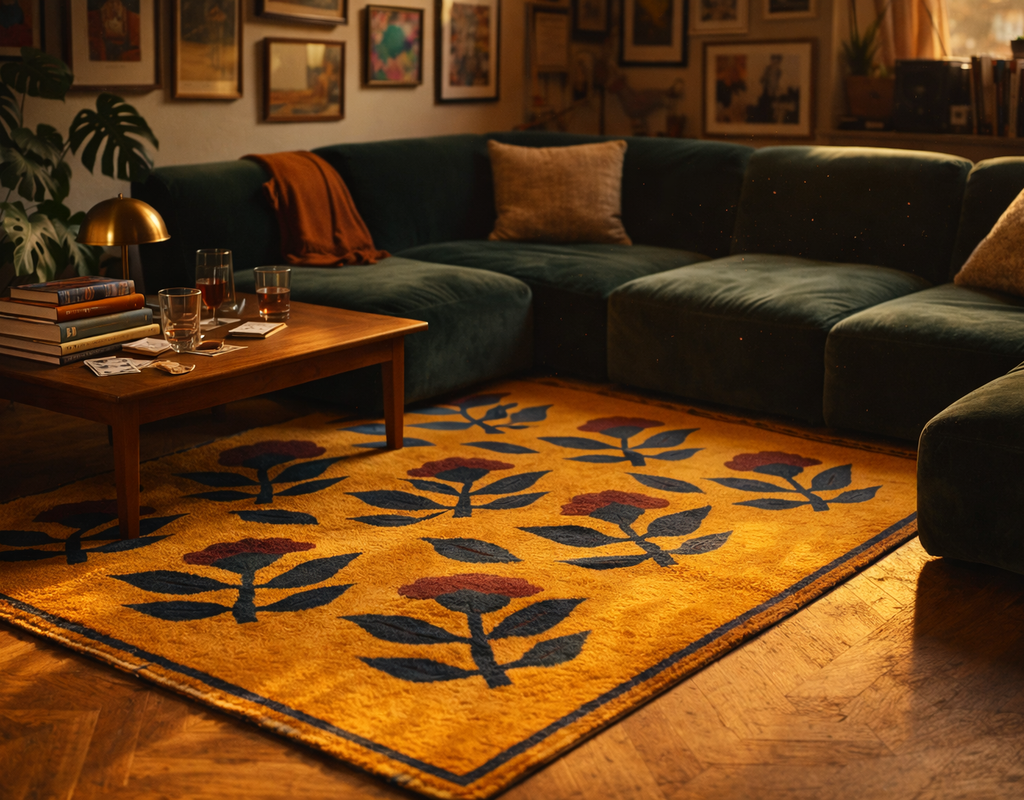
A vibrant, stylized floral rug anchors this warm and eclectic living space.
Its ability to hold tension without breaking allows artisans to produce precise, durable rugs. On the surface, cotton’s softness and dye receptivity make it ideal for flatweaves and decorative designs, ensuring it serves both practical and aesthetic purposes.
What Is a Cotton Rug?
A cotton rug is any rug in which cotton plays a visible role as the primary surface fiber. Unlike rugs that only use cotton in their warp and weft foundations, cotton rugs highlight the material on the face of the piece, whether in a handwoven kilim, a tufted bath mat, or a modern flatweave. These rugs are valued for being lightweight, breathable, and often easier to clean than wool or silk alternatives.
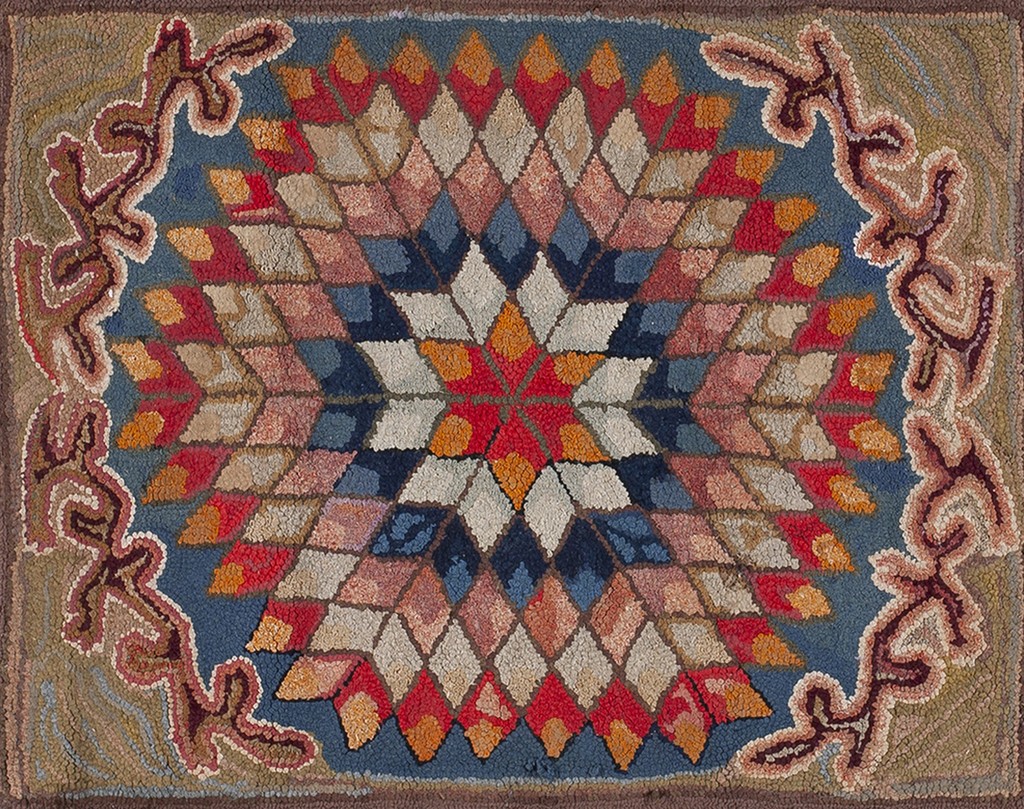
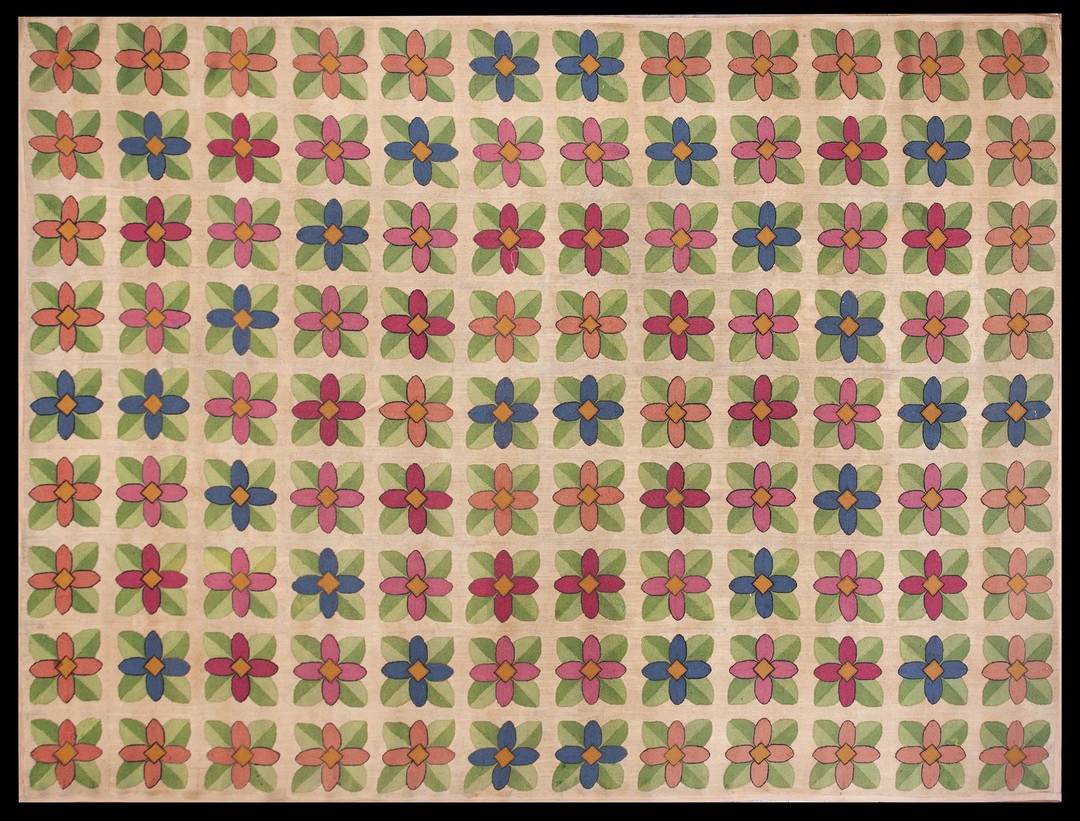
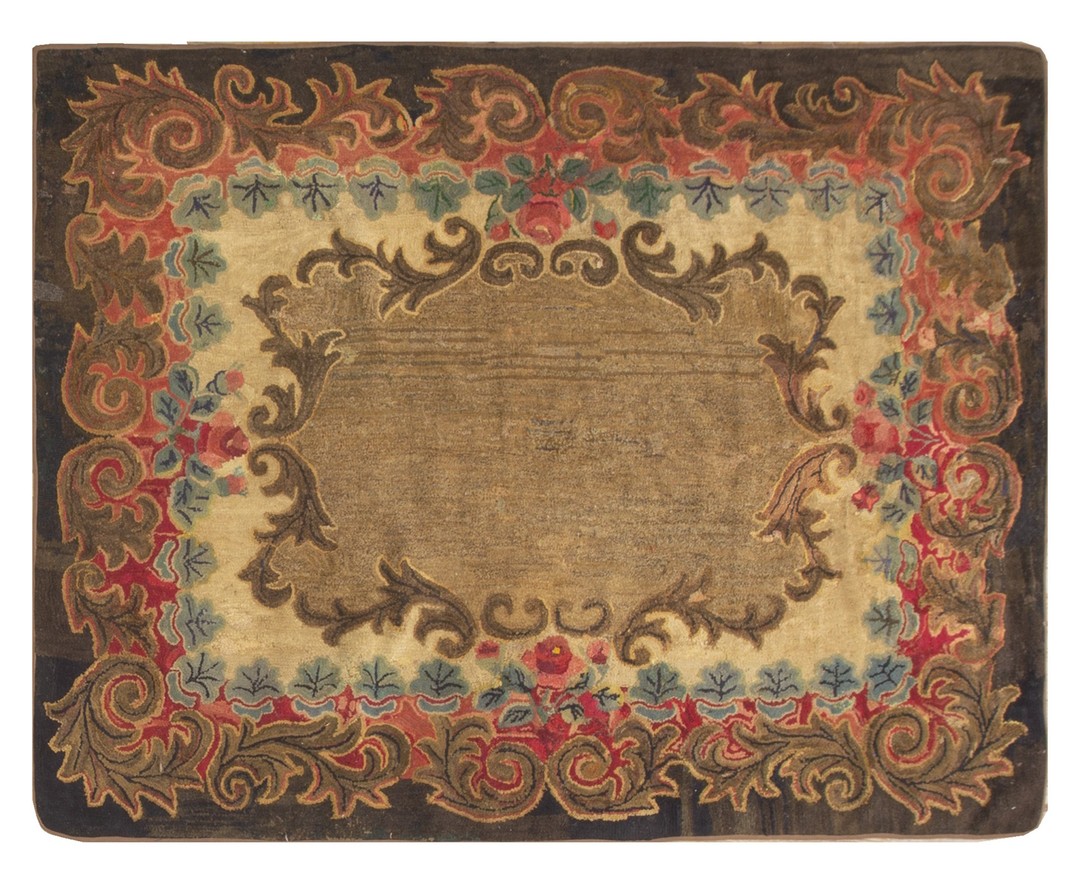
Antique American Hooked Small Scatter Size Wool & Cotton Multicolor Rug by Rugs On Net
Cotton rugs can be handmade or machine-made, appearing in contexts ranging from traditional village crafts to industrial-scale production, and they continue to hold a strong place in contemporary interiors.
Cotton Fiber: Properties, Processing, and Technical Advantages
Cotton’s Structure and Fiber Behavior
Cotton fiber is fundamentally cellulosic, composed of natural plant cellulose that makes it both strong and highly absorbent. Unlike protein-based fibers such as wool and silk, cotton is hydrophilic—it readily takes in water and holds moisture. This absorbency means that cotton rugs dry more slowly and can be susceptible to mildew if left damp, but it also ensures excellent dye penetration and vibrant coloration.
Another defining trait is cotton’s strength when wet, a property that makes it invaluable in rug foundations where the warp and weft must withstand prolonged tension on the loom. However, cotton also has low elasticity. Unlike wool, which springs back after compression, cotton fibers lack natural crimp and are less resilient.
This makes cotton less ideal for pile but highly suitable for rug backbones, where dimensional stability matters more than softness underfoot. The combination of tensile strength, dye receptivity, and affordability explains why cotton in rug making has remained so widespread across both handmade and industrial traditions.
Mercerization and Colorfastness
A key process that elevates cotton’s performance in rugs is mercerization. In this treatment, cotton fibers are immersed in a caustic soda solution under tension, which causes the fiber structure to swell and smooth. The result is mercerized cotton—shinier, stronger, and more receptive to dyes than untreated cotton. Mercerized cotton rugs exhibit brighter, longer-lasting colors, making them visually closer to silk.
Because of this luster, mercerized cotton is often marketed as “art silk” in affordable rugs, offering the luxurious look of silk without its high cost. This process also improves the fiber’s dimensional stability and resistance to shrinkage, enhancing cotton rug durability in daily use.
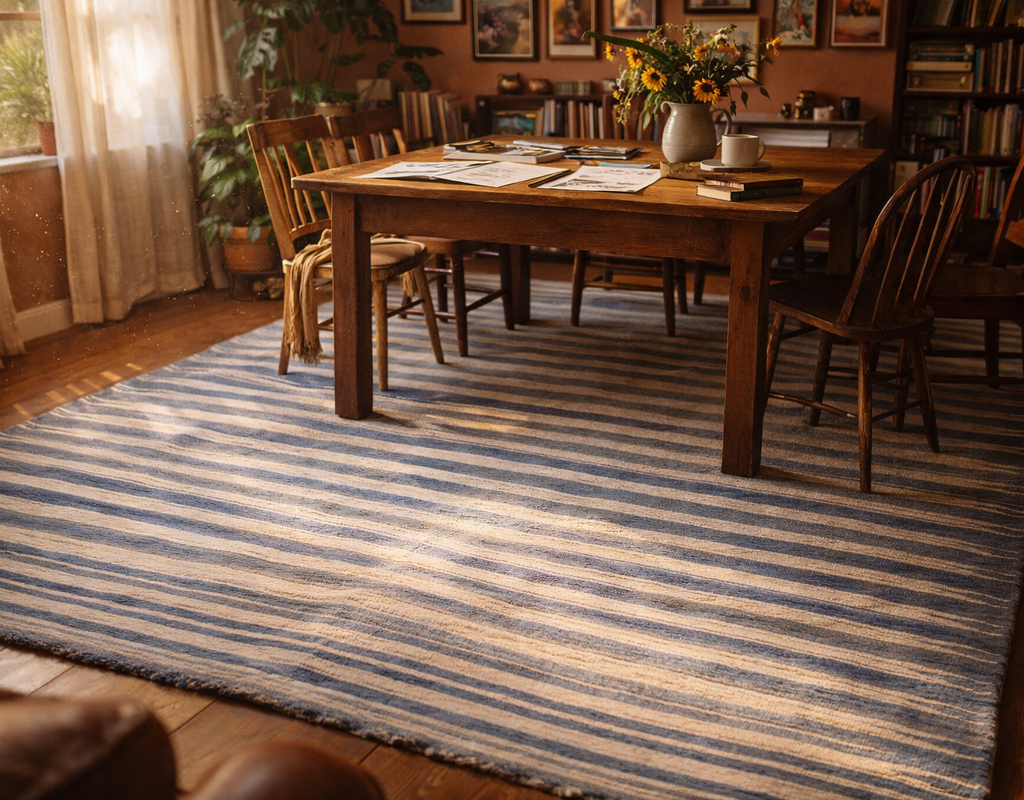
A blue and natural striped rug grounds this rustic dining space filled with natural light and wooden furniture.
When comparing mercerized cotton to regular cotton in rugs, the difference lies primarily in appearance and colorfastness. Regular cotton rugs may fade more quickly with sunlight or repeated washing, while mercerized versions retain sheen and clarity of color for longer periods.
Cotton vs. Wool: Pros and Cons
- Absorbency — Cotton absorbs more moisture than wool, making it superior for dye clarity but more vulnerable to mildew if damp. — Why: Hydrophilic cellulose in cotton versus water-repellent lanolin in wool.
- Elasticity — Wool is springier and bounces back under pressure, while cotton lacks elasticity and compresses more easily. — Why: Wool’s natural crimp provides resilience, cotton’s smooth fibers do not.
- Durability in Foundations — Cotton’s strength under tension makes it ideal for rug warps and wefts, whereas wool may stretch or weaken on the loom. — Why: Cotton maintains dimensional stability under strain.
- Surface Performance — Wool rugs generally wear longer underfoot traffic, while cotton rugs are more prone to wrinkling and fading. — Why: Wool’s protein structure resists wear, cotton fibers flatten more quickly.
- Cost and Accessibility — Cotton rugs are generally cheaper than wool rugs. — Why: Cotton is abundantly produced worldwide and easier to process than wool, which requires specialized shearing, scouring, and spinning.
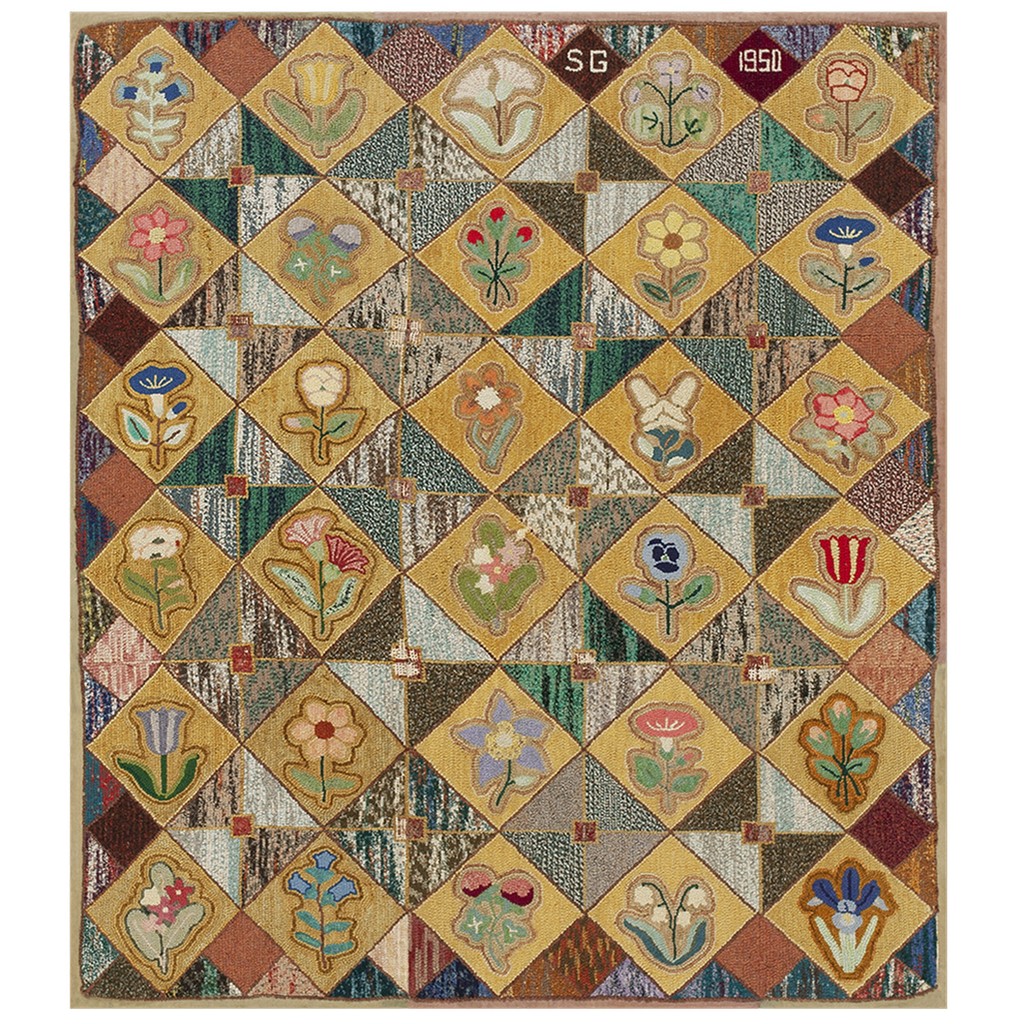
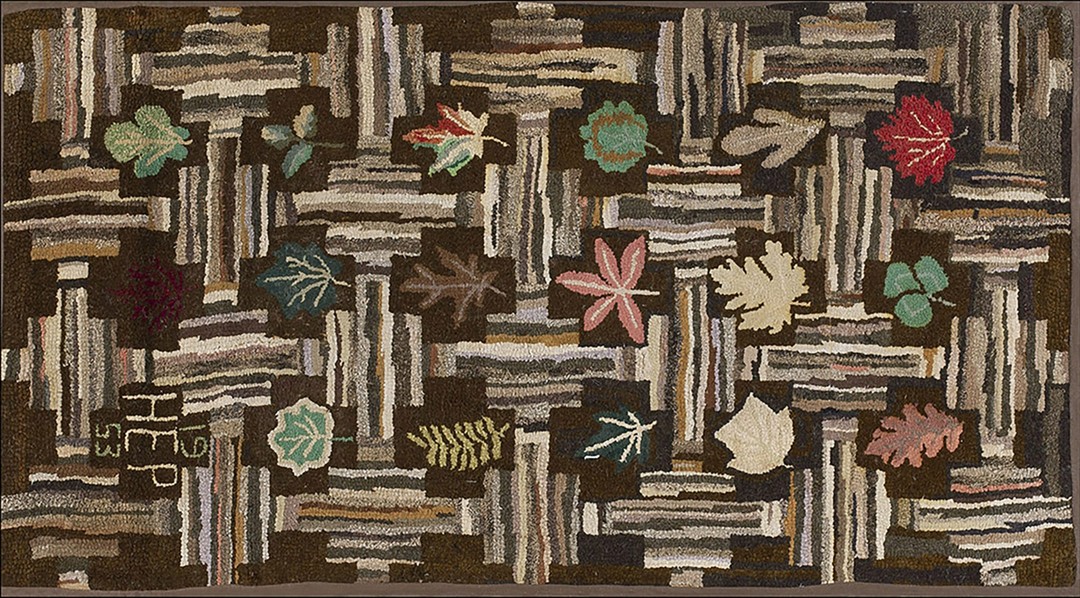
Vintage American Hooked Multicolor 1950s Rug by Rugs On Net
Cotton’s Technical Dominance
Cotton’s unique balance of strength, absorbency, and availability explains why it dominates rug foundations. Its ability to anchor complex weaving techniques has made it indispensable in Persian, Anatolian, and Indian rug traditions, and its modern adaptability ensures relevance in both handmade cotton rugs and machine-made cotton rugs today.
Whether as mercerized art silk for sheen or as sturdy warps for structure, cotton fiber properties continue to define how rugs are built and appreciated.
Cotton’s Global History & Cultural Roots
Ancient Origins and Spread
The story of cotton in rug-making begins deep in global textile history. Archaeological evidence shows that cotton was first spun and woven in the Indus Valley around the 4th millennium BCE, where early civilizations cultivated the plant for both clothing and household textiles. Parallel developments occurred in ancient Egypt, where cotton fragments have been found in Nubian sites, and in the Americas, where indigenous cultures in Peru and Mexico wove cotton centuries before European contact.
In China, cotton arrived later but was quickly integrated into broader textile traditions. These independent centers of development established cotton as a truly global fiber long before it entered the specialized world of rugs. As cotton spread through trade networks, it became prized for its cool comfort in hot climates and for its affordability compared to silk. In regions like Persia, Anatolia, and India, cotton began to complement wool and silk in the production of oriental rugs, particularly as a foundation material.
Its ability to hold dyes vividly also made it valuable in both decorative textiles and utilitarian weaves. The earliest cotton history rugs thus reflect not just technical innovation, but also the interconnected trade routes of the ancient world.
Adoption in Urban vs. Nomadic Rug Traditions
Cotton’s role in rug traditions varied sharply between urban and nomadic contexts. In settled, trade-connected cities such as Isfahan or Cairo, cotton was widely accessible through markets and workshops. Urban artisans incorporated cotton into rug foundations, enabling precise knotting and complex patterns.
The availability of cotton signified refinement and economic integration, and in many urban contexts it became a marker of craftsmanship and cultural sophistication. By contrast, nomadic and pastoral weaving traditions relied almost exclusively on wool, the fiber most readily available from their flocks. Cotton entered nomadic rugs only when trade made it accessible, often through barter in bazaars.
Thus, cotton in oriental rugs became a symbol of connection to broader economic and cultural systems—an indicator of whether a community was integrated into urban trade or remained self-sufficient with wool. Over time, this distinction cemented cotton’s association with professional workshops and urban artistry, while wool remained the mainstay of village and nomadic weaving.
Key Timeline: Evolution of Cotton in Textiles and Rugs
- Antiquity (4th millennium BCE – 1st millennium CE): Cotton emerges in the Indus Valley, Egypt, and the Americas. — Why: Early cultivation and spinning established its use as both luxury and utilitarian textile fiber.
- Islamic Golden Age (8th–13th centuries): Cotton production and weaving flourished in Persia, India, and the Middle East. — Why: Trade routes like the Silk Road spread cotton textiles, and workshops began to employ cotton in rug foundations for technical precision.
- Industrial Revolution (18th–19th centuries): Mechanized cotton spinning and weaving transformed global textile economies. — Why: Mass production lowered costs, making cotton area rugs and cotton textiles accessible across Europe and beyond.
- Modern Era (20th century–present): Cotton became central to both handmade and machine-made rugs worldwide. — Why: Rug-grade cotton is now grown in major agricultural hubs and processed industrially, balancing tradition with mass-market demand.
Cotton as Luxury and Everyday Fiber
Across ages and cultures, cotton has occupied the paradoxical position of being both a luxury and an everyday fiber. In elite urban centers, it was valued for its refinement and technical utility in producing sophisticated oriental rugs. At the same time, cotton rugs and flatweaves offered everyday households a practical, affordable textile solution.
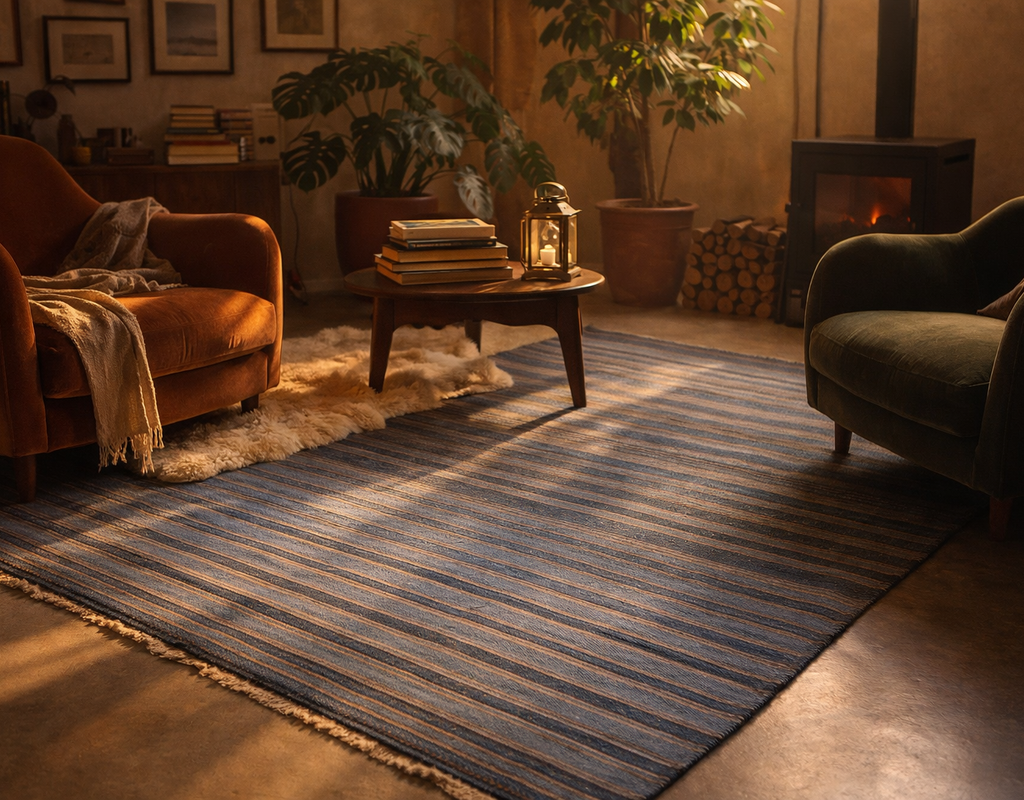
A warm and inviting space anchored by a textured, horizontally striped rug.
This duality underscores its cultural importance: cotton rug traditions reflect not only aesthetic achievements but also the rhythms of daily life.
Today’s Sources and Foundations
Most rug-grade cotton today is sourced from large-scale producers in India, Pakistan, China, and Egypt, where long-staple fibers are cultivated for strength and consistency. India, in particular, remains a global hub for both raw cotton and the weaving of handmade cotton rugs.
Cotton became a foundation material for rugs because of its ability to withstand loom tension, hold knots tightly, and provide a stable, smooth base for pile and pattern. These properties allowed artisans to create finer, more complex designs than were possible with wool foundations, cementing cotton’s place in rug-making across centuries.
Cotton’s Roles in Rug Construction
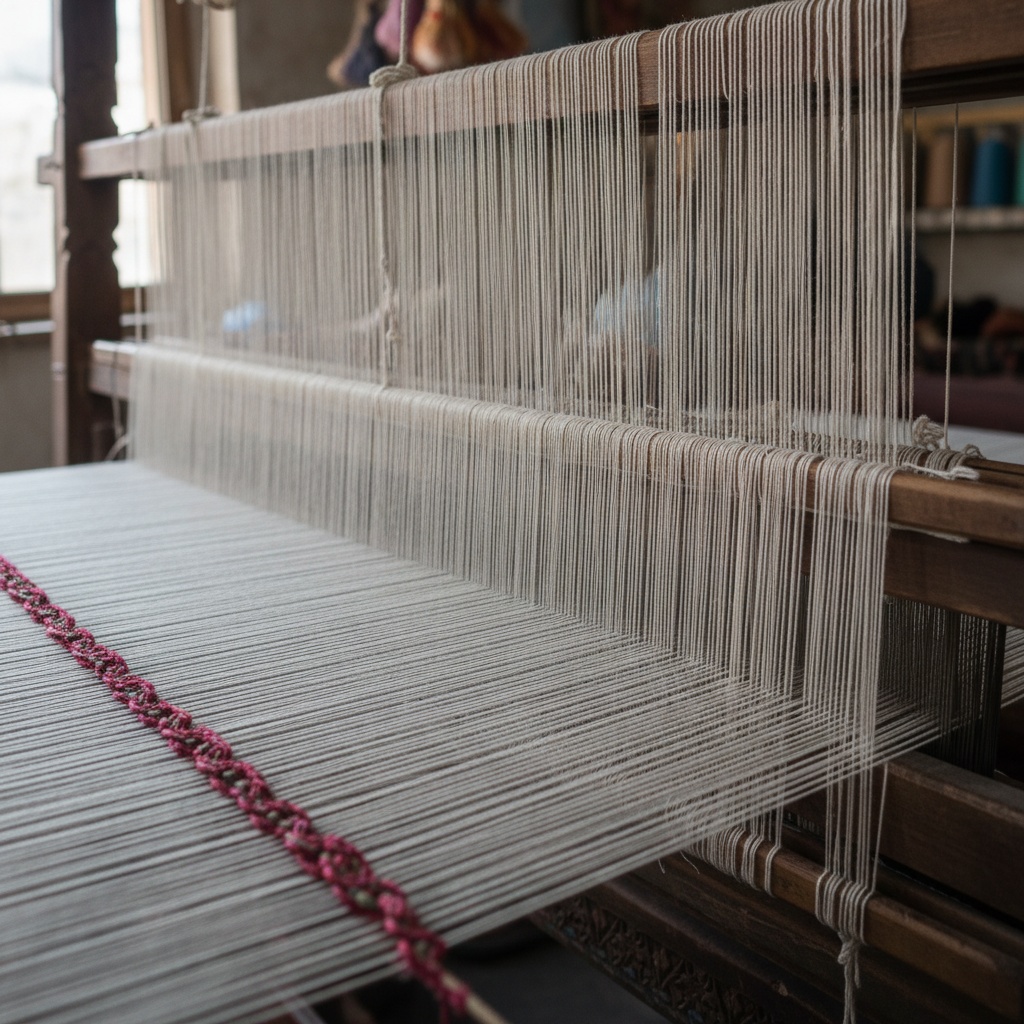
Warp threads ready for weaving on a loom
Foundation Use: Warp/Weft, Tension, and Benefits
Cotton has long been structurally prized in rug-making for its role in foundations. The warp and weft—the vertical and horizontal threads strung across the loom—often determine how straight, stable, and durable a rug will be. Cotton warp rugs and cotton foundation rugs hold tension better than wool, producing flat, even surfaces that resist warping.
This quality is critical in sophisticated weaving centers such as Tabriz or Isfahan, where artisans rely on cotton to anchor fine knotting and achieve detailed, curvilinear patterns. Cotton’s low elasticity ensures that once tightened on the loom, the warp and weft remain taut, enabling precision. Unlike wool, which can stretch or relax, cotton maintains dimensional stability, making it a foundation of choice for both handmade and machine-made rugs.
Surface Use: Cotton as Pile or Pattern Highlight
- Mercerized Cotton Pile — Cotton can be mercerized to imitate silk, used as pile fiber in cotton pile rugs for an affordable sheen. — Why: Mercerization adds luster and dye brilliance, creating “art silk” looks without the expense of real silk.
- White Highlights in Kilims and Sumaks — Cotton is often introduced into patterned flatweaves for sharp white detailing. — Why: Its brightness and smooth finish contrast with wool, enhancing motifs.
- Hooked and Rag Rugs — In American hooked rugs, strips of cotton form surface loops or braids. — Why: Cotton’s abundance and flexibility made it a practical household fiber in folk traditions.
- Full Cotton Flatweaves — Cotton may serve as both warp and weft in lightweight rugs. — Why: Produces a breathable, reversible fabric ideal for summer or warm climates.
Iconic Cotton Rug Styles
- Dhurrie Rugs — Traditionally woven in India, dhurries are often 100% cotton, with warp and weft interlaced in flatweave construction. — Why: Lightweight, reversible, pest-resistant, and easy to fold or transport, dhurrie rugs are especially popular for summer use and casual interiors.
- Kilim Rugs — Woven across Anatolia, the Balkans, and Persia, kilims often use cotton in the warp while wool forms the weft and patterns. — Why: Cotton warp rugs produce a stable, tight base, while the fiber’s whiteness provides crisp contrast in geometric motifs. Cotton kilim rugs remain popular in summer homes because they are thin, breathable, and cool underfoot.
- Sumak Rugs — This decorative weft-wrapping technique sometimes incorporates cotton foundations for clarity of design. — Why: Cotton helps define the linear, tapestry-like appearance of sumak weaving.
- Hooked & Rag Rugs — Common in American folk traditions, these rugs recycle cotton scraps as loops or strips. — Why: Cotton’s availability and versatility made it a democratic, sustainable material for rural households.
Cotton Flatweave Rugs: Function and Appeal
A cotton flatweave rug is a textile where cotton forms the warp, the weft, or both, and no pile is used. Instead of knots, the design comes from interlaced threads, creating a thin, lightweight surface. Cotton flatweave rugs such as dhurries are breathable, portable, and practical in warm weather, making them enduring favorites in summer residences and coastal homes.
How Dhurrie Rugs Are Made
Dhurrie rugs are woven on horizontal or vertical looms using interlaced cotton warps and wefts, often producing bold stripes or geometric patterns. Because they are flatwoven, the rugs are reversible and free of pile, giving them a clean, minimal texture. Their all-cotton construction ensures they stay cool, resist pests, and fold easily for storage or transport.
By serving both as the hidden foundation and as the visible surface, cotton demonstrates its versatility in rug-making. Iconic forms like dhurries and kilims showcase how cultures across the world have leveraged cotton’s technical strengths for both artistry and function.
Modern Cotton Rugs: Types, Trends, and Buying Considerations
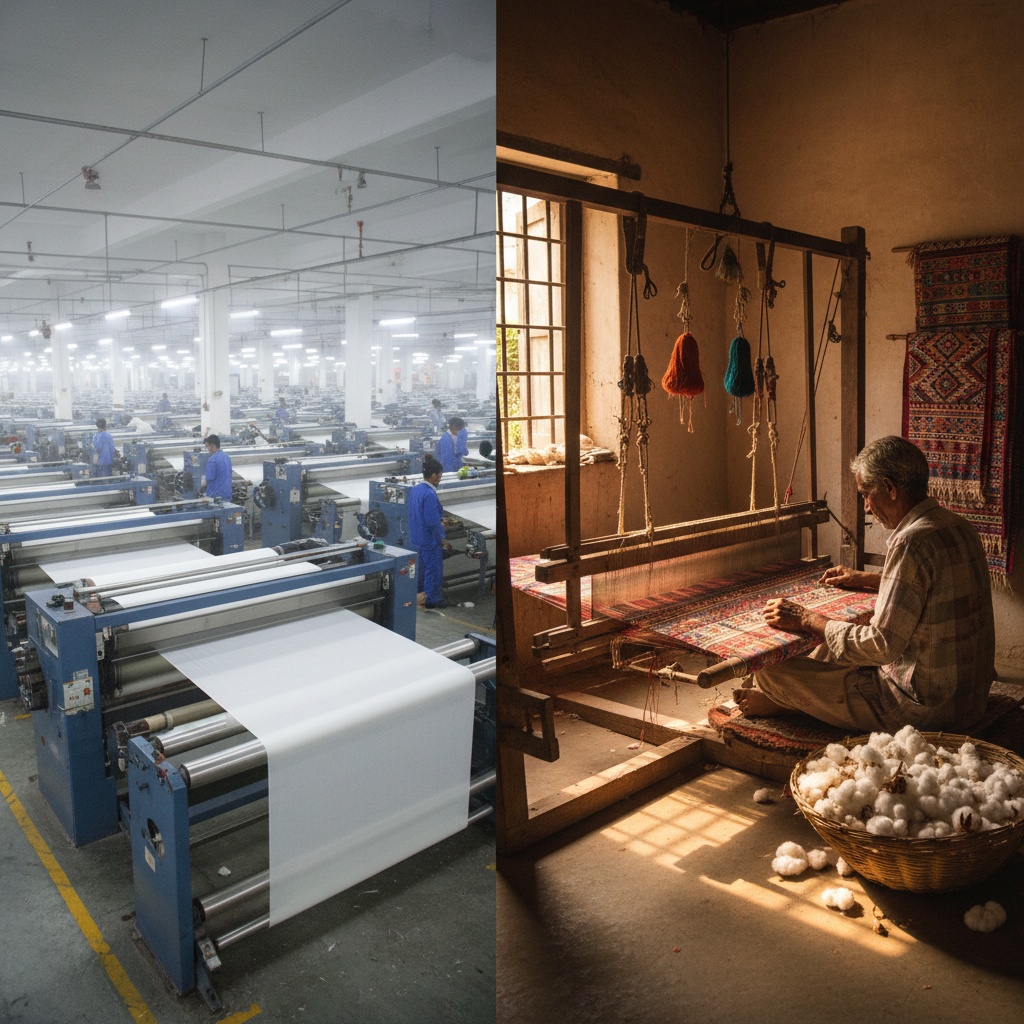
Contrasting modern machinery with traditional weaving methods.
Machine-Made vs. Handmade Cotton Rugs
- Machine-Made Cotton Rugs — Produced quickly and at scale, machine-made cotton rugs are widely available in global markets. — Why: They are affordable, consistent in pattern and size, and cater to households looking for practical, everyday solutions without the higher cost of artisan work.
- Handmade Cotton Rugs — Dhurries, kilims, and other flatweaves continue to be handwoven using traditional techniques. — Why: Handmade cotton rugs carry more character, cultural authenticity, and durability compared to machine-made versions, making them desirable for buyers who value craftsmanship.
Washable and Low-Maintenance Cotton Rugs
- Machine-Washable Cotton Rugs — Many cotton rugs, particularly small formats such as bath mats, nursery rugs, and lightweight flatweaves, can be cleaned in a standard washing machine. — Why: Their absorbency and lightweight construction make them easy to launder, unlike wool or silk rugs. This convenience has fueled demand for washable cotton rugs in modern homes.
- Low-Maintenance Appeal — Cotton’s breathability and reversible flatweaves make it simple to maintain with regular vacuuming or spot cleaning. — Why: For summer homes, casual spaces, or family-friendly interiors, cotton rugs provide practical elegance without the upkeep required by high-pile or delicate fibers.
Cotton Rug Pricing vs. Wool and Synthetics
- Affordable Cotton Rugs — Cotton rugs generally cost less than wool because cotton is more abundant and easier to process. — Why: Wool requires shearing and specialized cleaning, while cotton is harvested and spun on an industrial scale, lowering costs.
- Designer Cotton Rugs vs. Synthetics — Some cotton rugs, especially designer or artisan pieces, cost more than synthetic options. — Why: While synthetics can be mass-produced cheaply, handmade cotton rugs or those made with mercerized cotton (“art silk”) reflect craftsmanship, better dye quality, and sustainable materials.
- Handmade Rug Costs — A handmade cotton rug can range from under $100 for simple dhurries to several hundred dollars for fine kilims or larger artisan pieces. — Why: Costs depend on labor, weaving density, design complexity, and provenance.
Global Sourcing Today
Most rug-grade cotton is sourced from India, Turkey, and China, which dominate global textile production. India, in particular, leads in both raw cotton and handwoven rug exports, continuing centuries-old traditions of dhurrie and kilim production. Turkey is well-known for kilims and artisanal flatweaves, while China contributes significantly to machine-made cotton rugs at mass-market scale.
Increasingly, buyers are asking where are cotton rugs made, with sustainability and fair-trade certifications becoming selling points. Concerns over water-intensive farming and pesticide use in cotton have encouraged shifts toward organic and sustainable cotton in rug manufacturing.
Buying Considerations for Modern Homes
Cotton rugs remain an affordable, practical choice for contemporary interiors. Washable cotton rugs are popular for nurseries, kitchens, and casual living areas, while handmade cotton rugs like dhurries and kilims offer cultural depth with easy upkeep.
Designer cotton rugs demonstrate that even a traditionally affordable material can command higher value when sustainability, craftsmanship, and artistry are emphasized. Today, the cotton rug market reflects both mass production and artisanal heritage, giving buyers options across price points, styles, and ethical priorities.
Performance & Care of Cotton Rugs
Softness and Comfort
Soft cotton rugs are known for their light, cool, and breathable texture underfoot. While they lack the dense plushness of thick wool rugs, they provide a smooth, hypoallergenic surface that feels comfortable in barefoot areas like bedrooms, nurseries, and summer living rooms.
Compared to synthetics, cotton delivers a more natural, skin-friendly touch without static or chemical finishes. For buyers seeking comfort and simplicity, cotton rugs offer understated softness and everyday ease.
Durability for High-Traffic Areas
- Moderate Durability — Cotton rug durability is best suited for low- to medium-traffic spaces such as bedrooms or casual living rooms. — Why: Cotton fibers lack the spring and resilience of wool, so rugs may flatten or fray more quickly in hallways or entryways.
- Not Ideal for Heavy Wear — Cotton rugs are less durable than wool or synthetics in high-use rooms like family rooms or busy foyers. — Why: Frequent foot traffic accelerates soiling, fading, and edge wear.
- Best Use Cases — They excel in spaces where softness, washability, and affordability matter more than long-term endurance. — Why: A balance of comfort and practicality makes them great for rotating seasonally or as secondary rugs.
Cleaning: Washing, Spot Cleaning, Stain Issues
- Machine Washing — Many small and medium cotton rugs can be machine washed, provided their weave and size allow. — Why: Washable cotton rugs make upkeep simple for families and pet owners.
- Spot Cleaning — To spot clean a cotton area rug, blot stains with a cloth dipped in mild detergent and water, avoiding oversaturation. — Why: Cotton absorbs moisture quickly; excess water can cause shrinkage or mildew.
- Stain and Moisture Sensitivity — Cotton rugs can stain easily from spills and are prone to mildew if not dried properly. — Why: Their hydrophilic fiber structure locks in liquids unless blotted and dried quickly.
Common Issues: Shrinking, Fading, Mildew, Fraying
- Shrinking — Cotton rugs should be air-dried, never tumble-dried. — Why: Heat causes cotton fibers to contract, leading to distortion or reduced size. Air dry cotton rugs flat to preserve shape.
- Fading — Cotton dyes may fade faster than wool, especially under direct sunlight. — Why: Cellulosic fibers hold color vividly but are less UV-resistant.
- Mildew — Moisture retention can lead to mildew if rugs are not thoroughly dried after washing. — Why: Cotton’s absorbency makes ventilation and sun-drying essential.
- Fraying — Edges may unravel faster than in wool rugs. — Why: Cotton lacks the natural elasticity and resilience of crimped wool fibers.
Best Practices for Cotton Rug Care
Cotton rug care requires balancing its strengths—softness, washability, comfort—with proactive maintenance. Always air dry cotton rugs after washing to prevent shrinkage.
Spot clean quickly to minimize stains, and avoid steam cleaning, as high heat and water saturation can shorten the rug’s lifespan. With proper care, cotton rugs remain practical, affordable, and comfortable choices, even if they are less durable than heavier wool or synthetic counterparts.
Eco-Friendliness, Sustainability & Fair Trade in Cotton Rugs
What Makes Cotton Rugs Eco-Friendly?
Cotton rugs are often considered eco-friendly because the fiber is natural, renewable, and biodegradable. Unlike petroleum-based synthetics, cotton breaks down naturally at the end of its lifecycle, reducing long-term waste. Eco-friendly cotton rugs can also be made with recycled or organic cotton, lowering the environmental footprint further.
Recycled cotton rugs give new life to textile waste, a practice embraced by major global brands like IKEA, while organic cotton rugs avoid harmful pesticides and synthetic fertilizers, making them healthier for both consumers and farming communities. These attributes make cotton one of the most sustainable fibers for rugs when responsibly sourced.
Organic vs. Conventional Cotton
- Organic Cotton Rugs — Made from cotton grown without synthetic pesticides, herbicides, or fertilizers. — Why: They reduce chemical runoff, protect soil health, and support biodiversity while offering consumers a hypoallergenic, chemical-free option.
- Conventional Cotton Rugs — Produced using large-scale farming practices that often involve pesticides and heavy water use. — Why: While conventional cotton is less expensive and widely available, it has a larger ecological footprint, especially in water-scarce regions.
- Sustainability Impact — Organic cotton is generally more sustainable than conventional cotton, though it costs more. — Why: Certified organic production prioritizes reduced environmental impact, but lower yields raise prices for buyers.
Fair Trade and Ethical Sourcing
Fair trade cotton rugs and those certified by organizations such as GOTS (Global Organic Textile Standard) or BCI (Better Cotton Initiative) guarantee that environmental and social standards are upheld throughout the supply chain. Fair trade ensures that farmers and weavers receive fair compensation and work under ethical labor conditions, while certifications emphasize reduced pesticide use and better water management.
These measures can raise rug prices, but the premium reflects transparency, sustainability, and worker welfare. Buyers asking if fair-trade cotton increases a rug’s price should know the answer is yes, but the added cost supports ethical sourcing and long-term ecological benefits.
The Future: Sustainable Practices and Innovations in Cotton Rugs
The future of sustainable cotton rugs lies in scaling initiatives like the Better Cotton Initiative, which aims to cut water and pesticide use by up to 50%. Recycled cotton blends will likely grow in popularity, addressing waste while making affordable sustainable cotton rugs more accessible.
Designers are also experimenting with low-impact dyes, circular production systems, and rug take-back programs to close the loop on textile waste.
For consumers, paying extra for organic cotton rugs is increasingly framed not just as a personal choice, but as a way to support broader environmental and social change.
Key Takeaway for Buyers
Eco-friendly cotton rugs offer renewable comfort with reduced environmental costs, especially when made from organic or recycled fibers. While sustainable cotton rugs and fair trade cotton rugs may cost more upfront, they represent a conscious investment in cleaner production, fair wages, and long-term ecological balance.
For eco- and health-conscious homeowners, the trade-off between affordability and responsibility increasingly makes sense: choosing sustainable options aligns interior décor with values of stewardship and care.
Explore a few of our favorite cotton rugs
FAQ
- How much do cotton rugs cost?
Small cotton rugs often run \$20–\$100; mid-sizes \$80–\$250; many 8×10 cotton flatweaves land roughly \$150–\$600, depending on weave, brand, and pattern.
- Cotton rugs vs jute or polypropylene—when choose cotton?
Choose cotton rugs when you want softness, washability, and indoor comfort. Pick jute for rustic texture (dry spaces) or polypropylene for outdoor/weather resistance.
- Cotton rugs vs wool rugs—what’s the trade-off?
Cotton rugs are softer-priced, washable, and lighter; wool is more durable, stain-resistant, and longer-lasting. For heavy traffic, wool wins; for easy washing, cotton shines.
- Are cotton rugs eco-friendly and microplastic-free?
Cotton rugs are plant-based and don’t shed persistent microplastics. Prioritize GOTS or OEKO-TEX® labels for safer dyes and finishes.
- Will cotton rugs slide, and how do I stop it?
Thin cotton runners can slip. Add a grippy natural-rubber pad or corner grippers; avoid spray adhesives that can harm floors.
- What size cotton rug is right for a living room?
Common picks are 8×10 feet for a standard sofa (front legs on) and 9×12 feet for larger rooms. Ensure at least the front furniture legs sit on the cotton rug.
- What size cotton rug fits under a dining table?
For cotton area rugs under dining sets, allow about 24 inches beyond the tabletop on all sides so chairs stay on the rug when pulled out.
- How often should I vacuum and rotate cotton rugs?
Vacuum weekly (beater bar off on flatweaves) and rotate every 3–6 months to even out wear and sun exposure.
- How do I remove stains from a cotton rug?
Blot immediately; then treat with cold water + mild detergent (or oxygen cleaner if colorfast). Rinse, blot dry, and air-dry flat—never scrub or use hot water.
- Are cotton rugs suitable outdoors?
Cotton rugs are best on covered porches only; they absorb moisture and can mildew. For uncovered areas, pick outdoor synthetics and bring cotton rugs inside when wet.
- Can cotton rugs go over radiant floor heating?
Yes—choose thin, breathable cotton flatweaves and a pad labeled safe for radiant heat. Avoid thick foam or rubber backings that trap heat.
- What rug pad works best under a cotton rug on hardwood?
Use a felt + natural-rubber pad (grip + cushion) cut 1–2 inches smaller than the rug. Avoid PVC pads that can damage finishes.
- Can robot vacuums handle cotton rugs and fringe?
Flatweave cotton rugs are robot-friendly; fringe isn’t. Tuck or tape fringe under, and set “no-go” zones or low-suction modes to prevent snags.
- Are cotton rugs pet-friendly?
Yes—cotton rugs are comfy and washable after pet messes. Pick busy patterns/medium tones to hide fur, and use a non-slip pad to resist zoomies.
- Are cotton rugs safe for babies and allergy-prone homes?
Cotton rugs are breathable and easy to wash, a plus for nurseries and allergies. Look for OEKO-TEX® or GOTS-certified cotton to limit chemical residues.
- What are cotton chindi (rag) rugs?
Cotton chindi rugs are hand-woven from recycled fabric strips, making each piece unique and budget-friendly. Expect casual texture and easy spot-cleaning.
- What is a cotton dhurrie rug?
A cotton dhurrie rug is a reversible flatweave with no pile—thin, light, and easy to clean. It’s great under dining chairs and doors due to its low profile.
- Do cotton rugs shed or pill?
Cotton rugs don’t shed like wool, but some linting or fraying can occur at first. Vacuum without a beater bar and trim loose threads—not pull them.
- How long do cotton rugs typically last?
With regular care, cotton rugs often last about 3–7 years in busy homes; longer in low-traffic rooms. Rotating and using a pad extends lifespan.
- Are cotton rugs durable for high-traffic areas?
Cotton rugs are moderately durable; flatweaves hold up best. For heavy traffic, expect more frequent washing and consider a tighter weave and a pad to reduce wear.
- Are cotton bath rugs a smart choice for bathrooms?
Cotton bath rugs are absorbent and usually easy to wash; just dry thoroughly after each use. A fast-drying looped or Turkish-cotton style reduces mildew risk.
- Are cotton rugs good for kitchens?
Cotton rugs work well in kitchens because they’re lightweight and washable. Choose low-pile/flatweave cotton and use a non-slip pad to handle splashes and frequent cleaning.
- Do cotton rugs fade in sunlight?
Yes, cotton rugs can fade with prolonged direct sun. Rotate every 3–6 months and use window UV protection to slow color loss.
- Do cotton rugs shrink after washing or drying?
Cotton rugs can shrink—heat accelerates it. Wash in cold water and air-dry (or tumble on low/no heat, if allowed) to minimize size loss.
- Are cotton rugs machine-washable?
Many cotton rugs (especially flatweaves) can be machine-washed cold on gentle; always check the care label first. Air-dry flat to prevent distortion and dye bleed.