
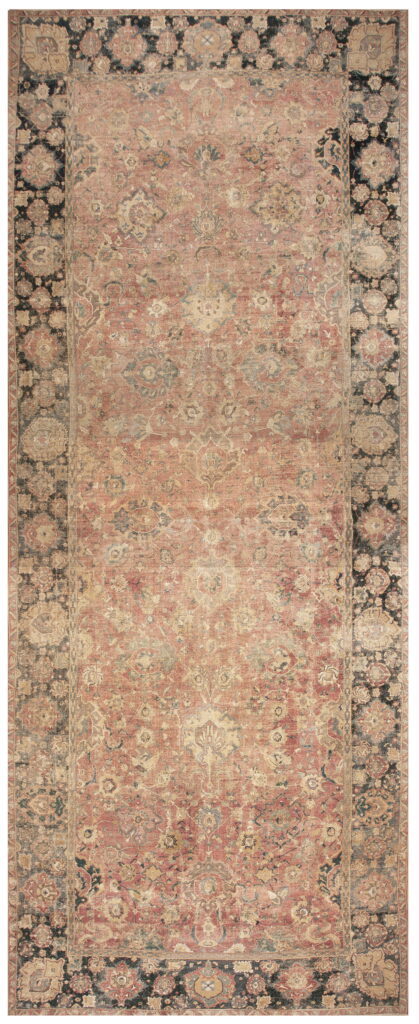
A Safavid Isfahan carpet is a wool court carpet woven in Persia under the Safavid dynasty, usually in the 1600s, with a red field covered in large palmettes and scrolling vines inside a dark blue or green border. Rugs On Net has one in its New York collection: a mid-17th century example measuring 10 feet 8 inches by 26 feet 4 inches (325 x 803 cm). This guide explains what these carpets are, how to recognize one, and what to look at in ours.
Key takeaways
- Safavid Isfahan carpets date mainly from the 17th century and are among the oldest Persian carpets a private collector can still buy.
- The classic look is a wine red or coral field, an allover design of palmettes and vine scrolls with no central medallion, and a dark blue or blue green border.
- Many were exported to Europe in the 1600s, and comparable carpets are held by museums such as the Metropolitan Museum of Art in New York and the Victoria and Albert Museum in London.
- Scholars still debate where the group was woven. “Isfahan” is the traditional trade name; some examples are also attributed to Herat, which is why you will see the label “Indo-Persian” or “Herat” on similar pieces.
- Our example, stock number 20133, is dated circa 1650 and can be seen by appointment at 36 East 31st Street, New York.
What is a Safavid Isfahan carpet?
It is a carpet from the classical age of Persian weaving. The Safavid dynasty ruled Persia from 1501 to 1722, and under Shah Abbas I, who reigned from 1588 to 1629 and made Isfahan his capital, carpet weaving became a court art with workshops, designers and an export trade. The wool carpets known in the trade as Isfahans are the largest surviving group from that period.
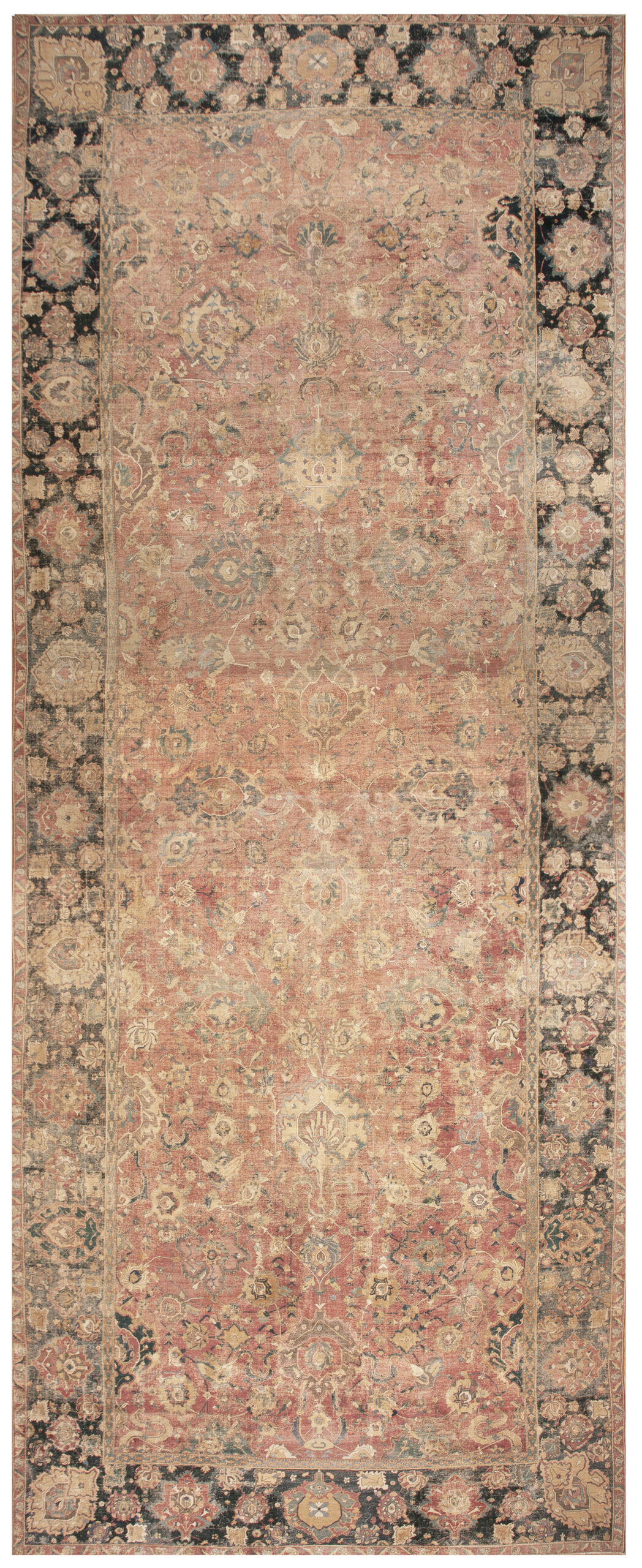
They are recognizable at a glance. The field is red, from deep wine to a soft coral where the color has mellowed. Across it runs a symmetrical system of thin spiraling vines carrying large palmettes, often called Shah Abbas palmettes, together with smaller blossoms, leaves and sometimes cloud bands. There is no central medallion: the pattern could continue in every direction, and the border simply frames a section of it. The main border is usually dark blue or blue green, with its own row of large palmettes.
How do you date an Isfahan carpet to the 17th century?
Mostly by the drawing. In the earlier carpets of the group the vines are fine and the palmettes are small and precisely drawn. As the 17th century goes on, the scale grows: the palmettes become larger and bolder, the vines play a smaller part, and the design reads more as a field of great blossoms. A mid-century carpet sits between the two, with large confident palmettes that are still held in a clear, symmetrical vine system.
Color, wool and wear matter too. These carpets were dyed with natural dyes that soften rather than fade harshly, which is why an old red field turns to coral and rose. Dating a carpet of this age is a matter of expert judgment, and we are glad to go through the evidence with you in front of the carpet itself.
Why are they called Isfahan, Herat or Indo-Persian?
Because the place of weaving has been argued over for more than a century. “Isfahan” is the old trade name, after the Safavid capital. Some scholars place part of the group in Herat, in the east of the Safavid world, and related red ground carpets were also woven in Mughal India, which gave rise to the term “Indo-Persian”. The names overlap in auction catalogs and museum labels. What does not change is the period, the design tradition and the quality that made these carpets the choice of courts and wealthy houses in their own time.
Where were these carpets used?
In Persia, and across Europe. Red ground palmette carpets were traded west in large numbers during the 17th century, and they appear in European paintings of the period, laid on floors and draped over tables. Many of the examples that survive today were preserved in European houses and churches before passing into museums and private collections.
What should you look at in our mid-17th century Isfahan?
- The size and shape. At 10 feet 8 inches wide and 26 feet 4 inches long, it is a long gallery carpet, a format suited to a hall or a long reception room.
- The field. A soft coral red ground carries an allover design of large palmettes, blossoms and vine scrolls, with no central medallion.
- The border. A wide dark blue main border holds a row of large golden palmettes and smaller flowers, between narrow guard borders.
- The age. It shows the wear of nearly four centuries. We will send a full condition report and more photographs on request.
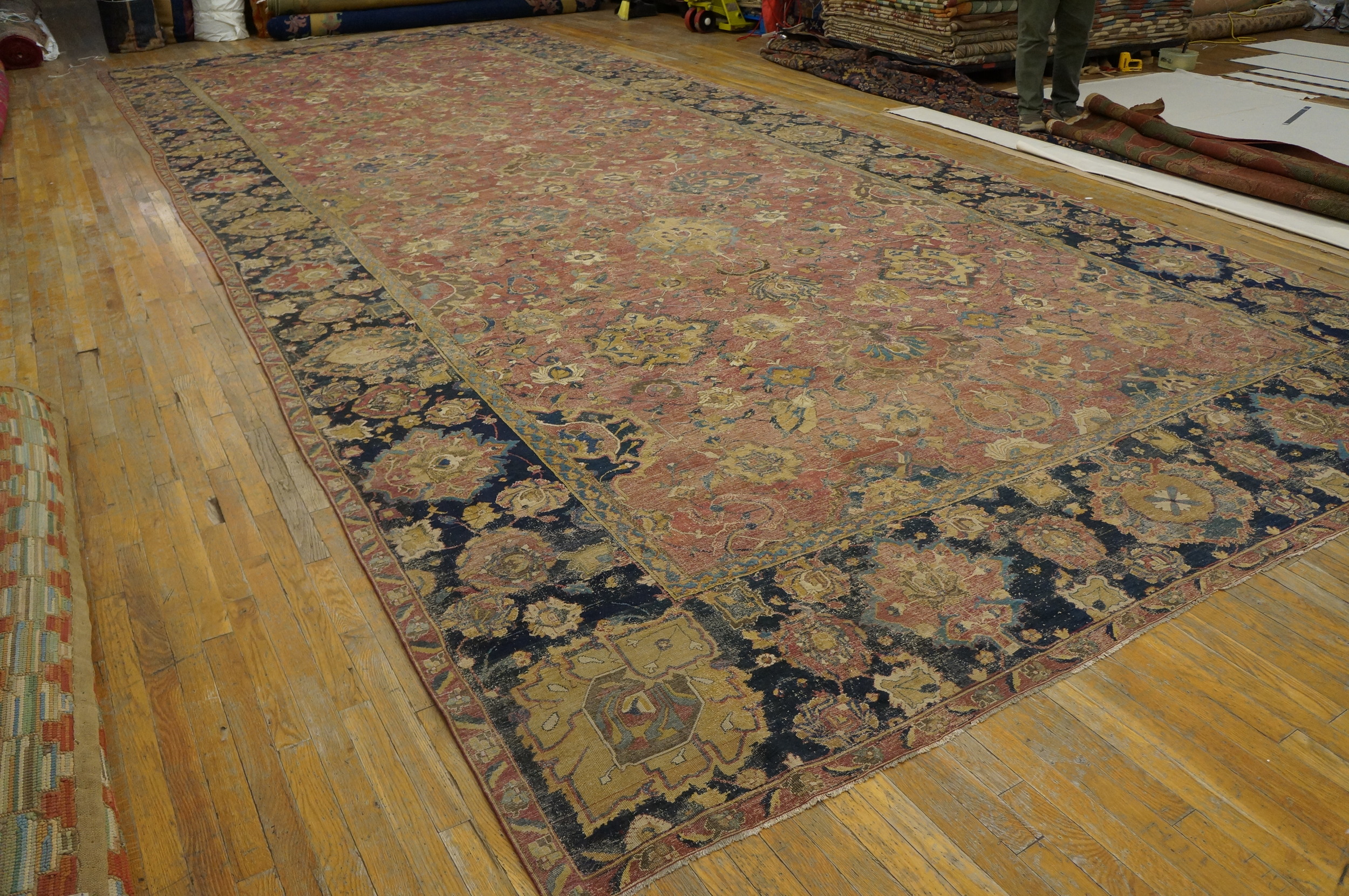
See the listing for the mid-17th century Safavid Isfahan carpet, stock number 20133, or the other pieces Kevin Rahmanan has selected in our collection highlights.
How do you buy a carpet of this age?
Slowly, and in person if you can. Rugs On Net is a family-owned New York gallery founded in 1979 by Kevin Rahmanan, and this carpet can be seen at our showroom at 36 East 31st Street, 9th floor, by appointment: book a visit, call (212) 683-0167 or email [email protected]. Ask for the condition report and for photographs of the back. If you already own an early carpet and want to know what it is, our free appraisal from photographs is a good place to start. You can also browse more antique Persian rugs or read our guide to choosing an antique rug dealer.
Safavid Isfahan carpet FAQ
How old is a Safavid carpet?
The Safavid dynasty ruled Persia from 1501 to 1722, so a Safavid carpet is between about 300 and 500 years old. Most Isfahan carpets of the red ground palmette type date from the 17th century.
Can you still buy a 17th century Persian carpet?
Yes, but rarely. Most surviving examples are in museums. Rugs On Net has a mid-17th century Safavid Isfahan carpet, 10 ft 8 in x 26 ft 4 in, stock number 20133, in its New York collection.
What does a Safavid Isfahan carpet look like?
A red or coral field covered with large palmettes, blossoms and scrolling vines, no central medallion, and a dark blue or blue green border with its own row of palmettes.
Is an Isfahan carpet the same as an Indo-Persian or Herat carpet?
The names overlap. Isfahan is the traditional trade name for the group. Some scholars attribute part of it to Herat, and related carpets were woven in Mughal India, so similar pieces may be labeled Herat or Indo-Persian.
Where can I see a Safavid carpet in New York?
The Metropolitan Museum of Art has Safavid carpets in its collection. To see one that is for sale, book an appointment at the Rugs On Net showroom, 36 East 31st Street, 9th floor.