
Introduction to Rya Rugs
Discover our complete range of luxury Swedish Shag Rya Rugs available for immediate purchase.
What is a Rya Rug?
A Rya rug is a traditional Nordic wool rug distinguished by its thick, shaggy pile, often measuring between one and three inches in length. Unlike flatwoven kilims or tightly knotted Persian carpets, the Rya is immediately recognizable by its plush surface and heavy texture. This deep pile was not merely decorative—it created a dense, insulating layer of wool that made the rug as practical as it was beautiful.
When spread across a floor or used as a cover, the Rya transformed cold interiors into warm sanctuaries during long Scandinavian winters. The visual identity of a Scandinavian shag rug lies in its tactile depth. Each piece carries a distinctive three-dimensional quality, its surface shifting with light and movement.
This iconic “shag” became both a design statement and a cultural signature, separating Rya from other weaving traditions. Today, collectors and designers admire these rugs not only for their comfort but also for their versatility: a long pile rug can act as a centerpiece of modern minimalism or as a colorful burst of texture in eclectic interiors.
Beyond aesthetics, the Rya is a story of resilience. Made from durable Nordic wool, the rug embodied both utility and artistry. To run a hand across a Rya is to encounter centuries of adaptation—woven for necessity, cherished for beauty, and now recognized worldwide as a timeless design object.
Quick History Snapshot
- Medieval origins in Scandinavia (15th century): Rya rugs began as thick bedcovers and cloaks in coastal Norway and Sweden, designed to shield against the unforgiving cold. — Why: Their long pile made them warmer and more protective than flatweaves, functioning almost like wearable blankets.
- The word “rya” in Swedish: Meaning “rug” or “thick cloth,” the term reflected their essential purpose rather than decoration. — Why: Language reveals their utilitarian beginnings as survival textiles.
- Shift from utility to art (17th–18th century): Over time, Rya carpets moved from the bed to the floor and wall, gaining decorative motifs influenced by both folk art and imported patterns. — Why: This transformation marked their entry into the realm of cultural expression and household pride.
- Modern revival (20th century): Scandinavian design movements rediscovered the appeal of Rya rugs, blending their historic shag with bold colors and geometric motifs. — Why: The postwar embrace of modernism positioned the Rya as both retro and avant-garde, fitting seamlessly into global interiors.
From Necessity to Icon
The Rya carpet tells a uniquely Nordic story. Born in fishing villages and mountain cabins as a means of survival, it evolved into an art form celebrated in museums and design magazines. Its long pile rug texture is instantly recognizable—an emblem of Scandinavian creativity and endurance.
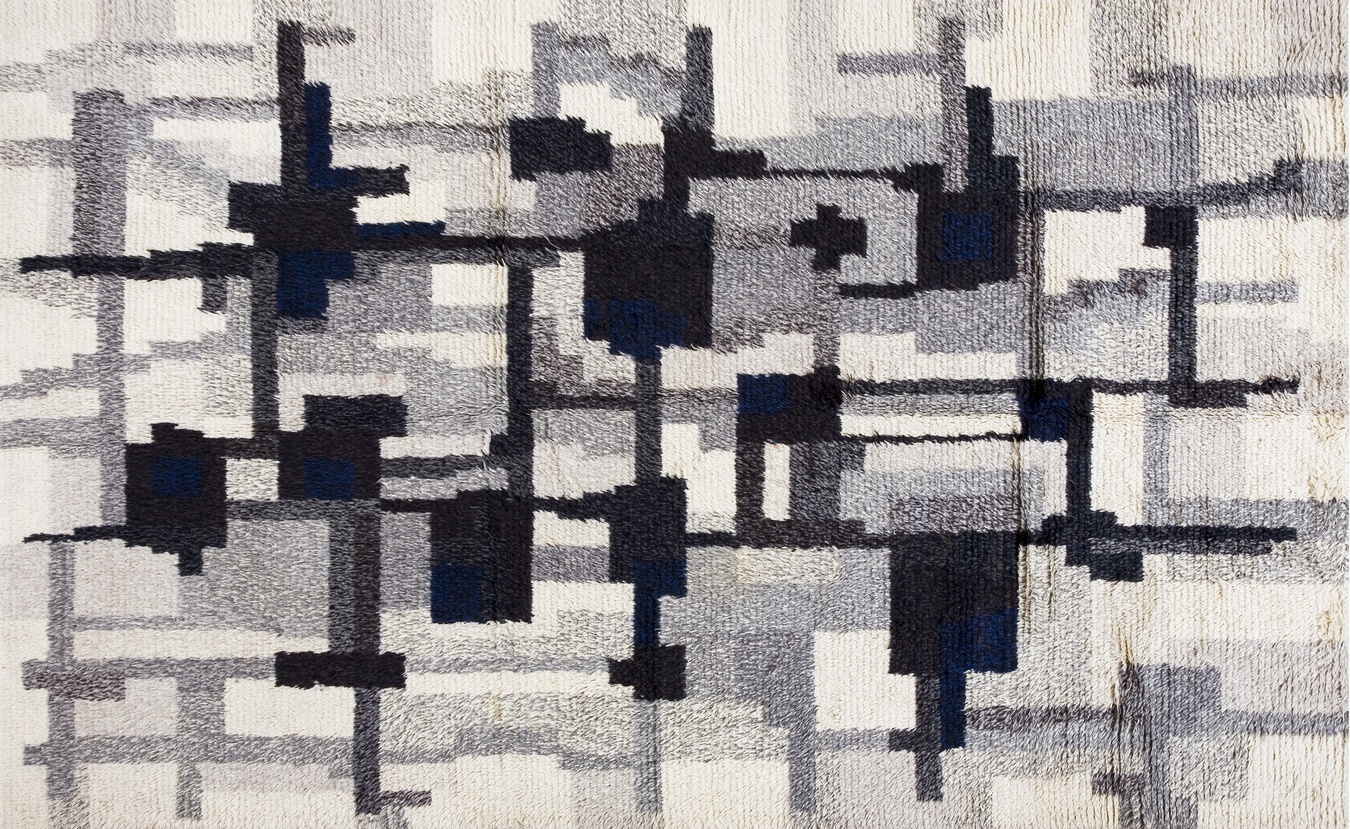
Today, a Rya is not just a floor covering; it is a tactile memory of northern winters, a bridge between folk tradition and contemporary style, and a symbol of how necessity can inspire beauty.
To answer the question of historical origin directly: Rya rugs originated in 15th-century Sweden and Norway as utilitarian woolen bedcovers and cloaks, designed for warmth in harsh Nordic winters. Over centuries, they transitioned into decorative and artistic textiles, making them one of Scandinavia’s most enduring contributions to global rug design.
Historical Origins & Scandinavian Evolution
Medieval Beginnings
The rug history of of these iconic carpets reaches back to the late medieval period in Scandinavia, when mariners and traders carried ideas and textiles across borders. Around the 1400s, Scandinavian sailors encountered Persian and Anatolian pile carpets through trade networks established by the Vikings centuries earlier.
These Eastern rugs demonstrated the insulating power of knotted pile, inspiring Nordic weavers to adapt the technique with their own abundant wool. The first medieval Nordic rugs were far from luxury items.

Viking-era attire suggests early northern textile use.
Woven with thick, long pile on a flat base, they were crafted to function as cloaks for fishermen, blankets for seafarers, and bedding that shielded families from the brutal cold of Nordic winters.
In this early stage, the Rya was a practical textile born of necessity—thick, heavy, and designed for survival.
Spread & Social Transformation
By the 15th century, the Scandinavian rug tradition spread into Finland, where the Rya quickly embedded itself into domestic life. Over time, its purpose shifted: what began as a seafarer’s protection slowly transformed into a treasured object in both peasant and noble households.
In the 18th and 17th centuries, Rya rugs became highly valued wedding dowries, gifted as symbols of warmth, fertility, and domestic prosperity.
These textiles carried not just physical comfort but emotional weight, becoming heirlooms passed down through generations. This evolution reveals how evolution of Nordic textiles mirrored broader social changes.
As communities stabilized and trade expanded, the utilitarian Rya gained decorative motifs, regional symbolism, and layers of cultural meaning. Its role expanded beyond the bed or cloak to become a marker of identity, wealth, and family continuity.
How Rya Rugs Evolved Over Time
- Maritime utility: Worn as cloaks and used as bedding by fishermen and peasants. — Why: The thick pile protected against icy winds and damp conditions at sea.
- Domestic adoption: Spread across Sweden, Norway, and Finland, appearing in both rural cottages and noble estates. — Why: Wool was readily available, and the rug’s warmth suited harsh Nordic winters.
- Social symbolism: Rya rugs entered dowries and became central to wedding traditions, symbolizing a family’s wealth and heritage. — Why: They transcended utility, taking on ceremonial and emotional value.
- Folk art tradition: Designs grew bolder, often featuring stylized flowers, birds, or geometric motifs. — Why: Regional identities and folk aesthetics reshaped the rugs into cultural expressions.
- Collectible decor: Rediscovered in the modernist era, Rya rugs became design icons admired for their shaggy pile and vibrant patterns. — Why: Their blend of comfort and artistry resonated with global tastes, placing them in museums, galleries, and homes worldwide.
From Survival Cloth to Heritage Textile
The evolution of Rya rugs in Scandinavia is a testament to cultural adaptation. What began as medieval Nordic rugs designed for survival grew into symbols of social status, folk artistry, and modern design innovation.
Their journey—from mariners’ cloaks to dowry treasures and finally to collector’s pieces—illustrates how textiles evolve with the people who weave, use, and cherish them. In the broader Scandinavian rug tradition, the Rya stands out as a rare example of a craft that preserved its functional roots while continually adapting to shifting social and cultural landscapes.
Materials, Wool Types & Construction
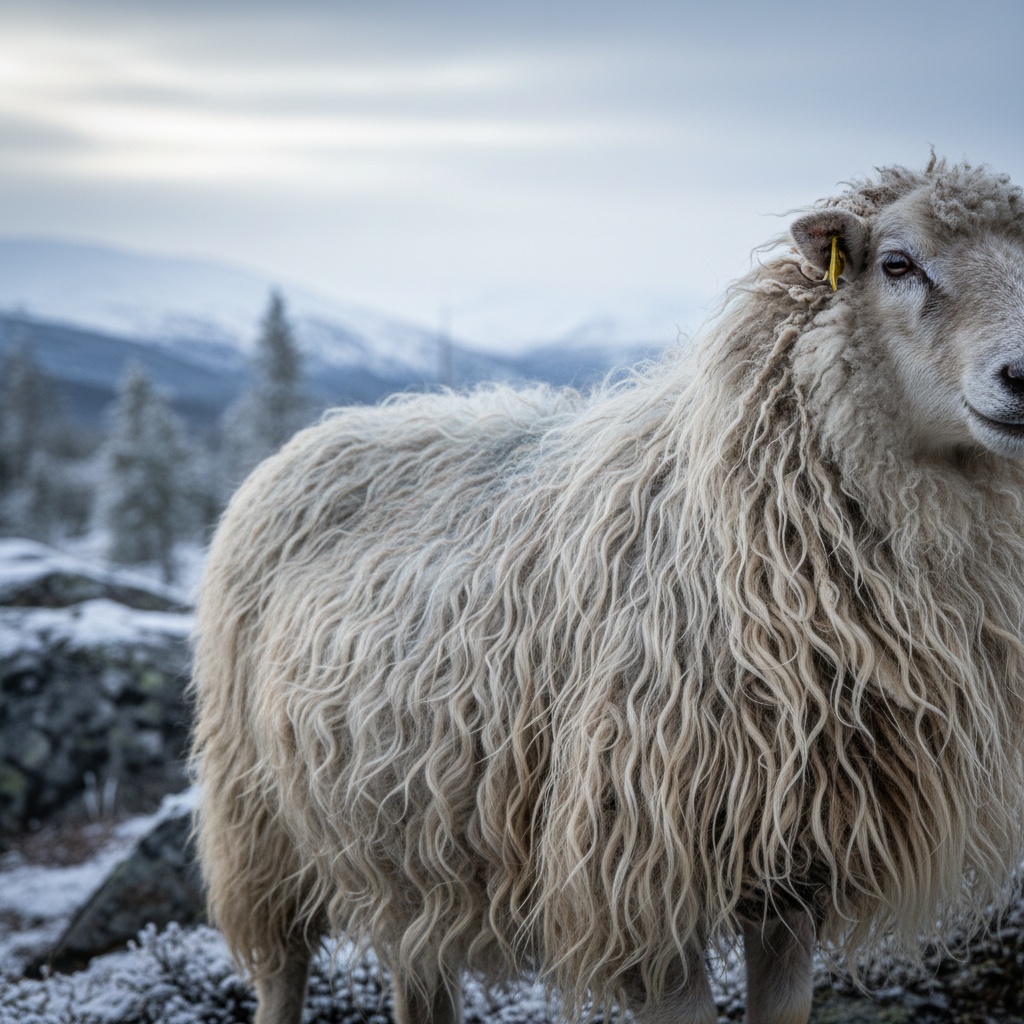
Thick, curly fleece texture on a live animal.
Traditional Wool Sources
At the heart of every authentic example lies the wool, sourced from hardy Nordic sheep adapted to long, cold winters. The most famous of these is the Rya sheep of Sweden, a breed developed specifically for its long, lustrous fleece. Unlike short-staple wools common in southern Europe, Rya sheep produced fibers long enough to create the signature shag pile, often with a natural sheen that reflected light beautifully.
Other regional breeds from Norway and Finland also contributed, with slight variations in texture and durability shaping local traditions. Wool quality was not just about warmth; it defined the entire Scandinavian rug tradition. Longer fibers produced denser, silkier piles, while coarser wool lent a rustic, robust texture.
The choice of fleece influenced color absorption, resilience under use, and how the rug aged, ensuring that the best examples remain vibrant centuries later.
The Hand-Knotting Method
Authentic Rya rug construction relies on the Ghiordes knot, also known as the Turkish knot. This symmetrical knotting technique allowed weavers to secure 3–4 strands of wool per knot, producing a dense, plush surface. Each knot was hand-tied around pairs of warp threads, building the rug row by row. This labor-intensive method created a pile that was not only thick but also firmly anchored, ensuring the rug could endure heavy use without shedding excessively.
The knotting technique was essential to the rug’s function: a hand-knotted Scandinavian rug was as much a survival tool as a textile. Unlike flatweaves, the securely tied pile trapped air, generating insulation against cold wooden floors or icy bedding. Hand-knotting thus became a guarantee of both durability and authenticity.
Understanding the Long Pile
What defines the long pile of Rya rugs is its depth and flexibility. Measuring between 1 and 3 inches, this shag was longer than almost any other historic rug tradition. The length served a clear purpose: the pile acted as a natural insulator, capturing body heat and repelling drafts. When used as a bedcover or cloak, the pile side was turned inward for warmth, while the flatwoven back faced outward, adding durability.
Over time, this shag rug technique evolved into an aesthetic choice. Designers and collectors came to admire how the pile shifted with touch and light, creating a dynamic surface unlike the flat precision of Persian or Anatolian carpets. Today, the long pile remains the most defining characteristic of a Rya—both a functional element and an artistic signature.
Foundation Materials & Dye Choices
Beneath the shaggy surface, Rya rugs were traditionally built on foundations of linen, wool, or cotton warps and wefts. Linen was especially valued in Sweden for its strength and resistance to stretching. Wool, however, allowed for more elasticity, making it easier to weave in rural households. Dyes evolved across centuries.
Early examples employed natural plant-based colors—madder for reds, woad for blues, and local plants for greens and yellows. These natural dyes produced earthy tones suited to folk aesthetics.
With the rise of synthetic dyes in the 19th century, color palettes expanded, leading to the vivid, modernist Rya rugs of the 20th century.
Machine-made vs. Handmade
- Machine-made: Feature uniform, often shorter piles and lack the tactile irregularity of hand-knotting. — Why: Industrial looms streamline production but sacrifice individuality and depth.
- Handmade: Each knot is tied individually, creating subtle variations in pile density and movement. — Why: These irregularities add life, warmth, and uniqueness, making them prized by collectors and designers.
- Durability differences: Machine-made piles tend to flatten with time, while hand-knotted wool piles bounce back after decades. — Why: Natural resilience of Rya wool combined with the Ghiordes knot preserves the rug’s function and form.
The Essence of Rya Rug Construction
From fleece to knot, every aspect of Rya rug construction reveals the marriage of utility and artistry. The wool defined the texture and longevity, the Ghiordes knot secured the pile, and the long pile itself provided unmatched warmth.
Whether woven on linen warps in a peasant cottage or revived with bold colors in the modernist era, the authenticity of a hand-knotted Scandinavian rug is inseparable from its materials and method—a textile tradition where every strand tells a story.
Motifs, Patterns, & Aesthetic Identity
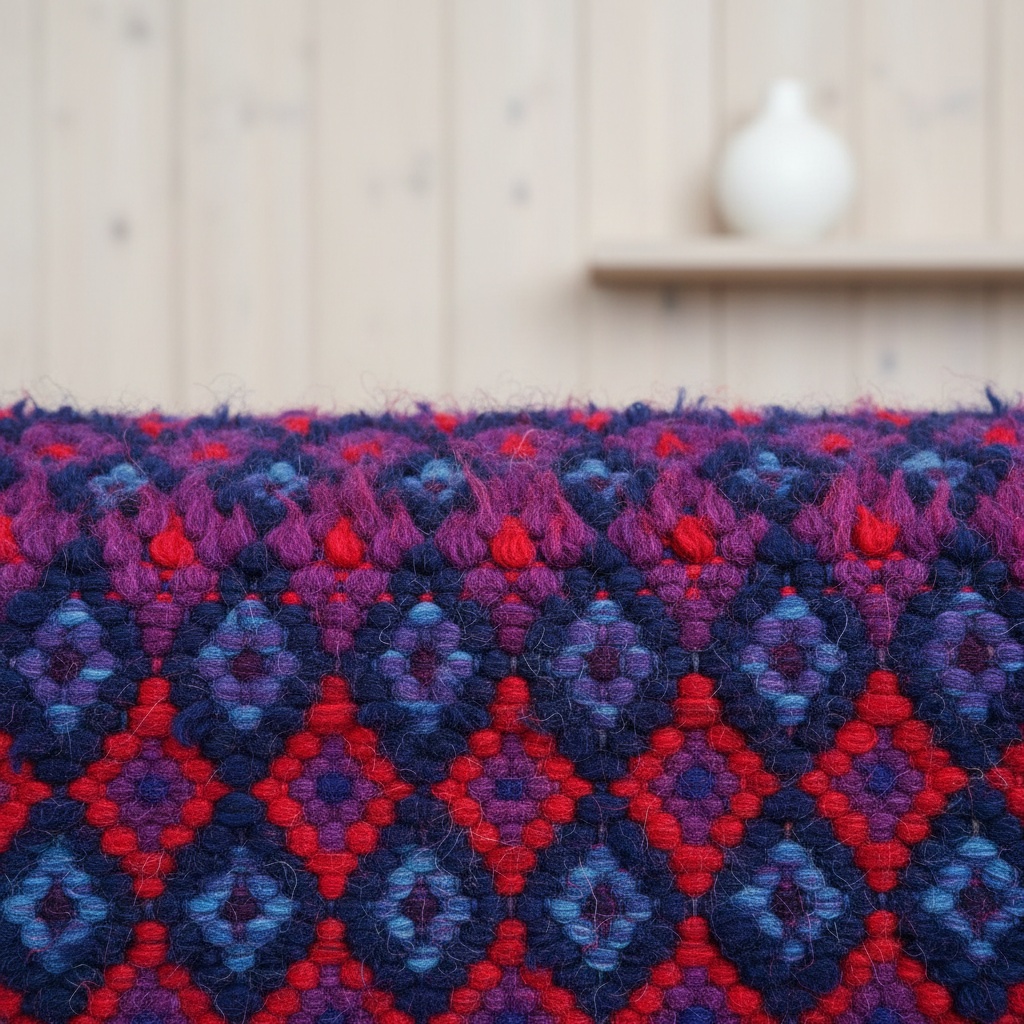
Vibrant geometric diamond motifs in rich colors.
Geometric Motifs: Why So Common?
The prevalence of geometric Rya rugs stems from both necessity and symbolism. Early weavers worked on simple looms, where straight lines and angular forms were easier to achieve than curves. Diamonds, chevrons, and stepped crosses naturally emerged from the grid-like structure of warp and weft. Over time, these shapes took on layered meanings—triangles could signify fertility, while diamonds evoked protection and continuity.
Thus, geometry in these wonderful area rugs was not just a technical limitation but a bridge between craft and cultural storytelling. The enduring appeal of these forms also lies in their adaptability. A symbolic rug pattern of repeating diamonds could appear minimalist to modern eyes, while still carrying centuries of folk resonance. In this way, the geometric base of the Rya tradition became a timeless design language.
Folk, Pictorial & Abstract Styles
- Folk art: Birds, flowers, and hearts were woven into the rugs to symbolize family life, love, and prosperity. — Why: These designs connected domestic textiles to the rhythms of rural Nordic life and folklore.
- Pictorial: Some featured the Tree of Life or stylized human figures, turning the rug into a narrative tapestry. — Why: They served as visual records of belief, heritage, and generational continuity.
- Abstract modern: In the 20th century, bold color blocks and freeform designs emerged. — Why: Artists embraced rya weaving as a medium for modernism, pushing the textile beyond folk art into contemporary design.
This spectrum of folk art motif rugs illustrates how the Rya could shift from simple stripe to narrative panel to abstract expression while retaining its signature shag surface.
The Role of Color and Dye
The story of their rug colors is also a story of evolving dye technologies. In the earliest ryas, palettes were restricted to the natural shades of wool—creamy whites, deep browns, and soft grays. These muted tones suited the rug’s utilitarian purpose while harmonizing with the raw interiors of peasant homes. By the 17th and 18th centuries, vegetable dyes introduced deeper reds, blues, and greens, enriching symbolic rug patterns.
Madder root gave crimson tones; woad provided indigo; birch leaves and lichens yielded soft yellows and olives. These hues carried symbolic associations—red for vitality, green for fertility, blue for protection.
The 19th and 20th centuries saw the adoption of aniline dyes, which dramatically expanded the palette. Suddenly, ryas could be woven in intense purples, oranges, and electric blues.
This transformation was crucial for the modern revival, where designers harnessed these dyes to create vibrant abstract ryas suited for contemporary interiors. Thus, dye choice did more than color the rug—it reshaped its entire aesthetic identity across centuries.
Pile Height & Rug Texture
Pile height in rugs defines not only appearance but also function. In these specific area rugs, the 1–3 inch shag creates an immediately recognizable texture. A longer pile produces a softer, more luxurious surface, amplifying the sense of warmth and insulation. Shorter piles, by contrast, are sturdier and more resistant to wear, making them practical for high-traffic areas.
Yes, pile height directly impacts the rug’s durability. While longer piles feel more sumptuous, they are more prone to matting under heavy use. Shorter piles offer greater resilience, but with less of the iconic shag effect. This balance between durability and aesthetics explains why weavers tailored pile height to a rug’s intended purpose—thicker for bedcovers, sturdier for floor use.
Aesthetic Identity Through Texture & Symbolism
The aesthetic identity of Rya rugs lies at the intersection of geometry, folk motifs, and shag texture. A geometric example might appear strikingly modern, yet its roots lie in centuries-old weaving constraints.
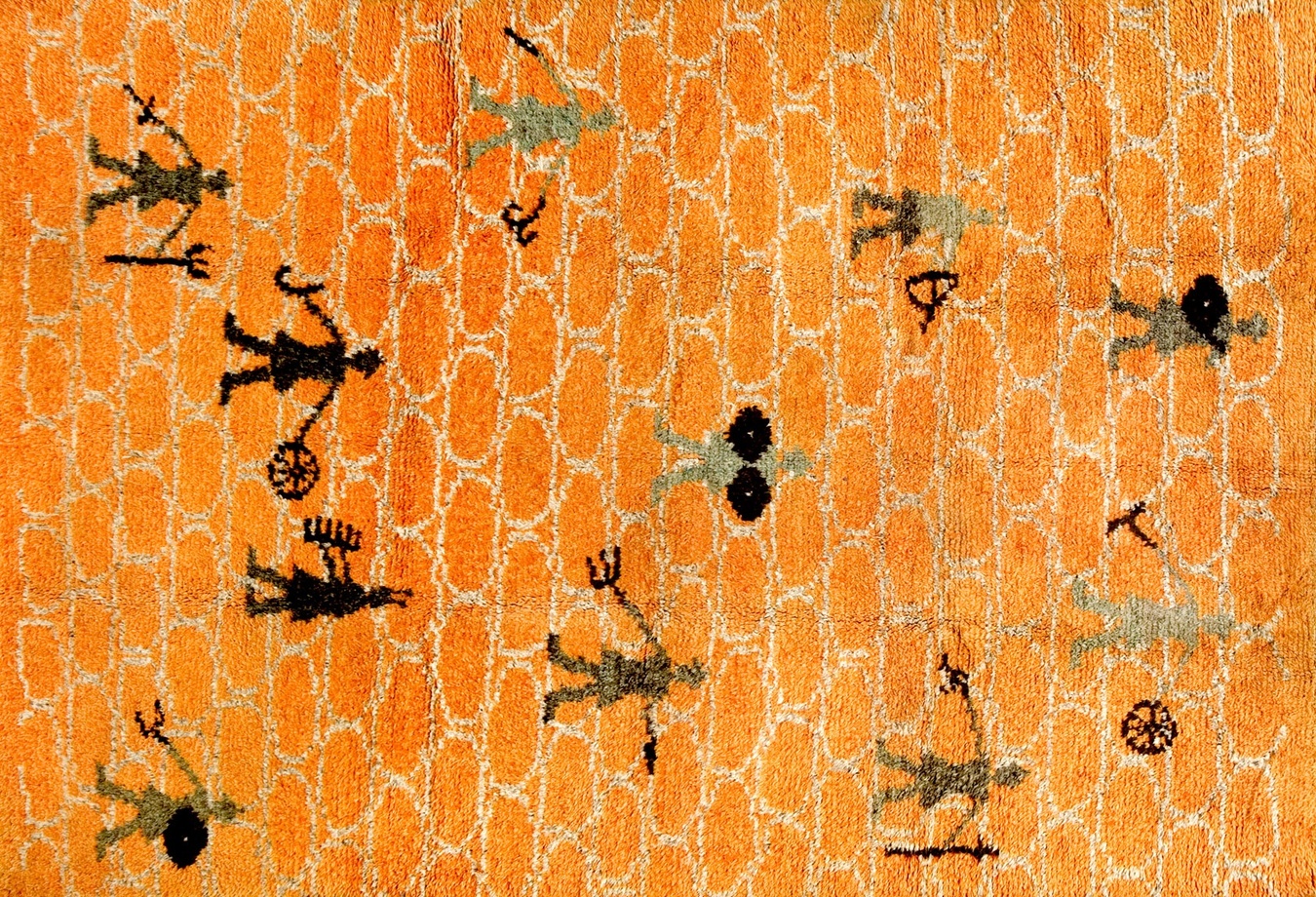
A folk motif rug might look decorative, yet each bird or heart carries symbolic depth. And above all, the interplay of Rya rug colors, pile height, and tactile depth ensures that every piece is more than textile—it is both functional warmth and visual poetry, woven into Nordic heritage.
Regional Styles & Cultural Symbolism
Swedish Rya Rugs
The Swedish rya is the earliest documented form of this Nordic textile, with records tracing back to the 15th century. Originally woven as cloaks and bedcovers, Swedish examples quickly transitioned into decorative pieces, balancing functionality with artistry.
Over time, regional weaving centers developed their own signatures—some favoring subdued natural tones, others experimenting with bold stripes and geometric layouts. Swedish ryas often reveal the dual purpose of the tradition: a practical woolen shield against harsh winters and a decorative object that expressed household pride.
Norwegian Rya Rugs
In Norway, the Norwegian rya retained its utilitarian character longer than in Sweden. Seafaring communities relied on shaggy, insulating rugs as cloaks and bedding during voyages.
Patterns were typically simpler, with basic stripes or diamond repeats rather than elaborate pictorial imagery. Yet the rugs also entered ceremonial life. In certain regions, woolen fabrics were incorporated into bunad, the traditional folk costume, as capes or lining. These garments blurred the line between rug and wearable textile, underscoring how deeply woven rya culture was into daily Norwegian identity.
Finnish Ryijy Tradition
The Finnish ryijy (a distinct spelling of the same word) became especially tied to marriage and family traditions. By the 18th century, ryijys were central to wedding ceremonies, given as dowries or hung behind bridal couples as symbolic backdrops. Bold colors and pictorial designs distinguished Finnish examples, often depicting trees, animals, crowns, and stylized human figures.
These wedding rugs were not mere decorations but expressions of fertility, prosperity, and family continuity. The tradition grew so culturally important that ryijys remain a recognized Finnish art form today, bridging folk heritage and contemporary textile design.
Cultural & Symbolic Meanings
- Tree of Life motifs: Represented fertility, eternal growth, and the continuity of family lineage. — Why: Weddings and dowries celebrated generational renewal, making this motif central.
- Birds and hearts: Common in symbolic Scandinavian rugs, these stood for love, harmony, and protection within the household. — Why: Such motifs personalized ryas as gifts and heirlooms.
- Crowns: Embodied honor, prosperity, and connection to local or royal traditions. — Why: Displayed social pride and aspirational values in Nordic folk rugs.
- Colors as symbols: Red for vitality and passion, green for fertility and life, blue for protection and loyalty, white for purity. — Why: Dye choices were never purely aesthetic; they infused the rug with meaning tied to life’s milestones.
Symbolism Rooted in Region & Ritual
Whether as a Swedish or Norwegian rya, or a Finnish ryijy, each regional style carried unique signatures while sharing a common bond as a Nordic folk rug. Sweden preserved the earliest decorative traditions, Norway emphasized seafaring utility and costume use, and Finland transformed the rya into a ceremonial centerpiece of weddings and dowries.
Across these regions, motifs like hearts, birds, and the Tree of Life imbued each rug with symbolic depth, ensuring that these textiles were not only practical but also powerful carriers of Scandinavian cultural identity.
From Utility to Art: Changing Roles
Medieval Blankets & Cloaks
The earliest examples were utilitarian in every sense. In the medieval Nordic world, this type of rug was as likely to be worn as a cloak or spread across a bed as it was to lie on the floor.
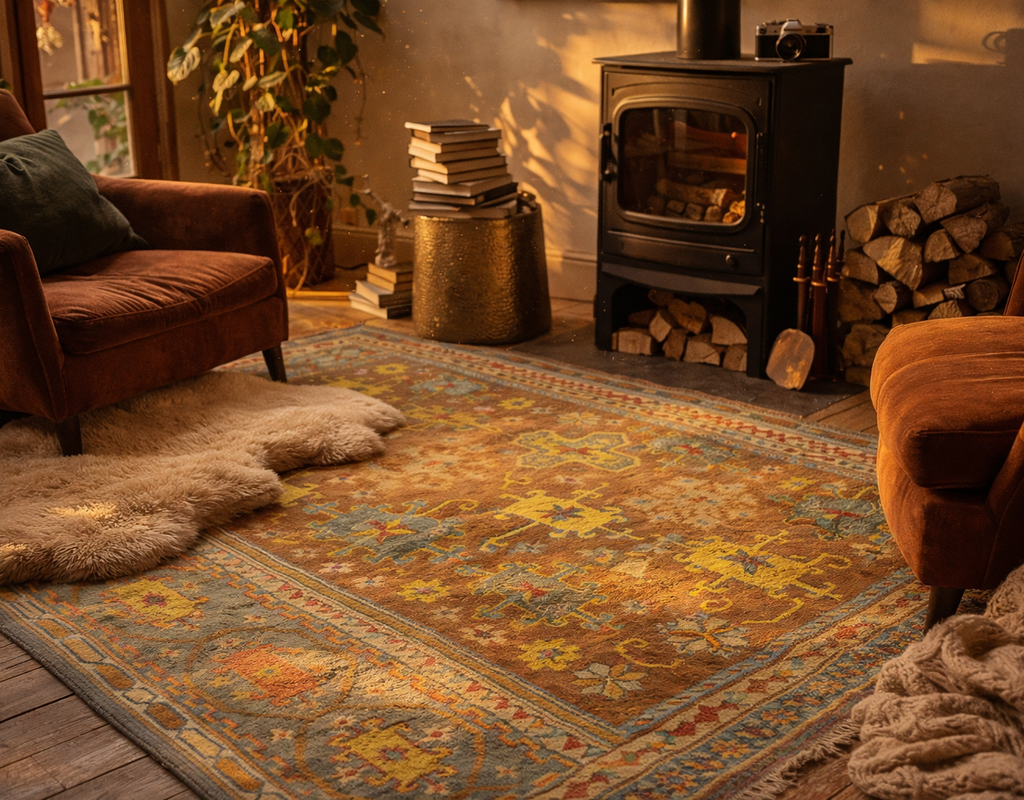
A richly patterned Oriental-style rug adds warmth and character to this rustic living space beside a glowing stove.
The long shaggy pile faced inward when wrapped around the body, acting as insulation against bitter winds and damp sea air. For mariners and farmers alike, the rya was not a luxury but a survival tool—a thick woolen shield against the harsh Nordic climate. These folk utility rugs embodied the principle of necessity first, decoration later.
Dowry & Wedding Ryas
By the 17th and 18th centuries, the rya wedding rug had become one of the most important ceremonial textiles in Scandinavia, especially in Finland. Given as part of a dowry, a ryijy was often the most valuable possession a bride brought into marriage. Hung behind the bridal couple or laid upon their bed, the rug’s motifs—hearts for love, crowns for prosperity, the Tree of Life for fertility—carried blessings into the household.
Passed down through generations, these dowry rugs became family heirlooms, embodying continuity, heritage, and prosperity. Their role at life’s pivotal moments elevated the rya from practical textile to sacred object.
Wall Art & Decor
Yes, Rya rugs can absolutely be used as wall art. In fact, this practice gained particular prominence in the 20th century. As Scandinavian modernism reshaped global design, these rugs were rediscovered not only as floor coverings but also as bold, tactile wall hangings.
Their deep pile and striking patterns made them function much like tapestries—adding warmth, sound absorption, and vibrant visual texture to interiors. The rise of the rya as wall art transformed it into a design statement, equally at home in minimalist modern apartments or folk-inspired country houses.
Collectible Art & Museum Pieces
Today, the journey of the rugs has reached the halls of major institutions. Historic examples are preserved in Nordic cultural museums, while avant-garde mid-20th-century designs feature in design museums worldwide. The collectible rya is valued for both its folk authenticity and its modernist adaptations.
Antique rugs of this kind, especially museum pieces with ceremonial provenance, command high interest from collectors. Their presence in curated exhibitions underscores the remarkable trajectory of the rya: from a medieval seafarer’s blanket to a prized cultural artifact and symbol of Scandinavian identity.
The Enduring Shift
The story of the rya is one of transformation. From woolen cloak to wedding dowry, from wall art to museum piece, it has continually reinvented itself without losing its tactile essence.
What began as humble survival cloth has become both a symbol of love and continuity in weddings and a celebrated work of textile art, proof that the threads of utility can be woven into the fabric of cultural legacy.
Rya Rugs in Modern Interiors
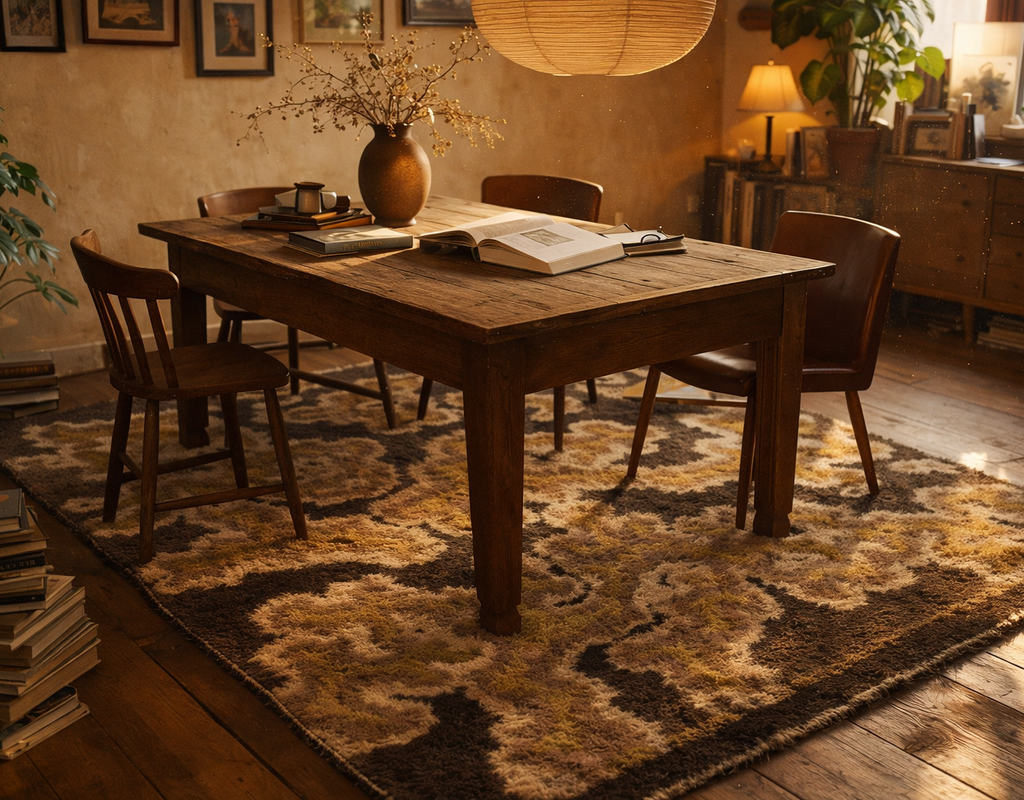
A richly textured shag rug anchors this inviting dining space bathed in warm, atmospheric lighting.
Vintage vs. Modern Rya Rugs
The Vintage rugs of this kind differ from newly woven rug versions in both construction and character. A vintage rya—woven between the late 19th and mid-20th centuries—was almost always handmade, with long, dense pile tied by hand using the Ghiordes knot. These rugs often feature bold geometric or abstract motifs and a tactile richness that comes from natural Rya wool.
By contrast, a modern examples of these rugs may be either handwoven in the traditional manner or machine-made with synthetic fibers. While modern examples revive the shaggy texture and vibrant colors, they sometimes lack the irregular charm and durability of vintage pieces. Yes, contemporary rugs of this kindare still handmade today, though in smaller numbers.
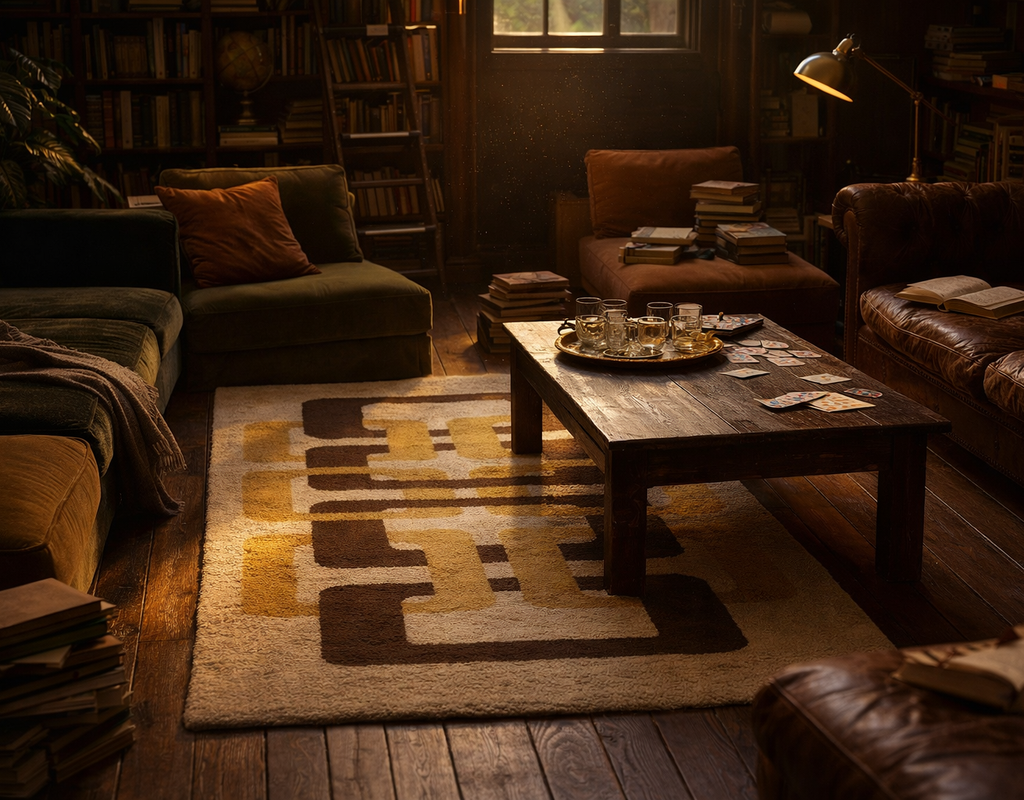
A richly textured reading nook illuminated by moody, ambient light, highlighting the retro charm of the geometric area rug.
A handful of Scandinavian artisans continue weaving authentic ryas, often as custom commissions or limited editions, ensuring that the tradition of the hand-knotted Scandinavian rug survives. However, the global market also offers mass-produced versions, making it important for buyers to distinguish between collectible, handmade vintage ones and industrially produced shag rugs.
Mid-Century & Contemporary Scandinavian Designs
The mid-20th century marked the global breakout of the rya. From the 1950s through the 1970s, Scandinavian designers reimagined the traditional shag with striking color blocks, abstract motifs, and daring palettes. These mid-century ones fueled the shag rug trend that spread to homes across Europe and the United States.
Designers such as Märta Måås-Fjetterström and others elevated these rugs into a textile art form, aligning it with the principles of Scandinavian Modern. In contemporary interiors, the rya continues to evolve. Designers adapt its deep pile and bold colors to suit modern living, with some leaning into minimalism with monochrome palettes and others reviving the eclectic spirit of the 1960s and 70s. The rya’s adaptability ensures its place as both heritage textile and contemporary design icon.
Minimalist, Boho, & Eclectic Uses
Yes, Rya rugs can absolutely suit minimalist interior styles. A neutral-toned minimalist shag rug provides texture and warmth without overwhelming clean-lined spaces. In contrast, a boho rug with bold, colorful patterns thrives in eclectic interiors, where layered textiles and vibrant accents are celebrated.
Eclectic stylists often hang ryas on walls, use them as layered rugs, or showcase smaller pieces as art, proving their versatility beyond the floor. This ability to move between minimalism and maximalism underscores the unique identity of the Scandinavian decor rug—one that adapts as easily to sleek modern apartments as it does to bohemian lofts or rustic cabins.
Sizing Trends & Market Demand
Market demand today favors larger ryas for open-plan living spaces, while smaller examples remain sought after as wall art or accent rugs. Expansive versions serve as focal points in living rooms, dining areas, and studios, their scale emphasizing the lush shag surface.
Smaller pieces, especially vintage ryas, are valued by collectors and interior designers for their versatility—they can act as wall hangings, layered textiles, or accent rugs in intimate spaces.
Enduring Relevance in Design
The trajectory of the rya proves its timelessness. From vintage masterpieces to modern rugs designed for contemporary interiors, these textiles remain relevant in global design.
Whether embraced as a minimalist shag rug in muted tones or a boho rug bursting with folk-inspired patterns, the rya continues to be a defining element of Scandinavian decor rugs. Its enduring popularity is not nostalgia alone—it is proof that texture, warmth, and heritage always find a place in the modern home.
Buying, Pricing & Collecting
Where to Find Authentic Rya Rugs
- Nordic auction houses: Institutions in Stockholm, Oslo, and Helsinki regularly feature vintage and mid-century examples. — Why: These venues attract serious collectors and guarantee provenance through expert evaluation.
- Specialized dealers & galleries: Scandinavian textile dealers curate authentic ryas with attention to regional styles and condition. — Why: Buying through experts reduces risk of reproductions.
- Museum shops & heritage organizations: Select museums and design foundations occasionally release reproduction ryas or deaccession original works. — Why: These sources combine authenticity with cultural oversight.
- Online marketplaces with vetting: Platforms specializing in mid-century design sometimes list Swedish rya rugs, but careful authentication is essential. — Why: While accessible, the risk of machine-made imitations is higher.
Mid-century Swedish rugs of this type are best found through specialized dealers, auctions, and Nordic galleries, where provenance and authenticity are prioritized.
Vintage & Mid-Century: Why Prices Vary
Vintage Rya rugs command higher prices because of their rarity, craftsmanship, and artistic heritage. Mid-20th-century versions designed by notable Scandinavian weavers are often considered textile art rather than mere floor coverings.
Their value reflects the quality of wool, hand-knotting, originality of design, and the condition of the pile. In contrast, later reproductions or machine-made ryas are far more common and therefore less costly.
Price Ranges for Quality Rugs
A quality Rya rug can range widely in price depending on age, size, and provenance. Small modern artisan-made ryas may cost $500–$1,500, while larger mid-century examples often sell between $3,000 and $10,000.
Rare works by celebrated designers or antique wedding ryas can exceed $15,000 at auction. Collectors should expect higher prices for pieces with documented provenance, fine wool quality, and vibrant original dyes.
Authentication, Restoration & Sustainability
Collectors authenticate Scandinavian Rya rugs by examining weaving techniques (presence of the Ghiordes knot, pile depth, density), materials (Rya wool on linen or cotton foundations), and provenance (gallery certificates, auction records, or artist signatures). Condition reports and expert appraisals are indispensable when investing at the higher end of the market.
When deciding between repair and replacement: a worn Rya rug should be restored if it is vintage or has historic or artistic value. Skilled textile restorers can re-knot sections, reinforce foundations, and revive colors. Replacement makes sense only for modern machine-made examples with no collectible merit.
Spotting Machine-Made Rya Rugs
Machine-made rugs can be spotted quickly by their uniformity. Signs include mechanically precise knots, evenly cut pile lacking variation, synthetic fibers instead of natural wool, and mass-produced backing materials.
A handmade one, in contrast, will show subtle irregularities, depth variation in pile, and a tactile, organic quality that machines cannot replicate.
Are Sustainable Rya Reproductions Worth the Investment?
For buyers seeking aesthetics rather than collectible value, sustainable Rya reproductions can be worthwhile. These rugs, made from natural fibers and ethically sourced wool, often provide durability and beauty at lower prices.
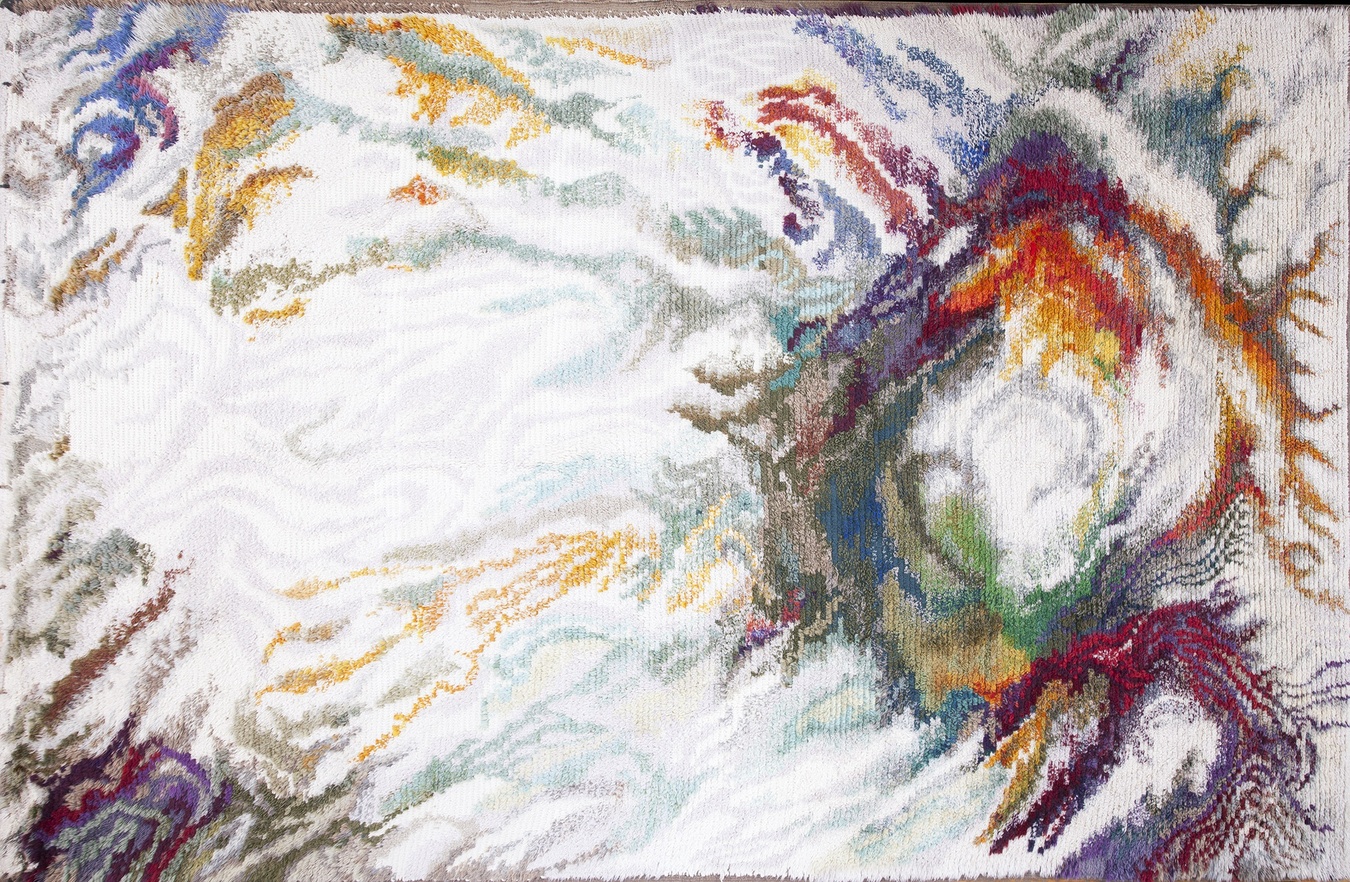
However, they lack the uniqueness, provenance, and long-term value of vintage or artist-signed ryas. As such, they are best viewed as interior investments rather than collectible assets.
The Collector’s Landscape
To buy a Rya rug today means navigating between authentic heirlooms and modern reinterpretations. Vintage rug prices reflect artistry, provenance, and rarity, while modern sustainable versions offer accessible beauty without heritage.
Authentication is critical—knowing how to distinguish a machine-made rya from a hand-knotted treasure protects both investment and cultural integrity. For collectors, the rya remains more than a purchase: it is an entry into the layered history of Scandinavian textile art.
Care, Restoration & Longevity
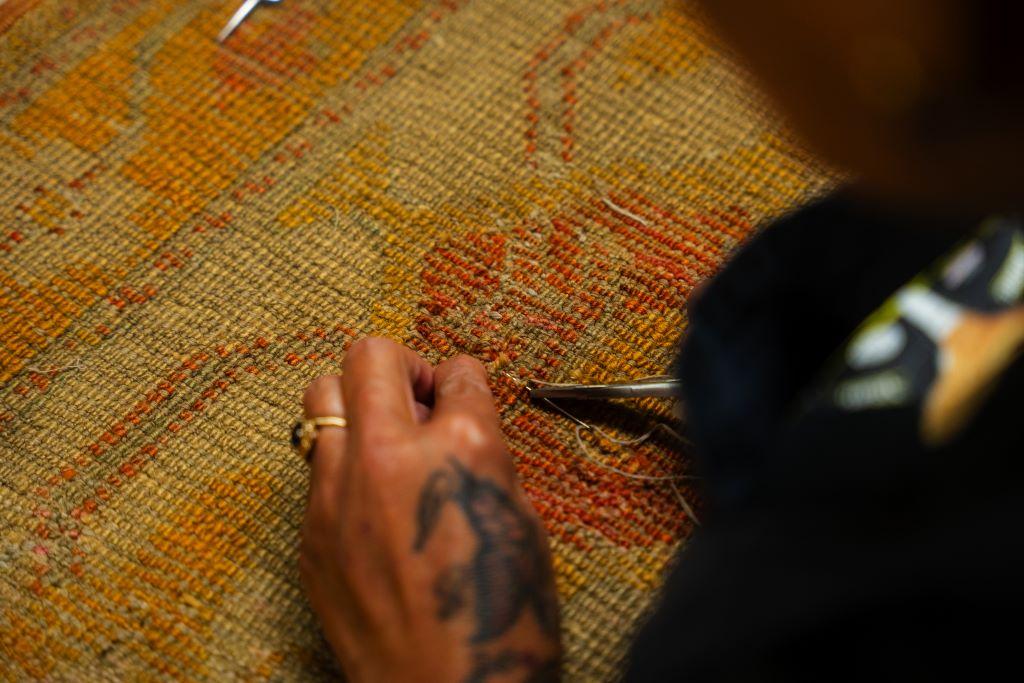
Detail of hands mending a rustic, richly colored woven rug.
Restoring vs. Replacing a Worn Rya
Whether to restore or replace a worn Rya rug depends on its value and condition. If the piece is vintage or collectible, restoration is strongly recommended.
Professional textile conservators can re-secure knots, patch foundations, and revive original colors, preserving both its heritage and market value. A restore rya approach ensures that family heirlooms or museum-worthy pieces continue to endure. However, for modern or machine-made ones with little historical or monetary value, replacement is often more practical than the cost of repair.
Cleaning & Maintenance
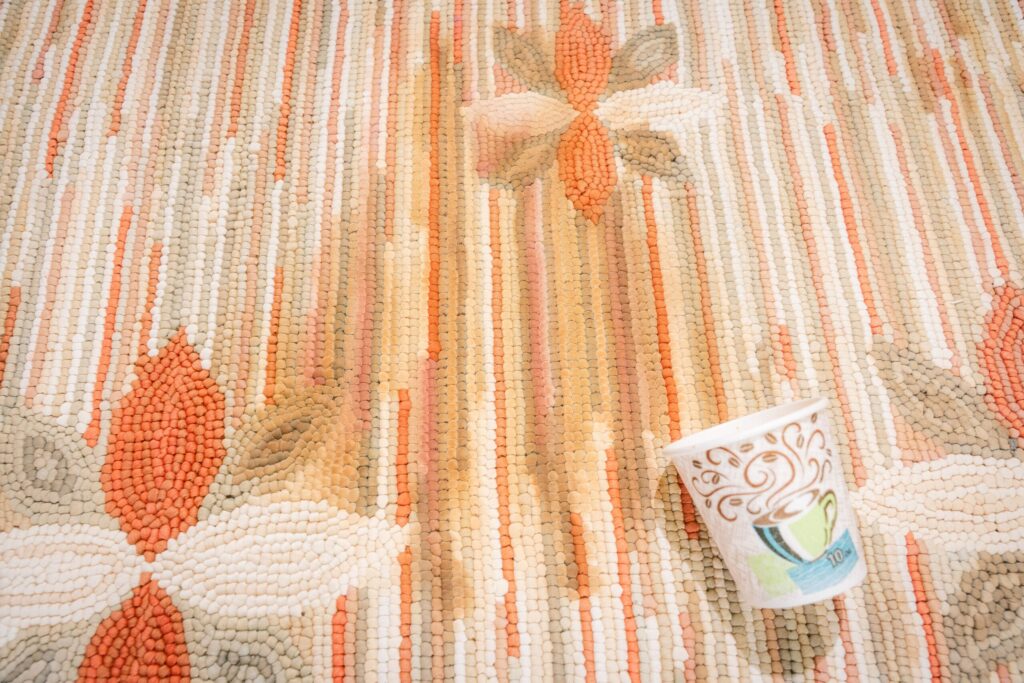
Close-up view of a tipped paper coffee cup resting on a handwoven wool rug, highlighting the rug’s dense pile, subtle color variations, and traditional geometric motifs in warm neutral and terracotta tones.
Proper rya rug care is essential for preserving both appearance and lifespan. Gentle vacuuming on low suction helps prevent dirt from settling into the shag pile, while periodic rotation reduces uneven wear. Spot cleaning with mild soap and water can address small stains, but deep cleaning should always be handled by professional rug cleaners familiar with long-pile textiles.
Sunlight exposure should be minimized to prevent fading, particularly in older vegetable-dyed ryas. By maintaining a consistent care routine, owners can keep the shag pile flexible, vibrant, and tactile for decades.
Durability Factors: Pile Height, Wool & Construction
Yes, pile height directly impacts a Rya rug’s durability. A shorter pile is less prone to matting and better suited to high-traffic areas, while a longer pile creates luxurious softness but requires more attentive maintenance. Wool quality is equally crucial—long, lustrous Rya wool from Nordic breeds is naturally resilient, retaining bounce and sheen over time.

A detailed focus on the intricate, vivid colors and geometric weave of a traditional textile rug.
Finally, authentic hand-knotted construction with Ghiordes knots ensures the pile is anchored securely, making the rug more resistant to shedding and wear. A combination of these factors determines whether a rug remains a durable one across generations.
Environmental Impact & Sustainable Rya Rugs
Sustainable Rya reproductions can be worth the investment if eco-friendliness and design appeal matter more than collectibility. Many modern artisans now focus on natural fibers, plant-based or low-impact dyes, and ethical sourcing practices, ensuring that new ryas align with environmental values.
While these sustainable rugs may not carry the historic or artistic value of vintage pieces, they represent a responsible choice for homeowners who want both beauty and sustainability.
Preserving Warmth & Value
These area rugs endure when treated with respect. From deciding whether to restore a rya or replace it, to following careful maintenance routines, owners shape the longevity of these textiles.
Authentic materials, hand-knotted construction, and thoughtful sustainability practices all contribute to keeping the rya relevant today. With proper care, a durable rya rug is not only a piece of Scandinavian heritage but also a lasting investment in texture, warmth, and cultural identity.
The Enduring Legacy of Rya Rugs
Influence on Global Design
The rya legacy stretches far beyond Scandinavia. With their long, shaggy pile and bold patterns, ryas directly inspired the global shag rug influence that took off in the 1960s and 70s. Designers in Europe and North America adopted the texture and drama of ryas, creating an international craze for deep-pile carpets.
Beyond flooring, ryas also shaped the rise of fiber art and textile wall hangings, encouraging artists to explore wool, color, and pile as sculptural media. Today, the influence of the Scandinavian icon is visible in both commercial interiors and experimental art studios, proving that the rya’s design DNA has become part of global textile language.
Future Trends in Rya Weaving
Looking forward, the modern rya continues to evolve. Contemporary artisans experiment with mixed materials such as silk, linen, and recycled fibers, adding depth and sheen to traditional wool bases. Scale has also shifted: some creators produce monumental rya-inspired installations, bridging the gap between rug and architectural art.
Sustainability is another defining trend—eco-friendly dyes, ethically sourced wool, and limited-edition hand-knotted ryas ensure that the craft adapts to modern values. With a renewed global interest in Scandinavian design, the future promises a continued blending of tradition and innovation in their weaving.
Why Rya Rugs Remain Iconic
- Texture and warmth: The long shag pile offers both tactile comfort and visual richness. — Why: It transforms cold, minimal interiors into inviting spaces.
- Cultural heritage: Each rya reflects centuries of Scandinavian weaving traditions. — Why: They embody continuity, storytelling, and regional pride.
- Design versatility: From rustic cabins to modernist apartments, ryas adapt across styles. — Why: Their neutral or bold palettes complement both minimalism and eclecticism.
- Global inspiration: Their role in shaping mid-century modern rugs and fiber art ensures relevance beyond Scandinavia. — Why: They remain a touchstone for designers exploring texture and form.
A Scandinavian Icon with Global Reach
The rya rug’s enduring legacy lies in its ability to move seamlessly between worlds: from medieval cloaks to modern installations, from Nordic homes to international design galleries.
It remains both a Scandinavian icon and a universal expression of warmth, artistry, and innovation. As heritage and contemporary design converge, the rya proves that true craftsmanship never fades—it adapts, inspires, and continues to shape how we experience textiles across centuries.
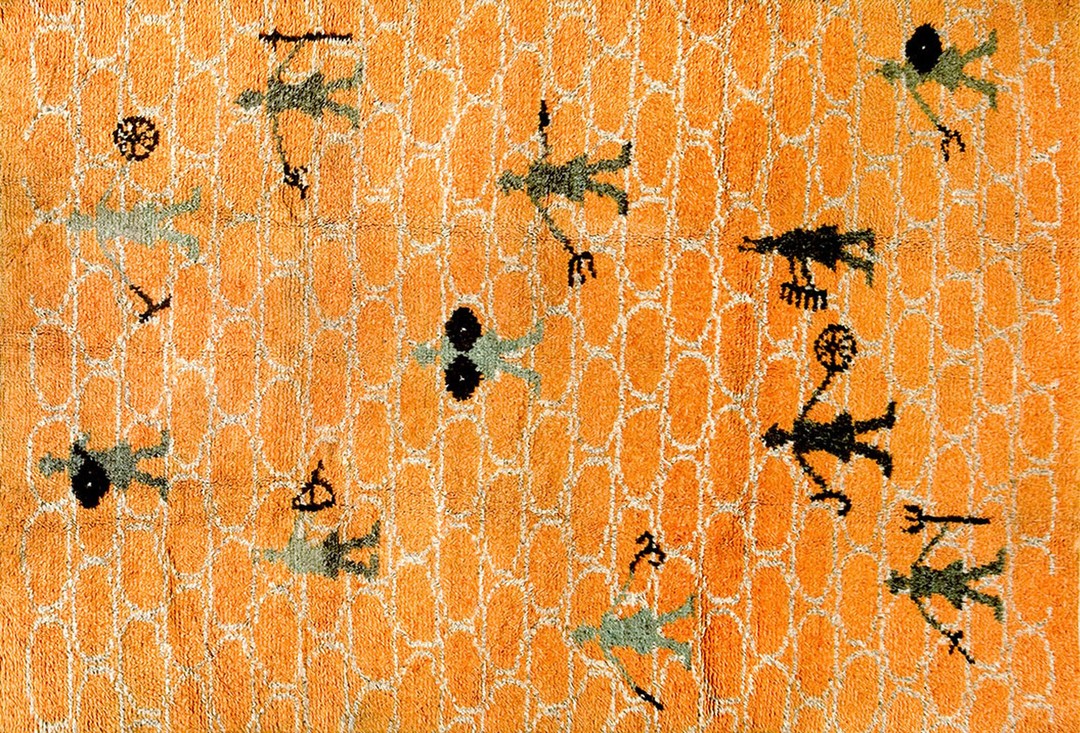
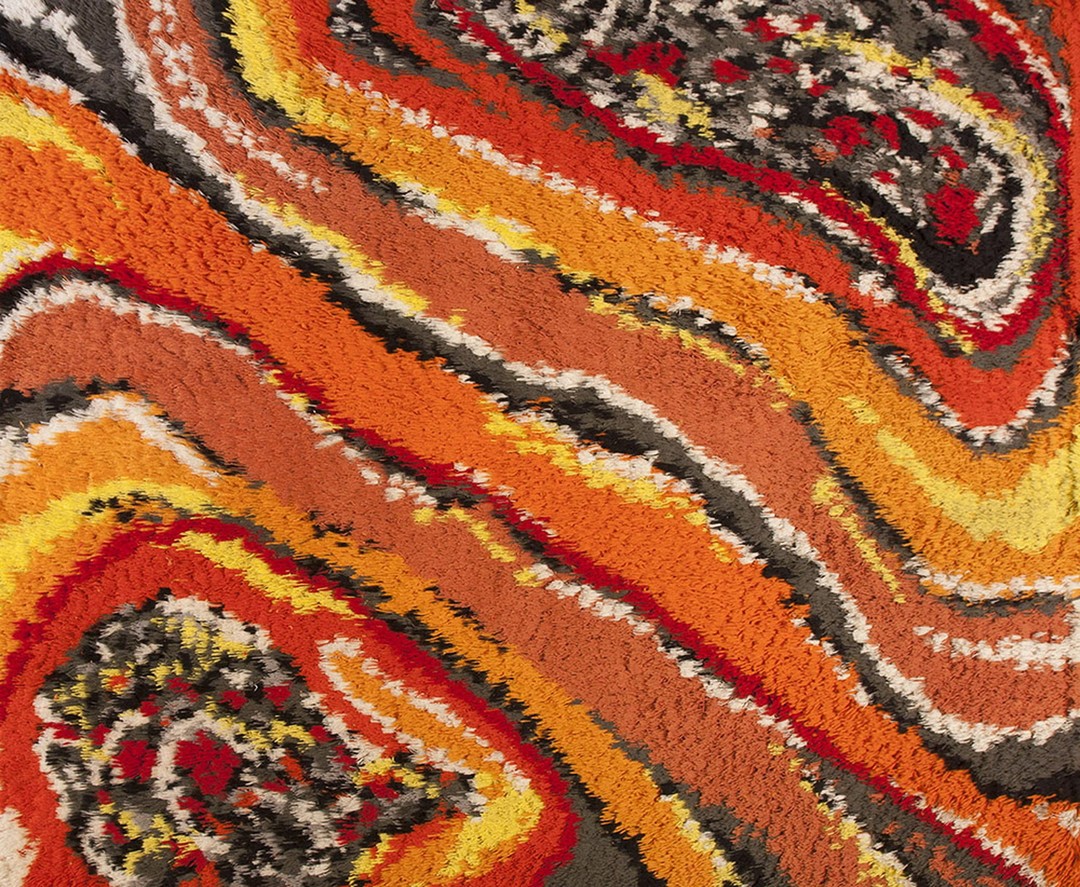
Explore a Few of Our Favorite Rya Rugs
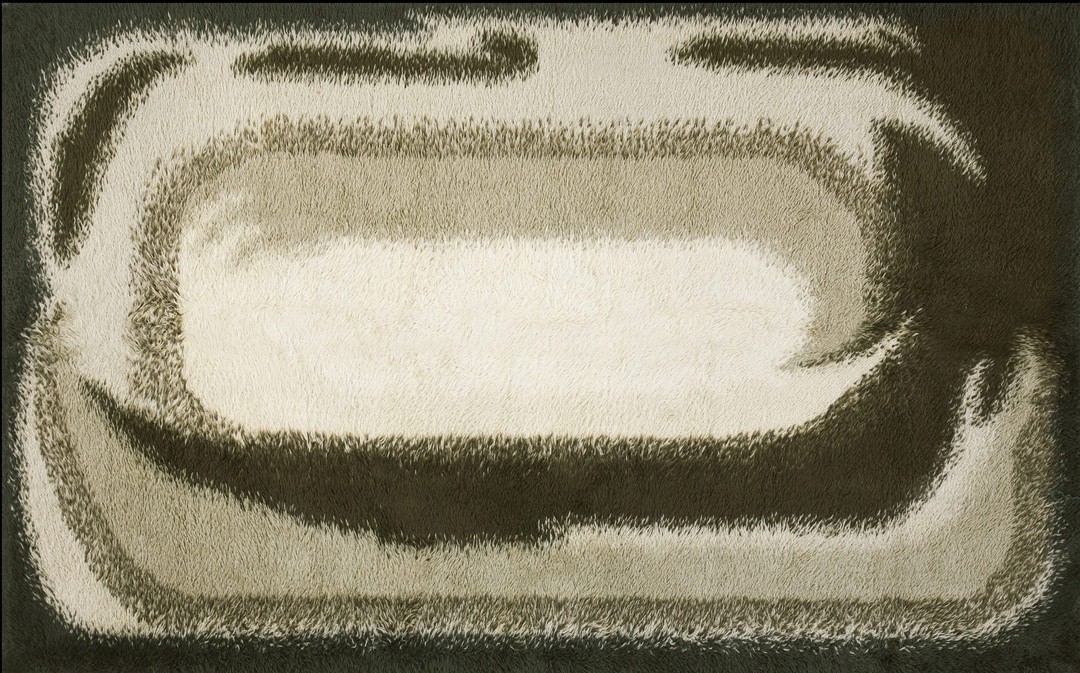
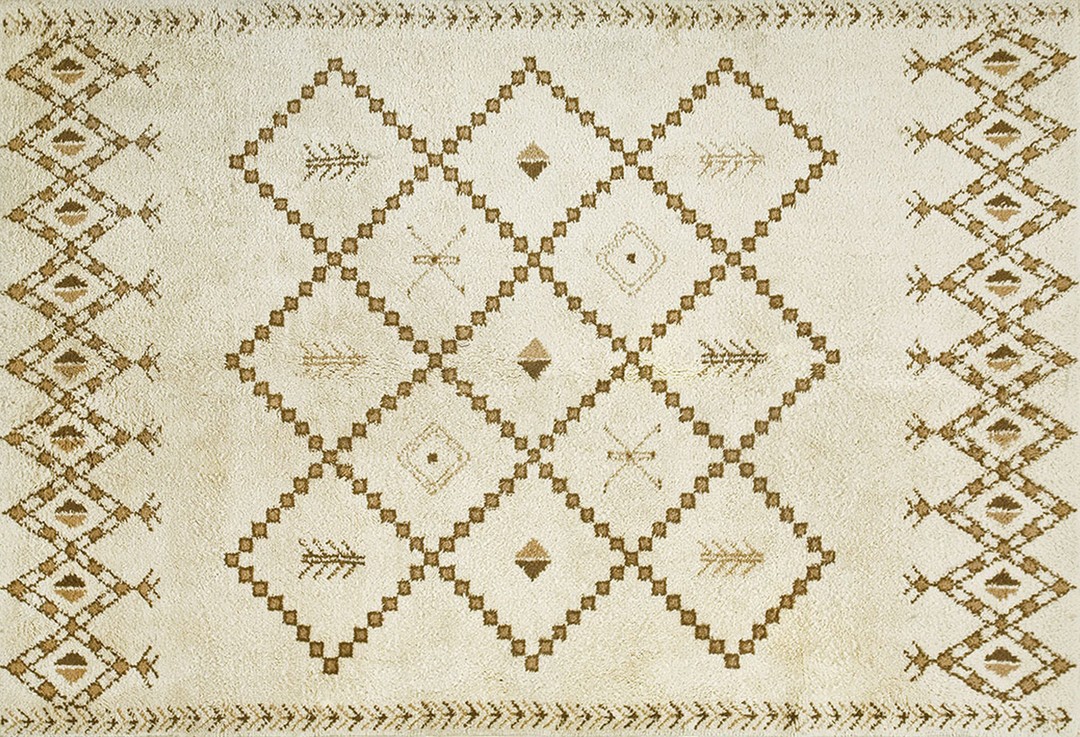
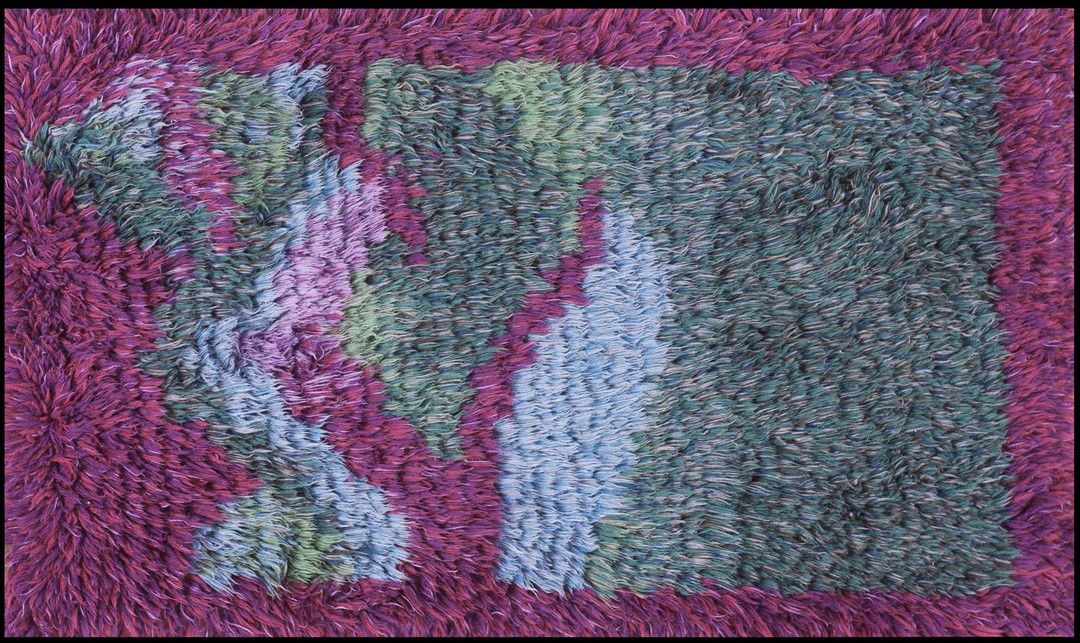
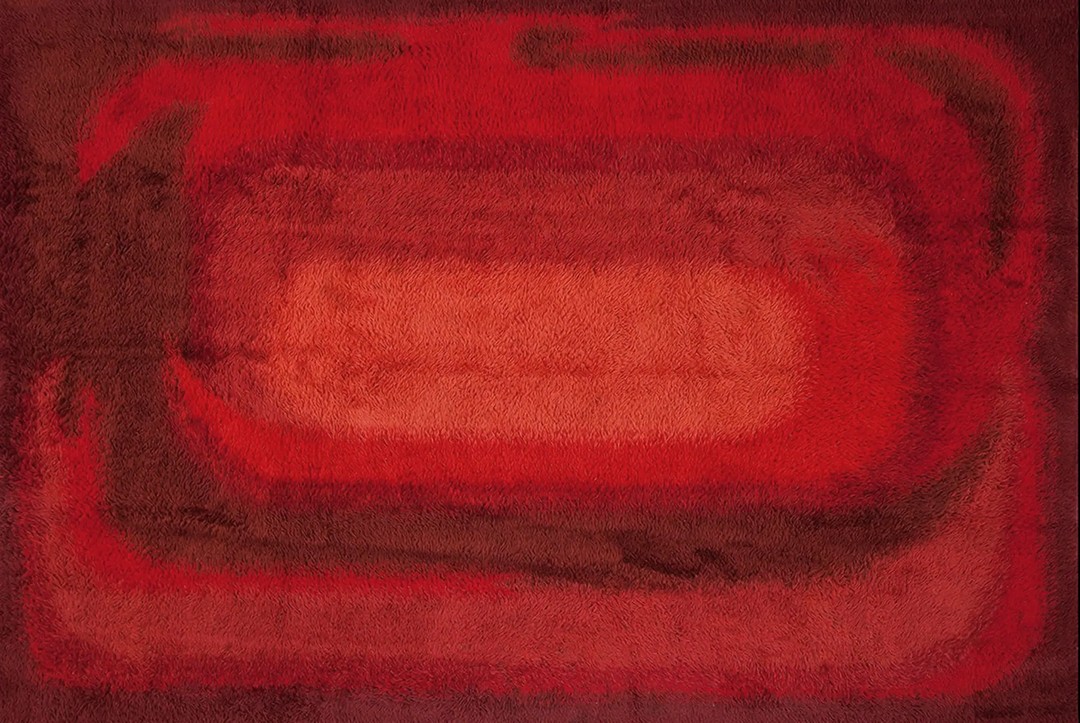
FAQ
- Are rya rugs still in style today?
Yes—rya rugs pair beautifully with mid-century and contemporary interiors. Vintage Scandinavian pieces are especially collectible, and colorful ryas add dramatic texture to neutral rooms.
- How should I store a rya rug long-term?
Clean the rya rug, roll (don’t fold), and wrap in breathable Tyvek or cotton—never plastic. Elevate off the floor and inspect every 3–6 months for pests or moisture.
- What rug pad works best under a rya rug?
Use a felt-and-natural-rubber pad (about 1/4–3/8 inch) under a rya rug for grip and cushioning. Trim the pad 1–2 inches smaller than the rug.
- Do rya rugs fade in sunlight?
Yes—prolonged sun fades wool dyes. Rotate your rya rug every 3–6 months and use shades or UV film on windows to minimize color loss.
- Do rya rugs shed?
New wool rya rugs often shed lightly at first; steady suction-only vacuuming reduces it over several weeks. Avoid aggressive brushing that can pull fibers.
- What’s the “snow cleaning” method for rya rugs?
In freezing weather, lay a rya rug pile-down on clean snow, brush, flip, and repeat, then air-dry. It freshens wool without soaking.
- How do I deep-clean a rya rug at home?
Spot-clean a rya rug with cool water and wool-safe detergent after a color test, then dry quickly with airflow. For full washes or antiques, use a professional rug cleaner.
- How do I vacuum a rya rug correctly?
Vacuum a rya rug with suction-only (beater bar off) on the highest pile setting, and occasionally flip to vacuum the back. Weekly care helps prevent matting.
- Are rya rugs pet-friendly?
The wool in a rya rug resists soiling, but long pile traps hair and dander; heavy shedders can mat it quickly. Vacuum with suction-only and consider no-go zones for robot vacuums.
- Can I hang a rya rug on the wall?
Absolutely—many historical rya rugs were wall-hung. Use a sleeve or Velcro-on tape to distribute weight and avoid piercing the textile.
- Can a rya rug sit over radiant floor heating?
Yes, but a thick rya rug insulates and reduces heat transfer. Use a breathable pad, avoid rubber-blocked backings, and follow your radiant system’s thickness and temperature guidance.
- Is a rya rug practical under a dining table?
Usually no—the long pile on a rya rug catches crumbs and impedes chair movement. Choose a low-pile or flatweave for dining; save ryas for seating areas.
- Are rya rugs good for high-traffic areas?
A rya rug’s long pile can mat in heavy traffic, so it’s better in bedrooms or lounges. If used in busier zones, rotate regularly and brush the pile to lift it.
- How can I identify an authentic rya rug?
Look for long wool pile and clear knot rows on the back of the rya rug, sometimes with initials, weaver marks, or mill labels. Wool feel, color depth, and aged backing are good signs.
- Are all rya rugs handmade?
Early and many mid-century rya rugs are handmade, but mid-century also introduced high-quality machine-made ryas (e.g., Danish and Swedish mills). Check labels, edges, and backing for clues.
- What sizes do rya rugs typically come in?
Many vintage rya rugs are small to mid-size—roughly 2×3 to 6×9 feet—though larger examples exist and command premiums. Wall-hanging formats are also common.
- How much do vintage rya rugs cost?
Small–mid vintage rya rugs often sell around \$300–\$1,100, while large or designer pieces can reach \$2,000–\$5,000+. Prices vary by size, condition, and provenance.
- How do rya rugs compare to Moroccan shags?
Moroccan Beni Ourain shags are North African, usually ivory with simple black lines, while rya rugs are Scandinavian and often colorful or geometric. Construction and regional heritage differ.
- Rya rugs vs. Flokati rugs—what’s the difference?
A rya rug uses knotted wool pile on a backing; a Flokati is a Greek woven wool rug whose pile is fluffed by a water-agitation process. Flokati is usually undyed ivory; ryas span bold colors.
- Are rya rugs the same as shag rugs?
Not exactly—“shag” is a broad style, while a rya rug is a specific Scandinavian tradition with wool knots and historic motifs. Many modern shags are machine-made synthetics; ryas are typically wool.
- What does “ryijy” mean with rya rugs?
“Ryijy” is the Finnish term for a rya rug and often refers to patterned long-pile textiles used in bridal ceremonies. Many ryijy were later displayed as wall tapestries.
- How thick is the pile on rya rugs?
The pile on a rya rug is typically 1–3 inches long. That length creates deep softness but also traps more debris than low-pile weaves.
- How are rya rugs made?
Most rya rugs are hand-knotted using a symmetrical (Ghiordes) knot tied onto a woven backing, often linen or cotton. Each knot commonly holds three strands of wool for rich color and texture.
- Where did rya rugs originate?
Rya rugs originated in Scandinavia, especially Sweden and Finland, as insulating bedcovers for sailors and households. Finnish “ryijy” pieces later became wedding dowry textiles and wall hangings.
- What is a rya rug?
A rya rug is a traditional Scandinavian wool rug with a long, shaggy pile (about 1–3 inches) originally used as a warm bedcover. It dates to the 15th century in Sweden and Finland.