
Introduction to Berber Tattoo Motifs in Rugs
Explore our extensive selection of handcrafted rugs from Morocco, our Berber carpet collection as well as our Boucherouitte rugs all featuring these stunning Berber motifs today.
What are Berber Tattoo Motifs in Moroccan Rugs?
Berber tattoo rug motifs are symbolic designs woven into Moroccan rugs, inspired by the same visual language once marked on the skin of Amazigh women through tattoos. Far from being ornamental, these motifs serve as carriers of meaning, encoding prayers, stories, fertility symbols, and talismanic protections into the textile.
Just as tattoos safeguarded the body and marked identity, the same shapes migrated into weaving, where rugs became both practical household items and powerful visual narratives. These tattoo patterns in carpets—ranging from diamonds and triangles to crosses and stylized eyes—reflect Amazigh symbolism deeply tied to life, spirituality, and cultural memory.
When placed in rugs, the motifs transform textiles into enduring artifacts of belief, lineage, and resilience.
Origins and Etymology of Amazigh Symbolism
The word “Amazigh” translates as “free person,” a self-designation that defines both the people and their cultural expressions. Amazigh symbolism in Moroccan rug symbols often draws from layers of linguistic and cultural history: Berber dialects, Arabic influence, and even traces of the ancient Tifinagh alphabet. Each motif carries a name and an etymological echo of its meaning.
For example, the diamond or eye motif known as bou ʿainin (“the one with two eyes”) invokes vision and protection against the evil eye. Triangular forms often allude to fertility and female identity, while zigzags may recall serpents or rivers, both potent in daily and spiritual life. The etymology of these motifs demonstrates the fusion of language and design.

Vintage Moroccan – Rabat Room Size Wool Ivory Rug – by Rugs On Net
Many terms are descriptive in Amazigh dialects, others have Arabic roots, and some reflect ancient script symbols adapted into abstract ornament. The result is a living lexicon of signs where a rug is not just a craft object, but a text—readable to those familiar with its codes.
Motifs as Living Stories in Textiles
Berber tattoo rug motifs embody the seamless migration of skin-based patterns into woven form, ensuring continuity of meaning across mediums. Tattoos once marked women’s bodies as sites of fertility, protection, and social identity. As rug weaving became central to Amazigh households, these same motifs were transferred to wool, allowing their protective and narrative powers to expand into domestic and communal spaces.
A rug woven with tattoo-inspired designs was not just a carpet for warmth or trade—it was a canvas where the weaver encoded her story, her prayers, and her cultural memory. Every symbol in these rugs holds significance: the diamond as eye, the cross as cosmic order, the zigzag as life’s journey, the comb as domestic life, and countless others.
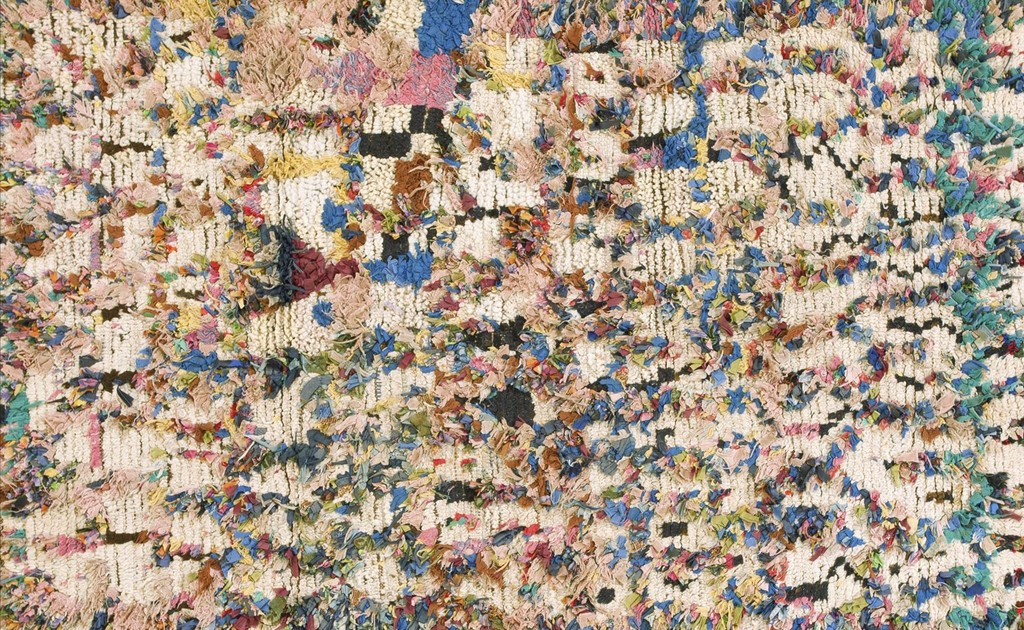
Vintage Berber Moroccan Boucherouitte Small Scatter Size Wool & Cotton Rug by Rugs On Net
Together, they form a tapestry of Moroccan rug symbols that resonate with both the ancient and the intimate. Each Amazigh rug meaning reinforces the cultural truth that designs are never arbitrary—they are visual stories with roots in freedom, identity, and survival.
Historical and Cultural Roots
Why Do Amazigh Weavers Include Tattoo Symbols in Carpets?
The presence of Amazigh tattoo in rugs reflects a worldview where weaving and the body were inseparable. For Amazigh women, who were both tattoo-bearers and rug weavers, the loom became another surface for inscribing identity. Tattoos had long served as protective amulets, marking fertility, warding off evil, and recording life’s passages.
When women sat to weave, they carried these same motifs into the textile, transferring their intimate body marks into communal objects. Carpets became extensions of their own bodies and heritage, embedding tribal symbolism in weaving as both protection and proclamation. This continuity ensured that, even as tattooing faced religious and colonial suppression, the symbolic lexicon survived in another medium.
Evolution from Body Art to Textile Design
The migration from body art to textile design followed a complex timeline tied to social change. For centuries, tattoos and rugs coexisted as parallel canvases, but the early 20th century marked a turning point. Under Islamic reformist movements, tattooing came to be seen as haram, while French colonial authorities often stigmatized it as “primitive.”
As fewer women tattooed their skin, the loom became the primary refuge for symbolic preservation. What was once etched on the body found longevity in wool. The decline of tattooing did not erase its meanings; instead, motifs evolved as woven signs, ensuring cultural resilience in the face of external pressures.
When Did Tattoo-Derived Patterns Shift from Tribal Storytelling to Home Décor?
Tattoo-derived motifs began their shift from tribal storytelling to broader home décor in the early-to-mid 20th century, coinciding with French colonial influence and the growing market for Moroccan rug weaving crafts. While Amazigh women continued to weave rugs as domestic tools and carriers of personal narratives, the Western gaze transformed them into desirable “ethnic” art objects.
What once encoded intimate stories of fertility, protection, and tribal lineage began to be reinterpreted as striking geometric decoration in modern interiors. By the mid-1900s, Berber rug history had moved from private weaving traditions to global design circulation, introducing a tension between sacred meaning and commercial use.
The Sacred and the Commercial
The decline of tattooing strengthened rug weaving as the last vessel for cultural symbolism, but globalization shifted its context. Within Amazigh households, motifs retained protective and spiritual significance. In Western markets, however, they became prized for abstraction and modernist appeal.
This duality highlights the evolution of Berber rug motifs: sacred emblems for one community, design icons for another. The rug thus embodies both continuity and change—a textile that bridges Amazigh heritage and global décor, carrying tribal symbolism in weaving even as its meanings expand beyond their original context.
Recognizing Classic Berber Tattoo Symbols
Key Motifs and Their Meanings

A rich, textured striped rug adds a splash of eclectic color to this sun-drenched, plant-filled living space.
- Diamond / Eye (bou ʿainin) — Represents vision, protection from the evil eye, and clarity of life’s path. — Why: As both tattoo and woven form, the eye safeguarded the body and the home.
- X-Shape / Cross — Symbol of balance, prayer, and cosmic guard. — Why: Often read as a marker of spiritual alignment and tribal identity.
- Zigzag / Serpent — Evokes water, life, and continuity through generations. — Why: A reminder of survival, fertility, and cyclical time.
- Frog — Symbol of fertility, transformation, and abundance. — Why: Reflects the natural cycles tied to rain and agricultural prosperity.
- Barley / Checkered Rectangle — Represents prosperity, nourishment, and duality. — Why: Weaving harvest into design assured blessings for the household.
- Khamsa / Hand — Talisman for protection against misfortune. — Why: A widespread North African symbol translated directly into Amazigh textile vocabulary.
- Comb Motif — Refers to domestic life, weaving itself, and feminine agency. — Why: A nod to women’s central role in cultural preservation.
- Hourglass — Represents time, cycles, and duality (male/female, earth/sky). — Why: Embeds cosmic order into everyday textiles.
- Stars — Symbol of guidance, cosmic protection, and spiritual illumination. — Why: A link between terrestrial life and celestial guardianship.
These Berber symbols in rugs create a dense network of meaning, turning each textile into a layered cultural document rather than mere decoration.
Geometric Shapes that Connect Berber Body Art and Beni Ourain Rugs
The most visible bridge between body art and rugs lies in geometry. Beni Ourain symbol guides highlight the crisscross diamond lattices and sparse linear compositions that echo Amazigh tattoo meaning. Diamonds symbolize the protective eye, while lattices suggest fertility and kinship, mapping out both physical lineage and spiritual guardianship.
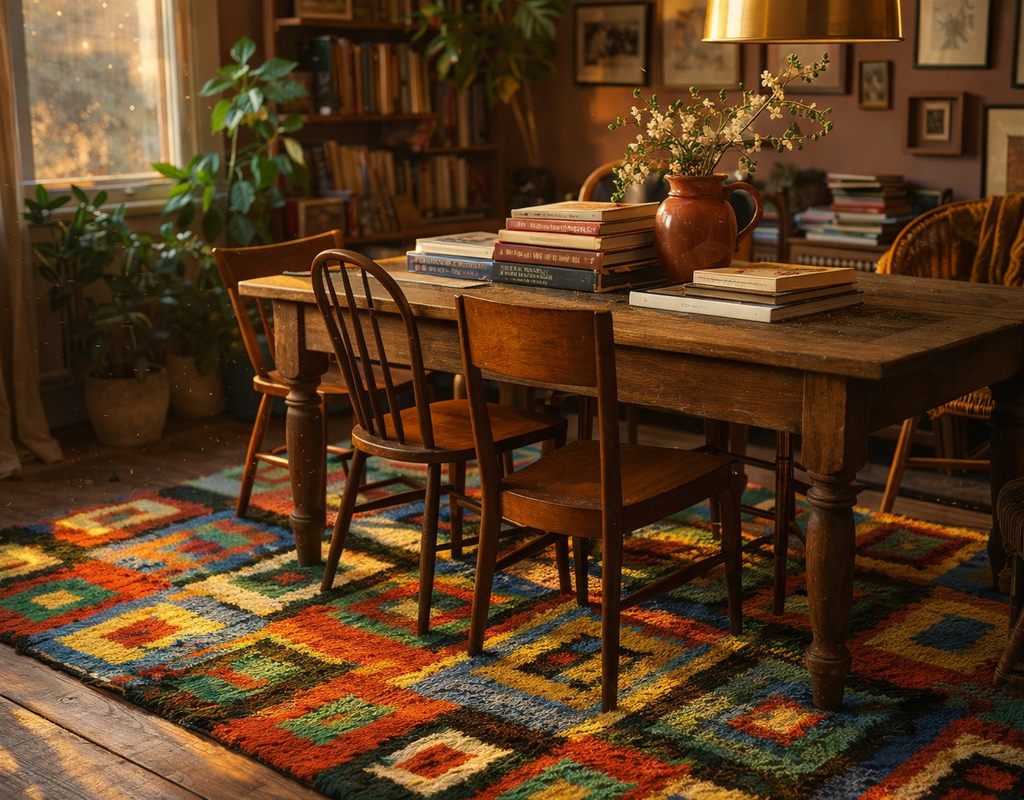
The vibrant, shaggy rug adds a burst of color and texture to this warm, book-lined study or dining space.
Simple X-shapes, triangular forms, and zigzags—once tattooed on faces, hands, and ankles—migrated almost unchanged into the minimalist black-and-white field of Beni Ourain carpets. This continuity proves that even abstract rug designs are embedded with body-based heritage.
Color Symbolism in Berber Rugs
Yes, color choice in Berber rugs often reflects traditional tattoo meanings. Just as tattoos employed symbolic pigments, weavers infused their textiles with hues that carried protective and spiritual weight.
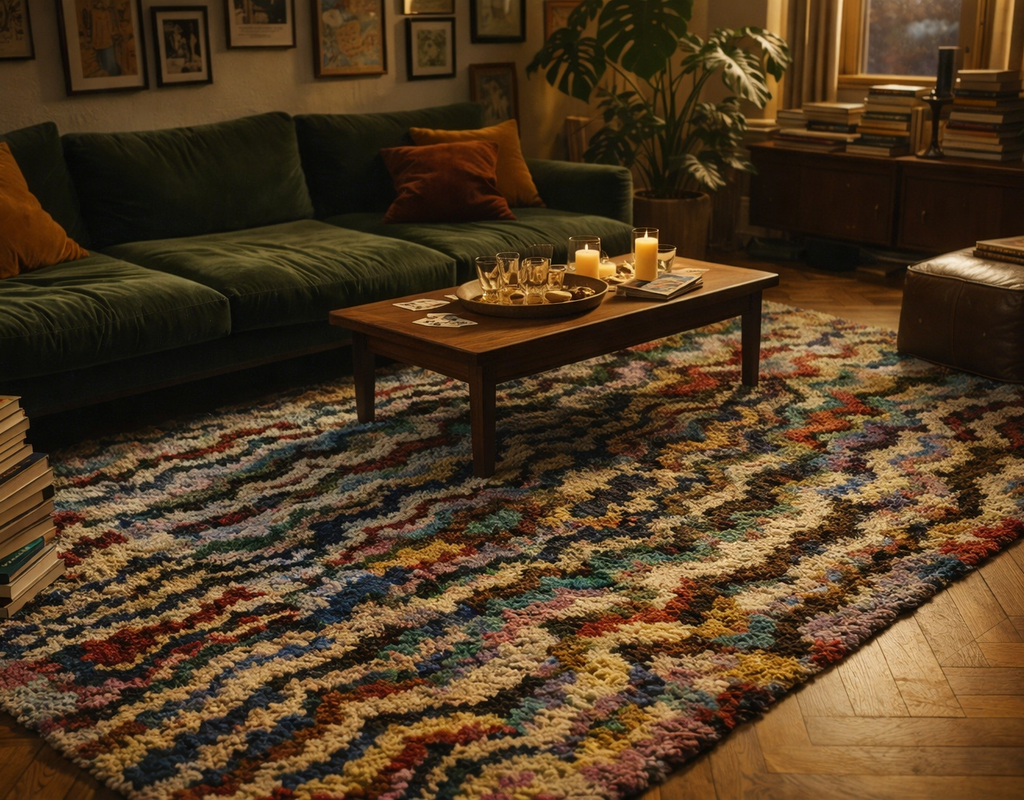
A bohemian-inspired living space warmed by ambient candlelight and anchored by a lively, multicolored textured rug.
In color symbolism in Moroccan rugs: red conveys protection and vitality, blue stands for wisdom and divine connection, yellow symbolizes eternity and permanence, and green reflects peace, fertility, and renewal.
These colors amplify the motifs, ensuring that the rug speaks a full symbolic language of both shape and shade.
How to Recognize Tattoo Symbols on a Rug
Learning how to spot tattoo rug motifs begins with training the eye to look for abstraction rather than realism. Classic motifs are almost always geometric and asymmetrical, with diamonds, zigzags, and X-shapes recurring most frequently.
Many are woven with deliberate irregularity, reinforcing their talismanic, rather than decorative, role. Popular motifs may be isolated or repeated in sequence, and in some cases, highlighted with metallic sequins to strengthen their protective force.
Even in minimalist carpets like Beni Ourain, where patterns seem sparse, each line encodes Amazigh tattoo meaning. To “read” a rug is to unlock its cultural and spiritual narrative, revealing that every textile is a dense archive of belief, memory, and protection.
Materials, Weaving Techniques, and Motif Expression
How Do Wool Pile and Knotting Affect Tattoo-Inspired Patterns?
The foundation of Berber rug materials lies in thick, hand-spun sheep’s wool, prized for its resilience and tactile richness. In pile rugs, motifs are rendered through knotting, where each knot builds a raised section of colored wool.
This technique gives tattoo motif clarity a textured, sculptural dimension—diamonds, zigzags, or crosses rise from the surface, echoing the permanence once seen on tattooed skin. The knotting style, whether asymmetrical or symmetrical, influences sharpness: tighter knots create more defined patterns, while looser work lends a blurred, organic look that mirrors improvisation at the loom.
Can Flatweave Kilims Showcase Berber Tattoo Symbols as Clearly as Pile?
Flatweave vs pile rug traditions offer different strengths. Kilims, woven without pile, rely on color-contrast techniques that can render geometric motifs with razor-sharp precision. Diamonds and X-shapes in particular translate cleanly into flat structures, much like tattoos etched with fine lines.

A detailed focus on the intricate, vivid colors and geometric weave of a traditional textile rug.
Yet pile rugs carry a tactile depth absent in kilims, giving motifs a sculptural, protective presence. Both methods preserve Amazigh tattoo symbols, but in distinct ways: kilims emphasize crispness, pile rugs emphasize texture.
What Weaving Methods Best Capture Amazigh Tattoo Lines in Carpets?
Moroccan rug weaving relies on vertical looms and memory-based improvisation rather than strict patterns. This approach allows weavers to transpose Amazigh tattoo lines into carpets with authenticity and spontaneity.
Bold outlines, asymmetry, and improvisational repetition mirror the body-art tradition, where no two tattoos were identical. Techniques like weft substitution in kilims or varied knot density in pile weaving let artisans adapt line work, ensuring that the essence of the symbol—not just its shape—is captured.
Are Synthetic Dyes Diminishing Spiritual Integrity?
Color has always carried symbolic weight in Moroccan rug weaving. Natural dyes—madder for red (protection), indigo for blue (wisdom), saffron for yellow (eternity), and vegetal greens for peace—imbue motifs with layered Amazigh tattoo meaning. With the introduction of synthetic dyes in the 20th century, practical benefits such as affordability and consistency came at a symbolic cost.
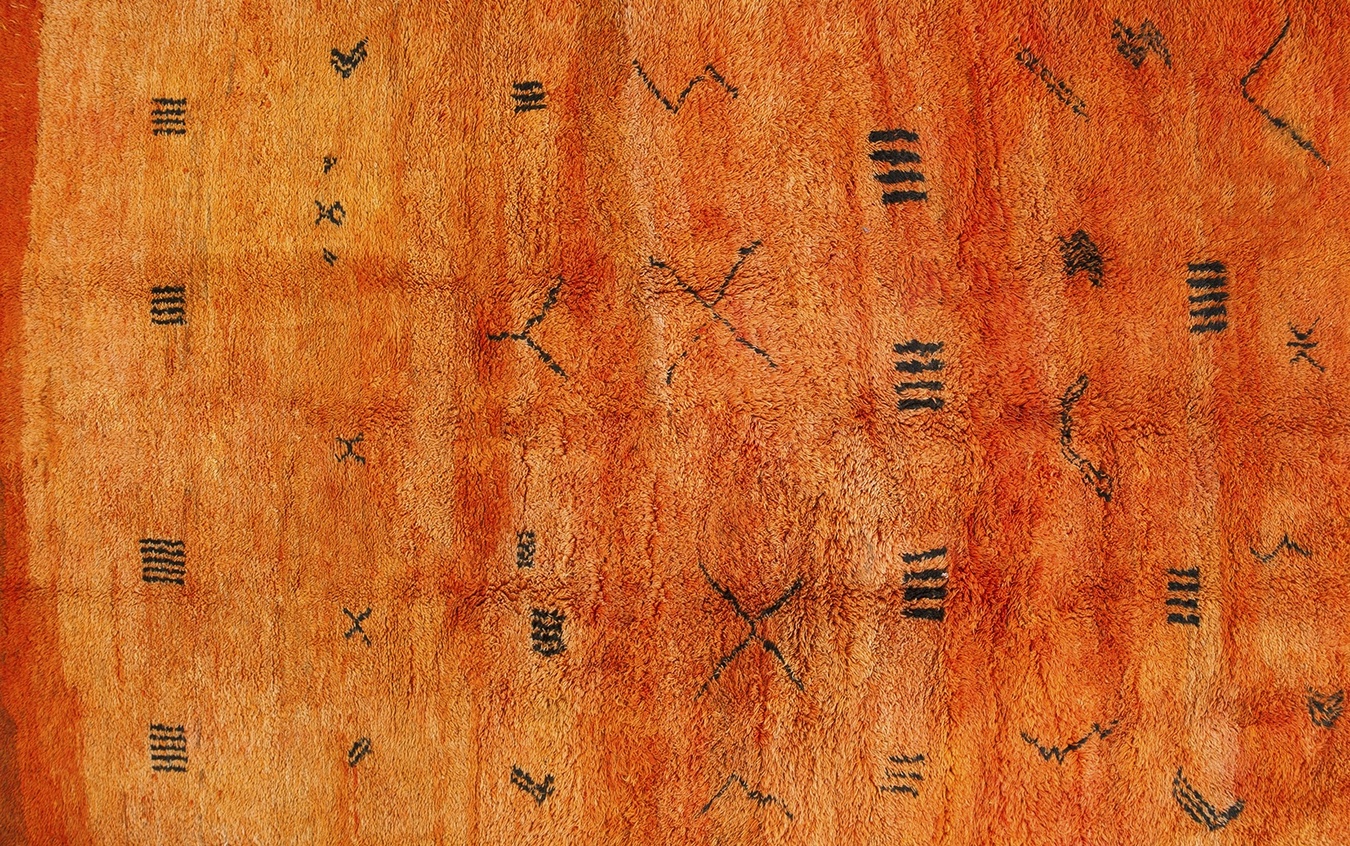
Antique Moroccan – Rabat Moroccan Yellow 1940s Rug – by Rugs On Net
Many argue that synthetic hues lack the spiritual resonance of natural pigments, diminishing the talismanic force once embedded in rug symbols. While the visual appeal remains, the deeper connection between material and meaning can be compromised when natural dyes are replaced.
Does Restoration Risk Erasing Symbolic Tattoo Motifs in Aged Berber Carpets?
Restoration plays a delicate role in preserving tattoo-inspired rugs. While it can stabilize structure and prolong the life of a textile, improper methods risk altering or erasing original motifs. Over-cleaning may strip dyes, and re-knotting with modern wool or synthetic colors can distort symbolic intent.
Since tattoo motifs are often subtle—sometimes only a zigzag shift or a small cross—any alteration threatens cultural authenticity. Provenance documentation and skilled, sensitive restoration are essential to ensure that Amazigh rug meaning survives intact for future generations.
Motif expression, then, is inseparable from material choice, weaving technique, dye integrity, and preservation methods. Each decision—from loom to dye vat to restoration bench—determines whether a rug continues to embody its original cultural and spiritual force.
Regional Variations and Sourcing
Where Are Vintage Rugs with Authentic Tattoo Motifs Commonly Sourced?
Vintage Berber rugs that preserve tattoo-derived symbolism are most often sourced from the Atlas Mountains—specifically the Middle Atlas, High Atlas, Anti-Atlas, and the Rif. Each region has its own weaving traditions that shape how Amazigh tattoo motifs are expressed.
Because these areas maintained cultural continuity despite colonial and religious suppression of tattooing, their textiles carry some of the richest symbolic vocabularies. Collectors and dealers typically seek rugs from small villages in these mountain ranges, where weaving served not only as a household craft but as a direct cultural archive of Amazigh identity.
Regional Styles: Middle Atlas, Anti-Atlas, High Atlas, Rif
- Middle Atlas — Known for bold geometric abstraction, asymmetrical placement of motifs, and strong color contrasts. The Beni Ourain tribe in this region produced the famous plush, ivory rugs with diamond lattices—direct reflections of tattooed eye and fertility symbols. — Why: Their minimalist style allowed symbolic motifs to stand out, making them highly sought after in modern interiors.
- Anti-Atlas / High Atlas — Rugs here often feature brighter palettes and more intricate medallions, shaped by Saharan influences. — Why: Exposure to desert trade routes infused these textiles with wider symbolic and chromatic diversity.
- Rif Mountains — Characterized by striped kilims and banded motifs in muted palettes. — Why: The emphasis on horizontal striping mirrors tribal tattoo banding, with subtle protective designs woven into understated forms.
- Beni Mguild (Middle Atlas) — Renowned for thick pile, bold colors, and dense diamond grids, many echoing Amazigh tattoo motifs. — Why: Their deep indigo and madder tones, combined with symbolic layouts, give these pieces both visual weight and cultural depth.
Regional Berber motifs reveal how geography shaped design: mountains, deserts, and trade networks influenced both structure and symbolism.
What Price Range Covers Mid-Century Beni Mguild Rugs with Tattoo Designs?
Mid-century Beni Mguild rugs that carry tattoo-derived patterns typically range from $2,500 to over $15,000, depending on size, condition, rarity, and provenance. Rugs with clear, undisturbed motifs, natural dyes, and documented village origins command the highest Beni Mguild rug value.
Pieces restored with synthetic dyes or altered designs may fall on the lower end. Exceptional examples—particularly those with intact deep indigo fields and diamond motifs—are considered investment-grade artworks.
Should I Buy a Vintage or New Tattoo-Motif Rug for Investment?
Both vintage and new rugs offer unique value, but the choice depends on investment goals. Vintage Berber rugs carry historic authenticity, preserving motifs woven in an era when tattooing was in cultural decline. They appeal to collectors who prioritize provenance, age, and symbolic integrity. Their value tends to appreciate steadily, especially when documentation is available.
New tattoo-motif rugs, meanwhile, support living Amazigh traditions, ensuring the survival of weaving knowledge and offering more accessible price points. While they may not hold the same long-term monetary appreciation, they embody cultural continuity and provide buyers with ethically sourced, contemporary heirlooms.
For Moroccan rug investment, authenticity, condition, and provenance remain decisive. Whether vintage or new, an authentic tattoo-motif rug is both a visual artifact and a vessel of Amazigh identity—anchored by regional style and the enduring power of symbol.
Authenticity, Provenance, and Collecting
How Can Provenance Documents Verify Authenticity of Tattoo Motifs in Rugs?
For collectors of Berber tattoo carpets, provenance is the single most reliable safeguard of authenticity. Provenance documents typically include tribal attribution, weaving region, approximate age, and sometimes the identity of the weaver or family lineage.
These records confirm whether a rug was produced in an area where tattoo-inspired motifs were historically woven, such as the Middle or High Atlas. Without provenance, distinguishing a genuine Amazigh textile from a modern reproduction becomes far more difficult.
For tattoo-motif rugs in particular—where motifs can appear deceptively simple—provenance secures their place in both cultural heritage and the collector’s market.
How Do Auction Houses Appraise Rugs Bearing Tribe-Specific Tattoo Iconography?
Auction house specialists evaluate tattoo-motif rugs through a blend of motif clarity, stylistic alignment with specific tribes, and historical context. For example, diamond lattices in a Beni Ourain rug or indigo-ground grids in a Beni Mguild piece must conform to established tribal weaving traditions to achieve strong appraisal values.
Age, rarity, and condition also weigh heavily, but the presence of tribe-specific tattoo iconography, when documented, elevates a rug’s status as both ethnographic artifact and art object. Moroccan rug appraisal thus depends not only on beauty but also on cultural fidelity—proving that each symbol belongs to an unbroken lineage.
Should Collectors Insure Tattoo-Motif Berber Rugs at Higher Premiums?
Yes. Collectors are advised to insure tattoo-motif rugs at higher premiums than ordinary carpets. While standard insurance often calculates replacement cost, tattoo-inspired Berber rugs embody cultural, historic, and artistic significance that cannot be replicated. A mid-century Beni Mguild with clear tattoo-derived motifs, for instance, represents both financial and cultural rarity.
As a result, premiums should reflect more than just material value—they should account for the rug’s role as an irreplaceable piece of Amazigh heritage. Insuring tattoo motif rugs this way ensures financial protection in line with their cultural weight.
Does Restoration Risk Erasing Symbolic Tattoo Motifs in Aged Berber Carpets?
As noted earlier, restoration carries inherent risk for tattoo-inspired motifs. Over-cleaning can strip natural dyes tied to symbolic meanings, while careless reweaving may alter or erase geometric figures such as zigzags, eyes, or crosses. Since these designs are often small and asymmetrical, even slight adjustments can compromise authenticity.
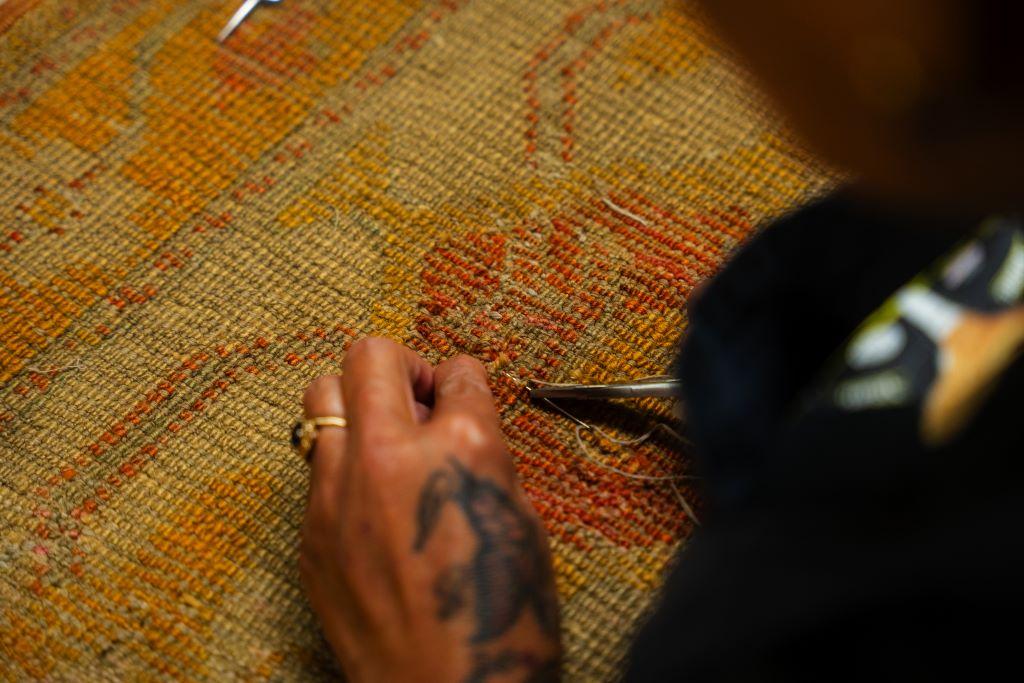
Detail of hands mending a rustic, richly colored woven rug.
For collectors, professional restoration by experts in Moroccan textiles is essential. Done correctly, it stabilizes structure without distorting design; done poorly, it erases the very motifs that define a rug’s historical and cultural importance.
Collecting Berber tattoo carpets therefore hinges on three essentials: verified provenance, informed appraisal, and careful preservation. Together, they safeguard both financial value and the symbolic worlds encoded in every rug.
Contemporary Practice and Cultural Dynamics
Are Modern Moroccan Rug Brands Still Weaving New Tattoo Symbol Collections?
Yes. Modern Berber rug brands and weaving cooperatives continue to produce rugs that incorporate tattoo-inspired designs, ensuring that the tradition remains alive rather than locked in the past. Many of these efforts are linked to heritage preservation and fair-trade initiatives, where women in the Atlas Mountains reinterpret ancestral symbols for contemporary markets.
The result is a dynamic Amazigh design revival in which tattoo motifs remain central, but palettes, textures, and scale adapt to global tastes. These contemporary Berber rug symbols extend the lineage of tattoo-derived patterns into a modern context, proving the vitality of tradition in today’s design world.
Can Custom Commissions Replicate Ancestral Tattoo Patterns Without Cultural Appropriation?
Custom tattoo motif commissions are possible and ethical when approached with cultural sensitivity. Authenticity depends on direct engagement with Amazigh artisans and transparent recognition of the motifs’ origins.
Appropriation occurs when symbols are stripped of context and reproduced superficially; respect is demonstrated when commissions are made through cooperative networks, where artisans guide both design and meaning. Ethical Berber rug sourcing ensures that clients receive rugs with genuine cultural depth, while weavers retain agency over their ancestral visual language. In this way, custom rugs become collaborations rather than imitations.
How Do Weavers Balance Sacred Tattoo Meanings with Contemporary Palettes?
Weavers today frequently adapt their designs to match modern interiors while protecting the essence of sacred symbolism. Contemporary palettes—neutrals, monochromes, and pastel tones—are often substituted for traditional indigo, madder red, or saffron yellow. Yet the motifs themselves, whether diamonds, zigzags, or khamsa hands, remain unchanged in meaning.
This negotiation reflects the dual role of the rug: both as a living artifact of Amazigh heritage and as a commodity in the global market. For weavers, balancing sacred tattoo meanings with contemporary palettes allows them to preserve cultural integrity while ensuring financial sustainability in modern design economies.
Legacy and Innovation: The Global Future of Berber Tattoo Motifs
The future of tattoo-inspired rugs lies in the interplay between legacy and innovation. As Amazigh women continue weaving, they preserve motifs once carried on skin and now carried in wool, ensuring continuity across generations. At the same time, global interest in these designs has increased visibility, elevating Berber tattoo carpets into icons of cultural resilience.
Yet with popularity comes risk: superficial imitation by mass-market brands threatens to strip these motifs of their depth. The challenge ahead is to protect the cultural authenticity of Amazigh symbolism while embracing its role as a modern design inspiration. Berber tattoo rug motifs, therefore, are not relics—they are a living tradition, continually renewed. Their journey from body art to textiles, and now into global décor, demonstrates both the adaptability and enduring power of Amazigh cultural expression.
FAQ
- How can I buy Berber tattoo rugs ethically?
Favor artisan cooperatives or direct-to-weaver platforms and request provenance details. Paying fair prices supports the makers and preserves Amazigh tattoo-derived motifs.
- Any risks with vintage Berber tattoo rugs?
Watch for unstable dyes, moth wear, or dry rot. Ask for UV-light photos, dye tests, and close-ups of the back; budget for professional cleaning (\$4–\$8 per sq ft).
- How do Azilal Berber tattoo rugs differ from Boucherouite?
Azilal rugs pair wool pile with vivid motifs inspired by tattoo symbols. Boucherouite are rag rugs—recycled textiles create color-heavy, irregular patterns with similar symbolic play.
- What’s the difference between Berber tattoo rugs and “tribal” rugs?
“Tribal” is a vague retail label. Berber tattoo rugs specifically reference Amazigh tattoo iconography and language (e.g., Tifinagh), tied to Moroccan weaving lineages.
- Are all Berber tattoo symbols interpreted the same way?
No—meanings shift by region, family, and weaver. A diamond might imply protection in one rug and fertility in another; ask sellers for that rug’s story.
- How should I style Berber tattoo rugs in modern spaces?
Let the graphic symbols lead—center under the coffee table with front legs of sofas on the rug. In bedrooms, an 8×10 usually frames a queen bed nicely.
- What sizes do Berber tattoo rugs commonly come in?
Standard U.S. sizes—5×8, 8×10, 9×12—plus runners (2–3×8–14). Many vendors offer custom sizes; thickness typically ranges about 0.4–1.0 inches.
- Are Berber tattoo rugs kid- and pet-friendly?
Wool is naturally resilient and soil-resistant; spot treat promptly and trim pulled yarns, don’t tug. For pets, avoid long fringe and very high pile.
- How durable are Berber tattoo rugs in high-traffic rooms?
Dense wool weaves hold up well with pads and rotation. Choose lower pile for entries or dining; place a 2×3 or runner at doors to catch grit.
- Do Berber tattoo motifs appear in flatweaves and kilims?
Yes—Amazigh tattoo symbols aren’t limited to pile rugs. You’ll see diamonds, zigzags, and crosses in kilims, hanbels, and even Tuareg mats.
- What rug pad works best under Berber tattoo rugs?
A felt-plus-natural-rubber pad balances grip and cushioning. Trim the pad 1–2 inches smaller than the rug on all sides to prevent peek-through and edge curl.
- Are Berber tattoo rugs OK with radiant floor heating?
Generally yes for wool, but avoid too-thick piles and insulative pads. Keep total R-value modest (around 1.5–2.0 is often cited) and use low, steady heat.
- Can I use a robot vacuum on Berber tattoo rugs?
Carefully—fringes and high pile can tangle. Fold fringes under, set no-go zones, and monitor first runs. Some models still misread dark rugs as “cliffs.”
- Will Berber tattoo rugs bleed color?
Some do, especially bright vintage pieces. Always perform a dye-stability test first; if color transfers, keep water minimal and call a specialist cleaner.
- How do I spot-clean a Berber tattoo wool rug safely?
Blot spills immediately, then test dyes with a white cloth. Use cool water and a wool-safe detergent; avoid steam or oversaturation. For big jobs, hire a rug professional.
- Do Berber tattoo rugs shed?
Yes, wool rugs typically shed for a few months, then taper. Vacuum weekly with suction only (no beater bar) and use a quality pad to capture fibers.
- How can I tell if a Berber tattoo rug is authentic?
Flip it—handmade backs show irregular knots and no glued latex. Fringes often continue the warp, not sewn on. Expect slight asymmetry and lanolin-rich wool scent.
- How much do authentic Berber tattoo rugs cost?
New hand-knotted 5×8 pieces often run \$800–\$3,000; vintage or gallery sizes can range \$3,000–\$10,000+. Ultra-cheap “Moroccan style” rugs are usually machine-made imitations.
- What materials are common in Berber tattoo rugs?
Mostly sheep’s wool with cotton warps; natural or low-impact dyes are typical, though synthetics exist. Undyed ivory/brown palettes are common in Beni Ourain pieces.
- Are Berber tattoo symbols sacred, and is buying Berber tattoo rugs respectful?
They carry cultural meaning but are widely woven for trade. Buy from artisan cooperatives or fair-trade sellers and avoid mislabeling (“tribal” catch-alls); ask makers about motif stories.
- Are Berber tattoo motifs used beyond Morocco?
Amazigh communities exist across North Africa, but Berber tattoo rugs seen in U.S. markets are overwhelmingly Moroccan. Tuareg reed mats also carry related geometric symbolism.
- Are Berber tattoo rugs the same as Beni Ourain rugs?
Beni Ourain is one famous subset of Berber tattoo rugs—usually ivory wool with dark, geometric lines and medium-to-high pile. Azilal rugs use brighter colors and sometimes mixed techniques.
- Where did Berber tattoo motifs in rugs originate?
Amazigh women historically encoded life events and protection symbols from facial/hand tattoos into textiles. Many motifs trace to the Atlas Mountains, then spread via tribal weaving traditions.
- What do the symbols on Berber tattoo rugs mean?
Meanings vary by tribe, but diamonds often signal protection or fertility, zigzags suggest water or journey, and X-shapes can echo the human figure. Expect layered, personal narratives rather than one fixed “key.”
- What are Berber tattoo rugs?
Berber tattoo rugs are Moroccan (Amazigh) weavings that translate traditional tattoo symbols—like diamonds, X’s, and zigzags—into patterns. Most are hand-knotted wool; classic examples come from Beni Ourain and Azilal tribes.