
Introduction to Islimi Rugs
Browse our elegant selection of authentic Islimi design rugs right now.
What is Islimi design in Persian rugs?
Islimi design in Persian rugs refers to the flowing, curvilinear arabesque patterns of scrolling vines, leaves, and blossoms that form one of the most recognizable visual languages in Islamic art. Unlike geometric designs, which rely on symmetry and grids, Islimi motifs are biomorphic—their shapes are drawn from the natural world, particularly plant life.
In carpets, this design tradition often takes the form of endlessly intertwining tendrils and palmettes, symbolizing continuity, spirituality, and the infinite nature of creation. Islimi is thus both a decorative style and a spiritual expression woven into the fabric of Persian arabesque rugs.
Key Features and Name Origins
The word “Islimi” comes from Arabic roots meaning “Islamic-style,” directly tying the motif to the broader tradition of Islamic ornament. In Persian art, the phrase “gol-e eslimi” literally means “arabesque flower,” emphasizing the floral inspiration behind the style.
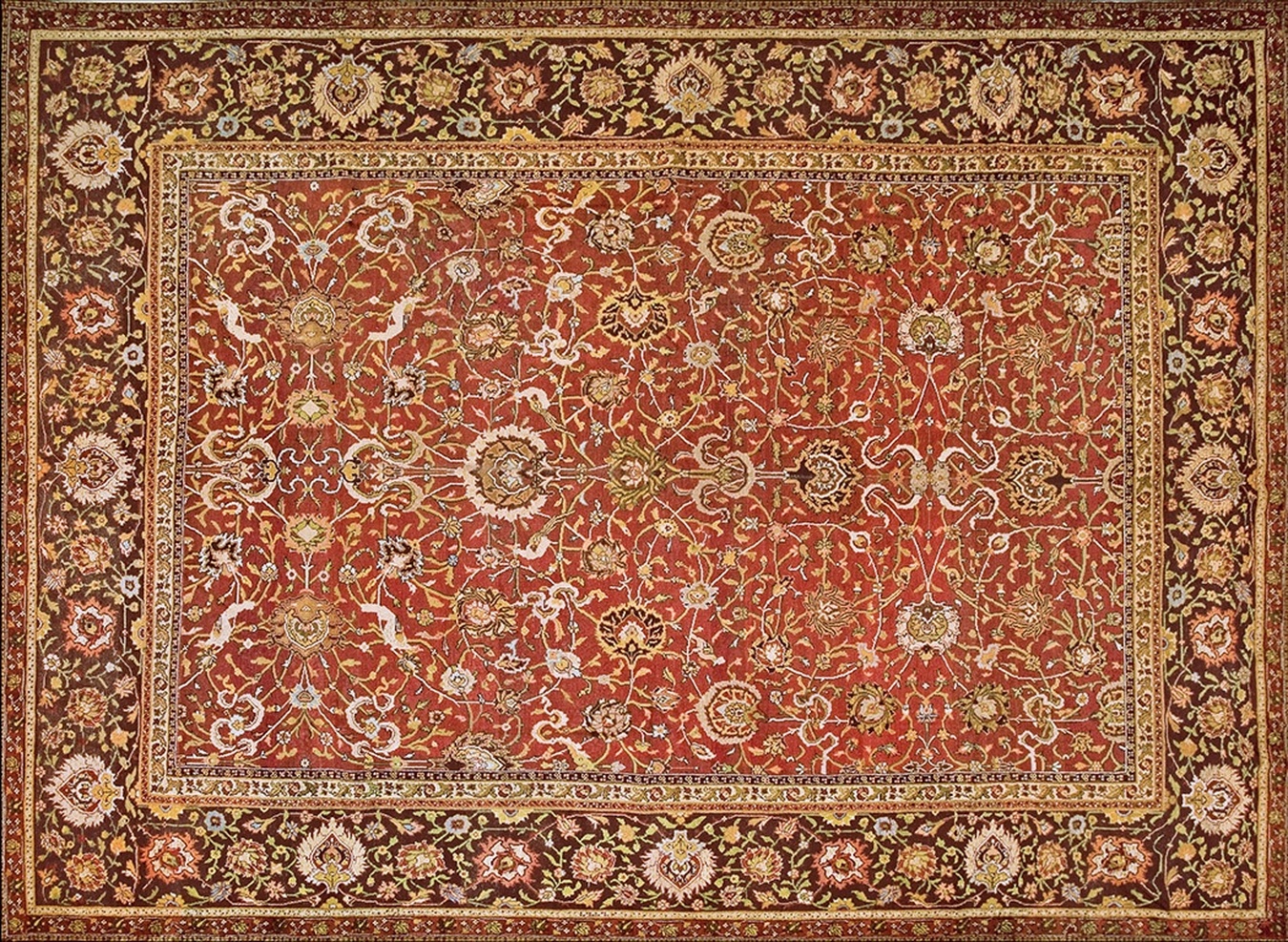
Western art history often uses the term “arabesque” to describe this design, but in rug studies, “Islimi” highlights its Persian interpretation.
Core features of Islimi motifs include:
- Interconnected vines and tendrils that twist, split, and rejoin seamlessly.
- Palmettes, blossoms, and stylized leaves rendered with graceful curves.
- Symmetry and rhythm, with patterns often mirrored across central axes.
- Spiritual abstraction, transforming natural plants into idealized ornament.
These qualities made the Islimi motif a signature of Persian carpets, later adopted in Turkish, Indian, and Central Asian weaving traditions. Whether described as eslimi design, arabesque vine carpet, or Islamic scrollwork, the visual intent is the same: to translate the vitality of nature into eternal, sacred pattern.
Visual Overview of Classic Islimi Patterns
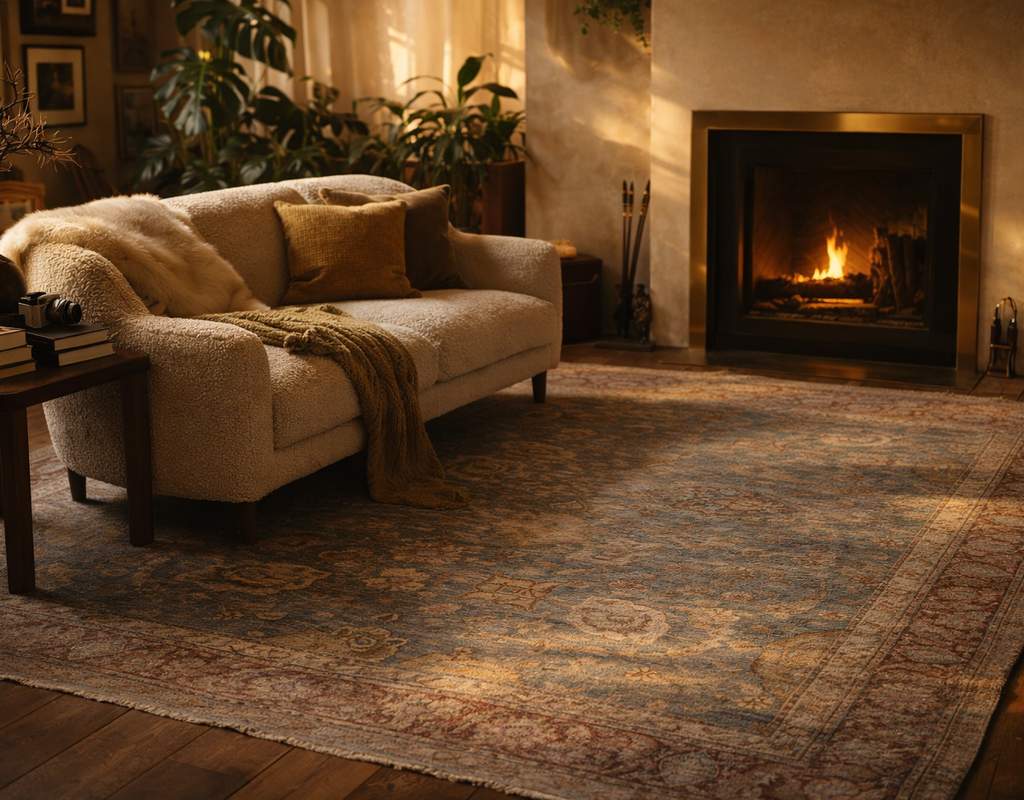
A perfectly curated moment of warmth and texture, centered around a vintage-style area rug.
- Scrolling Vines — Flowing tendrils loop endlessly across the field or border, suggesting infinite growth. — Why: This is the most immediate visual cue that a rug belongs to the Islimi family.
- Palmette Medallions — Large stylized leaves or blossoms anchor the design, often radiating outward. — Why: Palmettes are hallmark anchors in Persian arabesque rugs, balancing motion with structure.
- Cloud Bands and Split Leaves — Ribbon-like curves and bifurcating leaf forms appear in many carpets. — Why: These elements reinforce the organic, rhythmic quality of Islimi patterns.
- Symmetrical Layouts — Motifs mirror across central medallions or vertical axes. — Why: Symmetry ties the flowing vines into a structured, harmonious design, reflecting spiritual order.
- Gol-e Eslimi Blooms — Small stylized blossoms repeat within vine networks. — Why: These emphasize the floral roots of the style, distinguishing Islimi from purely geometric ornament.
Together, these identifiers make Islimi rugs instantly recognizable. The motif is more than decoration—it represents the unbroken cycle of life, a spiritual vine that binds Islamic art together across centuries and regions.
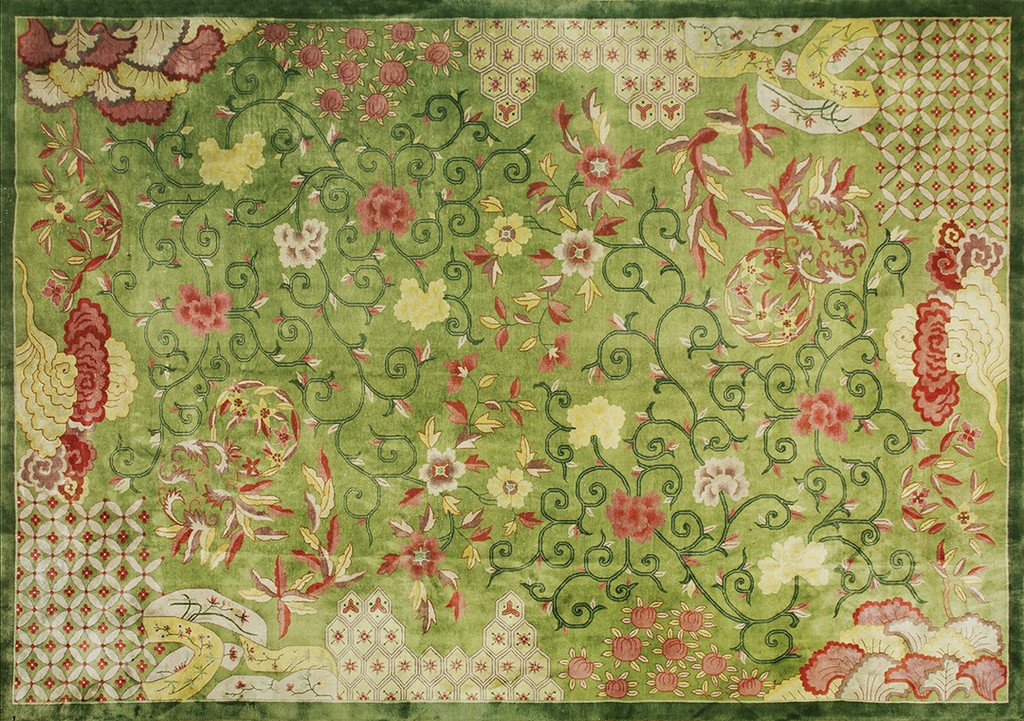
Stunning Antique Chinese Art Deco Carpet by Nichols Workshop Wool Green Hand Knotted Pile Rug by Rugs On Net
Whether encountered in a Persian arabesque rug, a Turkish medallion carpet, or an Indian court weaving, Islimi patterns remain the signature curvilinear expression of Islamic rug art.
Historical Origins and Development of the Islimi Motif
Early Vine Scroll Influences
The history of Islimi begins long before Islamic carpets. Its roots lie in the vine scrolls of Greco-Roman, Sasanian, and Byzantine art, where acanthus leaves, curling tendrils, and grapevines were carved into stone or painted in frescoes as symbols of fertility and abundance. When these traditions entered Persia during the Sasanian Empire, artisans translated them into textiles and stucco reliefs.
With the advent of Islam, these motifs were preserved but reshaped—no longer mimicking grapes and vines directly, but abstracted into flowing, biomorphic ornament free of naturalistic imagery. This transformation marks the earliest step from vine scroll to Islimi motif, setting the stage for its later dominance in Islamic scrollwork.
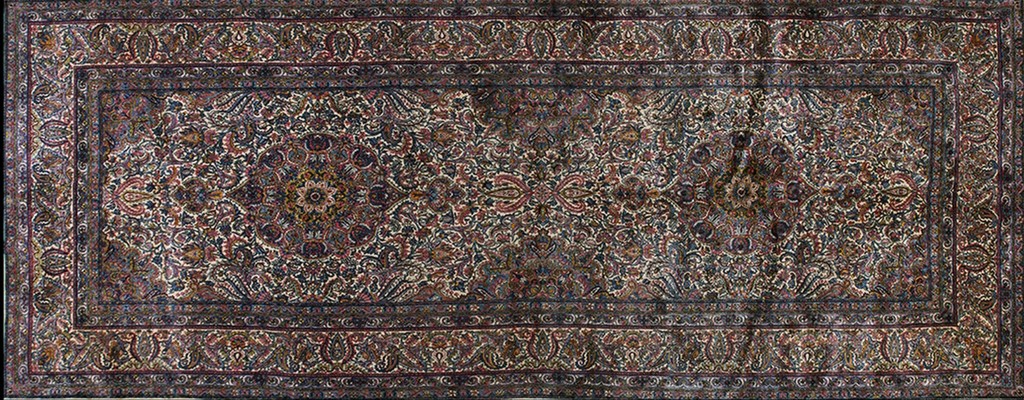
Antique Kilim Persian Knotted Rug by Rugs On Net
Emergence in Early Islamic Decorative Arts
By the 9th and 10th centuries, the origins of arabesque were firmly embedded in Islamic art. Under the Abbasid caliphate in Baghdad, artisans refined vine-scroll traditions into the abstract Islamic vine pattern, adorning manuscripts, mosque stuccoes, ceramics, and woodwork.
The Islimi design—often described as an infinite network of scrolling vines—became a unifying language across the Islamic world, harmonizing with the aniconic principles of Islamic aesthetics. Although not yet a common feature in carpets, Islimi ornament spread widely in the decorative arts, creating the stylistic foundation that Persian weavers would later translate into textile masterpieces.
Safavid Era: Who Popularized Islimi Motifs?
The Safavid dynasty in Persia (16th–17th centuries) elevated Islimi from manuscript borders and ceramic glazes into the monumental scale of carpets. It was in the royal weaving centers of Kashan, Tabriz, Isfahan, and Herat that the Islimi vine scroll became the hallmark of classical Persian vine scroll rugs. The Safavid court under Shah Tahmasp I and later Shah Abbas I commissioned carpets that fused intricate Islimi scrollwork with central medallions and floral palmettes, creating enduring templates that defined Persian arabesque rugs for centuries.
Court painters and designers such as Sultan Muhammad and Mir Sayyid Ali adapted the design motif from illuminated manuscripts into carpet cartoons, ensuring the motif became central to Safavid Isfahan’s flourishing carpet workshops. Direct Answer: Islimi motifs in carpets were popularized during the Safavid era by Shah Tahmasp I and Shah Abbas I, whose court ateliers integrated the arabesque vine into the very core of Persian carpet design.
Cross-Cultural Pollination
Though Safavid Persia set the standard, the Islimi motif did not remain confined to Iran.
The vine-scroll language of Islamic art spread outward, enriching diverse artistic traditions:
- Ottoman Turkey adopted Islimi scrolls into court carpets and İznik ceramics, blending them with tulip and carnation motifs.
- Mughal India reinterpreted Islimi patterns with lotus flowers and lush naturalism, producing carpets that bridged Persian elegance with Indian flora.
- China influenced and absorbed arabesque vine carpet design through silk trade, where cloud bands and Chinese floral motifs merged seamlessly with Islamic scrollwork.
This cross-pollination ensured that Islimi patterns became a pan-Islamic and global ornament, recognizable in architecture, textiles, and manuscripts across continents. The motif in carpets originated from the vine scroll traditions of Greco-Roman, Sasanian, and Byzantine art, refined in the Islamic era to align with spiritual abstraction.
Its true flourishing came during the Safavid period, when Shah Tahmasp I and Shah Abbas I’s workshops integrated arabesque scrolls into monumental carpets, setting a classical standard that influenced Ottoman, Mughal, and even Chinese art. Today, the enduring Islimi art history in carpets testifies to the motif’s role as both a Persian innovation and a shared Islamic visual language.
Design Elements and Symbolism of Islimi in Rugs
Core Motifs: Spiraling Vines, Palmettes, Rumi Split-Leaves, Khataei Florals
The Islimi vine motif is built on a network of spiraling vines, endlessly looping tendrils that link the design together. Along these scrolls sprout palmettes, stylized lotus or pomegranate forms that act as visual anchors. The rumi split-leaf, an Anatolian import, introduces bifurcated foliage curling outward in mirrored balance.
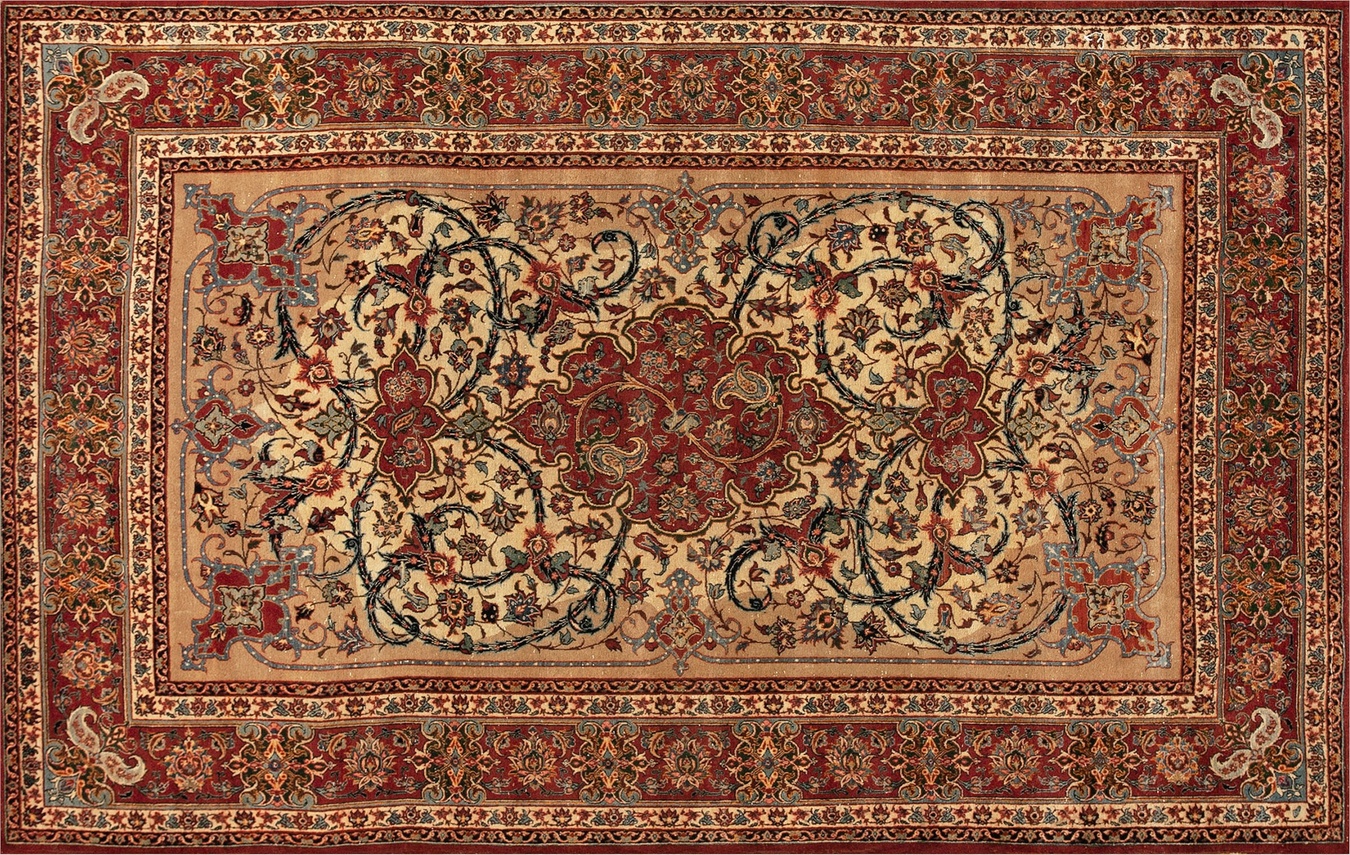
Antique Esfahan Persian Floral, Medallion Knotted Rug – by Rugs On Net
Layered among them are khataei florals—blossoms and buds with Persian roots, drawn in abstract but recognizable forms. Together, these design elements create the characteristic Persian scrolling vines seen in carpets from the Safavid era onward, a fusion of botanical abstraction and spiritual geometry.
Why Spiraling Vines?
Spiraling vines are not only the backbone of the design but also its most profound symbolic gesture.
- Visual Role: The vines act as connective tissue, linking palmettes, leaves, and blossoms into one seamless whole. Without them, the arabesque would fracture into floating elements.
- Technical Role: For weavers, the vine scroll provides a continuous guiding line, a framework that organizes motifs across vast carpet fields.
- Symbolic Role: The spiral represents infinity, divine order, and the eternal cycle of life. In Islamic culture, where figural imagery was often restricted, the vine’s endless growth became a metaphor for paradise and creation itself.
Direct Answer: Spiraling vines are central to Islimi rug design because they unify the composition visually, guide the structure technically, and symbolize infinite life and divine blessing.
Symbolism: Unity, Paradise, and the Tree of Life
The Islimi motif transforms natural plants into a universal spiritual language. Palmettes recall the lotus (rebirth) or pomegranate (fertility and blessings), while scrolling vines suggest unbroken continuity.
Many carpets interpret these vines as extensions of the Tree of Life rug motif, binding heaven and earth in a sacred design. At its core, Islimi embodies unity, paradise, infinity, and divine order—its rhythm and symmetry mirror the cosmic harmony celebrated in Islamic art.
Islimi vs. Shah Abbasi Florals
Though often paired in Safavid carpets, Islimi and Shah Abbasi florals differ in both form and philosophy.
- Islimi: Vine-driven, with arabesque palmettes, rumi leaves, and blossoms all interconnected in flowing scrollwork. The emphasis is on movement, rhythm, and unity.
- Shah Abbasi florals: Flower-head driven, with large, bold lotus blossoms or rosettes arranged in more isolated, sometimes geometric fashion. These motifs tend to dominate space rather than merge seamlessly into vines.
Direct Answer: Islimi patterns differ from Shah Abbasi florals in that the design emphasizes continuous, interlaced vines, while Shah Abbasi focuses on prominent, often geometric flower heads.
How to Spot Authentic Islimi Arabesque in Vintage Rugs
- Fine, Connected Vinework — Look for uninterrupted scrolls linking every motif. — Why: True Islimi never leaves motifs “floating”; the vine is always continuous.
- Radial Symmetry — Patterns mirror along central medallions or axes. — Why: Symmetry reflects the harmony and spiritual order central to Islimi design.
- Outlined Motifs — Leaves, palmettes, and blossoms often have clear, ink-like outlines. — Why: This precision is a hallmark of classical Persian arabesque rugs.
- Curvilinear, Not Geometric — Motifs should bend, spiral, and flow rather than align to grids. — Why: Islimi is strictly biomorphic, never angular or rigid.
- Complex Interlace — The more intricate the vine network, the closer it aligns to authentic tradition. — Why: Complexity shows fidelity to Safavid standards and helps distinguish true authentic Islimi arabesque from simplified imitations.
The Islimi vine motif is defined by spiraling scrolls that carry both structural and symbolic weight, binding arabesque palmettes, rumi leaves, and khataei florals into a unified design. Its meaning extends far beyond ornament, evoking paradise, infinity, and the Tree of Life.
In contrast to Shah Abbasi florals, which highlight bold blossoms, Islimi emphasizes continuous vine-work and interlacing harmony. For collectors and enthusiasts, spotting authentic Islimi arabesque in vintage rugs means looking for precision, symmetry, and curvilinear complexity—the hallmarks of one of the most profound visual languages in Islamic floral carpets.
Weaving Techniques, Materials, and Construction
Hand-Knotted Methods: Senneh vs. Ghiordes Knots
The foundation of every hand-knotted arabesque lies in its knot. For Islimi designs, where flowing curves are essential, the Senneh knot (Persian knot) is generally preferred. Its asymmetrical structure allows finer control over pile direction, enabling weavers to capture the fluid spirals and delicate arabesque palmettes of Islimi rugs with greater clarity.
The Ghiordes knot (Turkish knot), while stronger and highly durable, produces slightly bulkier loops that can limit precision in tight curves. For strength and longevity, the Ghiordes knot excels; for finesse and flowing vinework, the Senneh knot provides the edge.
How Knot Density Affects Design Clarity
Direct Answer: Higher knot density results in smoother, sharper, and more precise curves in Islimi rug design, while lower density produces more angular, simplified motifs. Knot density—measured as knots per square inch (KPSI)—directly determines how finely a weaver can execute the intricate Persian scrolling vines characteristic of the iconic design patterns.
A high-knot Persian carpet allows palmettes, rumi leaves, and floral scrolls to appear as if painted with a brush, while lower densities inevitably create pixel-like blockiness. For collectors, this makes knot density a decisive factor in both aesthetic quality and long-term investment value.
Best Materials for Islimi Detail: Silk, Wool, Cotton
- Silk — The ultimate material for Islimi detail. A silk Islimi rug offers unmatched clarity, allowing even the thinnest vine scroll to shine. Its natural luster amplifies sheen, making arabesque motifs shimmer in the light. — Yes, silk amplifies the sheen of Islimi motifs, enhancing their elegance and visibility.
- Fine Wool — More affordable and widely available than silk, yet when tightly knotted, wool still delivers excellent clarity. Persian weavers often use high-quality kurk wool to replicate intricate Islimi patterns at scale.
- Cotton — Usually reserved for the foundation (warp and weft), cotton provides stability and tension, supporting the finesse of silk or wool pile.
Cleaning: Silk requires the gentlest care—dry cleaning by specialists or careful blotting only, never harsh scrubbing. Wool, by contrast, is more forgiving: light vacuuming and spot-cleaning with mild soap are safe for everyday maintenance.
Cartoons, Outlining, and Natural Dyes
- Cartoons (Design Blueprints) — Master weavers rely on full-scale drawings to guide complex Islimi patterns. — Why: Precision in arabesque scrollwork is impossible without exact planning.
- Outlining with Dark Wool or Silk — Many Islimi carpets outline motifs in a darker shade before filling them. — Why: This technique sharpens definition, ensuring vines and blossoms don’t blur together.
- Natural Dyes — Madder red, indigo blue, walnut brown, and pomegranate yellow are staples. — Why: Natural dyes provide depth and harmony, essential to the spiritual aura of Islamic floral carpets.
Machine-Made vs. Hand-Knotted Islimi Curves
Modern machine-made rugs cannot replicate true Islimi curves with fidelity or investment value. While digital looms can mimic scrollwork superficially, the organic fluidity of hand-knotted arabesque cannot be duplicated by mechanical weaving.
Machine-made versions often lack the nuanced shading, vine continuity, and fine curvature of authentic pieces, making them decorative rather than collectible.
Should You Invest in High-Knot Islimi Rugs?
Direct Answer: Yes, high-knot rugs are investment-worthy because they best preserve design clarity, durability, and long-term resale value. Collectors prize high-knot Persian carpets for their ability to faithfully render complex Islimi vine motifs with elegance. Beyond beauty, the density of knots ensures structural strength, making them lasting cultural heirlooms. The construction of the rugs with this pattern depends on a triad of factors: knot type, density, and material.
The Senneh knot and high knot density bring life to delicate spirals; silk amplifies sheen and clarity, while fine wool balances quality and accessibility. With proper care—particularly specialized Islimi rug cleaning for silk—the investment value of hand-knotted arabesque rugs remains unmatched. Only in the hands of skilled artisans, guided by cartoons, natural dyes, and centuries of tradition, can the true spirit of Islimi be faithfully woven.
Regional Variations and Signature Styles
Persian Centers of Islimi Design
Direct Answer: The Persian weaving regions most associated with Islimi patterns are Isfahan, Nain, Kashan, Tabriz, Kirman, and Herat.
- Isfahan Islimi rugs — Renowned for luminous silk-and-wool blends, jewel-toned palettes, and exquisitely detailed arabesque scrolls paired with balanced medallions. These set the classical benchmark for Persian arabesque carpets.
- Nain arabesque carpets — Closely linked to Isfahan but often in a softer ivory-and-blue palette, woven with ultra-fine kurk wool and silk highlights. Their Islimi vinework is among the most delicate ever produced.
- Kashan — Famed for densely packed scrolling vines that often fill the entire field, creating a lush surface of arabesque motifs.
- Tabriz scrolling vines — Distinguished by pictorial complexity, sometimes incorporating hunting scenes intertwined with Islimi curves.
- Kirman — Known for sprawling field designs and elaborate borders where Islimi motifs intertwine with floral sprays.
- Herat — A historical hub producing intricate arabesque layouts that influenced both Persian and Central Asian weaving.
These Persian centers collectively forged the “gold standard” of Islimi rugs, each introducing regional inflections while maintaining the unbroken vine-scroll tradition.
Ottoman Turkish, Mughal Indian, and Central Asian Styles
Beyond Persia, the Islimi design adapted to regional tastes and aesthetics:
- Turkish rumi motif rugs — Ottoman workshops emphasized bold rumi split-leaves and saz-style vines, often elongated and geometricized. These were paired with cloud bands in borders, lending a more architectural feel than Persian arabesques.
- Mughal floral Islimi — In India, weavers softened the Persian model, weaving millefleurs (thousand flowers), cypress trees, and pastel color schemes. The vines remained, but blossoms were rendered more naturalistically than in Persia.
- Central Asian and Caucasus Islimi style — Local adaptations reduced arabesques to more geometric forms, with vine scrolls simplified into angular lines and blossoms rendered as star-like flowers, reflecting nomadic design preferences.
Common Features by Region
- Isfahan / Nain — Fine materials, high knot density, luminous sheen. — Why: These regions prioritized artistic refinement and courtly prestige.
- Kashan / Tabriz / Kirman — Field-filling arabesques, sometimes narrative elements. — Why: These workshops valued scale, storytelling, and richness of pattern.
- Ottoman Turkey — Bolder, more geometric vines with rumi leaves. — Why: Aesthetic leaned toward strength and monumentality.
- Mughal India — Delicate florals, softer colors, cypress motifs. — Why: Court tastes favored naturalism and elegance.
- Central Asia / Caucasus — Angular simplification. — Why: Geometric design aligned with nomadic tribal weaving traditions.
Durability for High-Traffic Areas
Direct Answer: A Nain rug with this deign pattern, while durable in its wool-and-silk construction, is not ideal for heavy-traffic areas. Nain arabesque carpets, like Isfahan rugs, are woven with exceptional fineness, sometimes exceeding 600 knots per square inch.
This makes them works of art with delicate silk highlights that can wear under constant footfall. They are best displayed in low-traffic spaces such as living rooms, formal reception areas, or bedrooms, where their precision and sheen can be appreciated without risk.
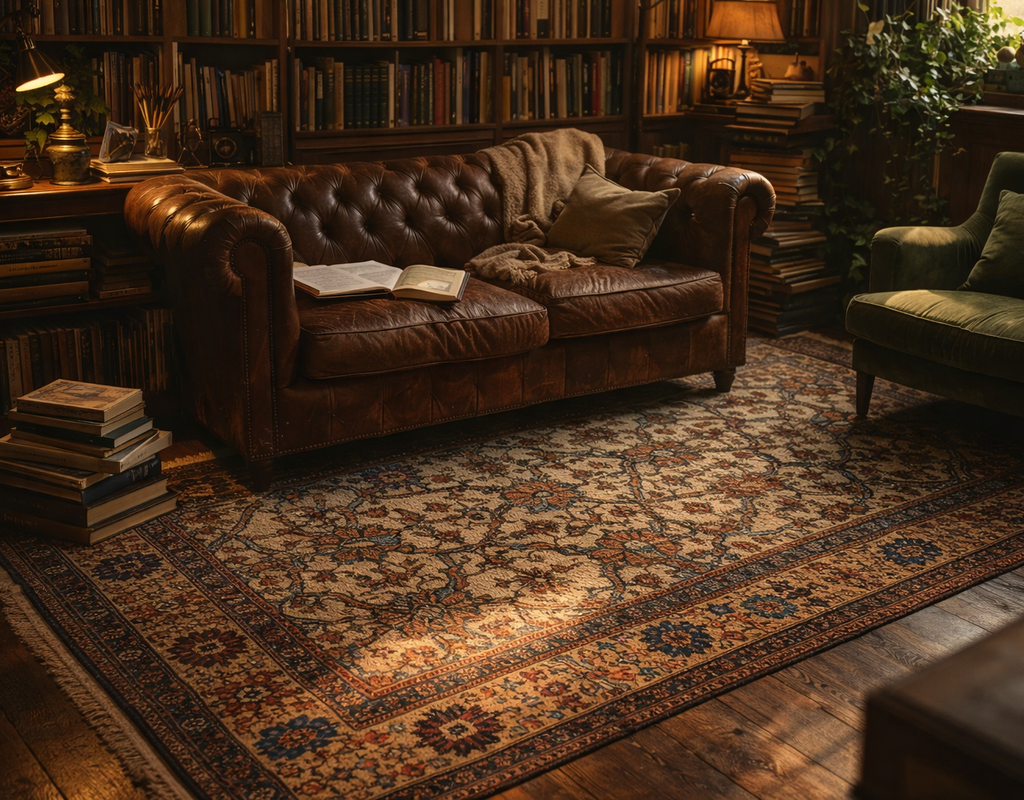
A traditional oriental rug anchors the seating area in this warm, book-lined den.
For heavy-use areas, thicker-pile tribal rugs or robust all-wool carpets are better suited. From the refined elegance of Isfahan and Nain arabesque carpets to the bold rumi of Ottoman Turkey, the naturalistic Mughal floral Islimi, and the geometric simplifications of Central Asia, each region developed its own visual vocabulary. While Persian centers set the classical ideals, regional adaptations expanded the versatility of the Islimi vine motif across cultures.
For collectors and decorators, understanding these differences—along with practical considerations like durability—ensures that choosing an area rug with this deign pattern means selecting not only a design but a legacy of artistry shaped by centuries of cultural exchange.
Collecting, Buying, and Valuing Islimi Rugs
Cost Factors: Size, Material, Knot Density, Age, Condition
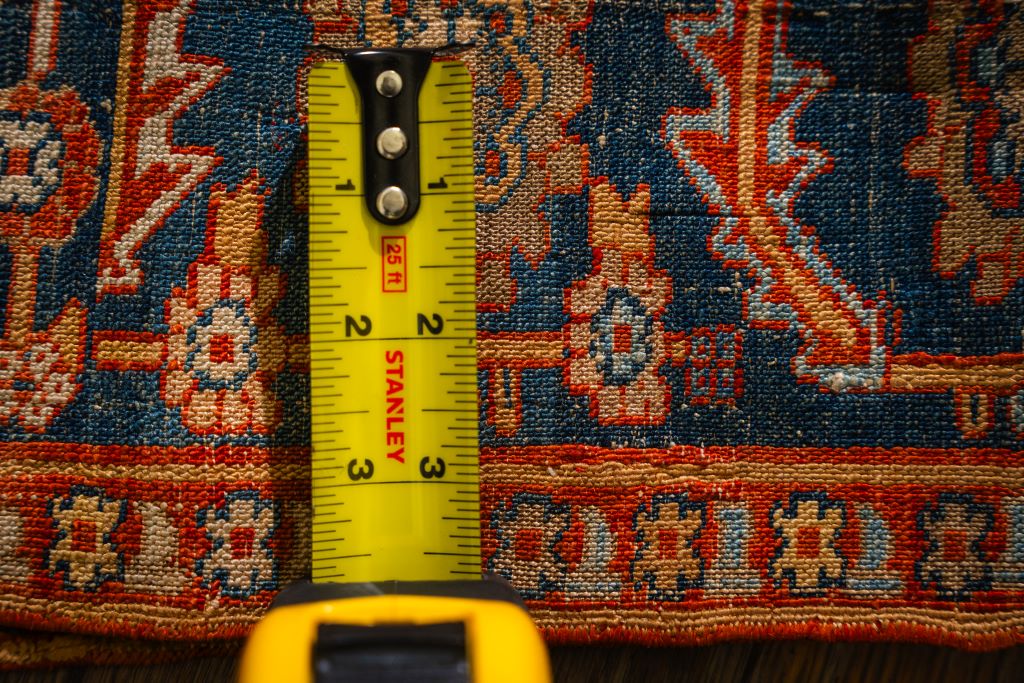
A detailed inspection of a richly colored oriental rug pattern while measuring its dimensions.
Direct Answer: Hand-knotted Islimi rugs today can cost anywhere from a few thousand dollars for fine wool pieces to well over $100,000 for antique silk masterpieces.
Pricing depends on several factors:
- Size — Larger rugs require more time and material, significantly raising cost.
- Material — A wool rug is often in the lower range, while a silk rug with high sheen commands premium value.
- Knot Density — A high-knot Persian carpet can double or triple in price compared to a coarser weave, since clarity of arabesque vinework improves dramatically.
- Age and Condition — Antiques in excellent condition are prized for rarity; restoration needs can lower value.
- Provenance — Rugs from renowned centers like Isfahan, Nain, and Tabriz often achieve higher resale value.
For collectors, these variables together define the hand-knotted Islimi value and investment potential.
Where to Buy Authentic Islimi Rugs Online?
Direct Answer: Authentic Islimi rugs can be purchased online through reputable Persian carpet dealers, specialist antique galleries, and established custom weaving ateliers.
Trusted sources include:
- Antique carpet dealers with documented provenance and return guarantees.
- Persian specialty retailers that focus exclusively on authentic arabesque rugs.
- Custom ateliers offering hand-knotted commissions in the Islimi style.
Avoid mass-produced or synthetic versions, as these lack the artistry, durability, and value of a true authentic Persian arabesque rug.
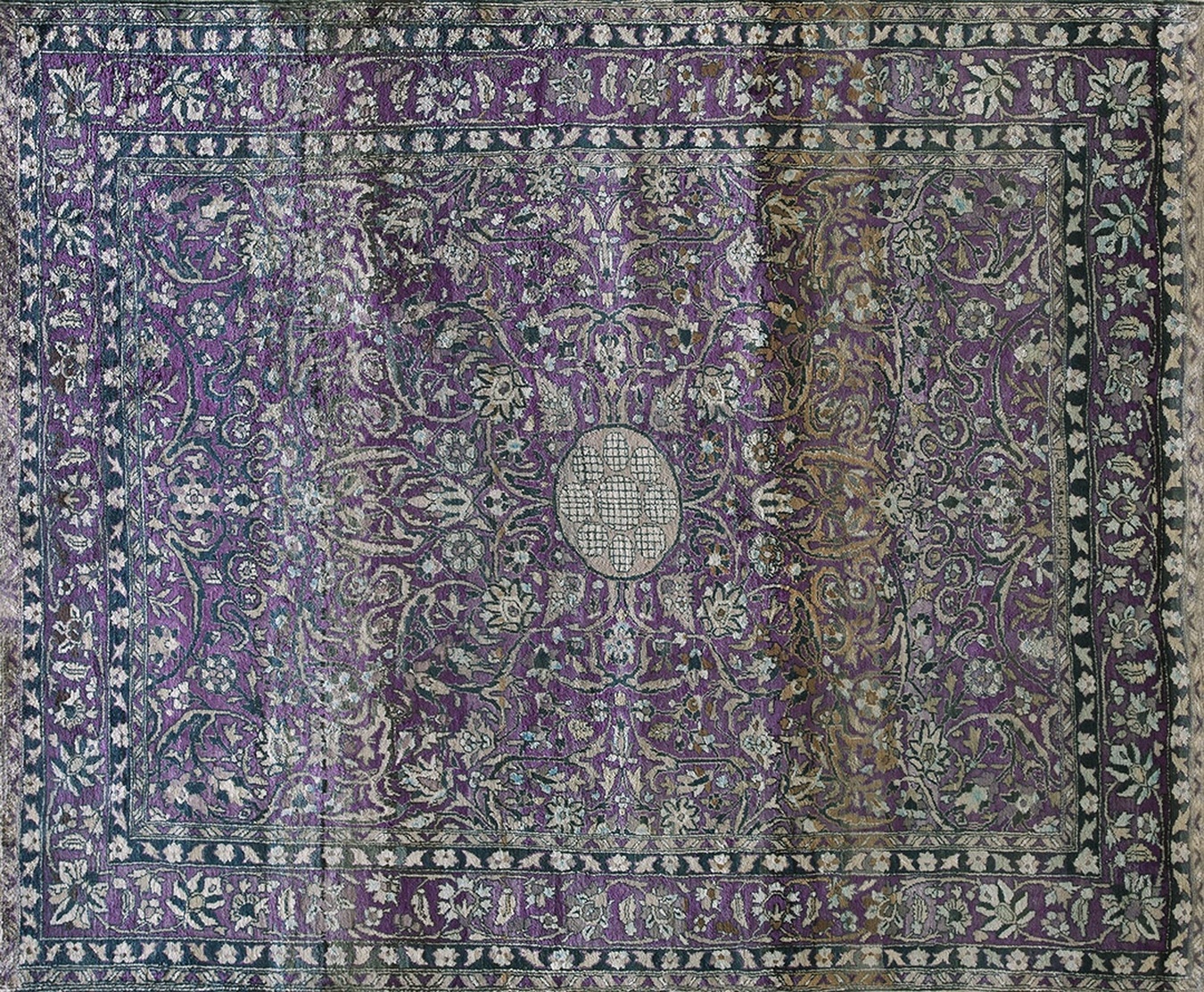
Museum-Quality and Rarity: The Ardabil and Beyond
Direct Answer: Museum-quality Islimi carpets, such as the famed Ardabil Carpet, are extraordinarily rare and now reside in major institutions like the Victoria & Albert Museum and The Met. The Ardabil carpet, woven in the 16th century for the shrine of Shaykh Safi al-Din, is one of the most celebrated examples of museum-quality example of the design.
Such pieces are considered cultural treasures, unattainable on the market today. While lesser—but still antique—examples may surface at auction, the finest Islimi rugs remain museum-held and virtually priceless.
Custom and Modern Commissions
Direct Answer: Yes, custom Islimi rugs can be commissioned today, often blending classical arabesque patterns with modern colors or room dimensions. Workshops in Iran, India, and Turkey continue to accept custom Islimi rug orders. Buyers can request traditional scrolling vines, medallions, or arabesque palmettes while tailoring palette and size to personal preference.
These commissions allow collectors and decorators to buy Islimi rugs online that honor heritage while fitting seamlessly into modern interiors. For collectors, buying rugs that boast this iconic deign pattern means navigating cost factors such as knot density, materials, and provenance, with hand-knotted pieces ranging from thousands to six figures.
While museum-quality carpets like the Ardabil remain cultural treasures beyond reach, authentic options can still be sourced through established online dealers and custom workshops. For those seeking heritage with a personal touch, custom Islimi rugs offer the opportunity to blend timeless arabesque design with individual style—an investment in both artistry and cultural legacy.
Modern and Contemporary Applications
Islimi in Transitional and Minimalist Interiors
Direct Answer: Yes, Islimi designs can work in minimalist décor, especially when simplified into oversized monochrome vines or distressed transitional styles. In contemporary interiors, modern rugs often take on pared-down forms—muted palettes, simplified scrolls, and distressed textures. In minimalist rooms, a single minimalist vine rug can act as a bold statement piece, introducing organic curves into otherwise linear spaces.
Transitional designs strike a balance by softening traditional arabesques into subtle, faded motifs that blend old-world charm with modern restraint. This adaptability proves that the Islimi motif is timeless, as effective in a sleek loft as in a classical salon.
Modern Rug Design: Innovations and Fusion
Today’s designers experiment with the Islimi vine in new ways:
- Fusion Motifs — Combining arabesques with geometric or abstract elements, creating hybrid designs that appeal to eclectic tastes.
- Bold Colors — Contemporary Persian Islimi rugs may use unexpected hues like teal, slate, or even neon tones, pushing the motif beyond its traditional indigo, red, and ivory palette.
- Scale Play — Oversized arabesque palmettes or single sweeping vines reframe the Islimi pattern for modern aesthetics.
These innovations allow the transitional arabesque carpet to cross cultural and stylistic boundaries, making it relevant in contemporary design projects worldwide.
Custom Ordering: Bespoke Contemporary Islimi
Direct Answer: Yes, custom rugs can be commissioned with modern Islimi interpretations, allowing buyers to blend classical arabesque design with personal style. Modern ateliers in Iran, India, and Turkey specialize in custom arabesque design, offering clients the ability to choose palette, scale, and motif balance.
Some prefer traditional scrolling vines with modern colors, while others commission entirely reimagined contemporary Persian works suited to specific architectural settings. This bespoke approach ensures that the Islimi language remains living, adaptable, and personal.
Vintage Isfahan vs. Contemporary Versions
Direct Answer: Vintage Isfahan Islimi rugs tend to be more intricate in design clarity and color harmony, while contemporary versions often use bolder palettes and sometimes less dense vines, though high-end Isfahan and Nain carpets still employ traditional materials and techniques.
- Vintage Isfahan rug — Typically wool-and-silk blends with very high knot density, luminous dyes, and flawless arabesque scrolls woven in courtly workshops.
- Modern Nain carpet or Isfahan rug — May experiment with color or slightly simplified vine structures, but fine examples continue the same classical construction methods.
- Key Difference — Vintage pieces emphasize harmony and restraint; modern versions may prioritize boldness and innovation.
Thus, while style and palette may evolve, the underlying craftsmanship of Persian Islimi remains intact in the finest workshops.
Maintenance for Modern Owners
- Vacuum Gently — Use low suction to avoid damaging pile. — Why: Protects delicate vine details, especially in high-knot rugs.
- Rotate Regularly — Prevents uneven fading and wear. — Why: Sunlight and foot traffic can distort colors or patterns over time.
- Professional Cleaning for Silk — Always handled by specialists. — Why: Silk rugs with this deign are highly sensitive to moisture and chemicals.
- Wool Care — Spot clean with mild soap and water. — Why: Wool is resilient but benefits from gentle maintenance.
- Synthetic Blends — Easier to clean but lack authenticity. — Why: Practical for busy households, though not collectible.
From minimalist vine rugs in modern interiors to bespoke custom arabesque designs, the Islimi motif has proven its adaptability across centuries. Vintage Isfahan rugs embody refined tradition, while modern Nain carpets reinterpret arabesques with bold colors and new contexts.
With thoughtful care, both antique treasures and contemporary rugs retain their brilliance—bridging timeless artistry with today’s design imagination.
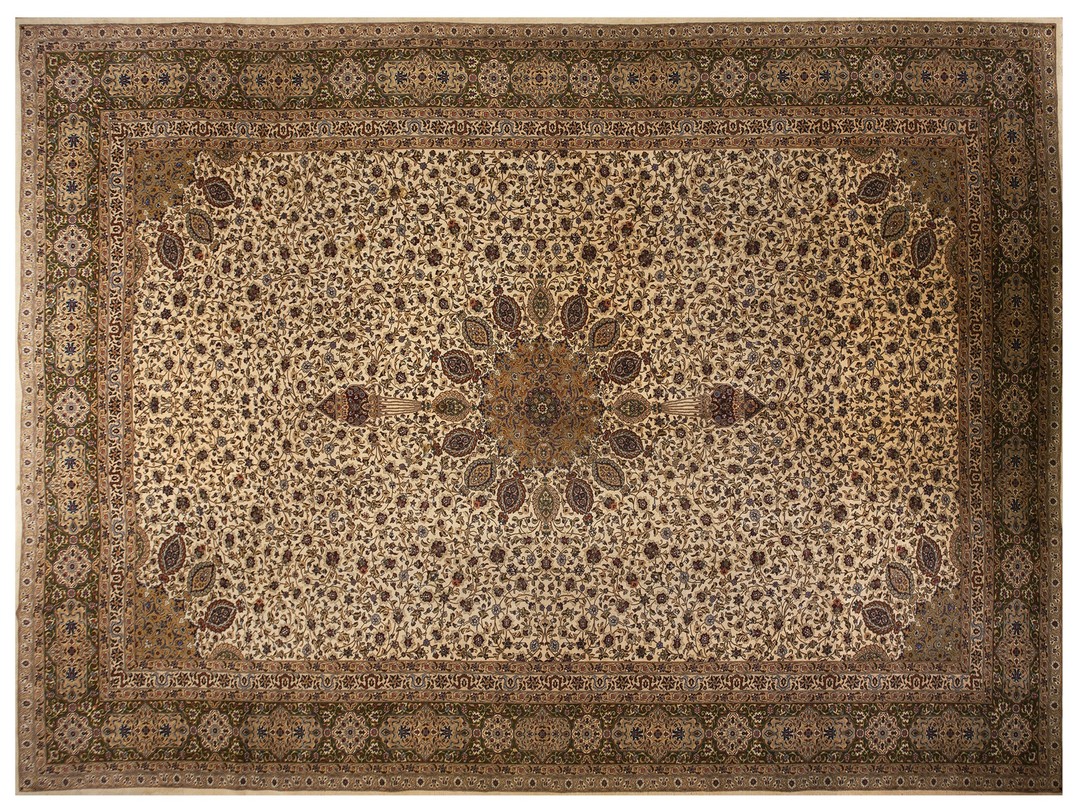
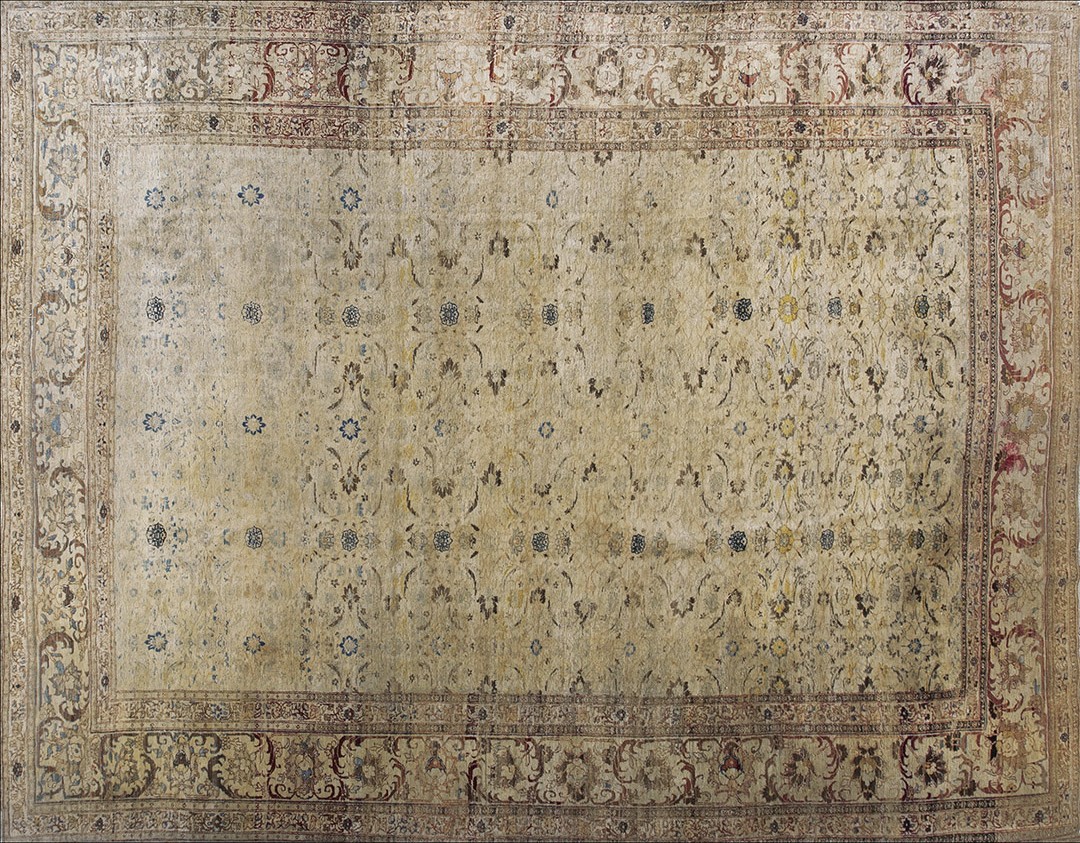
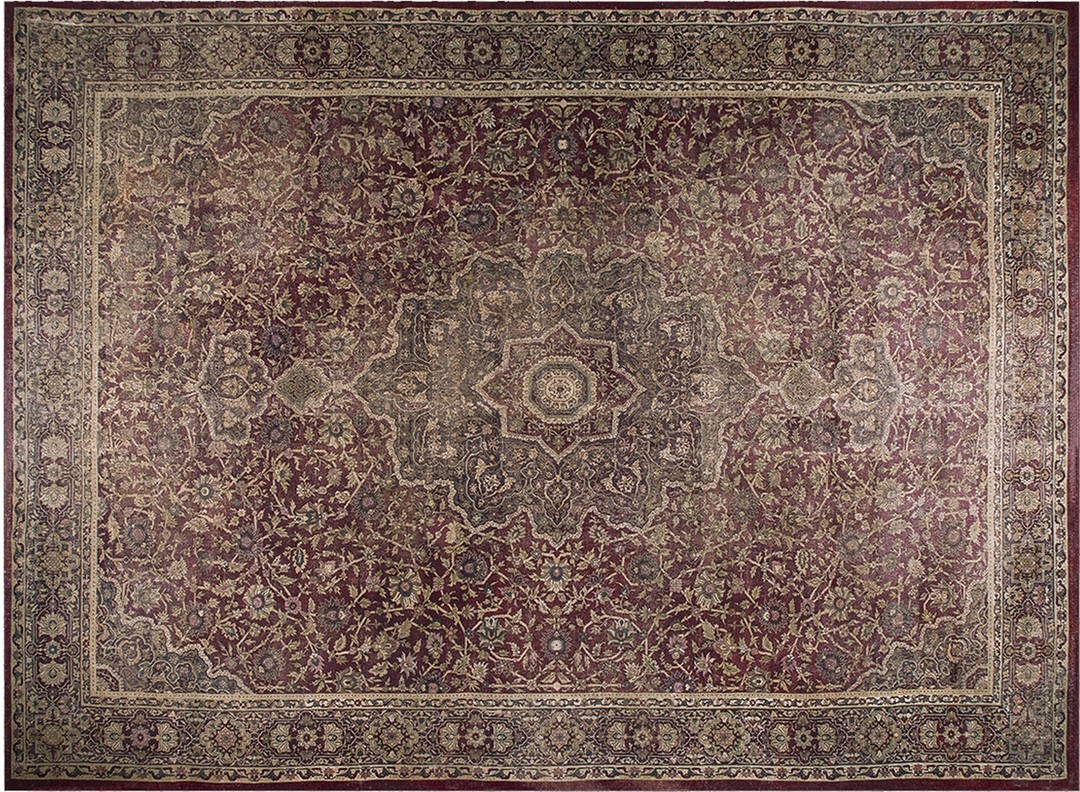
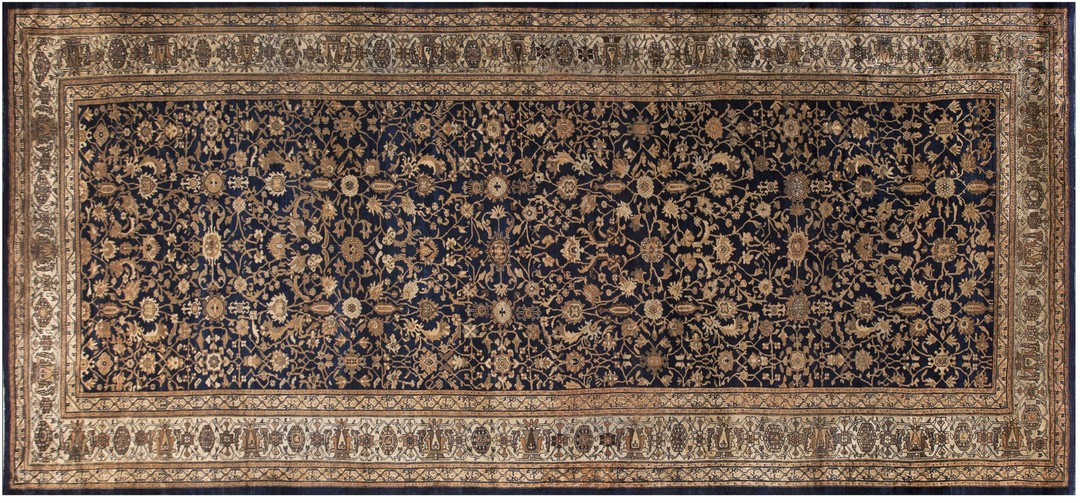
Explore Some of Our Islimi Design Rugs
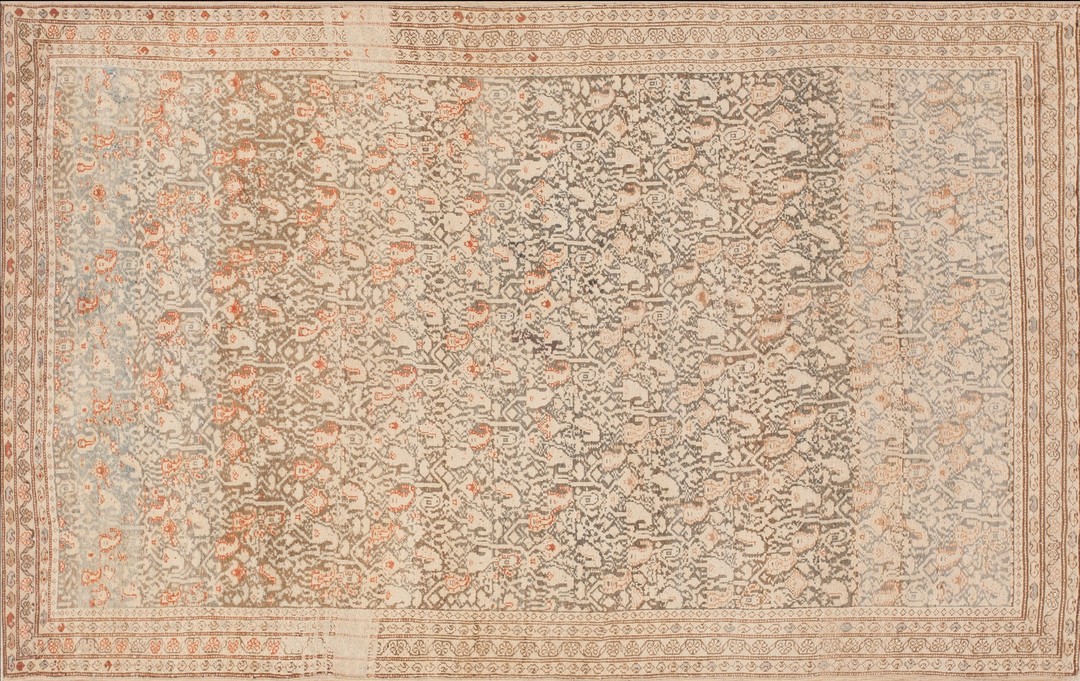
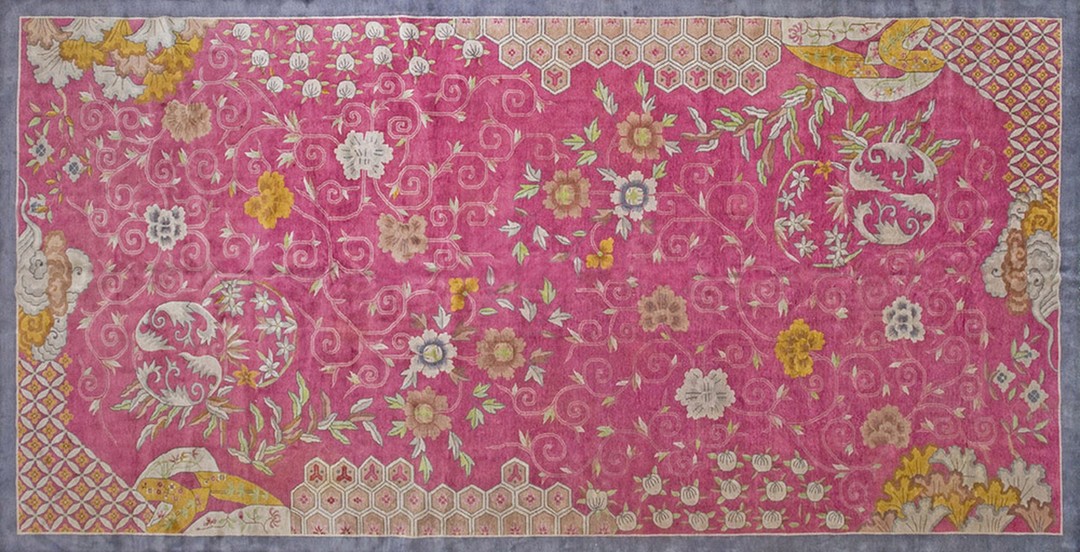
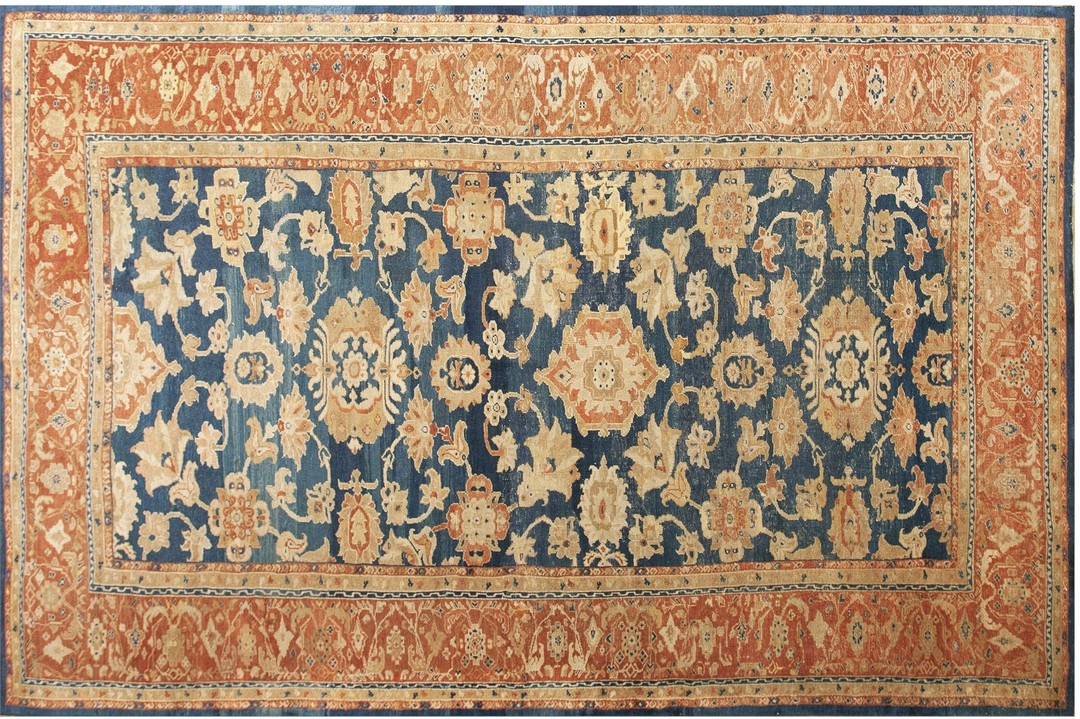
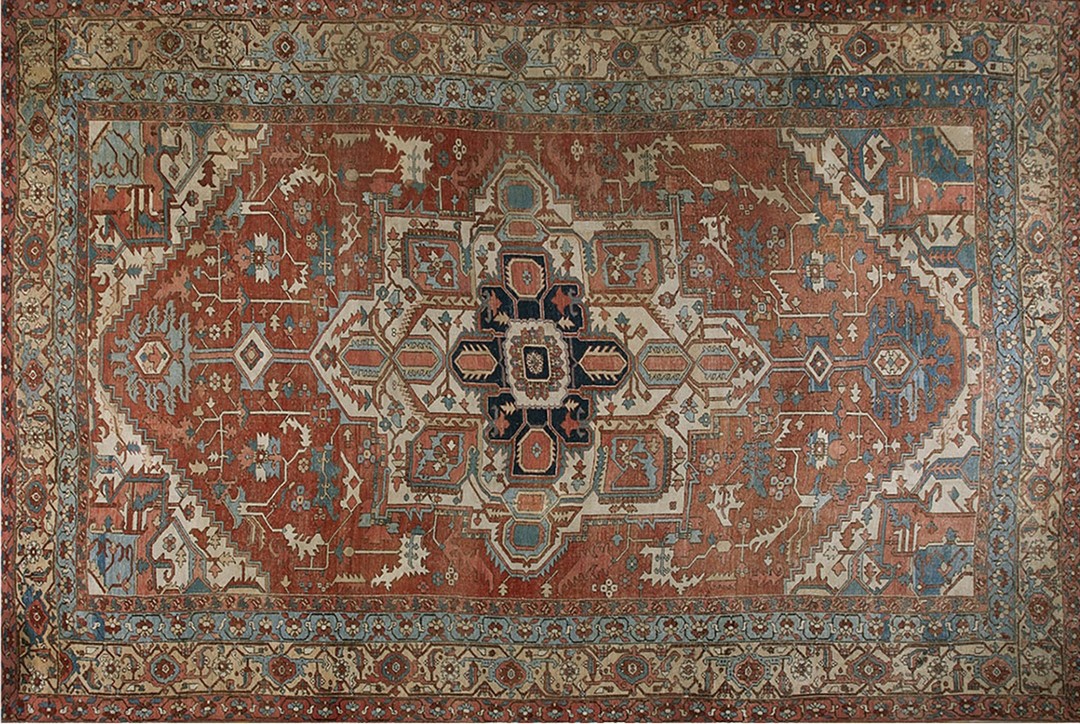
FAQ
- How do I style an Islimi rug with other patterns?
Let the Islimi be the statement; pair it with solids or small-scale geometrics and keep to a tight 2–3 color palette for cohesion.
- Are Islimi runners good for hallways and stairs?
Yes—the flowing pattern hides footprints and elongates narrow spaces. For hallways, leave about 3–4 inches of floor reveal on each side.
- Are outdoor Islimi rugs a good idea?
Traditional Islimi rugs are indoor pieces in wool or silk. For patios, choose purpose-made outdoor synthetics and keep heirlooms inside.
- Do Islimi motifs carry meaning?
Common readings include unity and the infinite order of nature, expressed through continuous scrolls. Symbolism varies by culture and workshop.
- Are antique Islimi rugs valuable?
They can be—age, condition, materials (wool/silk), and fineness drive price. Appraisals vary widely; seek a specialist for valuation.
- What rug pad works best under Islimi rugs?
A felt-and-rubber combo pad adds cushion and grip; size it 1–2 inches smaller than the rug. Avoid cheap PVC pads on heated floors.
- Do robot vacuums work on Islimi rugs with fringe?
Use caution—fringes can tangle in rotating brushes. Tuck fringe under, disable the beater bar, or set a no-go zone around fringed edges.
- Can I use an Islimi rug over radiant floor heating?
Yes, if it’s thin and natural-fiber with no rubber-backed pad. Use a heat-safe pad and avoid very thick piles that trap heat.
- Are Islimi rugs OK with pets and kids?
Yes—choose medium/low pile Islimi rugs with busy patterns to hide wear, and use a quality rug pad. Promptly blot pet accidents to prevent dye migration.
- How do I prevent fading on Islimi rugs?
Limit direct sun and rotate your Islimi rug every 6–12 months. Use window treatments or UV film in bright rooms.
- How should I clean an Islimi rug at home?
Vacuum with suction only (no beater bar) and blot spills with a wool-safe solution. Schedule professional washing every 1–3 years depending on traffic; consult a qualified rug cleaner for silk.
- Do Islimi wool rugs shed?
New wool Islimi rugs may shed for a few months; regular gentle vacuuming reduces this. Persistent heavy shedding can indicate low-twist yarn or poor construction.
- What size Islimi rug fits a living room best?
For sofas, an 8×10 or 9×12 Islimi rug typically anchors seating with front legs on the rug. Leave 8–18 inches of floor around the perimeter.
- What knot density is typical for fine Islimi city rugs?
Quality varies, but many city Islimi rugs exceed \~120 KPSI; Nain grades (6-La/9-La) and Isfahan pieces can reach several hundred KPSI.
- How can I tell a hand-knotted Islimi rug from tufted or machine-made?
Flip it—hand-knotted Islimi rugs show clear knots and the design on the back with no glued mesh. Tufted versions have fabric backings.
- How do Islimi rugs compare to Herati or boteh designs?
Islimi is curvilinear scrollwork; Herati (mahi) is a repeating diamond with “fish” leaves; boteh (paisley) is a droplet-shaped sprout. All can appear in Persian rugs.
- What colors are typical in Islimi rugs?
Expect ivory, indigo/navy, rich reds, and soft turquoise; Nain-style Islimi rugs often use cream, light blue, and navy.
- What materials are common in Islimi rugs?
Wool piles with silk highlights are typical; some fine Islimi rugs are all silk. Cotton or silk foundations are common in city weaves.
- Are Islimi rugs strictly traditional or can they look modern?
Both. The curvilinear Islimi motif reads classic, but in tonal palettes or large scale it suits contemporary rooms beautifully.
- What do “rumi” and “hatayi/khataei” mean in Islimi rugs?
In Islimi rugs, rumi are split-leaf forms and hatayi/khataei are stylized blossoms. They often intertwine with palmettes inside the scrolling vine system.
- How do I identify an Islimi motif on a rug?
Spot continuous S- and C-curves of vines with stylized leaves, buds, and palmettes. The scrolls feel “infinite,” with no obvious start or end.
- Which weaving centers are known for Islimi rugs?
Isfahan, Nain, and Mashhad frequently showcase Islimi rugs. Classic palettes include ivory, navy, and red with silk highlights in fine city pieces.
- Where do Islimi motifs appear on rugs?
Islimi motifs run through fields, borders, spandrels, and around central medallions. Look for unbroken spiral stems linking rosettes and palmettes across the design.
- Is “Islimi” the same as “arabesque” in rugs?
Largely yes—Islimi is the Islamic arabesque rendered as biomorphic scrollwork. In Persian contexts it often pairs with Shah Abbasi (palmette) flowers and medallions for an elegant curvilinear look.
- What are Islimi rugs?
Islimi rugs feature flowing, arabesque vine scrolls connecting stylized leaves and palmettes, symbolizing natural harmony. You’ll often see these curvilinear tendrils in the field and borders of Persian city carpets.