
The Definitive Collector’s Guide to Fine Rugs: Structure, Silk, History, and Connoisseurship
Fine rugs occupy one of the most sophisticated positions in the world of decorative arts. They are not simply textiles. They are architectural compositions executed in fiber. They are mathematical systems rendered by hand. They are the physical manifestation of time, discipline, and generational knowledge.
In luxury interiors and serious collections, the term “fine rug” is never used casually. It does not describe color, style, or age. It refers to measurable structural density, artistic precision, and technical mastery. A fine rug represents thousands—often millions—of intentional decisions. It embodies control over fiber, tension, symmetry, and visual rhythm.
For collectors and connoisseurs, understanding what makes a rug “fine” requires looking beyond surface beauty. It requires examining the hidden structure beneath the pile, the relationship between density and design, and the historical evolution of weaving at its highest levels.
This guide begins with structure—because fineness begins there.
What Does “Fine” Mean When It Comes to Rugs?
Technically, fineness refers to knot density: the number of hand-tied knots contained within a defined area. This is typically measured in knots per square inch (KPSI) or knots per square meter. Each knot functions like a pixel in an image. The greater the number of knots, the higher the potential resolution of the design.
A rug woven at 60–100 knots per square inch is generally considered coarse. Such rugs often feature bold geometric forms and strong tribal character. When density increases to 150–250 knots per square inch, we begin entering a refined category capable of more detailed motifs.
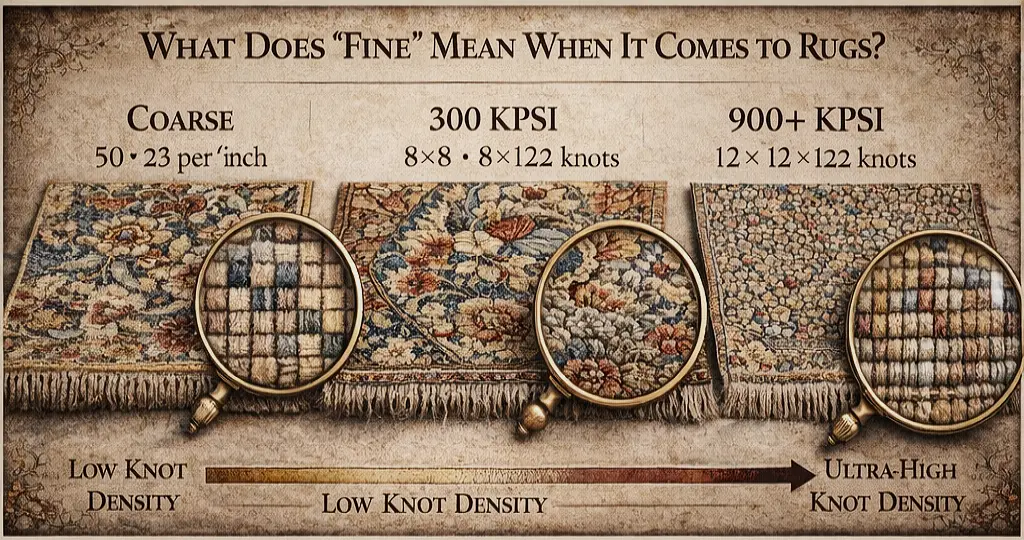
Once density exceeds 300 knots per square inch, a rug may legitimately be described as fine. At 500 knots per square inch and above, we are entering elite territory. Exceptional silk masterpieces may surpass 800, 1,000, or even 1,200 knots per square inch.
To understand what this means visually, imagine increasing the resolution of a digital photograph. At low resolution, curves appear jagged and detail is limited. At high resolution, curves become smooth, shading becomes nuanced, and detail becomes extraordinary. Fine rugs operate on this same principle.
However, fineness is not merely about numbers. It is about what those numbers enable.
Why Rugs with Higher KPSI Are Referred to as “Fine” and the Historical Origin of the Term
The designation of a rug as “fine” is directly tied to its knot density, measured in knots per square inch (KPSI). Knot density is a structural metric that quantifies how many individual hand-tied knots exist within a square inch of surface.
Each knot functions as a visual pixel: the higher the number of knots, the greater the potential for intricate, detailed, and subtle designs. Therefore, rugs with higher KPSI allow smoother curves, complex medallions, micro-patterns, and near-photographic detail, characteristics that define fineness.
The term “fine” in this context emerged gradually as both weaving technology and collectors’ standards evolved. In Persian and Ottoman court workshops of the 16th–17th centuries, master weavers produced high-density rugs for royal and imperial clients. European traders and connoisseurs who encountered these rugs began distinguishing them from coarser tribal or village rugs.
Documents from 17th–18th century European inventories and sales catalogs often used descriptors like “superfine” or “extra-fine” to denote pieces with exceptionally high knot counts and elaborate designs, indicating both technical mastery and luxury status.
Essentially, “fine” became a shorthand for the intersection of three criteria:
- High knot density: More knots allow higher-resolution designs.
- Material refinement: Use of silk or exceptionally fine wool to achieve dense knotting.
- Artistic complexity: Ability to execute intricate motifs and shading impossible in coarser rugs.
By the 18th and 19th centuries, rug dealers and collectors across Europe formalized the term in catalogs and auctions. “Fine Persian” or “fine silk” came to indicate both rarity and technical sophistication, linking the aesthetic and structural qualities directly to knot density.
Today, referring to a rug as “fine” or “superfine” remains synonymous with high KPSI, material quality, and detailed artistry, preserving the historical association between technical mastery and visual refinement.
The Structural Anatomy of a Fine Rug
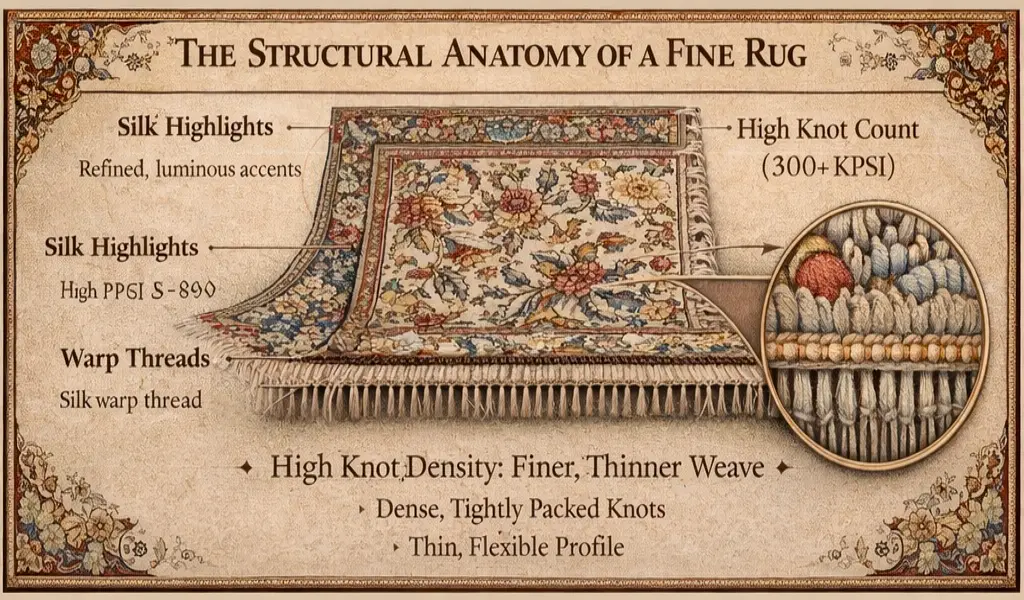
A hand-knotted rug is constructed on a loom using three foundational components: warp threads, weft threads, and pile knots.
The warp threads run vertically and form the skeletal foundation of the rug. They are stretched tightly across the loom before rug weaving and making begins. The weft threads run horizontally, passing between rows of knots to secure them. The pile knots are tied individually around pairs of warp threads, forming the visible surface.
In a fine rug, the warp threads are set extremely close together. This close spacing allows for small, precise knots. The yarn used for knotting must be thinner and more refined than that used in coarse weaving. Every row must be packed tightly and evenly to maintain structural integrity.
The weaver must maintain consistent tension across thousands or millions of knots. Even minor inconsistency can distort the design, especially in curved motifs where symmetry is essential.
The structural demands of fine weaving are significant. It requires highly trained artisans capable of sustaining accuracy over long periods. The physical act of tying small knots repeatedly for months or years demands both discipline and endurance.
Fine rugs are therefore both artistic and engineering achievements.
Why Fine Rugs Are Usually Thinner
One of the most common misconceptions among buyers is that thickness equals quality. In reality, fine rugs are typically thinner than coarse rugs, and this is not a flaw—it is a deliberate outcome of structural and artistic priorities.
There are two primary reasons fine rugs are thinner:
First: Structural Compression. Fine rugs use thinner yarn and contain far more knots per square inch. As these small knots are tightly packed together, they create a dense, compact surface. Because the knots themselves are smaller, the resulting pile height is naturally reduced. The rug becomes structurally dense but physically low in profile.
Second: Artistic Shearing for Clarity. This is the explanation that is often overlooked. Fine rugs contain highly intricate patterns—delicate floral scrolls, layered medallions, calligraphic elements, architectural renderings, and subtle shading transitions. If the pile were left long or plush, the surface would appear slightly fuzzy. Detail would blur. Fine outlines would lose definition.
After weaving, master finishers shear the pile down to a controlled, lower height. This process sharpens the pattern, enhances crispness, and ensures that intricate elements remain visually distinct. In silk rugs, close shearing also maximizes light reflection, increasing luminosity and dimensional effect.
Without this shearing process, the artistic advantage of high knot density would be compromised. The rug would lack clarity.
Fine rugs are thinner because precision demands sharpness.
Design Evolution in Fine Rugs
High knot density transforms design potential. Coarse rugs convey bold, geometric patterns, while fine rugs allow intricate medallions, layered floral arrangements, and even pictorial representations.
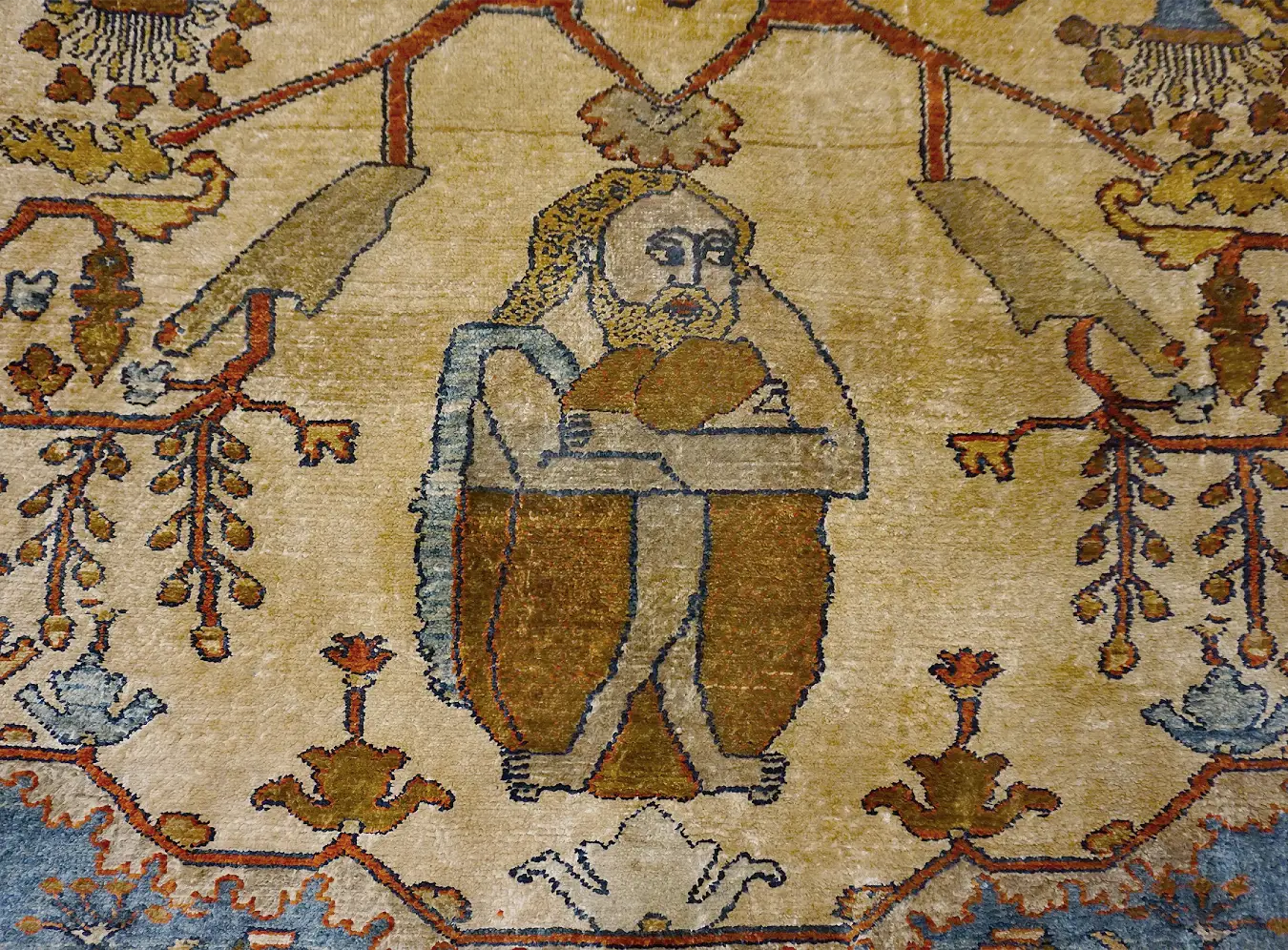
Over time, elite workshops optimized fine weaving to push artistic boundaries: Safavid Persian courts achieved detailed curvilinear motifs; Ottoman Hereke silk carpets achieved micro-patterned arabesques; Mughal India produced delicate garden and animal scenes. The evolution of fine rug design is inseparable from the technical advances that allowed higher knot densities and more intricate expression.
Time as a Structural Ingredient
To truly understand fineness, one must understand time.
Weavers typically tie between 8,000 and 12,000 knots per day, depending on complexity and skill level. A moderately sized rug woven at 80 knots per square inch may contain three million knots. The same size rug woven at 400 knots per square inch may contain fifteen to twenty million knots. At 800 knots per square inch, that number may approach thirty million.
Each of those knots is tied individually by hand.
Fine rugs require more time not only because of knot quantity but because precision slows the process. Curved motifs require careful alignment. Borders must remain symmetrical. Pattern cartoons must be followed with exacting accuracy. Silk threads require delicate handling and tension control.
A large, high-density silk rug may take two to four years to complete. During that time, the weaver must maintain consistency in tension, alignment, and rhythm.
Time is embedded in the structure of every fine rug. It is not incidental—it is foundational.
Resolution and Artistic Capability
The true significance of fineness lies in artistic capability. High knot density expands what can be expressed in fiber.
Fine weaving allows for smooth curvilinear forms rather than stepped approximations. It permits layered medallions composed of multiple geometric systems. It enables narrow guard borders containing intricate micro-pattern repetition.
Portraiture becomes possible. Facial expressions can be rendered. Architectural scenes with domes, arches, and columns can be depicted with clarity. Subtle shading transitions can create visual depth and dimensional illusion.
In silk rugs, the combination of high density and luminous fiber allows for near-photographic detail. The rug becomes not simply a pattern but an image.
Coarse weaving has its own power—boldness, graphic strength, and tribal authenticity. But fine weaving introduces nuance, subtlety, and visual complexity that coarse structure cannot support.
The Psychological and Aesthetic Experience of Fine Rugs
Fine rugs invite close viewing. They reward proximity. From a distance, they may appear harmonious and balanced. Up close, they reveal extraordinary intricacy—tiny blossoms, delicate tendrils, subtle color shifts.
This dual experience—macro harmony and micro detail—is one of the defining pleasures of collecting fine rugs. The rug functions as both architectural anchor and intimate artwork.
In well-curated interiors, fine rugs introduce a quiet authority. They do not overwhelm. They command attention through refinement rather than volume.
The thinner pile contributes to this aesthetic. A low-profile surface allows furniture to sit gracefully. It creates visual crispness rather than softness. The room feels structured rather than padded.
Fine rugs change not only the look of a space, but its psychological tone.
Fineness and Value Perception
Because fine rugs require greater labor, higher skill, and often superior materials, they generally command higher prices. However, value perception among collectors goes beyond cost.
Fineness signals discipline. It signals intention. It signals that the rug was not woven for speed or mass production, but for artistic accomplishment.
Collectors often respond to fineness instinctively. Even without counting knots, the eye recognizes resolution. Curves appear fluid. Motifs feel precise. The surface appears dense and intentional.
This visual clarity becomes a marker of quality.
In the sections that follow, we will explore how silk transformed fine weaving, how historical empires elevated rug artistry to its peak, how collectors evaluate true fineness, and how connoisseurship develops over time.
Silk vs. Wool: Materials of Mastery
When discussing fine rugs, the choice of fiber is paramount. While wool is the most common rug material globally, silk occupies the pinnacle of fine rug craftsmanship.
Each fiber imparts distinct structural and aesthetic characteristics:
- Wool: Wool is resilient, elastic, and capable of absorbing natural dyes beautifully. It allows for bold colors, dense pile, and tactile warmth. High-quality hand-spun wool is preferred for fine rugs because it creates uniformity and durability. Wool fibers are thicker than silk, which limits maximum knot density. Even so, exceptional wool rugs with high knot counts can display intricate floral motifs, geometric precision, and remarkable longevity. Wool remains the practical choice for high-traffic areas while still supporting refinement in design.
- Silk: Silk is thinner and more luminous than wool. The fibers can be spun to an extremely fine thickness, allowing knot densities that often surpass 1,000 KPSI in elite Persian, Ottoman, and Mughal pieces. Silk’s smooth filament surface reflects light, giving the rug a dynamic, almost three-dimensional appearance. Subtle color gradations and delicate lines are more achievable in silk than in wool, making it the preferred fiber for pictorial rugs, calligraphic inscriptions, and intricate medallions.
However, silk is less forgiving than wool. Its fine fibers are susceptible to abrasion, making silk rugs better suited for low-traffic environments. Handling and cleaning require specialized knowledge, including precise vacuuming and professional maintenance.
The Economics of Weaving: Time, Labor, and Value
Fine rugs are investments of time as much as materials. The labor involved in producing a high-density rug is staggering. A rug with 400 knots per square inch can contain 15–20 million knots in a modest 6×9-foot size.
Tying 8,000–12,000 knots per day, a single weaver may take several years to complete a rug of this size. Multi-weaver collaborations are often necessary for large, highly detailed pieces.
The time-intensive nature of fine weaving directly contributes to value. Labor costs, combined with premium materials such as hand-spun wool or silk, intricate designs, and limited production, establish pricing far above mass-produced rugs. Buyers are investing not just in the fiber but in human expertise, cultural heritage, and technical mastery.
What Fine Weave Enables Artistically
High knot density expands artistic possibilities beyond what coarse weaving allows. Consider a coarse rug with angular, pixel-like geometric patterns: it can express strong visual identity but cannot capture delicate curves or nuanced shading. In contrast, a fine weave allows smooth, flowing lines; multi-layered medallions; legible calligraphy; and pictorial imagery.
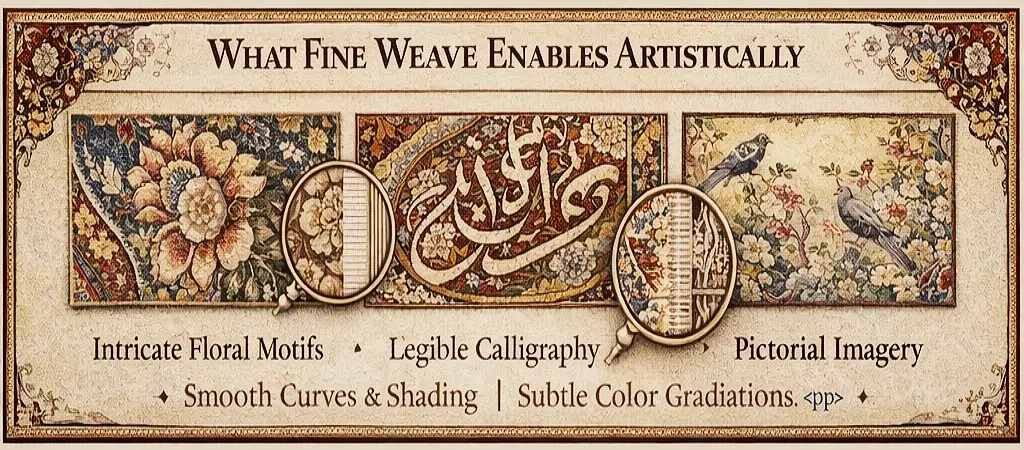
Examples include Persian floral motifs rendered with individual petals and subtle gradients, Ottoman palace carpets with delicate scrolling arabesques, and Indian Mughal rugs depicting palatial gardens and wildlife. The higher the knot count, the closer the rug can approach photographic realism while still retaining the tactile qualities of fiber.
Why Finer Rugs Were Rarely Produced by Nomadic or Semi-Nomadic Weavers
Fine rugs, characterized by extremely high knot density, delicate materials, and intricate design, were seldom produced by nomadic or semi-nomadic communities.
While these communities are celebrated for their distinctive tribal and village rugs, several practical, economic, and cultural factors limited their ability to create the type of refined, luxury textiles associated with court workshops or urban ateliers.
5 main reasons why nomadic and semi nomadic people did not weave finer rugs:
Mobility and Loom Size
Nomadic and semi-nomadic weavers traditionally lived in tents, yurts, or portable dwellings. Their looms needed to be collapsible and transportable, which restricted the width, length, and structural rigidity required for fine weaving.
High-density rugs require a stable, stationary loom to maintain even tension across thousands or millions of knots. Portable looms, while ideal for mobility, cannot provide the precision or support necessary for ultra-fine knotting.
Time Investment
Fine rugs are labor-intensive. A large silk rug with 800–1,200 knots per square inch can take years to complete. Nomadic life demands flexibility, seasonal movement, and labor devoted to herding, agriculture, or trade.
Such prolonged, uninterrupted dedication to a single textile project was rarely feasible in a mobile lifestyle. Tribal rugs were therefore designed for practical speed, durability, and portability rather than extreme detail.
Material Availability
Finer rugs often require silk or exceptionally refined wool, both of which were more readily available in urban or court settings. Nomadic communities relied on sheep, goat, or camel herding, producing wool of variable thickness and quality.
Access to imported silk or finely spun wool suitable for high-density knotting was limited, making ultra-fine weaving largely impossible.
Purpose and Functional Design
Nomadic rugs were primarily functional: they served as floor coverings, bedding, tent insulation, and portable decorative elements. The emphasis was on durability, warmth, and ease of maintenance. High pile or high-density rugs with delicate silk threads would have been impractical for everyday nomadic life, prone to wear, dirt accumulation, and damage. Coarser weaves provided longevity and structural robustness for a life in constant motion.
Cultural and Economic Factors
Urban workshops and royal ateliers had the financial backing to commission long-term projects. They could sustain weavers for years, provide access to rare materials, and demand the highest artistic standards. Nomadic weaving traditions were community-driven, with designs optimized for tribal identity, symbolic motifs, and intergenerational teaching rather than luxury or artistic experimentation at the extreme end of refinement.
In summary, the combination of mobility constraints, limited time, material accessibility, functional priorities, and economic support explains why the finest, ultra-high-density rugs were historically the domain of urban workshops. The city workshops and courtly ateliers handled all the palace commissions, rather than nomadic or semi-nomadic weavers.
Tribal and village rugs, while immensely valuable for cultural, aesthetic, and functional reasons, rarely approached the knot density, precision, or material refinement of the most celebrated fine rugs.
Historical Timeline: Fine Rugs Across Empires and Centuries
5th Century BCE
The Pazyryk Carpet, discovered in the Siberian permafrost, represents the earliest known knotted rug. Its advanced weaving technique and pictorial motifs demonstrate early mastery.
16th Century Safavid Persia
Safavid court workshops in Isfahan, Tabriz, and Kashan elevate rug artistry to its zenith. Curvilinear floral motifs, high knot density, and symmetrical medallion designs become hallmarks of refinement. These area rugs often incorporated silk highlights to emphasize depth and luminosity.
17th Century Ottoman Empire
Hereke workshops produce silk carpets exclusively for imperial palaces. High knot density, fine silk, and luxurious design reflect both aesthetic sophistication and political power. These 17th century area rugs were never intended for public sale, reserved instead for royal spaces and diplomatic gifts.
17th–18th Century Mughal India
Persian influence merges with local naturalistic aesthetics. Courtly carpets depict flora, fauna, and architectural features with extraordinary detail. High knot densities allow intricate floral gradients and symmetrical garden layouts, reflecting the Mughal vision of paradise on Earth.
18th–19th Century Global Trade
European demand for Persian, Turkish, and Indian carpets grows. Master workshops maintain high-density production for elite buyers, while coarser rugs become common in local markets. Exported rugs influence European interior design, leading to the incorporation of Eastern aesthetics into Western homes.
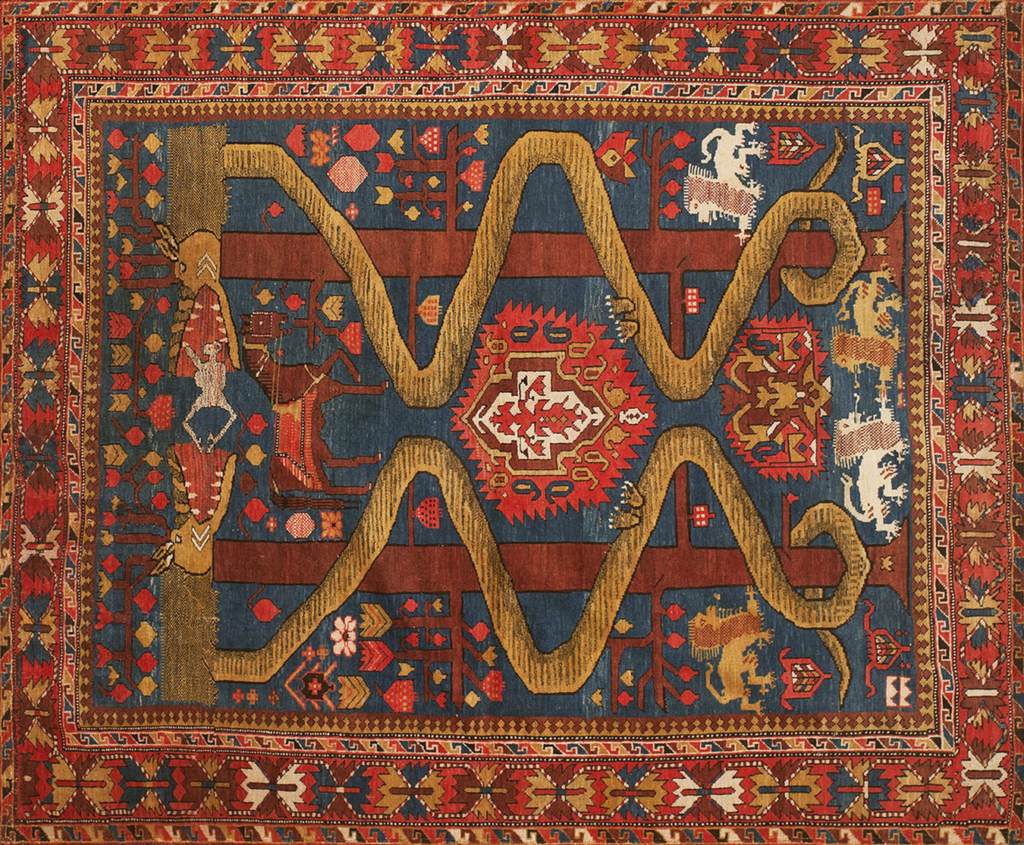
Modern Era
While mass production dominates contemporary markets, elite ateliers continue producing high-density masterpieces. Knowledge of knot density, fiber selection, and artistic tradition is preserved in select workshops. Museums and luxury galleries now serve as the primary custodians of this artisanal knowledge.
Silk as the Pinnacle Material in Historical Context
The historical preference for silk in fine area rugs is multifaceted. Silk allowed weavers to push the limits of resolution. It elevated the aesthetic experience, creating rugs that reflected light, emphasized color gradation, and captured minute detail. In royal commissions, silk was also a symbol of luxury, refinement, and status. No material could communicate imperial power as effectively.
Ottoman Hereke, Safavid Isfahan, and Mughal silk carpets are not merely decorative. They are documents of cultural identity and artistic achievement. Their value today derives from technical mastery, rarity, and historical significance.
Weaving Techniques and Regional Fineness
Fine rugs require exceptional control over weaving techniques. The use of asymmetrical (Persian/Senneh) knots often dominates in fine rugs because they allow higher knot density and smoother curves, essential for detailed motifs. Symmetrical knots (Turkish/Ghiordes) can be refined but generally support slightly lower density.
Finer rugs demand precise tension and even spacing over millions of knots—tasks only feasible in stable, stationary workshops rather than mobile, tribal settings. Regional variations—like Isfahan’s curvilinear floral motifs or Hereke’s dense silk arabesques—show how fine weaving techniques evolved to maximize clarity and resolution.
Regional Masterpieces: Persia, Turkey, India, China, and Beyond
Different weaving regions developed unique styles, materials, and technical approaches, contributing to the global heritage of fine rugs. Understanding these differences helps collectors evaluate quality, origin, and artistic value.
Persian Rugs
Persia (modern-day Iran) remains the benchmark for fine rug weaving. Centers such as Isfahan, Qom, Nain, and Tabriz are renowned for high knot density, intricate floral patterns, medallion symmetry, and delicate border motifs.
Persian weavers frequently incorporate silk highlights within wool rugs to emphasize detail, adding visual depth. Isfahan rugs are celebrated for their curvilinear designs, soft palettes, and extraordinary craftsmanship, often exceeding 400 KPSI.
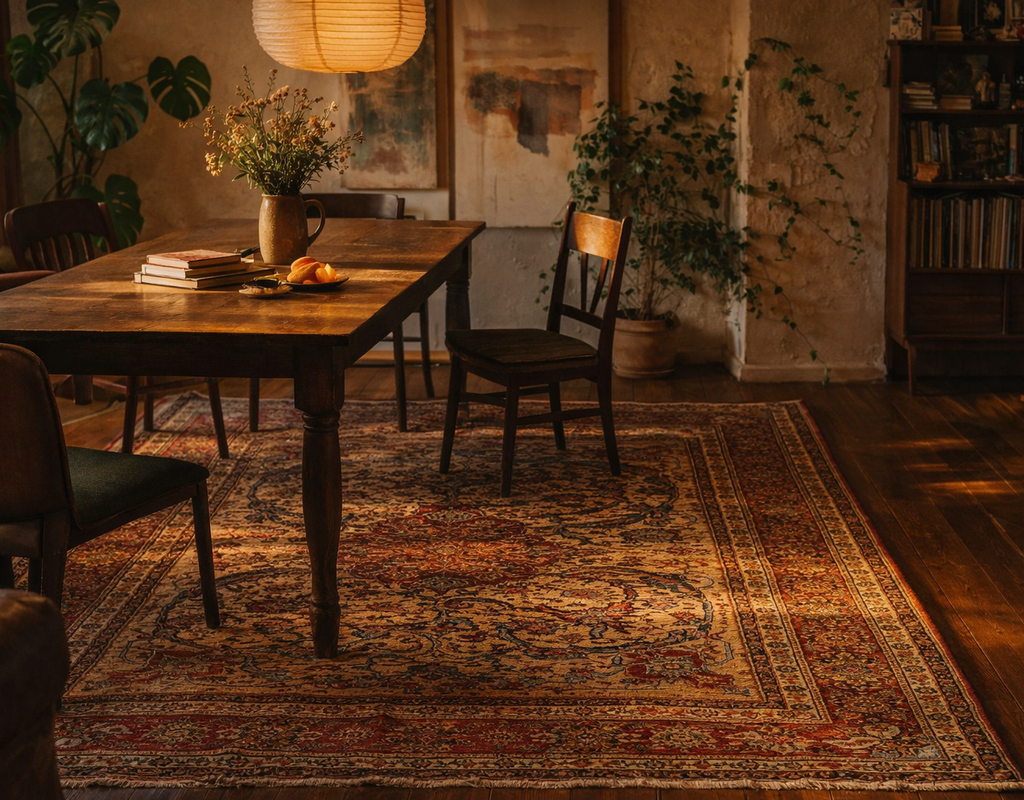
Turkish Rugs
The Ottoman Empire’s Hereke workshops produced some of the finest silk carpets in the world. Imperial Hereke rugs feature exceptionally high knot densities, often above 1,000 KPSI, with finely detailed floral arabesques, intricate medallions, and balanced composition.
Silk here was used not only for technical refinement but also as a symbol of prestige. Even small room-sized Hereke rugs demonstrate sophistication comparable to monumental Persian pieces.
Indian Rugs
Mughal India fused Persian artistic principles with local aesthetics. Jaipur, Agra, and Amritsar produced fine silk and wool rugs featuring naturalistic gardens, flowering flora, and stylized fauna.
Mughal carpets are notable for subtle gradations of color, pictorial narrative, and high knot density. Many Indian rugs used hand-spun silk and exceptionally fine wool to render refined details, making them prized collectors’ pieces.
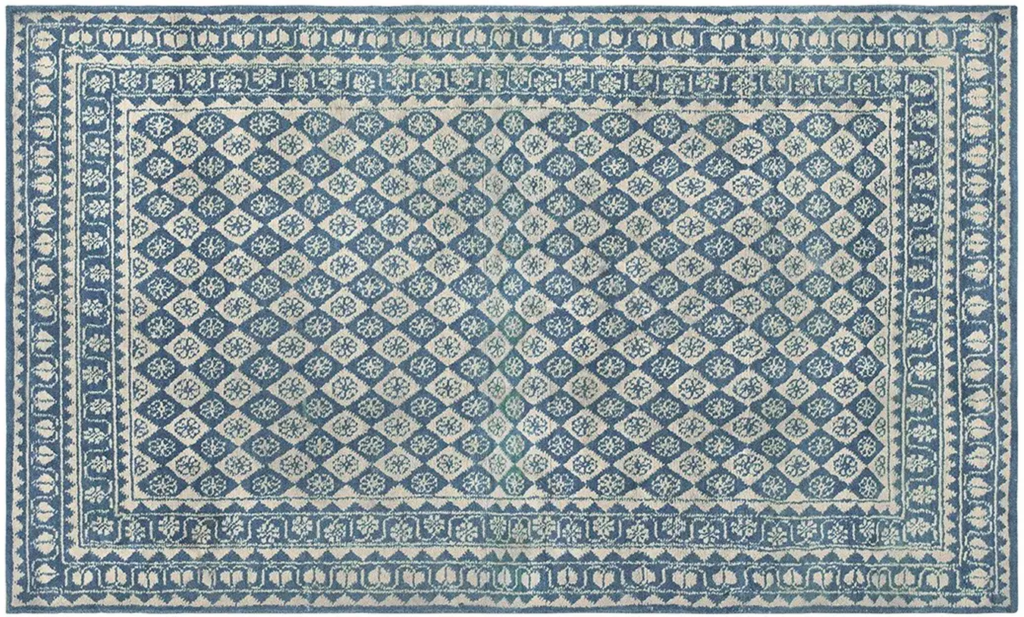
Chinese Rugs
Chinese silk carpets are renowned for luminous color, pictorial design, and shading complexity. Imperial Qing carpets, often commissioned for palace halls, combine geometric and floral motifs with scenes from Chinese mythology.
High knot density, silk yarn, and vibrant natural dyes give these rugs an almost three-dimensional effect, with light reflecting differently depending on angle. Chinese rugs excel in color brilliance and flat-surfaced intricacy.
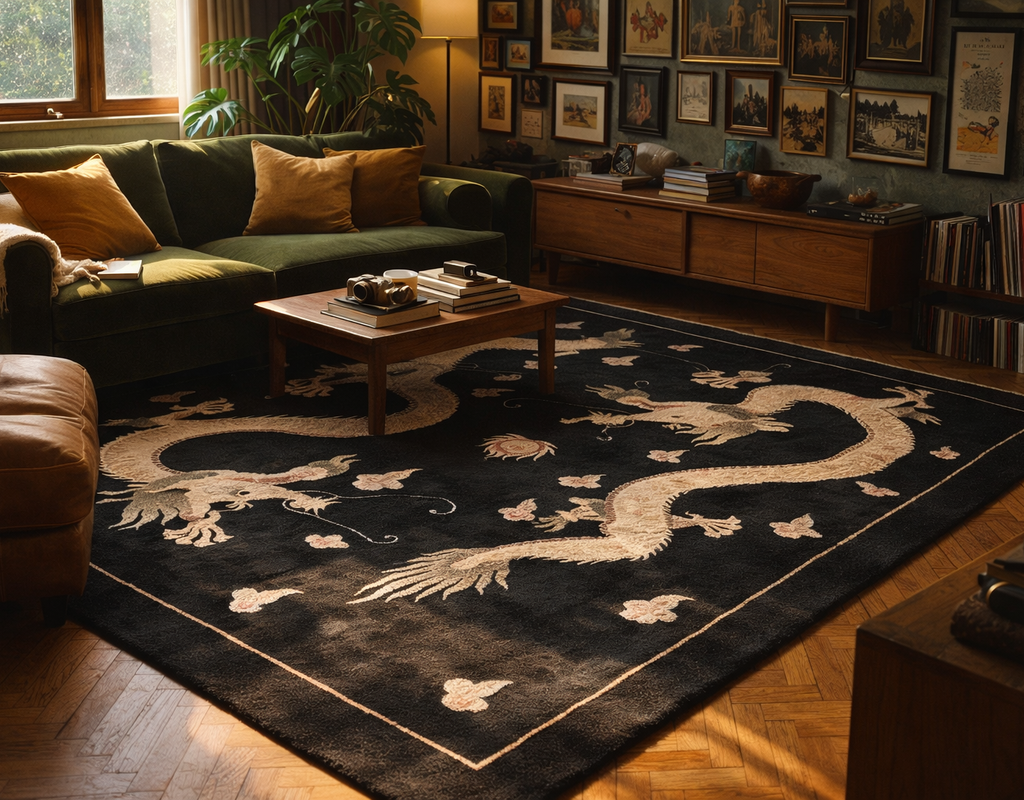
Other Notable Centers
While Persia, Turkey, India, and China dominate historical scholarship, Central Asia, the Caucasus, and Tibet also produced fine hand-knotted rugs. These regions contributed distinctive tribal motifs, geometric symmetry, and naturalistic dyeing techniques.
Though often lower in knot density than imperial workshops, these rugs display cultural significance and regional artistry, making them highly collectible for connoisseurs seeking diversity and provenance.
Dye and Color Analysis in Fine Rugs
In fine rugs, dye choice is not merely decorative; it is essential to achieving maximum detail and subtlety. High knot density allows minute pattern variations, which are only effective if color transitions are precise. Natural dyes—indigo, madder, cochineal, and pomegranate—interact differently with silk and high-grade wool, enhancing luminosity and shading.
Silk highlights in fine rugs reflect light differently depending on dye saturation, which creates a three-dimensional effect that coarse rugs cannot replicate. Precision in dye application ensures that every knot contributes to overall design clarity, making dye quality a critical factor in defining fineness.
The Finest Rugs Ever Woven
Determining the single “finest” rug ever woven is subjective, but several masterpieces are consistently cited by historians, curators, and collectors.
Here are some notable fine rugs:
- Ardabil Carpet (16th Century, Persia): Over 340 KPSI, complex medallion and corner motifs, monumental size. Preserved in the Victoria & Albert Museum.
- Hereke Palace Silks (19th Century, Ottoman Empire): Exceed 1,000 KPSI, imperial quality silk, intricate floral arabesques, extremely limited production.
- Qom Silk Rugs (Persia, 20th Century): Knot density above 1,200 KPSI, exceptional pictorial and floral detail, luminous silk finish.
- Mughal Imperial Rugs (India): Hand-spun silk with high density, naturalistic flora and fauna, often used in royal palaces and ceremonial halls.
- Qing Dynasty Silk Carpets (China): Brightly colored, pictorial, with high-density silk weaving, often for palace halls and shrines.
These rugs are valued not only for technical mastery but also historical importance, cultural heritage, and rarity. Many are preserved in museums, private collections, or luxury galleries.
Collector Evaluation Framework
Collectors evaluating fine rugs should consider multiple factors beyond aesthetics:
- Knot Density: High density allows more intricate design and indicates higher technical skill.
- Material Quality: Premium hand-spun wool and silk elevate both longevity and artistic refinement.
- Symmetry and Design Precision: Balanced borders, fluid medallions, and uniform motifs indicate master-level weaving.
- Color and Dye Integrity: Use of natural dyes provides depth and stability over time.
- Provenance: Rugs with documented origin and historical significance command higher value.
- Condition: Even fine rugs require careful preservation; signs of wear, damage, or repairs impact valuation.
Collector Psychology and Fineness
Collectors of fine rugs evaluate not only technical parameters but also subtleties enabled by high knot density. Finer rugs display “flow,” dimensionality, and light interaction impossible in coarser weaves.
Eye movement, pattern layering, and depth perception all benefit from high KPSI. Connoisseurs intuitively recognize these qualities, which influence acquisition decisions, display strategies, and long-term care. In fine rug collecting, fineness defines both aesthetic experience and intellectual engagement.
Durability, Care Science, and Preservation Techniques
Fine rugs are long-term investments. But their durability varies by fiber, weave, and placement.
Some examples and recommendations:
- High-quality wool: Surprisingly resilient, even in high-density rugs, can endure decades with regular care.
- Silk: Exceptional for detail, but sensitive to abrasion, sunlight, and humidity fluctuations; best used in low-traffic areas.
Recommended care includes:
- Vacuuming with suction only, avoiding rotating brushes.
- Rotating rugs periodically to ensure even wear.
- Controlling humidity between 40–55% to prevent fiber distortion or mold growth.
- Prompt treatment of spills and stains to avoid permanent damage.
- Professional cleaning every few years by specialists experienced in fine hand-knotted rugs.
Special attention should also be paid to antique pieces, as dyes and fibers can be more fragile. Using protective padding underneath helps reduce pile compression and preserves both structure and aesthetic clarity.
Maintenance Myths vs Best Practices for Fine Rugs
Fine rugs require care specific to high knot density and delicate fibers. Over-vacuuming or using rotating brushes can flatten the dense pile and damage silk threads, compromising pattern clarity. Fine rugs should be rotated regularly, vacuumed gently, and kept in controlled humidity to prevent fiber distortion.
Professional cleaning must respect knot density and pile height to maintain the crispness that defines a fine rug. In essence, maintenance for fine rugs is about preserving the structural and artistic integrity rather than simply cleaning dirt.
Investment and Market Rarity
Fine rugs are not just decorative art; they are tangible assets. Their value appreciates over time, particularly for antique pieces, high-knot-density silk rugs, and works from historically significant workshops. Collectors often approach acquisition with a dual perspective: aesthetic pleasure and financial prudence.
Market rarity is a critical factor. Limited production, exceptional knot density, and provenance elevate value. For example, an Ottoman Hereke silk rug made for the palace may appear on the market only once a century. Similarly, early Safavid Isfahan masterpieces exist in small numbers, making each sale highly competitive.
Buyers should also consider condition relative to age. Antique rugs that have retained color vibrancy, structural integrity, and minimal restoration are valued exponentially higher than those showing significant wear, moth damage, or fading.
Rugs with verified historical documentation or provenance—such as prior placement in royal courts or museum exhibitions—are even more desirable.
Luxury Buyer’s Guide
Acquiring fine rugs requires informed decision-making.
Collectors and interior designers should evaluate several key aspects:
- Purpose and Placement: Identify intended use. Silk rugs are best for low-traffic spaces like formal parlors or private studies. High-quality wool rugs suit more active areas while maintaining fine pattern clarity.
- Material Selection: Choose fiber according to aesthetic preference and functional requirements. Silk provides luminosity and extreme detail, while wool provides durability with soft, warm texture.
- Knot Density Assessment: Examine the back of the rug to count knots per square inch. Higher density indicates higher refinement and potential value.
- Design Complexity: Observe curves, medallions, borders, and micro-patterns. Symmetry and fluidity are hallmarks of expert weaving.
- Condition Check: Inspect for wear, fading, repairs, or moth damage. Even fine rugs lose value if structural integrity is compromised.
- Provenance Verification: Seek documented origin, workshop, and prior ownership. Certified expert authentication significantly enhances long-term value.
- Professional Appraisal: Engage certified appraisers who specialize in antique and luxury rugs for market valuation.
You may also want to review our article that talks about how rugs are woven and made.
Modern Production of Fine Rugs
Contemporary fine rugs continue traditional techniques at high densities. Modern ateliers use silk and fine wool to replicate or innovate upon historical patterns, often achieving densities of 400–1,200 KPSI. Unlike mass-market rugs, these fine pieces prioritize knot precision and artistic subtlety.
High KPSI allows weavers to produce modern designs with the same level of resolution as antique masterpieces, sustaining the cultural and technical legacy of fine weaving.
Fine vs Semi-Fine: Understanding Gradations of Quality
Within high-quality rugs, gradations exist. Semi-fine rugs may use slightly thicker yarn or fewer knots, limiting micro-patterns. Finer rugs, with higher KPSI, allow intricate floral motifs, detailed medallions, and pictorial elements. Price, durability, and aesthetic clarity scale with knot density.
For collectors, understanding these gradations is essential: only ultra-fine pieces can convey the subtlety, light reflection, and three-dimensional depth that define the pinnacle of craftsmanship.
Specialty Fine Rugs
Fine weaving allows specialty rugs to achieve unprecedented detail. Prayer rugs, miniature carpets, and pictorial pieces benefit from high KPSI, which makes small-scale motifs legible and proportionally precise.
Miniature rugs often exceed 600–800 KPSI, rendering images with near-photographic clarity. Pictorial rugs in silk demonstrate subtle color transitions and depth impossible in coarser textiles. Fineness is therefore both a technical and artistic prerequisite for specialty rugs.
Environmental and Ethical Considerations in Fine Rug Production
Fineness in rugs amplifies the importance of ethical and sustainable materials. Fine wool or silk used in ultra-dense rugs must be sourced responsibly to maintain fiber quality and structural integrity.
Unsustainably produced fiber can compromise yarn consistency, resulting in uneven knotting and loss of pattern clarity. Ethical sourcing ensures both technical excellence and cultural stewardship, which are central to the philosophy of fine rug collecting.
Connoisseurship and Stewardship
Owning a fine rug extends beyond acquisition; it encompasses stewardship. True connoisseurs cultivate knowledge about origin, materials, dye sources, weaving techniques, and historical context. They rotate rugs to prevent uneven wear, use protective padding, and avoid direct sunlight exposure. Handling silk rugs requires gloves and precise vacuuming methods to avoid fiber abrasion.
Stewardship also involves documentation. Maintaining detailed records of acquisition, provenance, condition reports, and appraisals ensures authenticity and protects long-term value. Exceptional collectors often maintain portfolios of both visual and textual records to support resale, insurance, and scholarly interest.
Educated care ensures that fine rugs survive for generations. This preservation transforms the rug from a mere decorative object into a legacy piece, carrying cultural, historical, and artistic significance forward.
Closing Thoughts
Fine rugs are extraordinary objects where technical mastery, artistic vision, and material excellence converge. They are thin yet dense, delicate yet enduring.
They are labor-intensive, time-consuming, and materially precious. Silk amplifies detail, while high knot density transforms fiber into intricate imagery that rivals painting or tapestry.
Collectors, designers, and historians alike recognize fine rugs as both aesthetic achievements and cultural artifacts. Every knot tells a story, every medallion reflects generations of technique, and every well-maintained rug carries its legacy into the future. Investing in fine rugs is investing in human ingenuity, artistry, and heritage.
Whether for display, study, or preservation, fine rugs reward patience, attention to detail, and informed care. They are treasures in which beauty, history, and craftsmanship intertwine seamlessly, standing as enduring testaments to the pinnacle of textile artistry.
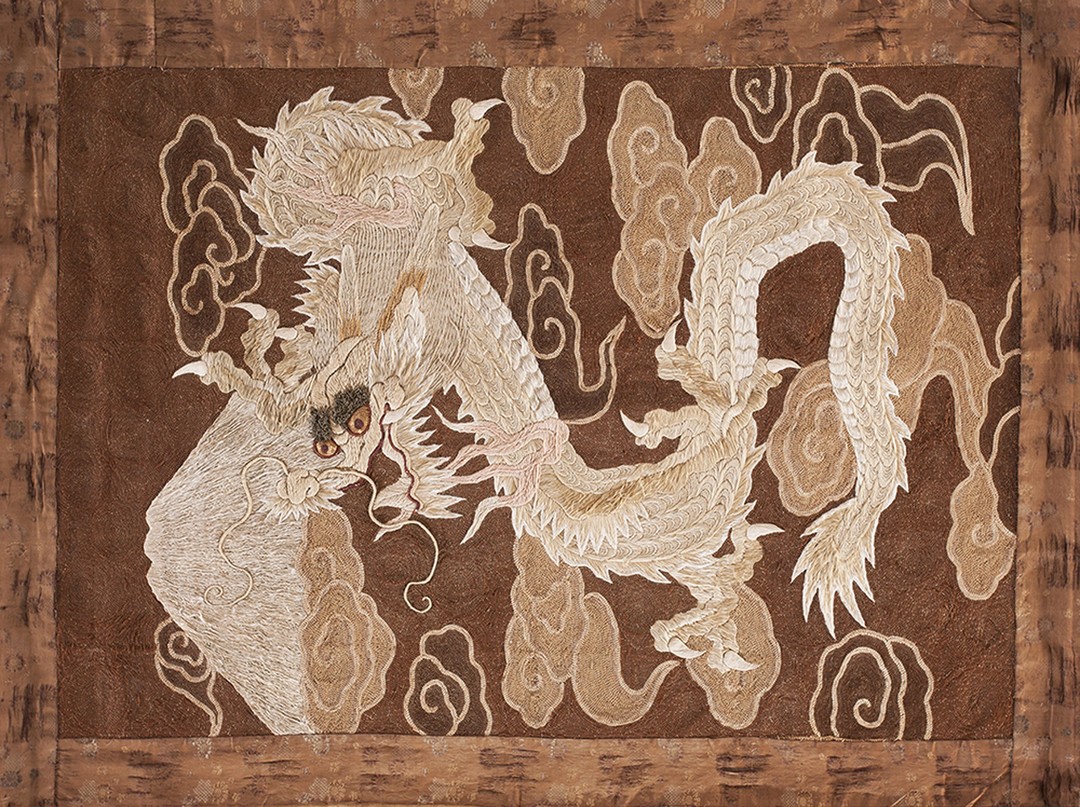
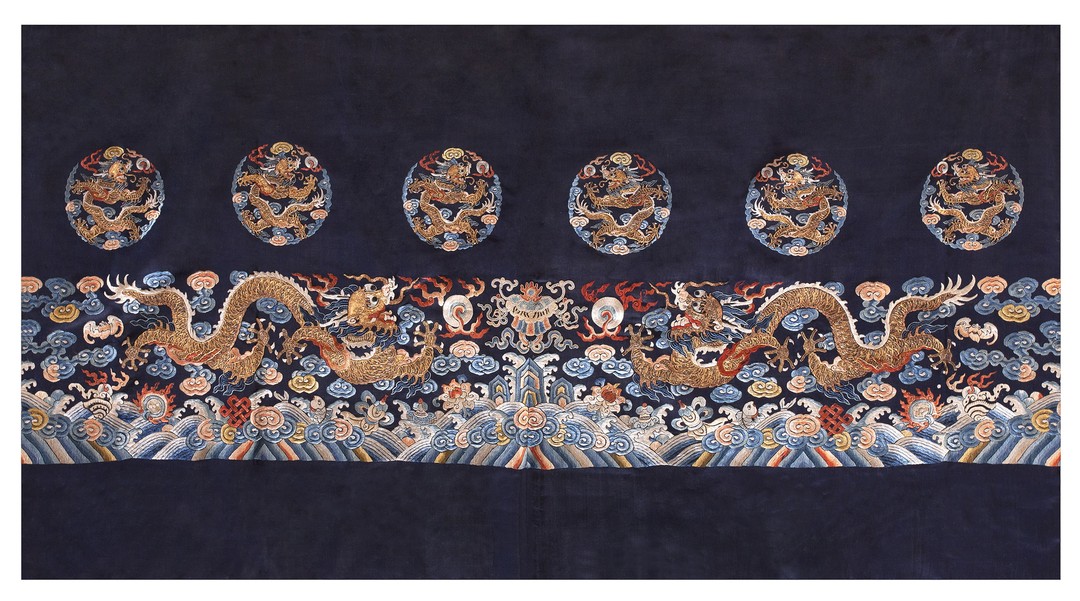
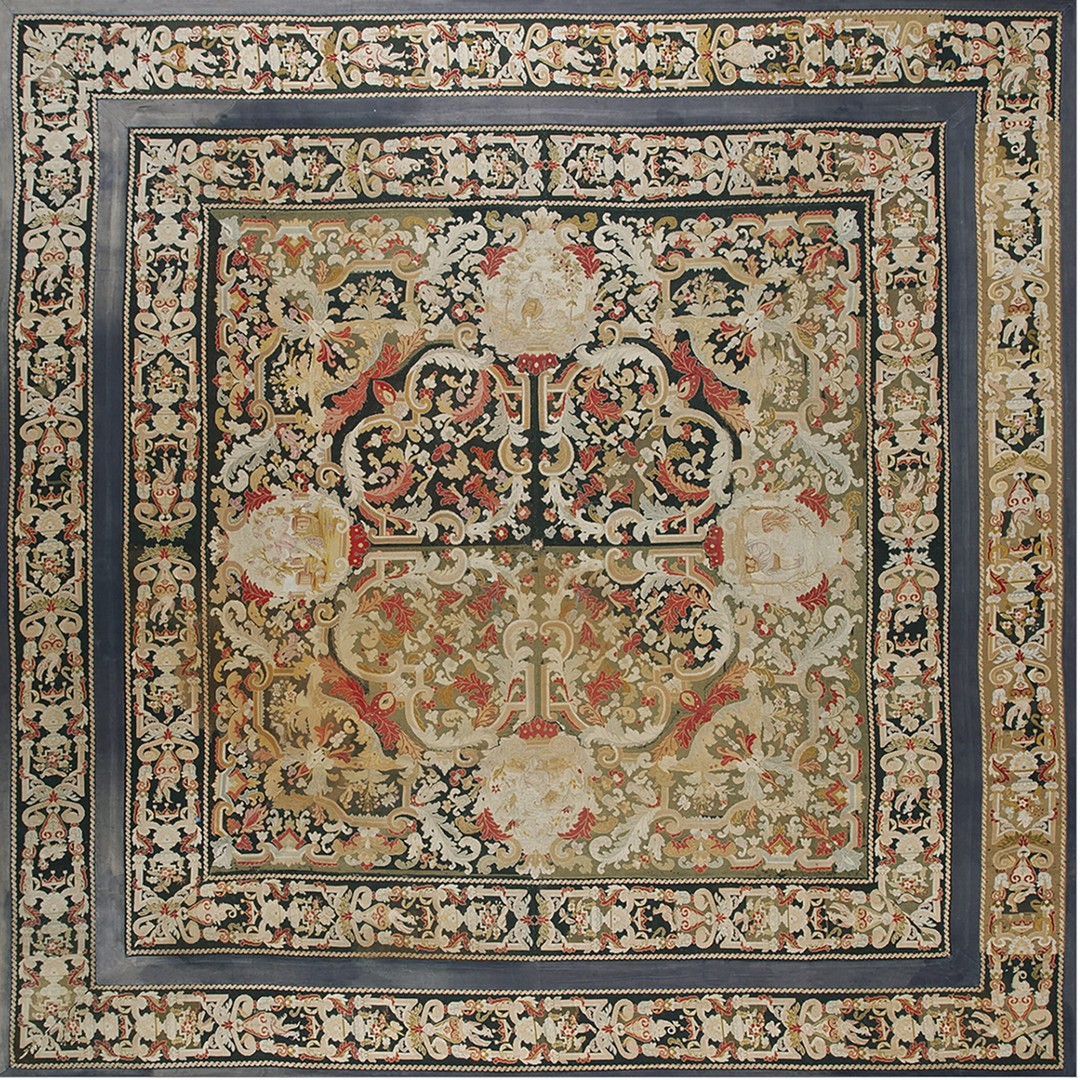
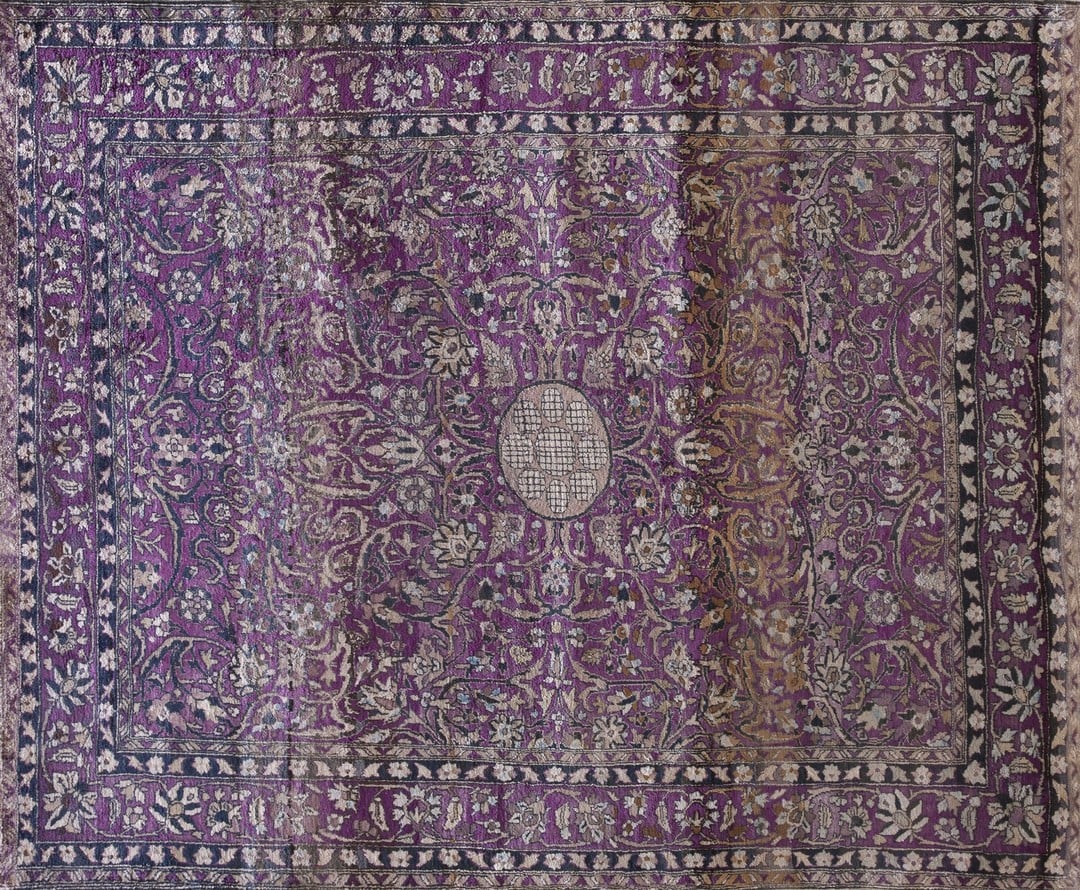
Browse a Few of Our Favorite Fine Rugs
FAQ
- What should I look for when buying fine rugs online?
Prioritize detailed photos (front, back, fringe, corner, and close-ups), a clear return policy, and exact dimensions. If possible, request a short video to confirm sheen, texture, and color.
- How can I authenticate fine rugs before buying?
Ask for clear photos of the back, close-ups of fringe/selvage, and fiber details, plus origin or workshop info when available. If the seller can’t answer basics, treat it as a risk.
- Why are fine rugs so expensive?
Labor and materials are the big drivers—hand-knotting can take months, and premium wool or silk costs more. Larger sizes and complex designs usually raise prices sharply.
- Do fine rugs increase in value over time?
Some fine rugs—especially rare, well-documented, or artistically significant pieces—can hold or gain value. Condition drives value, so repairs, staining, and sun fade can reduce it quickly.
- How do I prevent moth damage on fine rugs?
Keep fine rugs clean, vacuum regularly, and avoid storing wool rugs in damp, dark places. Moths prefer dirty fibers, so periodic inspections matter.
- What’s the best way to store fine rugs long-term?
Roll (don’t fold), wrap in breathable fabric like cotton, and store off the floor in a dry space. Add moth prevention and check the rug every 2–3 months.
- Can steam cleaning damage fine rugs?
It can—heat and moisture can cause dye bleed, shrinkage, or texture changes in some fine rugs. When in doubt, choose a specialist who cleans fine rugs specifically.
- How do I remove a fresh spill on fine rugs?
Blot immediately with clean, dry towels—don’t rub. Use cool water sparingly, and if color transfers or the stain persists after 1–2 gentle passes, stop and call a pro.
- Are fine rugs good for homes with kids and pets?
Wool fine rugs can be a solid choice because wool naturally resists minor soiling and rebounds well. Avoid delicate silk-only fine rugs in heavy “zoomies” zones.
- Can fine rugs go in high-traffic areas like hallways?
Yes, especially fine wool rugs with a lower-to-medium pile. Use a pad, rotate every 6–12 months, and consider runners with patterns that disguise wear.
- What rug pad is best under fine rugs?
A thin, dense felt pad is a common choice because it adds grip and cushioning without stressing the foundation. For most rooms, aim for about 1/8″ to 1/4″ thickness.
- How should I vacuum fine rugs safely?
Use suction-only or a gentle setting, and avoid strong beater bars that can fuzz the pile. Vacuum in the direction of the pile and keep passes light and consistent.
- Do fine rugs shed a lot when new?
Many fine wool rugs shed at first, especially in the first 4–12 weeks. Regular vacuuming (no aggressive beater bar) usually reduces shedding over time.
- Are fringes on fine rugs functional or just decoration?
On many fine rugs, fringe is the warp ends—part of the rug’s structure, not an add-on. If you can see stitching holding fringe on, it’s usually attached.
- How can I spot quality in fine rugs by looking at the back?
On fine rugs, the design on the back typically looks clearer and more detailed, with tighter structure. If the pattern looks fuzzy or pixelated, it’s often lower density or machine-made.
- Do fine rugs use natural dyes, and does it matter?
Many fine rugs use natural dyes, which can create richer, more layered color. Natural dyes can still fade with heavy sun, so UV exposure matters either way.
- What is “kork/kurk” wool in fine rugs?
Kurk (kork) is a softer, finer wool often associated with higher-end rugs and a velvety hand-feel. It’s prized because it can feel plush while still wearing well.
- Are silk fine rugs better than wool fine rugs?
Silk fine rugs can show ultra-sharp detail and shine, but they’re usually less forgiving in high-traffic areas. Wool fine rugs are typically more durable and easier to live with daily.
- What is a “good” knot density for fine rugs?
Many people consider roughly 120–330 knots per square inch as medium-to-good, and 330+ as very fine for many styles. The “right” density still depends on design type and fiber.
- Do fine rugs always have a high knot count?
Often, yes—higher knot density enables more intricate patterns and smoother curves. But some fine rugs prioritize rare dyes, great wool, or artistry even with a moderate knot count.
- How do I tell if fine rugs are hand-knotted or machine-made?
Fine rugs that are hand-knotted often have slight irregularities on the back and true fringe that’s part of the foundation. Machine-made rugs usually have very uniform stitching and attached fringe.
- What makes fine rugs “fine” compared to regular rugs?
Fine rugs usually combine higher knot density, better wool or silk, cleaner finishing, and more precise design. A simple check: the back pattern typically looks crisp, not blurry.
- What are fine rugs, exactly?
Fine rugs are high-end rugs made with tighter weaving and premium fibers, creating sharper detail and smoother feel. Many are hand-knotted with higher knot density than everyday rugs.
- Are fine rugs a good investment?
Some fine rugs hold value well, especially rare, well-documented, and well-preserved pieces, but returns aren’t guaranteed. Buy fine rugs first for beauty and use, and treat “investment” as a bonus.
- What’s the difference between market value and insurance value for fine rugs?
Market value is what a fine rug may sell for today; insurance value is often replacement-oriented and can differ a lot. Ask your appraiser which value type is being provided and why.
- Do fine rugs need an appraisal for insurance?
If a fine rug is valuable, an insurance appraisal helps you get properly covered for theft or damage. Re-appraise every 3–5 years if the rug is significant, since markets can change.
- How do moths damage fine rugs, and how can I prevent it?
Moths and carpet beetles eat wool fibers in fine rugs, especially in dark, undisturbed areas. Prevention: regular vacuuming, periodic rotation, and clean storage; treat infestations promptly with rug-safe methods.
- When should fine rugs be repaired instead of replaced?
Repair is usually worth it for fine rugs because issues like fringe loss, edge wear, and small holes can worsen fast. Early repairs often cost far less than major restoration later.
- What’s the safest way to remove a spill on fine rugs?
Blot immediately—don’t rub—then use cool water and a small amount of wool-safe cleaner if needed. If colors transfer to the towel or the stain spreads, stop and call a rug cleaner.
- How do I protect fine rugs from sun fading?
Limit direct sunlight with curtains, UV film, or rotating the rug every 6 months. Even “colorfast” fine rugs can lighten over years in strong sun.
- How often should I rotate fine rugs?
Rotate fine rugs about every 6–12 months to even out wear and fading. In high-traffic areas or strong sun, rotating every 3–6 months can help prevent one-sided wear.
- Can I steam clean fine rugs or use a rental carpet cleaner?
It’s risky for many fine rugs because overwetting and harsh chemicals can cause dye bleed, shrinkage, or foundation issues. For valuable fine rugs, professional rug washing (not in-home carpet cleaning) is safer.
- How often should fine rugs be professionally cleaned?
A common guideline is every 1–3 years depending on traffic, pets, and allergies. Hand-knotted fine rugs often do best with wash methods designed for their fibers and dyes.
- How often should I vacuum fine rugs?
Vacuum fine rugs regularly—weekly is a good baseline—using suction only (no beater bar) to protect fibers and fringes. In high-traffic zones, increase frequency and vacuum the back occasionally.
- What rug pad is best for fine rugs?
For most fine rugs, a felt-and-rubber combo pad balances grip and cushioning. Common thickness picks are 1/8″ for minimal lift, 1/4″ for everyday comfort, and 3/8″ when you want plushness.
- Are fine rugs good for high-traffic homes with kids and pets?
Yes—wool fine rugs are often excellent for busy homes because wool rebounds and hides soil. Choose lower-to-medium pile and a good pad; reserve delicate silk-heavy fine rugs for calmer rooms.
- Do fringe and tassels matter on fine rugs?
On many fine rugs, fringe is an extension of the foundation warps, not a decorative add-on. That said, some handmade fine rugs have turned-under or sewn fringe, so fringe alone isn’t proof.
- How can I spot quality details on the back of fine rugs?
Look for clear pattern definition and visible individual knots on the back of fine rugs. Blurry or perfectly uniform “pixel” backing can suggest machine production rather than hand-knotting.
- What is abrash, and does it lower the value of fine rugs?
Abrash is natural color variation across a rug, common in handmade fine rugs due to dye lots and wool differences. It’s usually considered a character feature, not a defect, unless it looks patchy or accidental.
- Do fine rugs shed, and is shedding normal?
Light shedding can happen at first, but persistent heavy shedding isn’t typical for well-made fine rugs. Excess shedding often points to short-staple fibers, weak spinning, or tufted/glued construction.
- Are silk fine rugs durable for everyday living rooms?
Silk fine rugs can last a long time, but they show wear faster in heavy traffic than wool. If you love silk, place it in a formal room or use a wool rug with silk accents.
- What materials are best for fine rugs?
Wool is the classic choice for fine rugs because it’s resilient, naturally soil-hiding, and comfortable. Silk (or silk highlights) boosts sheen and detail, but is usually better in lower-traffic areas.
- Can fine rugs be machine-made and still high quality?
Some machine-made rugs are very well made, but they’re rarely classified as fine rugs in the traditional sense. Fine rugs usually refer to handmade construction, where knots and materials drive longevity and detail.
- How do I tell if fine rugs are hand-knotted versus hand-tufted?
Hand-tufted “fine rugs” use glued backing and can shed or loosen as adhesive ages. Hand-knotted rugs show individual, irregular knots on the back and usually have sturdier structure over decades.
- How can I measure knot density on fine rugs at home?
Flip the fine rug over, count knots across 1 inch horizontally and 1 inch vertically, then multiply for KPSI. Example: 14 by 14 knots ≈ 196 KPSI.
- What knot count should I look for in fine rugs?
A common benchmark for fine rugs is roughly 200+ knots per square inch (KPSI), with exceptionally fine pieces reaching 300–400+ KPSI. Higher density usually means clearer pattern detail, not automatically better style.
- Are fine rugs always hand-knotted?
Not always, but most “fine rugs” are hand-knotted because knotting enables the sharpest detail and longest life. Fine handwoven flatweaves exist, but “fine” usually implies hand-knotting.
- What are fine rugs, and what makes a rug “fine”?
Fine rugs are typically high-grade handmade rugs defined by tight weaving, quality fibers, and crisp design detail. You’ll often see higher knot density, cleaner outlines, and better materials than mass-market rugs.