
Introduction to Dragon Rugs
Discover the mythological elegance when you shop our exclusive collection of Dragon motif rugs.
What Defines a Dragon Design Rug?
Here are the basic five aspects that make up a dragon rug design:
- Presence of Dragon Imagery — The defining feature of dragon rugs is the inclusion of dragon designs, which appear in stylized, abstract, or highly detailed forms depending on cultural origin. These mythical creatures often dominate the field or borders, making them instantly recognizable. — Why: The dragon motif is what separates this category from other Oriental carpets.
- Cultural Range — Dragon rugs appear in a wide geography, from Persia and the Caucasus to China and Tibet, each interpreting the dragon differently through local symbolism and artistic traditions. — Why: Their wide cultural span highlights the shared and adapted significance of dragons across regions.
- Design Composition — Beyond the dragon itself, these rugs often integrate supporting motifs such as cloud bands, floral elements, or geometric frames that situate the dragon within a broader decorative language. — Why: These surrounding patterns reinforce cultural context and help scholars identify regional origins.
- Material and Technique — Dragon rugs are typically knotted wool pieces, though silk examples exist in Chinese and Tibetan traditions. Weaving density, knot type, and dye use vary between regions, providing further indicators of origin. — Why: Materials and techniques are as crucial to classification as the motif itself.
- Symbolic Resonance — Dragons in these rugs embody diverse meanings: power and protection in Persia, water and fertility in the Caucasus, and imperial authority in China. — Why: Understanding symbolism adds depth to their artistic and cultural value.
Origins of the Term
The phrase “dragon rug” is largely a construct of Western scholarship. While dragon designs had existed in regional weaving traditions for centuries, the English-language label gained prominence in the 19th century, when Oriental carpets began circulating through European collections, museums, and scholarly catalogues.
Collectors used the term to categorize a distinct subset of carpets where dragons were the dominant visual feature. In local traditions, these rugs carried very different names.
In Armenian weaving communities, they were called “vishapagorg,” literally “dragon carpet,” reflecting a direct linguistic and mythological connection to local dragon legends.
In Azerbaijani culture, the word “əjdaha xalça” served a similar purpose, embedding the motif within a broader epic tradition of heroic battles with serpentine creatures.
Unlike the English label, which was imposed by collectors, these native terms reflect the living mythologies that informed the weavers themselves.
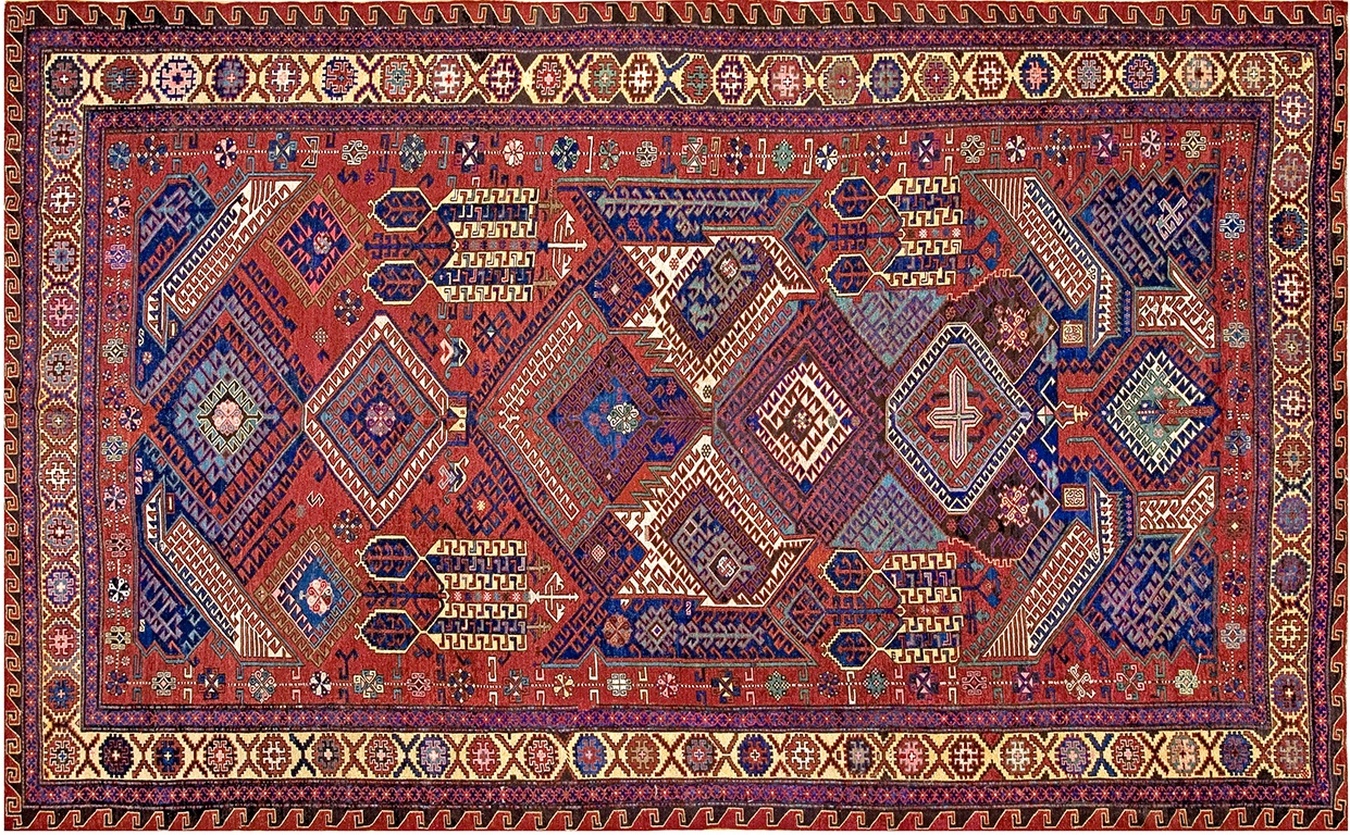
The adoption of “dragon rug” by Western dealers, museums, and scholars reflects a process of translation and simplification. The striking appearance of the dragon—whether woven as coiled, winged, or serpentine—was enough to justify a separate category in European eyes, even if the local cultural context was richer and more complex.
By the early 20th century, the phrase had become standard in art historical and collector circles, where it continues to frame discussions of these works today.
Immediate Recognition and Cultural Scope
Dragon design rugs are among the most visually commanding categories of Oriental carpets, defined by the presence of one of humanity’s oldest mythic symbols. Their ability to span geographies—from Persian court carpets to Caucasian tribal weaves, from Chinese imperial dragon carpets to Tibetan temple offerings—demonstrates both the adaptability and universality of the dragon image.
Although their terminology varies by culture, the unifying factor remains the dragon design itself, a design so prominent that it transcended local language and entered global collecting vocabulary.
Today, scholars and collectors alike recognize that while the phrase “dragon rug” is a Western shorthand, its roots lie in diverse traditions where the dragon was more than just a decorative figure—it was a bearer of meaning, authority, and myth.
Symbolism of Dragons in Rug Culture
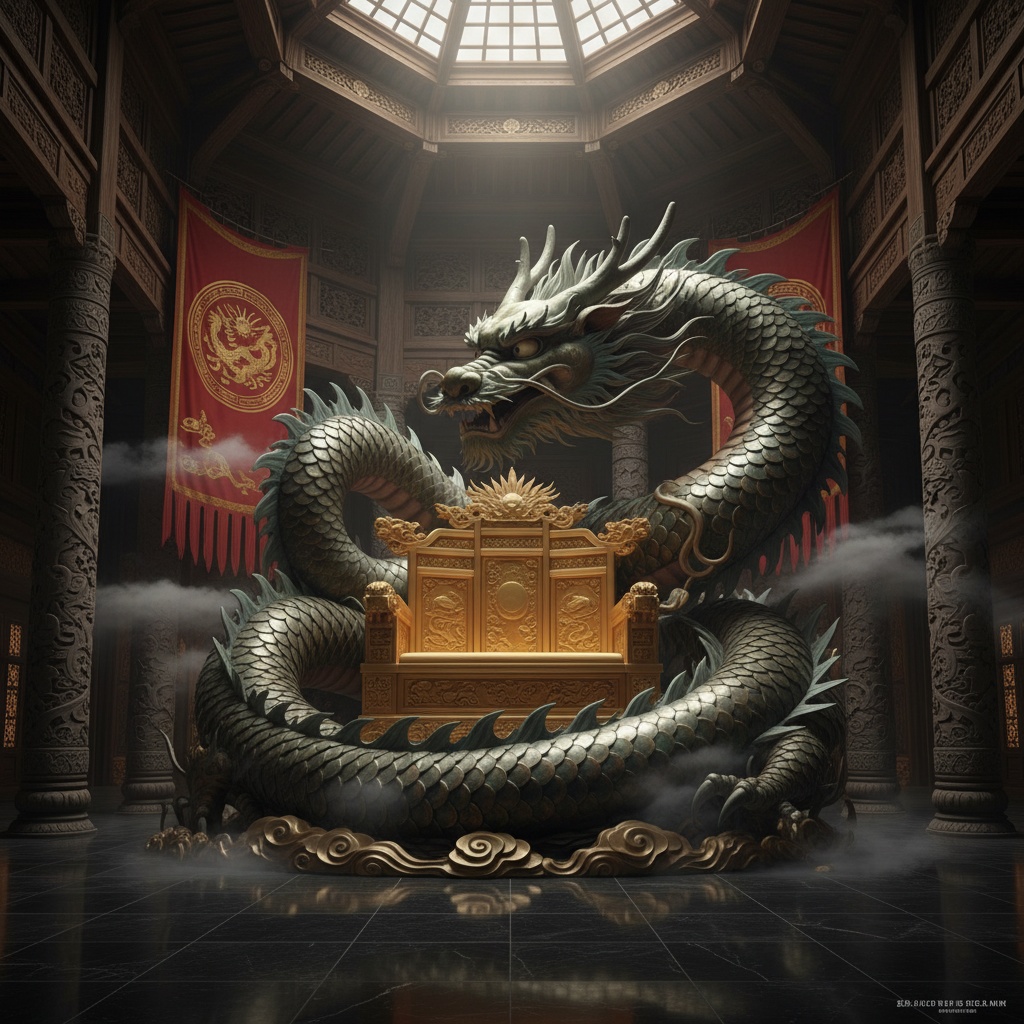
Majestic dragon guarding the imperial seat
Meaning Across Cultures
The symbolism of dragons in rugs varies dramatically across cultural landscapes, but certain themes of power, protection, and cosmic significance unify them. In China, dragons stand for imperial authority, cosmic order, and guardianship over the natural world. They embody control over rain and weather, securing prosperity for the empire.
In Tibet, dragons symbolize protection of the Buddhist law (Dharma) and are linked to spiritual enlightenment, appearing in rugs used in monasteries and sacred spaces.
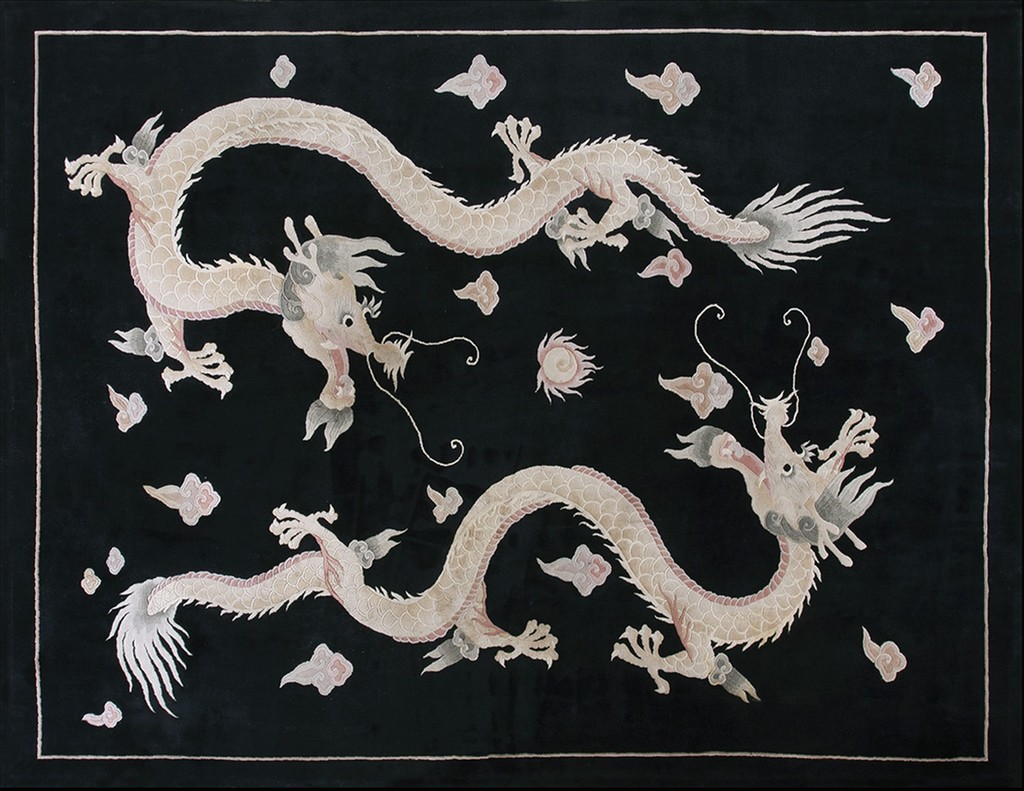
Vintage Black Double Five Claw Chinese Dragons Design Rug by Rugs On Net
Persian weaving traditions often represent dragons as forces of duality—sometimes paired with phoenixes to illustrate cosmic balance, other times as adversarial figures embodying chaos that must be conquered by good.
In the Caucasus, dragons carry apotropaic meaning, acting as protective forces against evil while also evoking water, fertility, and social status for their owners.
What Does the Dragon Motif Symbolize?
The dragon design in rug culture symbolizes power, protection, and cosmic order. It is rarely decorative alone; instead, the dragon represents divine guardianship, authority over nature, and the eternal struggle between order and chaos.
In every cultural setting, whether Tibetan temple carpets or Caucasian tribal weaves, the dragon conveys a force larger than life—whether protecting a household, legitimizing imperial authority, or marking the sacredness of a space.
Dragon & Phoenix, Five-Clawed Dragon Meanings
- Dragon & Phoenix — This pairing represents marital harmony, prosperity, and cosmic balance. In Chinese and Persian rug traditions, the combination reinforces the duality of male (dragon) and female (phoenix) energies, creating wholeness. — Why: The motif is sought after for wedding gifts and is seen as a powerful emblem of good fortune.
- Five-Clawed Dragon — In Chinese rugs, the five-clawed dragon was reserved exclusively for the Emperor. Use by others was forbidden, with punishments for those who defied the rule. Four-clawed or three-clawed dragons appeared in non-imperial contexts, but the five-clawed symbol embodied ultimate sovereignty. — Why: This restriction ensured the dragon remained a sacred and unmistakable emblem of the Emperor’s divine right to rule.
- Apotropaic Dragon — In Caucasian rugs, dragon designs often appear elongated, coiled, or locked in combat, serving as apotropaic devices meant to ward off evil. Their placement within borders or central medallions reinforced their role as guardians. — Why: This reflects the practical and spiritual desire for protection in tribal and household settings.
- Cosmic Dragon — In Persian designs, dragons frequently appear in combat scenes with phoenixes or other mythic beasts, representing the eternal tension between chaos and order. — Why: Such motifs underscore the philosophical worldview embedded in Persian mythology and artistry.
Imperial and Sacred Significance
The five-clawed dragon meaning in particular highlights the exclusivity of imperial Chinese symbolism. Only the Emperor’s rugs could carry this image, turning an imperial dragon design carpet into a direct marker of sovereignty and divinity.
Similarly, Tibetan dragon design rugs were considered sacred objects tied to religious practice, where the dragon’s roar symbolized the voice of the Buddha spreading Dharma across the heavens.
Whether interpreted as guardian, ruler, or cosmic force, the dragon symbolism in rugs demonstrates how a single mythic figure could transcend borders while remaining deeply anchored in each culture’s worldview.
Geographic & Cultural Origins
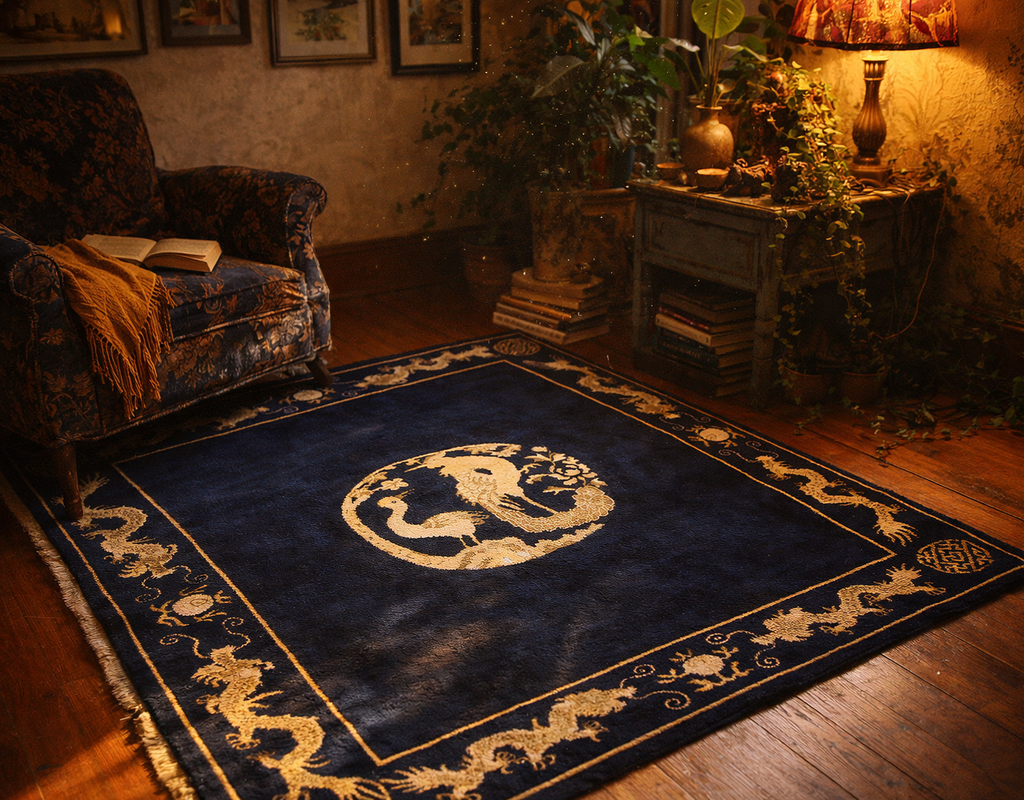
A richly designed blue and gold rug anchors this atmospheric, plant-filled corner perfect for reading.
Persian, Caucasian, Chinese, and Tibetan Origins
- Persian Origins — The origin of dragon design rugs is most clearly traced to Safavid Persia in the 16th century, where dragon-and-phoenix carpets were produced under royal patronage. These works blended Persian weaving traditions with strong influences from imported Chinese art, particularly porcelain and painting, brought westward along the Silk Road. — Why: Safavid examples created the template that later inspired adaptations across other regions.
- Caucasian Traditions — By the 17th–18th centuries, weavers in the Caucasus—especially Armenian and Azerbaijani workshops—were producing their own dragon rugs. These designs transformed the Persian model into bold, geometric, and highly stylized motifs. Known today as Caucasian dragon rugs, they often featured coiled or angular dragon forms interlaced with medallions and borders. — Why: The Caucasian adaptations show how local artisans reimagined imported themes through their own aesthetic vocabulary.
- Chinese Tradition — Chinese imperial dragon rugs evolved independently, particularly during the Ming and Qing dynasties. These pieces emphasized five-clawed dragons chasing flaming pearls, representing imperial authority, cosmic balance, and the mandate of heaven. Their designs were deeply rooted in native Chinese symbolism rather than Persian influence. — Why: They demonstrate the dragon as a long-standing, indigenous motif central to China’s artistic and political identity.
- Tibetan Tradition — In Tibet, dragon rugs appeared more prominently in the 19th century, often as monastic and ceremonial pieces. They combined Chinese-style dragons with Buddhist symbolism, where the dragon served as a protector of Dharma. Tibetan dragon rugs are typically smaller, designed for meditation platforms or temple interiors. — Why: These works reveal how Tibetan culture localized the dragon motif into spiritual and practical contexts.
How Did Dragon Designs First Appear in Carpet Weaving?
Dragon designs first appeared in carpets through cultural transmission along the Silk Road. During the Safavid era, Persian artisans encountered Chinese artistic traditions via trade, diplomacy, and gift exchange.
Chinese ceramics, scrolls, and textiles introduced dragon and phoenix imagery, which Persian weavers adapted into pile carpet design. Over time, this Persian reinterpretation circulated outward, influencing Caucasian workshops while coexisting alongside the independent imperial traditions of China.
Transmission via Silk Road; Armenian, Azerbaijani Contributions
The Silk Road served as the highway for artistic motifs, moving dragons from East Asia to Persia and beyond. Persian dragon and phoenix carpets set a precedent, but their circulation ensured that Caucasian weavers—especially Armenian “vishapagorg” traditions and Azerbaijani “əjdaha xalça” weavings—developed localized versions.
These Caucasian rugs emphasized angularity and bold coloration, contrasting with the more fluid Persian originals. In Central Asia and Tibet, trade and religious ties introduced Chinese dragons into Buddhist contexts, where the motif was given new layers of meaning.
This demonstrates how the origin of dragon design rugs cannot be pinned to a single place, but rather to a network of cultural exchange, where each region reinterpreted the dragon according to its own symbolic framework.
By the 19th century, dragon rugs represented a fusion of traditions: the cosmopolitan designs of Safavid Persia, the tribal stylizations of the Caucasus, the imperial symbolism of China, and the spiritual power of Tibet.
Together, they form one of the most fascinating cross-cultural categories in rug history.
Recognizing Dragon Rug Patterns
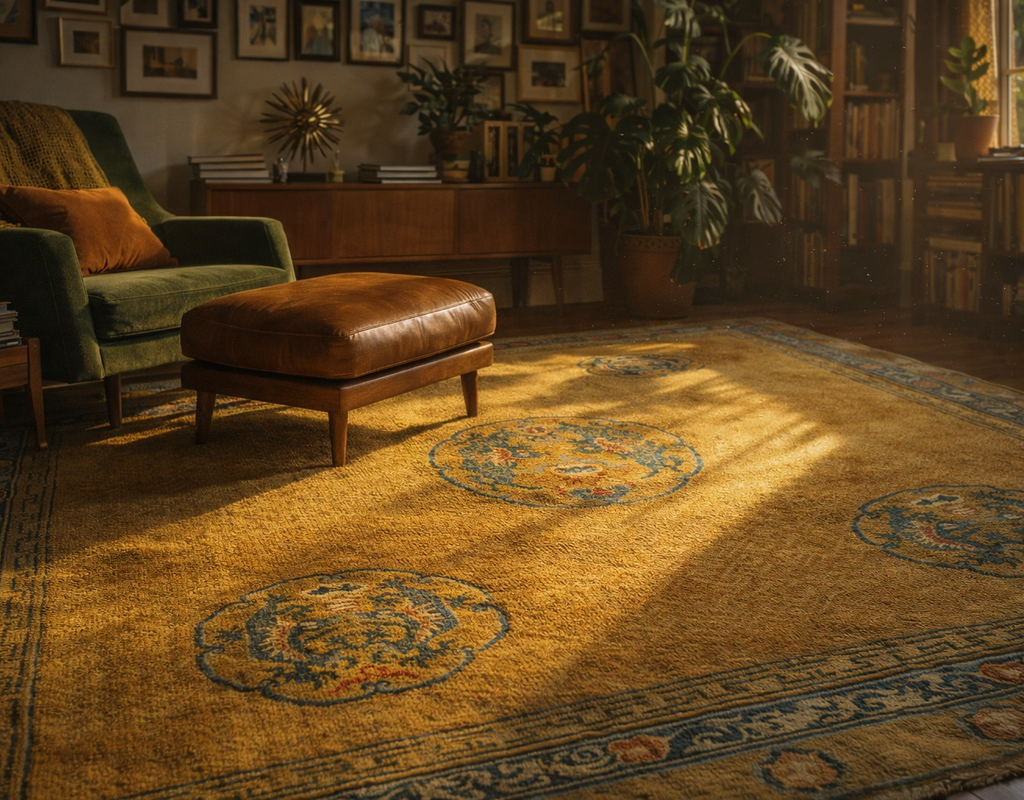
Sunlight streams across a vibrant, medallion-patterned rug in a cozy, vintage-inspired reading nook.
Key Features of Dragon Design Rugs
The dragon design rug pattern is distinguished by a set of recurring visual elements that vary by region but remain recognizable across traditions. Common features include stylized S-dragons.
These are often rendered as sinuous, serpentine figures; medallions that anchor the composition; lattice structures interlaced with beast forms; and cloud-band motifs, which symbolize the heavens.
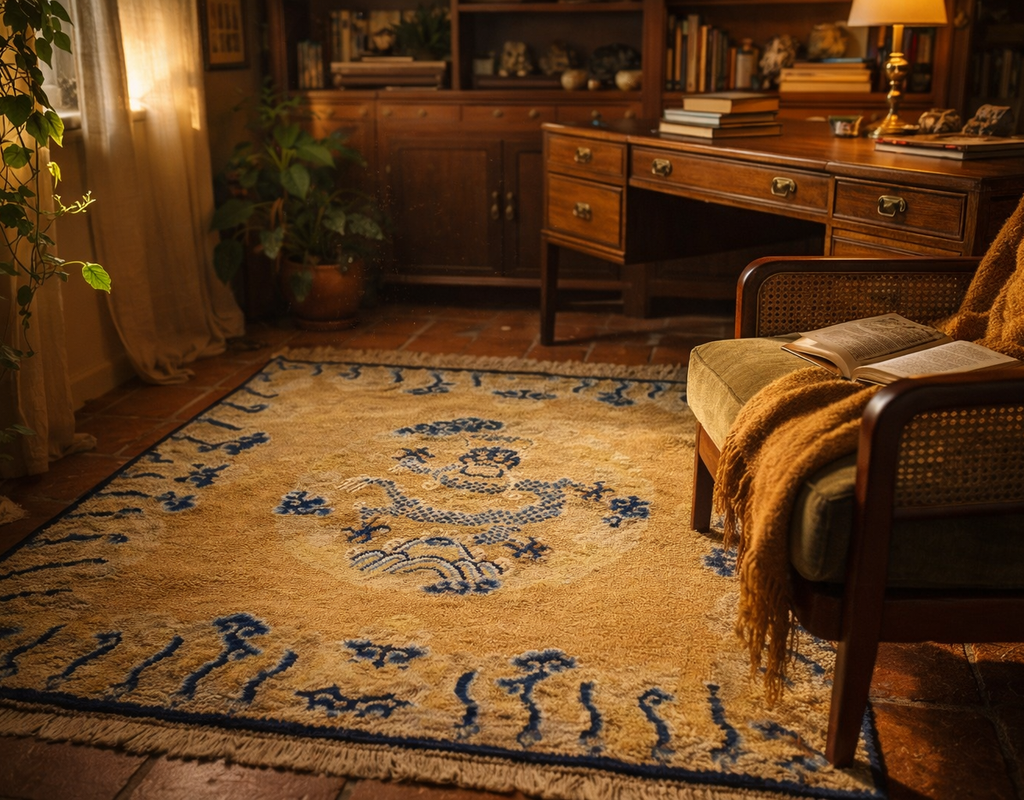
A vintage-style rug adds texture and color to this cozy, sunlit home library setting.
Supporting details such as phoenixes, lotuses, and floral scrolls often accompany the dragons, reinforcing symbolic narratives of cosmic balance, fertility, or imperial authority.
How Can I Recognize a Dragon Pattern on a Persian Rug?
Recognizing a dragon design in a Persian dragon medallion carpet requires close observation. Unlike the bold and figurative approach of China, Persian weavers often hid the dragon in elaborate vine scrolls and arabesques.
The dragons intertwine with tendrils, appearing as elongated serpentine bodies with stylized heads, sometimes so subtly woven that they almost blend into the floral ornamentation.
These motifs may appear in all-over field layouts or within central medallions, where phoenixes often accompany the dragons. Understanding these subtleties is essential, as Persian dragon designs were designed to integrate mythic power into elegant, courtly aesthetics rather than dominate the visual field.
Patterns: Chinese vs. Caucasian
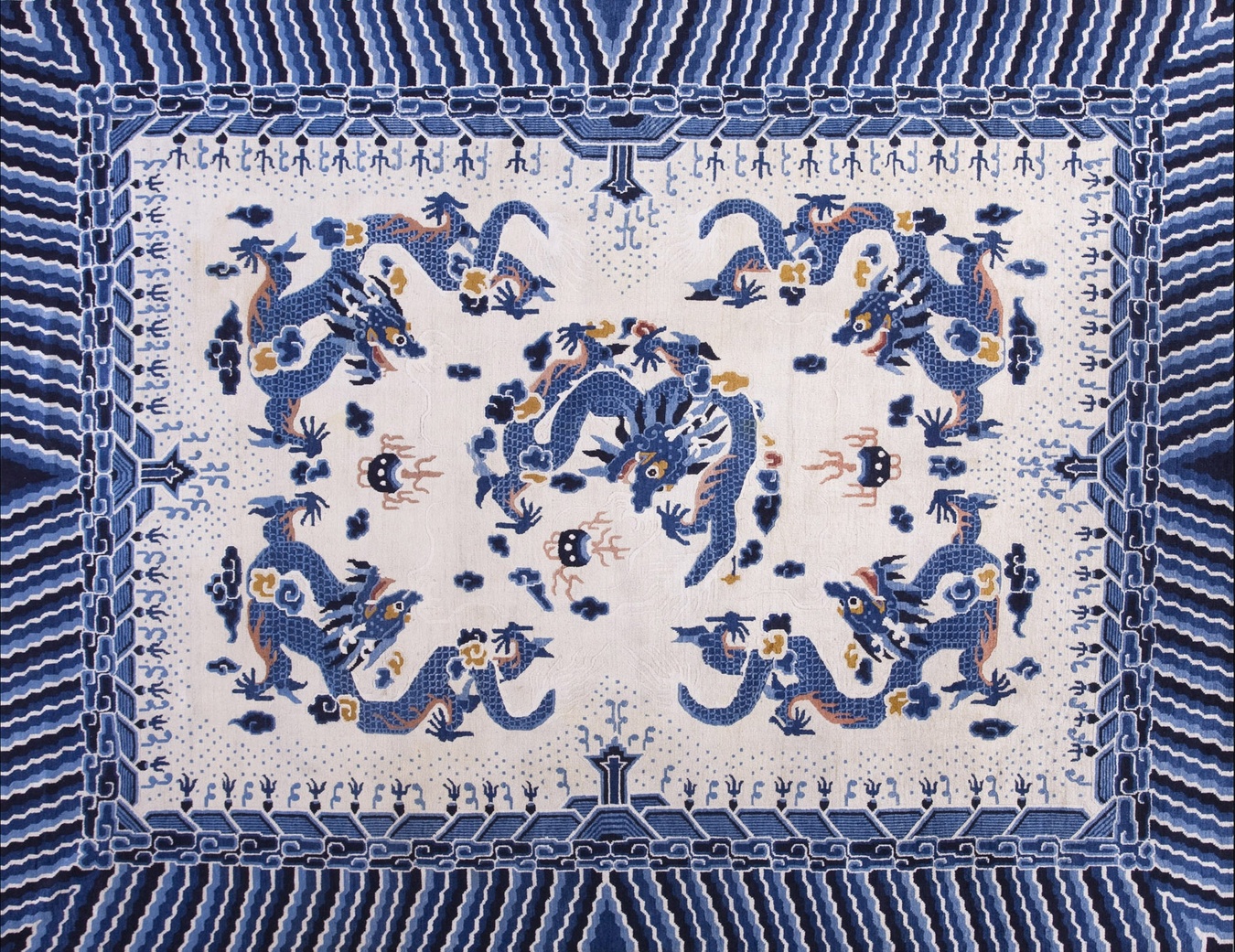
Antique Chinese – Ningxia Chinese Ivory 1930s Rug – by Rugs On Net
The most striking contrast in dragon rug patterns lies between Chinese and Caucasian traditions:
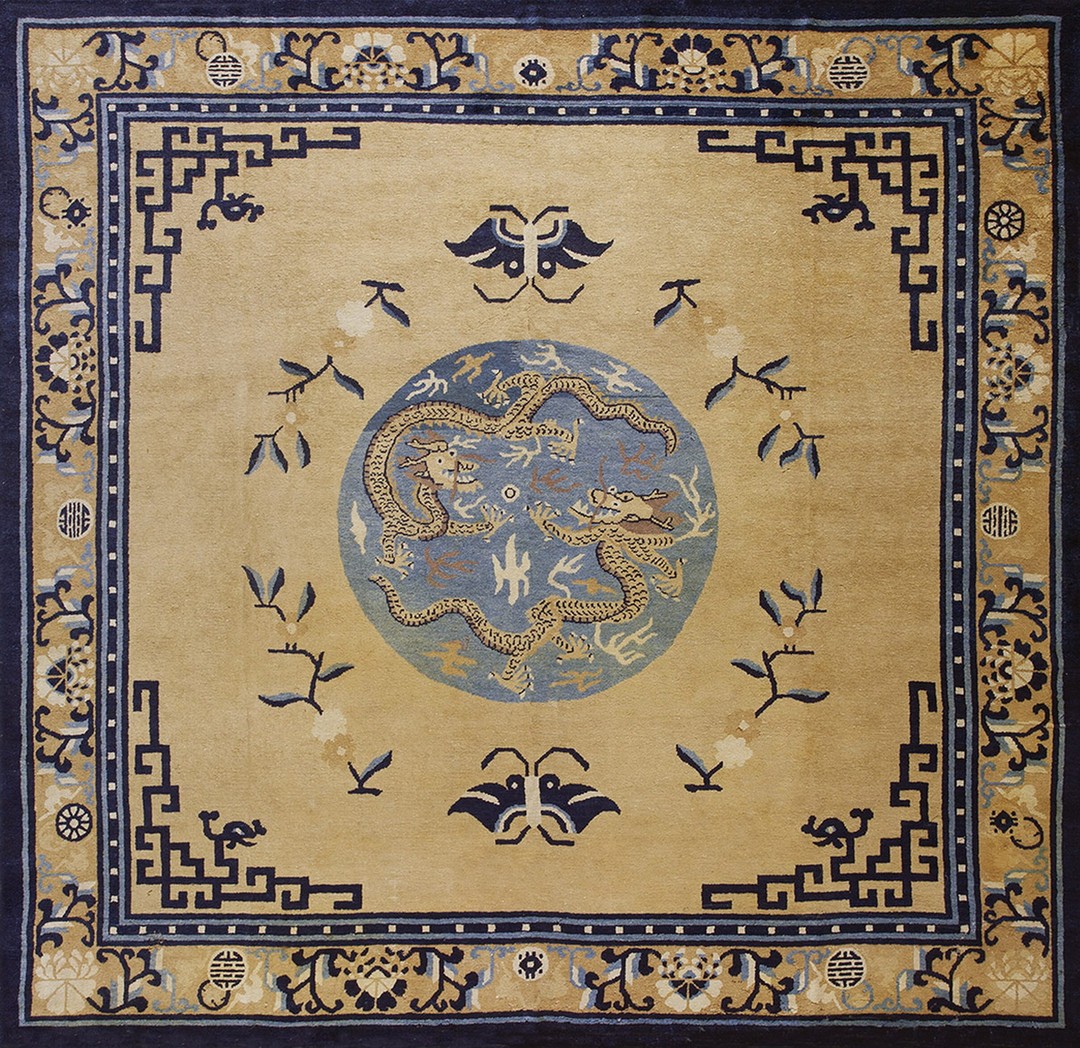
- Chinese Dragon Carpets — These display lung dragons in highly figurative form, complete with scales, horns, and flowing manes. They are often shown chasing flaming pearls, surrounded by cloud-band motif rugs and framed by borders rich with lotus blossoms. The number of claws is a critical detail: five-clawed dragons appear only on imperial dragon design carpets, while four- and three-clawed variants mark non-imperial pieces. These compositions emphasize the dragon as a celestial and sovereign figure.
- Caucasian Dragon Rugs — Here the dragon appears in S-shaped geometric form, sometimes called the S-dragon. The creatures lock together in rhythmic repetition, interwoven with large palmettes or latticework across the field. Unlike Chinese naturalism, these are angular and abstract, emphasizing symmetry and boldness rather than figurative realism. Their apotropaic meaning as guardians and protectors is conveyed through repetition and stylization rather than lifelike depiction.
Dragon & Phoenix, Cloud Motifs
Many dragon rugs also feature paired phoenixes, creating a balance of male and female cosmic forces. In both Persian and Chinese traditions, the dragon and phoenix rug stands as a symbol of harmony, often associated with marriage or cosmic unity.
The cloud-band motif is another recurring element, especially in Chinese and Persian examples, linking dragons to the heavens and emphasizing their role as controllers of cosmic order.
Regional Knowledge as Key
Recognizing a dragon design rug patterns requires attention to the visual language of its origin. A Persian rug may disguise dragons in winding vines, a Caucasian rug will highlight them as bold S-shaped forms, and a Chinese piece will show them with unmistakable figurative clarity.
In every case, the motif is central to the design, but its interpretation depends on cultural context and artistic tradition.
Design Characteristics of Dragon Rugs
Motifs, Imagery, and Composition
- Dragon Figures — The central motif of every dragon rug, ranging from lifelike Chinese lung dragons to the abstract S-dragons of the Caucasus. — Why: These figures define the category and carry the symbolic power of the design.
- Medallion & All-Over Layouts — Persian and Chinese dragon rugs often feature medallion carpets, where dragons circle a central emblem, or all-over layouts, where dragons interlace with vines or phoenixes. — Why: Composition dictates whether the dragon dominates or blends into decorative schemes.
- Secondary Motifs — Phoenixes, cloud-bands, lotus blossoms, and palmettes frequently accompany dragons, reinforcing cosmic balance or divine authority. — Why: These motifs add layers of meaning, such as marital harmony (phoenix) or heavenly power (clouds).
- Borders & Guard Stripes — Borders are dynamic and symbolic. Chinese cloud borders reference the heavens, Caucasian geometric meanders symbolize eternity, and Persian guard stripes unify the design. — Why: Borders frame the rug’s story and carry symbolic weight equal to the field.
Which Colors Are Most Common in Dragon Design Rugs?
The dragon rug colors vary by region but follow distinct palettes. Caucasian dragon rugs are known for bold, vibrant reds, deep blues, and touches of gold, creating striking contrasts that emphasize geometric forms.
Persian examples lean toward earthier tones—soft blues, terracotta, and muted creams—that integrate dragon designs into lush vine scrolls. Chinese dragon carpets stand apart with imperial palettes of yellow, blue, white, and gold, with imperial yellow carpets reserved for the highest ranks of the court. Tibetan rugs add their own bright reds, oranges, and blues, linking dragons to ritual and monastic settings.
How Do Natural Dyes Change the Look of Dragon Patterns?
The impact of dyeing is central to the beauty of dragon rugs. Natural dye dragon rugs, using indigo, madder, cochineal, or pomegranate, produce hues with depth, subtlety, and a tendency to age gracefully into nuanced tones.
These naturally dyed colors interact with light, giving dragon motifs a sense of movement and life. After 1870, the introduction of synthetic dyes brought sharper, brighter hues, but often at the cost of subtle gradation.
While synthetic colors can make dragons appear more vivid, they lack the mellow patina of naturally aged dyes, a quality highly prized by collectors.
Borders and Finishing
Borders are never merely decorative in dragon design rugs. A cloud border rug from China signals the heavens and the dragon’s celestial authority, while wave borders evoke water, linking the dragon to fertility and rain.
Caucasian geometric borders, often meandering endlessly, suggest continuity and eternity, framing S-shaped dragons with protective symbolism.
Persian borders, refined with layered guard stripes, serve as transitional elements between field and edge, unifying dragons, phoenixes, and floral scrolls into a cohesive design.
Color, motif, and border together create the identity of the dragon rug—each element as symbolic as it is aesthetic. The combination of natural dye richness, symbolic borders, and powerful imagery ensures that dragon carpets remain among the most striking of all Oriental weavings.
Materials & Construction
What Materials Are Typically Used in Antique Dragon Rugs?
The most common foundation of an antique dragon design rug is wool, prized for its durability, natural luster, and ability to hold dyes. Most pieces feature a wool pile with wool or cotton foundations, making them both resilient and visually rich.
In high-status or ceremonial works, particularly in Chinese imperial dragon carpets, weavers incorporated silk pile, silk highlights, or even gold thread, lending brilliance and prestige to the dragon design.
These silk dragon rugs were rare, reserved for the court and temples, while wool remained the standard material across Persian, Caucasian, and Tibetan weaving traditions.
Does Pile or Flatweave Affect Dragon Designs?
Dragon designs are almost always executed in pile carpets, not flatweaves. The three-dimensional structure of a pile carpet allows dragons to be depicted in relief, giving depth to scales, claws, and cloud-band motifs.

A detailed focus on the intricate, vivid colors and geometric weave of a traditional textile rug.
By contrast, a flatweave rug—such as a kilim—lacks the vertical structure to capture the intricacy of dragon forms, making them extremely rare for this category. The pile surface provided the necessary density and flexibility for dynamic, mythological imagery.
How Does Knot Density Influence Dragon Motif Clarity?
The knot density in dragon rugs directly affects how recognizable and detailed the dragon appears. High knot counts, as found in Persian dragon design carpets and finer Chinese pieces, allow weavers to depict elaborate dragons with sharp outlines, expressive faces, and detailed scales.
Lower densities, typical of Caucasian dragon rugs, emphasize bold, geometric S-shaped forms rather than fine detailing.
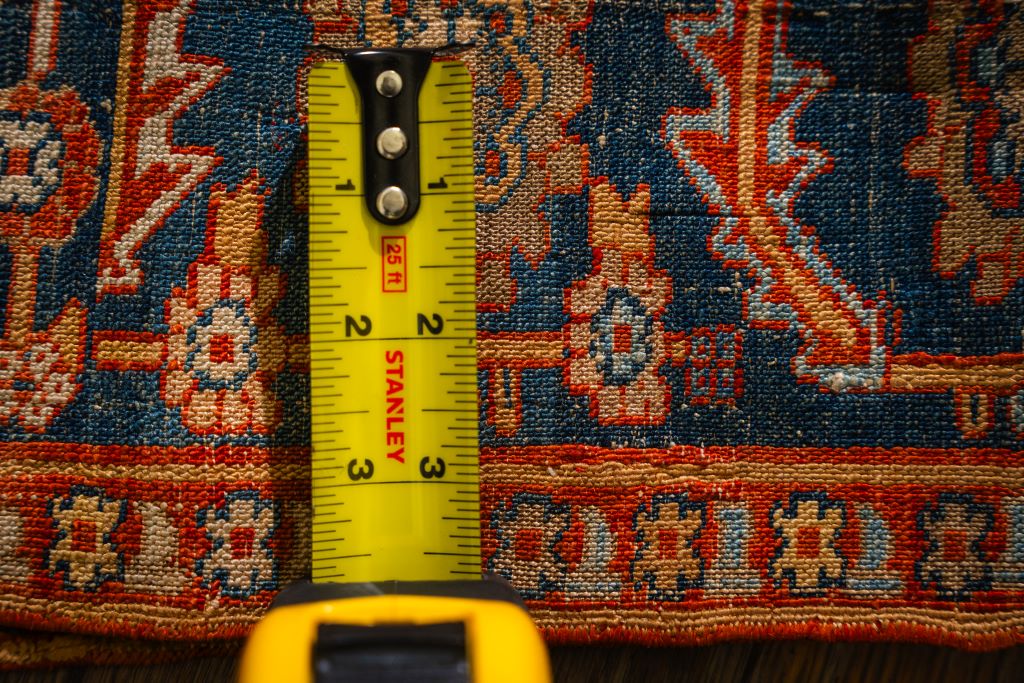
A detailed inspection of a richly colored oriental rug pattern while measuring its dimensions.
Tibetan rugs, with their distinctive Tibetan knot, create a unique, plush texture that softens outlines, giving dragons a more stylized, spiritual quality. In every tradition, density determines whether the dragon is rendered as a lifelike creature or an abstract, protective symbol.
Tibetan, Chinese, and Persian Variations
- Tibetan Knot Rugs — Characterized by their distinctive knotting method, which produces a thicker pile and softer contours. Dragons appear more spiritual, often tied to Buddhist iconography.
- Chinese Dragon Rugs — Use the symmetrical knot with medium to fine densities, balancing clarity with durability. These often feature imperial silk highlights and cloud borders.
- Persian Dragon Carpets — Woven with the asymmetrical (Persian) knot, enabling curvilinear vine scrolls where dragons intertwine with phoenixes. The higher the knot density, the more seamlessly these dragons emerge from the floral designs.
- Caucasian Dragon Rugs — Employ symmetrical knots, emphasizing bold outlines and angular, S-shaped dragons over minute detail.
By combining durable wool dragon rugs with innovative weaving techniques, each culture created a distinct interpretation of the dragon.
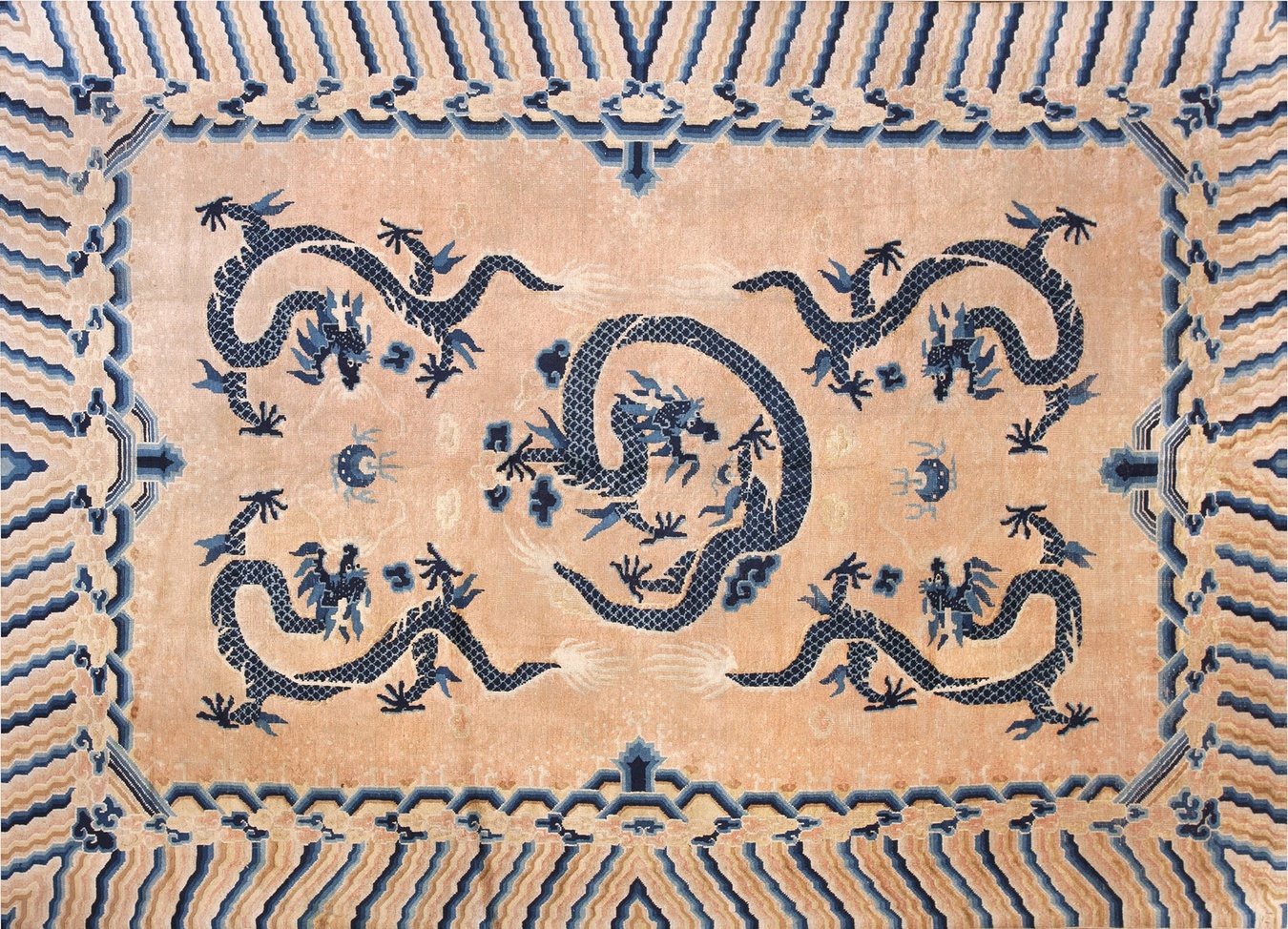
Antique Chinese – Ningxia Chinese Coral 1900s Rug – by Rugs On Net
Whether in the plush relief of Tibetan knots, the courtly silk brilliance of China, or the geometric boldness of the Caucasus, materials and construction shaped how these mythical creatures came alive in woven form.
Historical Evolution & Key Eras
Safavid Persia, Caucasus, Imperial China, Art Deco, Modern Revivals
- Safavid Persia (16th–17th c.) — The first great Safavid dragon design carpets emerged in royal workshops, where Persian weavers integrated dragons and phoenixes into vine scrolls. These courtly pieces set the visual and symbolic model for later traditions. — Why: Safavid artistry laid the foundation for dragon imagery in pile carpets.
- Caucasus (17th–18th c.) — Caucasian dragon rugs, especially from Armenian and Azerbaijani regions, transformed Persian curvilinear dragons into bold, geometric S-shapes. Their dynamic lattice and medallion layouts became highly distinctive. — Why: These represent the peak of regional reinterpretation, many now preserved in museums.
- Imperial China (Qing dynasty, 17th–19th c.) — Chinese weavers created Qing dynasty dragon design rugs with five-clawed imperial dragons, cloud borders, and flaming pearls. These carpets were ceremonial, linking directly to the Emperor and cosmic order. — Why: They reflect the dragon’s role as a sacred and political symbol of sovereignty.
- Art Deco (1920s–30s) — Chinese workshops in Beijing, Tianjin, and Shanghai embraced Western demand by producing Art Deco dragon carpets, blending traditional motifs with modern colors and abstract layouts. — Why: This era marks a unique fusion of East-West aesthetics, making them sought after by collectors today.
- Modern Revivals (21st c.) — In Azerbaijan, Armenia, China, and Tibet, dragon rug production has been revived, with artisans combining historic motifs with sustainable materials and contemporary design elements. — Why: Modern revivals keep the tradition alive while adapting dragon imagery for today’s market.
Why Do 17th-Century Dragon Carpets Command Record Auction Prices?
The 17th-century dragon carpet is the pinnacle of rarity and artistry in this category. Produced in Safavid Persia and the Caucasus, these rugs embody the earliest and finest executions of the dragon design.
Their age alone makes them scarce, but their value is enhanced by provenance, museum-level quality, and survival in exceptional condition. At auction, these antique dragon design rugs regularly achieve record-breaking prices because they represent not only extraordinary craftsmanship but also historical testimony to Silk Road cultural exchange.
Collectors prize them as irreplaceable artifacts of world art history.
Timeline of Dragon Rug Evolution
- 17th c. — Emergence of Safavid dragon carpets in Persia; spread via Silk Road.
- 18th c. — Flourishing of Caucasian dragon rugs in Armenian and Azerbaijani workshops.
- 19th c. — Expansion of Qing dynasty dragon rugs in imperial China, symbolizing court power.
- 1930’s — Production of Art Deco dragon carpets for export markets, blending tradition with modernism.
- Late 20th c. — Decline in traditional dragon weaving due to industrialization and political upheavals.
- 21st c. — Modern revivals in Azerbaijan, Armenia, Tibet, and China, with renewed attention to sustainable dyes and heritage preservation.
The evolution of dragon design rugs reflects the flow of history itself: from Safavid court artistry to Caucasian tribal boldness, from imperial Chinese ceremonial carpets to Art Deco experiments, and finally to contemporary revival.
Each era left its mark, but it is the 17th-century dragon carpet—rare, refined, and culturally rich—that remains the most coveted prize in the world of rug collecting.
Regional Variations
Chinese Imperial
The Chinese dragon design carpet is instantly recognizable for its large, figurative dragons, often shown mid-flight among clouds and chasing flaming pearls. The most important distinction is the five-clawed dragon, reserved exclusively for the Emperor.
These imperial carpets were woven in auspicious colors—imperial yellow, cobalt blue, and white—with strict symmetrical balance reflecting cosmic order.
Borders often carried cloud bands or wave motifs, linking the dragon to heaven and water. These designs embodied sovereignty and cosmic authority, reinforcing the Emperor’s mandate to rule.
Caucasian Tribal
By contrast, the Caucasian dragon design carpet has a tribal and geometric personality. Found particularly in Karabagh and other South Caucasian weaving centers, these rugs depict the S-dragon—elongated, angular forms woven in rhythmic repetition across fields and lattices.
Bold reds, blues, and golds dominate the palette, and the dragons often interlace with large palmettes or star-like medallions.
Unlike the lifelike dragons of China, these are stylized abstractions, intended more as protective apotropaic symbols than literal depictions. The Karabagh dragon rug is among the most iconic in this category, treasured for its striking combination of geometric rhythm and mythic symbolism.
Persian Workshop
In Persian dragon design rugs, dragons rarely appear as stand-alone figures. Instead, they twist through vine scrolls and arabesques, often paired with phoenixes in medallion or all-over designs.
These pieces reflect the sophistication of Safavid workshop carpets, where dragons were reinterpreted through Persian aesthetics, becoming part of an intricate ornamental system. Their rarity today makes them highly sought after by collectors, as few have survived outside museum collections.
Armenian, Azerbaijani, Tibetan, and East Turkestan
- Armenian Vishapagorg — The Armenian term vishapagorg means “dragon carpet,” and these works often incorporated inscriptions, letters, or even stone references unique to local tradition. They highlight the close link between myth and craft.
- Azerbaijani Rugs — Known locally as əjdaha xalça, Azerbaijani dragon rugs adapted Persian and Caucasian styles but emphasized tribal palettes and strong linearity, making them popular across the region.
- Tibetan Dragon Rugs — Tibetan weaving introduced bold, folk-inspired dragon imagery. These Tibetan dragon rugs often included Buddhist symbols such as lotus blossoms or the Eight Auspicious Signs, with dragons acting as Dharma protectors.
- Khotan & East Turkestan — In oasis towns along the Silk Road, dragon rugs blended Chinese symbolism with Central Asian design. Their dragons appear alongside pomegranate trees, cloud bands, and geometric borders, reflecting a crossroads aesthetic.
Why Are Five-Clawed Dragons Reserved for Imperial Chinese Rugs?
The five-clawed dragon was more than decoration: it was the sacred emblem of the Emperor himself. By law, only the ruler could commission or display carpets bearing this dragon.
Nobles, officials, or temples could use four-clawed or three-clawed dragons, but employing the five-clawed form outside the court was considered an act of treason. This exclusivity transformed the imperial dragon carpet into a visual statement of absolute power, instantly identifying the authority of the throne.
Regional Personalities of Dragon Rugs
Each region stamped its own character onto the dragon motif: Chinese carpets expressed imperial authority, Caucasian rugs embodied tribal protection, Persian workshops pursued ornamental intricacy, while Armenian, Azerbaijani, and Tibetan traditions localized the dragon within their own cultural frameworks.
These distinctions give dragon rugs their regional personalities, making them one of the most diverse yet unified categories in the history of Oriental carpets.
Cultural & Symbolic Relevance
Symbolism Across Cultures
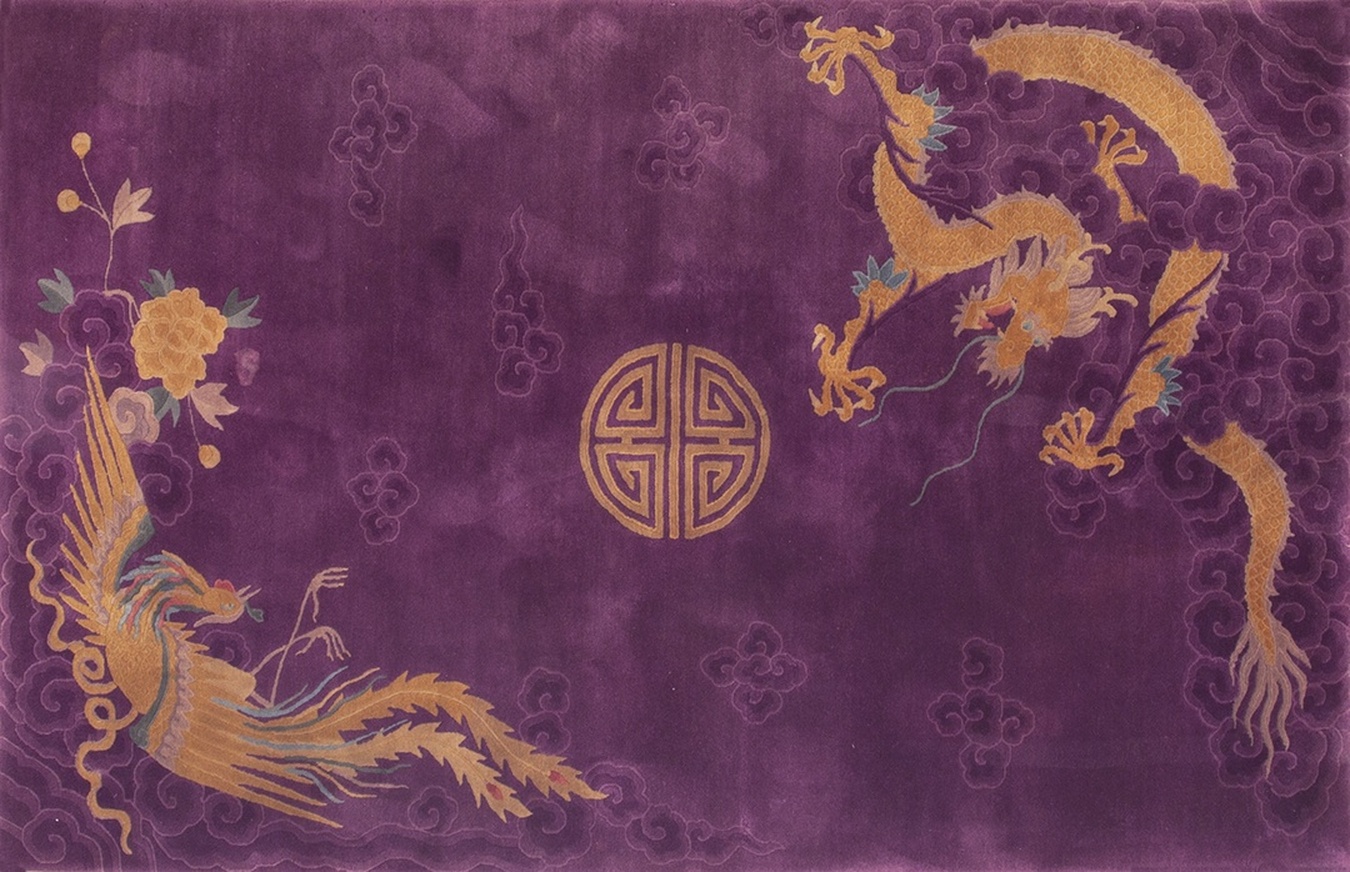
- China — The dragon is the ultimate emblem of cosmic power, imperial sovereignty, and celestial order. Chinese dragon carpets reinforced the Emperor’s divine authority and were infused with sacred meaning. — Why: These pieces symbolized political legitimacy and the link between ruler and heaven.
- Persia — In Safavid Persia, dragons often appeared alongside phoenixes, symbolizing cosmic balance, duality, and the triumph of order over chaos. — Why: The motif fit seamlessly into Persian philosophical and poetic traditions.
- Caucasus — In tribal Caucasian rugs, dragons had a more protective function, serving as apotropaic symbols to guard households, while also marking status and prestige. — Why: Their bold imagery carried both practical and social significance.
- Tibet — Tibetan dragon rugs depicted the dragon as a protector of Dharma, embodying enlightenment and spiritual guardianship. — Why: The motif linked local weaving to Buddhist cosmology and ritual practice.
Should a Collector Choose Silk or Wool for Investing in Dragon Rugs?
The choice between silk vs. wool rugs depends on investment priorities. Silk dragon design carpets—particularly Chinese imperial pieces—are far rarer and carry extraordinary value as luxury items. Their brilliance, fineness, and association with nobility make them prized collector’s pieces, though they are delicate and require careful preservation.
By contrast, a wool dragon rug is the classic standard: durable, deeply tied to tradition, and often preferred by purist collectors who value heritage and longevity over opulence.
For long-term investment, silk often commands higher auction prices, but well-preserved antique wool dragon rugs remain highly collectible for their authenticity and durability.
Does Provenance Significantly Affect Dragon Rug Value?
Yes—rug provenance is one of the most decisive factors in determining dragon rug value. A carpet with a documented origin, workshop, and historical context can see its value multiply.
Rugs tied to imperial workshops, noble households, or significant collections are among the most expensive, as provenance ensures authenticity and links the piece to cultural history.
Even for less rare examples, provenance increases desirability, giving buyers confidence in the rug’s age, authenticity, and significance. In the market for collectible dragon design carpets, provenance can make the difference between a valuable artifact and a priceless masterpiece.
Cultural Weight and Collector Demand
The enduring appeal of dragon rugs lies in their layered meanings. Each region endowed the dragon with unique symbolic weight, from cosmic order in China to protective guardianship in the Caucasus.
For collectors, the decision between silk and wool or the weight of provenance goes beyond financial value—it ties them to centuries of myth, power, and artistry woven into every carpet.
Modern Market & Contemporary Legacy
Where Can I Buy a Certified Antique Dragon Rug Online?
Collectors seeking an antique dragon rug for sale should focus on auction houses such as Sotheby’s or Christie’s, which specialize in museum-grade examples and provide detailed provenance.
Reputable rug dealers and select museum shops also offer certified dragon design carpets, often with appraisal papers and expert authentication. For buyers seeking guaranteed authenticity and long-term value, working with specialists who provide certificates of origin and restoration history is essential.
Price Range, Collectability, and Restoration
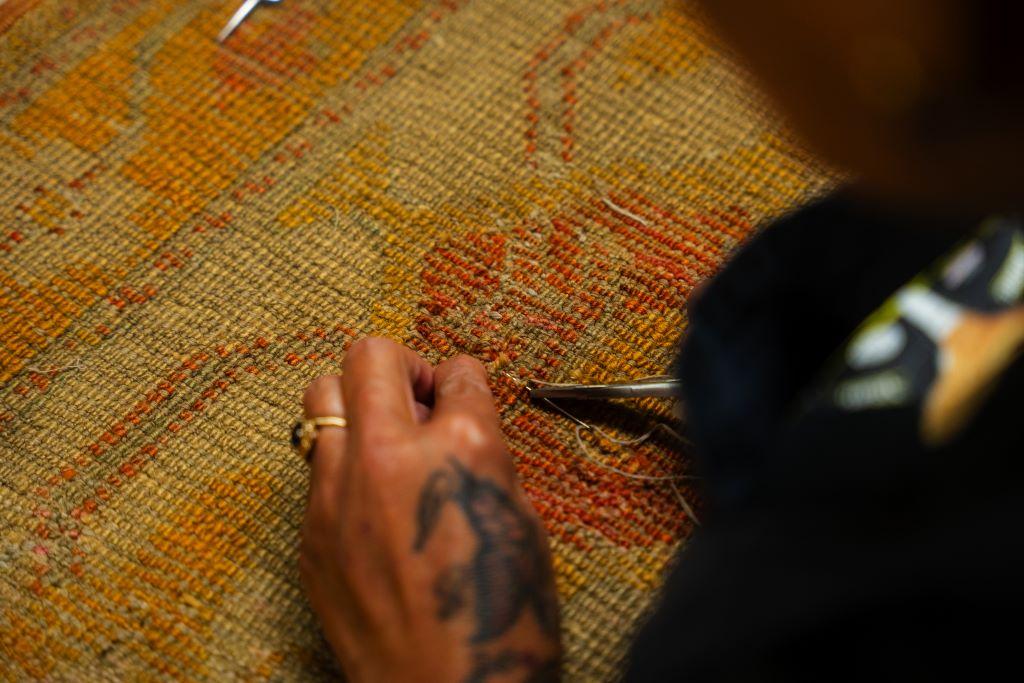
Detail of hands mending a rustic, richly colored woven rug.
- Basic Dragon Design Rugs — More accessible examples, often later Caucasian or 19th-century Tibetan dragon rugs, may begin in the low five figures, depending on condition. — Why: Entry-level pieces offer cultural value without the extreme scarcity of Safavid or Qing carpets.
- 18th Century Masterpieces — True antique dragon design carpets from Persia, the Caucasus, or Qing China can command six- to seven-figure prices at auction, reflecting their rarity, artistry, and provenance. — Why: Scarcity and historic significance drive record prices.
- Restoration — Professional dragon rug restoration involves gentle cleaning, color re-dyeing with natural pigments, and expert reweaving of worn sections. This process revives faded motifs without compromising authenticity. — Why: Proper restoration preserves both beauty and long-term investment value.
Are Modern Dragon Rugs Made Differently from Vintage Ones?
Yes—modern dragon rugs differ in materials and techniques. While antique examples relied on natural dyes and traditional knotting, many contemporary pieces use synthetic dyes or are machine-woven for mass production.
At the same time, artisan workshops in Tibet, China, and Azerbaijan continue to create hand-knotted dragon carpets using heritage methods, often with eco-friendly dyes and fair-trade certification. This dual market means collectors can choose between accessible decorative rugs and heirloom-quality artisanal works.
Are Limited Edition Contemporary Dragon Rugs Appreciating in Value?
Yes—limited edition rugs designed by leading weavers or in collaboration with museums can appreciate significantly, particularly when tied to exhibitions or cultural releases.
These contemporary dragon carpets blend modern design with traditional motifs, producing collectible works of art that bridge the past and present. Their rarity and association with recognized names make them attractive for both design enthusiasts and investors.
How Have Modern Designers Reinterpreted Traditional Dragon Motifs?
Contemporary designers have reimagined the dragon for a modern audience, creating dragon motif decor that ranges from minimalist abstractions to bold pop-art renderings.
Some reinterpret dragons with stripped-down silhouettes in muted palettes, while others embrace vibrant colors to echo traditional energy. These reinterpretations highlight the motif’s versatility, proving it can adapt to current design sensibilities while retaining its symbolic weight.
Can a Bold Dragon Motif Work in Minimalist Interiors?
Absolutely. A bold dragon design rug can serve as a statement anchor in minimalist spaces, where its intricate design contrasts clean lines and neutral tones. The rug becomes the room’s focal point, balancing simplicity with cultural depth.
This approach reflects a growing trend in interior design: using contemporary dragon carpets as centerpiece art rather than background decor.
Contemporary Legacy and Collector Appeal
Today, the dragon rug market remains a competitive and high-value niche. From antique masterpieces with imperial provenance to modern reinterpretations suited for minimalist interiors, dragon design rugs continue to embody both cultural significance and design appeal.
With options ranging from certified dragon carpets to limited edition rugs and artisan revivals, collectors and decorators alike find that the tradition is alive, evolving, and highly relevant to contemporary tastes.
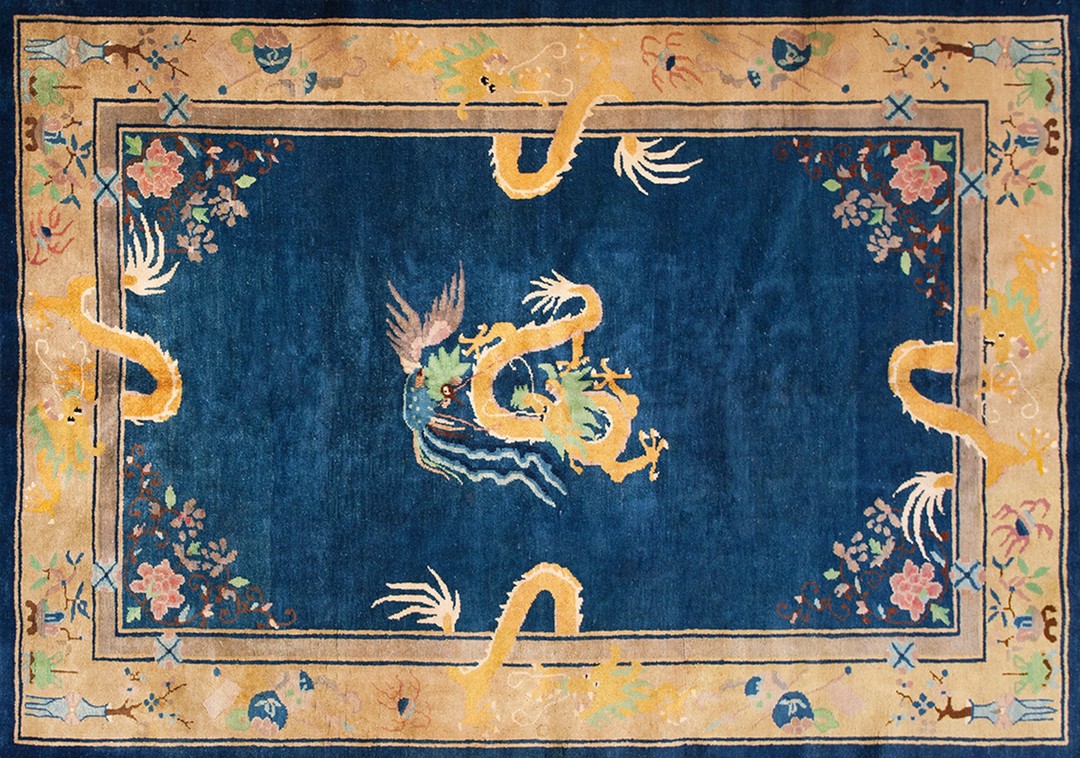
Explore a Few of Our Favorite Dragon Rugs
FAQ
- Is it culturally respectful to own dragon-motif rugs?
Yes, when appreciated as art and history; avoid altering sacred pieces, and seek reputable sellers who provide accurate cultural context and provenance.
- What affects the value of dragon rugs most?
Age, rarity of design (e.g., five-clawed imperial motifs), condition, size, dyes, and provenance; verified museum or notable collection history can dramatically increase price.
- Can I use a dragon rug under a dining table?
Yes—ensure the rug extends 24–30 inches beyond the table on all sides so chairs slide without catching; short to medium pile is easiest to maintain.
- How do I style a bold dragon rug in modern rooms?
Let the rug be the focal point and keep adjacent upholstery neutral; echo one accent color from the rug in two or three small accessories for cohesion.
- Are dragon rugs durable for high-traffic areas?
Wool-pile versions are resilient and spring back well; place a pad beneath and consider darker grounds or patterned fields to camouflage wear.
- How can I check for dye-bleed risks?
Lightly dab a hidden area with a damp white cloth; if color transfers, consult a professional cleaner and avoid DIY wet cleaning or steam.
- How do I store an antique dragon rug?
Have it professionally cleaned first, then roll (not fold), wrap in breathable paper, and keep in a cool, dry space around 60–75°F with moderate humidity to deter moths.
- What rug pad should I use under a dragon rug?
Choose natural felt or felt-with-rubber for grip and cushioning; avoid low-quality PVC pads that can off-gas or stick. Trim pads 1–2 inches smaller than the rug.
- Are dragon rugs okay over underfloor heating?
Wool rugs generally work if heat is moderated and a heat-safe felt or felt-rubber pad is used; keep antiques away from strong heat and monitor for dryness.
- Will sunlight fade a dragon rug?
Yes, UV light gradually weakens dyes and fibers; use window treatments, rotate regularly, and avoid placing only part of the rug in direct sun to prevent uneven fading.
- How do I vacuum a dragon rug safely?
Use suction-only (no beater bar), vacuum with the pile direction, and avoid catching fringes; rotate the rug every 6–12 months to even out wear and light exposure.
- What materials are typical for dragon rugs?
Wool pile on wool warps/wefts is standard for Caucasian and Tibetan types; Chinese examples may be wool (occasionally silk highlights), with cotton foundations in some later weaves.
- Are Tibetan dragon rugs always “antique”?
No; many were woven circa 1900–1930, and new Tibetan dragon rugs are still produced today using wool pile and traditional motifs.
- How much do dragon rugs cost?
Modern hand-knotted pieces start around a few hundred to a few thousand dollars; antique Caucasian or imperial Chinese examples range from tens of thousands to six or seven figures depending on rarity and condition.
- How can I tell if a dragon rug is hand-knotted?
Look for individual knots and pattern clarity on the back, irregularities in weave, and fringes that are warp extensions; machine-mades show uniform backing and glued edges.
- How old are authentic Caucasian dragon rugs?
The archetypal group originates in the 1500s–1600s, with later 18th–19th-century examples and 20th-century revivals; age, condition, and structure drive value.
- Which colors are common in Chinese dragon rugs?
Golden yellow, indigo blues, ivory, and soft browns are typical; Tibetan examples also use natural madder reds, indigo, rhubarb yellows, and walnut browns.
- What is a pillar or banner dragon rug?
Tall, narrow Ningxia pieces designed to wrap columns or hang as banners in temples or palaces; common motifs include paired dragons above wave (lishui) stripes.
- What does a dragon-and-phoenix rug signify?
It pairs yang (dragon) and yin (phoenix), symbolizing harmony, prosperity, and often marriage blessings; expect balanced, celebratory motifs and cloud scrolls.
- Why do some dragon rugs show a pearl?
The “flaming pearl” represents wisdom, perfection, and prosperity; twin dragons chasing the pearl is a classic auspicious scene promising abundance.
- What does a five-clawed dragon mean on rugs?
Five claws indicate imperial symbolism in Chinese art; such dragons were historically associated with the emperor and palace contexts, especially on large yellow-ground carpets.
- What are Caucasian “Dragon” carpets?
Early Transcaucasian pile or soumak weavings with highly stylized dragon forms in geometric medallions; originals date to the 16th–17th centuries, using symmetrical (Ghiordes) knots and wool piles.
- What is a Ningxia dragon rug?
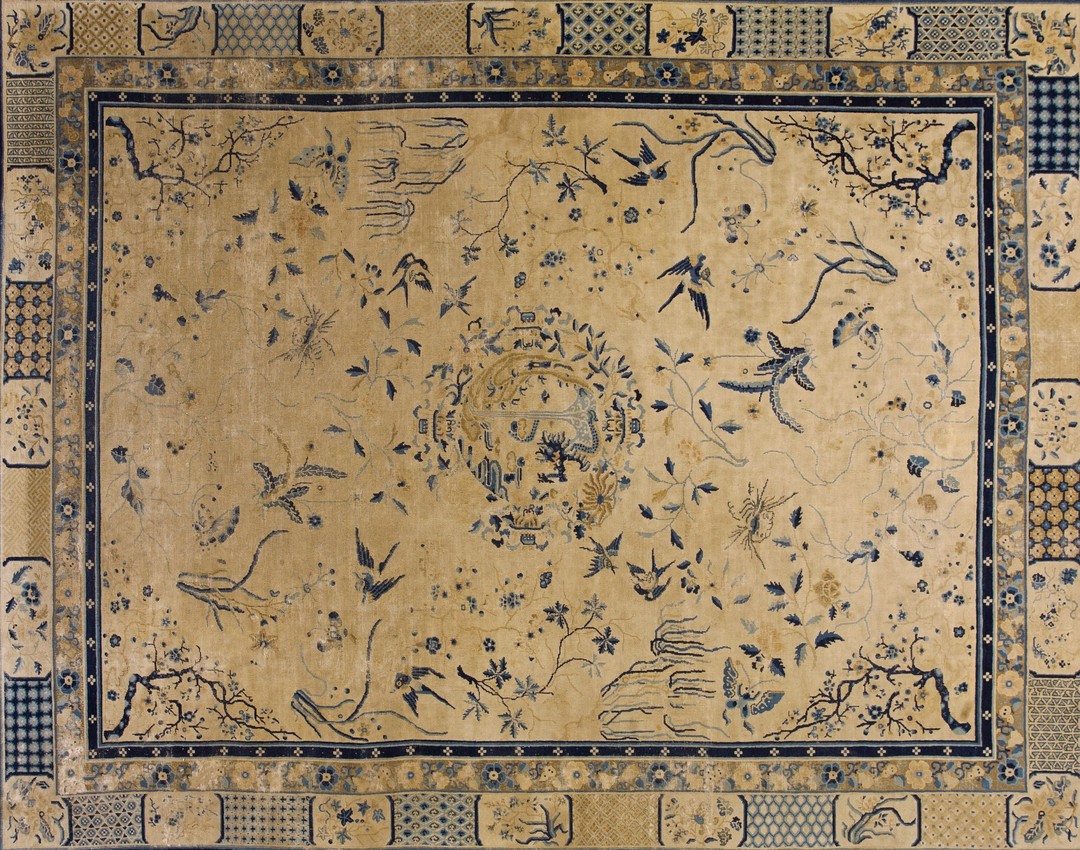
A Chinese rug style, often yellow or beige fields with blue dragons and cloud scrolls, woven in North China from the Qing era onward; many feature imperial imagery like five-clawed dragons.
- What’s the difference between Chinese, Tibetan, and Caucasian dragon rugs?
Chinese and Tibetan dragons are curvilinear and pictorial; Caucasian “dragon” rugs render dragons as stylized, geometric forms within lattices or lozenges, often 16th–18th century designs revived later.
- What does a dragon motif on a rug symbolize?
It typically represents power, protection, prosperity, and good fortune; in Chinese tradition the dragon is benevolent, rain-bringing, and auspicious, often tied to imperial authority and success.