
Introduction to Cloud and Cloud Band Motifs
Discover the ethereal beauty of this motif by exploring our exquisite collection of luxury Clouds Cloud Band Rugs available now.
Definition and Essence
Cloud band motifs in Oriental rugs are swirling, ribbon-like designs that evoke drifting clouds across a sky. They typically appear as curved, segmented forms that loop and fold into themselves, often extending across the field of a carpet or framing medallions. Instantly recognizable by their flowing, ribbon-like curves, these motifs are among the most distinctive symbols in the weaver’s vocabulary.
In rug studies, they are called cloud band rugs or cloud motif carpets, and they represent more than simple decoration: they symbolize the celestial realm, divine presence, and the eternal movement of nature. Scholars often describe them as a “marker of fusion” between cultures because they migrated across Asia through trade, war, and diplomacy, embedding themselves in diverse weaving traditions.
Etymology and Origin
The origin of the cloud motif is firmly Chinese. In Chinese painting, ceramics, and textiles, stylized clouds were used as auspicious emblems of good fortune and heavenly protection. These flowing curves developed into the Chinese cloud design, a motif that was especially prominent during the Tang and Song dynasties.
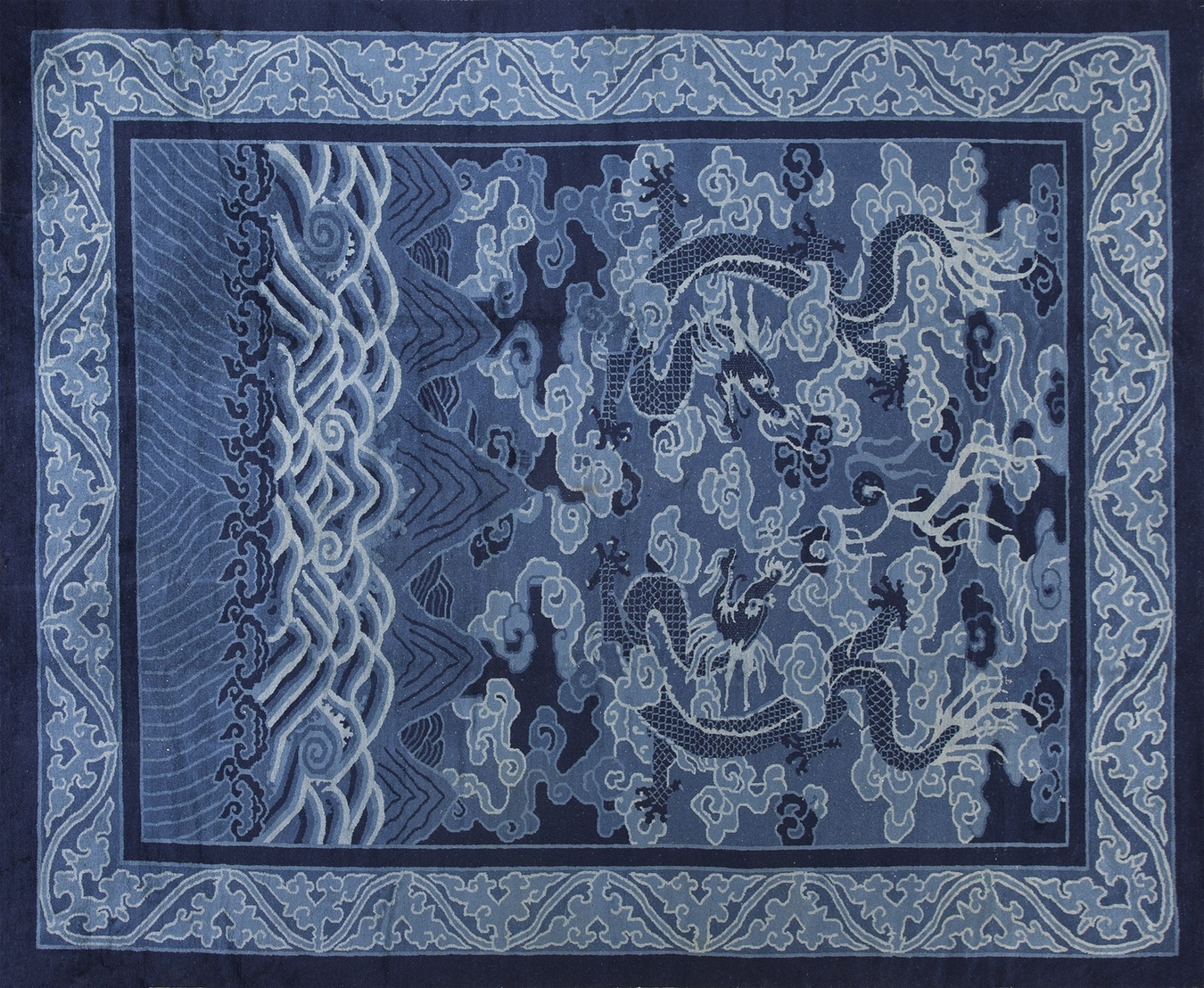
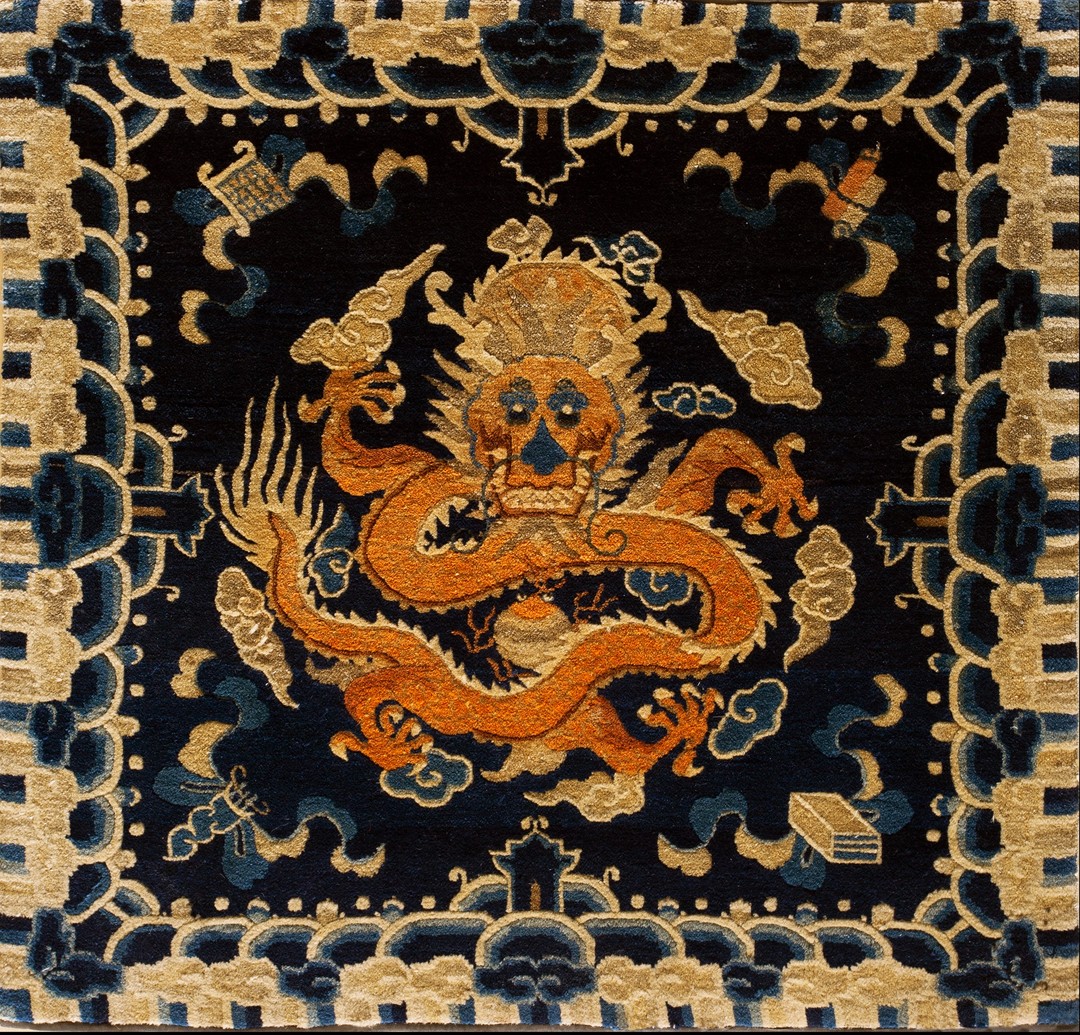
Antique Peking Chinese Allover Blue 1930s Rug – by Rugs On Net
With the expansion of Silk Road networks, such imagery moved westward, reaching Persia during the Mongol-Ilkhanid period in the 13th–14th centuries. In Persian, the motif was called abr-e chinī, literally “Chinese cloud,” a name that acknowledges its foreign source. Turkish weavers adopted it under the name bulut, meaning simply “cloud.”
From there, it appeared in Caucasian and Central Asian weaving, reshaped according to local aesthetics but always retaining its recognizable ribbon-like form. This transmission demonstrates how cloud bands are not confined to a single geography but are the product of centuries of cultural exchange.
Western vs. Eastern Terminology
In the West, the term “cloud band” was coined by art historians to describe the motif’s undulating, ribbon-like quality. Collectors and museums continue to use “cloud band rugs” as a catch-all phrase.
However, in the East, terminology is rooted in local language and perception. The Persian abr-e chinī emphasizes origin—acknowledging that these patterns came from China, not native invention. The Turkish bulut motif reflects a more direct descriptive naming, focusing simply on the visual resemblance to clouds.
In some contexts, the motif is linked to the “cloud collar pattern,” a related design used in Chinese robes that encircled the neck like drifting clouds. Together, these variations of terminology reveal not only the motif’s widespread adoption but also how each culture integrated it into its own artistic lexicon.
Cross-Cultural Fusion
Cloud bands are among the clearest markers of cross-cultural artistic fusion in carpets. Their Chinese origin, Persian adaptation, and Turkish reinvention illustrate the way ideas moved with merchants, envoys, and artisans along the Silk Road.
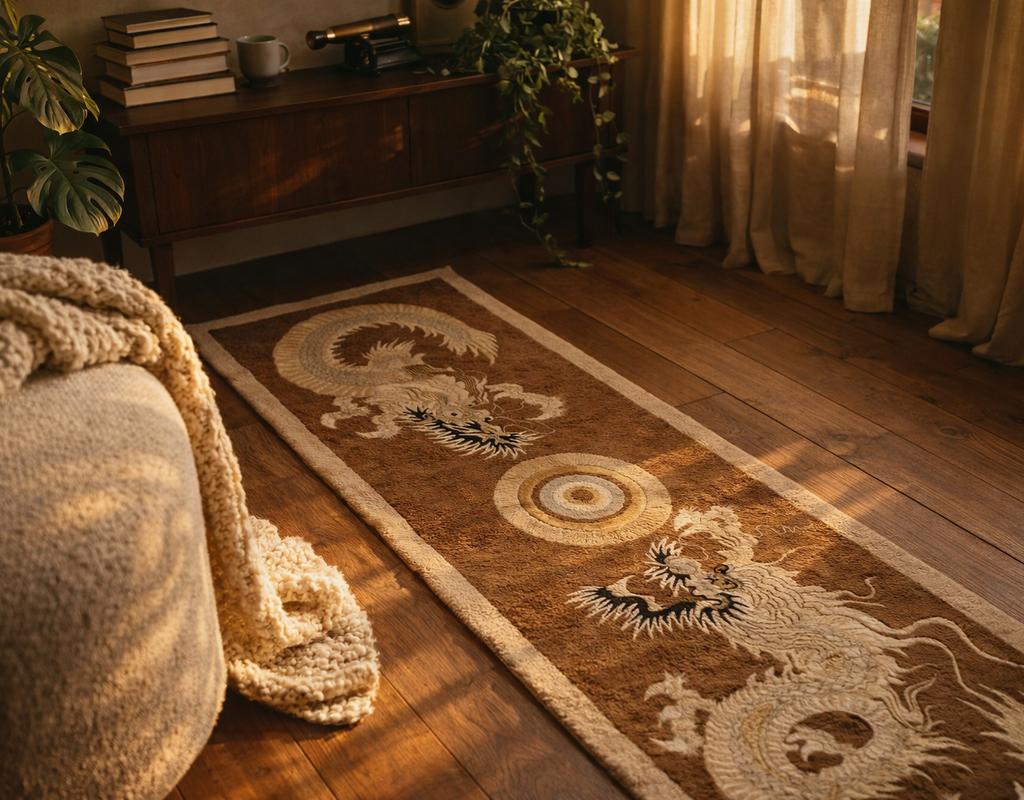
A striking dragon runner rug anchors the space, bathed in the golden afternoon light.
A Chinese auspicious emblem became an Islamic ornamental pattern and eventually part of the broader vocabulary of Oriental rugs. Whether called abr-e chinī, bulut, or cloud band, the motif preserves a visual memory of its Silk Road journey—a reminder of how weaving has always been an international art form, uniting East and West under shared skies.
Symbolism and Cultural Meaning
Spiritual and Celestial Meanings
The symbolism of cloud bands in rug design is inseparable from their origin in Chinese art. In China, drifting clouds were seen as heavenly messengers: signs of abundance, prosperity, and the emperor’s divine mandate. In paintings and textiles, the Chinese cloud design represented a connection between earth and sky, embodying the balance of heaven’s blessing with human life.
When the motif traveled westward, its celestial associations remained intact but were adapted to new worldviews. In Persia, abr-e chinī motifs came to signify paradise and the divine order, aligning with Islamic visions of the heavens as a garden of eternal reward. In Turkic and nomadic tribal contexts, the same swirling bulut motif often evoked rain clouds—symbols of fertility, sustenance, and protection for pastoral communities whose livelihood depended on the cycles of the sky.
In Sufi mysticism and Buddhist philosophy, clouds further carried the idea of impermanence and the transient nature of worldly existence, emphasizing life’s spiritual journey. Across each culture, cloud band rugs reinforced the universal human desire to connect with the heavens.
Symbolic Variations
- China: Clouds as Imperial Blessing — Why: They symbolized heaven’s favor, abundance, and cosmic harmony, making them suitable for use in textiles worn by emperors or nobles.
- Persia: Celestial and Divine Order — Why: Incorporated into carpets as signs of paradise, they affirmed spiritual ideals and reinforced the notion of rugs as “gardens of heaven.”
- Turkish and Tribal: Fertility and Fortune — Why: Among pastoral weavers, clouds meant rain and renewal, protecting herds and fields, and bringing prosperity.
- Buddhist and Sufi Contexts: Impermanence — Why: The cloud’s fleeting nature symbolized life’s passage, reminding viewers of the spiritual over the material.
- Cloud Collar Pattern: Sacred Protection — Why: In Chinese robes, the cloud collar pattern framed the wearer in celestial imagery, extending divine guardianship into daily life.
The Sky as a Shared Symbol
Although the meanings of cloud motifs vary, they are unified by a shared reference to the sky and heavens. Whether as an emblem of imperial mandate, divine order, life-giving rain, or spiritual impermanence, the cloud motif consistently elevates the carpet’s imagery from earth to sky.
The symbolism of cloud bands, therefore, reflects both power and protection, good fortune and sacred presence—an enduring sign that, wherever they appeared, these motifs connected the weaver and the owner to forces beyond the human realm.
Historical Journey: East to West
Chinese Origins
The history of cloud motifs begins in China, where stylized clouds first appeared in Han dynasty art (206 BCE–220 CE) as symbols of heaven’s mandate, abundance, and auspicious power. By the Tang dynasty (618–907 CE), cloud imagery had become a dominant feature in Chinese textiles, ceramics, and murals, often rendered in swirling, ribbon-like curves that carried spiritual and imperial meaning.
This Chinese cloud design was highly portable, easily adapted into repeating borders or floating across large compositions. Its visual flexibility, coupled with its celestial symbolism, ensured it was among the first motifs to travel beyond China’s borders.
Diffusion via the Silk Road
The Silk Road was the great conduit for cloud band diffusion, carrying not only goods but also patterns and artistic vocabularies across continents. During the Mongol-Ilkhanid period in Persia (13th–14th centuries), the Chinese cloud form—known locally as abr-e chinī (“Chinese cloud”)—was introduced into Persian manuscript illumination, ceramics, and textiles.
From there, the motif entered the woven arts, becoming part of the vocabulary of Persian rug design. Under the Safavids (16th–17th centuries), cloud bands took on a refined, courtly character, appearing in carpets woven for palaces and mosques. These rugs, rich in celestial motifs, broadcast an image of sophistication and cosmopolitan taste, tying Persian art to a larger world of Asian design.
By the Ottoman period, the motif had traveled further west, embraced in Turkish bulut designs and absorbed into Caucasian village weaving traditions. The spread of the cloud motif thus mirrors the movement of empires and trade itself: from East Asia to Central Asia, from Persia to Anatolia, and into the Caucasus.
Key Milestones
- Tang Dynasty China (7th–9th c.) — Why: Clouds became a central celestial emblem in imperial art, forming the prototype for all later cloud motifs.
- Mongol-Ilkhanid Persia (13th–14th c.) — Why: The Mongols bridged Chinese and Persian cultures, bringing the abr-e chinī into Persian decorative arts and eventually carpets.
- Safavid Persia (16th–17th c.) — Why: Cloud bands entered elite court carpets, symbolizing divine order and international sophistication in weaving.
- Ottoman Turkey (16th c. onward) — Why: The bulut motif became common in Ottoman textiles and carpets, reinforcing imperial connections with Persia and China.
- Caucasian Weaving (17th–18th c.) — Why: The motif appeared in village rugs, showing how international courtly designs filtered down into local tribal weaving traditions.
A Motif of Movement
The history of cloud band rugs illustrates how design traveled as swiftly as silk and spices. From its Chinese beginnings, the motif moved west along the Silk Road, gaining new meanings in each cultural setting.

A warm, inviting study corner defined by dark wood, lush plants, and a unique patterned area rug.
By the time it reached the Caucasus, the once-exclusively imperial emblem had become part of local folk art, woven by village weavers who may never have seen its Chinese prototype but carried its shape into their carpets. This long journey confirms the cloud motif’s role as a true emblem of global exchange in the history of rug design.
Design Characteristics of Cloud and Cloud Band Rugs
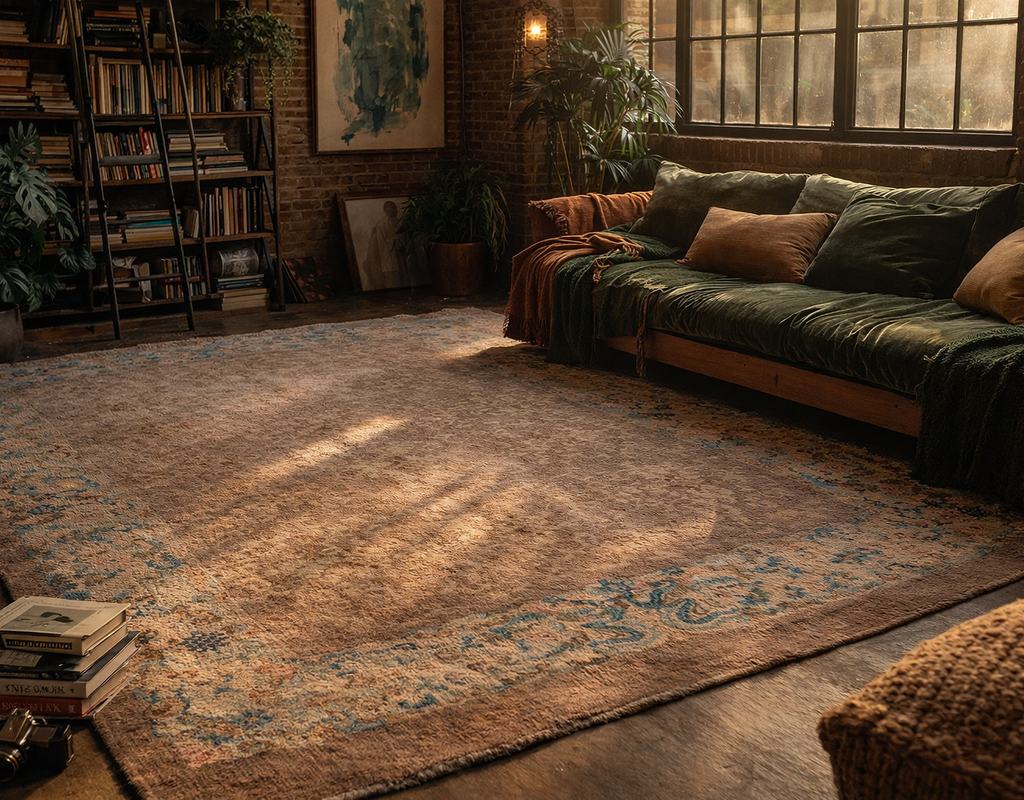
An antique-style rug warms up a cozy, plant-filled living room styled with dark, inviting textures.
Recognizing Cloud Bands: Shapes, Colors, Layout
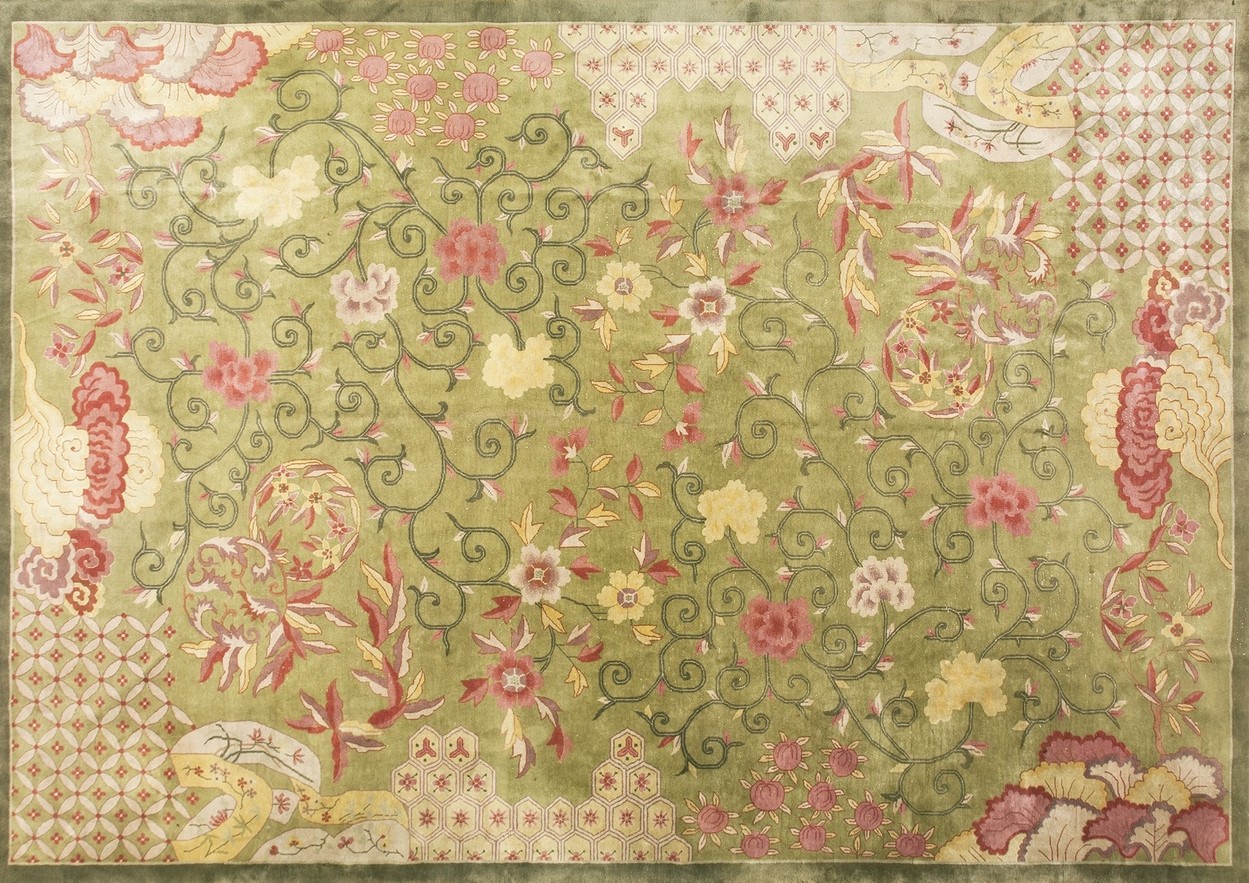
Antique Large Wool Green Hand Knotted Pile Rug – by Rugs On Net
To the untrained eye, cloud bands may seem like abstract curves, but once identified, the motif is unmistakable. Recognizing a cloud band pattern depends on looking for:
- Curvilinear, Ribbon-Like Forms — Why: Unlike geometric motifs, cloud bands flow in smooth arcs, looping or scrolling across the rug’s field.
- Hooked or Ruyi Ends — Why: Many cloud motifs terminate in hooked shapes or stylized ruyi heads, echoing Chinese ornamental vocabulary.
- Ribbon Segmentation — Why: Cloud bands often appear as segmented ribbons, folded back on themselves, suggesting depth and movement.
- Placement Around Medallions or Borders — Why: In Persian and Turkish rugs, cloud bands frequently encircle central medallions or trace the outlines of corner spandrels.
- Color Contrasts — Why: Chinese examples use multicolored ribbons in blues, reds, and yellows to emphasize motion, while Persian and Ottoman versions tend toward elongated S-shapes with bold but more restrained palettes.
These traits help distinguish cloud bands from other curved ornaments like vines or arabesques. Their flowing curves and segmented ribbons make them one of the easiest celestial motifs to identify in Oriental carpets.
Pairings: Dragons, Phoenixes, Florals
Cloud bands rarely appear in isolation. In Chinese tradition, they were natural companions to mythical creatures—most famously in dragon and cloud rugs, where the swirling forms suggest the turbulent sky in which dragons soar. Phoenixes are also commonly paired with cloud motifs, the bands curling around the bird’s feathers or trailing behind it to signify heavenly flight.
In Persian Safavid carpets, cloud bands may entwine with arabesques or floral scrolls, framing blossoms in their ribbon-like loops. The pairing of florals with cloud bands creates an image of paradise, uniting celestial sky forms with the earthly garden. In Ottoman and Caucasian adaptations, cloud bands often become bolder and more abstract, sometimes woven side by side with large stylized flowers or palmettes.
These arrangements not only highlight the motif’s celestial symbolism but also make the rug compositionally dynamic—dragons twisting through bands, phoenixes rising amidst cloud collars, or blossoms nestled in the curves of the sky.
Distinctive Fluidity
What ultimately sets cloud band designs apart is their fluid, organic quality. While many rug motifs favor symmetry and geometry, cloud motifs break free with sweeping motion, their curves suggesting the ever-changing nature of the heavens.
Whether bright and rounded in Chinese examples, elongated and S-shaped in Persian masterpieces, or bold and simplified in Caucasian interpretations, the cloud motif is consistently recognizable. Its ability to frame, encircle, and interact with other motifs makes it a central actor in rug design—a swirling ribbon of the sky woven into the earthbound textile.
Regional Styles and Interpretations
Chinese Vintage Carpets
Yes, cloud band designs are common in vintage Chinese carpets, particularly those woven in the late Qing dynasty and early Republic period. Chinese cloud rugs often display rounded, pastel-colored clouds swirling around dragons, phoenixes, or Buddhist emblems. Their forms are soft and painterly, with multiple bands of blue, pink, or yellow creating a sense of depth.
Unlike Persian or Caucasian examples, Chinese clouds are less angular and more cloud-like in their fullness, staying close to the motif’s classical origins. These carpets often served as both decorative and symbolic objects, where the flowing cloud collar pattern suggested heavenly blessing and imperial power.
Persian: Entry, Evolution, and Significance
Cloud bands entered Persian art during the Mongol-Ilkhanid period, when Chinese motifs were introduced into manuscripts, ceramics, and eventually weaving. By the Safavid era, the abr-e chinī had become a hallmark of Persian carpet art. Safavid cloud band rugs feature elongated, S-shaped ribbons that entwine with floral scrolls or frame medallions, creating a sense of infinite movement.
Their significance lies in how they embody cosmopolitan taste—linking Persia to the wider Silk Road network—while also reflecting Islamic ideals of paradise. The Safavid cloud band was not just decorative: it was a visual metaphor for divine order, elevating Persian carpets into both artistic and spiritual treasures.
Caucasian: Entry and Traits
Cloud band imagery entered Caucasian rug weaving in the 17th century, after its widespread adoption in Persian and Ottoman courts. In the Caucasus, the motif transformed into bold, geometricized bands, often with hooked ends and angular scrolls.
These forms appear most famously in so-called Caucasian dragon carpets, where cloud bands and dragon-like figures intertwine in a striking, abstracted composition. Unlike the curvilinear elegance of Persian designs, Caucasian cloud motifs emphasize strength and dynamism, reflecting the tribal weaving tradition’s preference for bold geometry.
Heriz vs. Tabriz Rugs
The cloud band motif provides a useful lens for comparing two major Persian weaving centers: Heriz and Tabriz. In Heriz cloud band rugs, the motifs appear bolder, more angular, and almost geometric, fitting the heavy, robust aesthetic of Heriz weaving. The cloud bands often serve as striking structural elements within the larger medallion format.
In contrast, Tabriz rugs—known for their refinement and detail—render cloud motifs as delicate, curvilinear bands. These motifs intertwine seamlessly with floral arabesques, creating a more fluid and graceful effect. Thus, the Heriz cloud band conveys power and monumentality, while the Tabriz cloud motif emphasizes elegance and sophistication.
Ottoman, Anatolian, Central Asian, and Tibetan Variations
- Ottoman & Anatolian Bulut Patterns — Why: Turkish kilims and pile rugs feature simplified bulut motifs, often in bold outlines, reflecting the Ottoman tendency to adapt motifs into strong, graphic forms.
- Central Asian Interpretations — Why: Among Uzbek and Turkmen groups, cloud motifs appear in stylized forms that blend with tribal geometry, highlighting their role as protective symbols.
- Tibetan Cloud Carpets — Why: Tibetan rugs often display white swirling cloud motifs against deep red, blue, or green grounds, directly tied to Buddhist cosmology and temple decoration.
- Regional Versatility — Why: Each culture reshaped the cloud motif according to local weaving traditions, proving its adaptability across geographies.
A Versatile Motif Across Cultures
From the rounded pastel clouds of Chinese cloud rugs to the S-shaped Safavid cloud bands, from Caucasian dragon carpets to Heriz and Tabriz contrasts, the motif is one of the most versatile in rug history.
Its regional transformations show how a single design could be reimagined through different looms, techniques, and worldviews—always recognizable, yet never identical.
Weaving Techniques and Materials
Highlighting Cloud Bands in Silk Rugs
The weaving of a silk cloud band rug showcases the motif at its most refined. Silk fibers allow for extremely fine knotting, which in turn produces precise curvilinear detail. This clarity is essential for cloud motifs, whose flowing, ribbon-like lines depend on subtle gradations of curve and contour. In Safavid carpets, for example, silk combined with metallic threads created dazzling effects where cloud bands appeared to shimmer like celestial ribbons.
The weaving technique—often using asymmetrical Persian knots or symmetrical Turkish knots—directly influences how seamlessly the curves are rendered. When woven in silk, the cloud motif weave becomes more than a design element; it transforms into a luminous representation of the heavens.
Materials: Wool, Silk, Cotton, Metallics
Cloud band rugs have been woven in a range of materials, each shaping the motif differently. Wool is the most common and practical, providing durability and warmth, though the motif tends to appear bolder and less finely articulated. Silk, by contrast, enables intricate definition and vibrant luster, elevating cloud motifs into courtly, high-status art.
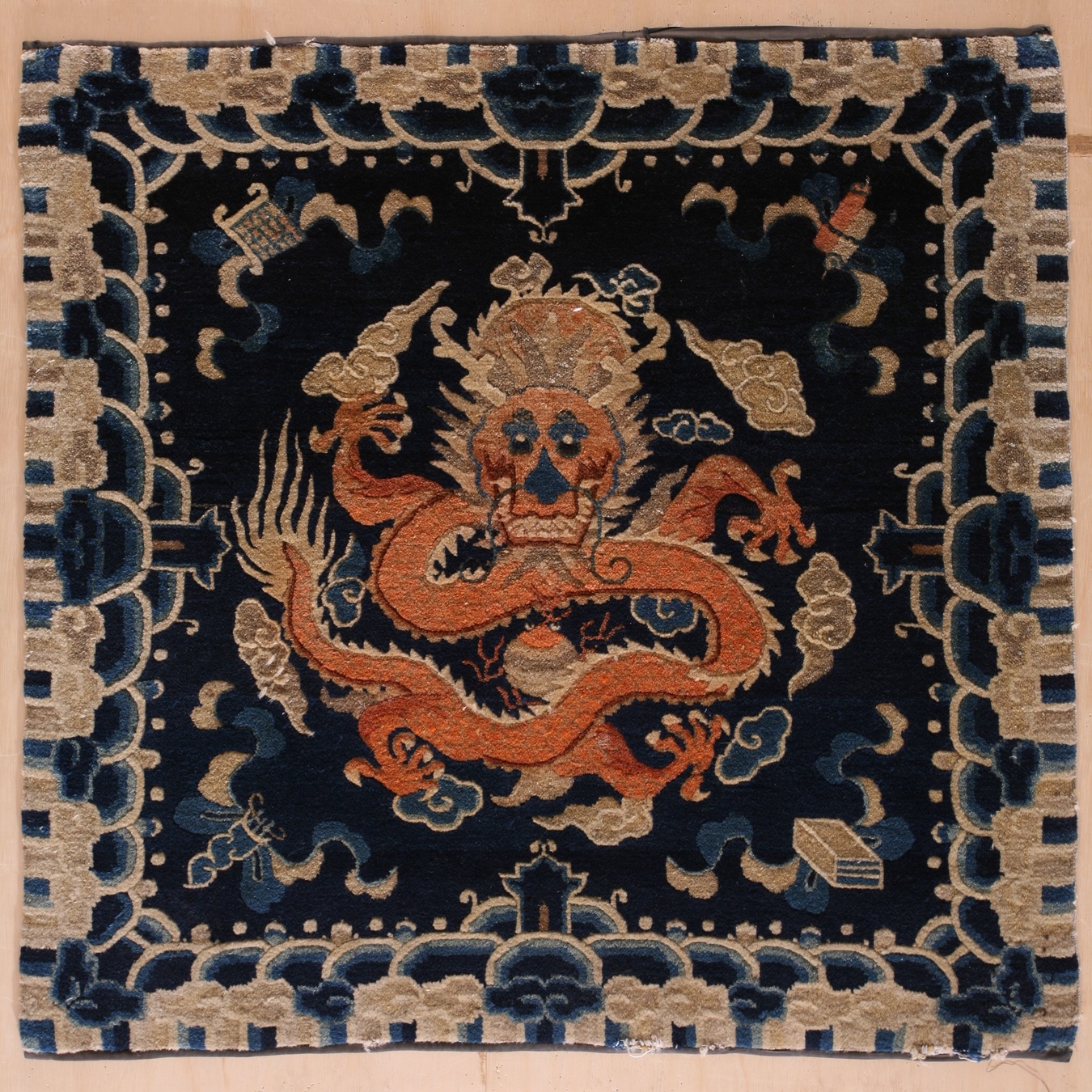
Cotton is often used for warp and weft, supplying strength and stability for both wool and silk pile. In some luxury carpets, metallic threads were added, accentuating the celestial symbolism of the design. The interplay of materials therefore determines not just the look but also the longevity and prestige of the finished piece.
Warp Material and Durability
Yes, the choice of warp material influences the durability of cloud band designs. Wool warps create flexible, resilient structures but may stretch under pressure, which can distort curvilinear motifs over time. Cotton warps provide stronger tension and help preserve the crisp alignment of cloud bands, making them favored in many Persian and Turkish rugs.
Silk warps, while delicate, enable extreme knot fineness, enhancing design clarity but requiring careful preservation. Thus, the warp is not only a structural element but also a hidden factor shaping the long-term stability of cloud motifs.
Knot Density and Motif Clarity

A detailed inspection of a richly colored oriental rug pattern while measuring its dimensions.
Knot density has a direct effect on the clarity of cloud band motifs. In rugs with high knot density, the elongated S-curves and ruyi-hooked ends of cloud motifs are crisp and detailed, reflecting the fluidity of their Chinese origins.
Lower knot density produces a more angular, blocky rendition, where the cloud motif may appear simplified or abstract. Collectors often value high knot count cloud band rugs precisely because they preserve the flowing aesthetic of the motif, proving how technical skill reinforces symbolic artistry.
Kilim vs. Pile Cloud Band Rugs
- Kilim Cloud Band Rugs — Why: Flatwoven techniques produce angular, geometric versions of the motif. They are more affordable and lighter, making them practical alternatives but less faithful to the flowing curves of the design.
- Pile Cloud Band Rugs — Why: With knotted pile, artisans can render the cloud motif with greater depth, fluidity, and shading, giving a truer reflection of its celestial form.
- Budget and Use — Why: Kilim cloud band rugs offer a budget-friendly option for those seeking symbolic motifs without the expense of silk or high-density pile weaving.
Material and Technique as Design Shapers
The elegance of cloud band rugs depends as much on their materials and weaving methods as on the motif itself. Wool vs. silk rugs, cotton vs. silk warps, low vs. high knot density—all determine how clearly the flowing ribbon of the sky emerges in the final piece. In this way, every cloud band rug is a collaboration between design and technique, where material choice and craftsmanship transform a symbolic image into a living textile.
Collecting, Value, and Investment
Premium Pricing and Rarity
Antique cloud band carpets command premium auction prices because they combine rarity, artistry, and historical significance. Persian Safavid examples or Caucasian dragon carpets with bold cloud motifs are particularly coveted. Collectors value these pieces not only for their age but also for their role in documenting the Silk Road’s artistic exchanges.
Clear, well-drawn cloud bands—especially those entwined with medallions or dragons—add further to the desirability. Provenance also matters: rugs tied to notable collections or with documented origins often achieve record prices. In short, the cloud band rug value rests on a mix of scarcity, craftsmanship, and cultural depth, making these carpets among the most elite categories in Oriental weaving.
Investment Value of Rare Cloud Band Rugs
Yes, investors should prioritize rare cloud band rugs for long-term value. Pieces from the Safavid or Ottoman periods, or 17th–18th century Caucasian dragon carpets, continue to appreciate as they grow scarcer. Their enduring demand stems from both academic interest and collector competition, ensuring that truly exceptional examples rarely lose value.
Even high-quality 19th-century Persian or Chinese cloud motif rugs retain strong resale potential if well preserved. For investors, these carpets function much like fine art: portable, finite in supply, and deeply embedded in global cultural history. Investing in cloud motif carpets can thus diversify a collection while holding long-term financial promise.
Sourcing Affordable Examples
For collectors working under $5,000, authentic options still exist. Affordable cloud band rugs can be found among:
- Vintage Chinese Rugs — Why: 20th-century examples often feature rounded, pastel clouds and can be sourced at relatively modest prices compared to imperial-era carpets.
- Anatolian Kilims — Why: The simplified bulut pattern appears in flatweaves that are both budget-friendly and durable.
- Newer Persian Reproductions — Why: Contemporary weavers in Tabriz and other centers produce quality rugs with cloud motifs that echo Safavid elegance without commanding antique-level prices.
A Smart Choice for Every Buyer
Whether acquiring a rare Persian carpet for investment or seeking affordable cloud band rugs for under $5,000, the motif offers both prestige and accessibility. For high-end collectors, these pieces anchor a portfolio with cultural and financial weight. For budget buyers, vintage Chinese or Anatolian kilims provide authentic pathways into the tradition. Across all tiers, investing in cloud motif designs ensures not only beauty but also a tangible connection to centuries of artistic and cultural exchange.
Modern Adaptations and Design Trends
Faithful Modern Replication
Yes, modern looms can faithfully replicate the complexity of antique cloud band designs, achieving precise curves and crisp detail. Advances in weaving technology allow artisans to produce rugs with knot densities and clarity approaching those of historical masterpieces.
However, while motif precision is possible, what cannot be fully replicated is the patina and tactile depth of antique pieces—the subtle abrash of natural dyes and the softness developed over centuries of use. Thus, modern cloud band rugs may offer technical fidelity, but they rarely match the soul and aura of their antique counterparts.
Minimalist and Modern Reinterpretations
Contemporary designers are indeed reinventing cloud motifs in minimalist rugs. Rather than detailed, multi-colored ribbons, today’s interpretations often distill the motif into simple arcs or fluid monochrome bands.
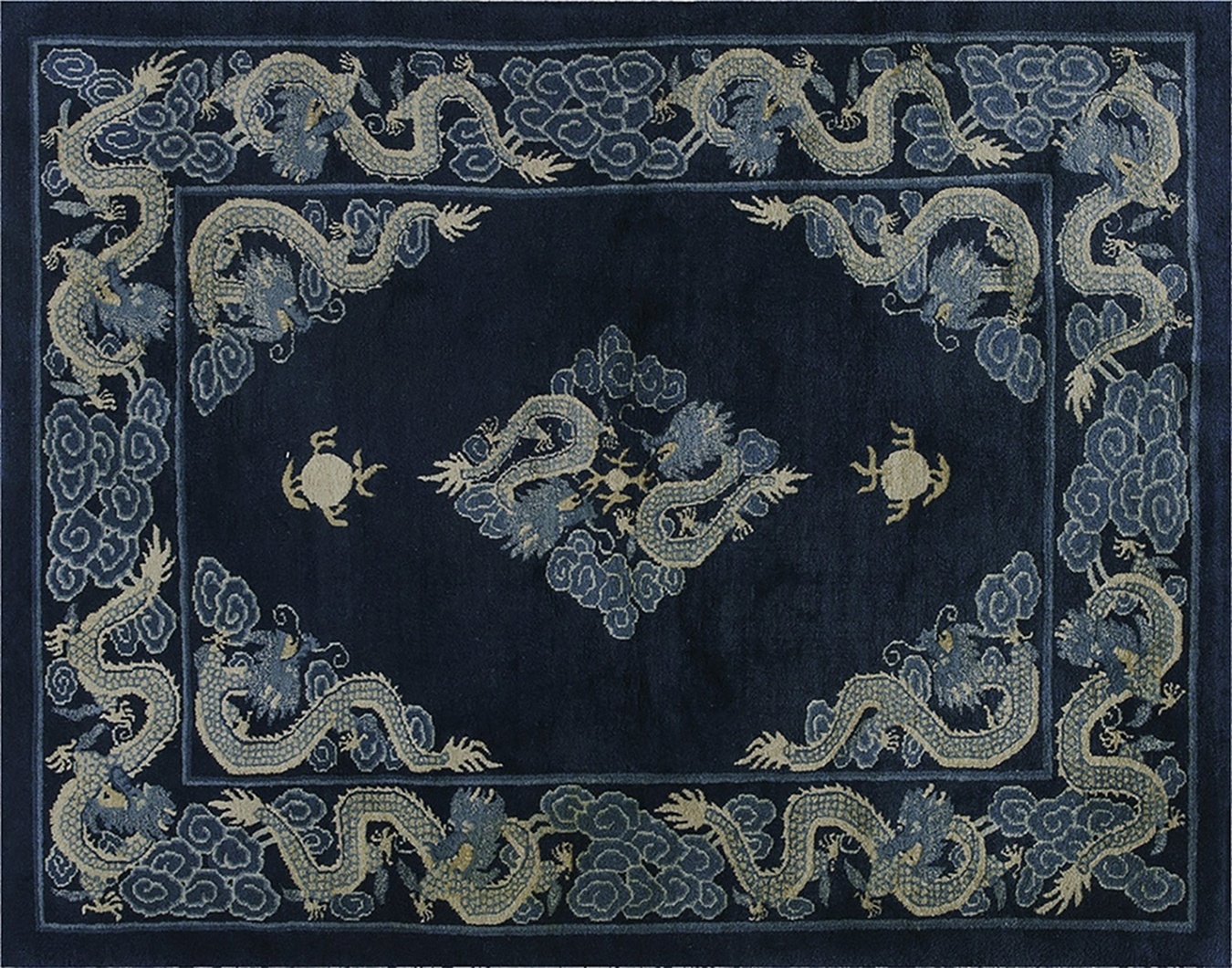
These minimalist cloud motif rugs harmonize with modern interiors by keeping the design understated while still suggesting the celestial flow of the original. In some cases, designers translate the motif into oversized, abstracted forms, turning it into a bold graphic statement suitable for contemporary living spaces.
Recreating Historical Color Palettes
Custom weavers can recreate lost cloud band color palettes, but doing so requires natural dyes and a high level of expertise. Many historical rugs employed vegetable dyes that aged into complex shades over time, a quality difficult to reproduce. Skilled artisans working with traditional dyeing methods—indigo for blues, madder for reds, pomegranate or saffron for yellows—can approximate these tones.
While modern synthetic dyes ensure consistency, custom dyed rugs using natural methods are valued for authenticity, producing cloud bands that echo the vibrancy and subtlety of antique examples.
Turkish Cloud Motifs Today
The bulut motif is relatively rare in today’s Turkish export rugs. Commercial production often emphasizes geometric, floral, or medallion-centered designs that appeal to broad markets. However, select heritage workshops and artisan cooperatives do occasionally revive cloud bands as part of cultural preservation projects. These limited lines offer modern interpretations of the motif while reconnecting Turkish weaving with its Ottoman and Silk Road legacy.
Current Interior and Fashion Trends
- Graceful Curves in Minimalist Interiors — Why: The flowing lines of cloud bands soften stark modern spaces, making them popular in Scandinavian- and Japanese-inspired décor.
- Heritage Revival in Luxury Rugs — Why: High-end designers draw from Safavid and Chinese models, appealing to collectors who want authenticity in a contemporary setting.
- Fashion Crossovers — Why: Contemporary cloud design appears in textiles, wallpapers, and even clothing, where its ribbon-like elegance resonates beyond carpets.
- Custom Artisan Projects — Why: Bespoke rug makers use the motif to satisfy clients who want historic richness paired with modern materials.
Timeless Adaptability
The history of cloud motifs proves their resilience. From antique dragon carpets to minimalist cloud motif rugs, the design adapts to shifting tastes while retaining its celestial essence.
Whether woven as faithful reproductions or pared down for modern interiors, cloud bands continue to bridge the ancient and the contemporary, affirming their place as one of the most timeless rug patterns in circulation today.
Shopping and Styling Guide
How to Style Cloud Band Rugs in Modern Homes
- Pair with Minimalist Interiors — Why: The flowing curves of a cloud band rug soften clean lines and neutral palettes, adding movement without clutter.
- Use as a Statement Piece — Why: In eclectic or bohemian settings, bold cloud motifs become a visual anchor that ties together varied textures and colors.
- Complement Formal Spaces — Why: Silk or finely knotted cloud motif carpets bring elegance to dining rooms or studies, echoing their historic use in courts and palaces.
- Layer with Contemporary Furniture — Why: Placing modern furniture over a traditional cloud band pattern creates a dialogue between past and present.
What to Look for When Buying
- Hand-Knotting — Why: Authentic cloud band rugs are handwoven; uniform machine knots signal reproductions.
- Dye Quality — Why: Natural vegetable dyes age gracefully, producing the subtle abrash that gives antique rugs depth; synthetic dyes may appear flat.
- Motif Clarity — Why: Sharp, flowing curves in the cloud band pattern indicate higher knot density and skilled weaving.
- Provenance and Documentation — Why: Knowing the rug’s origin—Chinese, Persian, Caucasian, or Anatolian—helps determine both authenticity and value.
Maintenance, Care, Authenticity
- Vacuum Gently and Rotate — Why: This prevents uneven wear, especially in high-traffic areas.
- Professional Cleaning — Why: Specialists in authentic rug care know how to preserve wool or silk fibers and maintain color vibrancy without damage.
- Proper Storage — Why: Rolling the rug with acid-free wrapping and keeping it away from damp or direct light extends its life.
- Check for Signs of Authenticity — Why: Hand-knotted rugs show irregularities on the back, while machine-made versions appear perfectly uniform.
Budget Alternatives: Kilims, Reproductions, Machine-Made
For those seeking affordable cloud motif carpets, there are multiple entry points: kilims, reproductions, and quality machine-made versions. Kilim cloud band rugs offer a flatwoven, geometric interpretation at lower cost.
Contemporary Persian or Turkish workshops produce reproductions with hand-knotting and natural dyes, blending authenticity with affordability. Machine-made rugs, while lacking the depth of handmade pieces, can provide accessible options for everyday interiors. These choices allow buyers to bring the celestial elegance of cloud motifs into their homes without stretching beyond budget.
Balancing Style and Authenticity
Styling a cloud band rug is as much about intention as design. Whether investing in a rare antique or choosing an affordable kilim, buyers can integrate the motif into both modern and traditional settings.
With careful buying choices and authentic rug care, the cloud motif remains a timeless element of home décor, offering elegance, history, and cultural depth at every price point.
Conclusion: Legacy and Inspiration
Timelessness and Cross-Cultural Appeal
The legacy of the cloud band rug is one of constant reinvention without losing its essence. Originating in Chinese art as symbols of heaven’s blessing, the swirling abr-e chinī and bulut motifs journeyed across the Silk Road into Persia, the Ottoman Empire, and the Caucasus.
Each region adapted the design—sometimes elongated and S-shaped, sometimes bold and geometric—yet the celestial meaning remained intact. This ability to transcend time, geography, and weaving tradition is what makes the cloud motif tradition so enduring. It continues to inspire artisans and designers today, proving its relevance from imperial palaces to modern interiors.
A Call to Explore
The enduring power and adaptability of the cloud band motif lies in its ability to connect past and present, East and West, sky and earth. To own or admire such a rug is to engage with centuries of artistry and cultural exchange.
Whether you are drawn to the mysticism of Chinese cloud designs, the elegance of Safavid cloud bands, or the boldness of Caucasian dragon carpets, there is always more to discover. We invite you to explore our cloud band collection and continue your journey into the timeless world of celestial rug design.
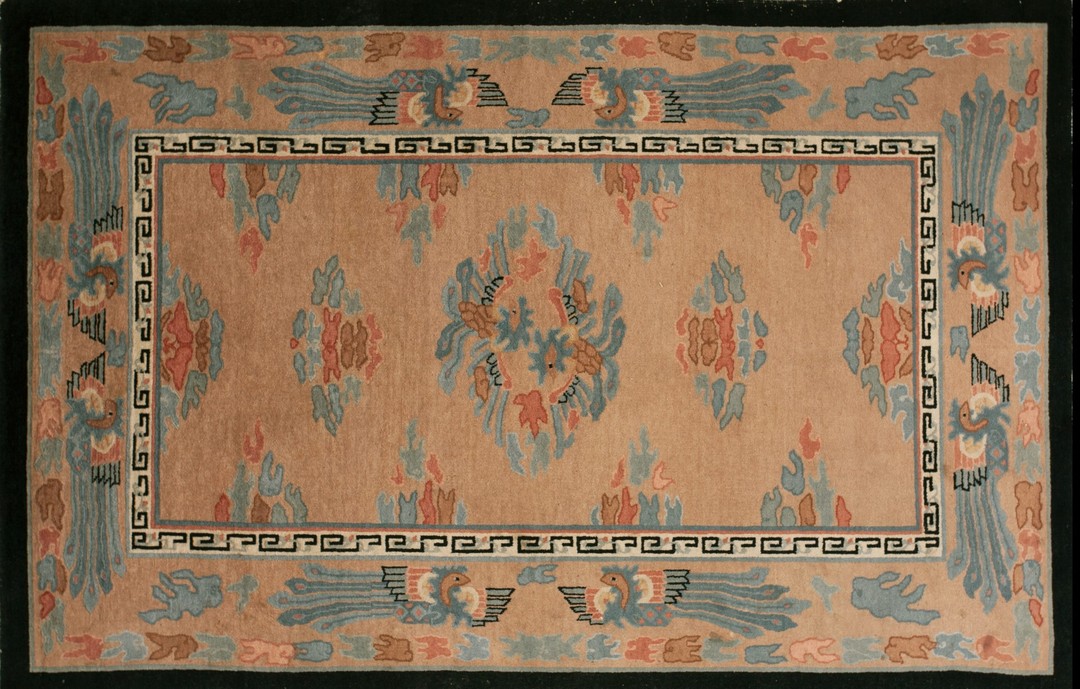
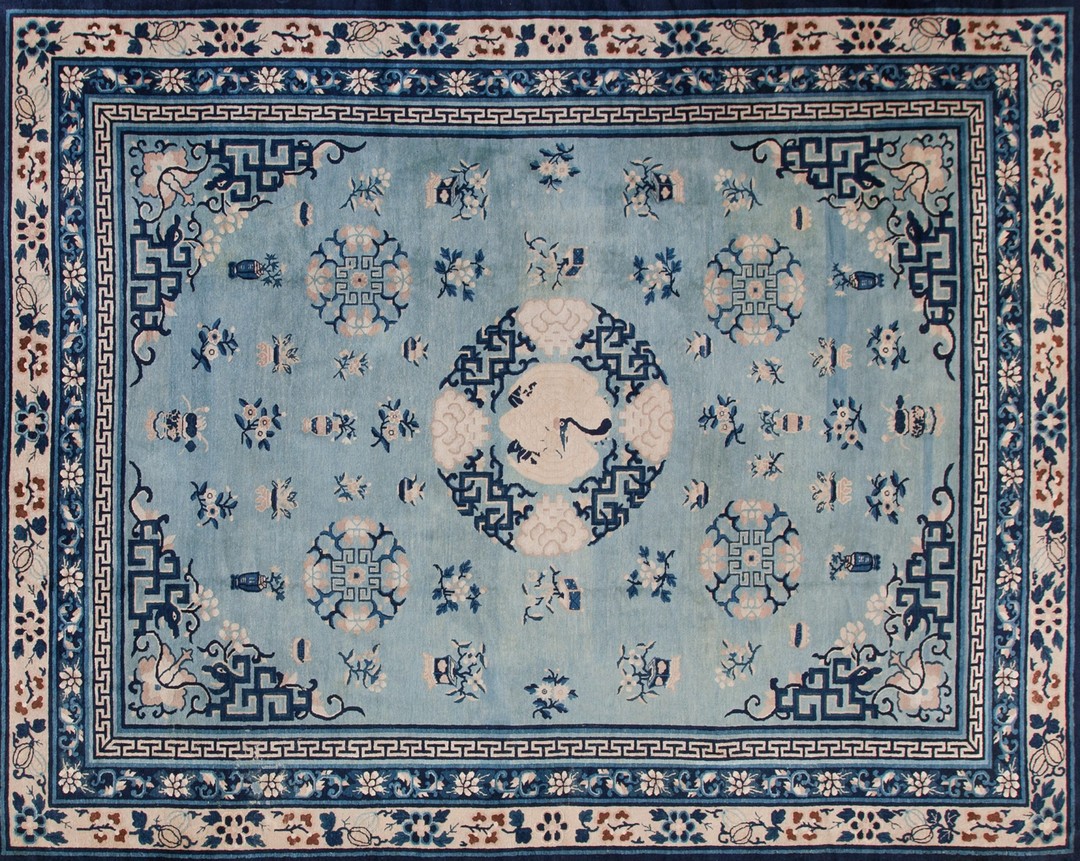
Explore a Few of Our Cloud Band Rugs
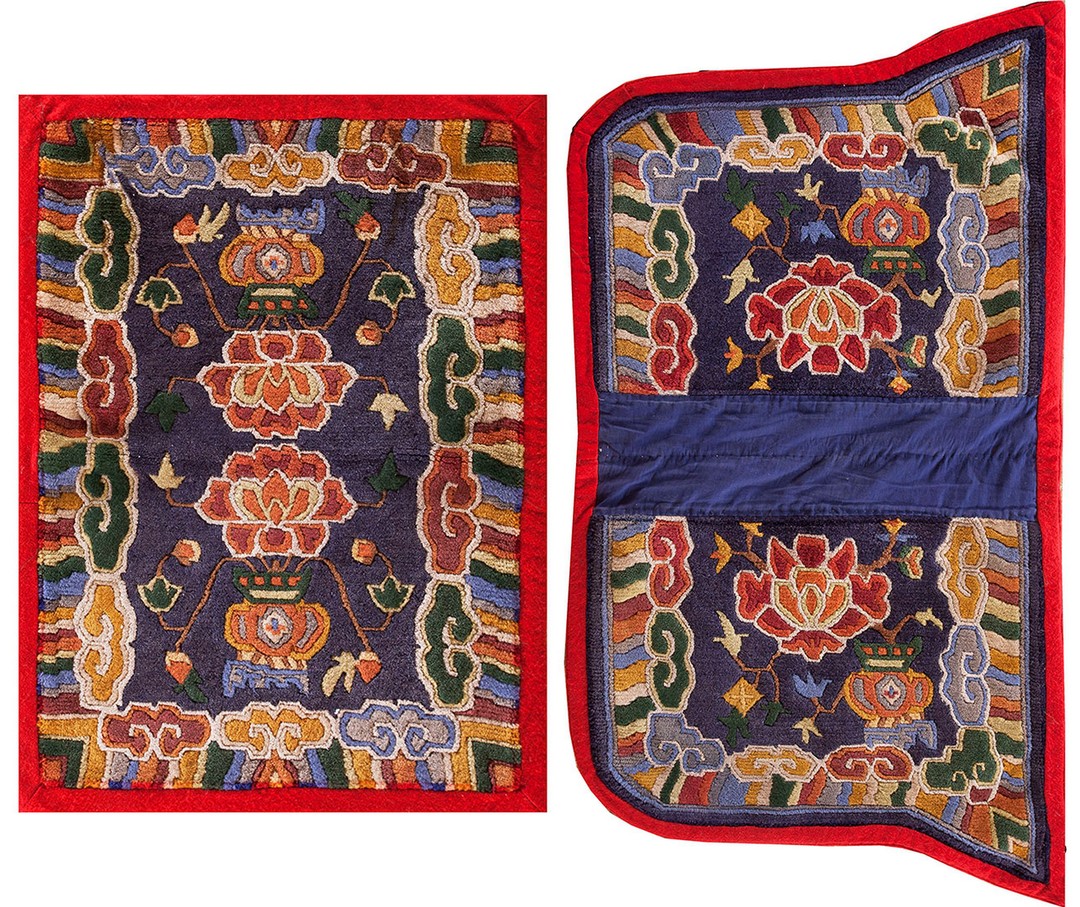
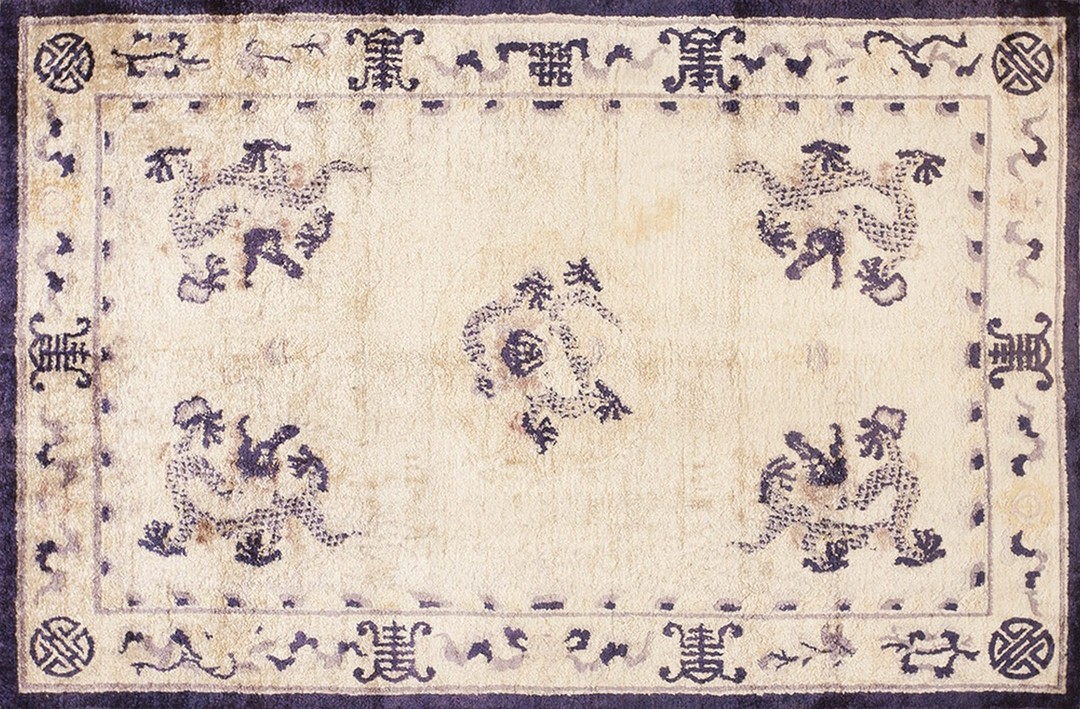
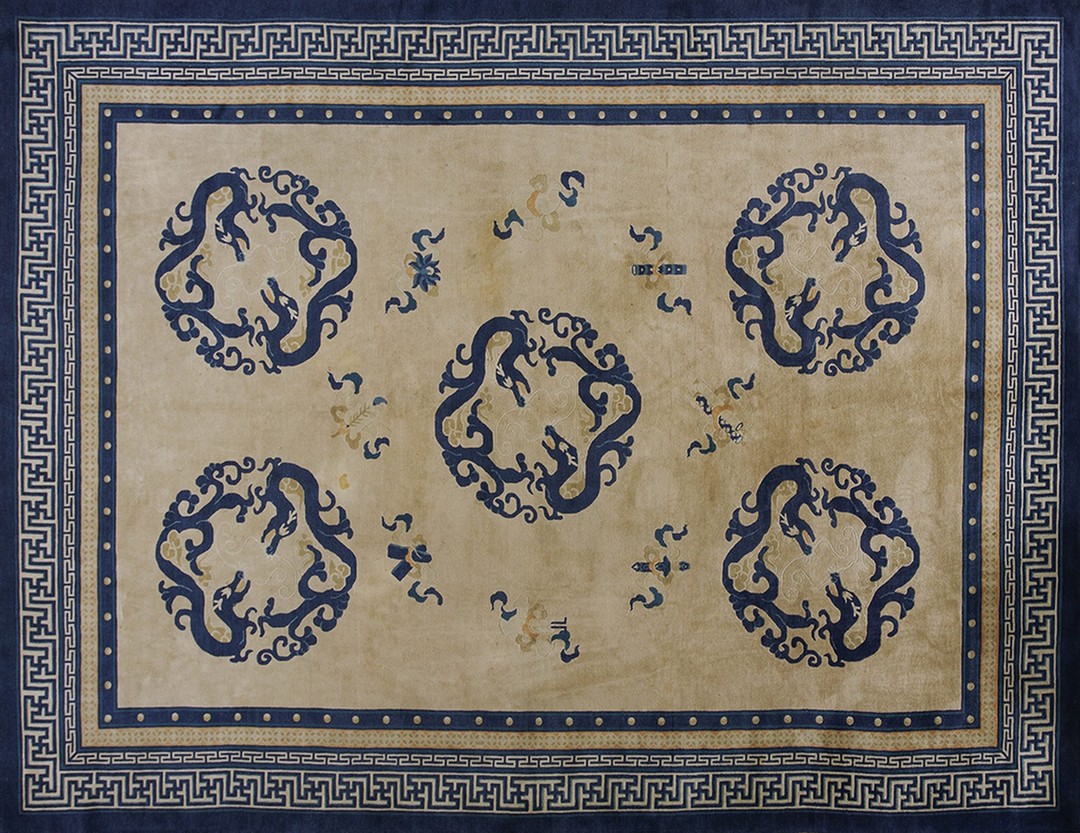
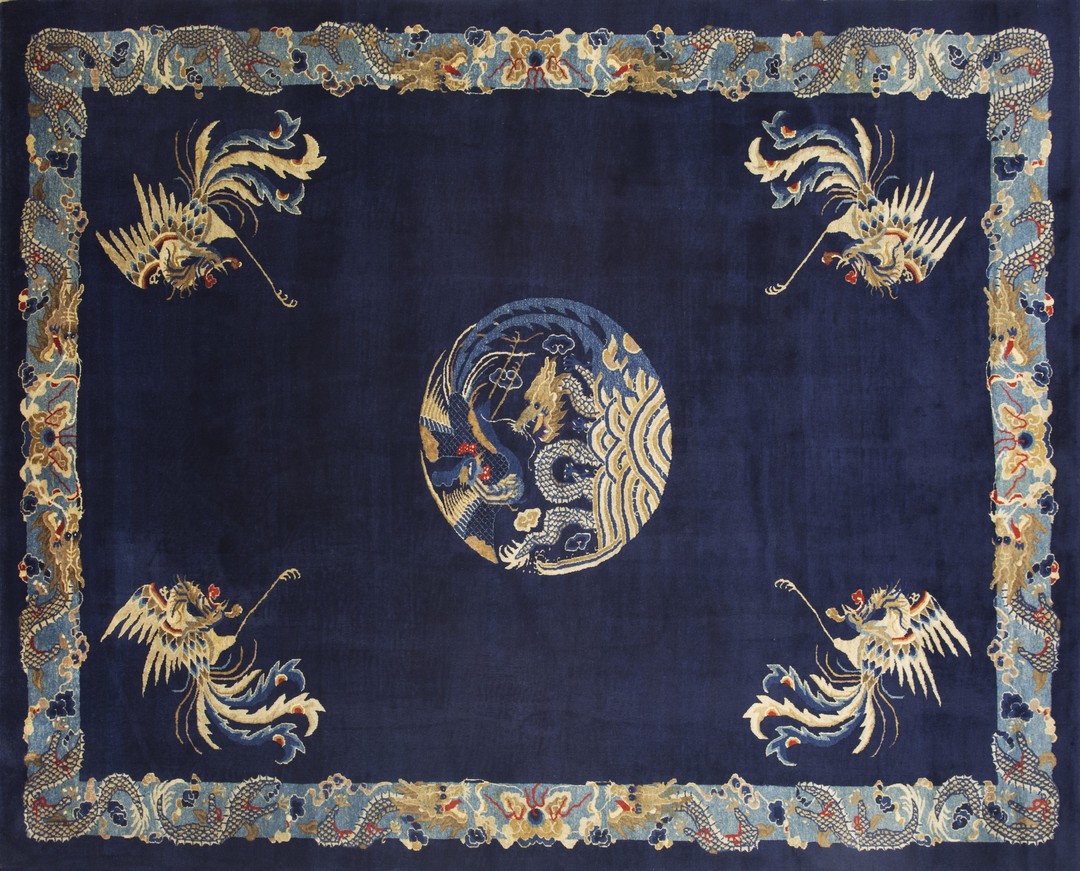

FAQ
- Where can I find authentic cloud band rugs in the U.S.?
Check specialist dealers, reputable auction houses, and museum deaccessions. Ask for a condition report and any provenance before purchase.
- How do I date cloud band motif rugs?
Evaluate dyes (synthetics after the mid-19th century), weave, and wear. For valuable pieces, consult a qualified appraiser for a written opinion.
- Will heated floors harm cloud band rugs?
Wool cloud band rugs are fine with radiant heat if temperatures stay moderate. Use a natural-fiber pad; avoid rubber-backed pads that can off-gas.
- Are cloud band motif rugs kid- and pet-friendly?
Wool cloud band rugs resist soiling and hide mess with busy patterns. Choose low pile and use a pad; spot-clean promptly.
- How can I tell if a cloud band rug is hand-knotted or machine-made?
Flip it over: hand-knotted backs show slight irregularities and knots; machine backs look uniform. True fringes are warp extensions, not sewn-on strips.
- Do cloud band borders signal a specific origin?
Not reliably. Cloud band borders occur in Persian court carpets and others; confirm origin by weave structure, dyes, and foundation materials.
- What’s the difference between cloud band and cloud knot motifs in rugs?
Cloud band is a flowing ribbon cloud; cloud knot resembles an interlaced or endless knot. Both can appear in Persian and Turkish designs, but they read differently.
- How do cloud band motif rugs pair with modern decor?
Let the swirling bands be the focal point against solids or light woods. For a living room, an 8×10 cloud band rug typically anchors a sofa with front legs on.
- Are modern reproductions of cloud band motif rugs worthwhile?
Quality hand-knotted wool reproductions last decades and cost less than antiques. Avoid printed or low-quality tufted copies if longevity matters.
- Can robot vacuums run on cloud band rugs safely?
Yes on low/medium pile, but avoid beater bars and keep fringes secured. Consider edge guards; fringes can snag and unravel quickly.
- How should I clean wool cloud band motif rugs at home?
Vacuum with suction only and blot spills using diluted wool-safe detergent. Test for colorfastness; schedule a professional wash every 3–5 years.
- Are cloud band rugs durable for high-traffic rooms?
Hand-knotted wool cloud band rugs wear well under daily use. Add a rug pad and rotate every 6–12 months to distribute traffic.
- How much do antique cloud band motif rugs cost?
Prices vary widely by age, condition, size, and provenance. Expect roughly \$2,000–\$50,000+, with exceptional 19th-century cloudband Kazak rugs commanding more.
- What’s a cloud collar, and how does it relate to cloud band motif rugs?
A cloud collar is a lobed “sky-gate” frame in Chinese design. Cloud band rugs use linear, ribbon clouds; both share celestial roots but are distinct motifs.
- What’s the difference between cloud band rugs and dragon rugs?
Dragon rugs depict creatures with heads and limbs; cloud band rugs show abstract ribbon clouds. Some Caucasian pieces blur lines, with bands interpreted as stylized dragons.
- How old are traditional cloud band motif rugs?
The motif appears in early Chinese art and enters carpets prominently by the 16th–17th centuries, with numerous 19th-century Caucasian cloud band rugs on the market today.
- What colors do cloud band motif rugs usually feature?
Caucasian cloud band rugs often mix deep reds, indigo blues, greens, and ivory. Chinese clouds motif rugs lean toward golds, blues, and softer pastels.
- What sizes are typical for cloudband Kazak rugs?
Many antique cloudband Kazak rugs are small to medium, roughly 4×6 to 5×7. Larger carpets and long runners exist but are less common.
- Which regions produced the most cloud band motif rugs?
You’ll find cloud band rugs from Caucasia (Karabagh/Kazak), Persia/Iran (Isfahan/Kerman), and China (Ningxia/Peking). Museum pieces and 19th-century village weavings exist across these areas.
- What do cloud band motif rugs symbolize?
In Chinese tradition, clouds suggest heaven, harmony, and auspicious fortune. That meaning traveled into cloud band rugs, where floating bands imply movement and celestial energy.
- Why do sellers call some cloud band rugs “Kazak” if they’re Karabagh?
“Cloudband Kazak” became a trade label, but many were woven in Karabagh in the southern Caucasus. Expect regional overlap in names used by dealers and collectors.
- Are cloud band rugs the same as “clouds motif” rugs?
“Clouds motif” is broader; cloud band rugs use a specific ribbon-cloud shape. Chinese clouds motif rugs may also include ruyi heads and cloud collars beyond the banded form.
- How do I identify cloud band motif rugs quickly?
Look for segmented, swirling bands resembling stylized clouds rather than vines or animals. In cloudband Kazak rugs, two large medallions often house serpent-like cloud bands.
- Where did cloud band rugs originate?
Cloud band rugs trace to Chinese cloud imagery that spread along the Silk Road, later appearing in Persian and Caucasian weaving. Safavid-era carpets and 19th-century Caucasian examples show it clearly.
- What are cloud band motif rugs?
Cloud band motif rugs feature ribbon-like, S-curving “cloud” forms, often with hooked or feathered ends. You’ll see them floating in the field or nested inside medallions on many antique pieces.