
Introduction to Cintamani Rugs
Discover our curated collection of exquisite Cintamani pattern rugs available now for immediate purchase.
What is the Cintamani Design?
The Cintamani design motif is one of the most distinctive and immediately recognizable patterns in textile and rug design. It takes the form of three roundels arranged in a triangular cluster, often accompanied by two horizontal wavy lines beneath or beside them.
These undulating stripes are sometimes interpreted as the tiger-stripe motif, a visual echo of animal strength that complements the symbolic energy of the three-dot formation.
In area rugs, the Cintamani is typically rendered in bold, high-contrast colors, making it both a decorative flourish and a statement of meaning. This three-dot motif is not just an abstract design—it reflects a long tradition of spiritual and cultural symbolism.
Rooted first in Buddhist iconography, the Cintamani design began as the “wish-fulfilling jewel”—a mythical gem believed to grant desires and embody cosmic power.
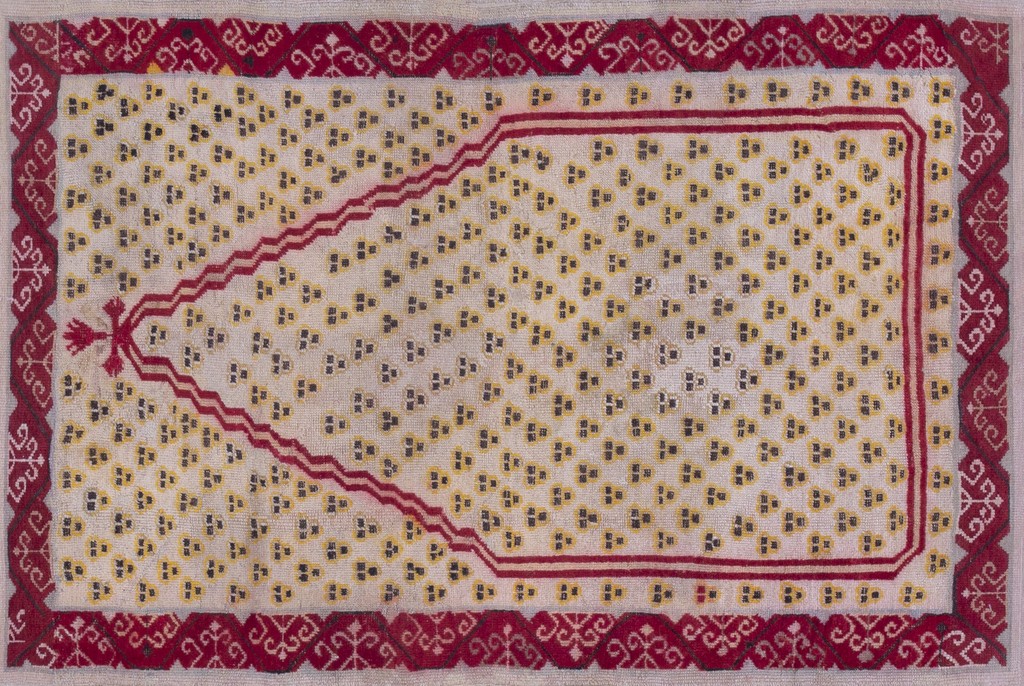
Antique Tribal Cintamani Design Turkish Ghiordes Islamic Prayer Rug by Rugs On Net
Over time, the form was adopted and transformed, eventually becoming a visual emblem of authority within the Ottoman court. In rug art, the motif’s clarity and symmetry allow it to stand out as both ornament and icon.
What Does the Cintamani Symbol Represent in Rug Design?
Within the world of rug weaving, the Chintamani symbol carries multiple layers of meaning. At its core, it signifies auspiciousness, power, and protection—qualities that made it highly desirable as a decorative element in both textiles and carpets. The three circles are often read as celestial orbs, embodying strength and fortune, while the wavy tiger-stripe motif conveys ferocity, vitality, and an untamed energy.
When woven into rugs, the Cintamani design served more than a purely decorative purpose. It was a way to invoke imperial authority, as the Ottoman elite adopted the symbol in courtly robes, ceramics, and carpets to reflect sovereignty and prestige. A rug featuring this emblem was not only a household furnishing but also a statement of alignment with power and divine favor.
As a result, the Cintamani motif became one of the most iconic Ottoman rug symbols, embodying the fusion of spiritual lore and political imagery. Its roots in the Buddhist wish-fulfilling jewel gave it mystical resonance, while its Ottoman adoption elevated it into an imperial insignia.
Today, collectors and scholars alike view the motif as a hallmark of Ottoman design, encapsulating both its cross-cultural origins and its enduring visual impact. By balancing the three-dot motif with the tiger-stripe lines, Cintamani rugs achieve a striking combination of order and dynamism—making them among the most recognizable and celebrated rug patterns in history.
Origins and Symbolism of the Cintamani Motif
Etymology and Spiritual Meaning
The word “Cintamani” comes from the Sanskrit phrase for the “wish-fulfilling jewel,” a sacred stone in both Buddhist and Hindu traditions. In early Indian and Central Asian belief systems, this mythical gem was thought to grant desires, radiate light, and protect those who possessed it. It was one of the great treasures of Buddhist lore, closely tied to the Three Jewels of Buddhism—the Buddha, the Dharma, and the Sangha.
As merchants and pilgrims carried ideas along the Silk Road, the Cintamani evolved from a purely spiritual symbol into a widely recognized auspicious motif that crossed borders and cultures. By the time the symbol reached Anatolia and entered Ottoman art, its meaning had expanded beyond religion.
What began as a Buddhist jewel became, in the Ottoman imagination, a mark of imperial power and cosmic protection. From sacred origins, the motif transformed into an emblem woven into courtly textiles and rugs, a bridge between spiritual devotion and earthly authority.
Symbolic Interpretations: Three Dots and Waves
The strength of Cintamani design symbolism lies in its layered interpretations.
The three dots and wavy stripes could be read differently depending on cultural context, yet always carried powerful associations:
- Three dots as the “Three Jewels” or sacred pearls — Why: This interpretation ties directly to Buddhism, where the three spheres represent the ultimate refuge. In other contexts, they are seen as pearls, symbols of divine wisdom and wealth.
- Three-dot interpretation as celestial bodies — Why: They evoke the sun, moon, and stars, standing for cosmic order and eternal cycles.
- Wavy lines as tiger stripes — Why: In Ottoman and Central Asian art, these stripes symbolize the ferocity, courage, and strength of big cats, associating the motif with royal might.
- Waves as cloud bands or cosmic energy — Why: Another interpretation links the undulating lines to spiritual energy or heavenly currents, suggesting protection from above.
- Protective talisman — Why: The combination of spheres and stripes was often seen as a charm against evil, meant to attract fortune and repel harm.
These interpretations show how the motif carried different layers of spiritual meaning in rugs—from Buddhist sacredness to Ottoman imperial strength. Over centuries, the tiger stripe meaning merged with the mystical wish-fulfilling jewel, creating a hybrid emblem that resonated with both sacred authority and worldly power.
Thus, when people ask, “Why do Cintamani rugs feature three dots and waves?”, the answer lies in this blend of traditions. The three-dot motif recalls Buddhist jewels or cosmic pearls, while the waves or stripes channel animal vigor and heavenly force. Together, they form an auspicious motif that offered both protection and prestige, explaining why it became so prominent in Ottoman rug symbolism.
Historical Evolution and Spread
Emergence in Anatolian Weaving
The Cintamani origin in rug design is closely tied to the rise of the Ottoman Empire as a cultural powerhouse. Although the symbol’s spiritual roots lay in South and Central Asia, it entered Anatolian rug traditions in the 15th and 16th centuries, particularly after the Ottoman conquest of Tabriz in 1514.
Skilled artisans from the Persian city were relocated to the Ottoman court, bringing with them a wide repertoire of motifs, including the Cintamani. From this moment, the Ottoman motif history begins in earnest: what was once a Buddhist and Central Asian emblem was swiftly adopted into the Ottoman design vocabulary.
By the late 15th century, the motif appeared in antique rugs, silk court textiles, woven into garments and banners. Soon after, it was incorporated into larger formats such as pile rugs, particularly the celebrated “White Ushak carpets” of western Anatolia. These carpets, known for their luminous ivory fields and bold motifs, often displayed the three dots with wavy lines in striking red and blue, signaling the design’s elevation to a courtly aesthetic.
How the Motif Moved from Asia to the Ottoman Court
The path of the Cintamani design motif reflects centuries of cultural exchange. Traveling along the Silk Road, the symbol shifted from Buddhist jewel to Central Asian talisman, before reaching the Ottoman court through artisan migration. In Anatolia, the motif underwent another transformation: it ceased to be simply spiritual and became imperial iconography.
This shift was deliberate—the Ottomans sought symbols that could project both cosmic legitimacy and worldly authority. By weaving the three-dot motif and tiger-stripe waves into rugs, textiles, and even ceramics and tiles, the Ottomans proclaimed their dominion as both divinely favored and fiercely powerful. The symbol’s adaptability made it the perfect fit for a dynasty eager to blend inherited traditions with its own political ambitions.
Why Ottoman Courts Favored Cintamani Textiles
The question often arises: Why did Ottoman courts favor Cintamani design in textiles? The answer lies in the motif’s resonance with fortune, power, and prestige. As the Ottoman motif history shows, garments decorated with Cintamani motifs were reserved for sultans and court officials, marking their elite standing. The auspicious jewel symbolism promised prosperity and divine blessing, while the tiger-stripe associations projected strength and fearlessness.
Cintamani design patterns on Ottoman silk textiles embodied luxury, often shimmering in gold-threaded brocades worn by royalty. In parallel, rugs such as the White Ushak carpets extended the symbol into architectural space, where it not only decorated floors but also reinforced the grandeur of palaces and mosques. Over time, what began as an exclusive emblem of imperial luxury diffused into village and folk weaving traditions, where local artisans adapted the pattern in simplified forms.
This transition ensured the Cintamani origin in courtly splendor also left a lasting mark on everyday Anatolian weaving, making it one of the most enduring and iconic motifs in rug history.
Design Features and Visual Identification
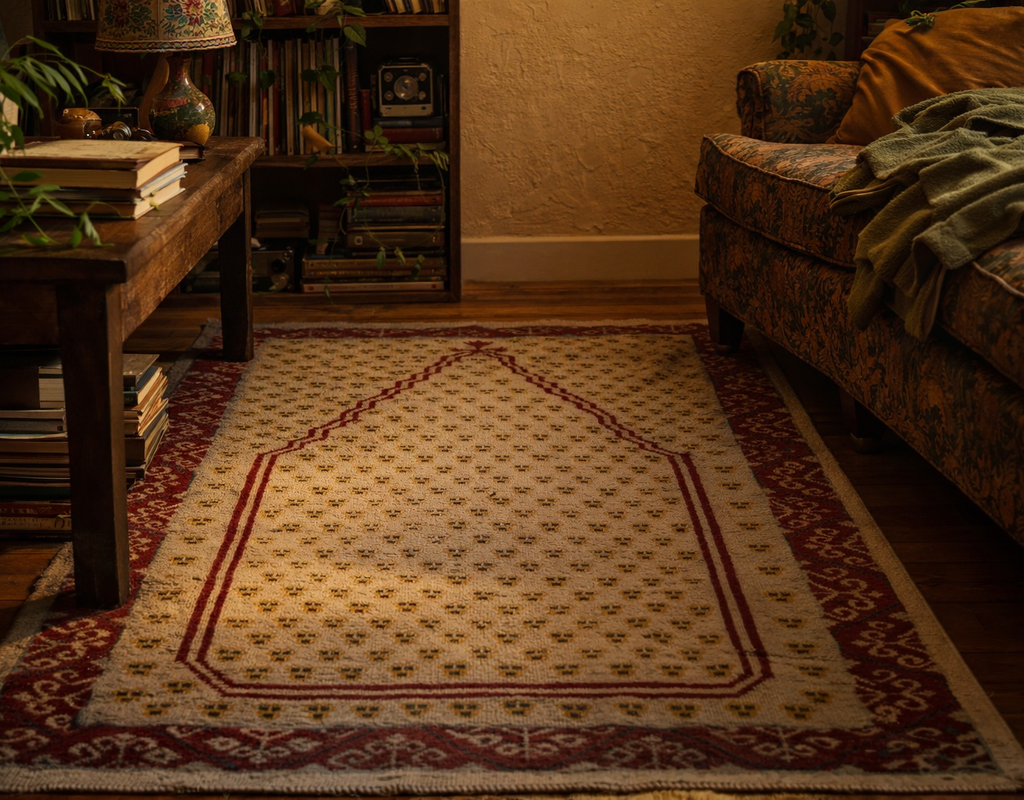
The detailed prayer rug adds a focal point of texture and pattern to this intimate, book-filled corner.
Anatomy of the Motif
At its core, the Chintamani design is defined by a simple yet powerful structure:
- Three equal-sized roundels arranged in a triangular formation — Why: This is the central emblem, instantly recognizable as the heart of the Cintamani motif. The circles are often interpreted as pearls, jewels, or celestial bodies.
- Two wavy lines beneath or beside the circles — Why: These are the “tiger stripes” or sometimes stylized as cloud band motifs, representing either animal strength or cosmic energy.
- Variations of form — Why: In courtly works, the motif may appear refined and perfectly circular, while in village weaving it becomes more geometric. Some versions display only the dots or only the stripes, while others introduce crescents or floral embellishments to soften the design.
- Bold use of color — Why: Strong contrasts—such as red, black, and gold against ivory or white—make the motif visually striking, aligning with its status as an imperial Ottoman rug symbol.
This anatomy makes the Cintamani design easy to describe but nuanced in execution, with endless artistic variations depending on time, place, and weaving context.
How to Recognize a Cintamani-Pattern Carpet
For those wondering how to identify a Cintamani rug, the key lies in spotting its defining structure:
- Look for three dots in triangular formation — Why: This is the unchanging anchor of the motif, whether large-scale or small.
- Check for accompanying wavy stripes — Why: The parallel lines beneath or beside the dots are the distinguishing feature separating it from other Anatolian designs like the Bird Ushak.
- Notice the bold contrast — Why: Colors are often placed for maximum visibility, reinforcing the motif’s prestige and talismanic power.
- Examine placement and repetition — Why: Courtly rugs often display the pattern in organized rows or repeats, while village versions scatter or stylize the motif more freely.
Even when surrounded by complex ornament, the three-dot plus two-stripe configuration remains the clearest clue for motif recognition.
Does Knot Density Affect Motif Clarity?
Yes—knot count and clarity play a crucial role in how the Cintamani design motif appears. Rugs with high knot density produce perfectly round, crisp dots and smooth wave lines, ideal for palace-grade silk textiles or finely woven pile carpets.
By contrast, lower-density Anatolian village rugs tend to render the circles as hexagonal or square-like, and the wavy stripes as angular zigzags. This difference doesn’t diminish the symbolic meaning, but it does change the visual refinement, helping experts distinguish between elite court production and vernacular adaptations.
Can Cintamani designs Appear Alongside Cloud Bands?
Yes—Cintamani design patterns can and often do appear with cloud band motifs, especially in works influenced by East Asian art. The cloud band, another popular design in both Central Asian and Ottoman weaving, complements the Cintamani by reinforcing its sense of cosmic energy and divine protection. When the two motifs appear together, the result is a layered symbol of fortune, strength, and celestial order.
Ultimately, to identify a Cintamani design rug, one must train the eye to spot the three-dot cluster paired with tiger-stripe or cloud band waves. Whether crisp and luxurious in silk or geometric and rustic in wool, this iconic design remains unmistakable across centuries of rug weaving.
Materials, Construction & Weaving Techniques
Typical Materials Used
The choice of rug materials in Cintamani weavings reveals much about their origin and purpose.
Examples:
- Silk — Why: In Ottoman court ateliers, silk was the preferred medium for garments and luxury carpets. Its smooth fibers allowed the Cintamani motif to be drawn with jewel-like clarity, and its luster enhanced the sense of imperial opulence.
- Wool — Why: For rugs such as the celebrated wool Ushak carpets, soft hand-spun wool provided durability and warmth, making it suitable for both palace floors and provincial households. Fine wool also took on natural dyes beautifully, producing vivid reds, blues, and whites.
- Cotton foundations — Why: Cotton was frequently used as warp and weft in court rugs to stabilize silk or wool pile, ensuring structure and longevity.
- Metal threads (gold and silver) — Why: In garments and courtly textiles, metal-wrapped threads were woven alongside silk, turning the Ottoman court textiles into shimmering symbols of authority.
The combination of these materials marks a clear distinction between imperial production and village weaving. While court silks were dazzling luxuries, provincial Cintamani rugs relied on sturdy wool and simpler techniques.
How is the Motif Woven into Silk Rugs?
In the elite workshops of Istanbul and Bursa, the silk Cintamani design rug was a feat of technical mastery. Court weavers often used the asymmetrical (Sehna) knot, which permitted finer curves and smoother outlines than the symmetrical Turkish knot. This method allowed the three-dot motif and tiger-stripe waves to appear crisp and flowing, rather than angular.
Silk’s fine texture meant that artisans could pack thousands of knots into a single square inch, achieving extraordinary detail. Combined with metallic threads, these pieces were not just rugs but imperial textiles, woven with the same precision as garments reserved for the sultans. Each silk Cintamani carpet became both functional floor covering and political emblem, communicating status and divine favor.
Knot Density and Its Impact
A recurring question is: Does knot density affect Cintamani design clarity? The answer is unequivocally yes. High knot counts (kpsi) in court silks or finely woven wool rugs produce rounded, lifelike dots and fluid wave lines, preserving the motif’s elegance. In contrast, tribal or provincial rugs with lower knot density render the circles as more angular and the stripes as jagged, giving the motif a geometric, almost abstract quality.
This distinction is not merely aesthetic but diagnostic: scholars and collectors can often tell a court atelier rug from a village production by the clarity of its motifs. The technical challenge of weaving three perfect roundels above flowing stripes is immense at lower knot counts, which is why White Ushak carpets—though coarser than silk textiles—still relied on the highest-quality wool and dyes to maintain visual impact.
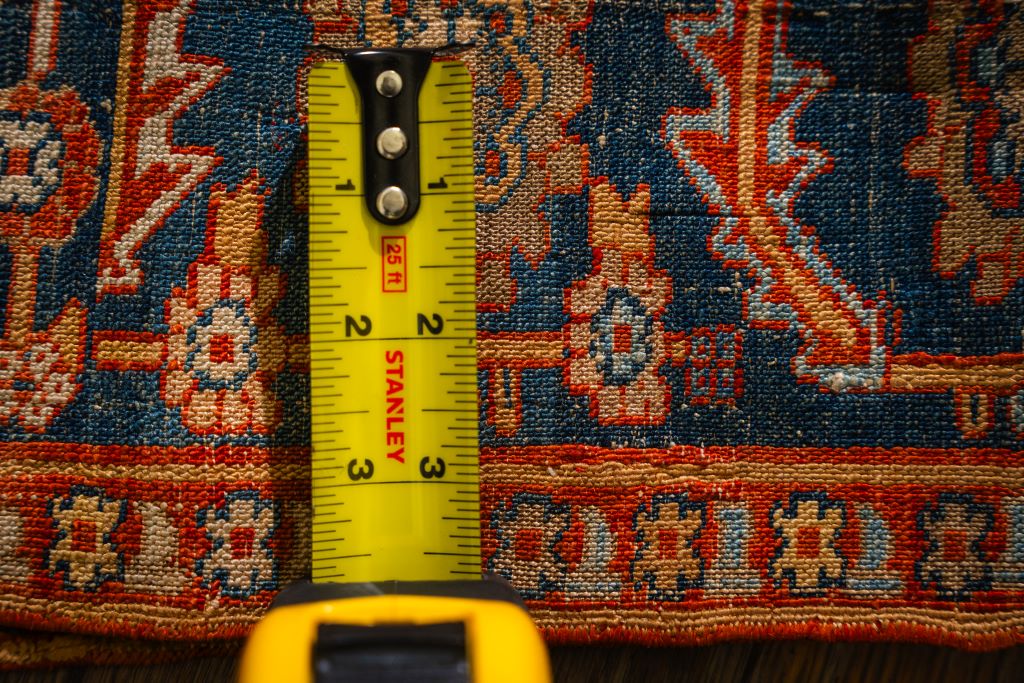
A detailed inspection of a richly colored oriental rug pattern while measuring its dimensions.
Ultimately, the construction and weaving technique define how the Cintamani design i motif is experienced. Whether shimmering in silk with gold threads or simplified in village woolens, the design’s essence remains unmistakable, but its refinement depends entirely on material and craftsmanship.
Regional Variations in Cintamani Design Rugs
Ottoman Court vs. Anatolian Village Styles
The clearest contrast in regional Cintamani weaving lies between the Ottoman palace workshops and the rural weaving centers of Anatolia. Ottoman court rugs present the motif on a large scale, with perfectly round dots stacked directly above flowing stripes.
These were executed in fine detail with a luxurious palette of ivory, deep red, indigo blue, and gold. The effect was regal and deliberate, befitting their function as symbols of authority. By contrast, Anatolian Chintamani rugs from village or workshop contexts reinterpreted the design more freely.
Instead of the dots aligning neatly above the crest of the stripes, they often sat above the troughs, producing a less formal look. Colors shifted to earthy tones with stronger contrasts, and the motifs themselves became more angular and geometric, reflecting the limitations of coarser wool and lower knot counts. Sizes were typically smaller, intended for household rather than palace display.
Persian, Central Asian, and Himalayan/Buddhist Variants
Though fundamentally an Ottoman court rug symbol, the motif spread across neighboring regions, adapting to local aesthetics and beliefs.
- Persian adaptations — Rare but notable. Here, the three-dot cluster was often floralized, transformed into rosettes or blossoms under the influence of Safavid design traditions. These adaptations reveal cross-cultural borrowing but with a distinctly Persian softness and preference for vegetal ornament.
- Central Asian versions — In tribal textiles, the three dots often stood as stark power symbols, while the wavy lines were read as cloud bands rather than tiger stripes. The emphasis was less on imperial might and more on cosmic force, reflecting steppe traditions of shamanic and sky-related imagery.
- Buddhist and Himalayan interpretations — In Tibet and surrounding Himalayan regions, the Tibetan jewel motif retained its original spiritual meaning. The three dots represented the Three Jewels of Buddhism, and the stripes symbolized wind lines or cosmic breath. These elements often appeared within tiger rugs, where the stripes resonated with both Buddhist energy and feline power.
Are There Regional Differences in Cintamani Design Rugs?
Yes—regional differences in Cintamani rug designs are substantial, and they reflect how each culture reinterpreted the motif’s form and meaning. In Ottoman workshops, the design was a statement of imperial identity and prestige. In Anatolian villages, it became a folk pattern, more angular and modest in scale. In Persia, it blended with floral ornament.
In Central Asia, it carried cosmic and protective associations, while in Tibet it retained its spiritual meaning as the wish-fulfilling jewel and the Three Jewels of Buddhism. By learning to spot these distinctions—formal, large-scale arrangements in Ottoman rugs, rustic angularity in Anatolian versions, floralized motifs in Persian carpets, or tiger-stripe wind lines in Tibetan textiles—one can quickly identify where a particular Cintamani design rug comes from and understand the cultural story it carries.
Collectibility and Authentication
What Distinguishes Vintage Cintamani Design Rugs from Reproductions?
For collectors, the first question is often: what separates a true vintage Cintamani design rug from a reproduction?
The hallmarks are clear once you know what to look for:
- Hand-spun wool and natural dyes — Why: Genuine vintage rugs use traditional materials, resulting in subtle abrash (color variations) and a soft, organic texture.
- Irregularities in weave and design — Why: Antique pieces often show slight asymmetry or uneven knotting, signs of human craftsmanship.
- Signs of authentic age and wear — Why: Natural fading, minor repairs, and patina reveal long use and history.
- Provenance and documentation — Why: Museum comparisons and dealer records confirm authenticity and value.
- Reproduction clues — Why: Synthetic dyes, machine-spun wool, perfectly even motifs, new foundations, or artificial distressing all indicate a modern rug imitating an old one.
True antique rugs with the Cintamani design carry the imperfections of time and human skill, while reproduction new rugs often feels too flawless.
How Do You Authenticate a 16th-Century Cintamani Design Carpet?
Authenticating a 16th-century Chintamani carpet requires scientific testing and expert analysis.
Collectors and conservators rely on:
- Fiber dating — Why: Radiocarbon or microscopic analysis helps establish whether the wool, silk, or cotton is genuinely centuries old.
- Dye testing — Why: Natural madder, indigo, and other organic dyes reveal age, while synthetic aniline colors betray modern production.
- Provenance research — Why: Auction records, estate histories, and archival sources confirm continuous ownership or museum parallels.
- Technical comparison — Why: Scholars compare knot density, weaving style, and design arrangement against securely dated Ottoman pieces in institutions.
- Expert appraisal — Why: Only trained eyes can judge the subtle differences between period workmanship and later imitations.
The rarity of true 16th–17th century Cintamani rugs makes authentication essential, as only a handful survive in museums and private collections.
Are Forged Cintamani Design Rugs Like Tuduc Pieces Worth Buying?
The Romanian master weaver Theodor Tuduc produced some of the most convincing rug forgeries in the early 20th century, including imitations of Ottoman designs. While his Tuduc rugs are not antiques, they have become collectible in their own right as examples of the forgery trade.
They hold value as curiosities or “collectible fakes,” but they cannot command the market prestige of a genuine collectible Ottoman rug. Buyers should weigh the risks: investing in a forgery means purchasing an artifact of deception, not a piece of 16th-century history.
How Do Conservators Restore Damaged Cintamani Design Rugs?
Professional rug restoration is delicate, aiming to stabilize rather than reinvent. Conservators typically:
- Clean with gentle methods — Why: Avoiding harsh chemicals prevents dye bleeding or fiber damage.
- Reweave missing sections — Why: Skilled artisans can rebuild small damaged areas with hand-matched wool or silk.
- Stabilize the foundation — Why: Reinforcing the warp and weft keeps the rug structurally sound.
- Color-match with natural dyes — Why: Ensures that repairs blend harmoniously with the original palette.
- Limit moisture and wetting — Why: Excessive washing can weaken fibers and distort motifs.
The goal is always preservation, not over-restoration, allowing the antique Cintamani carpet to retain its authenticity while extending its lifespan for future generations.
For collectors, the takeaway is clear: Chintamani authentication is essential, genuine Ottoman rugs are exceptionally rare, Tuduc forgeries occupy a niche market, and skilled restoration can protect—though never fully replace—the integrity of these iconic textiles.
Cintamani Design Rugs in the Modern Market
Are Cintamani Designs Used in Modern Rug Collections?
Yes. The bold geometry of the modern Cintamani design rug continues to inspire designers today. Contemporary collections often reinterpret the three-dot motif and tiger-stripe waves with updated colors, larger scales, or minimalist layouts.
Some brands favor muted neutrals for chic interiors, while others exaggerate contrasts in homage to the contemporary Ottoman rug legacy. Whether hand-knotted by artisans or machine-woven for accessibility, the motif remains a popular symbol of both heritage and trend.
Where Can I Buy an Authentic Cintamani Rug Today?
Authenticity matters when purchasing a collectible Ottoman rug.
Buyers should focus on respected sources:
- Auction houses (Sotheby’s, Christie’s, Bonhams) — Why: These offer museum-grade pieces with documented provenance, including the rare White Ushak carpets.
- Specialist dealers and galleries — Why: Trusted rug experts can guide buyers through authentication, condition, and value.
- Museum deaccession sales — Why: Occasionally, institutions release duplicates or secondary-quality holdings into the market.
- Verified online platforms — Why: Some curated platforms provide guarantees, though due diligence is essential.
Explore collection of antique rugs and make sure to review our guide to buying area rugs and carpets.
How Much Does an Antique Cintamani Design Carpet Cost?
The antique Turkish Oushak/ Ushak carpet price for genuine 16th–17th century examples can reach the high six-figure range, sometimes exceeding a million dollars depending on condition, provenance, and rarity.
These are museum-level acquisitions, virtually unattainable outside of elite collections. Later Ottoman-era or village-woven examples may command lower—but still significant—prices, reflecting their continued desirability.
Should I Choose a Cintamani Pattern Rug for a Contemporary Living Room?
For modern interiors, the buy authentic Chintamani decision depends on intent and budget:
- Design impact — Why: The bold three-dot and wave pattern adds striking geometry and historical weight to any room.
- Symbolism — Why: As a talisman of good fortune, protection, and power, it infuses a space with layered meaning.
- Durability — Why: Wool-based pieces, especially village or workshop productions, withstand daily use well when properly cared for.
- Affordability — Why: While true antiques are out of reach for most, modern Cintamani rugs and well-made reproductions offer the look at accessible prices.
This makes the motif a strong choice for homeowners who value both aesthetics and cultural resonance.
Can Improper Cleaning Fade Cintamani Motifs Over Time?
Absolutely. To care for Cintamani patterned area rugs, avoid bleach, harsh detergents, or soaking, as these can strip natural dyes and blur the clarity of the motif. Professional cleaning with wool- or silk-safe methods is essential to preserve the Chintamani design.
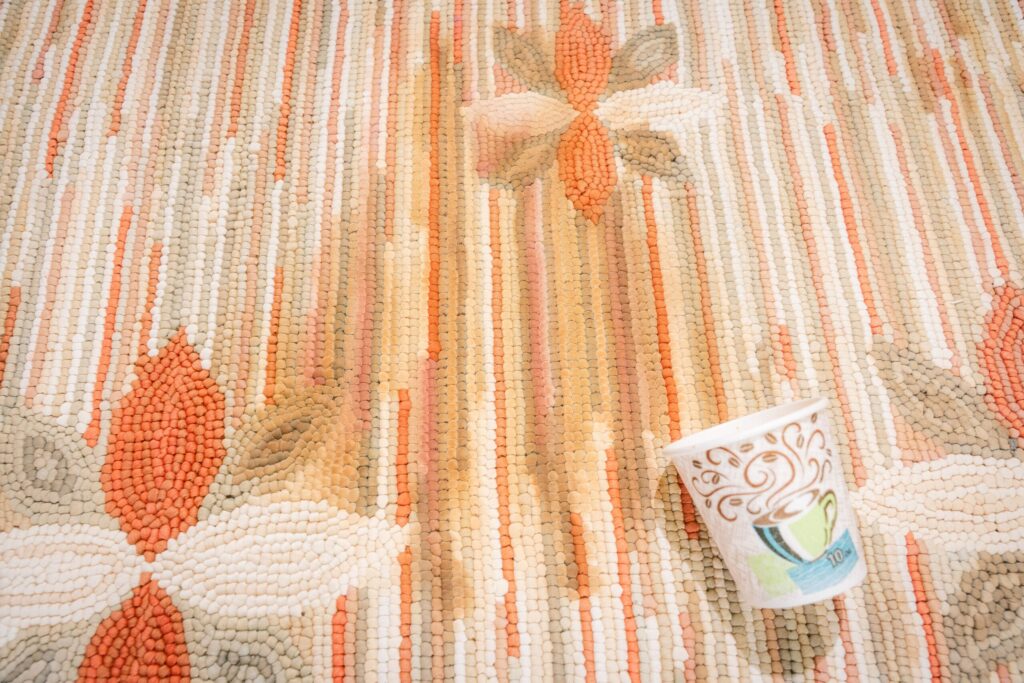
Close-up view of a tipped paper coffee cup resting on a handwoven wool rug, highlighting the rug’s dense pile, subtle color variations, and traditional geometric motifs in warm neutral and terracotta tones.
Even contemporary pieces benefit from careful maintenance, ensuring that their bold graphics remain crisp. [Learn more in our rug care guide → rug care page]
Does Investing in Cintamani Rugs Offer Good Long-Term Value?
The rug investment potential of Cintamani designs varies. Authentic antique Cintamani carpets appreciate steadily, given their extreme rarity and historical prestige. These are reliable long-term assets for serious collectors. Contemporary or designer reinterpretations, however, depend on quality, craftsmanship, and brand reputation.
While not guaranteed to rise in value, they retain decorative appeal and symbolic weight. For today’s buyers, the decision lies between acquiring a museum-worthy antique—a rare and costly treasure—or enjoying the timeless aura of a modern Cintamani design area rug, which brings Ottoman symbolism into contemporary life with accessibility and style.
Legacy, Influence, and Contemporary Appeal
The Enduring Allure of Cintamani
The Cintamani legacy lies in its ability to transcend time, geography, and meaning. Once the emblem of Ottoman imperial power, it continues to resonate today as a symbol of good fortune, strength, and elegance.
Its three-dot and tiger-stripe arrangement has become one of the most recognizable motifs in Turkish and global textile history. Beyond its historic role, it endures as a living design language, still woven, displayed, and reinterpreted by artisans and designers worldwide.
Design Trends: Contemporary Revivals and Cross-Cultural Symbolism
In today’s interiors, the Ottoman motif revival is thriving. Rug makers and textile designers revisit the motif, experimenting with new palettes, oversized scales, and diverse weaving techniques. Some emphasize minimalism, rendering the modern Chintamani décor in muted neutrals for urban living spaces, while others highlight bold contrasts reminiscent of palace grandeur.
The motif’s cross-cultural symbolism enhances its contemporary appeal. In Turkey, it remains tied to cultural identity and heritage, a visual shorthand for centuries of artistic achievement. Internationally, it bridges East and West, spiritual and imperial, past and present, making it attractive for heritage-inspired homes as well as avant-garde design projects.
Museums frequently feature Cintamani design carpets and textiles in exhibitions, ensuring their place in the scholarly and artistic canon. Designers, decorators, and collectors continue to embrace it not only for its history but for its ability to inject symbolism and sophistication into modern interiors.
Internal Linking Suggestions
To enrich exploration of the motif in contemporary interiors and its broader cultural:
- Ottoman rugs — Why: Contextualizes the imperial origins of the Cintamani motif.
- Symbolism in rug design — Why: Explains the broader symbolic language of carpets across cultures.
- How to buy antique rugs — Why: Guides collectors interested in authentic Cintamani and related pieces.
- Rug care tips — Why: Ensures longevity and preservation of motif clarity in both antique and modern rugs.
- Ushak carpets — Why: Highlights one of the most famous Ottoman rug types featuring the motif.
- Motif encyclopedia — Why: Provides comparisons with other patterns and their meanings.
The Cintamani design motif’s transformation from imperial emblem to modern design element underscores its remarkable adaptability. It remains a thread that connects heritage with innovation, ensuring that the motif in contemporary interiors continues to inspire and captivate across centuries.
FAQ
- How do I date a Çintamani motif rug?
Dating cintamani motif rugs relies on weave (Turkish/Gördes knot), dyes, and pattern style. Consult a qualified appraiser for lab dye analysis and expert comparison.
- What décor styles pair best with cintamani motif rugs?
Cintamani motif rugs suit transitional, eclectic, and minimalist spaces. The bold dots and stripes read graphic—balanced by neutral walls and simple furniture.
- Do circles above or below stripes matter on Çintamani motif rugs?
Arrangement varies across cintamani motif rugs, and meanings are debated. Treat placement as a design variation unless a specific piece has documented context.
- Where can I buy cintamani motif rugs in the US?
Look for cintamani motif rugs at specialty dealers, reputable online galleries, and auction houses. Ask about return windows (e.g., 7–14 days) and cleaning histories.
- Where can I see Çintamani motif rugs or the motif in the US?
US visitors can view the motif in Ottoman artworks and textiles at major museums. For example, The Met displays Iznik ceramics with cintamani patterns.
- How rare are museum-quality Çintamani motif rugs?
Museum-quality cintamani motif rugs are scarce; the motif appears more widely in Ottoman textiles and ceramics. Expect only a handful of notable carpet examples.
- Are cintamani motif rugs kid- and pet-friendly?
Wool cintamani motif rugs are naturally resilient and patterned to disguise minor stains. Choose a cut-pile or low pile; avoid loop piles that snag claws.
- How do I verify provenance for a Çintamani motif rug?
For valuable cintamani motif rugs, request documented provenance, dye tests, and expert appraisal. Auction catalogs and museum parallels help confirm age and region.
- Is “chintamani” the same as Çintamani motif rugs?
Yes—“chintamani,” “cintamani,” and “çintemani” all refer to the same motif. Spellings vary by transliteration from Turkish and Sanskrit sources.
- Are there prayer-format cintamani motif rugs?
Rare prayer-format cintamani motif rugs exist, typically from Ottoman contexts. They’re uncommon and often appear at major auctions or museum collections.
- Will a robot vacuum damage a Çintamani motif rug?
Robot vacuums can catch on fringe and edges of cintamani motif rugs. Tuck fringe under temporarily or set a virtual boundary.
- Are cintamani motif rugs safe with radiant floor heating?
Wool cintamani motif rugs generally work with low-to-moderate radiant heat. Keep temperatures below manufacturer limits and avoid heat-trapping pads.
- How do I clean a Çintamani motif rug at home?
Vacuum your cintamani motif rug without a beater bar and blot spills immediately with diluted mild detergent. Schedule professional cleaning every 1–3 years.
- What rug pad works best under a cintamani motif rug?
Use felt for larger cintamani motif rugs to add cushioning and grip, or natural rubber for smaller pieces. Avoid cheap latex pads that can stick to floors.
- Are Çintamani motif rugs good for high-traffic areas?
Wool cintamani motif rugs handle foot traffic well and hide soil with their dotted pattern. Use a quality pad and rotate every 6–12 months.
- How much do antique cintamani motif rugs cost?
Antique cintamani motif rugs can range from several thousand dollars to six figures depending on condition, age, and provenance. Modern hand-knotted options often start around \$1,000–\$3,000 for 8×10.
- What sizes do Çintamani motif rugs come in today?
Modern cintamani motif rugs follow standard US sizes like 5×8, 8×10, and 9×12. Antique examples vary and may be smaller or irregular.
- How do I style cintamani motif rugs in a modern room?
Pair cintamani motif rugs with solid upholstery and minimal patterns. Let the three-dot motif be the focal point, then echo one color in pillows or art.
- Do modern makers produce Çintamani motif rugs?
Yes—both hand-knotted and power-loomed cintamani motif rugs are available. Contemporary versions often reinterpret the dots-and-stripes in neutral palettes.
- What materials are typical for cintamani motif rugs?
Wool is standard for cintamani motif rugs, sometimes with silk highlights. Antique pieces use natural dyes like madder reds and indigo blues.
- How can I identify an authentic hand-knotted Çintamani motif rug?
Flip the cintamani motif rug: look for visible knots, uneven backs, and fringe as warp cords. Printed or machine-made versions have uniform backing and glued edges.
- Are cintamani motif rugs common in antiques?
Antique cintamani motif rugs are rare compared with textiles and ceramics bearing the design. Expect limited availability and auction-only pieces.
- Where did Çintamani motif rugs originate?
Çintamani motif rugs emerged in the Ottoman sphere (Anatolia) during the 16th–17th centuries. Uşak workshops are frequently cited in surviving examples.
- What do the symbols on cintamani motif rugs mean?
In cintamani motif rugs, the three dots suggest pearls or power, and the wavy bands evoke tiger stripes. Ottoman usage linked them with protection and royal authority.
- What are Çintamani motif rugs?
Çintamani motif rugs feature three circles (dots) often paired with two wavy “tiger-stripe” bands. The name comes from a Sanskrit term for a wish-fulfilling jewel.