
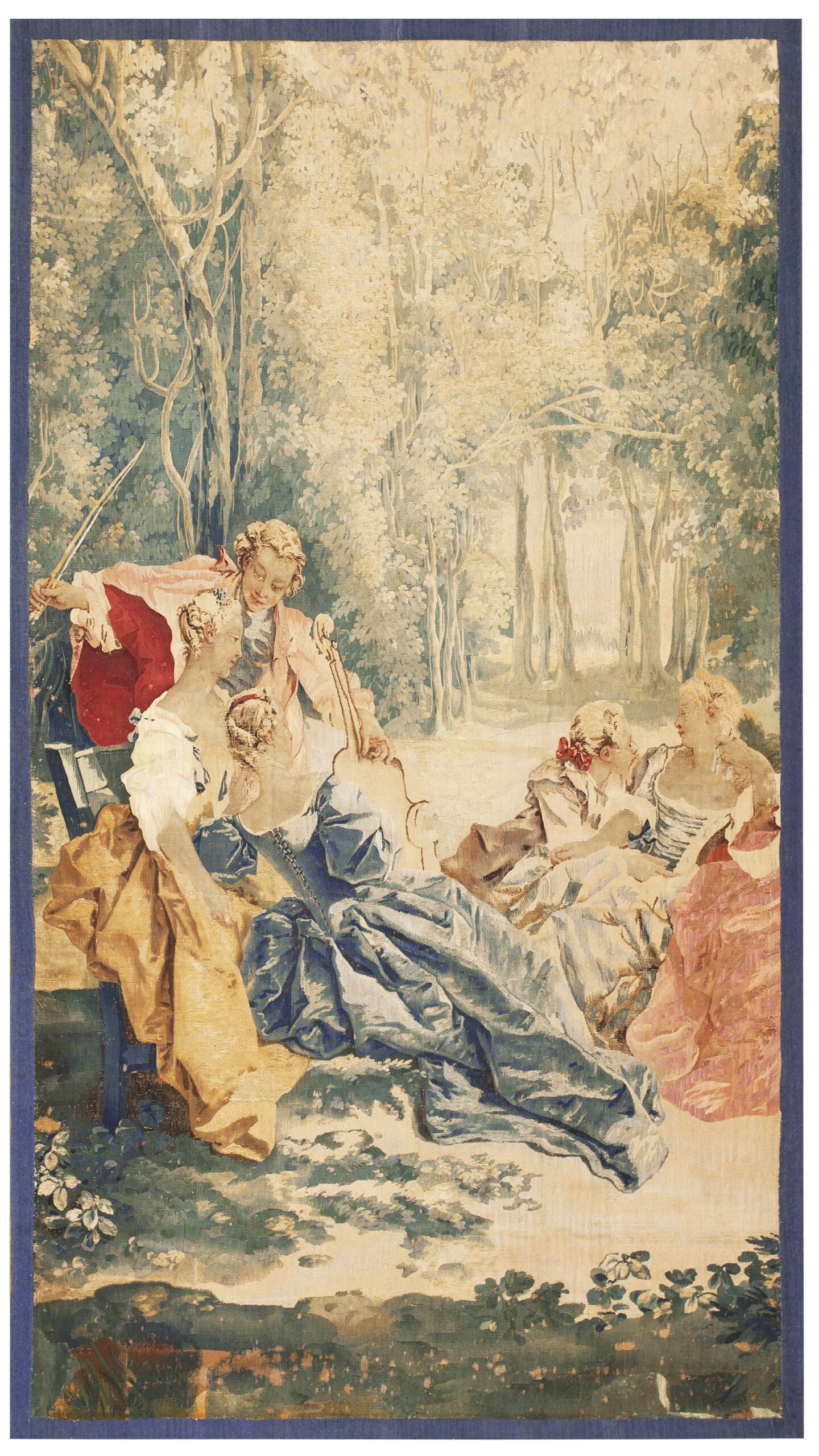
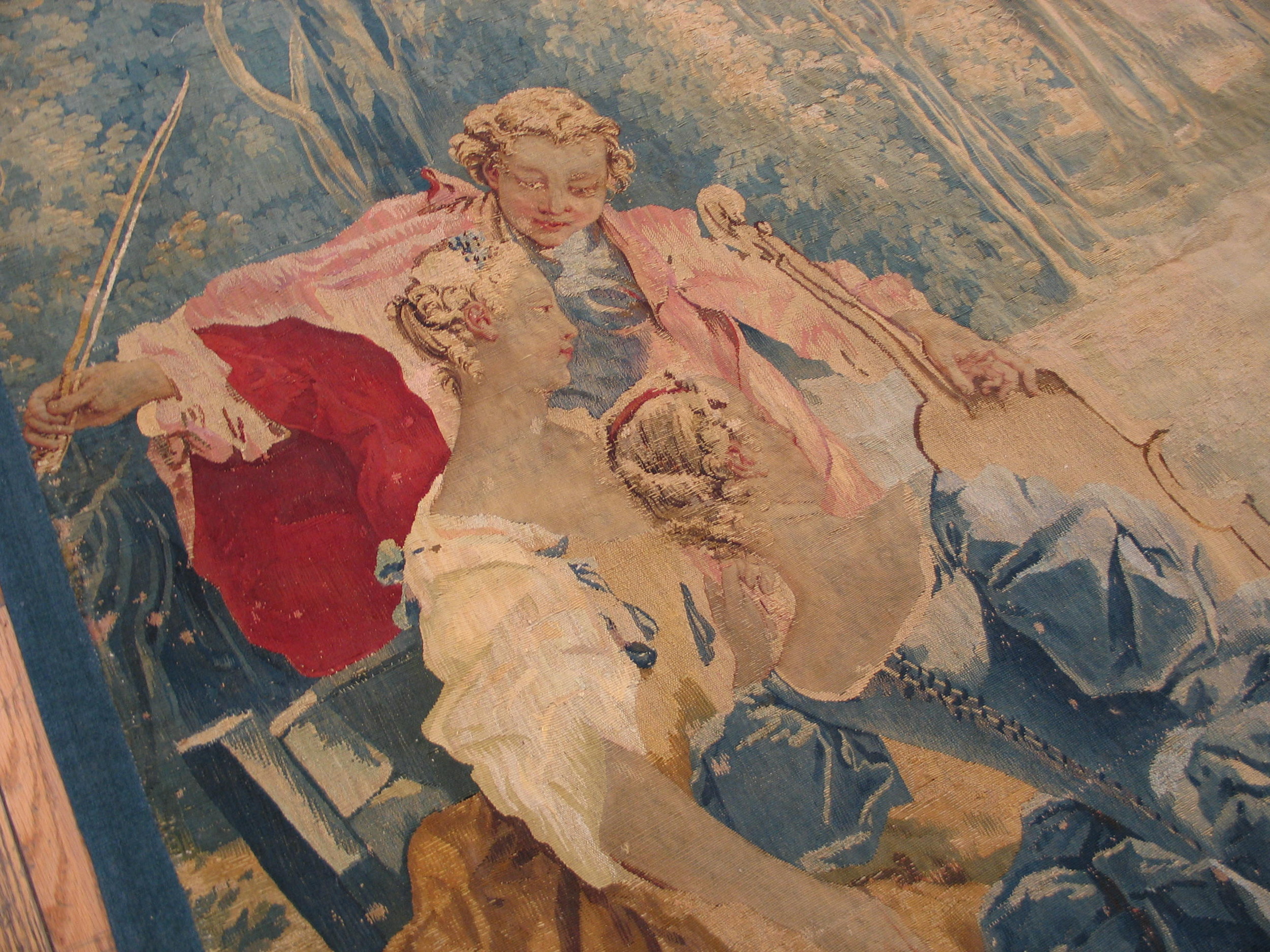
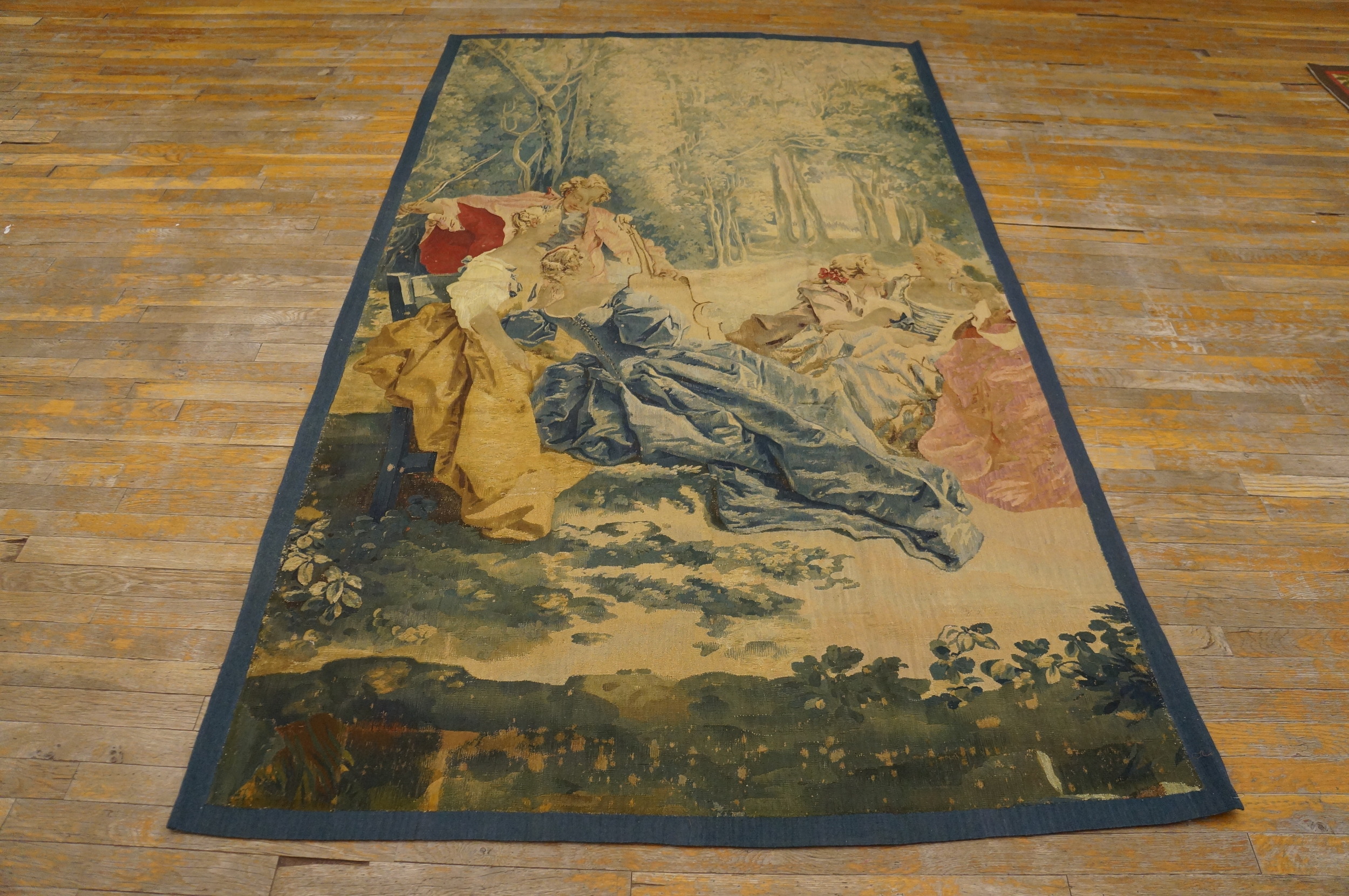
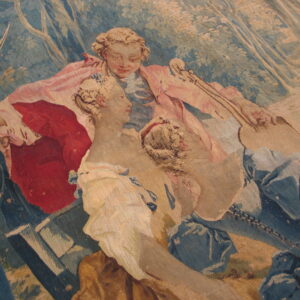
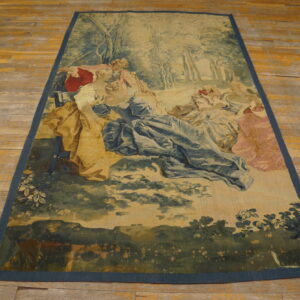
A masterpiece of mid-eighteenth-century / Louis XV period French refinement, this vertical tapestry panel captures a whimsical “Music Lesson” within a lush, sun-drenched woodland. The scene is a classic representation of the fête galante—a genre of art depicting the aristocracy at leisure—heavily influenced by the “Noble Pastorales” of the premier Rococo painter, François Boucher. The central narrative focuses on a musical courtship: a young gentleman in a rose-colored frock coat leans over an elegant noblewoman, assisting her with a viola da gamba. In the playful language of the Rococo era, music served as a direct metaphor for romantic harmony, making this “lesson” a poignant allegory of seduction and grace.
The textile showcases the extraordinary technical skill of the Aubusson workshops, where weavers translated Boucher’s painterly brushstrokes into intricate threads. The play of light through the towering “Verdure” trees creates a theatrical sense of depth, while the sophisticated palette of indigo, champagne, and muted gold remains remarkably vibrant. Woven with wool for structural durability and silk for the shimmering highlights of the costumes, the panel is framed by its original deep blue selvedge. This vertical pierment is a commanding architectural statement, designed to bring the airy, escapist beauty of a royal French garden into a sophisticated interior.
The Scene: The Music Lesson / Courtship in the Woods
This scene is a classic representation of fête galante—a category of painting depicting the aristocracy enjoying outdoor entertainments.
The Narrative: The central focus is a musical courtship. A young gentleman in a pink frock coat is leaning over a seated lady, helping her hold or tune a viola da gamba (a predecessor to the cello). To the right, another couple sits in the grass, engaged in intimate conversation.
Symbolism: In Rococo art, music was a direct metaphor for the “harmony” of a romantic relationship. The act of a man teaching a woman to play an instrument was a common, thinly veiled trope for seduction and courtship.
The Setting: The figures are set against a “Verdure” background—a dense, sun-dappled forest. The high-set trees and the play of light through the leaves create a “theatrical stage” effect, which was a hallmark of the Beauvais and Aubusson workshops.Portion of cartoon from La Musique – Designed by Francois Boucher.
Even More Information:
Beauvais, French Royal Tapestry Workshop under the direction of Nicolas Besnier and Jean – Baptiste Oudry (1734-1753), or A.C. Charron (1753-1780).
La Musique (Music) No. 9 was from of a set of 14 panels “Fetes Italiennes” or “Italian Scenes”, showing peasants and working-class folk with a few panels displaying members of the upper classes at play. “Music” is one of these.
Boucher’s original drawings for Music (and other tapestries as well) are in The Stadelkunst Institute (Frankfort, Germany), and in a private collection in Paris.
This was Boucher’s first tapestry design commission for the Beauvais factory. His other work includes the “Nobles Pastorales” series in the 1750’s.
There is no complete set of all 14 tapestries extant and no complete set was ever woven for a single client. The present panel lacks a mark in the outer plain blue border, now excised and replaced by a later restoration. The mark would have given the place (Beauvais) and either Besnier’s or Charron’s name.
The entire set of the “Fetes Italiennes” comprises:
Le Operateur (The Charlatan)
La Bohemienne (The Gypsy Fortune Teller)
Les Pecheuses (The Fishing Girls)
Les Chasseurs (The Hunting Boys)
La Curiosite (Curiosity)
Les Filles aux Raisins (Girls Gathering Grapes)
La Danse (Dance)
La Collation (The Luncheon)
La Musique (Music)
Le Jardinier (The Gardener)
La Bergere
La Cabaretier (The Inn Keeper)
Le Perroquet (The Parrot)
Le Marchant d’Oeufs (The Eggseller)
Of the Fetes Italiennes, No. 9, Music was executed eleven times: 1745, 1746, 1750 4 times, 1751 twice, 1753 twice. 1754.
There was a partial set of six panels including Music sold in Paris, M.X…Collection, Galerie Georges Petit, 23.5.27 and all are illustrated in the catalogue. The version of Music, lot 2 is shorter, 3.15 m. height, 2.90 m. long.
Only the right half of the whole composition appears, ending just to the left of the outstretched arm of the cellist in the center. The trellised garden ledge and tower, along with two figures are not present. Our panel is 8’ 8” longer than the 1927 example. The double guilloche border is common to both versions and is one of the standard Beauvais borders used as late as 1774. It also appears in the set in N.Y.
The sizes and subjects of the X … Collection pieces are as follows:
Dance 3.10 m x 4.75 m
Music 3.15 m x 2.90 m
Hunters 3.10 m x 2.75 m
Fishers 3.10 m x 2.0 m
Entrefenetre 3.05 m x 1.45 m
Entrefenetre 3.10 m x 1.40 m
Music is therefore, in its original form, the largest of the set.
The 1927 catalogue notes that there are longer replicas of Music with the additional personages to left. This variation and reduction of scenes is not uncommon and because of the weaving process, here from right to left, is easy to accomplish. The process proceeds horizontally, and the weavers can start or stop at any point in the cartoon.
Panel no. 9, Music, was woven in:
1745 for M. Gautier (nos. 7, 8, 9)
1746 for General Sale (nos. 7-10)
1750 for M. d’Aremberg (nos. 7-10)
1750 for Sueden (nos. 7, 9, 10)
1750 for M. Lalande (nos. 2, 8-10)
1750 for General Sale (nos. 1-4, 7-10)
1751 for M. Thibault (nos.1,3,4,7,9,10)
1751 for M. de Vermonoye (nos.7-9)
1753 for M. Duvocel (nos. 9-11)
1753 for Mme. Geoffrin (nos. 4,7-10)
1754 for M. Marchant (nos. 3,4,9,11)
Since our panel employs the full cartoon, it was likely one of the earlier editions, possibly as early as 1745 or 1746.
The Metropolitan Museum of Art in NY has 9 pieces including one duplicate slightly expanded to left. Music is not included. Standen is in error in stating that the Met’s set is complete.
The series is internally stylistically coherent and some of the same figures and scenic elements are reused. For example, Music and The Gardener (no. 10) both employ the same trellised garden walls and the female in profile in The Gardener reappears almost exactly as the central girl close to the cellist in Music. The putti riding dolphins in the fountain at the right of Music reappears in other examples of Boucher’s work. The rustic leaning on the ledge is of the same laborer social class as The Gardener in no. 10. The dimensions of “Music” are the greatest for any of the series and although it is unknown how many of the eleven editions of this design were produced in the fully extended large format, it was clearly a special creation. No armorial device was ever present. Sets were often split and recombined, and it is not possible to trace all the editions on individual panels.