
Introduction to Amritsar Rugs
Discover our collection of luxurious hand-knotted Amritsar rugs for sale today.
Location and Etymology
Amritsar lies in the fertile plains of Punjab, northwest India, only a short distance from the frontier with Kashmir. The city’s name, meaning “pool of nectar,” refers to the sacred tank surrounding the Golden Temple, the holiest shrine of the Sikh faith. This symbolic pool gave Amritsar both its name and its spiritual reputation, anchoring it as a cultural center of the Sikh Empire in the 18th and 19th centuries.
Beyond its religious significance, Amritsar’s position made it a true crossroads: open to influences from Persia and Central Asia via the northwest frontier, while also tied into the broader Indian textile traditions of Punjab. The rugs woven here—commonly known as Amritsar rugs or Amritsari carpets—take their identity directly from this setting.
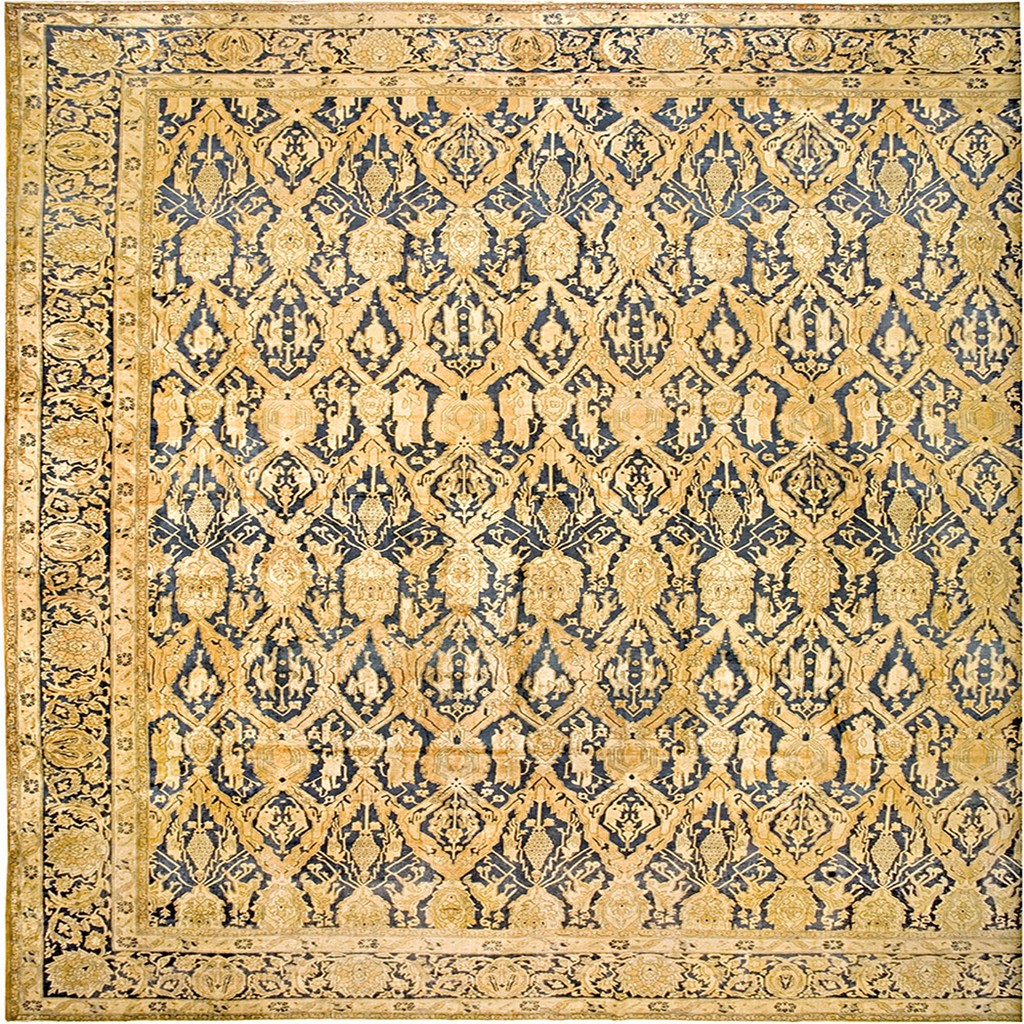
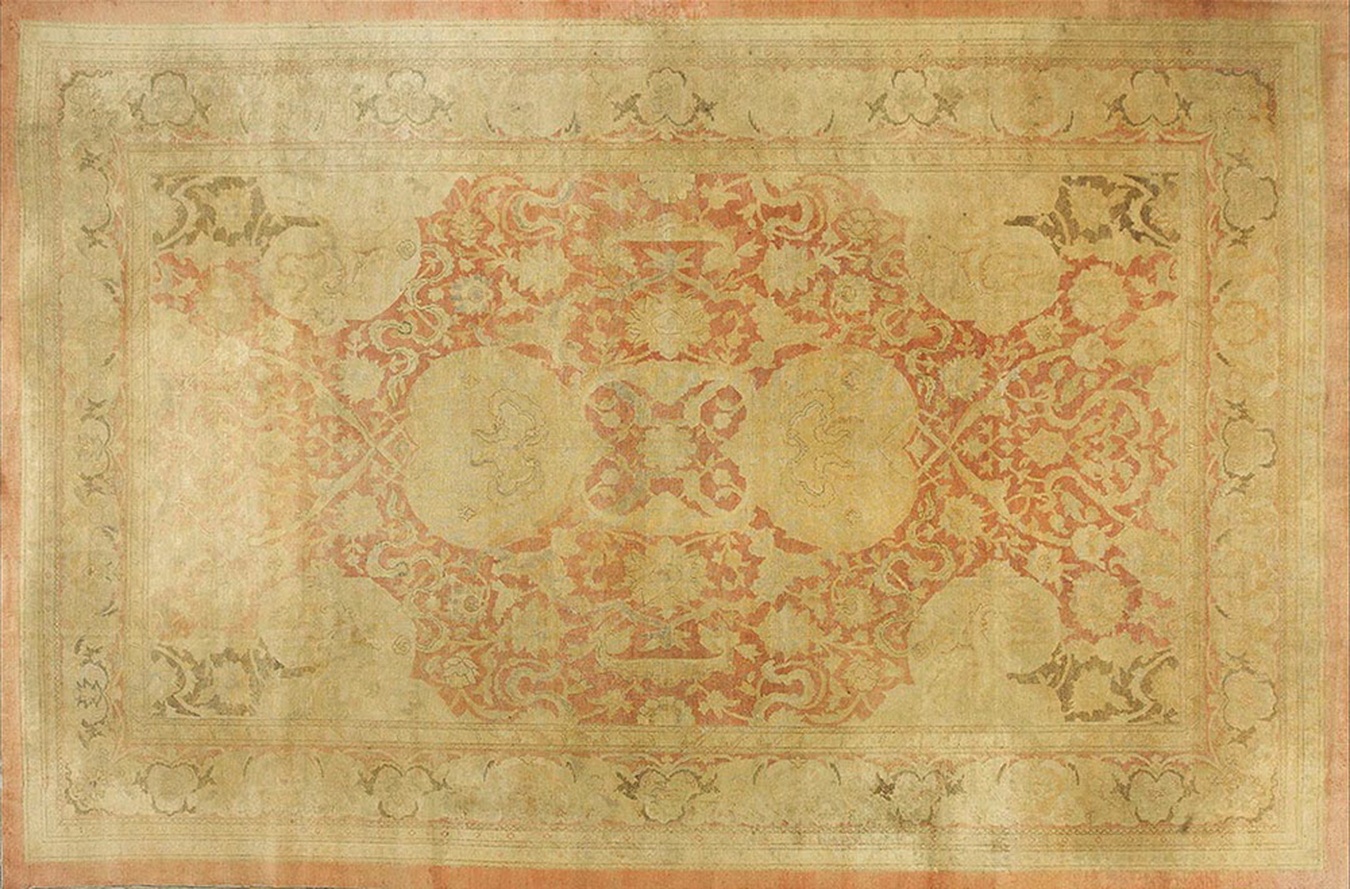
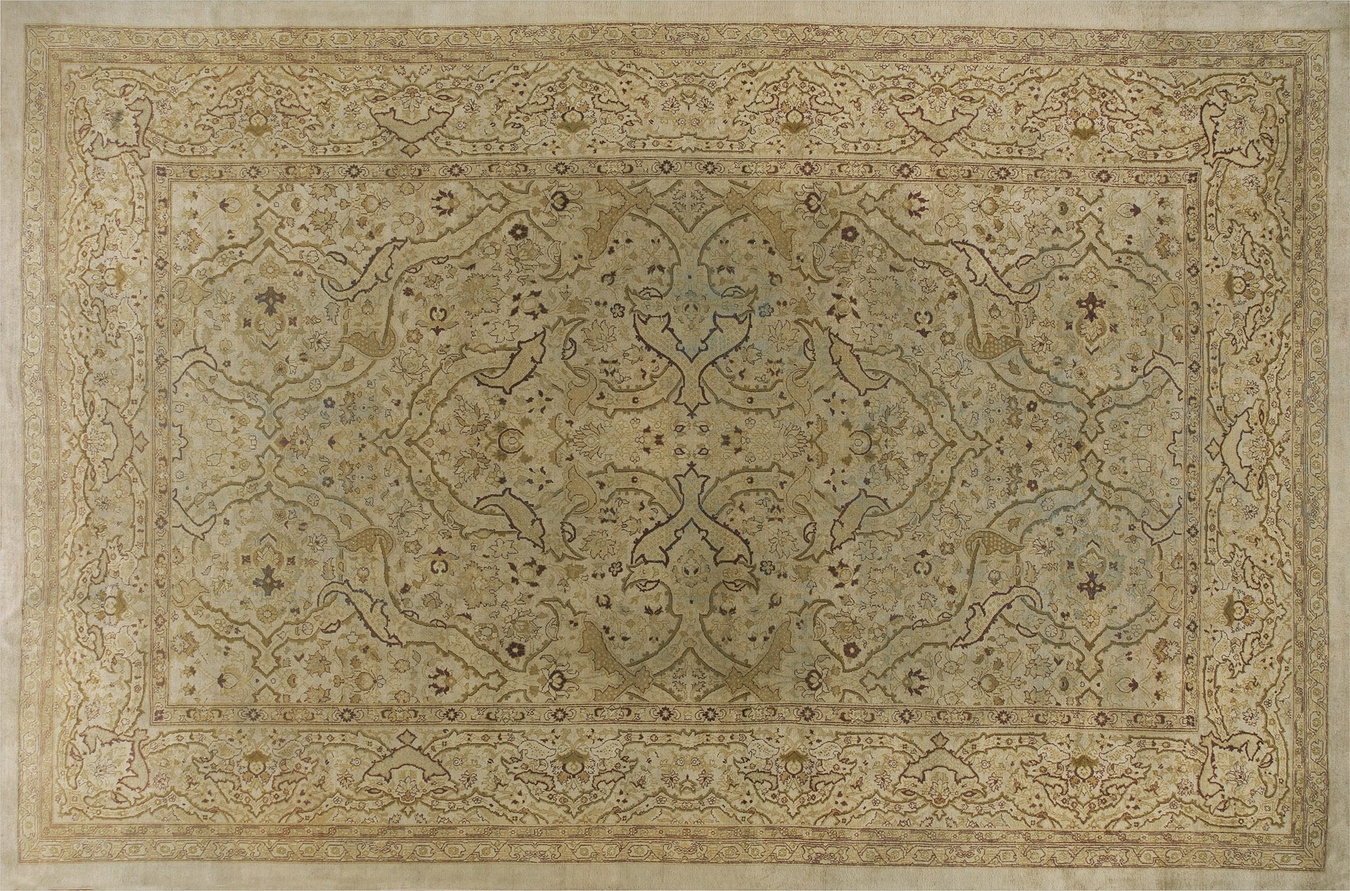
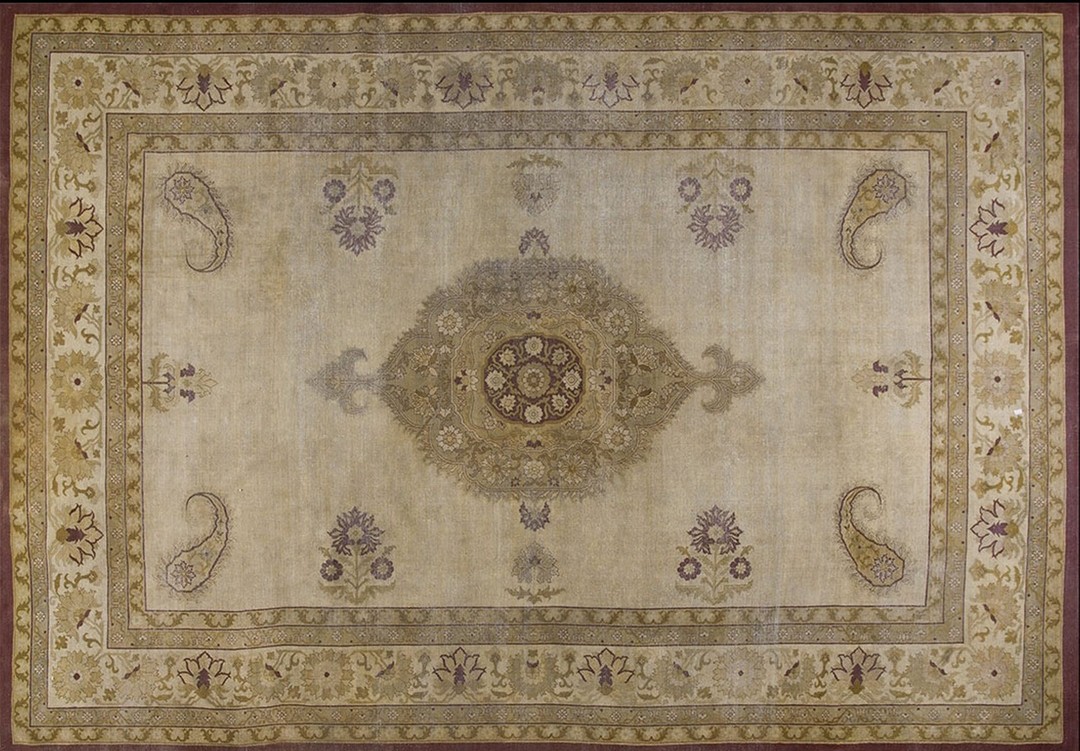
Antique Oversized Amritsar Indian Knotted Rug by Rugs On Net
Just as the city itself blends commerce, religion, and artistry, the carpets reflect a meeting of worlds. They combine the grandeur of Persian-inspired motifs with a distinctly local sense of refinement, creating a category of weaving that is uniquely tied to Amritsar’s place on the map.
Why Amritsar Rugs Are Celebrated
- Luxurious scale and quality — Why: Amritsar carpets were typically woven in large formats, suitable for palaces, colonial mansions, and great halls. Their scale matched the ambitions of wealthy patrons.
- Elegant floral and botanical patterns — Why: Inspired by Mughal and Persian precedents, these designs feature scrolling vines, blossoms, and palmettes, executed with balance and grace.
- Fusion of Persian and Western aesthetics — Why: Amritsar rugs adopted Persian-style motifs but softened them with muted, European-friendly color palettes, which appealed to colonial and export markets in the 19th century.
- Craftsmanship rooted in Punjab — Why: The weavers of Amritsar drew upon Punjab’s deep textile traditions while incorporating influences from Kashmir and Persia, producing carpets of both cultural and technical sophistication.
- Status as cultural markers — Why: Owning an Amritsar carpet signified cosmopolitan taste, as these rugs embodied the artistic dialogue between East and West.
Amritsar’s weaving heritage underscores its geographic and cultural role as a gateway city. Just as Punjab has long been a meeting ground of empires, faiths, and trade routes, the city’s rugs encapsulate this blend. To rug enthusiasts, an Amritsar carpet is more than just a floor covering—it is a mark of cross-cultural artistry, a textile that embodies the city’s layered identity.
In short, Amritsar’s fame among rug lovers comes from both its location and its legacy: rooted in Punjab’s heartland yet open to influences beyond, and celebrated for rugs that marry Persian grandeur with Western restraint. This unique balance ensures that Amritsari rugs remain prized as some of the finest Indian floral carpets ever woven.
Geographic & Historical Origins
The story of Amritsar rug history begins in the mid-19th century, shortly after the British annexation of Punjab in 1849. Before this turning point, the city had no major weaving tradition of its own. Instead, it rose to prominence as a weaving hub under colonial rule, when techniques and artisans arrived from Kashmir in the 1840s.
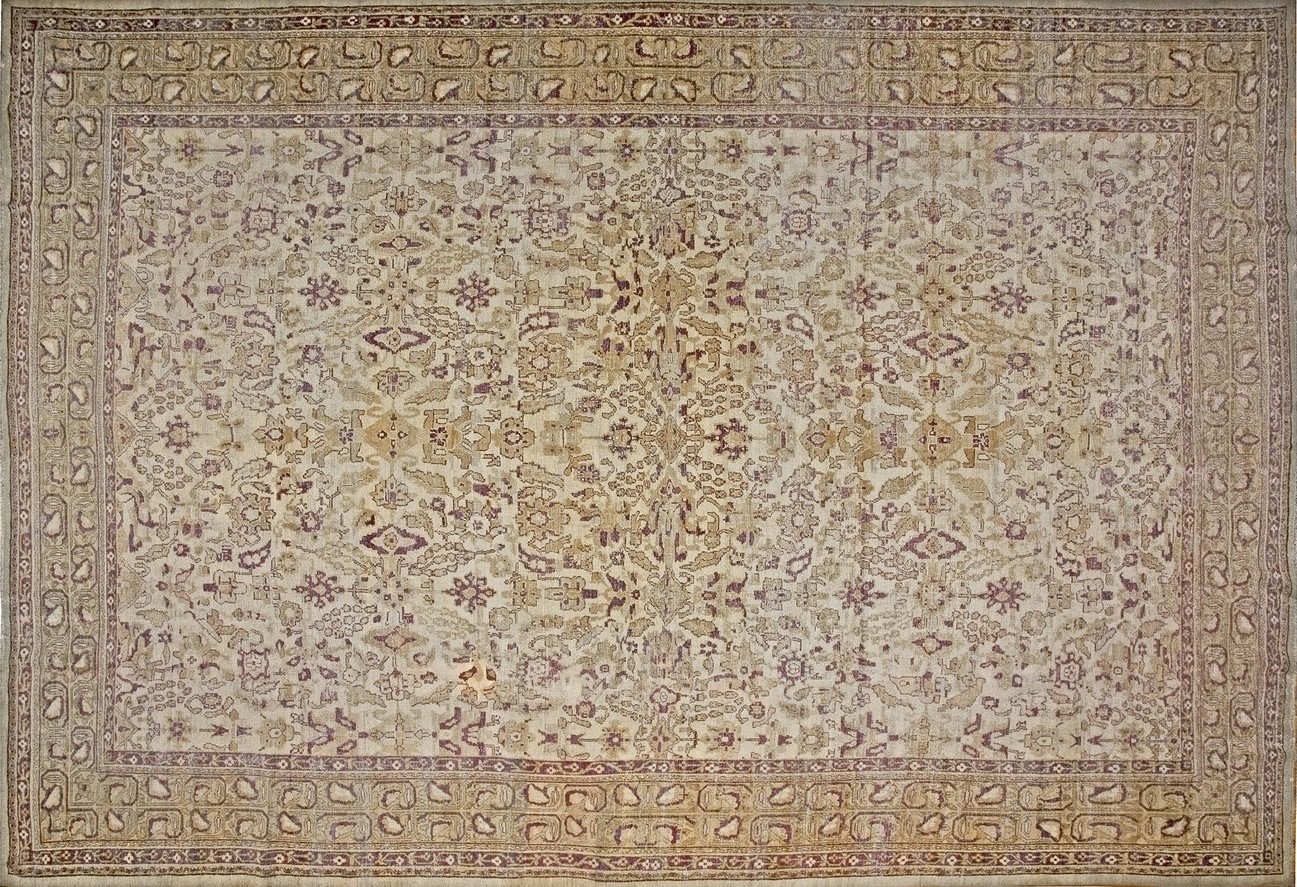
Rise of Weaving in Amritsar
Kashmir, already celebrated for its silk carpets, provided both the skills and the models that would define early Amritsar production. The political shift of Punjab from the Sikh Empire to British control created a new demand for local industries, and weaving became one of the most important crafts to flourish under this new order.
Mughal and Kashmiri Influences
Although weaving began in Amritsar relatively late, its artistic roots ran deep. The Mughal carpet heritage of the 16th and 17th centuries provided the foundation: scrolling vines, palmettes, garden layouts, and naturalistic floral motifs that blended Persian and Indian aesthetics. To this legacy, Amritsar added the Kashmir carpet influence, where weavers were skilled in producing fine knotting and intricate designs.
The result was a fusion tradition, where Mughal-inspired gardens and Persian elegance merged with regional artistry, all filtered through Amritsar’s new role as a colonial city. The rugs thus became “Mughal-inspired, Victorian-adapted,” embodying centuries of Indo-Persian artistry translated into a 19th-century idiom.
British Patronage and Industrial Boom
The most decisive factor in Amritsar’s rise was British colonial patronage. Exhibitions such as the 1851 Great Exhibition in London introduced Indian carpets to Victorian audiences, sparking demand for large-scale, finely woven pieces suited to Western interiors. To meet this appetite, the British established weaving workshops, most famously at the Amritsar Jail, where prisoners were trained to produce carpets in great numbers. Alongside this institutional system, a cottage industry of home-based weaving also thrived, ensuring both quantity and variety in production.
Under this patronage, Victorian Indian rugs from Amritsar reached global markets. Export houses and colonial officials shaped design choices, encouraging softer palettes and grander proportions to suit drawing rooms, ballrooms, and estates. The industry became not only a local craft but also part of the wider global trade in British colonial carpets, symbolizing how art and empire intertwined.
Amritsar’s weaving history is therefore one of colonial and cross-regional exchange: Mughal motifs reborn through Kashmiri skill, adapted for Victorian taste, and disseminated worldwide through British trade networks. To answer directly: carpet weaving in Amritsar began in the mid-1800s, after British annexation, and it was British patronage and global demand that transformed the city into one of India’s great weaving centers.
Design Characteristics of Amritsar Rugs
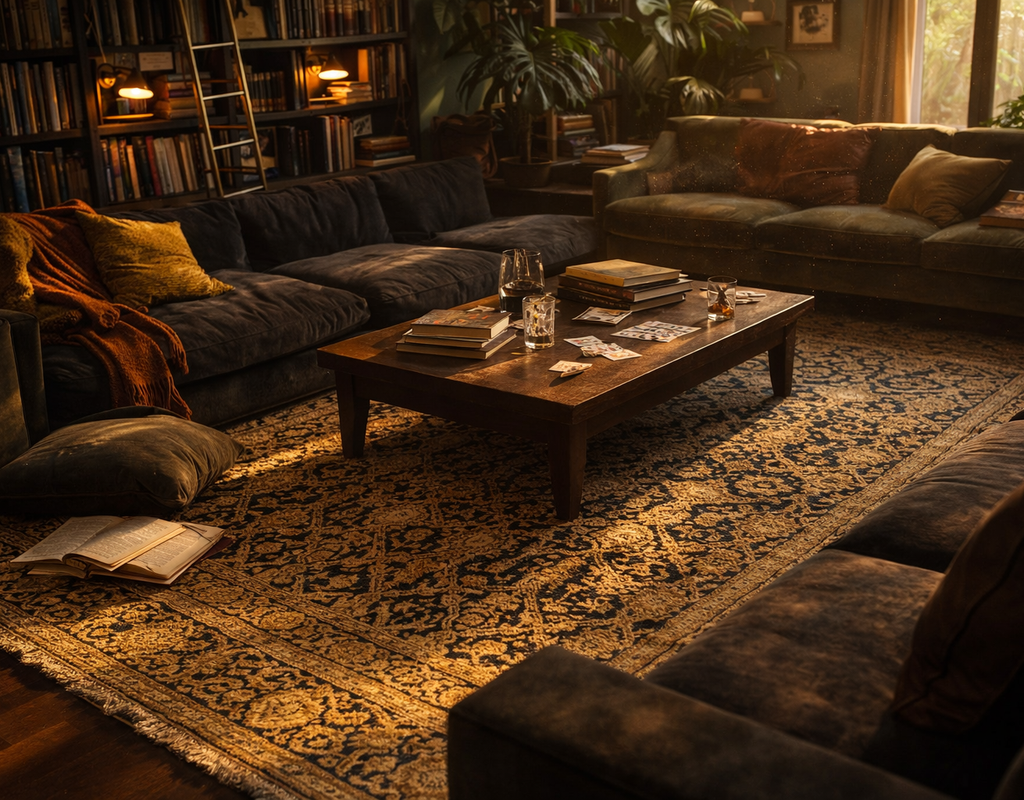
Warm sunlight illuminates the ornate details of the traditional area rug in this intimate, book-lined lounge.
Muted palette floral motif reminiscent of classic textile designs.
Signature Motifs and Patterns
Amritsar rug patterns are defined above all by their botanical abundance. Typical designs include all-over fields of scrolling vines, palmettes, lotus blossoms, and roses, arranged in flowing, curvilinear layouts.
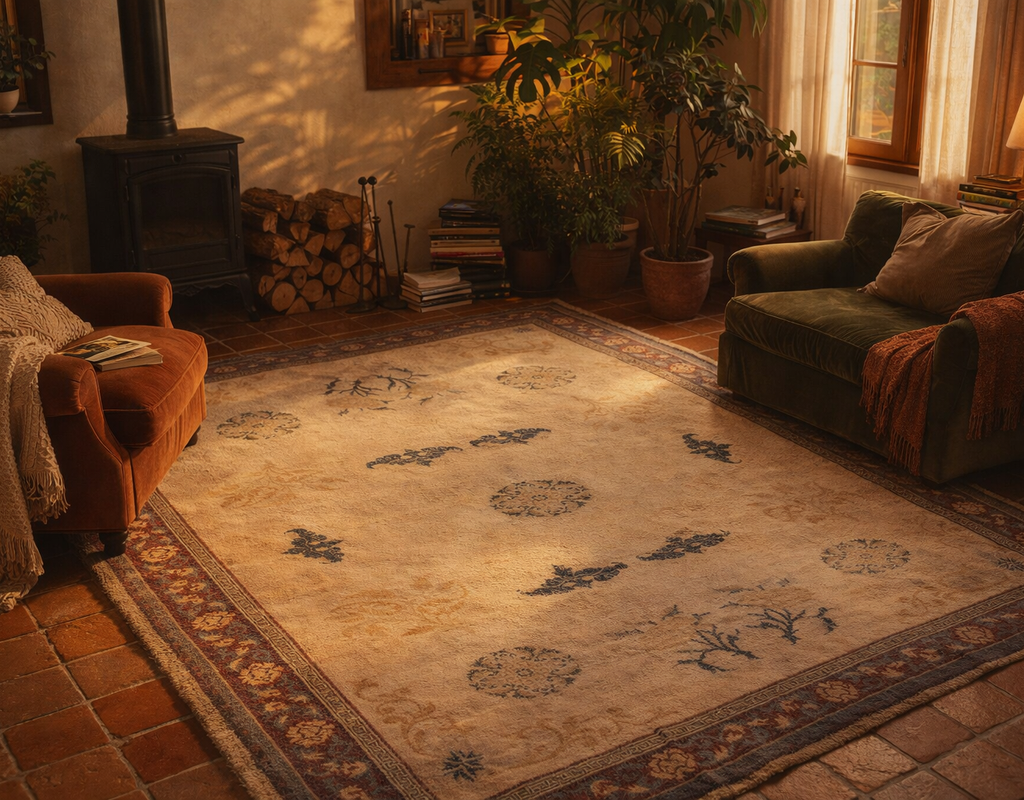
A sunlight-drenched living space centered around a traditional area rug, suggesting comfort and warmth.
Many pieces evoke the imagery of a Mughal garden—an Eden-like “garden in bloom”—with patterns that suggest fertility, paradise, and harmony with nature. Unlike more rigid geometric Indian carpets, these floral Indian carpets are praised for their fluidity and painterly rhythm, each rug resembling a tapestry of endless blossoms.
Color Palette and Materials
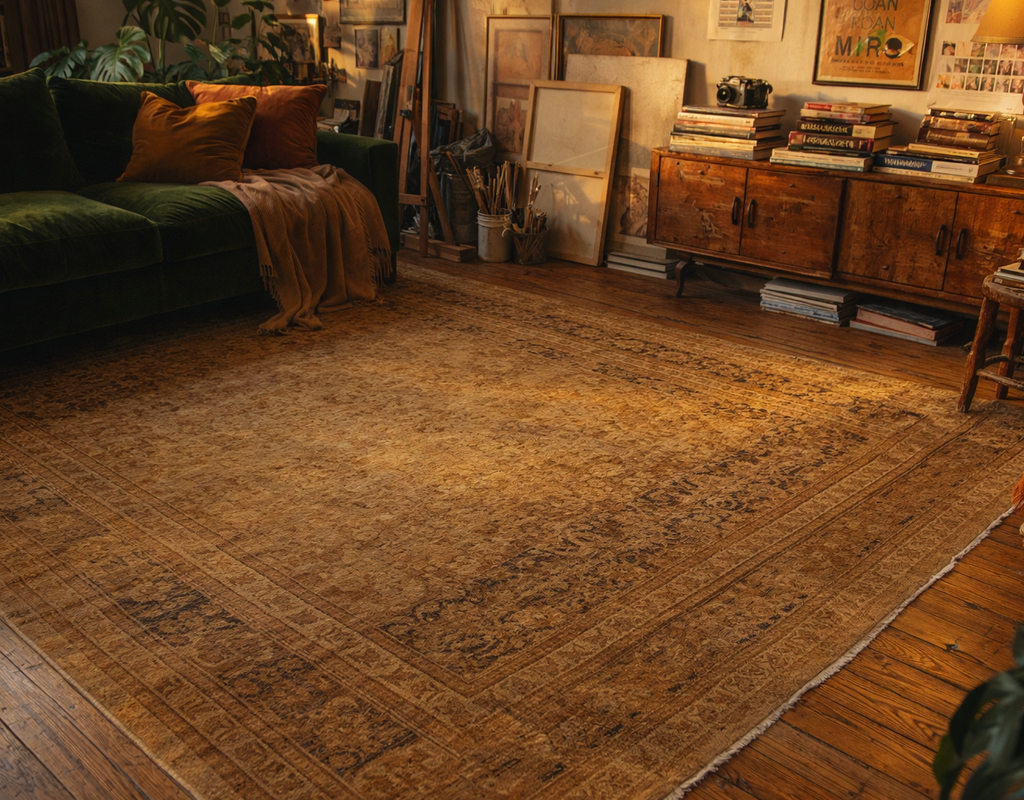
Golden light illuminates the rich textures and vintage elements of this cozy, art-filled living space.
- Earth tones dominate — Why: Beiges, sands, pale blues, and sage greens reflect Western interior tastes of the 19th century, making Amritsari weavings versatile for drawing rooms and salons.
- Subtle metallics and pastels — Why: Muted golds and dusky silvers create a gentle tonal range, enhancing elegance without overwhelming.
- Strategic accent colors — Why: Burgundy, aubergine, and rust were used sparingly to provide depth and contrast, ensuring vibrancy while preserving a soft atmosphere.
- Luxurious fibers — Why: Many were woven with fine wool, often pashmina, on a cotton foundation, giving the rugs both strength and sheen.
This combination made Amritsar’s color story distinct: more subdued and Western-friendly than the brighter jewel tones common in Persian or Indian court carpets.
Construction: Weave, Knotting, Pile
Technically, Amritsar rugs employ the asymmetrical Persian knot—a feature that enabled delicate curves in floral motifs. Knot density typically reached 100 knots per square inch or more, placing these rugs in the high-quality tier of Indian weaving.
The pile, woven in wool on cotton with a double weft, is dense yet soft, medium in height, and remarkably supple underfoot. This texture explains why Amritsar weavings are considered soft pile antique rugs, prized for comfort as well as beauty.
Distinctiveness vs. Other Indian Rugs
What sets Amritsar apart is its adaptation to Western tastes during the 19th century. Where Persian and Mughal carpets often showcased saturated colors and bold contrasts, Amritsari rugs leaned into subtle tonalities, aligning with Victorian and Edwardian interiors.
Their botanical carpet motifs and muted palettes made them especially appealing to collectors and households abroad, distinguishing them from the brighter tribal and village rugs of India.
To answer directly: traditional Amritsar carpet patterns are defined by floral and botanical all-over motifs, their knot density averages around 100+ knots per square inch, and they are softer than other Punjabi weaves because of the fine pashmina wool and meticulous Persian knotting technique.
In every way, these carpets embody a signature blend of artistry and comfort, making them some of the most refined Persian knot Indian rugs ever woven.
Materials, Sourcing & Techniques
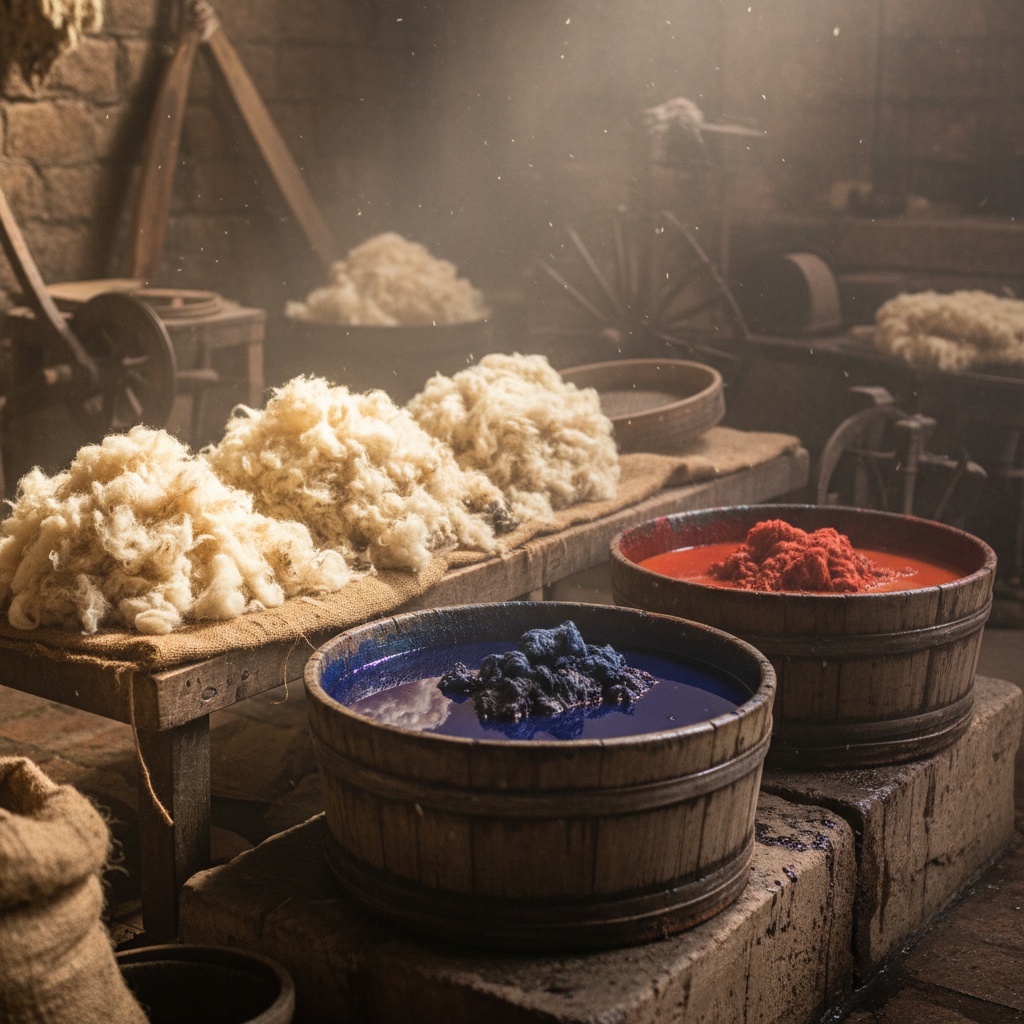
Raw wool ready for vibrant dyeing processes.
Wool Sourcing in Punjab
The hallmark softness of Punjab wool rugs begins with the fibers themselves. In the 19th century, wool was sourced from surrounding Punjab districts such as Gurdaspur, Amritsar’s own hinterlands, and areas stretching toward Ludhiana and Ferozepur. The finest grades came from Himalayan sheep and goats, particularly prized for producing pashmina-quality fibers.
This supply chain ensured a steady flow of durable, silky wool that could be spun into the lush, pliant threads characteristic of Amritsar carpets. The city’s location at a regional crossroads gave weavers access not only to local herds but also to trade routes carrying Himalayan fleeces, making Amritsar a natural hub for high-grade wool processing.
Foundation, Pile, and Knot Density
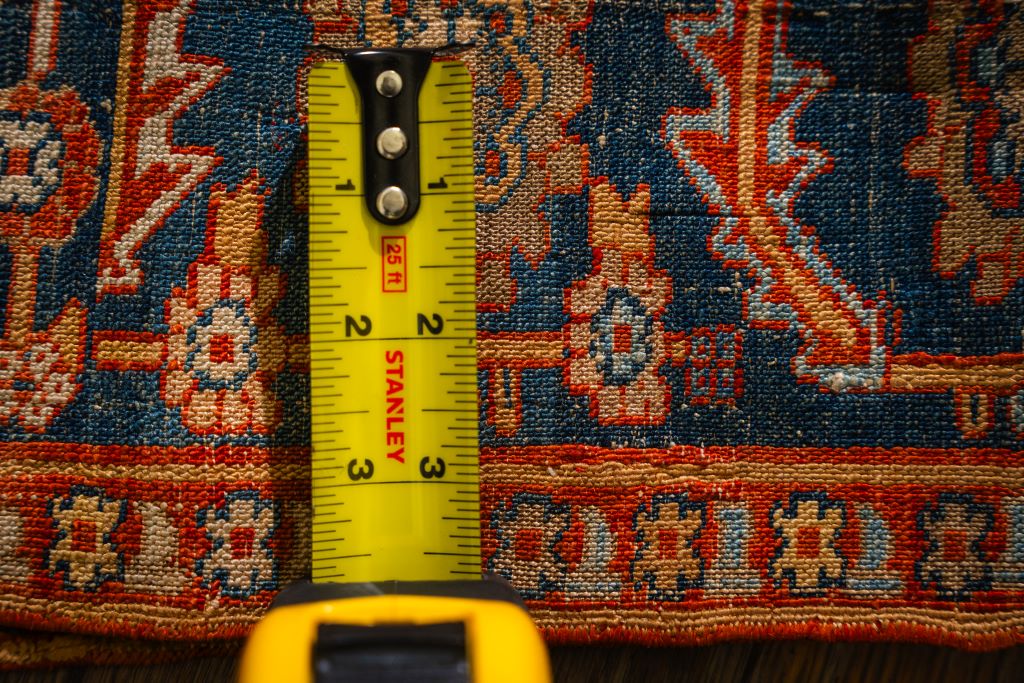
A detailed inspection of a richly colored oriental rug pattern while measuring its dimensions.
Structurally, Amritsar carpets rely on a cotton foundation with double wefts, which adds resilience to the weave. Onto this base, artisans tie the asymmetrical Persian knot, creating precision in curvilinear floral motifs. Knot densities often exceeded 100 knots per square inch, a technical benchmark that allowed for delicate rendering of vines, palmettes, and blossoms.
The pile, woven in Himalayan wool, is medium in height but exceptionally dense and soft. Compared with other Indian rugs, this construction produced textiles that balanced durability with tactile luxury, explaining why Amritsar weavings are consistently recognized among the softest pile Indian rugs.
Dyeing Methods and Climate Impact
Early Amritsar production relied on natural dyes: indigo for blues, madder for reds, henna for browns, and pomegranate rind for yellows and golds. These vegetal sources lent depth and subtlety to the carpets, producing shades that mellowed beautifully with age. In the late 1800s, however, synthetic aniline dyes entered workshops under British influence, offering brighter hues and faster production, though sometimes at the expense of durability. The climate of Amritsar—marked by hot summers and monsoon humidity—had a tangible impact on dyeing.
Humidity altered dye uptake, often leading to abrash, or gentle variegation in color, which collectors today value as a marker of authenticity. Consistency was harder to maintain in such conditions, but this irregularity contributed to the living character of Amritsar carpets. Today, most commercial production relies on synthetics, but a few high-end workshops continue to employ natural dyeing methods, preserving traditional palettes and artisanal integrity.
Punjab districts such as Amritsar, Gurdaspur, and Ludhiana historically supplied wool to weavers, Amritsar’s humid and hot climate shaped the dyeing process by influencing absorption and creating abrash, and while natural dyes are rare in modern workshops, a small circle of artisans still uphold this heritage. Together, these elements—Himalayan wool, Persian-knot construction, and climate-affected dyeing—form the technical DNA of the Himalayan wool carpets woven in Amritsar.
Regional and Stylistic Variations
Lahore, Kashmir, and Punjab Connections
Amritsar’s weaving must be understood as part of a North Indian carpets continuum rather than as an isolated tradition. Lahore carpets, woven just across the Punjab frontier (now in Pakistan), share the same Indo-Persian lineage of scrolling vines, medallions, and floral fields. Meanwhile, Kashmir rug influence is evident in Amritsar’s technical finesse: the adoption of fine knotting techniques, Persianate motifs, and the use of high-quality pashmina wool originated in Kashmir and filtered southward into Amritsari looms.
This interconnection reveals a cultural and technical overlap, with Punjab serving as a crossroads of Mughal design traditions, Kashmiri artistry, and British colonial patronage. For collectors and investors, this broader cluster—Lahore, Amritsar, Kashmir—represents a web of production centers with shared DNA yet distinct outputs.
Formal vs. Decorative Substyles
- Formal rugs (medallion and hunting-scene types) — Why: These rarer carpets reflect courtly Mughal precedents and were likely woven for elite or ceremonial use, with dense narrative detail and symmetry.
- Decorative rugs (all-over floral patterns) — Why: The majority of Amritsar production falls here, with continuous botanical fields designed for Anglo-Indian and Western interiors. Their flexibility and elegance made them highly marketable in Victorian parlors and drawing rooms.
These Indian rug substyles allow buyers to choose between museum-level rarities and more versatile decorative pieces, each with its own cultural resonance.
Workshop vs. Cottage Industry Rugs
- Amritsar jail carpets (institutional workshops) — Why: Produced under strict supervision, these rugs display consistent knot counts, balanced compositions, and adherence to classical Indo-Persian templates. Their reliability suited large-scale exports.
- Cottage and family workshop rugs — Why: Woven in homes or small ateliers, these carpets often show charming individual flourishes, variations in design, or subtle irregularities. Collectors prize them for their human touch and unique character.
The coexistence of Amritsar jail carpets and family-made pieces ensured a rich spectrum of quality and style, expanding the city’s reach across markets from local elites to global buyers. To answer directly: yes, investors should consider Punjab clusters beyond Amritsar—notably Lahore and Kashmir—because these regions share techniques and designs that enrich the category of North Indian carpets.
Together, they form a complementary triad, where Amritsar shines for decorative botanical rugs, Kashmir for silk finery, and Lahore for classical Indo-Persian grandeur. This interconnectedness adds both depth and diversity to the world of Indian rug substyles.
Cultural & Symbolic Relevance
Symbolism in Motifs
- Lotus blossoms — Why: In both Indian and Persian traditions, the lotus symbolizes purity and spiritual awakening, making it a recurring feature in Indian rug symbolism.
- Roses and garden vines — Why: These motifs represent love, harmony, and paradise, directly echoing the Mughal conception of the rug as a “garden underfoot.”
- Scrolls and palmettes — Why: Their endless repetition suggests eternity and cosmic order, blending Islamic and Indian visual languages.
Through these designs, Amritsar rugs embody an aesthetic of balance, harmony, and sacred paradise, aligning daily life with cultural ideals.
Sikh Heritage and Artistic Influence
The Punjab artistic heritage of the Sikh era profoundly shaped Amritsar’s identity as a craft center. Prosperity under the Sikh Empire created an environment where the arts could flourish, and although weaving only rose after British annexation, the visual sensibility of the Sikh court still influenced design.
Architectural details, frescoes, and manuscripts from the Sikh period carried floral and symbolic themes that parallel Sikh carpet motifs later found in Amritsari production. More broadly, the cultural blending of Punjab—where Sikh, Mughal, Persian, and later British traditions coexisted—ensured that Amritsar carpets bore the imprint of a uniquely layered identity.
Impact of the Golden Temple
The Golden Temple design is not directly copied into carpets, but its influence is unmistakable. The city’s name, meaning “pool of nectar,” references the sacred sarovar around the temple. This imagery of sanctuary, reflection, and divine purity found symbolic echoes in carpet patterns that emphasize enclosed gardens, tranquil floral layouts, and the idea of paradise on earth.
For Amritsar’s weavers, the Golden Temple was both a spiritual anchor and an artistic inspiration, shaping the sense of serenity and sacred beauty woven into the rugs.
Amritsar Rugs as Colonial and Modern Status Symbols
During the Victorian period, colonial Indian art in the form of Amritsar carpets became a mark of cosmopolitan worldliness. Their muted colors and expansive floral fields appealed to Western interiors, turning them into luxury symbols of taste for British officers, merchants, and aristocrats. To own an Amritsari rug was to signal engagement with both Eastern artistry and Western refinement.
Today, these same qualities resonate with modern buyers. Collectors prize them not only for their tactile softness and decorative elegance but also for their hybrid heritage, which fuses Mughal symbolism, Sikh-era cultural grounding, and colonial adaptation. To answer directly: Sikh heritage influenced Amritsar carpet motifs by embedding floral and symbolic designs rooted in Punjab’s cultural identity, while the Golden Temple shaped the city’s rugs through themes of sanctuary, harmony, and sacred beauty.
Together, these influences ensure that Amritsar carpets remain woven records of spiritual and cultural resonance.
Modern Market and Legacy
Collecting Antique Amritsar Rugs
- Rarity and age — Why: Genuine antique Amritsar carpet collecting focuses on pieces woven between the 1850s and 1930s, which are increasingly scarce on the market.
- Subtle palettes and softness — Why: Collectors value the muted earth tones, botanical all-over designs, and silky pile that distinguish authentic Amritsar pieces from brighter Persian or Indian rugs.
- Artistic status — Why: Museums and leading designers treat antique Amritsar rugs as art objects, elevating them beyond decoration to high-design investments.
- Market demand — Why: Their cross-cultural aesthetic appeals to global buyers, ensuring steady appreciation in price at auction and in private collections.
Modern Production and “Amritsar Style” Reproductions
While authentic antique pieces remain rare, “Amritsar style” rugs are still produced today—though often outside Amritsar itself. Weaving centers such as Jaipur and Bhadohi create reproductions inspired by the soft palettes and floral layouts of Amritsar designs. These rugs cater to international buyers who want the look but cannot access or afford a true antique.
However, the distinction is critical: in the present market, “Amritsar” often refers to a stylistic category rather than a geographic origin. For authenticity, collectors must verify provenance, construction methods, and materials to ensure they are purchasing an original from Punjab.
Investment and Buying Tips
- Verify provenance — Why: Documentation of origin ensures authenticity and protects buyers against misattributed “Amritsar style” reproductions.
- Examine knotting and pile — Why: Antique pieces will show Persian-knot construction and a dense but soft pile, key markers of quality.
- Check dye and wear — Why: Natural dyes show age with graceful fading, whereas synthetic dyes from later periods often appear harsh or uneven.
- Be mindful of regulations — Why: Exporting Amritsar carpets does not face unique restrictions, but buyers should comply with India’s general cultural heritage laws on antiques.
- Negotiate in person — Why: Visiting Amritsar’s Hall Bazaar or other Punjab markets can help buyers negotiate, but prices for true antiques are rarely discounted significantly due to their rarity.
For those considering where Amritsar ranks among Mughal-inspired designs, the answer is high: Amritsar rugs stand beside the finest Indo-Persian carpets, unique for their Victorian-adapted color schemes and botanical elegance.
In summary, the Amritsar rug investment market is defined by its emphasis on antique originals, while modern weaving in Jaipur and Bhadohi sustains the style for broader audiences.
The legacy remains intact: to buy Indian rugs of Amritsari type is to participate in a tradition that bridges Mughal gardens, Sikh heritage, and colonial adaptation, carried into the present as both art and asset.
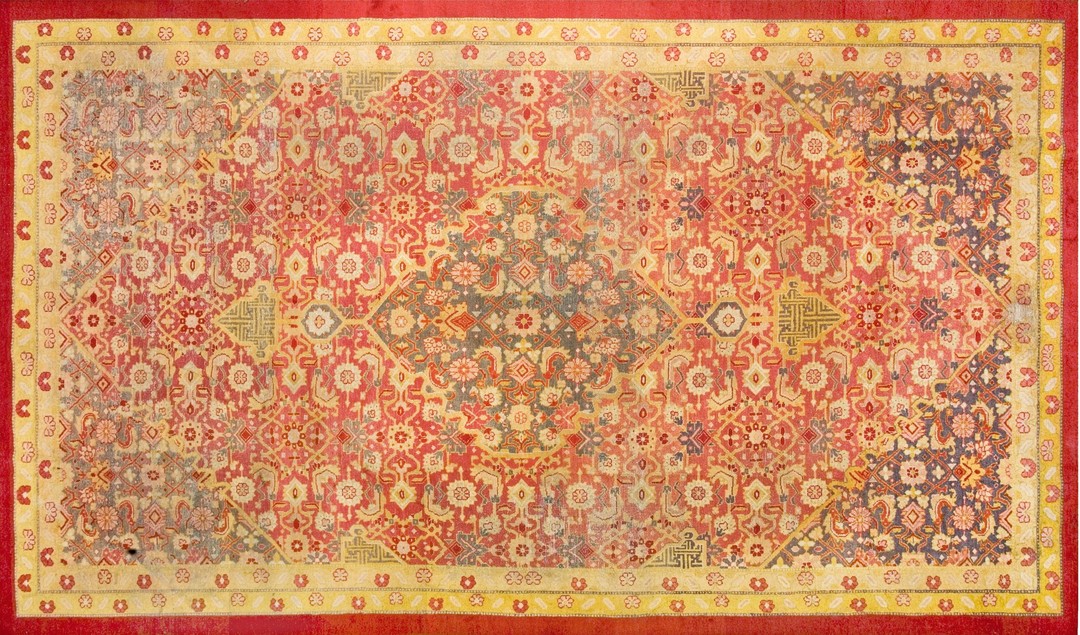
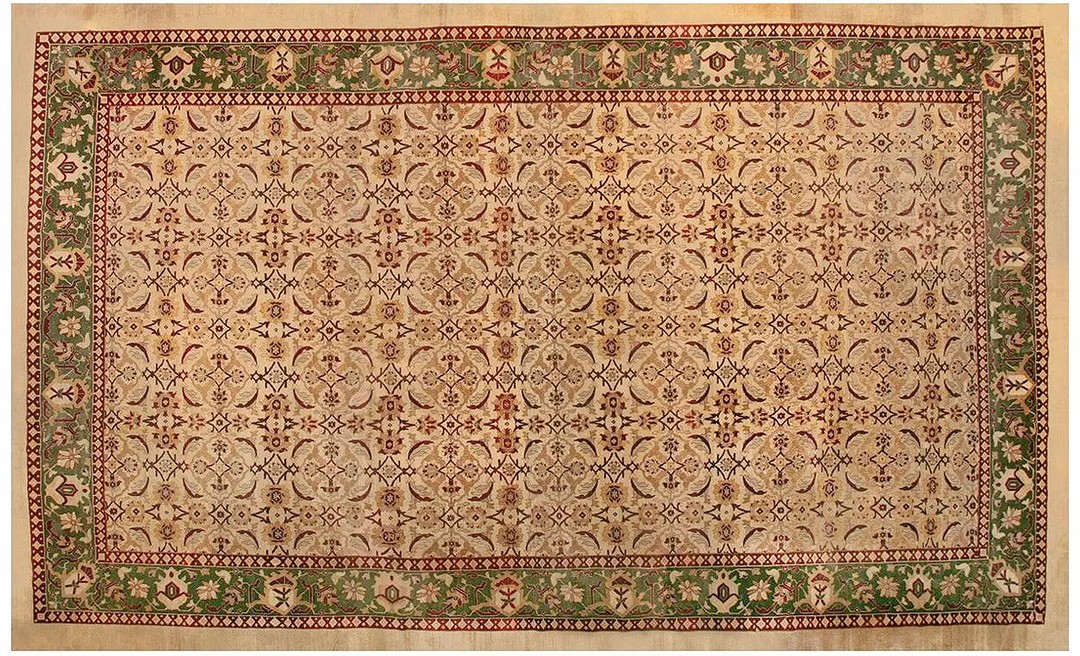
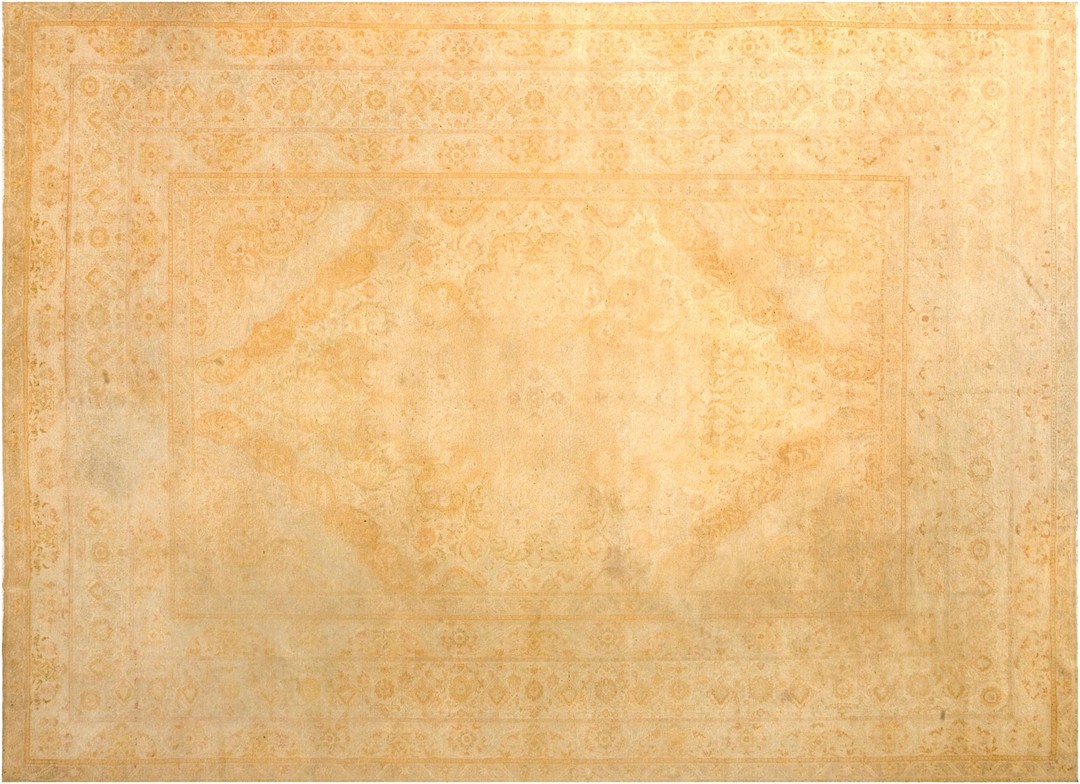
Explore a Few of Our Favorite Amritsar Rugs
FAQ
- Will Amritsar rugs work with modern or minimalist decor?
Absolutely. Their soft, earthy palettes and allover florals layer beautifully with neutral rooms; a 9×12 Amritsar rug can anchor open-plan seating without visual clutter.
- What rug pad should I use under Amritsar rugs?
Use felt or felt-and-natural-rubber pads cut 1–2″ smaller than the rug. They add cushion, protect floors, and extend rug life—especially on hardwoods or radiant heat.
- Are Amritsar rugs vegetable-dyed or synthetic-dyed?
Many antique Amritsar rugs use natural dyes; later pieces may include early synthetics. Black/brown outlines sometimes show “dye corrosion,” thinning pile over decades.
- How should I store Amritsar rugs to prevent damage?
Clean, dry, then roll (never fold) and wrap in breathable material like Tyvek; avoid damp areas. For moth prevention, vacuum edges regularly and inspect every few months.
- Do Amritsar runners exist for hallways?
Yes—Amritsar runners can be unusually long (20′+). They’re excellent for galleries and corridors when paired with a non-slip pad.
- What is the typical knot density of Amritsar rugs?
Many Amritsar rugs fall in a medium range—roughly \~80–150 KPSI—though finer or coarser weaves exist. Knot count isn’t the only quality metric.
- Are Amritsar rugs a good investment?
Quality examples can hold value, but markets vary. Focus on condition, color, scale, and design; oversize pieces (e.g., 12×18) and sought palettes often command premiums.
- How do you pronounce “Amritsar” in Amritsar rugs?
“AM-rit-sar” (um-RIT-sar). The city is in Punjab, India, home to the Golden Temple.
- Where can I buy authentic Amritsar rugs in the US?
Check reputable specialist dealers and major auction houses; review condition reports, returns, and provenance. For antiques, ask for a written appraisal and care guidance.
- What is the “Salting” design seen in some Amritsar rugs?
It refers to late-19th-century Indian carpets echoing famous museum pieces collected by George Salting—intricate, historical patterns adapted for export. Sizes often exceed 12×15.
- Do Amritsar rugs fade in sunlight?
Direct UV will fade Amritsar rugs over time. Use shades or UV film and rotate the rug 180° every 6–12 months to even exposure.
- Can robot vacuums be used on Amritsar rugs?
Cautiously. Set “no-go” zones over fringe, use low suction, and monitor first runs—dark fields can confuse cliff sensors. A canister vacuum with brush-roll off is often safer.
- Can I use Amritsar rugs over underfloor heating?
Yes—pair Amritsar rugs with breathable pads and keep rug + pad thermal resistance under \~2–2.5 tog. Avoid thick rubber backings; wool and cotton foundations handle moderate heat well.
- Are Amritsar rugs good for homes with pets and kids?
They can be—choose mid-tone, patterned Amritsar rugs to mask messes, use a pad, and address accidents immediately. Avoid bright, pale antiques in dining/play zones.
- What’s the basic cleaning routine for Amritsar rugs?
Vacuum with suction-only (no beater bar) and blot spills promptly using cool water and wool-safe detergent. Plan a professional wash about once a year for frequently used pieces.
- Are Amritsar rugs durable for high-traffic rooms?
Yes—wool pile is resilient. Use a quality rug pad and rotate every 6–12 months to even wear; avoid dragging heavy furniture and protect high-traffic paths.
- How do Amritsar rugs compare to Persian city rugs (e.g., Kashan/Tabriz)?
Amritsar rugs lean Western in palette and favor open, allover florals; Persian city rugs often feature centralized medallions and tighter drawing. Materials overlap (wool pile, cotton warp/weft).
- How can I verify an Amritsar rug is hand-knotted, not machine-made?
Flip it: you should see individual, slightly irregular knots and an integral fringe (warp ends), not a sewn-on fringe or latex/fabric backing. Pattern on the back should mirror the front.
- How much do Amritsar rugs cost?
Prices vary by size, age, and condition: late-19th-century room-size Amritsar rugs can realize \~£10k–£20k at auction, while dealer listings for large fine examples often range \$20k–\$50k+.
- Are Amritsar rugs still made today?
Antique Amritsar rugs are prized, and modern “Amritsar-design” rugs are still woven in India. Look for GoodWeave labels to ensure ethical production and traceable supply chains.
- What sizes do Amritsar rugs commonly come in?
Most are room-size—8×10, 9×12, 10×14—and oversize pieces (12×18+) exist. Long runners are found too, including lengths over 20 feet.
- What patterns and colors are typical in Amritsar rugs?
Expect allover palmettes, millefleur sprays, and scrolling vines in light blues, golds, teal, rust, and aubergine. Borders often echo floral motifs with gentle abrash from natural dyes.
- What materials and construction define Amritsar rugs?
Traditional Amritsar rugs use high-quality wool pile on cotton foundations, typically double-wefted with asymmetrical (Persian) knots. Medium knot densities are common.
- What distinguishes Amritsar rugs from Agra rugs?
Amritsar rugs favor large, curvilinear florals and soft, Western-leaning palettes (mauve, teal, burgundy). Agra rugs often show Mughal-influenced gardens and lavender/rust tones; both can be room-size (e.g., 10×14).
- What are Amritsar rugs?
Amritsar rugs are hand-knotted carpets from Amritsar, India, woven mainly in the late-19th/early-20th centuries for Western taste. Expect wool pile, refined florals, and spacious layouts in room sizes like 9×12 and 12×18.