
Introduction to Heriz Rugs
Explore our handpicked collection of authentic Heriz Serapi rugs available for your home.
What Is a Heriz Rug?
- Heriz Persian rug — Why: These carpets originate from the Heris district of Northwest Iran and are instantly recognizable for their large central medallions and bold, angular motifs.
- Village-made carpet — Why: Unlike finely detailed city rugs, Heriz rugs are woven in villages by families who rely on memory and inherited patterns, giving them a more spontaneous, folk-art character.
- Geometric Persian rug — Why: Their design language favors sharp, rectilinear lines and bold geometric symmetry, distinguishing them from the flowing curvilinear motifs of urban carpets like Isfahan or Kashan.
- NW Iran rug — Why: The geographical location provides not only cultural distinctiveness but also wool of exceptional strength, attributed to copper-rich mountain water in the region.
- Azeri rug — Why: The Azeri-speaking community of the Heris district maintains this weaving tradition, embedding its cultural identity into every hand-knotted piece.
Geographic and Cultural Origins
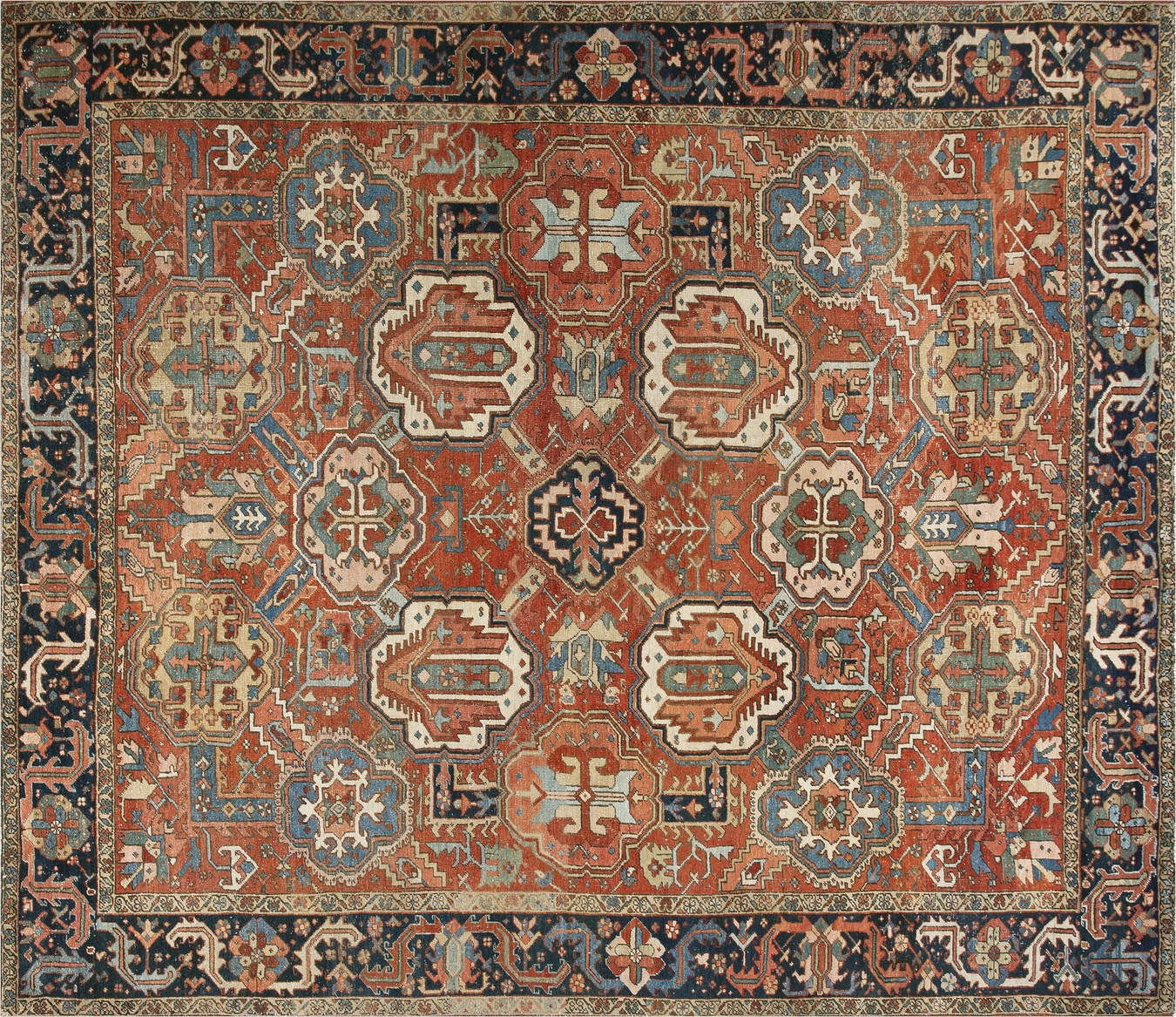
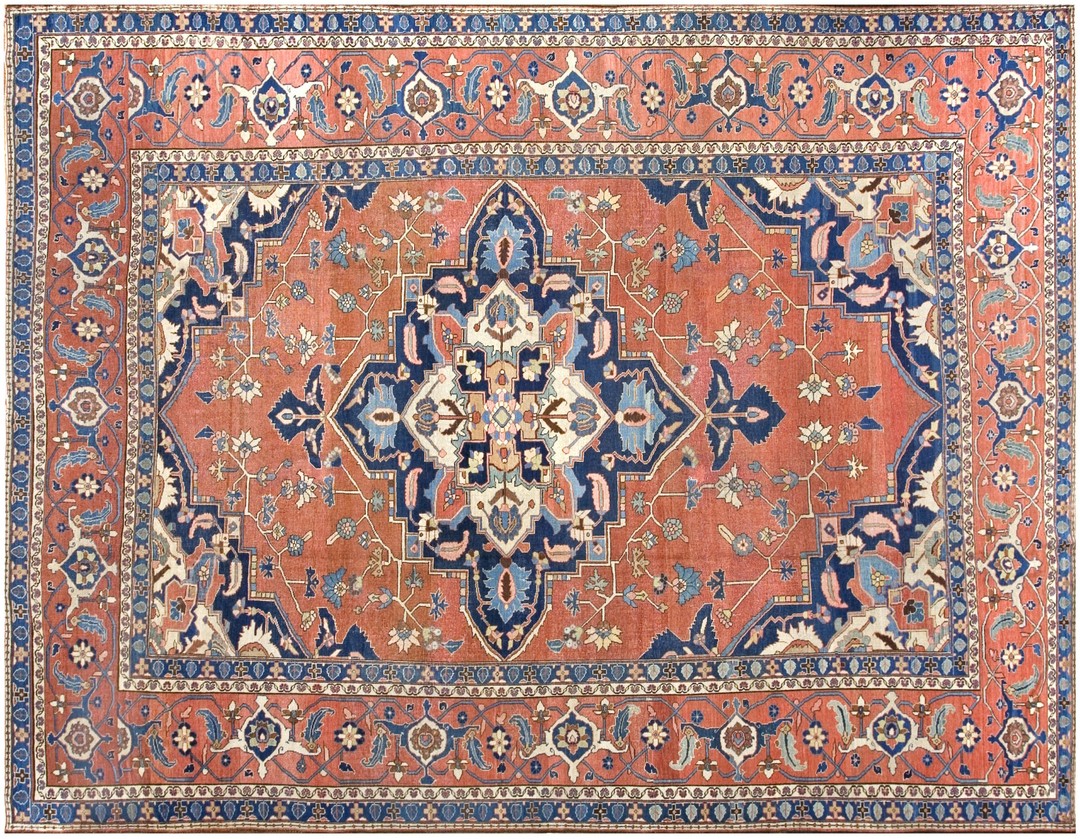
Antique Heriz Room Size Wool Coral Rug – by Rugs On Net
Heriz rugs come specifically from the Heris district in Northwest Iran, a mountainous area near Tabriz. This setting shapes both their style and substance. Unlike urban carpets, which were often produced in organized workshops under strict design supervision, Heriz rugs are woven in villages. Each weaver works from memory, passing down motifs through generations rather than following a paper cartoon. This results in bold improvisations, minor asymmetries, and a raw expressiveness that collectors prize.
The makers of these rugs are largely from the Azeri community, a Turkic-speaking group with deep roots in the Caucasus and Iranian Azerbaijan. Their weaving reflects not only technical skill but also cultural storytelling. Everyday life, family tradition, and symbolic motifs find their way into the warp and weft, ensuring that each Heriz rug feels deeply personal and local rather than manufactured for export alone. The contrast with city carpets is stark: urban pieces may achieve delicate precision, but Heriz rugs radiate durability and authenticity, born from village life and intended for long-term use in homes.
Significance in Persian Weaving
Within the broader tradition of Persian carpets, Heriz rugs hold a special place. They are renowned for balancing artistry with practicality. While their geometric style sets them apart from the refined floral curvilinear patterns of Kashan or Qom, their durability makes them household favorites worldwide. A Heriz Persian rug can withstand heavy foot traffic, making it not only a decorative centerpiece but also a functional, long-lasting floor covering. One enduring belief attributes their toughness to the copper-rich water sources of the Heris region.
The sheep that graze there are said to grow exceptionally strong, lustrous wool, providing a natural advantage to the weavers. This folklore adds to the aura of resilience associated with Heriz rugs and further explains why they remain so sought after in modern interiors. Heriz rugs also symbolize the strength of village-made Persian carpets in preserving identity amid changing times. Despite globalization and mechanized production, the weaving culture of Heris has maintained its handmade authenticity.
These rugs stand as cultural emblems of NW Iran, embodying both the Azeri people’s heritage and Persia’s wider artistic legacy. In sum, a Heriz rug is not merely a floor covering—it is a woven record of place, community, and endurance, celebrated for its striking geometry, vivid palette, and the lived traditions it carries forward.
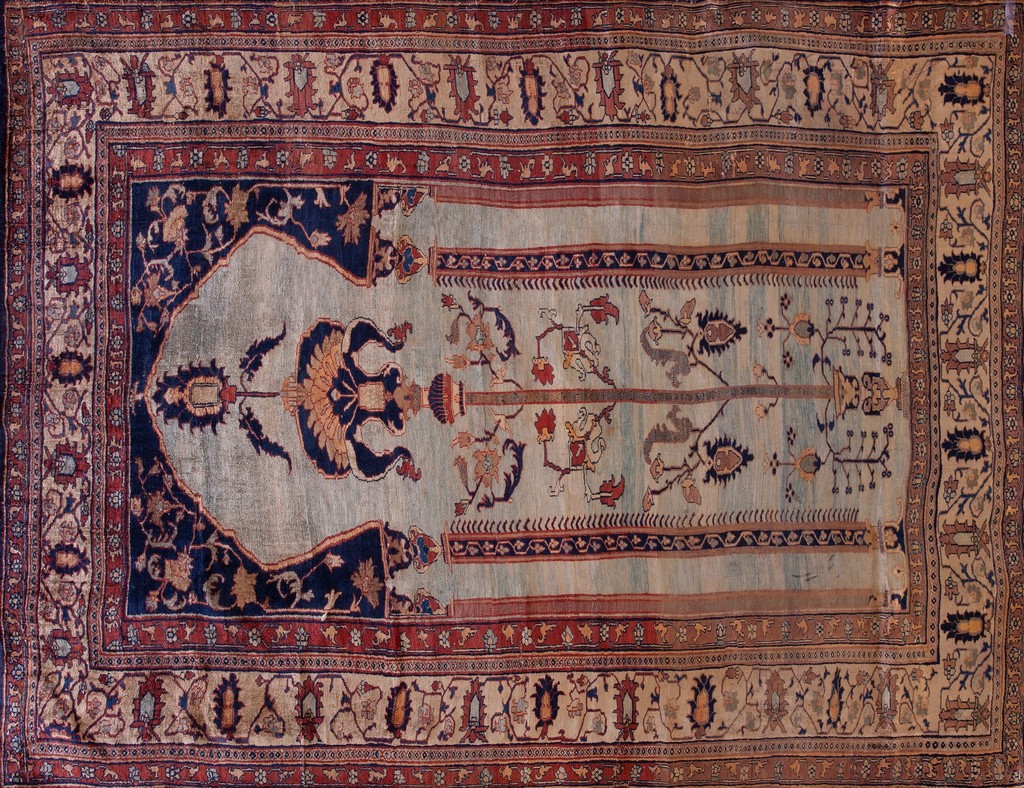
Antique Small Scatter Size Sky Blue Fine Persian Silk Heriz Muslim Prayer Rug by Rugs On Net
Name, Etymology, and Protected Status
The Heriz/Haris Name
The Heriz rug etymology traces directly to the town of Heris (هريس) in East Azerbaijan Province, Northwest Iran. In Western sources, the spelling “Heriz” is common, though “Heris” or “Haris” appear interchangeably. All three refer to the same weaving district, making the name itself a marker of geographic authenticity. By contrast, the trade term “Serapi” does not refer to a town.
Instead, it emerged in Western rug markets as a label for especially fine or large-scale Heriz carpets, often with softer palettes or more spacious designs. Some scholars suggest “Serapi” may have derived from Sarab, another town in the region, though no local weaving tradition by that name exists. The essential point is that Serapi is a trade designation, not a geographical origin, and its usage can sometimes mislead buyers.
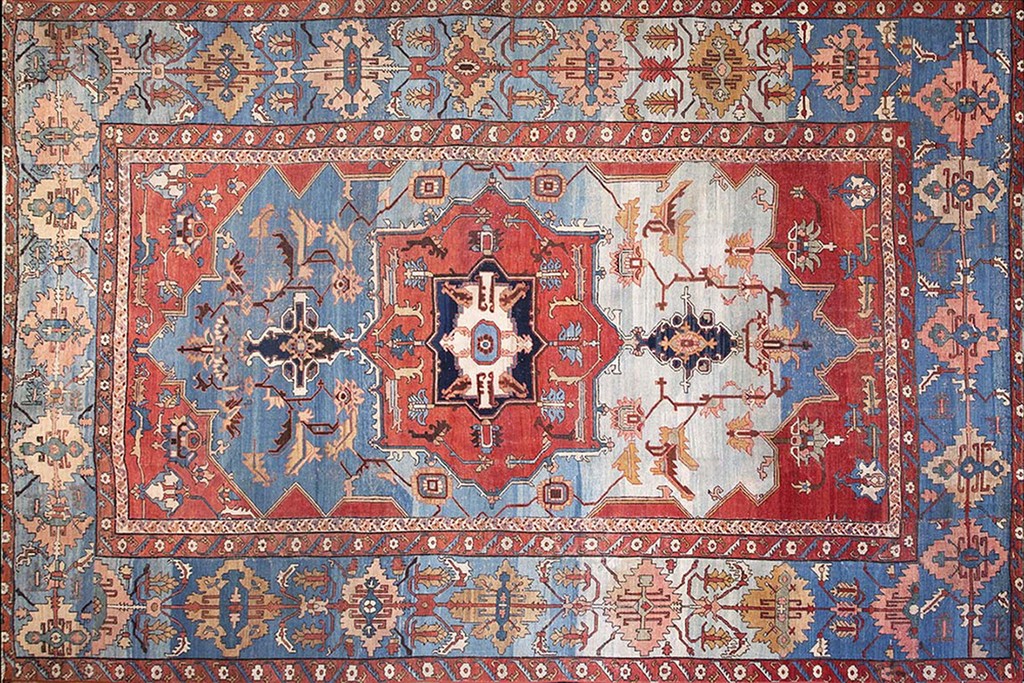
Antique Serapi Large Room Size Wool Blue Rug by Rugs On Net
Legal Appellation & Geographical Indication
- Iran registered “Heris/Heriz Handmade Carpet” as a protected geographical indication in 2013 — Why: This legal recognition ensures that only rugs woven in the Heris district can be marketed under the “Heriz” or “Heris” name within Iran, safeguarding the authenticity of production.
- Geographical Indication (GI) protection supports local weavers — Why: By tying the name to its exact place of origin, the law prevents mislabeling and strengthens the economic sustainability of village weaving communities.
- Authenticity verification through GI status — Why: Buyers can feel more confident when rugs come with certificates or documentation linking them to the Heris region, especially when purchased from reputable dealers.
For collectors wondering how to verify authenticity before investing in a Heriz rug, the most reliable steps include purchasing from trusted dealers, looking for provenance documentation or GI certification, and examining hallmarks of the type—strong wool pile, bold geometric medallion layouts, and the telltale angular design language of a true Heris carpet.
When these criteria align with verified origin, buyers can be assured they are acquiring an authentic Heriz and not a lookalike from another region.
Regional & Cultural Context
The Heris District and Neighboring Villages
The Heriz region lies in East Azerbaijan, northwest Iran, not far from the city of Tabriz. While Tabriz is famous for its sophisticated workshop carpets, Heriz is defined by its village carpet traditions. The district encompasses numerous weaving villages, each with subtle stylistic signatures—Gorevan, known for expansive medallions; Bakhshaish, for balanced geometric order; Karaja, with its smaller-format rugs featuring triple medallions; Mehraban and Ahar, both contributors to the broader regional identity.
Together, these villages create a tapestry of styles that collectively fall under the Heriz name, their shared geography and cultural fabric uniting them as a single weaving tradition.
Village Weaving Traditions vs. Workshop Rugs
Heriz weaving differs fundamentally from the finely organized carpets of cities like Tabriz. Workshop rugs are produced in centralized ateliers, guided by detailed paper cartoons, with professional weavers executing designs to precise specifications. By contrast, Heriz rugs are woven in homes by families, often without formal templates.
Designs are drawn from memory, resulting in bold improvisations and occasional asymmetries that give each rug individuality. This village-made character imbues Heriz carpets with authenticity, charm, and a sense of folk art rarely found in urban pieces. They are not just floor coverings but expressions of rural life, family heritage, and cultural storytelling.
Weaving Demographics
The population of Heris is largely Azeri, a Turkic-speaking community with strong cultural ties to the Caucasus and Iranian Azerbaijan. Their influence is visible in the angular forms, geometric precision, and symbolic motifs of the Azeri Persian rug tradition. Weaving in Heriz was historically a cottage industry, with women playing the central role. Carpets were often woven as part of a dowry, ensuring both economic and symbolic significance within family life.
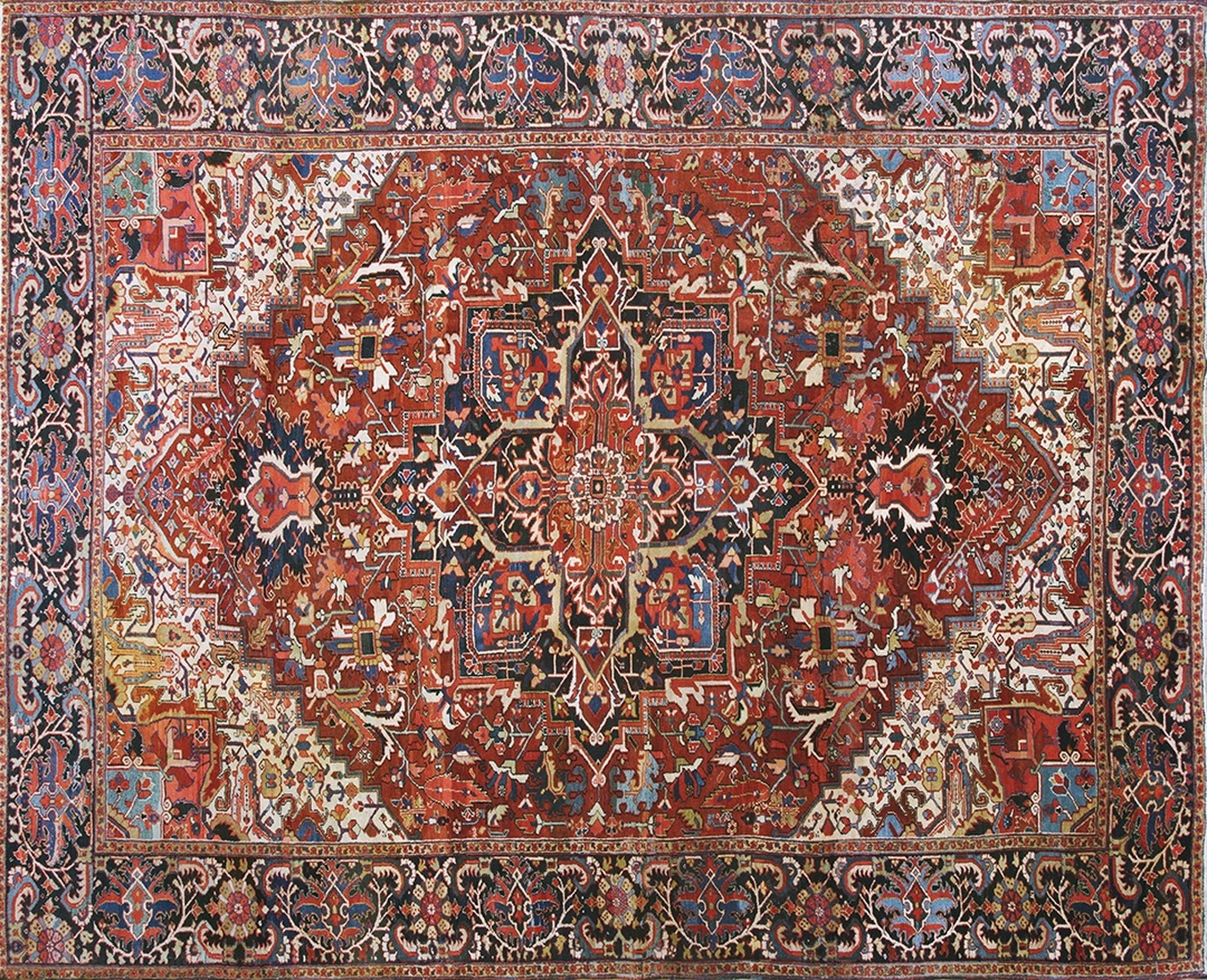
Antique Heriz Persian Coral 1935 Rug – by Rugs On Net
Patterns and motifs were passed orally and visually from mother to daughter, embedding folklore, environment, and belief systems into the textile. The cultural symbolism is profound: angular leaves, stylized flowers, and strong medallions not only decorate but also narrate the weaver’s world. Each rug becomes a woven record of Azeri folklore and environment, carrying forward motifs that may represent protection, fertility, or spiritual order. As for materials, traditional Heriz rugs use hand-spun wool for the pile, renowned for its strength due to copper-rich mountain pastures.
The foundation is typically cotton warp and weft, giving the carpet stability and allowing for large-scale weaving. Natural dyes—deep madder reds, indigo blues, and ivory tones—complete the palette, reinforcing both durability and visual power. In sum, the Heriz carpet is the product of village identity, Azeri culture, and family-based weaving traditions, distinct from the formal precision of city workshops yet every bit as significant in Persian weaving heritage.
Design Characteristics of Heriz Rugs
The Medallion Layout: Defining Features
- Dramatic central medallion — Why: The hallmark of a Heriz medallion rug is its commanding star-, diamond-, or lobed-shaped centerpiece. This bold element anchors the entire design, radiating energy across the field.
- Angular spandrels — Why: Each corner of the rug typically contains sharply defined spandrels that mirror or echo parts of the central form, creating a balanced geometry.
- Symmetry with variation — Why: Though medallions and spandrels maintain symmetry, village weaving allows for slight improvisations that make each carpet unique, reflecting memory-based artistry rather than rigid templates.
Color Palette and Dye Sources
The color identity of a madder red rug from Heriz is distinctive. Weavers traditionally relied on natural dyes: deep reds derived from madder root, indigo blues from local plants, and ivory from undyed wool. Accents of green, gold, pink, and ochre provide vibrancy. Over time, these natural dyes mellow and produce abrash—gentle striations in color that collectors prize as signs of authenticity and hand-dyeing. In contrast, Tabriz carpets, produced in urban workshops, favor a more extensive palette and smoother blending of tones. Their curvilinear designs often employ pastel shades and subtle transitions. Heriz, by comparison, is bolder and earthier, with powerful contrasts that emphasize geometry rather than painterly finesse. Modern Heriz rugs may incorporate synthetic dyes, but traditional examples showcase the organic, time-softened brilliance that sets them apart.
Geometric Motifs & Symbolism
- Rectilinear floral rug motifs — Why: Flowers, leaves, and palmettes are translated into angular, geometric interpretations, embodying the weavers’ folk-art approach.
- Serrated leaves and turtle palmettes — Why: These recurring designs symbolize protection, continuity, and the natural cycles of life, often stylized with jagged outlines that reinforce the boldness of the rug.
- Lotus or sun medallion — Why: The medallion itself frequently symbolizes enlightenment, rebirth, or cosmic order, anchoring the design in spiritual as well as visual balance.
- Motifs woven from memory — Why: Unlike city rugs, Heriz carpets are not copied from formal drawings; each element reflects cultural transmission through family traditions, making symbolism deeply personal and varied.
Borders and Outlining Details
Heriz rugs are known for wide, powerful borders, often enclosing the central field with a series of layered guard stripes. Common patterns include the Herati design (a diamond with curved leaves and rosettes) or large-scale turtle palmettes. Outlining is a defining technique: motifs are edged with contrasting colors, which sharpens their geometric form and heightens visual clarity.
This outlining contributes to the unmistakable geometric Persian carpet look that distinguishes Heriz rugs from their curvilinear counterparts. Heriz carpets stand out for their bold geometry, symbolic motifs, and enduring colors, a design language that has made them some of the most recognizable and enduring Persian rugs in the world.
Materials and Construction
Wool, Cotton, and the Turkish Knot
- Local hand-spun wool — Why: The Heriz region’s sheep graze on pastures nourished by copper-rich mountain water, believed to produce exceptionally strong, lustrous fleece. This wool forms the pile of the hand-knotted Heriz, giving it both softness and extraordinary resilience.
- Cotton foundation — Why: Warp and weft are typically cotton, providing stability and allowing larger rugs to maintain their shape. Cotton selvages and knotted fringes reinforce the structure.
- Turkish knot rug construction — Why: Heriz carpets are woven with the symmetrical Turkish (or Ghiordes) knot, which locks pile yarns securely around two warp threads. This knot type creates a denser, more durable surface compared to the asymmetrical Persian knot, suiting the village’s emphasis on longevity over fineness.
Weaving Techniques: Double Wefting, Knot Density
Heriz rugs are often double-wefted, meaning two horizontal weft threads are inserted after each row of knots. This strengthens the foundation, lending the rug a heavier, more durable handle. Knot density typically ranges from 30 to 100 knots per square inch (KPSI).
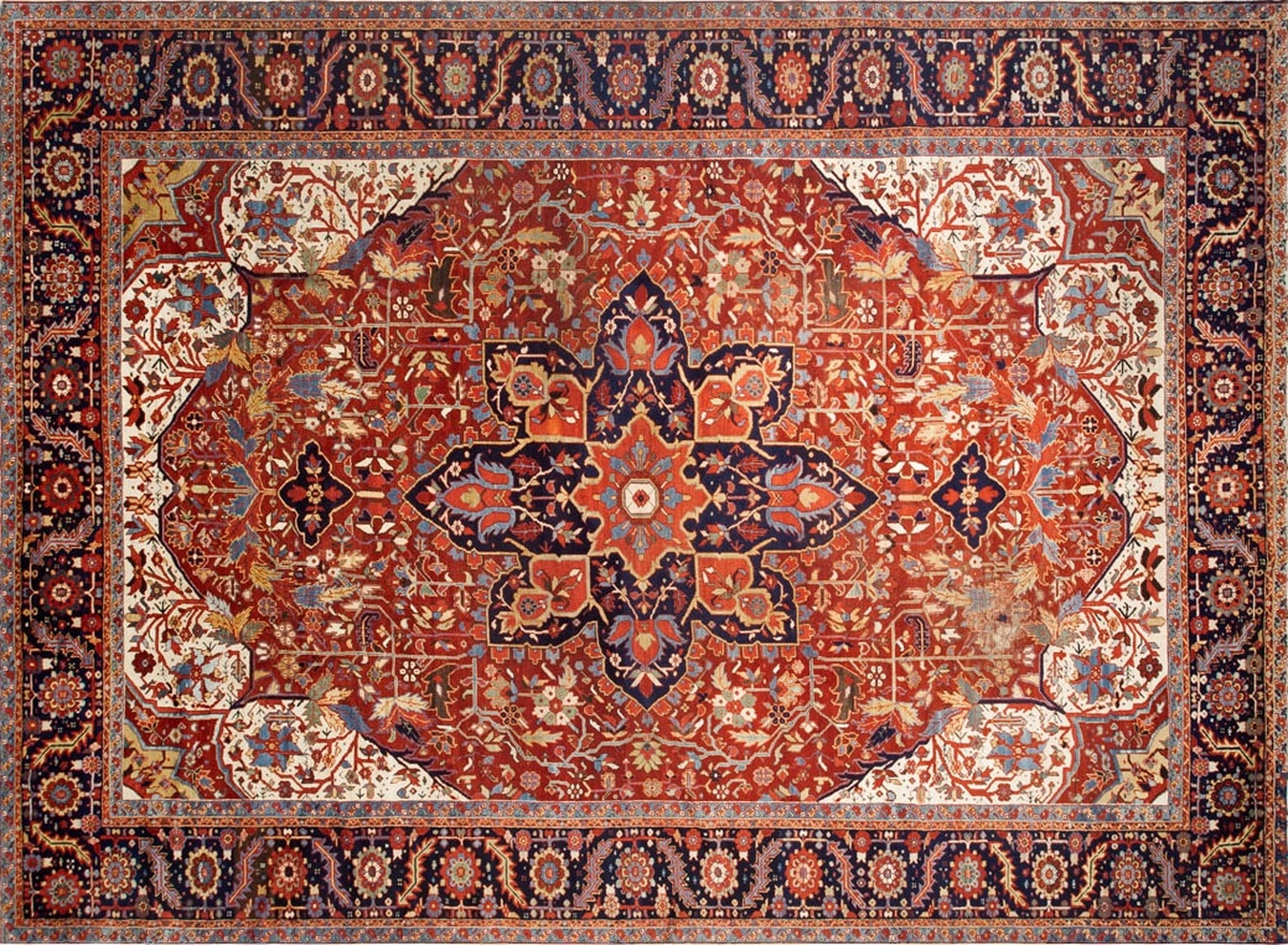
Antique Large Heriz Persian Knotted Rug – by Rugs On Net
While this is considered “medium coarse” compared to city workshop rugs, it is intentional. The density strikes a balance between design clarity and structural toughness—making a Heriz a durable Persian rug designed to be used, not merely admired.
Natural Dyes vs. Synthetic Dyes
- Natural dye rug tradition — Why: Historically, colors were drawn from natural sources—madder root for red, indigo for blue, walnut husks for brown, pomegranate rind for yellow-green, and weld for golden tones. These dyes age gracefully, developing patina and the beloved abrash striation.
- Synthetic dyes introduced in the 20th century — Why: While synthetic and chrome dyes allowed for consistency and speed, they sometimes produced harsher tones and lack the nuanced depth of naturals. For collectors, antique Heriz rugs with natural dyes command higher value because of their beauty and rarity.
Durability and Wear Resistance
- “A Heriz wears like iron” — Why: This common saying underscores the rug’s reputation for toughness. Its dense pile, double wefting, and sturdy cotton foundation allow it to withstand generations of heavy use.
- Knot density and wear — Why: While Heriz rugs are not tightly knotted like fine Tabriz carpets, their moderate density ensures less stress per knot, allowing the rug to absorb foot traffic without crushing.
- High-traffic suitability — Why: Families have long used Heriz rugs in living rooms, corridors, and dining areas precisely because they resist wear and age beautifully.
In every aspect of construction, from the Turkish knot to the copper-hardened wool, Heriz carpets embody the ethos of strength and endurance—rugs made to live on floors, not behind glass.
Sub-Types and Regional Variations
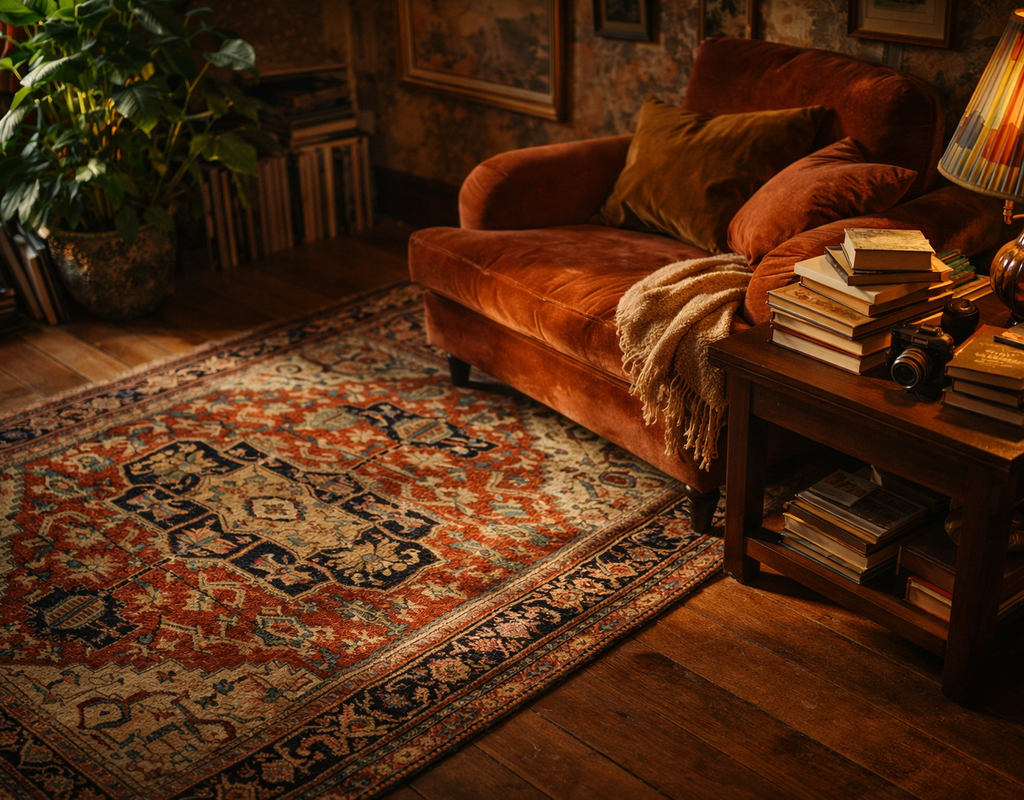
A vintage-patterned area rug complements the warm tones of the velvet armchair in this intimate, bookish setting.
Serapi, Gorevan, Bakhshaish, Karaja, Mehraban, Ahar Rugs
- Serapi rug — Why: Produced primarily before 1910, Serapi carpets are the rarest and most collectible of the Heriz sub-types. They feature more open, airy spacing, a touch of curvilinear grace, and lighter palettes compared to typical Heriz rugs. Their rarity and refinement make them the most valuable on the market.
- Gorevan carpet — Why: Coarser in weave and construction, Gorevan rugs were designed as utilitarian household pieces, often woven between 1900 and 1930. They may feature thick, heavy piles and sometimes allover patterns, trading refinement for durability.
- Bakhshaish Persian rug — Why: Known for rustic charm and camel-tone fields, Bakhshaish rugs often use wool foundations rather than cotton. They can appear with medallion or allover layouts and are among the most prized of Heriz sub-types for collectors, often rivaling Serapi in desirability.
- Karaja runner — Why: Produced in the Karaja village, these rugs are distinctive for their narrow runner format and triple medallion columns. They employ single-weft construction and showcase unique geometric star motifs, filling the niche for hallways and smaller spaces.
- Mehraban and Ahar rugs — Why: Finer-quality sub-types within the Heriz tradition, sometimes referenced in trade as markers of grade. These pieces share the Heriz DNA but often show greater technical precision and smoother execution.
Differences in Design, Weave, and Value
The diversity of Heriz sub-types underscores the richness of East Azerbaijan weaving. While they share the bold medallion-based geometry that defines the group, each village variation highlights a distinct weaving identity: Serapi for sophistication, Gorevan for rugged use, Bakhshaish for rustic artistry, Karaja for versatile runners, and Mehraban/Ahar for finer grading. Collectors look especially for Serapi and Bakhshaish rugs, whose rarity, natural dyes, and pre-commercial village aesthetic set them apart. These command the highest values at auction. By contrast, Gorevan pieces, while authentic, are considered more utilitarian and often fetch modest prices.
Karaja runners remain popular for interior use due to their size and charm, even if not as valuable as Serapi or Bakhshaish. It is important to note that village names often describe quality and weave type more than strict geographic origin. A “Serapi” may not come from a place called Serapi, and a “Gorevan” may simply indicate coarser construction. This highlights the need for expertise when evaluating authenticity and value. In essence, Heriz rugs are not a monolith—their sub-types reflect a spectrum from rugged Gorevans to refined Serapis, each contributing to the enduring reputation of the Heriz weaving tradition.
Historical Evolution
Safavid Roots to 19th-Century Innovation
The antique Heriz rug traces its lineage back to the Safavid dynasty (1501–1736), when Persian court workshops perfected the grand medallion format. These curvilinear palace carpets, woven in Tabriz and Isfahan, inspired village weavers in nearby Heris to reinterpret the medallion within their own geometric idiom. The result was a striking folk-art transformation of courtly design: angular spandrels, rectilinear florals, and bold outlines gave the Heriz medallion its unmistakable rugged elegance.
The Export Boom: 1870–1930
Between the late 19th century and World War I, Heriz rugs entered their golden age. Fueled by Western demand for large, durable floor coverings, production soared. During this Serapi era, pieces were woven with airy spacing, lighter colors, and natural dyes, qualities that today define the most sought-after examples.
By 1910, export networks centered in Tabriz connected village weavers with European and American markets. This period cemented the export-era rug as a commercial classic, marrying durability with the grandeur of Persian design.
Postwar to Contemporary Production
The interwar years brought change. After 1910, designs became busier, medallions more standardized, and colors darker. By the mid-20th century, synthetic dyes replaced many traditional sources, while global demand spread Heriz carpets far beyond Iran.
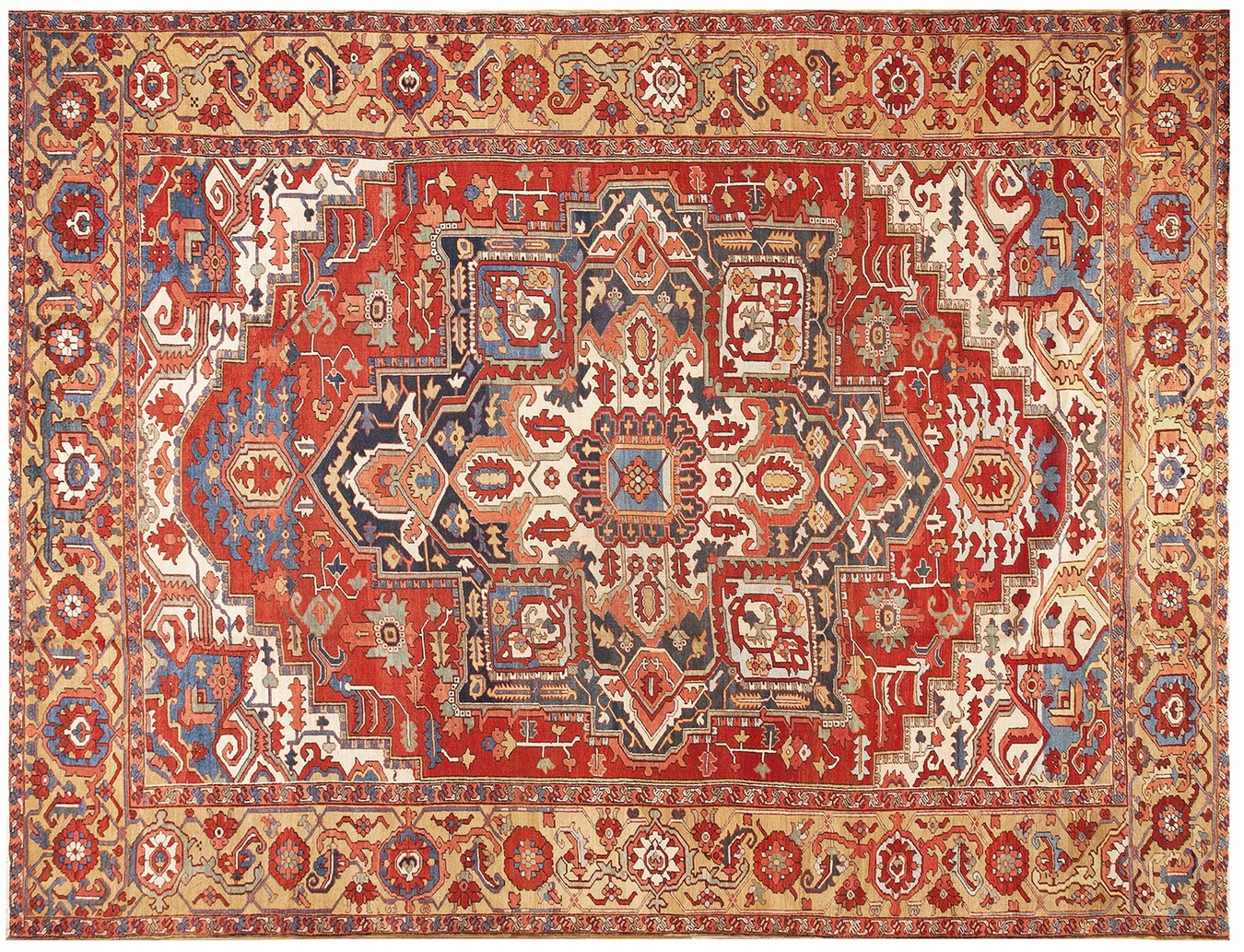
Postwar production emphasized consistency and affordability, which sometimes came at the cost of the freehand originality seen in earlier rugs. Today, authentic Heriz weaving continues in Iran, though production is smaller in scale. Modern Heriz rugs may feature pastel colors to suit contemporary décor, and some reproductions are woven outside Iran—in India, Pakistan, or Turkey—emulating the Heriz style but lacking the provenance of an authentic Heriz rug.
Changes in Design, Color, and Weaving Over Time
- Design: Early Serapi and pre-1920s Heriz pieces are noted for openness and originality; later rugs became denser and more formulaic.
- Color: Natural-dye palettes of madder red and indigo softened into layered abrash; post-1950 synthetic dyes introduced brighter but sometimes harsher hues.
- Weaving: Earlier rugs used wool foundations at times and looser knots, while later Heriz rugs adopted consistent cotton foundations, denser pile, and standardized medallion forms.
The journey of the Heriz carpet is thus one of adaptation: from Safavid court influence to village innovation, from golden-age exports to modern classics. Each era reflects shifts in materials, dyes, and market demands, yet the Heriz remains one of the most enduring icons of Persian carpet history.
Modern Market, Collecting, and Value
Authentic Iranian Heriz vs. Global Reproductions
- Authentic Persian carpet from Heriz — Why: True Heriz rugs are hand-knotted in the Heris district of Iran, using copper-hardened wool and traditional village techniques. They carry cultural weight and long-term value.
- Heriz reproduction rugs — Why: Large numbers of rugs in the Heriz style are woven today in India, Pakistan, Turkey, and China. While some are hand-knotted, they lack the specific wool quality, dye traditions, and cultural authenticity of Iranian originals. These are attractive alternatives for buyers seeking the look at lower cost, but they do not carry the same collectible value.
Pricing Factors: Age, Size, Knot Density
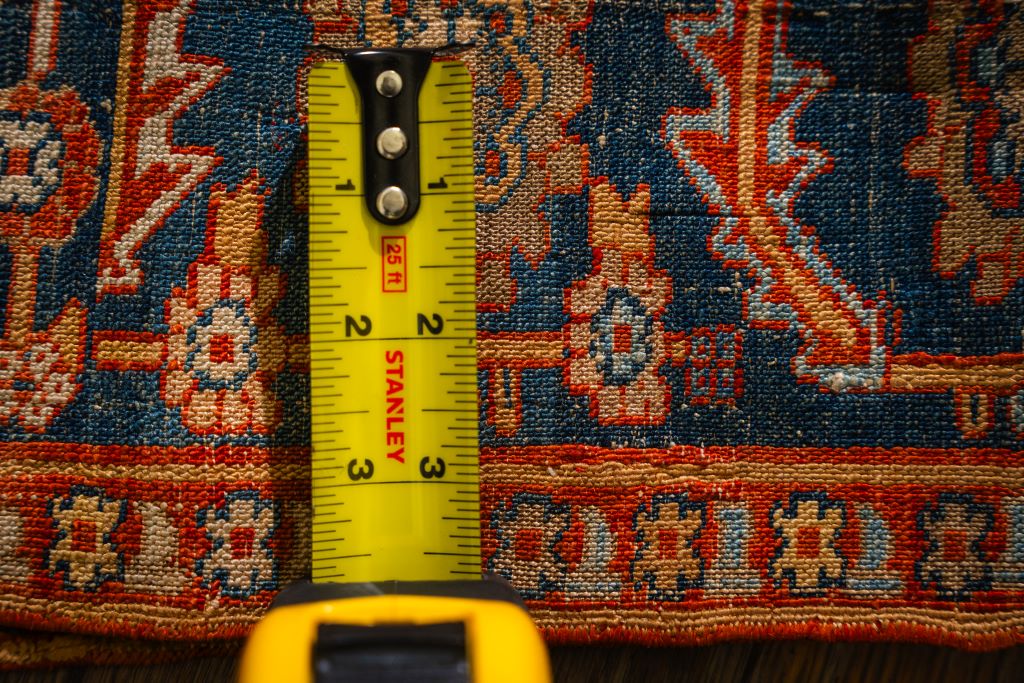
A detailed inspection of a richly colored oriental rug pattern while measuring its dimensions.
- Age — Why: Older pieces, particularly pre-1920s Serapi and Bakhshaish rugs, command the highest prices due to rarity, natural dyes, and artistry. Mid-century examples hold solid value, while new Heriz rugs are more affordable.
- Size — Why: Larger carpets require exponentially more labor and materials, driving up cost. Room-size antique Heriz rugs are highly sought after and can reach five-figure sums.
- Knot density & construction — Why: While Heriz rugs are not “fine” in density compared to city carpets, sturdier and denser examples fetch higher prices. A tight weave with crisp medallion design adds to value.
- Condition — Why: Restored or heavily worn rugs are worth less; original, well-preserved condition boosts desirability.
Investment Value and Collectibility
The Heriz rug value lies not only in its decorative power but also in its role as an investment Persian rug. Collectors prize antique examples, especially Serapi and Bakhshaish, for their rarity and enduring demand.
Over decades, these rugs have consistently appreciated in value, particularly when provenance is documented. Unlike many modern furnishings, a well-chosen antique Heriz is both usable and collectible, straddling the worlds of interior design and art investment.
Where to Buy Authentic Heriz Rugs
- Reputable galleries and specialty dealers — Why: Trusted sources with expertise can guarantee authenticity and provide provenance.
- Major auction houses (Christie’s, Sotheby’s, Bonhams) — Why: Auctions remain a prime venue for rare Serapi and antique Heriz rugs, often accompanied by expert condition reports.
- Buy antique Heriz rug online from vetted platforms — Why: Sites that provide clear photographs, condition details, and appraisal certificates allow safe entry into the market, provided buyers verify the seller’s credibility.
How to Authenticate Before Investing
- Check for origin certification (GI tag in Iran) — Why: Protects against mislabeling and confirms the rug’s link to the Heris district.
- Examine materials and construction — Why: Authentic Heriz rugs are wool on cotton with symmetrical Turkish knots and robust double-wefting.
- Assess dyes and abrash — Why: Natural-dye rugs show rich, layered tones and subtle striations; harsh, uniform colors may signal synthetics or reproductions.
- Dealer reputation and provenance — Why: Buying from long-established dealers or auction houses with documented histories provides confidence in authenticity.
In today’s market, collectors balance aesthetics with investment potential, knowing that while Heriz reproductions serve as budget-friendly décor, only authentic Iranian Heriz rugs carry the cultural, artistic, and financial weight that makes them enduring treasures.
Styling & Use in Interior Design
Suitability for Modern & Minimalist Spaces
A Heriz rug in a modern setting is one of the rare examples where traditional Persian craftsmanship complements minimalist design. Its bold geometry and saturated colors act as a visual anchor, grounding neutral interiors with a sense of history and permanence.
Clean-lined furniture and simple palettes allow the rug’s medallion and angular motifs to stand out, transforming it into functional art. Far from clashing, the rug’s strong structure resonates with the order and restraint of minimalism. This makes the Heriz rug modern not just in adaptability but also in timeless appeal.
Room Placement and Sizing Tips
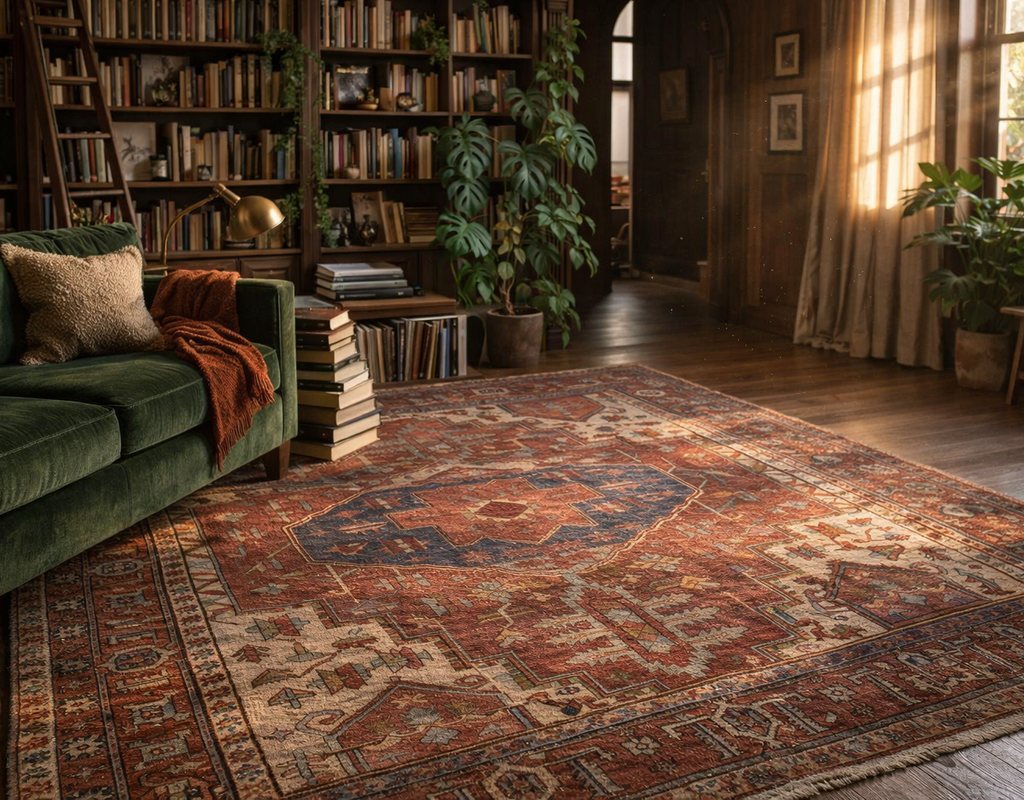
The warm glow of sunlight highlights the intricate details of the rust-toned traditional area rug in this cozy, book-lined study.
- Living rooms (8×10 or 9×12) — Why: A large Heriz provides balance to seating arrangements, its medallion drawing the eye to the room’s center.
- Dining rooms (9×12 or larger) — Why: The dense, low pile allows chairs to slide easily, while the rug’s durability withstands heavy use.
- Entryways & halls (Karaja runner) — Why: Runners from the Karaja sub-type fit narrow spaces, introducing pattern and warmth where smaller rugs might be overlooked.
- Layering vintage Heriz rugs — Why: Smaller, antique examples can be layered over neutral floor coverings, creating texture and character without overwhelming a space.
- Rotation and care — Why: Rotating a Heriz rug every year prevents uneven wear, especially in high-traffic areas, and extends both beauty and life.
Mixing Heriz Rugs with Contemporary Decor
Heriz carpets blend effortlessly with contemporary styling. A vintage Heriz under a glass coffee table highlights its artistry without visual clutter. In modern lofts, pairing a Heriz with abstract art creates a dialogue between folk geometry and contemporary form.
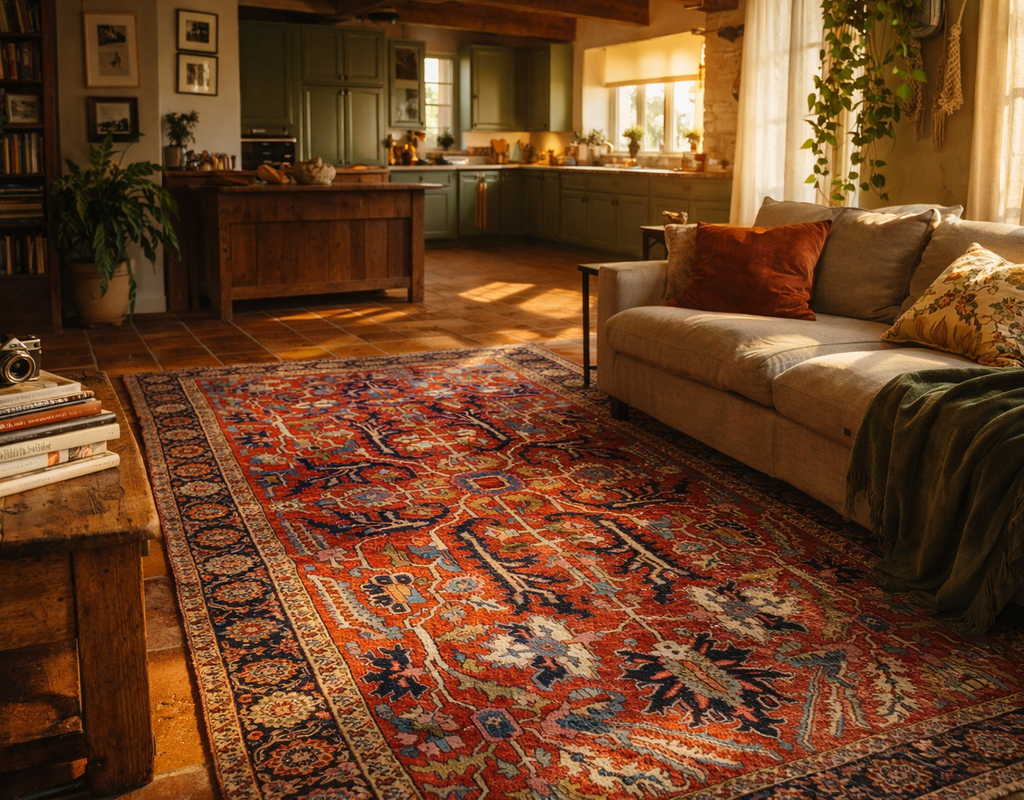
A vibrant, traditional rug grounds the living space, creating a striking contrast with the earthy tones and rustic wooden elements.
Even in minimalist rooms, one rug can supply all the needed color and ornament, eliminating the need for additional pattern. Ultimately, Heriz rugs stand apart as a Persian carpet styling classic—durable enough for daily use, yet versatile enough to function as the centerpiece of both traditional and modern interiors.
Care, Maintenance, and Longevity
Cleaning: Professional vs. At-Home
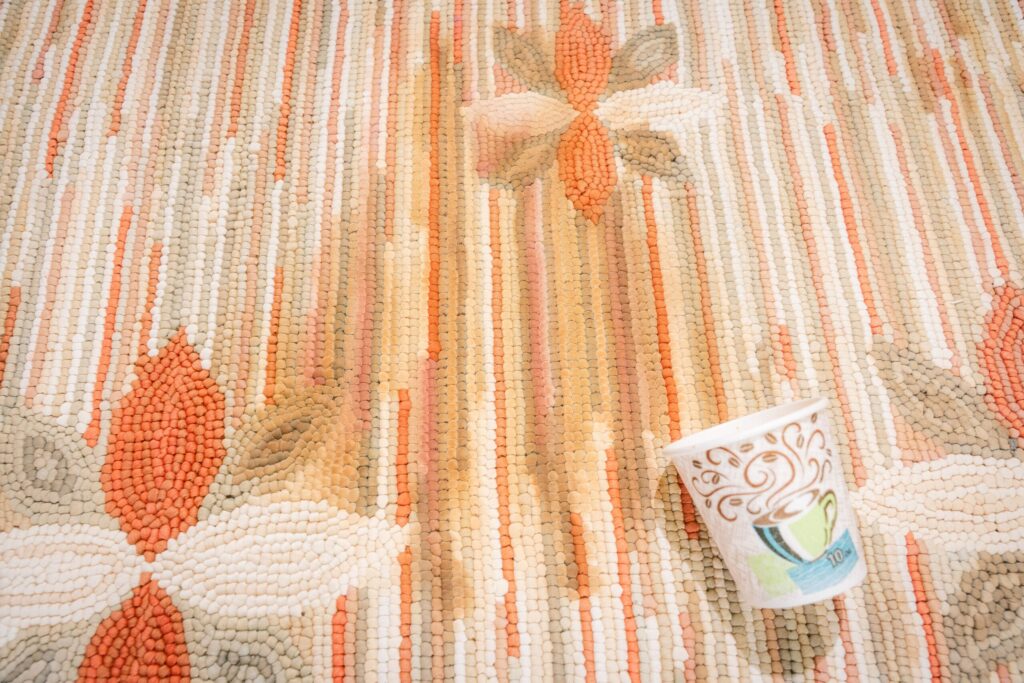
Close-up view of a tipped paper coffee cup resting on a handwoven wool rug, highlighting the rug’s dense pile, subtle color variations, and traditional geometric motifs in warm neutral and terracotta tones.
- Professional rug wash — Why: Although Heriz rugs are famed for their toughness, deep cleaning should be entrusted to professionals. Expert cleaners know how to handle wool fibers, natural dyes, and structural details without risking shrinkage, color bleeding, or fiber damage.
- At-home care — Why: Minor spills and surface dirt can be managed with blotting and gentle vacuuming, but harsh chemicals and aggressive scrubbing should be avoided. Spot cleaning works for small issues; anything more should go to a specialist.
Rug Rotation and Even Wear
- Rotate every 6–12 months — Why: Regular rug rotation ensures even wear across the surface, preventing one area from fading or flattening faster due to foot traffic or sunlight.
- Traffic patterns — Why: Living rooms and entryways see heavy use, so rotation is especially important in these spaces.
- Rug pads — Why: Using a pad underneath reduces stress on knots and prevents slipping, adding years to a rug’s life.
Preserving Colors and Value
- Minimize direct sunlight — Why: Natural dye colors in a wool Heriz rug fade if exposed to constant UV light. Curtains, blinds, or rotating placement help maintain vibrancy.
- Avoid harsh chemicals — Why: Strong cleaners can strip wool oils and damage dyes, reducing both beauty and resale value.
- Gentle vacuuming — Why: Regular but light vacuuming lifts dust before it abrades the pile, keeping the rug’s surface fresh and resilient.
By following these Heriz rug care practices—professional cleaning when needed, routine rotation, and mindful color preservation—owners can ensure their rug remains not just a floor covering but a lasting heirloom.
Simple habits dramatically extend rug life, allowing a Heriz to serve for generations.
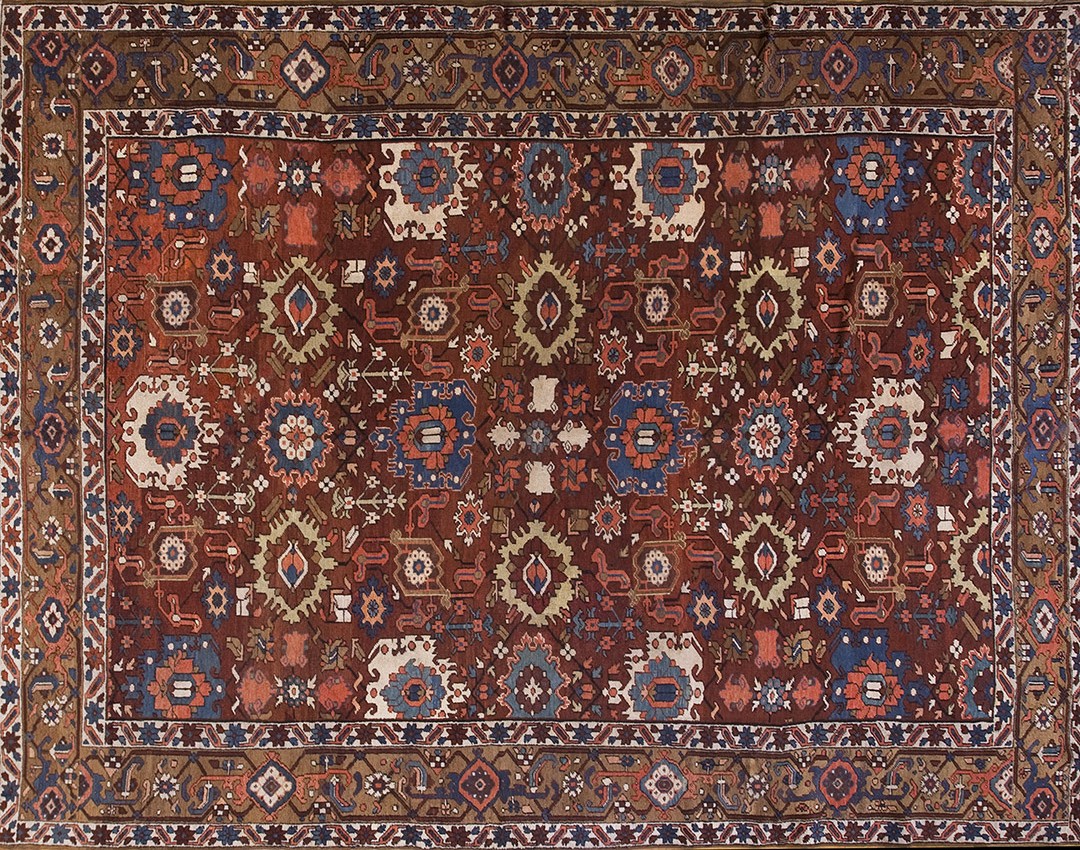
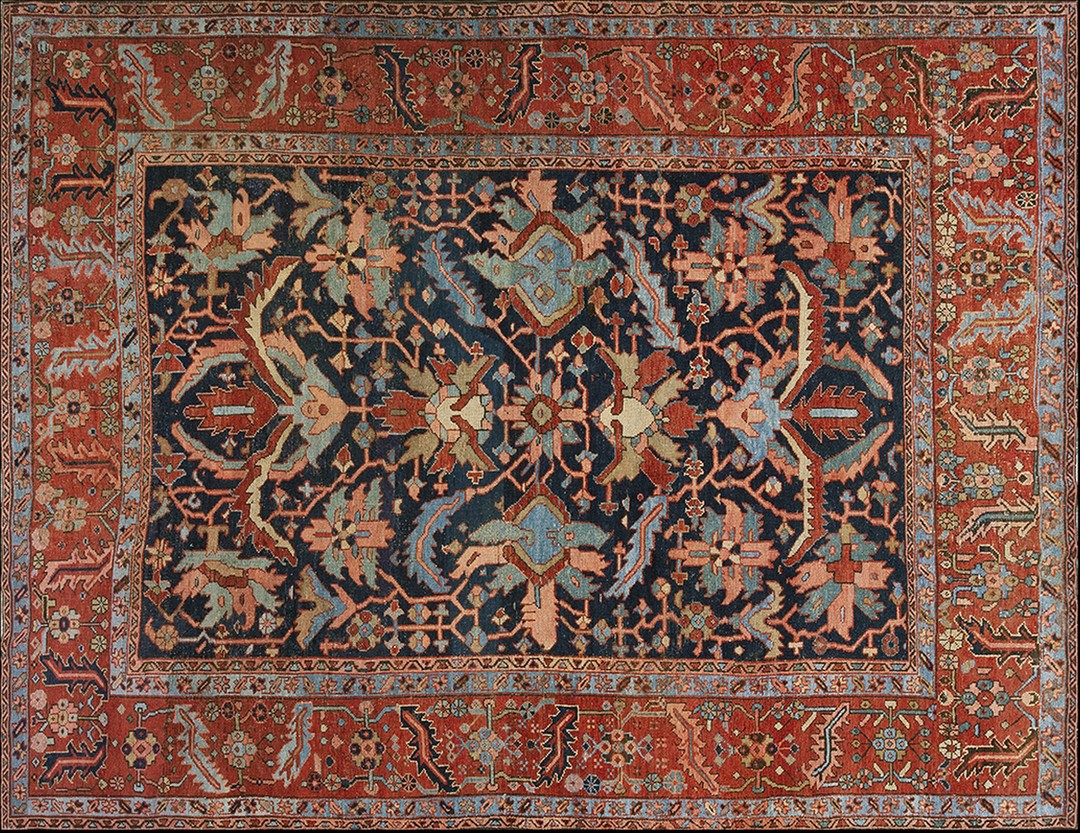
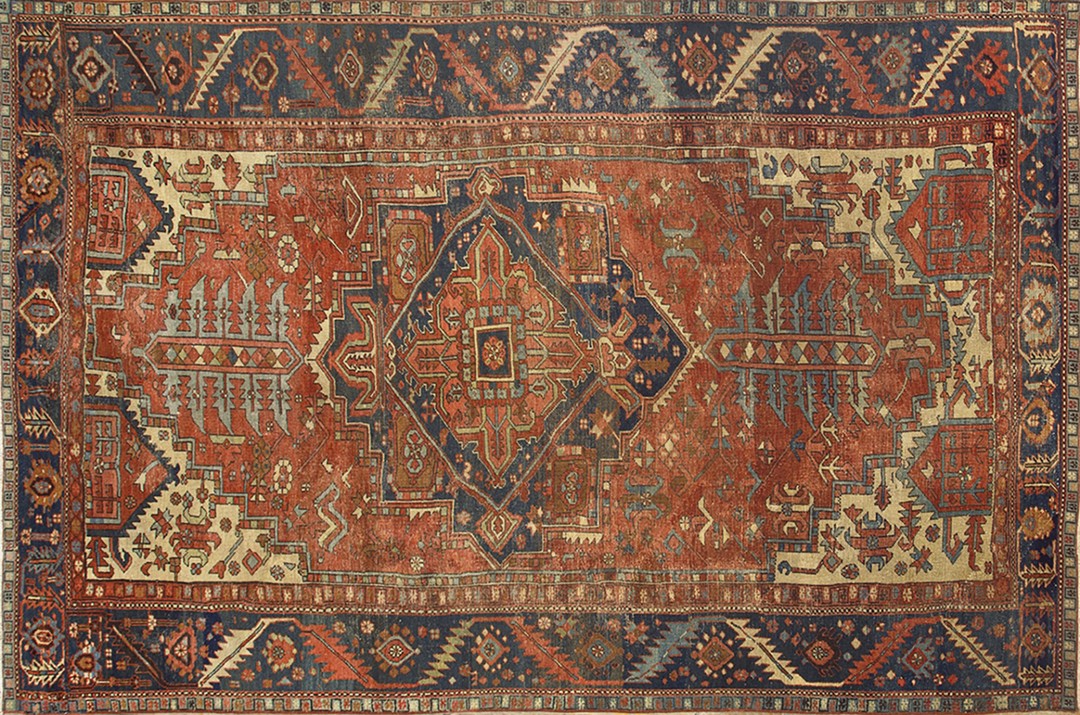
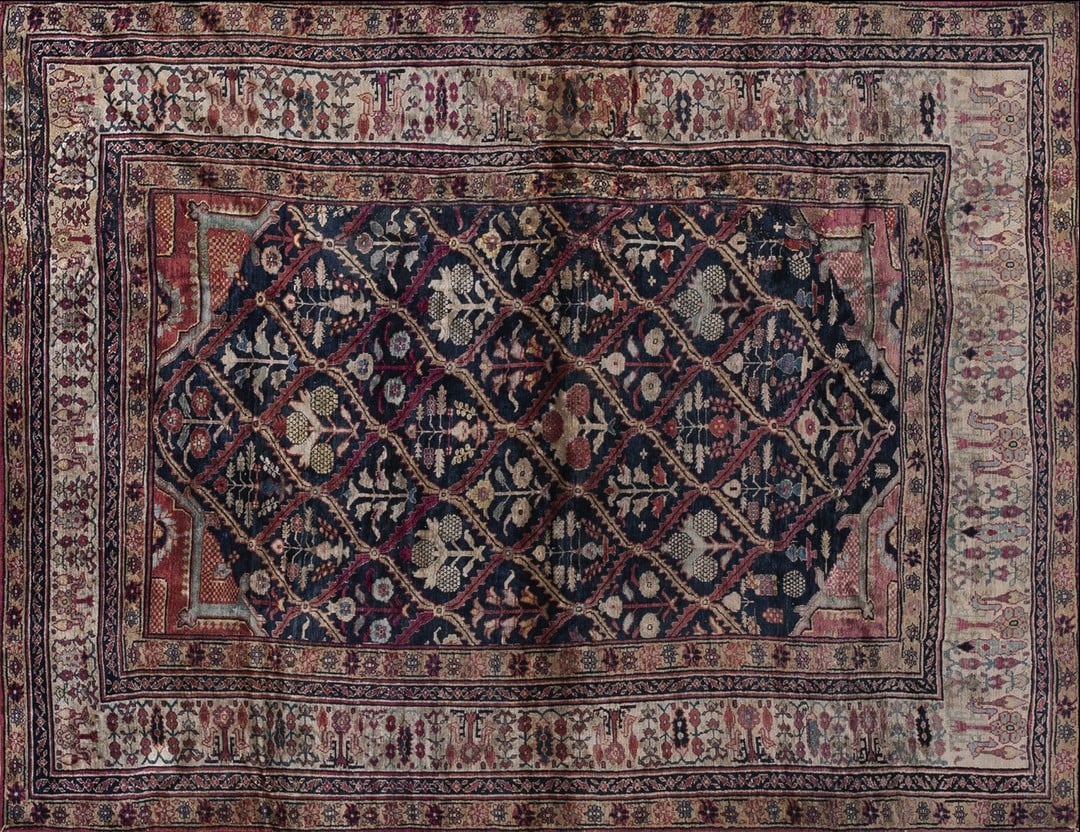
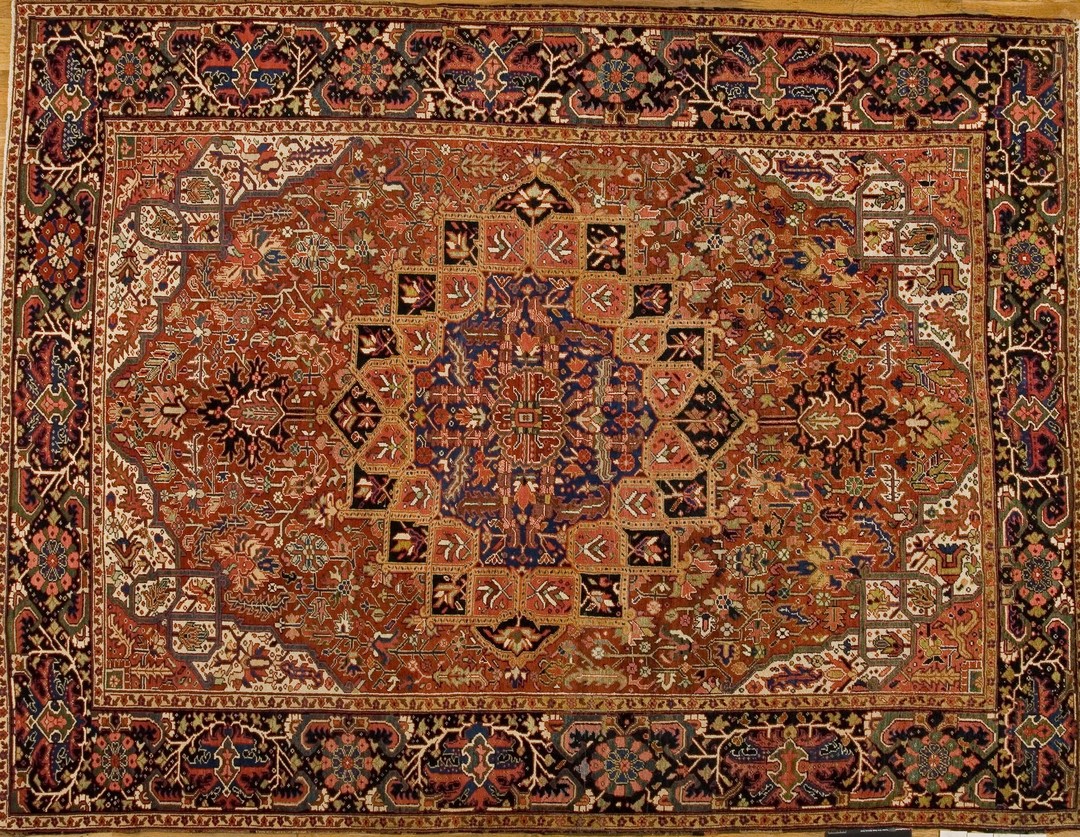
Explore a Few of Our Favorite Heriz Rugs
FAQ
- How should I place a Heriz rug in a living room?
Anchor seating with front legs on the Heriz rug (or all legs for larger rooms). Common fits are 8×10 under sofas or 9×12 for spacious layouts, leaving 12–18 inches from walls.
- Are Persian Heriz rugs restricted in the U.S.?
Since 2018, U.S. sanctions restrict importing Iranian-origin rugs commercially; many antiques already stateside remain available. Used personal effects carried by travelers may qualify under exemptions—check current OFAC/CBP rules.
- Are Heriz rugs a good investment?
Well-chosen antique Heriz or Serapi rugs can hold or appreciate, but outcomes vary. Prioritize authenticity, condition, and aesthetics; get appraisals for insurance and expert guidance.
- Can Heriz rugs be used over radiant floor heating?
Yes—wool Heriz rugs work with underfloor heat if pile and pad aren’t too thick. Favor low-to-medium pile and breathable pads to avoid trapping heat.
- What are Gorevan and Karaja in the Heriz rug family?
Gorevan (Goravan) typically denotes coarser, robust Heriz-type weaves; Karaja (near Heris) is known for smaller pieces and runners with stacked medallions—great complements to room-size Heriz rugs.
- Are “Heriz-style” rugs from India or Afghanistan worth considering?
They’re solid budget-friendly options with Heriz motifs, but they’re not Persian Heriz rugs. Expect differences in wool, dyes, weave, and resale; buy on look, quality, and price.
- What rug pad should I use under a Heriz rug?
A felt + natural rubber pad is ideal—cushion on top, grip underneath. A 1/4-inch thickness often balances comfort, stability, and air flow for wool Heriz rugs.
- What is “abrash” in Heriz rugs?
Abrash is natural striation where hues subtly shift as dye lots change or wool absorbs dye differently. It’s a hallmark of hand-dyed Heriz rugs and adds character.
- Do Heriz rugs fade in sunlight?
Any dyed textile can fade with prolonged direct sun. Rotate Heriz rugs every 6–12 months, use window UV protection, and avoid hot spots to preserve color.
- Are Heriz rugs pet-friendly?
Generally yes—wool’s natural lanolin helps resist soiling. Urine is fiber-damaging, so blot immediately, rinse, and consider enzymatic treatment or professional care to prevent odor set-in.
- Are Heriz rugs good for dining rooms?
Yes—patterns conceal crumbs and wool cleans well. Choose a Heriz rug that extends 24–30 inches beyond the table on all sides so chairs slide fully on the rug.
- How should I clean a Heriz rug?
Vacuum regularly with suction only (no beater bar), blot spills promptly with cool water and wool-safe detergent, and professionally wash every 1–3 years. Always test colors before spot treatments.
- Do Heriz rugs shed?
Quality hand-knotted Heriz rugs shed minimally once early loose fibers vacuum out. Persistent heavy shedding points to poor fiber quality or construction rather than the Heriz type.
- What knot density do Heriz rugs typically have?
Heriz rugs are typically coarse to medium—often about 30–90 KPSI. Finer counts exist in older Serapi examples, but knot density alone doesn’t determine quality or value.
- What materials and knots do Heriz rugs use?
Most Heriz rugs use wool pile on cotton warps/wefts, often double-wefted, with symmetric (Turkish/Ghiordes) knots. Expect a firm, medium-low pile that’s easy to live with.
- Heriz rugs vs. Tabriz rugs—what’s the difference?
Heriz rugs are angular, tribal-leaning, and coarser; Tabriz rugs are city-workshop, curvilinear, and generally finer. Both hail from northwest Iran but represent distinct aesthetics.
- How do Heriz rugs compare to Bakshaish rugs?
Bakshaish rugs (near Heris) often have looser, more rustic drawing and can show softer earth tones. Many Bakshaish pieces are prized antiques with slightly finer or varied weaves.
- What’s the difference between Heriz rugs and Serapi rugs?
Serapi is a trade term for earlier, finer Heriz-region pieces with more open layouts and softer palettes. All Serapi are Heriz family, but not all Heriz rugs are Serapi.
- How can I tell if a Heriz rug is hand-knotted and authentic?
Flip it—hand-knotted Heriz rugs show the design on the back and have integral fringe (warp ends). Tufted versions have canvas/latex backings; machine-made backs look perfectly uniform.
- How much do Heriz rugs cost?
Prices vary widely: vintage 8×10–9×12 Heriz rugs often run \~\$2,000–\$8,000, while finer antique Serapi cousins can fetch \$10,000–\$30,000+. New “Heriz design” reproductions range from a few hundred to several thousand.
- What sizes do Heriz rugs commonly come in?
Traditional Heriz rugs skew large—8×10, 9×12, and 10×14 are common—though runners and smaller accent sizes exist. Allow 12–18 inches of floor border for balanced room layouts.
- Are Heriz rugs good for high-traffic rooms?
Yes—Heriz rugs are renowned for toughness and hold up in living rooms, halls, and dining spaces. Dense wool pile and cotton foundations resist wear; rotate every 6–12 months to even traffic.
- Where are Heriz rugs made?
Authentic Heriz rugs are woven around Heris (East Azerbaijan province, Iran) near Tabriz and Mount Sabalan. Related village weaves include Serapi, Bakshaish, Gorevan, and Karaja.
- What makes Heriz rugs unique?
Heriz rugs pair graphic, angular motifs with hard-wearing construction. Many feature a commanding central medallion, oversized corner spandrels, and saturated reds/blues with natural “abrash” tone shifts that age beautifully.
- What is a Heriz rug?
A Heriz rug is a Persian hand-knotted carpet from the Heris district of northwest Iran, famous for bold geometric medallions and durability. Most have wool pile on cotton foundations and sturdy, room-size formats like 8×10 or 9×12.