
Introduction: The Lion-with-Sword Rug Motif
Explore our comprehensive collection of Lions Sword Motif Rugs and bring this powerful symbolism into your home.
What is the Lion-with-Sword Rug Motif?
The lion-with-sword motif, known in Persian as Shir o Khorshid (“Lion and Sun”), is among the most enduring and symbolic designs in the history of oriental carpets. At its core, the motif portrays a lion—usually in side profile—gripping a curved scimitar or sword, with the radiant disk of the sun rising behind it. This striking combination of imagery is far more than ornamentation.
It embodies a layered language of symbolism: the lion represents strength, courage, and guardianship; the sword stands for divine justice and martial power; and the sun signifies enlightenment, prosperity, and cosmic order. Unlike purely geometric or floral patterns common in other weaving traditions, the Persian lion carpet carrying this emblem communicates authority and national identity.
Within rug design, the motif served not only to decorate floors and walls but also to project messages of sovereignty, spiritual legitimacy, and cultural pride. This makes the oriental lion sword rug unique in the broader lexicon of textile motifs: it is both political icon and protective talisman, translated into the language of wool and dye.
Symbolic Prevalence and Cross-Cultural Impact
The Shir o Khorshid motif gained prominence in Persian art, especially during the Safavid and Qajar dynasties, when rulers sought powerful visual emblems that would resonate with both the populace and foreign courts. Carpets woven with the lion-with-sword motif often appeared in royal residences, ceremonial halls, and diplomatic gifts.
By embedding the symbol into everyday textiles, weavers ensured its circulation across households, markets, and borders. Its influence extended beyond Iran. In the Caucasus, local workshops adapted the design into their own visual vocabulary, creating bold, angular depictions that still retained the lion’s authority and the sword’s protective role.
For tribal and village weavers, integrating the emblem transformed rugs into carriers of collective identity and aspirations. In some contexts, the sun’s radiant disk was stylized into rosettes or starbursts, showing how flexible and resilient the motif became across regions.
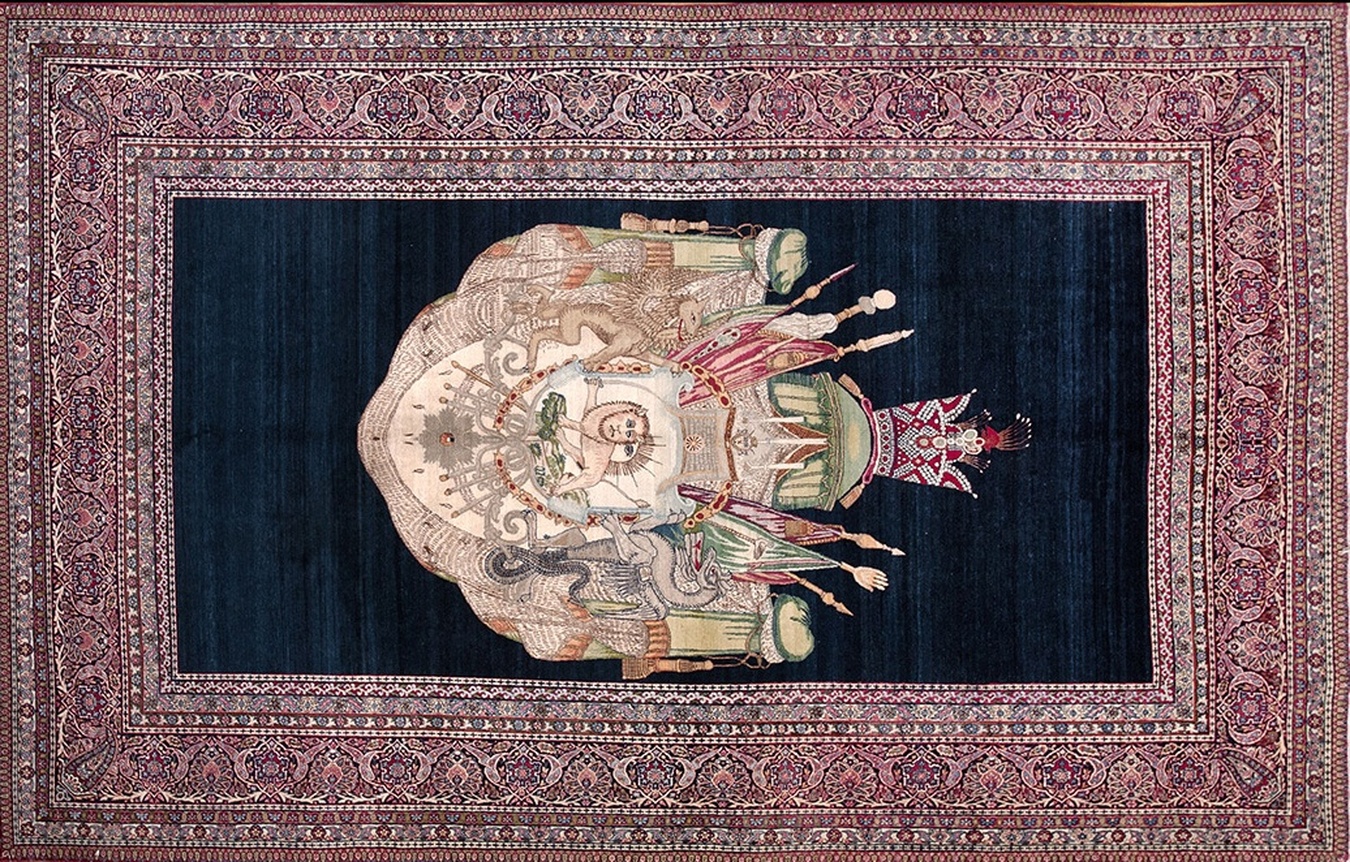
This Lion and Sun rug tradition demonstrates how imagery travels between political authority, folk culture, and artisan practice. For Persians, the lion evoked kingship and divine sanction. For Caucasian tribes, it could embody local warrior spirit and community defense.
Collectively, these interpretations reinforced the motif’s versatility, ensuring it remained meaningful from palaces to modest village homes.
Heritage and Modern Appeal
Today, the lion-with-sword motif continues to attract collectors and historians for its blend of artistry and symbolism. Each element—lion, sword, sun—tells a story not just of design but of historical memory. Rugs woven with this emblem are treasured for their ability to embody royal symbolism, folk art, and national identity in a single textile.
Far from being mere decoration, these rugs function as woven chronicles of Persian culture and its regional echoes. Modern collectors prize Shir o Khorshid carpets for their rarity and historical resonance. Whether displayed as wall art or preserved as heritage textiles, they remind us that every thread carries a narrative of power, belief, and cultural pride.
The lion-with-sword motif is thus not only an artistic device but also a visual anthem—one that has endured centuries of change and continues to inspire admiration across cultures.
Name & Etymology of the Lion-with-Sword Symbol
Terminology Across Languages
The emblem most commonly recognized in rug studies as the lion-with-sword motif carries a deeply Persian identity. In its native context, it is called Shir o Khorshid, which literally translates to “Lion and Sun.” The word shir means lion, a creature revered for courage and royal authority, while khorshid means sun, a celestial force symbolizing light, prosperity, and divine order.
In traditional renderings, the lion often grips a shamshir—a distinctive Persian curved sword—so integral that the design is sometimes described more precisely as the lion and sun with sword. In English, collectors and scholars frequently use terms such as lion-with-sword rug or Lion and Sun rug, highlighting both the animal and celestial imagery.
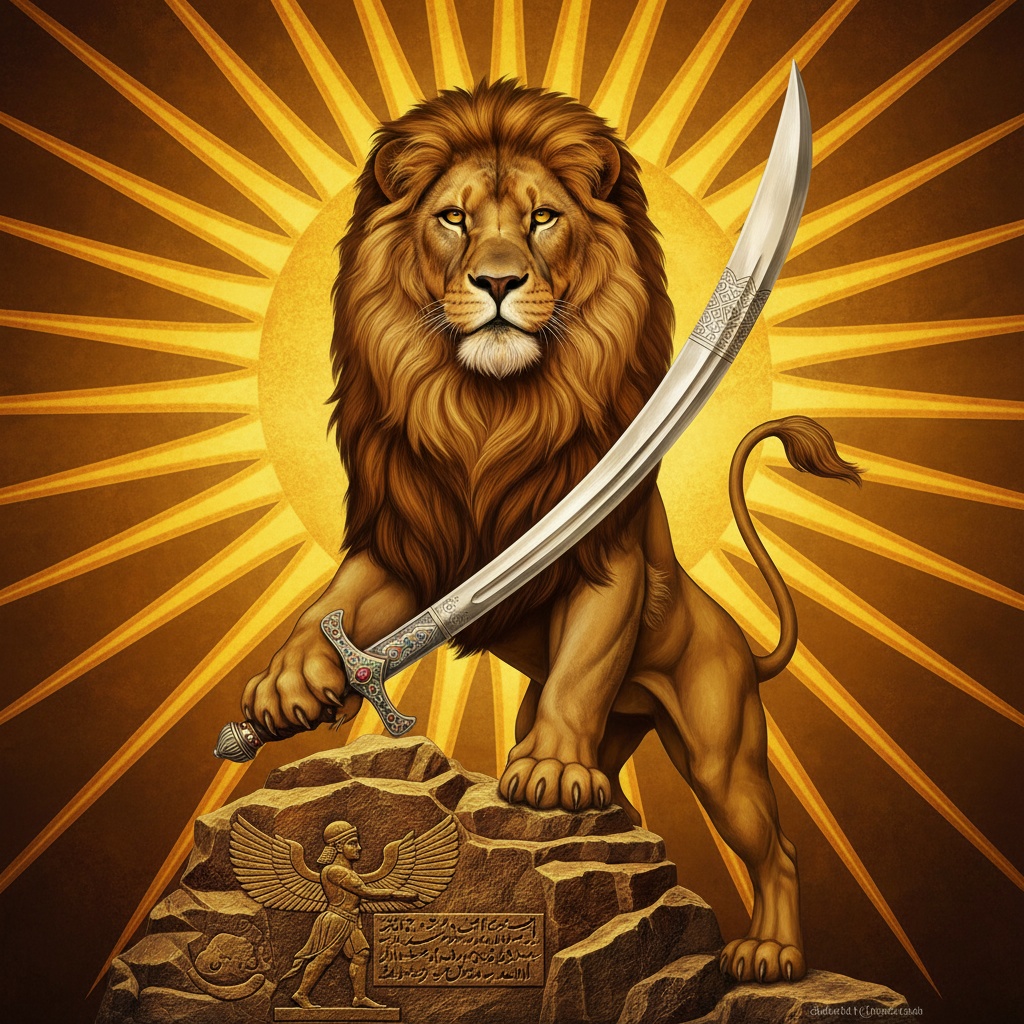
Lion motif wielding a sword over carved stone.
Within the Caucasus and Anatolia, regional names also emerged, with Turkic and Armenian weavers referencing the emblem in local dialects while adapting its form to their own visual traditions. Yet regardless of the language, the Persian name remains the anchor: it is in Iran that the symbol took shape and gained national significance.
The Sword as Symbol of Valor in Persian Art
The sword is not an incidental flourish but a defining feature of the lion sword motif. In Persian visual culture, the shamshir embodies more than military might—it represents valor, justice, and divine protection. By placing the weapon in the paw of the lion, the motif fuses two layers of power: the natural strength of the beast and the righteous authority of the blade.
This combination transforms the image from a decorative device into an emblem of kingship and moral defense. In the context of rugs, the sword communicates reassurance to the household, suggesting protection from harm and the upholding of justice within the home. On a larger scale, it reinforces the idea of the ruler as both guardian and warrior—qualities mirrored in Persian literature and court iconography. This is why Persian rugs feature lions holding swords: the weapon amplifies the lion’s symbolic role, ensuring the image projects courage and legitimacy, not just beauty.
The Persian sword rug thus reflects a tradition where every element is deliberate. Without the sword, the image of the lion and sun might emphasize light and majesty; with it, the motif asserts strength, resolve, and the readiness to defend both crown and community. For this reason, the sword remains intrinsic to the Shir o Khorshid design, an irreplaceable element in one of the most iconic symbols of Persian cultural expression.
Geographic and Cultural Origins
Where Did Lion-and-Sword Rug Designs Originate?
The lion-and-sword rug motif has a firmly Persian origin, developing first in the elite visual culture of Iran before entering the broader world of weaving. While lions appear in earlier Persian art, it was during the Safavid dynasty (16th–17th centuries) that the motif took on its distinctive form—lion, radiant sun, and sword combined into a heraldic image of authority.
Under the Qajar dynasty (18th–19th centuries), the emblem was standardized as a state symbol, appearing on flags, coins, and royal regalia, which directly encouraged its translation into textile art, including rugs.
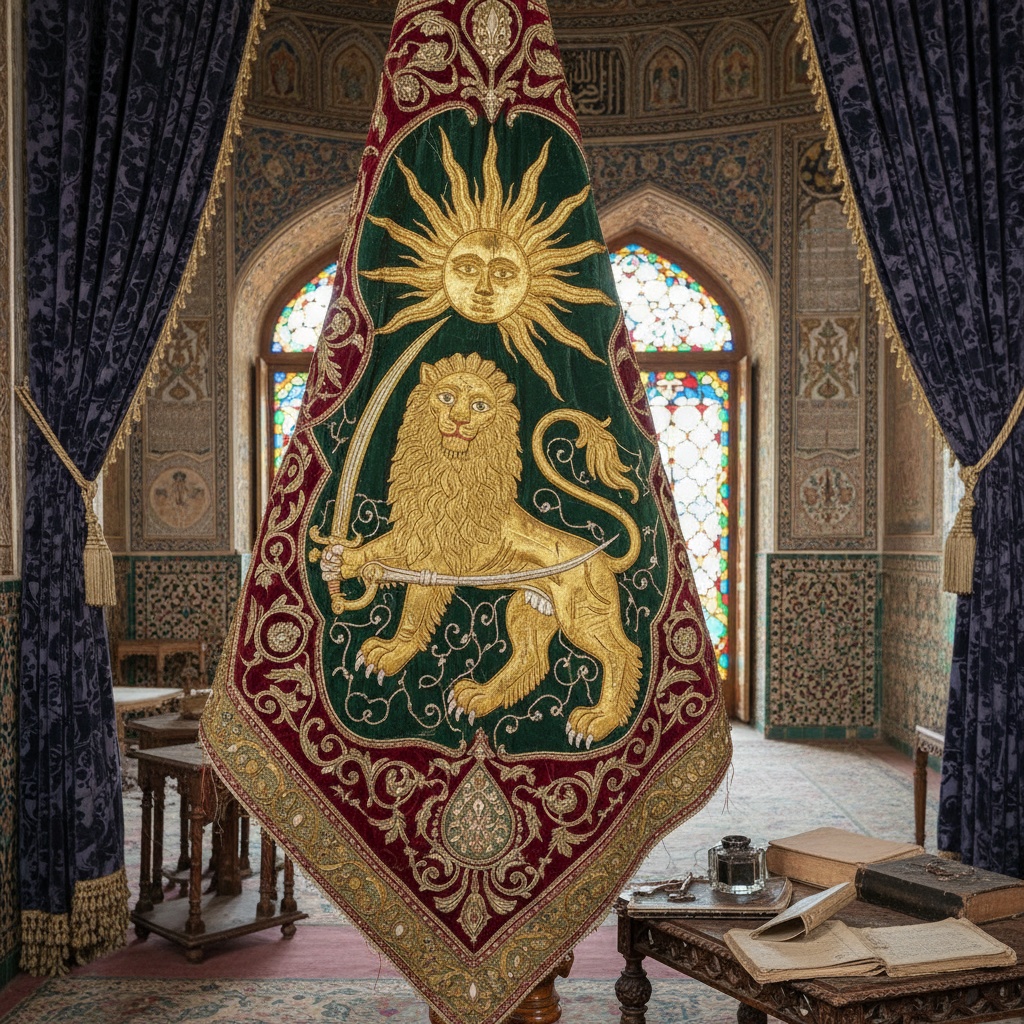
Embroidered textile showing a lion and sun motif.
As rugs often functioned as portable canvases of identity, the adoption of this emblem by weavers ensured that royal iconography entered households, shrines, and markets across Iran and beyond.
The resulting Qajar rug tradition is one of the most recognized sources for surviving examples of lion-and-sword carpets.
Origins in Persian Art and Royal Insignia
The Safavid court emphasized a fusion of political legitimacy with Shi’a symbolism, and the lion-and-sun pairing already had strong astrological and spiritual resonance. Adding the sword (shamshir) elevated the lion from a passive emblem into an active guardian of crown and faith.
By the Qajar period, this image was fully institutionalized: the lion-with-sword motif became not only a political insignia but also a recognizable emblem of national identity, woven into carpets, painted on banners, and minted onto coins. Thus, what began as Safavid heraldry evolved into a symbol of continuity and authority in the Qajar era, making the design inseparable from the political and cultural history of Iran.
Diffusion to the Caucasus and Central Asia
Through centuries of Persian political and cultural influence, the motif traveled beyond Iran. In the Caucasus, local weavers adapted the design into their own geometric and stylized rug traditions. Caucasian lion carpets often preserved the core imagery—the lion, the sword, and the radiating sun—but simplified or reinterpreted them with bold outlines and tribal aesthetics.
These versions underscore how the motif was not confined to courtly settings but became a folk symbol in villages and markets as well. In Central Asia, the motif appeared less frequently, but echoes survive in textiles influenced by Persian trade routes and cultural exchange. These rare instances demonstrate the emblem’s broad symbolic appeal, even in regions where it was not officially institutionalized.
Imperial Symbolism vs. Folk Adaptation
The lion-and-sword rug illustrates the dynamic between imperial iconography and local creativity. On one hand, it functioned as a state emblem—appearing on royal banners, Qajar-era flags, and government insignia, reinforcing the authority of kingship. On the other, it filtered into folk art and tribal weaving, where village artisans reinterpreted the symbol in ways that reflected local aesthetics and communal pride.
This duality—imperial yet folk, royal yet popular—explains the motif’s lasting resonance. The Iranian rug symbol of lion, sword, and sun was both a top-down projection of sovereignty and a grassroots emblem of protection and identity, making it one of the most versatile and enduring designs in the history of oriental carpets.
Design Characteristics of Lion Sword Rugs
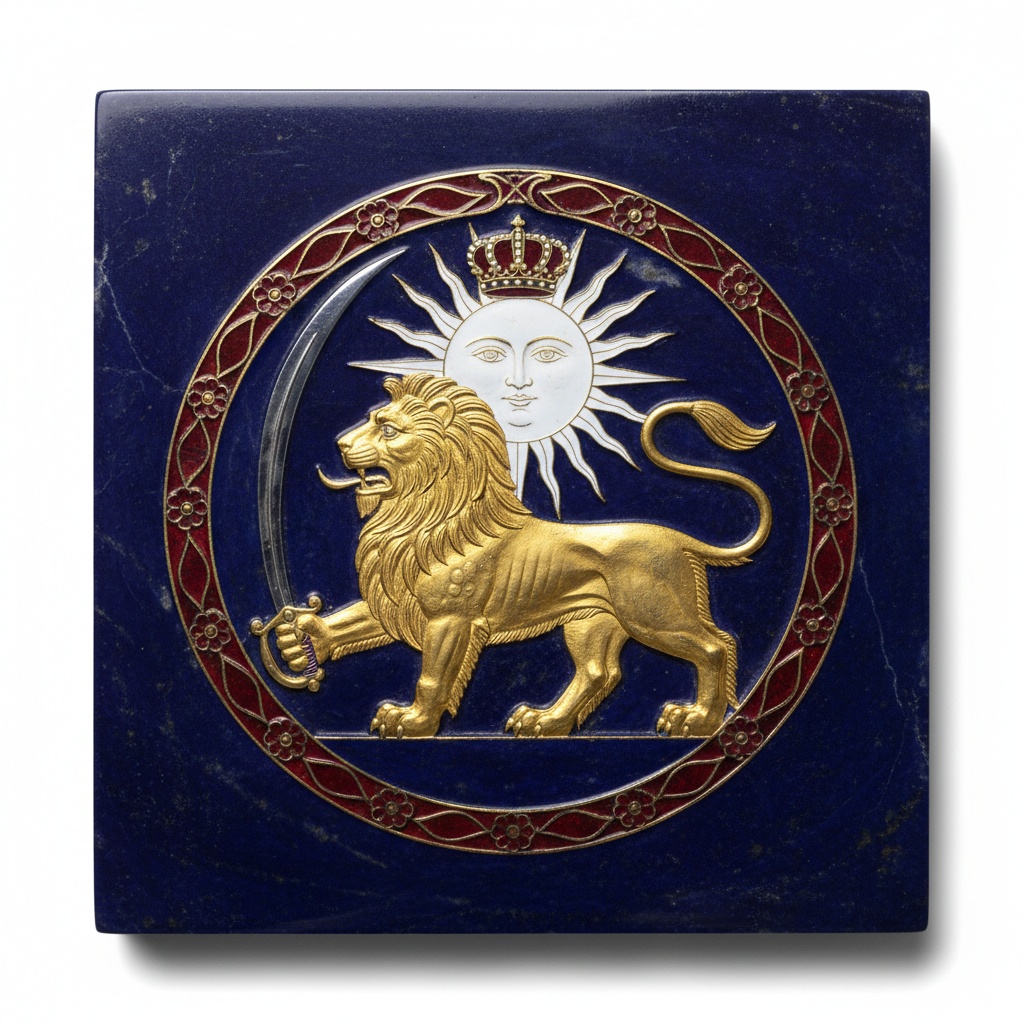
Emblematic lion and sun design detail
Visual Structure and Key Symbols
The lion sword rugs are pictorial works built around a strong central structure.
Their main elements include:
- Lion figure — usually shown in profile with a full mane, often muscular and stylized. — Why: It conveys authority, courage, and royal strength.
- Sword (shamshir) — curved and placed firmly in the lion’s paw. — Why: Symbol of valor, justice, and the defense of sovereignty.
- Sun disk — sometimes plain, sometimes with a human face radiating outward. — Why: Represents cosmic order, prosperity, and divine blessing.
- Royal crown — occasionally placed above the lion or sun. — Why: Adds a heraldic note, reinforcing dynastic and national symbolism.
Together, these lion rug symbols form a coherent emblem that blends political imagery with cultural storytelling.
Posture and Iconography
The lion’s posture varies with the weaving tradition and the message intended. In some rugs, the lion is standing upright, sword raised to emphasize action and martial readiness. In others, the lion is reclining yet alert, a calmer stance reflecting dignity and guardianship rather than immediate combat.
Certain Qajar pictorial rugs feature crowned lions, directly connecting the image to dynastic heraldry and state identity. These differences highlight the flexibility of the motif across time and region while keeping its core meaning intact.
Sun, Sword, and Ancillary Motifs
The core triad—lion, sword, and sun—is often enriched with additional imagery:
- Floral rosettes or blossoms — Why: Softens the martial tone, linking the motif to Persian garden symbolism.
- Smaller animals or birds — Why: Adds narrative or folk art detail, creating a broader protective scene.
- Inscriptions or calligraphy — Why: Embeds political mottos, poetry, or blessings, further elevating the rug from decorative to declarative.
- Heraldic crown — Why: Reinforces the royal or state-centered reading of the design.
These ancillary motifs do not dilute the message but contextualize it, making each rug a more layered work of art.
Color Schemes & Iconic Palettes
Color choices in lion and sun rugs are deliberate and highly symbolic:
- Bright yellow or golden hues for the lion — Why: Evokes majesty, strength, and divine light.
- Deep reds — Why: Serve as backdrops for authority, power, and spiritual intensity.
- Dark indigo blues — Why: Contrast with red and yellow, grounding the composition in a sense of night and infinity.
- White or pale yellow for the sun motif — Why: Ensures the radiance of the sun remains visually dominant.
These pictorial rug colors ensure the emblem is instantly legible, even from a distance, while preserving symbolic resonance.
Knot Density & Material Choices
The knot density of a rug directly influences lion motif clarity. In finely woven Persian city carpets, high knot counts allow artisans to depict intricate features—the curve of the sword, the mane of the lion, even facial details on the sun. In contrast, tribal or village rugs often employ lower knot density, resulting in more graphic, simplified lions with bold outlines and exaggerated features.
Both approaches hold value: the former for its precision and artistry, the latter for its raw, folk vitality. Material also shapes the outcome. Wool provides durability and warmth of color, while the occasional use of silk highlights luxury and enhances brightness. Together, knotting technique and material quality determine how effectively the lion-with-sword motif communicates its blend of authority, beauty, and cultural identity.
Materials & Construction
Wool vs. Silk vs. Mixed Foundations
The lion sword construction of oriental rugs depends heavily on material choice. Wool is the traditional pile fiber, valued for its durability, warmth, and ability to hold natural dyes with depth. A wool lion rug often emphasizes bold outlines and rustic charm, making it ideal for tribal and village renderings of the lion motif. By contrast, silk is reserved for elite urban workshops.
A silk lion carpet has extraordinary sheen and fineness, allowing weavers to capture the mane’s curls, the glint of the sword, and even facial details in the sun disk. Many city rugs also employ cotton foundations for stability, paired with silk or fine wool pile, producing crisp definition. In short, wool excels in graphic power, while silk and cotton foundations support detailed artistry.
Knotting Techniques: City vs. Tribal Weaving
The way a rug is knotted directly shapes the clarity of the lion-with-sword motif. City rugs, particularly Persian, often use the asymmetrical Persian knot (Senneh knot). This method allows higher knot density, meaning artisans can render intricate details like the lion’s mane or the radiating lines of the sun with remarkable precision.
Tribal rug knotting, on the other hand, frequently relies on the symmetrical Turkish knot (Ghiordes knot). These produce bolder, more angular motifs with less micro-detail but strong visual impact. Thus, while the city rug knotting method suits heraldic and highly detailed interpretations, tribal knotting preserves the folk, graphic vitality of the symbol.
Loom Types and Weaving Traditions
Different loom types also influence construction and style:
- Fixed vertical looms — Why: Common in cities, they permit larger, denser rugs with precision for intricate lion and sword motifs.
- Horizontal ground looms — Why: Used by nomadic and tribal weavers, producing smaller pieces with bold, simplified imagery.
- Workshop looms — Why: Enable multiple weavers to work simultaneously, essential for large Qajar pictorial rugs featuring lion-and-sword iconography.
These loom traditions reflect the context of production—palatial workshops for high-detail carpets, village courtyards for folk variants.
Dye Sources and Their Impact on Color Vibrancy
The brilliance of a lion and sun rug depends on its dye sources. Traditional Persian dyers used madder root for deep reds, indigo for enduring blues, and a range of yellow sources—weld, saffron, or onion skins—to achieve the golden hues that highlight the lion’s body or the sun motif.
The sword was often accented with undyed white wool or pale plant-based tones, ensuring it stood out against darker grounds. Natural dyes not only gave vibrancy but also aged beautifully, lending antique lion sword rugs a soft, glowing patina admired by collectors today.
Suitability of Materials for Lion Sword Designs
To answer directly: Does wool or silk suit lion sword designs better? The choice depends on the intended effect. A wool lion rug delivers strength, warmth, and boldness—perfect for rustic or tribal versions of the motif.
A silk lion carpet, supported by cotton foundations and fine knotting, provides unmatched clarity and refinement, capturing the full heraldic detail of the lion, sword, and sun. Both materials serve the motif, but silk and cotton excel in detail, while wool excels in graphic power and durability.
Historical Evolution of the Lion-Sword Motif
How Old Are Lion-With-Sword Carpet Patterns?
The lion rug history stretches back many centuries, though the precise form of the lion-with-sword carpet pattern crystallized later. Lions appear in ancient Persian art, from Achaemenid stone reliefs to Sassanian metalwork, where they symbolized strength, cosmic order, and royal power.
While these earlier depictions did not yet include the sword, they laid the groundwork for the heraldic imagery that would dominate carpets in later centuries. By the 16th century, under the Safavids, the motif began to appear more consistently in textiles, linking astrology, Shi’a symbolism, and political authority into one cohesive emblem.
Ancient and Pre-Safavid Roots
Before the Safavids, lions held deep significance in Persian culture. Mythological references in the Shahnameh (Book of Kings) cast the lion as a foe of heroes and a symbol of valor.
Astrological traditions tied the lion to the zodiac sign Leo, while Shi’a symbolism occasionally paired the lion with Imam Ali, renowned as the “Lion of God.” Though these pre-16th century references did not feature the sun and sword in combination, they prepared the symbolic vocabulary from which the Safavid carpet motif would emerge.
Safavid, Zand, and Qajar Eras
During the Safavid dynasty (16th–17th centuries), the lion was paired with the radiant sun, reflecting both astrological cosmology and royal grandeur. By the Zand dynasty (18th century), the motif was increasingly popular in banners and ceremonial contexts. The decisive transformation came in the Qajar period (19th century), when the Qajar lion carpet became widespread and the motif was fully standardized as a national emblem.
The lion now consistently grasped a sword, symbolizing martial readiness and divine justice. Folk weavers, especially in villages and the Caucasus, adapted the design into their own aesthetic language, producing bold, graphic renderings alongside refined courtly examples.
Pahlavi Era, Post-1979, and Contemporary Revivals
The Pahlavi dynasty (20th century) retained the emblem, adapting it in more Westernized heraldic forms. Rugs from this era often presented cleaner, more formalized versions of the lion, sword, and sun, linking them to modern nation-state identity. However, after the 1979 Islamic Revolution, the lion-with-sword motif was removed from the official Iranian flag and state iconography.
This marked a dramatic shift: while no longer a state emblem, the motif survived in folk weaving, diaspora art, and heritage carpets. In contemporary contexts, the design has seen a revival in heritage workshops and among collectors who view it as a cultural touchstone. The post-1979 lion rug carries layered meanings—nostalgia for pre-revolution Iran, a celebration of Persian artistry, and a universal emblem of courage and protection.
The Motif’s Enduring Adaptability
To answer directly: How old are lion-with-sword carpet patterns? Their roots trace back over a millennium through Persian art, but as a standardized rug design, they date most clearly to the Safavid and Qajar periods, gaining widespread presence in the 19th century.
How has the lion-sword symbol evolved since the Qajar era? It has transformed from an official state emblem into a folk talisman, dynastic badge, national symbol, and modern collectible, reflecting each era’s cultural and political currents. This adaptability ensures that the lion-with-sword rug remains not only a textile but a living chronicle of Persian identity across centuries.
Regional Variations & Identifying Qashqai Lion Sword Rugs
Persian City Rugs (Tabriz, Kashan)
In Persian city workshops such as Tabriz and Kashan, the city pictorial lion rug achieved its highest refinement. These carpets often employed cotton foundations with fine wool or silk pile, allowing for high knot density and precise detail.
Lions appear with carefully modeled musculature, flowing manes, and swords rendered with crisp, elegant curves. The sun disk may include a finely drawn human face, framed by rays executed with painterly delicacy. These rugs represent the courtly, heraldic interpretation of the lion-with-sword motif, blending artistry with symbolism for urban elites.
Qashqai, Tribal, and Folk Interpretations
By contrast, the Qashqai lion sword rug demonstrates the power of folk imagination. These tribal weavings feature a thick, wooly pile, asymmetrical knots on wool foundations, and bold, almost totemic depictions of the lion.
Colors are bright and saturated—reds, oranges, and yellows dominate—giving the animal a lively, almost talismanic presence. The lions are often drawn in naive but striking form, sometimes accompanied by inscriptions or protective motifs. Unlike the refined city carpets, Qashqai examples prioritize symbolic vitality over naturalistic accuracy, producing rugs that radiate communal identity and spiritual guardianship.
Caucasian and Armenian Styles
In the Caucasus, particularly Karabagh, the Karabagh lion rug emerged as a regional adaptation of the Persian motif. These pieces are woven with symmetrical knots, geometric drawing, and vivid contrasting colors. Lions are abstracted into angular forms, often placed against bright red or deep indigo fields.
Armenian and Azeri inscriptions occasionally appear, linking the rugs to their local communities while still echoing the Persian emblem. Such rugs exemplify the cross-cultural diffusion of the authentic tribal lion carpet, where imperial imagery was reinterpreted through local aesthetic traditions.
How to Identify Authentic Qashqai Lion Rugs
To distinguish a true Qashqai lion sword rug, look for these features:
- Wool foundation and thick pile — Why: Reflects nomadic materials and gives a dense, tactile surface.
- Asymmetrical knots — Why: A hallmark of Persian tribal weaving, offering strength with flexibility.
- Bold, naive lion drawings — Why: The lions are not naturalistic but stylized, often with oversized eyes, prominent manes, and exaggerated swords.
- Bright, saturated palette — Why: Reds, yellows, and oranges dominate, making the motif immediately striking.
- Inscriptions or symbolic motifs — Why: Many Qashqai rugs include written blessings or tribal symbols, grounding the rug in cultural identity.
These elements together confirm authenticity, setting Qashqai rugs apart from city or Caucasian interpretations.
Regional Significance
The diversity of the lion-and-sword motif across regions demonstrates its flexibility: regal in city workshops, spiritual and communal among the Qashqai, and geometric in the Caucasus.
Each weaving tradition contributes its own lens, ensuring that the lion-with-sword rug is not a single style but a family of expressions—imperial, tribal, and regional—woven into the fabric of Persian and Caucasian culture.
Cultural and Symbolic Relevance
Royal, Religious, and Folk Meanings
The lion sword symbolism weaves together royal, religious, and cosmic layers of meaning. In its most elevated form, the motif represented Persian kingship, projecting authority and sovereignty. The lion stood as a guardian of the throne, while the sword signified martial justice and readiness to defend crown and country. Religiously, the motif resonates with Shi’a traditions.
The lion is associated with Imam Ali, the “Lion of God,” revered for his courage and righteousness. The sun reinforces themes of divine light and guidance, while its pairing with the lion integrates Islamic spirituality into a symbol of worldly authority. Even older are the pre-Islamic and astrological roots. The sun-lion pairing echoes the zodiac sign of Leo, linked to cosmic order and seasonal cycles.
For villagers and nomads, this celestial connection gave the design talismanic strength, ensuring fertility, protection, and prosperity for the household. Thus, in folk rugs, the lion-with-sword could serve not only as decoration but as a protective emblem warding off misfortune and evil.
Political Symbolism and Modern Interpretations
The motif’s political power was formalized in the Qajar period, when the Persian royal rug often carried the lion, sword, and sun as part of the national emblem. During the Pahlavi dynasty, it persisted as a symbol of national identity carpets, bridging ancient heritage with modern statehood. After the 1979 Revolution, however, the political rug symbol shifted dramatically.
The new Islamic Republic removed the lion and sun emblem from the state flag, replacing it with a stylized calligraphic crest. As a result, rugs carrying the lion-with-sword motif became charged with layered meanings: for some, a nostalgic connection to pre-revolution Iran; for others, a quiet symbol of opposition or cultural pride in the diaspora.
Today, collectors must be aware that displaying such rugs can carry political connotations. To answer directly: Are political connotations of lion-sword motifs a resale risk? Yes—while many buyers prize them as heritage objects, in certain contexts they may be viewed as politically sensitive. In Iran itself, public display of the motif can invite scrutiny, whereas abroad it may signal nostalgia, resistance, or simple admiration for Persian artistry.
The lion-with-sword rug motif thus remains one of the rare designs where artistry, faith, folklore, and politics intersect. Owning such a carpet is not just an aesthetic choice but an engagement with centuries of national identity, Shi’a rug motifs, and cultural symbolism—a reminder that every woven image carries meanings far beyond its threads.
Lion Sword Rugs in the Modern Market
Where Are Lion-Sun Rugs Woven Today?
Authentic lion-with-sword patterns are rarely produced in Iran today due to the political shift after 1979, when the motif was removed from the national flag. However, demand from collectors and the Iranian diaspora has encouraged reproduction weaving in India, Pakistan, and China.
These modern workshops create modern lion sword rugs that echo the historic designs but often lack the cultural weight and fine artistry of antique Persian originals.
Are Lion-with-Sword Patterns Common Now?
The motif is uncommon in contemporary mainstream rug production. Most workshops focus on floral, geometric, or abstract designs for export markets. As a result, lion-and-sun rugs are now primarily encountered in vintage or antique form, or in reproduction pieces aimed at niche buyers.
Authenticity and cultural resonance make antique examples far more desirable to collectors than newly woven counterparts.
Value Factors: Vintage vs. New
- Antique lion carpet value — Why: These rugs are scarce, historically rich, and often tied to Qajar or Pahlavi Iran, making them highly collectible.
- Semi-antique Kirman lion rug — Why: Rugs woven in Kirman during the late 19th or early 20th century balance affordability with heritage, often a smart investment.
- Modern reproduction lion rugs — Why: While not as collectible, they may suit buyers seeking decorative appeal or cultural symbolism at a lower cost.
- Hand-tufted lion rug — Why: Although able to depict the imagery, tufted construction lacks the depth, durability, and artistry of hand-knotted pieces, limiting long-term value.
Restoration, Provenance, and Reproduction Rugs
- Lion sword carpet restoration — Why: Sensitive cleaning and reweaving can preserve value, but over-restoration or alteration of motifs diminishes authenticity.
- Lion rug provenance — Why: Documentation of ownership, sales records, or museum catalog references dramatically increases a rug’s credibility and price.
- Reproduction lion rugs — Why: Worth buying for décor or diaspora symbolism, but not a substitute for antiques in terms of investment or artistry.
Political Connotations and Resale Risk
For collectors, political meaning is a practical consideration. Within Iran, resale of lion-and-sun rugs can be sensitive due to the motif’s royalist associations. Abroad, however, the design often carries nostalgia and cultural pride, increasing demand among diaspora buyers.
Some collectors deliberately seek the political rug symbol as a statement piece, while others may avoid it due to potential controversy.
Where to Source Museum-Grade Lion Sword Carpets
For those seeking the highest tier of these rugs, museum-grade lion sword carpets are typically found at:
- Major auction houses such as Sotheby’s and Christie’s, which occasionally feature Qajar or Kirman examples with provenance.
- Specialized dealers in Persian and Caucasian antiques, where carpets are accompanied by expert documentation.
- Museum deaccessions and private collections, though rare, sometimes release pieces into the market.
To answer directly: Why do vintage lion sword rugs cost more than new? Because they embody historical authenticity, artistry, and rarity, whereas modern pieces lack the same symbolic depth. Should I invest in semi-antique lion sword Kirman rugs? Yes, for many collectors these balance affordability with heritage.
How do restoration choices impact value? Proper restoration preserves worth, while heavy alteration lowers it. What provenance documents prove authenticity? Auction records, museum catalog listings, and expert appraisals.
Where can collectors source museum-grade lion sword carpets? At premier auction houses, elite dealers, and occasionally through private estate sales. In today’s market, the antique lion carpet value continues to climb, driven by scarcity, symbolism, and collector demand—making these rugs not just woven art, but powerful artifacts of cultural and political history.
Actionable Takeaways for Collectors & Buyers
Tips for Authenticating and Valuing Lion Sword Rugs
- Examine materials closely — Why: A genuine collectible lion carpet from Persia typically uses wool or silk pile, often with cotton foundations in city pieces; all-wool tribal examples are common among Qashqai and Caucasian rugs.
- Check knot type and density — Why: Lion sword rug authentication depends on weaving structure; Persian city rugs use asymmetrical knots for detail, while Caucasian versions employ symmetrical knots with bolder graphics.
- Assess clarity of the motif — Why: A true antique should depict the lion, sword, and sun with purposeful design; unclear or blurred motifs may signal reproductions or later copies.
- Seek lion rug provenance — Why: Auction records, dealer certification, or museum references add significant value and credibility to the rug.
What to Look For in Materials, Knotting, and Documentation
- Wool vs. silk — Why: Wool offers durability and rustic appeal, while silk highlights finer details, especially in city pictorial rugs.
- Knotting technique — Why: Higher knot counts provide refined depiction of the sun’s rays, sword curve, and lion’s mane; coarse examples may emphasize bold symbolic presence.
- Documentation — Why: Provenance establishes authenticity and helps determine whether the rug is an antique, semi-antique, or reproduction. Without it, resale potential diminishes.
When to Choose a Vintage, Reproduction, or Restored Rug
- Vintage/antique lion rugs — Why: Best for collectors seeking heritage and long-term value; rarity and authenticity command higher prices.
- Reproduction lion carpets — Why: Suitable for decorative use or cultural pride at lower cost; however, they do not appreciate in the same way as antiques.
- Rug restoration value — Why: Professional restoration preserves original artistry and prevents deterioration, but over-restoration or alterations to the motif reduce authenticity and market worth.
Considerations for Political or Cultural Display
- Cultural symbolism — Why: The lion motif rug carries royal, Shi’a, and national identity associations; buyers should understand these meanings before display.
- Political context — Why: In Iran, lion-and-sun imagery may be sensitive due to its pre-1979 associations; abroad, it can signify nostalgia or opposition, which may influence resale prospects.
- Collector awareness — Why: Understanding the motif’s layered history helps avoid unintended cultural or political misinterpretation when displaying or reselling.
Final Guidance for Collectors
- Buy only from reputable dealers offering transparent provenance.
- Prioritize rugs with authentic materials, correct knotting, and strong visual clarity of the lion, sword, and sun.
- Recognize that authenticity, documentation, and condition are the three pillars of investment-grade lion sword rugs.
- Consider the political rug symbol implications when purchasing for display or resale, particularly for Iranian markets.
By applying these lion motif rug buying tips, collectors can navigate authenticity, assess condition, weigh restoration choices, and understand political context—ensuring that each acquisition is not just a decorative purchase but a secure and meaningful addition to their collection.
Explore a Few of Our Lion Design Rugs
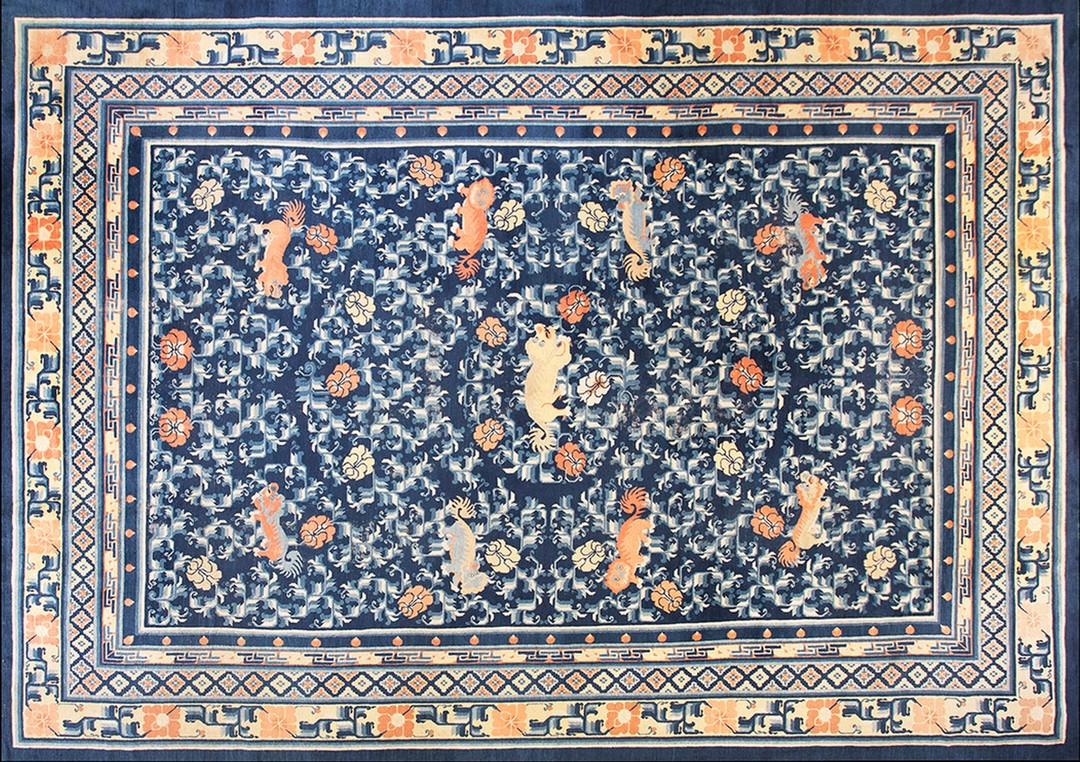
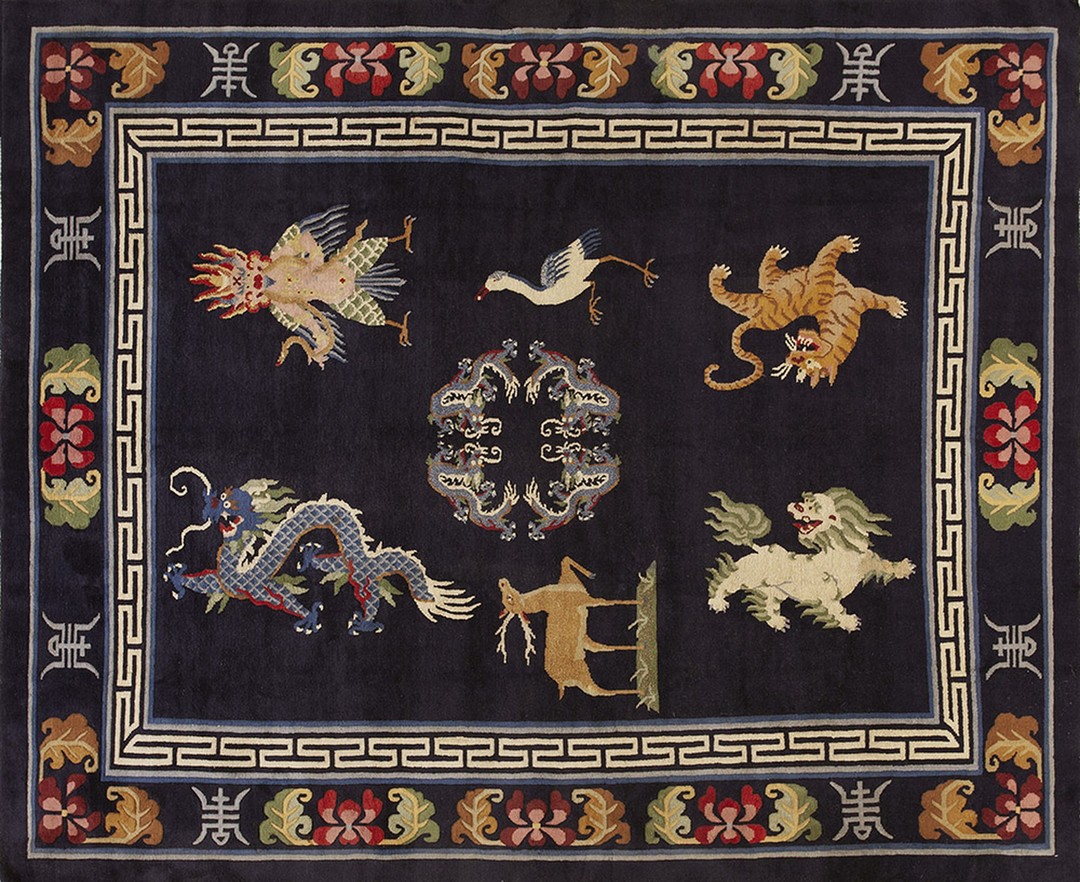
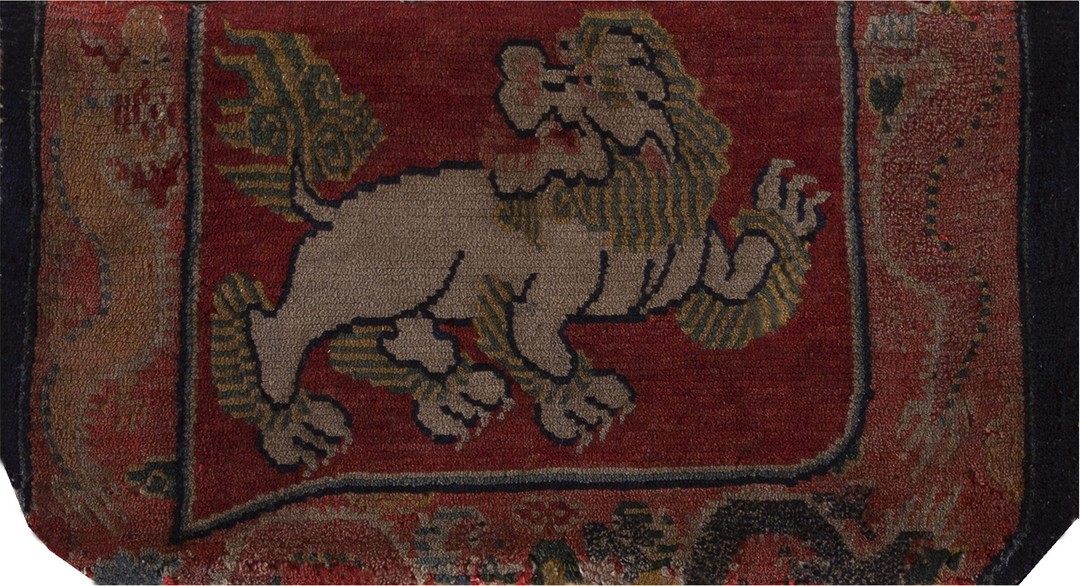
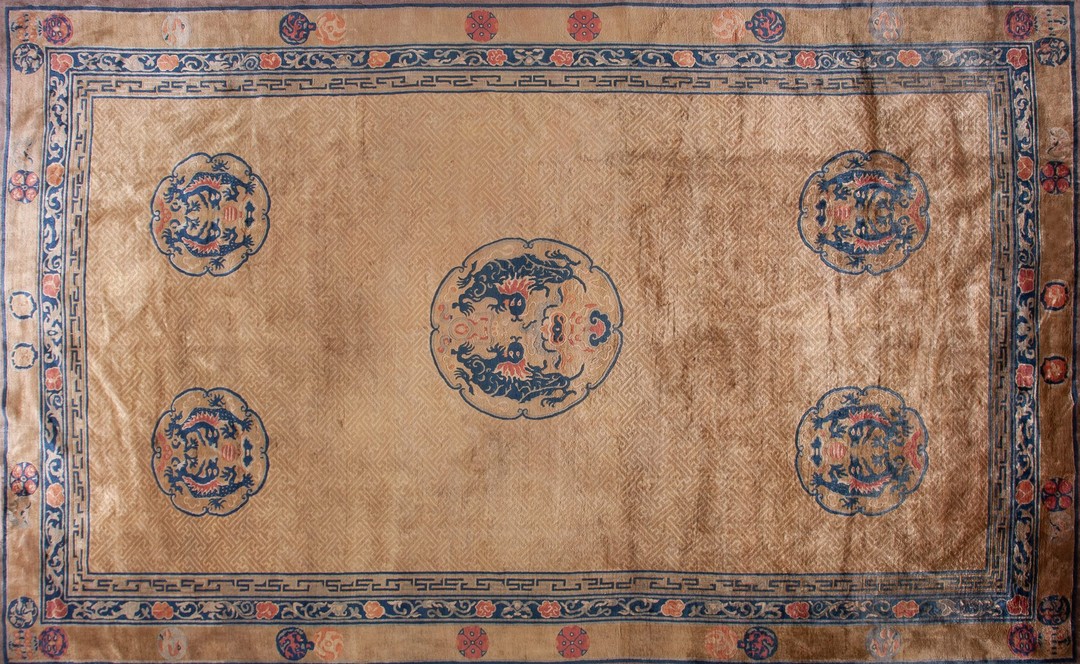
FAQ
- “Lion and Sun” vs. “Lion with Sword”—what’s the difference?
“Lion and Sun” shows the lion before a rising sun; “lion with sword” adds a raised shamshir. Many Persian examples combine all three elements in one emblem.
- What does the sun behind the lion signify?
It relates to the zodiacal sun in Leo, later layered with royal and religious meanings; together they signal vitality, sovereignty, and protection.
- Will dyes bleed during cleaning?
Older vegetal dyes are often stable but can crock if over-wet or alkalized. Always blot with cool water, avoid high pH, and test first.
- Are these rugs kid- and pet-friendly?
Wool is naturally stain-resistant and resilient; use a pad, trim pet nails, and keep pets off fringes to prevent pulling.
- Are Afghan or Indian reproductions acceptable?
They’re fine if transparently sold as such; many use good wool and natural dyes. Prices should reflect workshop origin, not antique Persian value.
- How can I authenticate a lion-motif rug?
Check back structure (hand-knotted knots, irregularities), foundation fibers (wool vs. cotton), and dyes (abrash). For value, get a written appraisal from a specialist.
- Do lion motifs work in modern interiors?
Yes. Graphic, single-figure lions read like art; pair with neutral sofas and let the rug’s palette inform a single accent color.
- Can I hang a lion rug on the wall?
Absolutely. Use a sewn sleeve and slat or museum-grade Velcro to distribute weight; avoid piercing the foundation with nails.
- How should I clean a lion pictorial rug?
Vacuum gently with suction only and spot-test dyes before any moisture. For deep cleaning, use a specialist who handles hand-knotted rugs.
- Do thick-pile Gabbehs shed a lot?
Newer ones can shed moderately at first due to loose fibers; shedding tapers with regular vacuuming (without a beater bar).
- Are lion Gabbeh rugs durable for high-traffic areas?
Yes. Their dense wool pile and simple construction wear well; use a quality rug pad and rotate yearly for even aging.
- How much do lion-motif rugs cost?
New small pieces can start in the low hundreds; vintage tribal examples often run \$1,000–\$5,000; rare antique city or Caucasian works can reach \$10,000+.
- Is importing Persian lion rugs into the U.S. allowed?
Import rules change and can be restrictive; domestic resale of existing pieces is common. Check current OFAC/CBP guidance or a customs attorney before importing.
- Are lion-with-sword rugs political?
Historically they reference Iran’s former state emblem; today most buyers treat them as cultural-heritage art. Context matters—display respectfully in public or institutional settings.
- What sizes are typical for lion pictorial rugs?
Many are small to mid sizes (around 3×5 to 5×7 feet) for hanging or accent use; larger room sizes exist but are less common and often pricier.
- Are “foo dogs” on rugs the same as lion motifs?
They’re stylized Chinese guardian lions, not dogs; they share protective symbolism with Persian lions but come from different Buddhist-influenced traditions.
- Are these motifs antique or still woven today?
Both. Nineteenth–twentieth century examples are collectible, while modern Persian-style, Afghan, and Indian workshops still produce lion pictorials and Gabbehs.
- What is a Caucasian Karabagh/Chelaberd lion or sunburst type?
Karabagh pieces can show heraldic animals or sunbursts; structure is typically wool on wool with symmetrical knots and strong, graphic medallions.
- How do I identify a Kerman pictorial lion rug?
Expect finer, city-workshop drawing, cotton foundations, and delicate color palettes; lions may appear in framed “pictorial” scenes alongside crowns, arches, or inscriptions.
- How can I recognize a Qashqai lion Gabbeh?
Look for thick, lofty wool pile, simple bold drawing, wool foundations, and vegetal-dyed fields; many show one large lion spanning the field with naive, charming proportions.
- Which tribes wove lion Gabbeh rugs?
Primarily Qashqai and neighboring Fars groups (including Khamseh and Luri), weaving thick-pile, folk-art lion rugs often for family use rather than export.
- Are lion motifs only Persian?
No. Persian examples are best-known, but lions also appear in Caucasian, Indian, Chinese, and Tibetan rugs (e.g., Tibetan snow lions, Chinese guardian “foo” lions).
- Where are lion-with-sword motifs most common?
Most are Persian, appearing on Qajar-era and later pictorial pieces and tribal weavings from Fars Province, with related examples in Kerman and occasional Caucasian interpretations.
- What does a lion holding a sword on a rug represent?
It references Iran’s historic “Lion and Sun” emblem; the sword (shamshir) adds ideas of guardianship and state power, and in folk contexts can allude to Imam Ali’s legendary blade.
- What does the lion motif on rugs mean?
It typically symbolizes strength, protection, and royal authority; in Persian traditions, lions can signal courage and prestige, sometimes tied to historic court or tribal power.