
Introduction to Jewish Motifs in Rug Design
Explore our sophisticated range of area rugs featuring Jewish designs today.
What Defines Jewish Motifs?
Jewish motifs in rugs are identifiable through the integration of religious, cultural, and historical symbols that reflect Jewish identity, faith, and heritage. Unlike purely decorative patterns, these motifs often serve as visual affirmations of belief and continuity, sometimes woven with intentional subtlety during times of exile or persecution. A rug with Jewish motifs design may feature iconic imagery such as the Star of David, menorah, or pomegranate, or include Hebrew inscriptions that directly reference scripture.
Other works were created for ritual use—Torah ark covers, prayer rugs, or synagogue textiles—marking them distinctly as Jewish-inspired carpets. These visual languages functioned both as spiritual reminders and as protective emblems, turning household or communal objects into carriers of sacred meaning.
Name Origins and Symbolism if Jewish Motifs
The roots of many Hebrew rug symbols lie in the language and scripture itself. The Magen David, translated as the “Shield of David,” is more than a geometric star; it embodies divine protection and Jewish identity across centuries. The menorah, described in the Torah as the seven-branched lampstand of the Temple, represents enlightenment and resilience. Pomegranates, tied to fertility and abundance, appear in Biblical descriptions of priestly garments and later became woven emblems of blessing.
The Lion of Judah references the Biblical tribe of Judah and symbolizes strength, sovereignty, and Messianic hope. Even protective amulets like the Hamsa, a hand-shaped design often associated with warding off evil, entered Jewish rug design as a cultural bridge between Jewish, Islamic, and Mediterranean traditions. These names, often retaining their Hebrew origin, reinforce how language itself preserves sacred meaning within design.
Why the Star of David?
Among all Jewish motifs in rugs, the Star of David rug is the most recognizable. Its six-pointed geometry carried practical and spiritual roles: protection, communal identification, and a reminder of divine connection. In weaving, it served as both a bold proclamation and a coded emblem. During periods when Jewish expression was suppressed, the symbol was embedded discreetly into border patterns or central medallions, visible only to those who knew what to look for. This layered visibility helped safeguard cultural continuity.
Its prominence also reflects the adaptability of the symbol—it could sit at the heart of a rug’s design, mark the corners as protective seals, or appear alongside Hebrew script and other sacred icons. As later parts of this series will show,the Magen David’s endurance in Jewish rug design is not accidental but the result of its dual role as both ancient marker and modern emblem of Jewish heritage.
Symbols Defining Jewish-Inspired Rug Patterns
The defining repertoire of Jewish-inspired carpets includes:
- Star of David (Magen David) — Why: emblem of divine protection and Jewish identity.
- Menorah — Why: symbolizes enlightenment, the Temple, and spiritual resilience.
- Pomegranate — Why: represents fertility, blessing, and scriptural continuity.
- Lion of Judah — Why: embodies strength, sovereignty, and Messianic tradition.
- Hamsa (Hand of Miriam) — Why: protective amulet against evil, cross-cultural yet distinctly adapted into Jewish motifs and symbolism.
- Hebrew Inscriptions — Why: invoke scripture, blessings, or liturgical associations directly into textile form.
Together, these motifs show that Jewish motifs in rugs are never just decoration. They encode resilience, faith, and heritage into woven form, binding together the practical beauty of textile art with the spiritual story of a people.
Historical Development and Geographic Spread
Biblical and Ancient Roots
The story of Jewish rug history begins in the earliest biblical accounts of sacred textiles. The Torah describes the Tabernacle adorned with curtains embroidered with cherubim, woven from blue, purple, and scarlet threads. Later, the Temple in Jerusalem featured similar imagery, with golden lampstands and pomegranates appearing both in ritual objects and in priestly garments. These scriptural references set a precedent: textiles were not just functional but carriers of holiness.
While no rugs from the First or Second Temple survive, the motifs—pomegranates, menorahs, and protective emblems—established the vocabulary that Jewish artisans would weave into their works for centuries to come. Early Jewish weaving origins thus lie at the intersection of ritual command and artistic expression, where threads and knots became extensions of scripture itself.
Diaspora and Regional Adaptations
As Jewish communities dispersed after the destruction of the Second Temple, weaving traditions traveled with them. Distinctive Jewish diaspora textiles arose in every major settlement center:
- Persia (Iran) — Why: home to some of the oldest Jewish communities outside Israel, where Jewish artisans worked in elite workshops and developed richly symbolic rugs.
- North Africa — Why: communities in Morocco, Tunisia, and Egypt wove rugs that blended Berber or Arab aesthetics with Hebrew motifs.
- Ottoman Levant — Why: synagogues from Aleppo to Istanbul employed Jewish weavers to create Torah ark covers and prayer rugs decorated with menorahs and script.
- Europe — Why: Jewish settlements in Italy, Spain, and later Eastern Europe adapted local Renaissance and Baroque designs into synagogue textiles.
- Central Asia — Why: Bukharan Jews became known for bright dyes, silk weaving, and carpets where Jewish motifs fused with Islamic patterns.
These migrations meant that while motifs like the Star of David or menorah remained constant, their visual expression shifted according to surrounding styles. The result was a body of historical carpets with Jewish motifs that look regionally diverse yet spiritually unified.
Influence of Persian and Islamic Workshops
Among all diaspora regions, Persia held a unique role. Jewish artisans there were highly skilled in dyeing and knotting, trades often restricted in other societies but permitted in Persian cities. Many of the great Safavid and later Qajar workshops employed Jews, who contributed not only technical expertise but also wove their own community’s symbolism into private commissions.
This explains why Persian rugs with Jewish motifs became central to the spread of motifs: they circulated through trade routes from Isfahan and Kashan into the Ottoman and European markets. The blending of rugs boasting Jewish motifs with the refined artistry of Persian design ensured both preservation and adaptation. Hebrew inscriptions, menorahs, and Stars of David could appear alongside arabesques, medallions, and floral scrolls, demonstrating cultural resilience through artistic fusion.
In this way, the geographic spread of Jewish rug design mirrors the Jewish diaspora itself—scattered across continents yet bound together by recurring motifs, rooted in biblical command and sustained by the artistry of exile.
Key Jewish Symbols and Rug Patterns
Core Jewish Motifs: Star, Menorah, Lions, Pomegranates, etc. The heart of area rugs with Jewish motifs lies in their layered symbolism, each design carrying theological, cultural, and protective meaning.
- Star of David (Magen David) — Why: emblem of divine protection and identity, found in central medallions or repeating across borders.
- Menorah — Why: symbol of the Temple and eternal light, often woven as a seven- or nine-branched candelabrum on a menorah rug used in synagogue textiles.
- Pomegranate — Why: represents fertility, abundance, and the 613 mitzvot (commandments), making the pomegranate motif rug both decorative and scripturally grounded.
- Lion of Judah — Why: heraldic symbol of strength, sovereignty, and Messianic promise, frequently flanking Torah crowns or ark covers in Lion of Judah carpets.
- Tablets of the Law (Ten Commandments) — Why: affirm covenant and Torah centrality.
- Crowns — Why: signify honor to the Torah, known as Keter Torah.
- Hamsa (Hand of Miriam) — Why: protective amulet against evil, adapted into Jewish usage as a guardian motif.
- Grapevines, olive branches, palm trees, and doves — Why: agricultural and peaceful imagery rooted in the Land of Israel, symbolizing blessing, continuity, and hope.
These motifs appear across centuries of weaving, always carrying meanings beyond decoration, binding rugs to liturgy, history, and identity.
Calligraphy and Hebrew Inscriptions
One of the most distinct markers of a Hebrew inscription carpet is its use of text as design. Jewish artisans frequently wove or embroidered verses from the Torah, Psalms, or liturgy into borders or cartouches. Common examples include blessings such as Baruch Atah Adonai (“Blessed are You, Lord”) or dedication inscriptions recording a donor’s name and the year.
These inscriptions were not only ornamental but functional, transforming rugs into devotional objects. Hebrew calligraphy also set Jewish motifs apart from Islamic or Christian textiles: the presence of square or cursive Hebrew letters immediately identifies the rug as part of a Jewish tradition, making calligraphy one of the clearest indicators for anyone learning how to identify rugs with Jewish motifs.
Narrative and Pictorial Carpets
Beyond symbolic motifs, some Jewish weavers created narrative or pictorial rugs that visually told sacred stories. These narrative carpets might depict King Solomon enthroned between lions, Moses receiving the Tablets, or imagery from Psalms and prophetic visions.
In communities with greater artistic freedom, rugs also commemorated Jewish history—marking synagogue dedications, communal events, or historical struggles. Such pictorial textiles highlight that rugs with Jewish motifs were not simply abstract patterns but active storytelling mediums, preserving collective memory in fiber and dye.
Identifying Jewish Motifs and Design Elements in Rugs
To recognize a Jewish-inspired rug pattern, look for the combination of sacred symbols and Hebrew text. The Star of David and menorah are the most universal motifs, but regional variations may emphasize lions, pomegranates, or agricultural symbols depending on local influence.
The presence of Hebrew calligraphy is the clearest identifier, as it rarely appears in non-Jewish textiles. Most importantly, every motif—whether protective, narrative, or liturgical—is meaningful. These symbols encode faith, tradition, and resilience, making Jewish rugs both aesthetic and spiritual artifacts.
Regional Variations in Jewish Rug Motifs and Designs
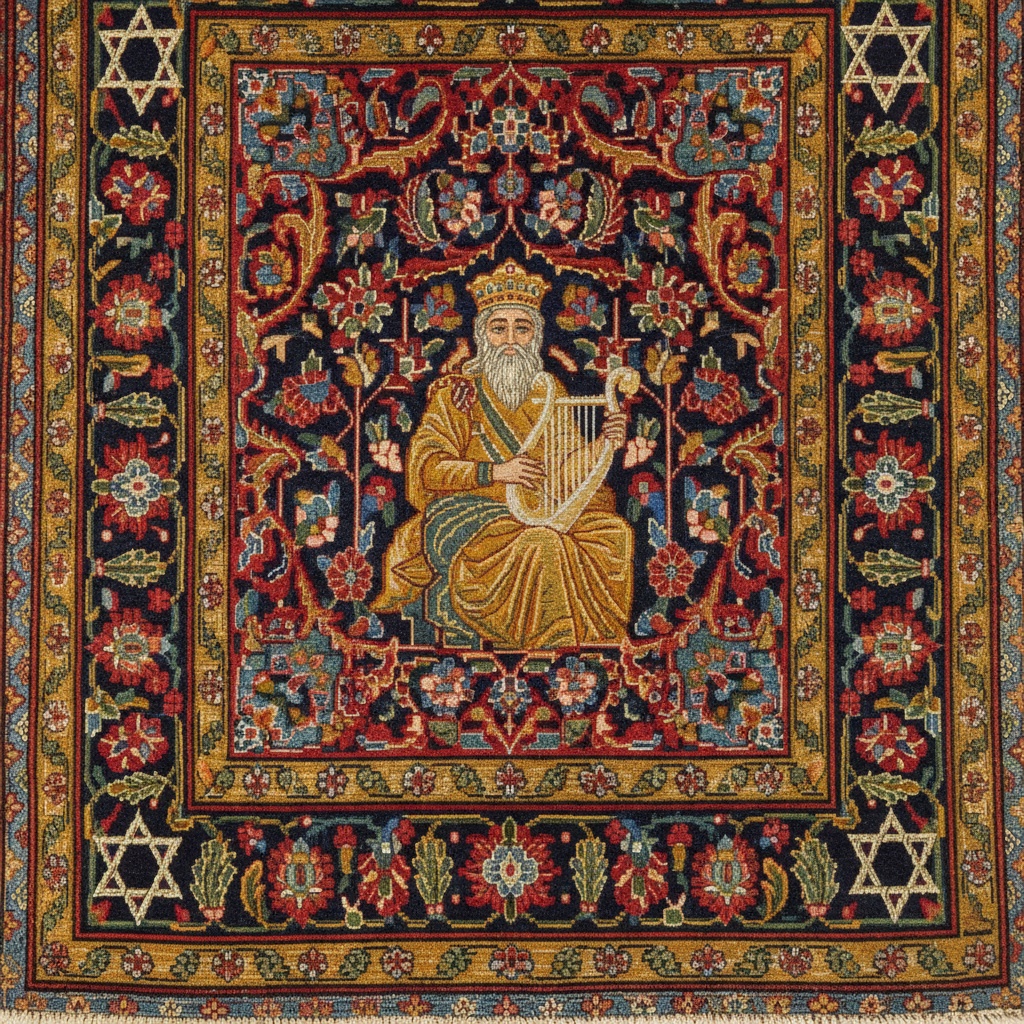
Central medallion featuring King David motif
Persian and Iranian Rugs With Jewish Motifs
Among the richest traditions of weaving, Persian rugs with Jewish motifs stand out for their pictorial and narrative qualities. Produced in cities such as Isfahan, Kashan, and Shiraz, these rugs often incorporated biblical scenes—King David with his harp, Moses at Sinai, or Queen Esther in royal splendor—interwoven with floral arabesques and central medallions.
Hebrew inscriptions framed the imagery, recording donors’ names, blessings, or dedications to synagogues. Luxury was central: silk pile, fine knotting, and saturated dyes gave these textiles a prestige equal to the celebrated Safavid carpets. Persian Jewish rugs became early carriers of Jewish motifs into the global market, affirming both religious identity and craftsmanship at the highest level.
North African and Moroccan Styles
Distinctive Moroccan Jewish rugs reveal an urban–rural divide.
- Urban centers (Fez, Marrakesh, Tunis) — Why: Jewish artisans adapted bold color palettes and geometric structures of local guilds, subtly inserting Hebrew initials or Stars of David into borderwork.
- Rural communities (Atlas Mountains, southern Morocco) — Why: symbols like the hamsa were woven directly into tribal-style rugs, serving as protective amulets. Rustic textures and earth-based dyes marked these weavings, linking faith with daily life.
North African rugs with Jewish motifs demonstrate how diaspora communities retained motifs of blessing and protection while embracing vibrant local aesthetics.
Levant and Middle Eastern Weavings
In the Levant and Ottoman Middle East, Jewish weaving was often directed toward ritual use. Synagogue textiles dominated: Torah ark curtains, bimah covers, and prayer rugs woven from local wool or imported silks. Designs commonly featured menorahs, lions, and Hebrew calligraphy.
In 20th-century Jerusalem, the Bezalel School revived these traditions, producing carpets that married biblical symbolism with modern art motifs. These textiles highlight how Jewish identity in the region was expressed through sacred function as much as visual design.
Central Asian and Caucasus Traditions
Communities in Bukhara and the Caucasus produced highly decorative textiles with a blend of embroidery and weaving. Bukharan Jewish embroidery, especially in the form of suzani, was renowned for gold and silver threads arranged in floral and geometric motifs, often incorporating Hebrew blessings.
Synagogue carpets in Central Asia employed niche layouts resembling Islamic prayer rugs but reinterpreted with Stars of David or Hebrew verses. In the Caucasus, Jewish workshops contributed to the bold medallion and lattice traditions of the region while preserving distinct motifs for communal use.
Ashkenazi Ritual Textiles
In Eastern and Central Europe, Jewish artisans often favored embroidery and applique over pile weaving.
- Torah ark curtains (parochet) — Why: adorned with lions, crowns, and tablets of the Law, marking synagogue sanctity.
- Family crests and heraldic motifs — Why: embroidered into carpets and curtains to express lineage and communal pride.
- Wimpels (Torah binders) — Why: embroidered cloths made from circumcision swaddling cloths, inscribed with Hebrew blessings, turning personal milestones into ritual textiles.
These Ashkenazi ritual textiles embodied resilience, as portable symbols of heritage even in regions where Jews were excluded from weaving guilds.
Yemenite and Lesser-Known Regional Styles
In Yemen and Iraq, Jewish artisans employed unique fibers and bold geometric patterns. Yemenite Jewish weaves often included striped designs in wool and cotton, while bridal belts and blessing bands incorporated Hebrew inscriptions.
Iraqi Jewish textiles sometimes combined imported silks with Hebrew script, used in both domestic and synagogue settings. These regional works demonstrate that even in isolated communities, motifs like blessings, menorahs, and protective emblems persisted, adapted to local materials and techniques.
Early Centers of Jewish Rug Weaving
When asking where were early rugs with Jewish motifs woven, the answer spans from ancient Israelite ritual textiles to later diaspora hubs: Persia, North Africa, the Levant, Central Asia, and Europe.
Each region produced distinct visual languages—woven, embroidered, or appliqued—yet all retained the recognizable core of Jewish motifs and symbolism. This geographic spread ensured that the identity encoded in rugs survived wherever Jewish communities took root.
Materials and Construction Techniques
Preferred Materials: Wool, Silk, Cotton, Linen
The foundation of a Jewish rug lies in its materials, chosen for durability, symbolism, and availability.
- Wool — Why: the most common fiber, prized for its warmth, resilience, and ability to absorb natural dyes deeply, making it ideal for long-lasting wool Jewish rugs.
- Silk — Why: used in luxury and ceremonial textiles, silk provided luster and refinement, especially for synagogue carpets or Torah ark curtains.
- Cotton — Why: often served as a warp or foundation material, stabilizing pile construction.
- Linen — Why: less common in pile rugs but frequent in embroidered ritual textiles, valued for its smooth texture and biblical associations with priestly garments.
These fibers grounded Jewish weaving in both practical use and sacred symbolism, with natural fibers preferred for purity and tradition.
Knotting, Weaving, and Embroidery
Construction techniques reflected regional standards while incorporating Jewish motifs.
- Persian knot (asymmetric) — Why: dominant in Iranian Jewish weaving, producing fine Persian knot carpets with pictorial and narrative detail.
- Turkish knot (symmetric) — Why: used in the Caucasus and Anatolia, favored for bold, geometric motifs.
- Flatweave and tapestry techniques — Why: applied in North African or Yemenite Jewish weaves, allowing symbolic bands and blessings to be worked into fabric.
- Embroidery and applique — Why: especially important in Europe for Ashkenazi ritual textiles, enabling Hebrew inscriptions and motifs on Torah curtains and wimpels.
Every method carried not only aesthetic purpose but also encoded spiritual meaning in the structure of the textile itself.
Dyeing: Natural vs. Synthetic Colors
Jewish artisans historically relied on natural dye rugs to enhance symbolic resonance.
- Indigo and tekhelet (murex blue) — Why: blue symbolized divinity, recalling the fringes (tzitzit) commanded in the Torah.
- Madder red — Why: associated with vitality and sacrifice.
- Saffron or weld yellow — Why: conveyed light and spiritual joy.
- Pomegranate husks and walnut shells — Why: produced warm browns and soft golds, linked to fertility and earth.
When synthetic dyes spread in the 19th century, some Jewish workshops adopted them for cost efficiency, but traditional weavers often continued to prefer natural sources, since symbolic colors carried deep ritual associations.
The use of natural dyes not only enhanced visual beauty but reinforced sacred meanings, making each symbolic color rug a theological statement.
Distinctive Features of Vintage vs. Modern Rugs with Jewish Motifs
Visual and Technical Differences
The contrast between a vintage area rug with Jewish motifs and a modern reinterpretation lies in both appearance and construction. Vintage pieces were almost always handmade, employing natural fibers such as wool or silk and colored with plant-based or mineral dyes. Over time, these materials aged into soft, glowing palettes—indigo fading into sky blue, madder red mellowing into earthy tones—creating the patina collectors prize.
Many older rugs also contained coded motifs, where symbols like the Star of David or Hebrew initials were worked discreetly into the pattern to protect identity during persecution. By contrast, the modern carpet with Jewish motifs may feature cleaner lines, minimalist reinterpretations of menorahs or pomegranates, and palettes influenced by contemporary design—neutrals, bohemian earth tones, or bold contrasts.
Technically, modern construction often includes synthetic fibers and digitally programmed looms, producing rugs that are more uniform but lacking the irregular charm of hand-knotting.
Machine-Made vs. Handmade Durability
- Handmade rugs — Why: crafted knot by knot, they are highly durable, repairable, and often last generations, retaining both utility and symbolic value as authentic Jewish rugs.
- Machine-made rugs — Why: accessible and affordable, they offer practicality but wear down more quickly, especially under heavy traffic, and rarely hold resale or heirloom value.
- Hybrid or semi-handmade rugs — Why: some workshops use a combination of digital design and hand-finishing, striking a balance between cost and artistry.
Are modern machine-made Jewish design rugs durable enough? Yes, they can serve well for everyday use in homes or synagogues, but they cannot match the longevity, repairability, or spiritual resonance of handwoven pieces.
Modern Adaptations and Designer Trends
- Minimalist reinterpretations — Why: contemporary designers reduce motifs such as the Star of David or menorah into clean geometric outlines, suitable for modern interiors.
- Bohemian and eclectic palettes — Why: blending Jewish symbols with earthy textures and free-form designs resonates with younger buyers seeking meaning-rich but stylish décor.
- Designer collaborations — Why: artists reimagine designer Jewish rugs as statement pieces, fusing ancient motifs with luxury aesthetics, sometimes on silk or wool-silk blends.
- Custom commissions — Why: bespoke works allow clients to select inscriptions, symbols, and colors that resonate with family heritage or synagogue use.
In short, how do vintage Jewish-design rugs differ from modern versions? Vintage rugs embody handwork, natural dyes, and subtle symbolic codes, while modern pieces often balance tradition with innovation, offering versatility but varying in authenticity.
The choice between them depends on whether one seeks the heirloom depth of history or the adaptable style of contemporary design.
Authentication, Value, and Collecting
How to Identify and Authenticate Rugs WIth Jewish Motifs
Recognizing an authentic Jewish rug requires careful attention to symbols, inscriptions, and context.
- Hebrew inscriptions — Why: presence of blessings, donor names, or scriptural verses is a strong indicator of Jewish origin.
- Core motifs — Why: Stars of David, menorahs, pomegranates, Lions of Judah, or Torah crowns consistently signal Jewish significance.
- Regional style — Why: the weaving technique (Persian knot, Turkish knot, or embroidery) should align with known Jewish communities from that region.
- Provenance — Why: synagogue use, family lineage, or community dedication strengthens authenticity.
- Wear and materials — Why: natural fibers and natural dyes, alongside ritual signs of use, help authenticate Jewish rugs versus modern reproductions.
For collectors, the ability to authenticate a Jewish rug rests on combining these markers with expert evaluation.
Provenance, Documentation, and Value
Jewish rug provenance is critical for establishing both authenticity and market worth. Documentation that traces a rug to a synagogue, family event, or donor inscription can significantly increase its price.
A Torah ark curtain with known communal use, for example, carries both historical and spiritual weight, making it a prized collectible. Provenance can also differentiate between otherwise similar-looking rugs—turning a decorative textile into a museum-quality artifact. In short, provenance documents directly affect pricing of rugs with Jewish motifs, often multiplying value compared to undocumented pieces.
Investment, Restoration, and Rarity
- Does a vintage rug with Jewish motifs hold investment value? — Yes: authentic vintage and antique rugs often appreciate in value, especially if connected to synagogues or communal history. Their rarity, handwork, and symbolism make them attractive to collectors of Judaica and fine textiles.
- How rare are antique Jewish prayer rugs on the market? — Extremely rare: authentic rare Jewish prayer rugs appear only occasionally at major auctions or through specialized dealers, reflecting both their fragility and limited original production.
- Where can I authenticate antique Jewish synagogue carpets? — Seek experts in Judaica textiles, major auction houses (Sotheby’s, Christie’s), or museum curators specializing in Jewish decorative arts. Specialized appraisers in Jewish ceremonial objects are best positioned to confirm authenticity.
- Is restoring a damaged Jewish design rug worth the cost? — Yes, if performed by qualified textile conservators. Restoring a Jewish rug protects both its cultural legacy and financial worth. In many cases, sensitive restoration enhances long-term investment value, provided original motifs and inscriptions remain intact.
Collecting rugs with Jewish motifs means engaging with history as much as art. Their value as Jewish carpets rests not only on craftsmanship but also on rarity, story, and preservation. Authentic, documented examples serve as heirlooms of a global diaspora—woven records of identity that continue to hold both cultural and financial significance.
Contemporary Uses and Interior Design
Rugs with Jewish Motifs in Modern Spaces
Today, a rug with Jewish motifs for placement in modern homes is more than an antique heirloom—it’s a statement piece that blends heritage with contemporary style.
- Living rooms and lounges — Why: a hand-knotted Jewish carpet with a Star of David or menorah pattern adds cultural depth and acts as a meaningful centerpiece.
- Minimalist interiors — Why: geometric motifs such as hexagons or stylized pomegranates align with clean modern lines while preserving symbolic resonance.
- Eclectic or bohemian homes — Why: vibrant colors and narrative designs introduce visual storytelling, connecting modern décor to ancestral traditions.
In all settings, the appeal lies in their ability to enrich interiors with layers of identity and meaning.
Commissioning Custom and Family Symbol Rugs
Commissioning a custom rug with Jewish motifs is a living continuation of centuries-old practice.
- Family symbols — Why: weaving a Star of David, Lion of Judah, or Hebrew blessing into a rug transforms it into a personalized heirloom.
- Lifecycle events — Why: weddings, anniversaries, and synagogue dedications are often commemorated with bespoke rugs.
- Design flexibility — Why: clients can choose motifs, inscriptions, colors, and materials that reflect family heritage.
Answering directly: Should I commission a custom rug with Jewish family symbols? Absolutely. A Jewish family symbols rug becomes both functional art and a tangible legacy, ensuring cultural identity is preserved for future generations.
Integration in Jewish Ritual and Home Life
Jewish motifs in rugs continue to serve both ritual and domestic functions.
- Synagogues — Why: Torah ark curtains, bimah covers, and prayer rugs reinforce sacred atmosphere.
- Weddings and lifecycle events — Why: rugs featuring blessings or crowns mark milestones with symbolic weight.
- Everyday homes — Why: families display menorah or pomegranate patterns to embody continuity, pride, and heritage.
These uses reflect how tradition and daily life remain interconnected, with rugs acting as carriers of both faith and beauty.
Where to Find Authentic and Custom Rugs
Authenticity remains vital. Collectors and homeowners can source artisan Jewish rugs through specialized Judaica dealers, auction houses, or contemporary designers. Hand-knotting continues in several global centers:
- Israel — Why: Bezalel-inspired workshops and independent artisans maintain biblical symbolism in modern forms.
- Iran and Morocco — Why: historic weaving hubs where Jewish motifs remain part of local tradition.
- United States — Why: contemporary Judaica designers offer custom Jewish rugs tailored to family or synagogue needs.
Direct answer: Where do artisans still hand-knot Jewish motifs rugs today? Israel, Iran, Morocco, and the U.S. remain active centers, blending age-old techniques with modern creativity.
Ultimately, whether chosen for ritual use, interior design, or personal heritage, hand-knotted Jewish motifs in carpets remain one of the most versatile and meaningful ways to weave tradition into modern life.
Explore Some of Our Jewish Design Rugs
FAQ
- What should I check before buying Jewish motif rugs online?
Verify fiber content, knot count or pile weight, and close-ups of motifs/edges. Request return terms and a written statement if the Jewish motif rug is “signed.”
- Do Jewish motif rugs include mizrah designs?
Some Jewish motif rugs adapt mizrah themes, but mizrah is traditionally a wall plaque indicating east. Use such designs as textiles on walls rather than floors.
- Are custom Jewish motif rugs available?
Yes—many workshops will custom-weave Jewish motif rugs with chosen symbols, sizes, and colors. Expect 6–12 weeks for hand-tufted and longer for hand-knotted.
- How do I hang a Jewish motif rug on the wall?
Sew a sleeve or use Velcro/clip systems to mount Jewish motif rugs evenly. Keep out of direct sun and maintain ½–1″ airflow from the wall.
- What sizes work for entryways with Jewish motif rugs?
Runners (2–3′ × 6–10′) or mats around 2′ × 3′ suit entryways. Ensure door clearance and use a cut-to-size rug pad.
- Are there minimalist or modern Jewish motif rugs?
Yes—many modern Jewish motif rugs use tone-on-tone hexagrams, line-art menorahs, or abstract Jerusalem silhouettes. Subtle motifs fit contemporary interiors.
- Can Jewish motif rugs be used outdoors?
Use outdoor-rated Jewish motif rugs in polypropylene for weather resistance. Bring them inside during heavy rain and store dry to prevent mildew.
- Are Jewish motif rugs good for high-traffic areas?
Yes—wool Jewish motif rugs with dense knots and a quality pad handle traffic well. Aim for medium to dark grounds to hide soil.
- How do I clean and maintain Jewish motif rugs?
Vacuum gently without beater bars and rotate Jewish motif rugs twice yearly. Professionally clean wool every 1–3 years to preserve dyes and pile.
- What colors are common in Jewish motif rugs?
Jewish motif rugs frequently use deep blues, golds, reds, and neutrals. Bezalel pieces often blend Arts-and-Crafts palettes with Levantine earth tones.
- How do Jewish motif rugs differ from Islamic geometric rugs?
Both use geometry, but Jewish motif rugs often feature Hebrew, menorahs, lions, or Jerusalem scenes. Islamic rugs more commonly emphasize non-figurative geometry and arabesques.
- Do Jewish motif rugs conflict with shatnez rules?
No—shatnez applies to wearing wool-linen blends, not to floor coverings. When in doubt for religious observance, ask a competent rabbinic authority.
- Are Jewish motif rugs okay for non-Jewish homes?
Yes—Jewish motif rugs are fine for anyone who appreciates the culture. Be respectful by avoiding sacred names or ritual-specific inscriptions.
- How should a Jewish motif rug with text be oriented?
Align Jewish motif rugs so Hebrew reads upright from the primary viewing side. If used as a wall hanging, a “mizrah” theme traditionally faces east.
- What materials work best for Jewish motif rugs?
Wool is classic for Jewish motif rugs due to durability and color richness. Silk accents or cotton warps appear in finer or flatwoven pieces.
- Are Jewish motif rugs suitable for synagogues or community centers?
Yes—choose durable wool Jewish motif rugs and avoid divine names underfoot. Many institutions prefer wall-hung textiles for sacred imagery.
- Where can I buy Jewish motif rugs in the U.S.?
Seek Jewish motif rugs at Judaica galleries, specialty rug dealers, and auction houses in cities like New York and Los Angeles. Verified provenance and condition reports are key.
- How much do vintage Jewish motif rugs cost?
Prices for Bezalel-type Jewish motif rugs typically range from low thousands to tens of thousands. Smaller signed pieces might be \$2,000–\$6,000; larger or rarer examples can exceed \$20,000.
- How can I authenticate vintage Jewish motif rugs like Bezalel?
Look for workshop signatures (“Bezalel,” “Jerusalem,” or “Marbadiah”), period dyes, and Jewish iconography. Provenance and auction records materially increase confidence and value.
- What are Bezalel rugs within Jewish motif rugs?
Bezalel rugs were woven in early-20th-century Jerusalem and often show menorahs, lions, and Hebrew inscriptions. Many pieces are signed “Bezalel” or “Marbadiah/Marvadiah.”
- Are hamsa designs considered Jewish motif rugs?
Hamsa rugs (Hand of Miriam) fit Jewish motif rugs and also appear in broader Middle Eastern culture. The symbol represents protection and is common in Jewish Sephardi/Mizrahi decor.
- Can Hebrew text be used on Jewish motif rugs?
Yes—use general words like “Shalom,” “Chai,” or blessings without divine names. Sacred names should be avoided on floor textiles or anywhere likely to be soiled.
- Are Jewish motif rugs appropriate for floors?
Yes, Jewish motif rugs are fine for floors if designs are respectful. Avoid rugs that spell out divine names (like the Tetragrammaton) to prevent desecration.
- Which symbols appear most on Jewish motif rugs?
Common Jewish rug motifs include the menorah, Magen David (Star of David), pomegranates, the Lion of Judah, Jerusalem scenes, and Hebrew calligraphy. Pomegranates often reference the 613 mitzvot.
- What are Jewish motif rugs?
Jewish motif rugs are textiles featuring Jewish symbols or themes—like menorahs, Stars of David, pomegranates, lions of Judah, or Hebrew lettering. They can be hand-knotted, flatwoven, or machine-made for floors or walls.