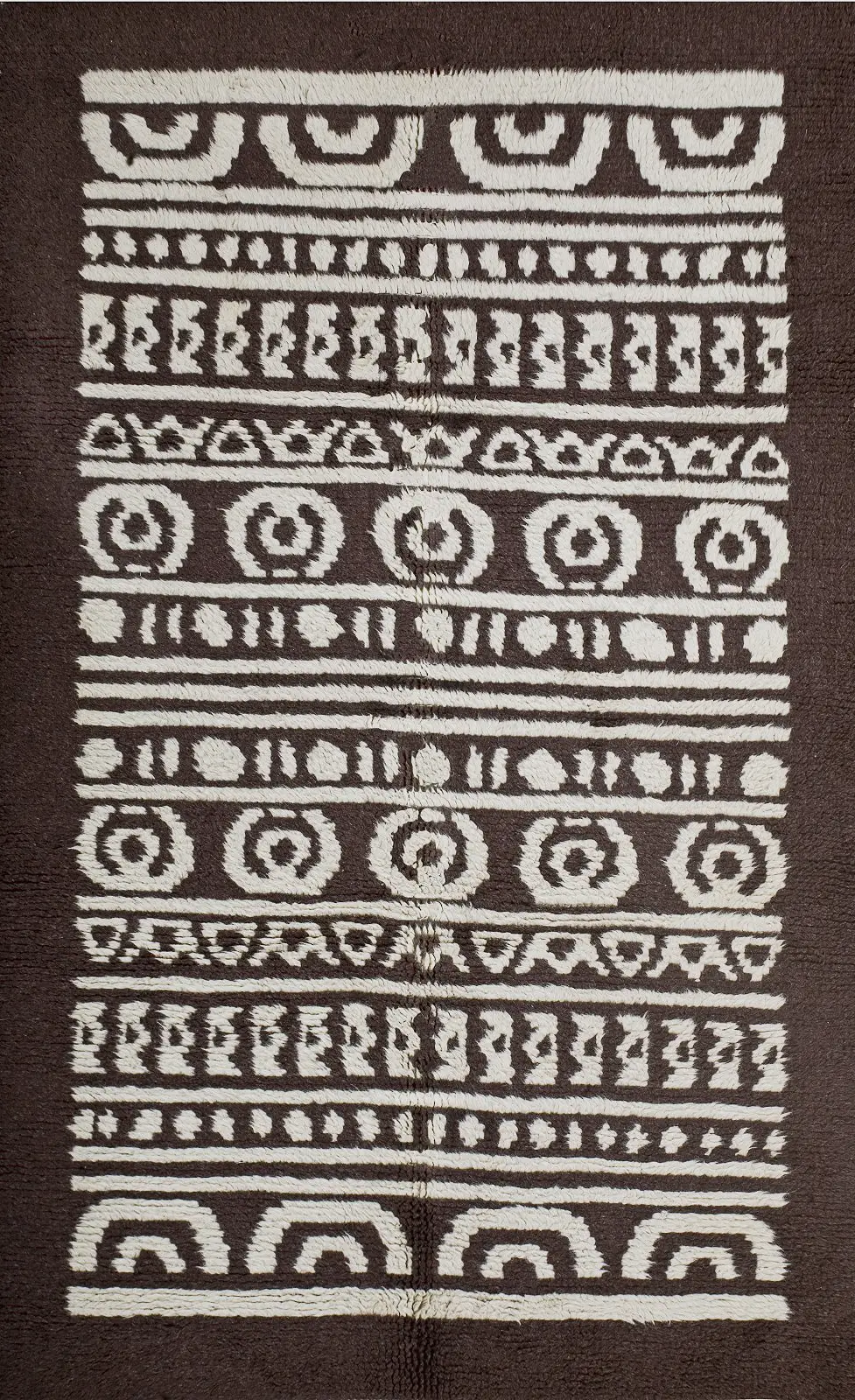
Emerging from the transition between late Art Deco and the streamlined aesthetics of the 1940s and 50s, “Continental Art Moderne” textiles are defined by their intellectual rigor and graphic bravery. This vintage Continental area rug eschews the floral softness of the past in favor of a bold, “machine-age” architectural language. It reflects the mid-century fascination with “Primitivism”—a movement where artists like Picasso and Matisse drew inspiration from the stark, honest linework of tribal cultures to create a new, universal visual vocabulary.
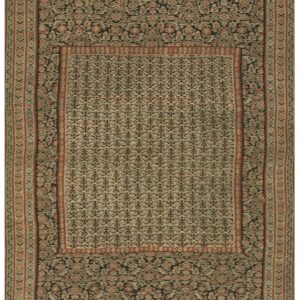
The rug is anchored by a deep, sophisticated brown—a color that served as the foundational “neutral” for the mid-century modernist interior.
- The Ground: A rich espresso or tobacco brown that provides a grounding, masculine weight to the space.
- The Accents: Bold, high-contrast ivory or cream geometries pierce the dark field, creating a rhythmic visual tension.
- The Patina: As a vintage mid-century piece, the wool has developed a wonderful “matte” finish that absorbs light, highlighting the crispness of the geometric pattern rather than obscuring it with shine.
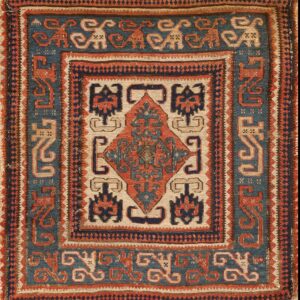
The “Bold Tribal” pattern is a masterclass in balance. The use of repeating zig-zags, crenelated borders, or stark diamonds suggests a nomadic heritage, yet the precision of the layout is undeniably “Continental.” It is a textile that feels both ancient and futuristic—a quality that made it a favorite for the wood-paneled offices and glass-walled villas of the 1950s European elite.
Small-format area rugs of this caliber are the “secret weapons” of interior design. This piece is not merely a floor covering; it is a piece of graphic art.
Its compact size and powerful pattern make it ideal for:
- The Minimalist Foyer: Setting an immediate tone of curated, intellectual taste.
- The Modern Study: Pairing perfectly with Eames-era furniture, leather upholstery, and warm teak woods.
- Wall Hanging: Its graphic clarity allows it to function beautifully as a textile “tapestry” in a contemporary gallery setting.
Specifications:
- Origin: Continental Europe (likely French or Scandinavian influence)
- Period: Mid-20th Century (Circa 1940–1960)
- Style: Art Moderne / Mid-Century Tribal
- Palette: Espresso Brown, Alabaster, and Charcoal
- Composition: 100% Dense Hand-spun Wool
- Character: A rare “small-batch” artisanal weave showcasing the strength of post-war geometric abstraction.
Condition: Good.