Rugs Circa 1886
1886: The Flourishing of the Great Persian Workshops
A rug woven in 1886 represents a masterwork from the height of the Victorian rug revival. By the late 1880s, the “Ziegler Revolution” was in full swing, and the master workshops of Sultanabad, Kirman, and Tabriz had perfected a style that balanced ancestral motifs with the grand scale required for Western palatial homes. This year is particularly prized by collectors because it captures the transition from “tribal” weaving to “workshop” excellence. The rugs of 1886 possess a robust, heavy handle and a sophisticated symmetry, marking a period where quality control was at an all-time high to satisfy the elite markets of Europe and America.
Technologically, 1886 exists at a fascinating crossroads of color. While the synthetic dye “Aniline” had been available for two decades, the most prestigious looms of this year were part of a deliberate “Vegetable Dye Renaissance.” Master weavers realized that the international market demanded the soft, variegated “abrash” that only natural pigments could provide. Consequently, a c. 1886 carpet is often characterized by its exceptional use of Kermes and Madder reds and deep, layered Indigo blues, providing a color fastness and tonal depth that remains vibrant over a century later. This was the year that the industry solidified its “High Antique” standards, ensuring that every knot contributed to a textile intended to last for generations.
The world of 1886 was a landscape of bold ambition and global firsts. In the United States, this was the year the Statue of Liberty was dedicated in New York Harbor, a gift from France that signaled an era of cross-continental artistic exchange. It was also the year that Karl Benz patented the first internal combustion engine, forever changing the speed of the world, while the first Coca-Cola was served in Atlanta. Amidst this rapid modernization, the weaving villages of the East remained a sanctuary of slow art. A rug from 1886 encapsulates this historical tension: it is a product of ancient, patient hands, yet it was destined for a world that was suddenly discovering the thrill of the modern age.
Circa 1886 rugs are recognized for their intricate ornamentation and established weaving practices. These pieces carry strong antique character.
Prefer to see a rug in person?
-
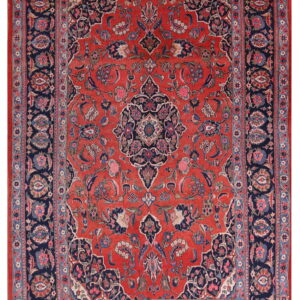
Antique Kashan Room Size Wool Coral Rug
$3,000.00 Antique RugsSKU: 5423Rug sizes: 7 ft 3 in x 11 ft 1 in (2.21 m x 3.38 m)