
Rug Blocking & Stretching: The Loom Reset
At Rugs On Net, our Manhattan studio provides a complete spectrum of specialized care for your hand-knotted textiles. Beyond this service, we ensure your investment remains structurally sound and visually vibrant.
Also read about our other services we offer: Expert Rug Repair & Restoration Services, Moth Proofing, and Rug Cleaning.
A wrinkle is a wound. It may look minor today, but in a hand-knotted rug it becomes a structural fault line that worsens with every footstep, every vacuum pass, every season. At Rugs On Net, we call the correction process The Loom Reset: returning a rug to the original geometry and Tension Memory that was built into it on the loom, before humidity, furniture, poor cleaning, or storage pulled it out of shape.
Most people treat rug waves as a cosmetic annoyance. They are not. A warped rug is a stress map. Every raised ridge absorbs disproportionate friction from foot traffic. Every valley traps particulate grit that grinds the knots from underneath. Every curled edge is a trip hazard. Your rug should fit your room — not fight it.
I have seen owners try to solve this with books, tape, heavy planters, and even home irons. In every case, the distortion either returned within days or the “fix” created new damage. The reason is simple: surface weight does not restore internal tension. What a wrinkled rug needs is a recalibration of the forces inside its foundation — and that is a job for specialized equipment and hands that understand textile engineering.
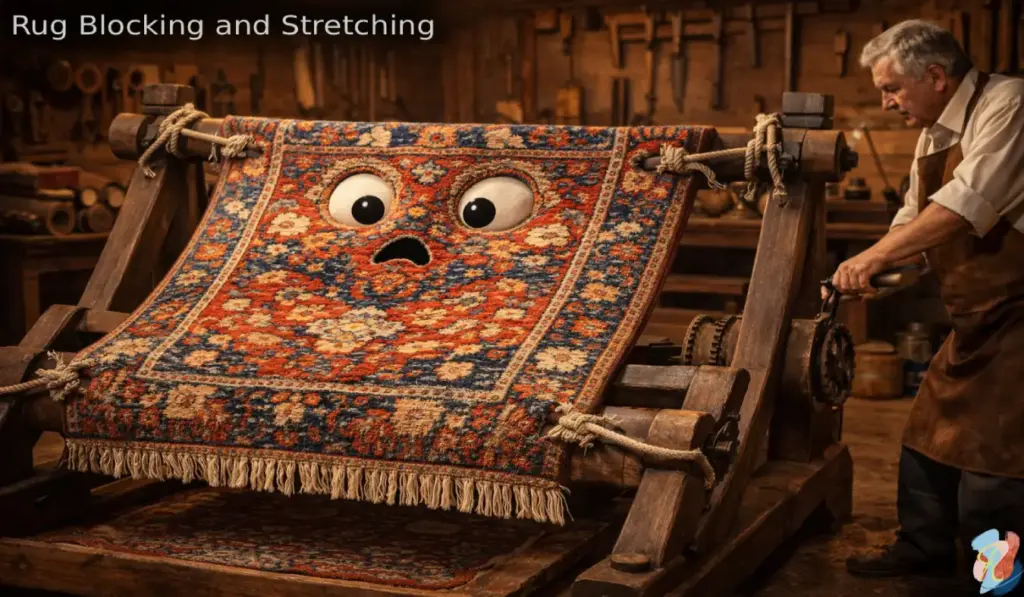
The Physics of Rug Warping
To understand why professional blocking works, you need to understand why rugs lose their shape in the first place. A hand-knotted rug is not a flat sheet. It is a tensioned structure. The warps (vertical threads) and wefts (horizontal threads) are held in a precise balance of mechanical tension that was established while the rug was stretched on a loom during weaving. Every knot sits at an intersection of those forces. When the tension balance is disturbed, the knots shift, the plane buckles, and the rug begins to “remember” the wrong shape.
We map these failures using what we call Foundation GPS — a hands-on diagnostic pass that charts exactly where the weave has drifted, how severely, and in which direction. This is not guesswork. It is a structural assessment that tells us exactly how much force, in what direction, at what temperature, the rug needs to return to True Geometry.
Common Causes of Rug Distortion
The Humidity Pendulum
Manhattan apartments are uniquely punishing on rug foundations. In winter, forced steam heat drives indoor humidity below 20%, causing cotton warps to contract and become brittle. In summer, ambient moisture can climb above 70%, causing those same threads to swell. This seasonal swing — what we call The Humidity Pendulum — means the foundation is constantly expanding and contracting at uneven rates across its surface. Over several cycles, the rug develops permanent waves, buckles, or a diagonal skew that no amount of “airing out” will correct.
The Compression Trap
A sofa, bookcase, or bed frame sitting on a rug for years creates what we call The Compression Trap: localized permanent deformation. The weight slowly resets the foundation tension in that zone. When the furniture is finally moved — during a renovation, a cleaning, or a room rearrangement — the compressed area cannot spring back. It has been “taught” a new shape. The surrounding rug is flat, but the area under the old furniture position is depressed, warped, or buckled. This is one of the most common reasons clients bring rugs to us.
The Shear Factor
Dragging a rug across a floor — even once — applies lateral shear force to the foundation. This shifts warp threads out of their original alignment, creating a subtle but persistent ripple pattern. The damage is often invisible at first, but worsens over time as foot traffic reinforces the new distortion. I have seen rugs that were dragged during a single apartment move develop ripples that took years to fully manifest. By the time the owner notices, the distortion has become structural.
Over-Wet Cleaning Distortion
This is the single most common cause of post-cleaning warping, and it is almost always preventable. When a rug is cleaned without controlled, even drying, the cotton foundation absorbs moisture unevenly. Different sections swell, then dry at different rates depending on air exposure and pile density. The result is a rug that was flat before cleaning and wavy afterward. At our studio, we control the drying environment precisely to prevent this — but many rugs arrive at our door already warped from a prior bad wash elsewhere.
Fold Storage Damage
A rug that has been folded for storage — rather than rolled — develops hard crease lines that can become permanent buckles. The foundation “memorizes” the fold angle, and the longer it stays folded, the deeper that memory becomes. We see this frequently with inherited rugs, estate pieces, and textiles that have been in closets or basements for years. Unfolding and laying the rug flat is not enough. The crease memory needs to be actively reset.
The “Rug Stretching Near Me” Risk
When people search “rug stretching near me,” the results often prioritize convenience over competence. Most local providers are carpet stretching services — companies that handle wall-to-wall synthetic broadloom using power stretchers, knee kickers, and tack strips. These tools are designed for carpet that is meant to be nailed to a floor. They are not appropriate for a hand-knotted textile that needs to lie flat under its own weight.
The difference matters enormously. A carpet stretcher applies brute directional force from the edges. On a hand-knotted rug, this can tear the selvage, distort the border knots, or create new stress lines in the foundation. I have personally examined rugs that came to us after a carpet company “stretched” them, and the damage was worse than the original wrinkle. Nails through the edges. Glue on the backing. Staples punched into the fringe. These are not exaggerations — they are the predictable outcome of applying carpet tools to a textile that was built on a loom, not stapled to a subfloor.
Common DIY Attempts That Backfire
Before bringing a rug in, many owners try home solutions. I understand the impulse — you want to fix the problem quickly and avoid the logistics of transporting a large textile. But every common home approach has a flaw:
- Stacking heavy objects: Gravity is not a repair tool. Books, planters, or furniture on top of wrinkles may flatten the surface temporarily, but they do not restore the internal warp-weft tension. When the weight is removed, the wave returns — often within hours.
- Reverse rolling: Rolling the rug in the opposite direction of the curl sometimes reduces edge lift temporarily, but it can also create a new curl in the other direction, or stress the foundation at the roll point.
- Rug tape and adhesive pads: These hold edges down cosmetically but do nothing about the underlying distortion. When eventually removed, the adhesive residue can damage the backing and attract dirt.
The Iron Myth
This one deserves its own warning. Heat without calibration is destruction. A home iron operates at a single high temperature with direct contact pressure. On wool, this scorches the fiber surface, creating a permanent glaze that changes the texture and color of the pile. On silk, it can melt individual fibers and leave shiny, flattened tracks. And because a home iron is small relative to the rug, it creates localized heat zones that can actually lock in distortion rather than releasing it.
Our industrial pressing phase uses controlled heat bands that are calibrated to the specific fiber type and pile direction of each rug. The temperature, pressure, and duration are all different for wool versus silk versus cotton. This is not a step you can replicate at home with consumer equipment.
Our Blocking & Stretching Process: The True Geometry Protocol
Every rug that comes into our studio for blocking follows a structured, multi-phase process. We do not use a single technique for all textiles. A tribal Baluch with a wool foundation requires a fundamentally different approach than a fine Tabriz on cotton, or a modern Tibetan on a high-twist wool warp. The fiber dictates the method.
Phase 1: Textile Intake & History Review
We begin by identifying the rug’s weave type, fiber composition, construction origin, and any prior repairs or interventions. If the rug has been cleaned recently, we note the method used, because a prior over-wetting may have caused the current distortion. We also ask the owner about the rug’s environment — heating system, furniture placement, recent moves — because this context shapes our correction strategy.
Phase 2: Foundation GPS Mapping
This is the diagnostic step. We lay the rug flat and systematically chart every distortion: ripple lines, edge memory (where edges have curled and hardened), skew zones (areas where the rug has shifted diagonally), and compression channels (the footprint left by heavy furniture). We note the direction and severity of each issue. This map tells us exactly where to apply force, how much, and in what sequence.
Phase 3: Pile Conditioning
Before any mechanical work, we hand-brush the pile to reveal hidden wave paths that may not be visible from the surface. Brushing also relaxes directional pile stress — the tendency of the fibers to “lean” in the direction of the distortion. This step reduces the amount of force needed in the next phase and protects the pile from unnecessary mechanical pressure.
Phase 4: Controlled Re-Tension
This is the core of the blocking process. Using mechanical tension tools, we apply incremental, directional force to rebalance the warp-weft geometry. The key word is incremental. We do not yank the rug flat in one pass. We apply tension gradually, in stages, allowing the foundation to relax into its corrected position over time. Aggressive pulling creates new stress points. Patient, calibrated tension restores the original balance.
Phase 5: Fiber-Calibrated Pressing
Once the foundation is re-tensioned, we set the shape using industrial pressing equipment. The temperature and pressure are calibrated to the specific fiber: wool tolerates moderate heat, silk requires low heat with minimal contact pressure, and cotton foundations respond to steam-assisted pressing at controlled humidity levels. We press along the pile grain, not against it, to avoid creating new texture anomalies.
Phase 6: Edge & Corner Stabilization
Edges and corners are the most stubborn areas because they have the least structural support from the surrounding weave. If the edges show persistent curl or the corners have developed hard memory, we install reversible anti-curl backing support. This is never glue, never nails, never tape. It is a textile-based stabilizer that can be removed if needed without leaving residue or damage.
Phase 7: Final Geometry Review
I personally verify lay-flat behavior, edge stability, and walk-surface safety before releasing the rug. This means walking the entire surface, checking each edge and corner, and confirming that the rug sits flat under its own weight without any mechanical aid. If any area is still lifting or rippling, we go back and address it before the rug leaves the studio.
Goal state: True Geometry. Flat, stable, safe, and visually balanced.
[Image: before/after split showing curled-edge rug corrected to flat geometry]
Before & After: What to Expect
I want to set honest expectations here, because not every distortion is a one-visit fix.
Many rugs — especially those with recent or moderate distortion — respond fully to a single blocking session. The rug goes from visibly wavy to perfectly flat, and it stays that way. These are the straightforward cases: a post-cleaning buckle, a seasonal humidity wave, a corner curl from a rug pad that was too small.
Other rugs have what I call “deep memory distortion.” These are pieces that have been warped for years, stored folded for extended periods, or subjected to repeated seasonal cycling without correction. In these cases, the foundation has physically adapted to the distorted shape. Correcting this takes staged work — an initial blocking session to break the memory, followed by a rest period, followed by a second session to set the final geometry. We tell you up front which category your rug falls into, and we never overpromise a single-session result when staged correction is what the textile actually needs.
- Before: Ripples across the field, diagonal skew, edge lift, corner memory, uneven furniture sit, visible buckling in the center.
- After: Flat lay, stable edges, safer walk path, restored visual symmetry, furniture sits level, and improved long-term wear pattern because stress is distributed evenly across the pile instead of concentrated on the ridges.
How Much Does Rug Blocking Cost?
Pricing depends on size, fiber type, severity of distortion, and whether edge stabilization is needed. We provide an exact quote after hands-on inspection — not a rough guess over the phone or from a photo. Every rug’s distortion profile is different, and the labor required to correct a mild post-cleaning wave is very different from the labor required to reset a rug that has been folded in a basement for a decade.
Common Concerns About Rug Blocking
“Will blocking damage the pile or change the way the rug looks?”
No. Our process works on the foundation — the warp and weft structure underneath the pile. The pile itself is conditioned and pressed along its natural grain. If anything, a properly blocked rug looks better afterward because the pile lies uniformly instead of being distorted by the underlying wave pattern.
“Can blocking fix a rug that was already repaired or rewoven?”
Usually yes, with care. Rewoven areas and structural patches sometimes have slightly different tension than the original foundation. We identify these during the intake phase and adjust our tension approach to avoid stressing the repair boundary. In some cases, a rewoven section may need to be stabilized independently before the surrounding rug is blocked.
“How long does the correction last?”
For most rugs, a professional blocking holds indefinitely — as long as the conditions that caused the original distortion are not repeated. If the rug is going back into the same environment with the same furniture layout and the same seasonal humidity swings, I recommend pairing the service with proper rug padding and periodic rotation to prevent recurrence.
When to Bring a Rug In
If you are noticing any of the following, do not wait for it to resolve on its own. Distortion does not self-correct. It compounds.
- Waves or ripples that return after home flattening attempts
- Corners that curl upward and create tripping hazards
- Skewed layout where the rug no longer sits square with the room
- Post-cleaning distortion from a prior wash that went wrong
- Rugs coming out of long-term folded or rolled storage with visible creases
- Uneven furniture sit — chair legs rock, table does not sit level
For ongoing preventive care between blocking services, see our rug care guide. For rugs that also need structural repair, see our rug repair and restoration service. And for rugs that need proper support underneath, see our custom rug padding.
Schedule Rug Blocking & Stretching in Manhattan
Rugs On Net
36 E 31st Street
New York, NY 10016
+1 646 551-0591
Hours: By appointment
FAQ
- Where can I schedule rug blocking and stretching in Manhattan?
Look for a rug-focused studio (not a carpet installer) that can inspect the foundation in person. In NYC, ask about controlled drying, measurement-based squaring, and reversible edge support.
- What aftercare helps prevent needing rug blocking and stretching again?
Use a correctly sized, non-slip pad, rotate the rug every 6–12 months, and avoid dragging it during moves. Managing indoor humidity helps a lot in four-season climates.
- Should I clean the rug before rug blocking and stretching?
Often yes—cleaning removes grit that can “lock in” distortion and lets the foundation relax evenly. A reputable shop will advise based on fiber type and prior cleaning history.
- Can rug blocking and stretching help a rug that rocks under furniture legs?
Yes—flattening waves and correcting dips can make tables and chairs sit more level. If the issue is thick pile only, a furniture coaster or pad adjustment may be enough.
- What should I avoid if I’m searching “rug stretching near me”?
Avoid providers who treat it like carpet stretching with tack strips, staples, or adhesives. Rug blocking and stretching should be reversible and textile-safe, not a flooring install.
- Do I need rug blocking and stretching if my rug is on carpet?
Sometimes—especially if the rug “walks” and bunches on plush carpet. A firm non-slip pad made for carpet-on-carpet setups often helps, but severe ripples may still need blocking.
- Will rug blocking and stretching last, or will waves come back?
It can last indefinitely if you remove the original cause. If the same humidity swings, pad issues, or furniture compression continue, distortion can gradually return.
- Can rug blocking and stretching fix buckling caused by humidity?
Yes—humidity-related swelling can relax tension and create waves. Blocking restores alignment, and then humidity control and proper padding help prevent recurrence.
- When should I choose rug blocking and stretching instead of replacing the rug?
If the rug is valuable, sentimental, or structurally sound but distorted, blocking is usually worth it. Replacement only makes sense when the rug has major foundation failure or delamination.
- Why is ironing a rug risky compared with professional rug blocking and stretching?
Direct iron heat can scorch wool, flatten pile, or leave shiny tracks—especially on silk. Professionals use calibrated heat/pressure across larger zones to avoid “hot spots.”
- Is it safe to steam a rug instead of doing rug blocking and stretching?
Light steaming can help minor shipping ripples, but it won’t fix structural skew or deep waves. Avoid soaking the rug—moisture is a common cause of buckling.
- Can I do rug blocking and stretching at home with weights or books?
Heavy objects usually flatten only the surface and the wave often returns. True rug blocking and stretching requires controlled, directional re-tensioning of the foundation.
- Can rug blocking and stretching fix creases from folded storage?
Sometimes, but deep fold creases can be “memory-set” and may need staged work. Rolling for storage (not folding) is the best prevention for future distortion.
- Will rug blocking and stretching fix a rug that’s skewed diagonally (not square)?
Often yes—diagonal skew is a classic blocking case. A proper shop will measure corners and borders and re-tension until the rug returns to right angles.
- Can rug blocking and stretching damage the pile or change how the rug looks?
Done correctly, it should not damage the pile because the correction targets the foundation underneath. Many rugs actually look better afterward because the surface lies evenly.
- Does rug blocking and stretching work on antique and hand-knotted rugs?
Yes—blocking is commonly used to restore symmetry in fine, hand-made textiles. The key is gradual, calibrated tension so you don’t stress borders, selvages, or fragile foundation threads.
- How much does rug blocking and stretching cost per square foot?
Typical pricing starts around $1.50–$2.00 per sq ft for mild distortion, with higher rates for severe warping. The real cost depends on size, fiber, and how “set” the memory is.
- How long does rug blocking and stretching take?
Many shops keep rugs in a blocked position for several days to “set” the shape—often around 4 days. Add time if the rug needs cleaning, drying control, or staged correction.
- Can rug blocking and stretching fix curled corners and edge lift?
Often yes—especially when curl is from pad mismatch, furniture pressure, or humidity. Stubborn corners may also need edge stabilization so the rug stays flat long-term.
- How do I know if I need rug blocking and stretching or just a rug pad?
If ripples return after re-positioning and a properly sized non-slip pad, you likely need rug blocking and stretching. If the rug mostly slips or shifts, a better pad may solve it.
- What are the most common causes that lead to rug blocking and stretching?
Humidity swings, over-wet cleaning, dragging the rug, bad pads, long-term furniture compression, and folded storage are the big drivers. Most distortions start small, then worsen with traffic.
- Why does my rug need blocking and stretching after cleaning?
Uneven moisture and uneven drying can make the foundation swell and dry out of alignment. Rug blocking and stretching resets the rug’s geometry after a “wavy” post-cleaning finish.
- Is rug blocking the same thing as carpet stretching?
No—carpet stretching is for wall-to-wall carpet that’s reattached to tack strips. Rug blocking and stretching rebalances the rug’s foundation tension without nails, staples, or glue.
- What is rug blocking and stretching, and what does it fix?
Rug blocking and stretching re-shapes a distorted rug so it lays flat again. It targets ripples, waves, diagonal skew, curled edges, and “out-of-square” corners.