
Introduction: The Shah Abbas Motif in Persian Rugs
Discover our curated selection of stunning Shah Abbas Motif Rugs and bring ancient Persian elegance into your modern home.
Executive Overview of the Shah Abbas Palmette Motif and Its Importance
The Shah Abbas rug motif is one of the most recognizable and enduring patterns in Persian carpet weaving. At its core lies the stylized palmette, a lotus-like floral form often paired with scrolling vines, arabesques, and complementary blossoms.
This elegant design became a hallmark of Safavid art under the reign of Shah Abbas I (1588–1629), when court-sponsored weaving workshops elevated rug design into a refined imperial craft. The motif spread across Persia and beyond, defining the visual vocabulary of luxury carpets for centuries.
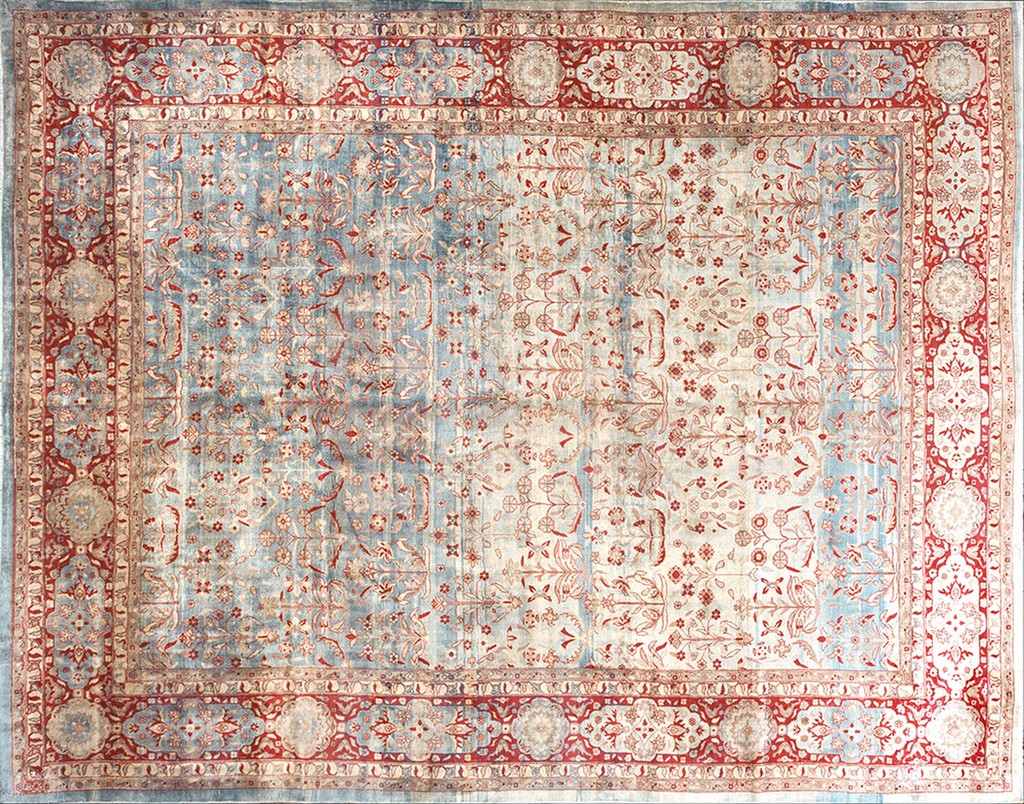
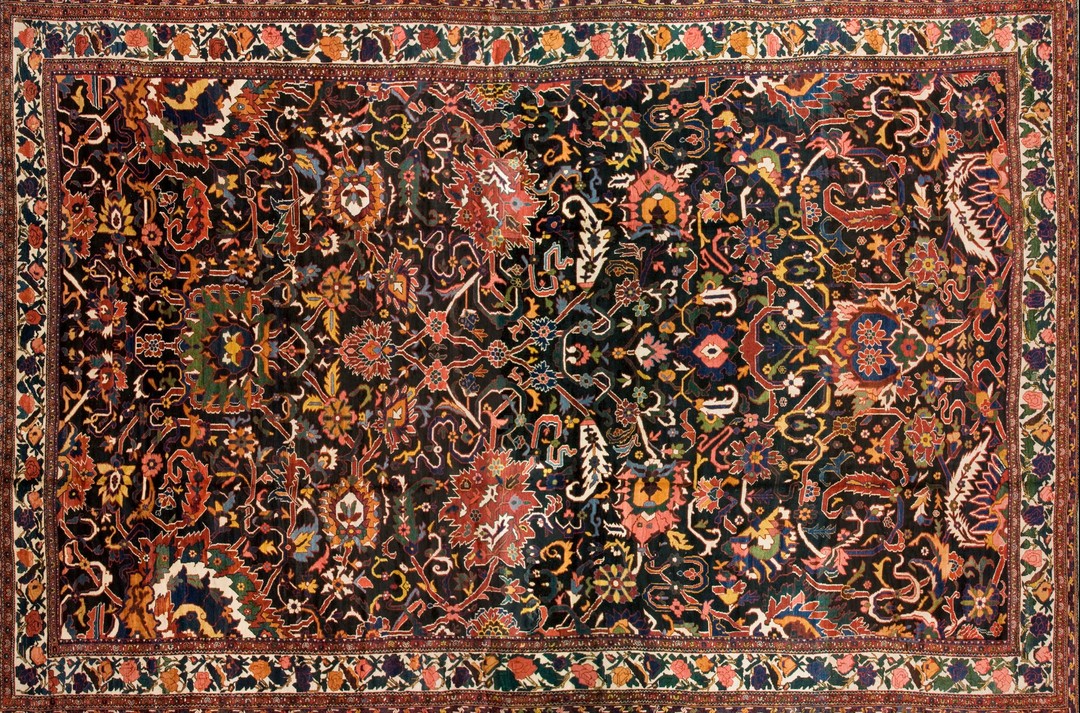
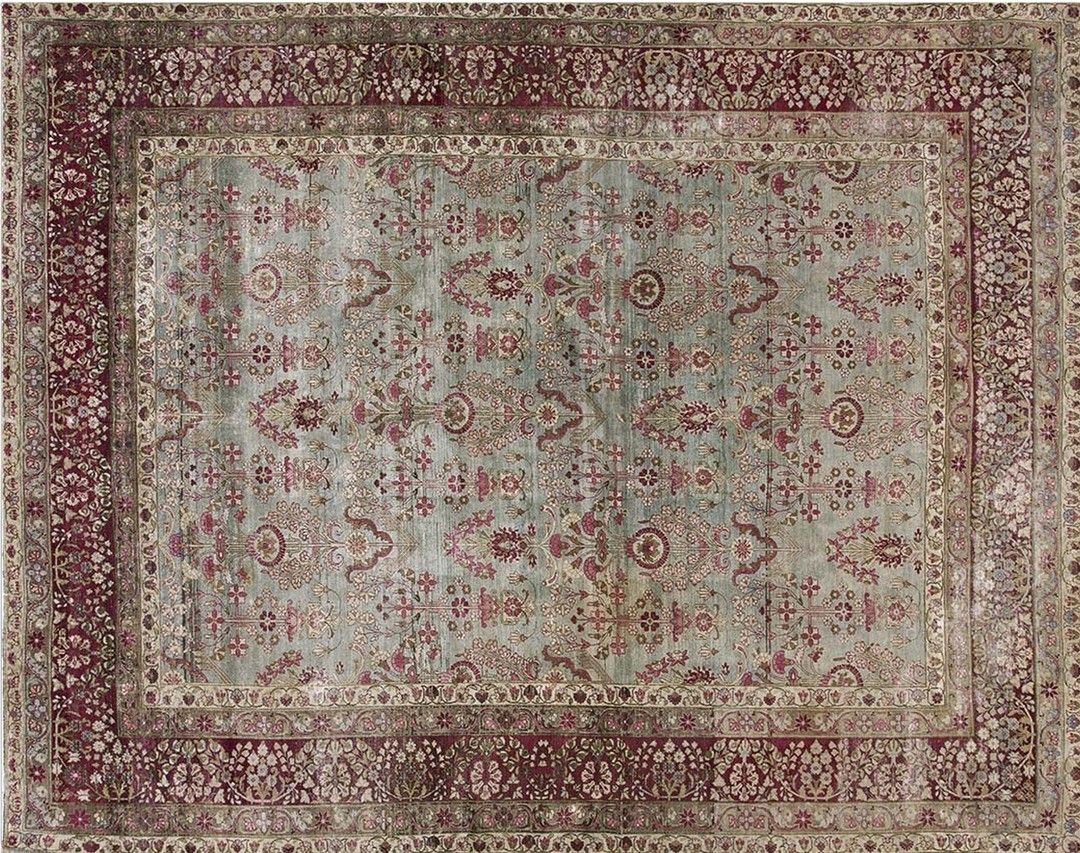
Antique Lahore Indian Knotted Rug by Rugs On Net
Today, collectors, historians, and designers alike regard the Shah Abbasi floral as a cornerstone of Persian rug identity, embodying the union of botanical inspiration with symmetrical precision.
Position in Persian Rug Design History
The introduction of the Persian palmette carpet marks a turning point in the history of textile arts. Before the late 16th century, many Persian carpets were dominated by geometric tribal motifs. The Safavid court transformed this tradition by embracing more naturalistic, flowing ornamentation influenced by Islamic manuscript painting, Chinese floral art, and earlier Near Eastern patterns.
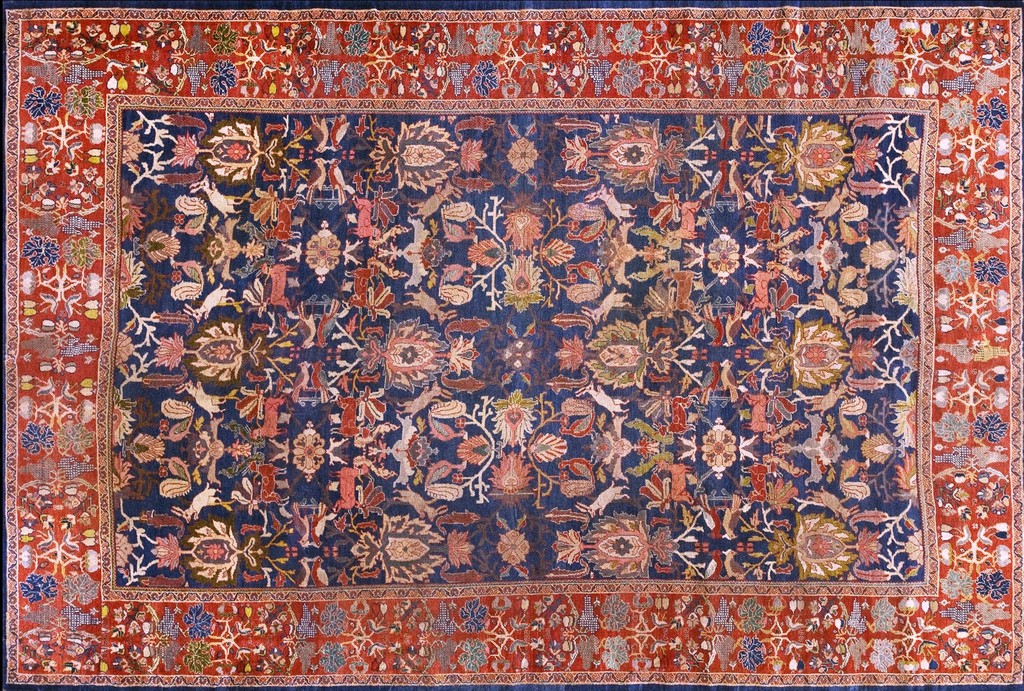
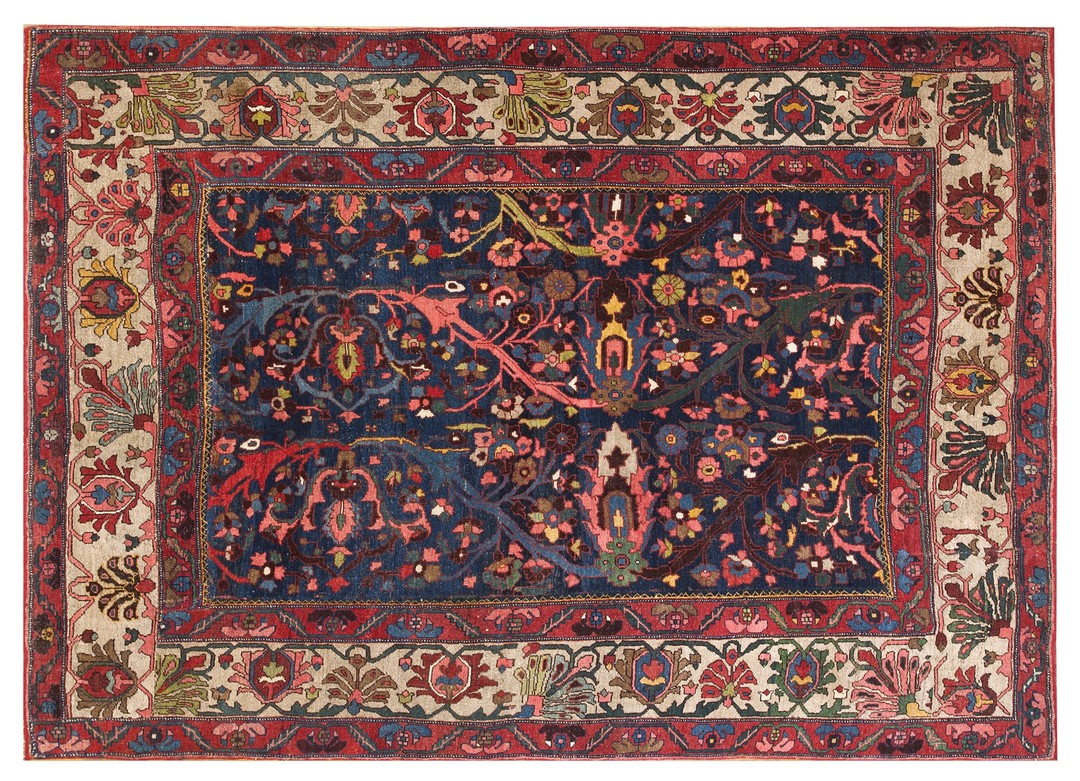
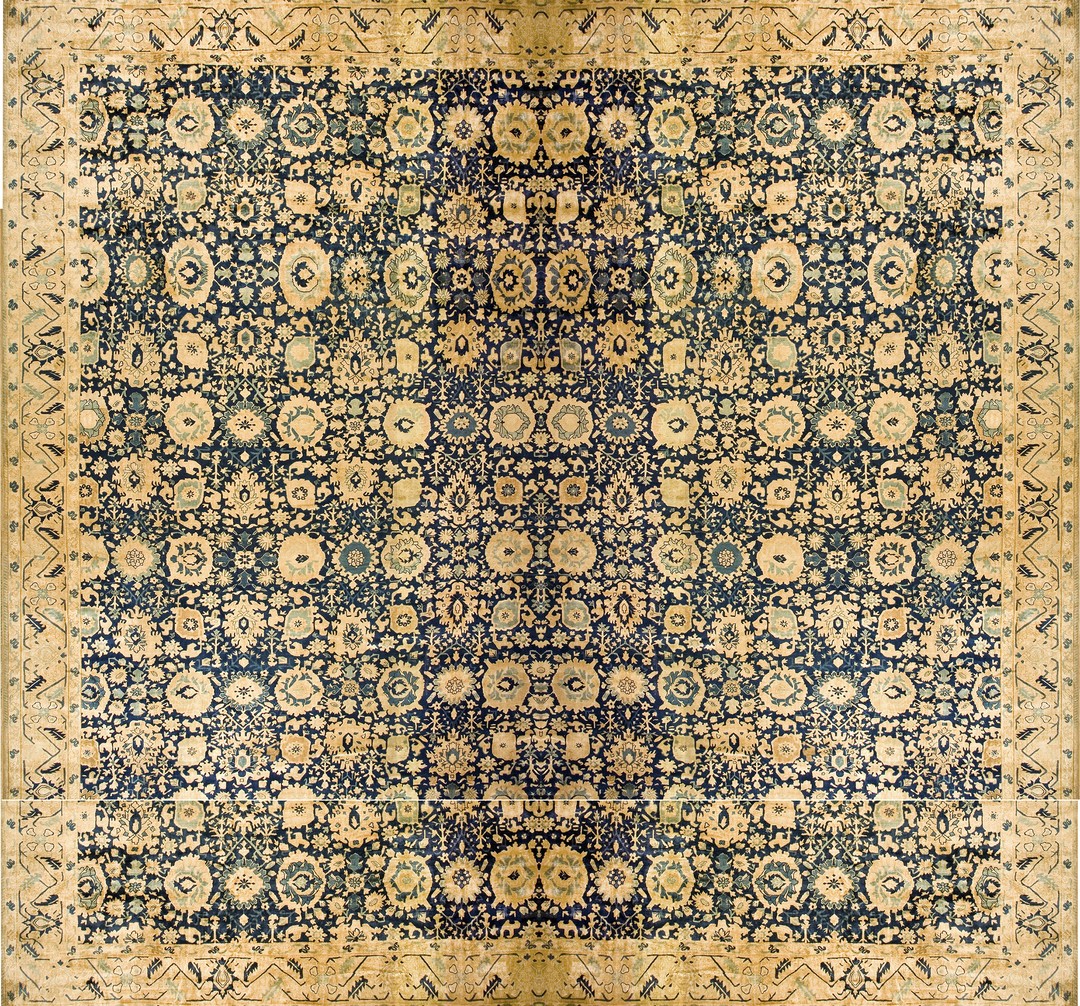
1880s Persian Hand Knotted Pile Blue Wool Antique Allover Sultanabad Geometric Rug by Rugs On Net
The result was a lush but disciplined decorative scheme where lotus-like blossoms were repeated in rhythmic harmony, linked by scrolling vines that filled space without overwhelming it. The Shah Abbas motif thus became not only an ornamental device but also a symbol of refinement during the golden age of Safavid rug design.
Its presence in court workshops—particularly those of Isfahan, Kashan, and Tabriz—signaled a fusion of imperial power, religious symbolism, and artistic exchange. Over time, regional weaving centers adapted the design to their own aesthetic, ensuring its survival well into the Qajar period and into the export-oriented carpets of the 19th and 20th centuries.
What Is the Shah Abbas Rug Design Motif?
The Shah Abbas rug design motif refers to a floral palmette, often resembling a lotus blossom, that is stylized into symmetrical, repeating patterns across the rug’s field and borders. Characterized by its rounded petals, balanced proportions, and integration with scrolling vine networks, the motif projects both elegance and harmony.
Unlike purely geometric tribal motifs, the Shah Abbasi floral is organic yet ordered, evoking ideals of paradise gardens central to Persian aesthetics. Typically, the palmettes appear in alternating arrangements: large blossoms dominate the central field, while smaller versions are framed within borders or medallions.
Each element interlocks seamlessly with arabesques and tendrils, creating a continuous flow across the textile. This design is more than decoration; it reflects the Safavid vision of paradise, symmetry, and order under divine rule.
Rooted in Royal Patronage and Cross-Cultural Exchange
The enduring importance of the Shah Abbas rug motif lies in its origins. Shah Abbas I reorganized the Persian economy and centralized artistic production, establishing royal workshops that brought together master weavers, painters, and designers.
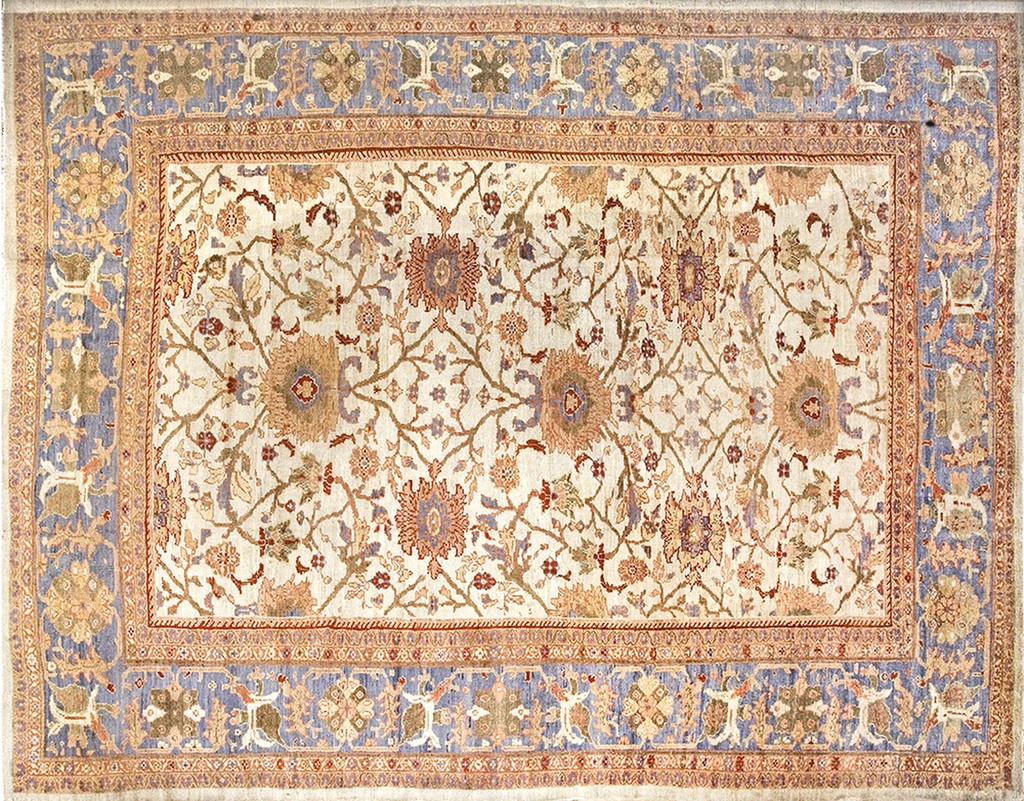
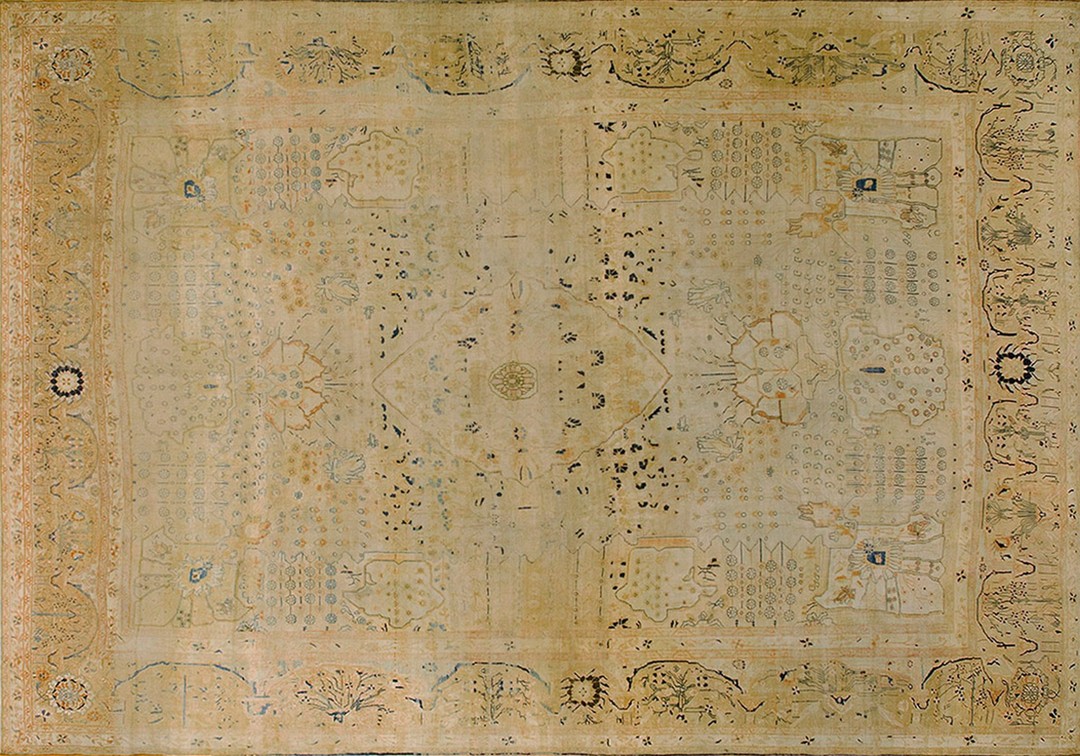
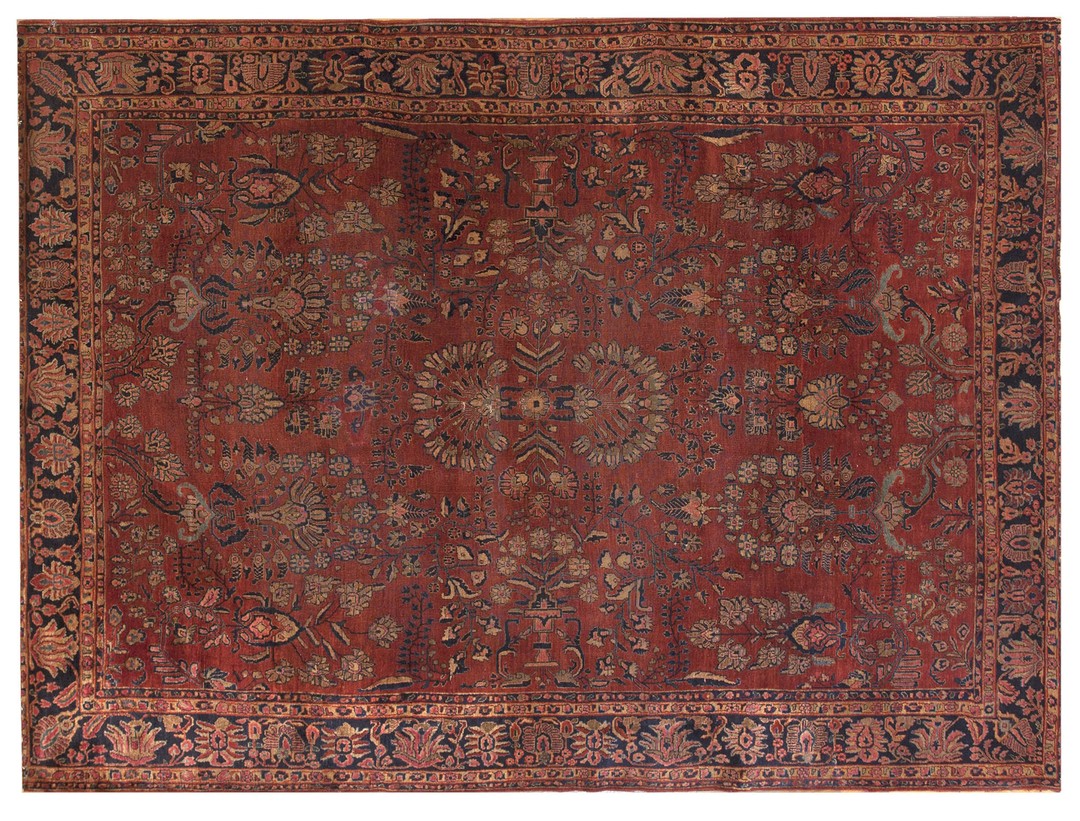
Antique Sultanabad Zeigler Large Room Size Wool Ivory Rug by Rugs On Net
Under his patronage, Persian rugs were not only domestic furnishings but also diplomatic gifts exchanged with Ottoman, Mughal, and European courts. This exposure accelerated the motif’s spread, as European patrons developed a taste for Safavid rug designs and adapted them into their own decorative arts.
The Shah Abbasi floral reflects this dynamic period of cultural exchange. Its lotus-like form suggests influences from East Asia, while its disciplined geometry is rooted in Islamic design principles.
This synthesis made it adaptable to countless variations across centuries and geographies. From palace halls in Isfahan to museums in Paris, London, and New York, the motif remains a living testament to the Safavid dynasty’s global artistic legacy.
Instantly Recognizable and Timeless
Few motifs in the world of decorative arts achieve the instant recognition of the Shah Abbas palmette. Its rhythmic curves and balanced floral structure continue to inspire rug weavers and textile designers today.
Whether woven into a 17th-century Kashan masterpiece or reinterpreted in a modern Persian carpet, the motif carries with it the prestige of history, the elegance of Persian artistry, and the memory of an era when rugs embodied imperial identity. The Shah Abbas rug motif stands not only as a visual hallmark but also as a cultural emblem of Iran’s enduring artistic genius.
Name, Etymology, and the Figure of Shah Abbas
Meaning and Roots of “Shah Abbas Motif”
The term Shah Abbas motif—in Persian, Gol-e Shah Abbasi or “Shah Abbas’s flower”—reflects both its visual form and historical association. The design itself, a lotus-like palmette with scrolling vines, predates the Safavid era in ornamental art, but it was under Shah Abbas I’s reign that it became firmly established as the emblem of Persian carpet design.
By attaching the monarch’s name to the motif, Persian weavers and historians signaled its elevation from a regional decorative element to the defining hallmark of Safavid court carpets. The act of naming the motif after Shah Abbas was not merely descriptive but symbolic. It registered the palmette as an imperial signature, inseparably tied to royal patronage.
The phrase Shah Abbasi floral thus embodies both the botanical inspiration of the design and the political authority that gave it permanence in the world of Persian imperial rugs.
Who Was Shah Abbas in Persian Rug History?
Shah Abbas I (1588–1629) was the fifth monarch of the Safavid dynasty and one of Iran’s most influential rulers. Known for centralizing power and revitalizing Persian culture, he relocated the capital to Isfahan, transforming it into a dazzling hub of architecture, commerce, and art. Among the arts elevated under his reign, carpet weaving was institutionalized as a state-sponsored industry.
Royal workshops in Isfahan, Kashan, and Tabriz employed master artisans to create monumental carpets that were both functional and diplomatic treasures. In Persian rug history, Shah Abbas is remembered as the patron who transformed weaving from a largely local craft into a refined imperial art form.
Carpets adorned mosques, palaces, and trade halls; they were gifted to Ottoman sultans, Mughal emperors, and European monarchs, securing Persia’s place in global luxury markets. Through his reforms and patronage, the Shah Abbasi motif became more than a floral pattern—it became a symbol of Persia’s golden age of textile production.
The Motif as a Monument to Patronage
Though floral palmettes existed in earlier Persian and Islamic art, it was under Shah Abbas that the motif gained prominence and codified form. His endorsement effectively “registered” the design in his name, ensuring that the Shah Abbasi motif carried the weight of royal identity. Every repetition of the lotus-like blossom on a rug recalled the prosperity and cultural power of the Safavid court.
By linking his name to the motif, Shah Abbas secured an enduring legacy in Persian decorative arts. The Shah Abbas rug motif remains an instantly recognizable symbol of the Safavid golden age, reminding collectors and scholars alike that design in Persia was never separate from the authority and vision of its monarchs.
Origins: Safavid Iran and the Rise of the Motif
How Did Shah Abbas Carpets Originate During Safavid Iran?
The Shah Abbas carpets originated in the late 16th and early 17th centuries, during the reign of Shah Abbas I, when Safavid Persia entered its cultural and political zenith. While floral and palmette designs existed before, it was under his direct patronage that the Shah Abbasi motif was standardized into the iconic lotus-like palmette framed by scrolling vines.
By reorganizing the carpet industry into centralized, state-sponsored workshops, Shah Abbas transformed weaving from a regional craft into an imperial art form. These carpets were not only furnishings but symbols of political power, exported as diplomatic gifts and prized luxury commodities across Asia and Europe.
Royal Workshops & Isfahan’s Artistic Boom
At the heart of this transformation was Isfahan, which Shah Abbas made his capital in 1598. There he established royal weaving ateliers that employed master artisans, designers, and dyers to produce monumental Persian court carpets.
The Isfahan workshops set new standards of quality, with high knot density, symmetrical compositions, and sophisticated floral arrangements that placed the Shah Abbasi floral at the center of Persian decorative vocabulary. Isfahan’s artistic boom extended beyond carpets. The city became a hub for calligraphy, miniature painting, ceramics, and architecture, with each medium influencing the others.
Court carpets mirrored the arabesques found in mosque tilework and the rhythm of illuminated manuscripts, blending disciplines into a unified imperial aesthetic. From Isfahan, the designs spread to other weaving centers such as Kashan, Tabriz, Kerman, Nain, and Qum, each adapting the palmette into its own regional style while preserving the Safavid model.
Cultural Influences
The Shah Abbas era was defined by cross-cultural exchange, and the palmette motif reflects this synthesis. Its lotus-like form recalls the ancient lotus symbol of pre-Islamic Iran, associated with renewal and divine order. The Silk Road brought further influences: Chinese porcelain and painting introduced new interpretations of floral balance, clouds, and wave-like motifs that entered Persian ornament.
Meanwhile, Islamic geometric precision provided the structural framework into which these flowing floral elements were woven. The result was a design that embodied multiple worlds: ancient Persian symbolism, Chinese naturalism, and Islamic symmetry, all harmonized into the Shah Abbas rug motif. This layering of cultural voices gave the motif universal appeal, allowing it to transcend its Safavid origins and endure as a timeless emblem of Persian artistry.
State Sponsorship as Imperial Visual Language
The formalization of the Shah Abbasi floral was inseparable from state sponsorship. By embedding the motif into Persian imperial rugs, Shah Abbas established a visual language that projected authority at home and abroad. Carpets woven in royal workshops decorated mosques, adorned palaces, and were exchanged as diplomatic gifts to Ottoman sultans, Mughal emperors, and European monarchs.
In this way, the Shah Abbasi motif was more than an artistic flourish—it was a deliberate expression of Safavid identity and power. From the halls of Isfahan to the far reaches of the Silk Road, the Isfahan carpet workshops ensured that the floral palmette became the enduring face of Persia’s golden age.
Design & Composition: Anatomy of the Shah Abbas Motif
Central Palmette and Vines
At the heart of every Shah Abbas palmette lies a floral form of monumental elegance: a lotus-like blossom composed of layered petals radiating outward in perfect symmetry. This palmette, often inspired by the lotus and peony, is the anchor of the composition.
From it emerge scrolling islimi vines, arabesque curves that weave across the field of the carpet, binding blossoms, buds, and tendrils into a continuous whole. The vine system is not decorative filler but a unifying framework, ensuring that each element contributes to the overall harmony of the Persian floral rug design.
Layout Variants: Medallion vs. All-Over (Afshan)
Two principal formats showcase the Shah Abbasi floral: the medallion carpet and the all-over afshan pattern. In medallion designs, a grand central rosette echoes the dome of a mosque or the cosmic order of the universe, anchoring the field with celestial symbolism. The Shah Abbas palmette often radiates from this medallion, balanced by corner spandrels and layered borders.
By contrast, the all-over afshan pattern disperses the palmette and vines across the entire field, producing a “garden-like” effect with no single focal point. This variant suggests the idea of an eternal paradise garden, where every corner of the rug blooms equally, without hierarchy. Both layouts embody balance and discipline, but the medallion design emphasizes cosmic centrality while the afshan pattern expresses abundance and continuity.
Accompanying Motifs
- Roses — Why: Symbolize beauty and spiritual perfection, enriching the palmette with layers of meaning.
- Tulips — Why: Represent prosperity and Ottoman-Persian cultural dialogue, often appearing in border ornament.
- Islimi vines — Why: Provide rhythmic flow and interconnection, visually binding the composition.
- Boteh (paisley) — Why: Suggest eternal flame and fertility, adding Persian identity to the floral ensemble.
- Border designs — Why: Frame the field, reinforcing order while echoing paradise garden walls.
Together, these motifs support the palmette as the centerpiece, expanding the symbolic vocabulary of the carpet and reinforcing its sense of balance.
Color Palettes and Symbolism
The beauty of a Shah Abbas rug motif is heightened by its rich dye palette. Natural dyes derived from indigo, madder root, pomegranate rind, and walnut husk yielded deep blues, vibrant reds, golden ambers, and earthy browns. These colors were not chosen arbitrarily: they carried symbolic meaning and communicated status.
Indigo evoked spirituality and infinity; red signaled vitality and power; gold suggested imperial wealth; green, though rare, invoked paradise. The harmony of these tones underscored the Safavid pursuit of balance between beauty and order.
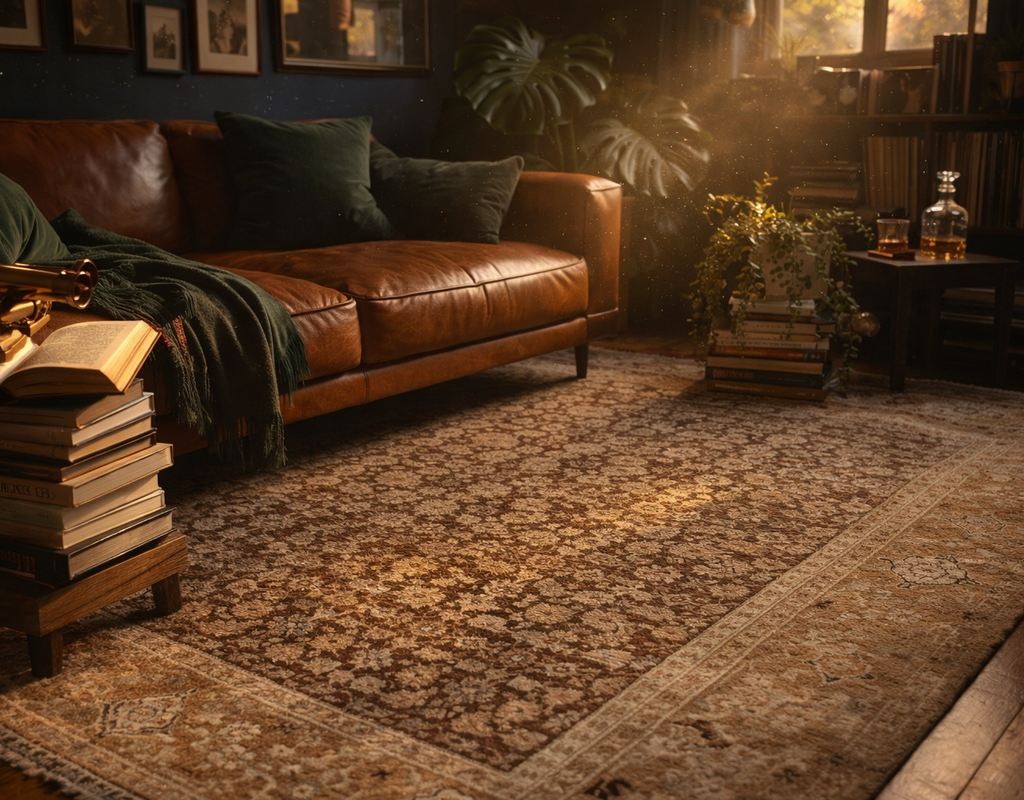
A traditional rug ties together the warm tones of the leather sofa and the intimate, library-like setting.
In elite workshops, the intensity and evenness of dye application were marks of luxury, distinguishing Persian floral rug designs made for the court from those woven for local markets.
Why Are Palmettes Central to Shah Abbas Designs?
Palmettes are central because they embody the essence of Safavid imperial identity. The lotus-like blossom, repeated across the carpet, symbolized eternity, divine paradise, and the authority of the monarchy. In medallion formats, the palmette reflected cosmic order, with the ruler metaphorically at the center of the universe. In all-over afshan carpets, its repetition suggested infinite renewal and abundance.
By placing the palmette at the core of design, Safavid artisans created rugs that were more than decorative textiles—they were woven expressions of paradise and sovereignty. This is why the Shah Abbas palmette remains the most defining and enduring element of Safavid rug design.
Symbolic Meaning and Cultural Status
Imperial Symbolism and Dynastic Identity
The imperial floral motif at the core of Shah Abbas carpets was more than a decorative flourish—it was a statement of dynastic power. By standardizing the palmette as the central visual device, the Safavid court projected its identity across mosques, palaces, and diplomatic gifts. Each status symbol rug woven in the royal ateliers carried with it the weight of authority, reminding viewers of the monarch’s divine right to rule.
The palmette’s grandeur, symmetry, and placement reinforced the notion of a ruler positioned at the center of the cosmos, surrounded by order, abundance, and beauty.
Tree of Life and Divine Right
The Shah Abbas palmette is deeply tied to the Tree of Life carpet tradition, where floral forms symbolized eternal renewal, divine paradise, and dynastic continuity. The lotus-like palmette echoed the ancient Persian symbol of the lotus—associated with rebirth and eternity—while its upward-reaching vines mirrored the cosmological link between earth and heaven.
This imagery aligned with Islamic and Persian philosophical thought, framing the monarch as God’s appointed ruler, upholding balance and harmony on earth. In this way, the palmette represented both imperial legitimacy and the Safavid vision of eternal prosperity.
Paradise Garden Allegory
Perhaps the most enduring symbolism of the Persian paradise rug lies in the concept of the portable garden. In Persian and Islamic culture, gardens were understood as earthly reflections of paradise—a space of symmetry, flowing water, and blossoming life. Shah Abbas carpets recreated this ideal in woven form. The all-over floral designs suggested endless blooming, while medallion formats evoked celestial order.
By laying such a carpet in a hall or mosque, the Safavids brought the paradise garden indoors, creating what scholars often call a “portable paradise.” This idea became central to Persian carpet symbolism and explains the lasting emotional and spiritual power of these textiles.
Social Status and Collectability
Beyond their spiritual and dynastic associations, Shah Abbas carpets quickly became markers of wealth and cultural sophistication. To own a rug woven in the royal workshops was to possess a treasure that embodied artistic refinement and imperial connection. Across Europe, these carpets were displayed in palaces and cathedrals, where they were admired as both art and status objects.
Within Persia, families who owned Tree of Life carpets or medallion rugs modeled after court designs signaled their prestige and participation in the Safavid golden age. Even today, antique Shah Abbas carpets are prized collector’s pieces, valued for both their artistry and their cultural resonance.
How Do Colors in Shah Abbas Patterns Symbolize Status?
Colors in Shah Abbas carpets were carefully chosen to communicate meaning as well as rank. Deep indigo blues, derived from costly natural dyes, conveyed spirituality and prestige; brilliant madder reds symbolized vitality, wealth, and power; and golden hues from pomegranate rind or weld suggested imperial grandeur.
Green, reserved for sacred contexts, evoked paradise and divine blessing. The intensity and harmony of these tones marked a rug’s quality, distinguishing courtly works from provincial imitations. To own a status symbol rug rich in such colors was to declare not only wealth but also participation in the cultural and spiritual ideals of Safavid Persia.
Materials and Weaving Methods: Then & Now
Fibers: Wool vs. Silk
- Wool — Why: Traditional and durable, wool was the foundation of most Shah Abbas carpets. Its resilience allowed rugs to endure centuries of use, and its ability to absorb dye gave colors warmth and depth.
- Silk — Why: Reserved for court commissions and elite patrons, the silk Persian rug exemplified luxury. Its fine, lustrous fibers enabled sharper detail and a glowing finish, making it the ultimate expression of Safavid artistry.
- Blended Wool-Silk — Why: Some masterpieces combined wool’s strength with silk’s sheen, balancing practicality with refinement.
Together, wool and silk defined the material spectrum of Safavid weaving—wool for everyday prestige, silk for imperial splendor.
Dyes: Natural vs. Synthetic
The beauty of a natural dyed rug lies in its organic palette. Safavid dyers mastered the use of indigo, madder, pomegranate rind, and walnut husk, producing tones that aged gracefully over centuries. These natural dyes gave Shah Abbas motifs a depth and harmony unmatched by later chemical substitutes.
Synthetic dyes, introduced in the 19th century, offered speed but lacked the subtle tonal gradations and longevity of natural colors. Today, collectors and connoisseurs prize rugs that retain their naturally dyed brilliance, viewing them as both eco-friendly and historically authentic.
Weaving Techniques: Knot Type, Density, Detailing
Safavid carpets typically employed the asymmetrical Persian knot (Senneh knot), enabling fluid, curving lines suited to the Shah Abbasi floral. Knot density ranged widely, with masterworks reaching 200–800 knots per square inch.
This density determined the level of detail: higher counts allowed weavers to render delicate vines, layered petals, and intricate borders with painterly precision.
Does Knot Density Affect Shah Abbas Rug Detail?
Yes—knot density directly influences detail. A carpet with 300 kpsi can display refined floral forms, but one with 600–800 kpsi achieves near-miniature precision, translating the flowing Shah Abbas palmette into exquisite curvilinear lines.
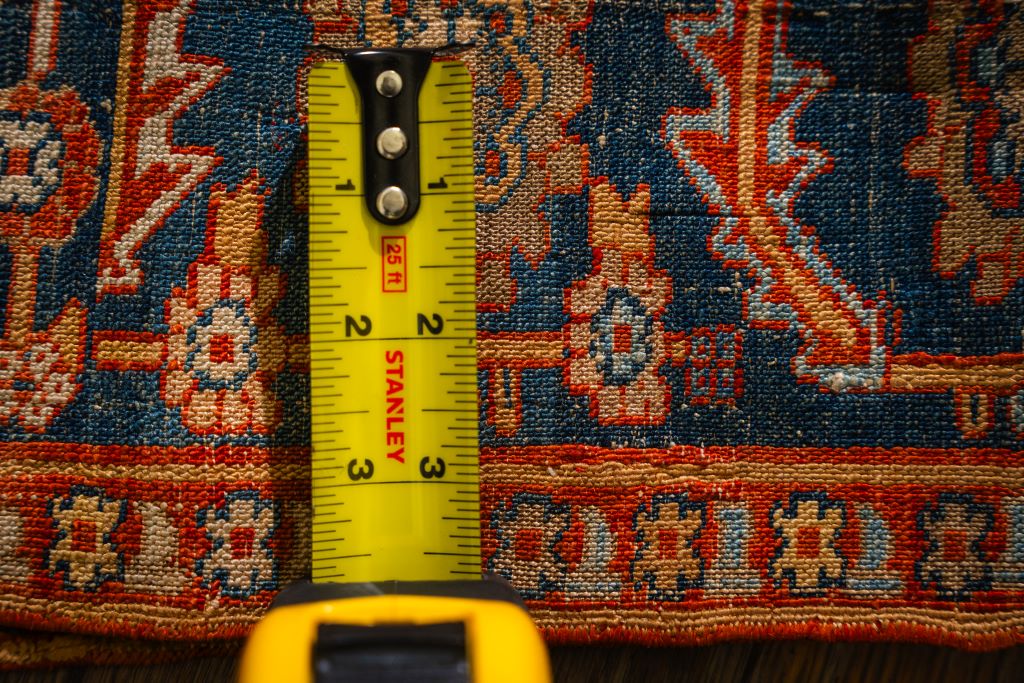
A detailed inspection of a richly colored oriental rug pattern while measuring its dimensions.
Lower knot densities blur the motif’s subtle contours, while higher densities elevate the rug into the realm of fine art.
Modern Replication: Machine vs. Hand-Knotting
- Hand-knotted — Why: Preserves the nuance of curves, authentic texture, and cultural continuity. Each knot reflects an artisan’s skill.
- Machine-made — Why: Affordable and widely available, but lacks the layered beauty, material richness, and subtlety of true hand-knotted Shah Abbas carpets.
- Tufted or power-loomed — Why: Imitations with surface-level resemblance but no lasting value; details flatten quickly compared to authentic weaving.
Collectors universally agree that only hand-knotting can replicate the depth, durability, and artistry of Safavid originals.
Should I Choose Wool or Silk for a Shah Abbas Rug?
The choice depends on intent. A wool Shah Abbas carpet offers durability, warmth, and affordability while still honoring tradition. A silk Persian rug provides unmatched refinement, sharper detail, and luxurious sheen, but requires more careful handling.
For daily use and longevity, wool is ideal; for prestige, display, or collection, silk is the ultimate choice.
What Materials Are Common in Shah Abbas Design Rugs?
Authentic Shah Abbas rugs most often feature fine wool warps and wefts, richly dyed with natural pigments. Silk carpets, woven for courts and nobility, survive as museum treasures today.
Whether wool or silk, what unites them is the combination of high-quality fibers, natural dyes, and meticulous knot density—the hallmarks of a true Shah Abbas masterpiece.
Does Machine Weaving Replicate True Shah Abbas Detailing?
No—machine weaving cannot capture the intricate fluidity of the Shah Abbasi floral. While mass-produced imitations may mimic the layout, they lack the material richness, subtle color gradation, and tactile depth of hand-knotted Persian court carpets.
The soul of the design lies in the hand-tied knot, each carrying centuries of tradition and artistic intention.
Historical Evolution: From Safavid to Today
Safavid Golden Age
The Safavid golden age of carpet weaving under Shah Abbas I was marked by extraordinary artistic innovation. Court ateliers in Isfahan, Kashan, and Tabriz perfected medallion layouts, balancing a central rosette with corner spandrels, borders, and repeating Shah Abbas palmettes.
The Safavid workshop system standardized proportions, dye palettes, and knot densities, ensuring that each carpet bore the unmistakable refinement of imperial patronage. These rugs were not merely textiles but imperial statements, blending Islamic symmetry, botanical naturalism, and Persian cosmology into one visual language.
Decline and Revivals
- Afsharid / Zand (18th century) — Why: Political instability and foreign invasions disrupted the workshop system, leading to a decline in production quality and volume.
- Qajar Dynasty (19th century) — Why: Renewed interest in Persian heritage and European demand for “oriental carpets” sparked revival weaving, often inspired by antique Shah Abbas rugs.
- Pahlavi Era (20th century) — Why: State-sponsored initiatives promoted rug exports as symbols of national culture, restoring traditional Shah Abbasi motifs to prominence.
- Modern Period — Why: Workshops across Iran continue to produce Shah Abbas designs, both for domestic use and international collectors, blending heritage with contemporary preferences.
This cyclical pattern of decline and revival underscores the enduring vitality of the Shah Abbas rug motif across centuries.
Global Spread: Turkish, Indian, Modern Replications
From the 17th century onward, the fame of Safavid rugs ensured that the imperial floral motif traveled far beyond Persia. Ottoman workshops in Turkey wove Turkish floral carpets that adopted the palmette and vine scrolls into their own decorative vocabulary. Mughal India embraced the motif as well, blending it with local preferences for naturalistic flowers, creating what is often called the Indian Persian rug tradition.
By the 19th and 20th centuries, with rising European demand, weaving centers in India, Pakistan, and later China began producing carpets directly modeled after Shah Abbas prototypes. Today, machine-made copies of the design circulate globally, yet the enduring prestige of the hand-knotted Persian revival carpets ensures that the motif remains a standard of elegance.
Can Shah Abbas Motifs Appear in Turkish or Indian Rugs?
Yes—Shah Abbas motifs do appear in Turkish and Indian rugs, as well as in those woven in Pakistan, China, and other countries. The design’s adaptability made it a universal decorative language, easily absorbed into Ottoman, Mughal, and modern weaving traditions.
While the purest expressions remain in Persian originals, Indian Persian rugs and Turkish floral carpets often replicate the lotus-like palmette, sometimes blending it with local motifs and color palettes. This global diffusion highlights the power of the Shah Abbas design: it is both a Persian cultural emblem and a worldwide decorative icon.
Enduring Design Language
The persistence of the Shah Abbas motif—from Safavid masterpieces to 21st-century replications—testifies to its strength as a design language. Even as dynasties fell and weaving centers shifted, the palmette endured, continually reinterpreted across cultures.
Whether preserved in an antique Shah Abbas rug or echoed in a modern reproduction, the motif remains one of the most recognizable symbols of Persian artistry and its influence on global textile traditions.
Regional & Workshop Variations
Where Are Shah Abbas Style Rugs Traditionally Woven?
The Shah Abbas rug motif spread widely after its courtly birth in Safavid Isfahan, becoming a shared design language across Persian weaving centers.
Workshops in Isfahan, Kashan, Tabriz, Kerman, Mashhad, Nain, and Qum all developed distinct interpretations of the palmette, each reflecting local preferences for drawing style, dye palette, and material choice.
Beyond Iran, the design was adapted into Indian, Turkish, and later Pakistani workshops, proving its universal adaptability.
Isfahan vs. Kashan
How do Isfahan and Kashan versions of Shah Abbas rugs differ?
- Isfahan Shah Abbas rugs are celebrated for their ultra-fine weaving, curvilinear precision, and balanced, harmonious color schemes. With knot densities often exceeding 600 kpsi, they emphasize clarity of line, controlled symmetry, and delicate interplay of vine scrolls with central medallions. Their refined elegance reflects the Safavid capital’s role as the model of classical Persian design.
- Kashan palmette rugs, by contrast, are known for their lush aesthetic, anchored by deep reds and blues. Their fields tend to be denser, with a crowded arrangement of blossoms and palmettes that create a more dramatic presence. A signature detail in Kashan versions is the “flame-like” serration within palmette petals, lending dynamism and intensity to the design.
Together, Isfahan and Kashan represent two poles of the Shah Abbas tradition: one refined and airy, the other bold and richly saturated.
Tabriz, Kerman, Mashhad, Nain, Qum
- Tabriz floral carpets: Characterized by precise draftsmanship and adaptability, Tabriz versions often blend curvilinear Shah Abbas motifs with local medallion formats, producing elegant and highly ordered compositions.
- Kerman vase carpets: Known for creativity, Kerman weavers expanded the palmette repertoire with unusual layouts, animal figures, and even pictorial elements, adding narrative layers to the floral theme.
- Mashhad: Rich in color saturation, Mashhad rugs often amplify the reds and blues, pairing them with heavy floral fields that exude power and grandeur.
- Nain silk rugs: Distinguished by pale ivory and soft blue palettes, Nain weavings reinterpret the Shah Abbas palmette into lacy, airy frameworks, frequently enhanced with silk highlights that shimmer against the wool pile.
- Qum Persian rugs: Typically woven entirely in silk, Qum versions are bright, jewel-like, and highly detailed, pushing the Shah Abbas floral into the realm of fine miniature painting translated into textile form.
Each center infused the motif with its own “dialect,” balancing fidelity to Safavid prototypes with local innovation.
Tribal & Non-Iranian Interpretations
- Heriz & Northwest Persia — Why: Translated curvilinear palmettes into bold geometric forms, reflecting tribal weaving structures.
- Afshar & Qashqai — Why: Simplified floral elements to suit nomadic looms, producing rustic yet expressive versions of the motif.
- Indian & Pakistani workshops — Why: Adopted Shah Abbas designs for export markets, often using softer color palettes and thicker piles to appeal to European tastes.
- Turkish adaptations — Why: Incorporated the palmette into Ottoman floral traditions, creating hybrids of Persian and Anatolian design.
Regional Dialects of a Shared Language
The Shah Abbas palmette is best understood as a design “language” with many regional dialects. Isfahan Shah Abbas rugs spoke in refined tones, Kashan palmette rugs in bold colors, and Kerman vase carpets in experimental compositions.
Even beyond Persia, the motif adapted seamlessly into Turkish, Indian, and modern Pakistani weaving. This adaptability underscores its cultural power: one floral motif, endlessly reinterpreted, yet always recognizable as the mark of Persian artistry.
Market, Value & Collecting
Antique vs. Modern Value
- Antique Shah Abbas rugs — Why: Rugs from the Safavid and early Qajar eras are considered masterpieces of world art. Their rarity, provenance, and artistry place them in the highest tier of the market, with antique Persian rug values reaching hundreds of thousands to millions at auction.
- Modern fine weavings — Why: Hand-knotted rugs from reputable workshops in Iran, India, or Turkey still command high prices, but they rarely approach the historical or cultural weight of antiques. Their value lies in craftsmanship and collectible beauty, rather than historical rarity.
- Decorative modern copies — Why: Mass-produced or machine-made Shah Abbas designs serve as affordable décor but hold little investment value.
This distinction defines the collecting market: true antiques are museum-level treasures, while modern examples range from decorative to collectible depending on material, knotting, and provenance.
Silk vs. Wool Pricing
The choice of material greatly influences price. A silk Shah Abbas rug commands the highest premiums due to its luster, fine detailing, and rarity, often ranging from $10,000 to $100,000+ depending on size, knot density, and condition.
By contrast, a wool Shah Abbas carpet is more accessible, with values spanning a few thousand to tens of thousands for top-quality examples. Blended wool-and-silk rugs occupy the middle tier, offering both durability and elegance.
Museum-Quality and Authentication
How to authenticate a vintage Shah Abbas design carpet?
Authentication requires examining several factors:
- Design clarity — Crisp drawing of palmettes and islimi vines indicates high-quality weaving.
- Knot density — Fine densities (300–800 kpsi) signal elite craftsmanship.
- Material — Natural dyes and silk or fine wool piles distinguish authentic Persian court weavings.
- Regional style — Details such as Kashan flame palmettes or Nain ivory-and-blue palettes can confirm origin.
- Provenance — Documentation or long-term collection history adds to authenticity.
For certainty, collectors rely on appraisals from established auction houses or museums specializing in authentic Persian carpets.
Restoration & Investment Potential
How does restoration impact Shah Abbas rug value? Professional, sensitive restoration can preserve a rug’s structural integrity and maintain its market value. However, amateur or heavy-handed repairs—such as over-dyeing, patching, or reweaving with mismatched materials—reduce both monetary and historical worth. Collectors prize originality, even with wear, over poorly executed restoration.
Are Shah Abbas design rugs a good investment today? While few modern pieces will appreciate like Safavid-era masterpieces, fine hand-knotted silk or wool rugs from reputable weavers remain solid investment rugs. They combine beauty, utility, and cultural prestige, retaining value especially when well-preserved.
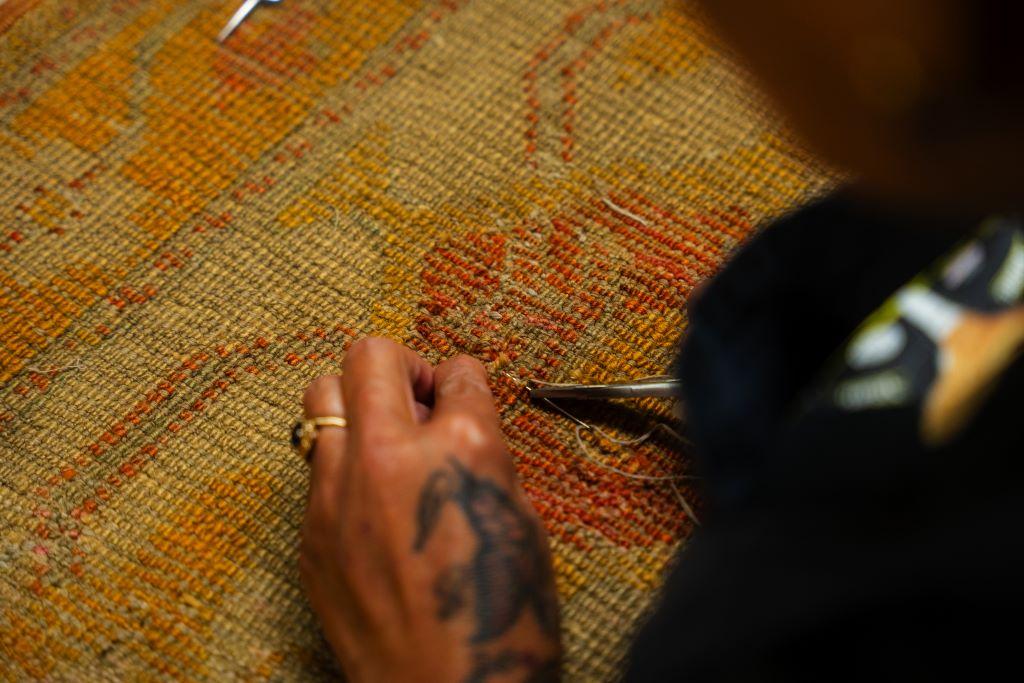
Detail of hands mending a rustic, richly colored woven rug.
Antique Shah Abbas rugs, however, are in a different category altogether, often performing strongly at auction as rare and collectible assets.
Are Modern Shah Abbas Rugs as Valuable as Antiques?
No—modern rugs, no matter how finely woven, rarely approach the antique Persian rug values of Safavid or Qajar examples. Antiques carry historical significance, rarity, and museum-level artistry that cannot be replicated.
That said, high-quality modern pieces still attract collectors and interior designers, especially when woven with silk and natural dyes.
Where Can Collectors Find Museum-Quality Shah Abbas Carpets?
True museum-quality examples reside in the collections of institutions such as the Victoria & Albert Museum (London), the Metropolitan Museum of Art (New York), and the Carpet Museum of Iran (Tehran).
At auction, Sotheby’s and Christie’s occasionally offer collectible carpets of Shah Abbas design, though opportunities are rare and prices extremely high. For private buyers, elite dealers in London, Paris, Tehran, and New York are the main gateways into this rarefied market.
Enduring Collectability
The Shah Abbas palmette endures as both an aesthetic and financial asset. From million-dollar antiques to finely woven modern pieces, these rugs symbolize a union of artistry and prestige.
Whether as a collectible carpet, a silk Shah Abbas price investment, or a treasured family heirloom, the motif continues to command admiration and value across centuries.
Modern Relevance: Interiors, Style & Innovation
Decorating with Shah Abbas Rugs
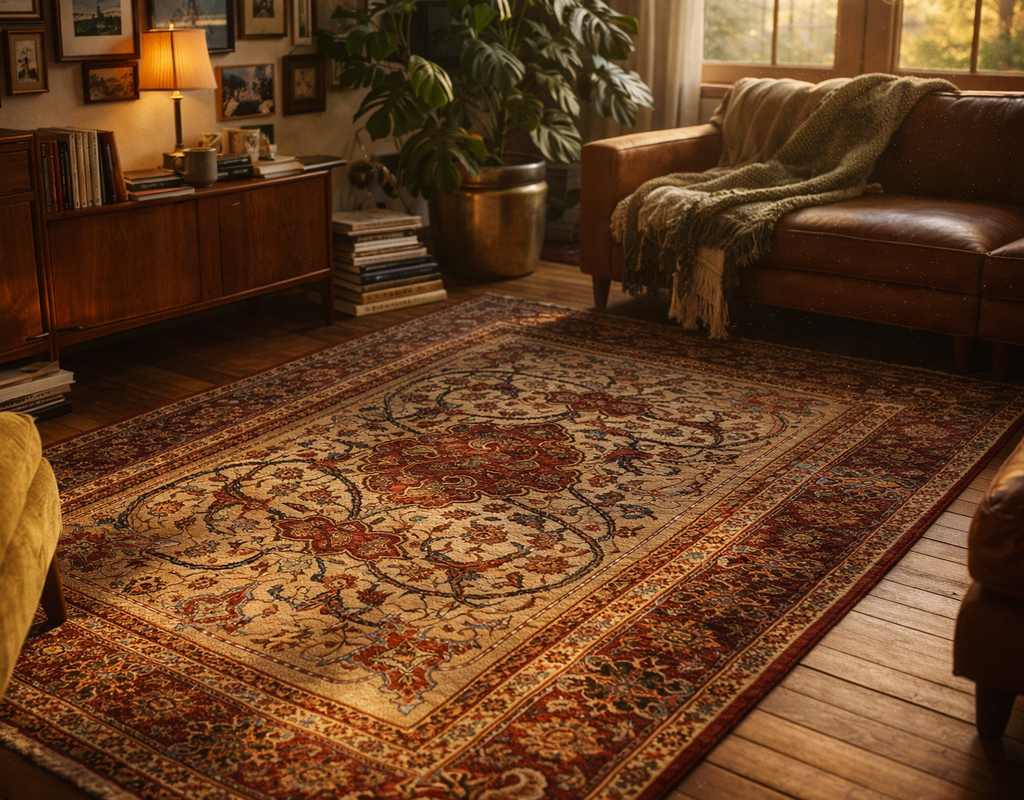
A richly patterned traditional rug defines the warm, eclectic style of this comfortable living area.
- Tradition — Why: A hand-knotted palmette rug instantly brings the legacy of Safavid artistry into the home, serving as a bridge between past and present.
- Versatility — Why: The design adapts to both classic and contemporary interior design, anchoring a minimalist space with subtle pattern or enhancing a traditional setting with grandeur.
- Color Options — Why: From deep madder reds and indigos to pale Nain blues or bright Qum silks, the palette of a bespoke Persian carpet can complement any scheme, whether bold or understated.
Because of this flexibility, Shah Abbas rugs remain among the most reliable and timeless decorative investments.
Can Custom Looms Reproduce Traditional Shah Abbas Palmettes?
Yes—custom Shah Abbas rugs woven on traditional looms can faithfully reproduce the curves and detail of the original palmette designs. Skilled artisans working with high knot densities can achieve the fluidity of vines and layered petals that define the motif.
Machine looms, by contrast, cannot fully capture the nuance and depth of true hand-knotted palmettes, often flattening curves and losing tonal subtleties. For collectors or designers seeking authenticity, bespoke hand-weaving remains the gold standard.
Motif in Modern Art and Design
The influence of the Shah Abbas motif extends well beyond carpets. Contemporary designers have reinterpreted the palmette and vine scroll in wallpaper, upholstery fabrics, couture fashion, and graphic prints.
This migration of the motif into other media reflects its adaptability: the floral forms are abstract enough to transcend cultural boundaries yet distinctive enough to remain unmistakably Persian. In modern textile design, echoes of the imperial floral motif bring both heritage and sophistication into everyday life.
How to Style Modern Interiors with Shah Abbas Rugs?
A modern Persian rug décor approach embraces balance. In minimalist spaces, a muted ivory-and-blue Nain or silk Qum rug adds elegance without overwhelming the room.
In bold interiors, a Kashan-inspired red-and-blue palmette carpet can serve as the centerpiece, grounding eclectic furnishings. Designers often pair Shah Abbas rugs with contemporary furniture, using the rug’s flowing vines and medallions to soften clean architectural lines.
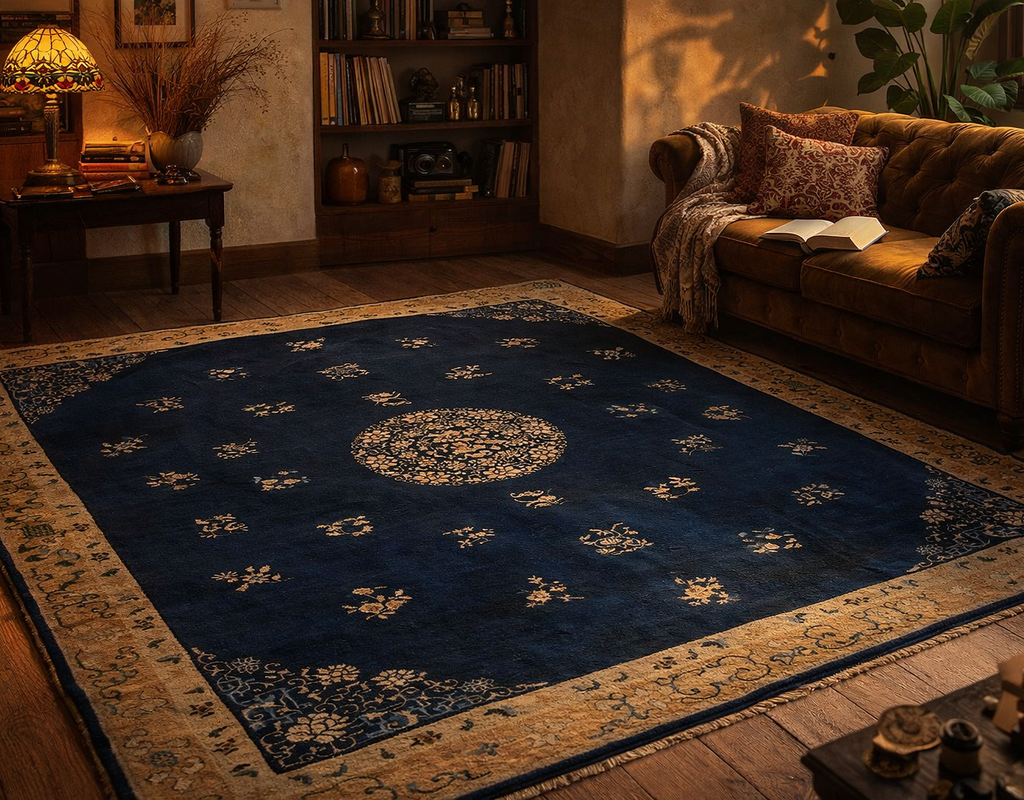
A deep blue and gold Chinese-style rug defines the center of this richly appointed, warmly lit study or living area.
The result is harmony between old and new: a space where a centuries-old motif enhances 21st-century style.
Timeless Innovation
The enduring appeal of the Shah Abbas rug motif lies in its ability to transcend its Safavid origins. Whether hand-woven in traditional workshops or adapted into modern prints, it retains its identity as both an imperial emblem and a design classic.
Today’s bespoke Persian carpets allow for custom sizes, colors, and even contemporary adaptations, proving that the Shah Abbasi floral is not frozen in history but continues to evolve. From museum floors to modern lofts, the motif remains a timeless symbol of artistry, elegance, and cultural continuity.
Browse a Few of Our Shah Abbas Designs

FAQ
- Do Shah Abbas rugs work under dining tables?
Yes—prefer an allover Shah Abbasi (Afshan) so a medallion isn’t hidden. Allow 24–30 inches of rug beyond the table for chair pull-out.
- How old is the Shah Abbas motif in rugs?
The Shah Abbas motif flourished under Shah Abbas I (1588–1629) and remains a staple of Persian design today—centuries of continuity.
- Are Shah Abbasi rugs pet-friendly?
Wool Shah Abbasi rugs resist soiling and hide fur with busy florals. Avoid silk pile if you have energetic pets or frequent spills.
- Can Shah Abbas rugs go over radiant floor heating?
Generally yes for wool/cotton Shah Abbas rugs. Use a heat-rated natural pad and keep indoor humidity around 40–60%.
- Are Shah Abbas runners a thing?
Yes—Shah Abbas runners are common, typically 2’6″–3′ wide and 8’–14′ long. They’re great for halls with classic architecture.
- How can I authenticate a Shah Abbasi rug?
Check crisp curvilinear drawing, balanced palmettes, and a tidy back. City cues (Isfahan/Kashan) and a written appraisal add confidence.
- How much do Shah Abbas rugs cost?
New hand-knotted Shah Abbas rugs often start around \$500–\$2,000 for small sizes; fine vintage/antique examples can range from \$5,000 to \$50,000+.
- What sizes are common for Shah Abbas design rugs?
Shah Abbas designs appear from small mats to palace sizes. Popular area sizes include 5×7, 8×10, and 9×12, plus hall runners.
- Should I use a pad under a Shah Abbas rug?
Yes—a felt or felt-rubber pad (around 1/4″) reduces slip, cushions wear, and protects floors. It also improves sound absorption.
- How should I clean a Shah Abbas motif rug?
Vacuum gently with the beater bar off and avoid fringe. For stains, blot, test for dye bleed, and use a professional rug cleaner annually in heavy-use homes.
- Are Shah Abbas rugs durable for high-traffic rooms?
Wool Shah Abbas rugs are durable if tightly knotted; silk-pile versions suit low-traffic areas. Use a rug pad and rotate every 6–12 months.
- Do Shah Abbasi rugs work in modern interiors?
Yes—choose muted Shah Abbasi rugs (e.g., ivory/blue) for minimal spaces. Balance the ornate motif with solid upholstery and plain curtains.
- Are Shah Abbas rugs only Persian?
The Shah Abbas motif is Persian in origin, but modern Shah Abbas rugs are also woven in India, Pakistan, and Turkey. Origin affects value.
- What colors define traditional Shah Abbas motif rugs?
Classic Shah Abbas palettes mix rich reds, indigo/blue, and ivory. Many modern weaves offer neutrals like beige, gray, and soft blues.
- What borders appear on Shah Abbas pattern rugs?
Expect meandering vine borders punctuated by repeating Shah Abbasi palmettes. Guard stripes often echo small rosettes or serrated leaves.
- What knot counts are common in fine Shah Abbasi rugs?
Fine Shah Abbasi rugs often exceed 200 KPSI; top workshop pieces can reach 400–600+ KPSI. Density depends on city and era.
- What knot types are used in Shah Abbas rugs?
Shah Abbas rugs vary: Isfahan/Kashan typically use the asymmetrical Persian knot; many Tabriz pieces use the symmetrical Turkish knot.
- What materials are typical in Shah Abbas motif rugs?
Most Shah Abbas rugs are wool pile on cotton foundation, sometimes with silk highlights. Rare court-grade examples can be all silk with metal-wrapped threads.
- Is “Shah Abbas” the same as “Shah Abbasi” in rug terminology?
In rugs, “Shah Abbasi” refers to the palmette motif; “Shah Abbas” references the ruler/period. Many dealers use both interchangeably.
- What does the Shah Abbasi palmette on rugs symbolize?
The Shah Abbasi palmette is often interpreted as a lotus symbolizing abundance and refinement. Meaning varies by workshop and period.
- Do Shah Abbas rugs use medallion layouts or allover fields?
Both. You’ll find Lachak-Toranj (medallion-and-corners) and Afshan (allover palmette/vines) Shah Abbas rugs.
- Are Shah Abbas design rugs considered curvilinear?
Yes—Shah Abbas design rugs are classic curvilinear, with scrolling islimi (arabesque) vines and rounded palmettes. Straight, blocky geometry is uncommon here.
- Which regions most commonly weave Shah Abbasi rugs?
Shah Abbasi rugs are especially linked to Isfahan, Kashan, Tabriz, Kerman, Nain, and Mashhad. You’ll also see modern versions from India and Pakistan.
- How do Shah Abbas rugs differ from Herati (mahi) rugs?
Shah Abbas rugs feature large palmettes and curvilinear vines; Herati rugs show a tiny repeating fish/diamond rosette. Scale and flow are the quickest tells.
- What is the Shah Abbas motif on rugs?
The Shah Abbas (Shah Abbasi) motif is a stylized lotus/palmette with flowing arabesques popularized in Safavid Persia. It often appears as layered petals around a central core.