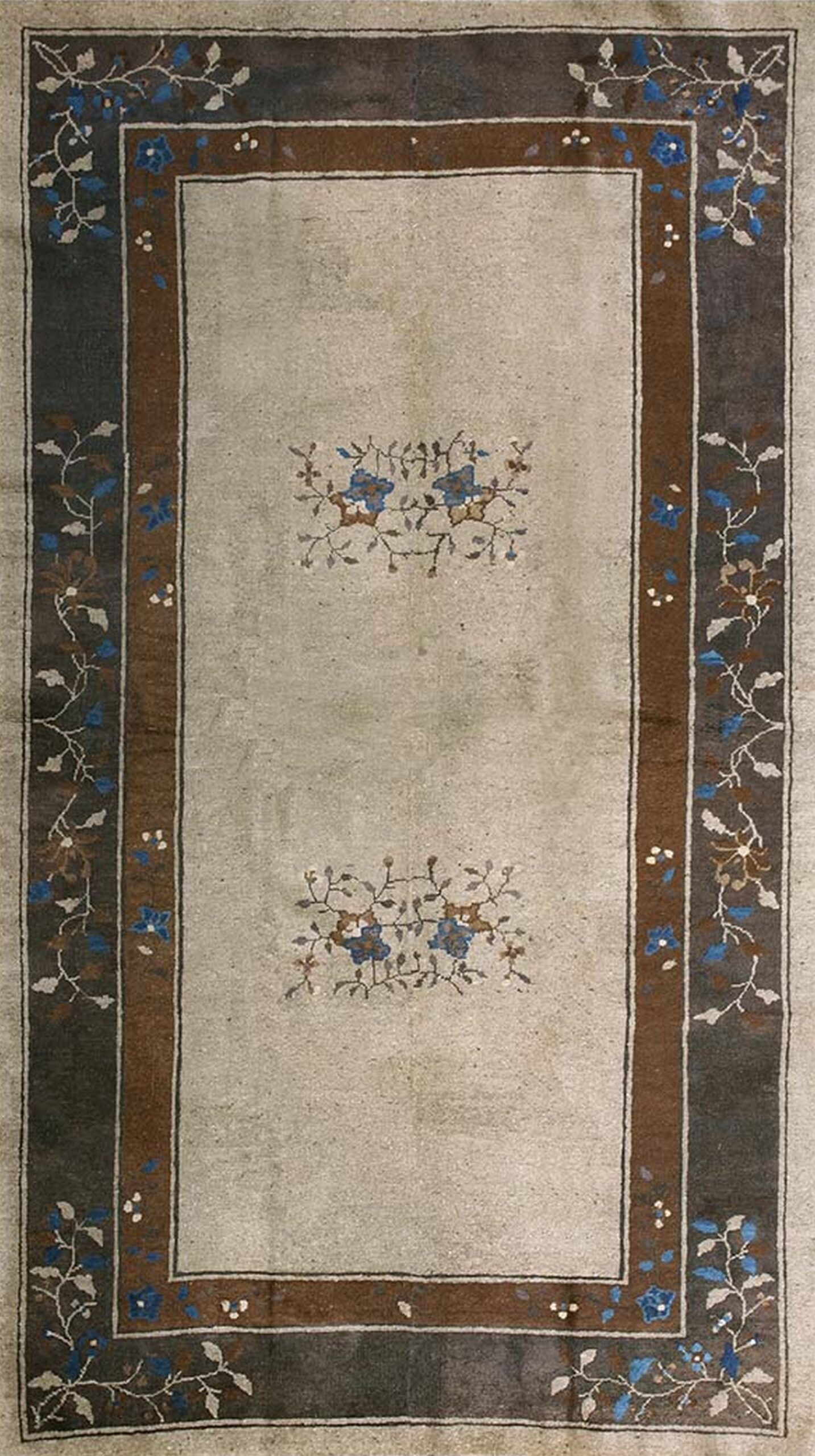
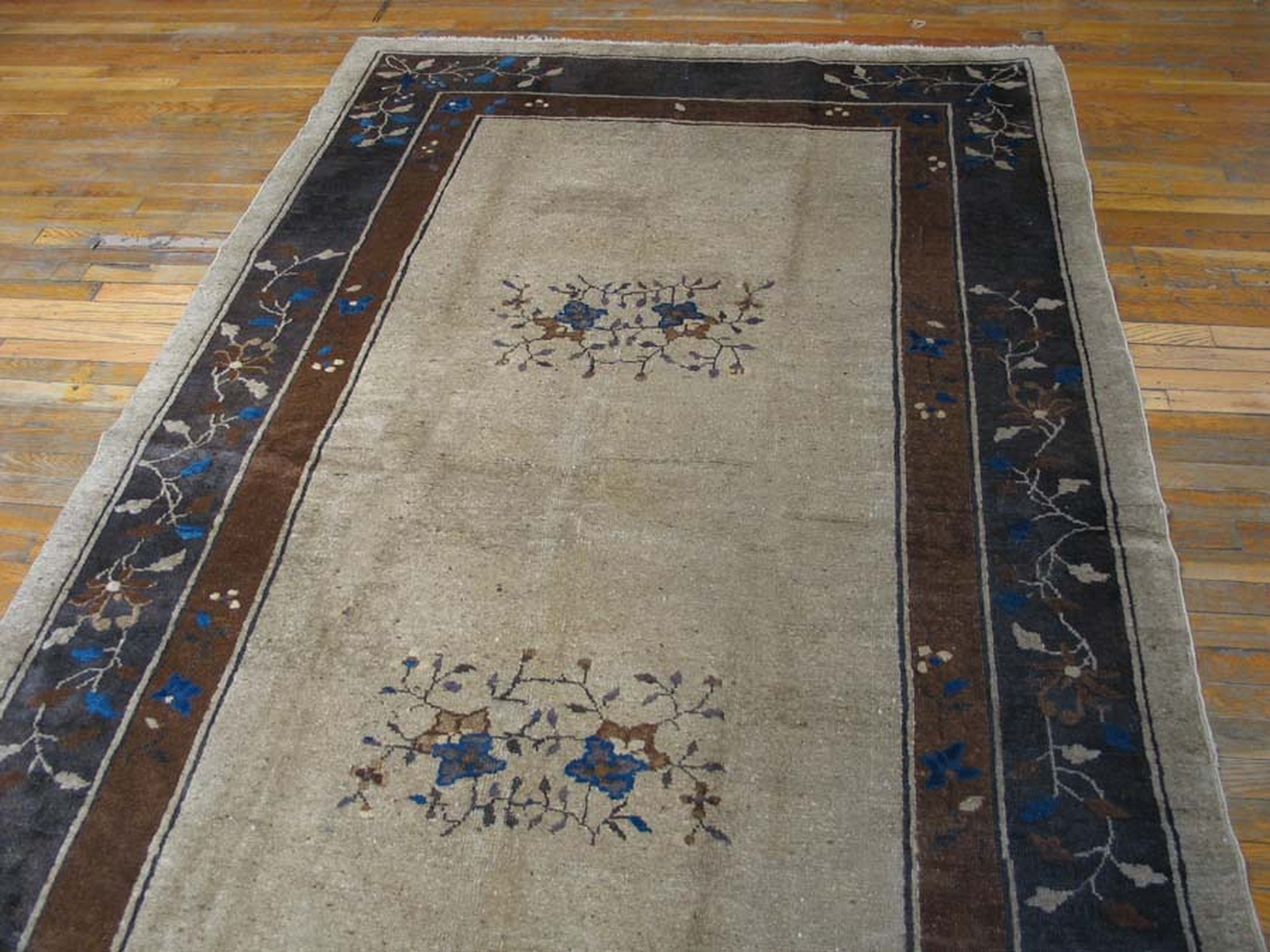
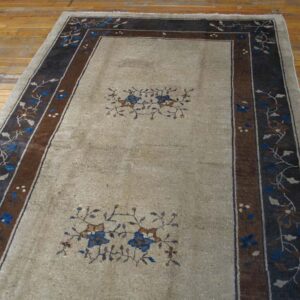
This early 20th-century Chinese Peking rug is a masterclass in “Oriental Minimalism,” representing a sophisticated departure from the dense, multi-layered patterns often associated with traditional weaving. Emerging from the workshops of Beijing (Peking) during the late Qing Dynasty to early Republic period, this style was highly favored by the international Art Deco movement for its clean lines, symbolic negative space, and architectural serenity.
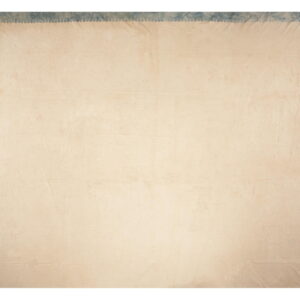
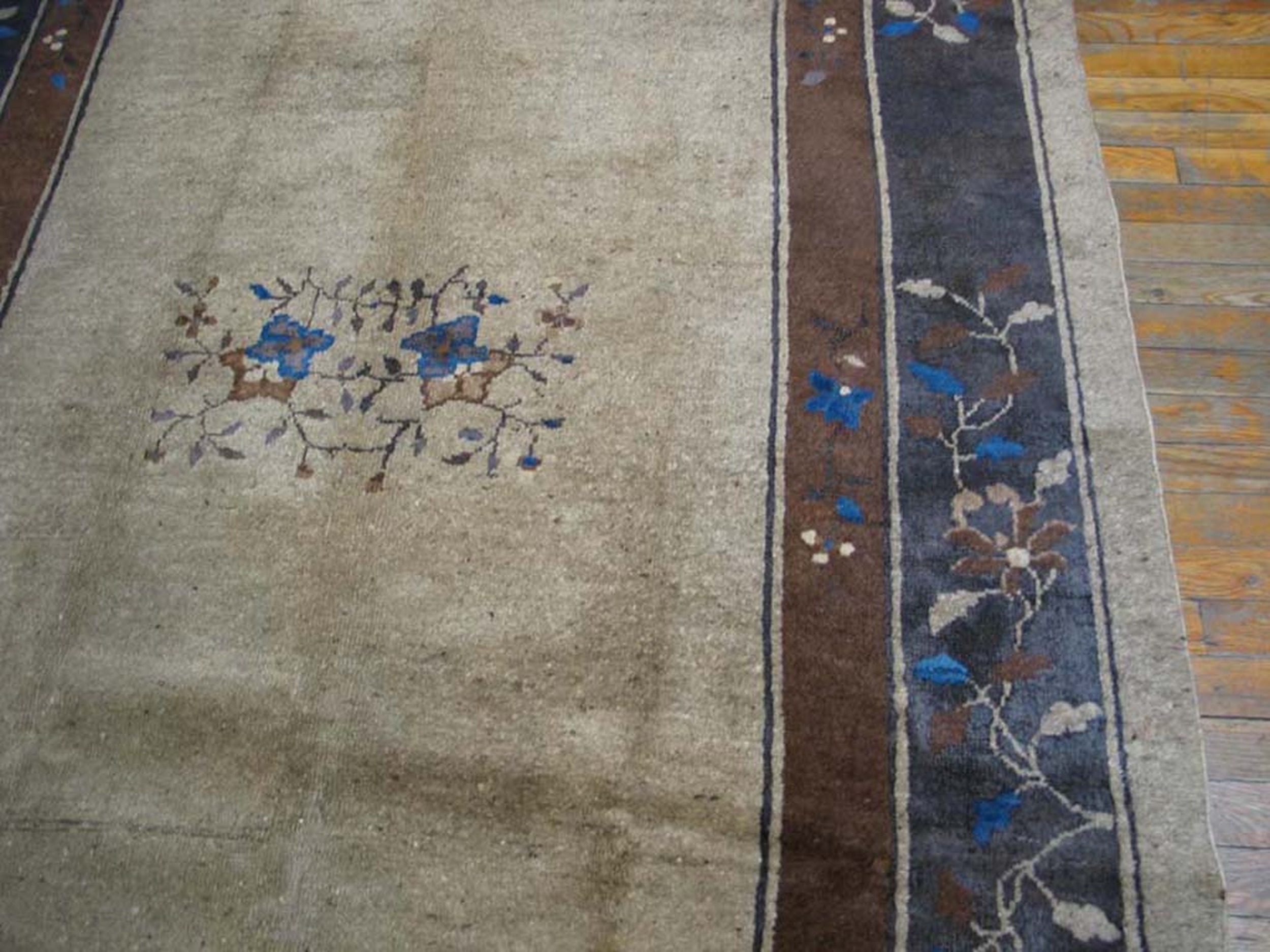
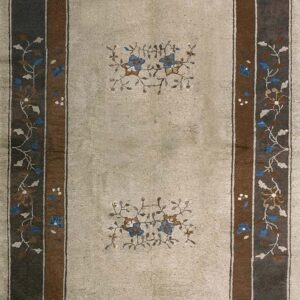
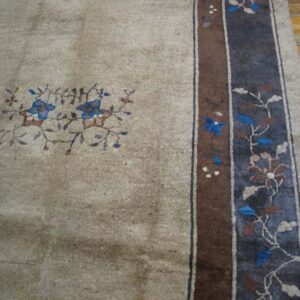
The composition is defined by its minimalist solid “open” ivory color field, a design philosophy that celebrates the concept of Liu Bai (leaving blank space). Rather than filling the field with repetitive motifs, the weaver has allowed a vast expanse of ivory to serve as a tranquil “canvas.” Within this open space, a few carefully curated Floral Sprigs or Auspicious Symbols—likely peonies or lotus blossoms—are placed with painterly precision. This restrained drawing style gives the beautiful antique area rug from China a “sculptural” quality, where every line and petal carries significant visual weight.
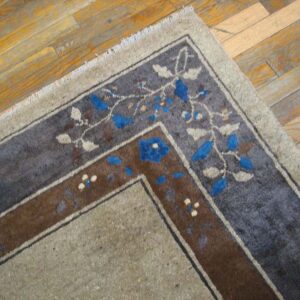
The palette is anchored by a luminous Antique Ivory foundation, a tone that has mellowed over nearly a century into a soft, “parchment” or “clotted cream” hue. Against this monochromatic stage, the secondary accents are typically rendered in a classic Peking palette of Indigo Blues, soft Teals, and subtle Ochres. Because this is an antique specimen, the ivory field exhibits a magnificent “marbled” variegation; the natural, undyed wool possesses a tonal depth that reflects the light in a shimmering, watercolor-like fashion, preventing the minimalist design from feeling cold or flat.
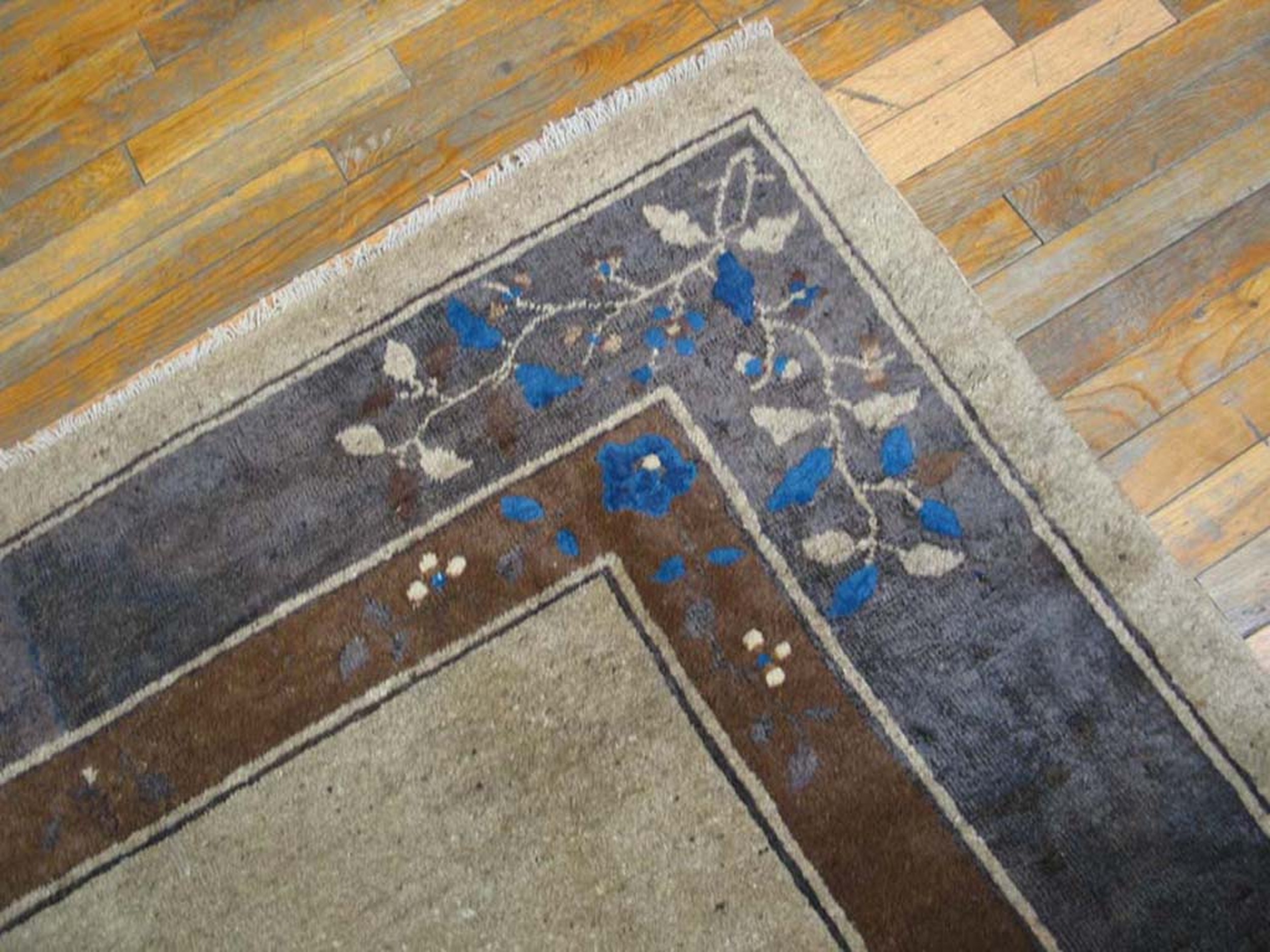
Technically, this Peking rug is prized for its lush, “silky” wool pile and substantial, “meaty” handle. The wool used in these city-weaving traditions was often of the highest grade, rich in natural lanolin, which results in a velvety surface with a subtle, luminous sheen. The pile is often “carved”—a unique Chinese technique where the weaver hand-clips the wool around the edges of the motifs to create a three-dimensional, “embossed” effect that brings the floral elements to life.
The borders act as a simple but necessary architectural frame, often featuring a single band of deep indigo or a whisper-thin “Meander” (Greek Key) fretwork to “lock in” the airy lightness of the ivory field. To possess this antique Chinese Peking rug is to own a monument to “Zen” aesthetics. It bridges the gap between ancient dynastic tradition and the modern “Less is More” philosophy—transforming any space into a sanctuary of historical gravity and serene, ivory grace.