Rugs Circa 1857
1857: The Golden Twilight of the Pre-Chemical Era
A rug woven in 1857 sits at a singular crossroads of history. This year serves as the definitive boundary for the “Pre-Chemical” era; while William Henry Perkin had discovered the first synthetic dye in a London lab only a year prior, that technology had not yet traveled the Silk Road. Consequently, an 1857 weaving is a time capsule of pure organic chemistry, saturated with time-intensive pigments like indigo, madder root, and larkspur—colors with a “living” depth that was largely lost once rigid aniline dyes arrived in the following decades.
Beyond the loom, 1857 was a year of profound global shifts. In the East, the Indian Rebellion (the Sepoy Mutiny) began, a massive uprising that sent shockwaves through Central Asian trade routes and disrupted the traditional mercantile paths between the Orient and Europe. In the West, the Panic of 1857 triggered a sharp economic downturn, the first truly worldwide financial crisis. For the rug trade, this meant a temporary scarcity of fine textiles reaching Western markets, making authenticated examples from this exact year particularly rare “pre-conflict” artifacts.
Because this year predates the era of the great European weaving conglomerates like Ziegler & Co., a carpet from the late 1850s retains an uncompromising tribal integrity. These motifs were not yet adapted for the Victorian parlor; they remained pure expressions of nomadic symbolism and regional identity, woven for the soul of the artisan just moments before the world’s markets demanded a standardized commercial blueprint.
Prefer to see a rug in person?
-
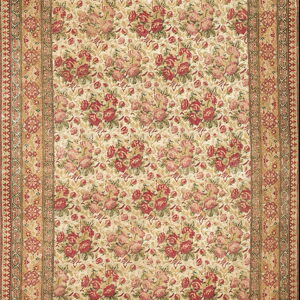
Mid 19th Century Light Ivory Antique Floral Pattern Persian Afshar Rug
$9,000.00 Antique RugsSKU: 21660Rug sizes: 4 ft 4 in x 7 ft 4 in (1.32 m x 2.24 m)